The Unbearable Lightness of Being in Orbit

An announcement tells me that my train is significantly delayed by one minute as I wait patiently at Kanazawa Station. Today I’m travelling to a place in the remote countryside of Ishikawa; a seaside town said to have had the most UFO sightings in Japan.
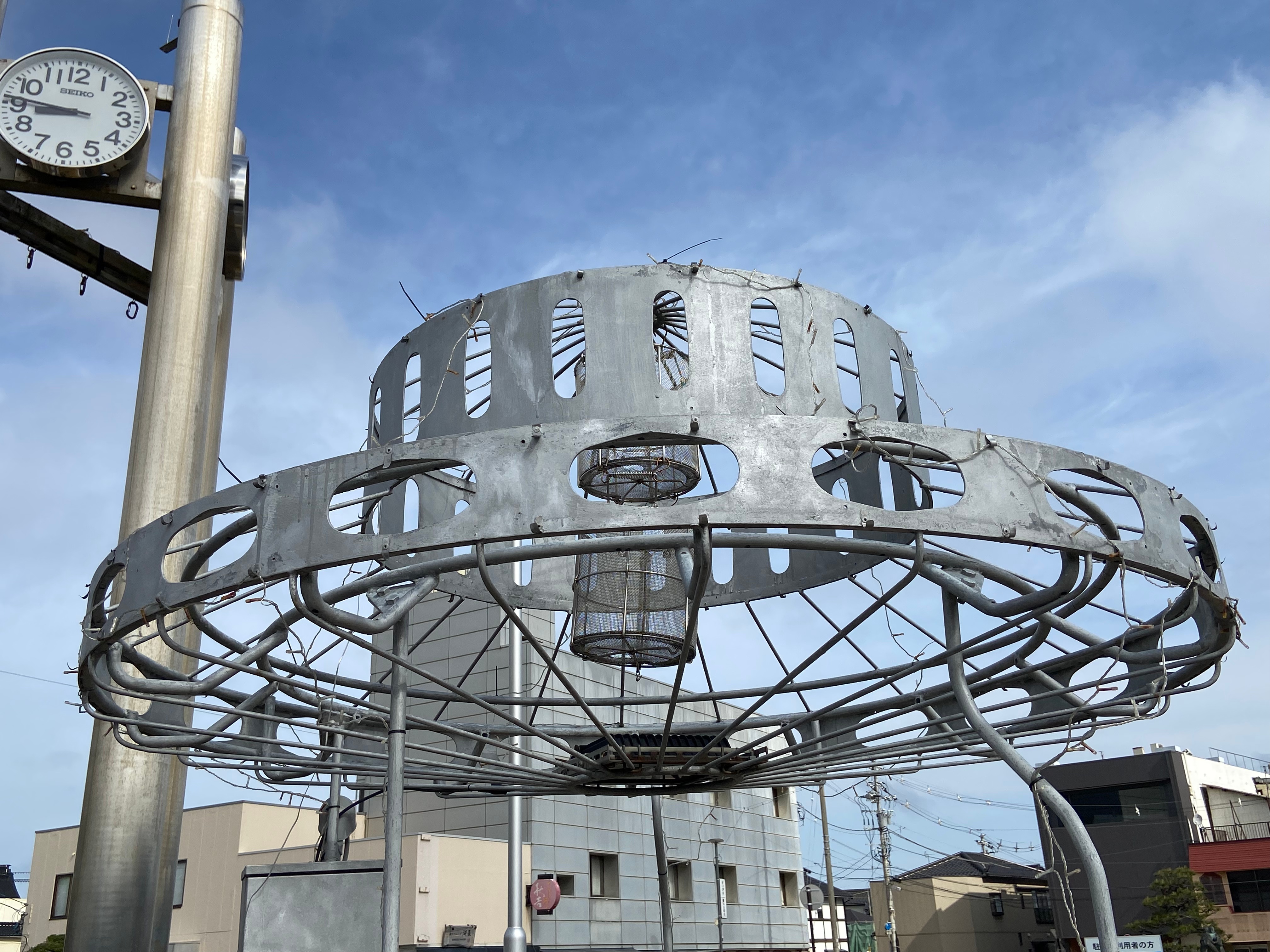
Outside Hakui Station, the morning sun is blazing. I immediately notice UFO-themed public artwork, spaceship sculptures, and a sign for the oddly named UFO Museum. Since the sightings, Hakui has fully embraced this alien identity, becoming a UFO hotspot, and now hosts the largest space collection in Japan.

As I wander in the vague direction of the museum, I see a massive flying saucer-shaped building with a large American rocket beside it, and two Carnival Cutouts in spacesuits. I’m not entirely sure this is the museum, as there isn’t a single car in the car park; I do worry, briefly, that if it is, it might be closed today. Much like our deeper understanding of space, there are no signs of life anywhere.
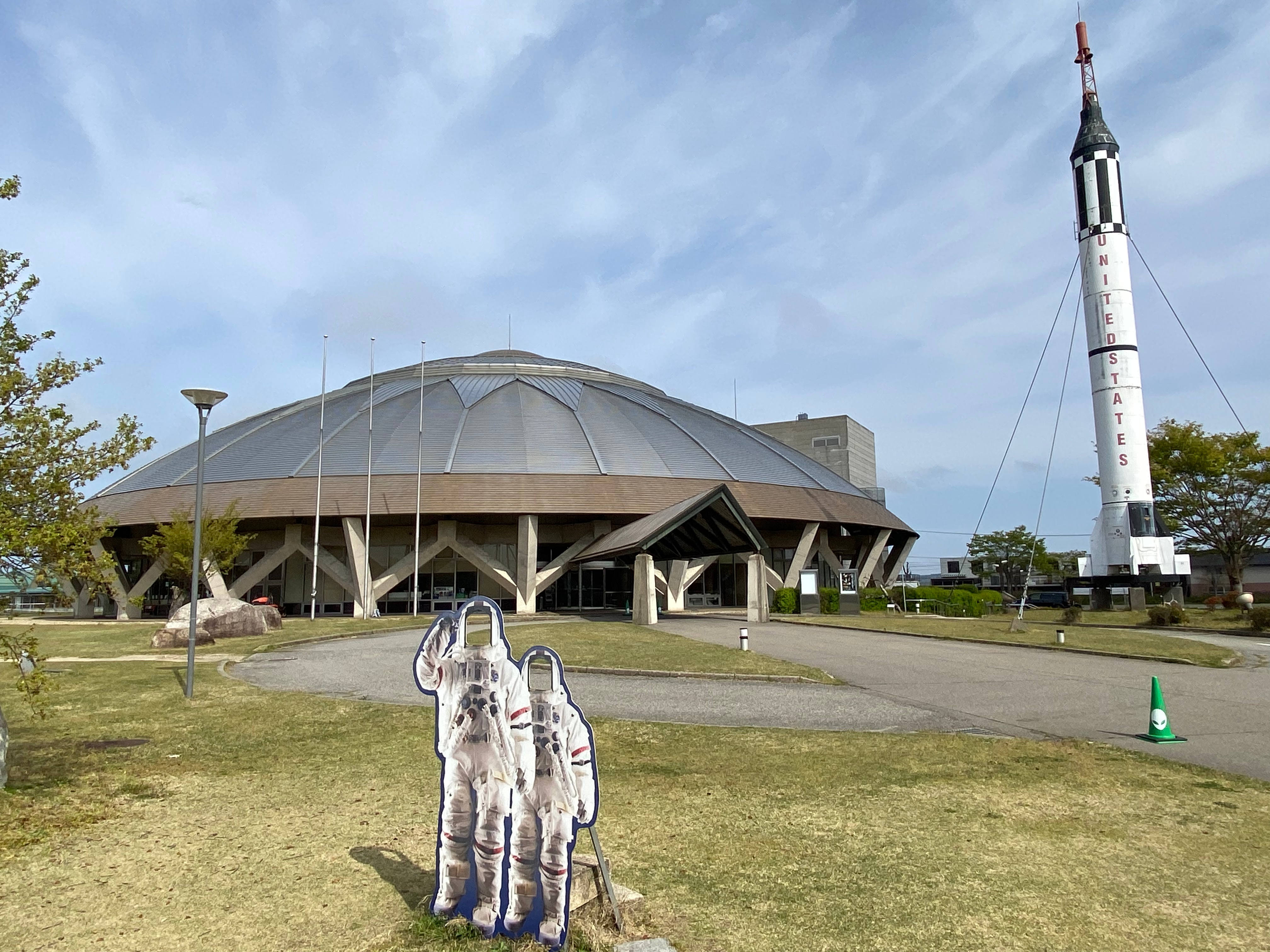
My instinct was partially correct; it is the museum, but it isn’t closed, confirmed when I’m greeted by a woman in an alien mask. I purchase a ticket and hover past a replica Lunar Rover, which looks like it was assembled from spare shopping trolleys, then over to the lift and up to the exhibition floor. The lift features an illuminated planetarium and some faintly sepulchral music, which is nice.

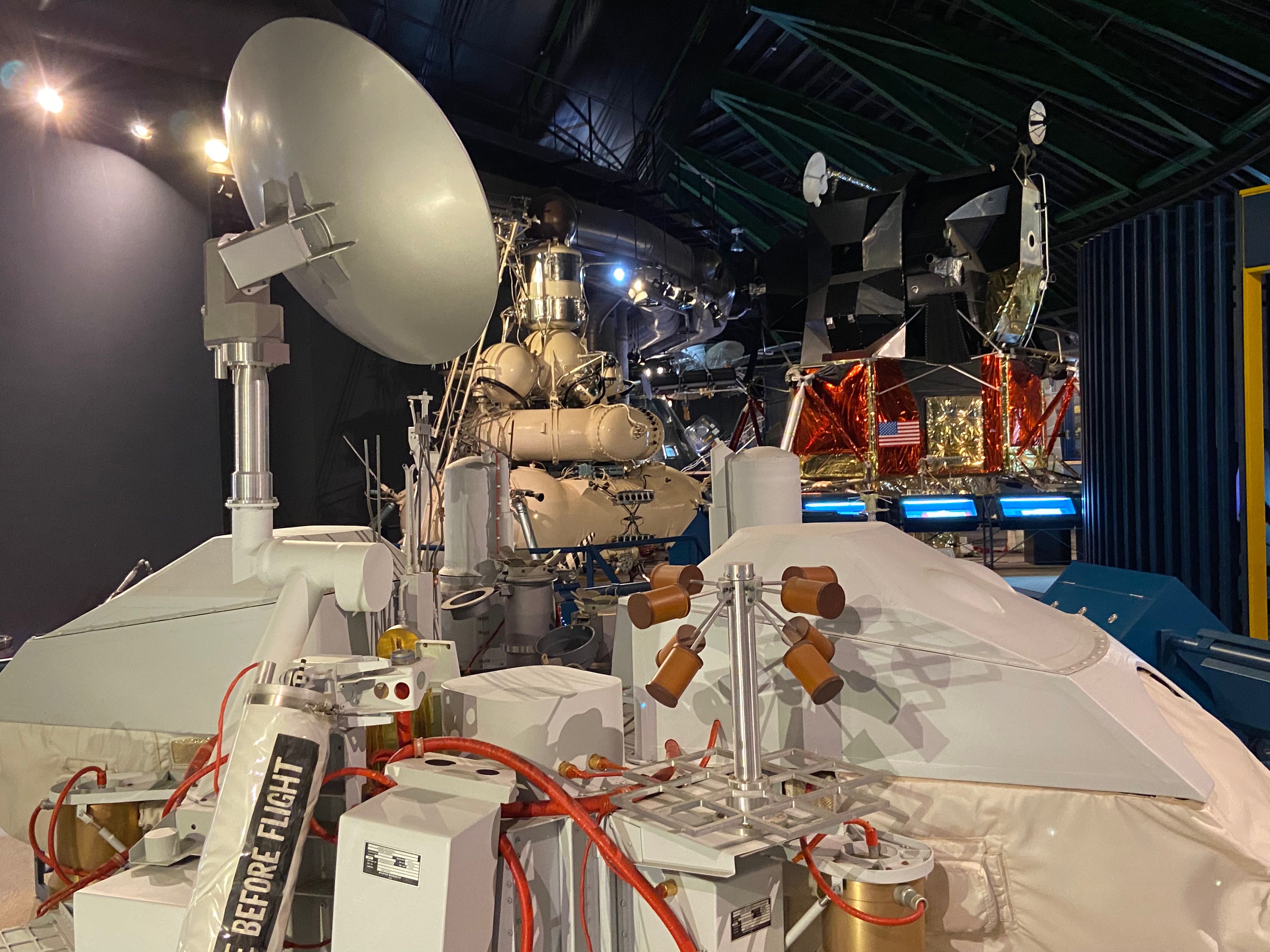
I’m giddy as I enter the exhibition, but somehow, as I see all these space relics, I wonder how most of these things even made it up there. The Vostok capsule, a scorched metal sphere, looks less like something that carried a human and more like something that returned one. I can amazingly take a single photograph capturing the Apollo Lunar Module, the Viking lander, and Luna 24; it makes me wonder how we actually did any of this.
I explore. There are Moon rocks that I can touch. Ripped clothing and Snoopy caps. There’s space food; macadamia, cauliflower cheese, smoked turkey, and tea with sugar, all purchasable at the end from the museum’s impressive gift shop.

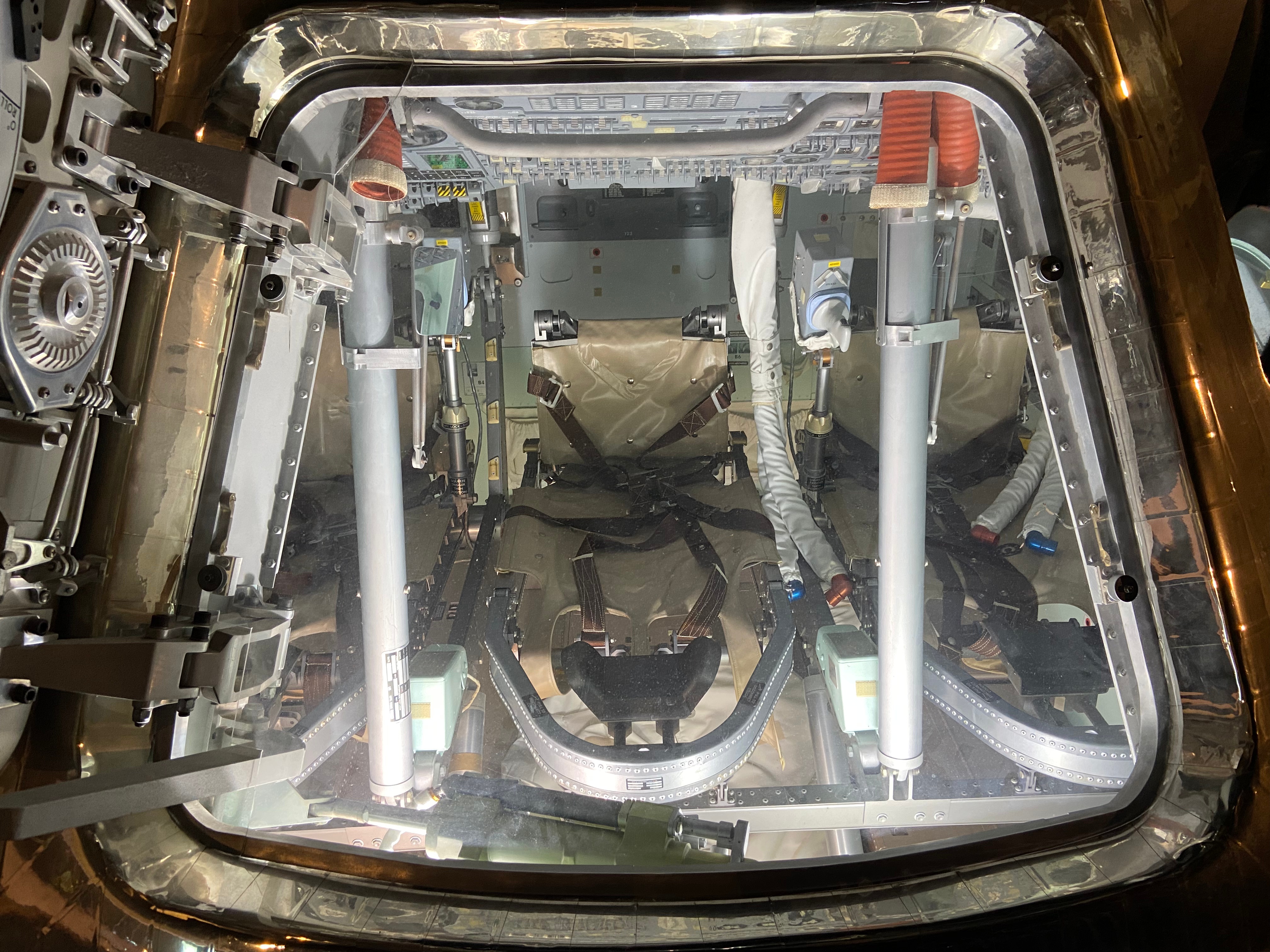
The very watch worn by Neil Armstrong as he pranced across the surface of the Moon back in 1969, an Omega Speedmaster, is on display. I suspect his was accurate to the microsecond, unlike my train this morning. I assess every detail of the Mars Rover, enjoy reading about SETI and the search for extra-terrestrial life, and peer deeper into the Apollo Command Module.
The one part of the exhibition that strikes me is Voyager. I move through the music and photographs we sent into space; solar system parameters, chemical definitions, DNA structure, nursing mothers, continental drift, Earth’s structure, diagrams of evolution, demonstrations of licking and eating, women in rush hour, telescopes and violins alongside music scores. A quiet catalogue of ourselves, cast outward. I can even play sounds recorded by Voyager. Real sounds taken in space; eerily empty and cold. Desolate. Something that feels like abandonment, drifting into the vastness of the void.

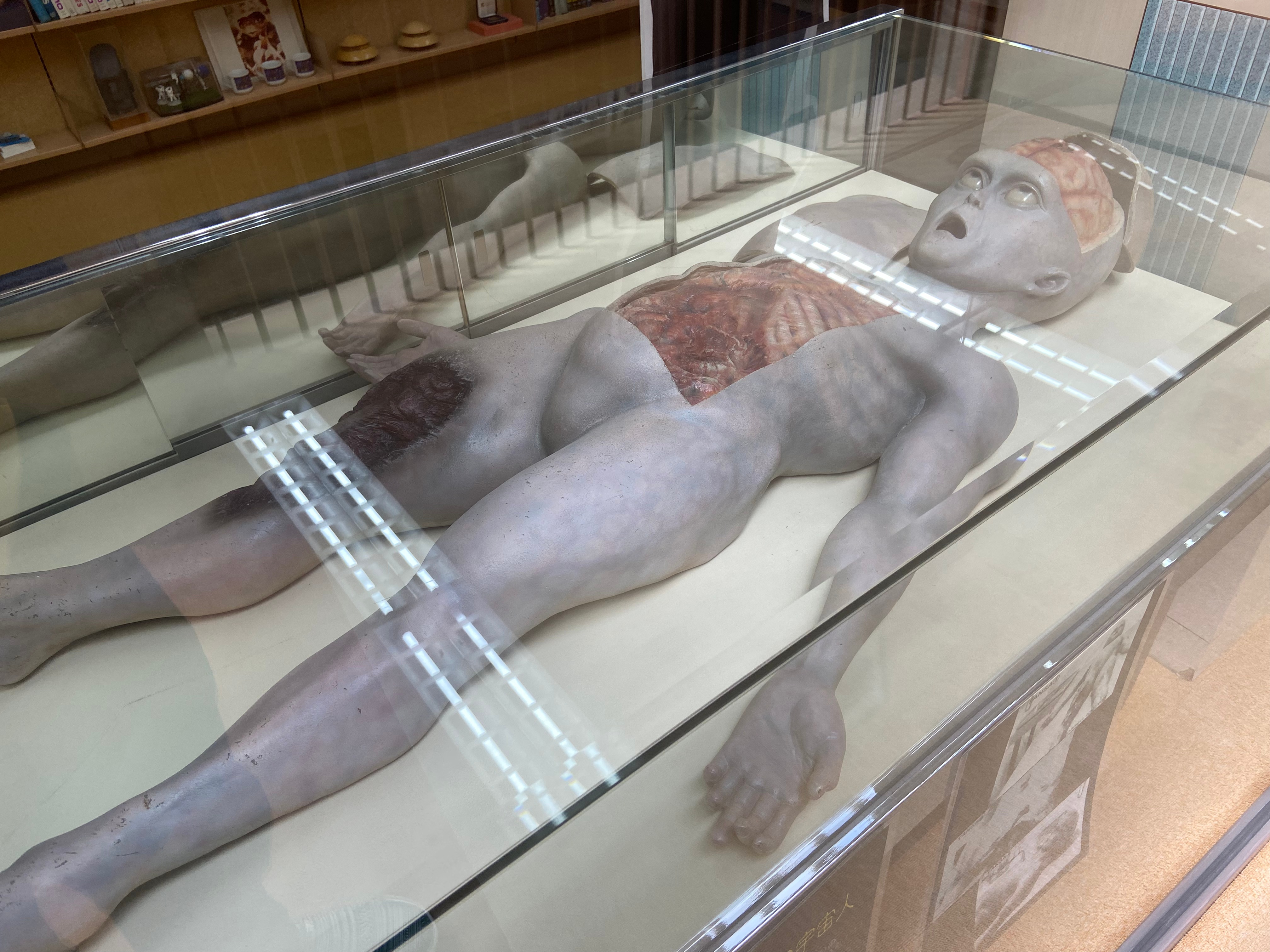
There is one final room filled with UFO paraphernalia, including photographs from Roswell depicting a dissected alien. However, this public library and exhibition hall appears to be closed today; as does the restaurant serving UFO-themed food, probably due to a staffing shortage.
Back at the station, I discover the trains back are just as infrequent, and that I’ve missed mine by one minute. So, with bad planning and two hours to kill, I head back through the Hakui heatwave. I’m not used to any form of pleasant weather in April, being from England, and so I haven’t even thought about bringing anything to protect my skin.

As I make my way toward the only other point of interest in the area, a nearby beach, I search desperately for a Family Mart or Seven Eleven. The only real building of note I do pass, however, is what looks to be an abandoned house.
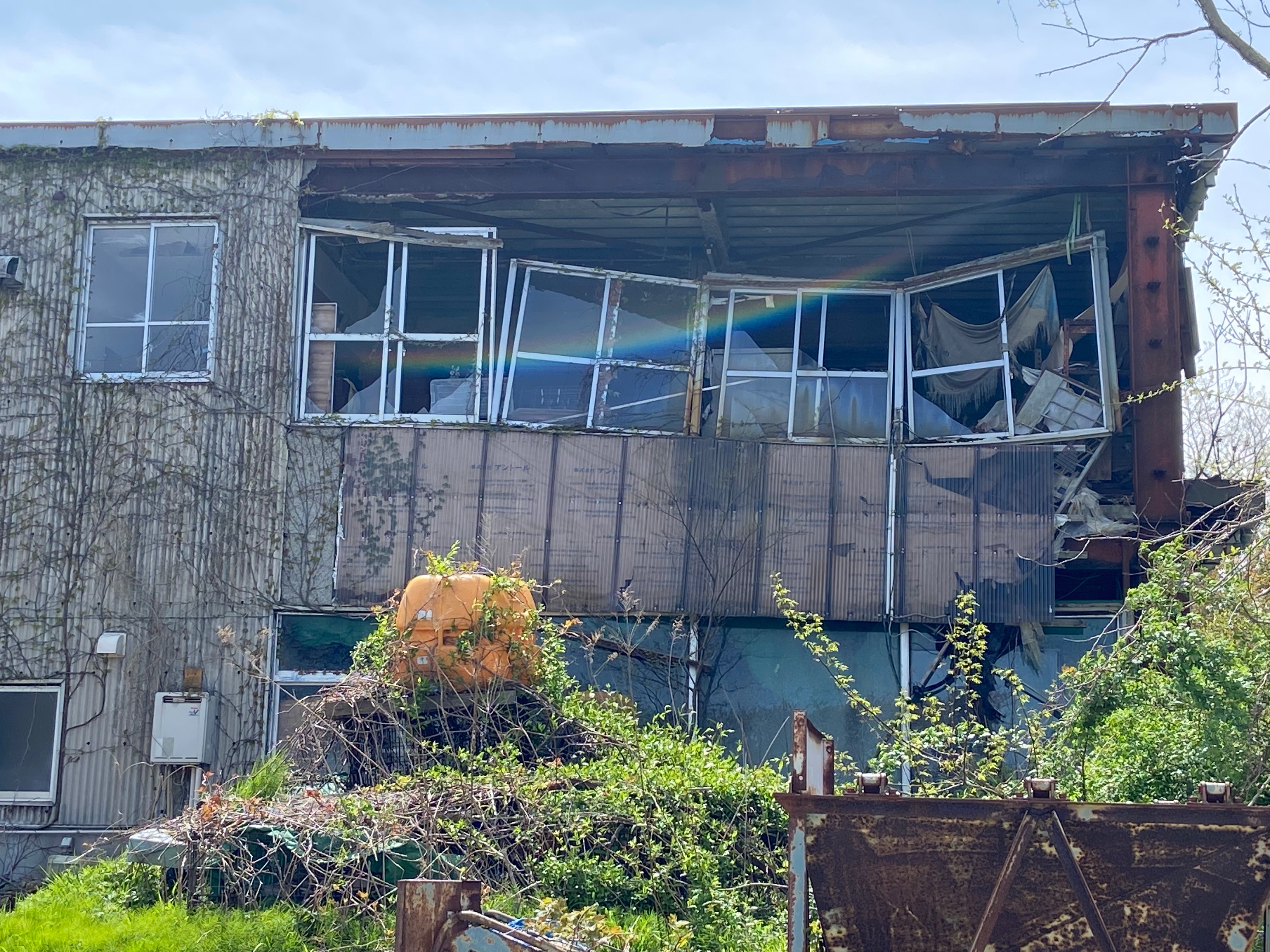
As I wander, I’m surprised by just how completely empty the town is. I don’t find a convenience store. I don’t see another human on the entire walk. It’s as though they’ve been removed; abducted, lifted clean out of the day. Maybe they have. I pass empty galleries and closed bakeries, abandoned supermarkets and buildings in complete disrepair.

I was going to leave that point there, but as I get further from Hakui Station and closer to the beach, it becomes clear just how severe it is. I’ve remarked on abandoned villages before, but this is by far the worst I’ve seen; this feels like an entire abandoned city.
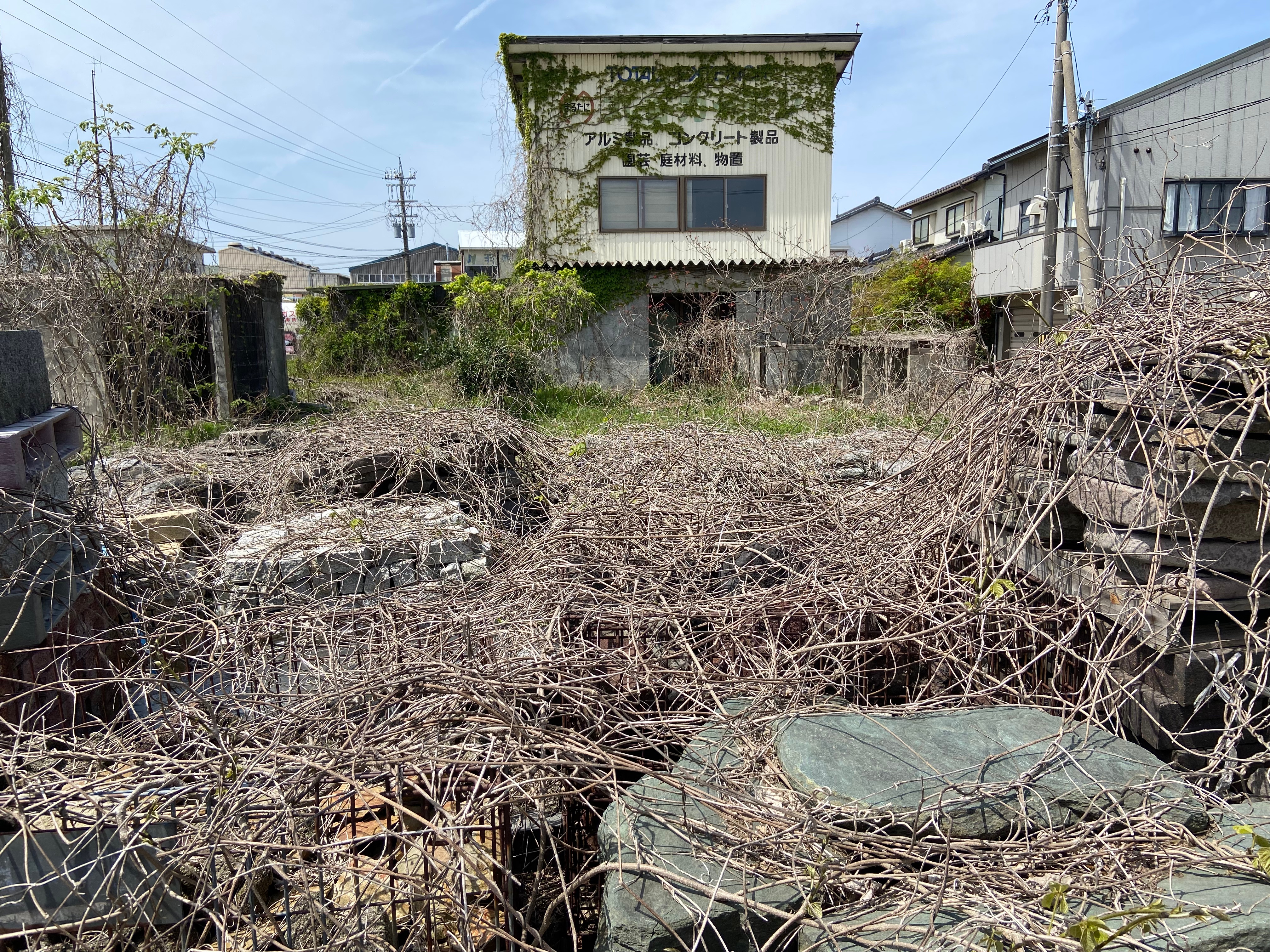
I pass a crumbling car wash, a house that seems to have collapsed mid-sigh, and a whole hotel on the main road just five hundred metres from the beach entrance, abandoned.

A sports centre sits empty. There is a closed-down supermarket crawling with vines. A crumbling old school. And a massive apartment block with collapsed balconies and rusted gates. Where are the people, I wonder. Some have died; some have moved on. A few, perhaps, simply vanished into quieter lives elsewhere. When they were here, at least they got to live near a beach.
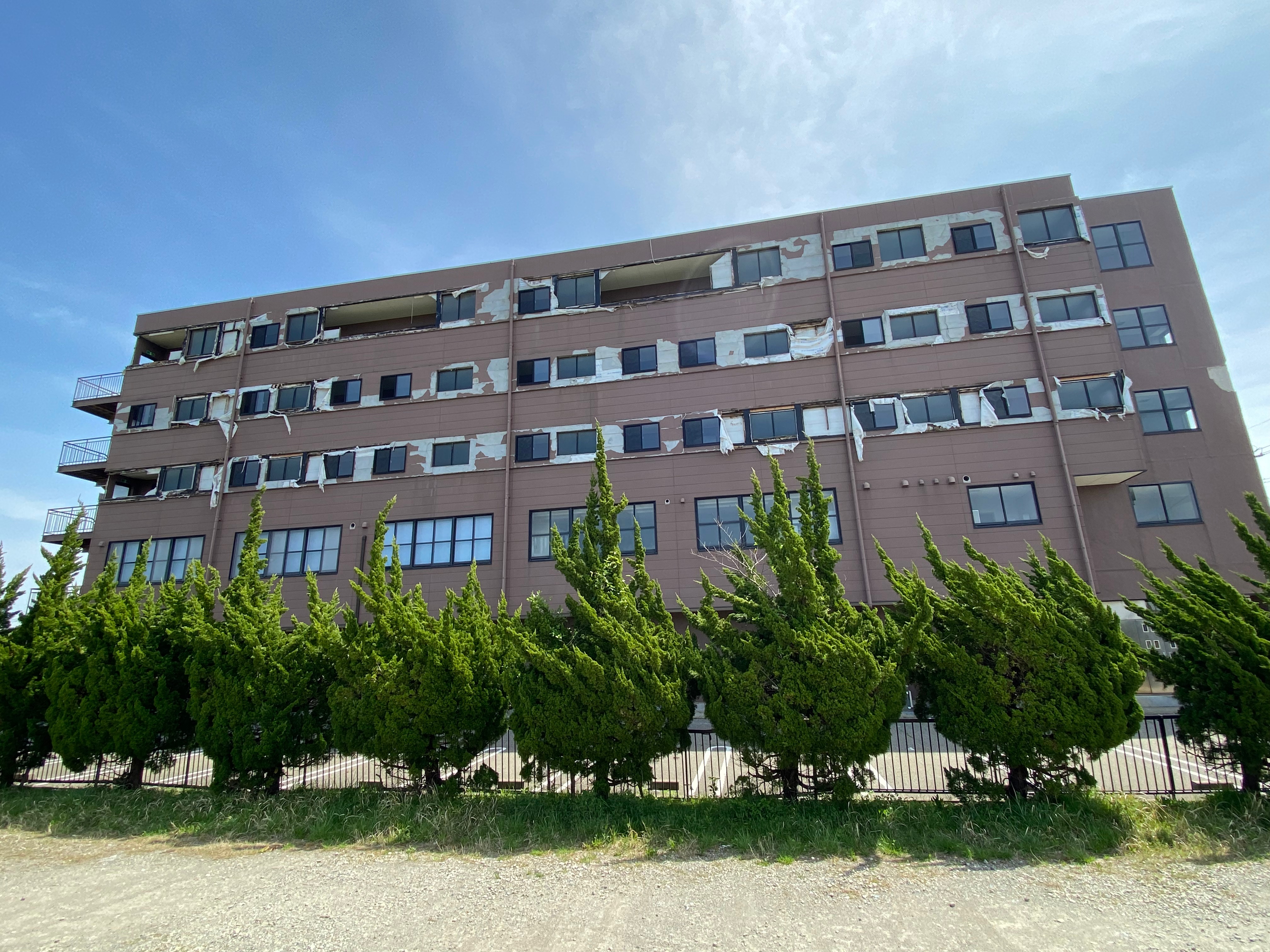
The only upside I’ll add is that, as lonely and quiet as it is, at least it’s peaceful. Perhaps the same can be said about death; lonely and peaceful. No cars on the road. No chatter. Voids and emptiness. If there ever were to be an alien invasion, I doubt anyone around here would notice the aftermath.

I do eventually arrive at Chirihama Beach. It’s nice. Beaches often are. This one is slightly different, though, as it allows motor vehicles to drive on the sand. Glancing over the horizon, I notice quite a few cars parked there. Hopefully, for the owners, the tide isn’t on its way.
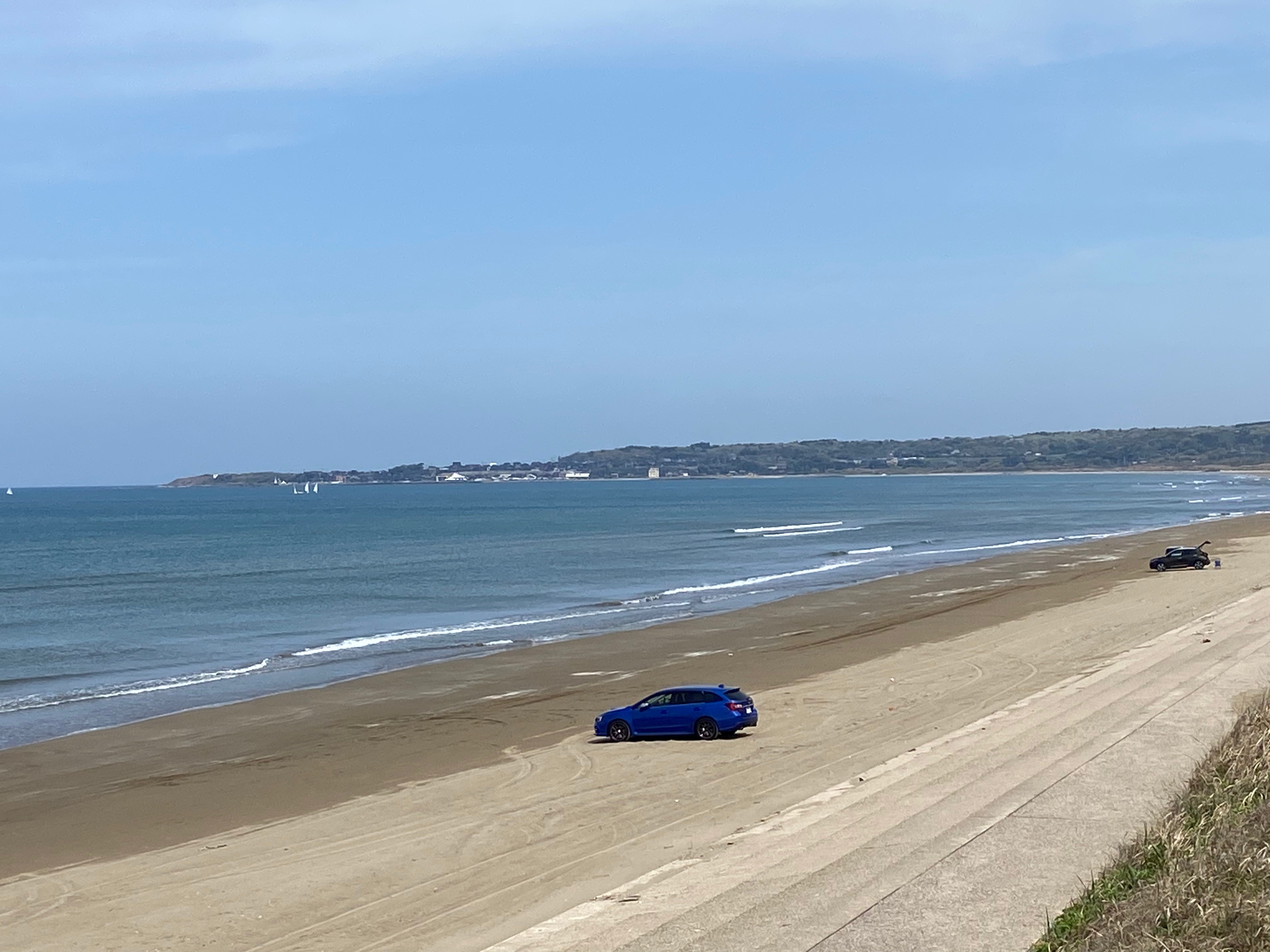
As I walk along, enjoying the sound of the waves, hoping not to get any sand in my shoes, I can’t stop thinking about the abandonment; it really was a shock to see. I also think about the cosmological impact my sixty-second delay this morning has had on the causality of the day. I wouldn’t be on this beach thinking about this had everything aligned just slightly differently.

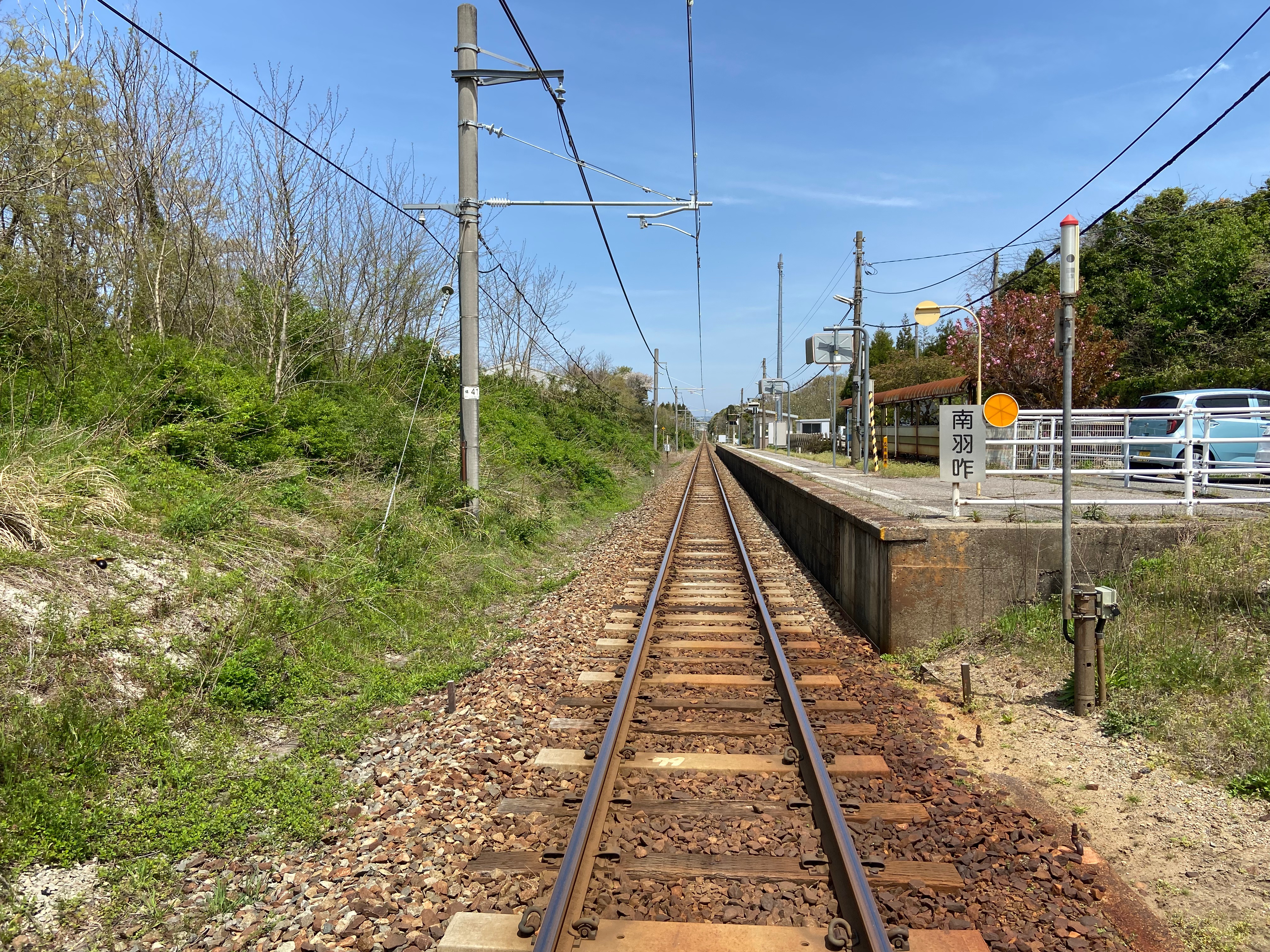
At Minami-Hakui Station, I’m burning from the lack of sunscreen. I was at least expecting a small shop and a toilet; instead there are no staff, no toilets, no ticket machines, no shops, just a single platform and a single track. A sign tells me not to litter or leave cleaning tools around, as this might attract bees and bears.
In the end, I didn’t see any real UFOs; not that I ever thought I would. I also didn’t see any bees or bears, and if I don’t include the woman in the alien mask from the museum, I didn’t see another human being all day.
Strange Tales of the Crescent Moon

The morning sky gave me a look as I stepped out onto the platform at Yabuzuka Station. It’s a small platform with just two tracks and no one around to ask for directions. I’m certain I’ve arrived somewhere between Gunma Prefecture and the Edo period.

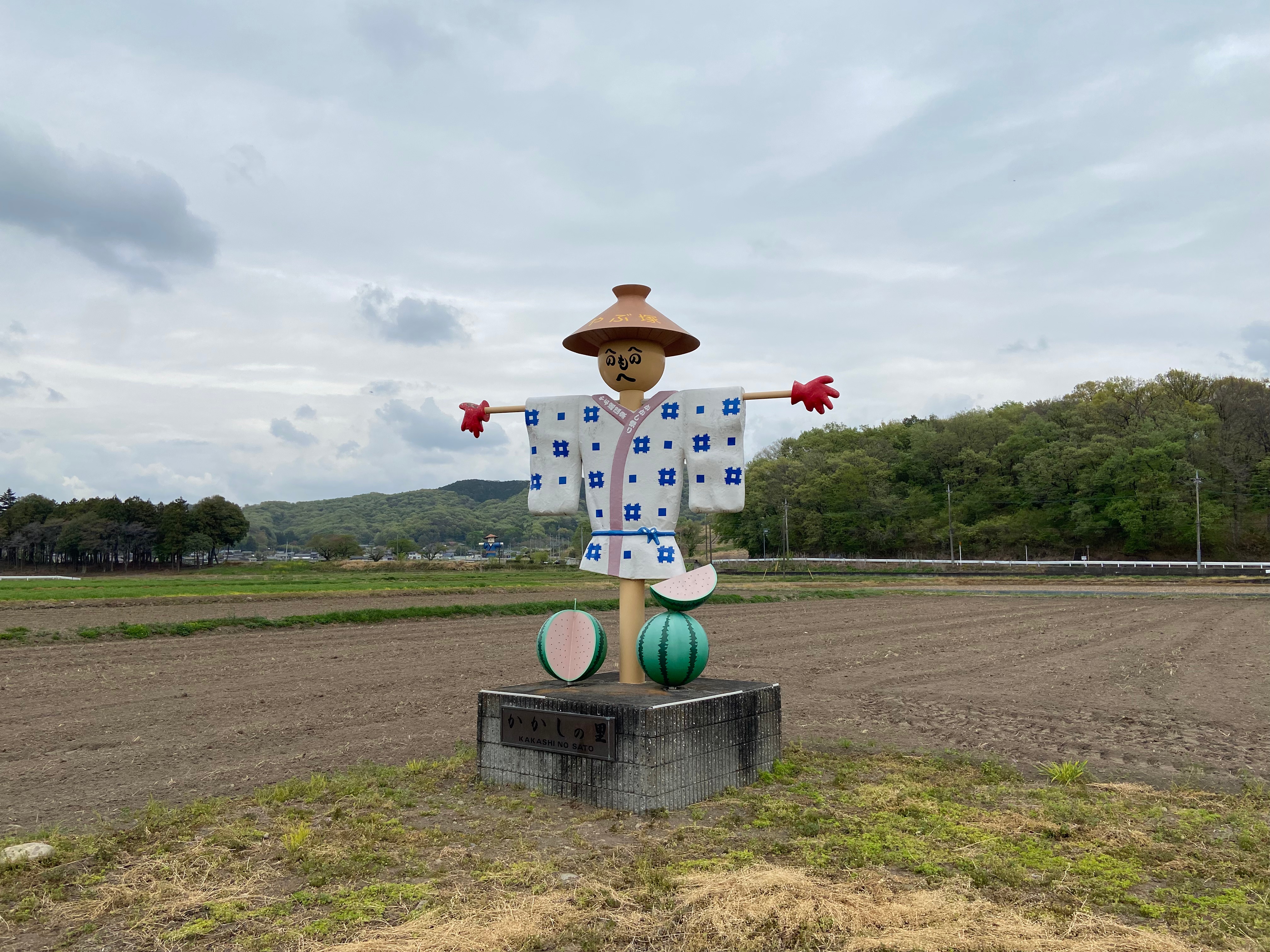
The station exhales me into a residential area of a few low houses, a solitary vending machine, and fields stretching across every distance. Staked into each field, a Japanese scarecrow stands alone.

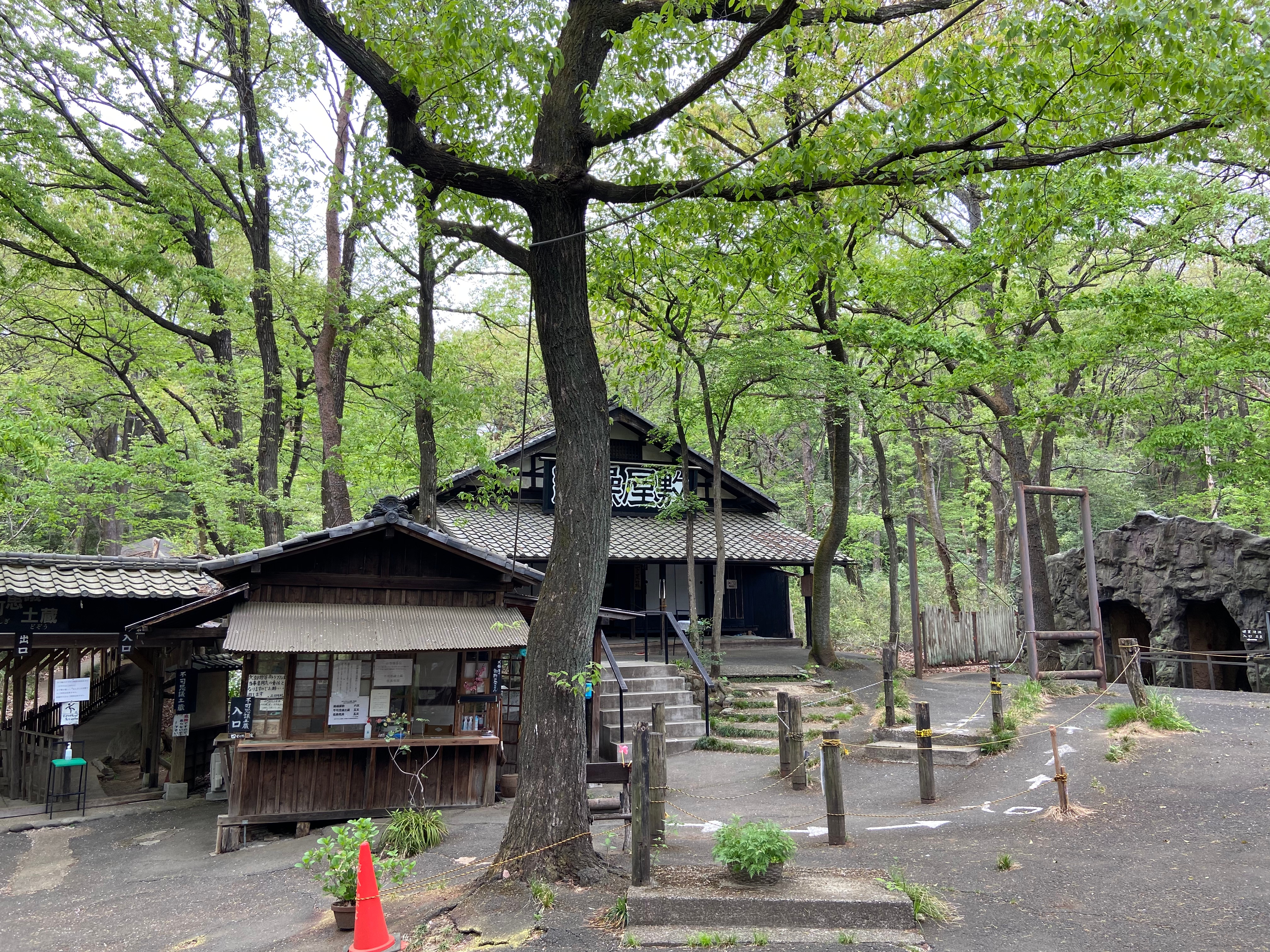
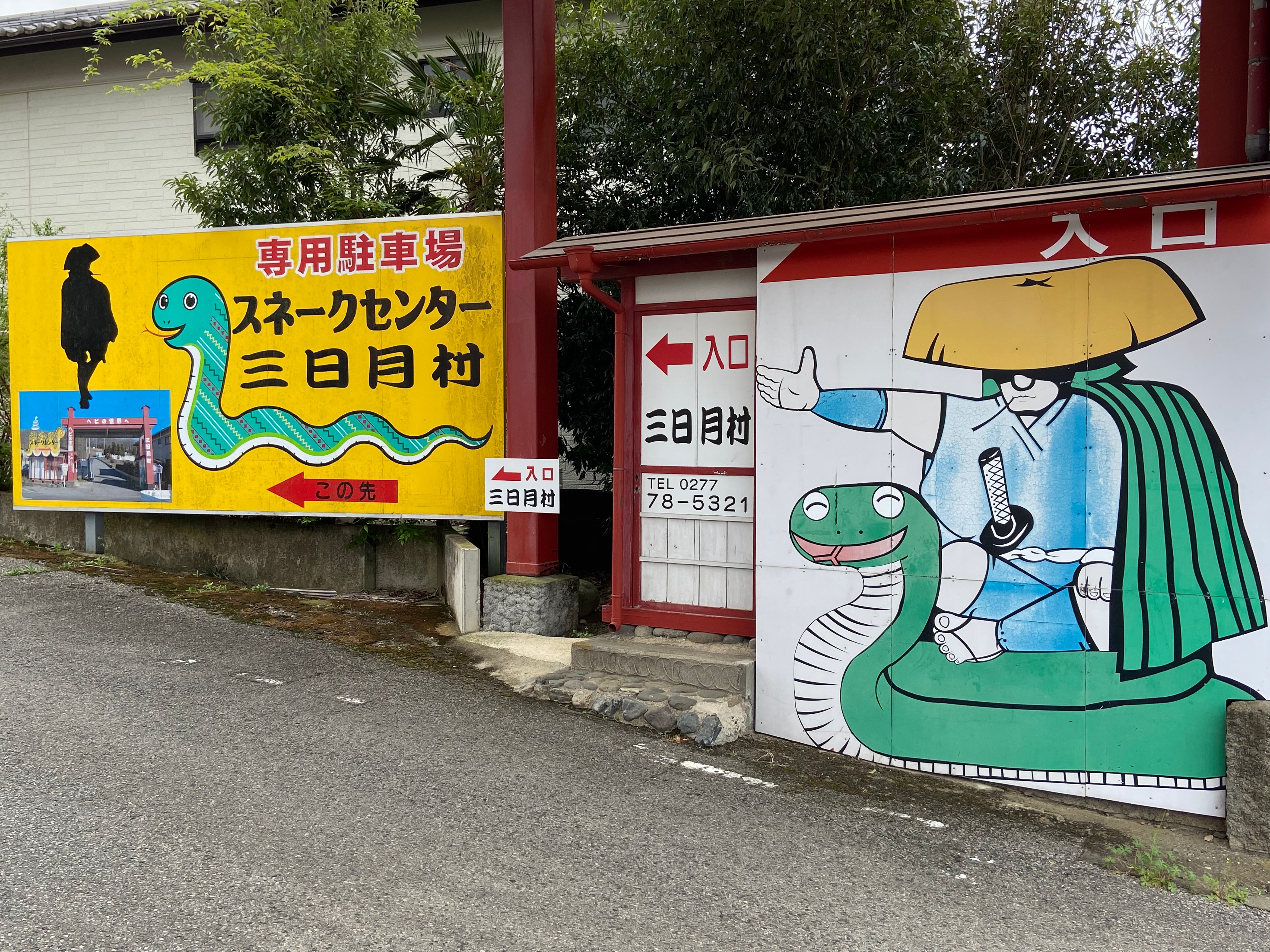
I walk further. My destination today is below the clouds, along a humid forest mountain path. The cicadas hum with an almost animatronic precision, their vitality echoing across the fields and back from the mountains. As I wander, I see an entrance marked by a billboard that features a samurai riding a snake.

Mikazukimura, which roughly translates to Crescent Moon Village, is a historical theme park that faithfully reproduces a village from Edo times (1603–1868). It aims to capture the nostalgia of the era, but I wonder, is it ever really nostalgia if you were never there? I don’t ever recall the Tokugawa shogunate popping round for a cup of tea.

Anyway, at the entrance I buy a ticket. I also have to exchange some Japanese yen for replica Edo coins. These coins are used to buy fish-shaped waffles, crafts, or souvenirs in the park. The unusual time dislocation here means I’m literally buying the past with the present using fake plastic coins. I don’t mind it though. It adds another dimension to everything.

Inside, thatched tea houses make up the backdrop, layered with tempera paint shops, tempura food stalls, temple buildings, and three main attractions. It’s like looking into a painting of a time long gone, just without any people in it. In fact, the dirt streets of the village are so quiet that it almost feels like the sort of place where a ghost story might have begun… or ended.

The first attraction is Kaiigendo, a mysterious trick-filled cave activity. The sign says, “This attraction is caving,” but I certainly hope it isn’t. To enter, I have to buy a ticket with my special coins. The lady here stamps my attraction card, before rather quickly explaining, in Japanese, what feels like a lot of safety instructions I probably should understand, much to my own confusion.

She then hands me a torch, says, “No ghost. No scary,” and wanders off.

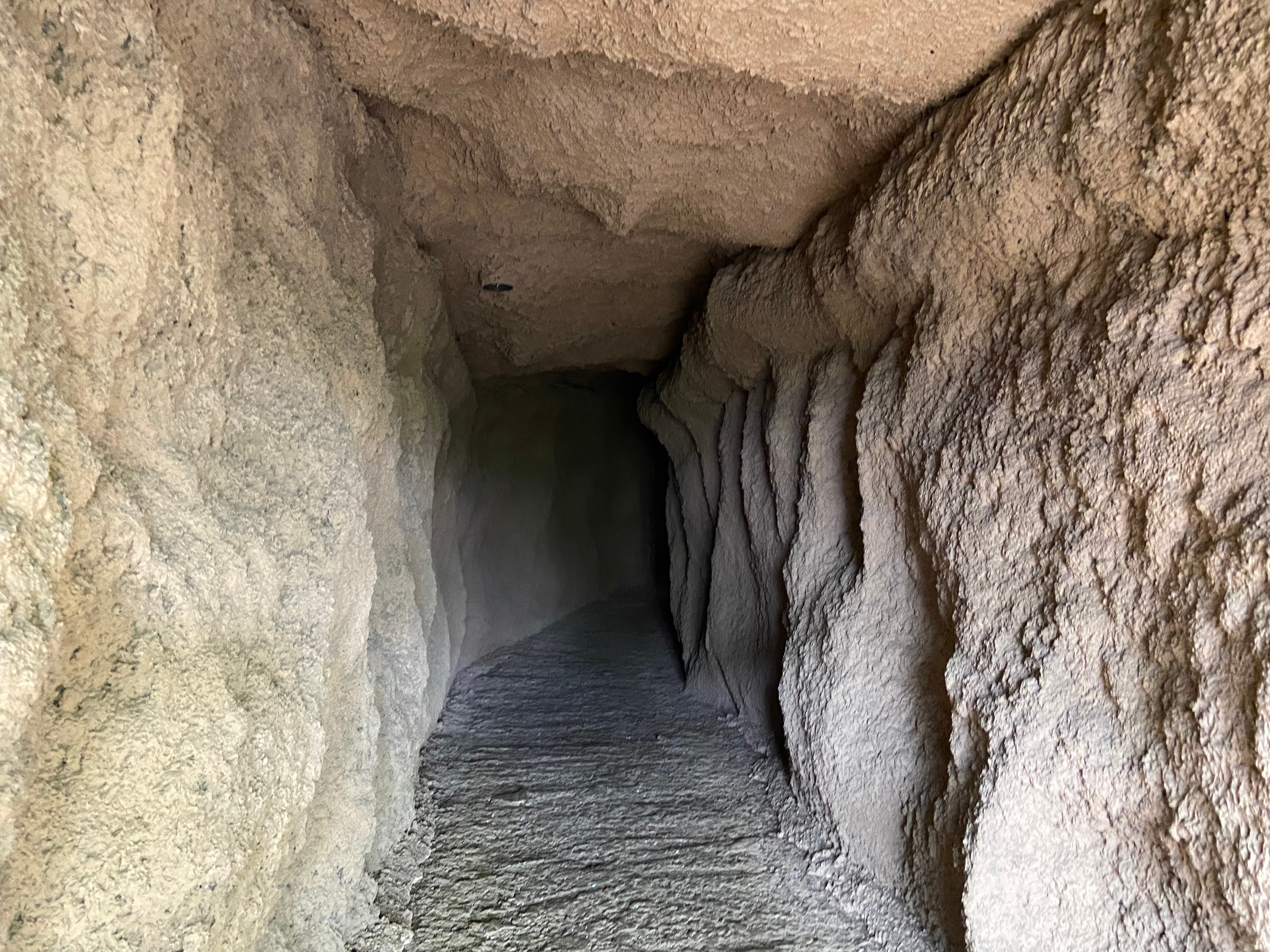
The cave describes itself as an underground tunnel filled with traps and hidden entrances. There are sliding doors, and there are secret doors. There are doors that creak, and doors that open. There aren’t really any instructions, so I turn on my torch and wander through the darkness.

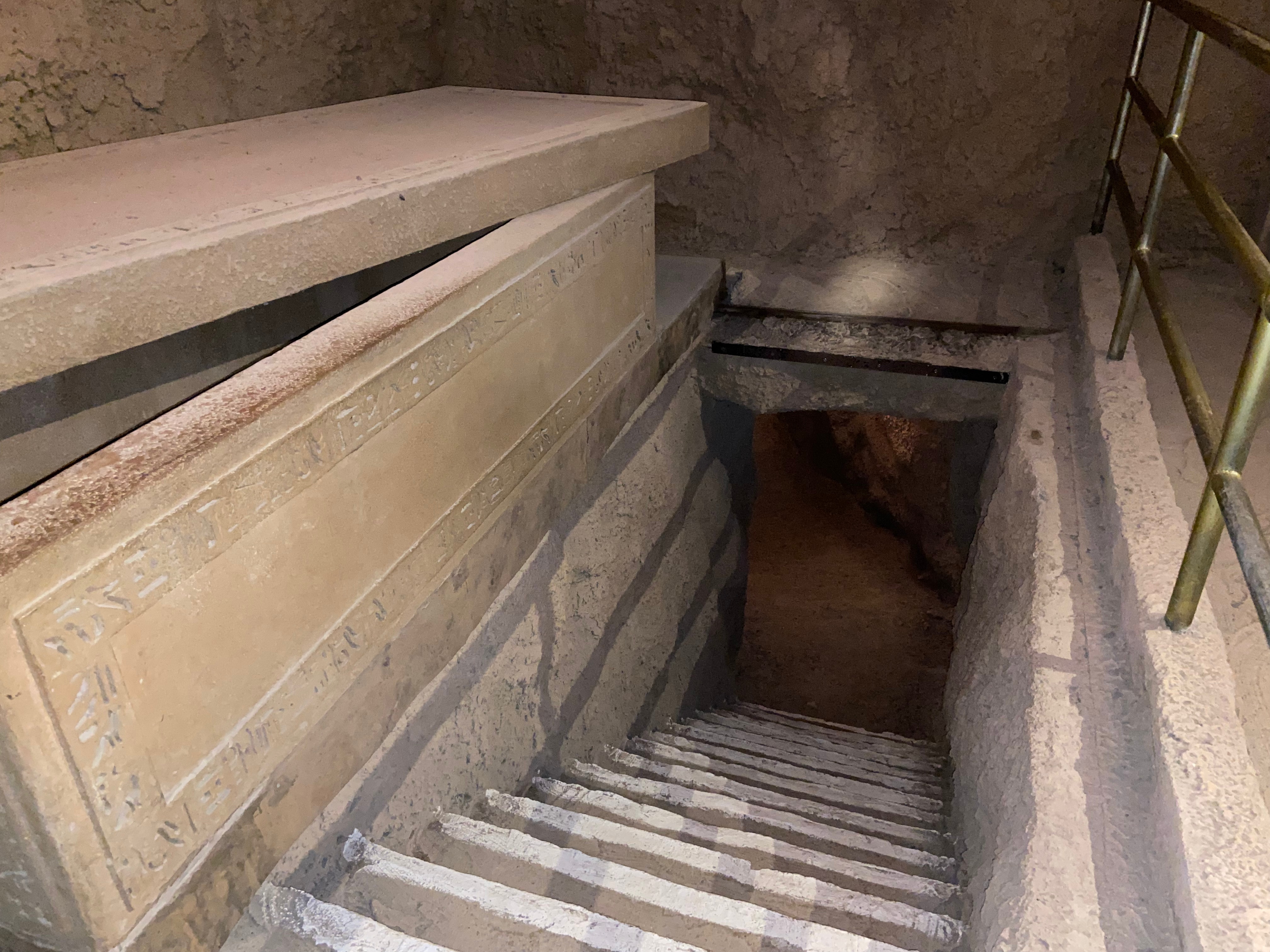
It’s actually pretty scary. I get a bit lost in the maze-like caverns until I reach what I think is a dead end. Eventually I discover a secret tunnel that I have to activate simply by standing next to it. A huge stone tablet mysteriously shifts to the side, revealing a staircase leading deeper underground.

As I pass the stairs, the tablet slides back across, trapping me inside. I follow the rooms, secret doors, narrow passageways, across a bridge, to a room with a waterfall, to another with booming music, mirrors, and red lighting. It takes me far too many attempts to figure out how to escape this claustrophobic panic attack. Eventually I find the exit behind a bookcase that only slides aside if I clap my hands; again not explained at all.

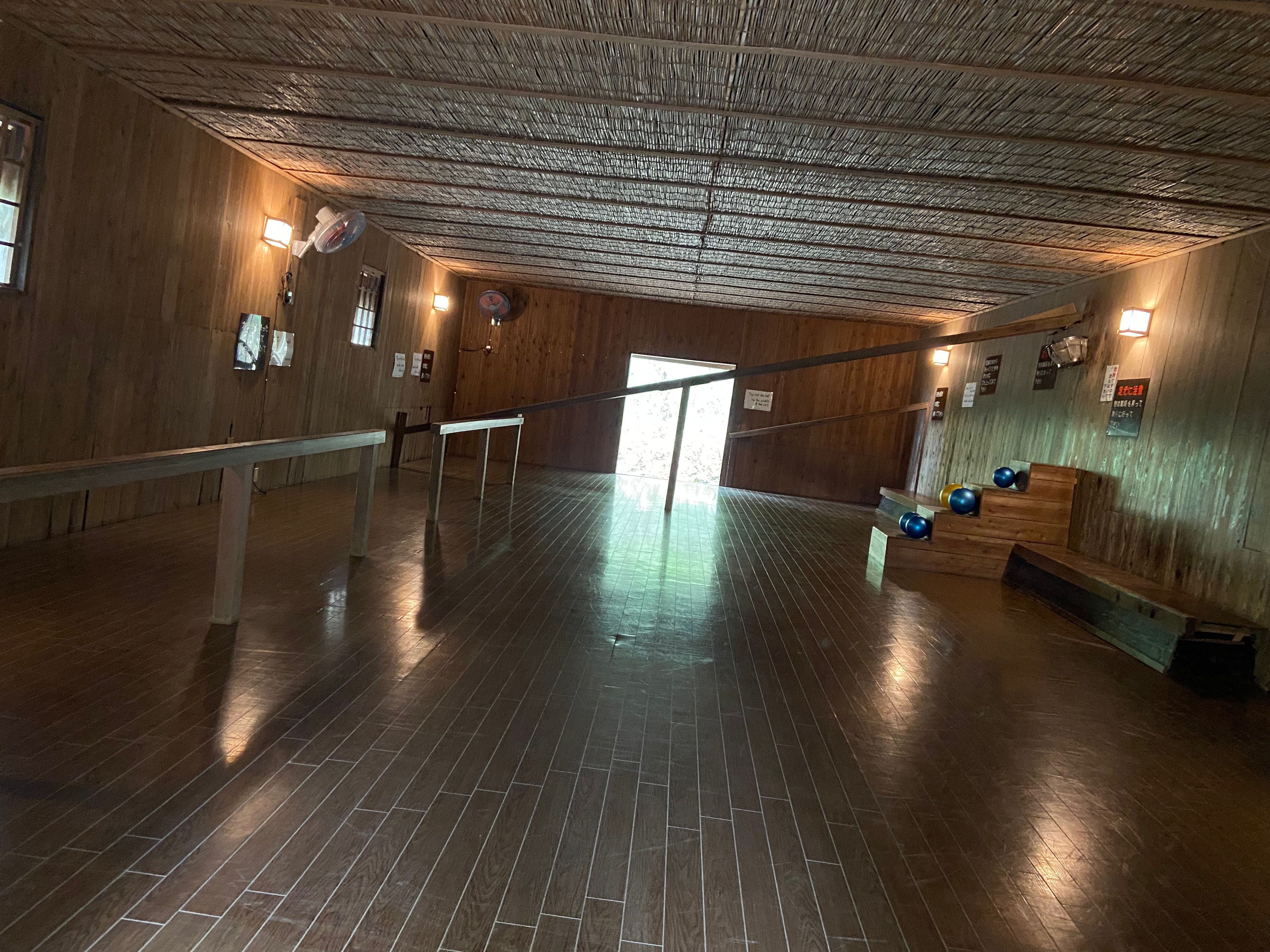
My next attraction is Fukashigidozo, a sloping house. A sign lying on the ground next to the sloping house says, “Don’t fall over,” having itself ignored its only instruction. The purpose of the house is to challenge my sense of balance. The building has been constructed at an angle, on a slope, and confuses me in a way that makes me feel dizzy, like I’m falling over, even though I am standing perfectly still.

I want to sit down. I want to not be standing up beside the house that feels like it’s falling down. It messes with my brain, despite understanding exactly what’s happening. The house is so profound that I am at complete unease as I wander back toward the main village.

Here, the staff stay fully in character, even when no one is watching. I stay fully myself, which requires significantly less effort, yet still somehow wears me out. In the end, Mikazukimura doesn’t quite manage to hold the illusion together, and instead echoes something slightly decayed, enveloped in a careful silence. I head next door to the Japan Snake Centre.

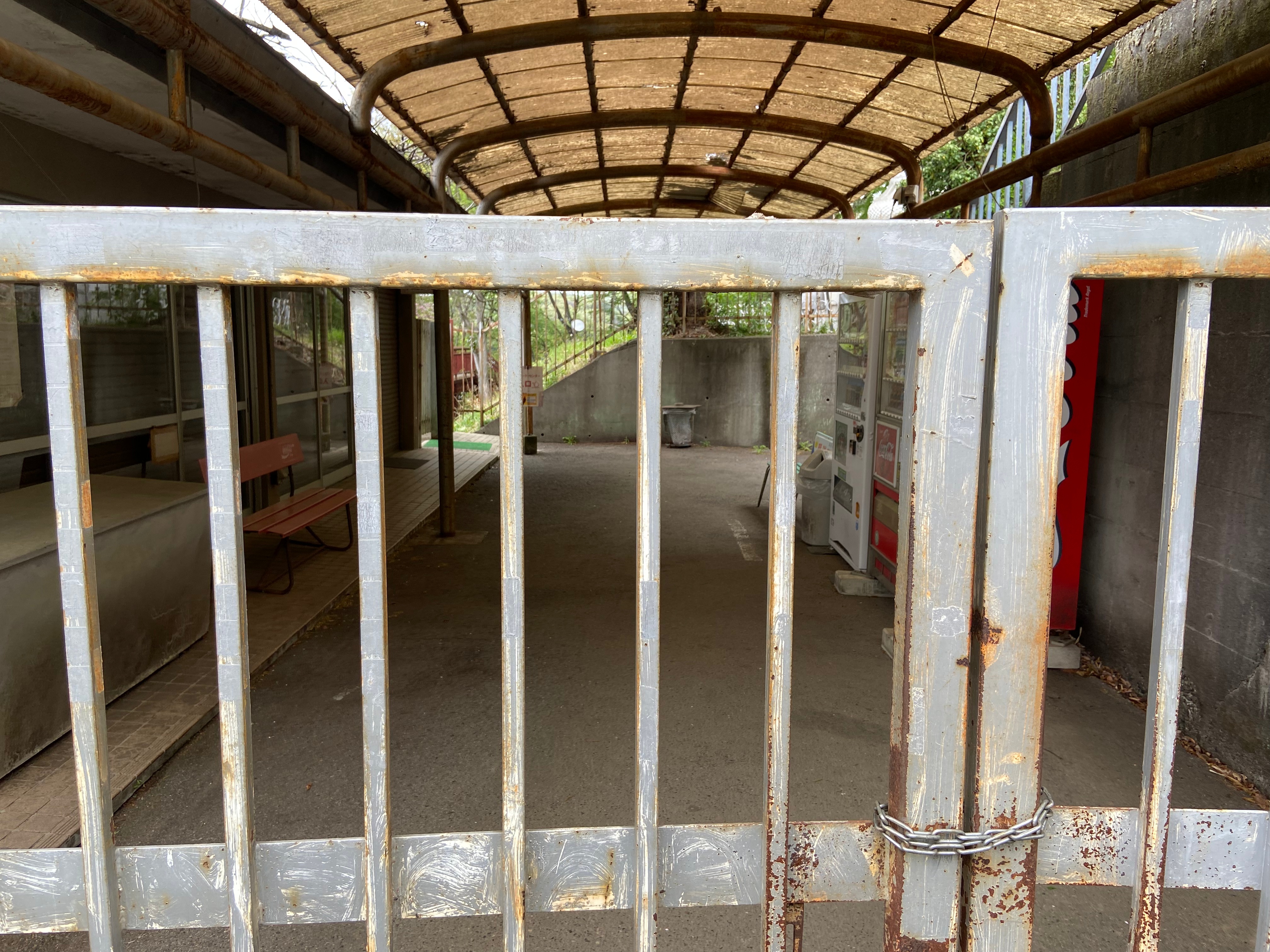
The door here is chained shut despite a sign saying, “Open.” I was hoping to look at some creatures that predated the Edo period by millions of years, but it looks like I’ve outlived them. The Snake Centre is permanently closed. I head back across the fields of crops, scaring away a few crows on my way, and return to Yabuzuka Station, but with no train for two hours, I decide to walk to Isesaki.

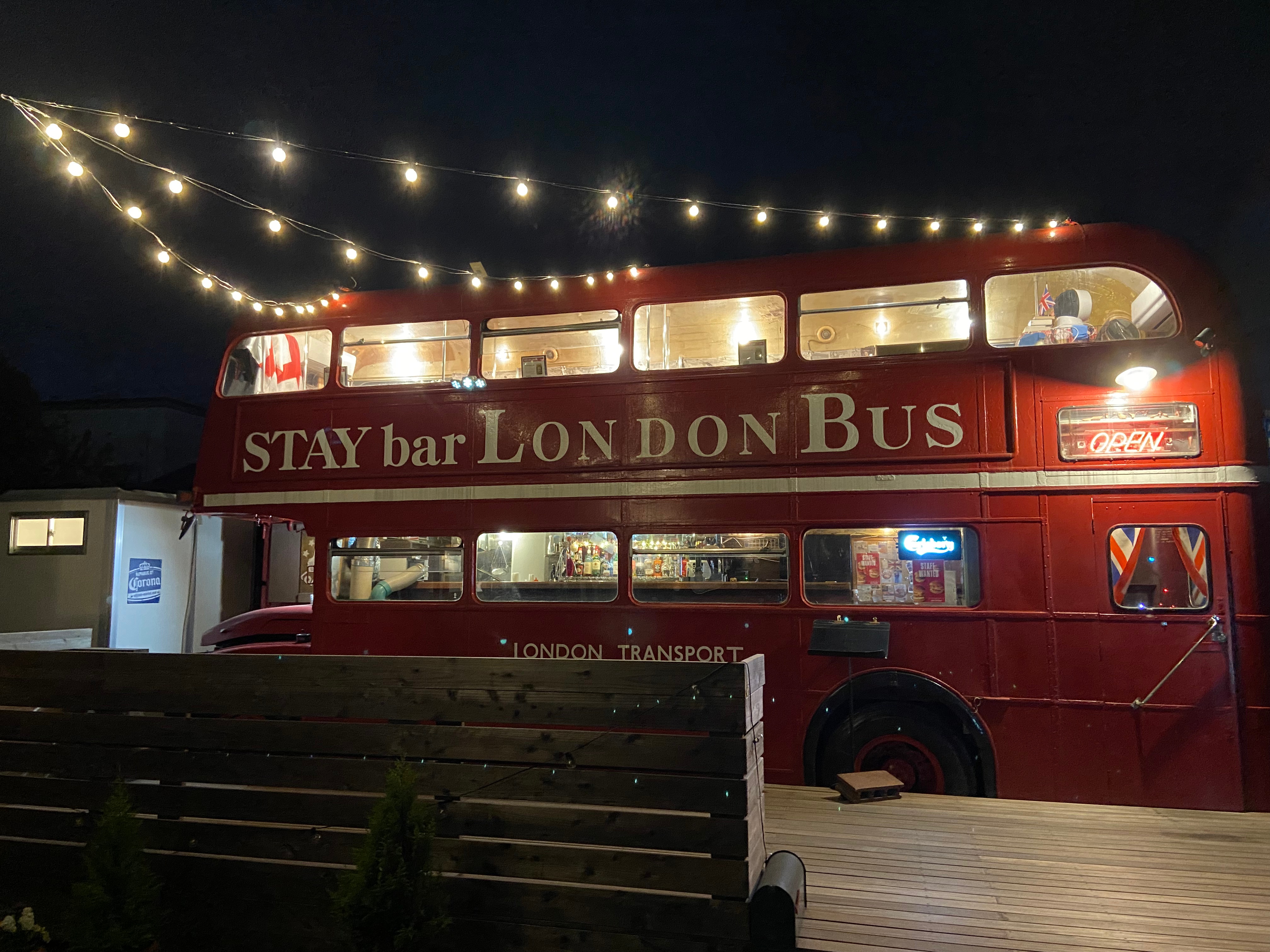
On the walk, I spend some time on my phone researching azimuths and lunar illumination percentages. I walk on, mostly in silence. The occasional passing car. The odd cawing crow. There’s no footpath most of the way; and as the sky darkens I don’t particularly enjoy being constrained to walking on unlit country roads. Somewhere along the way, my eyes catch something that looks so out of place that I stop to investigate. A big red London bus parked on a side street.

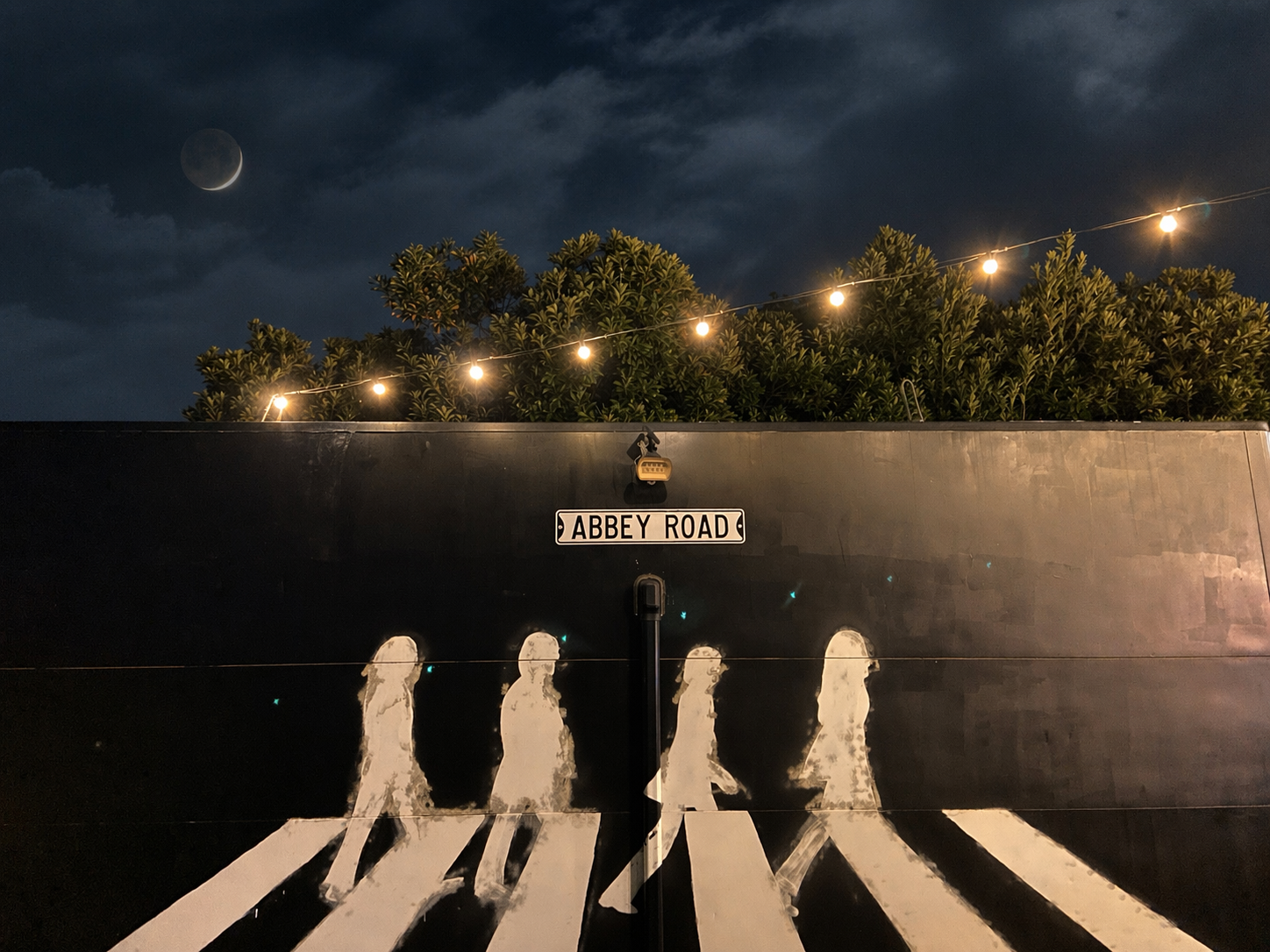
Inside, a bar. I order a drink and chat with the owner. He tells me that the couple that used to run the bar are no longer here, and that he took over. They used to really like London which is how this place came about. The new owner here can barely speak English, which is a shame, because I wanted to ask him about the ghost children crossing Abbey Road.

Our conversation breaks apart. Neither of us really has anything to say. Eventually he goes out into the back room to cook himself some food. So I sit, sipping on my Suntory Highball in silence. Out here, there’s no one to sit beside.

I finish my drink and leave. The red London bus glows under the Gunma sky. Above, a waning crescent moon hangs like a chipped Edo coin, its dark edge faintly visible in earthshine.

Once Upon a Timeline

Today, I’m in Yoro, a town in Gifu Prefecture. I’m here to change my destiny.

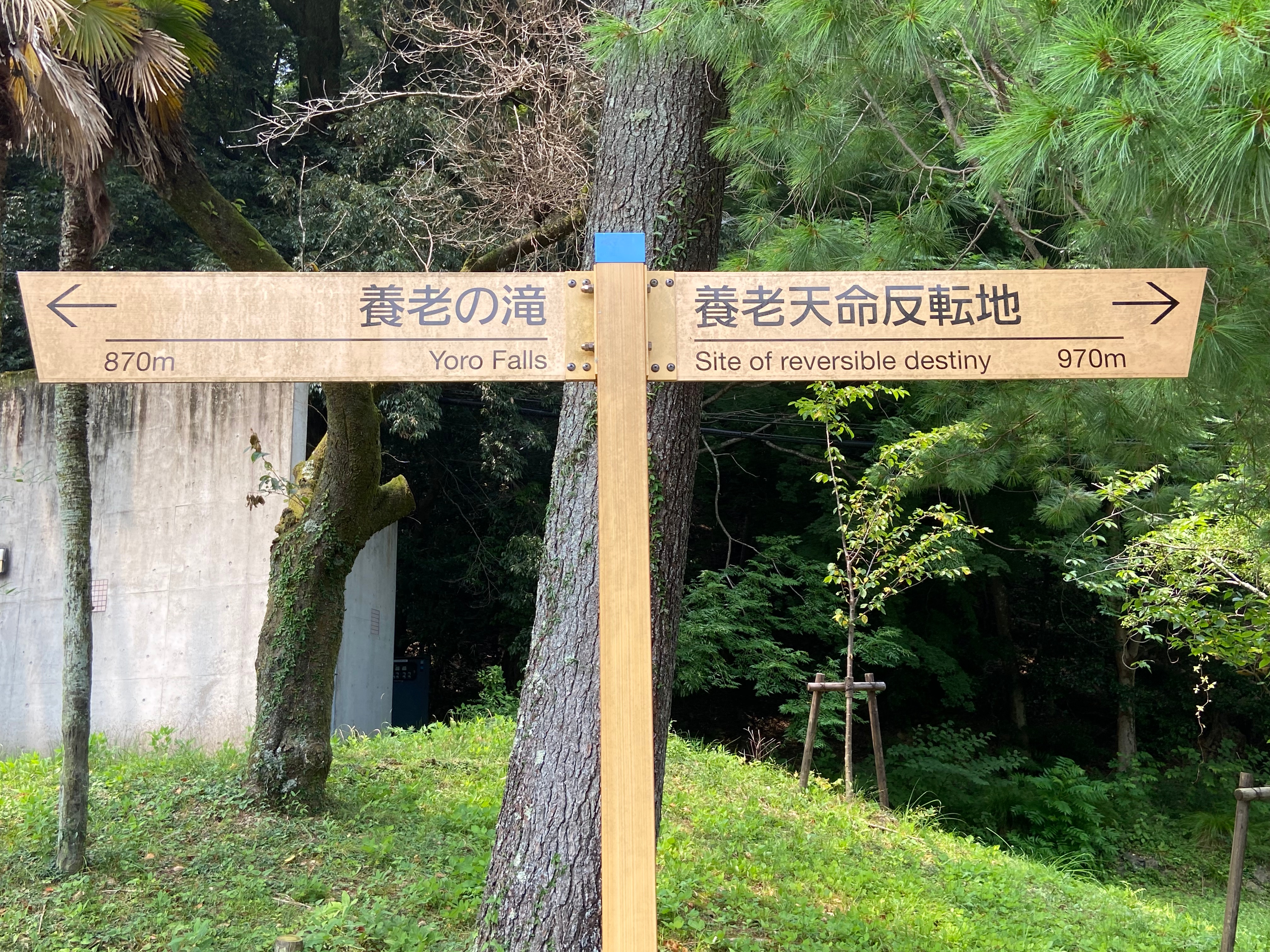
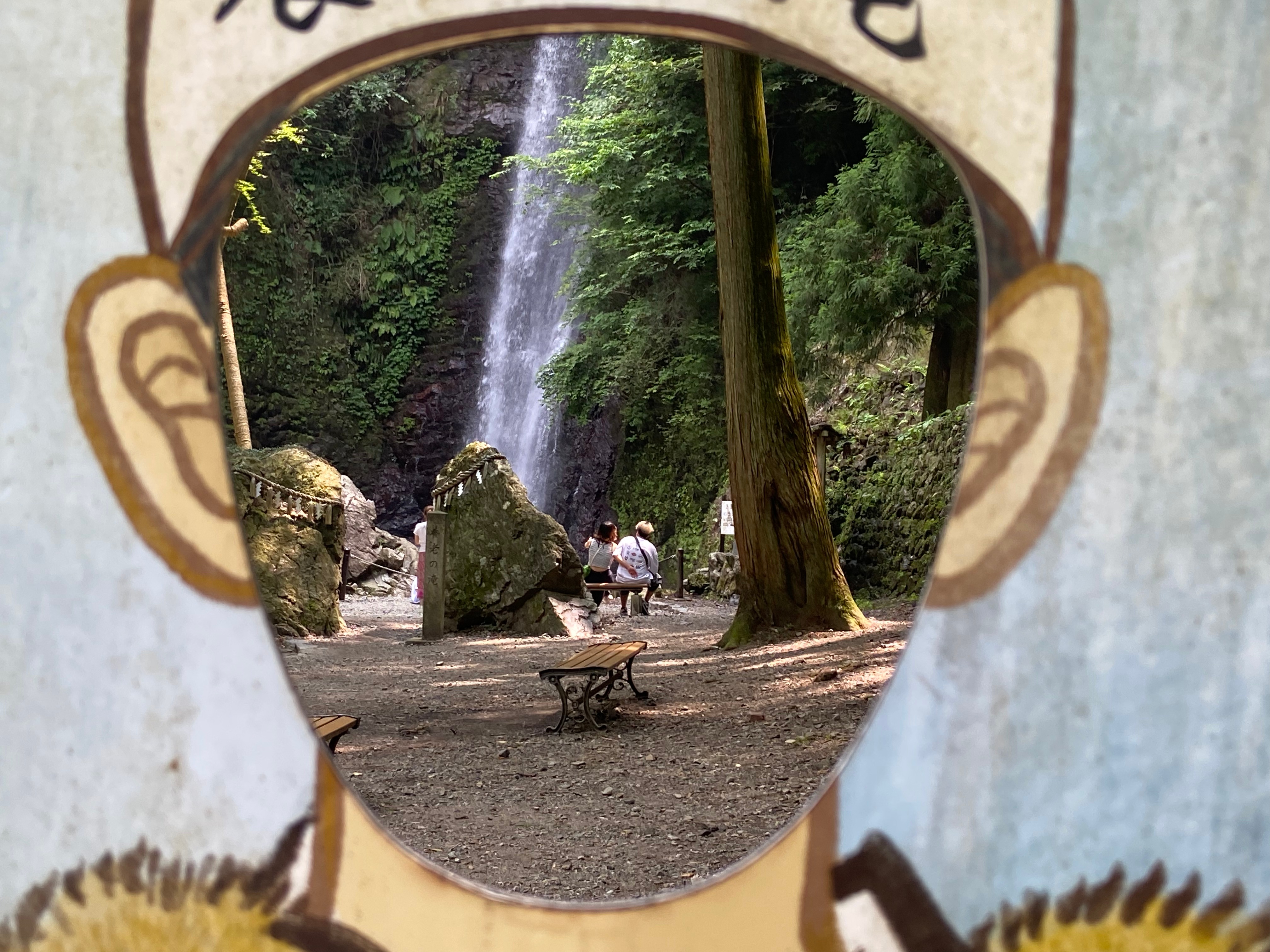
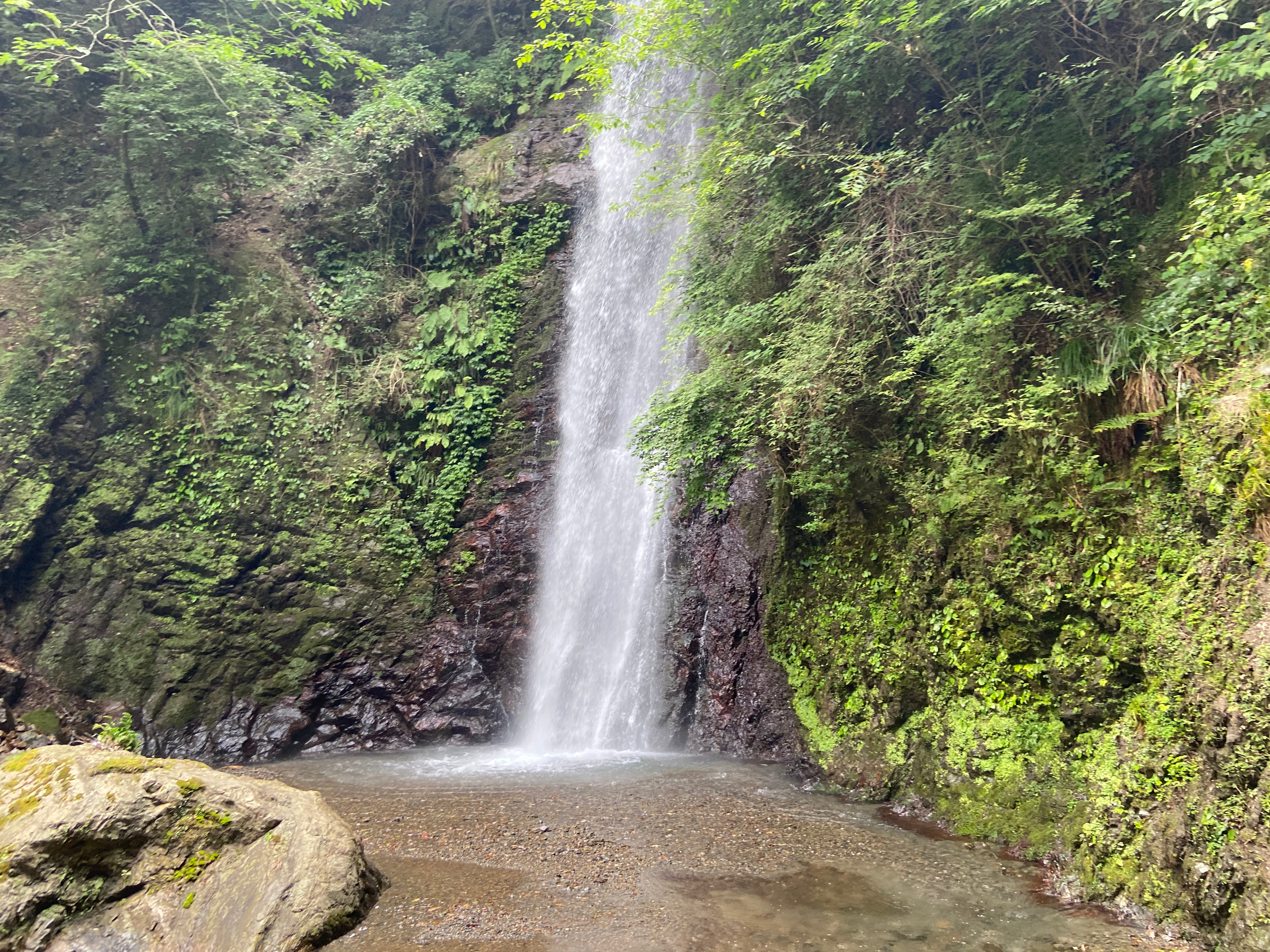
First, I decide to take a thirty-minute stroll along the edge of a cliff to visit a famous waterfall. This waterfall is said to be made entirely of flowing alcohol, specifically Japanese sake.

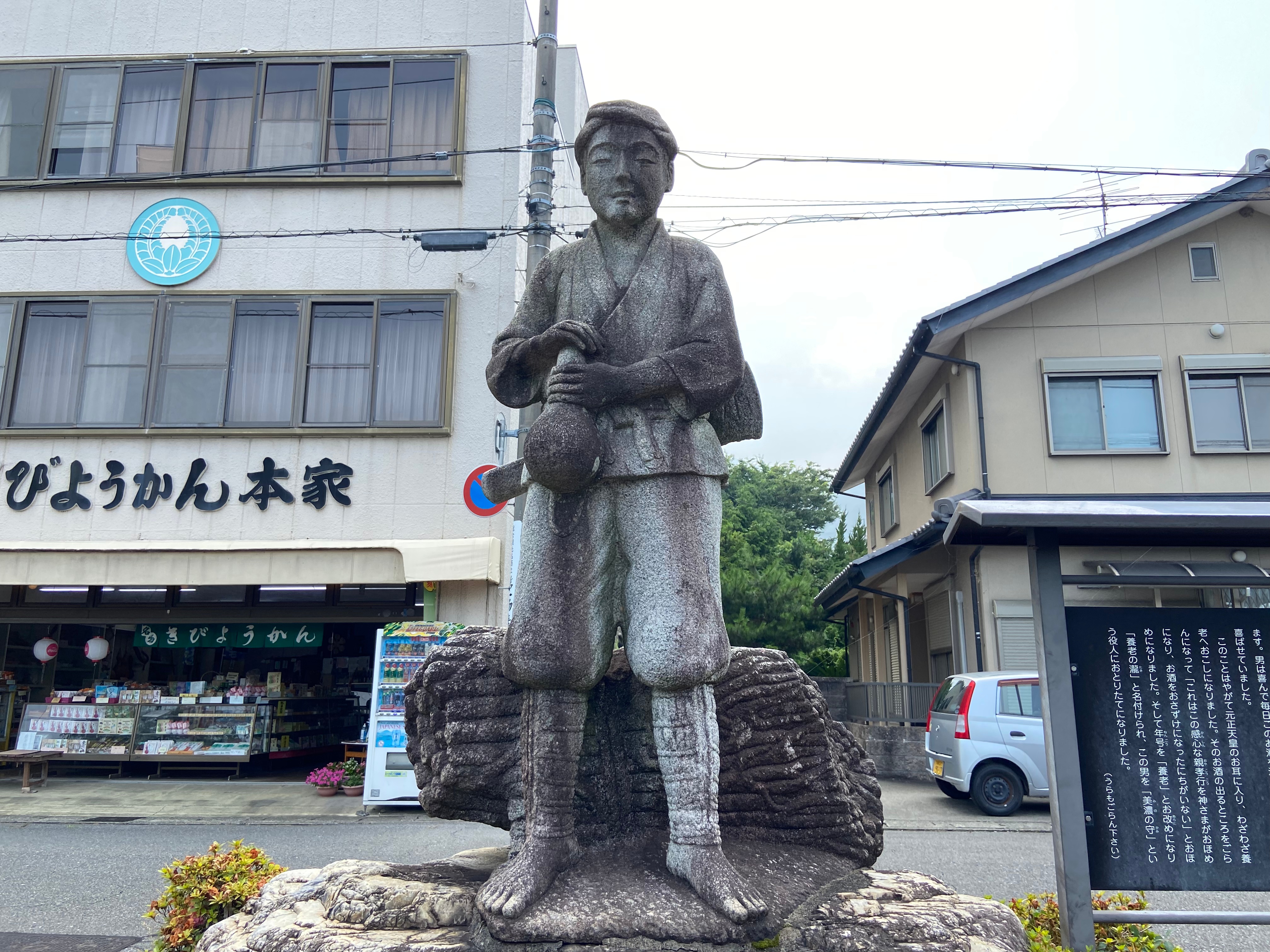
The story goes that there was once a poor lumberjack with a very old, ill father. On his deathbed, the father requested his favourite Japanese sake, but the lumberjack couldn’t afford it on his meagre income. One day, the son walked the treacherous path near the waterfall.

Some say he was out looking for wood for a fire, but he was a woodcutter, so any tree would have sufficed. Others say he was simply thirsty. Regardless, he fell in the woods and definitely made a sound, and after falling and lying on the dirty ground, the poor lumberjack could smell the sweet scent of sake.

It was here that he discovered the water from the waterfall was not water at all.

He returned home with a gourd full of sake, and his father drank it. The transformation was instant, and he miraculously became younger and healthier.

News of this reached the ancient capital of Nara, and Empress Gensho visited the waterfall herself. She was so impressed by the beauty of the area and the magical water that she declared it a sacred site and renamed the area Yoro, meaning elderly care.

It takes me about an hour to reach the waterfall despite it being advertised as a thirty-minute stroll. It’s a tough hike too, up a mountain. It’s humid; it feels like 40 degrees. I’ve probably sweated more water than I’ve seen flow down the falls. I can only imagine how hard it must have been for the lumberjack, carrying that gourd and heavy axe to the top.

Next to the waterfall, a faded poem engraved on stone in Japanese reads:

“Listening to the flow of Yoro Falls,
One’s heart is healed and refreshed,
Like the pure sake that rejuvenated the old man,
Flowing eternally, blessing those who visit.”

I stand looking at the waterfall for a time, enveloped in tranquillity. I think about water flowing down a river, following a predestined path. It cascades over the falls, flows further south, and meets a tributary, where its path diverges and its destination shifts, a choice not made but followed.

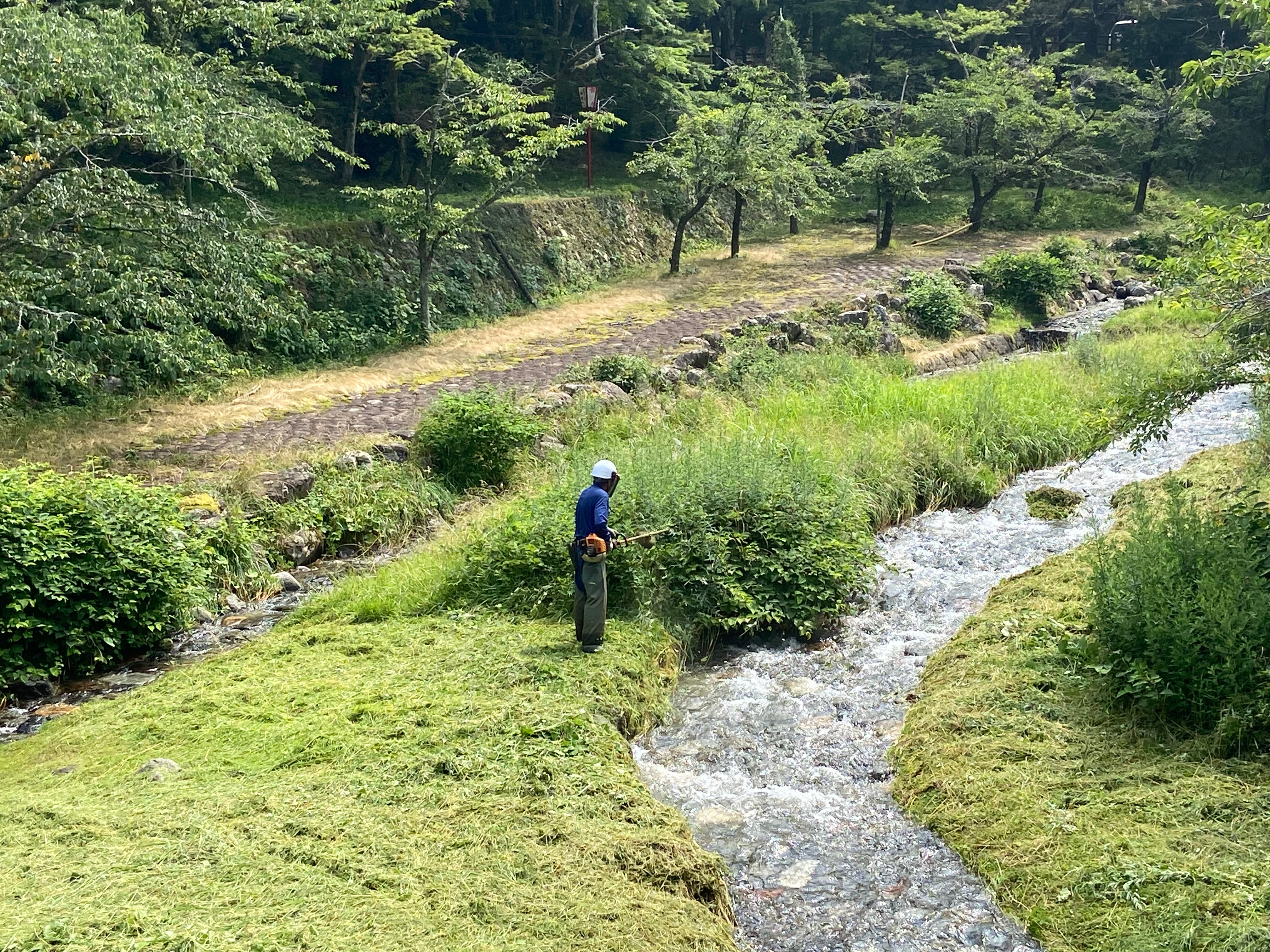
Somewhere, after leaving Yoro Falls, a butterfly shivers against the wind. At the bottom of the waterfall, the tranquillity ends and is swamped by the sound of a man with a grass strimmer.

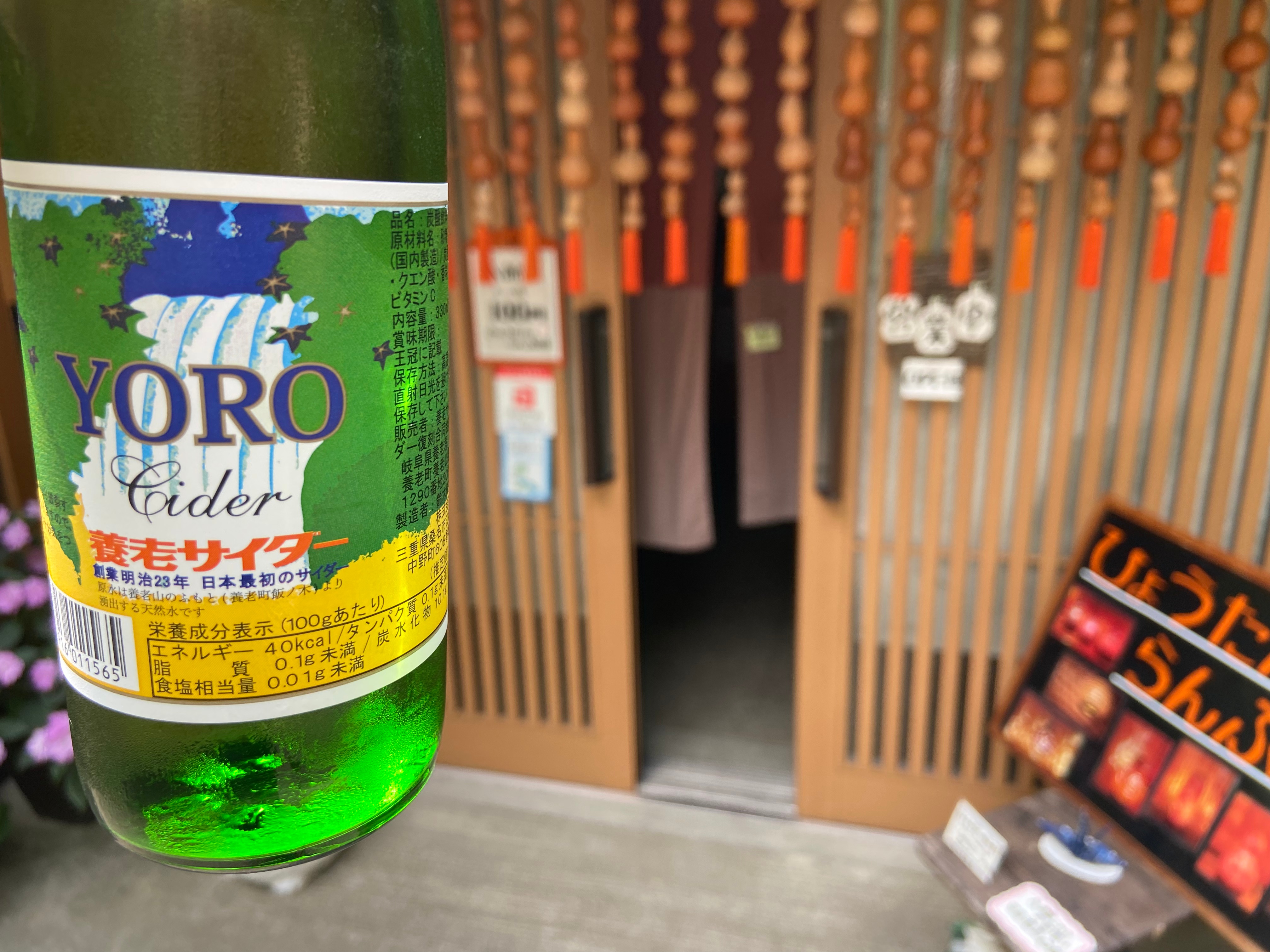
I stumble upon a small souvenir shop selling bottles of carbonated cider made with the magical sake water. The cider tastes delicious. Unlike in England, cider in Japan is a soft drink, so despite the falls apparently being made of alcohol, this drink somehow contains none.

I leave with a healed heart, feeling blessed. Eternally refreshed. Next to the small shop is the Yoro Gourd Museum. I look at a few gourds made into artwork and lamps before moving on.

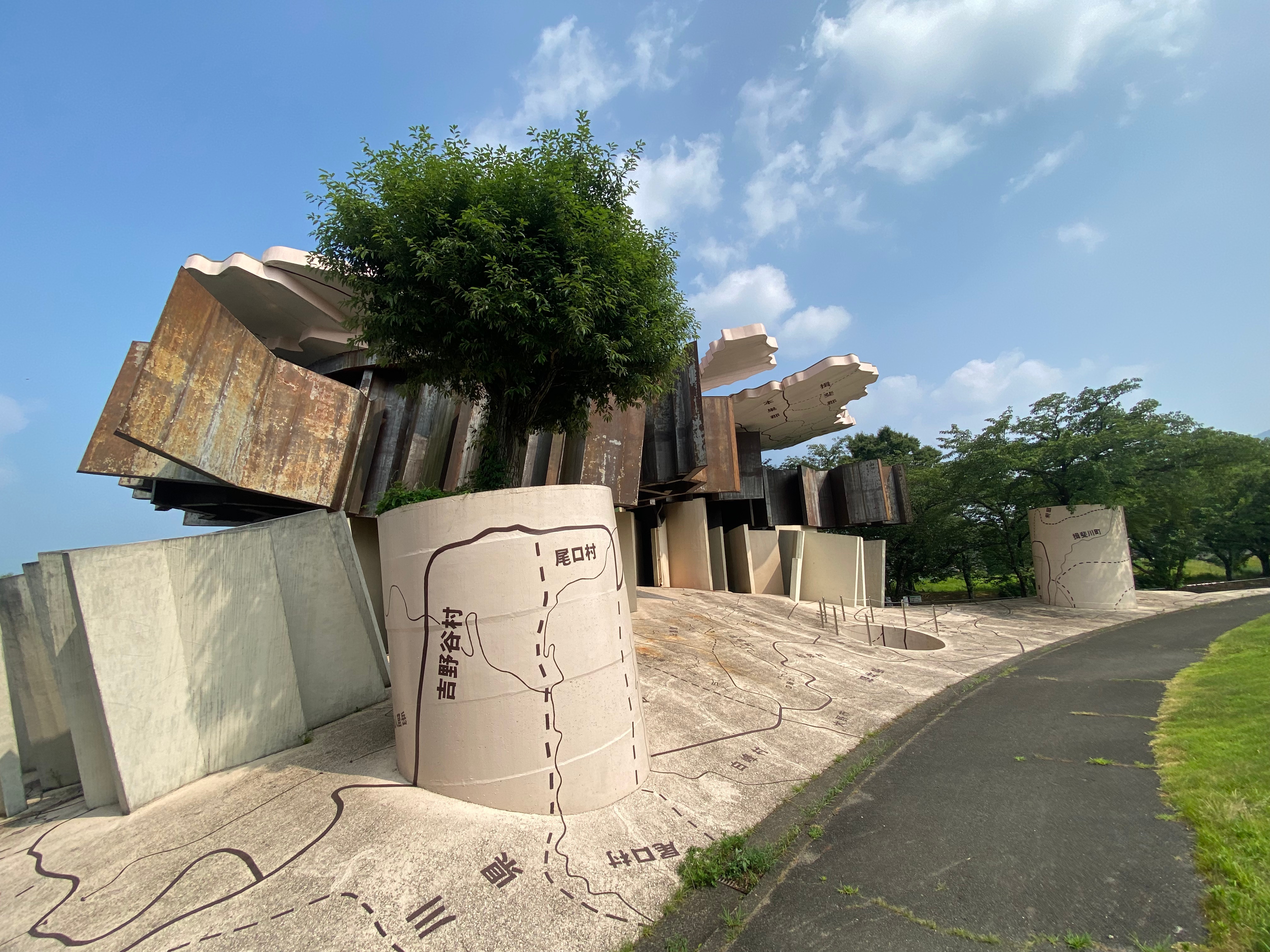
My final stop today is within Yoro Park, a place known as the Site of Reversible Destiny. A massive outdoor interactive art park dreamed up by Shusaku Arakawa.

It’s quite bizarre, funny, and downright unusual. There’s a house that is a road and a road that is a house. There’s a nostalgia generator, a few mazes, and some piles of things that I don’t even understand.

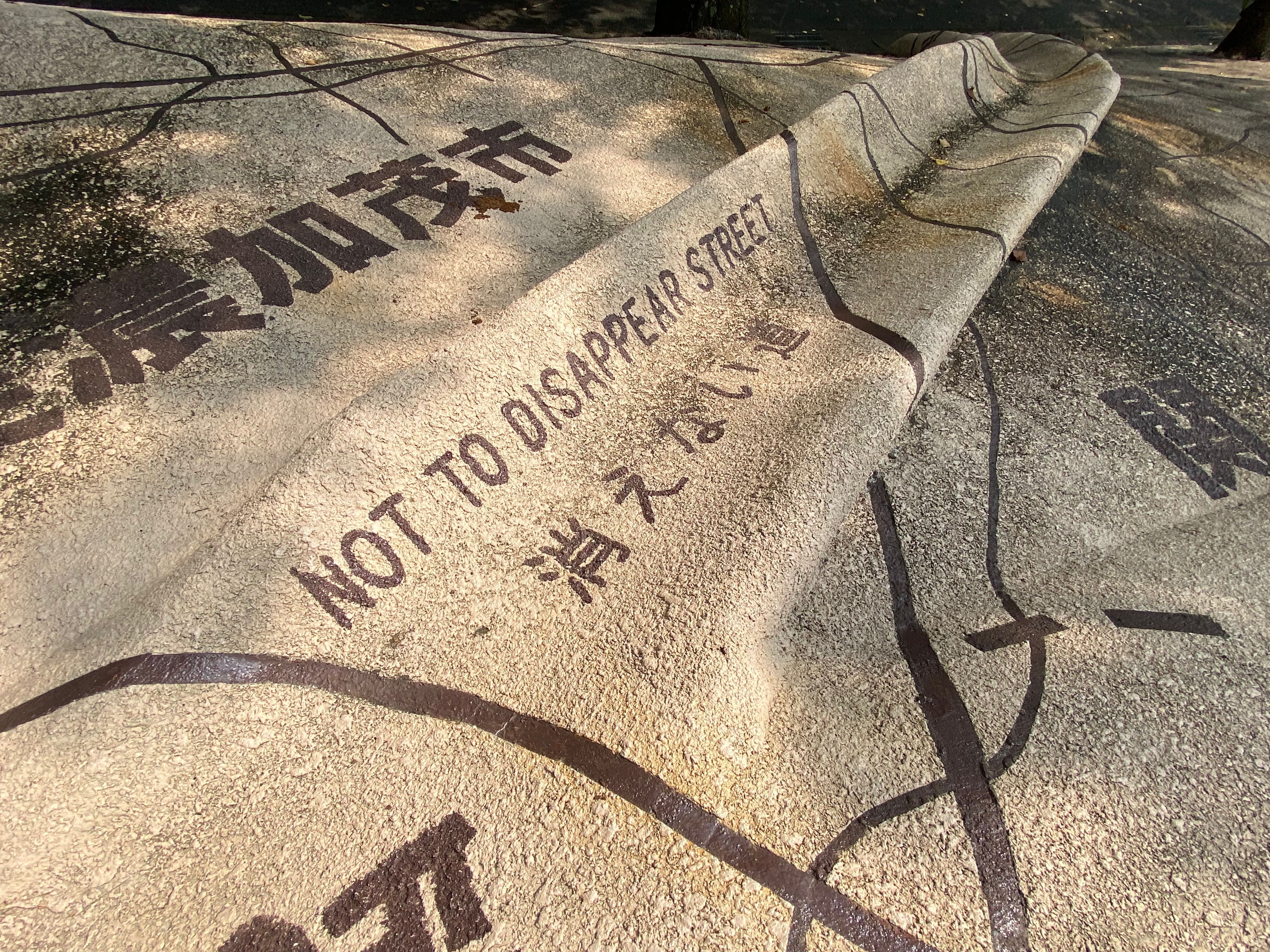
I pass Not To Disappear Street, the Gate of Non-Dying, and an area known as Geographic Ghost. I climb over the Zone of Clearest Confusion, leave through the Trajectory Membrane Gate, before getting lost in the multicolour of Destiny House.

Shusaku Arakawa was obsessed with the idea of death and destiny. He built this site with his wife, Madeline Gins, as a challenge to mortality itself. That’s the point of the Site of Reversible Destiny: to confuse your soul and reroute your path. When Arakawa died in 2010, his wife said, “This mortality thing is bad news.”

With fate as mutable as the weather, or the seeds of a dandelion, you blow away, only to take root in unexpected soil. My destiny begins to unravel. The sun still rises in the morning and sets in the west, but the days no longer feel the same. Each moment becomes a whispered echo of a choice that altered everything, carried on a timeless breeze.

The concept of a multiverse unfolds like a kaleidoscope of infinite reflections, where certainty and uncertainty intertwine like vines in an ancient forest, tangling into something that resembles fate.

Yet, if every possible outcome and path exists, there must also be a universe where the notion of such multiverses is impossible. It is here that we find ourselves staring into the paradoxical abyss.

Sweeping aside the contradiction of parallel worlds, it is on the train that I ponder the existence of a universe where I do not exist. As the train changes track to a branching line, the landscape blurs past, indifferent to my absence. My reflection in the window shimmers, quantum-thin.

For a moment, I am here and not here, observed and unobserved, a wave function waiting to collapse. I step off the train. I step into the world. And the world, impossibly, steps into me.

A Spiral, a Darkness, a Fever, and a Staircase

I wake up in pain. Cramp. My leg screams. I’m in Fukushima Prefecture, Aizu-Wakamatsu, an old samurai town with a historical past. I’ve been here for a few days. I feel oddly connected to this place in a way I’m really not sure how to describe. Aizu is famous for its samurai and a red cow named Akabeko (translated to mean red cow).

I leave my hotel. The sun is so bright that the sky isn’t blue, but white, yet there are no clouds. It’s like walking through a thick fog of heat. Imagine you’re a little tiny person the size of an ant, walking through an oven set to 180 degrees. That’s what it feels like. I walk across the sheet pan in the direction of the mountains, vaguely knowing that I will arrive somewhere spirally important.

In Aizu, the legendary red Akabeko cow can be rubbed and is said to heal illness or sickness. The thing I like about Akabeko is that they have bobbing heads, so every time I walk past one I push its head down and smile as it nods up and down.

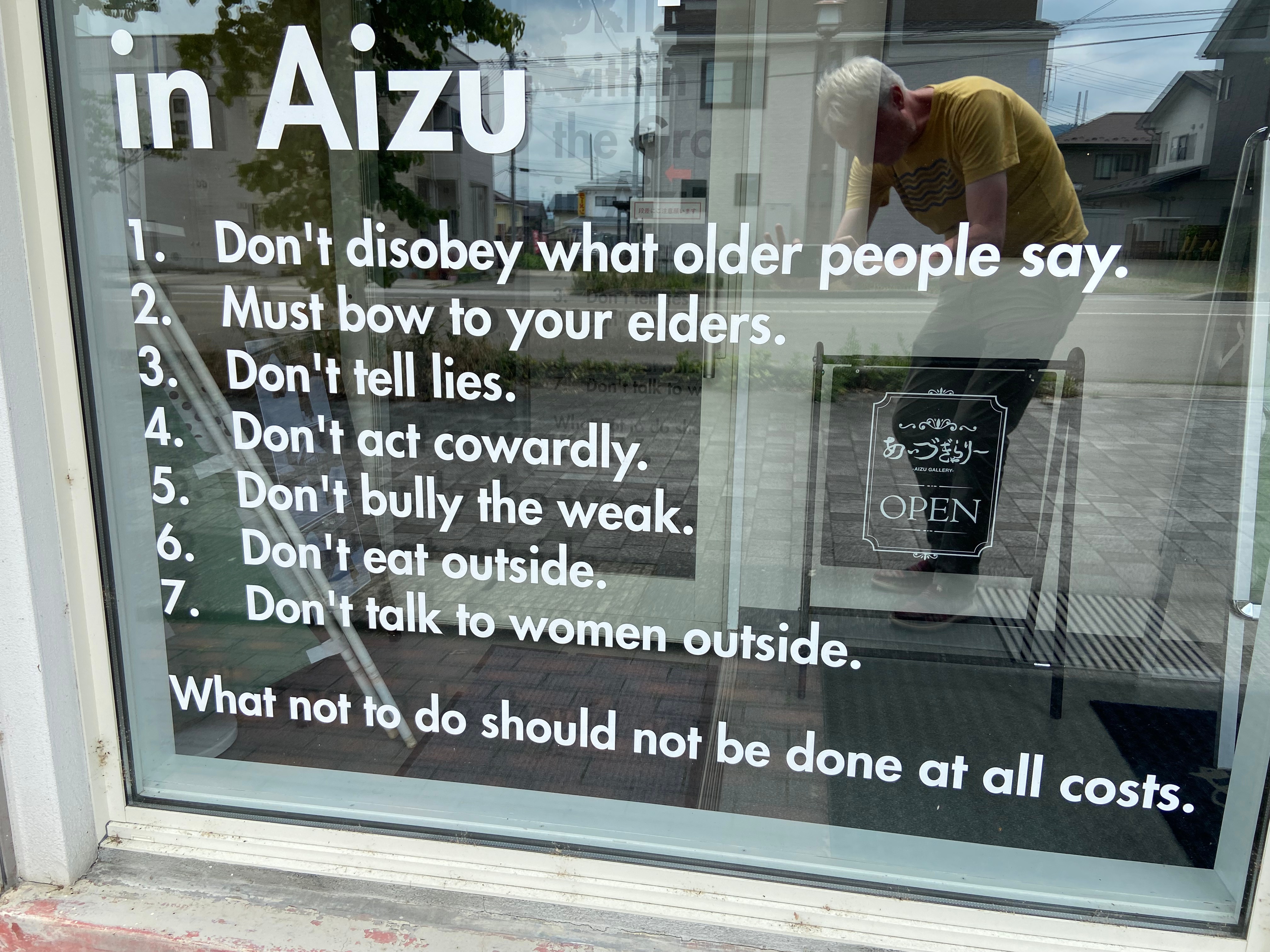
A little further up the road, Aizu-Wakamatsu is offering politeness lessons:

Don’t talk to women outside. Must bow to your elders. The two conflicting lines bother me, because as I photograph the sign, an elderly Japanese woman starts speaking to me in Japanese. Obeying the rules, I just bow my head and walk away.

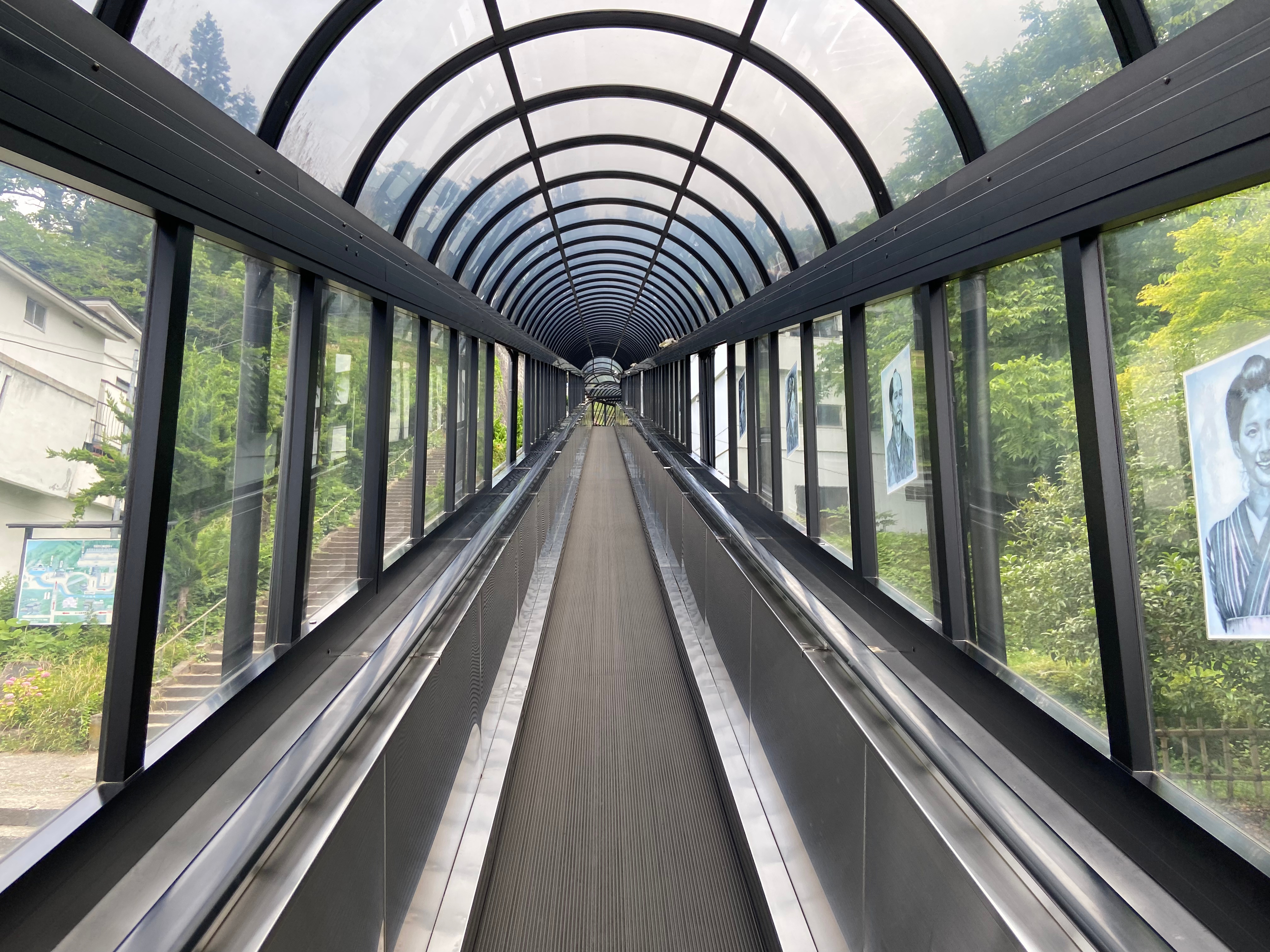
A black Seven Eleven with none of the usual green and red stripes greets me funereally; I’ll soon find out why it’s black. The cascading sunshine and the black stripes make me feel as though my eyes are glitching. Outside the entrance to Sazae-do Temple, there are sweeping steps that twist all the way up, but someone has placed an escalator to one side. You have to pay 250 yen to ride it, but the cramp is threatening to return.

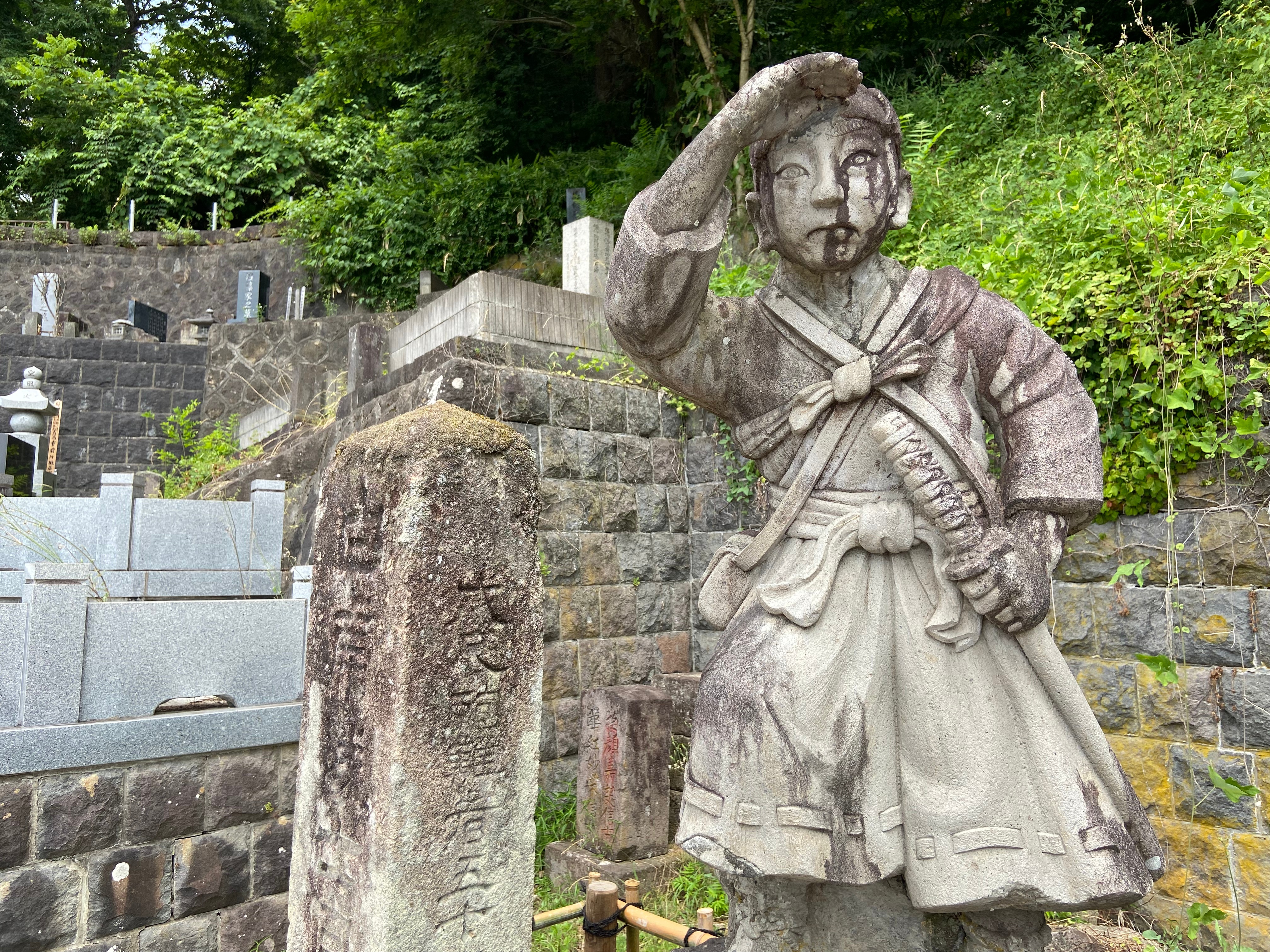
I don’t know what it is about today, but as soon as I step off the escalator and into an open area of monuments, the suddenness of place hits me, catching me off guard. To summarise what happened: on October 30, 1868, during the Battle of Aizu, the Byakkotai, a group of teenage samurai thought they had lost the civil war. They saw smoke in the distance, thought the castle had been sieged, so they killed themselves, not far from where I stand. Learning this, I become swallowed by sadness.

Their bodies were left outside for days, until a man, Isoji Yoshida, decided to take it upon himself to move the bodies of the dead children and bury them. For this, he was arrested. Katamori Matsudaira, the 9th lord of Aizu, wrote a poem in their honour. It goes:

“People will visit, and their tears will fall upon your graves. You will not be forgotten.”

There are monuments here for everyone involved. For the dead children, for all who died. The tomb of sixty-two fourteen- to seventeen-year-old samurai. It’s devastating. I try not to bring myself too much into these stories. But this place, these dead children, their story found its way in. I think what gets me is they don’t mention the word suicide, they explicitly state every time that they killed themselves.

I weep my way around a cemetery before turning toward the temple I originally came up this hill to see. There is a prayer wheel that, when you turn it, creates a mournful sound said to be heard in the underworld, comforting the spirits of the Byakkotai warriors. “Please turn it quietly with your heart.”

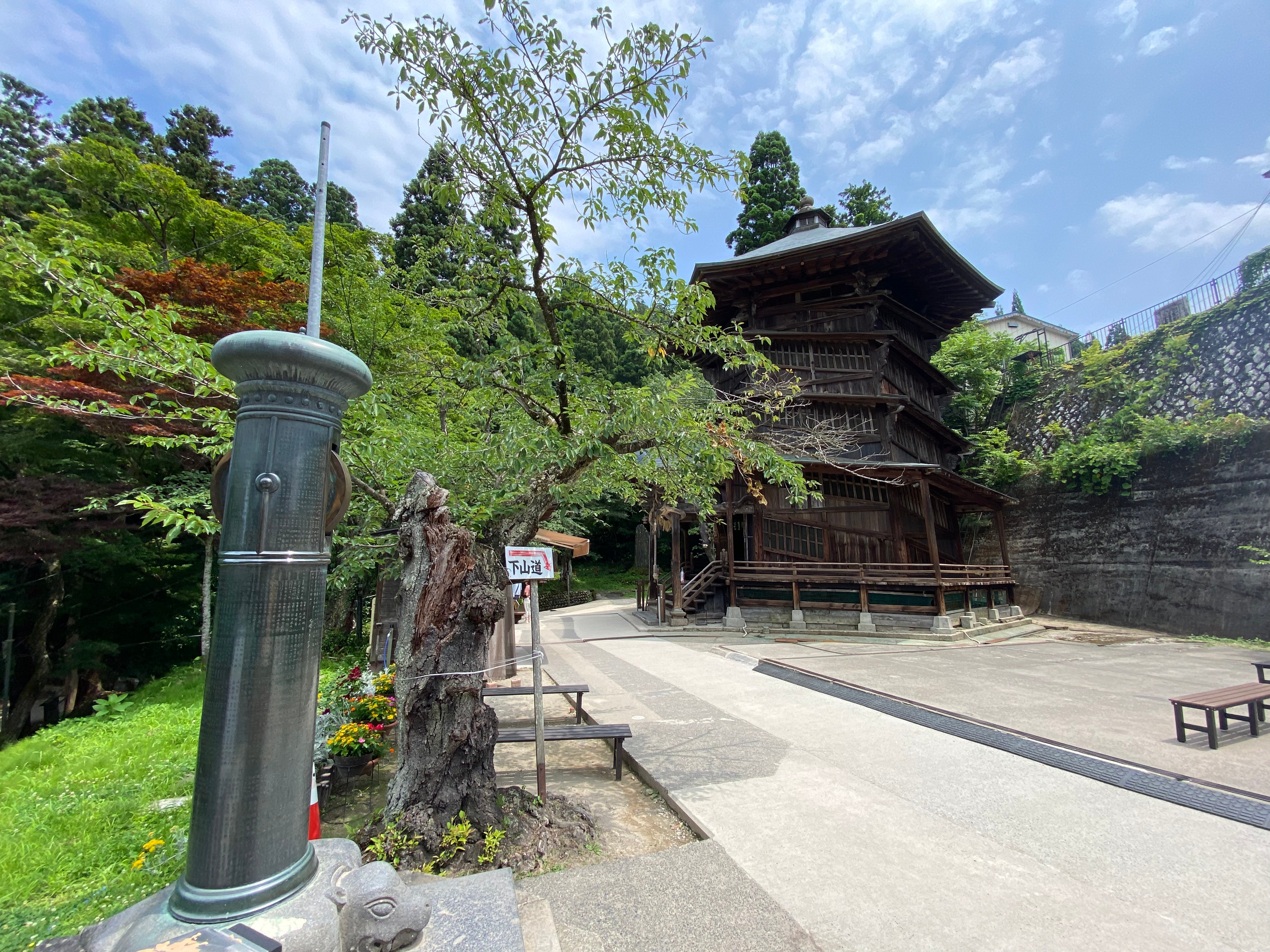
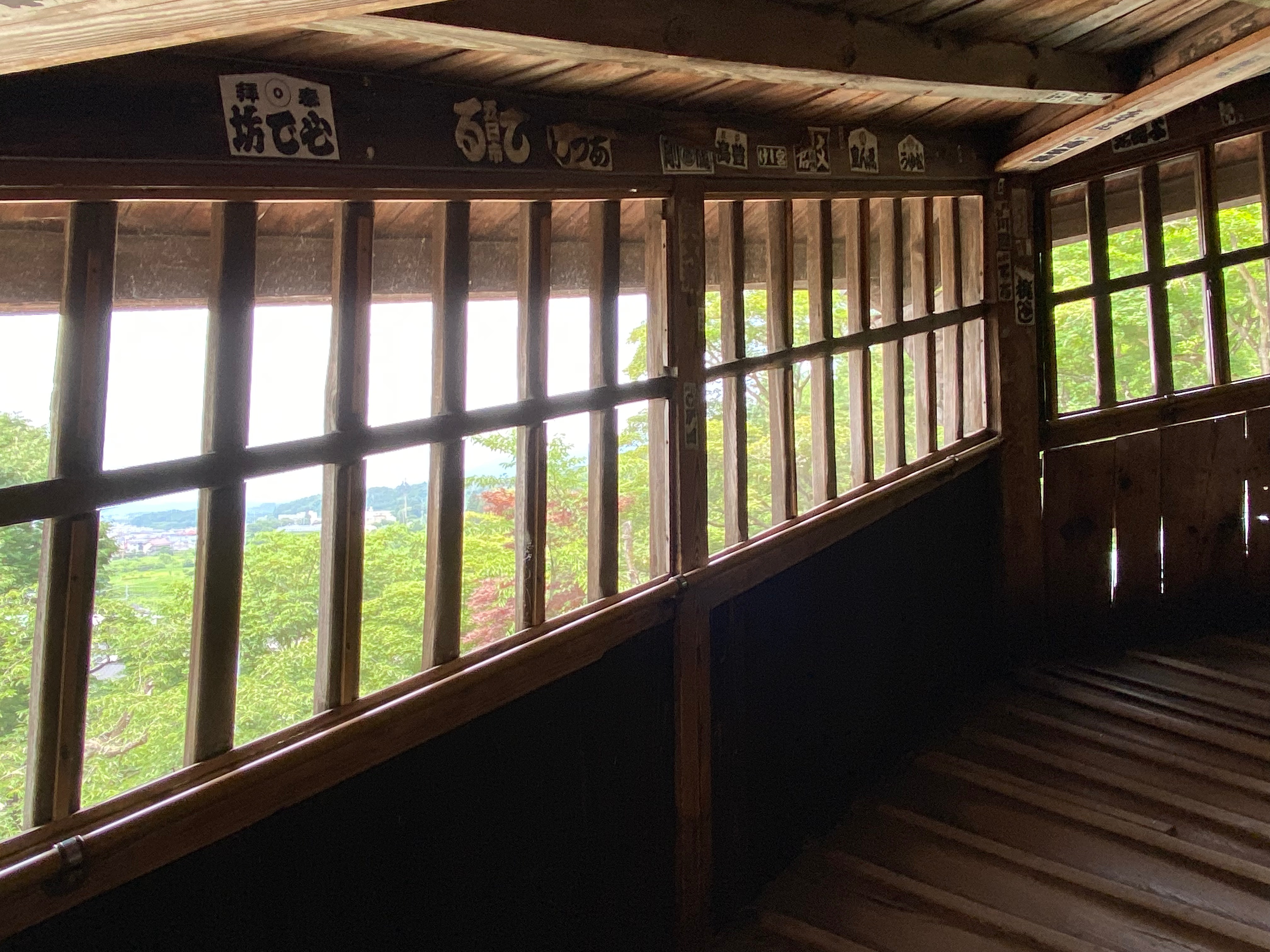
Sazae-do, a wooden Buddhist temple constructed in 1796, is famed for its distinctive spiral staircase that ascends and descends in an intricate, intertwining path. Encircling the ramp are 33 Kannon statues, each believed to grant the same spiritual merit as completing the entire Aizu Pilgrimage route to anyone who passes by them.

At 16.5 metres tall, three storeys, and shaped like a hexagon, you enter from the right side, climb the spiral staircase, and exit back down another way. You never see another soul. This valuable structure is the only wooden building of its kind from the mid-Edo period still standing in the world. It’s also the only known double-helix-shaped wooden structure in existence.

I breathe a heavy sigh before exiting through the gift shop and buying a shirt featuring Akabeko. I think about people, those loved and lost, on days when we exist together, and days when we don’t. At five o’clock, Yuyake Koyake starts playing, the song that tells the children to go back home. It elevates my sadness.

I head to a steak restaurant for dinner. I eat the red cow’s bleeding heart.

Quivering Heights

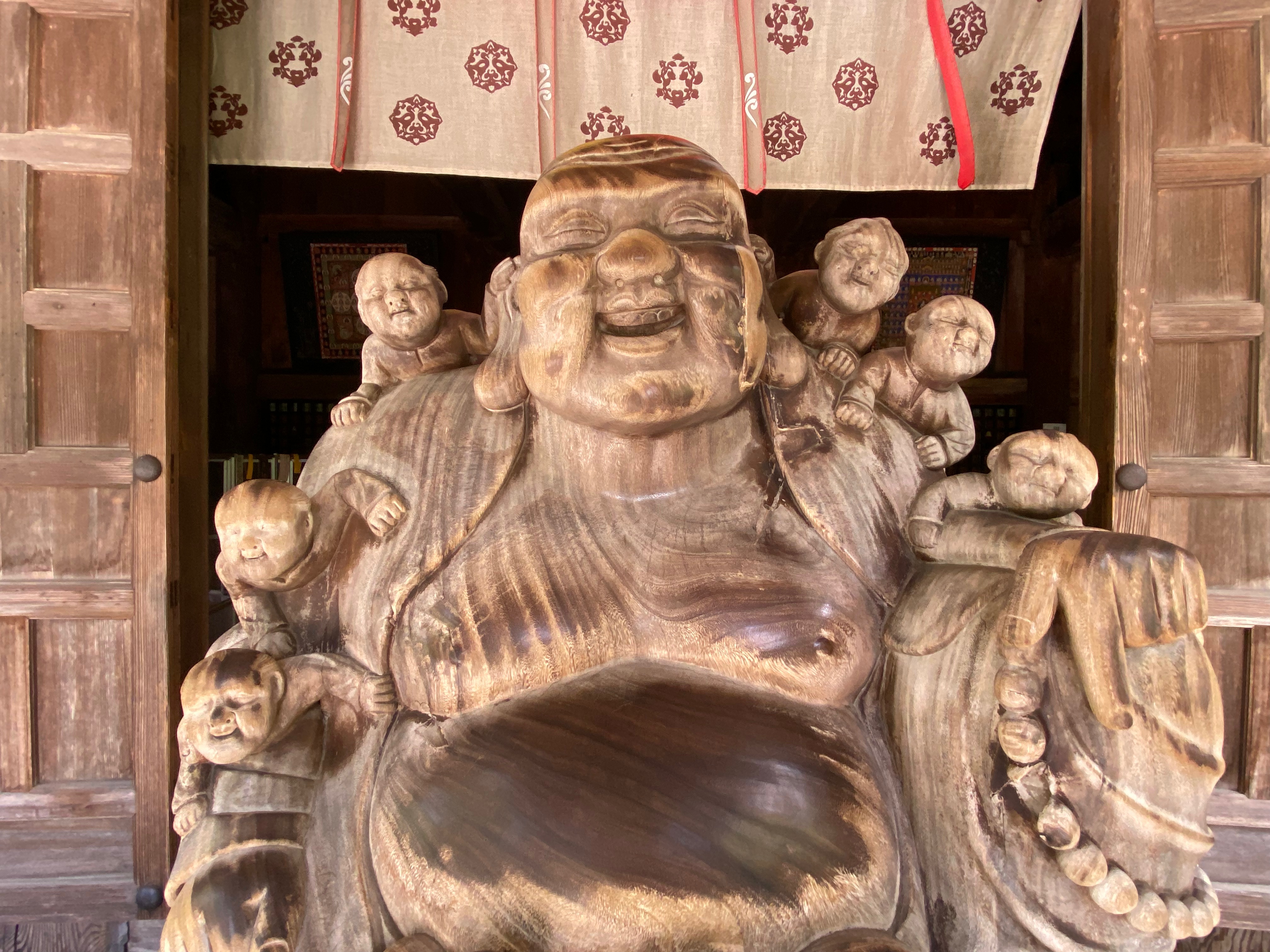
I’ve come to Mount Hoju in Yamagata Prefecture to experience one of the best views in Japan. At the base of the mountain is the usual buzzing of tourist-targeted shops selling shaved ice, overpriced noodles, and fish-shaped waffles. Beyond that is the oldest beech wood building in Japan, home to a massive wooden statue of Buddha.

The statue is Yakushi Nyorai, the Buddha of healing. They say that if you have an illness or ailment, something you want cured, you rub that part of the Buddha, then climb to the top of the mountain and you will be miraculously healed. Naturally, I rub the Buddha on the neck and hope my scars fade.

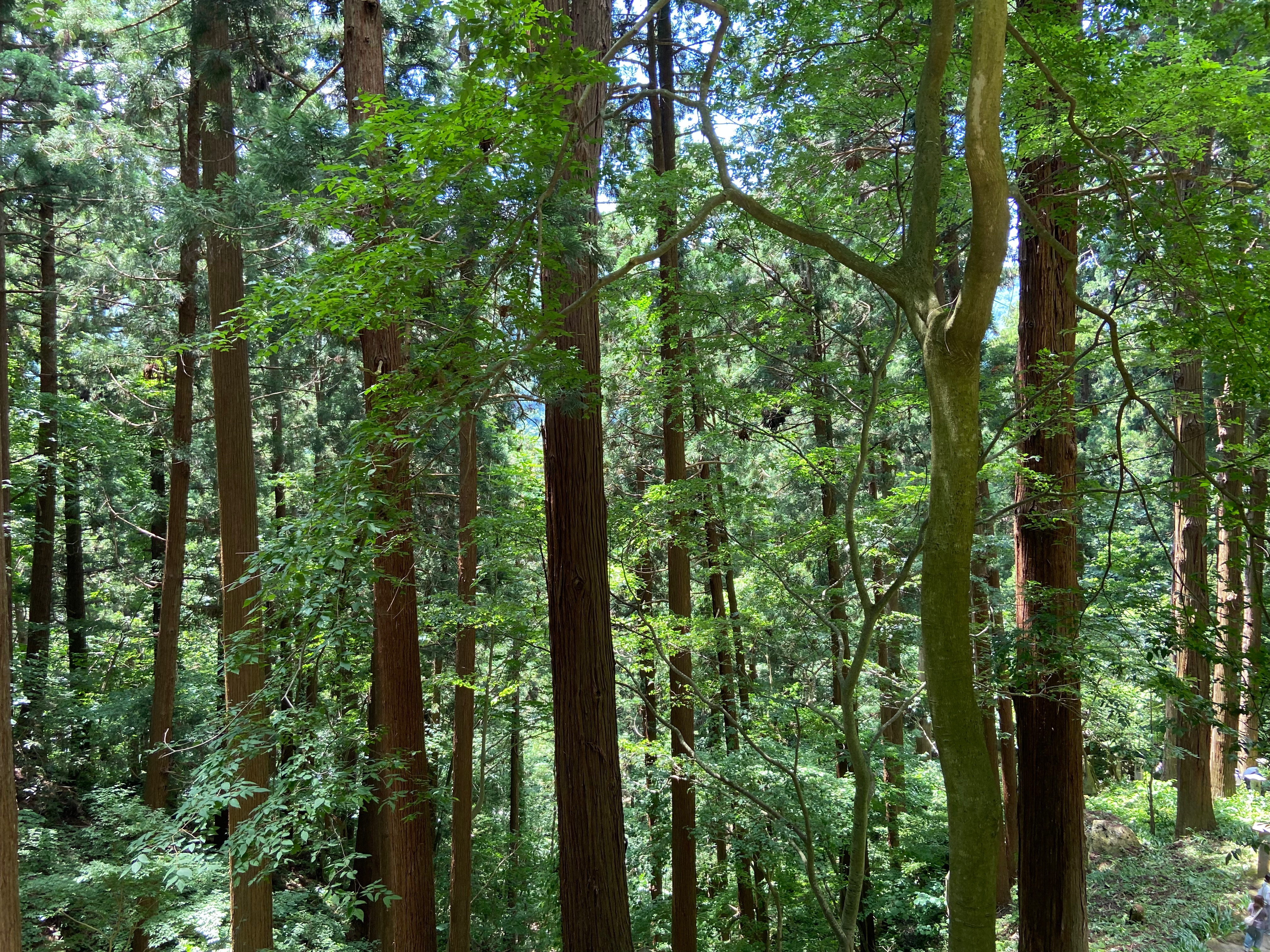
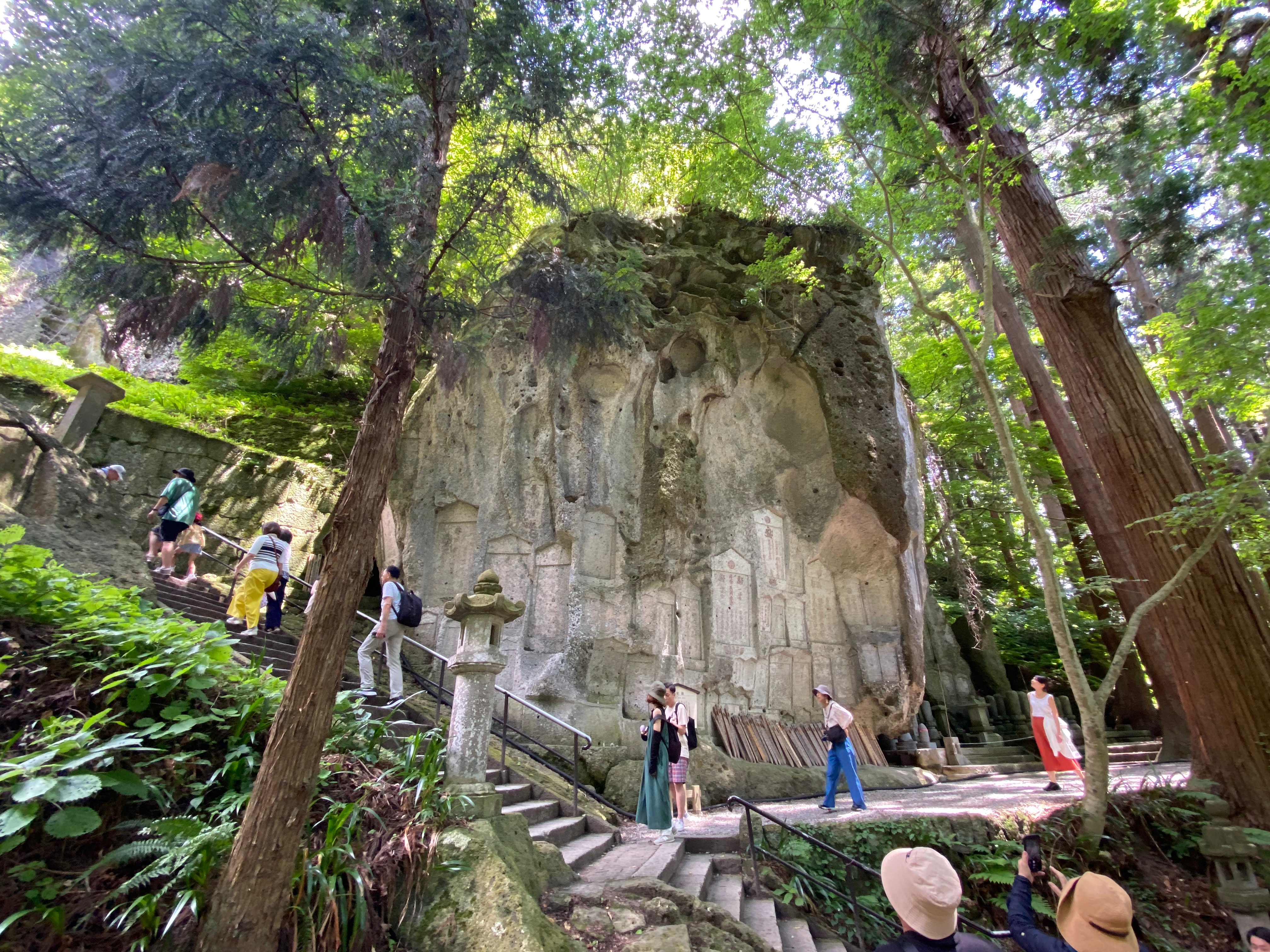
Next, it’s time to climb the mountain. The road to the temple is 1,015 stone steps surrounded by thick woods and strangely shaped rocks. Cedar trees make up the mountain forest. The Risshakuji Temple at the top of the mountain means “Mountain Temple,” which is the perfect name for it, considering it is atop a mountain.

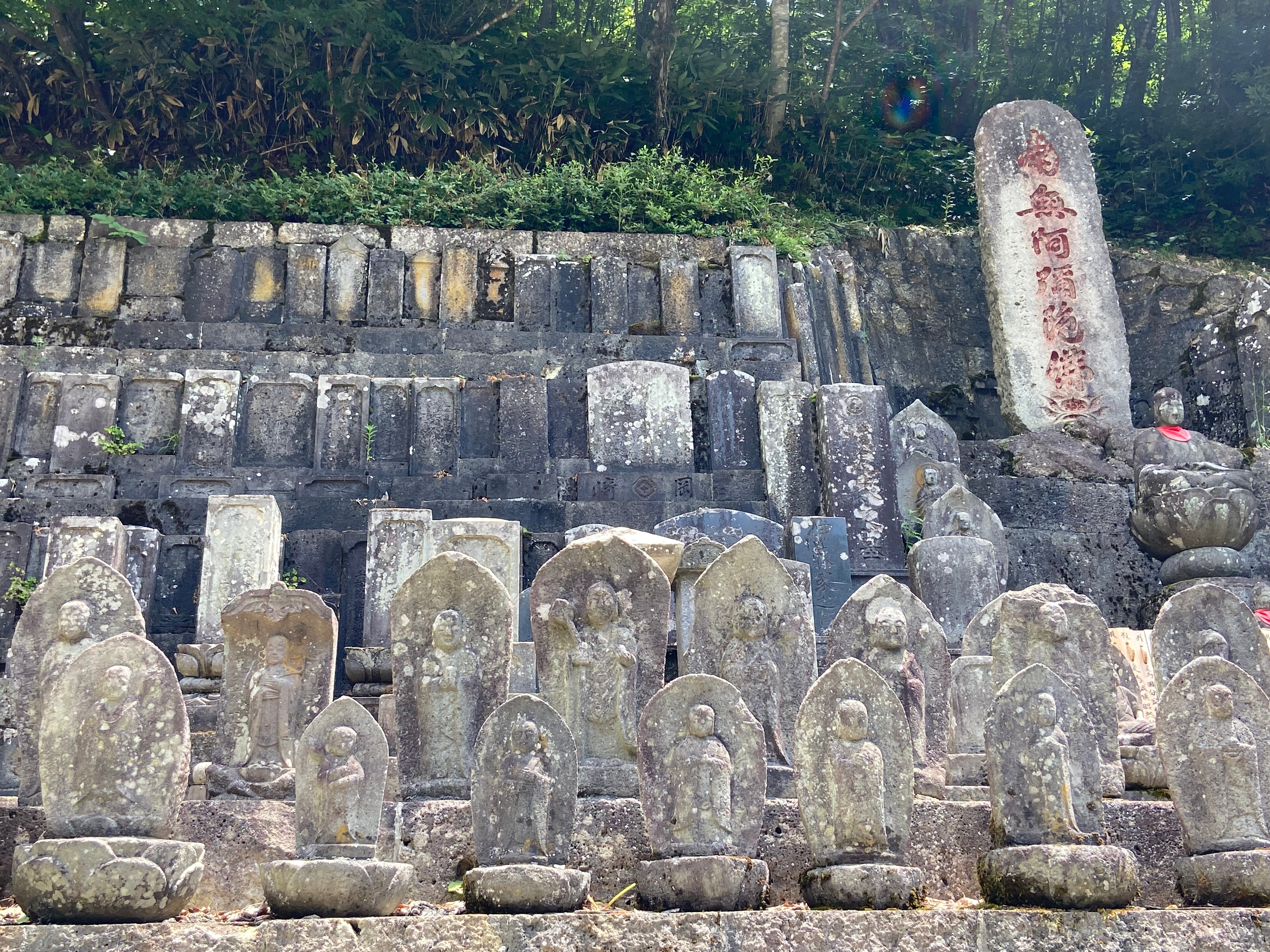
Some of the steps are in sections of 108, to represent the 108 Buddhist sins. There are Jizo statues scattered throughout the ascent adorned with coins. There’s a monument engraved with another poem by Basho, and it’s a famous one:

Such stillness,
the cicadas’ cries,
sink into the rocks.

After the second set of 108 steps I’m already worn out. Half a million steps last month, I now find myself humbled by a mere 216. I’m already close to spiritual defeat. The day is hot, the air quality poor, and it’s very humid. It has a way of wearing me out, I suppose.

It’s so hot that every now and again there will be an ever-so-slight breeze, and every time there is, I notice it. A lot of the Japanese people are carrying these little portable electric handheld fans. A country famous for fans, so it makes sense. At about 550 steps there’s a massive rock that everyone is photographing.

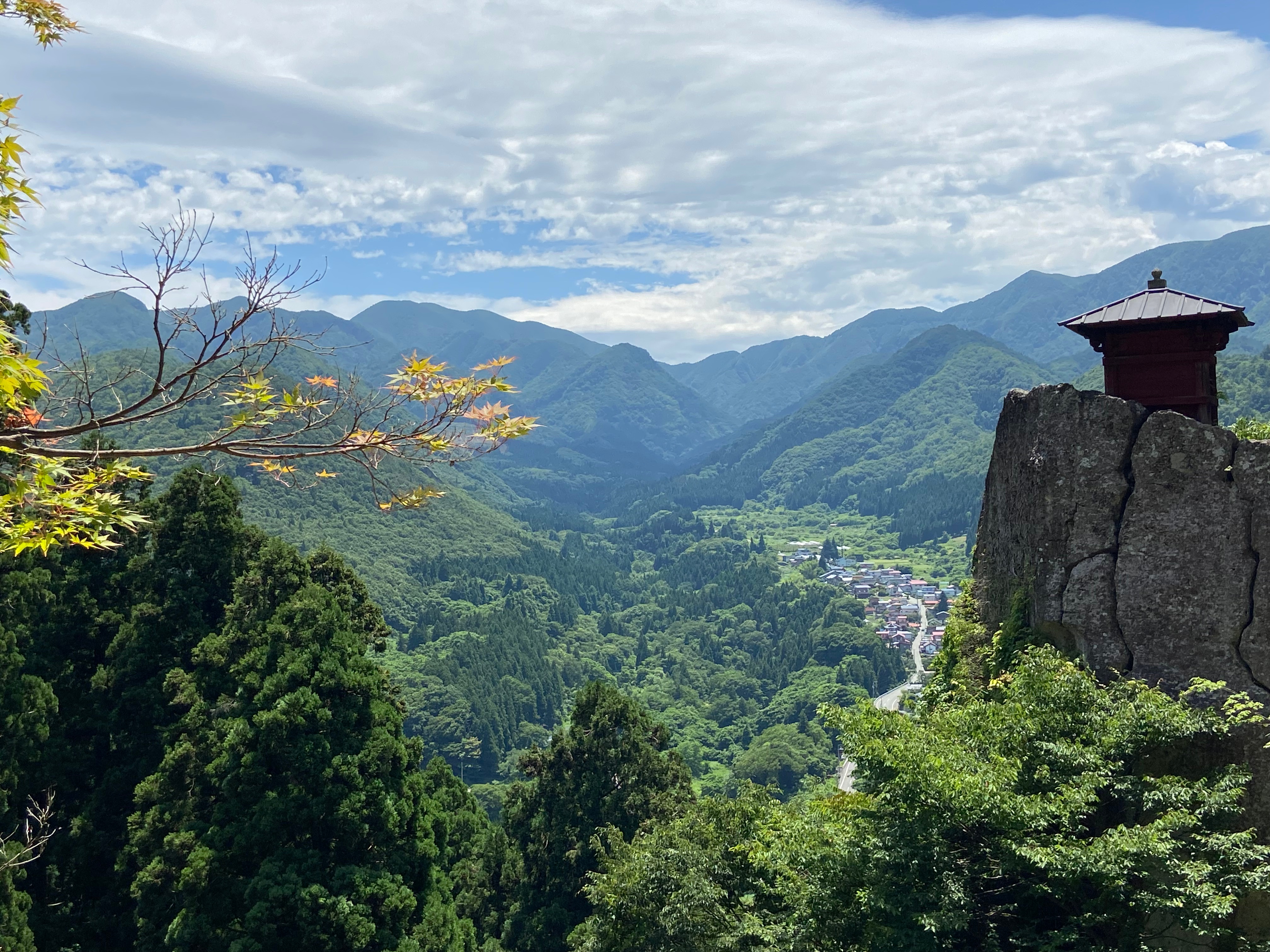
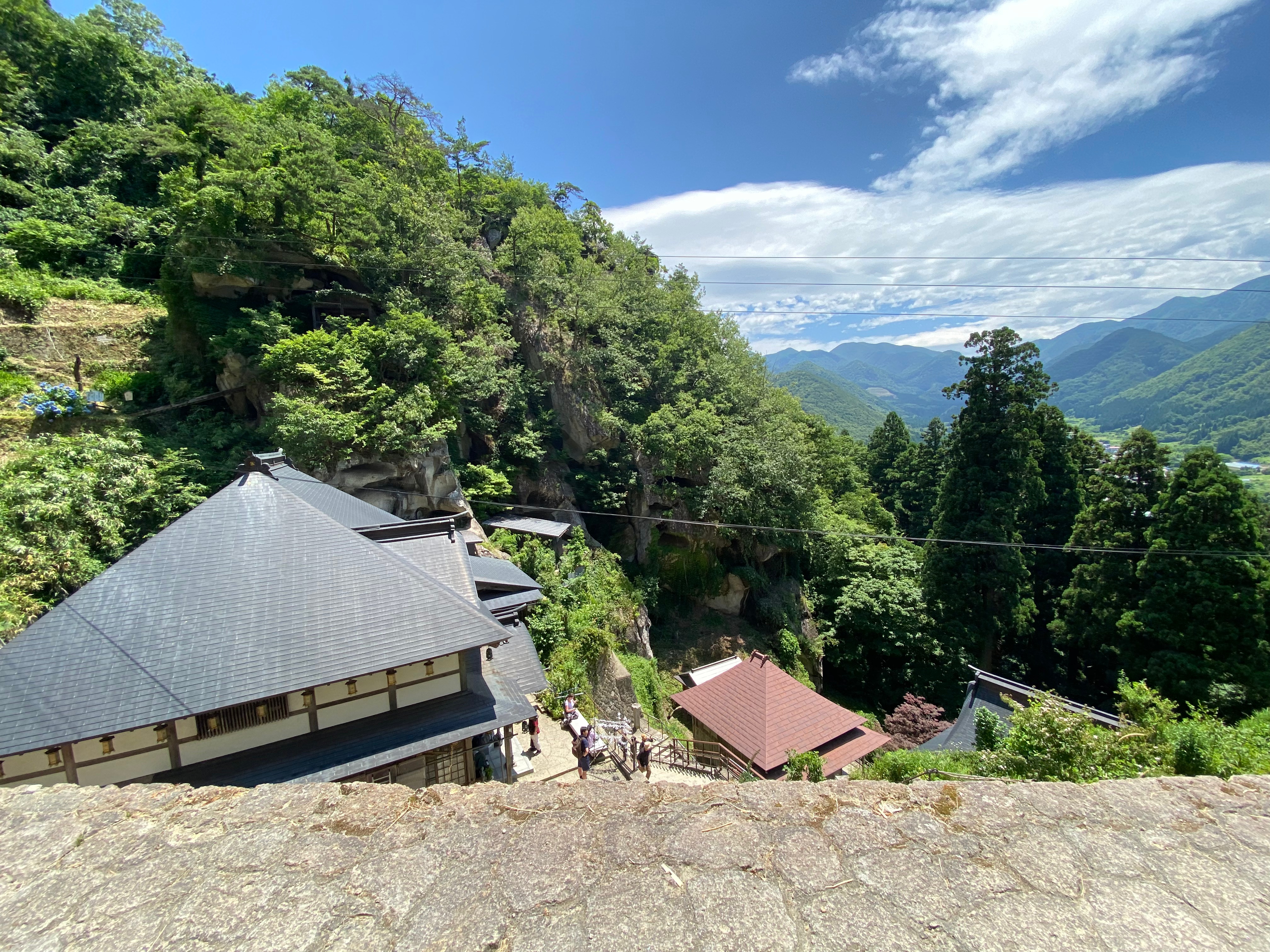
Further up, there’s Risshakuji, founded in 860 AD, a small temple of minimalist qualities. From here I realise just how high up I am, that I can make out the city below. The thing that’s unusual is there is no barrier here. I could fall off the mountain in an earthquake, and that’s exactly what almost happens.

The mountain shakes, ever so slightly. A shift. Nobody else seems to react or notice. It’s just the subtle shift. The whole thing took a tiny step to the side. The mountain itself… adjusts. It’s not dramatic. Nothing tumbles. There’s no sound. But I feel it. And for a moment I am filled with dread. Then it stops. I wonder if being on a mountain is the worst place to be during an earthquake.

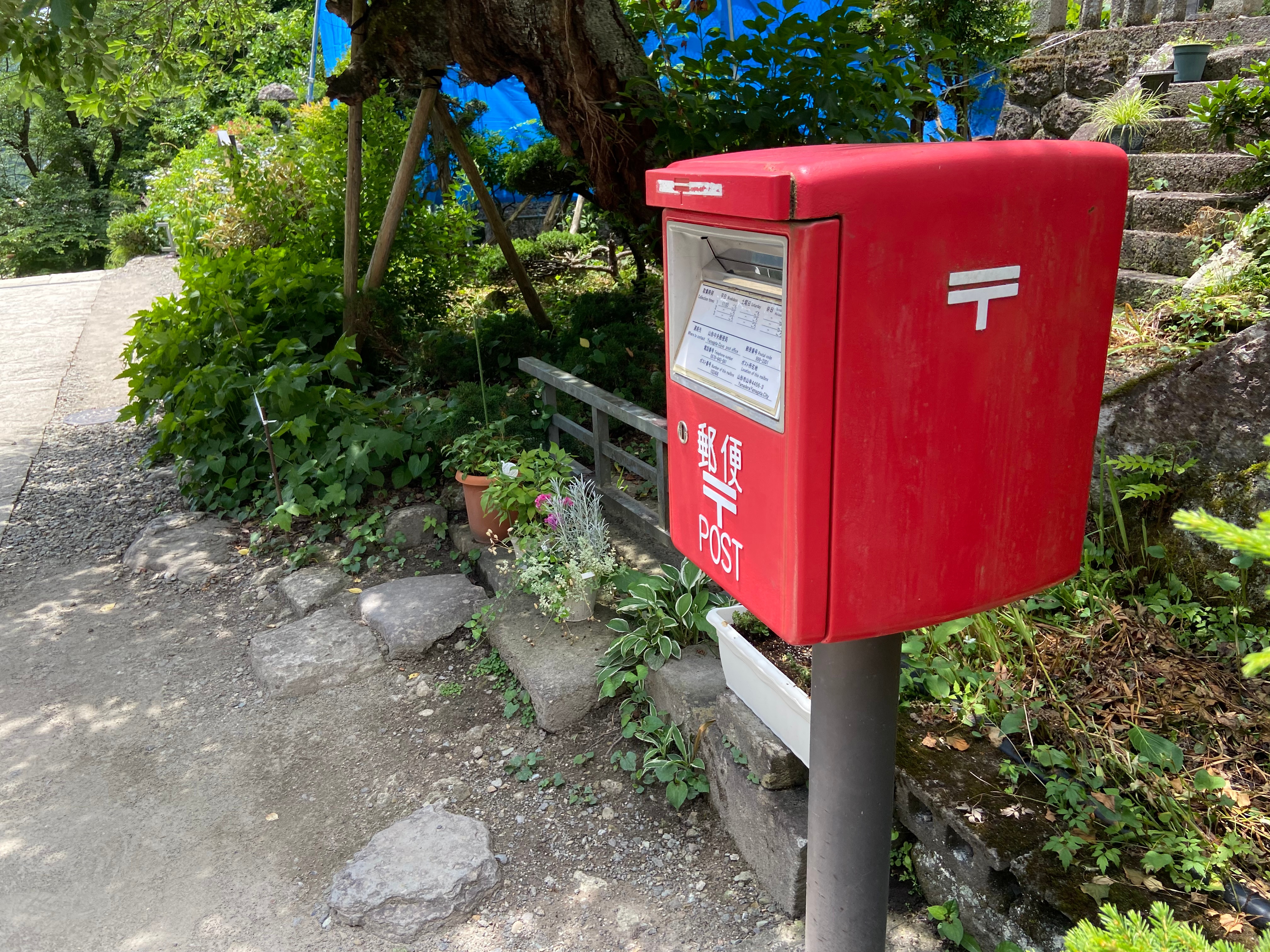
Very close to the top of the mountain is a post box. At the bottom of the mountain there is a post office, a mere 940 steps away. I naturally feel sorry for the postman whose job it is to walk up and down a mountain every day to collect what is likely just the odd piece of mail.

1,015 steps. I reach the top. The cicadas’ song fills the humid afternoon here, sharp and piercing, like needles being driven into a heart. Their cries echo, sinking into the ancient rock.

A cemetery at the top concludes the climb. Crooked gravestones pushing through moss. Everything here is slanted, aged, dignified in its entropy. I sit beside the tombs, trying not to melt into them. The mountain temple echoes these themes of death, decay, and transcendence as it climbs through cemetery terraces and silence.

I stand to rest, to catch my breath, to take it in. My shirt clinging to me like skin, thirst calling me to a vending machine back at the base of the mountain. But I linger. Amongst the graves, everything feels tilted. Stones, time, even thought.

Walking down is the reward as I can see it all. All the views, all the way down. There’s something about a good vista. I say goodbye to the top of the mountain, and goodbye to the vista. Hasta la vista. Until I see the view again, opening like lungs exhaling. I can see the whole valley now, softened by haze.

Back at my capsule hotel, I voluntarily entomb myself in a plastic drawer like a very polite corpse.