The Men Who Scare At Boats

There’s a massive clock outside Kii-Katsuura Station. Each tick sounds like a nail being hammered into a coffin. About a twenty-minute walk from the station, between the mountains and sea of Wakayama Prefecture sits Fudarakusan-ji, a small, unassuming Buddhist temple with a wooden boat outside.
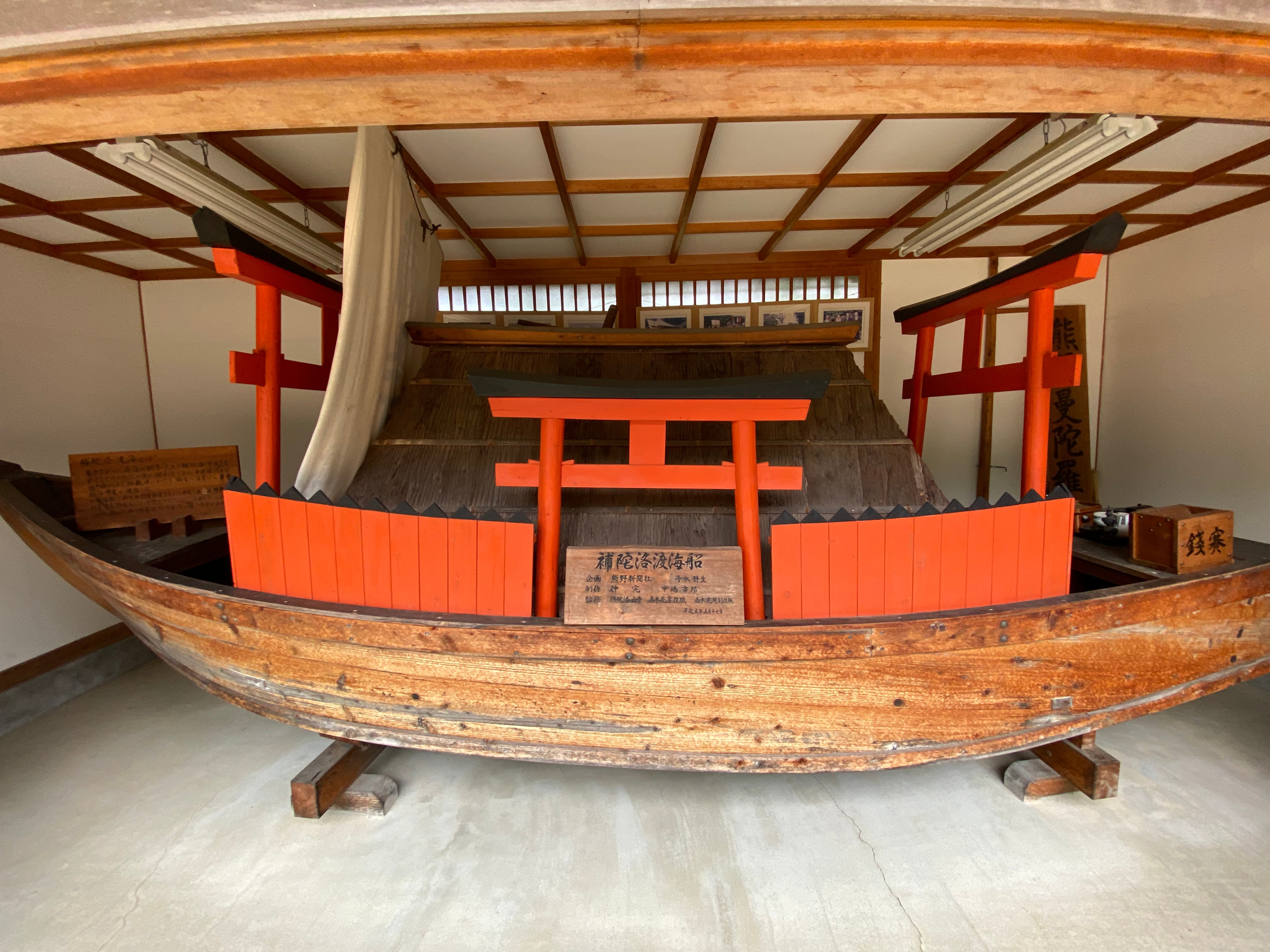
The temple was built to face the Pacific Ocean because that is the perfect location for casting boats out to sea. The only problem with these boats was the reason they were cast out; the priests inside them were trying to reach Fudaraku, the Pure Land.

The boats were designed with a sealed cabin, no windows or doors; a claustrophobics nightmare. Ever had a dream about being buried alive? The priests here lived it. They’d climb inside, and the boats would be nailed shut from the outside. The orange wood and torii gates surrounding all four sides of the boat are a nice touch.
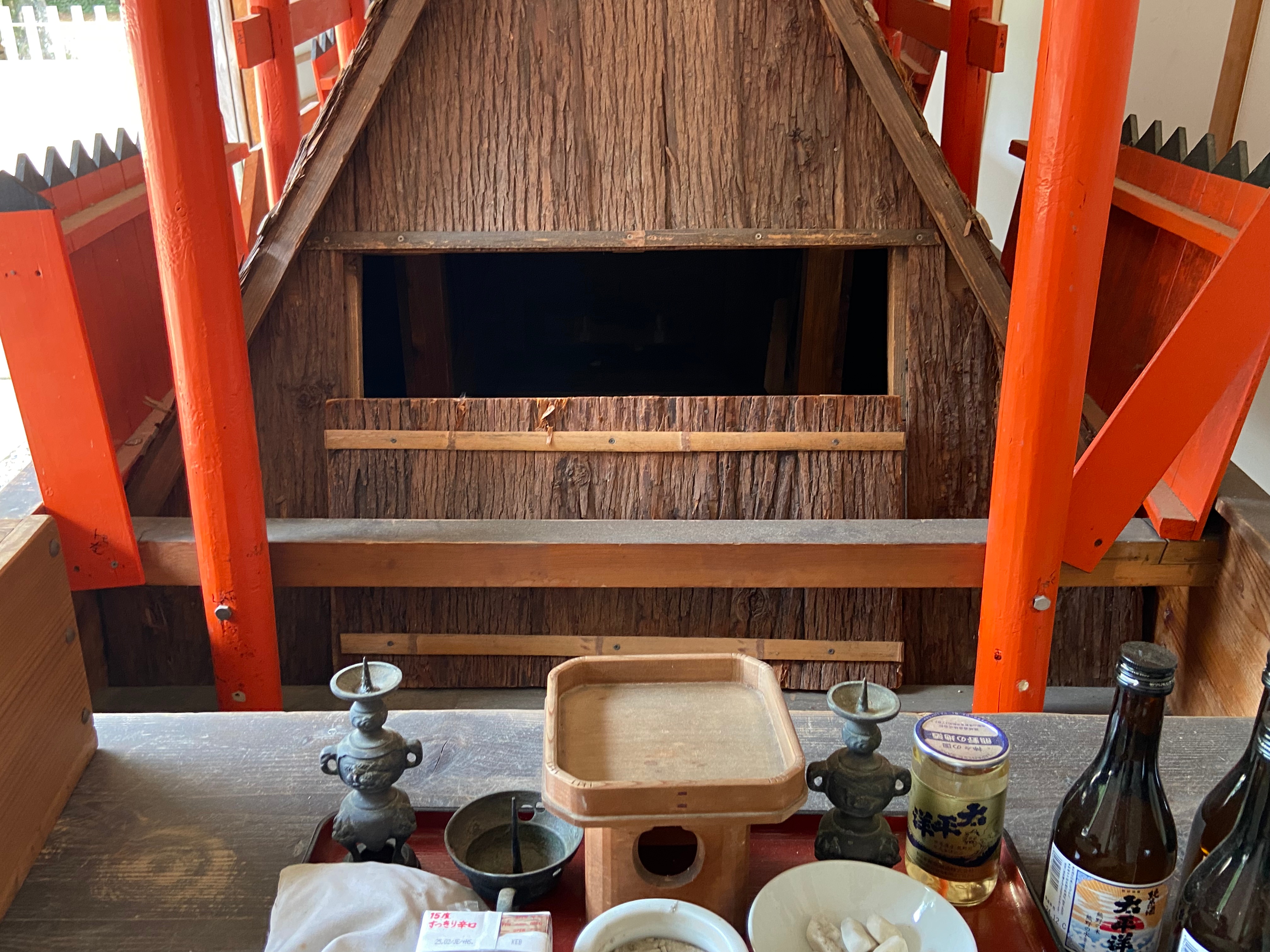
Water, a small supply of food, and a fuel lamp were placed inside before the priest’s departure. The lamp was there so the priest could keep reciting sutras and appeals to Kannon until they found the Pure Land, until they reached the end of their journey, or their life.

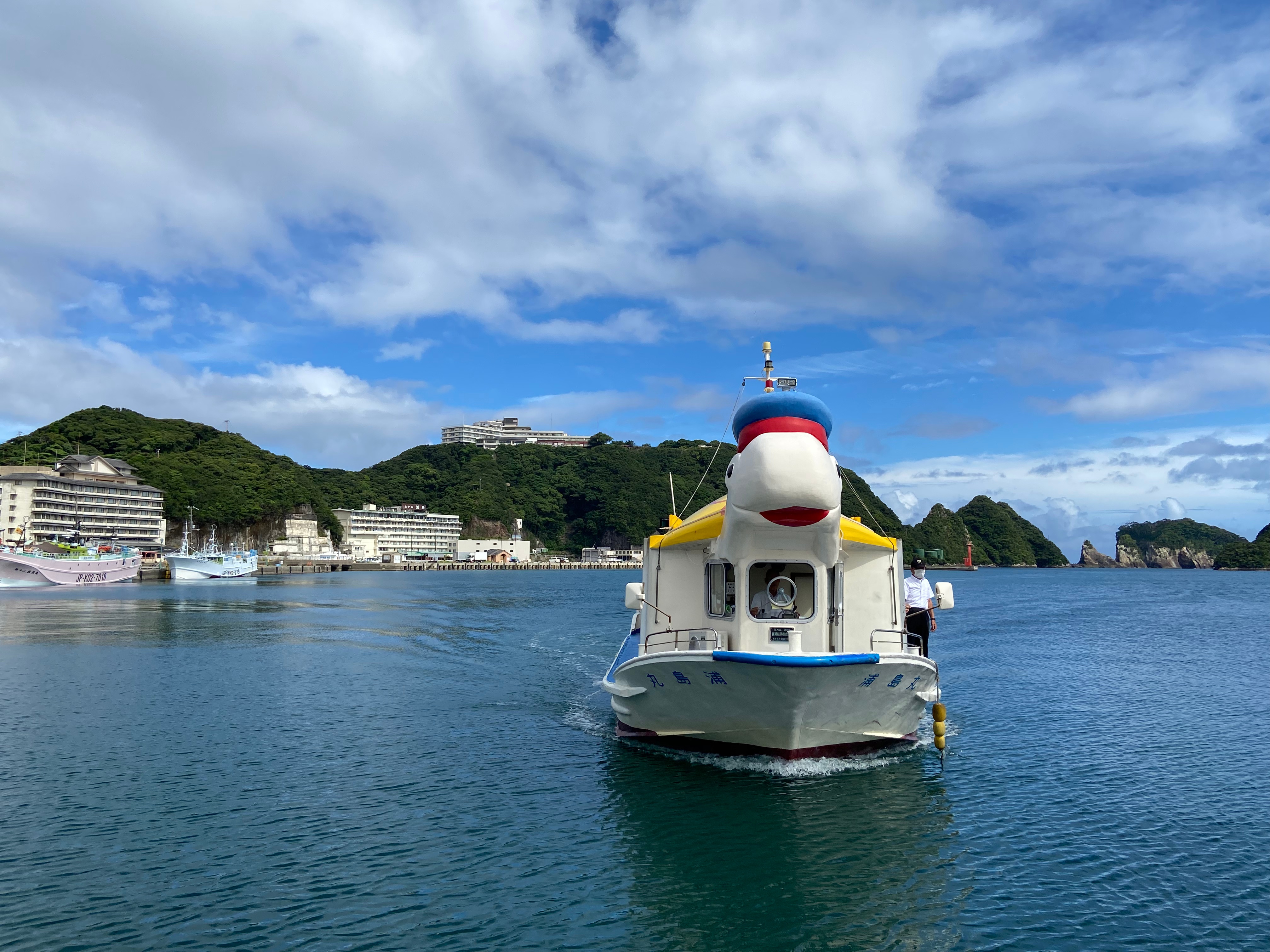
Some of the boats washed up in Kii-Katsuura Bay. A few priests escaped. Most died of starvation, drowning, or dehydration. To stay on theme, I book a night in Urashima. To get there, I have to board a boat myself. This one features no death, just a turtle mascot. The four huge buildings making up the backdrop are all part of my hotel: one on top of a mountain with an observation platform, one at the side of the mountain connected through a network of tunnels, one at the base of the mountain by the dock, and one that isn’t shown on any maps but is there, accessed through the labyrinth.
Checking into my accommodation I’m provided a map. The hotel is so large it features a multitude of interconnected buildings attached through tunnels and cave systems carved into a mountain. The place describes itself as a resort and spa. It has everything: five onsen baths, a games centre, karaoke rooms, a Lawson Stores, shopping streets, massage parlours, restaurants for eating, ballrooms for dancing, ball rooms for ball games, conference rooms, well you get the idea.

There’s one area where I have to take multiple escalators rising the length of 154 metres that take about five minutes. There’s rest areas between each escalator with sofas and tables, just in case the standing becomes too much. I exit onto the 32nd floor and admire the view.

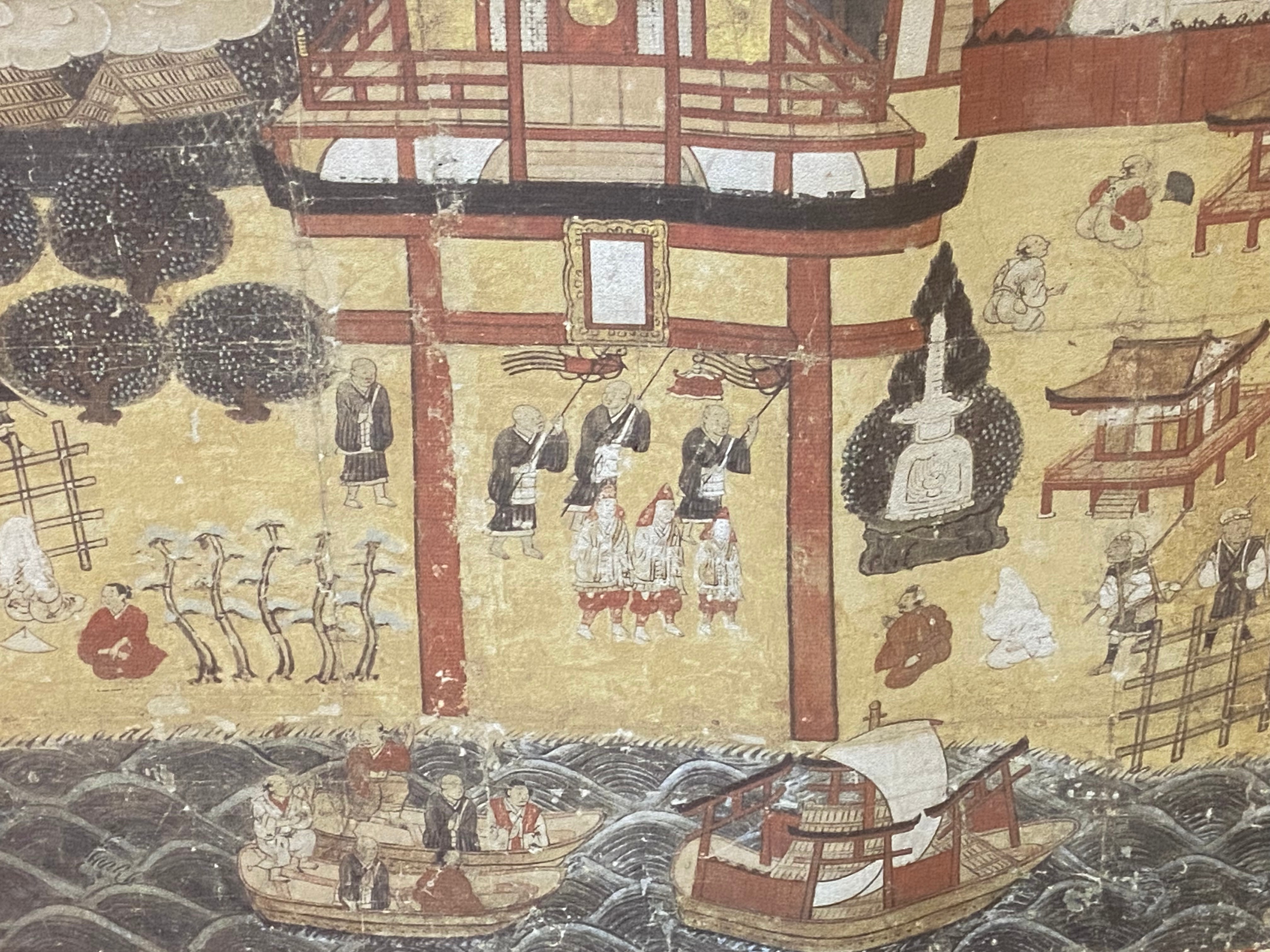
On one of the random floors, I find a replica of an original painted tapestry held in the Treasure Hall at Kumano-Nachi Taisha Grand Shrine. I’ll visit there tomorrow, weather permitting. The full tapestry features the Nachi Pilgrimage Mandala, which displays all the details of this area, from the top of the waterfalls down to Fudarakusan-ji. Here, at the bottom, one of the boats is being cast away into the Pacific Ocean.
Walking through the hotel, I feel as though I’m in some cult dystopian movie. Everyone is walking around in matching yukata. Some of the tourists are not Japanese and wear their yukata crossed the wrong way, for funerals. Everyone goes for breakfast at the same time, for dinner at the same time.

The hotel feels almost haunted, some entire areas are abandoned. It would be the perfect setting for a horror movie. It makes me feel like a rat in a maze or a character in Severance as I navigate the hotel’s endless, echoing corridors.

Having just about explored every length of the hotel, I decide to end the day by soaking in the healing power of a hot spring bath. Of the five to choose from, I opt for the one carved into a cave that looks out onto the Pacific Ocean.

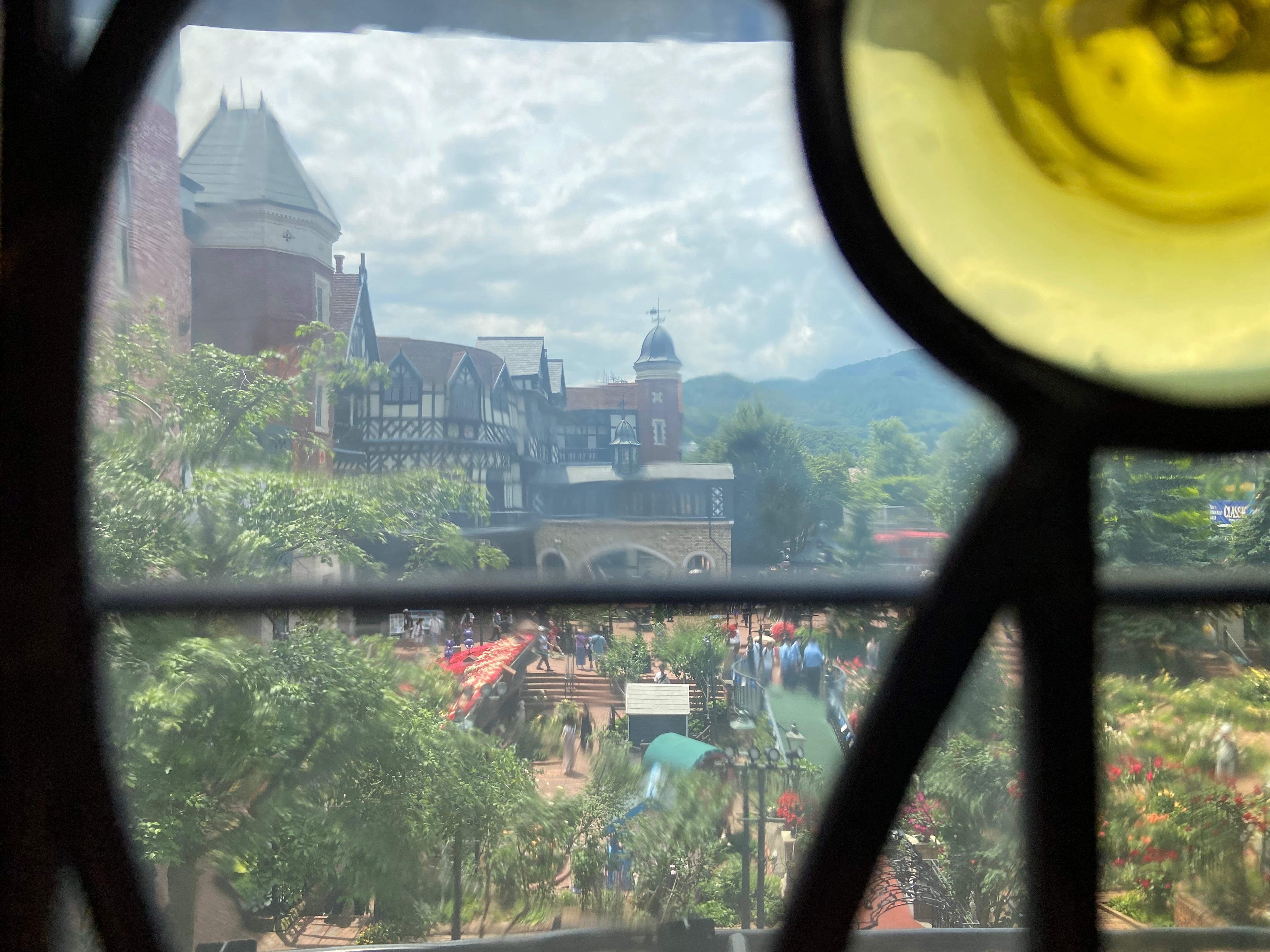
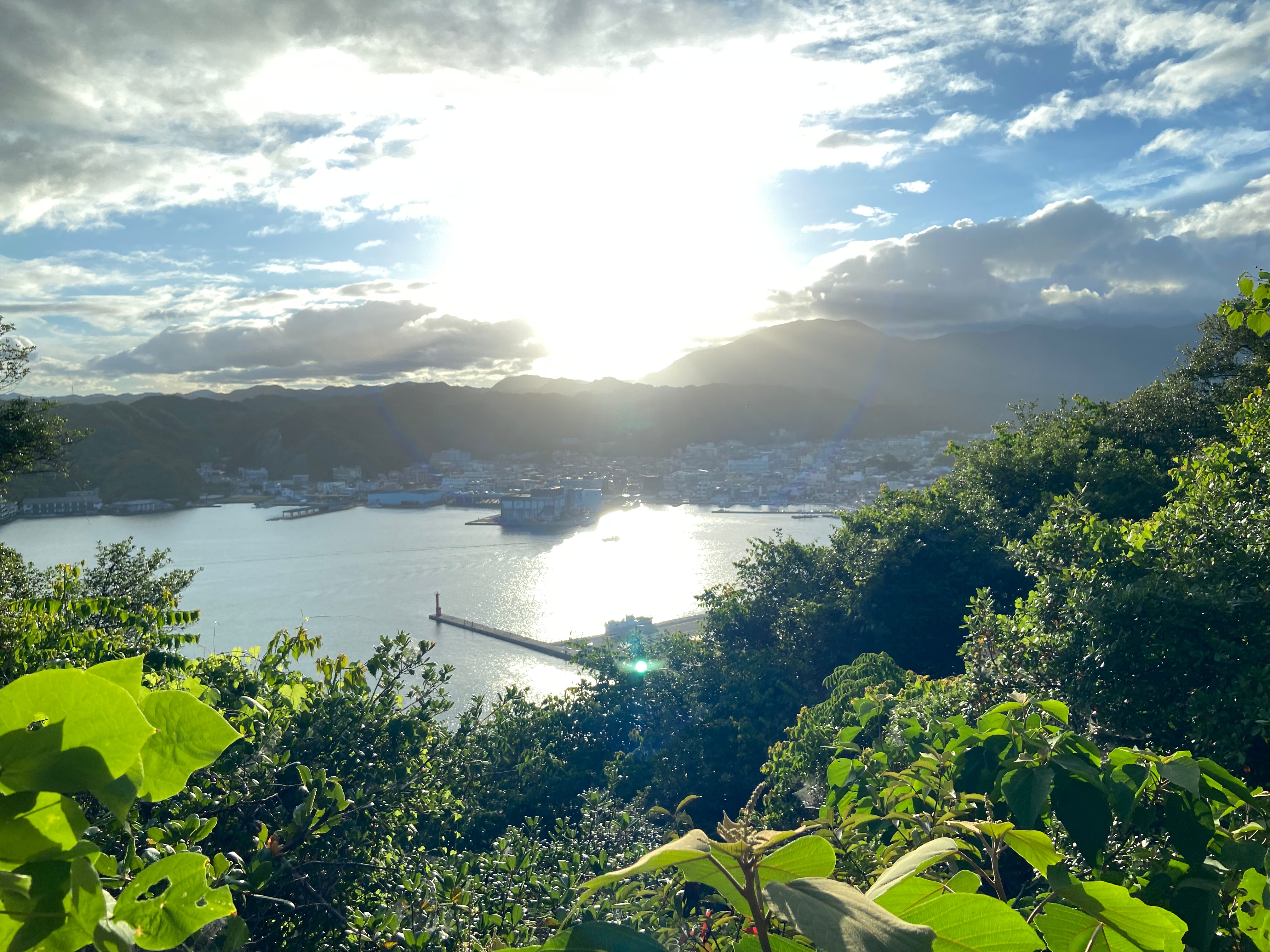
The onsen is so peaceful that I no longer feel as though I’m in a hotel. Sadly, I’m not allowed to take photographs in the onsen, for obvious reasons, so instead, here is the view from the 32nd floor looking out into the bay, the 40 degree sky, and the town of Nachi-Katsuura.
I sit, submerged in hot water, staring past the cave and out to sea. I think of the lost souls who once set off from this shore, sealed inside a boat, nailed shut.
Before the Wind Blows It All Away

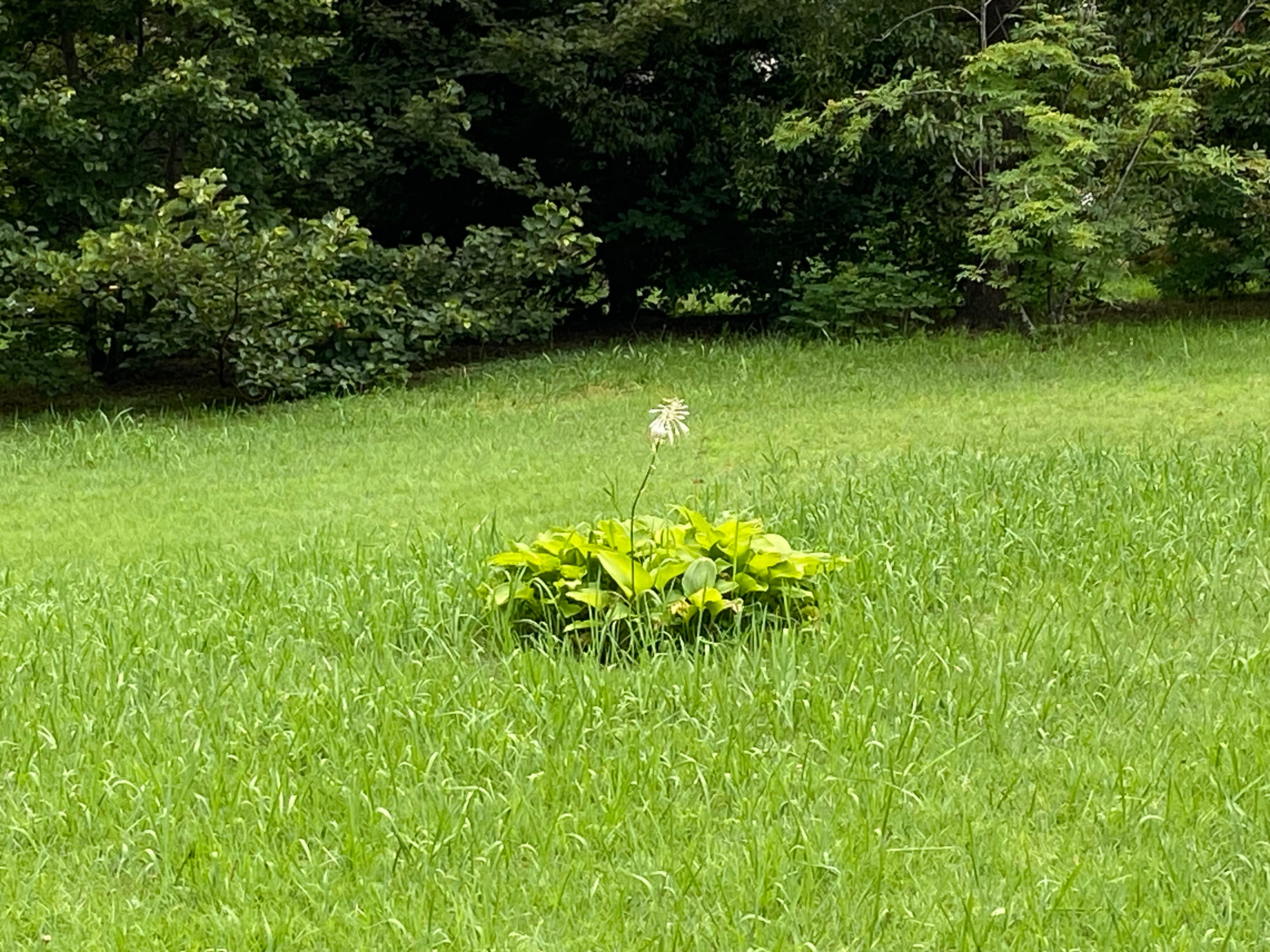
Today I’m travelling back in time, specifically, 20,000 years in time. I’m in Miyagi Prefecture to see the Museum of the Forest of Depths of the Earth. I don’t really know what to expect. When I arrive, there’s a small outdoor garden of evergreens and summergreens. There’s a single flower in the middle of the lawn, with a sign before it stating: Be careful not to step on the flowers. The sign uses the plural form flowers, and it bothers me slightly.

I believe the single flower is a panicled hydrangea. The garden has been recreated. “Let’s go into the grass and observe,” says another sign. The whole point of the place is to compare the vegetation of the Ice Age with that of present-day Sendai.

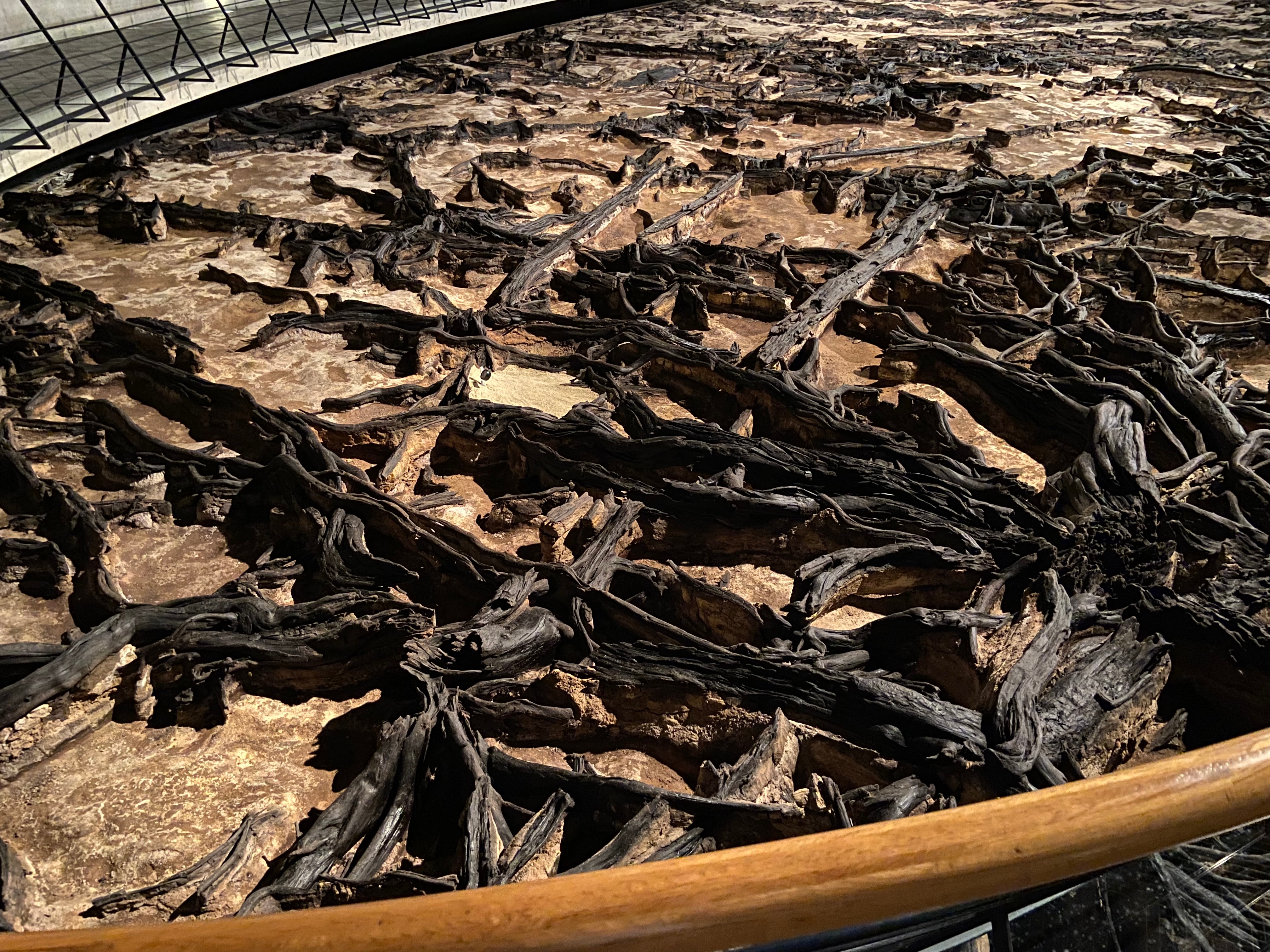
There’s an architecturally stunning structure in the gardens. It’s the only one of its kind in the world. Inside are the 20,000-year-old remains of a wetland coniferous forest. It might not sound very impressive, but when I walk through the doors of the museum and see the sheer size of the trees, it causes me to stagger.

The museum is fascinating. In 1987, an archæological dig found, just five metres below the ground, the preserved remains of fossilised trees, along with artefacts from the same era. There’s a separate tree root I’m encouraged to touch and smell, and it carries some weight.

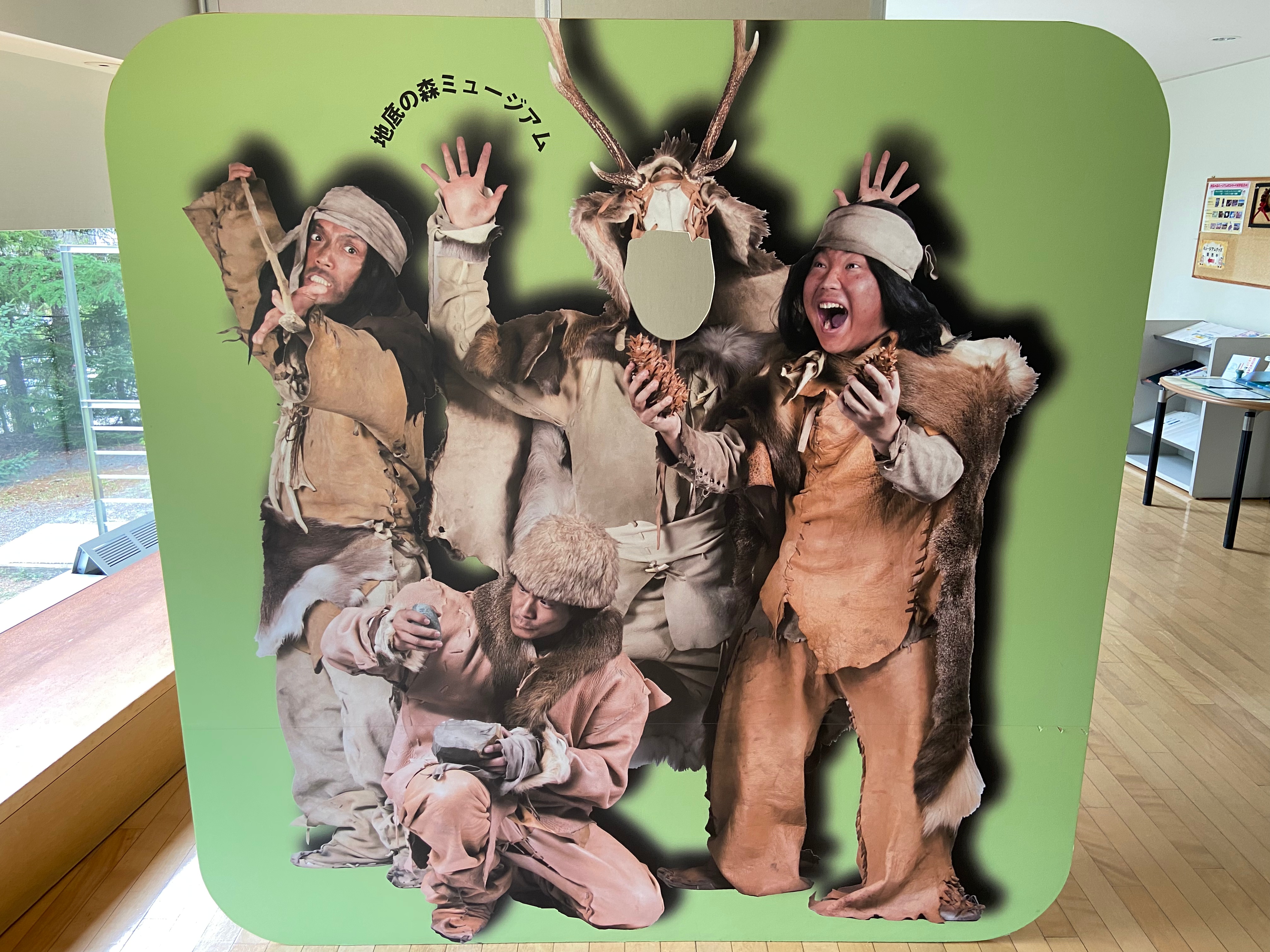
Aside from the trees, I can also learn about the Paleolithic Age. There are the remains of a campfire that was excavated here. Bits of broken pottery. Deer fæces. Arrowheads. Glass boxes of skulls. Carnival Cutouts: the breath of ancient times.

Having touched a 20,000-year-old tree root, the only thing left to do later is visit a mountain, so I decide to walk to the coastline. Along the way, I pass a tsunami evacuation tower made from steel. It can safely evacuate 300 people to a height of at least six metres.

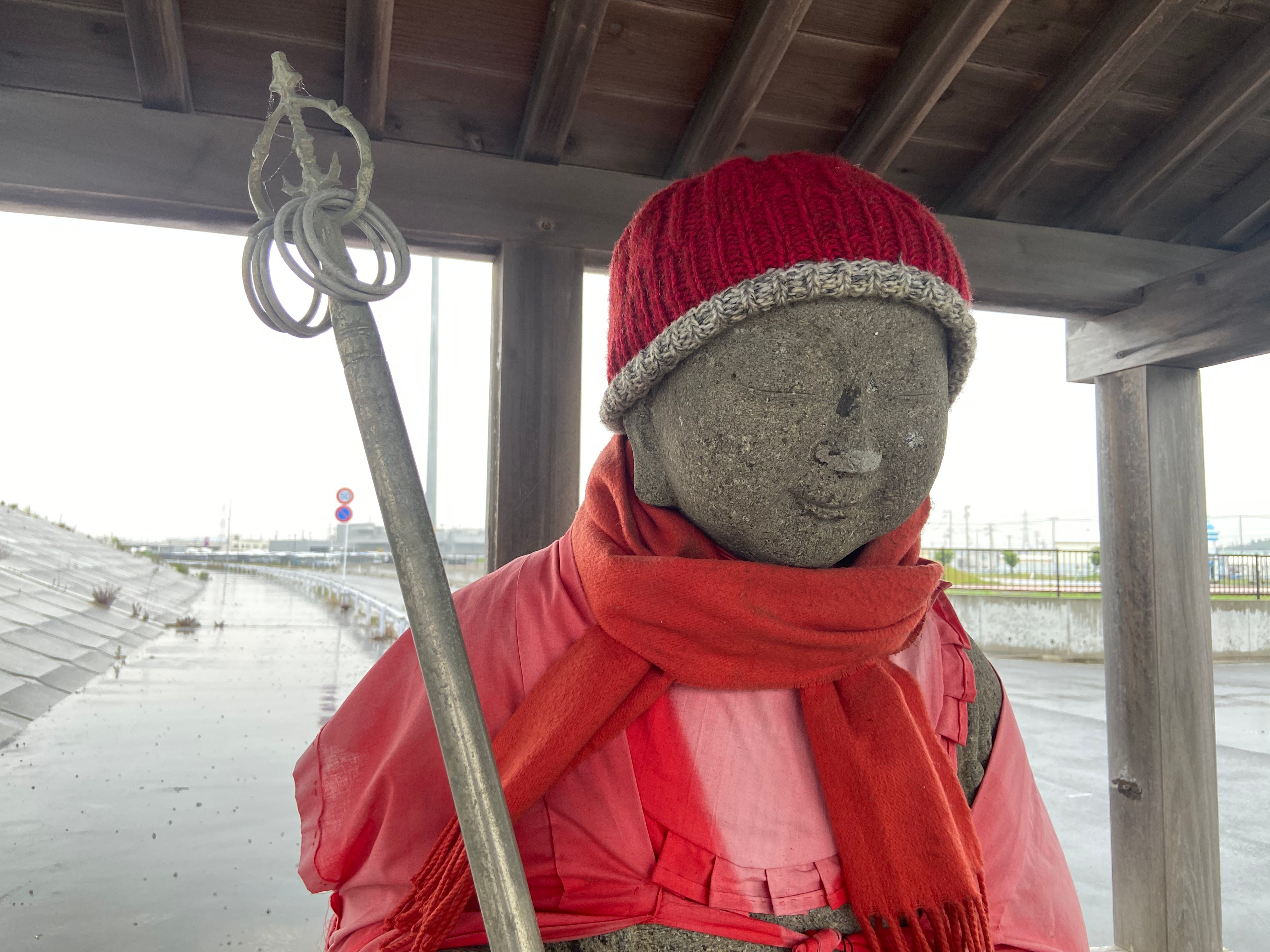
As I stare at the tower, the sky suddenly fills with grey cloud, and it begins to pour. I run into a nearby park but find nowhere to hide, eventually sheltering beneath a small Jizo statue. The smug Jizo is smiling and holding a rain wand.

Behind the statue is an embankment highway that runs along the Nanakita River and Sendai Bay, designed to help prevent tsunami waves. The tides must get pretty high here anyway, as on my side of the barrier are dozens of dead crabs, seemingly washed over the wall and cracked open on the concrete below. The Jizo shares his little shelter with the stench from the Sendai Gamo Biomass Power Plant. It stinks.

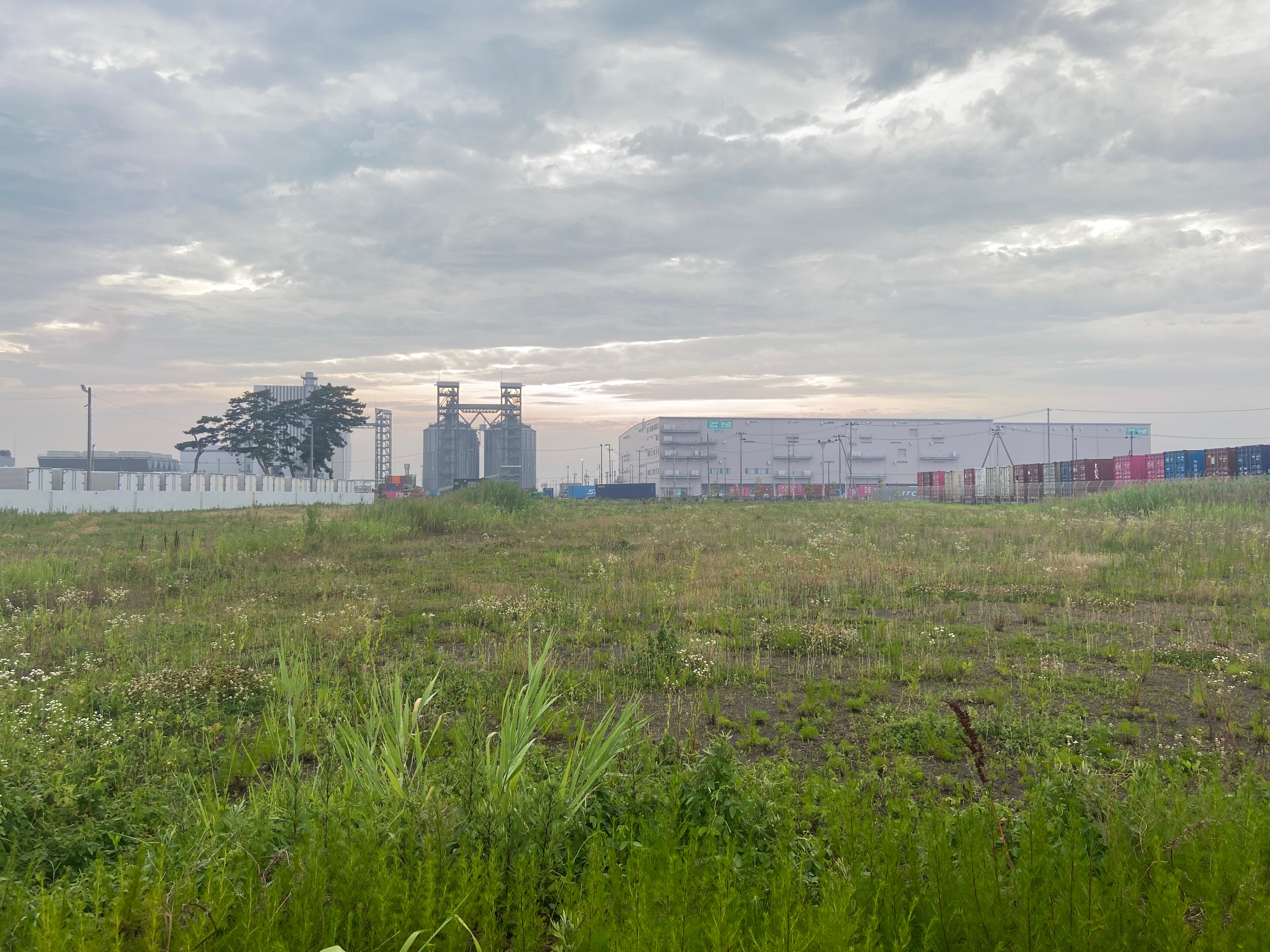
A little further up the coastline, I try to find what I’m really looking for. Usually, it’s pretty easy to find a mountain. But when you’re searching for what’s recognised as the smallest mountain in Japan, it gets trickier. I eventually do find it, half-hidden behind a factory car park.

I climb Mount Hiyori, Japan’s smallest mountain. Well, I don’t actually climb it. I just stand next to it. It looms at three metres now. Smaller than it once was. The 2011 Tohoku earthquake and tsunami took most of it. But still, someone left a summit marker. Still, it has a name. And I’m glad for that.

Around me, the wind starts to rise. I think about the ancient forest floor, perfectly preserved in silence. The looming shadow of a tree long gone. I think about how we keep naming things, even after they’ve almost disappeared. I think about how some things vanish slowly, and some things vanish all at once.

I walk away, back into the storm, careful not to step on the mountains.

The Curious Case of Chocolate Button

My day begins with a visit to a chocolate factory. Luckily, this chocolate factory is more a museum of chocolate facts than a factory made of chocolate, which, in 30-degree heat, would be somewhat messy. I’m still in Hokkaido, so while it’s hot, the humidity is reasonably low.

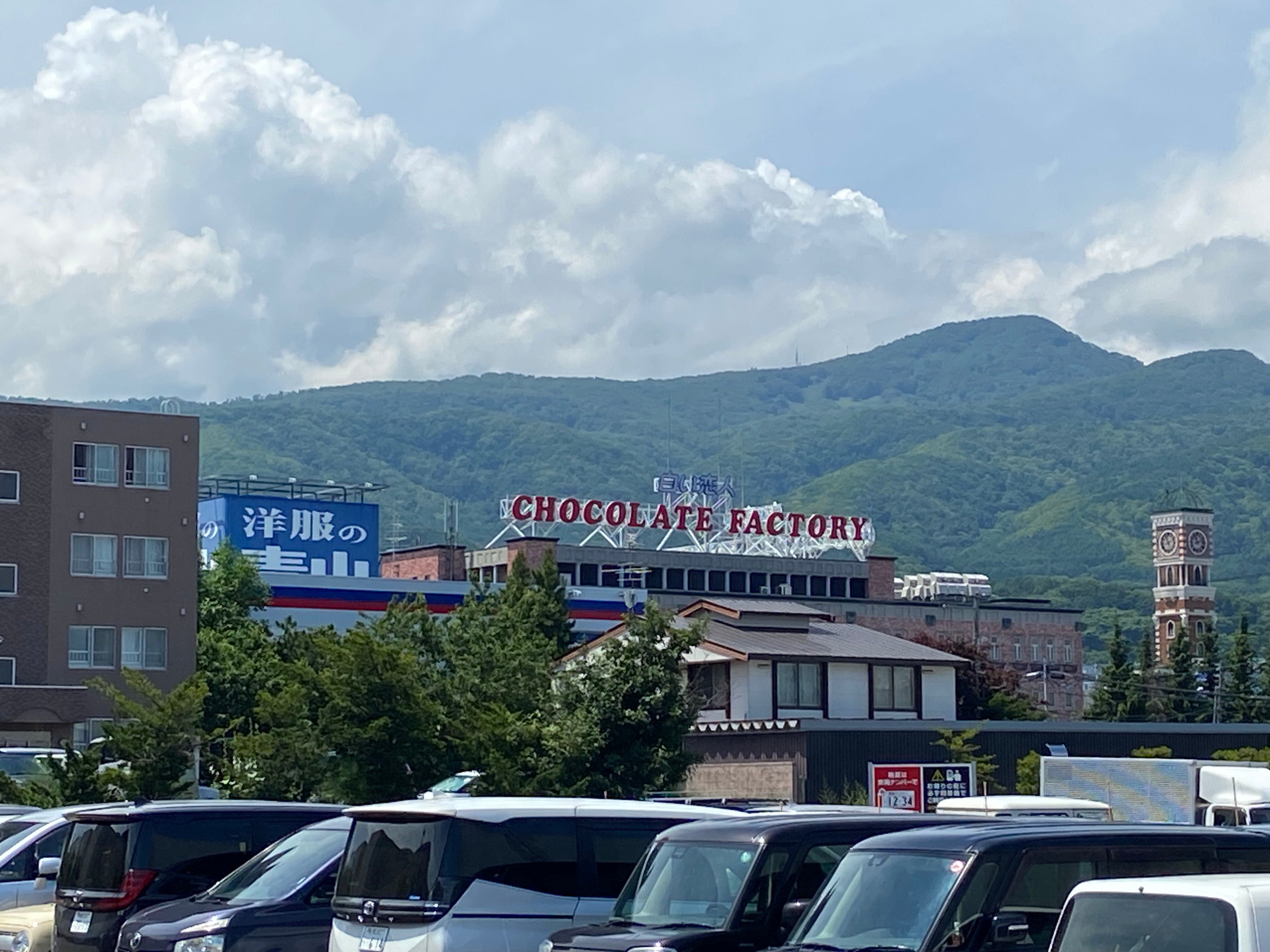
Today marks the 30th anniversary of Shiroi Koibito Park, a chocolate-themed factory with gardens. The translation of the name is unusual and means White Lover Park. However, the word for dwarf is the similarly spelt kobito, meaning little person, and has been named that way as a cheap pun which we’ll see later.

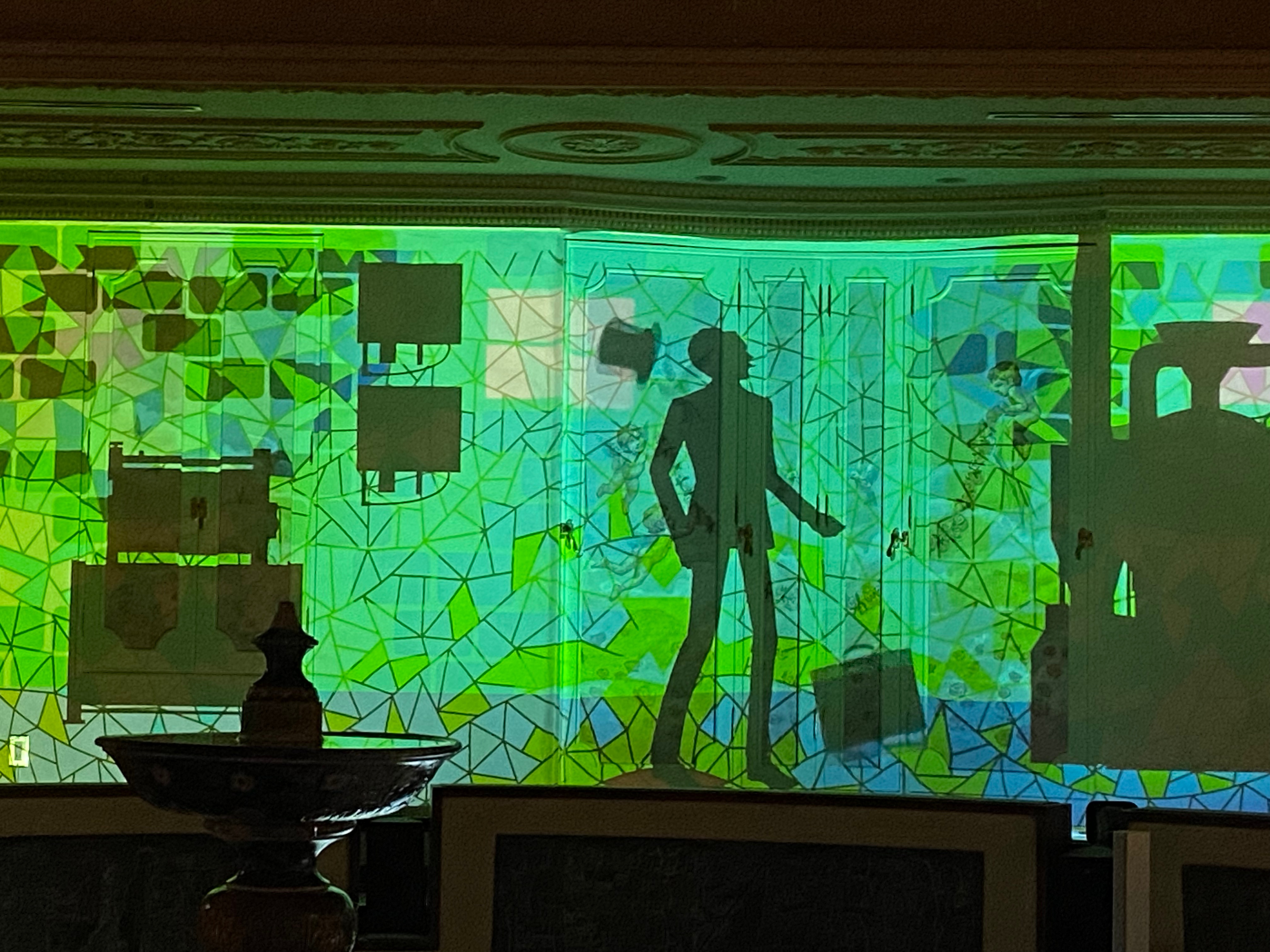
Entering the park, I buy a ticket (not golden), and receive a small wrapped square containing the exact chocolate that this factory makes; a bit of a spoiler, giving me the final product at the entrance. Inside, everything smells faintly of white chocolate and mild concern. There are a lot of stairs, the sound of cats meowing through speakers, and a room full of video screens telling the story of the factory.

In the quirkily named Time Travel Room, we learn about how this chocolate came about. One of the screens checks to make sure we’ve all been paying attention by offering up a quiz question answered by show of hands. The question is: What is added to chocolate to make it sweet? a) Powdered Milk, b) Powdered Cheese, or c) Powdered Snow?

“Hands up if you said powdered cheese?” says the woman running the tour, as she looks around rather confused. “Nobody said cheese??? How about snow?” It turns out I wasn’t paying attention, but still managed to correctly guess that chocolate can be sweetened by adding powdered milk. Next, we follow some cat prints on the floor up some more steps to the factory.

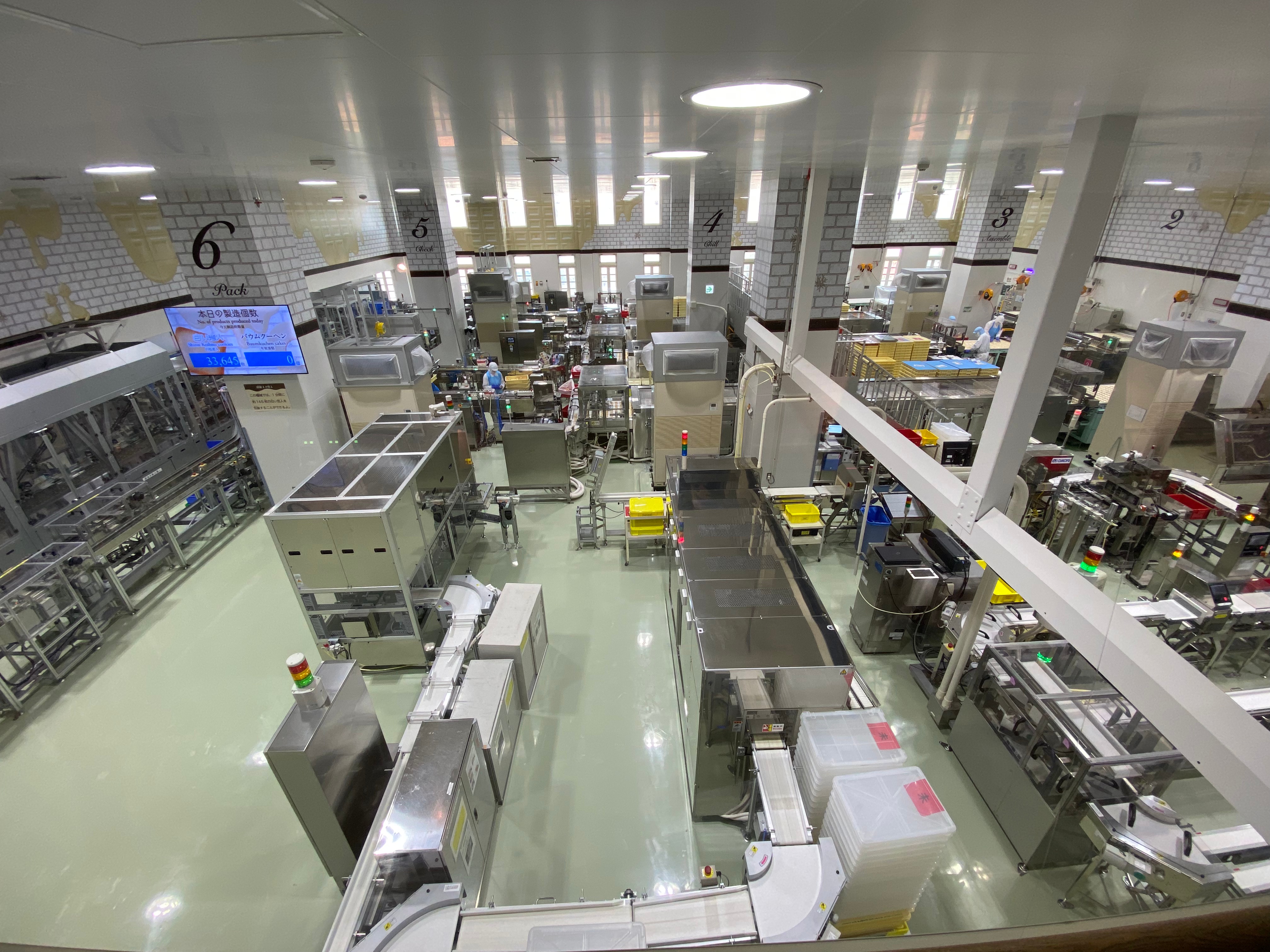
The factory floor is impressive, fully operational, and producing just one product: cookies. There is a counter that displays how many of each product has been produced today: 33,645 Shiroi Koibito cookies; 0 Baumkuchen cakes. I suppose they are using the lack of cakes as a comparison.

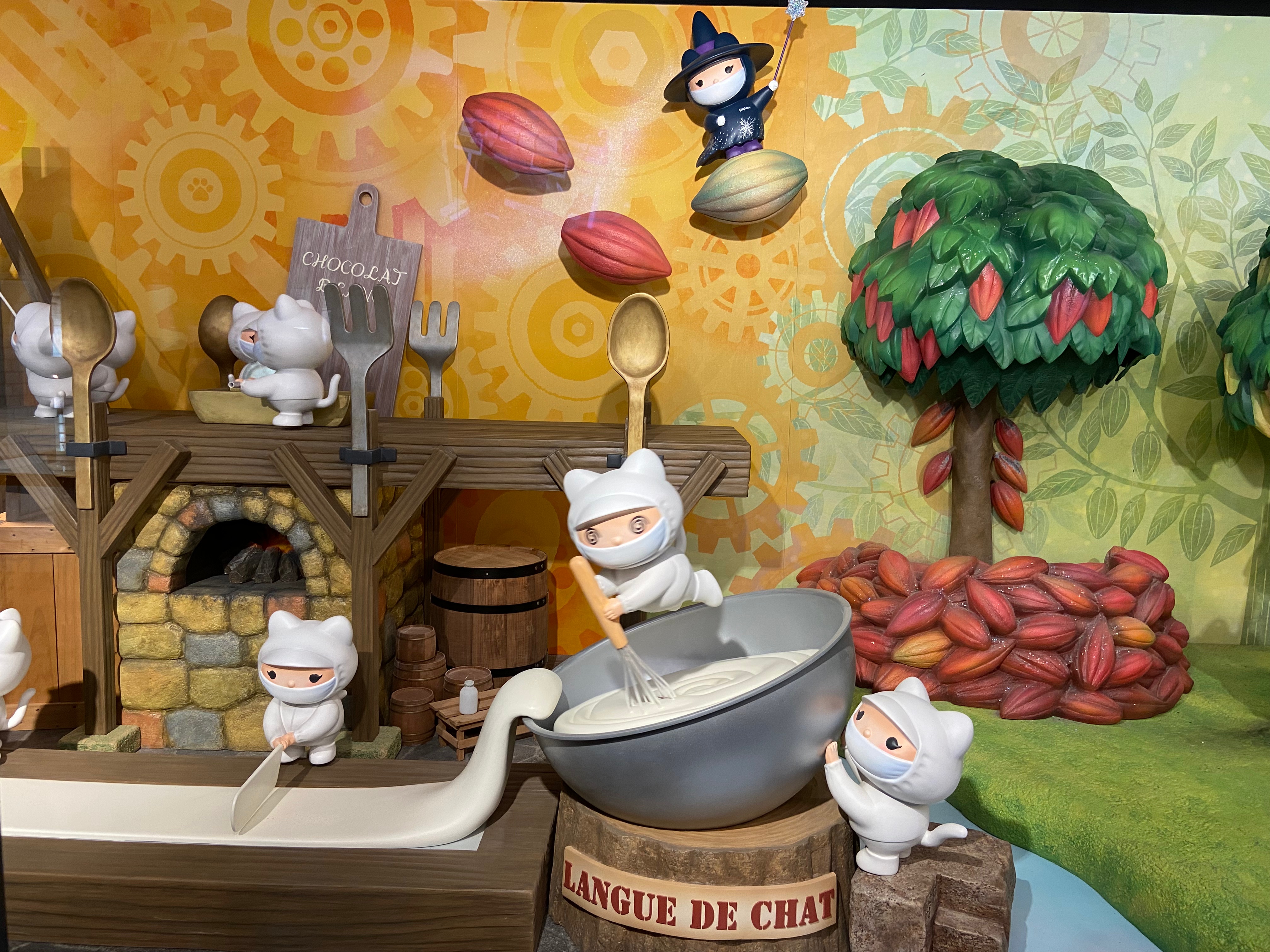
Remember that pun I mentioned? Well, in the next room it is on full display. All good factories have their slaves. Oompa Loompas, Wonkidoodles; but here at Shiroi Koibito Park we have White Dwarfs. They perform all of the tasks here, including milking the cows and creating white chocolate.

After yet more stairs, the sound of cats meowing, and multiple rooms of chocolate-related trinkets, we reach the end. I realise that we never did get an explanation for the cats. I exit through the gift shop and use the restroom. I notice someone has left some chocolate in one of the toilets.

I take the stairs up and into the café, where I decide to take a rest from all the walking and climbing. The factory really needs to invest in an elevator; preferably one made of glass. Speaking of glass, I order a glass of Shiroi Koibito Wine, not sure exactly what to expect.

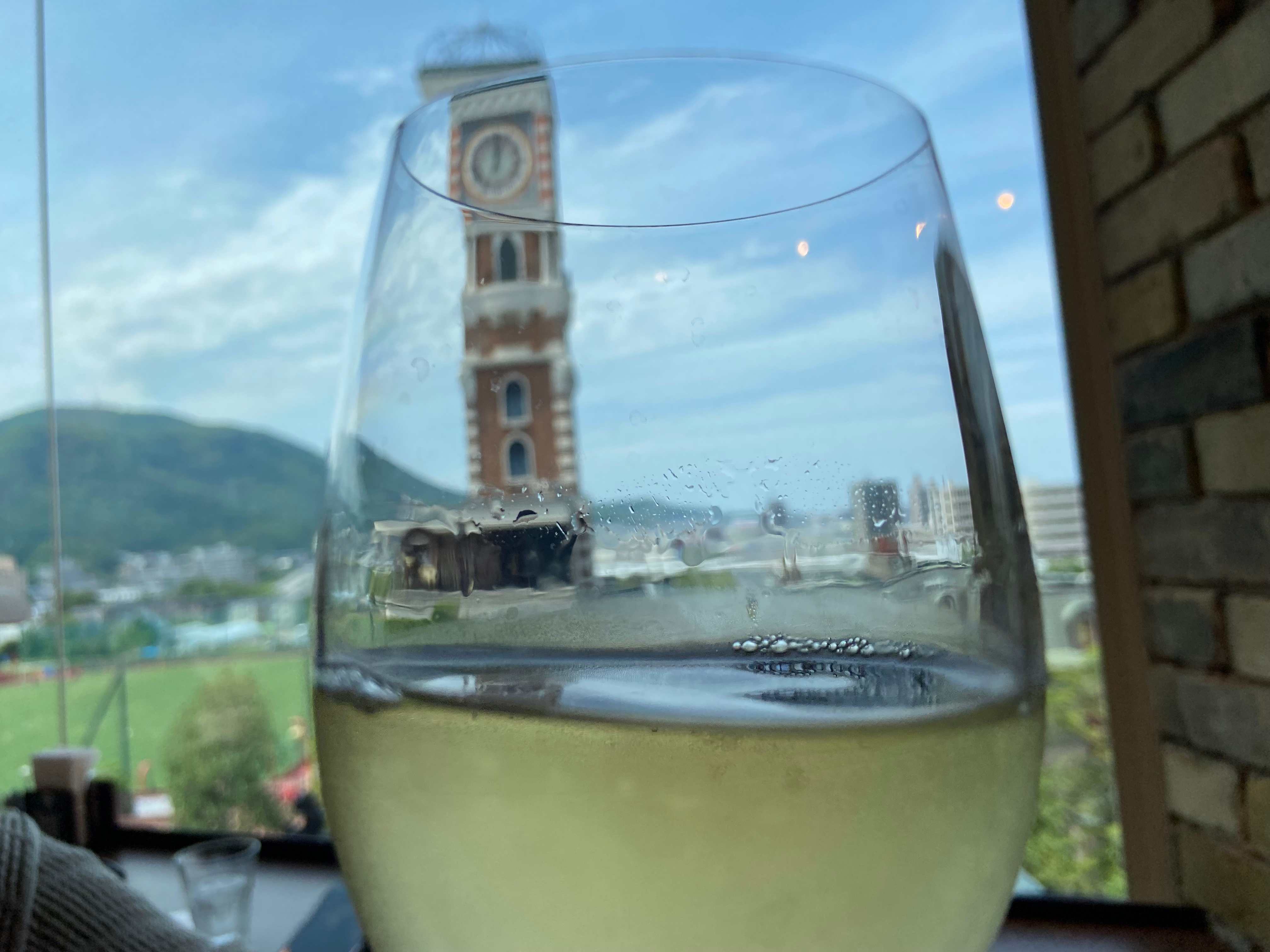
It doesn’t taste like chocolate. It tastes like regret. Perhaps one of the worst wines I’ve ever had the displeasure to drink. I was expecting notes of white chocolate; however, this wine is unfortunately made from Niagara grapes, which are more commonly used for grape juice than wine.

At exactly 12 o’clock, the distant clock tower chimes and opens up, and there’s a little animatronic parade. I slowly sip on my wine, trying not to wince. I watch the White Dwarfs trapped in a loop of mechanised merriment. I finish my glass before finally taking a stroll out through the gardens.

Taking the train back to Sapporo, I get off at Odori Station. The train station is connected to a huge underground shopping complex called Aurora Plaza. I decide to take a stroll through, passing shops selling clothes and souvenir-fit cakes. I also see some T-shirts with terribly translated English: Fun up necessary!

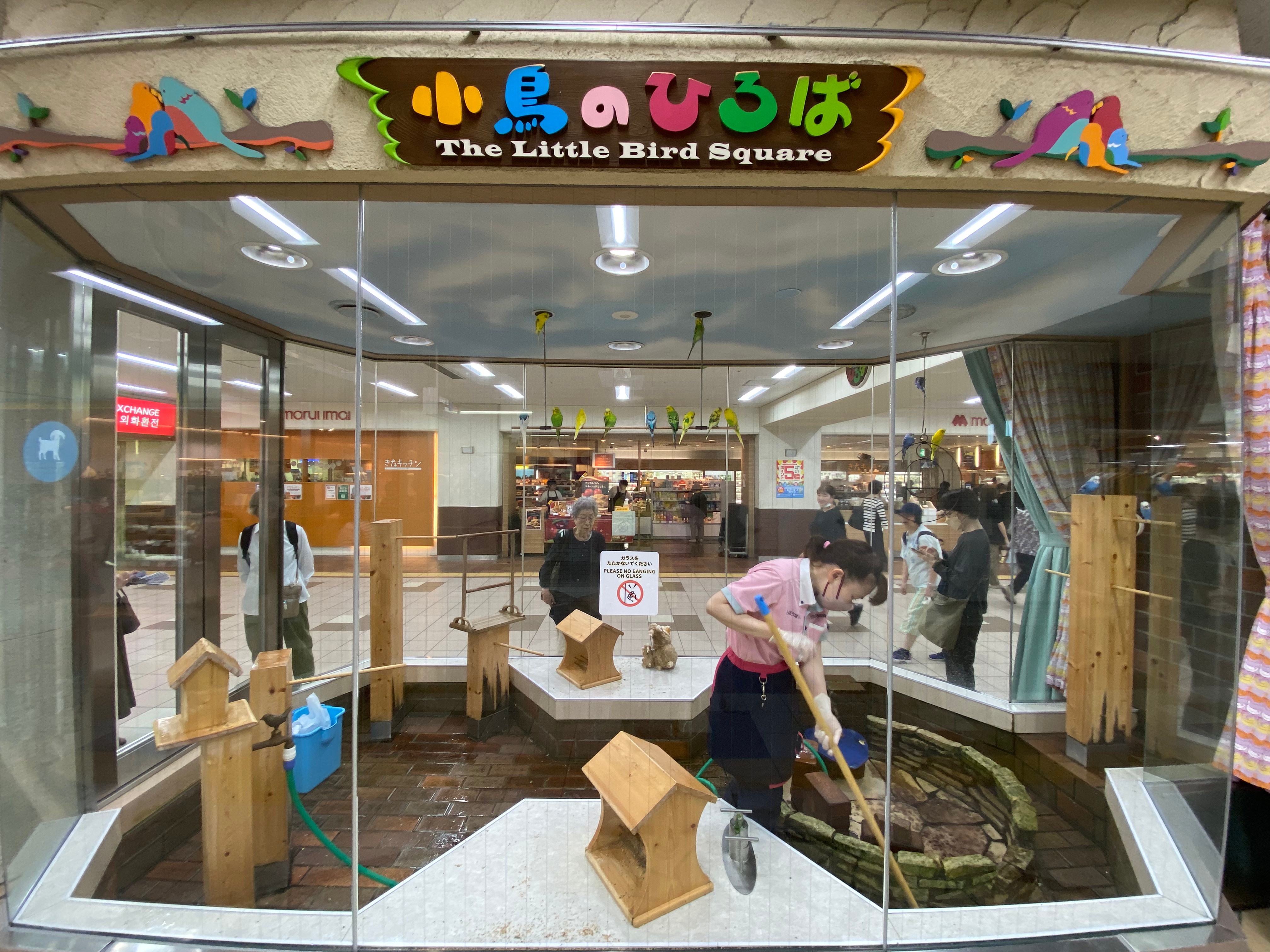
As I continue my stroll, in the distance I hear what sounds like birds chirping excitedly. I then see a sign for ‘Bird Corner’ and decide to see what all the chattering is about. It turns out to be a glasshouse full of parakeets called The Little Bird Square.

There are a couple of blue birds, multiple green birds, and that’s about as good as my knowledge of birds goes, I’m afraid. Although I’m pretty sure keeping them down here in an underground plaza means they will most likely die before they ever see natural light. Credit though, as it does seem that someone at least cleans out the enclosure, and I’m certain that one of the birds did smile at me.

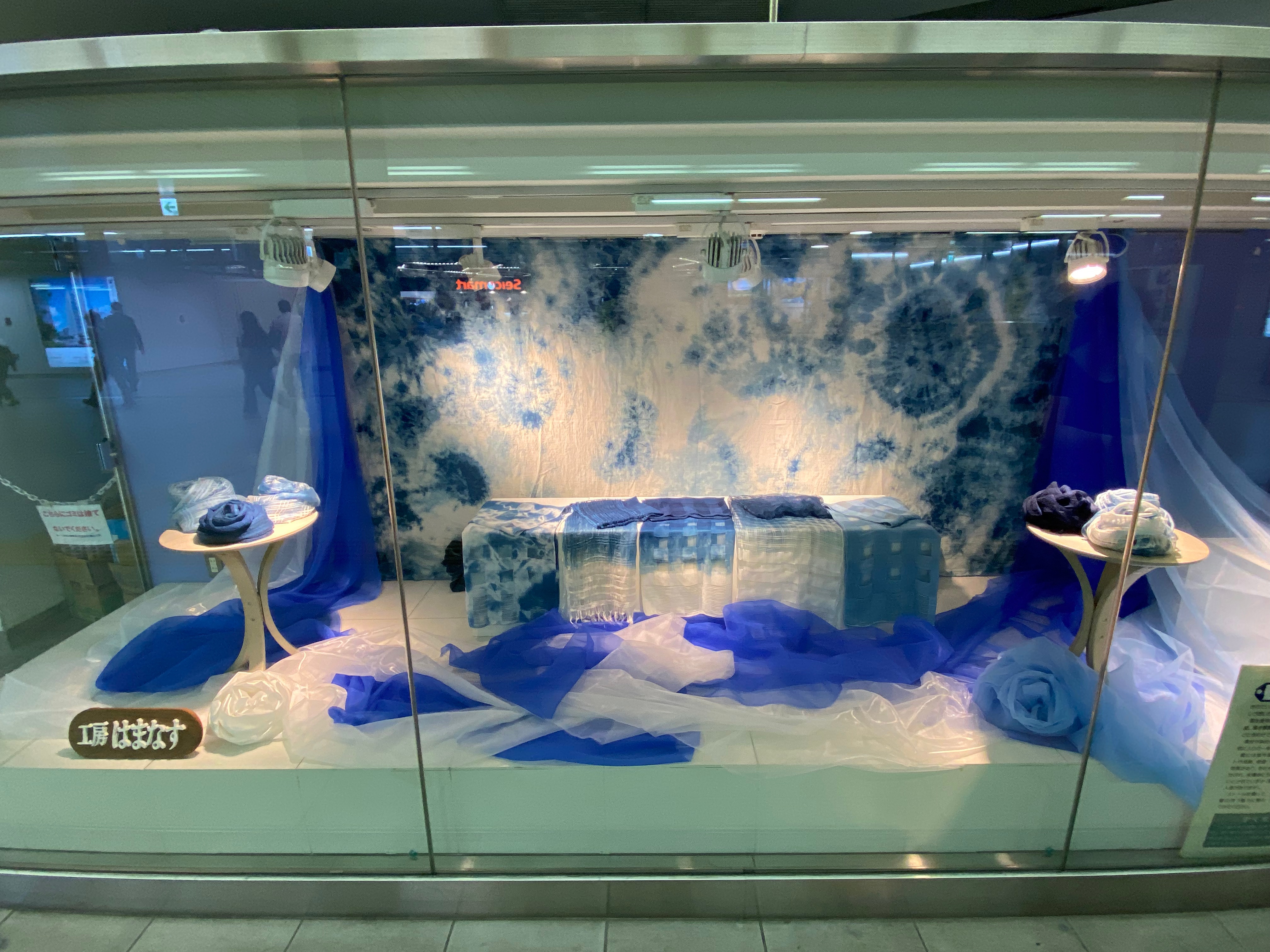
Further along the shopping complex, I stumble once again on a glass enclosure. This one, however, unusually contains scarves. The cloth appears to be well tended to, not the least bit ruffled. I think it’s supposed to look like a sea of clouds, but I can’t be sure. I do know that the scarves aren’t harmed in any way, and none of them seem likely to die anytime soon. They’ve already been dyed indigo!

My final stop for the day is a place called Retro Space Saka Hall. It’s a strange little museum that’s only open for a few hours a day, a couple of days a week, and houses the personal collection of curiosities owned by Kazutaka Saka, an 82-year-old Japanese man.

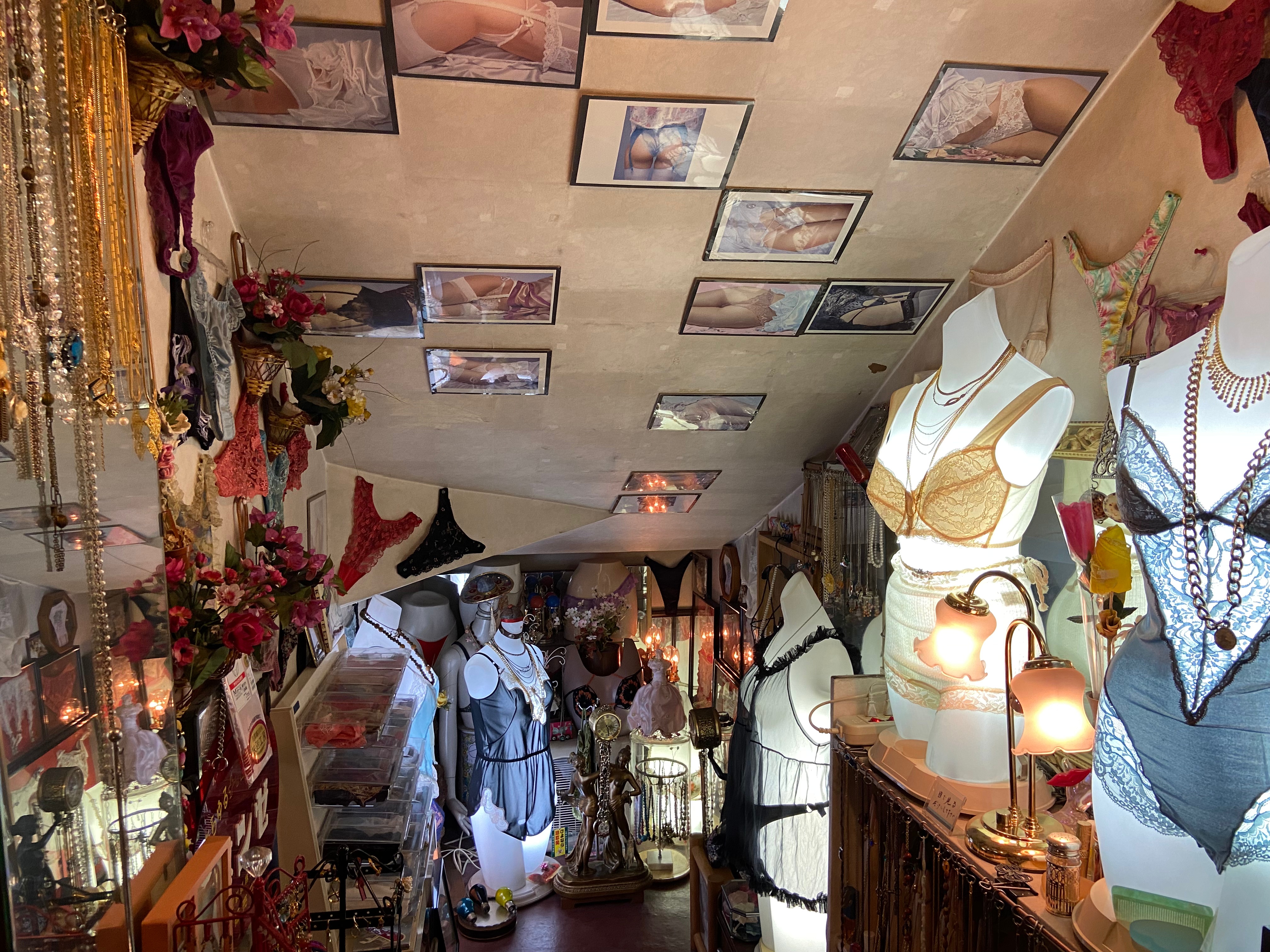
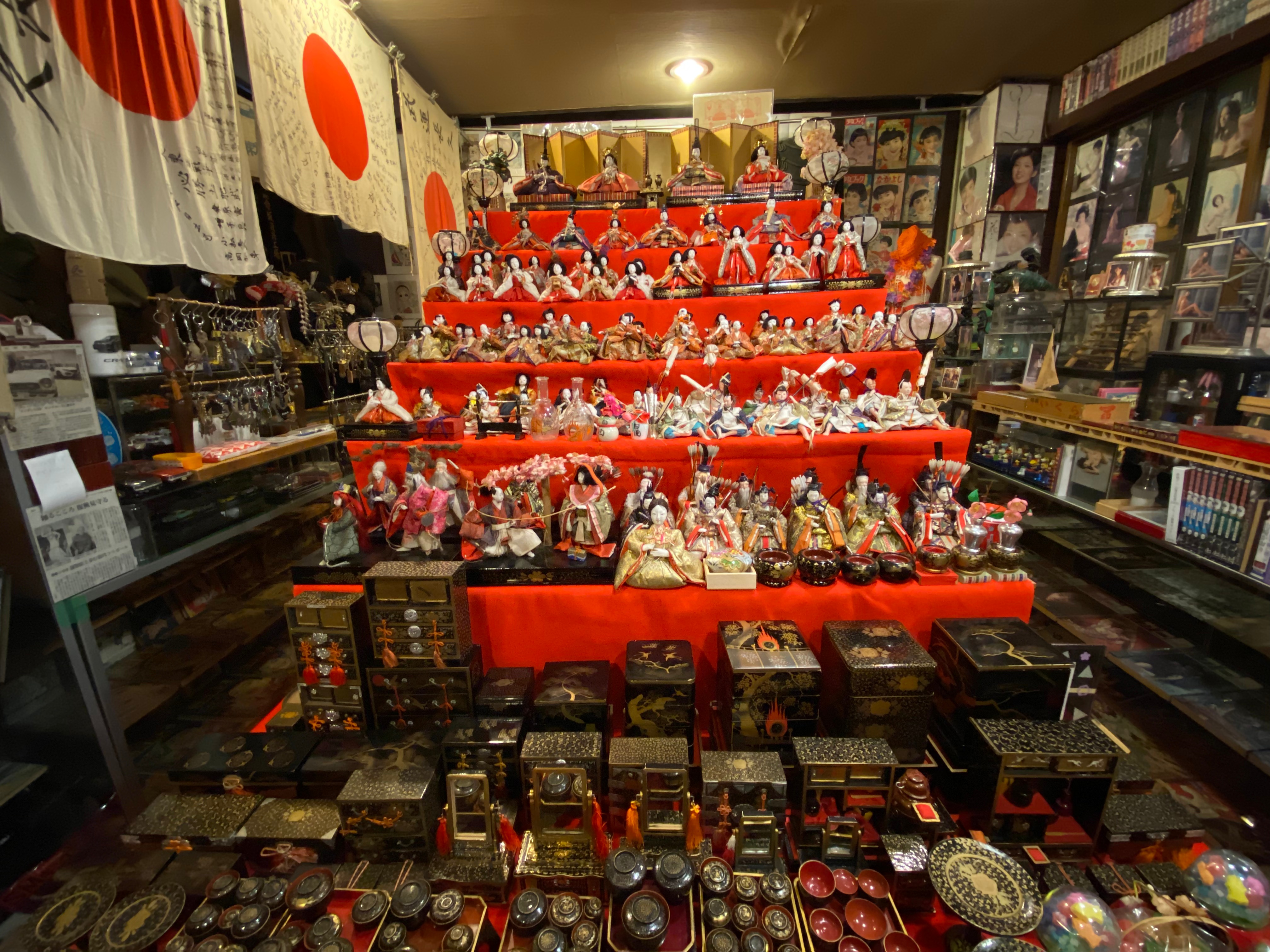
The museum is full of tightly packed shelves in every direction, arranged in sections and side rooms; a very well-organised collection of… well, of things. I don’t know where to look. There are things everywhere. If you can imagine it, Mr. Saka has probably collected it: Showa-era relics, gas masks, a large collection of syringes, musical instruments, a whole section dedicated to Eiffel Tower-shaped whiskey bottles, toys, figurines, bottle caps, buttons, stamps, cigarettes, women’s underwear, and photographs of women wearing underwear…

I begin to wonder whether Mr. Saka started out by collecting pornography and then, over time, began adding other random items like glass beakers and rocking horses to distract from all the images of naked women. Eventually it grew into this sprawling collection of almost one million objects. I don’t mind saying, I wouldn’t fancy having the job of dusting.

I have another thought as I pass by a wall of photographs of pin-up girls and a big pile of dolls: do other people just come here with stuff they no longer need and leave it behind? I can’t imagine anyone would actually notice the odd addition to the collection.

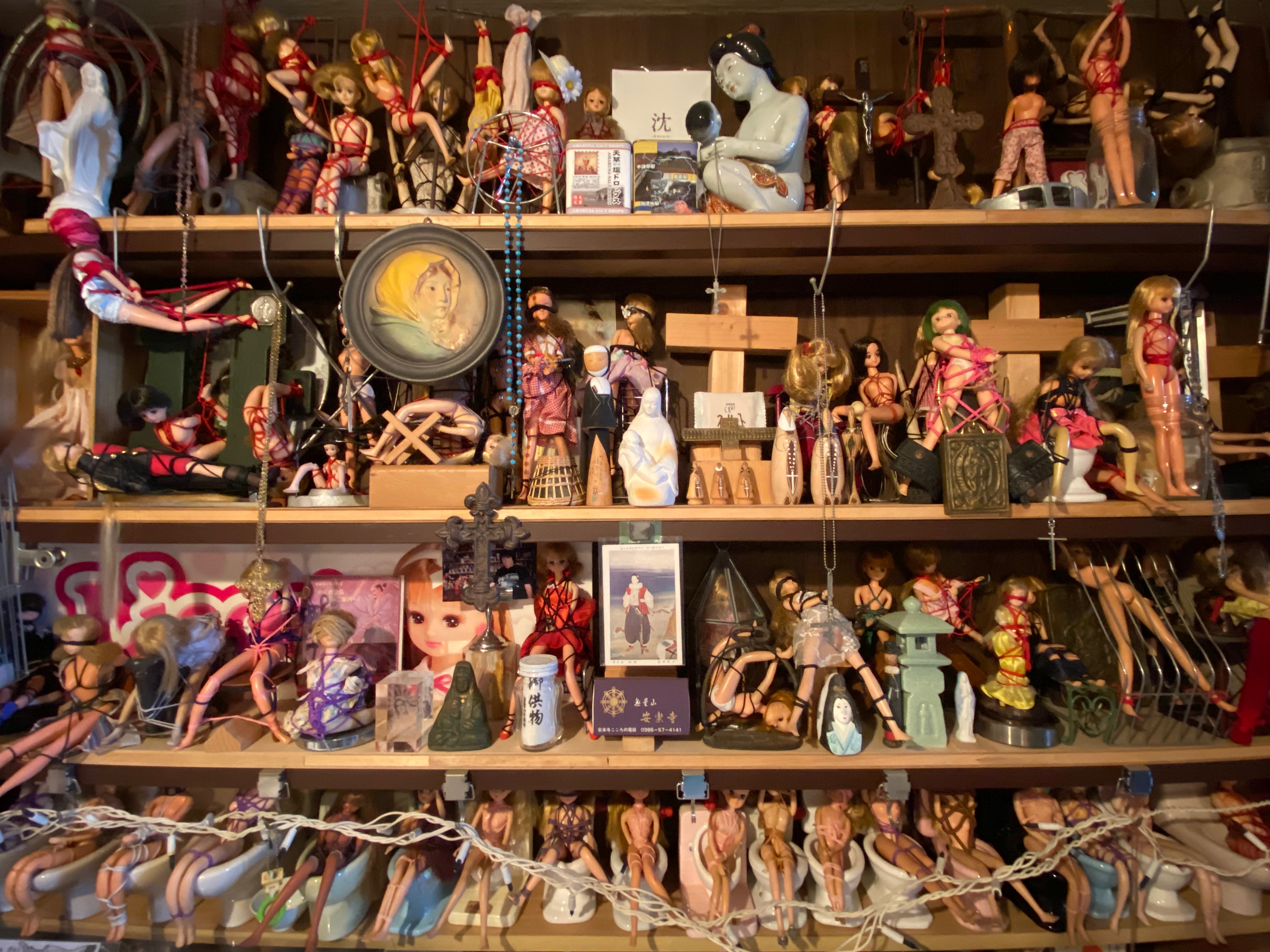
Just looking at the photograph of the pile of dolls, there’s so much going on in just that one area. Now imagine multiplying that by a hundred; you’ll get a good idea of just how overwhelming Retro Space Saka Hall really is.

I’m about to leave, heading toward the exit, but decide to take one last look at a shelf to my left. I must have missed it on the way in, overwhelmed on arrival by the treasure trove of everything mixed in with that odd smell of bygone. The shelf I’m standing before features a lot of dolls, tied up with string. The tied-up dolls on the bottom row are neatly arranged, all sitting on plastic toilets.

As I walk back to the train station, I decide that something about Mr. Saka is not quite right. Anyone with an entire shelf dedicated to Eiffel Tower-shaped whiskey bottles has a serious problem.

Dead Children Playing

Halfway into my eight-hour train journey to the northern region of west Japan, I decide to take a break from sitting and get off at Kurashiki, a quaint coastal town in Okayama Prefecture. Famous for its strategic location during the Edo period, which made it a popular place to store rice, Kurashiki, literally meaning “storehouse,” is also conveniently located halfway between Tokyo and my final destination. Upon arriving at the train station, I am greeted by a sign that reads, “Welcome to Okayama, the Land of Sunshine.”

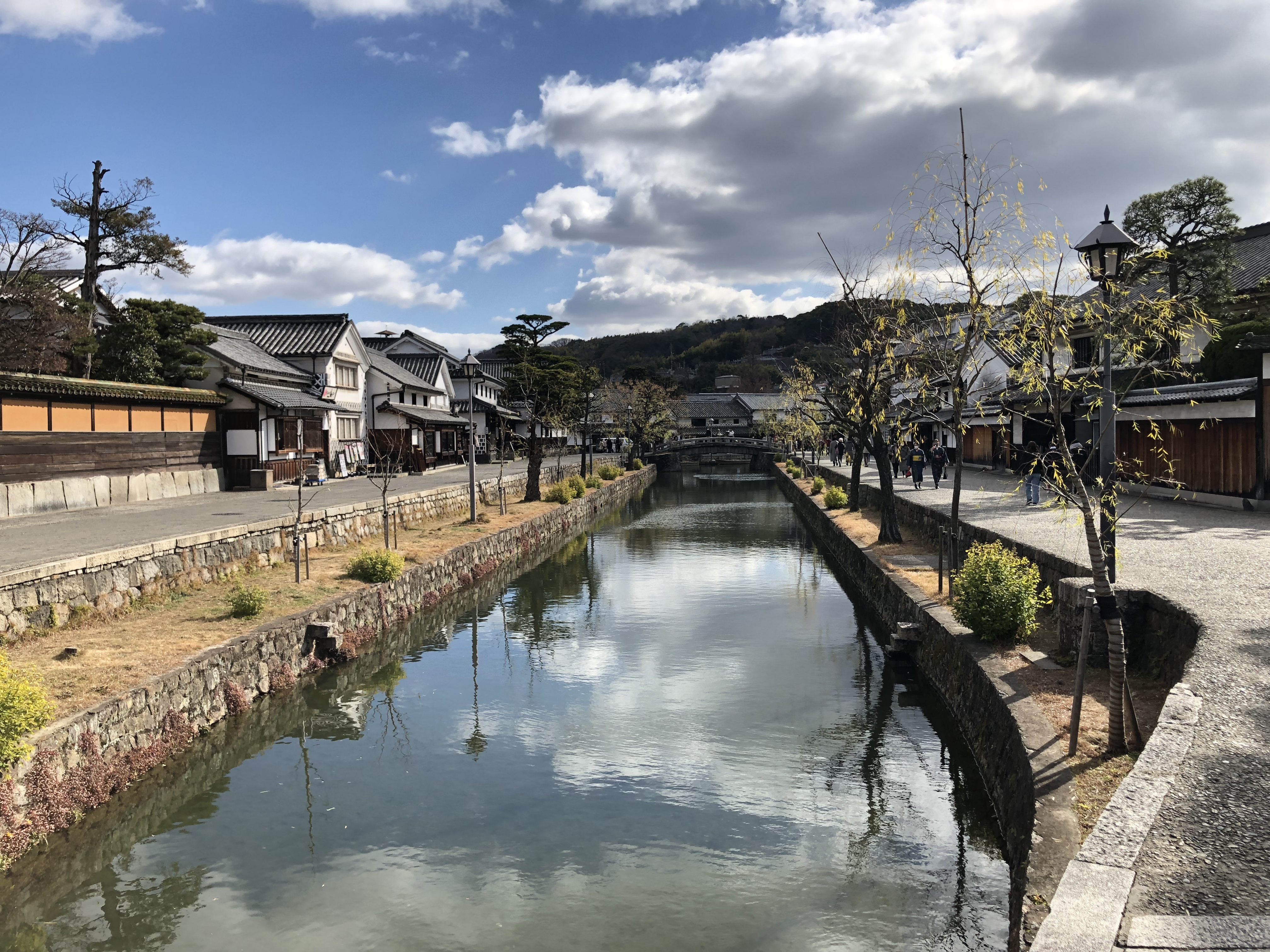
As I step out of the station, I find that the weather is not quite as sunny as the sign had promised. The sky is cloudy and grey, but that does not dampen my spirits as I begin to explore the winding streets of the Bikan Historical Quarter. Here, the buildings are old and charming, with weeping willow trees, historic godowns and canals that interconnect throughout the area. Touts eagerly await me, offering rides in their rickshaws. Just as I begin to further complain about the weather, the sun breaks through the clouds, illuminating the streets and bringing a warmth to the air.

I come across a shop called Gangukan, which has an annexed building featuring a toy museum. Intrigued, I pay the lady at the cashier, who shows me a sign in English that reads, “I will take you to the entrance.” She guides me through a maze of small alleyways to the entrance of one of the museum buildings. The door creaks as it opens, and the woman mutters something in Japanese before swanning off, leaving me to explore the museum alone.

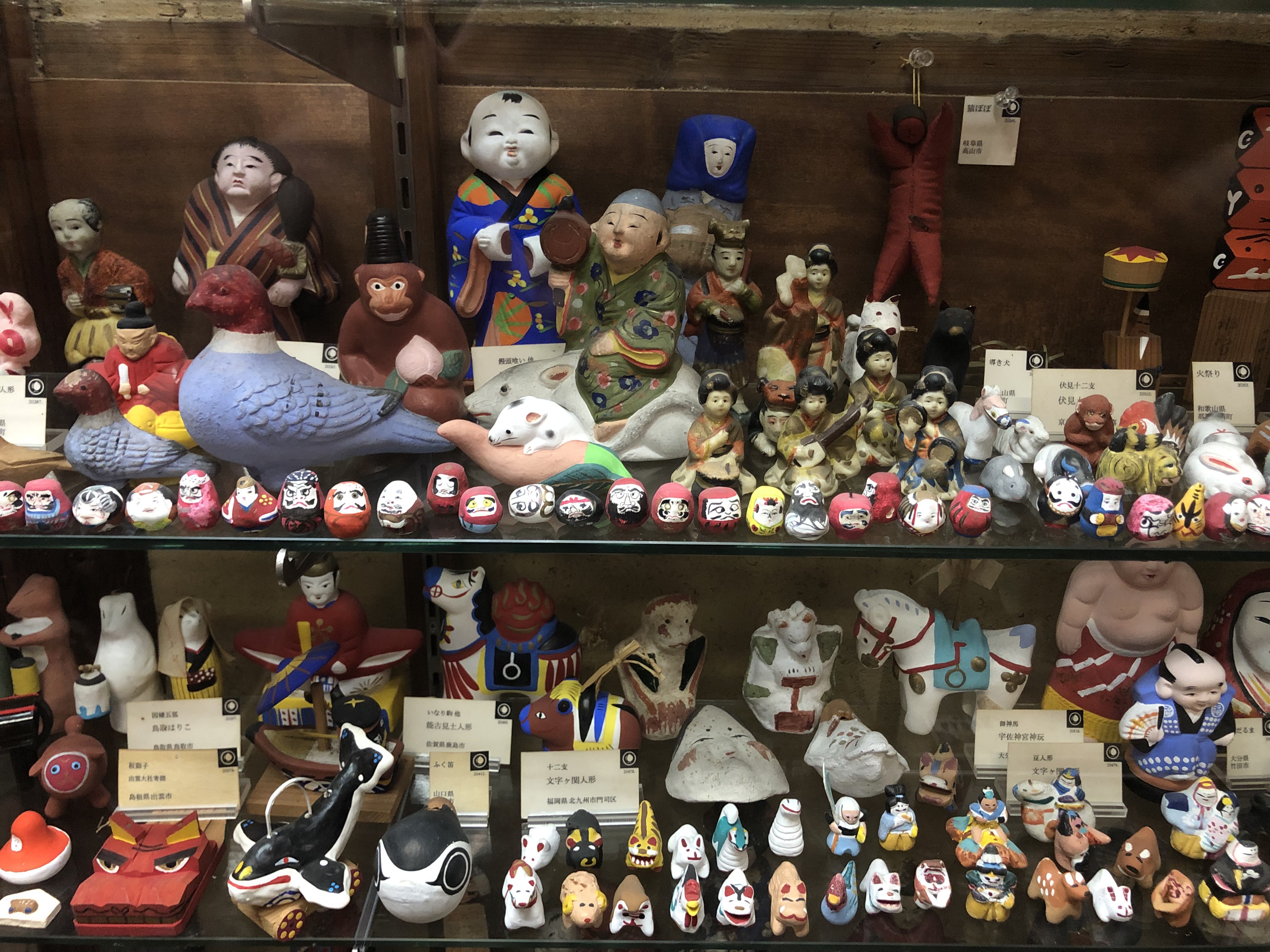
The Japan Rural Toy Museum is one-of-a-kind, housed in a beautifully renovated old rice storehouse, the museum features toys from 1600 to the 1980s. Inside the first room, I am greeted by a collection of folk-craft toys from every prefecture in Japan. In the second gallery, Daruma dolls are displayed alongside clay figures, ceramic bells, dove flutes, and wood wishing plaques.

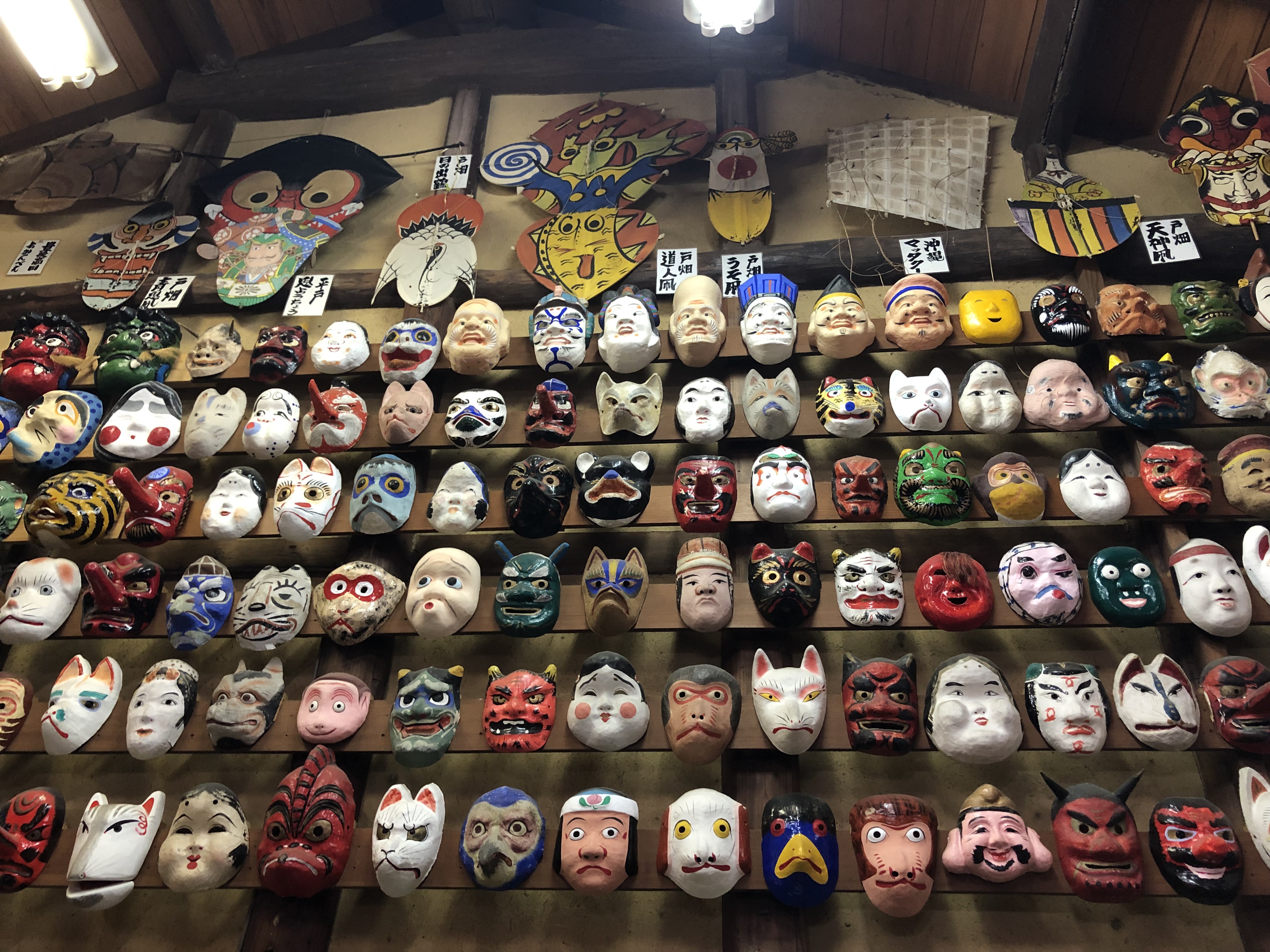
As I move to the third gallery, I am greeted by old wooden toys and spinning tops, and displays of annual New Years postage stamps from 1954 to present. In the fourth and final gallery, I see masks, a lot of masks. I’ve always wondered if masks can be classified as toys, but then again, I suppose the same question can be asked about postage stamps too. The gallery also features decorated shells, porcelain dolls, papier-mache dolls, and a large collection of old dusty books and badminton rackets.

As I step out of the museum, I find myself facing a small shrine. I can only assume that it is a tribute to the god of toys. As I think about the ancient toys, especially those dating back to the 1600s, I am struck by the enduring legacy of these simple objects of play. The children who once laughed and played with these toys, now long gone, reduced to mere memories and dust. But the toys remain, locked behind the glass walls of the museum. It’s a poignant reminder of the tragedy of death, and the beauty of the small things that outlast us. The toys, once a source of joy and laughter, now stand as silent witnesses to the fragility of existence.

As I continue my stroll through Kurashiki, I come across Denim Street, an entire street lined with shops selling the same thing. Along the way, I also pass small shops selling watercolour paintings and origami paper. The area, with its stunning canals and old shops, feels like a cross between Kyoto’s Gion district and Tokyo’s Asakusa district, but with less commercialisation. The area boasts a number of museums as well, including art, archæology, natural history, and folk-craft.

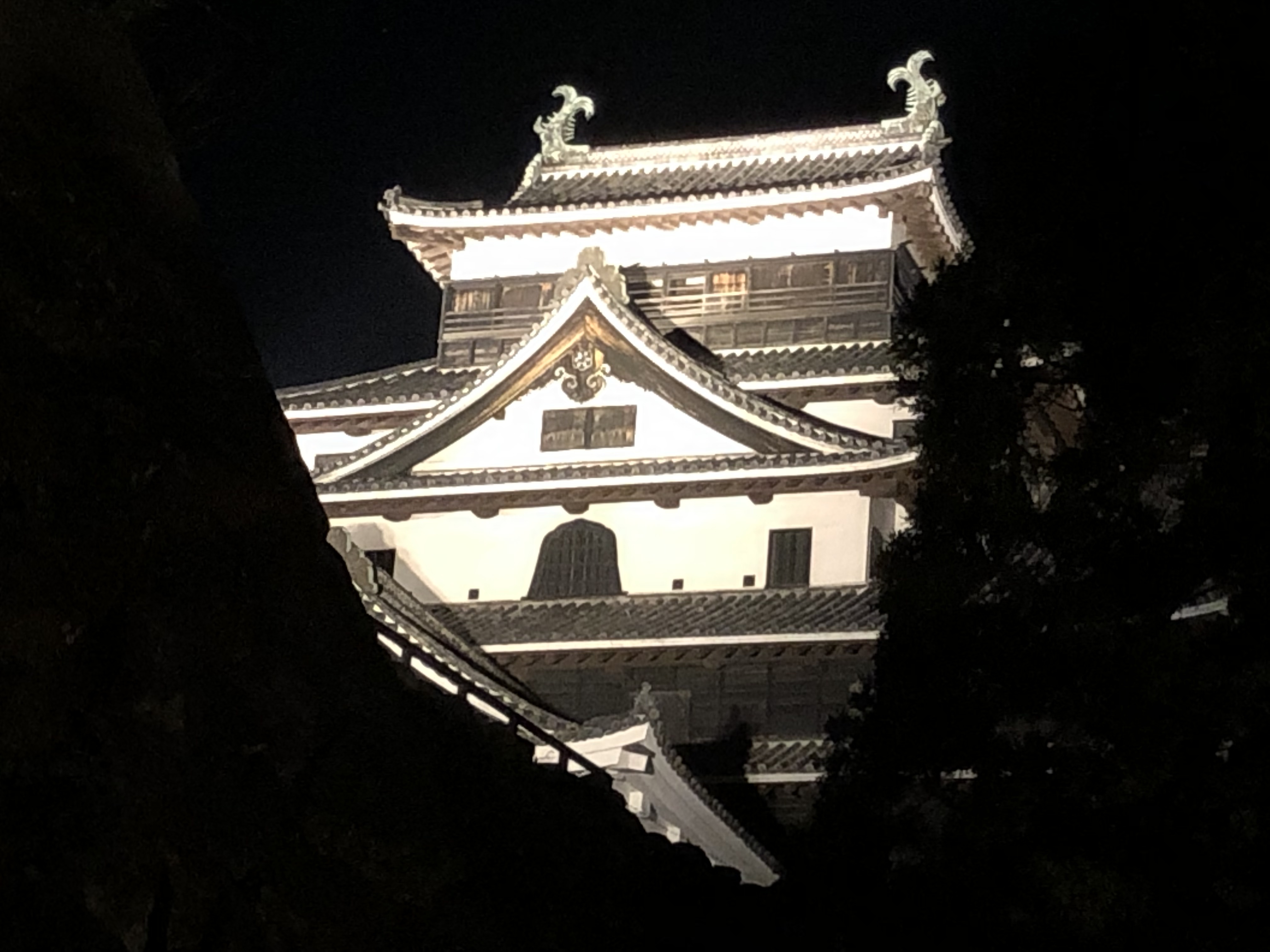
After a few hours of exploring, I leave the Land of Sunshine and embark on another four-hour train journey to the city of Matsue in Shimane Prefecture. As I arrive at dusk, I navigate the streets and make my way to Matsue Castle. Nicknamed the “black castle,” it is one of only 12 castles in Japan that have been perfectly preserved in their original state. It stands out in the darkness of the night, seeming to effortlessly float suspended in the sky. The grandeur of the castle illuminated by the moonlight, casting a mysterious and ethereal aura, making it an enchanting sight to behold.

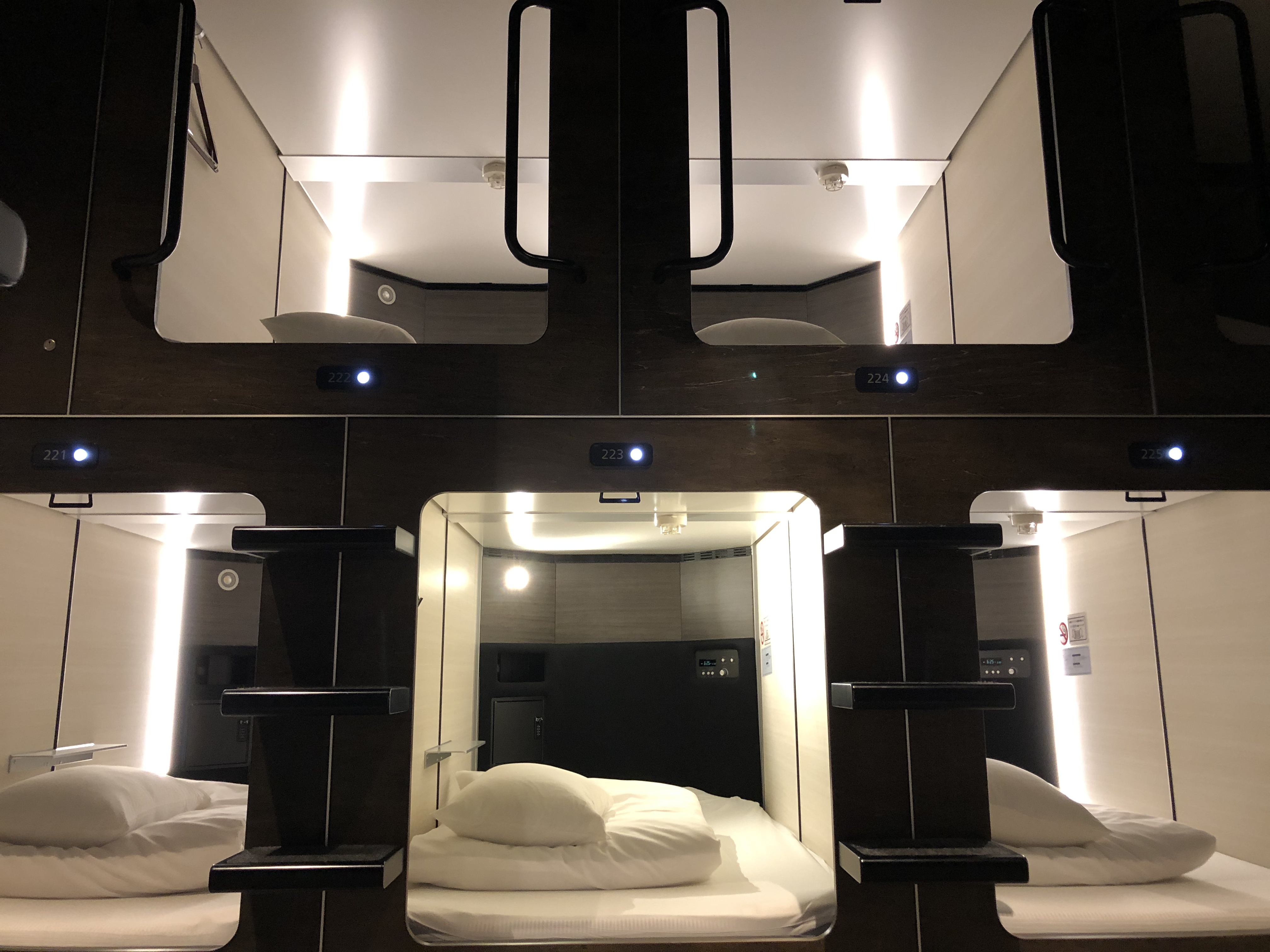
Leaving the castle, I decide to check into an iconic capsule hotel, something I’ve been meaning to do in Japan for years. After finding my “coffin” for the night, I realise that my room, if I can even call it that, is contained within a larger room with 39 other boxes stacked on top of one another. Thankfully, none of the other capsules are occupied. The hotel offers a reasonable amount of amenities, such as towels, toothbrushes, razors, earplugs, bathrobes, and nightwear. It’s also impeccably clean.

I grab some food from a nearby supermarket and head back to my hotel. Due to the limited space, it’s not possible to eat inside the room where the capsules are located. However, the hotel does offer a large common area with comfortable seating. The common area also features its own jaunty, catchy music that plays on a loop ad infinitum. It’s like being in a 1980s video game where the composer was hired on a budget. After eating my deep-fried tofu with rice and listening to the same piece of music for the twenty-third time, I retire for the evening, and crawl into bed.

As I lay in my coffin, the jaunty music swirling around my head like a relentless earworm, I think back to the toys, and thoughts on life, how we too are on a never-ending loop, chasing after fleeting moments of joy before inevitably succumbing to the silence of death.

Around the Wards in Achy Days

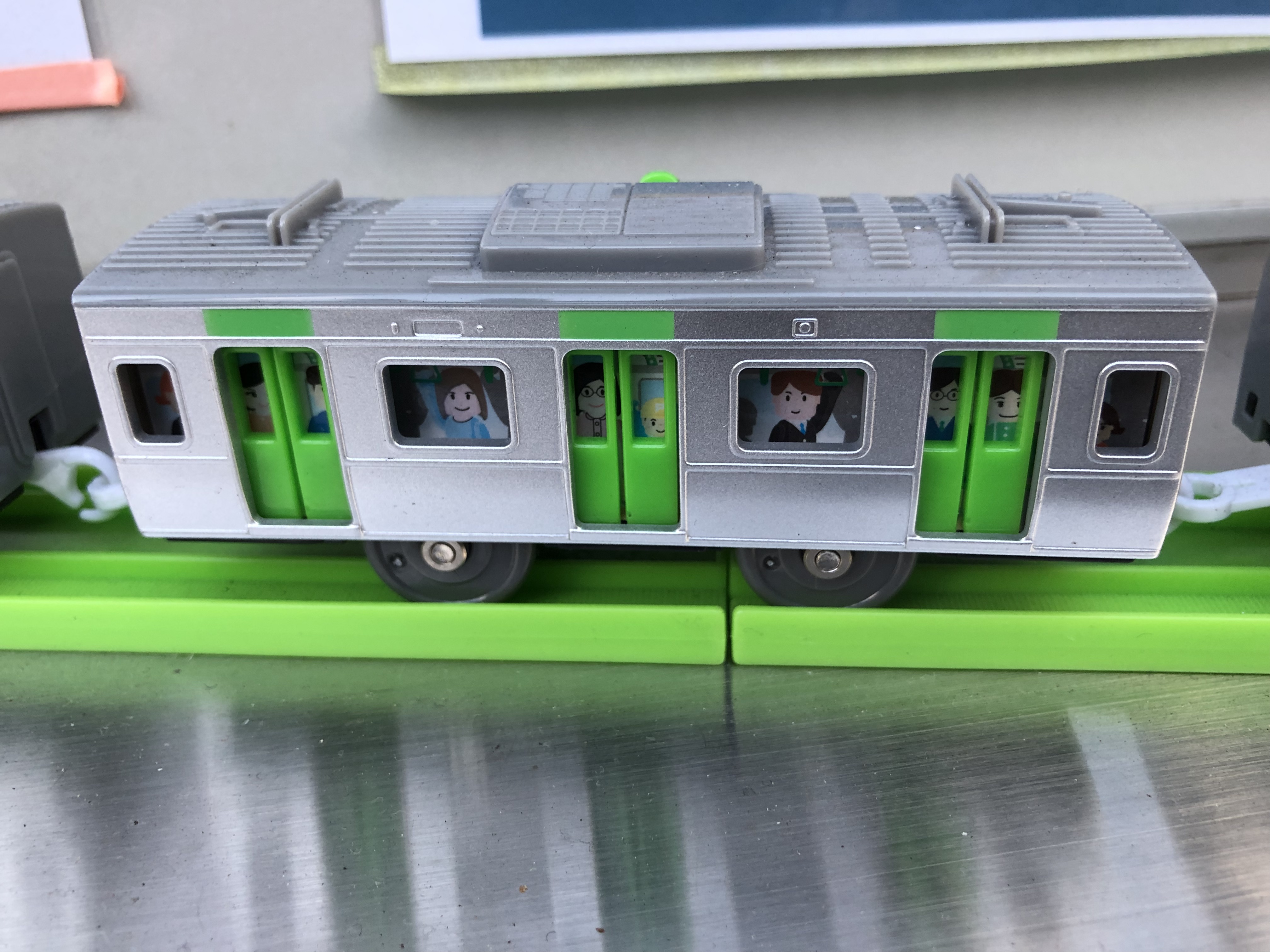
To celebrate the 150-year anniversary of railways in Japan, and my own personal achievement of having finally explored and written about all 23 wards of Tokyo, I decide to pay tribute to the city in a meaningful way. I choose to do so by embarking on a journey to walk the entire length of the Yamanote Line, a challenge that will allow me to experience Tokyo in a way that I never have before.

As the early morning sun blazes brightly between the gaps in the skyscrapers, I set out to meet my friend Maki. Though not typically a fan of early starts, today will be a long day that calls for an exception to be made. The Yamanote Line, a loop line encircling central Tokyo, is approximately 34.5 kilometres in length. But on foot, without walking on the tracks, the journey becomes a formidable 44 kilometres – just a little over a marathon’s distance. Thus, the route earns itself a playful portmanteau: the Yamathon.

I meet Maki outside a small cafe in Sumida, and we cross the bridge over into Asakusa. She asks me if she can give up, to which I jokingly reply that it’s a bit early to be considering such a thing. After all, with the Yamanote Line constantly circling the city, it’s always possible to find a train station nearby in case the need to give up arises. We set off from Ueno, the start and end point of our journey. Our first decision is whether to walk clockwise or anti-clockwise. After some deliberation, we opt for the latter, as the prospect of navigating through the eerie streets of Uguisudani at night seems daunting. And so, we set off in the direction of Ikebukuro.

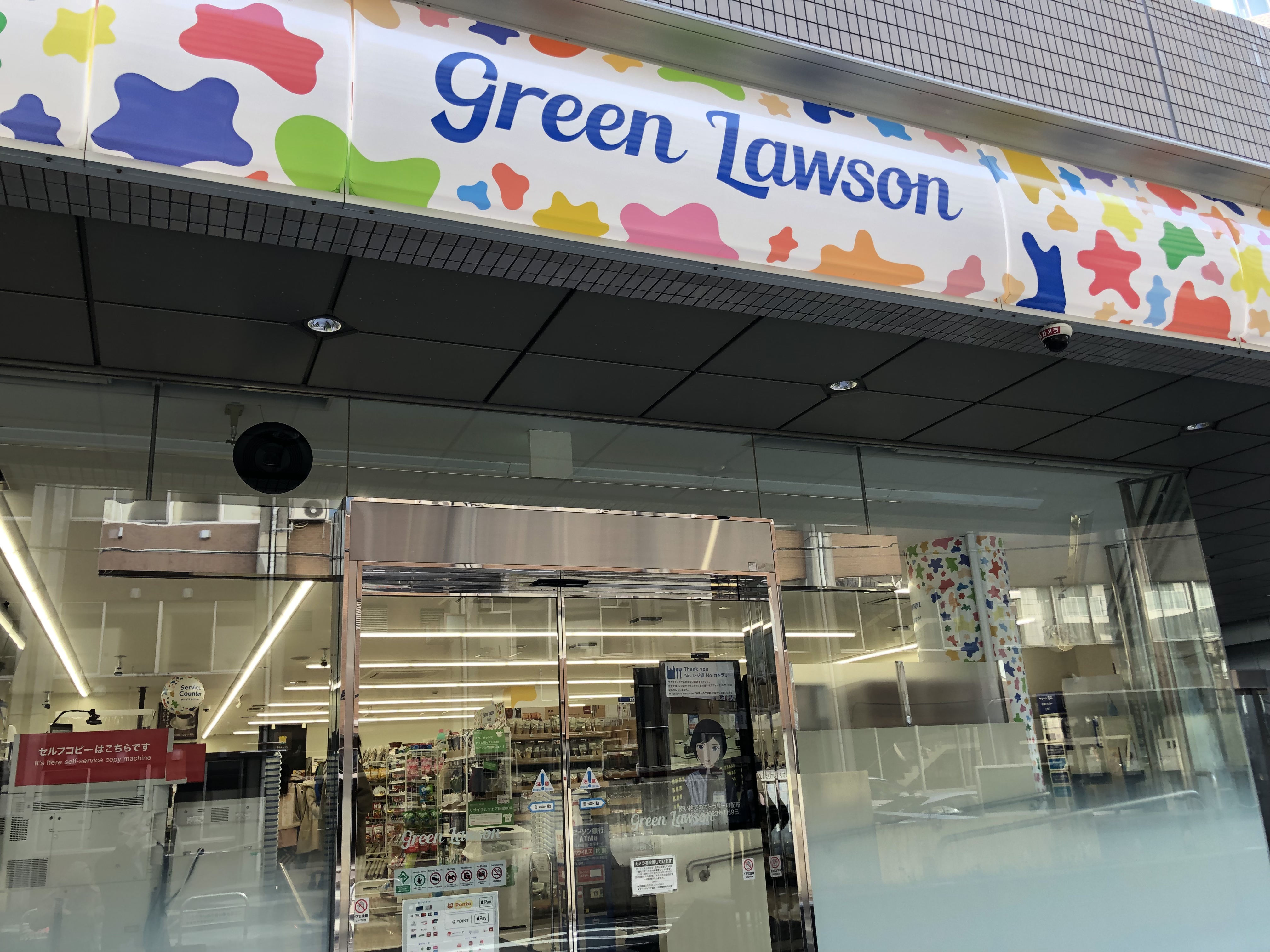
As we approach Nippori, the road runs out and we are forced to venture into the familiar territory of Yanaka Cemetery (still no sign of the ‘snow-protective lifting tool’). While meandering amongst the empty graves, we become momentarily lost, but the distant rumble of a Yamanote Line train eventually guides us back to the tracks. We continue on, making our way through Tabata and eventually reaching Otsuka Station. It is here, three hours into our quest, that our journey takes an unexpected detour in the form of an interesting discovery: the first and only Green Lawson in Tokyo.

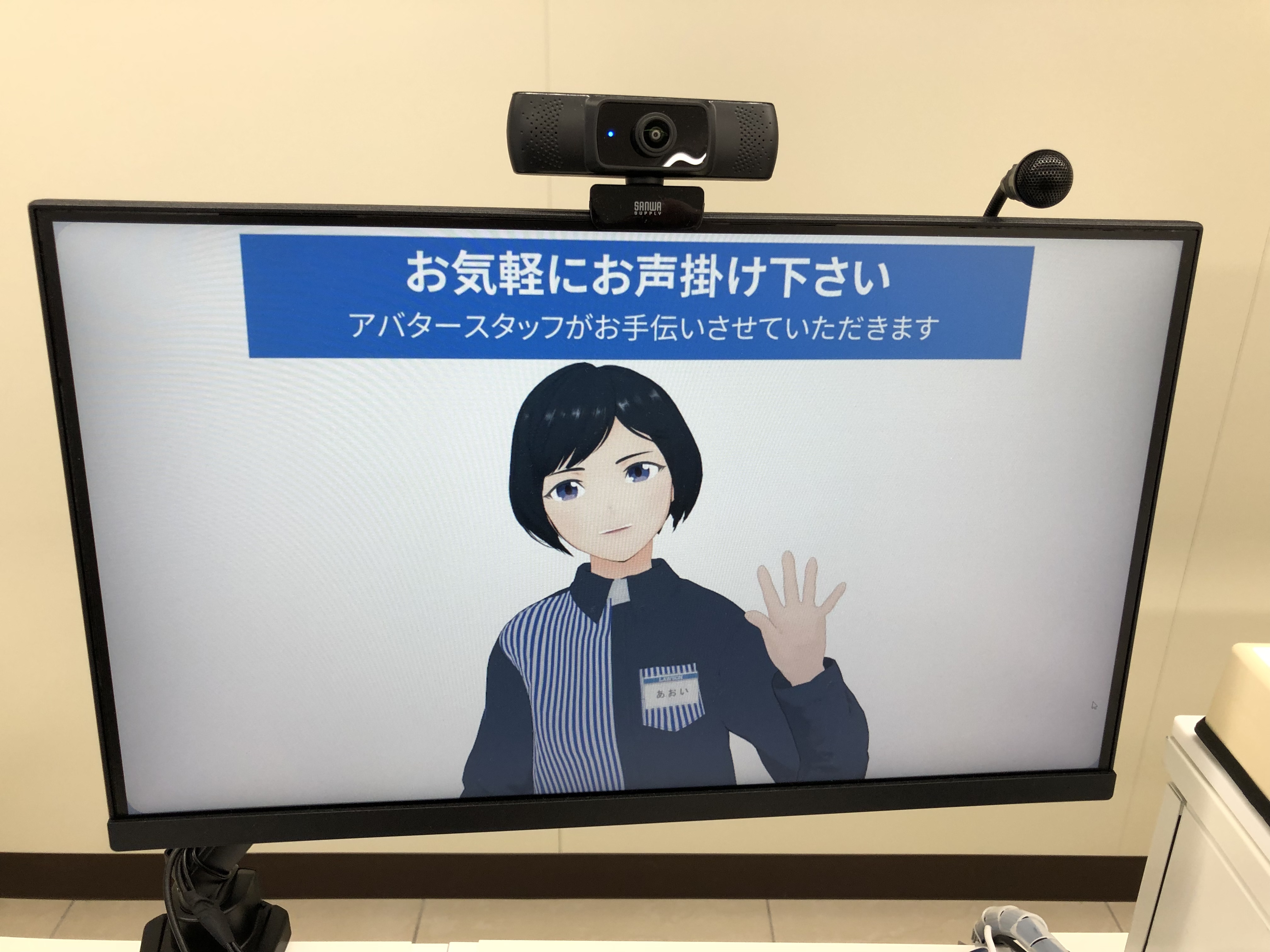
The thing that makes this store so unique is that it is fully staffed by digital avatars of Lawson employees, rather than human staff members. As we wander into the store, intrigued by the novelty of it all, we decide to explore further. As we pass by one of the avatars, she greets us with a cheerful “Happy New Year” in Japanese. As Maki chats with the AI about our epic journey along the Yamanote Line and my documenting it in a blog, the clever machine quips that it would be happy to strike a pose for a photograph. It suggests three options: a cheerful “wave,” a universal “peace” sign, or a self-deprecating “loser” sign.

Eager to learn more, I take the opportunity to ask the AI about the philosophy behind Green Lawson. To my surprise, the machine responds in fluent English, explaining that the store aims to reduce food waste, support the local economy, and contribute to world peace.

As we resume our walk, the towering buildings along the route create pockets of shade on the pavement. It’s cold in the shadows, but warm in the sun. Maki explains that there are two words in Japanese that both describe these respective conditions, but I find myself struggling to come up with the antonym for “shade.” This lack of an opposing word begins to bother me, and I consider the possibility that it might be a failing of my memory.

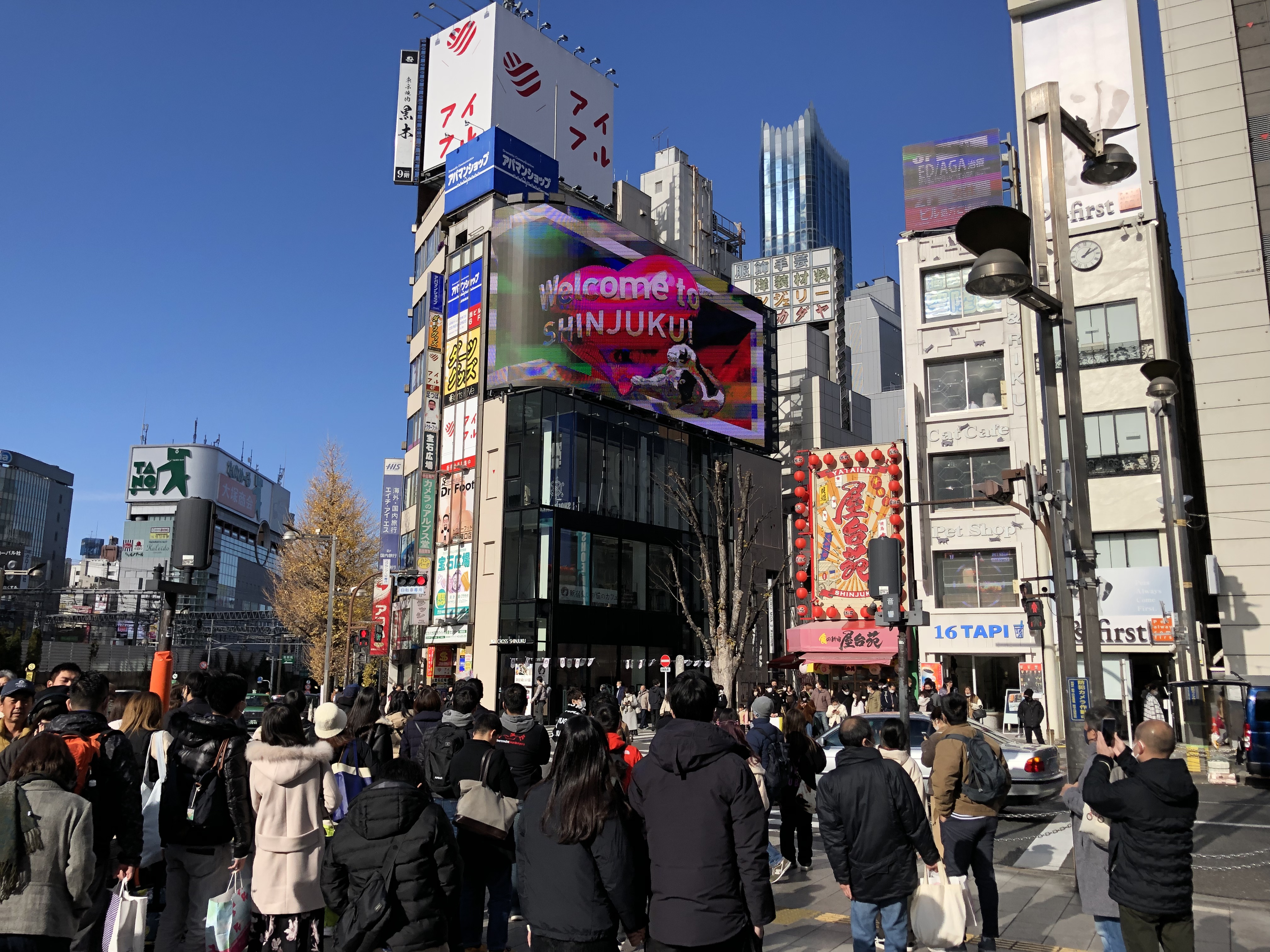
We continue on, passing a large group of people running along the street dressed as rabbits, a nod to the Chinese New Year’s chosen animal. At Ikebukuro, we are treated to the sight of sculptures that litter the streets. As we enter Shin-Okubo, we find ourselves wandering through the bustling streets of Korean Town. And at Shinjuku Station, we are greeted by a television screen that displays words in a mesmerising three-dimensional phenomenon.

Almost five hours into our walk, we arrive at the halfway point of our journey: Harajuku Station. Here, people stand in line, eagerly waiting to purchase tapioca from a street vendor. A little further up the street, we see a similar scene, but with people queueing up along the entire length of a road to buy shoes. In Shibuya, we encounter yet another line, this time composed of people waiting to take a photograph of Hachiko the dog, adorned with a special wreath to mark the New Year.

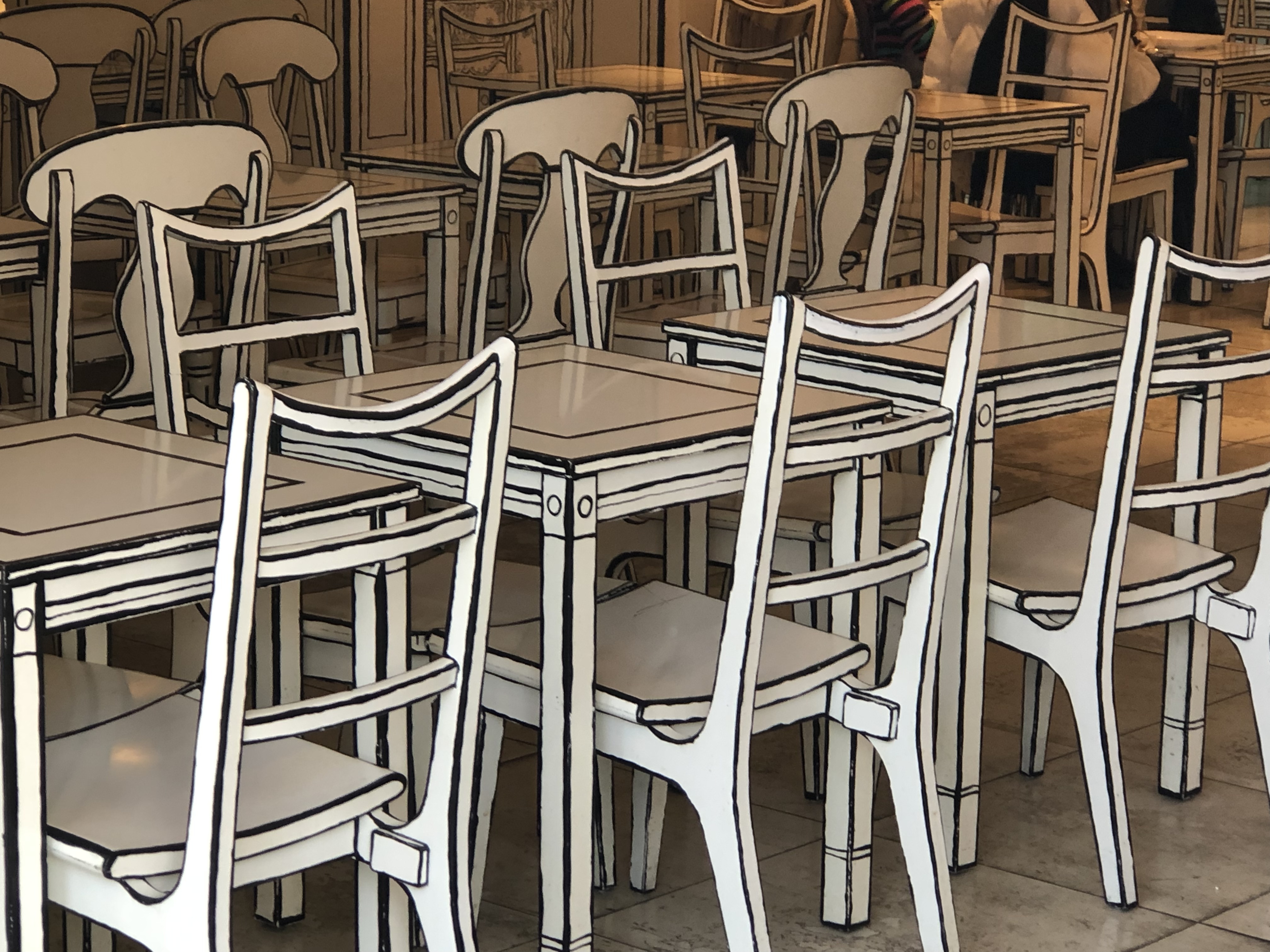
After hours of constant walking, our legs begin to feel sore. We decide to take a well-deserved break at a small, charming cafe. In contrast to the bustling, three-dimensional imagery of Shinjuku Station, the atmosphere at the cafe is a tranquil, two-dimensional one.

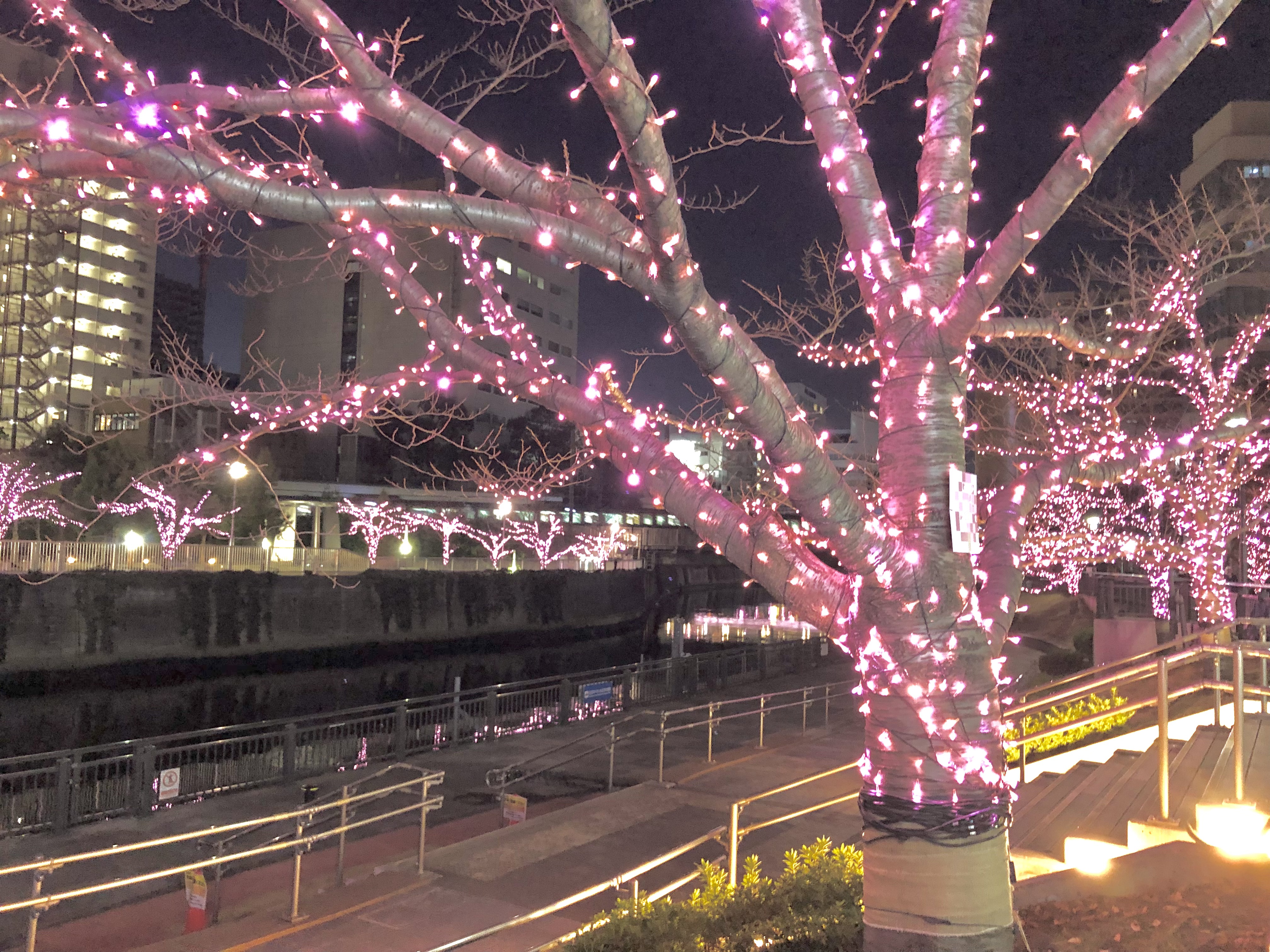
With the night falling and the wind picking up, a chill fills the air as we resume our journey through the darkening city. Despite the challenges presented by the fading light and the increasing cold, we persevere, striding forward on our journey. Close to Meguro Station, we are treated to a beautiful distraction in the form of the Meguro River Cherry Blossoms Promenade, a scenic riverside path lined with cherry trees that are illuminated by beautiful pink lights.

The tranquil scene is a welcome respite from the pain in my calves, and Maki and I take a moment to simply savour the beauty around us.

With weariness setting in, we consider the possibility of giving up, but in the end, we decide that we cannot allow ourselves to quit, for the fear of regret is too great. If we can push through and complete this challenge, we tell ourselves, then we can conquer anything. And so, we push on, determined to see our journey through to the end.

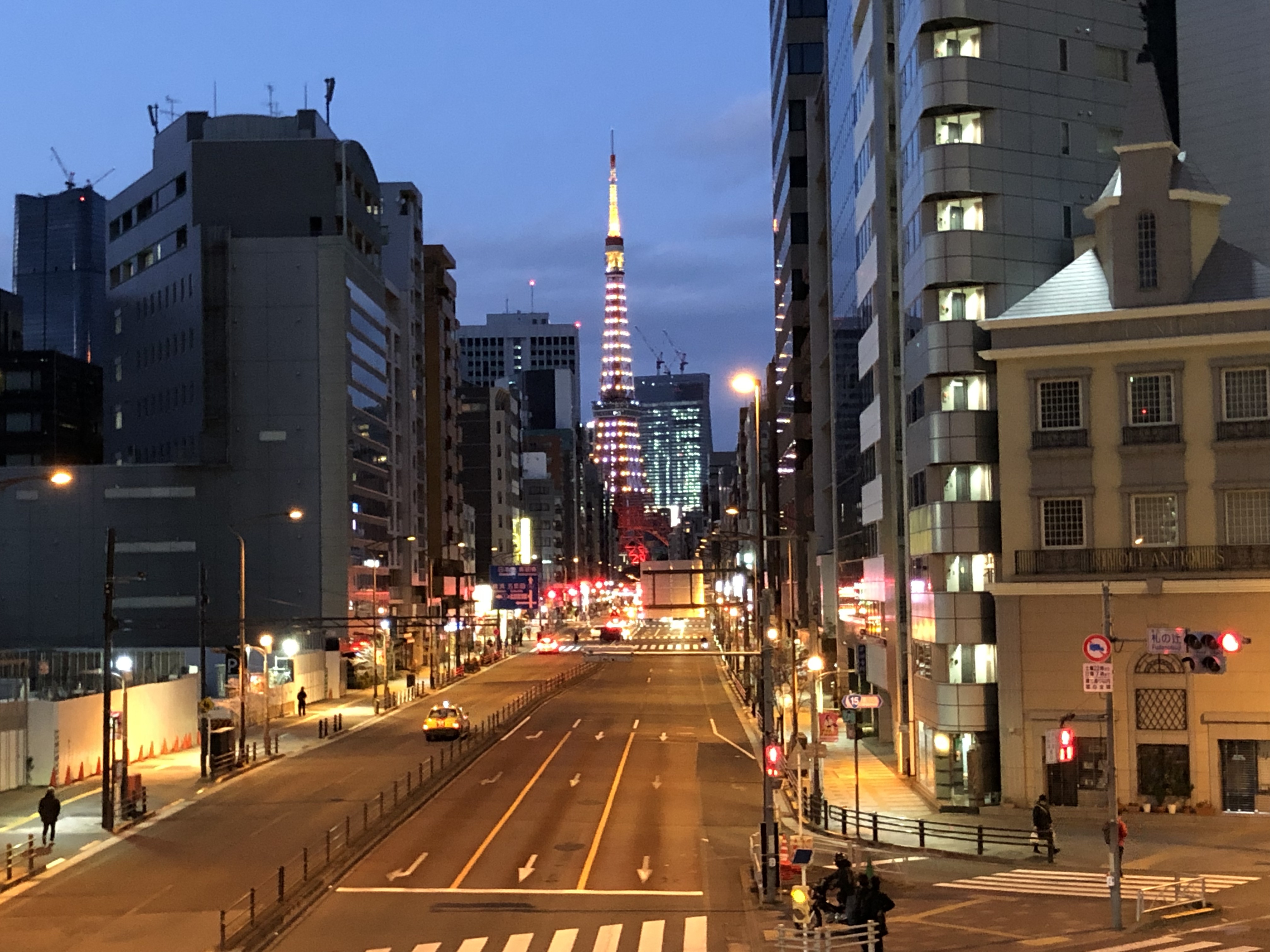
We pass through Shinagawa and the newly built Takanawa Gateway Station, the most recent addition to the Yamanote Line. At 5 p.m., the “Yuyake Koyake” bells ring out from speakers at every intersection, beckoning us to return home. But we do not heed their call, for the end of our journey is nearly in sight. In the distance, I am heartened by the sight of the bright illuminations of Tokyo Tower.

Built from the remains of United States military tanks damaged in the Korean War, Tokyo Tower was designed to mirror the iconic Eiffel Tower in France. However, in a show of competitive spirit, Japan deliberately made its tower 2.6 metres taller, earning it the title of the tallest freestanding tower in the world (a title now held by Tokyo Skytree).

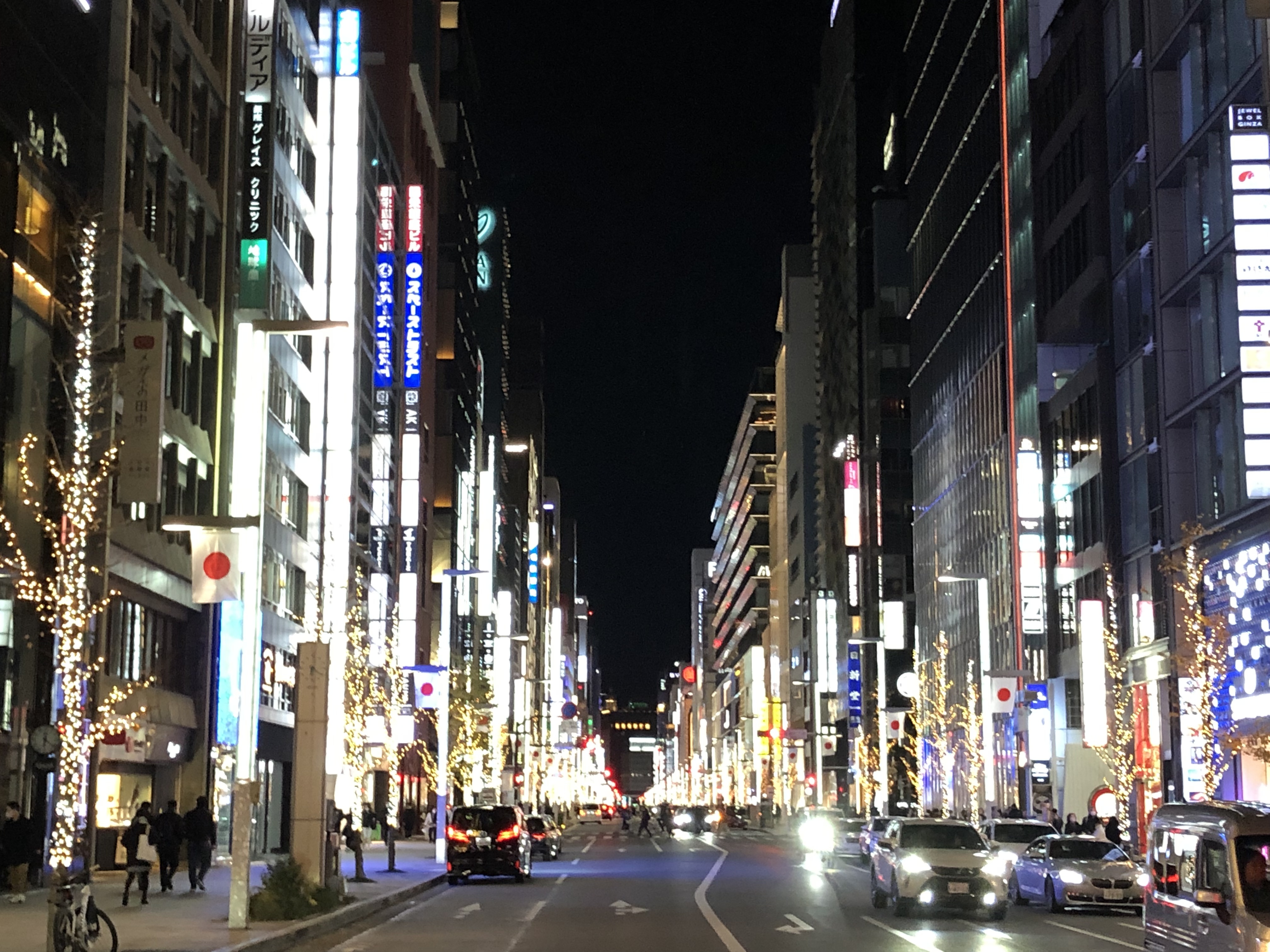
As we near the end of our journey, we are mesmerised by the bright lights of Ginza, Tokyo, Kanda, and Akihabara, all of which are transformed into a neon nirvana at night. It is at this moment that I am struck by the realisation that Japan has not just four, but five seasons – one that is marked not by the changing colours of nature, but by the way in which the country’s cities and towns are transformed by the darkness of night.

After a grueling nine-hour journey that saw us take a total of 55,454 steps, we finally arrive at Ueno Station, exhausted but triumphant. Our legs ache and our feet throb with pain, but the sense of accomplishment helps to outweigh the discomfort. Upon returning to Asakusa, I allow myself the indulgence of an ice-cold beer – the best I’ve ever tasted – as a way to celebrate and relax after our achievement. As Maki and I bask in the afterglow of our journey, the fatigue slowly starts to fade away.