Canal City, a Wedding, a Japanese Massage

Today is Marine Day, but nobody let me know. The purpose of this public holiday is to thank the ocean for all the fish. Stock markets are closed, as are some shops. The weather is nice, and everyone has taken a day off for a trip to the beach.

I spend two hours of my Marine Day celebrations cycling between closed post offices. I wonder why they are all closed? After finding the fourth post office open, I conclude my business and leave with great dissatisfaction. These three police officers on one-speed bicycles soon cheer me up as they chase after a fugitive.

policebike[1]

My legs are starting to ache after days of excessive exercise. I’ve established an eight-kilometre cycling routine that I follow every morning and evening for the past four days. I’ve managed to trim it down to about forty minutes, which is good by my standards, considering I’m on a one-speed bike and often encounter crowds of pedestrians that slow me down.

I head to Hakata on foot. Outside Hakata Station a stage has been erected and god knows what is going on. People on stage finish up singing, “We are the Bridge.” The theme song for the Asian Pacific Children’s Convention; a non-profit organisation that ‘connects dreams around the world’. I recognise the song, but I am not sure how or where from.

thebridge[1]

I head to a place called Canal City. This place is huge. 234,460 metres squared of shops, restaurants, a theatre, a Taito Station video game arcade, a cinema, two hotels, and an indoor canal running through the middle. The nickname for Canal City is, ‘the city within the city’, and it certainly lives up to its name.

There is also a water jet show. The water sprays up into the air from the fountains below. There is a mat of synthetic grass where children can get absolutely soaked as they dodge the water as it falls toward them. A woman stands with a huge water pistol, shooting at the children, a grin on her face.

If you look closely, in the window beyond the water, a bride and groom are getting married.

wedding[1]

Back at the hostel, the manager asks me if I ever eat. I was asked this question yesterday by another member of staff. It turns out none of the staff here have ever seen me eating. I try to explain to them that ten years of working nights have reduced me to just eating one meal a day, but they don’t seem to understand.

I head to the Nakagawa River. On the way, I stop and talk to Alan, the busker. He is taking a break, sipping on his Royal Milk Tea. He is from England and became homeless eight years ago. Singing with a banjo, he managed to earn enough money for a one-way ticket to Australia. For the past eight years, he has spent six months at a time in various countries. The money he makes busking every day covers the costs of his accommodation and meals.

As I walk across the river, my calf muscles are hurting. I decide to have my first Japanese massage, a type called Shiatsu, which focuses on finger pressure. I opt for a 50-minute full-body massage, emphasising my neck, back, legs, and Achilles. Afterward, I indulge in a ten-minute head and eye massage. The massage, performed fully clothed, is amazing. It costs me ¥4470.

I don’t have any photographs from the massage, as I didn’t have my camera with me. Instead, lazily, here’s a photograph I took of televisions earlier today:

televisions[1]

I leave the massage feeling great, but darkness has fallen on Fukuoka, and I don’t know where I am. I buy a bottle of green tea and walk for a while in the vague direction of Hakata Station before giving up and asking a young Japanese man which direction it is.

He says to me, ‘I am going to Hakata, come with me.’ I follow him until Japan turns into a Monty Python sketch. ‘Come along, come along,’ he tells me, ‘over here.’ I follow him for ten minutes; at each intersection, he checks to see that I am still following him. ‘This way, come on,’ he says, ‘nearly there now.’ We do indeed arrive at Hakata Station. I thank him, and we go our separate ways.

I haven’t eaten anything today, just water and green tea, and it’s 9 p.m. It’s been thirty hours without food, but I don’t feel hungry. I force down a Family Mart dinner before heading out to do my laundry.

As I open the dryer door, a voice inside greets me with, ‘Irasshaimase!’ I sit in the Coin Laundry, reading, and every now and then, I glance up to watch my clothes spinning. I’m only writing about my laundry experience because I found the orange sign above the dryer amusing. ‘Help!’ shouts the shirt, as if about to be gobbled up. After the drying cycle is finished, the machine cleverly switches to ‘Cool Down Mode.’ Five minutes later, my laundry is at room temperature—fascinating. The dryer door thanks me as it opens, ‘Arigatou gozaimasu.’

coolwashluke[1]

Back at the hostel, I strike up a conversation with an Italian girl. She left Italy without money or a job and used whatever she had to fly to South Korea. Swiftly, she found a job and established a new life for herself. As we talk, I mention Alan, the busker; his story seems to have some parallels. Surprisingly, she knows Alan—around four months ago, she met him in Seoul. ‘An Englishman with a banjo, right!’ she exclaims.

Many of the people I’ve met at this hostel are residing in South Korea and are currently here on a visa run. Their visas expire, prompting them to fly to Japan, stay for a day, then fly back out, earning another three-month tourist visa. Interestingly, as tourists, they legally trade work in hostels for free accommodation without exchanging money. This way, they can keep traveling indefinitely, and some have been doing just that.

A guy from Canada has a big carrier bag full of jet black volcanic ash. “A souvenir from Kagoshima,” he proudly tells me. It weighs a tonne.

Bike to the Fuchsia

A cloudy yet hot day, with a cool breeze—a perfect setting for cycling. Today, I’m filled with motivation. My first stop is a small park along the way to yesterday’s failed destination, Dazaifu.

Inside this lovely park, three old ladies play bowls on a synthetic lawn while beautiful fuchsias wave in the wind near a natural stream. Japan currently recognises almost 110 species of fuchsia. These particular flowers boast the classic blend of purple and red hues.

As I arrive at Dazaifu around 3 p.m., the first thing catching my eye is a hill crowned with ruins. Parking my bicycle, I decide to climb it. From the hilltop, I’m greeted with a view of traditional Japanese houses in the distance. At the bottom of the hill lies Gakugyouin Temple.

shrine1[1]

I cycle around, admiring the greenery and scenery. In Tokyo, the greenery was often overshadowed by the buildings, but here, the mountains seem adorned with temples. A swarm of dragonflies gracefully drifts above an open allotment. This place exudes tranquillity, likely absent from any guidebooks. This is precisely the Japan I’ve yearned for since my arrival—a serene experience I hadn’t yet encountered.

Kanzeon-ji is a seventh-century temple, once the chief Buddhist temple in Kyushu. It houses a multitude of historical, artistic, and religious treasures. Beside it lies the ruins of the once-marvellous seven-story high pagoda.

kanzotemple[1]

Dazaifu is starting to remind me a lot of Kyoto. In eight days, I’ll be heading to Kyoto for one week. Then, I have two weeks without plans before I head back to Tokyo. The thought has crossed my mind to cycle back to Tokyo from Kyoto, stopping off at interesting places along the way. The two cities are only 367 kilometres apart.

The sign next to the temple mentions that the pagoda was restored in 741 A.D. at a scale of 1/10. Conveniently, that’s available to see outside the Dazaifu City Fureai Cultural Hall. That’s my next stop.

pagado[1]

I enter the cultural hall, and the woman at the desk seems startled by my presence. Politely, I ask if I can look around, and she agrees—it’s also free. Inside, there are various objects encased in glass, mostly old roof tiles. After a brief tour of the building, I take my leave.

Next, I cycle to Komyoten-ji Garden to see the Government Ruins—the remnants of the medieval Dazaifu Administrative Buildings. They rest within a vast public park at the foot of Mount Ono. As I arrive, I notice some boys playing football, using jumpers for goalposts. The goalkeeper rushes forward, expertly dribbling the ball past six players before scoring an excellent goal. Applause erupts from everyone watching.

govruins[1]

All the children in Dazaifu say ‘Hello’ to me. Surprisingly, there’s a distinct lack of tourists for such a historic place. Maybe I’m the first Westerner they’ve ever seen. With a wry smile, I reply to them, ‘Konnichiwa.’

As I cycle by, insects chirp loudly near one of the men employed to direct traffic. However, there’s no traffic on this road; I don’t sense a car has come this way for hours. He smiles warmly at me, signalling with a wave of his hand and a deep nod for me to continue.

As I pass Kaidan-in Temple, I see a sign for an Exhibition Hall. Carnival Cutouts wait for me outside. Inside, there’s no one present—no tourists, no staff members, no one to take my money. It’s just more objects enclosed in glass. A sign prohibits photography, but I snap a cheeky shot; no one will ever know.

pagodo2[1]

My final stop in Dazaifu is the Kyushu National Museum, seemingly tucked away in the woods. I leave my bike; I really should lock it up, but I don’t bother. There are more temples around here too.

A sign simply saying ‘Museum’ points up a mountain path. I follow the path for a good ten minutes before encountering a new sign, indicating that the museum is 2.1 kilometres away. Quite odd. I retrace my steps to my bicycle and head off in the new direction.

museumsign[1]

I cycle up into the mountain and reach the museum car park; a sign indicates ‘last entry 4:30 p.m., exhibitions open until five.’ Glancing at my watch, it reads 4:28 p.m. Swiftly, I park my bicycle in one of the bays intended for cars and start running up the many steps to the museum.

A man with a red lightsaber appears out of nowhere. He insists that I must cycle all the way to the top and park my bike in the designated parking area. I protest, saying, “But the museum closes in two minutes, and I came all the way from Hakata!”

He makes a phone call and speaks in Japanese for a few minutes. Afterward, he tells me they can still let me in. Lucky me. As I make the final approach to the Kyushu National Museum, its sheer size almost knocks me off my bike.

kyushunationalmuseum[1]

Opened in 2005, it stands as the first new National Museum to open in Japan in over 108 years. It’s also the first to emphasise history over art and boasts an on-site conservation centre, the largest in Kyushu. The museum primarily focuses on prehistory to the Meiji era.

Once inside, I ride the escalator to the 4th floor and pay a ¥420 entry fee. The rooms are impeccably clean; the glass seems polished on the hour. The museum is enormous. Separate rooms display various collections of historic artwork or fossilised ruins. Photography isn’t allowed here—not even an opportunity for a quick shot; two staff members stand guard in every section. With just twenty-five minutes to look around, I leave dead on closing time.

After the museum, I cycle 18.2 kilometres back to the hostel. It takes me an hour, stopping once for a bottle of Pocari Sweat, and a second time to photograph this building:

chesterhouse[1]

At the hostel, I realise that I’m starving. I decide to keep my stomach empty and write up some of the day’s events. At 8 p.m., I head back outside and run on my empty stomach, finding the red lights of traffic intersections providing nice little rest stops from time to time.

I run for almost fifty minutes, passing packed restaurants offering any choice of cuisine imaginable. Even though it’s been twenty-three hours since I had any food, nothing really draws me in; my appetite is oddly missing.

I see a random square:

randomsquare[1]

As I run, I notice some red lights in the sky that resemble a tower. Intrigued, I head in that direction. As I get closer, I spot planes floating by in the distance. A sinking feeling hits me; I might have circled back to Fukuoka Airport, recognising the tower used for Air Traffic Control. Oddly, I didn’t see any signs indicating the airport, though.

To my relief, my assumptions were false. I arrive at Hakata Pier, realising that the tower I saw was Hakata Port Tower. Calculating the distance, I note I ran for 5.7 kilometres to get here. Earlier today, I cycled at least forty kilometres. It’s surprising—I’ve never had so much energy.

hakatatower[1]

Fishermen line up along the pier, and finally, my appetite for food returns, specifically for fish. However, the only fish I find here are sandwiched between glass in another small, free aquarium. I scout out the area and stumble upon another temple—I seem to have come across quite a few of these today.

The pier looks picturesque at night, adorned with its myriad of lights. Entering the food court, I find that the only place with any appeal is a French restaurant. However, as I approach, the lights suddenly go out. Closed at nine o’clock sharp.

piershot[1]

I head back to Hakata and unexpectedly stumble upon the all too familiar Reisen Park. Spotting other runners doing laps around the park, I decide to join them for a while. When I finally locate the camera shop, I get my bearings.

The area around the park is bustling at night, with outdoor izakayas lining the streets. The enticing aroma of barbecued meats fills the air. I’m rather fond of the monument in the park, so I try to take a photograph, but unfortunately, it doesn’t turn out so well. Quickly, I make my way back to Hakata Station.

parkstatue[1]

I undo all the hard work of the day and opt for McDonald’s. It feels like I’m a death-row inmate having his last meal, as I’ve decided this will be my final indulgence in junk food for a while. It costs me ¥986, effectively for fish and chips.

As I walk back from the station to the hostel, it unexpectedly starts to rain—for a grand total of exactly five seconds. Umbrellas shoot up, and just as quickly, they come down. Since I don’t usually carry an umbrella on hot days, I get ever so slightly wet.

Back at the hostel, I find I still have an abundance of energy. It’s been a remarkably productive day. I spend a few more hours writing, followed by some reading. Then, I head to bed—stone cold sober.

Into the Belly of a Whale

I am filming the rain as it slowly sweeps toward me. The rain is just a bit further away on the other side of the road. It’s heavy, two weeks worth of rain all in one go. As it passes through me my umbrella goes up with the flick of a button. Flick. Swoosh. Patter patter. At Tawaramachi Station, I see a member of the hostel staff. He doesn’t have an umbrella. I walk him the five minutes to the hostel holding my umbrella above us both, much to his delight.

On the way back to Tawaramachi Station, the path is already flooded. The thunder sounds like a drum, a big booming drum. It starts from behind me and roars across the sky travelling above me and away into the distance. One fell swoop. I stand for a while watching the lightning over the Sumida River, it dances around Tokyo Skytree, a giant lightning rod on a day like today. I wait with my camera, poised for the shot that never comes. Ten minutes pass and I decide ten minutes is long enough to wait.

sitandlistentotherain[1]

I grab the train to Shinagawa, via Nihonbashi for a ¥300 orange and ginger smoothie. Outside Shinagawa Station a thick grey blanket of cloud covers every inch of the sky, casting rain and darkness across the city. Street lights have come on and it’s only 10 a.m.

I go to the Tokyo University of Marine Science and Technology. There is a museum here about fishing methods. There is also a big round pond for the turtles to swim around in.

The highlight for me is something you won’t find in a guidebook. A full size skeleton of a western gray whale. There is a sign saying ‘open’ but there is not a sole in sight. I enter the room housing the giant whale skeleton. It is incredible. The way the exhibit has been put together allows you to walk inside its rib cage, into where its stomach would have been. I contemplate spending three days and three nights in the belly, like Jonah, but the smell of the bones is quite potent. Like a rotten seaside smell. I take a few photographs, but the whale is so big, I can’t fit it into a single shot.

whaleofatime[1]

I wander around the rest of the university campus. I find it interesting to get a perspective of what it’s like here at a university in Japan. They have tennis courts, surfboards, labs, classrooms, a whale skeleton, boats, dormitories, and an outdoor swimming pool brimming with rainwater. I leave impressed. In Tokyo, every train station has its own theme tune for each train line, and the Tokyu Toyoko Line does not disappoint.

Back at the hostel I think about moving on. A hostel in Beppu claims that: “If you are tired while you are traveling, Beppu is the best place to relex! [sic] Beppu is blessed with abundant nature for trekking, soaking in natural hot springs, or playing in the ocean. You can choose what you want depending on your mood. There are eight different kinds of hot springs, depending on the area you go to.” The hostel having its own hot spring bath making the decision very easy for me, and I book a two week stay.

greenbike[1]

Outside the rain has just about stopped, so I go to hire a bicycle. Bright green, my favourite. Yesterday I wanted to buy my own bike, I even went to the bike shop. The guy told me I can’t buy a bike unless I have a permanent address. Apparently, to prevent theft, all bicycles in Japan have to be registered to an address and all bicycles are stamped with approval. Each cyclist has a card with their name and address and a number matching the number stamped to the bike. If stopped by the police you can prove the bicycle is yours. If a bike is abandoned the police know who it belongs to and will charge you to have it sent back.

On my bright green hired bicycle I cycle to Ueno. There is an expedition on today at the Tokyo National Museum. It is art work from Taipei and has been big news in Japan for all the wrong reasons. The Japanese billboard advertising the Treasured Masterpieces from the National Palace Museum in Taipei had omitted the word ‘national,’ an act that was perceived by the Taiwanese government as undermining the nation’s dignity. The exhibition was almost cancelled until a last minute correction was made and an apology from Japan was given. Unfortunately, the famous ‘Jadeite Cabbage’ was left back in Taiwan amidst the controversy. I came here solely to see The Cabbage, so perhaps it was a wasted journey. Outside the museum, I eat green tea ice cream while gazing in, saving my ¥1600.

exhibition[1]

The time is 19:11, so I head to Seven Eleven. I buy Inarizushi (sushi rice wrapped in deep fried tofu). I also buy an egg sandwich, a box of natto, and some hot chilli flavoured Potato Chips, for the natto. At the counter, chopsticks and a mint tipped toothpick are given to me in a handy little bag, complimentary of course. I head to my hiding place on the 4th floor of the hostel and read. The packaging for my sandwich thanks me for eating its contents. I eat natto until I run out of Potato Chips.

I decide to cycle around Asakusa looking for something to do. Outside Senso-ji Temple, I spot a television crew and TV presenter Kazuo Tokumitsu. He is with a female singer who’s name I haven’t yet discovered. She sings a few songs, her voice sweet, her smile sweeter. She thanks a few members of the crowd and then everybody leaves.

femalesinger[1]

Back at the hostel, I plan on an early night. My early night doesn’t quite happen though and somehow I’m in a bar with three guys from the hostel. For some reason, I can still recall the stench of the whale bones. I stay to watch the first half of the Uruguay game, before giving in to slumber at around 2 a.m.

Mascot, Mascot, Mascots

The elevator stops at a random floor. I stick my head out, but there’s nobody there—very odd indeed. Outside, the rainy season has decided to take a day off; the weather forecast for Tokyo today is ‘scorchio!’ I am up quite early so I decide to do my laundry. I chill out in the ball bath for a while whilst waiting.

Once finished I leave the hostel and decide to check out Kappabashi Street; a road I have walked past at least thirty times since being here but have never bothered to venture down. It is a shopping street selling many specialty goods, mostly kitchen products. This street is littered with pink lanterns. It also has its own special mascot, the kappa, a Japanese river imp.

PINKS[1]

After walking the full length of Kitchen Street, I arrive at Ueno Station. Here I take a train to Ikebukuro.

I visit an art gallery, only to find a sign inside stating ‘closed today.’ I start to ponder if anything in Japan is ever open. Outside, I notice a sign reading ‘パフォーマンス中’, with ’12:15′ scribbled below it on a whiteboard. Translating the sign, I discern it means ‘performance at 12:15’. It feels like my Japanese learning is finally paying off.

I head across to a nearby McDonald’s to kill half an hour and to kill my healthy diet. I sit down in a private booth, there is a screen in front of me so nobody else can watch me eating. All very strange.

Back outside the performance is about to start. A man appears dressed as a type of Godzilla human statue. He walks slowly to the middle of a large open area and stands on a slightly raised platform. Here he remains perfectly still. Two minutes later someone puts a coin in his collection bucket. It is at this moment he comes back to life to give the person a ‘thumbs up’, before returning to his original position.

Stone[1]

It is a hot day. The sun burning in the sky, but there is not a bead of sweat on the man. There is a moment of comedy when a woman poses next to the statue for a photograph, presumably she thinks the statue is real. The man steps off his raised platform and sneaks up on the lady; when she finally notices him she lets out a loud scream and everybody laughs. After a while of literally standing around, I decide to grab the train bound for Harajuku.

At Harajuku Station there is a sign with arrows pointing to nearby tourist attractions. Takeshita Street, Yoyogi Park, the NHK Building, and Meiji Shrine. All four are within five minute walking distance from the train station. I toss a coin and it lands in the gutter. I toss another and it directs me to the NHK Building.

NHK is Japan’s national public broadcasting organisation, its equivalent being the BBC. Inside I see everything from props and set locations, the history of NHK, quiz machines to test my knowledge of NHK, a machine that lets you be a nature cameraman, and my favourite activity, a mock up television studio.

NHK1[1]

At the mock up studio I am seated at a news desk and instructed to look at the camera. Next, I take part in a fake weather broadcast. I stand behind a Tokyo skyline and point at things which are being projected onto a large television screen. It is all very exciting.

I get the chance to witness a live broadcast. Behind a large glass screen, NHK is airing a television show called ‘Studio Park Kara Konnichiwa.’ It’s a live chat show featuring two hosts, a guest, a producer, and four cameramen. I stand and watch for a while, probably fifteen feet away from the show’s hosts, before eventually realising I can’t understand a word of what is being said. So much for my Japanese learning finally paying off.

Leaving the NHK media theme park, a statue of Domo-kun waves me goodbye. Domo-kun has been the broadcaster’s mascot since 1998, and is described as ‘a strange creature that hatched from an egg’. Goodbye Domo-kun! The exit leads out into Shibuya. I am surprised just how close together everything is in Japan and wonder why people waste so much time here on trains.

mascot[1]

On the train, I see an advertisement for the FIFA World Cup; it shows the mascots for the Japanese National team. They are the Pokémon characters Bulbasaur, Charmander, Chespin, Fennekin, Froakie, Helioptile, Litleo, Meowth, Pancham, Pikachu, and Squirtle. I am looking forward to the World Cup and think Japan are worth a punt at 200/1. Back at the hostel I discover that England’s game against Uruguay is at 3 a.m. here. I am no longer looking forward to the World Cup.

I eat Wasabi flavoured crisps, watermelon, and my favourite food, Cheese Mushi Cake. I then head out to the English bar where I practice my teaching skills. Much to my delight, the English bar is playing Beatles Radio; a mix of original and cover versions of the Beatles songs. I stay until last orders and head back to the hostel to find a party going on and a guitar.

I play ‘Give up the Ghost’ by Radiohead. After I finish a man says that the way I play reminds him of Thom Yorke. His comment makes my day. Later, three ladies from Thailand who had heard me playing earlier approach me and start talking to me in Radiohead; the perfect end to an evening.

A Tale of Two Squids

I wake up to the birds cheeping outside and the sun blazing through the window. An early start today in the far too hotter than I’m used to 30°C Tokyo sunshine finds me out and about for 9 a.m. I head across to the bar I had been the previous evening, which luckily for me, doubles up as a vegan and vegetarian restaurant in the day time; and only a 45 second walk from my hostel too. After a breakfast of beans, egg, and toast, washed down with a damn fine cup of coffee, it’s time for a stroll.

I take a five-minute walk to Senso-ji, a Buddhist Temple in Asakusa and the oldest temple in Tokyo. The entrance to the temple is marked by a giant red and white lantern, and probably the largest lantern I have seen in my life. This section is known as Kaminarimon, or the Thunder Gate. Standing either side of the gate are two large statues, the one on the left, I am told, is Fujin, the god of wind; and to the right, Raijin, the god of thunder.

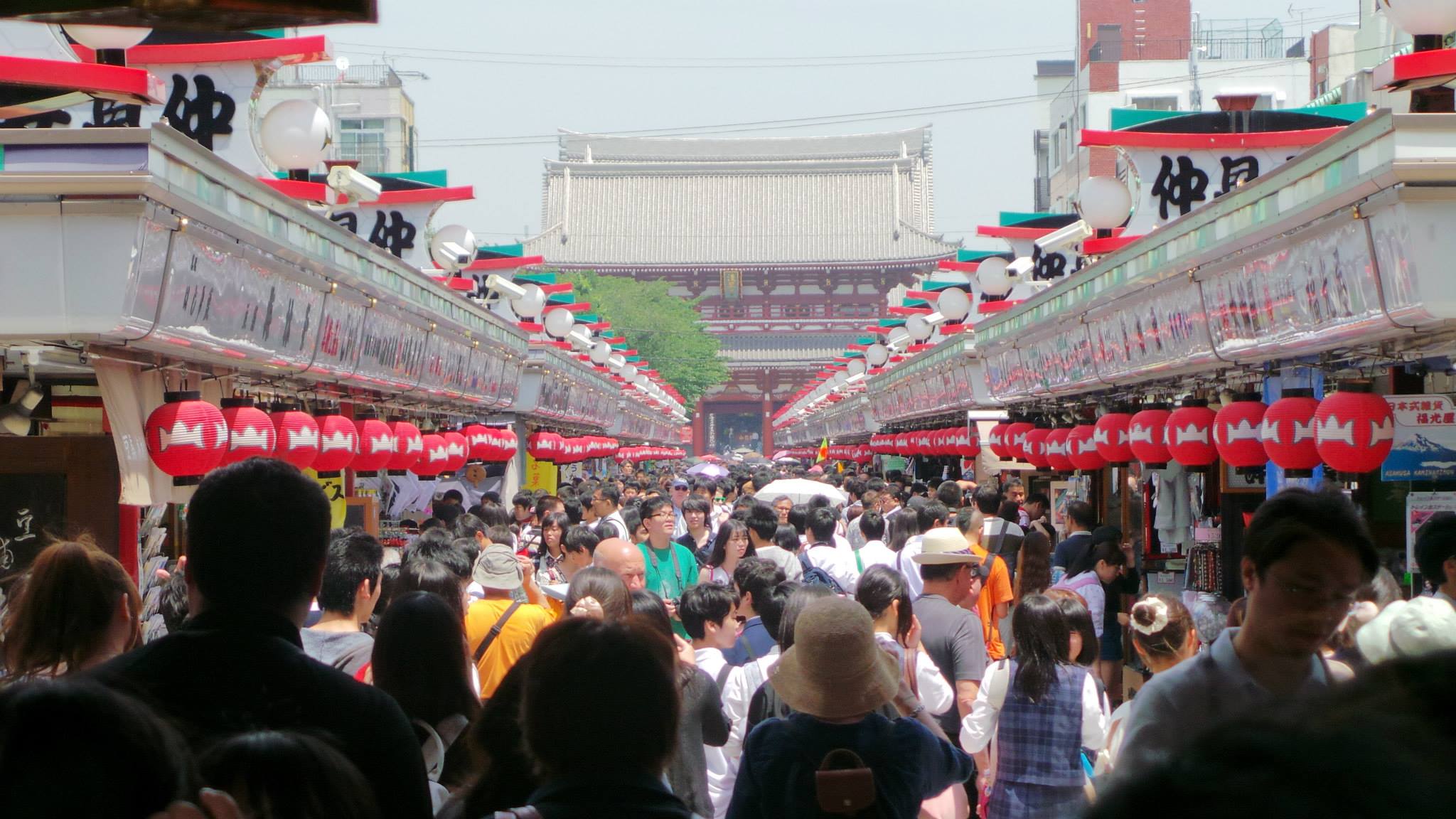
Continuing towards the temple, there’s a line of over 80 stalls offering fans, umbrellas, souvenirs, and an array of food items (bean paste buns and rice crackers seem to be popular today), along with clothing, handbags, and even a stall claiming to sell tortoise shell and coral. Known as Nakamise-Dori, this stretch forms a beautiful lantern-lit pathway of stalls leading to the temple.

senso

In the temple courtyard stands Goju-no-To, a five-story pagoda that stands at 53 metres tall, making it the second-highest pagoda in all of Japan. Prior to the temple entrance, there’s a massive cauldron emitting thick incense smoke. This cauldron marks the threshold before the entrance to the Hondo, or Main Hall. Inside the Main Hall, a striking golden statue of Kannon, the goddess of mercy, awaits. Legend claims the statue was retrieved from a lake in the year 628 AD by two fishermen.

After some sightseeing around the temple, I head to a nearby shaded indoor market. After a short while, I notice a woman who, for no apparent reason, is strolling through the market balancing a bottle of green tea on her head. As she passes by, I stop and turn around to confirm what I had just witnessed – indeed, a woman balancing a bottle of green tea on her head. In the process, I almost get knocked over by a passing cyclist.

Upon returning to the hostel, I start feeling somewhat tired: a touch of jet lag, extended periods of wakefulness, and my newfound, albeit very healthy diet of Suntory Black Boss Coffee being the obvious causes. I opt to take a nap.

I awaken. It’s 8 p.m., and outside, the darkness of the sky has been replaced by the brilliance of vibrant neon lights. I realise that Japan takes on a strikingly different appearance in the evening. I begin my walk back toward Senso-ji, passing by pachinko parlours, game arcades, and brightly lit restaurants that seemed non-existent earlier today. The streets are now bustling with people seated at tables, dining. Shutters down, shutters up—there isn’t a clothing shop in sight; everything has been transformed into restaurants.

restaurants[1]

I return to Senso-ji to witness the Pagoda and Temple illuminated at night—an impressive sight. Strolling back through Nakamise-Dori, almost all of the 80 stalls are now closed with their shutters down. Only a single food stall remains open; it’s time to find something to eat.

I opt for a tempura restaurant that proudly boasts an English menu. According to the menu, their prawns are exceptionally tasty due to being raised using extensive aquaculture—an environmentally friendly method. They exclusively use 100 percent vegetable oil with no cholesterol. Ordering a tempura set with noodles and a pint of Kirin Beer, I indulge in tempura sweet potato, lotus root, squid, and prawn, all served on a bed of rice. While the squid tempura is remarkable, the standout, confirming the menu’s claim, happens to be the most delectable prawn I’ve ever tasted.

tenpura[1]

The meal, including the beer, costs me ¥1060—an incredibly reasonable price indeed.

Deciding to conclude the night back at the hostel, my appetite is thoroughly satisfied. I purchase a few affordable cans of Asahi from the vending machines and head to my room, where I’m greeted by a few fellow roommates. A lady from Taiwan offers me some squid on a stick. ‘Try it,’ she says with a grin, ‘it’s nice and a little bit spicy too!’ For some reason, I agree to give it a try.

Two minutes later, I’m still at the tap, trying to wash away the taste of what must have been the most disgusting food I have ever tasted. The texture was chewy, the taste was off, the regret was apparent.

My second day in Japan oddly mirrored by both morning and evening visits to Senso-ji Temple: walking the same streets once bathed in the brightness of a hot sunny day and then again in the neon-lit darkness of the night; and some food to remember, followed by food to forget.