Welcome to the World of Mizuki Shigeru

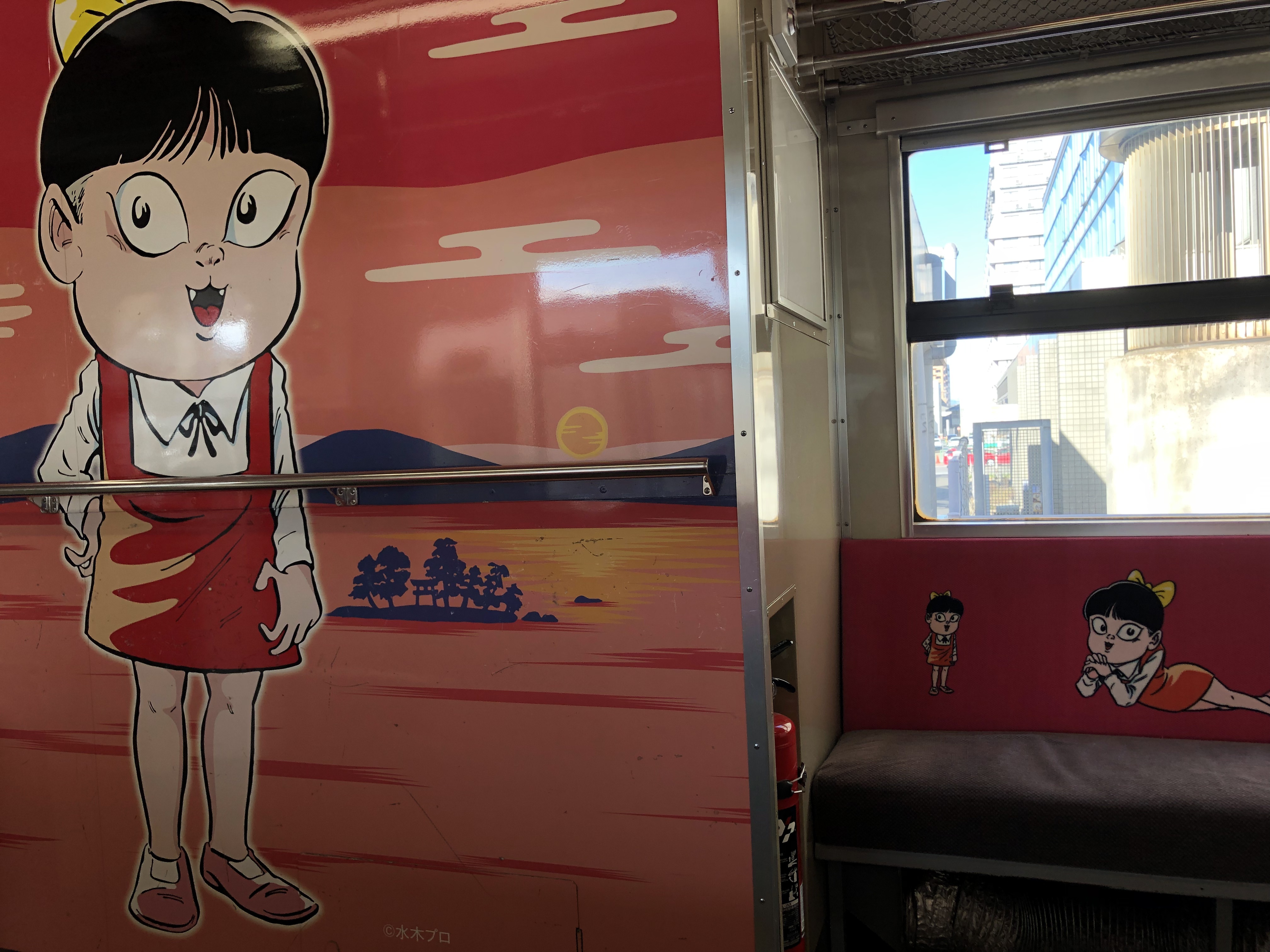
I stand at Yonago Station, my eyes fixed on the tracks as I await the arrival of my train from Track 0. This station, also known as Ratman Station, is located in Tottori Prefecture near the border of Shimane. The stations on the Sakai Line all have an alternative name, and this one is no exception. As my train arrives, I can’t help but notice the lively characters from the popular anime, GeGeGe no Kitaro, decorating its exterior. The walls are adorned with illustrations of Nekomusume, a supernatural cat known as “Cat Girl,” who, to my surprise, also serves as one of the train’s announcers.

As the train chugs along, it gently rocks back and forth, the sensation akin to being on a ship at sea. Nekomusume is normally a reserved yokai girl, however she is known to shapeshift into a fearsome catlike monster with razor-sharp fangs and piercing eyes, particularly when she is angry or hungry for fish.
Finally, I arrive at the port town of Sakaiminato and get off the train at Babasakicho Station, nicknamed ‘Kijimuna’ meaning Okinawan wood spirits. As I exit the station, I feel lost and consider whether I have made a mistake. But after a short walk, I see a sign pointing me to my destination: “Welcome to the World of Mizuki Shigeru.”

Mizuki Shigeru was a Japanese manga artist, born in 1922 and raised in the town of Sakaiminato. Upon arriving at Mizuki Shigeru Street, I am immediately struck by the abundance of weird statues that line the road. A total of 177 bronze yokai statues, each depicting a different supernatural entity from Japanese folklore, have been placed along the 800-metre street. Mizuki Shigeru made his name by portraying such entities in his work and the area here is dedicated to his legacy.
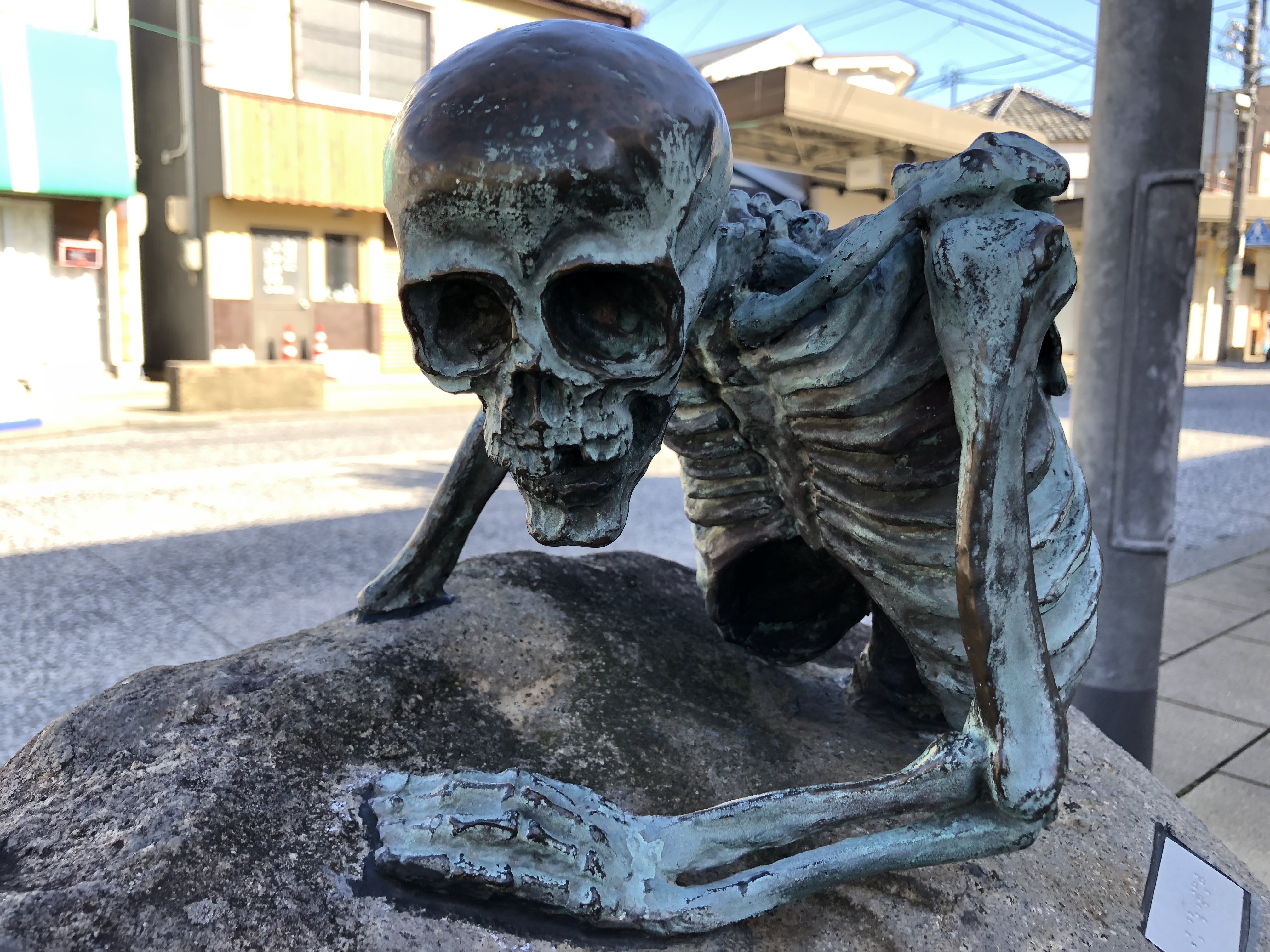
The street is filled with souvenir shops selling official Mizuki Shigeru goods, and the entire road is dedicated to the artist. It’s clear that even in death, Mizuki Shigeru has become immortalised with not only a statue, but an entire street and a train line. The vending machines are adorned with illustrations of monsters, there are photo booths where you can take a picture with yokai, there is a large museum, and even a place called Yokai Shrine.

The renowned Mizuki Shigeru Museum showcases many of Mizuki’s works, including manga books from his “only-for-rent-manga-period” and other masterpieces about yokai. The museum also displays numerous photographs and materials about the writer’s trips and his research of the yokai world. Visitors can even find yokai that lived in ancient times in Japanese households. The museum truly immerses visitors in the world of yokai and the brilliance and wonder of Mizuki Shigeru’s work.
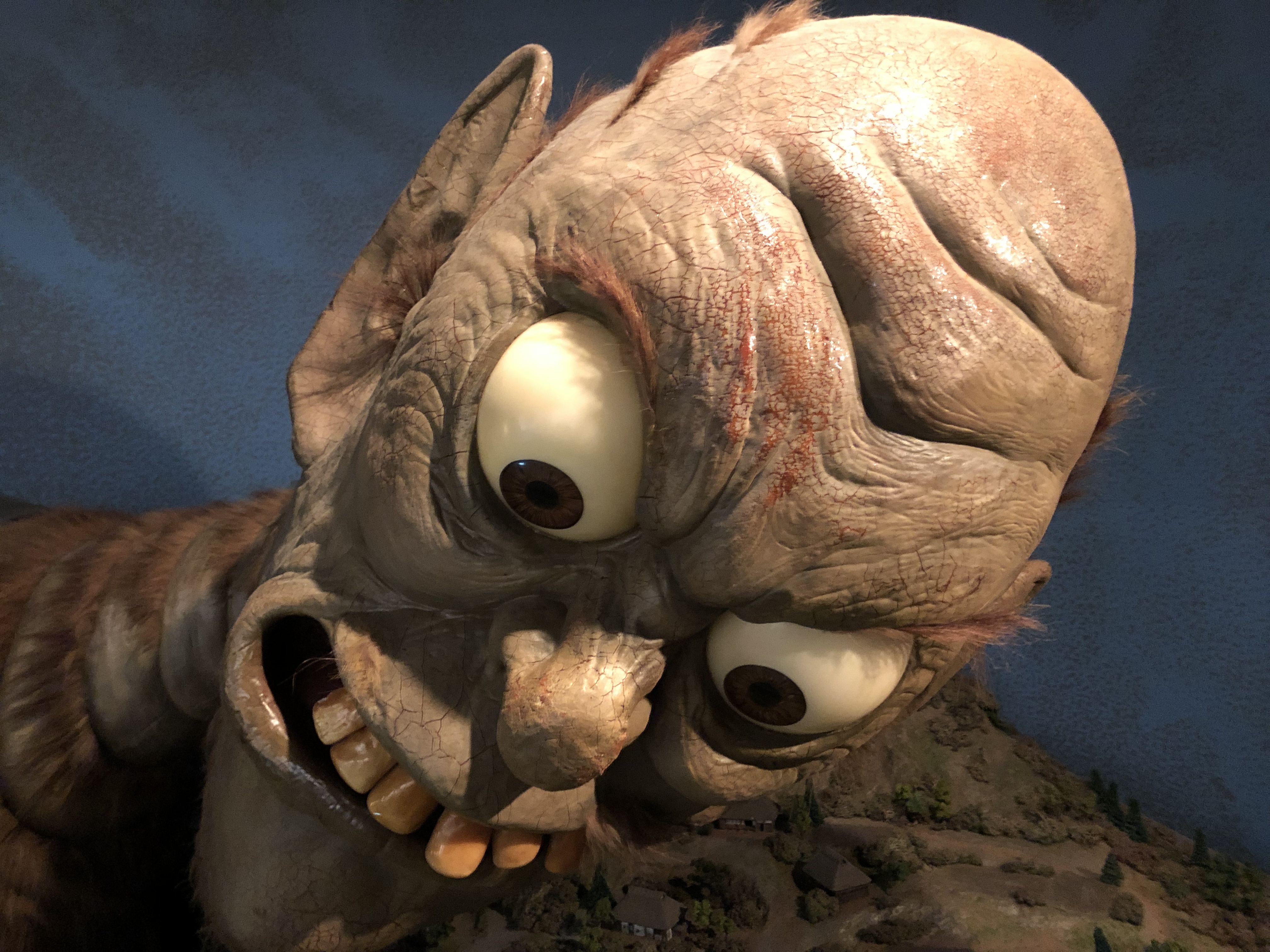
The museum’s flyer sums it up best, “You will meet a lot of yokai. Hope you will become friends with them.”

Continuing my exploration of the museum, I pass books and board games, and a lot of comics, most of which feature imagery that depicts death. The museum spans a massive ten rooms and includes original cells, drawings, a bronze engraving of Mizuki’s palm print, his passport, and a complete timeline of his life.
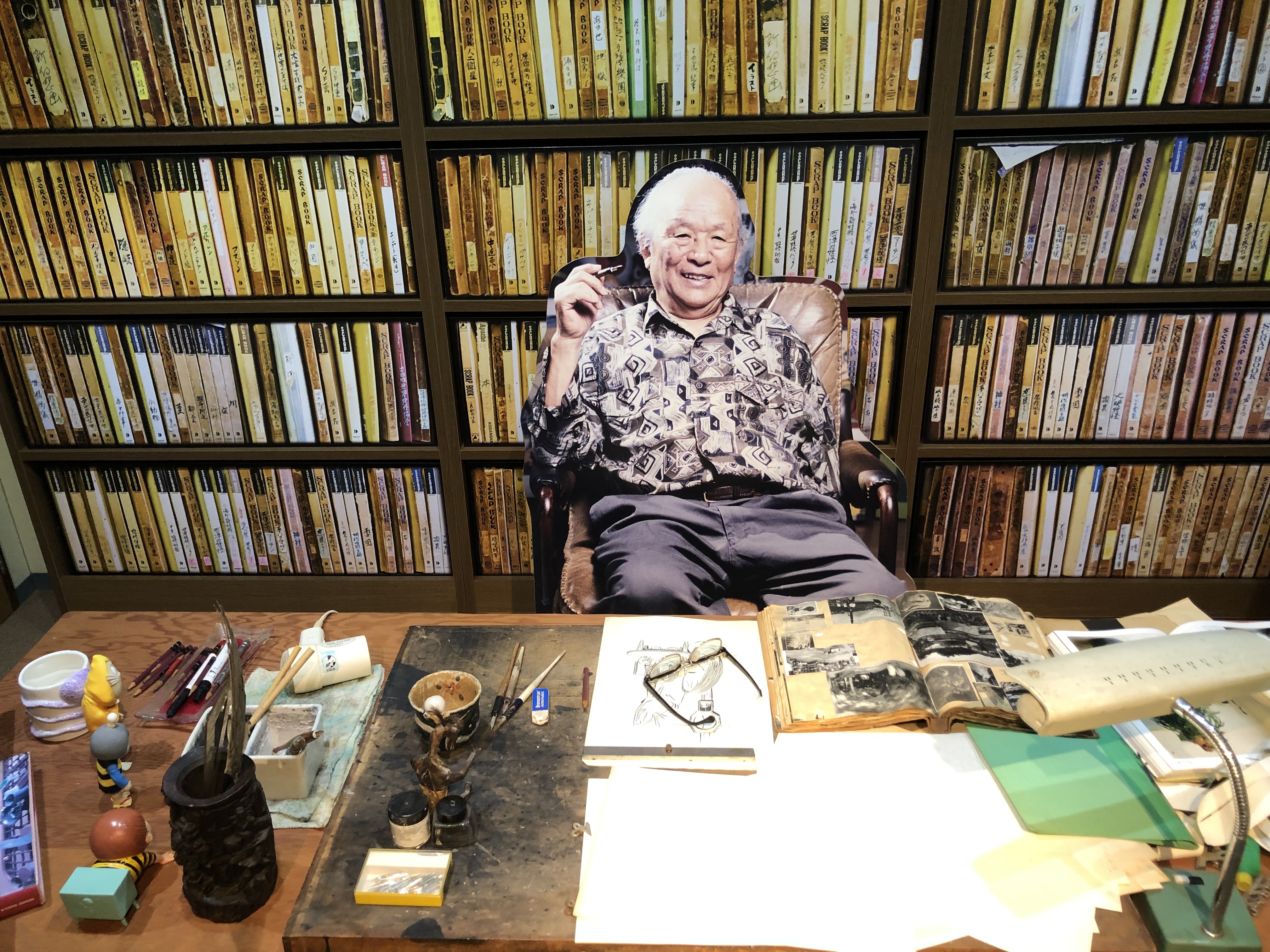
Weird, creepy music plays as I pass through a haunted house. I learn in the museum of an interesting temple over in Matsue Prefecture, three hours from here by train. The temple is very much related to the story of Mizuki Shigeru’s life. As I leave the museum I pass a terrifying wall of heads in the Yokai Cave, and finally outside I discover a traditional Japanese garden littered with macabre images.

After a few hours on the train, I arrive at Ichibata-Guchi Station. The train station features a small statue of yokai. As I exit the station, a really old woman approaches me and starts chatting in Japanese. She is surprised to hear that I am planning to walk to the temple, as it is about five kilometres away and up a mountain. The walk is quite difficult, she warns me.
As I begin my hike, I walk down a conveniently straight stretch of road. The first car I see since leaving the station is driven by a Japanese man who, for no apparent reason, smiles and bows his head at me. A short distance later, I come across two stone lanterns that mark the beginning of the route, which will start to incline steeply. From this point, the footpath vanishes leaving two lanes of an empty road devoid of traffic or vehicles. As the path becomes steeper still, it meanders and curves up the mountain and I find that the further and higher I climb, the better the view becomes. At one point I can make out Lake Shinji in the distance.

As I near the top, I realise how hot it is, and it doesn’t help that I am wearing a thick winter coat. It must be 20 degrees. The breath of winter now a fiery gasp, as the planet scorches in its rage.
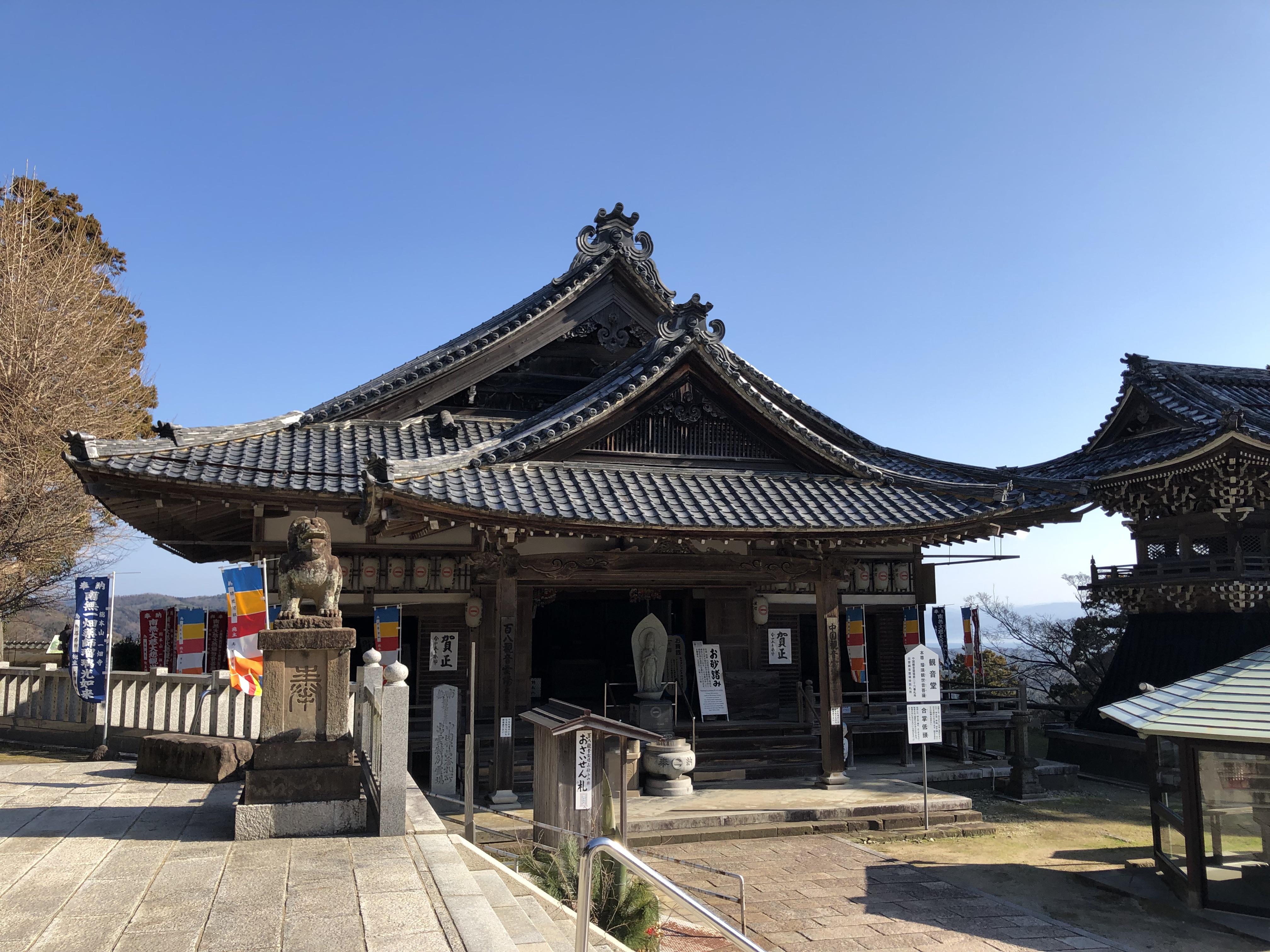
After a challenging hike I reach Ichibata Yakushi, a Zen Buddhist temple, and part of multiple pilgrimages, one of which includes visiting 108 Kannon temples in Japan. The temple was said to be founded after a monk named Yoishi followed three white foxes up this mountain, and decided to build a temple at the site where the foxes led him.

The reason for visiting this temple today is that the story goes that Shigeru Mizuki used to visit here a lot, and that a ghost of a really old woman would meet him here, whispering to him all the legends and stories he used in his creations. I explore the temple grounds, and get a feeling that someone ordered a few too many statues. It is said that there are 84,000 statues here, however, I count just 30,780.
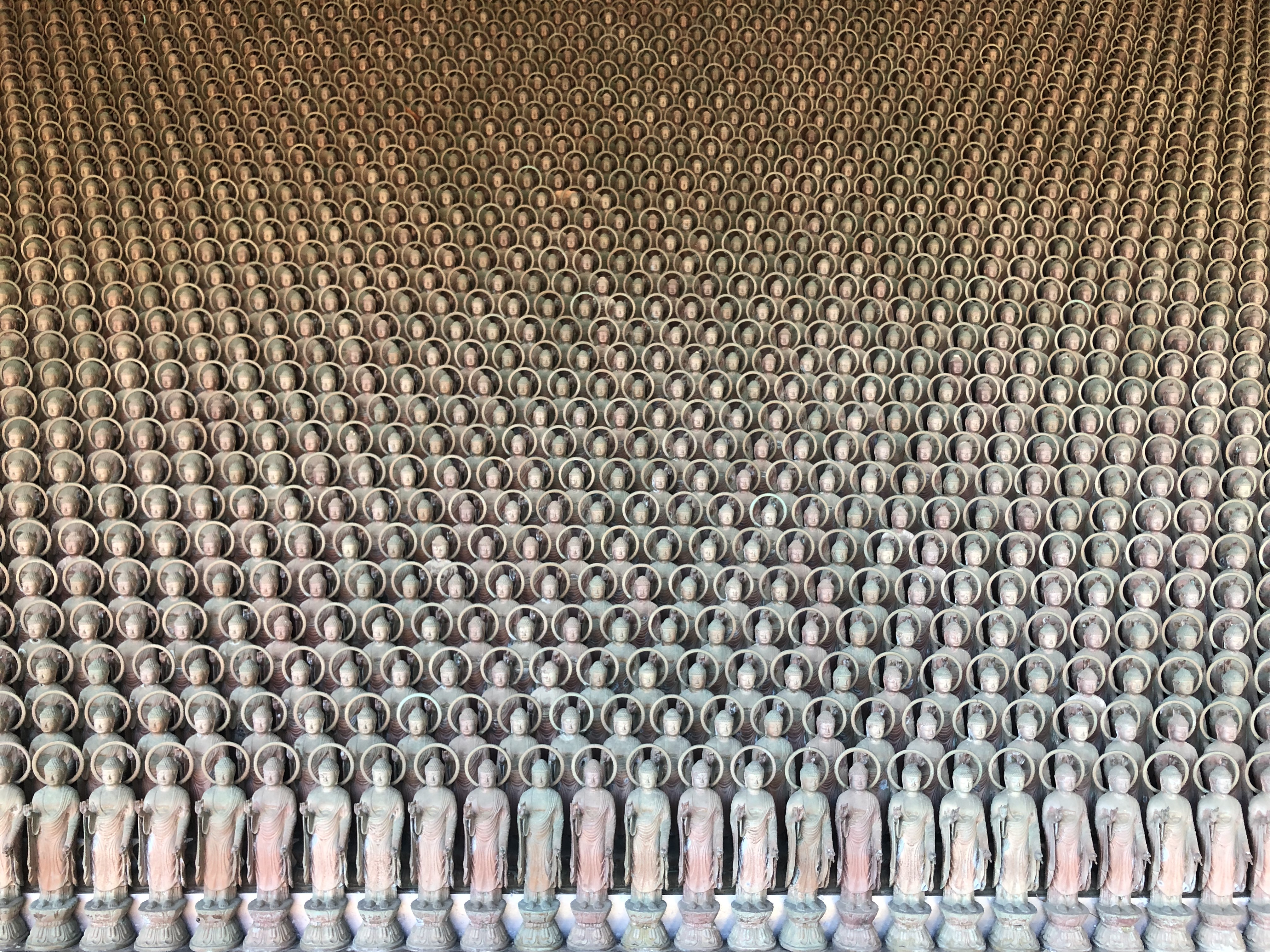
As I continue to explore, I decide that it’s really quite beautiful up here. The area also features mountain cottages to rent for a night for as little as ¥10,000, offers stunning views of the landscape below, and for some reason, appears to be really popular with dog owners, as I count five dogs within the temple grounds.

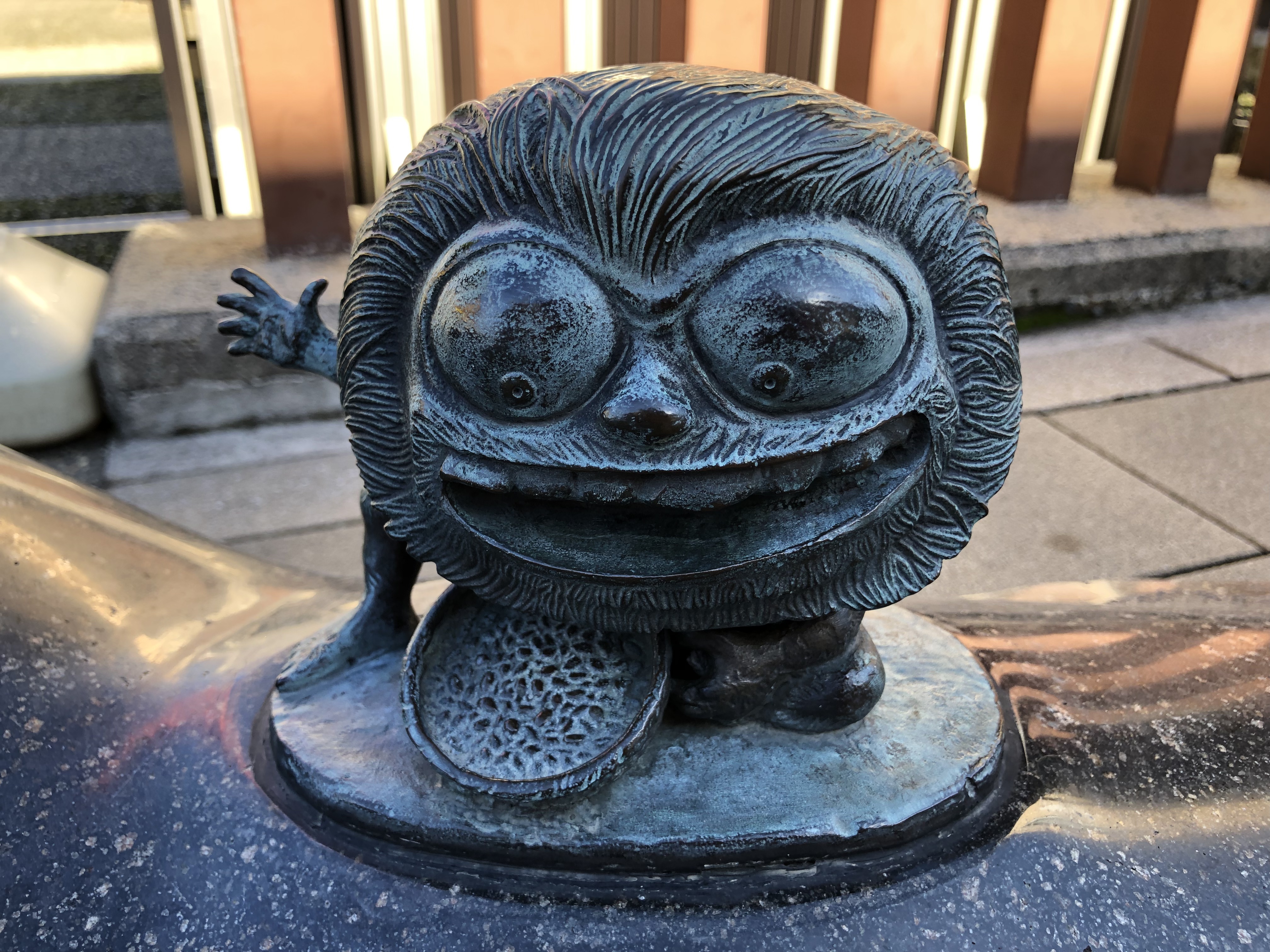
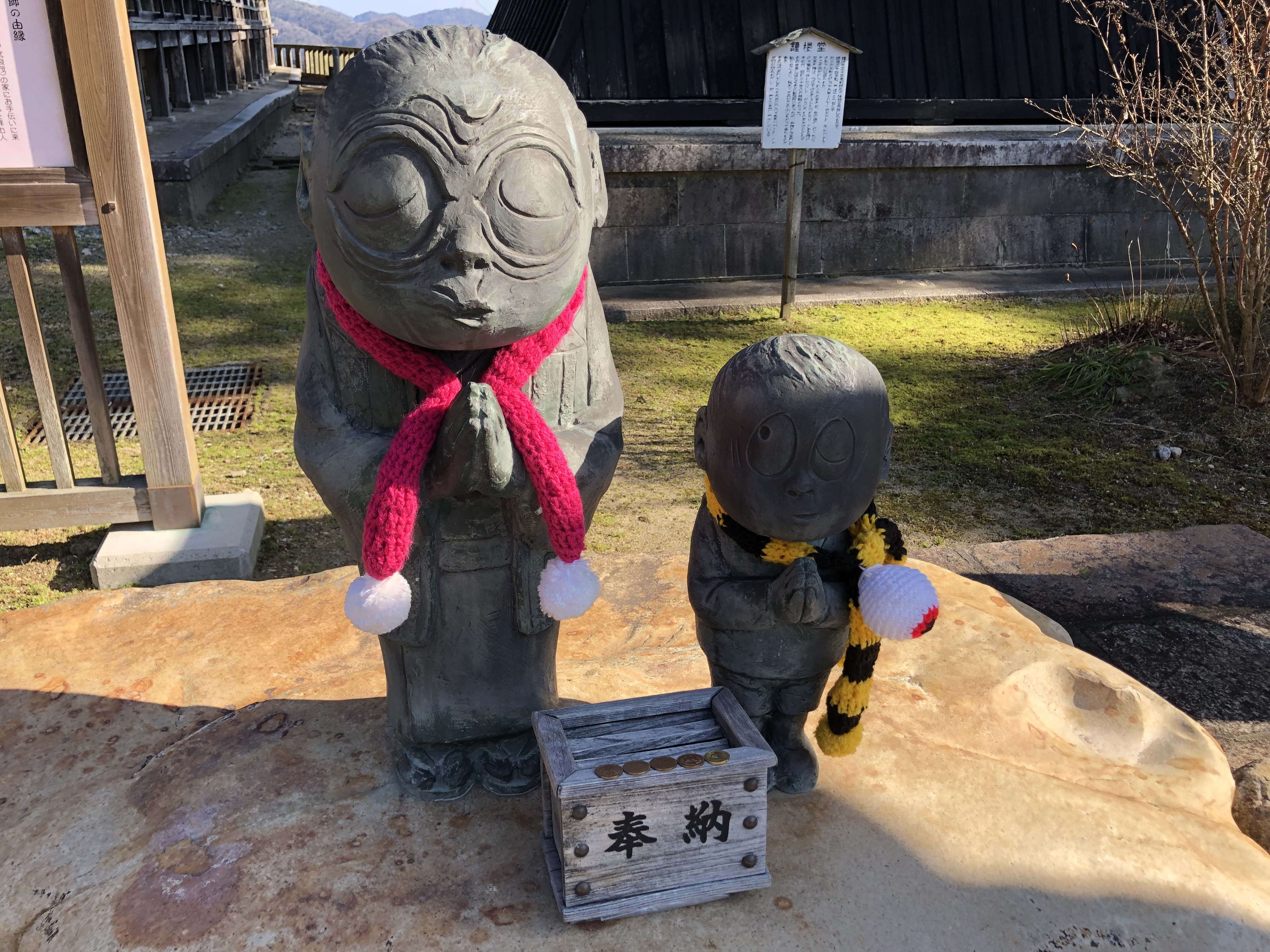
I place some coins in the box next to some statues of yokai, and decide that this is the nicest temple I’ve visited. In the future, I wouldn’t mind visiting more temples on a pilgrimage trail, but for today, I decide it’s getting late, and I head back down the mountain passing a small mountain village, before stumbling across another yokai statute, sitting unassumingly at the bottom of some stone steps.
After climbing up the 1,270 moss covered steps, I arrive back at my favourite temple, exhausted and realising this was just an alternate route. I carefully climb back down the steps to leave. The really old woman I saw at Ichibata-Guchi Station smiles at me as I pass her on the steps, and I can’t help but wonder if she might be Shigeru Mizuki’s whispering ghost.
Statues of Dogs, Statues of Gods

During the reign of Tokugawa Tsunayoshi, the fifth shogun of the Tokugawa shogunate, a ban on the eating of meat and the killing of animals was enacted in Japan. This ban was part of a series of laws and regulations related to animal welfare that were put in place during Tsunayoshi’s reign. Tsunayoshi was known for his strong interest in animals, particularly dogs, and is often referred to as the “Dog Shogun” due to his efforts to protect and care for dogs during his time as shogun.

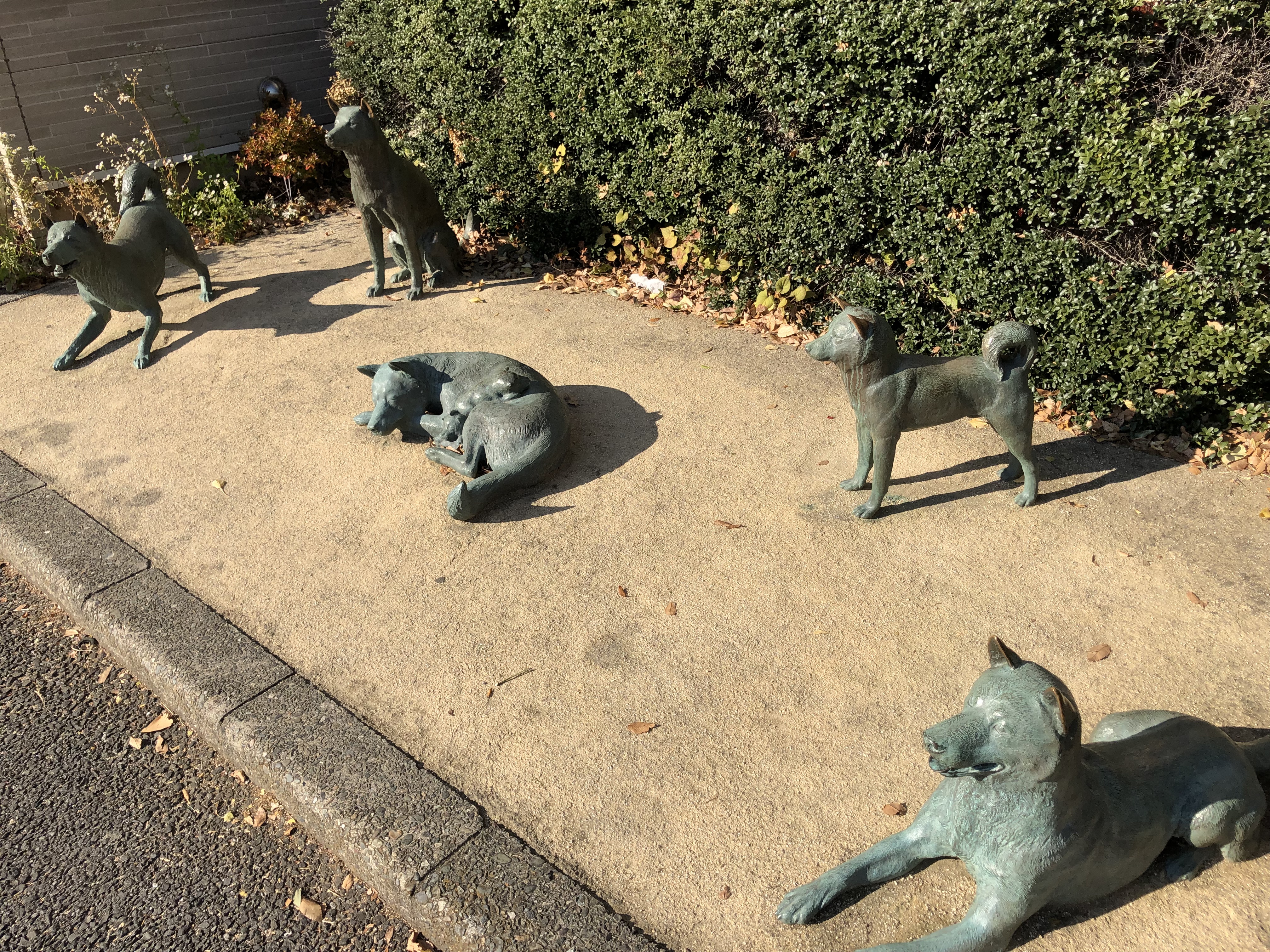
One aspect of Tsunayoshi’s efforts to protect dogs was the creation of a large sanctuary for them in the area where Nakano Station now stands. It is here that I find many statues of dogs. The ban on eating meat and killing animals was likely intended to protect and care for dogs specifically, as they were considered sacred animals in Japan at the time. Strangely, the ban did not apply to birds.

This interpretation of the ban led Buddhists in Japan to argue that rabbits, which are not birds, should be considered a type of flightless bird and therefore be eligible for consumption. This argument was granted, much to the delight of the Buddhists. This is why the system for counting rabbits and birds in Japanese is the same, and is only used for these animals.

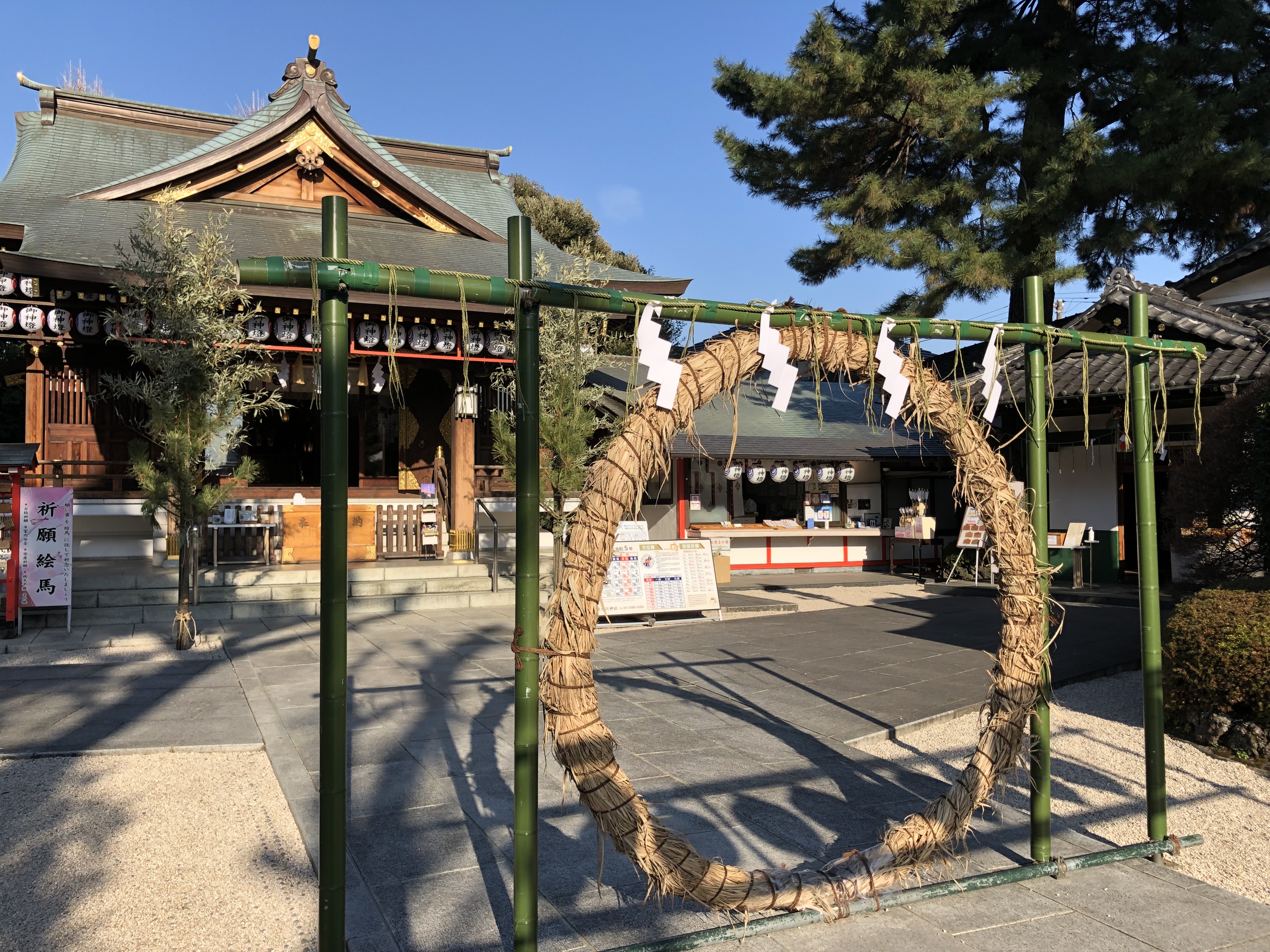
As I continue on my journey, I walk through the bustling shopping and entertainment district of Nakano Broadway. My next destination proves to be a bit more challenging to find, as it is allegedly located somewhere between the Kirin Lemon Sports Centre and Heiwanomori Park. Despite my best efforts, I am unable to locate the Nakano Prison Main Gate “Peace Gate.” It seems that it is either hidden behind a construction site or has been erased from history and replaced by a grassy meadow and a running track. After my search for the old prison proves unsuccessful, I am drawn towards the melodic sounds of a shamisen. As I follow the music, I come upon a peaceful-looking shrine.

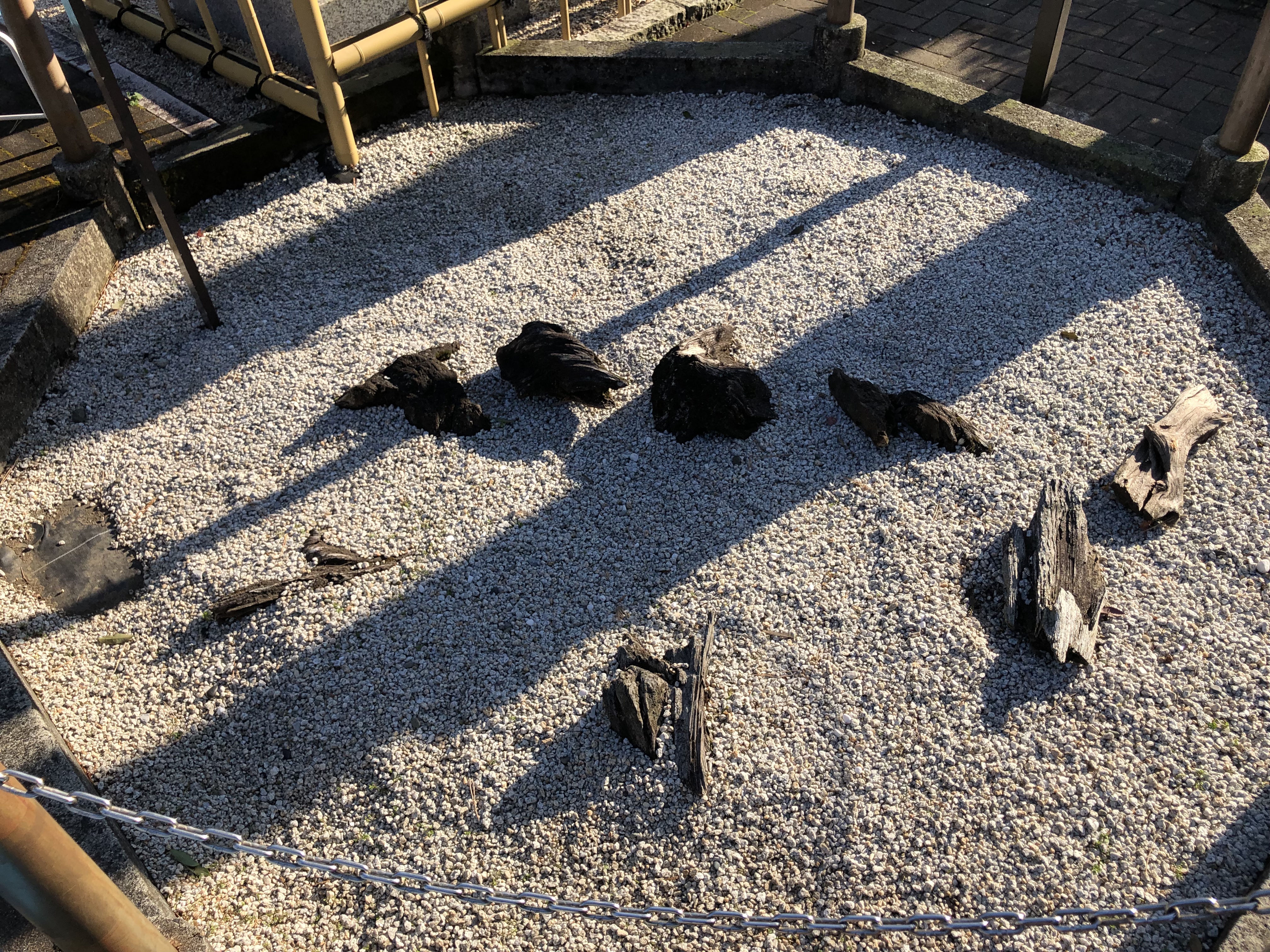
The Numabukuro Hikawa Shrine in Nakano is home to the remains of the Dokan Cedar tree, which once stood tall at a height of 30 metres. This tree passed away in 1944 due to old age, but it was a significant and beloved part of the community for centuries. The Dokan Cedar tree, also known as the Dokanzakura, was named after its owner, Dokan Ota, who planted it in the late 16th century. It was considered a natural monument and was protected by the city of Nakano.

The Dokan Cedar tree was known for its impressive size, with a circumference of approximately 14 metres. It was believed to be over 400 years old, making it one of the oldest trees in the city.

The tree was also believed to have spiritual and supernatural powers and was often visited by people seeking good fortune and blessings. Even though the tree is no longer alive, its remains serve as a poignant reminder of my own mortality and the impermanence of life. The Dokan Cedar tree stood tall for centuries, weathering the passage of time, but eventually, even it could not escape the inevitability of death. The tree’s remains remind me of the fragile and fleeting nature of life, and the profound sorrow that comes with the end of all things.

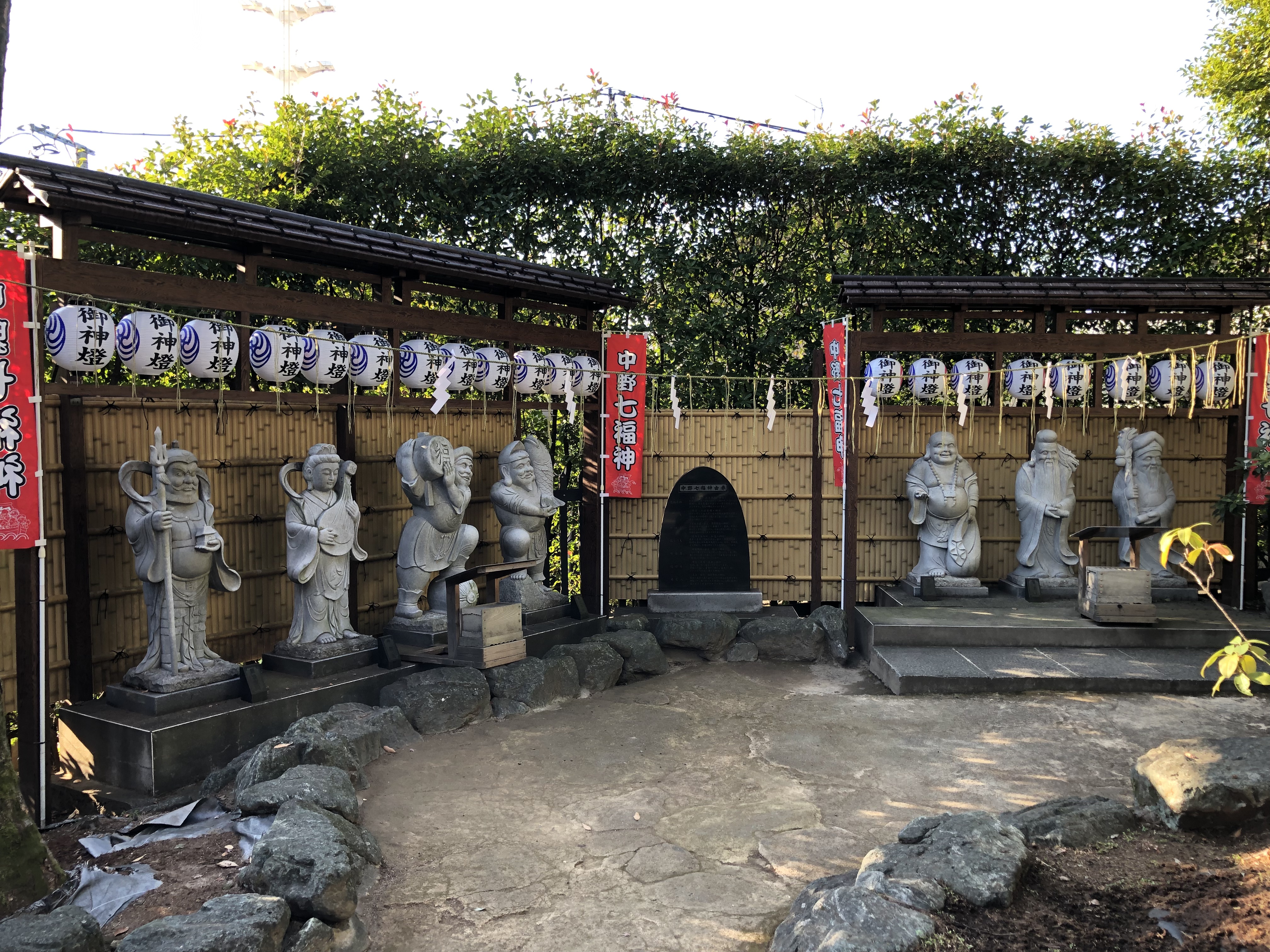
As I continue to explore the peaceful grounds of the shrine, my attention is captured by a group of statues. It is here that I discover all seven of the lucky gods of fortune

For anyone looking to complete the Pilgrimage of the Seven Lucky Gods of Fortune, a traditional cultural practice that involves visiting a series of shrines or temples dedicated to the seven lucky gods in Japan, this shrine offers a convenient shortcut. All seven of the lucky gods, who are revered as bringers of good fortune and prosperity, stand proudly on the shrine’s grounds, making it possible to pay respects to all of them in one place.

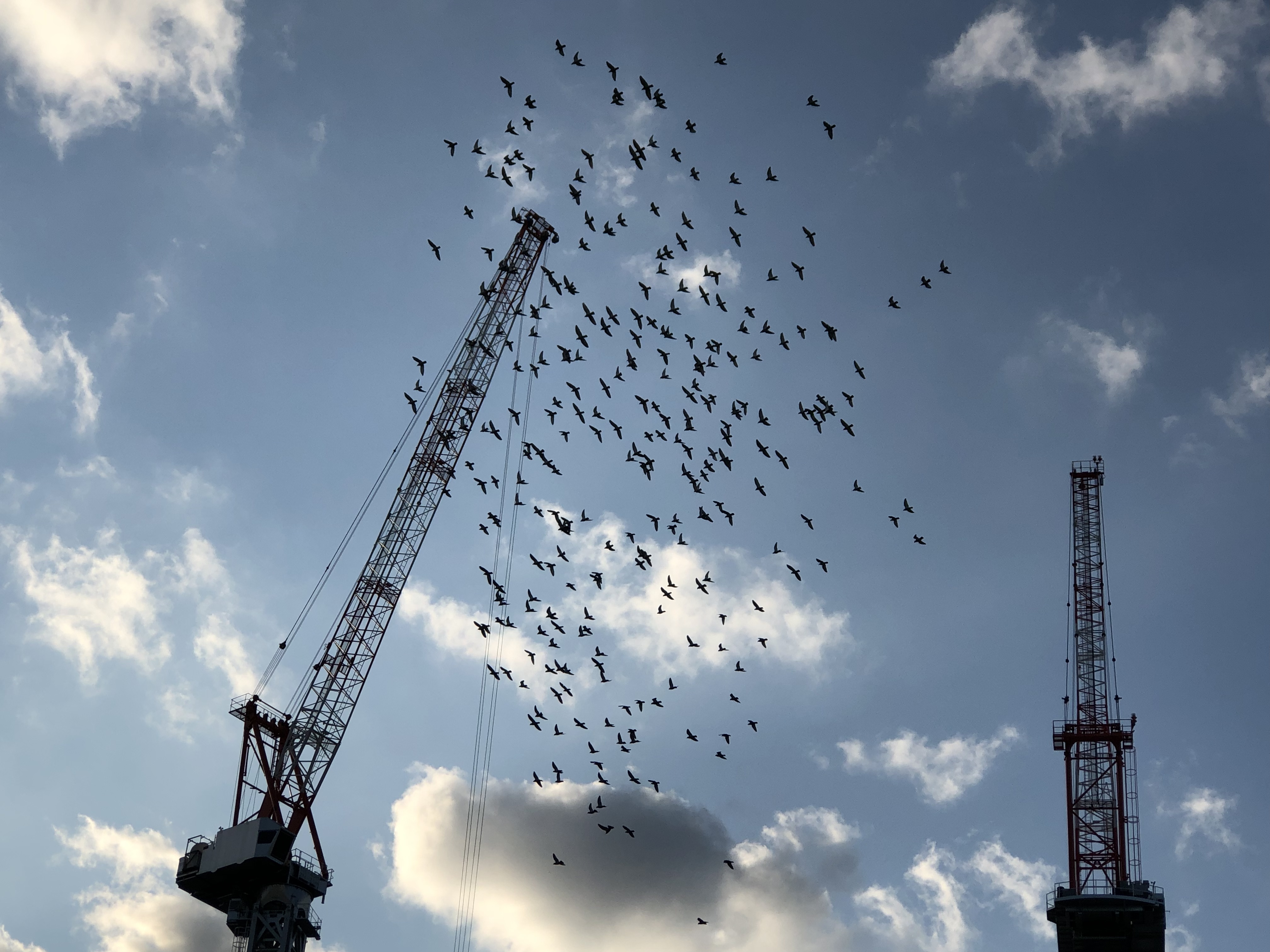
As I make my way back towards the station after a long day of sightseeing, I am pleasantly surprised by the sight of three small groups of birds soaring through the air. They fly in a seemingly chaotic but coordinated manner, their movements fluid and graceful as they weave through the sky. This phenomenon, known as murmuration, is a truly amazing and mesmerising sight. The birds dance and swirl in the air, creating intricate patterns and formations that shift and change suddenly. It’s as if they are performing a beautiful, otherworldly ballet, their wings beating in perfect unison as they move through the air.

I stand in awe, mesmerised by the beauty and grace of this natural spectacle, before considering that they might not be birds at all, but rabbits.

Marriage on the Rocks

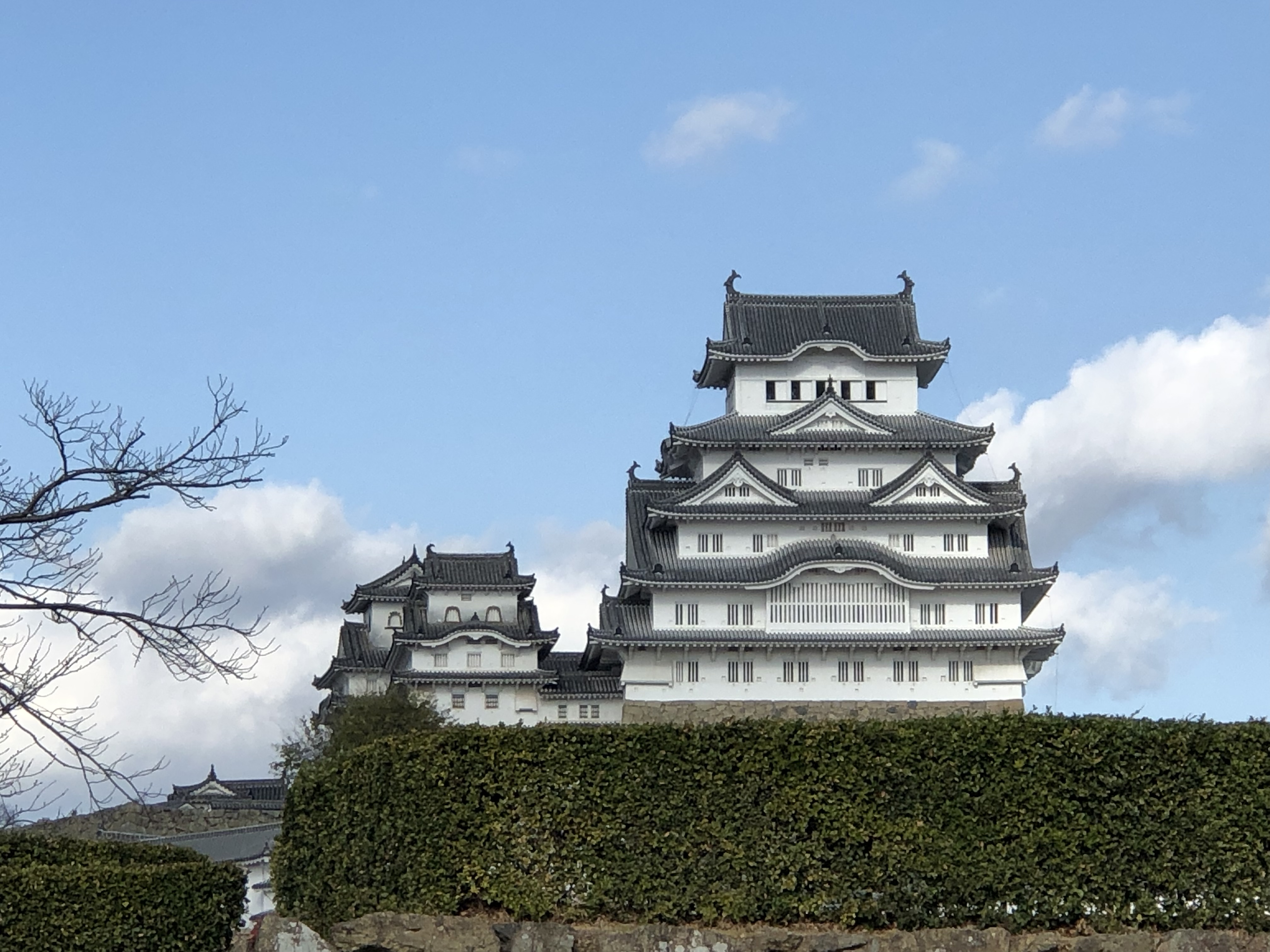
As the dawn breaks, I set out for Himeji, Hyogo Prefecture, my ultimate destination: a resplendent castle, the most visited in all of Japan and a UNESCO World Heritage Site. I had previously visited this castle back in 2012, but the main building was undergoing maintenance work at the time, and I was unable to catch a glimpse of its splendour. Instead, the cladding around the castle featured an image of its future state, once the five-year renovation of its roof and walls was finally complete. Today, I get to finally see the future for myself.

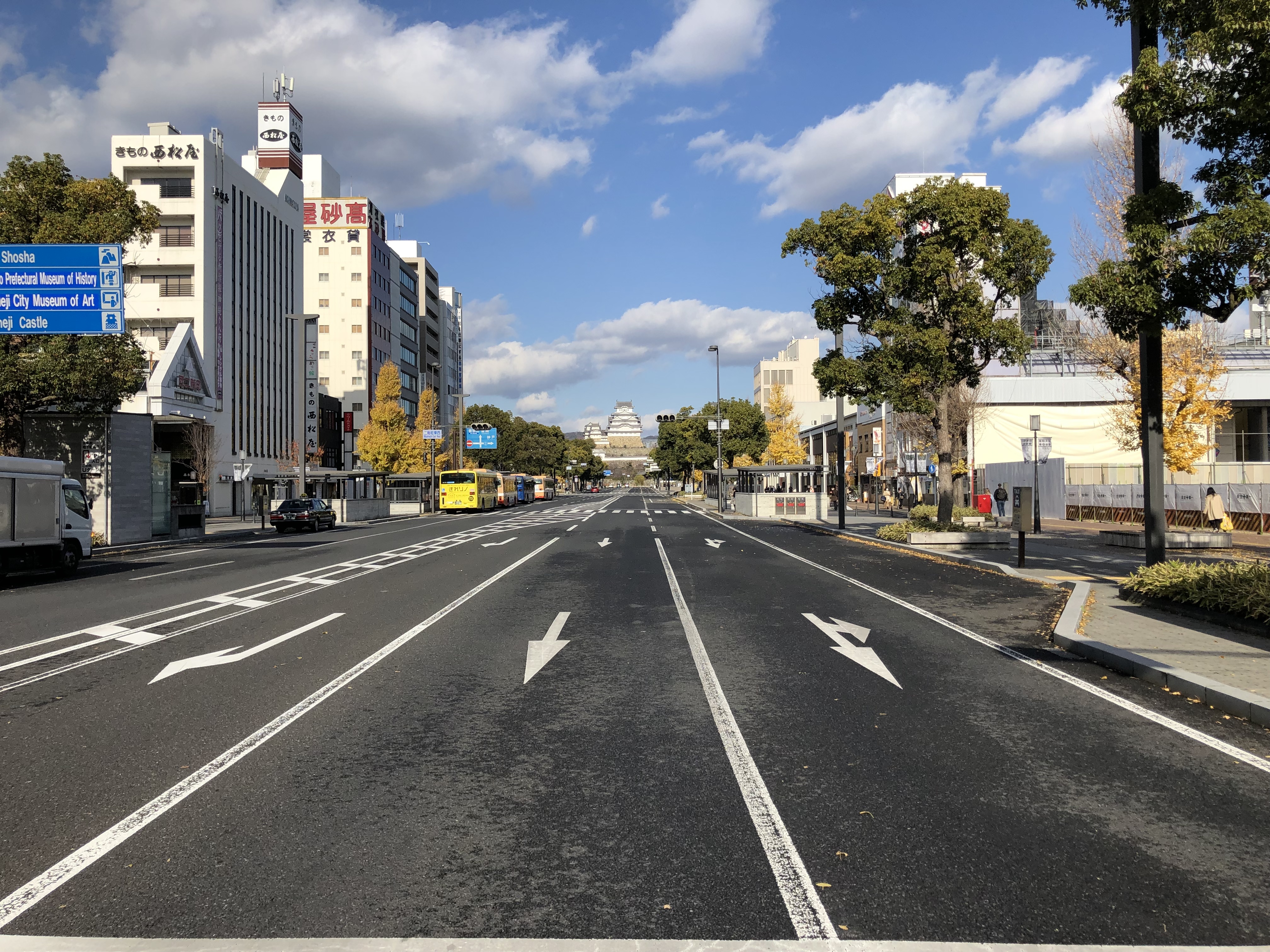
Leaving Himeji Station, I stroll along Otemae Street, a kilometre-long street running between the station and the castle. This charming street is lined with shops and restaurants, and the trees are neatly arranged on either side, their branches reaching skyward in a wild, untamed fashion. The empty roads are absent of cars, providing an unobstructed view of Himeji Castle, which rests atop a distant hill like a sentinel of the past.

Himeji Castle has earned itself the nickname “White Heron Castle,” due to its supposed resemblance to a bird taking flight, and because it is strikingly white. For the last 400 years, Himeji Castle has survived bombing during World War II and a multitude of devastating earthquakes and typhoons. It remains one of Japan’s best examples of 17th-century castle architecture.

The castle and its sprawling network of 83 buildings and gardens stretch across a vast expanse of 233 hectares. Even though I have visited before, the sheer size of the castle, along with the impeccably maintained grounds and gardens, is nothing short of breathtaking. It is a veritable kingdom of history and beauty, a realm that leaves one feeling utterly overwhelmed by its grandeur.

I bid farewell to the castle and embark on a journey by train to Osaka. From there, I transfer to a local line train bound for Ise City, Mie Prefecture. My journey is a long and tedious one, with my train halting at each of the 73 stations along the way, incurring a hefty cost and consuming three gruelling hours. At almost every station, the train is met with silence, as not a soul disembarks or boards. It is a complete waste of time. Halfway into my journey, the train is severed in two, and I am moved to the front carriages by the staff. As my truncated train pulls away, the express train bound for Ise City arrives at the platform, leaving me to rue my misfortune and wonder why this was not disclosed to me earlier.

At last, I arrive at Ise Station, where I must transfer to a local line that operates on a limited schedule, running just once an hour. This train will bring me closer to my ultimate destination. Time is of the essence as I have only six minutes to make the switch, but as if to mock my efforts, my ticket gets swallowed up by the ticket machine at the transfer gate. A loud, flashing red notification blares out the ominous words: ‘Ticket jam! Ticket jam!’ It seems that my luck has taken a turn for the worse.

The staff member takes an age going through each and every intricate mechanism within the machine with a pair of tweezers, trying to find my lost ticket. He won’t wave me through because he can’t confirm that I have paid up to this station, I am stuck waiting for what feels like an eternity, and just as time seems to stand still, I miss my connecting train. After about ten minutes, I receive my ticket and the only solace I take is the fact that I got to see the immense inner workings of a Japanese ticket machine.

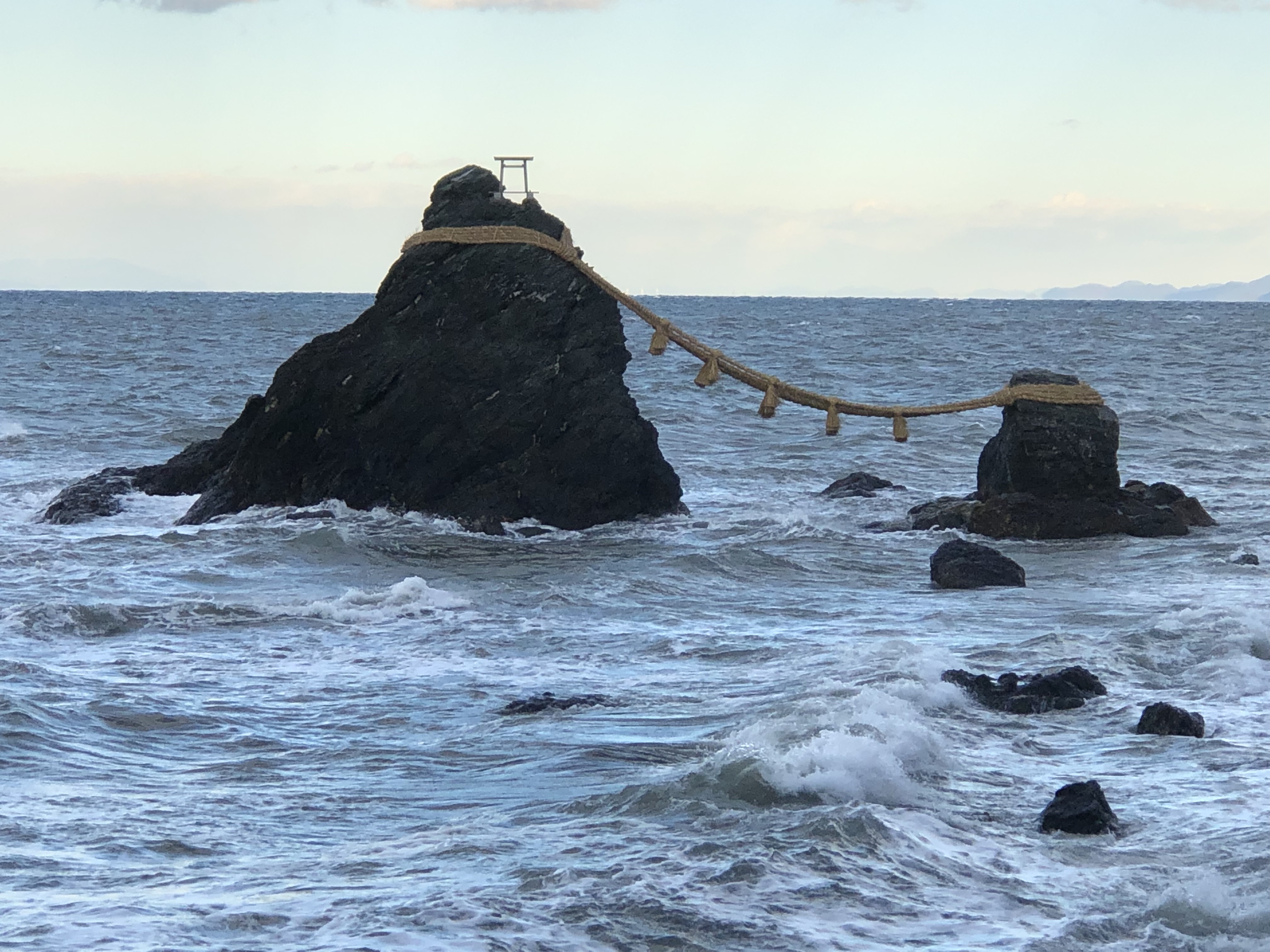
With no train for the next hour, I opt to walk the roughly eight kilometres to my destination, braving the ghostly chill in the air as I cross the Isuzu River. Eventually, I arrive at a place known by three different names: Futamiokitama Shrine, Meoto-iwa, and the Wedded Rocks. The rocks sit placidly in the water, with the small torii gate perched atop the larger rock like a crown. The gentle waves of Ise Bay add to the serene atmosphere of the scene.

The larger of the two rocks is said to represent the husband, while the smaller rock represents the wife. These two rocks are connected by a massive, thick rope, which, according to Shintoism, symbolises the unity of marriage between the two most important gods in Japanese mythology, Izanagi and Izanami. On a clear day, one can see the majestic Mount Fuji on the distant horizon, its frosted peaks a breathtaking sight above the graceful rocks below. However, my luck continues to abandon me as Mount Fuji is nowhere to be seen today. Perhaps I’ll see it later.

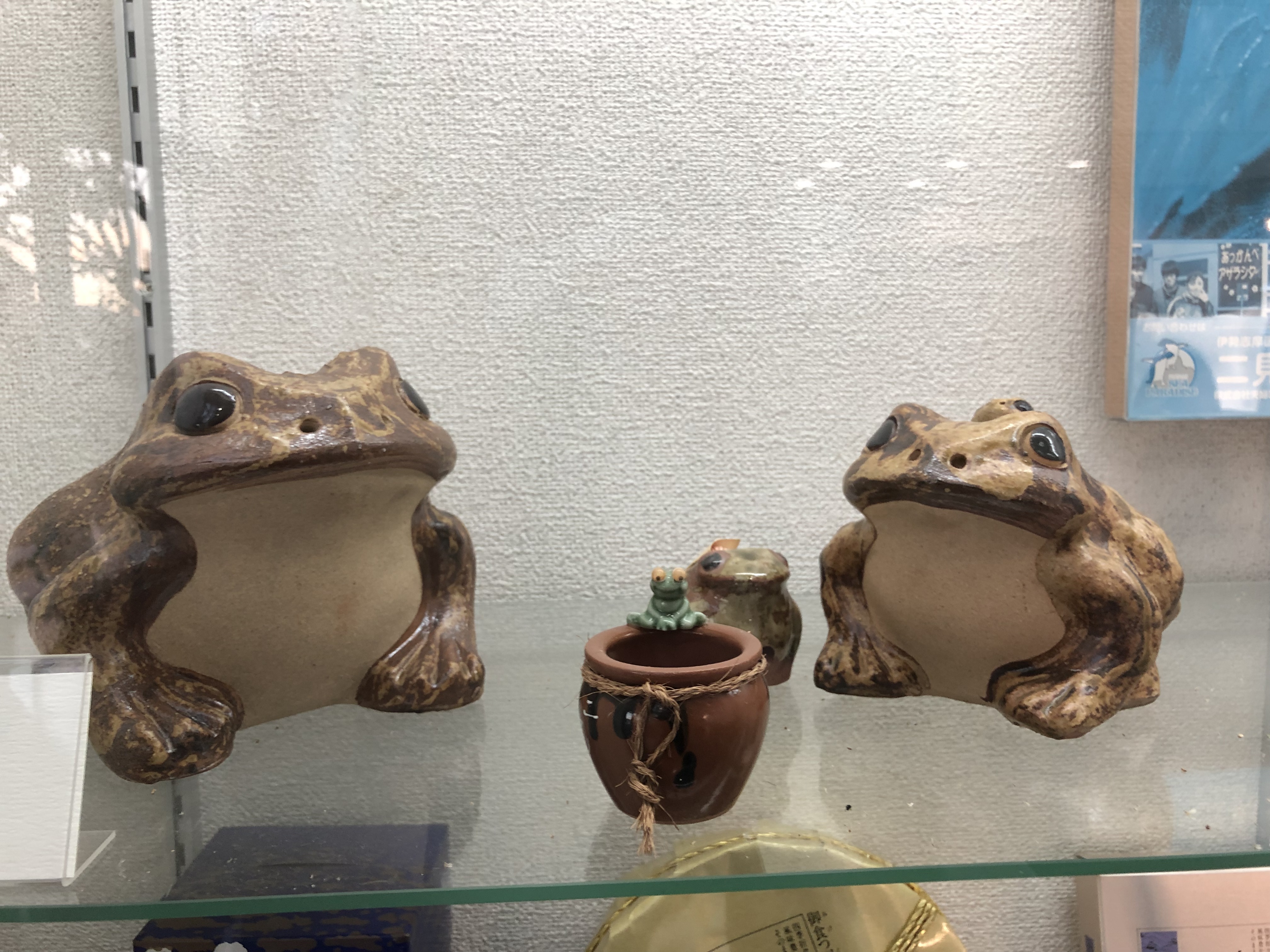
Seemingly unrelated to the story of Meoto-iwa, I also notice that sculptures of frogs are incredibly popular here – in fact, they seem to be absolutely everywhere!

The frogs here are a rarity, believed to have the power to grant specific wishes – particularly those related to returning home or recovering lost items. The Japanese word for ‘return’ or ‘go home’ is ‘kaeru’, which also happens to be the word for ‘frog’. It seems the presence of all these frog statues is simply because of a play on words. If only I had had one at the station with my lost ticket.

After all of my recent travels, I am completely exhausted and decide to take a break in Tokyo to reconnect with some old friends and participate in the New Year’s celebrations. I board a slow local train heading north to Nagoya, before switching to the high-speed bullet train bound for Tokyo.

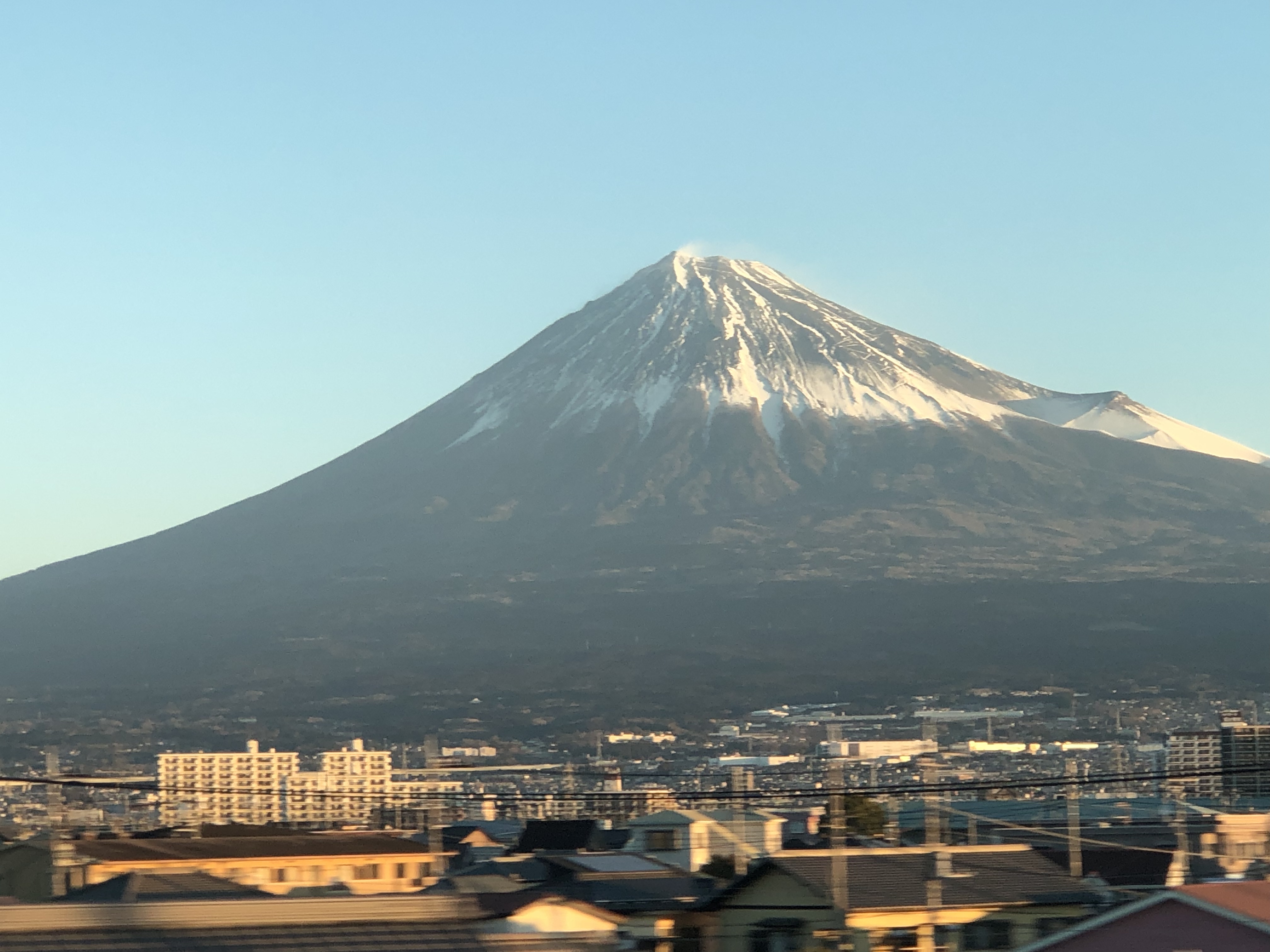
From the train, the graceful, snow-capped beauty of Mount Fuji greets me.

Pebbles Without Applause

My new adventure begins in Miyazaki Prefecture, on the southernmost island of Kyushu. I take an antiquated and somewhat dilapidated train that consists of a single carriage from Miyazaki Station bound for Iibi Station. As the train advances, the unceasing sound of tree branches pummelling against stainless steel fills the carriage; unkempt trees clawing at the train’s ancient frame.

At Iibi Station I am the only person to alight and instantly feel that I am making a mistake. I wander over to the bus stop. The timetable informs me that my bus left one minute ago, and there won’t be another for two hours. It appears as though I am walking to my destination, some 13 kilometres away. Just beyond the bus stop, the view is spectacular, the blistering 26°C sunshine adding to the experience.

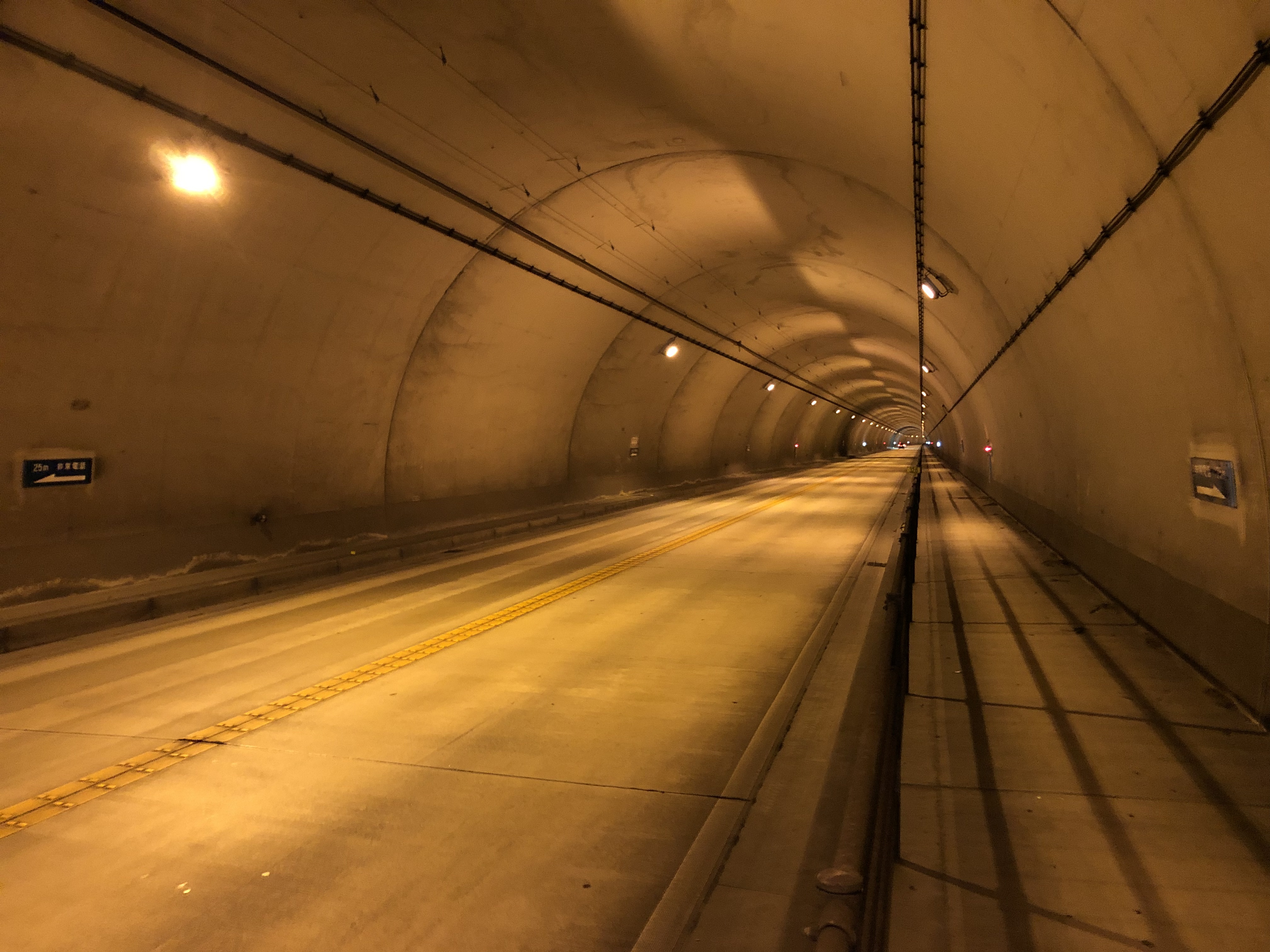
I search my route on Google Maps, and begin to walk south along the east coast of Miyazaki. What Google Maps neglects to tell me, however, is that over fifty percent of this walk is through tunnels carved into the mountains. Some of these tunnels don’t even have a footpath, so I have to shine my torch behind me as I walk, signalling to oncoming motorists.

One of the tunnels is over one kilometre in length. The noise inside this tunnel is deafening, the sound, a cacophony of cars, bouncing and echoing around this dimly lit passage. The smell of recycled diesel fills the air. It’s on this rare occasion that I actually want to put on my mask. The intense heat inside this passageway adds to my discomfort. Buttons marked SOS are conveniently placed every fifty metres, nausea, heat exhaustion, and exposure to loud noise all valid reasons to signal in distress.

As I exit the tunnel, I am rewarded with a beach. I stand for a moment taking in my surroundings. To the east, Futo Beach, golden sands and clear ocean water, to the west, mountains daubed by lush green foliage. The clear air cleanses my lungs of petroleum. The sound of the ocean waves crashing into the rocky cove that contains the sea a delightful upgrade in contrast to the screaming traffic. I allow myself to collect the moment, absorb it, and enjoy it in its full focus, before continuing on.

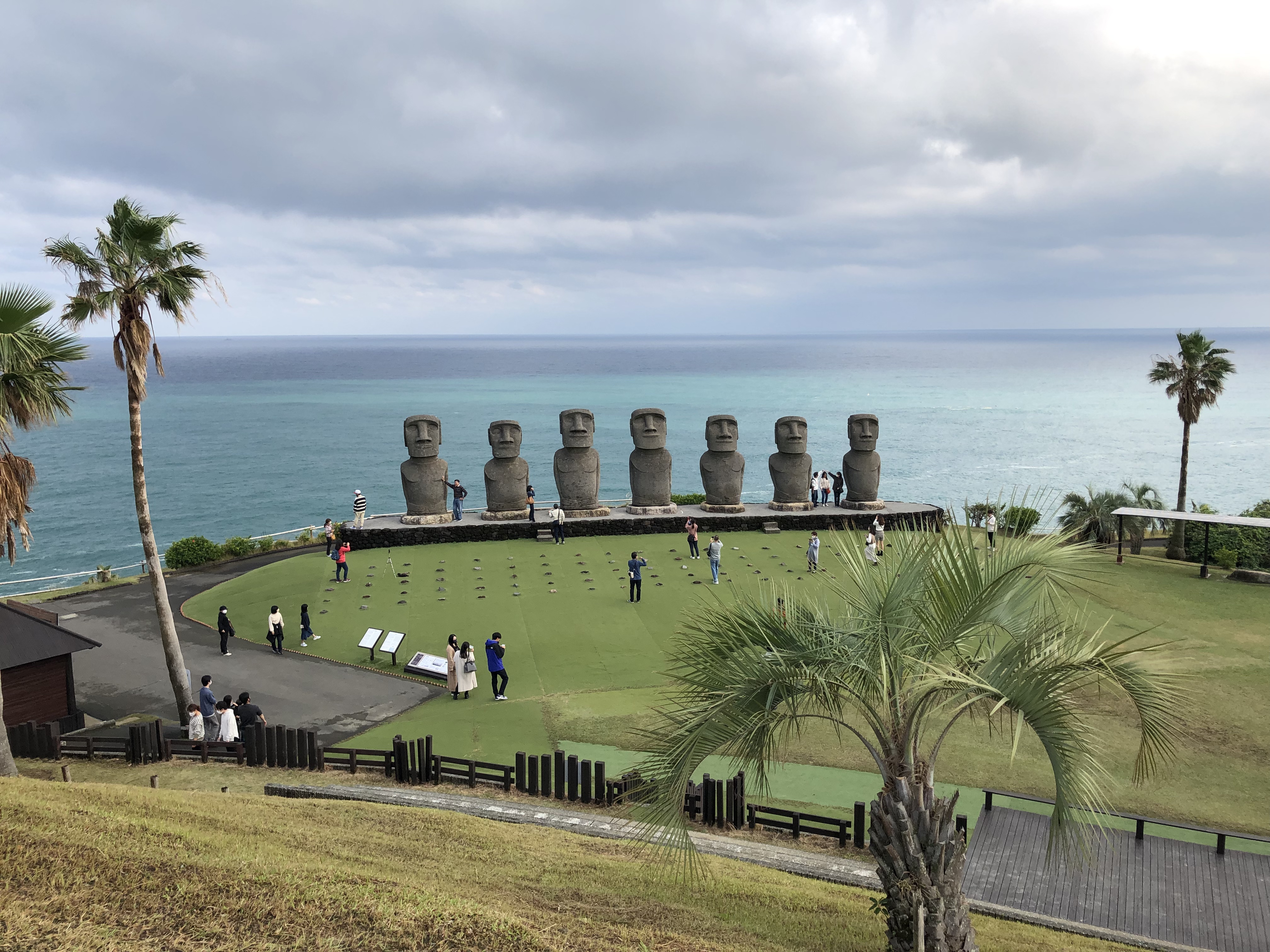
Still a good six kilometres away from my destination, I see a strange statue here on the Nichinan Coast and decide to explore it further. The statue is a monolithic human figure carved from stone, Moai, the kind of statue you might find on say, Easter Island. It turns out I’ve inadvertently stumbled upon a Unesco World Heritage site. I walk the steep and twisting 500 metre trail to the entrance and purchase a ticket.

Sun Messe Nichinan is a small theme park in the middle of nowhere. It was built with the purpose of promoting peace on Earth and environmental awareness. The replica statues built here are known as Afu Akivi, otherwise known as Moai statues, which translates to mean ‘Future Life’. Each statue is 5.5 metres in height and weighs around twenty tonnes. All seven statues have their own meaning too, from left to right the sign says they are: Job, Health is GOOD, Love, Peace of the Earth, Marriage, Lucky with Money, and Study.

I explore the park a little, passing the Sky Tower, a garden terrace named Garden Terrace, an exhibition hall in Central Plaza, a place called Butterfly Paradise (the butterflies here notable by their absence), before finally arriving at the Earth Appreciation Bell. The bell was built with money donated by eighteen different religious groups, including Christianity, Shintoism, and Buddhism, and is a true symbol of the peace this park is promoting.

Twice a year during the equinox, the sun rises from behind the middle of the seven Moai statues, and its sunlight passes through a ten centimetre wide gap in the Sky Tower, runs up the sun steps, and penetrates the centre of the bell at the top of the hill, basking the bell in a glow of sunshine. Sadly though, today is not the equinox, and the bell isn’t very photogenic whilst not being basked, so my photograph here is some random peace mural I found.

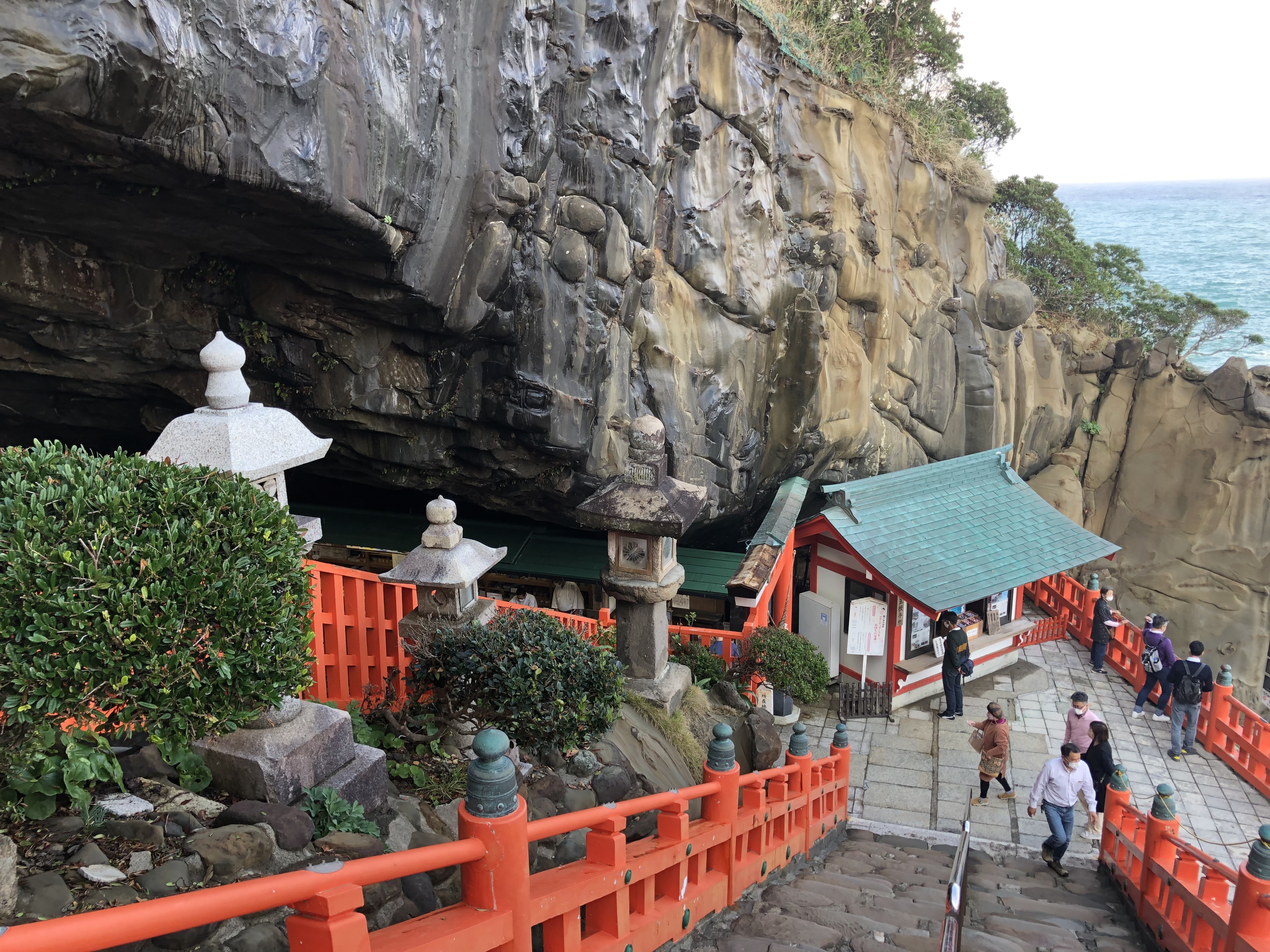
I leave Sun Messe Nichinan and continue my walk along the coast. The rocky coastline here twists around the mountains, the ocean crashing into the cliffs below, my destination in sight. After another tunnel and what feels like an eternity of walking, I finally reach Udo Shrine. The shrine is set in a cave carved into the rocks of a mountain, and it requires a climb down steep stone steps to reach its entrance.

Udo Shrine is primarily a fertility shrine. The gods enshrined here are all about safe delivery during childbirth, matchmaking for couples, and safety at sea. The mythology here is that Toyatama-hime, otherwise known as Luxuriant Jewel Princess, daughter of the Goddess of the Sea, decided to attach her breasts to the rocks. It is said drinking the water that trickles down from her cold stone bosom will bring fortune in pregnancy.

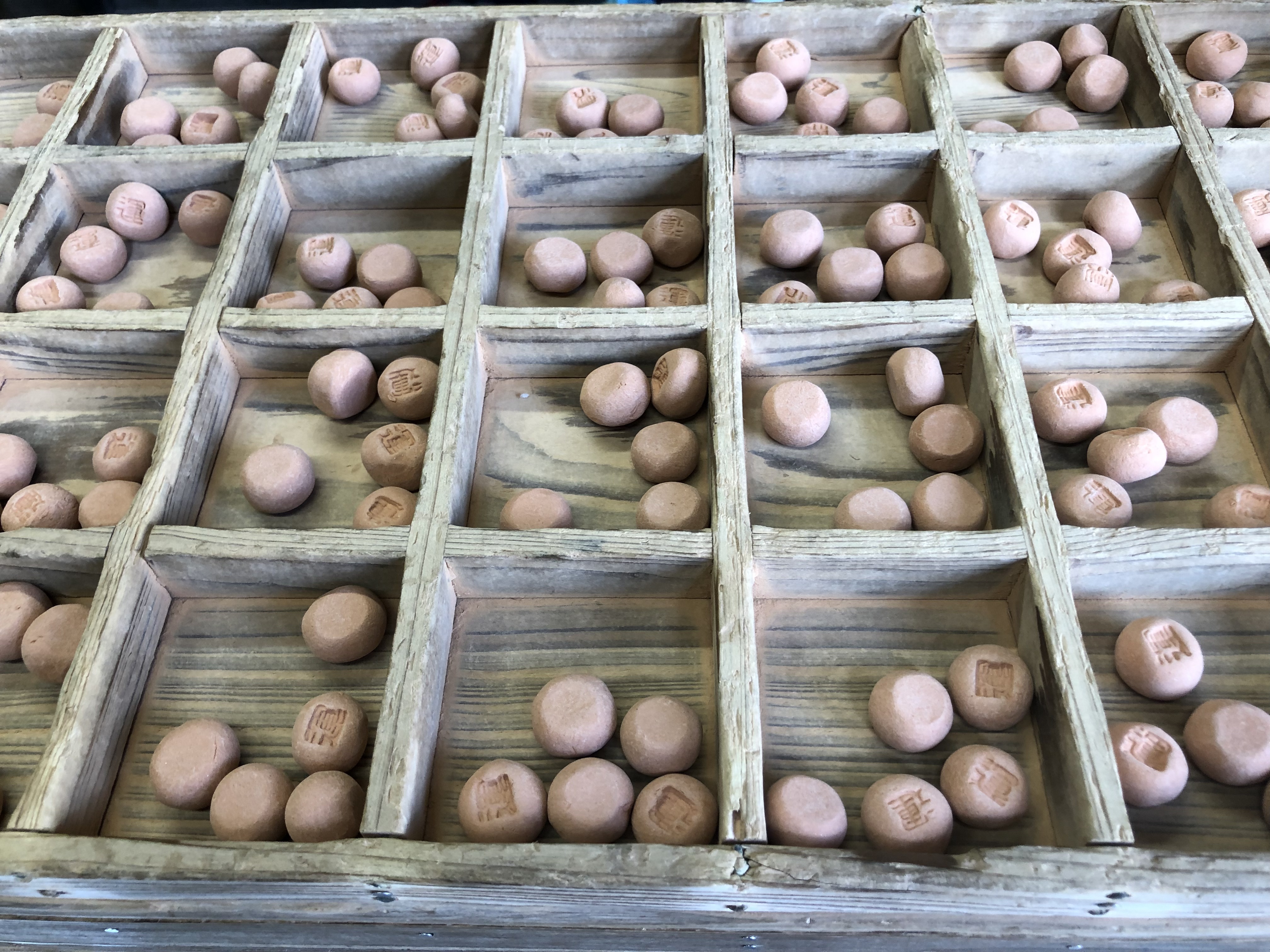
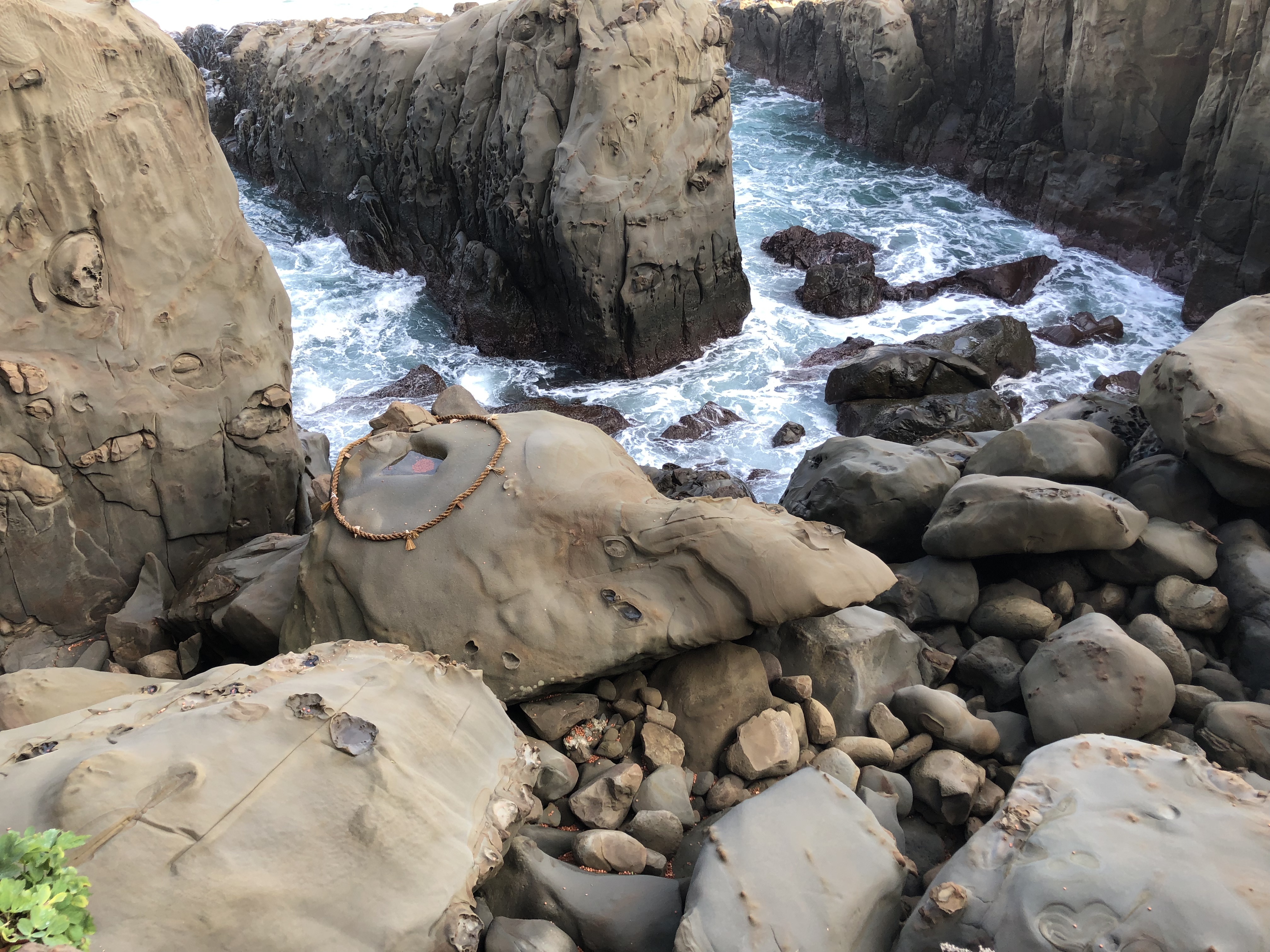
The second attraction here is the custom of throwing small clay balls known as ‘Undama’ into a pool located on one of the rocks below the main shrine. The sign reads, “Men throw the clay pebble with left hand. Women throw with right hand. If the ball lands in the rope circle, you will have a good luck.” It costs just ¥200 for five pebbles.

A Japanese man wanders over and throws his first pebble, landing it in the pool first time, everyone around him applauds. His good luck however instantly wears off as he proceeds to miss his next four throws. All five of my pebbles are tossed into the ocean. Nobody claps. There doesn’t appear to be any limit to the number of Undama I can purchase, therefore, I could continuously buy more pebbles and keep trying until I finally land one in the pool, thus guaranteeing myself a chance to have a good luck, but I decide against it.

Originally, the rules for the Undama were that both the man and woman in a relationship would each throw five stones, and the total amount from ten that landed in the small pool would equal the total number of children that the couple would have. However, problems arose and arguments were had, especially when a couple wanting a child would miss all ten throws, so the shrine decided to change the outcome to become about good fortune instead.

As I leave Udo Shrine, I find my timing to be just about perfect as the last bus pulls up. I get on the bus bound for Miyazaki Station. At Aoshima Station, a Japanese couple board the bus with their ten children.

Death Becomes Here

Today is warm again, and I have arranged to go on a bicycle tour with three very close friends. We meet up at half-past one and cycle in the direction of Yanaka Cemetery. It might sound a little morbid, heading once again to this huge cemetery, but the reason we have settled on this location is that it is quiet, out of the way, and not packed full of tourists. Today might well be the last day we can view sakura, and I can’t think of a better way to enjoy the flowers than with my friends in an area that is free from the usual crowds.

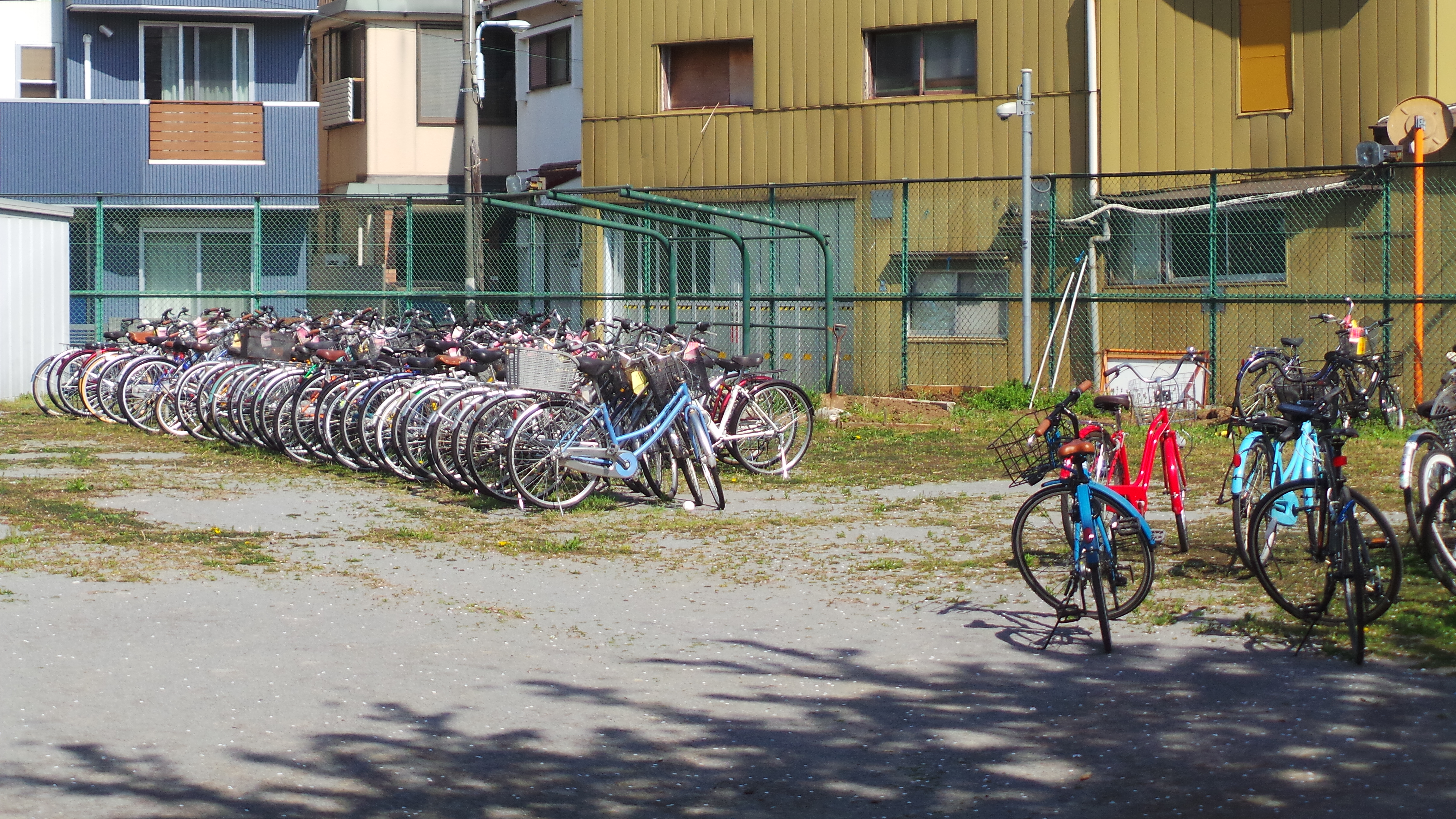
We decide, for whatever reason, to park our bikes in a zone where abandoned bicycles are collected and locked away. This fenced-off area charges a fine of ¥5000 to people who have left their bicycles illegally parked. After impounding our own bicycles, I worry that something might go wrong, and we too will have to pay the hefty fine when we return here later this afternoon. “Don’t worry about it,” says one of my friends, “we can just pretend that we don’t speak any Japanese, it’s no problem.”

illegalparking

We head through the cemetery, getting very lost in the process. The interesting thing about Yanaka Cemetery is that there are no bodies in the ground. Every grave here features a cremated corpse in an urn. Something about the blend of cherry blossom trees mixed in with the gravestones soothes me in a way that I can’t really describe. I really like this cemetery, and today is perhaps my tenth visit to this area since arriving in Japan.

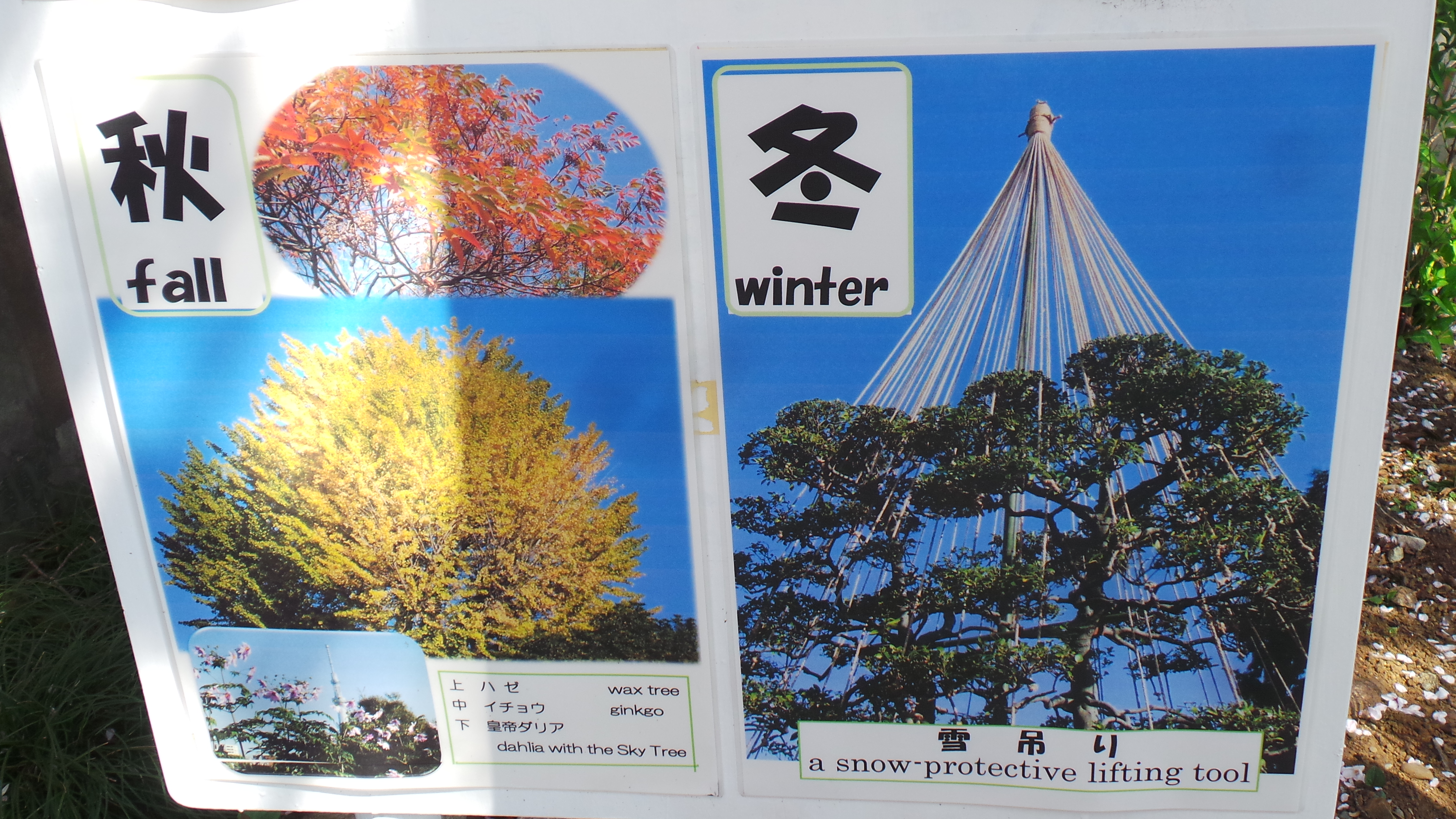
On the other side of the dead, there are some old houses and a street known as Cherry-blossom Avenue. I noticed a sign here a few months ago that displayed the four seasons of Yanaka Cemetery and various flowers. The section for winter was incomplete, but now, finding the sign, I can see that whoever is in charge here has finally updated the winter information, and it was worth the wait: a snow-protective lifting tool.

signcompleted

The photograph shows nothing resembling winter, and the sign is meant to depict the different flowers of each season (it doesn’t). I’m not certain if a snow-protective lifting tool is a genus of flowering plants or perhaps something more obscure; nevertheless, I am intrigued enough to make plans to return here next winter and investigate this peculiar seasonal tool.

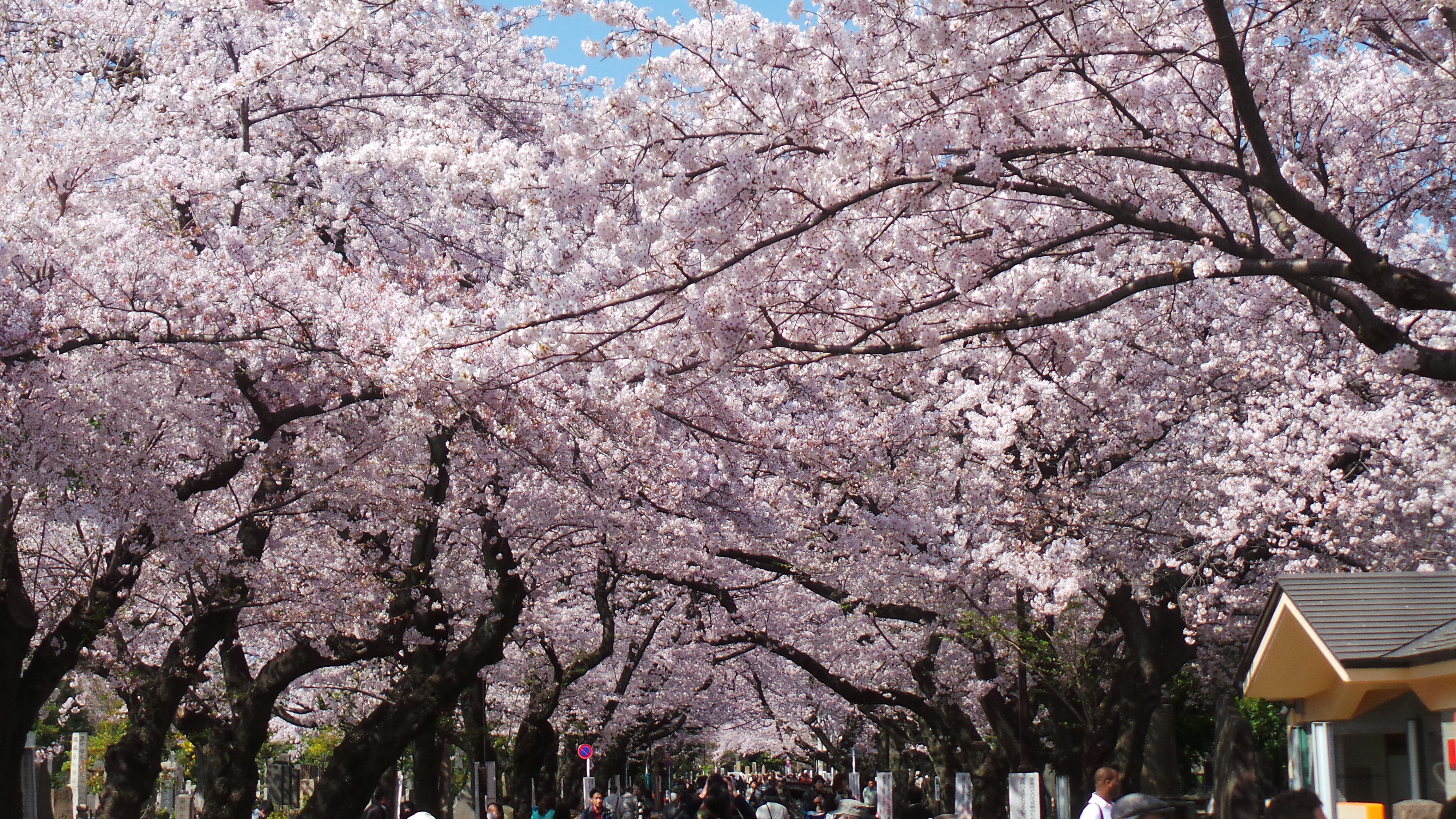
On Cherry-blossom Avenue, it is slightly more crowded than we had anticipated. Dozens of people meander the street, each side adorned with a wall of pink flowers arching over the tunnel-like path, creating an incredible sight. It’s unquestionably worth the visit, offering the most serene view of sakura I have seen so far. We continue our stroll on this lovely spring afternoon, relishing views under the canopy of blossoms.

sakuratunnel

On the other side of the street, we enter a very large temple. Tennoji Temple boasts a massive statue of Buddha and an ancient well that still functions today. One of my friends appears excessively excited about the well and immediately starts pumping water from the ground below. Apparently, the water has a metallic taste.

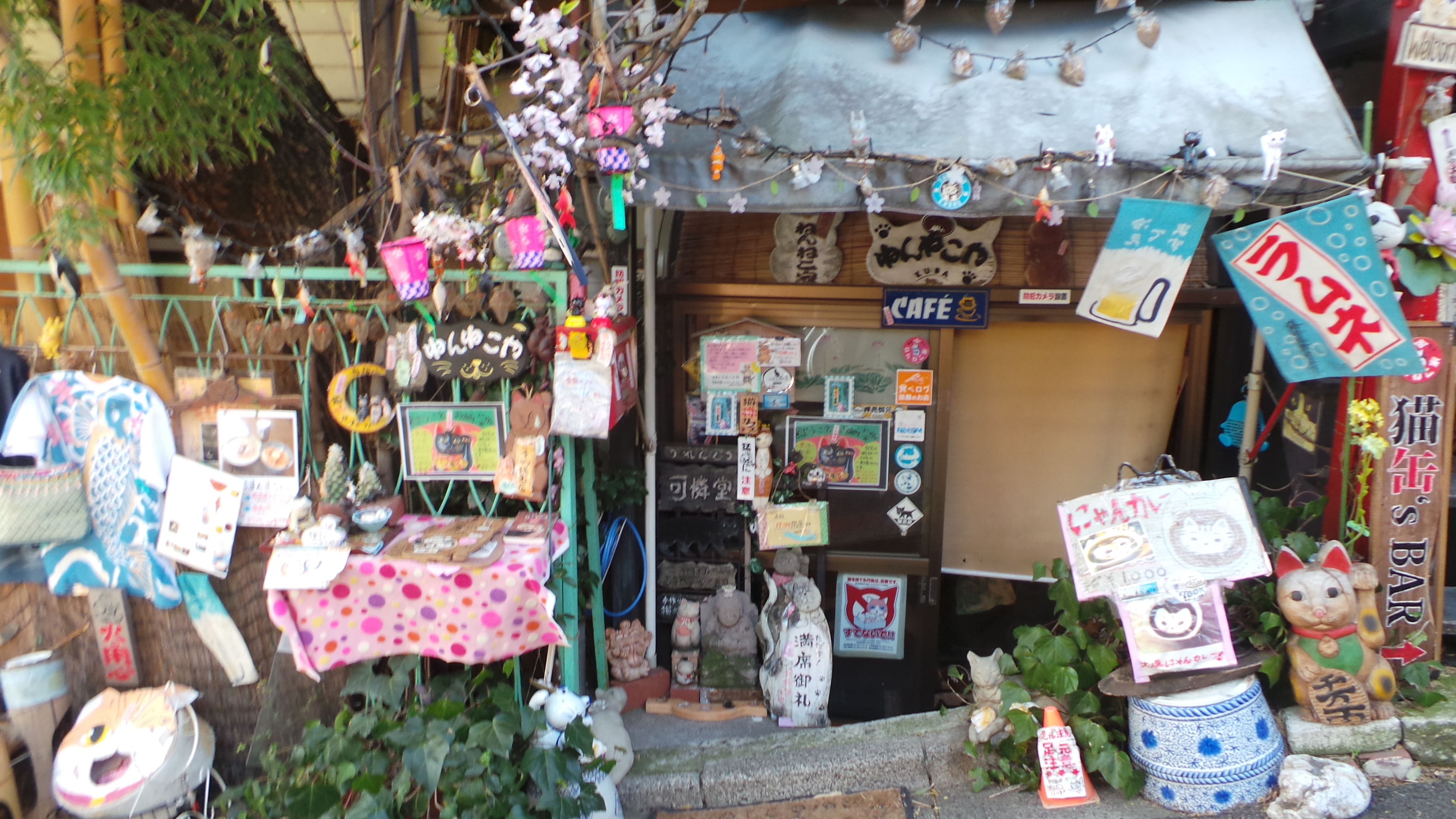
We leave the temple and the cherry blossoms behind us, heading down Yanaka Ginza Street. The market is an unusual bustle of crowds and tourists, drawn to the area for flower viewing and now wandering along this ancient street. Although tea houses, locally sourced products, and hand-made items are on sale, none of them capture our interest. In our quest for food, we stumble upon the knowledge that there’s a cat cafe nearby, and given our shared love for cats, we eagerly turn a corner and walk for ten minutes in a vague direction before finding a cafe adorned with cat paraphernalia. “Maybe this is the place?” I am told, with transparent obviousness.

catcafeagain

We wander into the deceptively small cafe and take a seat on the floor around a small table. Unlike the other cat cafe I have visited, this one doesn’t require us to pay any additional fee to eat with the cats. It feels more like someone’s living room than an actual cafe. Although the place is slightly pricey, perhaps the extra charge is used to subsidise the cost of cat food, care, and maintenance.

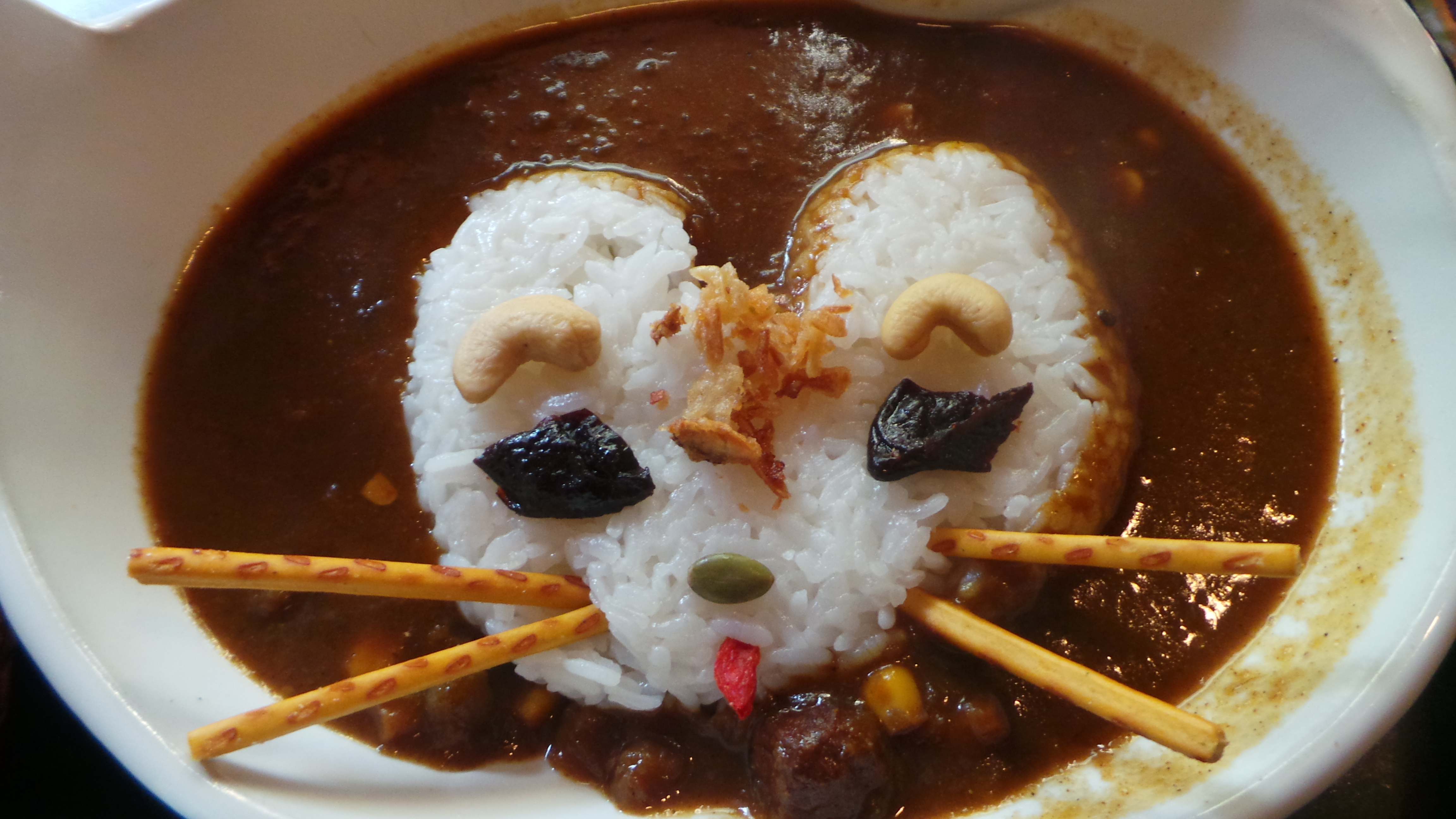
I order a vegetarian curry and wait. My friends, seemingly uninterested in real food, opt for a selection of cakes and sweets. As we sit and talk for a while, I completely forget that I am in the company of cats; perhaps the reason for this is that there is just a single cat here. Only one. Sleeping quietly under a heated table. Eventually, my food arrives, and a second cat appears from seemingly nowhere. Much to my surprise, my food looks nothing like any curry I have had before. Something is very different about it, and it takes me a while to realise exactly what it is.

catfoxcurry

As I dine on curry and rice shaped like a feline, or perhaps a fox, I begin to wonder if this is okay. Eating food in the shape of a cat, while surrounded by two actual cats, makes me feel very strange indeed. What would a cat think if it saw me eating one of its friends? Perhaps it would get angry, maybe even scratch at me. After finishing my curry, I attempt to pet the awake cat, but it runs away in fear, confirming my suspicions about eating cat-shaped food. The owner informs us that the manager of the cafe is, in fact, the sleeping cat. It makes me wonder if the cat even knows how to operate the antiquated till system (it doesn’t).

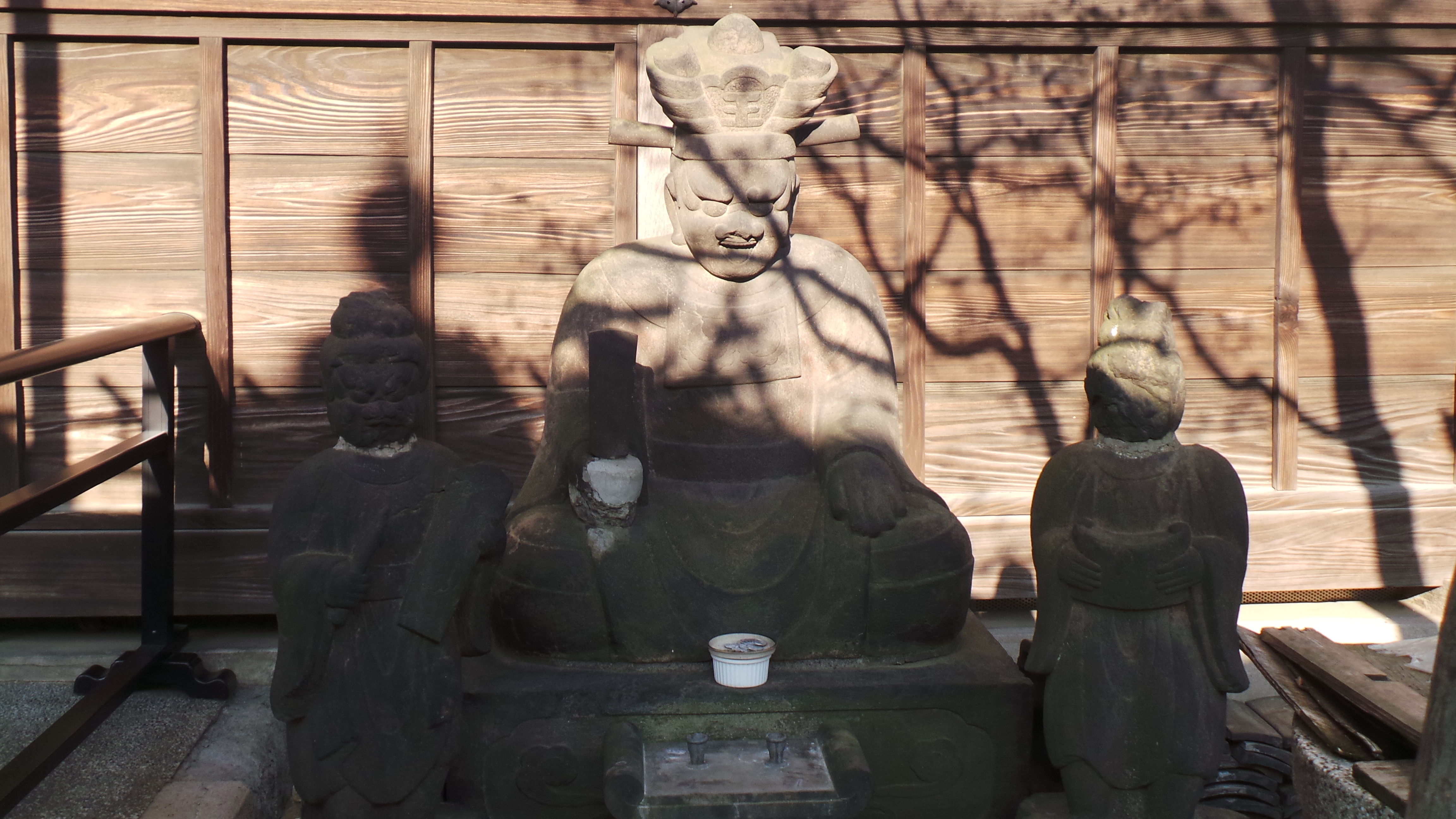
We set off in the direction of our bicycles, and along the way, we once again inadvertently stumble upon a temple. This particular temple houses the King of Hell, Enma-raja. The statue, carved from stone, depicts him with his servants sitting on either side. His servants are Shimyo and Shiroku, tasked with delivering the King’s judgment and recording it, respectively.

enma

It is believed that Enma-raja judges the conduct of the living and determines their destination after death. Rumour has it that if you tell a lie in front of the statue, the King of Hell will remove your tongue. Intrigued, I decide to test this out with a paradoxical statement, “You will cut out my tongue.” Nothing happens, indicating that I have told a lie, meaning the statue should cut out my tongue. But if it does, then I can’t have told a lie, and this creates a paradoxical loop. The logical conundrum continues endlessly. Eventually, the statue disintegrates in a quarrel of logic (it doesn’t).

It is quite fitting to find such a statue here, as the area of Yanaka is in the direction of the Ox Tiger, depicted with horns, sharp claws, and an evil demeanour. Because of this, it is considered an unlucky direction, and Yanaka shares the unfortunate possibility that it contains a demon gate—an invisible gate that leads directly to hell, known as a Kimon. Often, temples in Japan face the same direction as this Chinese zodiac symbol. This might explain why there are over thirty temples and shrines here, helping to purify the area and prevent an oni demon from showing up and killing everyone.

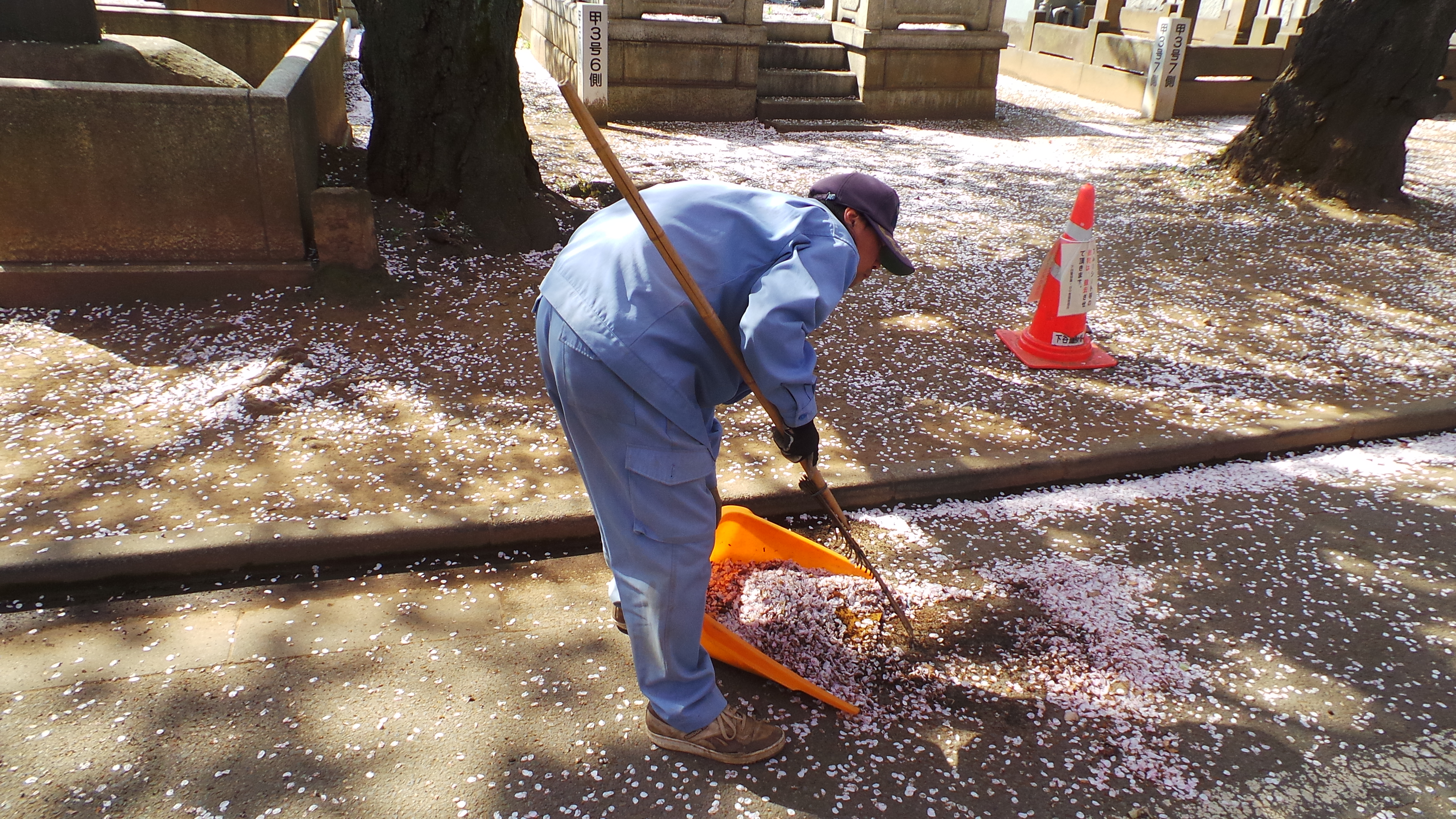
With death surrounding us, it is a pleasure to encounter something that brings a wry smile to my face. A man quietly sweeps up the fallen, dead petals of cherry blossom flowers that litter the floor. I watch eagerly as he sweeps. The area he cleans is instantly covered with petals within a minute of him finishing, and I fear for him; his job might be unavailing and endless.

foreversweeping

We eventually return to our bicycles, relieved to find them unharmed. However, a man looks confused as we stroll into the compound, unlock our bikes, and race toward the exit. Speaking in Japanese to one of my friends, he seems suspicious about our actions. “Next time, you should kindly ask for permission first,” is all he says. Fortunately, he doesn’t impose any penalties or cause any problems. As we cycle away from the cemetery towards Asakusa, it appears I had nothing to worry about, except perhaps for the sudden sharp pain that starts to shoot through my tongue.