Befall Upon The Watchtower

For whatever reason, someone has suggested to me that I check out the area where the Arakawa River and the Sumida River flow into one. As I head out into what feels like a spring afternoon, I realise that my destination today might offer little excitement to anyone, including myself. Somehow, I feel drawn in the direction of Arakawa, the shackles of free will severed from my legs. Part of me feels like there is a demon possessing my very soul, controlling my destiny as I cycle at rapid speeds in the direction of Arakawa.

I see the remnants of a temple or shrine, but it looks as though perhaps it is trapped within the confines of an industrial site. Not letting that stop me for one moment, I park my bicycle and wander in. Seconds later, I am cornered by a security guard. He shouts angrily in Japanese as he waves his hand in the direction of the street. A strong urge to not give up consumes me, and I quickly find myself on the other side of the complex.

sewertemple[1]

It is a strange sight. I am standing along the Sumida River, and there is nothing but tall yellow grass stretching off in every direction. No cars pass along the road in front of the shrine. No people are walking. It is silent, yet only ten minutes away are the tall residential buildings that make up my neighbourhood. Looming over the Shinto shrine are three huge green balls, presumably part of a sewerage station. Perhaps the god of water treatment resides here.

I carry on my journey, not wanting to disturb the sewer gods, and eventually find a map. Sure enough, the place I had just visited is marked as ‘Sewer Station Shirahige Nishi Pump Place.’ However, there is no mention of any temple or shrine on the map. There is, however, one other interesting point of interest labelled as ‘Ballpark for boy Ground of using combinedly.’ I excuse the terrible English and carry on along the river.

Ten minutes later, my fanciful difficulty fades away, offering me some karmic resolve.

thewatchtower[1]

A watchtower. The best thing that has happened to me all week. It somehow feels like I am stumbling through an episode of the television drama ‘Lost’. For no apparent reason, there is a massive wooden watchtower sitting guard at the entrance to one of the bridges that traverses the Sumida River. What is it doing here? Who built it? Is this real? My mind floods with questions and possibilities, as if somehow collecting fragmented pieces of information and forming them into ideas in my head.

I park my bicycle, and ignoring the sign that tells me to stay away, I enter the wooden doorway. My body filled with an emotion that is yet to be given a name. As I climb the watchtower, I begin to wonder if all of this is just some giant metaphor for something else, something that can’t be explained with words. Each step toward the top tests me, as if life is testing me at this very moment. Eventually, as I near the top, the cracks in the surface become wider, making way for sunbeams.

insidetower[1]

The view from the top is of nothing of note. Tokyo Skytree hangs in the distance, slightly masked by concrete surroundings. In the direction I came from, I can see the water treatment plant and the barren riverbed. I stand at the top of the tower in silence for a while, watching the blue hue of the river for a time, before the sound of footsteps echo from below. A man appears. He looks devious, something very odd about him; like he means to cause trouble. He stands atop the watchtower with me, blissfully staring out into a void. The man doesn’t speak to me, and something about him makes me incredibly uneasy. I decide that I can’t stand here any longer, so I head back down the steps to my bicycle below.

I cross the river as fast as I can, somewhat unnerved. On the other side of the river, I take a right, following its path back toward what looks like civilisation. After twenty minutes of cycling, I realise I am slightly at a loss. I don’t really know where I am, and I’m not sure if the river I crossed was the Arakawa River or the Sumida River. Perhaps I have already cycled beyond the confluence.

deserted[1]

I try to check the map on my camera, but nothing appears to work. I stop for a moment, take a deep breath, and take in my surroundings. Desolate. Empty. Nothing. Everything here looks abandoned, and it begins to reflect on me. Right now, even I feel completely abandoned; which is the strangest feeling I have suffered in a while. As I stand here, lost in the middle of something that might or might not be nothingness, a certain fear destroys my usual calm demeanour, and I begin to panic.

Everything will be fine, though. As if saved, I can just make out the silhouette of Tokyo Skytree on the horizon; so I point my bicycle in the direction of the structure. After what seems like an hour of following the river, I reach a bridge and am finally free to cross. This bridge takes me over the Arakawa River, so it appears that I never reached my destination, never found what I sought out to find. Regardless, I am finally back within familiar territory, heading back toward life. I stop to photograph a sign that probably has no relevance here, but perhaps it does. The sign appears to have been written by Yoda from Star Wars.

closedsorryweare[1]

As the day continues to distract me, I inadvertently end up in Akihabara. Tired from three or four hours of intemperate exploration, I decide to leave my bicycle at the train station. Inside, I stand at the platform, waiting for the train to take me back to Minowa. It is here that I see yet another strange vending machine.

The machine offers four shelves of items, two of which are toys for children: two sets from the Nature in Japan series. Small models of various different animals native to the country. It is what is contained within the other two shelves that I find strange. At a bargain price of ¥200 per purchase, I can buy office ladies that sit on the edge of my coffee cup; legs open, underwear exposed.

noupskirting[1]

Akihabara Station famously has signs at each escalator, warning women to watch out for ‘upskirting.’ Apparently, it is a law in Japan that all cameras must make a sound when a photograph is taken. With Akihabara being the home of electronics and comic books, lonely men have often been known to pry on women as they ride the escalator, sneakily taking photographs from below.

This vending machine perhaps tries to solve that problem. These coffee cup women are clearly exposing their undergarments, with no shame. The only shame is possibly when your co-workers see you with a decorated coffee cup featuring this type of imagery. ‘Make your office fun!’ ‘Happiness in your cup!’ are just some of the explanations on offer, scrawled in Japanese across the machine.

There are certain times in my life when my mind is simply not capable of understanding something, and this is certainly one of them.

Wheel of Misfortune

Today is the day that I finish my pilgrimage. One temple, one shrine, and the final two gods. I start off in the direction of Uguisudani. My previous attempt to find Motomishima Shrine here was marred by the fact that this area is a massive red-light district and couldn’t possibly be the location of a sacred shrine. Once again, as I stumble through alleyways of neon, I see no signs of a god; just prostitutes leaving hotels with presumably married Japanese men.

Eventually, I leave the area to find wireless Internet, stolen as always from a nearby Seven Eleven. I punch the name of the shrine into my GPS and am redirected to the same area I had previously wandered. It is an unusual location for a shrine, an area littered with over seventy love hotels, but somehow I find it sandwiched between Hotel Exe and Hotel Foxy.

lovehoteltemple[1]

Motomishima Shrine is home to Jurojin, the god of longevity. This deity is always accompanied by a wild deer, believed to symbolise long life. It is said that Jurojin shares the same body as another of the Seven Gods of Fortune, Fukurokuju, which, if you ask me, is a rather unfortunate fate.

It is fair to say that to reach this shrine, I had to jump through hoops. Inside, I walk through a hoop to reach the stone steps that lead to the god. Here, I pay my respects with a deep bow before taking my fortune for the last time this month, at a cost of ¥200. With all these fortune readings, it’s a surprise that I have any money left. Not to worry, though—I have a frog in my wallet, so all is well.

hoops[1]

“Whoever caught this fortune, please read. Further increases the happiness if familiar, money will come to the body when you strive daily and today. We are been obtained by loss. Performing without effort for others is within the range of possibility, always! Rather than hit the thing with the one person that you are waiting for, poor is a small problem, this time. You do not have to worry only for those who carried out jointly because the immediate profit will go up with your results. If you move a large bowl, results should come out.

“Whatever you do for other people, always take action for things in the future. Make yourself aware. Concentrate at the entrance; are you aware of the limits of their fitness? Also, the energy from long illness in the future will see recovery gradually. Concentration will add enhancement, especially to enhance the energy. No effort should not be in vain. Come back to be sure of the joy of tomorrow.”

Confused as to what all this means, I leave the red-light district and head over to Hoshoji Temple.

hoshoji[1]

Bishamonten stands guard here, carrying a scroll. Traditionally, he is the god of warriors and war, depicted with a spear and dressed in armour. However, the statue here deviates from the expected representation. Unfortunately, it is the only photograph I have of this temple, and I am certain I am in the right place. There are no signs of other statues of gods here, leaving me with no idea about the identity of this scroll-wielding warrior—most likely Shonin or someone else. No English signs, nothing else to guide me.

With all this good fortune flowing through my veins and having completed the pilgrimage of the Seven Gods of Fortune, one would expect that I’d actually receive some fortune. In reality, the opposite has occurred. Over the last few days, I have felt like a ghost, floating through life, completely devoid of any sense of belonging. Perhaps this is just a phase. A changing of the tides could erase all that I feel at this moment, and hopefully, that will happen. Maybe I should just move a large bowl. Right now, though, I am tired of walking around temples and shrines; it fills me with this strange empty feeling that is difficult to explain.

I wander back to Asakusa and am instantly drawn in by the flashing lights of a strange vending machine.

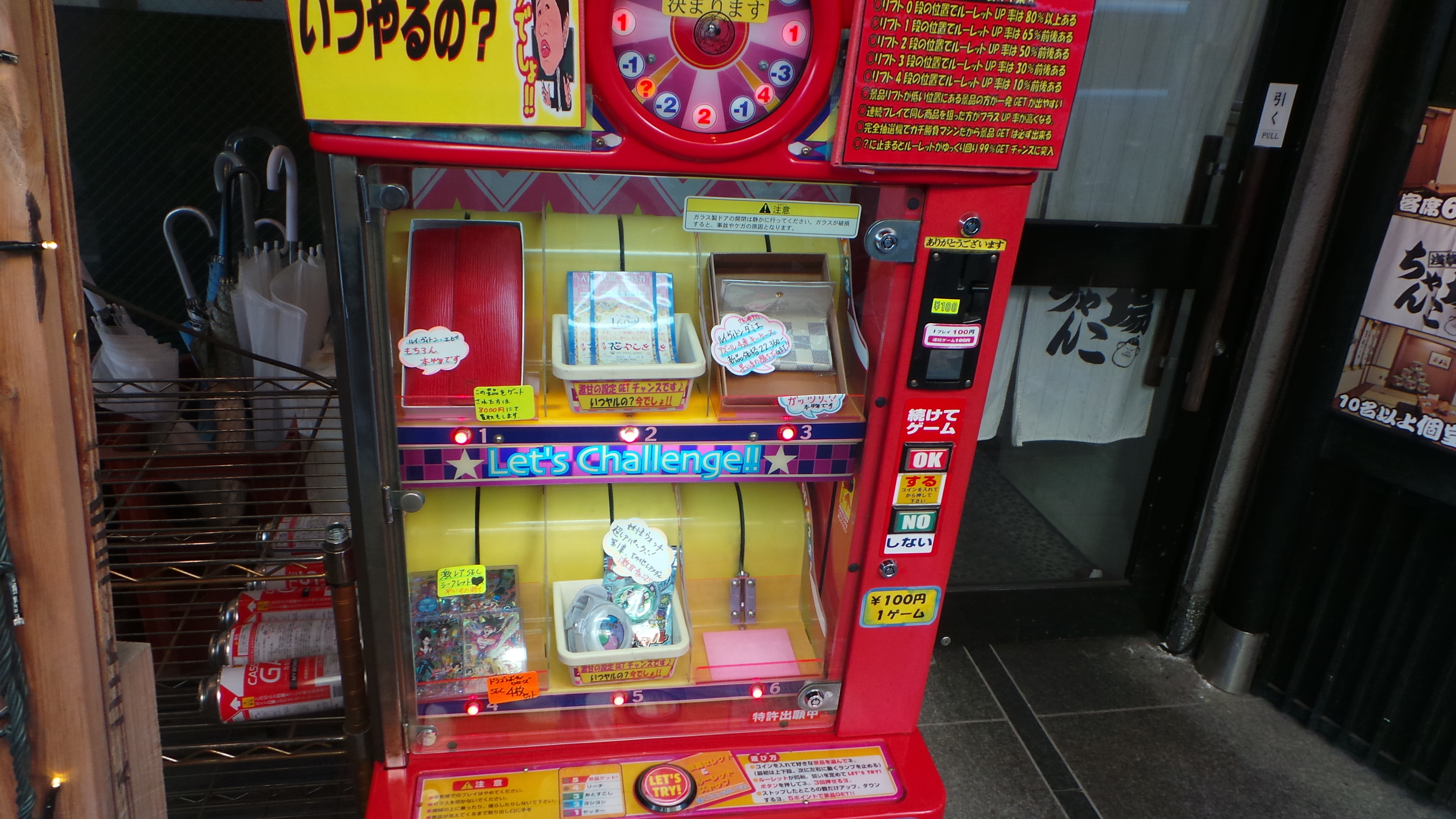
letschall

The machine costs just ¥100 and offers a chance to win excellent prizes. It’s called ‘Pocket Lifter,’ and presumably, it lifts money from my pocket by tricking me into thinking I can win one of the luxury prizes. Hidden behind its polished glass front are some trading cards, two Louis Vuitton purses, and tickets to Hanayashiki Amusement Park—the oldest amusement park in Japan. Despite seeing this park every day in Asakusa, I have yet to make the visit. However, Hanayashiki might have to wait a little while longer, as I am still somewhat traumatised by my recent visit to Tokyo Disneyland.

The machine says, ‘One-two-three-four-GET!’ Winning is as easy as counting. One of the Louis Vuitton purses can be won and sold for ¥8000 at a nearby shop, conveniently listed next to the prize—a gambling loophole once again exposed. Above the prizes, a wheel with bright flashing lights beckons, ‘Let’s Challenge!!’ How could I possibly resist? Keenly, I insert a ¥100 coin. ‘Thank you,’ the machine says as it swallows my money. The wheel spins and lands on the number one. The prize shelf moves up a fraction of an inch, then nothing happens. For a limited time only, I can get three tries for my money. I repeat the button-pressing process twice, and disappointment reoccurs twice more. No prizes, no amusement, no amusement park—just more bad fortune. Thanks, pilgrimage.

Dome Alone

Over the last few days, the temperature has been getting increasingly colder. Winter is finally upon us. Recently, as I have wandered around in just a short-sleeved shirt, I have started to lose count of the number of times I have been asked, “Aren’t you cold?” The weather today is 18°C, and Tokyo is just a rainstorm away from resembling an English summer. I head out into the freezing cold in search of something to do.

My first stop is an event in Asakusa known as Neko Matsuri, translating to mean ‘Cat Festival.’ Unfortunately, a more accurate translation might be ‘Cat Disappointment.’ The festival consists of two small market stalls selling cat postcards and biscuits with cat faces on them—nothing else, not even a cat mascot to photograph. Disappointed, I leave the festival and start walking in the direction of Ueno Park to see some ninjas.

ninjacarnival[1]

Today is the Iga-Ueno Ninja Festival. Market stalls here sell overpriced food, and on stage, a band comprises eight young women dancing and looking exhausted. The only ninjas present are those trying to trick small children into winning rubbish prizes at fairground-style attractions. Once again, not a very exciting festival for me; perhaps this one is more of a family event, and coming here alone at thirty years old, I am probably not the target audience. At least I got to see a man dressed as a ninja, though.

I take a short wander in the direction of Akihabara Station. Inside the station, I am surprised to find that just outside the entrance to the Sobu Line is a live music event known as JR Live. With five different lines at Akihabara Station, only the people heading to this platform get to witness the delights of this event. It’s a strange location for a stage, if you ask me.

jrlive[1]

The band is dressed in festive clothing and is performing a familiar tune, but I can’t quite place it. The poster says that ‘This mini orchestra can be enjoyed by both children and the elderly.’ Once again today, I don’t quite fit into the age demographic, and subsequently, I can’t enjoy the music.

I take a train and arrive at Suidobashi Station. From here, I walk five minutes to Tokyo Dome. Today, and for the next three months, the entirety of Tokyo Dome City is wrapped in light as part of its annual winter illuminations.

domeplanets[1]

It becomes apparent to me that at this time of year, all the interesting festivals seem to have finished, only to be replaced by Christmas illuminations and other festive events. In a country where fewer than 1% of the population are Christian, I find it strange that so many places are littered with Christmas decorations, playing Christmas music, and promoting a holiday that doesn’t quite fit in with traditional Japanese culture.

The theme for this year’s Tokyo Dome illuminations is ‘Light of Promenade,’ and there are lots of lights—2.2 million to be exact. Attractions include the ‘Galaxy Dome,’ the elaborately titled ‘Glorious Chandelier,’ and a ‘Milky Way’ of light featuring a 140-metre-long corridor lit by motion sensors. The corridor of lights changes colour as people walk beneath them. The corridor is directly under the path of a well-lit roller coaster; as the ride roars above, the lights flicker and shake.

tunneldome[1]

Despite the subtle Christmas theme featuring only nine massive Christmas trees, the rest of the illuminations look quite nice. An instrumental version of ‘A Whole New World’ from Disney’s Aladdin plays from every speaker in the vicinity. A giant statue of Ultraman stands guard beside a glass pyramid of multicoloured lights, and people dressed in Santa Claus outfits dash about merrily.

Alone, I walk the full length of the illuminations, passing couple after couple holding hands and smiling. I realise that this is my first time seeing any public displays of affection in Japan. It reminds me of just how lonely it is here—the mix of Christmas displays, pretty lights, and couples in love. I take one last photograph of some ordinary trees before heading back to the train station.

domeleaves[1]

On the train, I see a sign that says, ‘Merry ChristmaSOCKS!,’ and it instantly cheers me up.

On the Other Side of the Mountain

Today, I am exactly halfway through my trip. To celebrate, I have decided to take a break from city life and booked a night at a Japanese inn, known as a ryokan. It is situated in the middle of the mountains in a place called Nikko, in Tochigi Prefecture. My plan for the next few days is to experience a more traditional side of Japan.

From Asakusa, I pay ¥2390 for an express train taking 140 minutes. At Shimo-imaichi Station, I have to change to a dreaded local train. On the platform, I wear a short-sleeved shirt. A Japanese man says to his friend, “Look at that guy; he must be freezing!” I admit, it is a little cooler than Tokyo, but I only have to wait two minutes at the cold station platform. I eventually get on the local train. It sounds like a roller coaster as it claws its way up the mountainous tracks. The train’s only luxury is its heated seats; they make the whole train smell like the inside of a giant hairdryer. Five minutes later, I arrive at Tobu-Nikko Station.

I head out of the station and onto an old bus; the transport on this trip is getting progressively worse. The place I am staying tonight is at Yumoto Onsen; ninety minutes from Nikko Station and some 185 kilometres north of Tokyo. It’s just gone five, but the sun is no longer visible. The bus crawls through the darkness. A warning says, ‘Hold onto the handrail as the bus will sway from side to side as it makes its ascent.’

The bus eventually arrives at my stop, the last stop. I pay ¥1700. This is also the last bus. I am trapped up here now; no coming back. Outside, it is freezing cold—the coldest I have been since leaving England. Luckily, at the bus stop, I am greeted by warm smiles. A Japanese woman with a sign is waiting for me. We head to her car, and she drives me thirty seconds to the place I will spend the night

Inside the ryokan, she takes me to my room—the biggest room I have stayed in since being in Japan, spacious and warm. It has a massive double futon laid out, and a table of equal size. The woman starts by preparing me a hot cup of green tea before leaving to prepare my dinner. I get dressed into my yukata, carefully ensuring I cross it left over right; crossing it the other way is how the dead are dressed at funerals, and I am not dead. I also make sure to tie the bow behind me; a bow at the front is how prostitutes dress.

At 7 p.m., the woman comes back into my room to serve me dinner.

ryoklunch[1]

My food consists of buttered trout, salmon, vegetable tempura with natural salt, radish, simmered sesame tofu, lotus root, miso gratin with cabbage, yuzu pepper salad, grilled eggplant, fried tofu, boiled tofu in a soy milk pot with mushrooms, rice, a selection of vegetables, a selection of pickles, and a couple of things I can’t identify. The entire meal is pescatarian, and all the food is of the highest standard. I don’t usually like tofu, but up here, it is made from the cleanest of mountain water and tastes phenomenal.

After a while, the woman comes back into my room to clear and clean the table before bringing me dessert. In comparison to the huge dinner, my dessert is somewhat anticlimactic.

ryokdessert[1]

I help myself to a couple of the complimentary bottles of Autumn edition beer before deciding to take a dip in the hot springs. I book the outdoor onsen for forty-five minutes. Outside, there is not a single sound. The stars are out. Mountains loom in the distance. The contrast of boiling hot water mixing with the cold winter air is wonderful and relaxing. After my time is up, I head indoors to onsen number two.

The indoor onsen doesn’t offer a window, so there isn’t much of a view. It is a rather lonely experience. After I get out, I take a shower. It is etiquette in Japan to shower before and after getting into a hot spring bath, so this is actually my fourth shower this evening. I notice weighing scales in the changing room; I haven’t weighed myself since before I came to Japan. After a massive meal and a not-so-massive dessert, I am surprised to discover that I am 7kg lighter than when I arrived in this country.

ryokindoor[1]

Back in my room and with kilogrammes to gain, I decide that the perfect way to cool off is with a delicious tub of homemade cream cheese and alcohol-flavoured ice cream. Sulphur from the onsen taints the experience slightly, the smell of rotten eggs lingering in the room.

I sip quietly on complimentary beers with the window wide open, wrapped up in my traditional Japanese clothing. The clean cold air is nothing more than a fresh distraction to the silence that engulfs me. Outside, the only thing I can see is hot smoke billowing from the many hot spring baths and the dark outline of mountains in the distance.

Swings and Sound and Boats

My hotel offers a ‘classic’ help-yourself breakfast, so I opt for a bowl of rice, pickled cucumber, a pot of natto, a salad, and a couple of croissants. Natto for breakfast—enough to wake even the dead! I add mustard to rid myself of its abhorrent taste.

The day is gloomy with the threat of rain, yet curiously, I can’t seem to locate my umbrella—this is becoming a regular occurrence. The rain halts, I absentmindedly leave my umbrella outside a shop, and upon exiting, it slips my mind entirely. Now, sans umbrella, I’m left fervently hoping the rain stays at bay. But as expected, the very instant I step out of the hotel, the rain begins to pour.

Today, I only have two things on my sightseeing list, and they’re quite a distance apart. Given that I’m in Japan, the journey between them is sure to unveil something intriguing along the way—perhaps even a shop shaped like a boat.

boatshop

I head into Arc City and visit the Hamamatsu Museum of Musical Instruments. It’s the largest municipal museum of musical instruments in Asia and was the very first of its kind to open in Japan. The museum boasts an incredible display of 1,200 musical instruments. Admission costs just ¥400.

Most instruments come with two sets of headphones. I thoroughly enjoy examining each instrument, studying its unique shape, and imagining how it might have sounded in use. I then choose a pair of headphones to listen to its actual sound—A great way to kill a morning.

instruments

The museum showcases instruments from across the globe, with expansive sections categorised by continent. Here, I delve into a wealth of musical knowledge. My particular fascination lies with transverse flutes, shakuhachi flutes, and Japanese taiko and tsuzumi drums. Moreover, I uncover an intriguing fact: the very first Japanese-made piano originated here in Hamamatsu. This revelation perhaps accounts for the abundance of music shops, Romantic-era traffic lights, museums, and two concert halls.

In the ‘hands-on room,’ I indulge in playing a variety of instruments, but the spinet piano steals my heart as a favourite. Lost in the museum’s captivating exhibits, time slips away unnoticed, and I find myself leaving after two or three hours.

Outside, the cicadas persist in a symphony of their own, undeterred by the torrential rain. Amidst the deluge, there’s at least one person seemingly relishing the downpour:

rainingagain

Seeking refuge from the weather, I find solace inside Hamamatsu Station. Ascending seven escalators to the 8th floor of the shopping complex, I reach a bookshop. In Japan, lingering or sitting down to read books in a bookstore is perfectly acceptable. Similarly, spending hours browsing magazines in a convenience store is considered normal. I pass fifteen minutes here before descending, only to discover that the storm has worsened.

Everyone at the station appears as ill-prepared as I am. Umbrella-less, they huddle together, patiently awaiting the rain’s cessation. I hastily make my way to Seven Eleven, purchasing my sixth umbrella for ¥540. The surrounding buildings are shrouded in a white mist of cascading water—an unexpected sight, especially considering my plans to visit the beach today.

actbuilding

As time passes, I find myself seated on the only bench in that deserted shopping arcade. With several hours to kill due to hotel cleaning schedules, I contemplate. During a storm like this, I can’t help but wonder if the safest haven might just be a shop shaped like a boat.

After a while, the rain subsides, prompting me to stroll to the beach, a journey of about an hour. This beach holds significance due to the Nakatajima Sand Dunes, and it serves as a conservation area for the nesting Loggerhead Sea Turtles. Every summer, these turtles come ashore to lay their eggs on this very beach.

“Prazer em recebê-los!” says a drawing of a Loggerhead Sea Turtle in fluent Portuguese.
“Nice to meet you, too!” I reply, in fluent English.

dune

These sand dunes rank among the three largest in Japan, and the wooden fences stand to protect their conservation. A warning sign sternly advises, ‘Do not damage the fences!’ The wind, notably stronger in this area, renders my umbrella ineffective—unless I’m keen on turning my sixth umbrella inside out.

By the time I reach the sea, I am completely soaked. I was really hoping to see a turtle, but I sadly can’t find any; not too surprising really, they are a rare and endangered species. After the beach I head into a nearby park. There is a big man-made hill in the park built specifically as a tsunami evacuation point. There is also a windmill and a set of swings. I rest my legs for a while.

swing

On my walk back to the hotel, I pass a pachinko parlour called, ‘God’. I also pass dozens of construction sites promising modern skyscrapers; office blocks and apartments. It seems that the southern part of Hamamatsu is the last and latest to be developed, perhaps in four or five years this place won’t seem so desolate.

The rain stops just before I cross the river.

bridgebird

After walking for an hour, alone, my thoughts begin to wander and I drift off into daydream.

Upon returning to the hotel, I realise I can’t recall the journey here, yet here I am. After drying off, I dedicate some time to researching my trains for tomorrow. It appears I have yet another four-and-a-half-hour local train marathon to endure. However, I don’t mind; after forty-eight days away, I’m finally heading back home to Asakusa.