A Spiral, a Darkness, a Fever, and a Staircase

I wake up in pain. Cramp. My leg screams. I’m in Fukushima Prefecture, Aizu-Wakamatsu, an old samurai town with a historical past. I’ve been here for a few days. I feel oddly connected to this place in a way I’m really not sure how to describe. Aizu is famous for its samurai and a red cow named Akabeko (translated to mean red cow).

I leave my hotel. The sun is so bright that the sky isn’t blue, but white, yet there are no clouds. It’s like walking through a thick fog of heat. Imagine you’re a little tiny person the size of an ant, walking through an oven set to 180 degrees. That’s what it feels like. I walk across the sheet pan in the direction of the mountains, vaguely knowing that I will arrive somewhere spirally important.

In Aizu, the legendary red Akabeko cow can be rubbed and is said to heal illness or sickness. The thing I like about Akabeko is that they have bobbing heads, so every time I walk past one I push its head down and smile as it nods up and down.

A little further up the road, Aizu-Wakamatsu is offering politeness lessons:
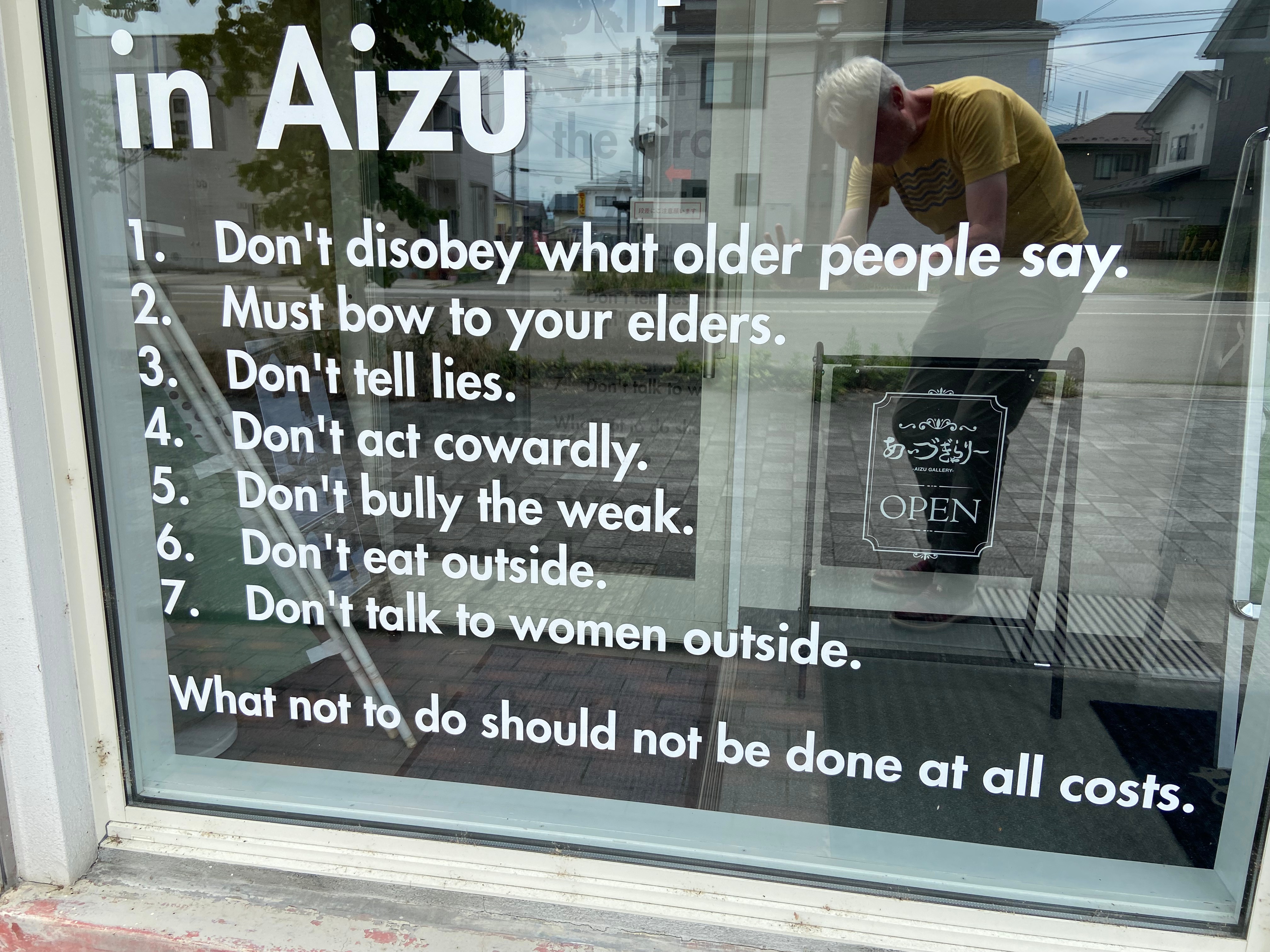
Don’t talk to women outside. Must bow to your elders. The two conflicting lines bother me, because as I photograph the sign, an elderly Japanese woman starts speaking to me in Japanese. Obeying the rules, I just bow my head and walk away.

A black Seven Eleven with none of the usual green and red stripes greets me funereally; I’ll soon find out why it’s black. The cascading sunshine and the black stripes make me feel as though my eyes are glitching. Outside the entrance to Sazae-do Temple, there are sweeping steps that twist all the way up, but someone has placed an escalator to one side. You have to pay 250 yen to ride it, but the cramp is threatening to return.
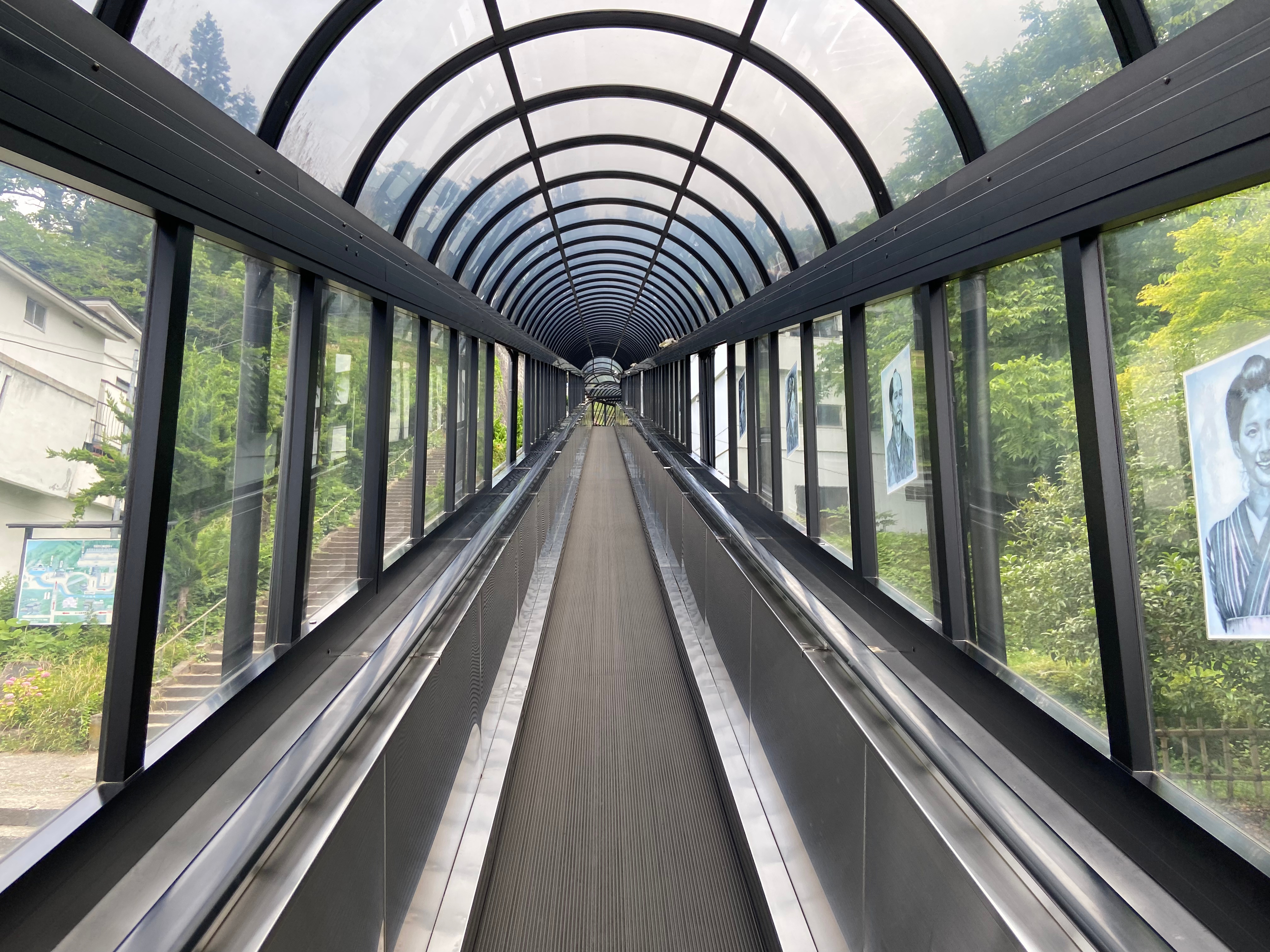
I don’t know what it is about today, but as soon as I step off the escalator and into an open area of monuments, the suddenness of place hits me, catching me off guard. To summarise what happened: on October 30, 1868, during the Battle of Aizu, the Byakkotai, a group of teenage samurai thought they had lost the civil war. They saw smoke in the distance, thought the castle had been sieged, so they killed themselves, not far from where I stand. Learning this, I become swallowed by sadness.

Their bodies were left outside for days, until a man, Isoji Yoshida, decided to take it upon himself to move the bodies of the dead children and bury them. For this, he was arrested. Katamori Matsudaira, the 9th lord of Aizu, wrote a poem in their honour. It goes:

“People will visit, and their tears will fall upon your graves. You will not be forgotten.”
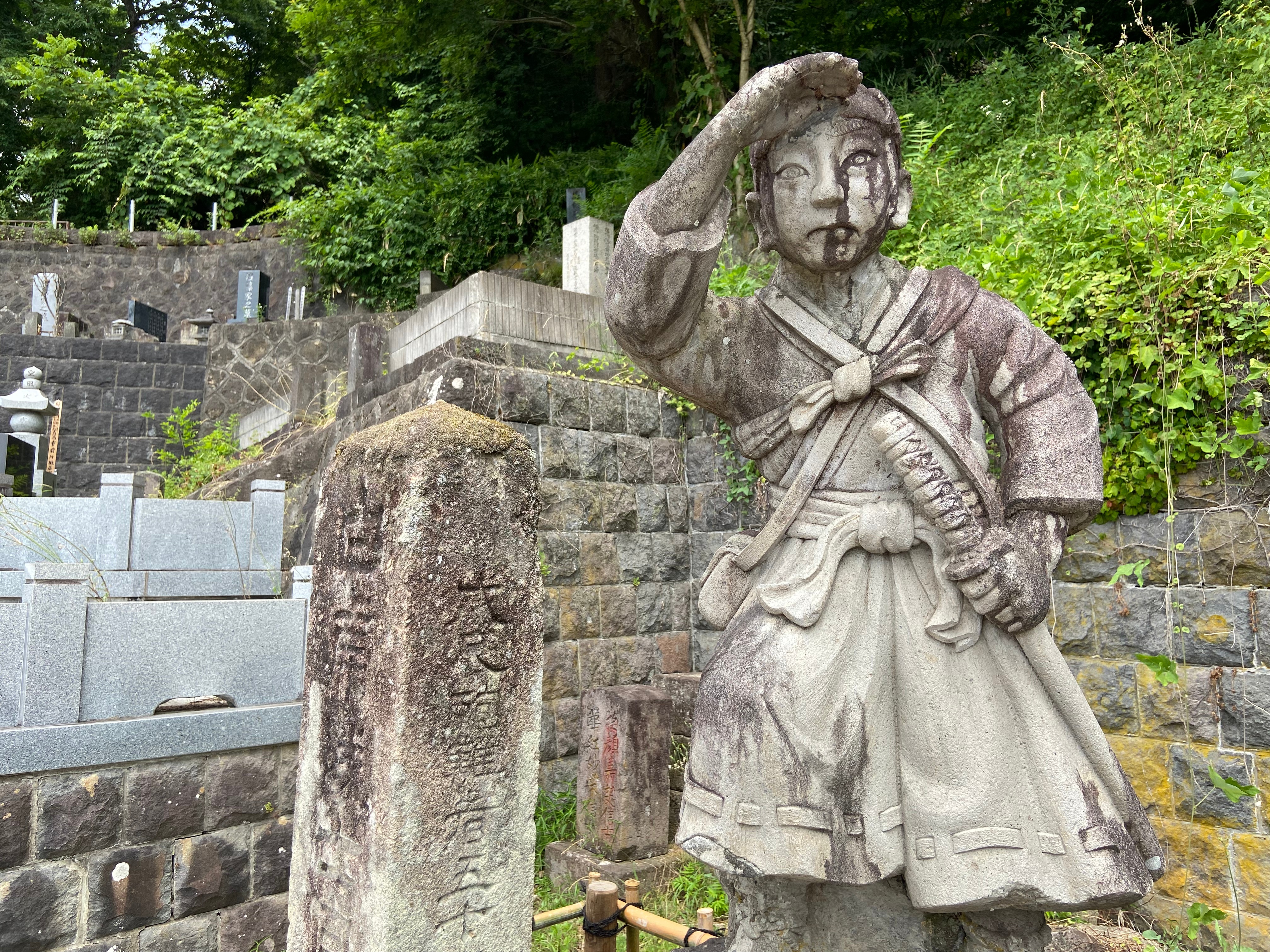
There are monuments here for everyone involved. For the dead children, for all who died. The tomb of sixty-two fourteen- to seventeen-year-old samurai. It’s devastating. I try not to bring myself too much into these stories. But this place, these dead children, their story found its way in. I think what gets me is they don’t mention the word suicide, they explicitly state every time that they killed themselves.

I weep my way around a cemetery before turning toward the temple I originally came up this hill to see. There is a prayer wheel that, when you turn it, creates a mournful sound said to be heard in the underworld, comforting the spirits of the Byakkotai warriors. “Please turn it quietly with your heart.”
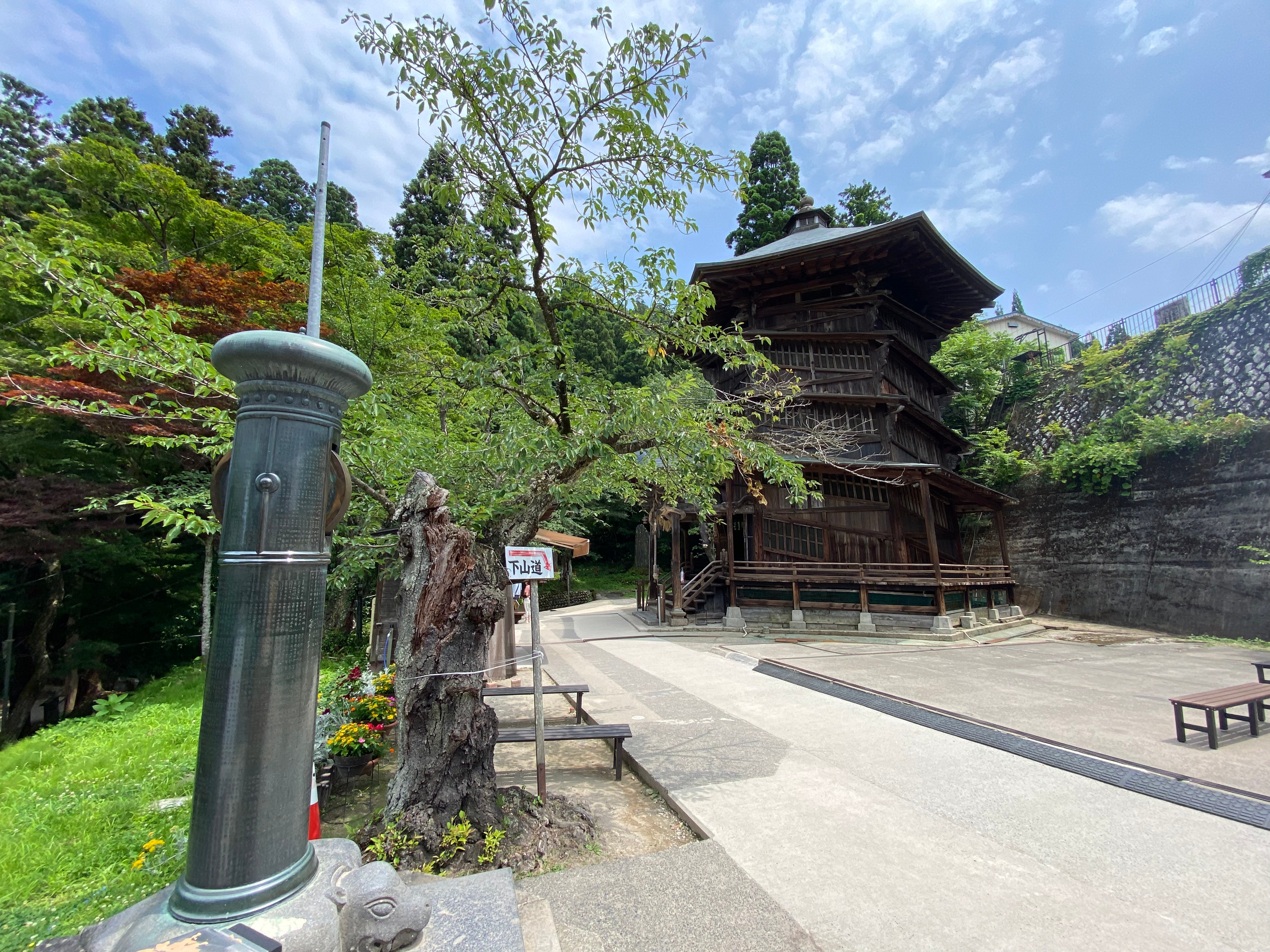
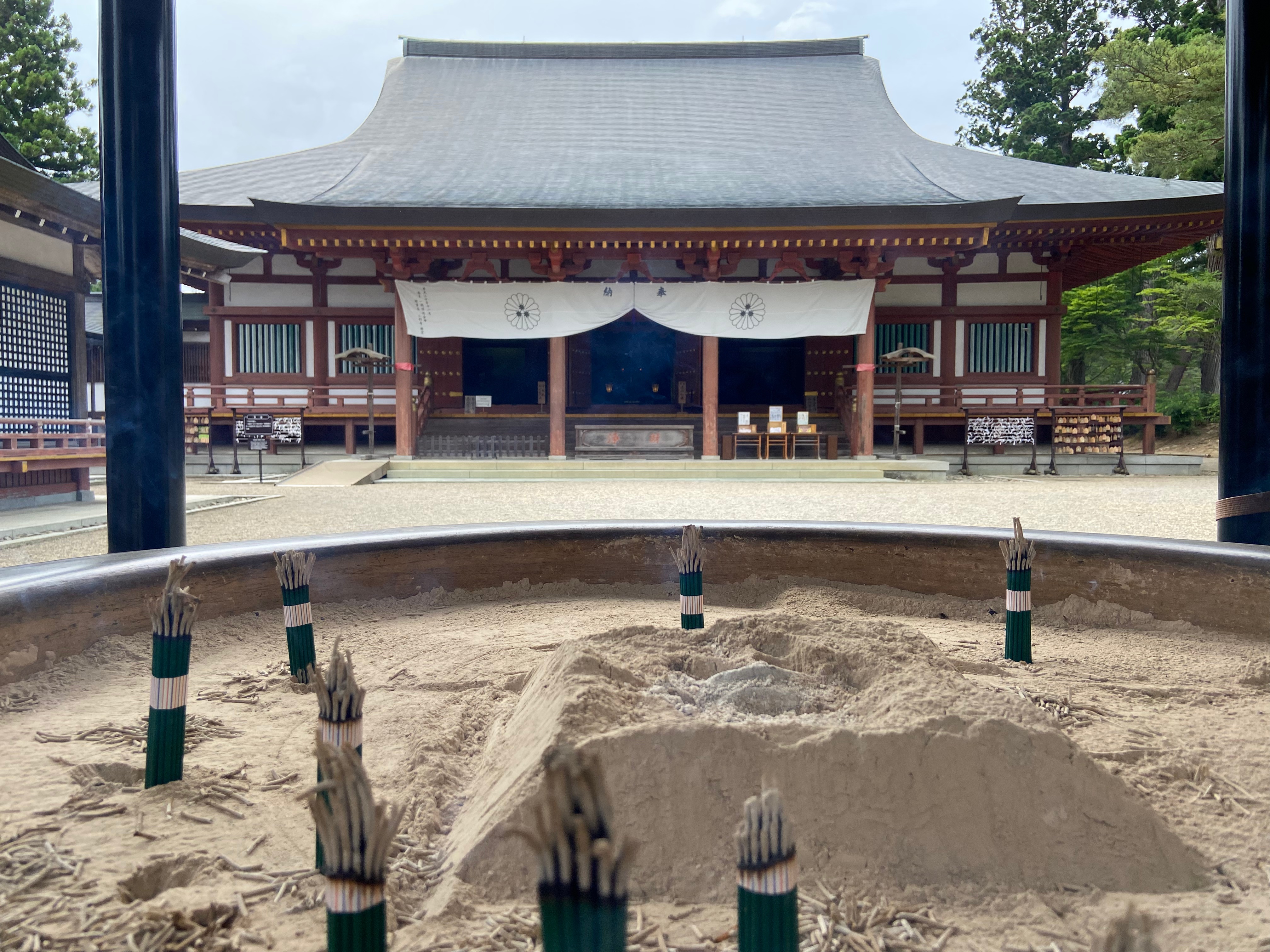
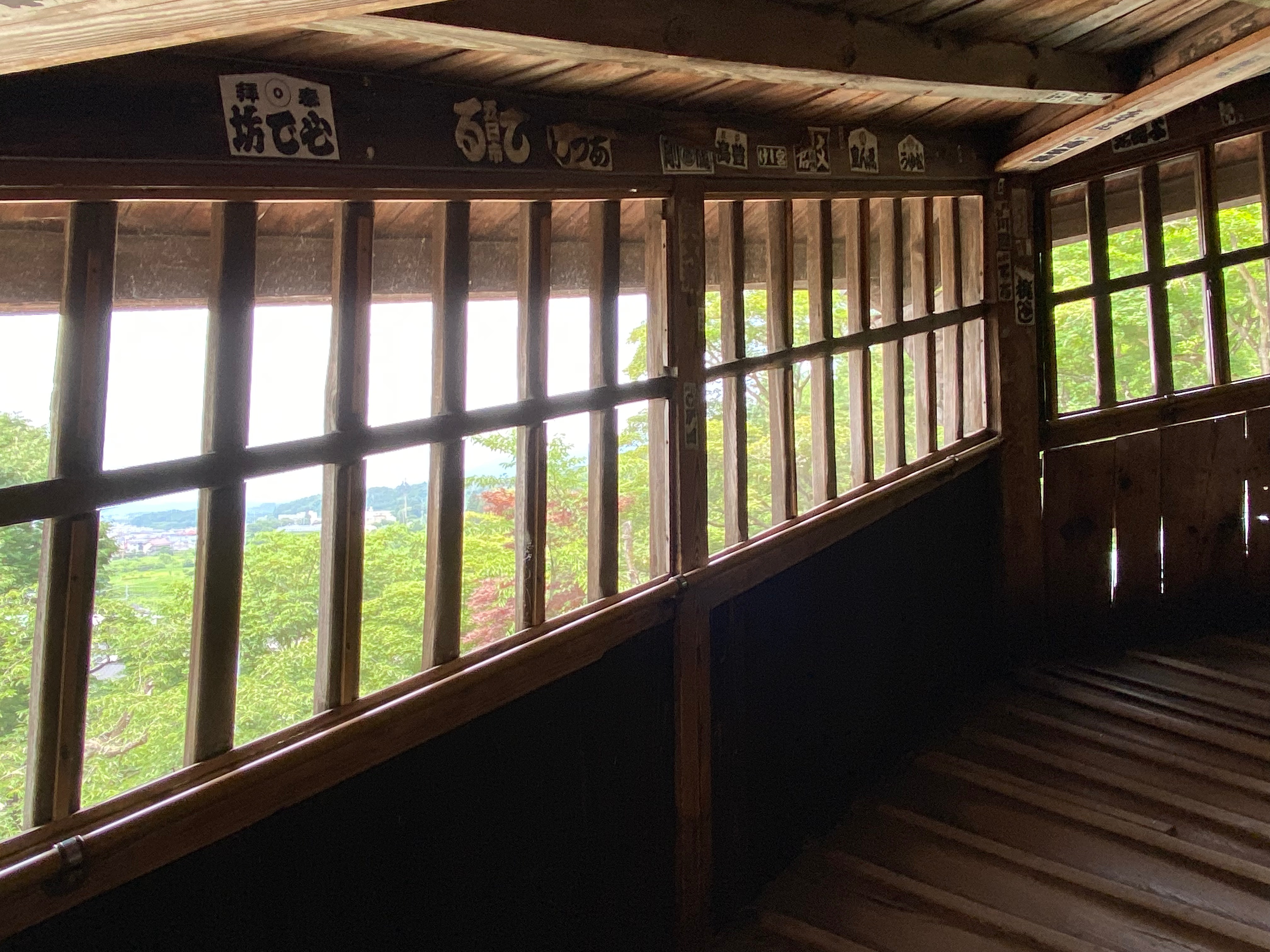
Sazae-do, a wooden Buddhist temple constructed in 1796, is famed for its distinctive spiral staircase that ascends and descends in an intricate, intertwining path. Encircling the ramp are 33 Kannon statues, each believed to grant the same spiritual merit as completing the entire Aizu Pilgrimage route to anyone who passes by them.

At 16.5 metres tall, three storeys, and shaped like a hexagon, you enter from the right side, climb the spiral staircase, and exit back down another way. You never see another soul. This valuable structure is the only wooden building of its kind from the mid-Edo period still standing in the world. It’s also the only known double-helix-shaped wooden structure in existence.
I breathe a heavy sigh before exiting through the gift shop and buying a shirt featuring Akabeko. I think about people, those loved and lost, on days when we exist together, and days when we don’t. At five o’clock, Yuyake Koyake starts playing, the song that tells the children to go back home. It elevates my sadness.

I head to a steak restaurant for dinner. I eat the red cow’s bleeding heart.
Boatman Begins

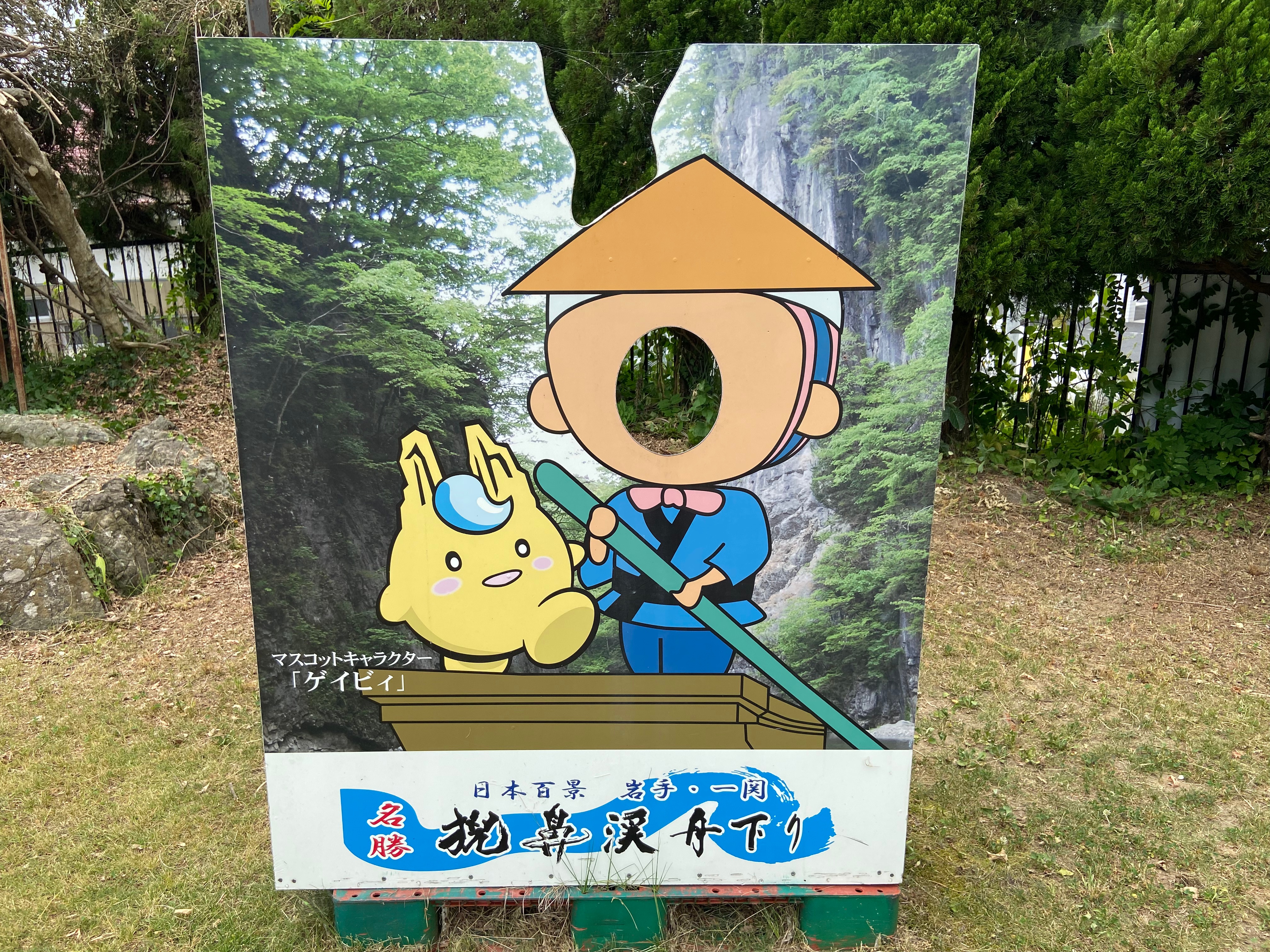
Somewhere between October 23, 1868 and July 30, 1912, a discovery was made. What had previously been regarded as dangerous wilderness turned out to be one of the most beautiful places on Earth: Geibikei Gorge.

In Japan, they love a good top three. Night views, bridges, and today, gorges. Nobody explicitly states which of the top three is actually the best. Politeness says: make a top three list, and leave it at that. Geibikei Gorge is one of the top three gorges in Japan.

As well as being one of the top three gorges in Japan, Geibikei has also been designated a National Place of Scenic Beauty, a Natural Monument, and one of the 100 Landscapes of Japan. It certainly is one of the landscapes.

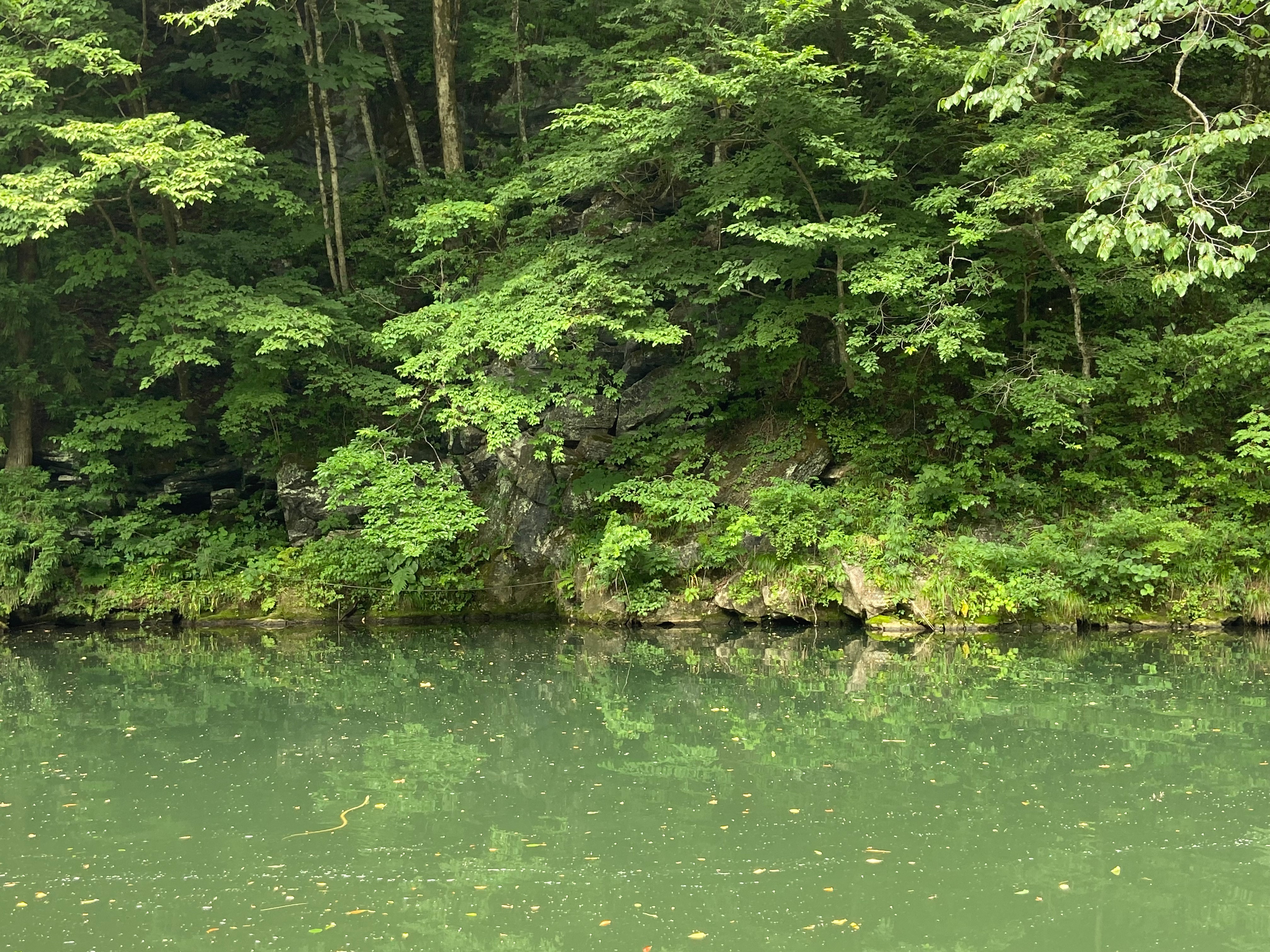
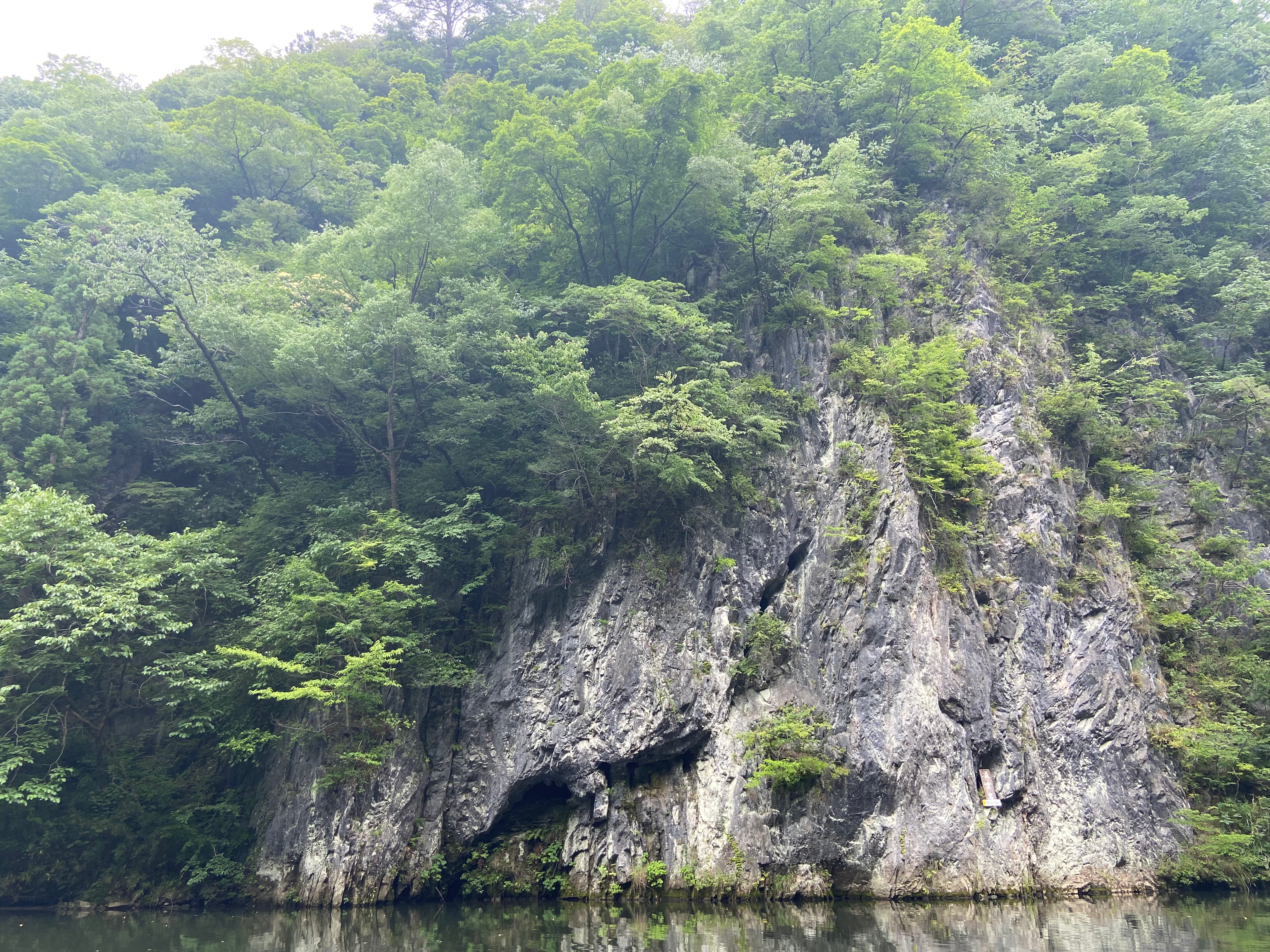
Geibikei Gorge (not to be confused with the similarly named Genbikei Gorge) is a 2-kilometre stretch surrounded by limestone cliffs. A river runs through it, so boats are required to fully explore it. The Satetsu River is a liminal, stillwater river. It flows neither up nor down. It just sits there like an ancient swamp. The only thing that interrupts the water is a boatman’s pole, or such nature as a falling leaf, the lapping of summer sweetfish, or the arrival of snakes.

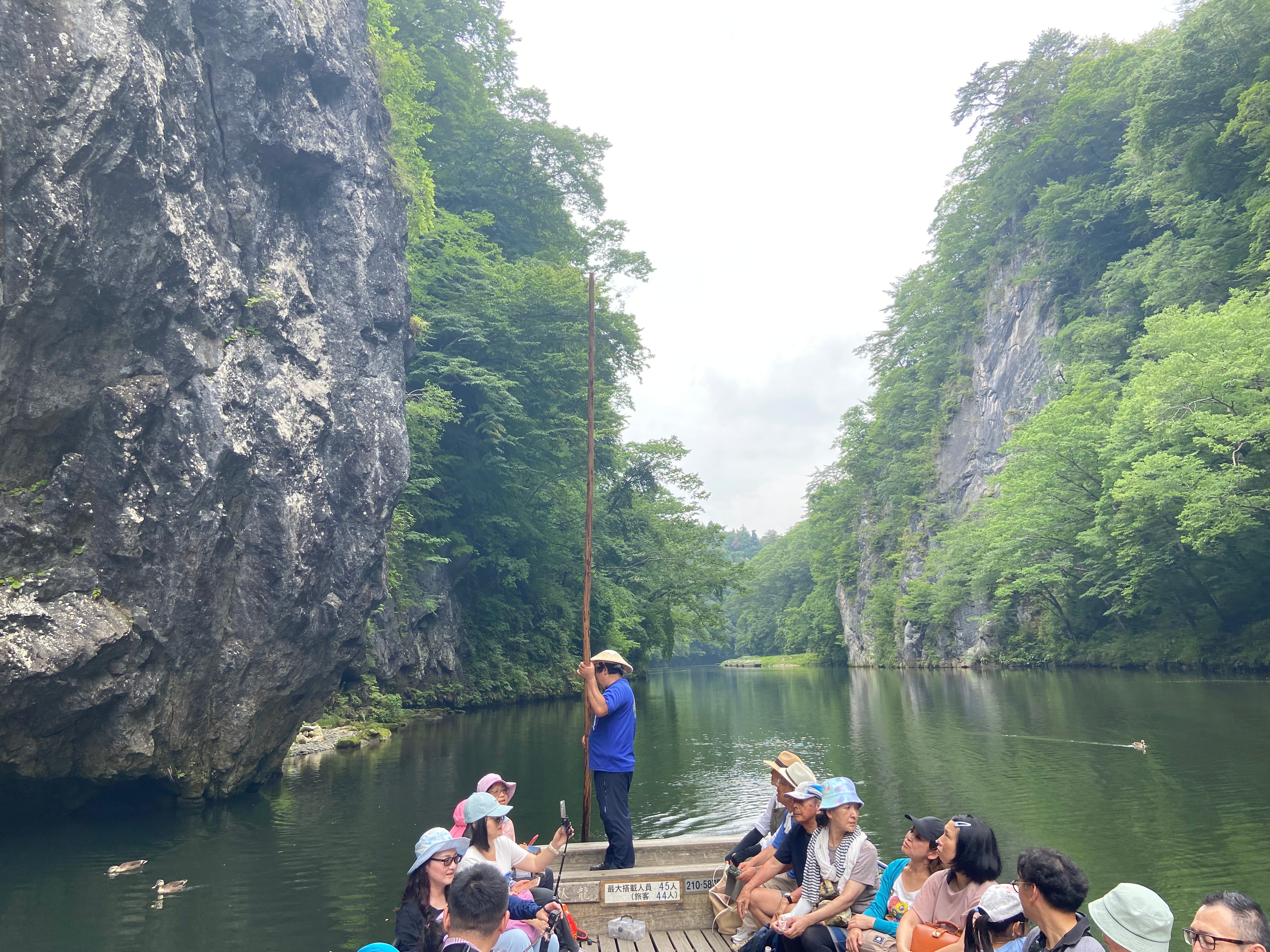
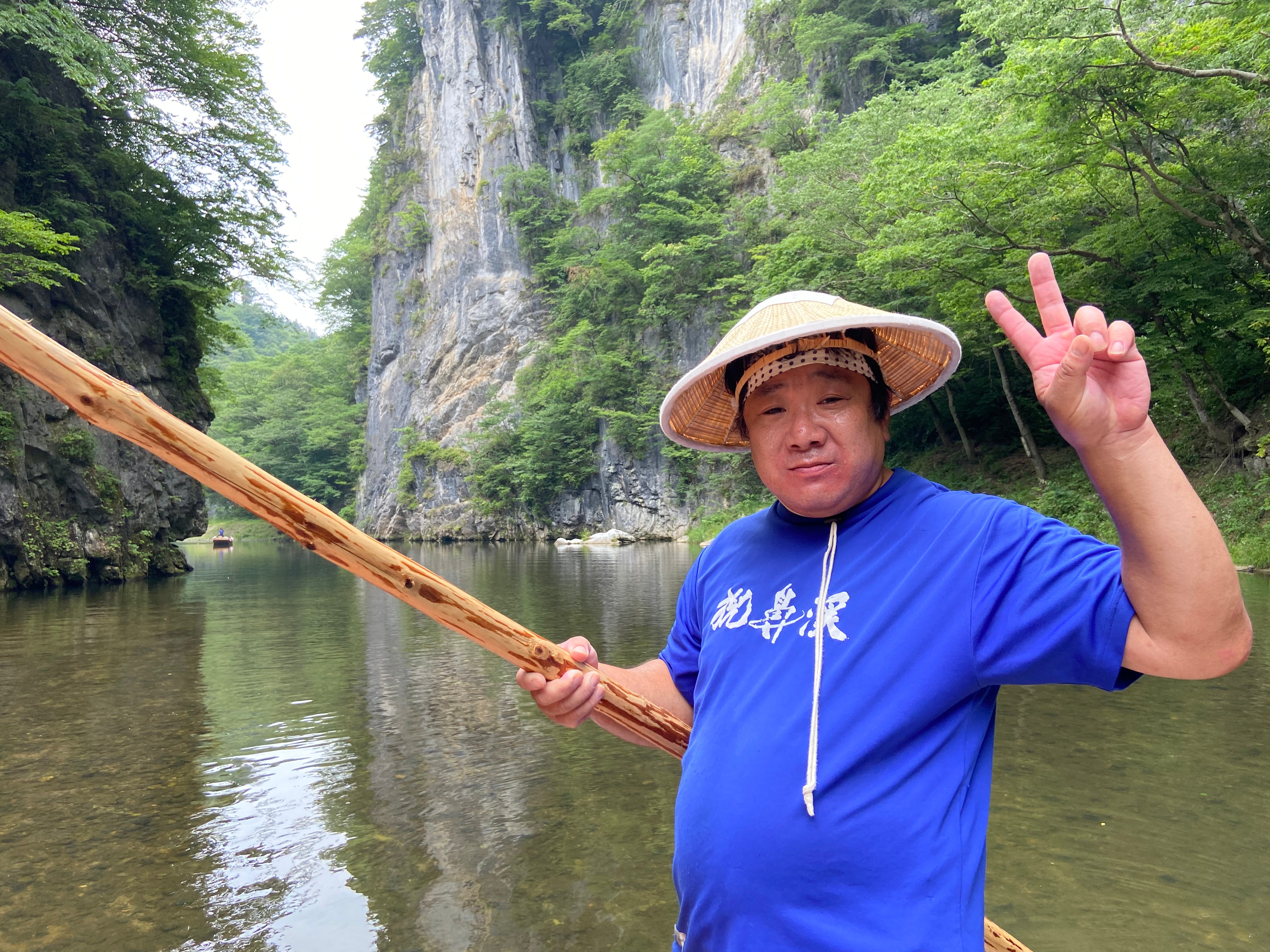
We buy some fish food in a little plastic bag, then sit on the boat, all 44 of us. The boatman introduces himself.
“Hello, I am Sato. Nice to meet you.”
Everyone applauds. Sato-san notices me.
“Hey foreigner, where you from?”
I tell him England. He just laughs and begins rowing, merrily. The snake swims away, frightened by the ripples of the boat. I realise that, after all the years living in Japan, I’d never seen a snake. This is now the second day in a row I’ve seen one, and I actually manage to photograph it.

I sit, gazing out. Sato-san interrupts the serenity.
“Hey foreigner, if you have a hat, glasses, camera …” he pauses for comedic effect, then mimes dropping the items overboard. “Oh no!” he exclaims.
He then repeats the same actions in Japanese before pointing and shouting, “The next rock!” Which is of course Kyomei-Gan (Mirror Rock), reflecting the sparkle of water off its surface like a giant mirror.

There’s a phrase I can’t quite remember. Something about the memory of a fish. I remember seeing fish, so that’s probably it. They’re clever and know we have food, and they gnaw at the side of the boat, almost jumping from the water. They follow us as we disturb the stagnant river.

It’s said the sweetfish leap in early summer, and the carp in autumn. One of the carp didn’t get the memo and shows up the moment I throw my stash of food into the river. The carp makes one giant leap, eats it all, and swims away. The sight of the fish is reminiscent of the Chinese legend, known in Japan as toryumon, in which carp become dragons after successfully leaping up a waterfall.

We carry on along the river. Sato-san is very enthusiastic. He slowly pushes the boat along with the wooden pole, but does so effortlessly. We aren’t rowing. We aren’t sailing. He just pushes the pole into the riverbed, presses ever so slightly, and propels us forward. The boat drifts for a moment, carried by the newly made current, then slows to a stop. He pushes again.

He points out various rocks along the gorge, makes jokes in both Japanese and English, and treats the 44 of us as an audience in his comedy routine. His confidence shines through, lightly heckling us, answering questions, entertaining us. The entertainment is so good that I almost forget about the view.

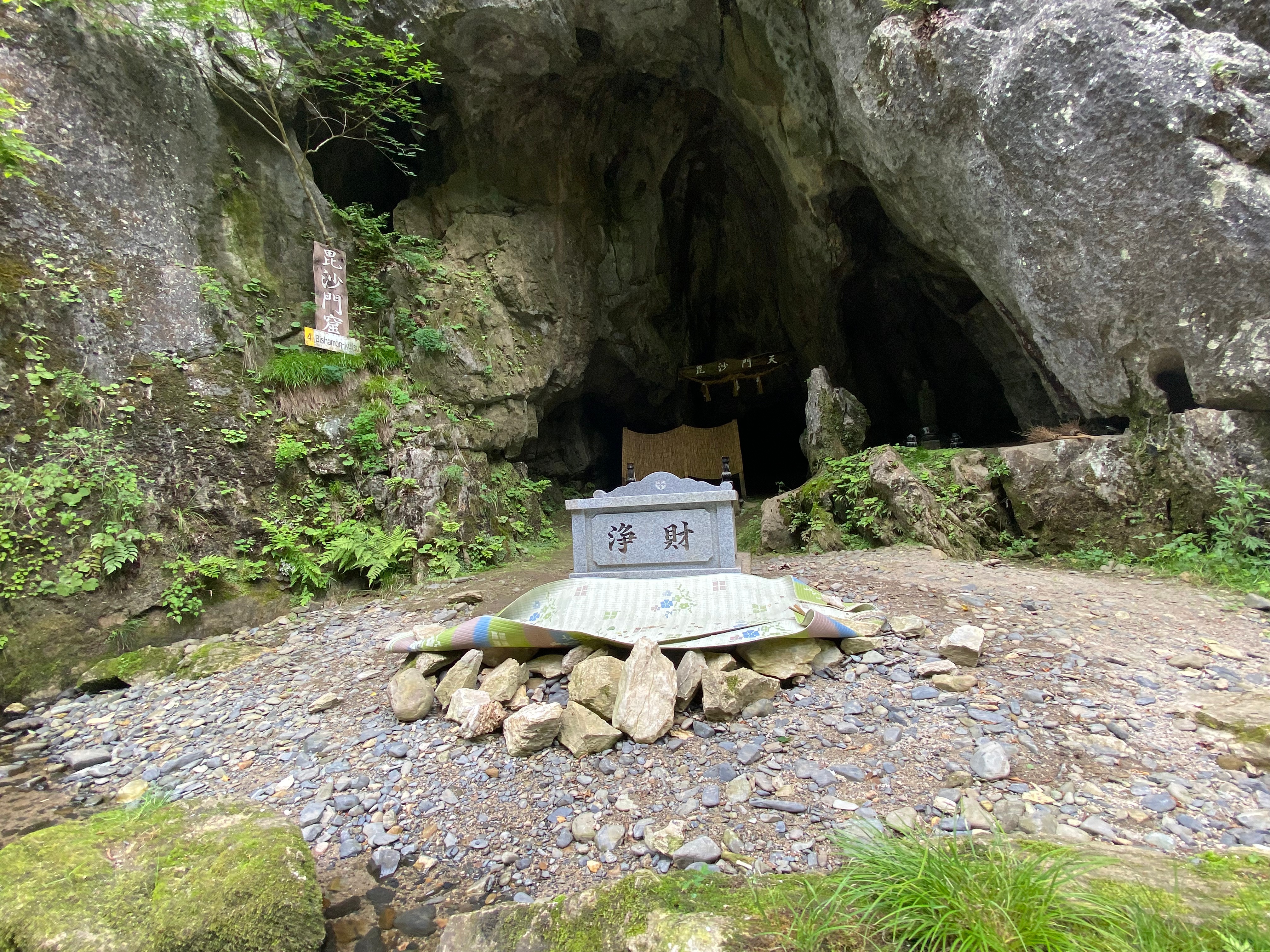
Further in, the sun splits open the sky directly above and the heat becomes immense. Some ducks appear, looking for food, and the fish still follow. We pass a small shrine in a cave dedicated to Bishamonten, the god of treasure. Everyone stands and throws their coins across the water to the shrine. Thousands of coins surround it. More gleam beneath the surface. It must be pretty easy being the god of treasure when people just hurl money at you.

We pass a man in a watchtower holding a Nikon camera. He shouts for us to say “cheese” before taking our photo. We pass another boat heading in the opposite direction and everyone waves at everyone else, like we’re in this together. I guess we are. So we continue on. It really is indescribably beautiful.

I take a moment to think, to contemplate, to evoke. Then I take some boatographs.

Thirty minutes into the boat ride, it’s time to make land and take a break. We glide over to a pebbled beach. Sato-san says something in Japanese, then turns to me.
“Hey foreigner, twenty minutes walking come back.”
I reply that I understand, in Japanese. The other 43 people laugh.

I see somewhere on the map labelled “Ninja Rock ??” but realise, when I can’t find it, that it’s a clever joke. I pass a rock shaped like a horse’s head, and at the very end of the expanse is Senryutan (Lurking Dragon Depths). A dragon is lying in wait for its chance to rise from being a Geibi carp, apparently. If you manage to throw an undama (pebble) into the hole, you’ll be rewarded with good luck. Apparently.

I walk around for a while before boarding the boat again. Eventually, everyone returns and sits in their original seat. There’s one seat empty that wasn’t on the way down. Someone has gone missing, but Sato-san makes light of it, then pushes the boat out once more. This time, instead of taking photographs, we just take it in. And instead of narrating or pointing at rocks, Sato-san begins to sing.
“Song time,” he says. “Very old time song. I do five or six minutes… maybe.”
He sings for twenty.

His voice transforms into something ancient, filling the gorge, lingering among the cliffs:

As I pole my boat,
on the clear waters of the Satetsu River,
the clouds,
that dull my heavy heart,
are dispelled,
by the Lion’s Snout.

His voice echoes long after the last note fades.

After singing, he looks exhausted, yet continues to carry us through the gorge in reflective silence. Nobody speaks. Even the water has quietened. I’m glad that of the multiple boatmen working today, that we were lucky enough to have Sato-san as our guide. His personality and comedic timing were a highlight, one of the most memorable experiences I’ve had in Japan.

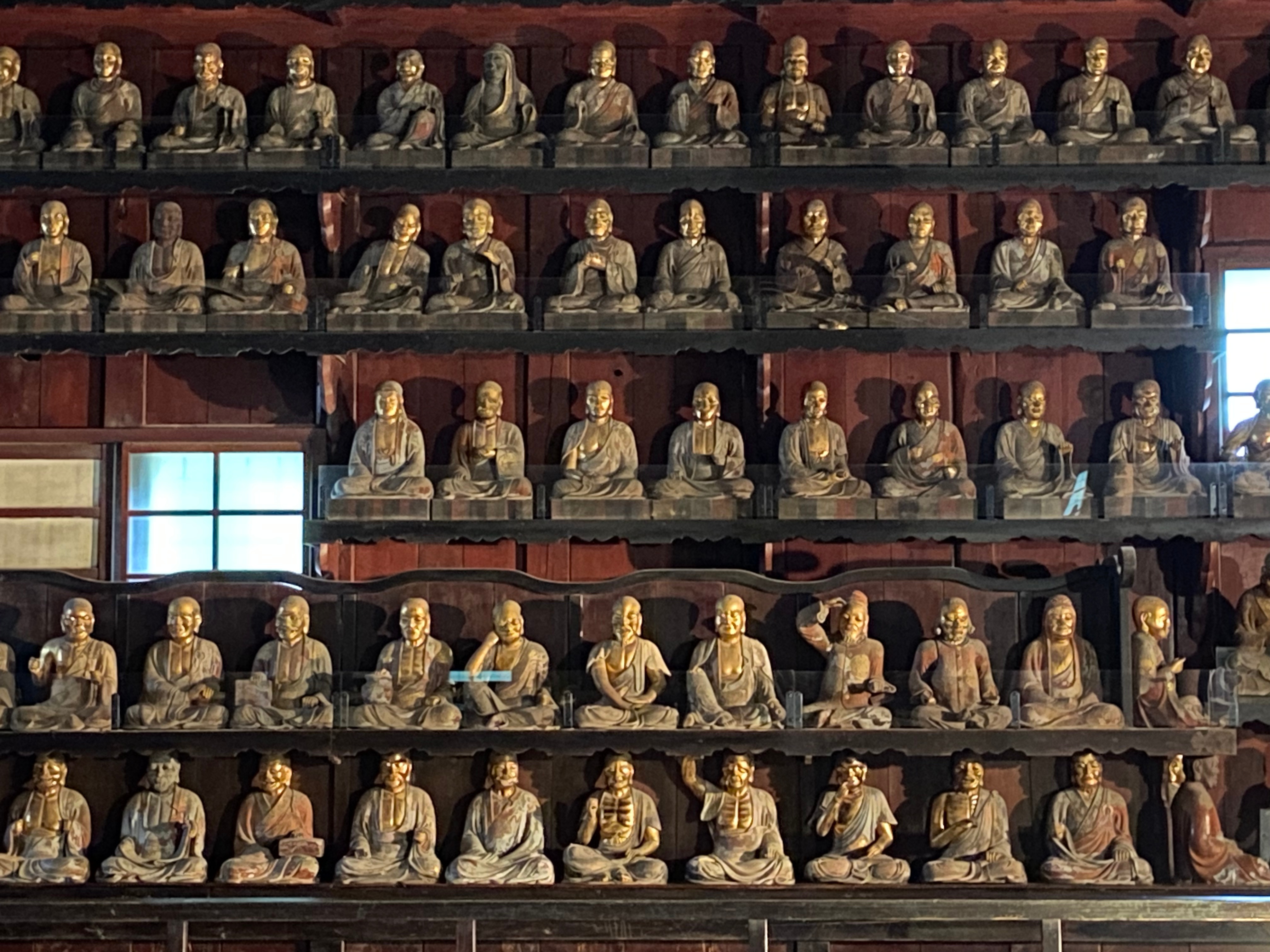
After the boat ride ends, we drift back into the real world. The gift shop waits patiently. A vending machine hums to the tune of overpriced green tea. I leave and take a train back to Morioka, walking the quiet streets until I reach Hoonji Temple. I take off my shoes and enter the silence. Inside the main hall, 499 rakan statues sit frozen in time.

They were hand-carved three centuries ago by nine monks. Each statue is lacquered, lifelike, and unmistakably human. Some laugh. Some grimace. A few seem lost in conversation. It’s almost as though I can hear them talking to one another. One of them is definitely Tom Waits. Others are said to resemble Marco Polo or Genghis Khan. There’s an expression to match everyone.

My eyes, for whatever reason, are drawn to a rakan sitting quietly in the corner, with a face I know well. It’s not me. It’s Sato-san. The boatman. Same smile. Same humour behind the eyes.
I blink, but he’s still there.
I never did find the one that looked like me.


Maybe I’m still being carved.

Castaways and Cutouts

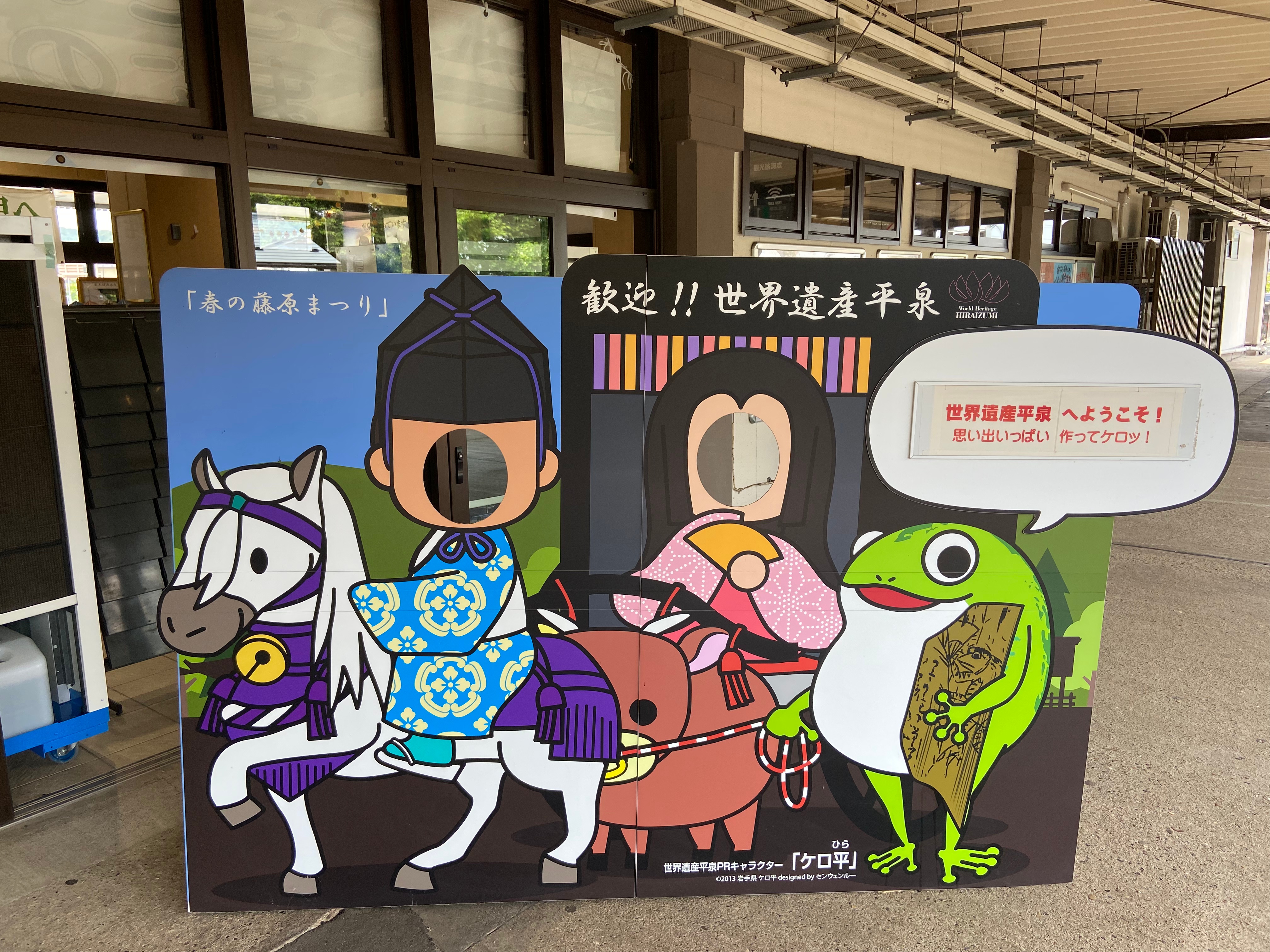
There’s a frog at Hiraizumi Station with the title of World Heritage Advertising Manager. His name is Kero-Hira. A speech bubble on the Carnival Cutouts cheerfully instructs, “Make lots of memories and relax!” He stands beside what appears to be a member of the Fujiwara clan riding a horse next to a woman riding a pig.

Today I’ve travelled a little further south, to Iwate Prefecture, in search of old ghosts and even older gold. I’m here to visit Chuson-ji Temple. Stepping past the frog and out of the station, the first thing I notice is the view of rice fields stretching out toward the distant mountains. The second thing I notice is the rack of travel pamphlets for Iwate Prefecture. One of them is familiar. Too familiar. It’s the same pamphlet I wrote ten years ago for a travel company I was working for at that time.

Having never set foot in Iwate Prefecture until now, it feels strange having already written about it in the past. That’s unfortunately how those travel companies operate, stock photographs and regurgitated information. I’m just fortunate enough to be able to visit these places as I am now, and use my own words and my own photographs.

It’s a twenty-minute walk to Chuson-ji Temple but I don’t mind it. The scorching summer sunshine is brutal and the humidity is high. Chuson-ji is a UNESCO World Heritage site that boasts two car parks, so I expect it to be busy. To enter, I must hike about ten minutes up a shaded forest path, lined with lush verdant trees of the cryptomeria variety. If I’m honest, I’m just pleased to be in the shade.

Before the main temple hall, there is Jizo-in, a smaller sub-temple. This temple features a picturesque Japanese garden. However, and as is often the case in life, the moment can’t be truly enjoyed. A man and a woman with leaf blowers fill the splendour of the garden with mechanical shrieking. The serenity is soundtracked by smug futility.

Entry to the Konjikido, or “Golden Hall,” costs ¥1000. It’s unassuming from the outside, just a rectangular building in weathered wood, but inside it’s another world entirely. No photos are allowed. Inside the hall is gilded in gold leaf, with three golden statues of Amida Nyorai flanked by bodhisattvas, all encased in a protective hall to preserve the original 12th-century architecture. The Golden Hall sits inside a larger protective concrete building, almost like a shrine within a shrine, carefully sealed off from time.

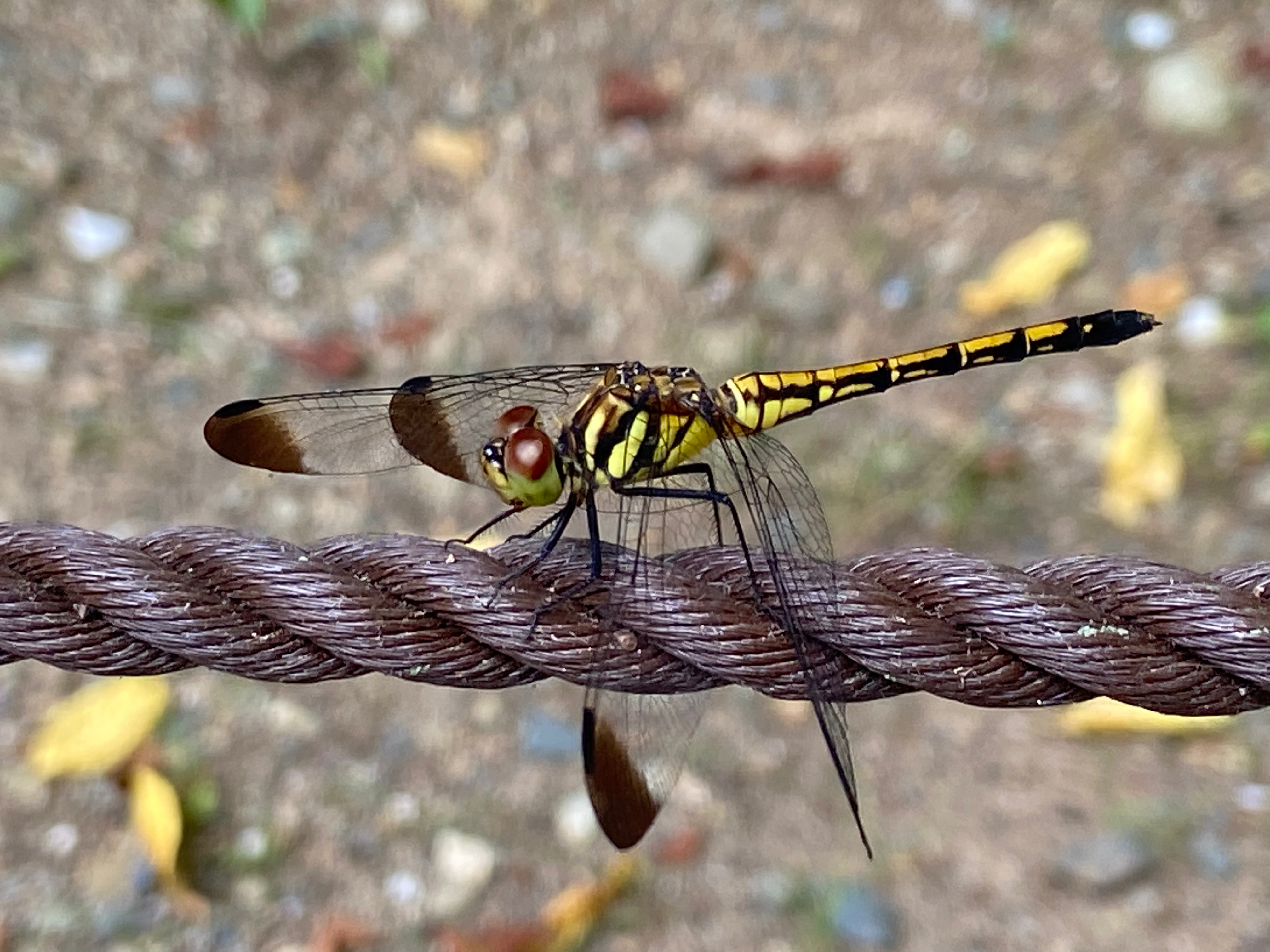
Because I couldn’t take any photographs of anything inside the Golden Hall, here is a photograph I took outside the hall, of a golden dragonfly:

On the way out, I draw an omikuji fortune slip. Once again, I pull “Excellent Luck.” I always seem to get the best one. It comes with a small Fortune Arrow trinket that is said to invite happiness and fulfilment of my wish, because an arrow hits the target. I tuck the trinket into my wallet for prosperity and fulfilment, a wish taking aim, and keep reading. It says that on travel, I will have an impactful journey, and that my lucky item is still dried flowers.

As I stand reading my fortune, I hear a voice. “Hey you! Come here,” shouts a Japanese man. I wander over to the man. He appears to be pointing at a large tree. It’s not until he speaks again that I realise what he is pointing at. “Look, a snake,” he says. “Very dangerous.”

After failing to take a decent photograph of a snake crawling into a tree, I wander to the final part of the complex, where the dead have clearly been hard at work. More stacked pebbles. Castaways from another world, trying to build their way back. The resemblance to Osorezan is uncanny. It turns out this temple was founded by Ennin, the same monk.

On the way down, the view opens up to a sweeping panorama of green hills and sky. It is simply stunning.

Leaving Chuson-ji, I walk another twenty minutes through thick heat and dense sunlight to reach Motsu-ji, another World Heritage Site. This will be the third temple this week founded by Ennin, and I have a fourth planned for later this week.

The famous haiku poet Basho visited this temple and left behind a haiku carved into stone:

Summer grasses—
all that remain of
warriors’ dreams.

Motsu-ji was mostly destroyed by fire, and the poem mourns the fallen glory of the Fujiwara clan and the entropy of all things. Since then, some of the buildings have been restored, like the main hall, but many of the structures are just rocks or sticks marking what used to occupy the now empty spaces.

Motsu-ji’s most enduring feature is its Jodo Garden, a symbolic recreation of the Buddhist paradise. It stands in quiet contrast to the ruins around it. The lake, said to evoke the Pure Land, now feels more like a mirror for dreams long since cast away.

I wander into the gardens. Aside from the lake, they are vast yet empty. There’s a small lily garden, the remains of what once was, and some immaculately cut grass. A single lawnmower sits abandoned atop summer grass, having half completed its job. It now lies idle in the heat.

I leave the gardens and return to the station, waving a silent goodbye to Kero-Hira, who is still smiling. I take the train north to Morioka. On the way to my hotel, I spot a sign for “Demon’s Hand Prints in the Rocks.” I decide to check it out.

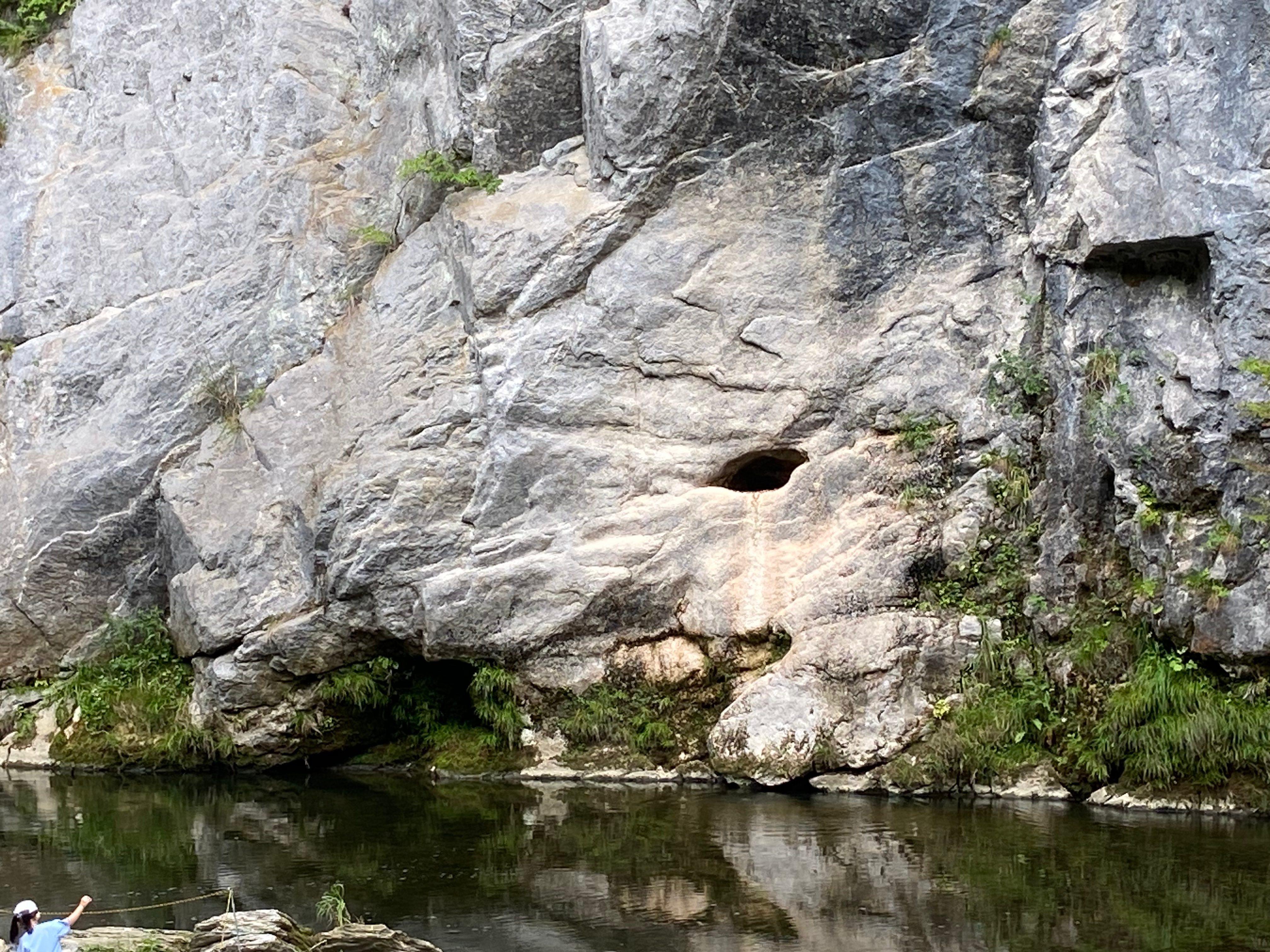
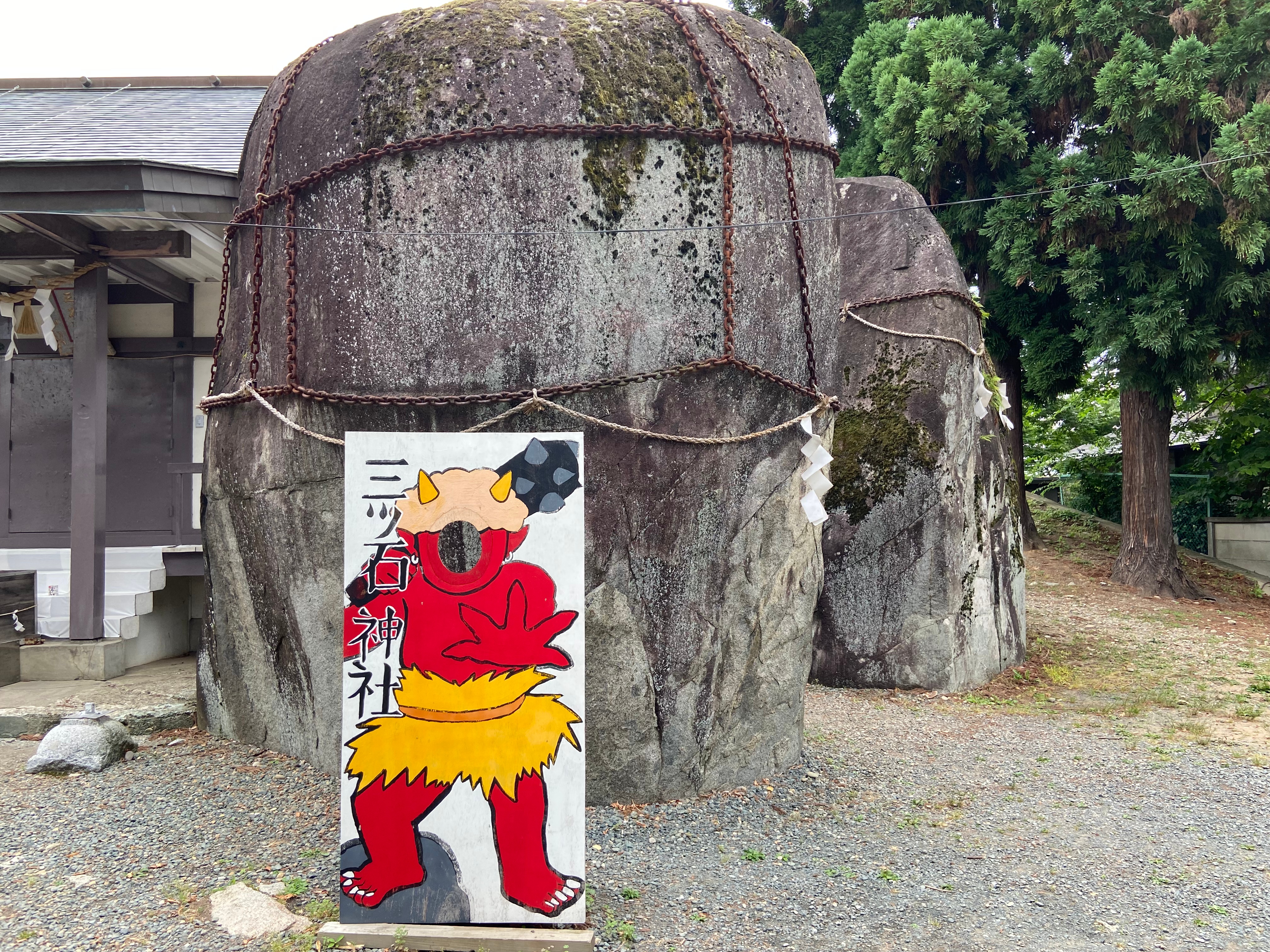
At the small temple sit three massive boulders, wrapped in rope and chain, said to have been thrown down when Mount Iwate erupted in a fit of rage. Locals once lived in fear of a demon who tormented the area, and they prayed each day for protection. One morning, the demon was discovered bound to these very stones, condemned to cause harm no more. Before his power faded, he struck one of the rocks with his hand, leaving behind a print that remains sealed in stone to this day.

I look at the rocks but don’t find any handprints. I do, to nobody’s surprise, find the customary Carnival Cutouts.

Life of Pipes

I’ve finally decided to visit Hokkaido Prefecture, specifically Sapporo, the capital of northern Japan. The area I’m staying in over the next few days is seemingly charming. The first thing I notice about it is the open spaces. Then the neat symmetry of the streets. Then the pipes.

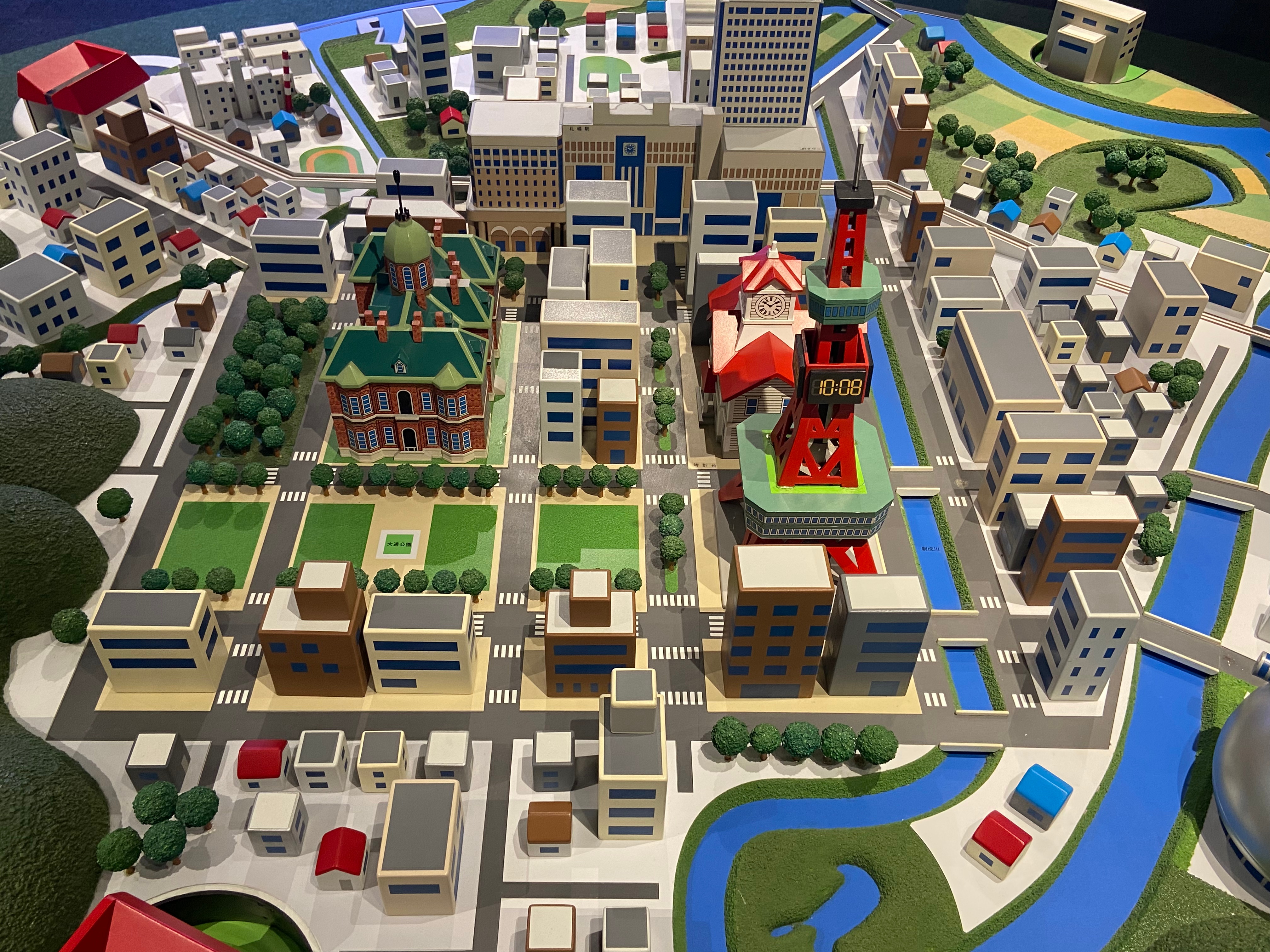
The nearby Odori Park slices across twelve neatly gridded blocks. There’s a river, a large red-brick mansion, and an illuminated TV Tower looming at exactly 147.2 metres in height: Sapporo’s artificial Polaris.

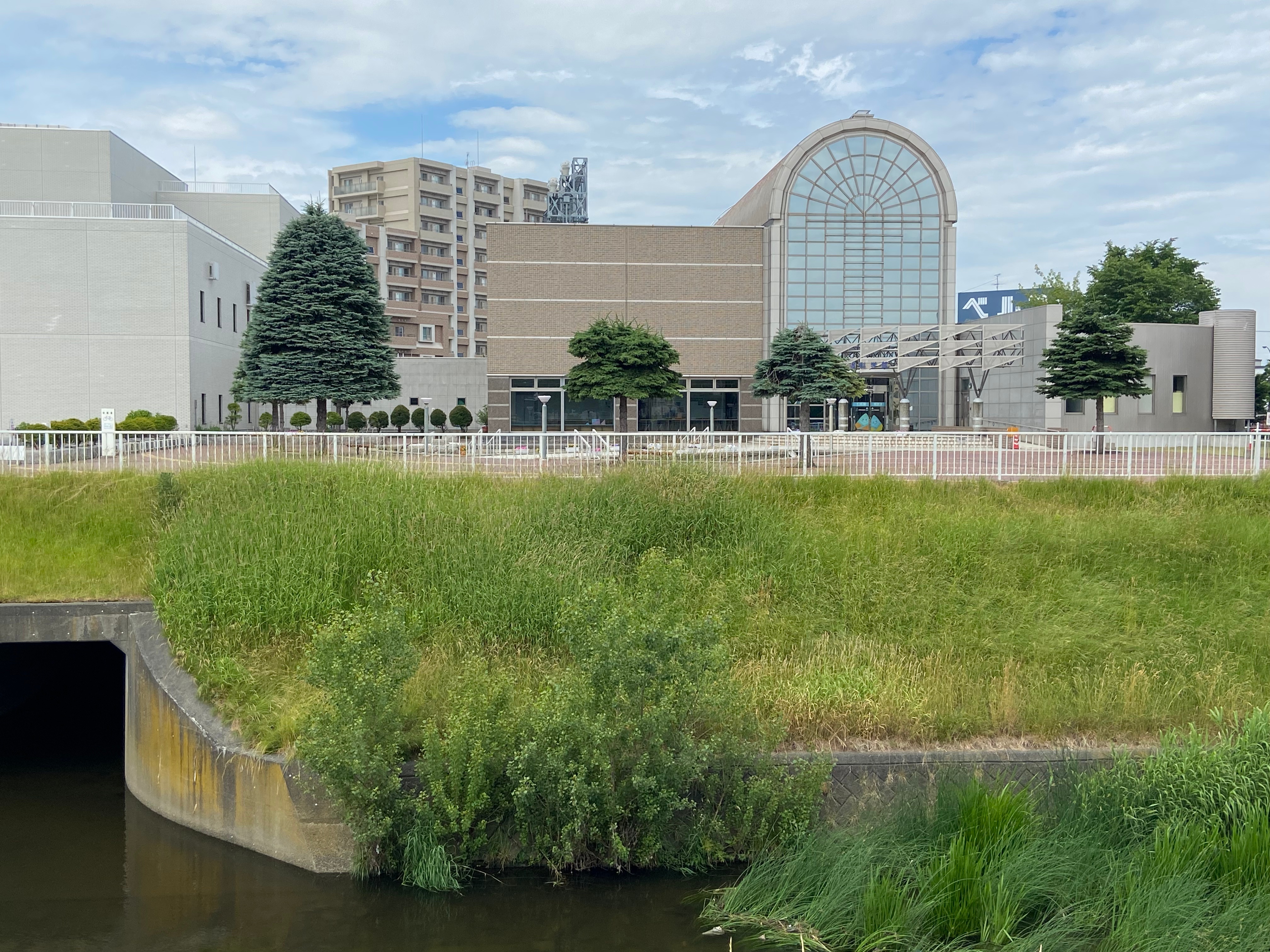
My first destination today is a bit of a hidden gem. So hidden in fact that the building itself is only identifiable by a single blue water droplet painted on its side. A grey concrete block of a structure in the middle of nowhere on the edge of the city. To find it, I am told to just follow the Soseigawa River. If you haven’t guessed it yet, the place I’m looking for is the Sapporo Sewerage Science Museum.

I don’t notice the single blue water droplet painted on the side of the building. What I notice instead is the stench; the kind that makes you immediately try to locate the source. Which, in this case, is the Soseigawa Wastewater Treatment Plant: right next door.

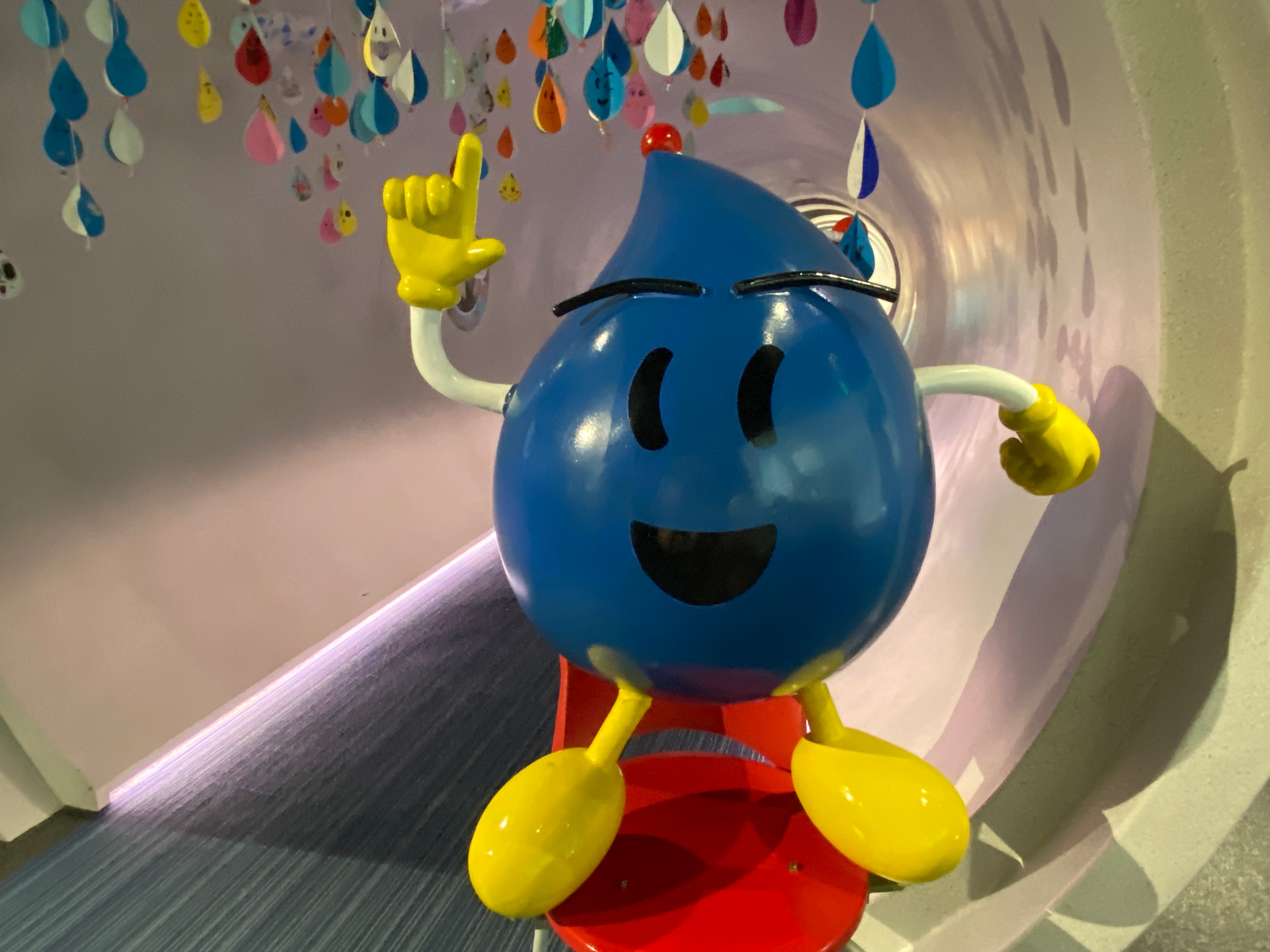
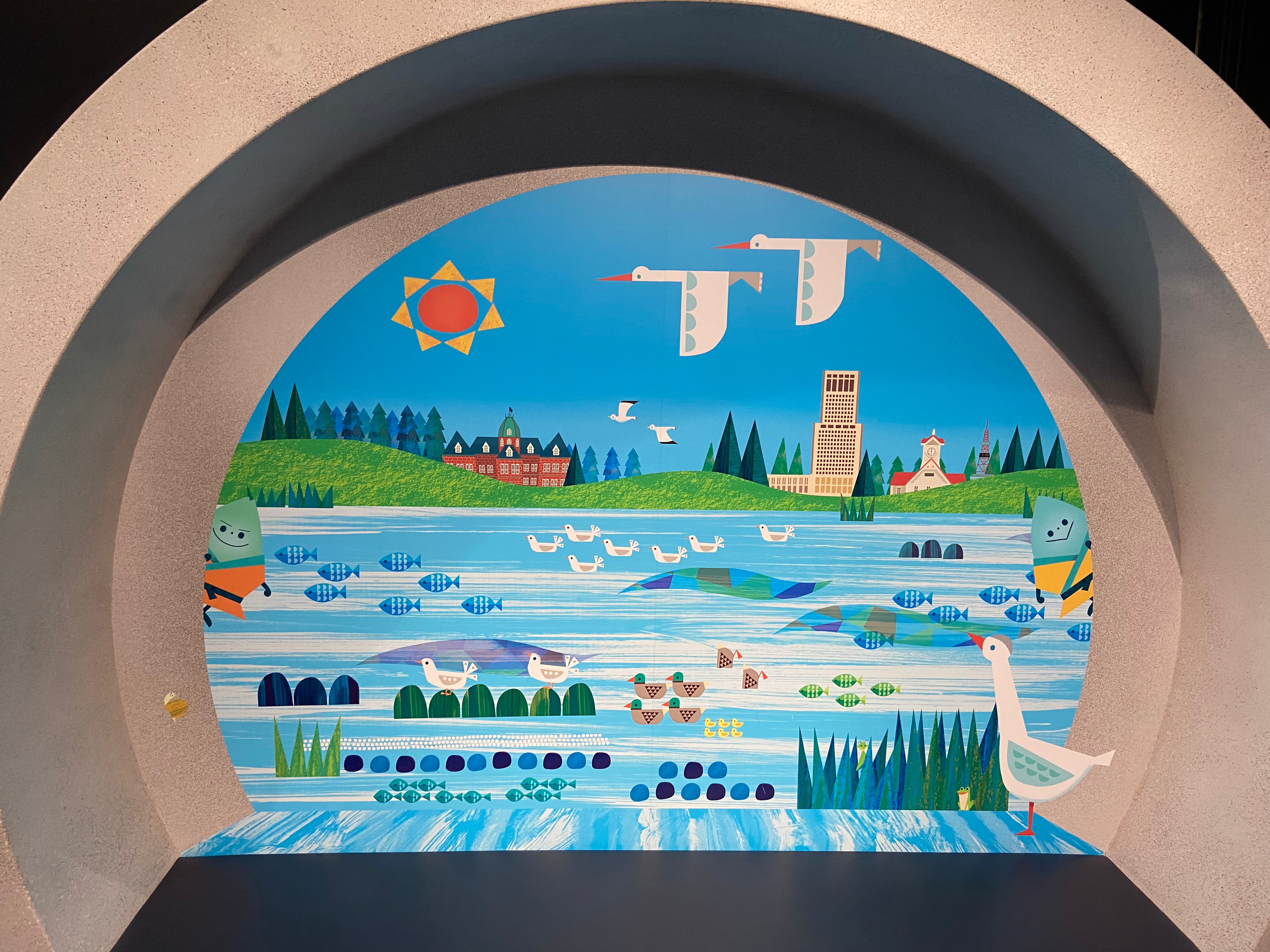
Inside the museum, there is nobody around. It’s actually free admission so I freely explore some of the exhibits. I quickly discover that there are mascots everywhere. There is a bacteria mascot, a sludge mascot, an activated sludge mascot, and a pipe-shaped mascot sporting sunglasses named Dr. Pipe. The water droplet is the star of the show and its name is Kurin-chan. There are no further details or backstories for any of the mascots.

The museum features a huge panorama theatre with empty seats, the movie they are showing today is called “Where Sewage Goes” and is an animated educational video. There’s a detailed diorama of the seemingly charming Odori area of Sapporo. Underneath the model of the city are drawers that can be pulled out to reveal the fascinating inner workings of Sapporo’s sewerage system.

I imagine children would love this place and its various petri dishes of animal fæces and eleven interactive games (some genuinely quite fun) where you can train to be an Operations and Maintenance Master, a Sewage Pipe Cleaning Master, or even a Sludge Treatment Master. There’s also a massive decorated pipe with artwork seemingly unrelated to the other parts of the museum.

Speaking of hands-on activities and pipes, the museum also features an 800-year old decommissioned sewer pipe that you can touch anywhere you like. I decide to only touch the outside of the pipe. I sanitise my hands and wave goodbye to Kurin-chan as I leave for the station.

In a city called Sapporo, it’s almost impossible to avoid seeing signs, sponsorships, and advertisements for a beer company that shares the city’s name: Sapporo. So, moving from one thing that comes out of pipes to another, I just hope this one tastes markedly better.

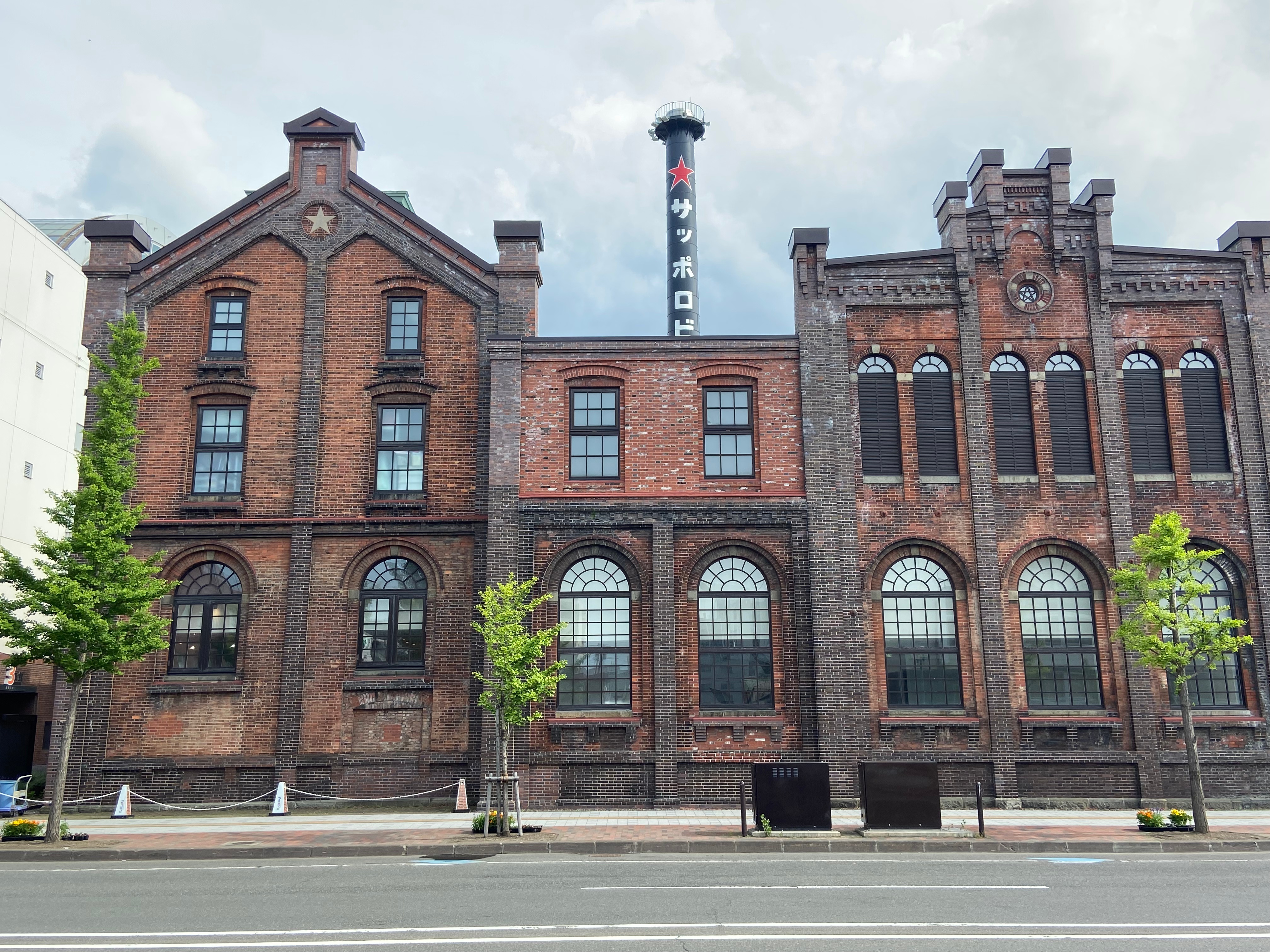
Founded in 1876 by German-trained brewers, Sapporo Beer survived relocation, stereotypes, and wartime censorship. The Tokyo facility was shut down for reasons that may or may not involve pipes. A year later, the first beer was delivered in boxes of ice back to Tokyo, and the years that followed saw Sapporo Beer’s popularity begin to soar across Japan.

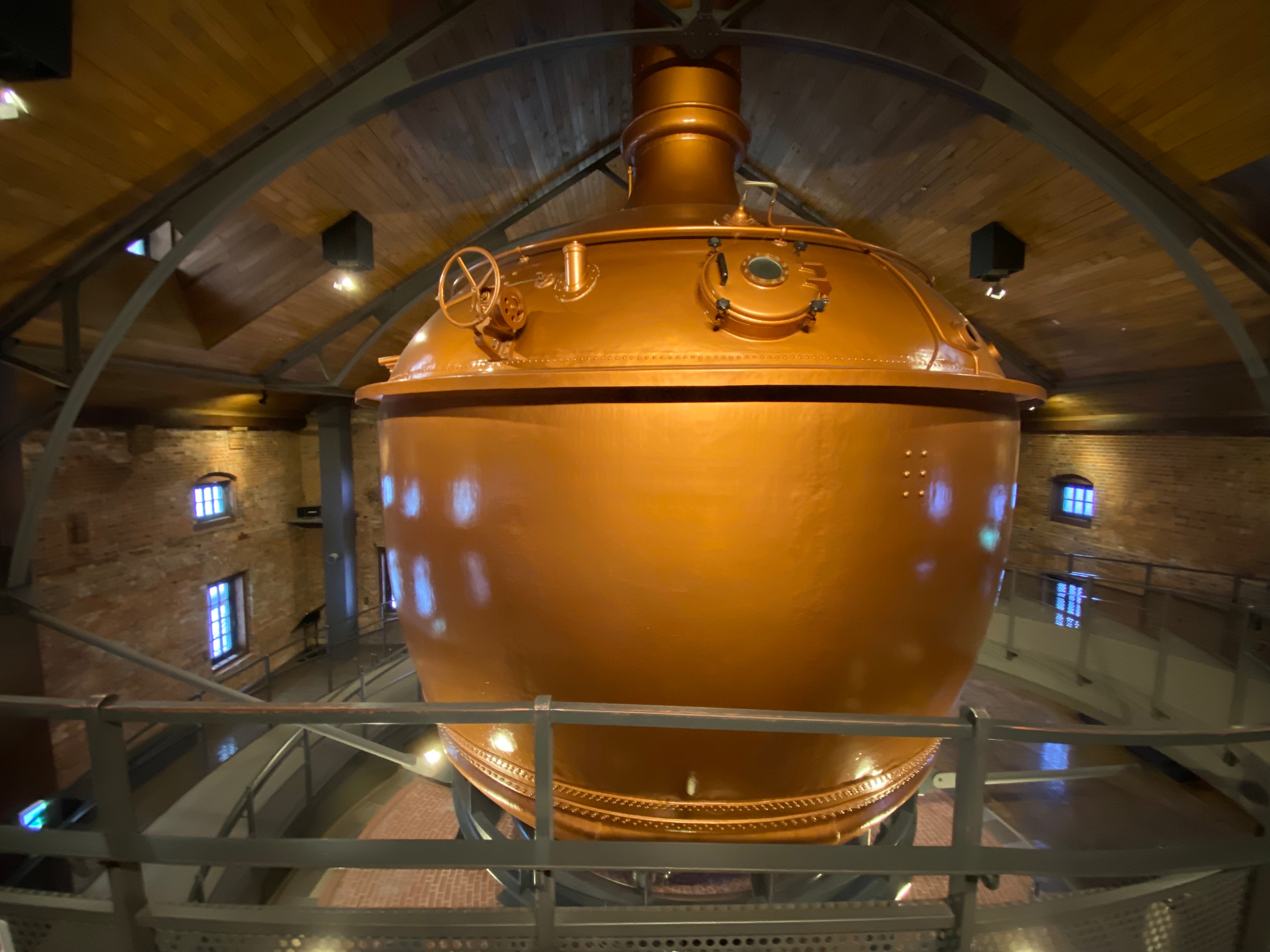
As I enter the Sapporo Beer Museum I am instantly struck by the size of the massive gold Walt Pan. Used from 1965 to 2003, this historic steel sphere is capable of brewing 280,000 cans of beer at once. For context, that’s 280,000 cans of beer. A sign at the bottom of the ramp politely asks: “Please do not climb on the Walt Pan.”

In 1908, Sapporo Beer began using geisha in its advertisements, an image later viewed as stereotypical. All advertising ceased in the late 1930s for unclear reasons. When it resumed in the mid-1940s, the geisha were gone, replaced by more glamorous and recognisable stars.

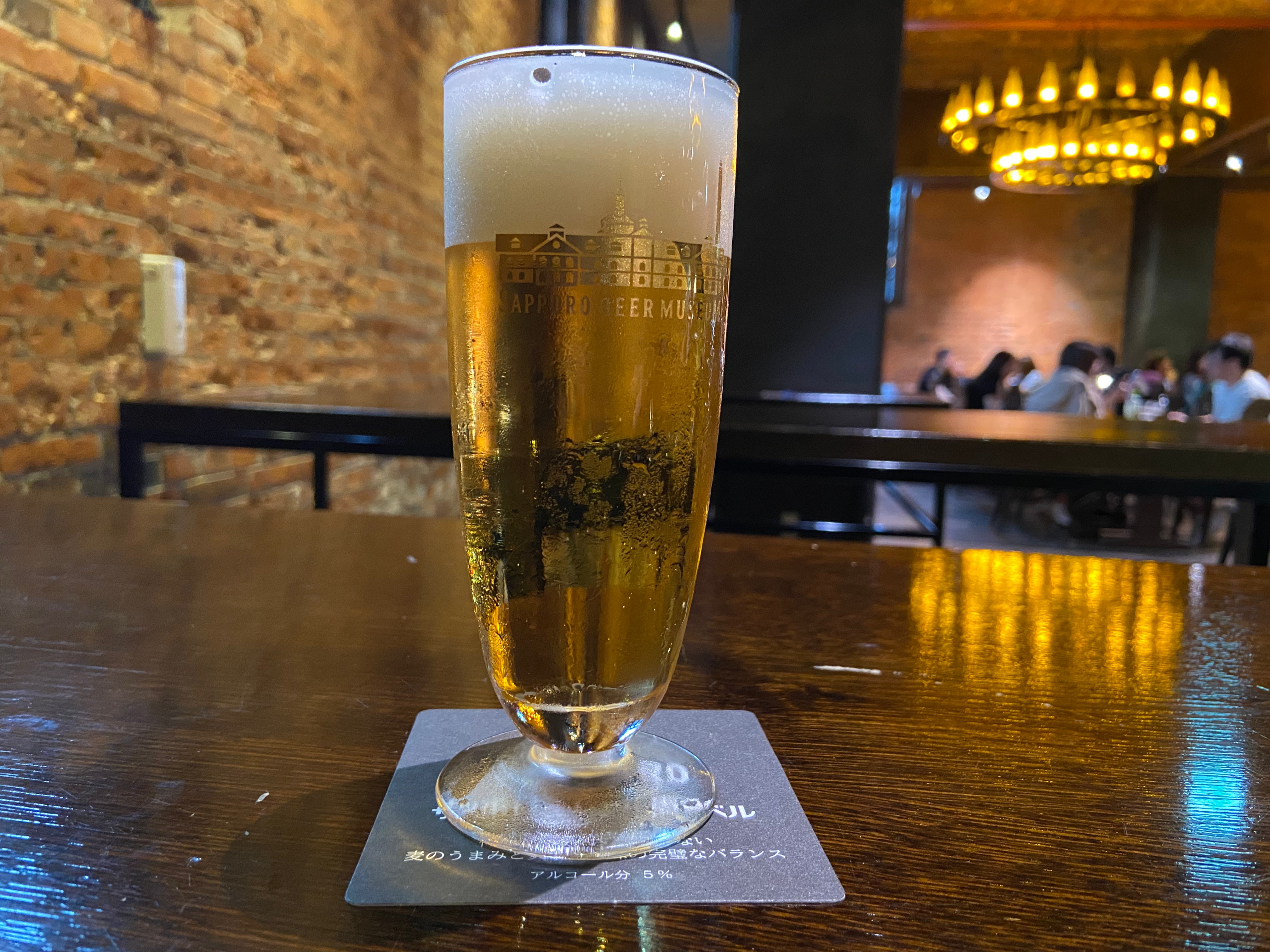
As I leave the museum I exit into a roped-off line of people queueing to buy tickets for beer at a vending machine. I pay ¥450 for a ticket that I then exchange for a small 240ml glass of beer. I don’t mind though, it tastes very good and makes for a great photograph.

In Japan, there’s a concept called wabi-sabi. It’s hard to explain, but that photograph of my small 240ml beer does a decent job. The lighting is perfect, the glass pristine, the faded backdrop of a crowd of people in the beer hall, but something is out of place: a bubble, or the absence of a bubble. One missing pixel at the top of the glass. An imperfection. But for wabi-sabi, that bubble is a missing thing of beauty.

I take two sips of beer and realise my glass is empty, so decide to move on to my final stop of the day: the Mount Moiwa Ropeway. Unironically, right next to the ropeway is the Sapporo Waterworks Memorial Museum (more pipes). Luckily, it’s long closed today, so I admire the exterior and move on.

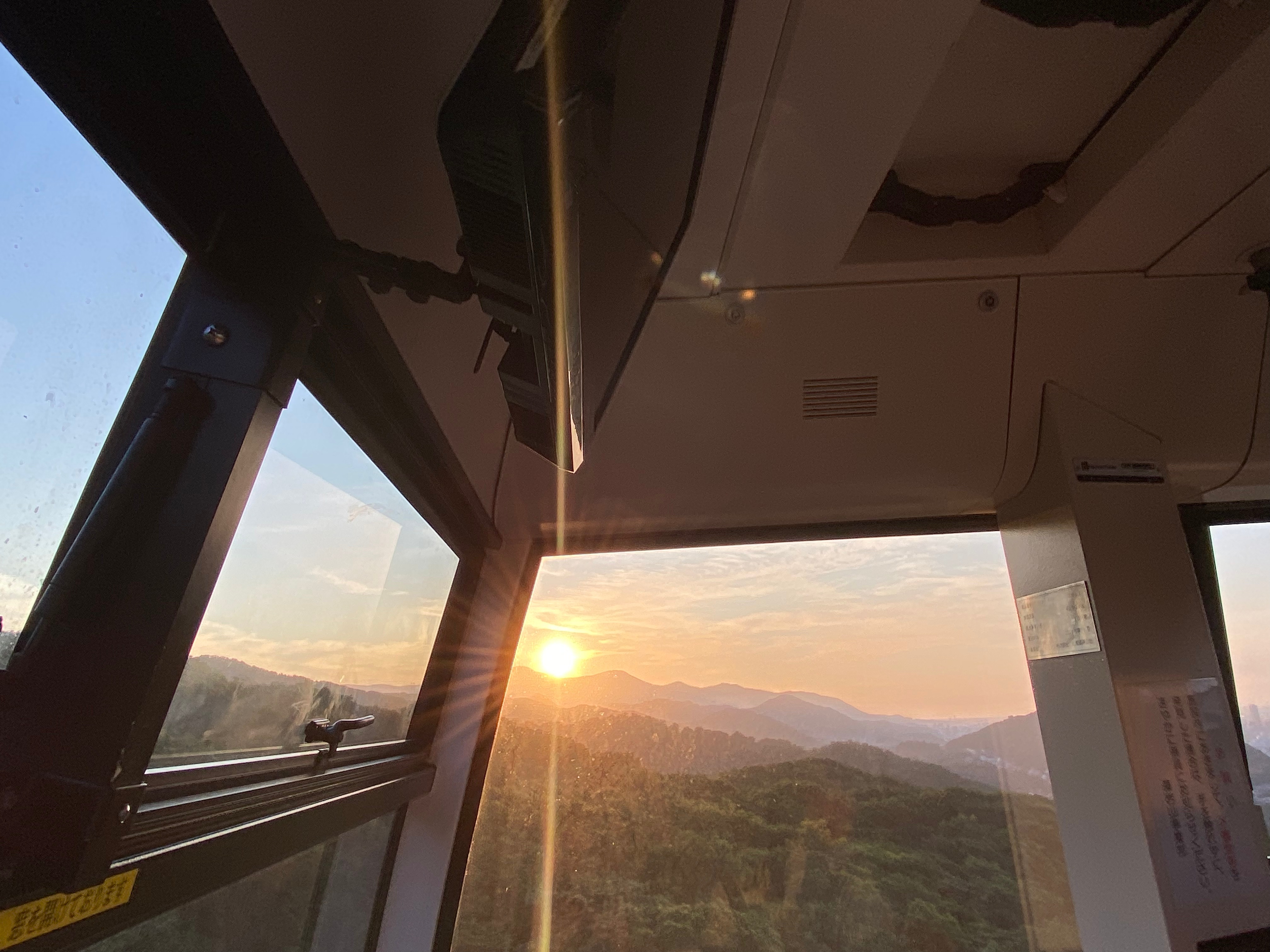
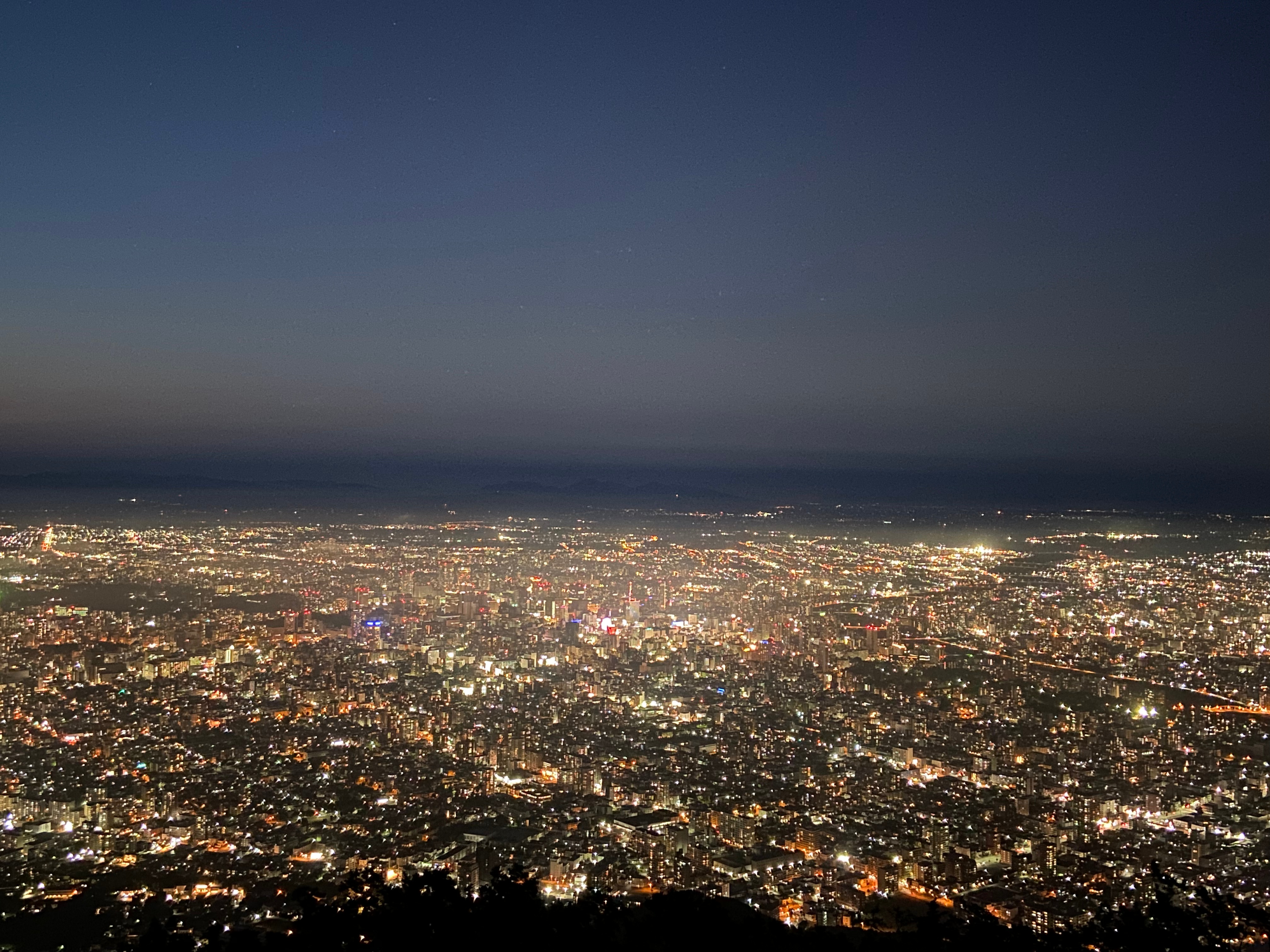
I pay ¥1900 and enter the ropeway. I am carried alone, lifted above the city, above the pipes, and past the skyline’s edges. The sun to the west sets behind the Shokanbetsu mountain range. I read a sign stating that Mount Moiwa has one of the three best night views in all Japan; at sunset, the view from the gondola is already stunning.

At the top, I await the gloaming. As the darkness of night blankets the city below, Sapporo shrinks and becomes less of a grid, and more of a circuit board of blinking lights. What makes the view even more satisfying is drinking my 500ml can of Sapporo Beer, whilst relaxing, staring down at the connected lights of my day below me, as I enjoy the moment.

Earlier today, I touched an 800-year-old sewer pipe that once carried the waste of people who don’t exist. I watched beer pour from a golden pipe into a glass, and now, I’m looking out at a city of interconnected lights.

I take in the view. Breathtaking. Yet all I can think about is that pipe. The one with the sunglasses.

Cabbage Over Untroubled Water

With just two wards of Tokyo left to write about, today is the day I will complete my tour of this great city. I start my day in Nerima, the birthplace of animation. Located in western Tokyo, Nerima is known for its residential atmosphere. Outside of its connection to animation, there isn’t much else to see here.

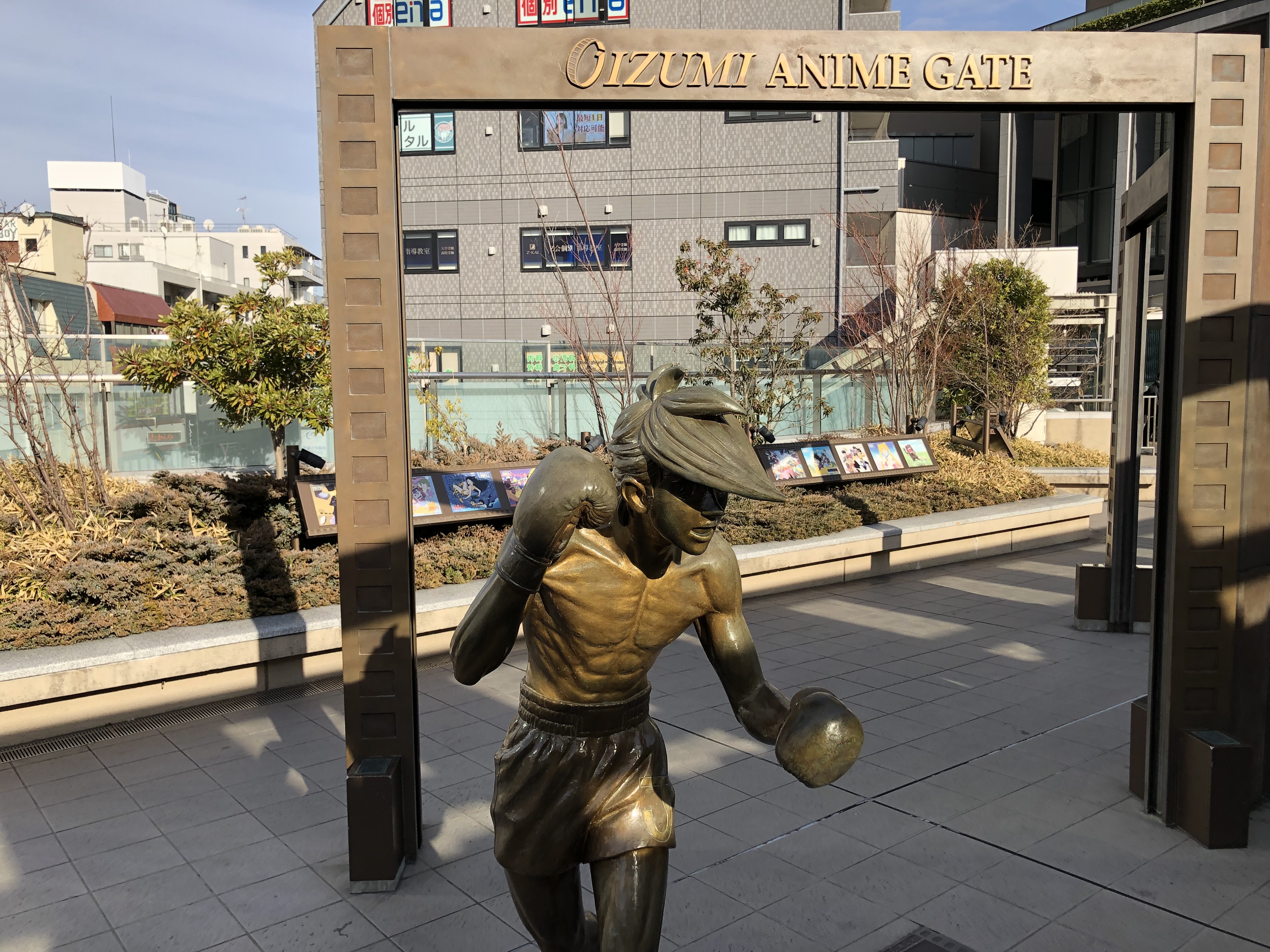
As I make my way through the streets, the presence of the anime and manga industry is strong. The ward is home to many studios and other companies involved in the production of these popular forms of entertainment. My first stop is the Oizumi Anime Gate, where I am greeted by a number of bronze statues of beloved anime characters.

As someone who is not a fan of Japanese anime, I only recognise one of the statues, probably because there once was a statue of the same character outside my old house in Taito Ward, that of Yabuki Joe, the main protagonist of the anime “Ashita no Joe.” This character is one of five depicted in statue form at this location, revered for their role in bringing Japanese anime to the world stage.

As I continue my wanderings through Nerima, I pass by a sign that reads “No more war! Stop Putin!” Eventually, I come across a map and see a sign pointing to a Cabbage Monument. Intrigued, and with little else planned for Nerima, I decide to go and check it out.

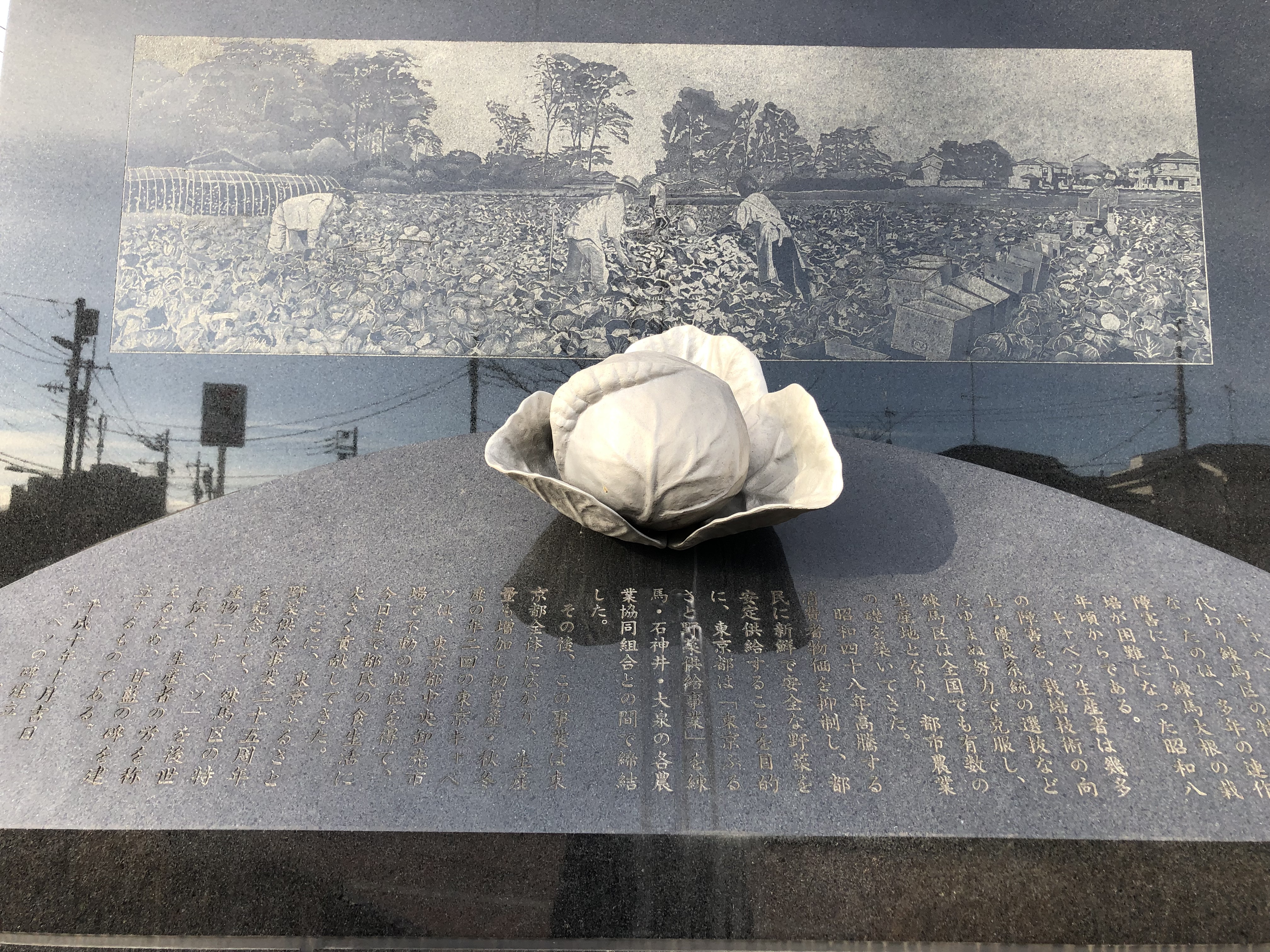
Hidden alongside the tranquil waters of the Shakujii River stands a monument of concrete adorned with an aluminium alloy sculpture of a cabbage. Erected in 1998 by the hardworking farmers of Nerima as a tribute to their resilient cabbage crops. An inscription on the monolith tells the inspiring tale of how these farmers triumphantly overcame pests and other obstacles as they transitioned from cultivating radishes to cultivating cabbage. Twice a year, these cabbages, known for their sweet and crunchy goodness, are harvested and proudly grown in Nerima to this day.

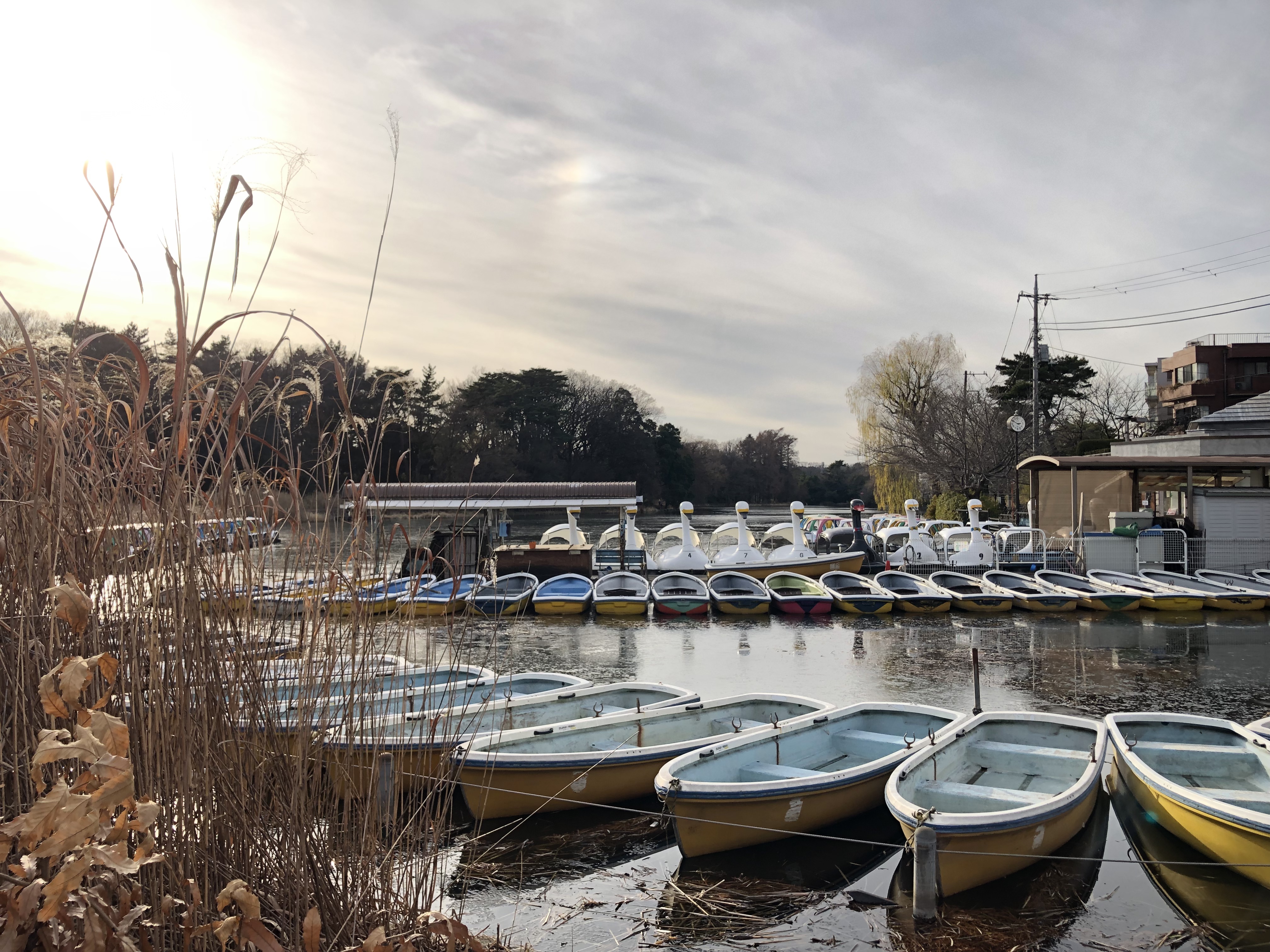
As I head towards the train station, I am struck by the delicate beauty of Shakujii Pond. This massive body of water is so still, it almost resembles a swamp. The surface of the water is completely calm and placid, not a ripple to be seen. It’s a strange, ghostly scene, made all the more surreal by the row of pagodas shaped like swans that line the pond.

With my tour of Nerima complete, it’s time to visit the final ward of Tokyo: Suginami. As I’m riding the train, my friend Marc messages me and asks what I’m doing that evening. I tell him I’m planning to visit Koenji, and he excitedly tells me that it’s his favourite place in Tokyo. He agrees to join me, and we meet halfway and get chatting on the train, accidentally missing our stop. So instead, we get off at Kichijoji, a neighbourhood that is consistently voted as the most desirable place to live in Tokyo.

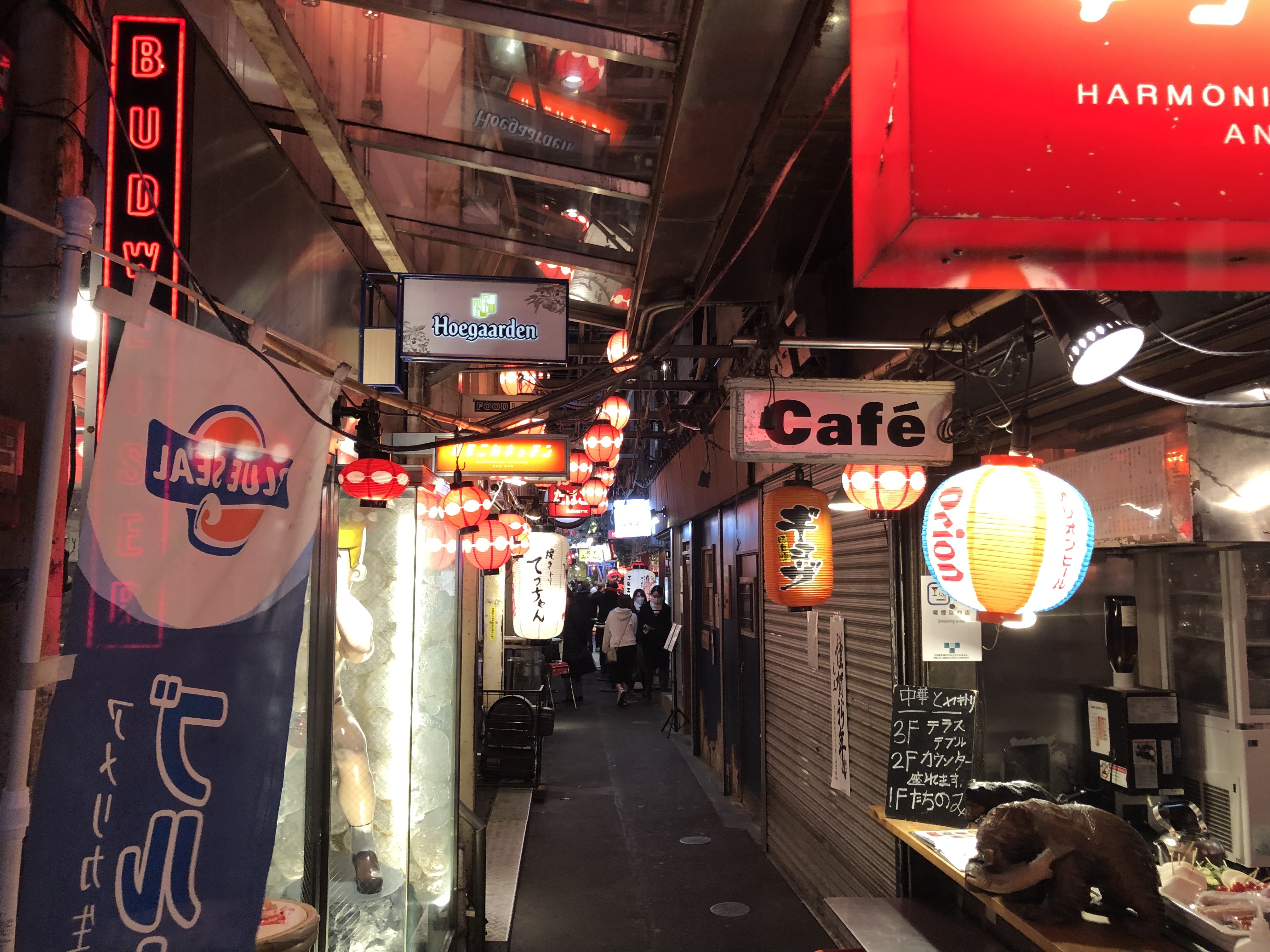
As we stand at Kichijoji Station, we decide that it would be a shame not to take a quick look around the area. Marc tells me that everyone in Kichijoji exudes the scent of capitalism. We wander from the station towards Harmonica Alley, a shopping district named after its harmonica-shaped pedestrian walkway.

This crisscross of alleyways is home to a number of small independent restaurants and bars, and as we wind our way through the cramped streets, I really enjoy the experience. Although not all of the shops are open, I get a good sense of the area – the small stalls selling food, the bright red lanterns, and the narrow streets all contribute to a Blade Runner-esque vibe. We explore the labyrinth of old-fashioned stores and soak up the atmosphere.

After immersing ourselves in the sounds and music of Harmonica Alley, we head back to the station and finally make our way to Koenji, a district known for its vibrant, youthful atmosphere.

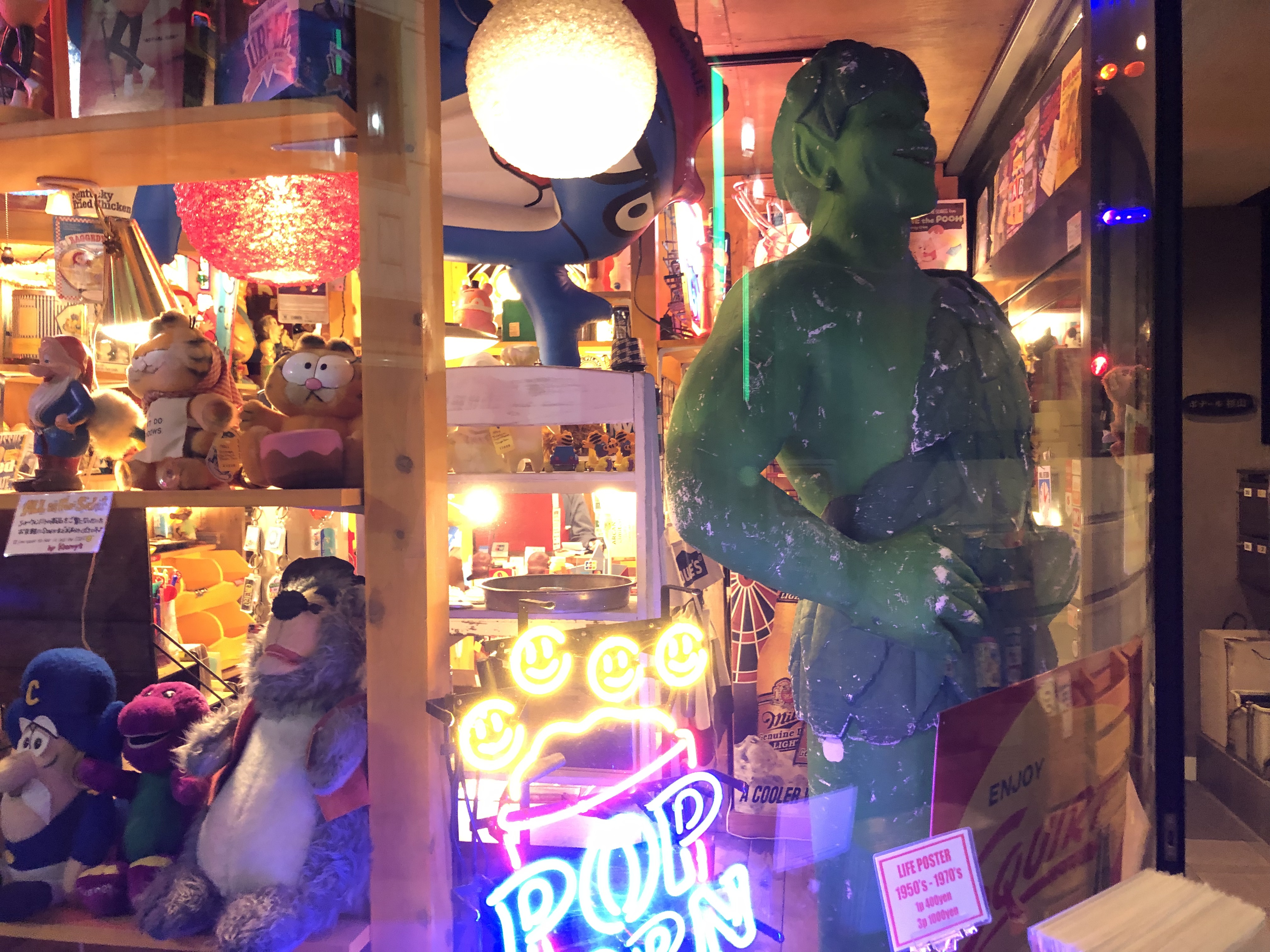
Marc takes me on a tour of the area, passing through the main shopping arcade. Despite it being early evening, I’m surprised to find many of the vintage clothing shops to be open. We pass by retro sweet shops, retro toy shops, and shops selling life posters from the 1950s. On the other side of the station, the nightlife scene in Koenji is lively, with many clubs and live music venues that attract young people from all over the city.

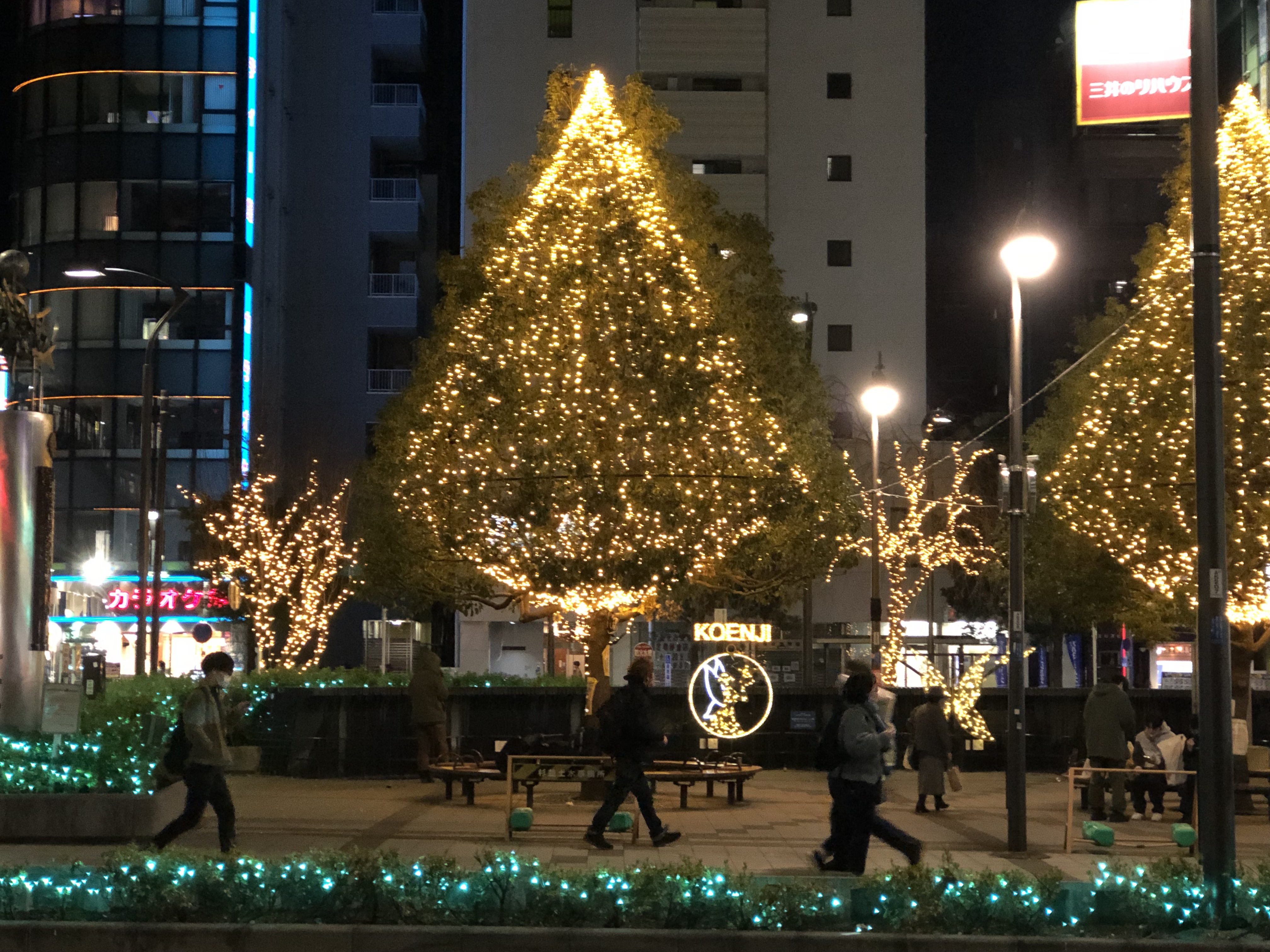
We don’t do much else of note here though, aside from trying out a few bars. As the night wears on, we move on from the trendy bars to an izakaya-style Japanese pub. We stay a while chatting, drinking Suntory whisky highballs while snacking on raw octopus, skewered meat, deep-fried tofu, and crisp, sweet cabbage from Nerima. The warm atmosphere and lively conversation make time seem to fly, and before we know it, the last train home looms near. With a sense of reluctance, we make our way back to the station, passing by out-of-season Christmas trees on the way.

As the train carries me home, a friend asks me what I’m doing on Wednesday and if I’d like to join her on a 42 kilometre walk around Tokyo. Fresh from my goal of completing the city, I am tempted by the idea of revisiting Tokyo’s streets in a different way. I agree to join her, ready to explore the city once more, entirely on foot.