Journey to the Centre of the Buddha

It has gotten very cold as of late, but today offers rare blue skies and a warm winter sun. Today might be the last day hot enough to do anything practical before spring, so I decide to make the most of it with a day trip out of Tokyo. My destination is a little over two hours away by train: the city of Kamakura.

Outside Kamakura Station, I am approached by a poorly dressed Japanese man speaking in English with an American accent. He is banging on about Buddhism, or something. When I mention that I have things to do, he looks a little disappointed before wandering off to talk to some new people just off the train.

I wander through the city, its streets lined with souvenir shops, gift shops, and stores selling various mementos. At this point, I realise I haven’t taken a single photograph in Kamakura, so I decide to walk up to the first temple I see.

genjitemple[1]

Shu Genji Temple doesn’t exude much happiness. It was once the residence of Shijo Kingo, a renowned Nichiren Buddhist skilled in medicine. Following Nichiren’s death, Shijo Kingo attended the funeral but ultimately chose to end his own life to demonstrate his unwavering faith in the religion.

A little further from the temple, I spot a strange machine covered in stickers. The ‘Happy Capsule’ machine costs ¥100, and each capsule contains at least three prizes. I try to resist, but as if possessed by some demon from another world, I find that I have already inserted a coin.

nogarbage[1]

My capsule contains a small glass fish statue with fried eggs randomly painted on each side, a colourful ankle bracelet with a small relic in the shape of an ice cream, and a teddy bear with the word ‘Love’ written on it. I also receive a ‘Lucky Sticker,’ which I am free to add to all the other lucky stickers that litter the machine. Noting the sign for ‘No Garbage,’ I take another look at my happy prizes and stand for a moment, enjoying the irony.

Eventually, I arrive at the place I came here to visit, Kotoku-in Temple. It is home to a giant Buddha, the same Buddha featured in Rudyard Kipling’s poem ‘The Five Nations.

A tourist-show, a legend told,
A rusting bulk of bronze and gold,
So much, and scarce so much, ye hold,
The meaning of Kamakura?

kamabud[1]

I pay ¥200 to enter the grounds of the temple and stand for a while in awe. The Great Buddha of Kamakura was housed within a wooden temple three times. It was destroyed by strong winds twice but rebuilt on both occasions. Eventually, in 1498, it was destroyed for a third time by a tsunami and was never rebuilt. The Buddha survived and now sits outside in the cold of winter, patiently waiting for the seasons to change.

As I walk around the statue, I notice two windows located in its back. There is a sign in Japanese emphasising the importance of showing deep respect when walking around inside the Great Buddha. A man sits half asleep at a small booth, and a sign above displays a price of ¥20. For such a low price, I would be a fool not to enter. I squeeze my way into a small hole in Buddha’s side and take the steps up into his massive belly.

innerbuddha[1]

Inside the Great Buddha of Kamakura, the acoustics are fantastic. I speak softly to myself and find that my words are thrown around by the bronze interior, echoing off into infinity. However, a bit of graffiti inside slightly spoils the experience — a complete lack of reverence by some.

I exit the Buddha and leave the temple. On the way out, I spot a sign warning about a particular type of bird in the area that likes to steal food from tourists. I start heading back toward the train station, stopping off at a small food shop to enjoy a sweet potato croquette. All the while, I keep my eye out for the hungry birds. Unfortunately, the birds don’t materialise, which is a shame.

I decide to take a different route for variety, and eventually, I spot some steps that sweep up a mountain. Intrigued, I take a little detour to see where they might lead.

anothertemple[1]

I find myself standing in front of Amanawa Shinmei Shrine. The place is deserted, seemingly untouched for years, presenting a stark contrast to the other places I have seen in Kamakura. This shrine, founded in 710 AD, is the oldest Shinto shrine in the city and is dedicated to Amaterasu, the goddess of the sun and the universe.

The view from the shrine is stunning, offering a different perspective of the area. In the distance, I see mountains, old houses, and multiple temples and shrines. From the top of the steps, I can also glimpse the sea. As I am about to leave, I spot a small path carved into the side of the mountain above, and with nobody else around, I decide to investigate.

upthemountain[1]

As I climb, the path is relatively easy to follow, twisting around the mountain and becoming less obvious. I have to brush away cobwebs from my face as I follow the steep approach. With every step, I am careful not to lose my footing as the mud gets wetter and the path becomes steeper. After about five minutes of climbing, the overgrowth becomes too much, and I can’t continue. I stop and take a look around, taking in my surroundings, and realise that this was probably not a good idea.

I struggle to get back down, having to crawl a little to ease my way down from the path that has clearly not been used for years. I use my hands on the rocks as I work my way back to safety. I am slightly disappointed that I couldn’t find where it leads, perhaps to the sun goddess, or maybe just an escape route lost over time. There’s nothing for me to see, though, and eventually, I am back at the shrine, taking the steps back toward the main road.

I wander down deserted side streets that are full of old houses, some with massive gardens, others with disproportionately small ones.

mygarden[1]

Back at Kamakura Station, I get ready to endure another two hours sitting on trains. Day trips are fun but rather exhausting at the same time. It’s nice to escape, though, and see places that offer a difference. I think about climbing up that mountain path, feeling completely free for a short time—free from anything but my own eagerness to explore, or perhaps to escape altogether. I decide that my next day trip will be to a mountain of sorts, a place unlike those I have been discovering of late. Somewhere new and exciting, where I can rekindle my sense of adventure. A place flowing with natural beauty.

As I arrive back in Tokyo, a chill consumes the air. Above, thick clouds made of snow hover over the skyscrapers, lying in wait—almost ready to unleash their flakes of misery over the city.

Wheel of Misfortune

Today is the day that I finish my pilgrimage. One temple, one shrine, and the final two gods. I start off in the direction of Uguisudani. My previous attempt to find Motomishima Shrine here was marred by the fact that this area is a massive red-light district and couldn’t possibly be the location of a sacred shrine. Once again, as I stumble through alleyways of neon, I see no signs of a god; just prostitutes leaving hotels with presumably married Japanese men.

Eventually, I leave the area to find wireless Internet, stolen as always from a nearby Seven Eleven. I punch the name of the shrine into my GPS and am redirected to the same area I had previously wandered. It is an unusual location for a shrine, an area littered with over seventy love hotels, but somehow I find it sandwiched between Hotel Exe and Hotel Foxy.

lovehoteltemple[1]

Motomishima Shrine is home to Jurojin, the god of longevity. This deity is always accompanied by a wild deer, believed to symbolise long life. It is said that Jurojin shares the same body as another of the Seven Gods of Fortune, Fukurokuju, which, if you ask me, is a rather unfortunate fate.

It is fair to say that to reach this shrine, I had to jump through hoops. Inside, I walk through a hoop to reach the stone steps that lead to the god. Here, I pay my respects with a deep bow before taking my fortune for the last time this month, at a cost of ¥200. With all these fortune readings, it’s a surprise that I have any money left. Not to worry, though—I have a frog in my wallet, so all is well.

hoops[1]

“Whoever caught this fortune, please read. Further increases the happiness if familiar, money will come to the body when you strive daily and today. We are been obtained by loss. Performing without effort for others is within the range of possibility, always! Rather than hit the thing with the one person that you are waiting for, poor is a small problem, this time. You do not have to worry only for those who carried out jointly because the immediate profit will go up with your results. If you move a large bowl, results should come out.

“Whatever you do for other people, always take action for things in the future. Make yourself aware. Concentrate at the entrance; are you aware of the limits of their fitness? Also, the energy from long illness in the future will see recovery gradually. Concentration will add enhancement, especially to enhance the energy. No effort should not be in vain. Come back to be sure of the joy of tomorrow.”

Confused as to what all this means, I leave the red-light district and head over to Hoshoji Temple.

hoshoji[1]

Bishamonten stands guard here, carrying a scroll. Traditionally, he is the god of warriors and war, depicted with a spear and dressed in armour. However, the statue here deviates from the expected representation. Unfortunately, it is the only photograph I have of this temple, and I am certain I am in the right place. There are no signs of other statues of gods here, leaving me with no idea about the identity of this scroll-wielding warrior—most likely Shonin or someone else. No English signs, nothing else to guide me.

With all this good fortune flowing through my veins and having completed the pilgrimage of the Seven Gods of Fortune, one would expect that I’d actually receive some fortune. In reality, the opposite has occurred. Over the last few days, I have felt like a ghost, floating through life, completely devoid of any sense of belonging. Perhaps this is just a phase. A changing of the tides could erase all that I feel at this moment, and hopefully, that will happen. Maybe I should just move a large bowl. Right now, though, I am tired of walking around temples and shrines; it fills me with this strange empty feeling that is difficult to explain.

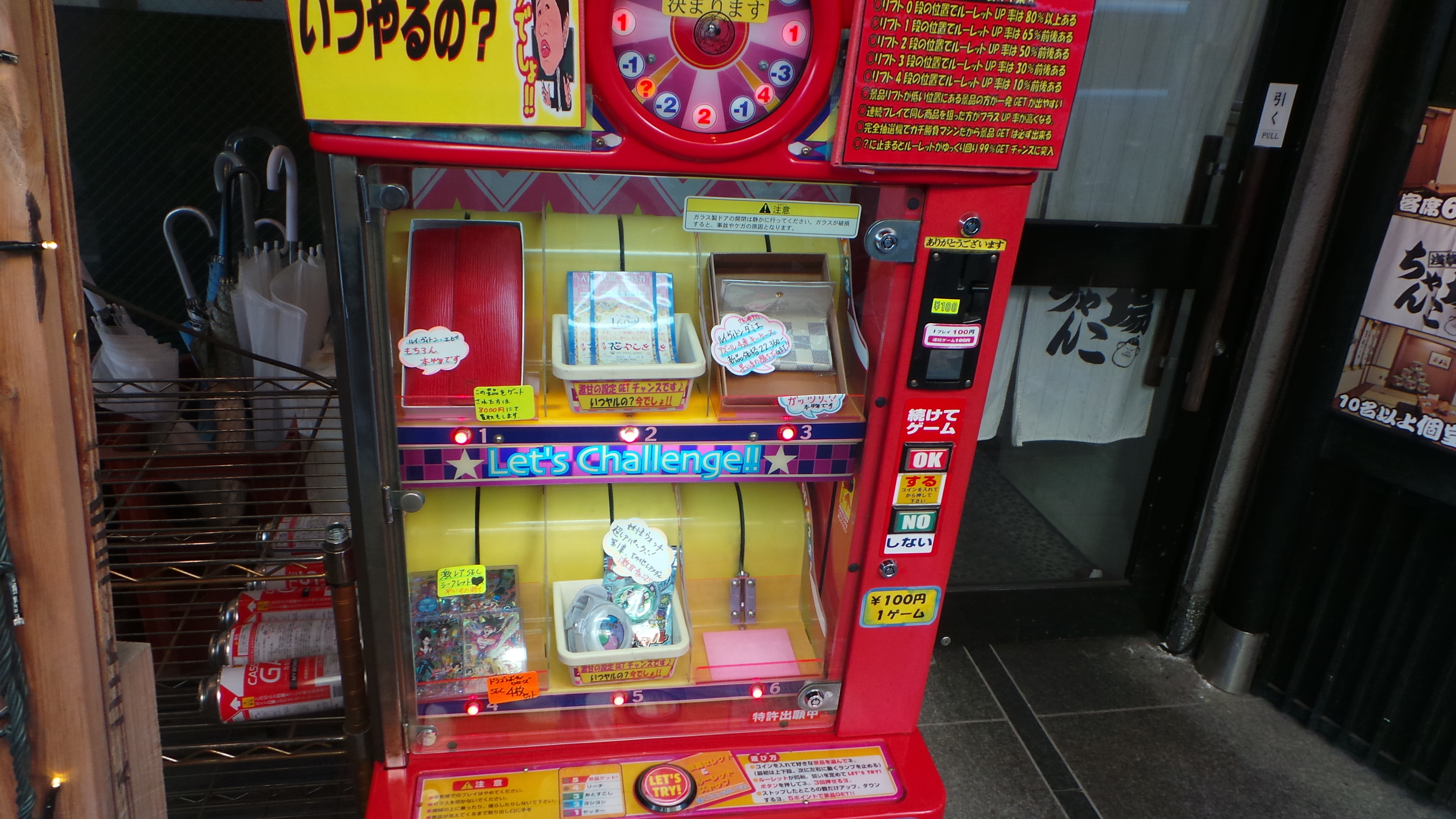
I wander back to Asakusa and am instantly drawn in by the flashing lights of a strange vending machine.

letschall

The machine costs just ¥100 and offers a chance to win excellent prizes. It’s called ‘Pocket Lifter,’ and presumably, it lifts money from my pocket by tricking me into thinking I can win one of the luxury prizes. Hidden behind its polished glass front are some trading cards, two Louis Vuitton purses, and tickets to Hanayashiki Amusement Park—the oldest amusement park in Japan. Despite seeing this park every day in Asakusa, I have yet to make the visit. However, Hanayashiki might have to wait a little while longer, as I am still somewhat traumatised by my recent visit to Tokyo Disneyland.

The machine says, ‘One-two-three-four-GET!’ Winning is as easy as counting. One of the Louis Vuitton purses can be won and sold for ¥8000 at a nearby shop, conveniently listed next to the prize—a gambling loophole once again exposed. Above the prizes, a wheel with bright flashing lights beckons, ‘Let’s Challenge!!’ How could I possibly resist? Keenly, I insert a ¥100 coin. ‘Thank you,’ the machine says as it swallows my money. The wheel spins and lands on the number one. The prize shelf moves up a fraction of an inch, then nothing happens. For a limited time only, I can get three tries for my money. I repeat the button-pressing process twice, and disappointment reoccurs twice more. No prizes, no amusement, no amusement park—just more bad fortune. Thanks, pilgrimage.

Flossed in Translation

I wake up early and resume my pilgrimage. My first stop is Jueiji Temple, which happens to be five minutes from my house. Inside the temple sits Hotei. He is often described as fat and happy. He certainly appears very fat and happy, as he is the god of abundance and good health. Awkwardly, I join a queue of people with my camera out. Yesterday, I didn’t take any photographs of the actual gods; I was more caught up in the stories of the temples.

Today, I wait patiently as people before me offer their prayers. They place coins in the gaping mouth of Hotei, though he certainly doesn’t need anything else to eat. One person even starts rubbing the statue’s body with his hand. Eventually, it’s my turn. I quickly snap a photograph before leisurely descending the stone steps to exit the temple.

pil21[1]

As I exit, a man chases me down the street. I stop, completely confused. He hands me a map of the pilgrimage trail. Brilliant, I think. No more confusing maps and getting lost. The only problem is that the map is written entirely in Japanese, and is therefore confusing and will most likely get me lost.

I head to my second stop, Shohoin Temple, also known as the Flying God Temple. I am here to meet the fourth god of seven, Ebisu. Ebisu is the god of fishers or merchants and is often depicted carrying a fish. In the temple, a sign says, “Ebisu is the god of candour, cheerfulness, and goog [sic] fortune.”

pil22[1]

Sitting beside the god are two statues of Arhat. These represent individuals who have undergone enough religious training to become worthy after attaining enlightenment. Arhat is often used as an honorific title for those blessed persons who have realised the ultimate truth. While the reason for these two statues sitting beside the sacred god of fishing isn’t explained, at least this temple features some English text.

I head over to Ryusen, to Bentenin Temple. This temple is difficult to find, located basically in a children’s play park and quite tiny. There is no activity here, no other pilgrims in sight. It’s as if this temple has either been missed off the route, or everyone is wandering around the side streets in search of this sacred spot. With no sign of a god anywhere, I snap a photograph that might be, but probably isn’t, the goddess Benzaiten; the goddess of knowledge, art, beauty, and music.

The goddess is usually depicted carrying a musical instrument, but this statue isn’t, which is the reason for my doubt.

pil23[1]

I head back to Asakusa. My pilgrimage is put on hold for another day, thanks to a trip to the dentist. I’ve now lost count of the number of times I’ve been to the dentist in Japan. It has become nothing more than a fortnightly inconvenience. Still, off I go, alone. As I sit in the waiting room at five to five, anticipating my half-past-four appointment, the wait is actually killing me.

An elderly woman enters, holding a wrapped present with a bow in tow. She hands it over to the receptionist, smiles, then bows. I find it unusual that someone would bring a present to the dentist. Next, a mother and daughter ask if they can ‘borrow’ one of the books for children. Again, a strange reason to make a visit to the dentist. Eventually, I am called, thirty minutes after my scheduled appointment time. Inside the ‘treatment room,’ the dentist holds up a gold bracelet that clearly belongs to a woman. “Luke-san, is this yours?” she asks, with genuine inquisition and lacking any sense of irony. What was supposed to be an amusing anecdote about dental floss has somehow descended into a gift-giving ceremony, a library, and a circus.

The dentist pulls out a ‘super sonic,’ as she calls it, and sprays water on my teeth. Next, she uses a scraping tool to clean, before finally flossing my teeth for me. Effectively, I have gone to the dentist to have my teeth brushed. Afterwards, the dentist gives me a packet of dental floss as a parting gift, wishes me a Happy New Year, and charges me just ¥740. Thank you, Japanese National Health Insurance.

I leave the dentist just as night begins to engulf the city. I head over to Senso-ji Temple. The crowds of people haven’t dispersed, and the New Year celebrations are still in full swing. For some reason, the first three days of the New Year are important days to visit temples and shrines, and because of this, queues of thousands are still waiting to pray for the first time this year. As I wander through the hordes of people, a man on stilts dressed as a giant sheep almost kicks me to the ground.

yearofram[1]

Still fatigued from seven days of intense sightseeing, I head home for another early night. Tomorrow, I will visit the final two gods of the pilgrimage, and finally, I can enjoy a much-needed break from exploring the city.

Lucky Number Seven Gods of Fortune

Today, I attempt to go on a pilgrimage. Seven different gods, seven different temples, and no idea where to start. I head into Asakusa for a traditional Japanese breakfast and find that a Japanese New Year’s ritual is taking place outside my favourite izakaya. “Happy Merry Christmas after year,” the owner says to me, flashing his trademark ten-yen smile.

The ritual is mochi making. Mochi is sticky rice that is boiled, and when it is hit with a wooden mallet, it becomes soft. These rice cakes end up more like dumplings and are consumed during January. Some sort of stew is cooking in a big pot beside the mochi, but I have no idea if it’s relevant to the ritual or not.

pil1[1]

After watching a man hit rice with a mallet for far too long, I decide to visit the first temple: Shingen-ji Temple in Iriya. This temple has two names; ‘Iriya no Kishibojin’ is the other name used, which just adds to my confusion. Inside the temple, I can hear the sound of monks chanting. Two young Japanese women dressed in kimonos pose for photographs. I wander to the temple, throw in some loose change, and pray.

The temple not only houses one of the seven gods but also Kishimojin, a goddess of children. Her story goes that she was once an evil goddess, snatching children and then eating them. One day, Gautama Buddha kidnapped the youngest son of this goddess, and it was only after experiencing the sorrow of losing a child that she became good. Now, she is worshipped as the guardian of childbirth and child-growing. However, she remains a criminal in my mind; all the children that she previously devoured have somehow been forgotten with her forgiveness.

pil2[1]

Next to the temple sits Fukurokuju, the god of happiness, wealth, and longevity—the first of the seven gods that I am here to visit on this pilgrimage.

My second stop is Eishinji Temple, which enshrines Daikokuten, another of the seven gods of fortune. Daikokuten is considered to bring the belief of commercial prosperity. At the entrance, children play with spinning tops and badminton rackets. This temple gives me the opportunity to get my fortune for ¥200, and with me currently on a roll of good fortune from these things, I decide to participate once again.

pil10[1]

The fortune I receive is huge. It contains three separate pieces of paper and one golden plastic frog.

“Average luck: Leading to the road of happiness will bless you if you have your own eyes open to the gods. Keeping the person in harm dear in my heart, will ensure that no harm is done, and the world will fit into the flame. With love, be aggressive. Take time to contemplate. The person you are waiting for will come, but will be very late. Don’t be impatient with your law suit. Contemplate. The lost article will be found and returned by someone with kindness. Be honest with money. If you are planning a trip, wait.”

pil7[1]

As for the little golden frog, it should be placed in my wallet to ensure that money always comes back. There is also a mention of rakes and ovals, but I can’t understand what this means. Additionally, the fortune tells of magical eggplants, but again, I have no idea. “This lucky charm grants wishes and brings happiness. Please keep it always in your purse.”

At the temple exit, I study the slightly confusing map and head to temple number three.

pil3[1]

Following the map, I end up at Onoterusaki Shrine. Although this shrine doesn’t house one of the seven lucky gods, I continue to explore it regardless. A monk on a balcony is hitting drums in a timely rhythm, and something about its calmness draws me inside. The shrine features a man-made imitation in the image of Mount Fuji.

Apparently, many Japanese people once believed that there was a god that lived inside the mountain; therefore, Mount Fuji became a place of worship for many religious groups. This particular Mount Fuji is called Fujizuka of Shitaya-Sakamoto and looks like a big pile of rocks. On July 1st every year, to celebrate the start of the climbing season of the actual Mount Fuji, this miniature mountain is open for the public to climb.

pil5[1]

Onoterusaki Shrine is also dedicated to Ono-no-Takamura, a scholar of Chinese classics in the early years of the Heian period.

Scattered around the shrine are these unusual white arrows. I discover that these arrows are known as hamaya. The name is derived from a once dangerously popular game for children involving archery and target practice. Nowadays, these arrows, which translate to mean ‘Demon-breaking arrows,’ are a popular means to dispel evil spirits at the beginning of the New Year.

pil4[1]

I leave the shrine and go in search of the third of the seven temples on the pilgrimage course. Temples with multiple names, maps that have no sense of scale, and a cold day of wandering around unfamiliar places. I end up in Uguisudani, an area that should contain one of the seven gods, but for me, the only things in and around the train station are love hotels.

I’ve been walking a lot this last week. Tired and slightly cold, I give up for the day. I head back to Minowa to rest my legs and tumble into a deep sleep.

Japanese New Year’s Eve

New Year’s Eve in Japan differs significantly from the celebrations and lively scenes I’m accustomed to in England. We kick off the evening at our favourite izakaya, where the owner, in his broken English, warmly greets us with, “Good morning this evening.” The atmosphere is festive, with people enjoying drinks and exchanging smiles all around. Among the options on the extensive Japanese menu is ‘Smile, ¥10, limited to ten per day.’ Fortunately, the stocks are plentiful, so I toss the owner a ten-yen coin in exchange for his wonderfully elaborate smile.

The television set above the bar is broadcasting the 65th annual Kohaku Uta Gassen.

NYtelevision[1]

Kohaku is a live talent battle between two teams of musical acts that have had a successful year in Japan. The white team consists of all male artists, while the red team is composed of all female artists. This exclusive, invitation-only event happens to be the most-watched show on NHK every year. Audience members cast their votes, and the only prize is pride for the winning team.

I was thoroughly enjoying a band of male vocalists singing, “La lalalala lalalala,” when out of nowhere, the owner of the izakaya switches channels to watch the latest episode of the popular pirate anime, One Piece. Food is then served to each of us in tiny bowls—traditional Japanese soba noodles, known as toshikoshi soba.

NYfood[1]

Soba noodles are notably thin and long, with the belief that their length symbolises a long life. It is also said that consuming these noodles helps ward off any lingering ghosts as the New Year arrives. The seasoning for the meal is served from a salt shaker crafted from a light bulb. While I’m unsure if this is part of the traditional way to eat Japanese soba, I find it quite appealing.

One Piece comes to an end, and the owner channel-hops, briefly settling on boxing before switching back to Kohaku. On the television, Idina Menzel graces the stage, singing ‘Let It Go.’ It’s quite rare for a non-native Japanese artist to be invited to perform at the event, but given the immense success of the movie Frozen in Japan, her appearance comes as no surprise. It’s at this moment that I’m hit with my first Tokyo Disneyland flashback.

We continue to enjoy our drinks, with people singing along to ‘Let It Go.’ Suddenly, the owner begins handing out gifts in small white envelopes.

NYsheep[1]

Next year marks the Chinese zodiac year of the Ram, or ‘sheep’ as my Japanese friend corrects me. I suppose interpretations vary across countries. The pendant I receive, if I’m completely honest, looks more like a goat. Regardless, I appreciate the gesture and the unexpected gift.

As midnight rapidly approaches, we finish our drinks and take a wander over to Senso-ji for Joyanokane. At the stroke of midnight, a priest will ring the bell 108 times, symbolising the 108 sins of Buddhism. Unfortunately for me, sarcasm is one of those sins. By merely staying and listening to the tolls of the bell, your body and mind are believed to be cleansed—an excellent way to start the year, if only we could get close enough to hear them.

nysenso[1]

It’s incredibly crowded here. People are queueing up to make their first prayer of the New Year. Others are here to shop at the many little food stores lining the route to the temple, while some are here to count down to the New Year. Our purpose is simpler—we are here to listen to the bells. Eventually, as the clock approaches midnight, we manage to get close enough to the temple, arriving at about two minutes to midnight.

The first bell chimes, and we cheer. Suddenly, as if a switch has been flicked, the plastic sheeting over the market stalls starts to shake. A ferocious wind appears out of nowhere, and the temperature drops to the lowest it has been since I arrived in Japan. It’s as if the gods are angry or trying to sleep, with the millions of people here disturbing their slumber.

It will probably take over two hours to queue and make our first prayer of the year, and the cold is too much to bear. We decide to postpone this ritual until tomorrow. Instead, we opt to get our fortunes for ¥100 each. Surprisingly, none of our group receives a bad fortune. I, personally, receive a ‘Good Fortune’ that says, ‘The linen robe turns into a green one.’ I’m not entirely sure what this means, but I presume it implies that I will turn into a kappa.

After receiving our fortunes, we go our separate ways. As I cycle home, the wind almost blows me off my bike.