Ticket to (almost) Ride

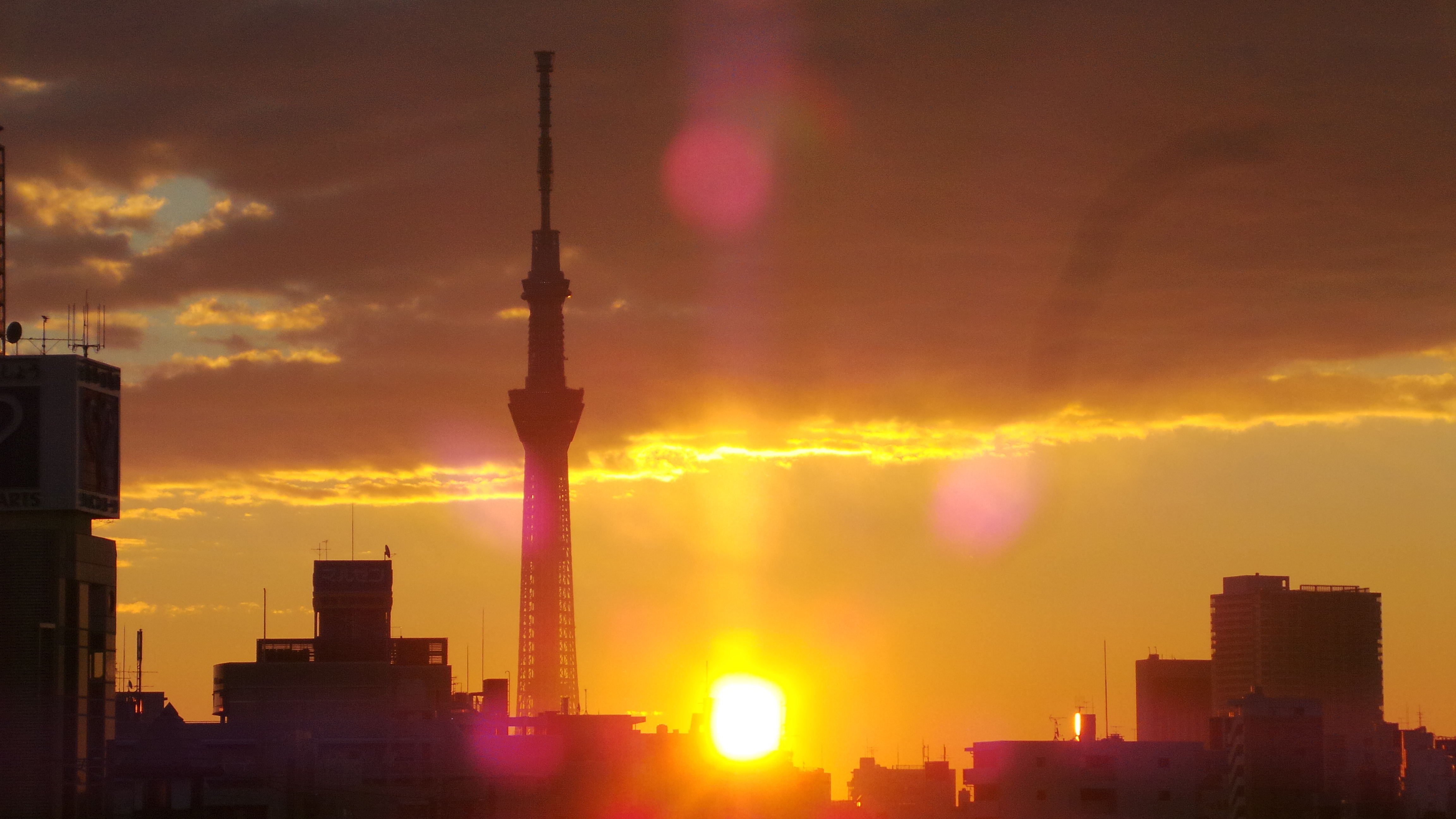
Today is Christmas Day. I wake up at 4 a.m. with a Christmas party hangover. It is too early to think, but I have things to do. Today, my friend Christine is arriving in Japan from England, and it is my job to act as a tour guide for the next few days. I walk to Nippori Station and arrive a little too early for my train. In order to kill time, I wander over the tracks to witness my second sunrise in Japan, the warm winter sun silhouetting Tokyo Skytree. My photograph is ruined by a smudge across my lens.
20141225_065945

Inside Nippori Station, it’s business as usual. Today might be Christmas, but for Japan, nothing changes. Salarymen dash to make their connections on the busy trains, Seven Eleven workers look exhausted from a heavy night shift, and ‘Let It Go’ blares from every speaker, as usual. It’s a normal business day here in Tokyo.

I take the Keisei Skyliner to Narita International Airport and wait. Eventually, my friend appears wearing a knitted Christmas jumper and a Santa hat. Despite seeing her in festive garb, it never really feels like Christmas. No trees and no snow; in fact, another clear warm day. There is no Christmas music in the airport either, just the constant drone of nonsensical announcements.

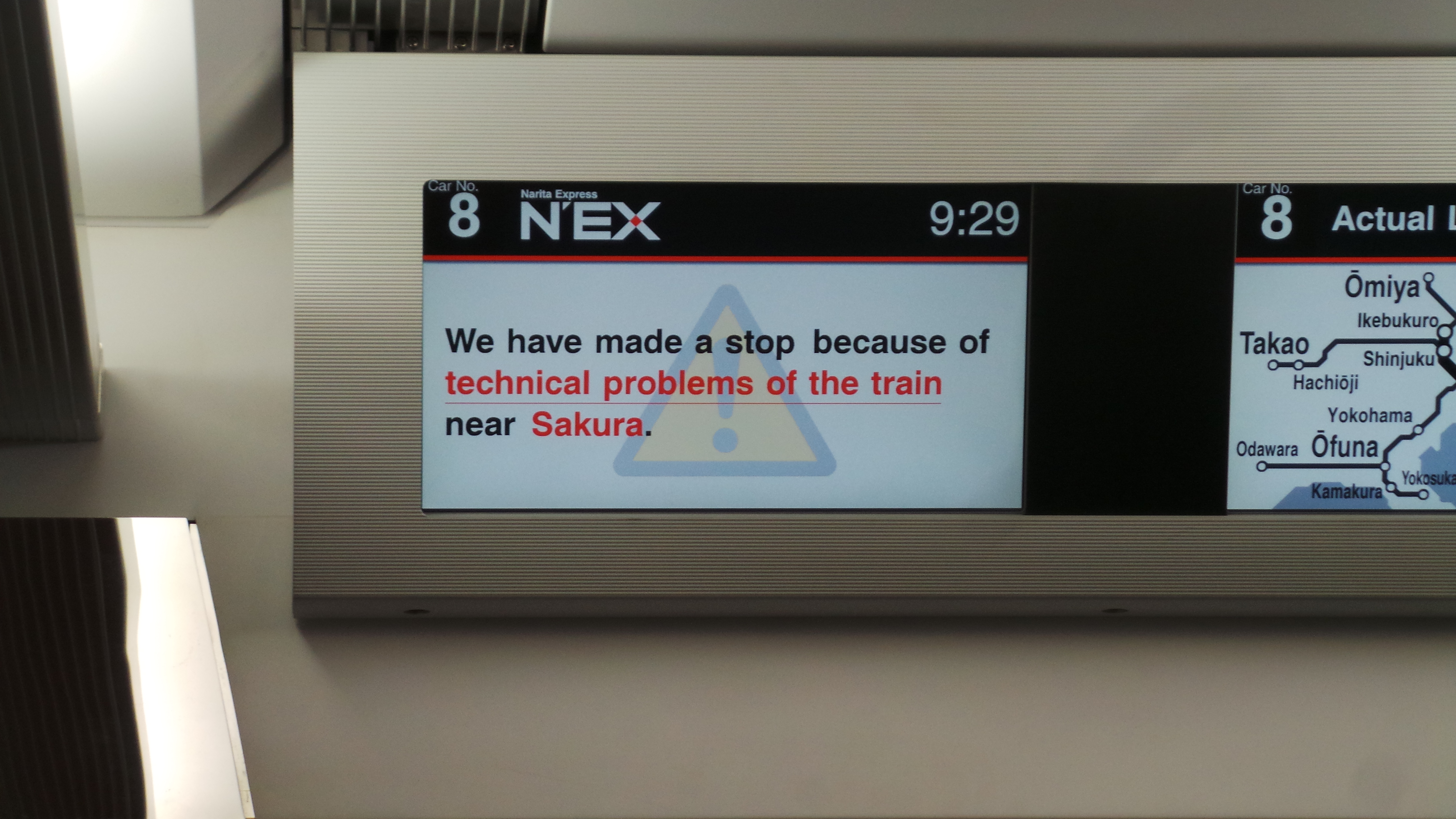
We take the Narita Express bound for Shinjuku Station. The Narita Express describes itself as ‘fast, convenient, and pleasant to ride,’ but never has a quotation been so far from the truth. On the train, Christine makes an offhand comment about whether things ever break in Japan. I tell her, ‘This is Japan,’ which translates to mean, ‘Things never break here.’ No less than five minutes later, our ‘pleasant to ride’ train crawls to a halt outside Sakura Station.
20141225_093039

We sit on the train for what seems like an hour before an announcement in Japanese tells us all to get off. A kind Japanese man sitting one row in front of us explains to us in English what is happening. We have to take a Sobu Line train from here to Chiba before continuing toward Shinjuku on local trains. For some unexplained reason, the Narita Express and the rapid line are out of action. Apparently, our ¥3390 tickets can be refunded in Shinjuku.

Not wishing to spend all day sitting on trains, we decide to get off close to Asakusa. We wander to Senso-ji Temple to get our fortune, something that I very much enjoy doing. Christine receives a ‘Bad Fortune’ and leaves it for the gods. We eat sushi at my favourite standing sushi restaurant before taking the train to Akihabara.

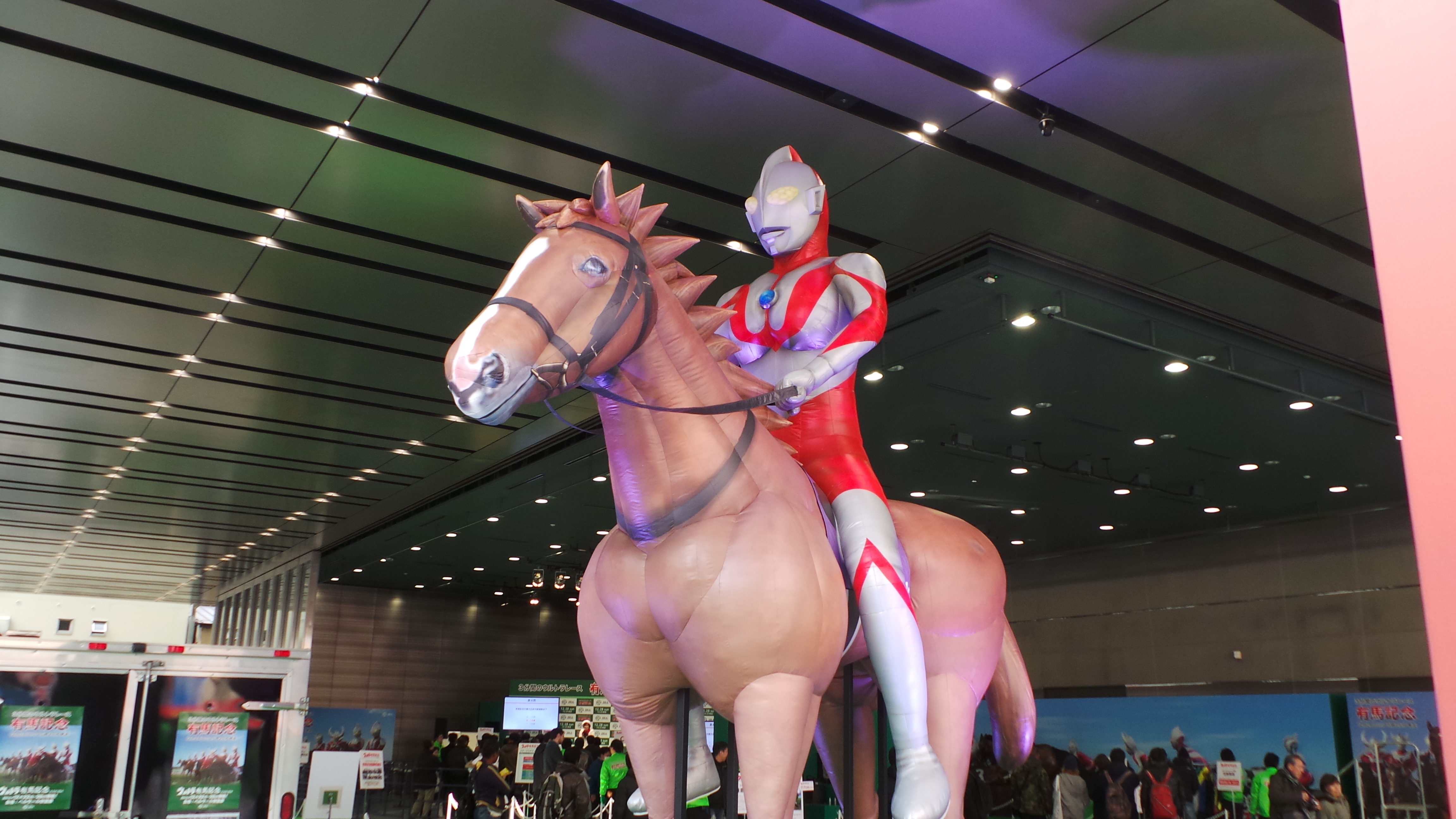
In Akihabara, for reasons that can’t be discerned, Ultraman is seen riding a horse.
20141225_133741

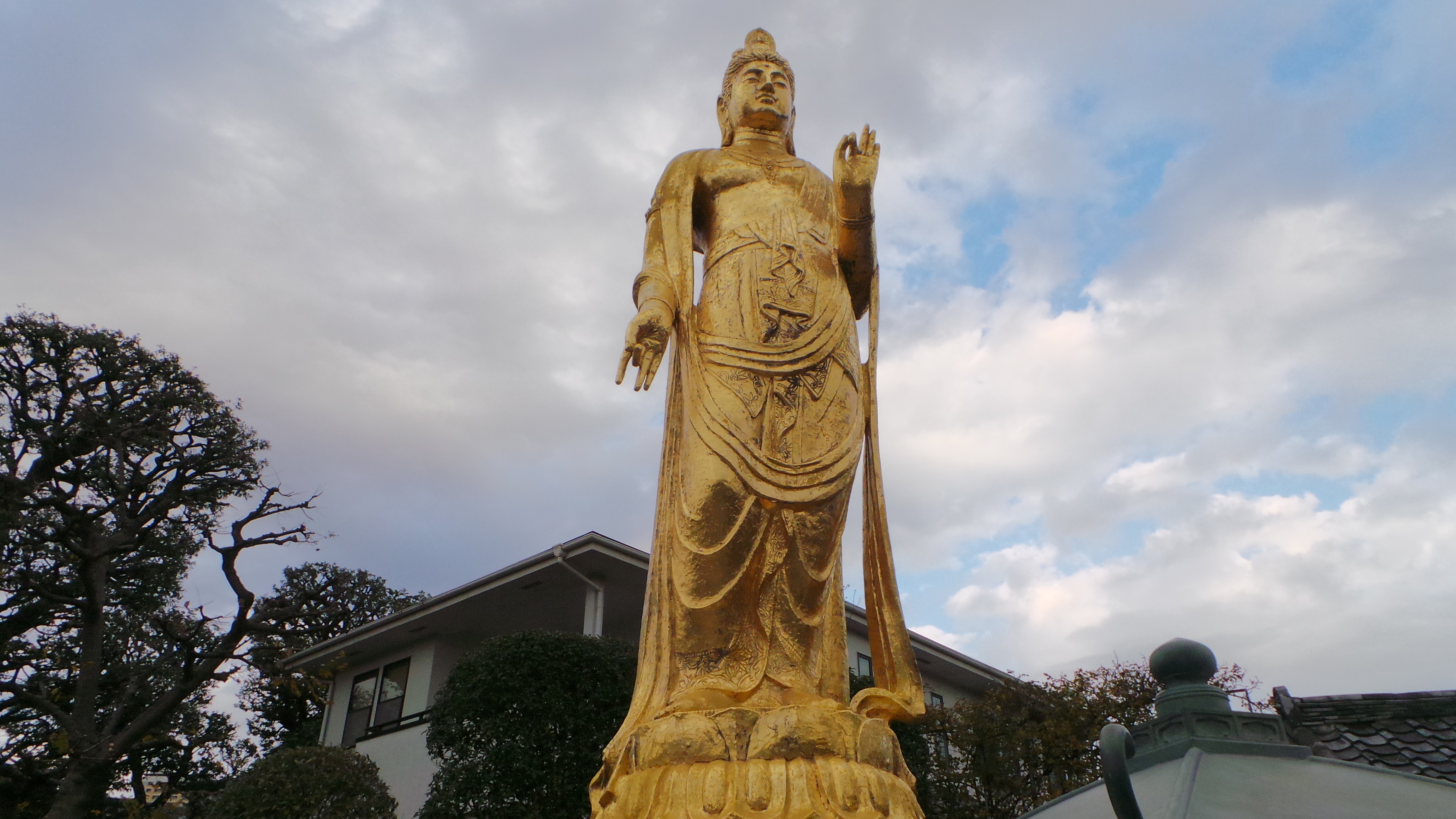
We hop on a Yamanote Line train and get off at a random station. Her choice is Nippori, my fourth visit to this station this week. We wander across the tracks and explore the many temples and shrines. Passing through Yanaka Ginza Street, we stop off at a small park. Tired and with feet hurting from too much walking, we take a breather at Zenshoan Temple. As we enter the temple grounds, in the distance stands a huge gold statue.
20141225_150326

The statue of Kannon is impressive, but what is potentially even more captivating is the Ghost Museum. Sadly, the museum featuring silk scroll paintings depicting ghosts and macabre ghost stories is only open during the summer months. There’s something about horror stories warming your blood, which is the reason for the seasonal opening hours.

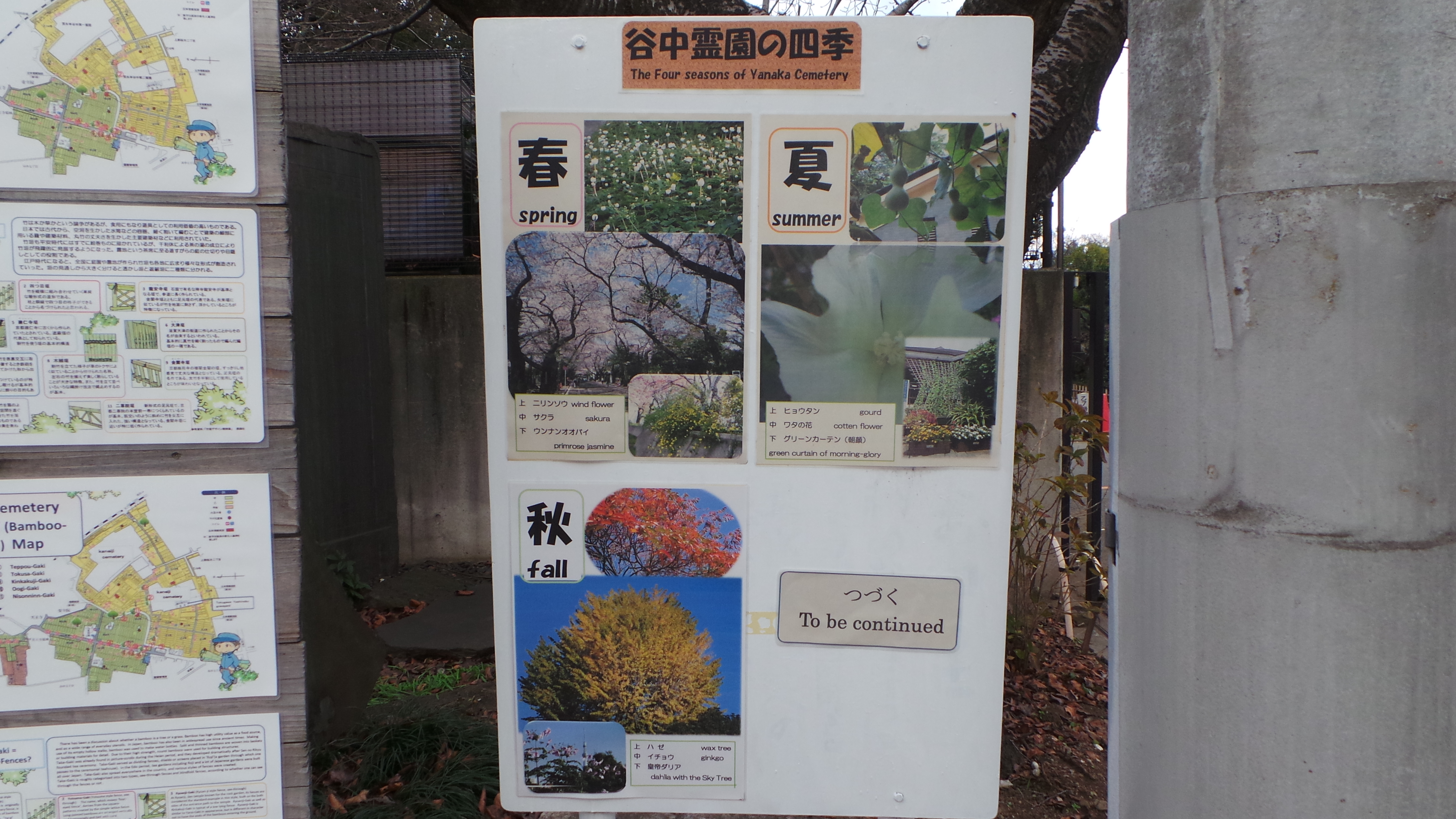
With all this talk of spirits, we take a wander through Yanaka Cemetery. I have visited here once before and found it incredibly peaceful, and do so now. There’s something about the perfect rows of decorated graves that is somewhat calming. Perhaps the quiet all around adds to this feeling. For some reason, the unfinished sign doesn’t display how winter should look here. The row of sakura trees and blossoming primrose jasmine in spring is a reason to once again walk among the dead next year.
20141225_151114

We head back to a hostel in Asakusa, the same one I had previously stayed at for eighty-two days. Tonight, the hostel is having a Christmas party, and Santa Claus will be arriving at half past eight by subway train. Exhausted from a long day and in need of my own bed, I decide to give the party a miss and head home.

Back in Minowa, I dine on Domino’s Pizza (four seasons) and a New York Cheesecake. I could post a photograph of a Japanese pizza from Domino’s, but it really isn’t any different from anywhere else. Instead, here are some instructions for Christmas decorations that I saw earlier today:

letsdecorate[1]

Merry Christmas.

Palace Under Fire

Today is His Imperial Majesty the Emperor’s 81st Birthday. To celebrate this momentous occasion, the people of Japan will enjoy a public holiday, taking a day off work. The only person not celebrating, it seems, is His Imperial Majesty the Emperor himself. Today, he will address the nation from the inner grounds of the Imperial Palace, a place that is only open to the public two days a year. Not one to pass up an opportunity to go inside the Imperial Palace walls, I head straight to Kanda Station directly after breakfast.

I enjoy a leisurely thirty-minute walk. The sky is clear, the sun is bright; it feels far too hot on this December day to resemble the apparent winter. His Imperial Majesty the Emperor himself couldn’t have ordered better weather for this special day, even if he tried. I walk to the Imperial Palace, stopping to admire some trees along the way. It seems that I go through phases of fascination, and, as you might be able to surmise, this month’s juncture is trees.

kandatrees[1]

The trees here were once used by the Meteorological Agency to help further their studies into phenological phenomena. These Yoshino Cherry and Japanese Maple trees served as specimens. The long-term observations from studying these trees helped solve problems regarding changes in weather conditions almost sixty years ago. With this data, the Meteorological Agency can accurately predict the days when cherry blossoms will flower. An important and worthwhile discovery.

When I finally arrive at the Imperial Palace, I find out that I have missed His Imperial Majesty the Emperor’s speech by a mere two hours; I will still be allowed inside, though, if I can find the correct entrance. I wander around the outer Imperial Palace walls. There is a large statue of Wake no Kiyomaro, a preacher of Buddhism and once a trusted advisor to the Emperor during the Nara period.

palacestatue[1]

Wake no Kiyomaro had his share of good and bad fortune. He was once exiled for years and forced to have the sinews of his legs cut out, rendering him immobile. Luckily, some stone boar statues magically came to life and healed his legs, and he was freed from exile. Eventually, he was reinstated as a trusted advisor to the Emperor. Nowadays, he is remembered by the grand title of ‘God of healing foot disease,’ and at this location outside the Imperial Palace, he has become a regular target for defecating birds.

I eventually find the entrance to the Imperial Palace grounds. Here, I get told off by a policeman for walking against the flow of people. One-way system, no signs. I head across the coned-off concrete and to a security checkpoint. After being thoroughly searched, I am clear to enter the inner grounds, free of charge. At the gate, I stand and watch a lifeless guard. He doesn’t blink for well over five minutes. I speculate that this man is actually an android, but his lack of animatronic function appears to counter my observation. I want to stay and watch, to see how long he can go without blinking, but a policeman kindly asks me to move along.

statueguard[1]

Inside the Imperial Palace grounds, there are more security guards than visitors. I wander past some overgrown trees and toward the Imperial Household Building. Outside, a small marquee has been erected. At the marquee, I am given the opportunity to write my name, nationality, and a nice message for His Imperial Majesty the Emperor. I write ‘Happy Birthday, His Imperial Majesty the Emperor.’ I take care to write it down neatly and deliberately. A sign hanging above tells me that my message of ‘Happy Birthday, His Imperial Majesty the Emperor,’ will be duly forwarded to its highest destination as an expression of my warm congratulations.

palacesigning[1]

After signing, I continue along the one-way system. Still no signs. The grass here is completely overgrown and is in desperate need of a gardener. The Japanese taxpayer covers the cost of outer garden maintenance, which boasts neatly trimmed grass cut on a daily basis. It feels like a waste of money to me. Inside, it is a very different story. Perhaps the tax money doesn’t quite make it into the ‘inner sanctum,’ or maybe His Imperial Majesty the Emperor is required to cut the grass here by himself. I am not sure, but regardless, the grass inside the Imperial Palace grounds is an overgrown shambles.

I pass an Obansho Great Guardhouse, one of three remaining, and the final checkpoint on the way to the Imperial Palace. This place would have had the highest-ranking samurai guardsmen stationed here. Ironically, it is at this point that the security guard and police presence seems to completely diminish. Further along the path, someone appears to have forgotten their ladder.

randomladder[1]

I walk idly along, somewhat unimpressed. I head up a slope before passing through the remains of Chujakumon Gate and into the public gardens. These gardens are somewhat more remarkable than the rest of the Imperial Palace grounds; the grass here is cut really short. Before me stands an orchard. His Imperial Majesty the Emperor personally planted three of these cultivars in 2008: the Sanbokan Grapefruit, a sour orange; the Tangor, a cross between a tangerine and an orange; and the Cherry Orange, a variety of Mandarin orange. The orchard was created on the site of the Castle of Edo based on His Imperial Majesty the Emperor’s idea that visitors would be able to enjoy the popular fruits of the Edo era.

lemontrees[1]

Forgetting about fruit and foliage for a moment, I decide to check out the mysterious Ishimuro Stone Cellar. Some people say this was an emergency storehouse to supply the inner section of the Imperial Palace. Some people say that this stone cellar housed an underground passage that once led directly into the Imperial Palace. Some people say that this cellar was a secret passage that led to hoards of treasure. I personally hope it was used as a secret passage, but perhaps I will never know. Despite the angle of the photograph, it is not possible to explore deeper inside the Ishimuro Stone Cellar, thanks to a fence blocking the entrance.

dungeon2[1]

My final stop is the Tenshuku Donjon Base, the highest-ever donjon built in Japan and a symbol of the Tokugawa Shogunate’s authority. Just nineteen years after it was built, in 1657, there was a conflagration known as the Great Fire of Meireki. The fire lasted three days, claimed over 100,000 lives, and destroyed this donjon. It was never constructed again.

The view from the ruined donjon is the old Edo Castle Honmaru Goten Palace, now just a large lawn full of people sleeping and enjoying the sunshine. Formerly, this area was lined with buildings. Presumably, these too were burnt down during the Great Fire of Meireki; a fire that is considered to be one of the worst disasters in Japanese history. A fire that left the old Edo city, now known as Tokyo, in complete ruin.

palacegarden[1]

The fire was said to be caused by a priest. According to legend, there was a cursed kimono that killed teenage girls, and the priest decided to burn it on that day in March 1657. It didn’t help that the buildings of that time were made from flammable materials such as wood, were built closely together, and had thin paper walls. The fire spread to all parts of Tokyo, leaving destruction and devastation in its wake.

From the ruined donjon, there is barely a trace left of the fire. All that remains is the site of an old castle now replaced by a neatly cut lawn, an orchard of lemon trees, and the overly developed city skyline looming in the distance.

Schindler’s Lift

Recently I have been a little caught up with having a cold, taking numerous visits to the dentist, and a sudden urge to spend the remainder of my free time filling out multiple sheets of paperwork pertaining to banking and insurance. This morning, I head outside to discover that everything has fallen down. I lift my bicycle up from the floor, pulling it apart from the scattered mess of other fallen bikes. The temperature in Japan is freezing cold now. Two days ago, there was snow in central Tokyo. Today, a strong wind blows through the air. I take my bicycle, armed with winter clothes, and cycle to Asakusa.

I head over to Senso-ji, passing hordes of skeletal trees. For the next three days, a festival takes place. Something to do with badminton rackets, or so it seems.

badmin1[1]

Today is Hagoita-ichi, a festival of decorated battledores—old-style badminton rackets depicting characters from kabuki shows. There are about twelve different stores here, each selling these rackets at a high price. These decorated wooden boards are supposed to deflect evil; perhaps this is where the ‘bad’ comes from in badminton. The sport that these rackets are used for is something of a Japanese childhood game called ‘hanetsuki,’ very similar to badminton but played without a net. I suppose the evil is the shuttlecock, and hitting it toward your opponent is a way to deflect that evil upon others.

The traditional way that hanetsuki is played involves the use of face paint. If you lose a point, your opponent gets to rub paint on your face. If you were terrible at the game, I suppose after a while, your colourful face might begin to resemble one of the characters portrayed on the hagoita. These days, these rackets are mainly used for decoration purposes. Sandwiched between the stores selling badminton rackets are food shops, and one specific store that caught my eye because it looked so out of place.

daruma[1]

Daruma dolls are traditional Buddhist dolls depicting the image of Dharma, and they are considered a symbol of good luck. With white eyes that stare into nothingness, it is said that if you colour in one eye, you can make a wish. Once the wish comes true, colour in the second eye, and your Daruma is almost complete. The only thing left for the doll is to be returned to the temple it was bought from and burned. It feels slightly unfair to burn an object that has done its best to grant you a wish, but sadly, that’s just how these things go. As I am taking a photograph of the dolls, a man next to me is doing the same. His hat flies off his head in a gust of wind. Somehow, I manage to reach my hand up and catch his hat in mid-air, like a pro.

After the festival, I go to Akihabara for some Christmas shopping. In Japan, where Alcatraz-themed restaurants and robot cabaret shows are common, it’s no longer strange to find a cafe themed around a popular girl idol band. Akihabara is bustling with comic book stores, video game shops, and large electronic department stores. However, that’s not my reason for being here. Almost instinctively, I leave the station and head directly to the AKB48 Cafe and Shop.

akbcafe[1]

The last twenty-three single releases by AKB48 have consistently claimed the top spot on the charts, indicating their immense popularity among Japanese people. One clever marketing strategy involves including a ticket for a handshake with a band member with every CD purchase. Observing the guy in front of me in the queue buying over one hundred copies of the same CD, it’s clear that he’s a fan of handshaking. I exit the store with ten copies of ‘Kiboteki Refrain’, and I can’t help but feel like a weirdo. Nevertheless, I’ve managed to wrap up Christmas shopping for ten people in less than ten minutes.

Before returning to Asakusa, I make a detour to Yodobashi Camera to play some piano. However, after thirty minutes, I decide to leave because one of the staff members is giving me an ‘are you going to buy anything?’ sort of look. Outside Akihabara Station, somebody seems to have mixed their Christmas up with Easter.

dancingrabits[1]

For some unknown reason, it is not possible to open a bank account in Japan unless you have lived here for a minimum of six months. Since my time in the country has exceeded that quota by almost three weeks, I decide it’s about time to get my documents in order and take the plunge toward integration. But, I can’t just wander into a bank saying, “I have been here six months, give me a bank account!” First, I need to get myself a personal seal. Not the aquatic mammal I had been hoping for; this seal is more like a stamp and is known as an ‘inkan’.

I head over to a small inkan shop opposite Tawaramachi Station and take the escalator up to the second floor. The escalator provides me with amusement, and the title of this overdue blog post practically writes itself.

schindlerslift[1]

Inside the shop, there are wonderfully expensive stamps on display in high-priced cases. Since I am only getting this product for one reason – a bank account – I opt for the second cheapest option available. The woman draws a circle that takes up a whole page of A4 paper and asks me to write my name in the way I would like it to be engraved in the stamp. Horizontally or vertically? Kanji or katakana? I don’t really care, so I just scribble my name across the paper as quickly as possible, and with very little thought.

Next, I select a case, once again opting for one of the cheapest available, but still seemingly of high quality. Perhaps there is no such thing as bad quality inkan. I hand over ¥2950, the cost of both the inkan and the case. The woman informs me that it will be ready in thirty minutes, hands me a slip of paper, and asks me to bring it back with me when ‘my time is up’.

myinkan[1]

Half an hour later, I am the proud owner of my very own inkan. Naturally, I head home immediately and start stamping my name on everything I own.

House of Red Leaves

There is a famous phrase in Japan, ‘You haven’t seen real beauty until you’ve seen Nikko.’ So far on this trip, I haven’t really seen a thing. Only darkness. I wake up at 9 a.m., and the first thing I do is take a look at the view from the ryokan window. No skyscrapers here, only mountains and sky.

viewfromryokan[1]

Outside, the air is clean, and a reasonable 20°C, so I take one last soak in the outdoor onsen before paying for the room and leaving. I realise once I am all the way at the bus stop that I’ve forgotten to pay for my ice cream. The bus stop tells me I have half an hour before the next bus, so I decide to explore the Yumoto Onsen area.

Despite this being the highest point in these mountains that the bus chooses to stop, and at an altitude of 1,475 metres, there is a huge natural lake up here. Lake Yunoko, translating to mean, ‘Hot Water Lake.’ The lake sits almost completely still. Formed twenty thousand years ago when a nearby volcano erupted, the lake is a nesting ground for wild ducks. A sign beside the lake says that ‘fresh’ landlocked sockeye salmon and rainbow trout swim in these waters.

hotwaterlake[1]

I take a wander around the water. At the south end, a waterfall; at the north, the view is somewhat ruined by a construction team nestled at the edge of the lake. It isn’t quite clear what they are actually doing, other than making noise and ruining the otherwise peaceful scene.

My bus eventually arrives. The elderly residents use their hand on the Suica card machine instead of actually scanning their cards. Presumably, they don’t have electronic cards on the mountain, and by the looks of it, they get to travel on the route bus free of charge.

The bus swings back down the mountain, passing impressive scenery. Mountains sit quietly in the distance, the view very much different from the journey yesterday. Toward the bottom of the bus route, I see some interesting red leaves, so decide to hop off.

redleaves[1]

“Koyo” refers to the colourful autumn leaves in Japan. They spread across the country starting from the north and moving south. This process takes about two months and is known as the koyo front. Almost completely opposite to cherry blossom season, but getting equally as popular, people come to areas of nature such as Nikko to view these leaves in the autumn.

Beside the area of red leaves, I see a sign for a World Heritage Site, Toshogu Shrine. The shrine is the place where Tokugawa Shogunate founder, Tokugawa Ieyasu, is enshrined. It was built on his orders and used as his hideaway, and I can see why he chose this area. The view from the entrance to the shrine is an impressive mix of mountains and wildlife, the perfect place for a military leader to spend his free time.

nikkonature[1]

Inside the temple grounds is the origin of a Buddhist proverb about not dwelling on evil thoughts. A statue of the three wise monkeys, Mizaru, Kikazaru, and Iwazaru, sits over the shrine. The proverb is rather well-known and translates to, ‘See no evil, hear no evil, speak no evil.’

At the entrance to the temple grounds sits the five-storey Gojunoto Pagoda. A sign beside the pagoda tells me that the structure is the same height as Tokyo Skytree. I think this is a translation issue, as this pagoda is a mere 36 metres tall, whereas Tokyo Skytree is an impressive 634 metres tall.

nikkopag[1]

What I think is meant by the sign is that the elevation here is 598 metres, meaning that the roof of the pagoda is at the same elevation as Tokyo Skytree. Perhaps this is merely a coincidence, but I would guess that Tokyo Skytree was built at this specific height so that it shares the same point in the sky as this famous pagoda.

After visiting the temples, I take a wander around the Nikko area. I see a shop selling ‘Heritage Nikko Cheese Egg,’ and would be a fool to pass up on the opportunity to eat a Cheese Egg. It costs just ¥100, and completely shatters my ignorant assumption that the Cheese Egg would contain at least one of the two ingredients in its name. Instead, I find myself eating a bland, tasteless cake. The primary flavour: disappointment.

I continue my wander and spot a cigarette machine with some advertising above it that would never be allowed in England.

nicesmoking[1]

I make my way back toward Nikko Station. The area around the station has a selection of small shops all selling exactly the same things—souvenirs. Other shops sell more souvenirs, and more shops sell the same souvenirs as the other twenty shops. The stallholders here are cashing in on a popular Japanese custom, omiyage. In Japan, when you visit another region, you are expected to buy souvenirs for everyone else who couldn’t make the trip. So for me, I have to buy everyone I know a gift.

Wishing I had purchased Cheese Eggs for all, I instead opt for a relatively pricey box of Strawberry Pie. I chose this gift because I enjoyed the English text; it reads: ‘Plenty of choice of strawberry red, so happy tea time we can enjoy this strawberry pie.’ Whatever that means.

After shopping, I wave goodbye to Nikko from the train station platform; the view of Mount Nantai in the distance is simply stunning.

nikkostation[1]

From the train, I watch the mountains disappear. A thrilling two-hour journey to Ueno awaits, then it is back to the chaos of Tokyo.

I Warm Duck Smoke

I wake to the sound of helicopters and sirens, more than one of each. I look out of my apartment window and see a pillar of billowing smoke that seems to be attracting the attention of five helicopters; they circle around the black cloud like flies. An ambulance buzzes by at speed, its sirens adding to the cacophony of early morning racket.

I head outside into the slums, making my way toward Minowa Station. Today, I have the pleasure of buying a Halloween costume, and the only place that offers any sort of choice, I am led to believe, is Tokyu Hands in Shibuya. At Minowa Station, there are seventeen fire engines.

fire[1]

I take the Hibiya Line. Distracted, I miss my stop at Ueno, so I stay on the train until Akihabara Station. I walk ten minutes through the crowd of young women in maid outfits trying to tempt me and head for Suehirocho Station. Here, I take the Ginza Line, Shibuya-bound.

It seems I have been drastically misled. Tokyu Hands has a Halloween range, albeit rather small. I begrudgingly spend ¥4800 on some awful ghoulish nonsense that I will only use once before heading back to the train station, Minowa-bound.

Outside Minowa Station, firefighters are still tackling the huge blaze, the smoke so thick that it chokes me. Helicopters armed with television cameras continue to drone on. Unbelievably, an advertising blimp for the insurance company ‘MetLife’ floats above the disaster, cashing in on some extra television airtime.

metlife[1]

At home, I grab my bicycle and cycle toward Kanda. I get as far as Asakusa and run into my good friend and fellow bicycle enthusiast, Khin. He asks me if I’ve had lunch yet. Realising that I am actually quite hungry, I agree to join him, and we head to a gyoza restaurant. I finally get to eat one of my favourite foods, vegetable dumplings—the first time I have had this food since coming to Japan. Delicious.

After the meal, we head over to Senso-ji to get our fortunes. I luck out and receive ‘Good Fortune.’ Khin doesn’t do so well and gets ‘Regular Fortune,’ so he ties it up for the gods to deal with. My fortune says, “It is a good sign to dream of a young horse in spring and a dream of a swift horse will bee [sic] a much better sign.”

goodfortune[1]

Next, we head over to the Edo Shitamachi Traditional Crafts Museum, an excellent little museum discreetly tucked away inside an indoor shopping arcade. Free entry seals the deal, and in we go. Inside, we find ourselves the only visitors. On display are fishing rods, fans, hand-forged cutters, paper lanterns, badminton rackets depicting kabuki characters, Buddhist statues, pottery, leather bags, and paintings. There is also a rack of very straight arrows.

Winter is coming, apparently. To celebrate, a small truck with a little stove on the back is circling around, selling hot sweet potatoes. As it passes by, it plays a little jingle in Japanese known as the baked potato song: ‘Ishiyaki imo, yaki imo, yaki imooooo,’ literally translating as ‘Baked sweet potatoes, sweet potatoes, sweet potatoooooes.’ I chase after the truck but waste time taking a photograph before it turns left and blazes off into the distance.

bakedpotato[1]

Khin and I head over to Cafe Byron Bay to meet some friends before heading out as a group of eight to a fish izakaya. Tonight is Dagmar’s last evening in Japan, so we are having a little leaving party for her. At the izakaya, we take off our shoes and sit at a nice table with tatami mat flooring. I am handed an English menu, and it just so happens to be the best menu I have ever seen.

The menu boasts the following delicious highlights:

Dirt Japanese bluefish drying a fish whole firing, ¥380
Wall thickness, taste are plentiful, and grease appears! ¥980
Semigrow and drag knob salad, ¥580
Tatami mat sardine, ¥280
Butter charcoal fire firing of the nettle tree, ¥380

ducksmoke[1]

The butter charcoal fire firing of the nettle tree turns out to be mushrooms, and the tatami mat sardine ends up on the floor. We eat plenty, drink plenty, and drink plenty, before going our separate ways, bidding our last goodbyes.

At home, I dream of horses in the spring.