Withdrawal & I

Today, I have a rough plan: a day trip to Nara with a stop in Uji. Last night, I arranged to meet my friend Slavek at noon. He’s planning on going to Nara anyway, so we decided to travel together. I wake up at 11 a.m. with a hangover; I shouldn’t have stayed up until 4 a.m. drinking whisky and teaching people magic tricks.

Slavek and I walk to Kyoto Station. I’m pleased to find that he is a fellow fast walker, and his pace matches mine perfectly. It takes us ten minutes at a brisk stride. On the way, I stop off at Seven Eleven to withdraw a ¥10,000 note. Seven Eleven cash machines are the only ones that accept my card in Japan, and the minimum withdrawal here is ten thousand yen. We pay ¥240 and head to Uji by train. Slavek is a very clever guy with great English skills, a keen eye for both nutrition and politics, and he’s an avid Haruki Murakami reader. We have decent conversations. In Uji, we’re off to see the temple that is depicted on every ten-yen coin.

coins[1]

I’m fond of Japanese coins. The 100% aluminium ¥1 coin floats on water and sticks to any part of your face without falling off. The copper ¥10 coin brought us to Uji to see the temple. The ¥500 coin is the most valuable everyday coin globally, and it’s also the most interesting. When tilted at a certain angle, you can spot the kanji for ‘five-hundred-yen’ hidden in the grooved lines. Additionally, the word ‘Japan’ is discreetly engraved in 0.2mm across the coin’s face.

Amidst my blathering about coinage, we end up missing the stop for Uji. Getting off the train, we cross the platform and board another train bound for Kyoto Station. It’s an easy mistake, one forgiven by the Japanese train ticketing system. Finally arriving at Uji Station, we head to Byodoin Temple, the one featured on the ten-yen coin.

Byodin[1]

Byodoin is a UNESCO World Heritage Site, marking another off my list. It’s one of the few remaining examples of Heian temple architecture in Japan, dating back to its original construction in 998 AD. Surprisingly, it doesn’t seem to attract many tourists; in fact, most of the visitors I see here are Japanese. The temple features Japan’s most beautiful Pure Land Gardens among the few that remain, alongside a small museum, both covered by the entry fee.

The museum has won four architecture awards. Inside, it houses 52 wooden Bodhisattvas, the temple bell, the south-end Phoenix, and other historically noteworthy items. Additionally, the temple bell here is recognised as a national treasure. I discover that the golden phoenix here is the same one depicted on the rear side of the ¥10,000 note. More money musings. After exploring the museum, we hop onto a packed train filled with tourists heading to Nara:

emptytrain[1]

We arrive in Nara just after 3 p.m. It’s a warm afternoon, thankfully quite cloudy. Heading to Todaiji Temple, we pass a lovely pond with turtles swimming around. We also visit a few smaller temples and a five-storey pagoda. Kohfukuji Temple, part of the Historic Monuments of Ancient Nara, is sadly closed for reconstruction. Surprisingly, it closed in October 2010 and won’t be ready until 2018. Eight years to reconstruct a temple. Just nuts.

And then there are the deer. Sika Deer roam freely through the town, with an estimated 1,200 of them in Nara. You can purchase deer snacks and feed them to these creatures. I’ve been told that the deer bow when you feed them. We witness a herd waiting patiently at a red crossing light, only crossing when the light turns green. They’re remarkably tame.

deercrossing[1]

Todaiji Temple is the second-largest wooden structure on the planet. It was built during the Nara period on the instruction of Emperor Shomu. We pay our ¥600 entry fee and stroll through the gardens toward the temple. On the temple grounds, there used to be two 100-metre-tall pagodas, but they were destroyed during an earthquake. In 751 AD, these pagodas would have been the second tallest structures in the world, after the Egyptian Pyramids.

Some interesting facts about the temple: Emperor Shomu issued a law in Japan stating that the people should directly participate in the creation of new Buddhist temples across the country. Thanks to this law, 2,600,000 people were involved in the construction of the Great Buddha Hall and the statue inside.

bigwoodentemple[1]

Another interesting fact: the Great Buddha Hall is 1/3 smaller than the original, as it burnt down in 1180 AD and again in 1567 AD. That’s what you get when you build it entirely out of wood. I’ve noticed that nearly every temple I’ve visited in Kyoto has suffered the same fate of burning down and being rebuilt. Inside the hall stands the statue of the Vairocana Buddha, also known as the ‘Buddha that shines throughout the world like a sun.’

This is the world’s largest bronze image of the Buddha, towering at 14.98 metres. The construction of this Buddha nearly bankrupted the Japanese economy at the time, as it consumed all of the available bronze in the country. Sadly, behind the statue, there are many small gift shops that seem out of place and frankly spoil the ambiance of the scene.

bigbuddha[1]

It’s just after 5 p.m., so Slavek and I decide to grab some food in Nara. We end up eating far too much sushi, spending a total of ¥6436 at the restaurant. Later, we hop on the express train back to Kyoto, mistakenly using our tickets intended for the local train. During the journey, the conductor asks us to pay an additional ¥510 as a surplus charge for the express train. The express train takes about twenty minutes, half the time of the local train. Finally, we walk back to the hostel from Kyoto Station.

In the hostel bar, I enjoy ¥500 glasses of Suntory whisky highball. It’s not until my third drink that I inquire about the price of a double, as the standard highball is a bit weak for my taste. “It’s ¥500,” explains Daiki, the barman. So, after being here for five nights, I discover that a double whisky and soda costs the same as a single. If this holds true in all Japanese bars, I’m in luck. I also order some bar snacks—¥100 for mixed nuts. Daiki places a small bowl on a tiny set of scales, pouring nuts into the bowl until they reach the specified weight. Just nuts.

Ainoshima Cat Island

With muscles loosened after a wonderful massage, I decide to truly test my body. My destination today is Shima Ferry Port. “You’re cycling to Shima?” asks a confused staff member. “Please make sure the bike is back before 9 p.m., okay? It has to be back before nine.” The time is now 11 a.m., and I have no intention of taking ten hours on this excursion. Little do I know.

I cycle for an hour in the direction Google suggested before realising I have no idea where I am. I spend a good half-hour navigating around an industrial estate, reaching a dead end, then turning around to eventually get back on track. None of the road signs are in my language, and there’s nobody around to ask for directions.

Ninety minutes into my journey and I arrive at a beach.

beach[1]

The beach offers a welcome rest, prompting me to park my bicycle and go for a short stroll. I stumble upon the only map in Fukuoka Prefecture and compare it to my photographed route; everything matches up. There’s still a long way to go, but at least now I know where I am. Thank you, ‘Mishima Water Area Circumference Route Map’.

At the end of the beach is what appears to be a closed amusement park called ‘Motown’

mowtown[1]

I continue cycling until the beach ends and the houses begin. I start uphill, hoping it’s the right direction toward Shima. Eventually, I find myself atop a mountain. It doesn’t seem right. Up here, I discover a stunning, random shrine and some very old houses, but not much else.

sshrine[1]

I eventually reach the downhill part of this frustrating journey, only to encounter a dead end overlooking the ocean. I have to push my bicycle back up the incredibly steep mountain roads, and it’s exhausting. Today is scorching at 35°C, and I’ve already used up a full bottle of Sun Aqua by now.

uphillstruggle[1]

At the top of the mountain, I spot a human being. I ask him in Japanese for directions to Shima. He responds in Japanese, and though I’m not entirely certain, I follow his directions. To my relief, I discover a small train station where one of the stops on the route is Shima.

I opt to follow the railway tracks, at times finding them disappear or being forced to detour due to a lack of pavement or road. After a challenging navigation, I finally spot a sign for Shima. I adhere to the instructions on the sign, and miraculously, after two hours and forty-five minutes of cycling, I arrive at Shingu Port.

“I’ve a feeling we’re not in Fukuoka anymore.” I pay ¥460 to a vending machine for a one-way ticket. After a forty-minute wait, the ferry finally arrives.

On the ferry, a television airs footage of a dirty factory in Shanghai. Staff members, their faces blurred out, are seen relabelling one-year-old rotten meat with new expiry dates. The screen shows a pile of processed meat spilling onto the floor while rats crawl below. The gloop is scooped up and pressed into another machine, which churns it into the shape of nuggets. I have no idea what this advertisement is for.

catisle1[1]

Ainoshima Island is just off the coast, a twenty-minute journey away. It boasts more cats than human inhabitants. In Japanese, the word for cat is ‘neko’, and its pronunciation rhymes with ‘echo’.

I arrive on the island to find a cluster of traditional old Japanese houses against a backdrop of mountainous terrain covered in deep forests. Despite its small size, the island takes a considerable amount of time to traverse completely. In the shade between each house, cats are scattered, peacefully asleep.

catisle2[1]

I wander around the island where the small Japanese houses provide little shade from the scorching summer sun. Today marks the hottest day of the year. I spot numerous cats, more than I care to photograph. Here are a few more:

catisle4[1]

There’s one cat that takes a shine to me. He follows me around the island as I walk, meowing or crying—I’m not sure which. I offer him some of my water, but he responds with ‘Nyaa nyaa’ (the typical cat noise here). Perhaps he’s just hungry. I assume tourists visit this island to come and feed the cats, but it’s merely a presumption.

catisle3[1]

I take the 4 p.m. ferry off the island. There are only three other people on the ferry and thirty-two empty seats. It seems like somewhat a waste of fuel, in my opinion. Sumo Wrestling is playing on the television.

There’s one last thing about Ainoshima Island not mentioned in any guidebooks: giant wasps that chase you. I managed to take a photograph of one that was idling, smaller in comparison to others. I’ll admit, though, most of my time on the island was spent either admiring the cats or running away from the wasps like a frightened rabbit.

bpwasp[1]

As the ferry pulls away, Ainoshima Island becomes nothing more than a blur.

I leave Shima at twenty past four, sticking to main roads and following the signs for Fukuoka. As I depart, a bus marked Tenjin Station mocks me as it cruises by.

Rice and Shime

I wake up at 11 a.m. Today, I’m heading to a place called Dazaifu, roughly fifteen kilometres away. Cycling on my one-speed bike in a straight line towards it, it should take me about an hour. Last night, the girl I met suggested I visit there—a kind suggestion.

As I set out, I discover a Domino’s Pizza just five minutes away from the hostel on the same road. I haven’t had one since arriving here—fifty days in Japan, only four pizzas so far. Tomorrow, it’ll probably become five.

A bit further along the road, near the Mikasagawa River, the skyscrapers start to disappear, and the sight of rice growing underwater becomes commonplace. Paddy fields full of semi-aquatic rice—it’s a picturesque sight, deserving a photograph.

rice[1]

Amidst the distraction of the rice fields, I suddenly realise that I am completely lost. In typical Fukuoka fashion, I see no maps, and signs pointing to Dazaifu have ceased to appear. Eventually, after cycling for about an hour, I find myself somehow at the base of a mountain.

For about ten minutes, I cycle without seeing another pedestrian. Eventually, a sign for a place called Shime catches my eye. My brain pauses for a second before a pun crashes into my consciousness. I decide to head there if only to make use of the pun: Rice and Shime.

shime[1]

It turns out Shime is up a hill—likely the same mountain I spotted earlier. I haven’t done much uphill cycling since Beppu, so my knees aren’t quite prepared for it. The footpath leading into Shime is in a state of disarray. Eventually, the incline transforms into a decline, and I find myself in a free fall into Shime. The wind is refreshingly cool on what is otherwise an alarmingly hot day.

overgrowth[1]

If you thought my post about Nishioita Station was exciting, wait until you hear about what Shime has to offer. Low-flying planes drift over and hang gracefully in the sky. At least I can follow the planes and track back to Fukuoka Airport; I know this isn’t far from Hakata, where I am staying.

I cycle around Shime, searching for anything of interest, but find nothing. Wikipedia confirmed it: ‘Although the town still has a railway station, the line is no longer used.’ Seems there’s no escaping Shime. Just as I decide to leave, I finally spot something noteworthy: a chicken wandering around in some mud.

torisan[1]

“Koke-kokko,” says the chicken in Japanese.
“Cluck-cluck,” I correct in English.

As I leave Shime, I find myself on the urban expressway, where all of the signs point to unfamiliar place names. I give in and revert to my plan of following the planes, soon arriving at the not very well-signed Fukuoka Airport.

fukuokaairport[1]

I see the same Chinook I saw yesterday, just landed. How very odd—I haven’t seen a Chinook in over fifteen years, and yet this week, I’ve seen the same one twice.

After cycling for a total of three hours, I arrive back at the hostel and indulge in a Seven Eleven lunch: a bottle of Pocari Sweat, a fruit salad, and, as usual, egg sandwiches.

After lunch, I do my laundry. In the Coin Laundry waiting area, there’s a rather odd set of photographs. I have no idea what they are showing. Alongside the images are some Japanese notices.

laundrycops[1]

I translate the notices back at the hostel. They read, ‘To prevent theft: if you notice any suspicious individuals, please contact the barnyard alternating Hakata police station if it was a robbery.’ There are also references to a theft in February, and still images captured by the 24-hour CCTV camera showing the criminal’s face. Named and shamed in a Coin Laundry.

After doing laundry and spending some time on Skype, I head to Hakata Station. Instead of taking the lift, I monotonously explore each of the ten floors. Hakata Station is a massive shopping centre with all sorts of shops, including the biggest bookstore I have ever seen.

There’s a record shop selling rare Japanese versions of classic albums. Perhaps there’s a profit to be made in reselling, but I don’t have the patience for that. I check for ‘Com Lag,’ but it’s the only Radiohead album they don’t have. The record shop also dedicates three entire aisles to the music of everyone’s favourite J-pop idols, AKB48. Crazy.

neonnight[1]

On the roof of the train station, I sit for a few hours, finishing off 159 pages of a Murakami novel. Night quietly sweeps in. The view at night is okay, but devoid of any stars. I ponder for a moment, questioning reality.

The Murakami book somewhat inspires me to make some changes in my life, specifically to start running more often.

On the tenth floor of Hakata Station, a Spanish restaurant.

seafoodpaella[1]

Paella and Rioja happen.

I jog back to the hostel, finding the late hours have already wrapped the city in silence, a stark contrast to the bustling streets earlier. Passing by the second Christmas tree I’ve seen since arriving in Japan, I can’t help but wonder why it’s there; it does seem a little early for such decorations.

christmastree[1]

The reflection of Lawson blue bounces off the glass beyond.

Much Beppu About Nothing

I haven’t really done any touristy things during my last two days in Beppu. Instead, I have listened to far too much Blind Pilot and filled the rest of my days reading Haruki Murakami. In the evenings I have visited bars. On Friday night I got to the semi-finals of a Table Tennis tournament, only to be beaten by Yojiro. Today I will write about general things in Japan.

Vending machines. There are far too many Coca Cola vending machines for my liking. One is too many if I am completely honest. As a non-consumer of this particular brand of misery (reasons: child labour, worker rights, pollution, murder), I often find myself cycling around looking for a machine with the Suntory Boss brand. The best vending machines offer Coffee Boss Rainbow Blend, and if I am really lucky, Boss Ice Creamy Latte.

Vendingboss[1]

Vending machine coffee in the summer is mostly cold. I have always enjoyed cold coffee anyway. In the winter, the machine changes and the can of coffee is hot. In the vending machine above, Coffee Boss Rainbow Blend is on a Price Down!

In Japan, there are far too many silly notices and signs in English; most have terrible grammar and bad spelling. Presumably these signs are mistranslated when they are put through Yahoo! BableFish. Google is surprisingly unpopular amongst the Japanese people. For news, emails, and searches, almost everyone here uses Yahoo! Here is an example of a bad sign:

Umbrellastand[1]

I like umbrellas.

Yesterday I met a vegetarian couple. They decided before coming to Japan that being a vegetarian here would be ‘too difficult’, so they have chosen to eat meat while they are here. I don’t quite understand this logic. Admittedly, vegetarianism is somewhat uncommon here. I find that simply learning to explain that you don’t eat certain foods will get you by. I have even seen people with printouts in Japanese explaining their dietary requirements. There are ways, and there are also plenty of amazing vegetarian dishes here too.

I think I have mentioned it before, but the streets here are littered with cats. Here are some cats:

Catseverywhere[1]

There are a lot of things I miss about England. Eating cheese. Crust on my sandwiches. Coleslaw. Sometimes I really wish I could sit playing the guitar for a few hours, but I don’t have a guitar here, maybe I can rent one. I also mentioned the stars before. Never visible. So strange. Maybe it is just because of the weather. When I finally see the stars I will probably write a huge post about it.

I went for a late-night walk in the ocean last night. The ocean here appears clear or blue, depending on the time of day. Sitting on the beach at midnight with a few beers, followed by a walk in the warm ocean — even at midnight, the air here stays warm. Even during heavy rain, the air remains warm. I’m uncertain about the winter; time will tell.

Here is the ocean in the day time. Very blue:

Bluebird[1]

Walking around at night with a beer and not breaking the law is also amazing. Convenience stores are everywhere, so if you cant find any nightlife, you can buy a beer from Seven Eleven, finish it by the time you get to Family Mart, buy a beer, finish it by the time you get to Lawson Stores, et cætera. Basically if you walked to every 24-hour convenience store in one area buying one beer at a time, you would get nicely drunk. I count eight stores within ten minute walking distance from my hostel.

I enjoy the lampposts and traffic lights playing happy tunes. I like being in Japan and being from England. When most Japanese people ask me where I am from, their attitude changes when I say England. It is as though I have uttered some code word that makes people more friendly. “Ah, from England! You know Sherlock Holmes?” The other night a Japanese salaryman bought me a drink in a bar, he said it was because he, “Likes England so much.”

Random things are placed on the streets here. This is inside Beppu shopping arcade. Spot the Carnival Cutouts:

Bignose[1]

There are things I don’t like. I dislike being tall. The number of times I’ve smashed my head into the top of a doorframe surprises me; I’m amazed I haven’t suffered a mild traumatic brain injury. Although, maybe I will ten years from now. I often forget the occasional English word. Whilst talking to someone, I might suddenly draw a blank on a word I should know. It’s like there’s a void in my head where the word used to reside. At other times, I unconsciously substitute a Japanese word for an English one without even realising.

I hate inconsideration, but who doesn’t. I am in a four bedroom dormitory room trying to sleep. Someone comes in, sits down on his bed and starts to eat from a bento box (a lunchbox style Japanese meal; commonly with sections for rice, pickled or cooked vegetables, and a type of meat or fish). He is eating chicken, but I don’t eat chicken. Now, my room smells of chicken, and amidst this olfactory assault, all I can hear is him chomping loudly on his food. The hostel has a dining area and a lounge area, so please refrain from eating chicken in the dormitory room. Additionally, some people insist on loudly packing their suitcase for about an hour at 7 o’clock in the morning. It shouldn’t take that long and can be done the night before.

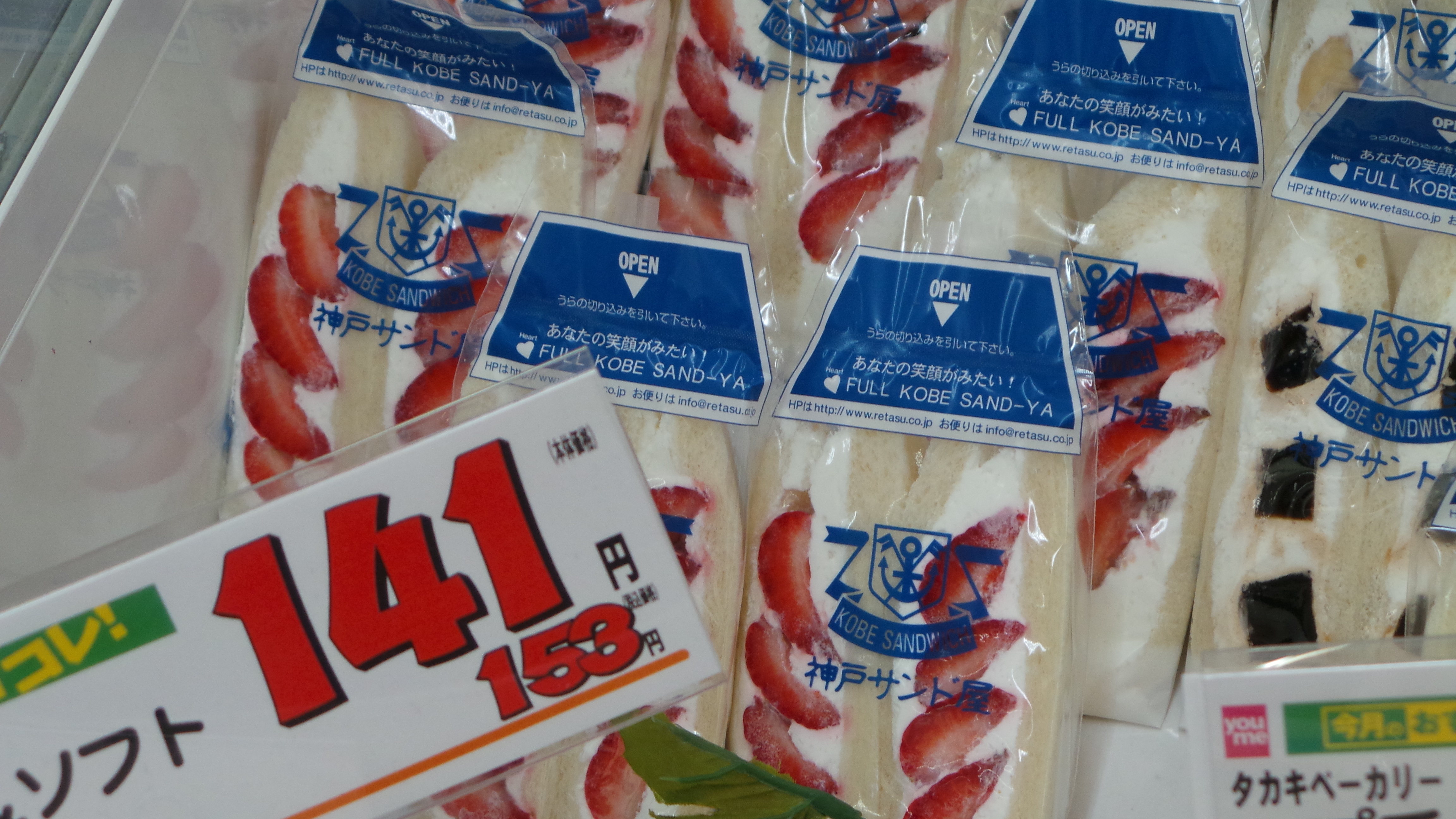
I went to the supermarket to photograph a bento box, but they had completely sold out. So instead, here is a photograph of some strawberry and cream sandwiches:

20140713_115654

Anyway, I have a bus to catch. Next stop: Fukuoka.

Twelve Hundred Monkeys

Super Typhoon Neoguri is planning to slam into Kyushu in two days time. Bringing with it rain, wind, high tides, and destruction. Looking at the predicted trajectory, the eye of the storm is where I was yesterday, Nishioita Station. All of last night I was woken up by heavy thunder and flashes of lightning all around me. Since 4 p.m. yesterday afternoon it hasn’t stopped raining. Water on the pavement outside pours downhill toward the ocean. Typhoon ‘Wild Raccoon’ is coming.

eyeofthestorm[1]

On a much lighter note, I spend about half an hour drying my shoes with a hairdryer; before heading to the station. My shoes are still soaking wet. What a waste of time. At Beppu Station the rain suddenly stops and a little bit of sun comes out. I decide that I should probably go to the Monkey Park and Forest Therapy Road, while I still have the chance.

As I wait for my bus a 68-year-old Japanese woman approaches me and asks me the usual questions. “Where are you from?” “What is your age?” “Do you know Elizabeth, the Queen?” She is quite polite about it, however, and I am somewhat relieved when my bus finally arrives. The 68-year-old woman thanks me for that chat, and apologises for bothering me. I reply with my favourite Japanese phrase, “Tondemo gozaimasen.” It is a super polite expression meaning ‘no problem’. She is surprised to hear me say it.

The entrance to Mount Takasaki Monkey Land National Park is at the bottom of a mountain. The mountain is 628 metres high, and the monkeys are about halfway up. I pay my ¥510 entrance fee and begin to walk the rather easy path. There was an option to pay to take a small train to the top, but I would rather walk, immersing myself in the atmosphere of the woods.

monkey_steps[1]

I get to some stairs and there are wild monkeys wandering around all over the place. A sign tells me, “If you look into their eyes, they will perceive this as a threat and they will attack.” Not looking into their eyes is actually harder than you might think. At the Monkey Park there are Japanese monkeys everywhere. Just over 1,200 monkeys, to be almost exact. They wander around by my feet, pretending not to notice me, or just not caring about me being here.

There is a staff member speaking Japanese on a microphone. Randomly all of the monkeys in every direction scream, this occurs maybe every minute or so. The sound is deafening. It turns out I have arrived just before feeding time, and the monkeys are screaming because they know this and want their food.

feeding[1]

A crate of food is brought out and the screams get even more intense. From every direction monkeys run toward the food. The member of staff takes the makeshift wheelbarrow carrying the crate of food, and runs away from all the monkeys. They chase him, jumping into the crate to grab food before jumping out again, satisfied.

The monkeys find their own little private spots to enjoy their food. One sits down right next to my foot and munches on a miscellaneous vegetable; another monkey swings back and forth on a swing. I wander around taking photographs of monkeys before heading back down the mountain. I was hoping to go to Forest Therapy Road, but it turns out that the path up the mountain was the magical healing forest.

swing[1]

The next bus to Beppu is in forty-five minutes time. Not as lucky with the bus as I was yesterday. Through the mask of clouds in the distance I can make out Beppu Tower. It doesn’t look too far away so I begin to walk. Some 4.3 kilometres later and I arrive at the supermarket near my hostel. Inside, I head to a restaurant and have a delicious lunch of raw tuna and fried salmon on a stick.

Back at the hostel I watch the television show that aired on Fuji TV on Saturday, Moshimo Tours. I am on screen during the very opening scene of the show. I also appear in the background at the very end. I was going to share the link but it has already been removed from YouTube. Instead, here is another poor quality photograph of my computer monitor. I promise the next photograph will be better.

moshimoto[1]

After watching the show, I take a bicycle and travel for a few hours with no real destination. It suddenly becomes really foggy in Beppu. I start to head back to the hostel, just as the first few drops of rain begin to fall. I grab a snack (a cake) from Seven Eleven and retire to the hostel computer to research typhoons.

Reid Wiseman is an American astronaut living on the International Space Station. He took this photograph of Typhoon Neoguri. In a few hours it will hit the tiny island of Okinawa. Then a day after that it will come to Kyushu, the island I am on. If its course stays the same, it will pass directly through Beppu.

space

After a discussion with some of the locals, I’m undecided on whether to stay here in Beppu or take the train further north. Beppu has mountains behind it, which might act as a shield against the onslaught of wind. The exact path of the typhoon can easily change. Considering its size, most of Japan is likely to face the worst of it anyway, so attempting to escape it might have the opposite effect.

I think about the people in Okinawa. I also think about the monkeys on Mount Takasaki. Probably two of the worst places you can be during a Super Typhoon; on a tiny island, and halfway up a mountain.