The Golden Reptile

With a new home comes a new train station. Today, I head to the nearby Minowa Station and take the Hibiya Line. At Kayabacho Station, a man runs out of the train as the doors close, trapping his foot. He falls over, smashing his face on the platform. The doors re-open, he gets up, and walks away calmly, as if it didn’t happen. The train is also full of screaming babies, which is endlessly annoying. I much prefer the calmness of the Ginza Line. I remain on the noisy train for as long as I can stand; which happens to be twelve stops later, at Hibiya.

“I’ve never been to Hibiya before, but the area seems to take its name from a train line, so I’m hopeful I’ll find something interesting here. Inside the station, the yellow area information map presents a world of endless possibilities. There’s the Passport Centre, the Imperial Hospital, or even the Diet Building. Instead, I opt to explore Hibiya Park. As I approach the park’s entrance, a group of marathon runners rushes past me. In the distance, I hear the sound of megaphones. Inside the park, a festival.

theyliketrains[1]

Today marks the 21st Railway Festival. On the main stage, a big yellow mascot, shaped like the front of a train, dances around energetically. Market stalls are brimming with train-based information and souvenirs. Adults form queues, eager to have their photographs taken with various images depicting trains through the ages.

A crowd of people stands silently, engrossed in taking photographs, so I head over to investigate. A man holds up a sign that reads ‘On Air.’ A complete film crew is present, recording for a channel called Ch.546. They are filming a segment focused on the railway festival, featuring what seems to be a Japanese idol displaying a remarkable enthusiasm for trains.

onair[1]

The bustling stalls attract a steady stream of people, children brimming with excitement, and families enjoying picnics. Despite the event being a railway festival, the only physical trains in sight are on a miniature track featuring characters like Thomas and Percy from Thomas the Tank Engine—a ride that children happily pay an overpriced fee to experience.

Deeper into the festival grounds, a queue of over a thousand people forms for a live music event. I decide to continue my stroll through the park, which turns out to be quite charming with its fountains, ponds, and well-tended gardens. After a while, feeling a bit bored, I decide to leave and make my way to Ginza. Here, I indulge in the familiar tranquillity of the Tokyo Metro Ginza Line until I eventually arrive at Ueno Station.

Today marks the 31st Kappabashi Kitchen Festival. I start my journey from Ueno towards Asakusa, walking through the bustling Kappabashi Kitchen Town. The place is crowded; too many cooks.

kitchenfestival[1]

This area is a hub where all the kitchen shops in Japan are clustered together. It’s the primary destination for purchasing kitchen products in the country. The festival serves as an avenue for shopkeepers to sell off their summer inventory at discounted rates, making room for their winter stock. Prices have been significantly reduced, resulting in a rush of shoppers clamouring for bowls, knives, pans, and even shop signage. Meanwhile, the enticing aroma of delicious food from various small stands fills the air.

I swim through bustling crowds until I spot a group of people capturing photographs of a statue—a golden kappa.

goldkappa[1]

The kappa has evolved into the official mascot of Kappabashi Street, although the reason might not be immediately apparent. One story suggests that ‘kappa’ translates to ‘raincoat’ in Japanese, as many merchants used to hang their wet raincoats out to dry on a nearby bridge. Another tale revolves around a merchant named Kappaya, who supposedly constructed a canal in the area to manage floodwater. Consequently, the street was named after him to honour his contributions. However, as time passed, these origins faded into obscurity, and now the street is simply associated with the homophonically named kappa—a mythical frog lizard—replacing historical roots with legend.

At the Asakusa end of Kappabashi Street, I make a brief stop at Cafe Byron Bay for a radio interview with the Japan FM Network, discussing vending machines. Interestingly, the interview won’t be broadcast until next month, and despite being recorded in Tokyo, it’s to be aired everywhere except here.

Turning the corner from the cafe, I’m greeted by the commencement of festivities—traditional Japanese taiko drums echoing through the air.

streetdrumsyetagain[1]

As I finally depart from the festival, the resonating beats of the drums linger in my ears. Heading back towards Minowa, the rain begins to fall—another typhoon approaching. Quick to act, I grab some snacks from Seven Eleven and opt to seek refuge in my apartment for the evening, bracing for the impending storm.

The Other Side of the Tracks

I say goodbye to Nagoya after spending five days there, realising that I could have used my time better, particularly during three of those days. The travel costs me ¥1950 and takes two hours. During the train ride, I manage to read over half of my new book, ‘South of the Border, West of the Sun.’ Interestingly, it is around the time I change trains at Toyohashi Station that a scene in the book unfolds in Toyohashi itself. I’ve nearly given up trying to attribute too much thought or meaning to these coincidences.

I arrive at Hamamatsu just before two. I would have arrived a bit earlier if two of my trains hadn’t been running late – not very Japanese-like. It’s unexpectedly warm outside. Sitting on a dull, air-conditioned train is quite deceptive, especially after the frankly terrible weather in Nagoya for the last few days. I immediately notice the distinct lack of tall buildings here.

I find my hotel on the map, it is probably a five minute walk. I take an unnecessary shortcut through a small shopping arcade. There are no voodoo dolls hanging here, but there might as well be. Every shop is closed or abandoned, and there’s no music playing. “Welcome to Hamamatsu,” I mutter to myself.

hama2

I notice that a significant number of signs here are in Portuguese. “Você está aqui,” says the map. Perhaps Hamamatsu has a large Portuguese-speaking population. My suspicions are somewhat confirmed as I pass a Brazilian imported goods store and a small boarded-up Portuguese restaurant.

Opposite the front door of my hotel is a construction site. However, it seems to be a day off because there are no workmen with flashing red sticks. Inside the hotel lobby, there’s a cream grand piano. It serves as a nice centrepiece for the room, but it also appears slightly lonely and seldom used.

I can’t check in for another twenty minutes, so I leave my bag and take a quick walk around the block. Behind the hotel, there are some incredibly old-looking Japanese houses. I can’t quite tell if they’re still inhabited or not; they seem to have weathered quite a bit, as if the Big Bad Wolf has paid them a visit.

brokenhomes

On this side of the train tracks, I count two Seven Elevens and one Family Mart. Every now and then, the pavement bears etchings of musical instruments; they look old and worn, as if they were made many years ago.

At 3 p.m., I check in. This is the second hotel in Japan where I’ve stayed without any wireless Internet. I can’t believe it. The building itself resembles more of a block of apartments than a hotel. I decide to rent the hotel’s laptop for both nights at ¥500 per night, which is actually not that bad.

My room provides only the basic amenities, but the hotel does have ¥180 cans of beer on the vending machine floor, although it’s only Kirin Beer. The hotel information seems quite standard, except for one exciting detail: “We offer free curry and rice from 17:00 to 20:00.” There is a neat, hand-drawn ink line through this particular piece of information. Not available today, it seems.

The laptop itself loads sluggishly, which is a common issue I’ve encountered in Japan. It’s so old that it doesn’t recognise my camera, preventing me from uploading any photographs. I search for the nearest Internet cafe and after a considerable effort, it finally locates a Popeye Media Cafe. Perfect.

I head toward the Internet cafe, taking the underpass beneath the train tracks. On the other side, I’m greeted by shrubbery and flowers; it’s like entering a different world.

hama1

The area here is bustling with shops, restaurants, and people—a lively hub of human life. I navigate using a photograph of the map and the GPS on my camera. In Japan, pedestrian crossings typically emit a loud drone or a repetitive beep-beep, beep-beep, or one of two tunes, all permanently etched into my memory. However, not in Hamamatsu. Here, classical music resonates from the loudspeakers. I cross the road to the tune of Chopin’s Nocturne in E-flat Major, Op. 9, No. 2.

After some time, I finally arrive at my destination, thanks to Google. Looking around, I realise I’m in the middle of the woods. Insects buzz loudly and mechanically around me. Surprisingly, there’s not a media cafe in sight.

I walk through the woods for a while and stumble upon a castle. There’s always a castle, it seems.

hamcastle

It’s half past five, yet the castle gate stands wide open, tempting me to wander inside. This is one of the smallest castles I’ve come across—deserted, with only the castle tower and gates standing tall.

Right next door to the castle sits the Hamamatsu Municipal Museum of Art. They’re hosting a special exhibition for the next two weeks: ‘The Genesis of Ultraman 1966-1980.’ How interesting.

To return to the main roads, I need to trek through the Sakusa Woods. Roughly five minutes into the woods, a Suntory Boss vending machine appears, offering either a welcome reward or a disruption to the tranquillity, depending on one’s perspective.

bossofthewoods

After ten more minutes, I might be lost in the woods. Endless loops of footpaths and stone stairways wind back and forth. Occasionally, I catch glimpses of the city through the trees. However, every turn I take towards it seems to carry me further away.

After twenty minutes, I find myself back at Hamamatsu Castle. From there, I retrace my initial steps and eventually discover an exit. It’s no wonder this small castle has survived for so many years. None of the advancing armies could locate it amidst the tangle of woods.

Abandoning my search for the media cafe, I make my way back to the train station. Along the way, I pass by a massive Yamaha store, the Watanabe Music Company, a shop named Viola, and three guitar shops. There’s an unmistakable musical vibe to this city.

At the station, I make my way towards what appears to be the tallest building in Hamamatsu, known as ‘Act City.’ It turns out to be a vast concert hall, but the next performance isn’t until Friday. I ascend the steps to an area named ‘Chopin Hill’.

actcity

Standing proudly atop the steps is a statue of the Polish composer Frédéric Chopin—a 1:1 scale replica of the famous bronze statue crafted by Wacław Szymanowski. Interestingly, the original statue resides in Warsaw, which happens to be Hamamatsu’s sister city.

I stroll to the open terrace and enjoy a splendid view of the train station below. The city appears lively from this side of the tracks, even quite beautiful.theothersideofthestation

I head to Seven Eleven for some food and decide to sit outside the shop for thirty minutes, making use of their free wireless Internet to upload my photographs.

Just after 7 p.m., I leave the land of the living and return to the side of the train station that contains my hotel. The atmosphere is eerily silent. On my way back to the hotel, I encounter only one other person—a young woman who, amidst the desolation, could easily be mistaken for a ghost.

There is one positive thing though, the pavement this side seems to be fairly new, and very flat. The perfect surface for running on, or for running away from ghosts.

Much Beppu About Nothing

I haven’t really done any touristy things during my last two days in Beppu. Instead, I have listened to far too much Blind Pilot and filled the rest of my days reading Haruki Murakami. In the evenings I have visited bars. On Friday night I got to the semi-finals of a Table Tennis tournament, only to be beaten by Yojiro. Today I will write about general things in Japan.

Vending machines. There are far too many Coca Cola vending machines for my liking. One is too many if I am completely honest. As a non-consumer of this particular brand of misery (reasons: child labour, worker rights, pollution, murder), I often find myself cycling around looking for a machine with the Suntory Boss brand. The best vending machines offer Coffee Boss Rainbow Blend, and if I am really lucky, Boss Ice Creamy Latte.

Vendingboss[1]

Vending machine coffee in the summer is mostly cold. I have always enjoyed cold coffee anyway. In the winter, the machine changes and the can of coffee is hot. In the vending machine above, Coffee Boss Rainbow Blend is on a Price Down!

In Japan, there are far too many silly notices and signs in English; most have terrible grammar and bad spelling. Presumably these signs are mistranslated when they are put through Yahoo! BableFish. Google is surprisingly unpopular amongst the Japanese people. For news, emails, and searches, almost everyone here uses Yahoo! Here is an example of a bad sign:

Umbrellastand[1]

I like umbrellas.

Yesterday I met a vegetarian couple. They decided before coming to Japan that being a vegetarian here would be ‘too difficult’, so they have chosen to eat meat while they are here. I don’t quite understand this logic. Admittedly, vegetarianism is somewhat uncommon here. I find that simply learning to explain that you don’t eat certain foods will get you by. I have even seen people with printouts in Japanese explaining their dietary requirements. There are ways, and there are also plenty of amazing vegetarian dishes here too.

I think I have mentioned it before, but the streets here are littered with cats. Here are some cats:

Catseverywhere[1]

There are a lot of things I miss about England. Eating cheese. Crust on my sandwiches. Coleslaw. Sometimes I really wish I could sit playing the guitar for a few hours, but I don’t have a guitar here, maybe I can rent one. I also mentioned the stars before. Never visible. So strange. Maybe it is just because of the weather. When I finally see the stars I will probably write a huge post about it.

I went for a late-night walk in the ocean last night. The ocean here appears clear or blue, depending on the time of day. Sitting on the beach at midnight with a few beers, followed by a walk in the warm ocean — even at midnight, the air here stays warm. Even during heavy rain, the air remains warm. I’m uncertain about the winter; time will tell.

Here is the ocean in the day time. Very blue:

Bluebird[1]

Walking around at night with a beer and not breaking the law is also amazing. Convenience stores are everywhere, so if you cant find any nightlife, you can buy a beer from Seven Eleven, finish it by the time you get to Family Mart, buy a beer, finish it by the time you get to Lawson Stores, et cætera. Basically if you walked to every 24-hour convenience store in one area buying one beer at a time, you would get nicely drunk. I count eight stores within ten minute walking distance from my hostel.

I enjoy the lampposts and traffic lights playing happy tunes. I like being in Japan and being from England. When most Japanese people ask me where I am from, their attitude changes when I say England. It is as though I have uttered some code word that makes people more friendly. “Ah, from England! You know Sherlock Holmes?” The other night a Japanese salaryman bought me a drink in a bar, he said it was because he, “Likes England so much.”

Random things are placed on the streets here. This is inside Beppu shopping arcade. Spot the Carnival Cutouts:

Bignose[1]

There are things I don’t like. I dislike being tall. The number of times I’ve smashed my head into the top of a doorframe surprises me; I’m amazed I haven’t suffered a mild traumatic brain injury. Although, maybe I will ten years from now. I often forget the occasional English word. Whilst talking to someone, I might suddenly draw a blank on a word I should know. It’s like there’s a void in my head where the word used to reside. At other times, I unconsciously substitute a Japanese word for an English one without even realising.

I hate inconsideration, but who doesn’t. I am in a four bedroom dormitory room trying to sleep. Someone comes in, sits down on his bed and starts to eat from a bento box (a lunchbox style Japanese meal; commonly with sections for rice, pickled or cooked vegetables, and a type of meat or fish). He is eating chicken, but I don’t eat chicken. Now, my room smells of chicken, and amidst this olfactory assault, all I can hear is him chomping loudly on his food. The hostel has a dining area and a lounge area, so please refrain from eating chicken in the dormitory room. Additionally, some people insist on loudly packing their suitcase for about an hour at 7 o’clock in the morning. It shouldn’t take that long and can be done the night before.

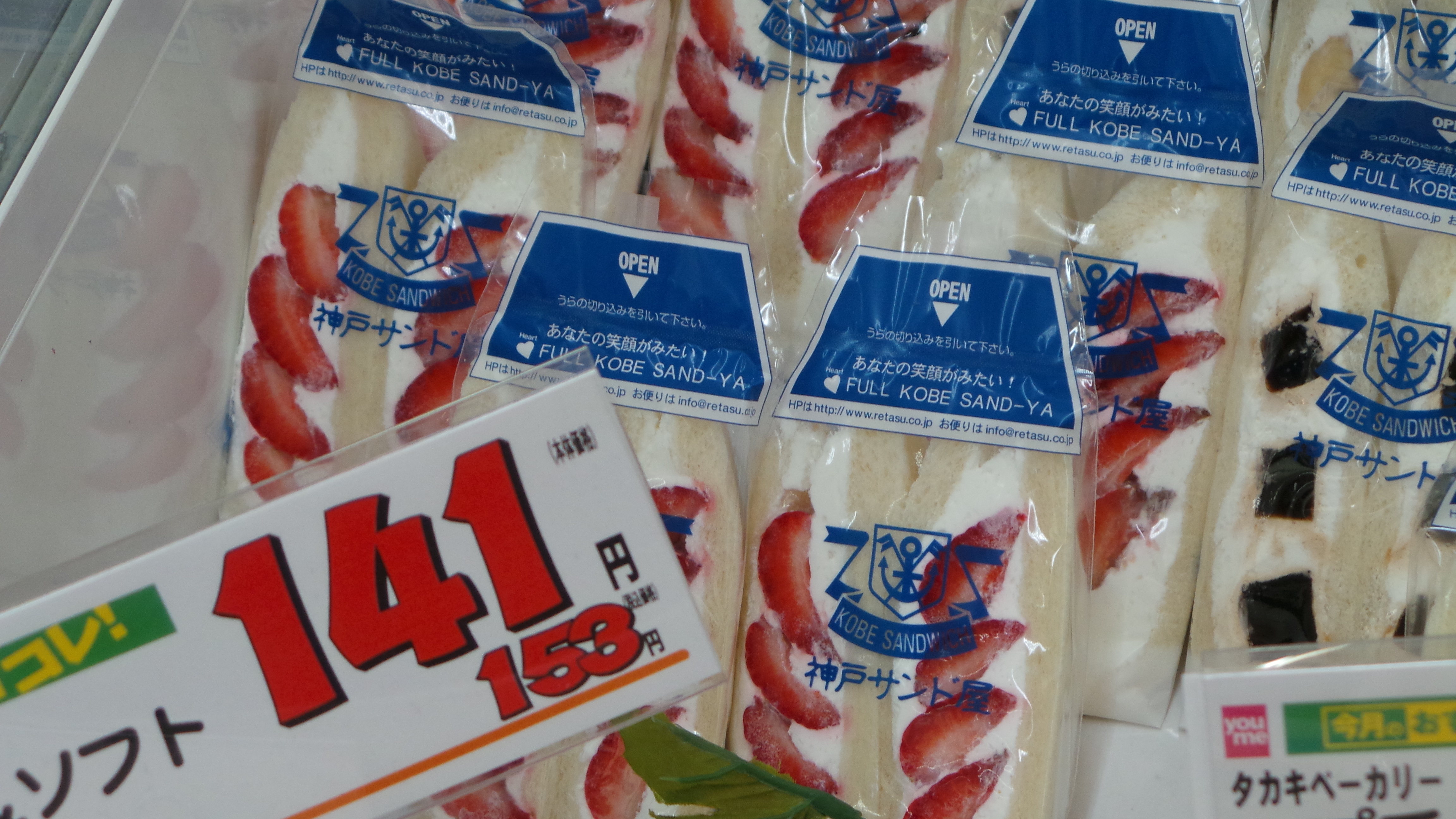
I went to the supermarket to photograph a bento box, but they had completely sold out. So instead, here is a photograph of some strawberry and cream sandwiches:

20140713_115654

Anyway, I have a bus to catch. Next stop: Fukuoka.

So Long, Tokyo, and Thanks for All the Fish

After a month of staying at the best hostel in the world (and finally memorising all nineteen stops on the Tokyo Metro Ginza Line), it is time to move on. The anticipation of spending eight hours on two different trains is something I lack. To avoid a whole day of travel I instead book a really cheap hotel at Kokura, which is the destination of the first of two trains.

At Tokyo Station, I purchase a ticket for the bullet train, the Shinkansen Nozomi. This high-speed train reaches speeds of up to 186 mph. After handing over my ¥22,310, I receive my ticket and proceed to the platform. I wait for thirty minutes while the train is cleaned in preparation for departure. The cacophony of noise from other platforms, announcements, station staff, and random whistles and bells floods back to me; I had forgotten just how prevalent it was when catching a bullet train.

seatontrain[1]

I take my ‘reserved’ seat by the window. The perfect seat. No one sitting next to me, and a plug socket for all my charging needs. If I had booked a ‘non-reserved’ seat, it would have meant queueing outside one of the first three carriages. When the doors open, it’s basically a free-for-all—first come, first served for seat selection. With my journey lasting an exact 4 hours and 48 minutes, rushing and fighting over a seat was out of the question. If no seats are available, you’re forced to stand up. Opting for a seat in a reserved carriage is well worth the extra couple of thousand Yen.

Back at my seat I weigh up the prices. A seven-day JR Rail Pass costs ¥29,110; this allows unlimited travel on all JR Rail lines for an activated seven-day period. Considering I still have a second leg of travel tomorrow (which will cost another ¥4000), the JR Rail Pass is a necessity if you are visiting Japan and plan to travel across the country. Travelling from Tokyo to Beppu will almost cost me the same as the seven-day pass.

this_taste_any_time[1]

The food cart eventually passes and I buy a packet of crisps for breakfast (Anytime, any where; right?) and a beer. I work my way through a third of Murakami’s ‘A Wild Sheep Chase’. Three beers later and I go for a doze. I wake up with an hour to go so listen to OK Computer. OK Commuter. I arrive at Kokura. My journey is an exact 288 minutes. Not a second more. Not a second less.

Kokura is located between Honshu and Kyushu; two of the largest of the four main islands that make up Japan’s geography. Honshu is the largest island, referred to as the Japanese mainland. It is the island that I’ve just left. Kyushu is the most south-westerly island, and where I am heading. Outside Kokura Station I am surprised to see a vending machine that for ¥650 sells unusual bottles containing fish in a brown liquid. I have no idea.

fishaction[1]

I am still reeling from the fish vending machine. With no sense of direction I find that my hotel is clearly marked on the Township Guide Map. Hooray! I take an unhurried walk carrying all of my stuff on my back for the first time in a month; I am sure it is heavier than I remember. I hate this kind of travel, moving to a hotel for just a day, then on to somewhere else. Nope. Book two weeks at a time minimum in the same place, that’s how I prefer it. I can take my time and take it all in. One thing a day. I don’t like to rush about.

After checking in to the hotel, I venture out for some food. Exhausted from the hours on a train and a few too many heavy nights of drinking, I grab some quick stand up sushi and head back to the hotel. The hotel was really cheap, ¥3400 cheap; and I understand why. The room is the size of a small cupboard. I can’t get the television to work, but luckily there are instructions in Japanese. I take a photograph of the instructions and my camera translates them to English. “Press and hold Power then press 3, 1, 3.” It works! I spend the night watching game shows and talent shows before falling asleep.

The next day (which is today, unless you’re reading this on a different day) 

I wake up to find time has moved the day to Sunday. To make up for my lack of updates I will continue on with this one. I’ve been merely socialising instead of sightseeing and feel a bit bad having not wrote anything for five days. I check out of the hotel early. Not to miss an opportunity, I head for Kokura Castle. The skies are hot and clear and I feel out of place with an umbrella and a rucksack. After seeing the castle, I head back to Kokura Station.

kokuro_castle[1]

No one I have met has spoken English in Kokura. I get through the ticket booking process by nodding and saying, “Hai!” I think the first question was, ‘single or return?’ The second was probably, ‘reserved or non-reserved?’ I receive my single reserved ticket; it costs me ¥4220 for 1 hour and 8 minutes on a train. This weekend is getting expensive and I still have to hand over ¥18,000 for two weeks at the hostel. On the way back, at least my travel time will be broken up by two-week intervals as I sweep back towards Tokyo. Between now and then I have 7 weeks of semi-planned stops along the way.

Beppu-bound on the Limited Express Sonic Train, I am glad for last night’s rest; having my own space and a bathtub were quite the treat. On the train I continue to read ‘A Wild Sheep Chase’ and find myself laughing out loud at regular intervals. The train journey flies by in no time at all.

beech[1]

I leave Beppu Station in awe. Beppu is by the sea and surrounded in every direction by tall mountains covered in wildlife. At my hostel I discover that I am a one minute walk from the beach and a two minute walk from Beppu Tower. As I hand over my ¥18,000, the woman at the reception desk finds it unusual that I am staying for two weeks. “What are you going to be doing for two weeks?” Take it all in. That’s how I prefer it. I don’t like to rush about.

It is Sunday and there is a nearby section of interesting intersecting streets filled with shops, bars, and restaurants; mostly closed. I find a vending machine selling not fish, but ice cream. I also find that my Suica card works on the vending machines here, a nice surprise. These little Japanese pre-paid cards can be used at Seven Eleven stores, some vending machines, and ticket barriers. I didn’t think they would work this far from Tokyo. The Pasmo card definitely doesn’t work. If you plan on travelling around Japan, always choose the Suica card over the Pasmo card.

pizzandwine[1]

I find a pasta and pizza restaurant with no English menu. I order a glass of wine and a pizza in Japanese. This is the first time I’ve ever felt I needed to speak the native language. In Tokyo I could get by just fine. Perhaps this is for the better; I got a little too comfortable and this might just give me some motivation to actually study a bit harder. The food costs ¥842 for the lot. At least I’ll save some money on food here.

Back at the hostel for 3 o’clock chicken time! I realise that I’m going to miss the crew in Asakusa; I’ve been missing a lot recently. I remind myself that this is not for here. Moving on I find my room; it is a traditional Japanese-style room with a Tatami flooring. Four beds, so sharing with just three others. Less crowded which is good. The view from the balcony is amazing. I can see Beppu Tower, which lights up at night. I can see a horizon of skyscraper obstructed mountains. I wonder which way the sun comes up; my sense of direction very much missing too.

tatamibed[1]

I explore my local surroundings. There is an international bar called Hot Bepper, it is thirty seconds away. You might think I exaggerate with my walking distances sometimes, but I can actually see the bar from the hostel. The bar has its very own table tennis table and is hosting a tournament next week. Hot Bepper is also run by the same company that runs the hostels I’ve been staying at. I like the pun name too, considering where I am.

I swing by the nearby Family Mart. An occurrence that will never fail to make me smile occurs. Staff at a convenience store greeting me through the door, bowing, saying thank you, bowing, and saying goodbye as I leave. Back at the hostel, I drink Suntory whisky highballs and write up the two days you’ve just read. I plan now to take a hot spring bath in the hostel’s very own hot spring baths; before heading out to the Hot Bepper bar, which will most likely be closed on Sundays.

Twenty-Four Hours in Japan

Sitting on a British Airways flight for thirteen hours with Suzuki-san, I land at Tokyo-Narita International Airport with a strong hangover and a profound but newfound knowledge of ballroom dancing. I was happy that I had someone to talk to during the flight, and Mr. Suzuki was happy because he got to practice his English. What struck me as odd, though, is that after two small Heineken beers, Mr. Suzuki handed me a pamphlet for his ballroom dancing studio, complete with a nice map and address. One Heineken later, he gave me a business card with his home address, telephone number, and email address. Japan must be the only country I have experienced that has such a high level of trust.

As I approach immigration at the airport, I notice a sign that reads, “Please refrain from physical contact with others, except for the staff.” I adhere to this unusual instruction and proceed to have my fingerprints and photograph taken. After a swift 90-minute train journey on the Narita Express, I arrive at Tokyo Station. Here, I make a seamless transition to what has always been my preferred railway loop line in Japan: the Yamanote Line. This remarkable train route encircles all the main stations in Tokyo, spanning 29 stops in just one hour—a line I aspire to traverse entirely on foot one day.

For now, I take a brief two-minute train ride from Tokyo Station to the following stop on the loop, Kanda Station. It’s at Kanda Station that I transfer to what will likely serve as my new home for the next month: the Tokyo Metro Ginza Line.

Finally, after a total of twenty-two hours of solid travelling, I step out of the subway, gaze across the skyline for a few seconds, and spot the second tallest structure in the world, as well as the tallest tower in the world, Tokyo Skytree. Standing a mere 634 metres tall, this will be my Polaris.

After finding my hostel with somewhat relative ease, I check-in. After a few moments I already decide that I have made the right choice to start my Japan journey here. “We offer free laundry powder,” the receptionist says in perfect English. “We also have a comic room!” he exclaims.
“A what?”
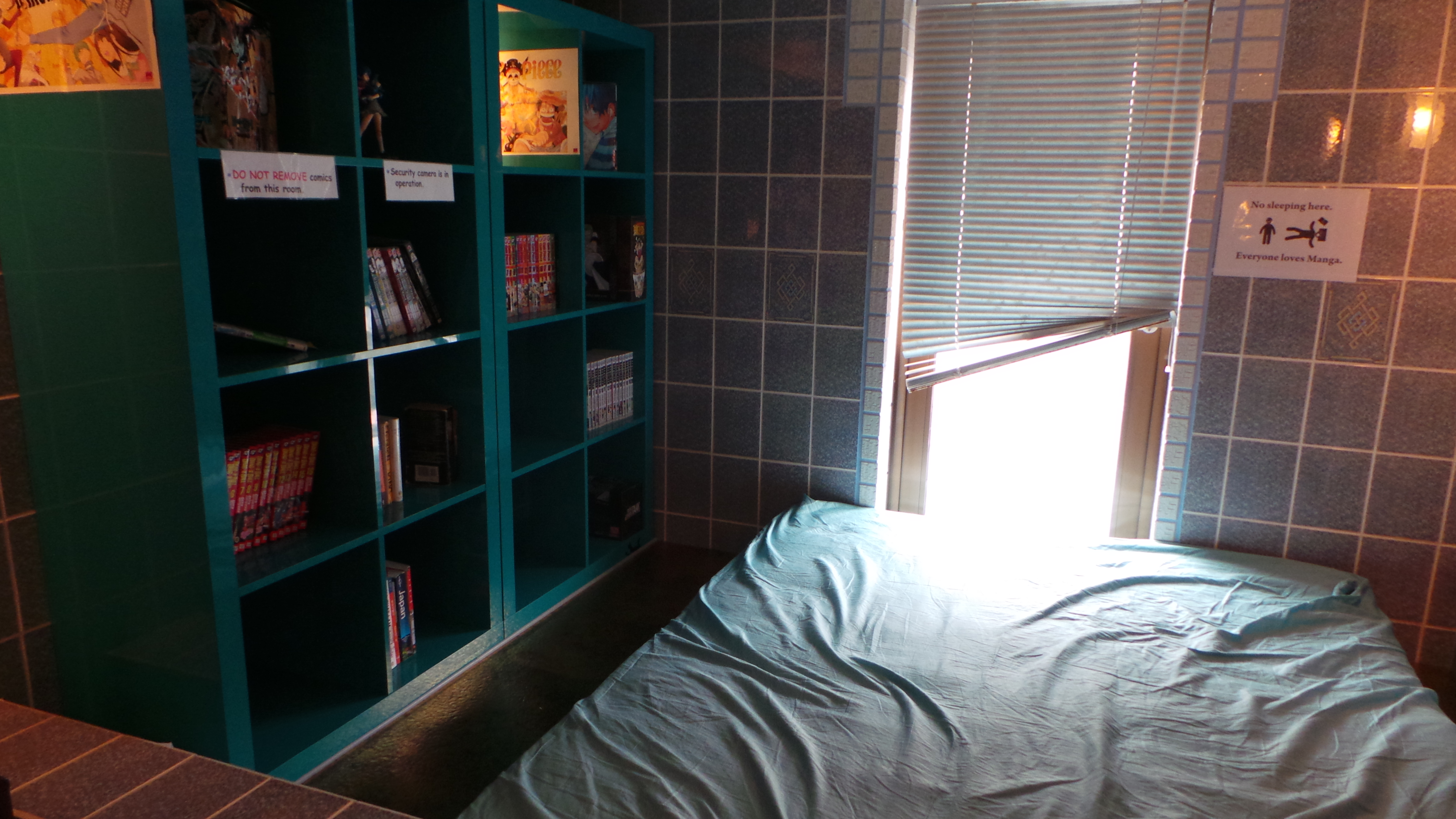
“A comic room,” he repeats. So up the lift we go, and he shows me to the comic room, with its free massage chair, and free manga comics.

Image

It is the official place to chill out and read manga comics, apparently. And it’s all free!

‘Free’ a word I will be hearing a lot of in the next few hours. The hostel has free tea and coffee, free laundry powder, free manga comics, free massage chair, free wireless Internet, free computers with free Internet, free toilet roll, and every Thursday, in a little room that doubles up as a whisky bar, is a free Jazz night, featuring excellent and professional Jazz musicians. Luckily for me, today is Thursday.

After finding my room and my amazing bed, I check out the facilities and find out that all the toilets in this hostel are made by Toshiba. I also find the hostel vending machines: one selling soft drinks and Boss coffee, one selling extremely cheap Asahi beer and 6% cider, and the other selling, ‘FOOD FOOD HOT FOOD 24 SEVEN,’ or so it says.

I relax in the hostel for a while reading one of the ‘free’ guide books. Eventually I team up with an Irish man, who is sharing my hostel room and whom I had previously met, and an American man. After a few beers we decide to head out for some food. The Irish man knows a great ramen shop across town, so off we go.

20140529_201217[1]

He was right, the ramen was amazing.

On the way back to the hostel for the Jazz night, the American spots a sign he had referenced previously that evening. It basically says free beer in exchange for some bar work, so we decide to check it out. I have been in Japan for less than a day and, although paid in beer, I have effectively landed a job.

Here, in this small back alley bar, Japanese men and women come to practice their English. My job is for thirty minutes to sit and talk to a Japanese lady in my native tongue. The moment I sit down a beer is poured for me, and it is on the house. Free beer brings the English speakers in, English conversation brings the Japanese customers in. A clever idea in a country that generally has limited to poor English speaking ability.

After thirty minutes of stop-start, but very enjoyable conversation, the bar owner asks the three of us to switch around. The Irish man gets put with the Japanese lady I had just been talking to; and I sit with a young Japanese man, probably in his mid-twenties. Another beer is poured for me, once again it is free.

This man has excellent English speaking ability, probably better than some of the native English speaking customers I have spoken to during my previous employment. He does not need to be here. I would argue that he is only in this bar to improve his confidence when speaking in English, however, this man has the confidence to come to this back alley bar, on his own; so I am not sure his confidence needs improving too much. Shortly into our thirty minute conversation he mentions a Japanese art and acting form called kabuki. Oddly, a few days ago I had watched an NHK World documentary about the subject, so from that, the conversation flows.

After our two thirty minute sittings, and my two free beers, the three of us head back to the hostel to find that unfortunately the Jazz has finished. However, the whisky is still flowing and the party in the Jazz club is far from over.

20140529_205706[1]

I don’t remember a great deal else from tonight, just that I leave in the early hours in a haze and head back to my room to sleep off almost 48 hours of being awake.

My first day in Japan.