Boatman Begins

Somewhere between October 23, 1868 and July 30, 1912, a discovery was made. What had previously been regarded as dangerous wilderness turned out to be one of the most beautiful places on Earth: Geibikei Gorge.

In Japan, they love a good top three. Night views, bridges, and today, gorges. Nobody explicitly states which of the top three is actually the best. Politeness says: make a top three list, and leave it at that. Geibikei Gorge is one of the top three gorges in Japan.
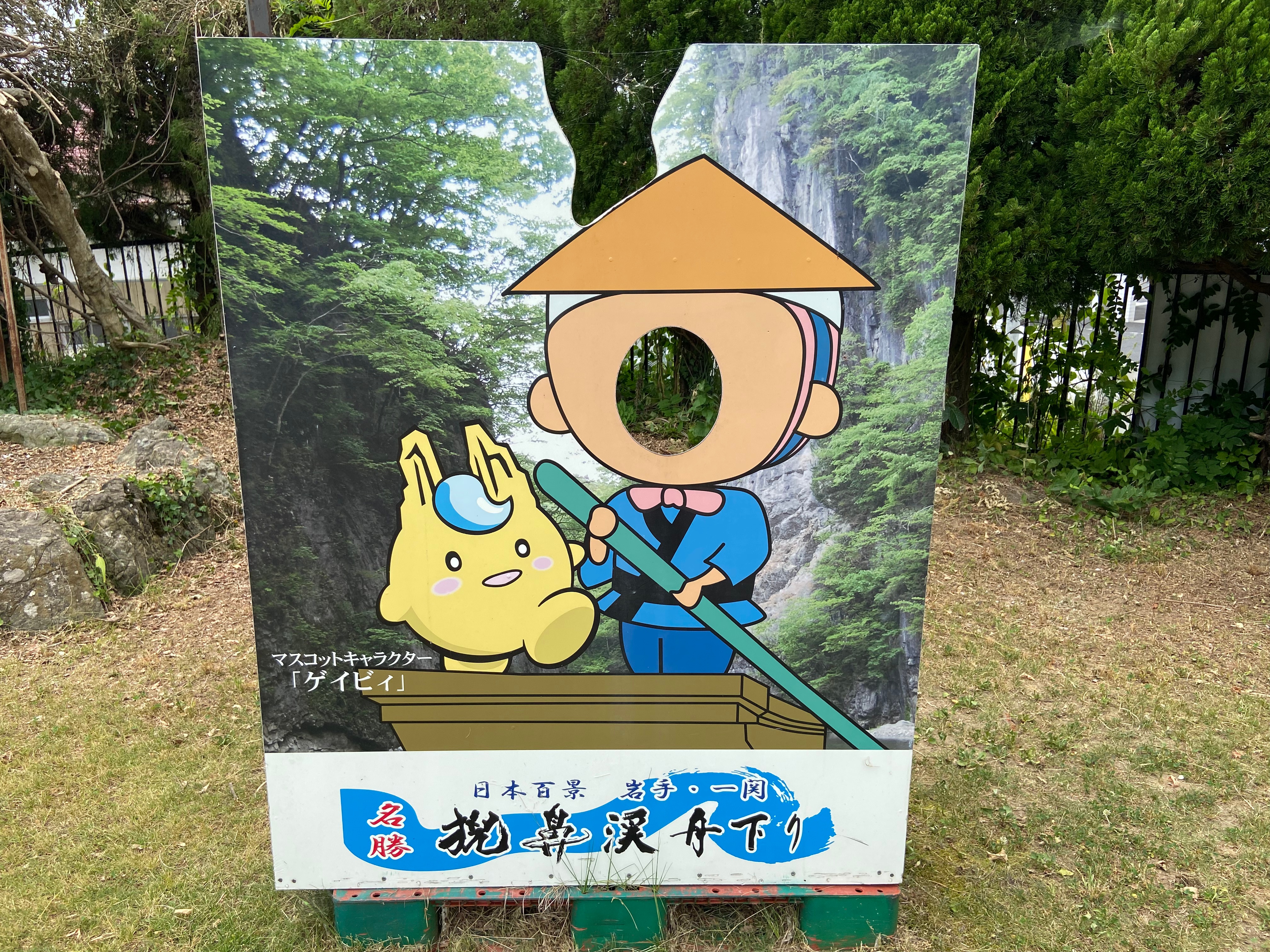
As well as being one of the top three gorges in Japan, Geibikei has also been designated a National Place of Scenic Beauty, a Natural Monument, and one of the 100 Landscapes of Japan. It certainly is one of the landscapes.

Geibikei Gorge (not to be confused with the similarly named Genbikei Gorge) is a 2-kilometre stretch surrounded by limestone cliffs. A river runs through it, so boats are required to fully explore it. The Satetsu River is a liminal, stillwater river. It flows neither up nor down. It just sits there like an ancient swamp. The only thing that interrupts the water is a boatman’s pole, or such nature as a falling leaf, the lapping of summer sweetfish, or the arrival of snakes.
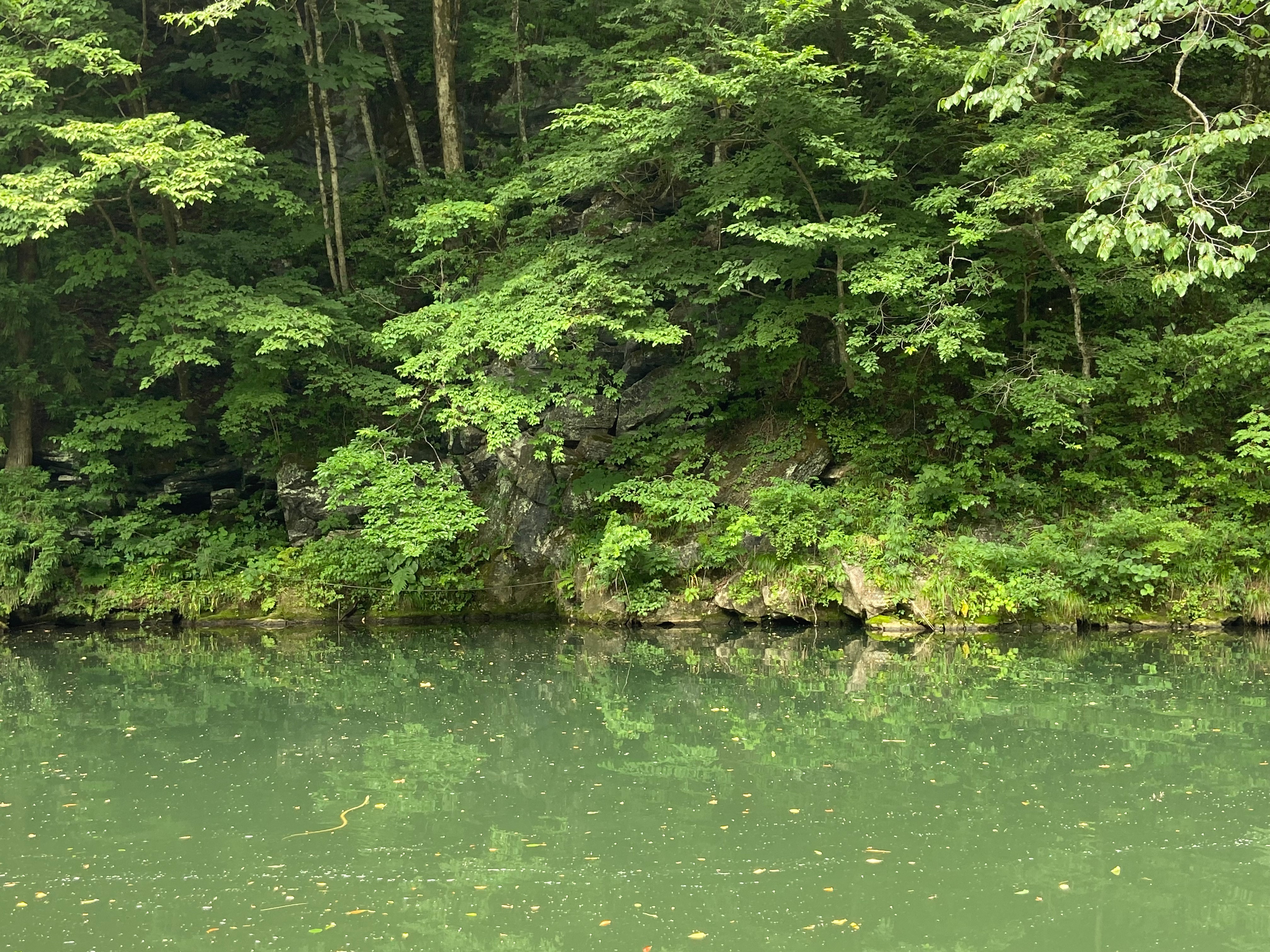
We buy some fish food in a little plastic bag, then sit on the boat, all 44 of us. The boatman introduces himself.
“Hello, I am Sato. Nice to meet you.”
Everyone applauds. Sato-san notices me.
“Hey foreigner, where you from?”
I tell him England. He just laughs and begins rowing, merrily. The snake swims away, frightened by the ripples of the boat. I realise that, after all the years living in Japan, I’d never seen a snake. This is now the second day in a row I’ve seen one, and I actually manage to photograph it.

I sit, gazing out. Sato-san interrupts the serenity.
“Hey foreigner, if you have a hat, glasses, camera …” he pauses for comedic effect, then mimes dropping the items overboard. “Oh no!” he exclaims.
He then repeats the same actions in Japanese before pointing and shouting, “The next rock!” Which is of course Kyomei-Gan (Mirror Rock), reflecting the sparkle of water off its surface like a giant mirror.
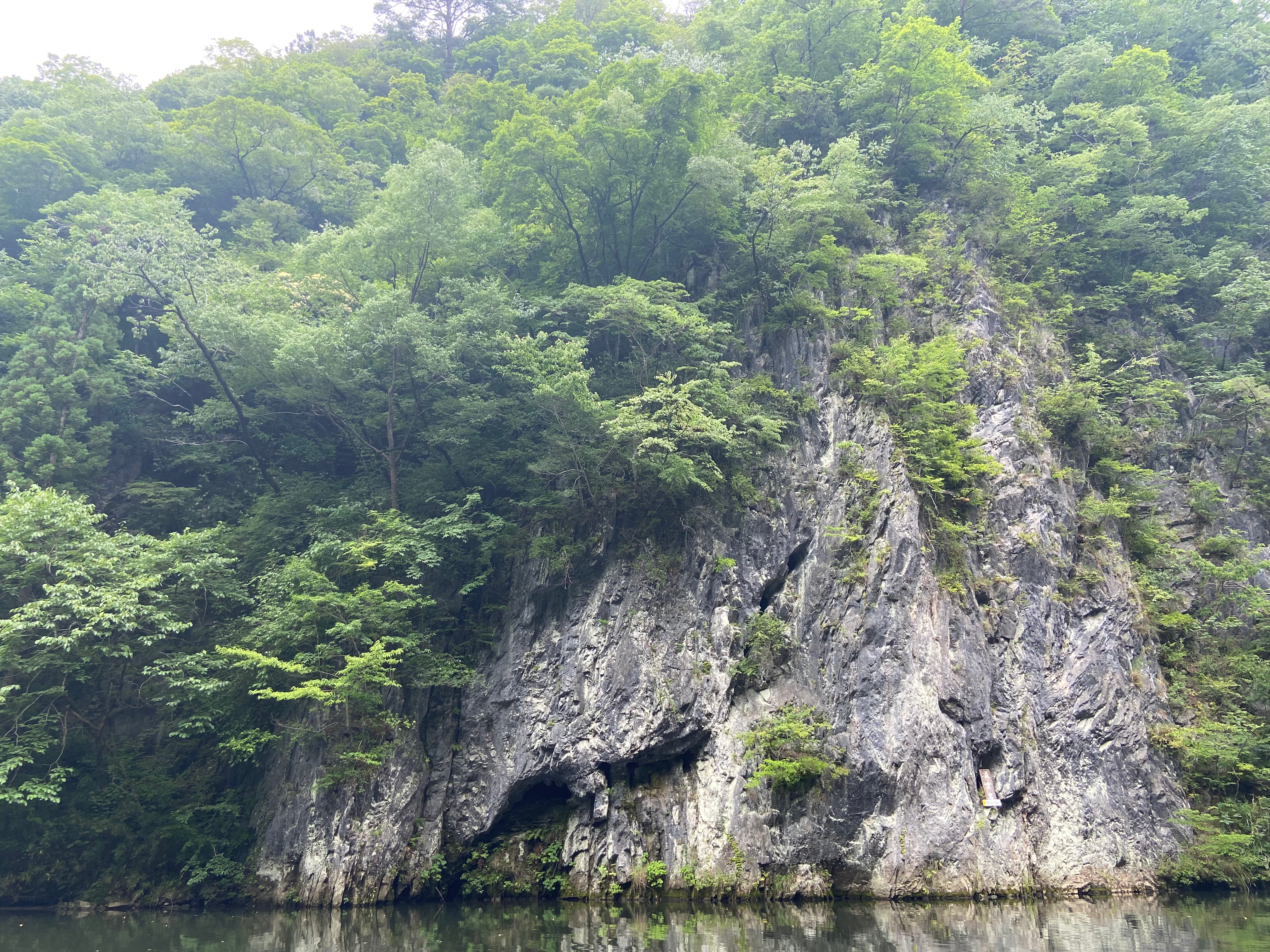
There’s a phrase I can’t quite remember. Something about the memory of a fish. I remember seeing fish, so that’s probably it. They’re clever and know we have food, and they gnaw at the side of the boat, almost jumping from the water. They follow us as we disturb the stagnant river.

It’s said the sweetfish leap in early summer, and the carp in autumn. One of the carp didn’t get the memo and shows up the moment I throw my stash of food into the river. The carp makes one giant leap, eats it all, and swims away. The sight of the fish is reminiscent of the Chinese legend, known in Japan as toryumon, in which carp become dragons after successfully leaping up a waterfall.

We carry on along the river. Sato-san is very enthusiastic. He slowly pushes the boat along with the wooden pole, but does so effortlessly. We aren’t rowing. We aren’t sailing. He just pushes the pole into the riverbed, presses ever so slightly, and propels us forward. The boat drifts for a moment, carried by the newly made current, then slows to a stop. He pushes again.

He points out various rocks along the gorge, makes jokes in both Japanese and English, and treats the 44 of us as an audience in his comedy routine. His confidence shines through, lightly heckling us, answering questions, entertaining us. The entertainment is so good that I almost forget about the view.
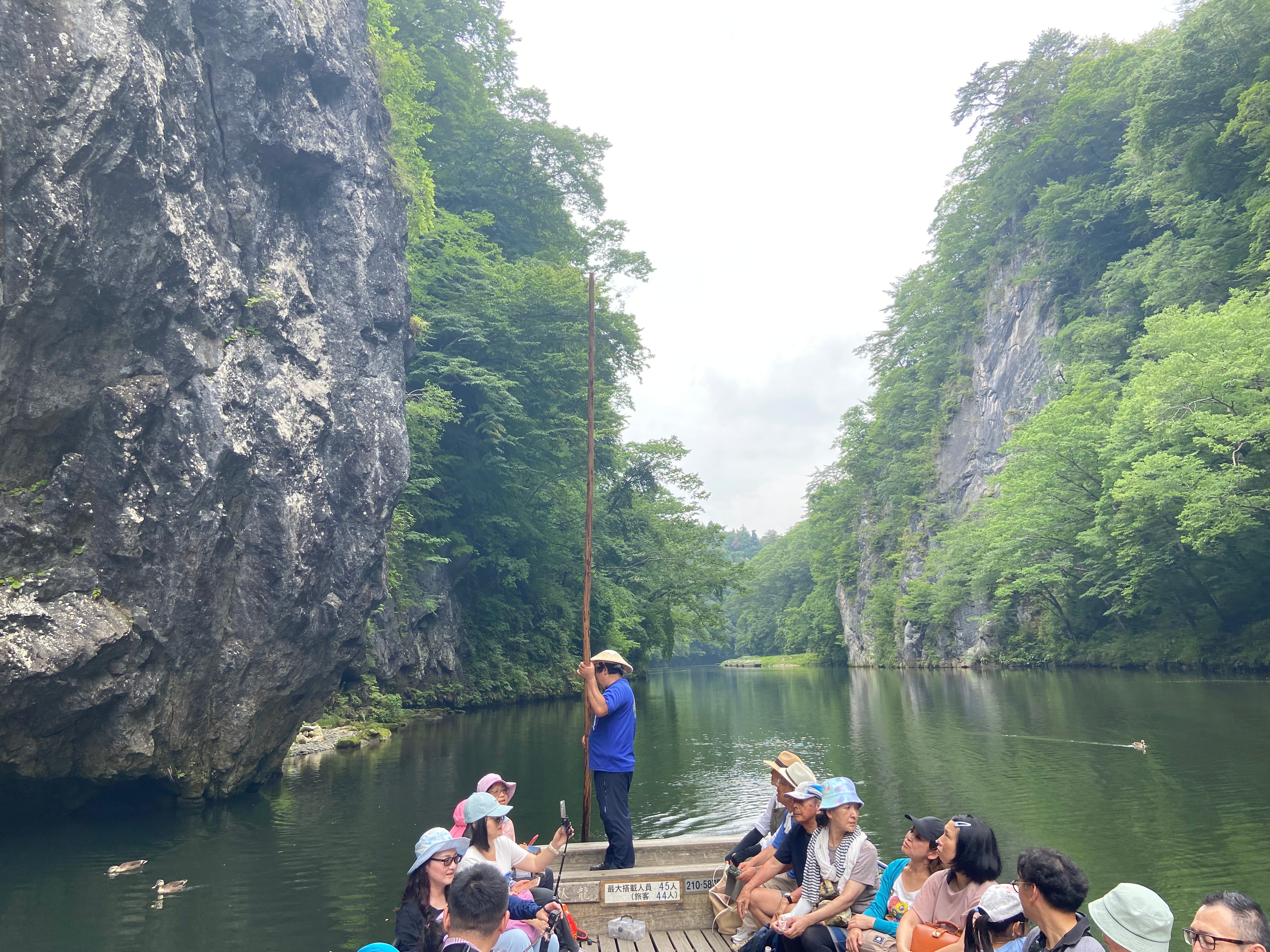
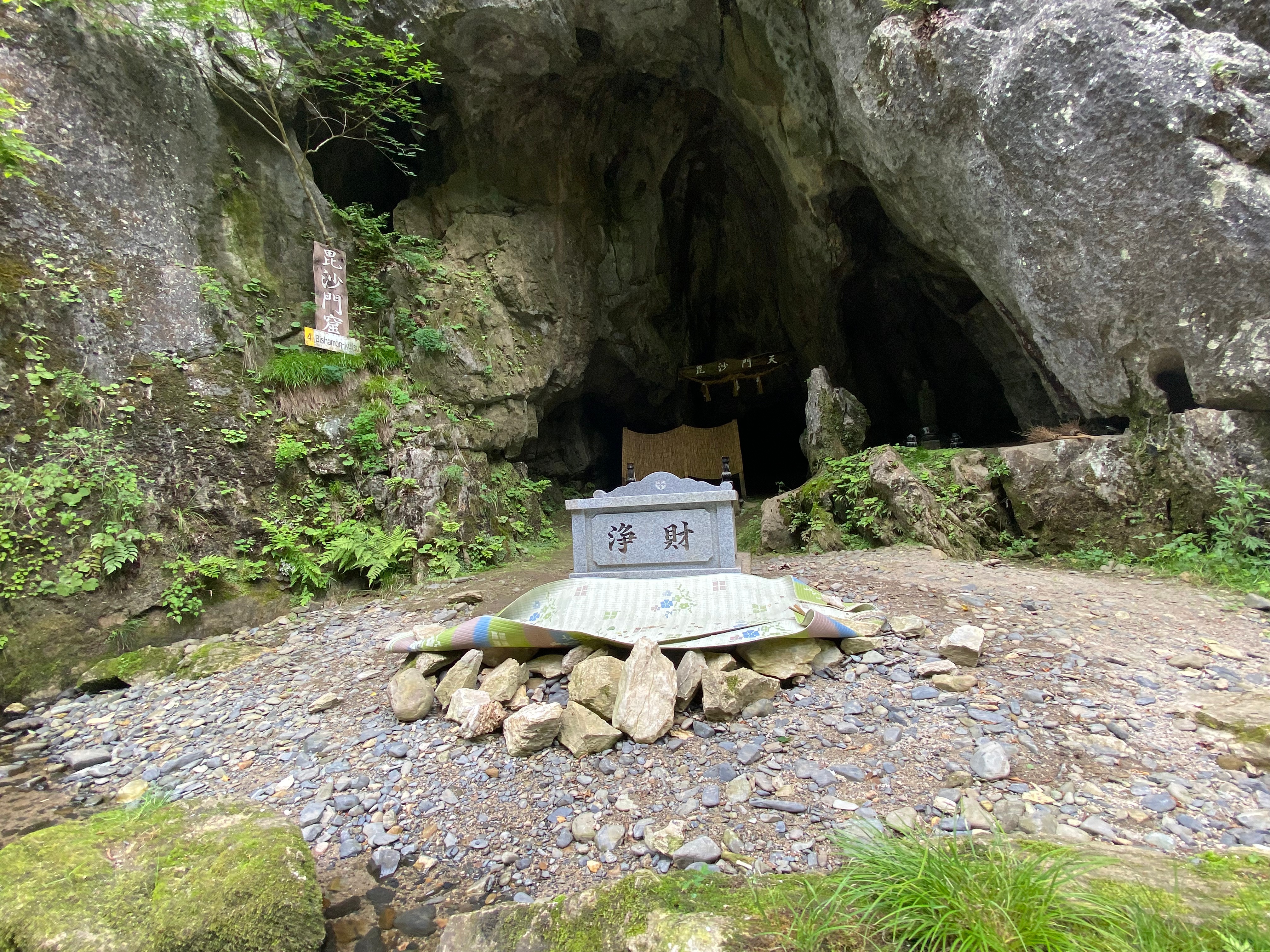
Further in, the sun splits open the sky directly above and the heat becomes immense. Some ducks appear, looking for food, and the fish still follow. We pass a small shrine in a cave dedicated to Bishamonten, the god of treasure. Everyone stands and throws their coins across the water to the shrine. Thousands of coins surround it. More gleam beneath the surface. It must be pretty easy being the god of treasure when people just hurl money at you.

We pass a man in a watchtower holding a Nikon camera. He shouts for us to say “cheese” before taking our photo. We pass another boat heading in the opposite direction and everyone waves at everyone else, like we’re in this together. I guess we are. So we continue on. It really is indescribably beautiful.
I take a moment to think, to contemplate, to evoke. Then I take some boatographs.

Thirty minutes into the boat ride, it’s time to make land and take a break. We glide over to a pebbled beach. Sato-san says something in Japanese, then turns to me.
“Hey foreigner, twenty minutes walking come back.”
I reply that I understand, in Japanese. The other 43 people laugh.

I see somewhere on the map labelled “Ninja Rock ??” but realise, when I can’t find it, that it’s a clever joke. I pass a rock shaped like a horse’s head, and at the very end of the expanse is Senryutan (Lurking Dragon Depths). A dragon is lying in wait for its chance to rise from being a Geibi carp, apparently. If you manage to throw an undama (pebble) into the hole, you’ll be rewarded with good luck. Apparently.
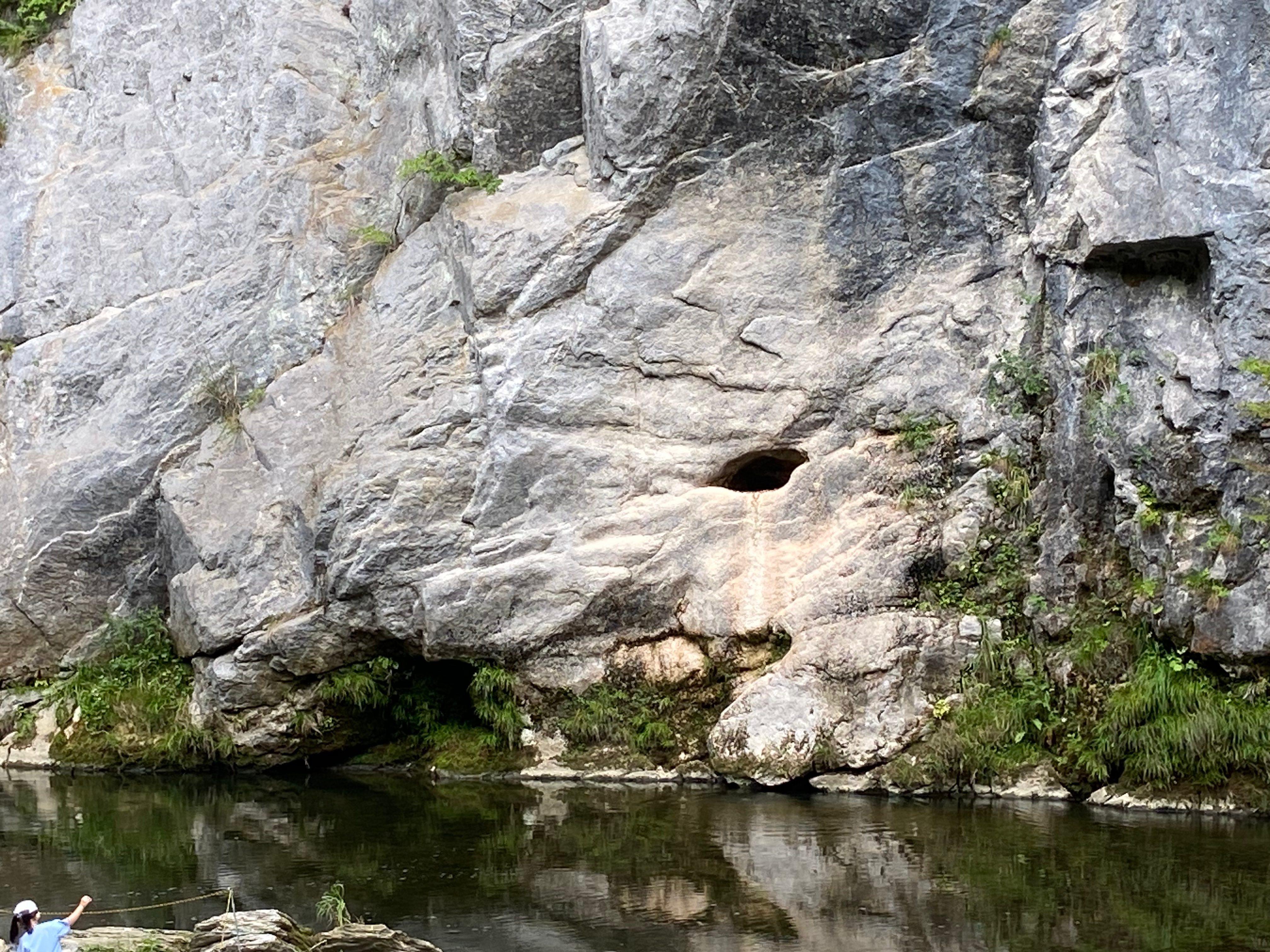
I walk around for a while before boarding the boat again. Eventually, everyone returns and sits in their original seat. There’s one seat empty that wasn’t on the way down. Someone has gone missing, but Sato-san makes light of it, then pushes the boat out once more. This time, instead of taking photographs, we just take it in. And instead of narrating or pointing at rocks, Sato-san begins to sing.
“Song time,” he says. “Very old time song. I do five or six minutes… maybe.”
He sings for twenty.

His voice transforms into something ancient, filling the gorge, lingering among the cliffs:

As I pole my boat,
on the clear waters of the Satetsu River,
the clouds,
that dull my heavy heart,
are dispelled,
by the Lion’s Snout.

His voice echoes long after the last note fades.
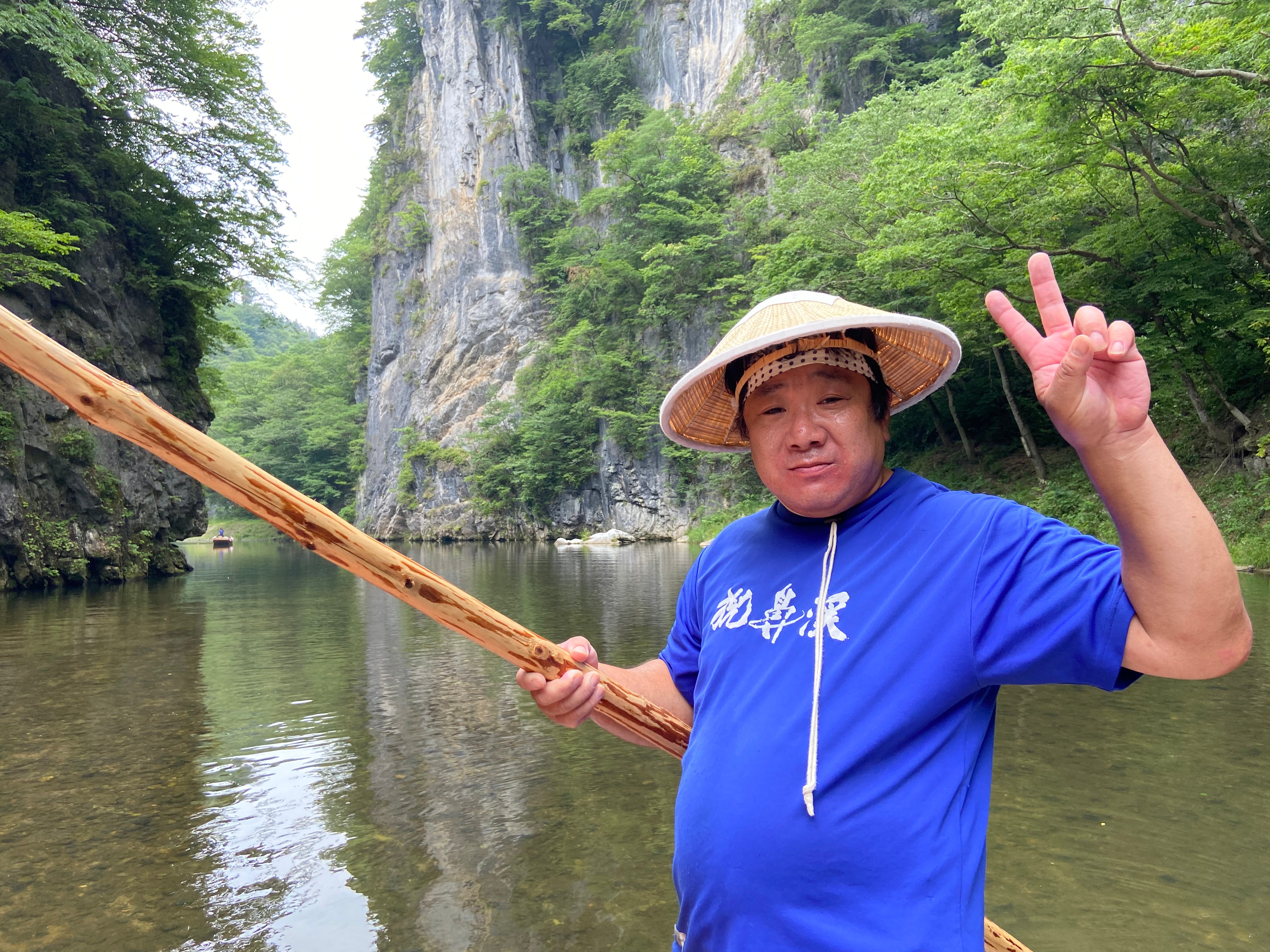
After singing, he looks exhausted, yet continues to carry us through the gorge in reflective silence. Nobody speaks. Even the water has quietened. I’m glad that of the multiple boatmen working today, that we were lucky enough to have Sato-san as our guide. His personality and comedic timing were a highlight, one of the most memorable experiences I’ve had in Japan.

After the boat ride ends, we drift back into the real world. The gift shop waits patiently. A vending machine hums to the tune of overpriced green tea. I leave and take a train back to Morioka, walking the quiet streets until I reach Hoonji Temple. I take off my shoes and enter the silence. Inside the main hall, 499 rakan statues sit frozen in time.
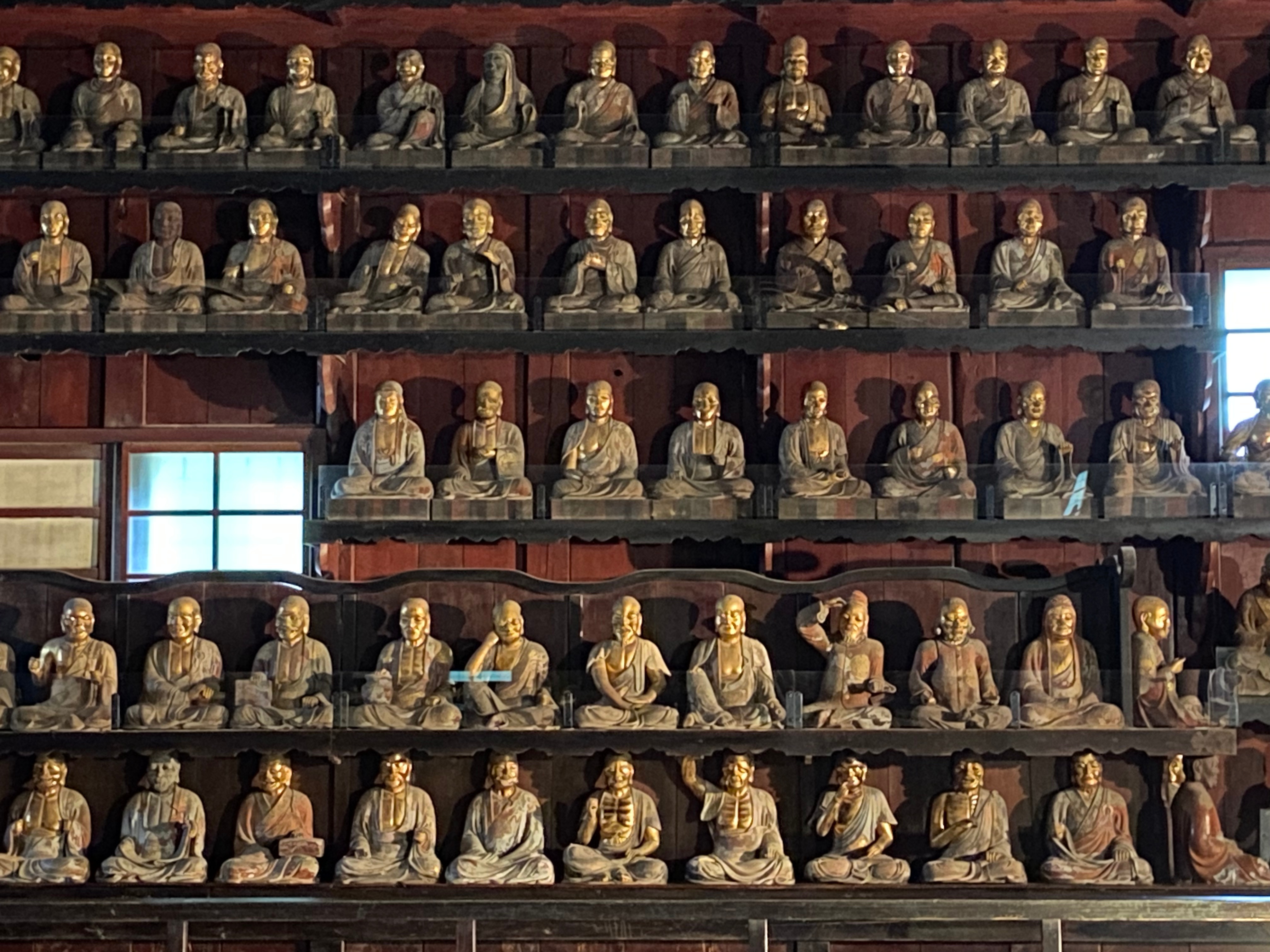
They were hand-carved three centuries ago by nine monks. Each statue is lacquered, lifelike, and unmistakably human. Some laugh. Some grimace. A few seem lost in conversation. It’s almost as though I can hear them talking to one another. One of them is definitely Tom Waits. Others are said to resemble Marco Polo or Genghis Khan. There’s an expression to match everyone.

My eyes, for whatever reason, are drawn to a rakan sitting quietly in the corner, with a face I know well. It’s not me. It’s Sato-san the boatman. He has the same smile and humour behind the eyes. I blink, but he’s still there.


I never did find the one that looked like me. Maybe I’m still being carved.
Castaways and Cutouts

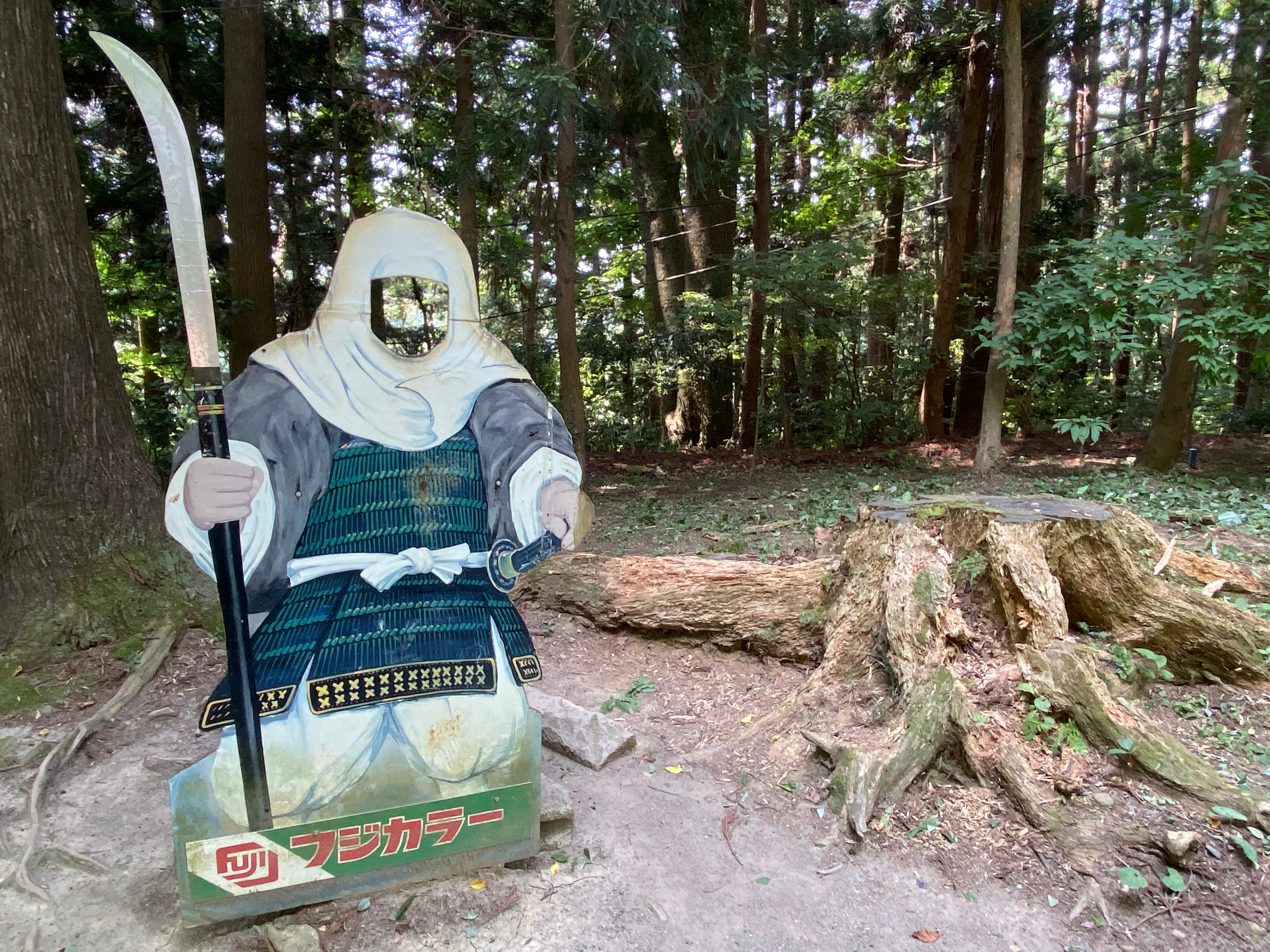
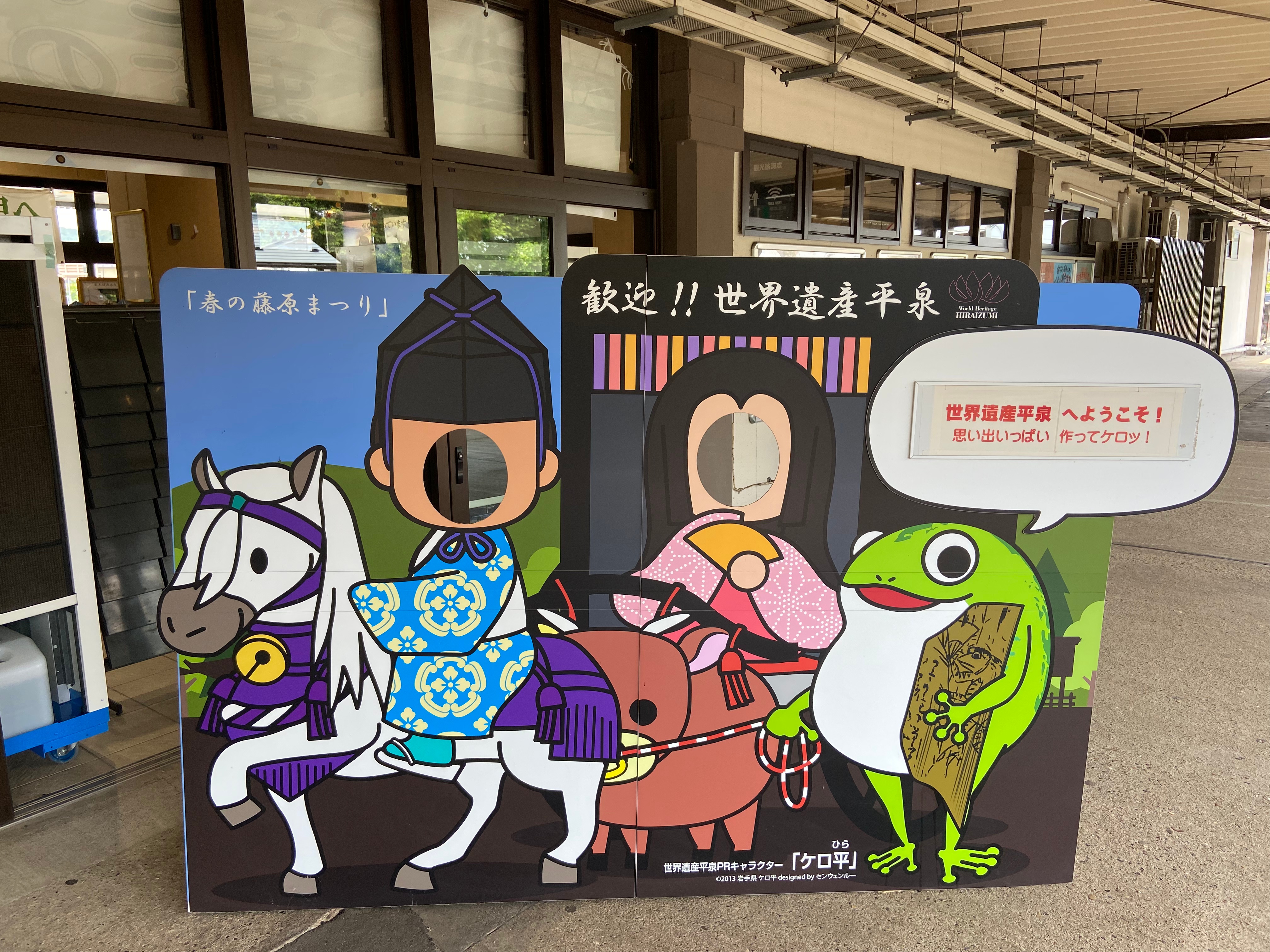
There’s a frog at Hiraizumi Station with the title of World Heritage Advertising Manager. His name is Kero-Hira. A speech bubble on the Carnival Cutouts cheerfully instructs, “Make lots of memories and relax!” He stands beside what appears to be a member of the Fujiwara clan riding a horse next to a woman riding a pig.

Today I’ve travelled a little further south, to Iwate Prefecture, in search of old ghosts and even older gold. I’m here to visit Chuson-ji Temple. Stepping past the frog and out of the station, the first thing I notice is the view of rice fields stretching out toward the distant mountains. The second thing I notice is the rack of travel pamphlets for Iwate Prefecture. One of them is familiar. Too familiar. It’s the same pamphlet I wrote ten years ago for a travel company I was working for at that time.

Having never set foot in Iwate Prefecture until now, it feels strange having already written about it in the past. That’s unfortunately how those travel companies operate, stock photographs and regurgitated information. I’m just fortunate enough to be able to visit these places as I am now, and use my own words and my own photographs.

It’s a twenty-minute walk to Chuson-ji Temple but I don’t mind it. The scorching summer sunshine is brutal and the humidity is high. Chuson-ji is a UNESCO World Heritage site that boasts two car parks, so I expect it to be busy. To enter, I must hike about ten minutes up a shaded forest path, lined with lush verdant trees of the cryptomeria variety. If I’m honest, I’m just pleased to be in the shade.

Before the main temple hall, there is Jizo-in, a smaller sub-temple. This temple features a picturesque Japanese garden. However, and as is often the case in life, the moment can’t be truly enjoyed. A man and a woman with leaf blowers fill the splendour of the garden with mechanical shrieking. The serenity is soundtracked by smug futility.

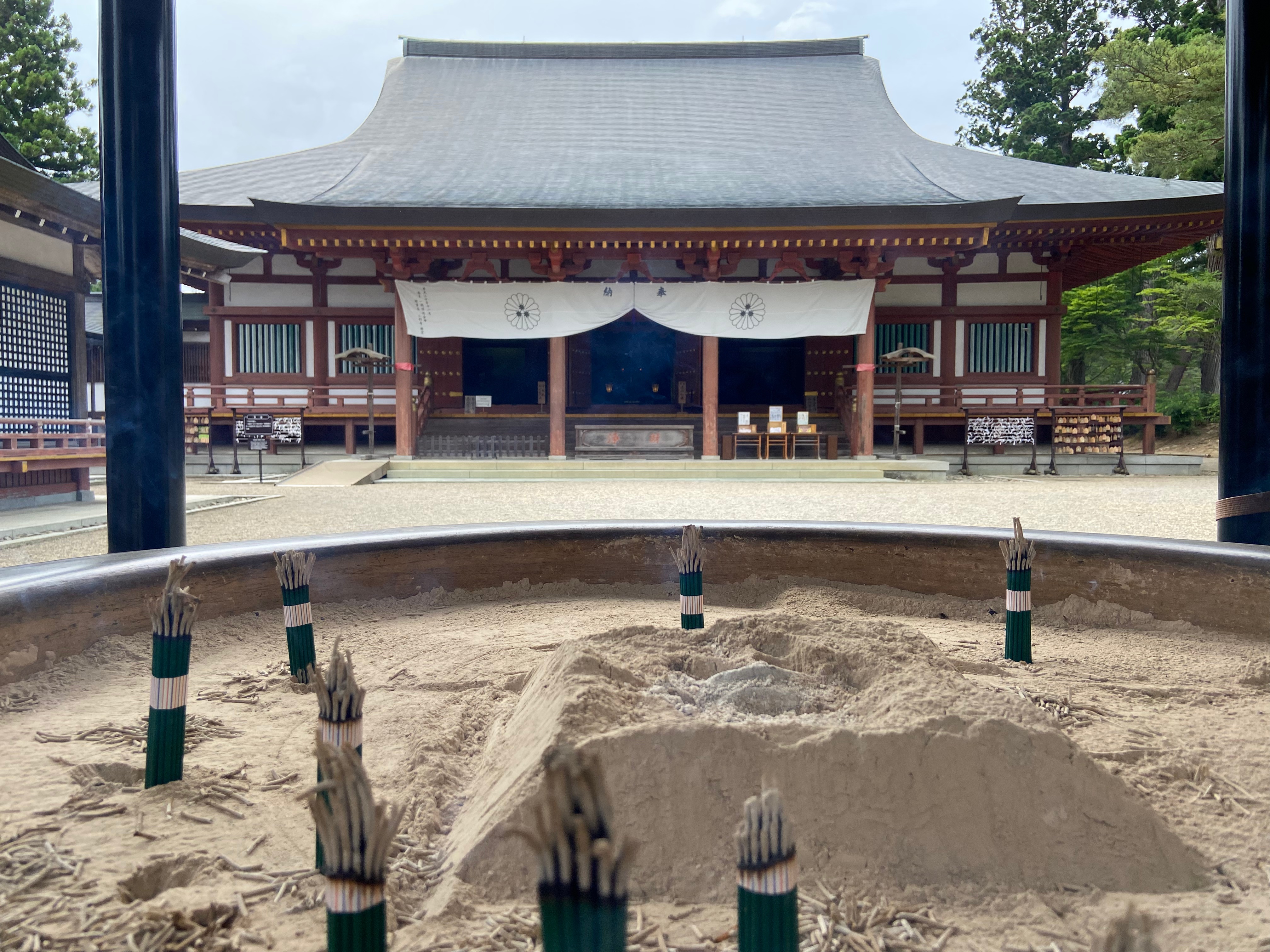
Entry to the Konjikido, or “Golden Hall,” costs ¥1000. It’s unassuming from the outside, just a rectangular building in weathered wood, but inside it’s another world entirely. No photos are allowed. Inside the hall is gilded in gold leaf, with three golden statues of Amida Nyorai flanked by bodhisattvas, all encased in a protective hall to preserve the original 12th-century architecture. The Golden Hall sits inside a larger protective concrete building, almost like a shrine within a shrine, carefully sealed off from time.

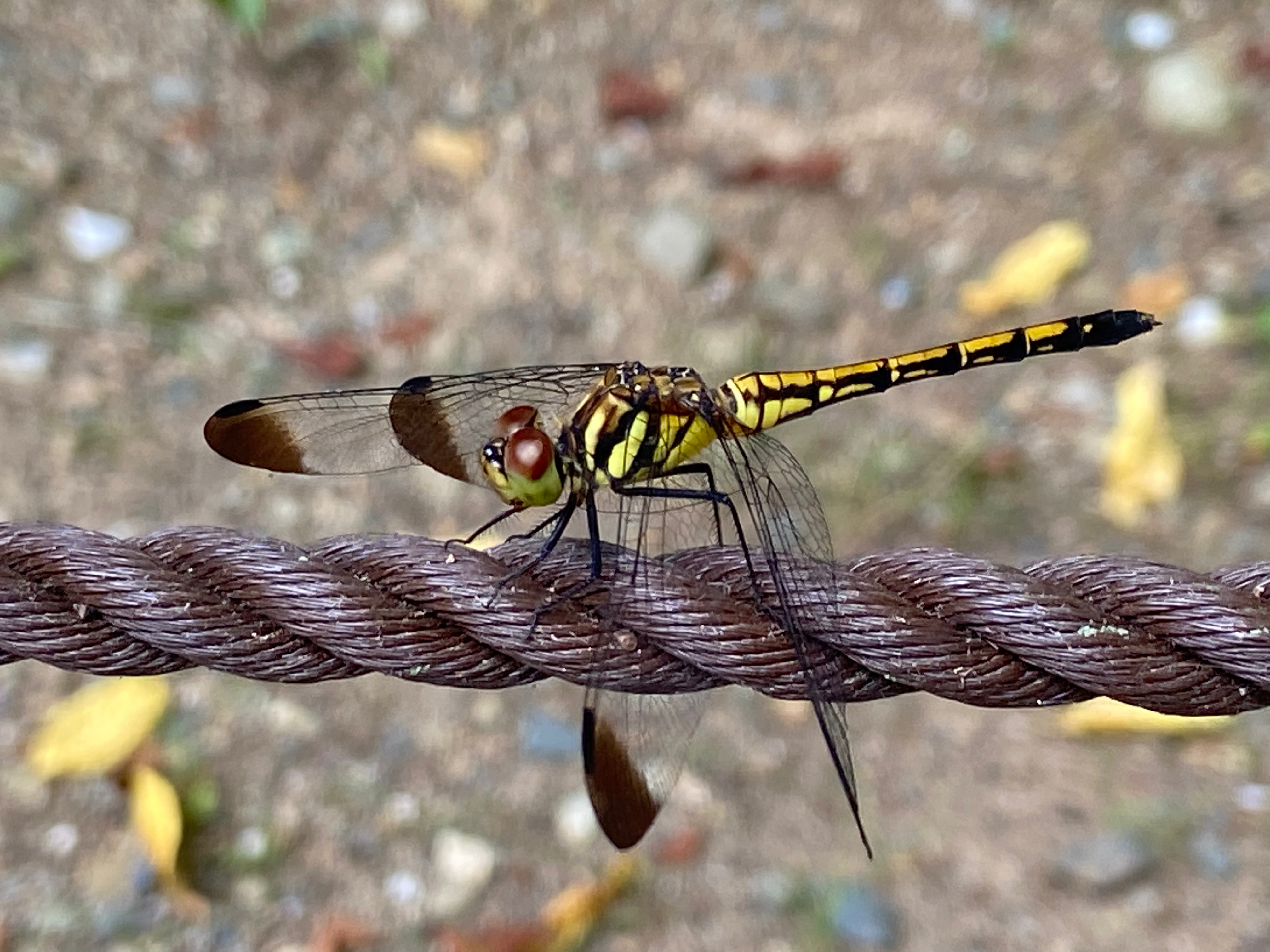
Because I couldn’t take any photographs of anything inside the Golden Hall, here is a photograph I took outside the hall, of a golden dragonfly:

On the way out, I draw an omikuji fortune slip. Once again, I pull “Excellent Luck.” I always seem to get the best one. It comes with a small Fortune Arrow trinket that is said to invite happiness and fulfilment of my wish, because an arrow hits the target. I tuck the trinket into my wallet for prosperity and fulfilment, a wish taking aim, and keep reading. It says that on travel, I will have an impactful journey, and that my lucky item is still dried flowers.

As I stand reading my fortune, I hear a voice. “Hey you! Come here,” shouts a Japanese man. I wander over to the man. He appears to be pointing at a large tree. It’s not until he speaks again that I realise what he is pointing at. “Look, a snake,” he says. “Very dangerous.”

After failing to take a decent photograph of a snake crawling into a tree, I wander to the final part of the complex, where the dead have clearly been hard at work. More stacked pebbles. Castaways from another world, trying to build their way back. The resemblance to Osorezan is uncanny. It turns out this temple was founded by Ennin, the same monk.

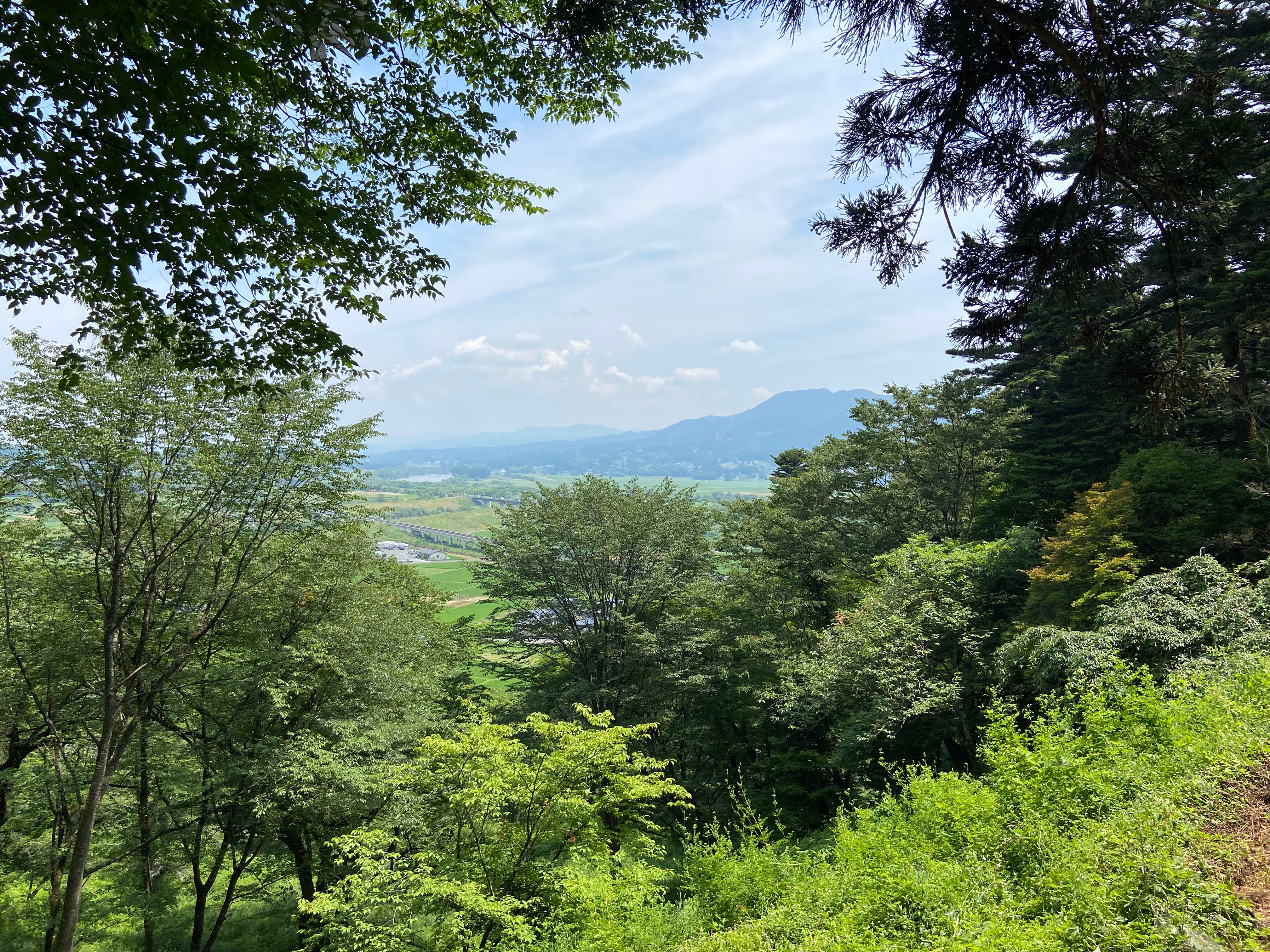
On the way down, the view opens up to a sweeping panorama of green hills and sky. It is simply stunning.

Leaving Chuson-ji, I walk another twenty minutes through thick heat and dense sunlight to reach Motsu-ji, another World Heritage Site. This will be the third temple this week founded by Ennin, and I have a fourth planned for later this week.

The famous haiku poet Basho visited this temple and left behind a haiku carved into stone:

Summer grasses—
all that remain of
warriors’ dreams.

Motsu-ji was mostly destroyed by fire, and the poem mourns the fallen glory of the Fujiwara clan and the entropy of all things. Since then, some of the buildings have been restored, like the main hall, but many of the structures are just rocks or sticks marking what used to occupy the now empty spaces.

Motsu-ji’s most enduring feature is its Jodo Garden, a symbolic recreation of the Buddhist paradise. It stands in quiet contrast to the ruins around it. The lake, said to evoke the Pure Land, now feels more like a mirror for dreams long since cast away.

I wander into the gardens. Aside from the lake, they are vast yet empty. There’s a small lily garden, the remains of what once was, and some immaculately cut grass. A single lawnmower sits abandoned atop summer grass, having half completed its job. It now lies idle in the heat.

I leave the gardens and return to the station, waving a silent goodbye to Kero-Hira, who is still smiling. I take the train north to Morioka. On the way to my hotel, I spot a sign for “Demon’s Hand Prints in the Rocks.” I decide to check it out.

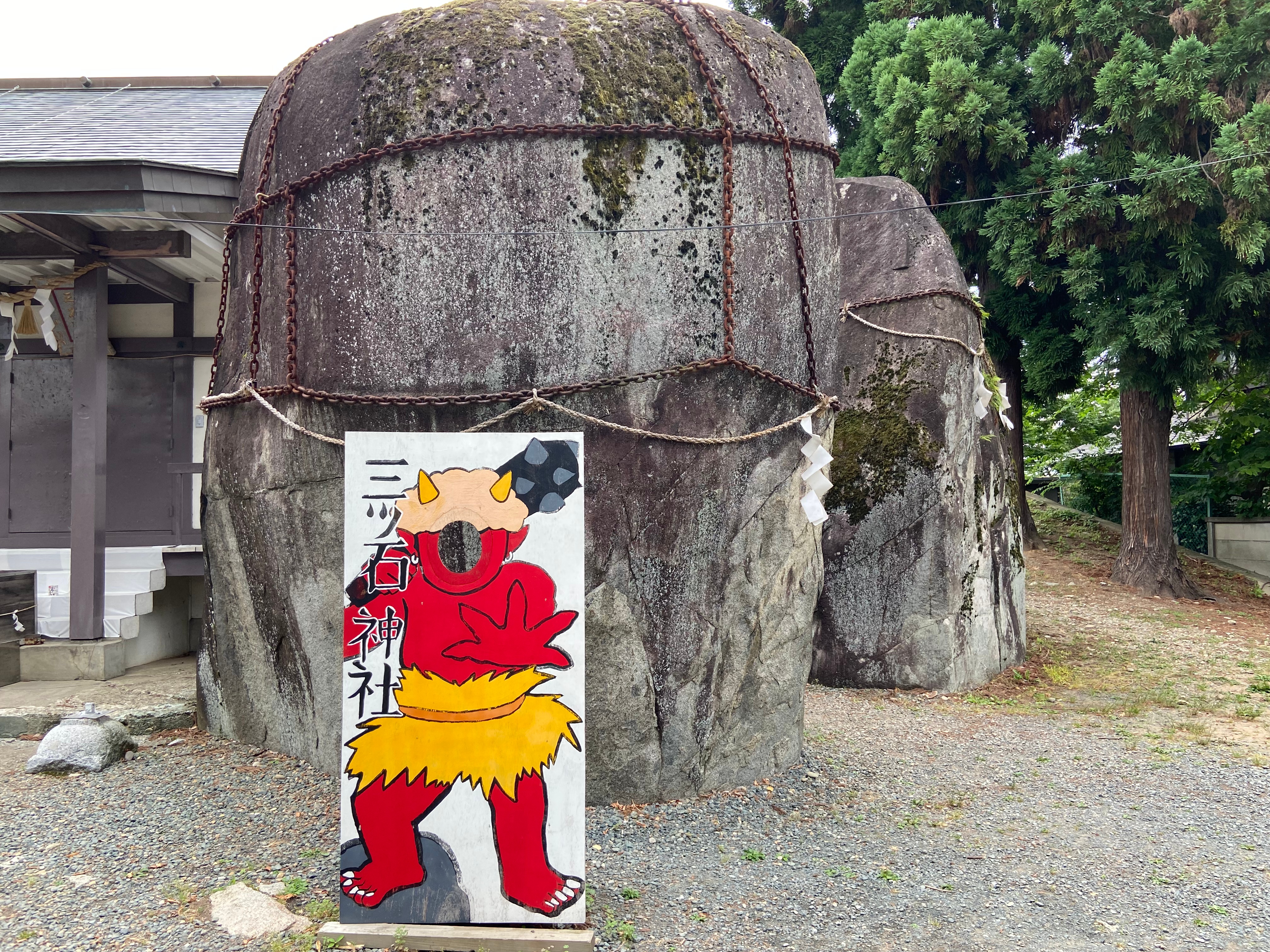
At the small temple sit three massive boulders, wrapped in rope and chain, said to have been thrown down when Mount Iwate erupted in a fit of rage. Locals once lived in fear of a demon who tormented the area, and they prayed each day for protection. One morning, the demon was discovered bound to these very stones, condemned to cause harm no more. Before his power faded, he struck one of the rocks with his hand, leaving behind a print that remains sealed in stone to this day.

I look at the rocks but don’t find any handprints. I do, to nobody’s surprise, find the customary Carnival Cutouts.

Everything Was Beautiful And Nothing Hurt

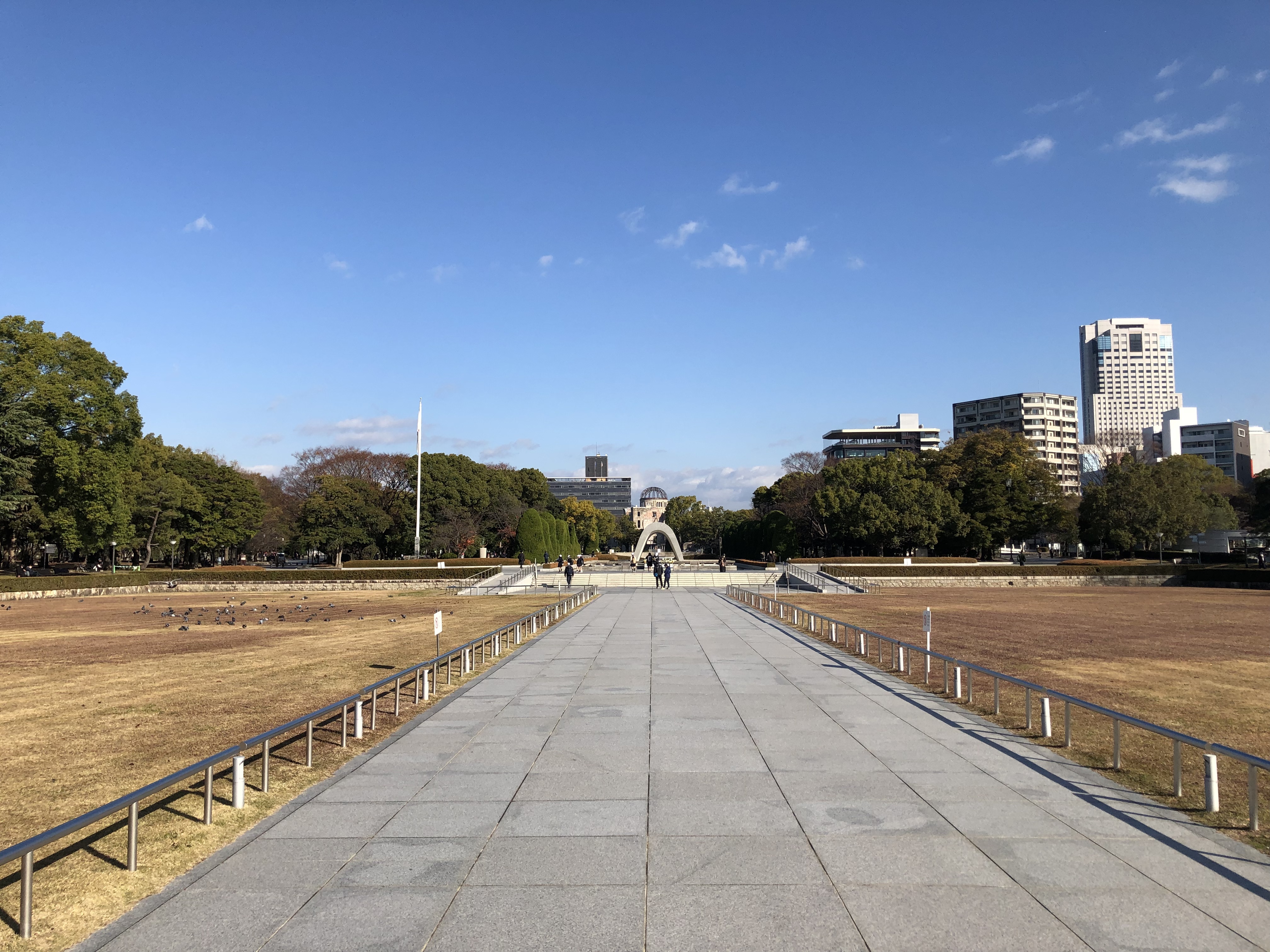
With toothache and a twisted ankle, I take the Bullet Train over to Hiroshima. My first stop, a place I visited ten years ago, Hiroshima Peace Memorial Park. Immediately after the atomic bombing, it was said that no plants or trees would grow for 75 years, but as I hobble along Peace Boulevard towards the park, I notice it is lined with large trees and lush greenery. Following a tree-planting campaign in 1956, in which neighbouring municipalities in Hiroshima Prefecture were asked to donate trees to the city, Hiroshima has been transformed into a verdant paradise.

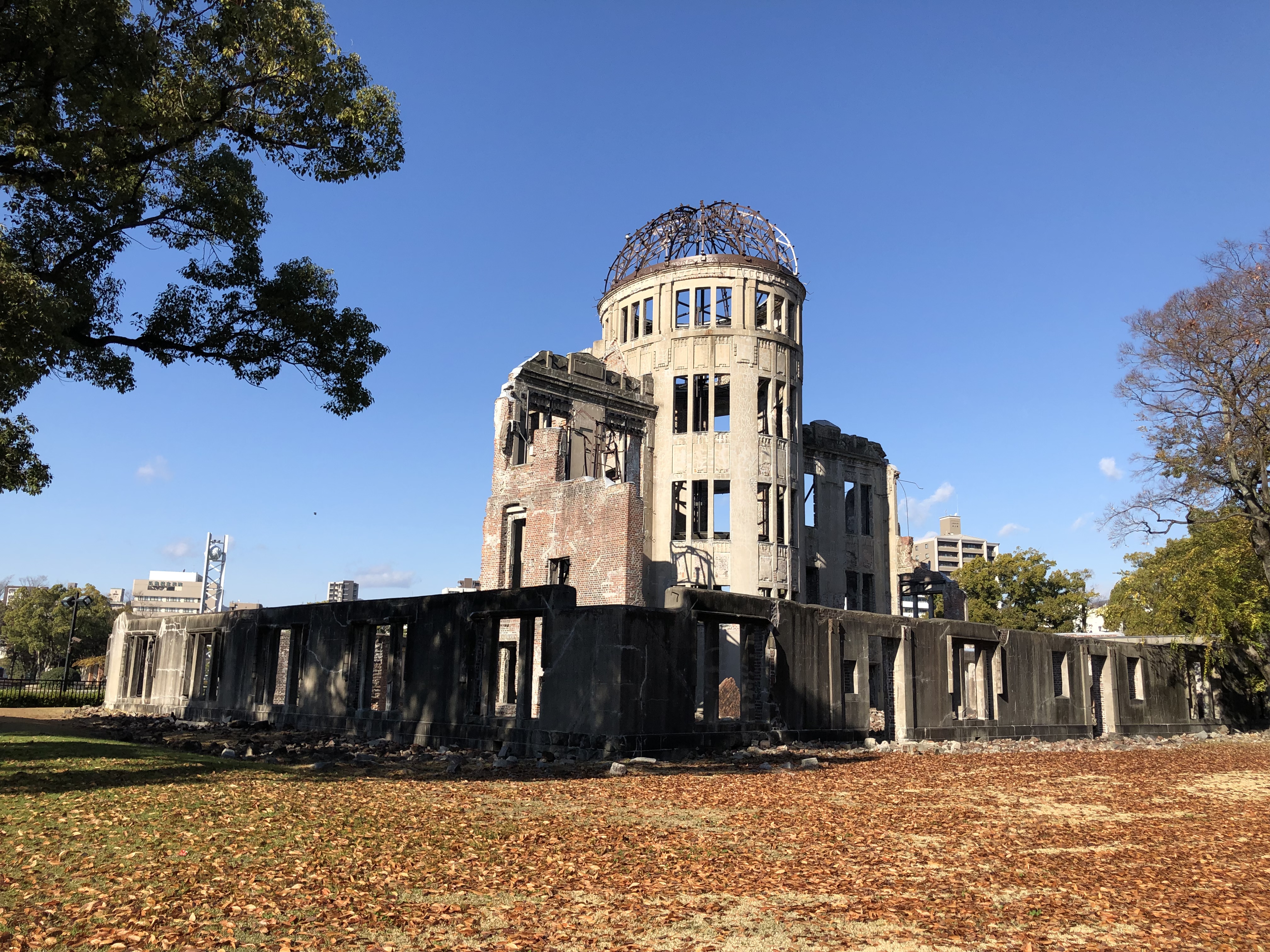
I stroll in silence through Hiroshima Peace Memorial Park. I take note of the fountains, the newly laid flowers at the cenotaph, the looming Atomic Bomb Dome in the distance; a survivor, its form so full of imperfections, its beauty an aide memoire of an aftermath of events that left it in such a state; a symbol of everything left behind, a skeletal figure of what once was, now ruins.

Seventy-seven years ago United States President Harry Truman authorised the bombing of Hiroshima. His actions, which would be considered a war crime today, resulted in the instant deaths of 80,000 people. As I further walk toward the dome in the distance, I can’t help but think about the enormous impact of these events; the devastation of an entire city in a single moment.

The building that houses the skeletal remains of the Atomic Bomb Dome is known as the Hiroshima Prefectural Industrial Promotion Hall, and in December 1996 it was added to the UNESCO World Heritage List as a reminder to the whole world of the horrors of the atomic bomb, and a symbol of global peace. As I look at this building I can’t help but become overwhelmed by sadness.

Because the bomb dropped on Hiroshima exploded from almost directly above this structure, some of the walls and the iron frame making up the dome remained standing, whereas everything else around it for miles was flattened to the ground. There has been some controversy about this building in the past, some people argued that it should be destroyed, for it’s a dangerously dilapidated building that evokes painful memories. Others argue that is should be preserved as a memorial to the bombing. Since the UNESCO status, the building is now protected and efforts are continually made to ensure that it looks identical to how it looked on that fateful day in 1945.

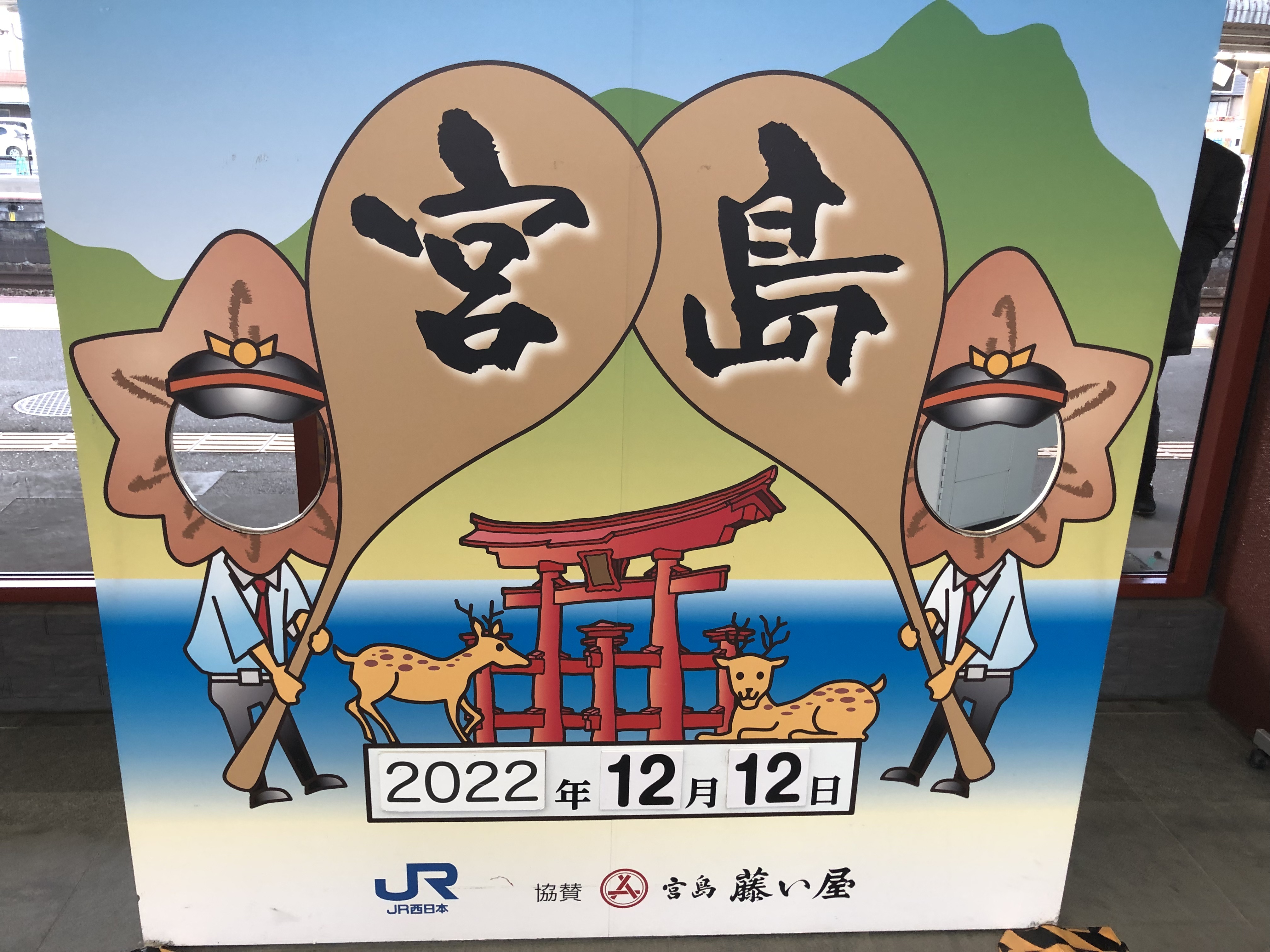
Leaving the solemn Peace Memorial Park behind, I embark on a journey by train to Miyajimaguchi Station. Located on the serene Miyajima Island, the revered Itsukushima Shrine is said to offer one of Japan’s most breathtaking views. As I enter the station, a display of the shrine and its iconic, wandering deer greets me with a festive flourish.

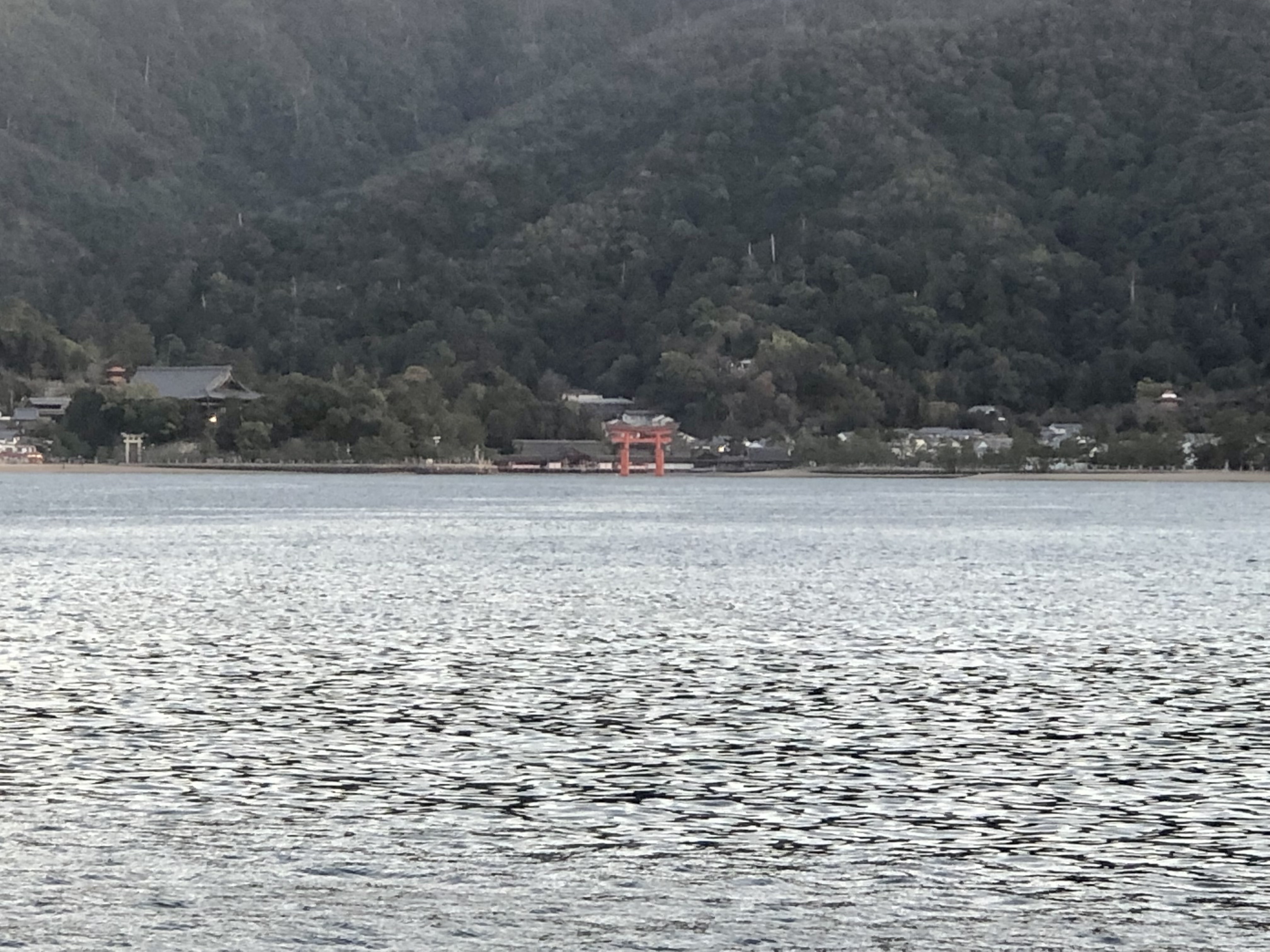
Before taking the ferry over to the island, I pause to capture a photograph of Itsukushima Shrine from the mainland. The shrine, known for its red torii gate that floats in the water during high tide, beckons me with its breathtaking beauty. I stare across at the shimmering water below, the sparkling lustre of Hiroshima Bay that stretches out before me, and with a sense of awe and wonder, I set out on the ferry towards the island, eager to explore its marvels.

The shrine is a Japanese National Treasure and a UNESCO World Cultural Heritage site. Unfortunately for me, there are none of the anticipated roaming deer hanging around today, but despite that, the shrine is amazing to look at. I can’t begin to describe how beautiful the red torii gate is up close. This landmark is one of the most photographed places in Japan, and I urge anyone visiting Japan to go and see it for themselves. My original photograph from the ferry port is the one I select here, as some things you just need to see and enjoy for yourself.

As I wander the streets of Hiroshima, I am determined to find a small standing bar that I visited 10 years ago. I remember the hotel I stayed at nearby and the bar owner’s enthusiasm for football, and I am eager to see if the owner’s guestbook is still around. However, after searching for over an hour, I discover that the bar’s location has been swallowed up by the ever-expanding Hiroshima Station, much to my disappointment. I had hoped to read the entry I made in the guestbook during my first trip to Japan back in 2012, but it seems that the bar’s memories have been lost to time.

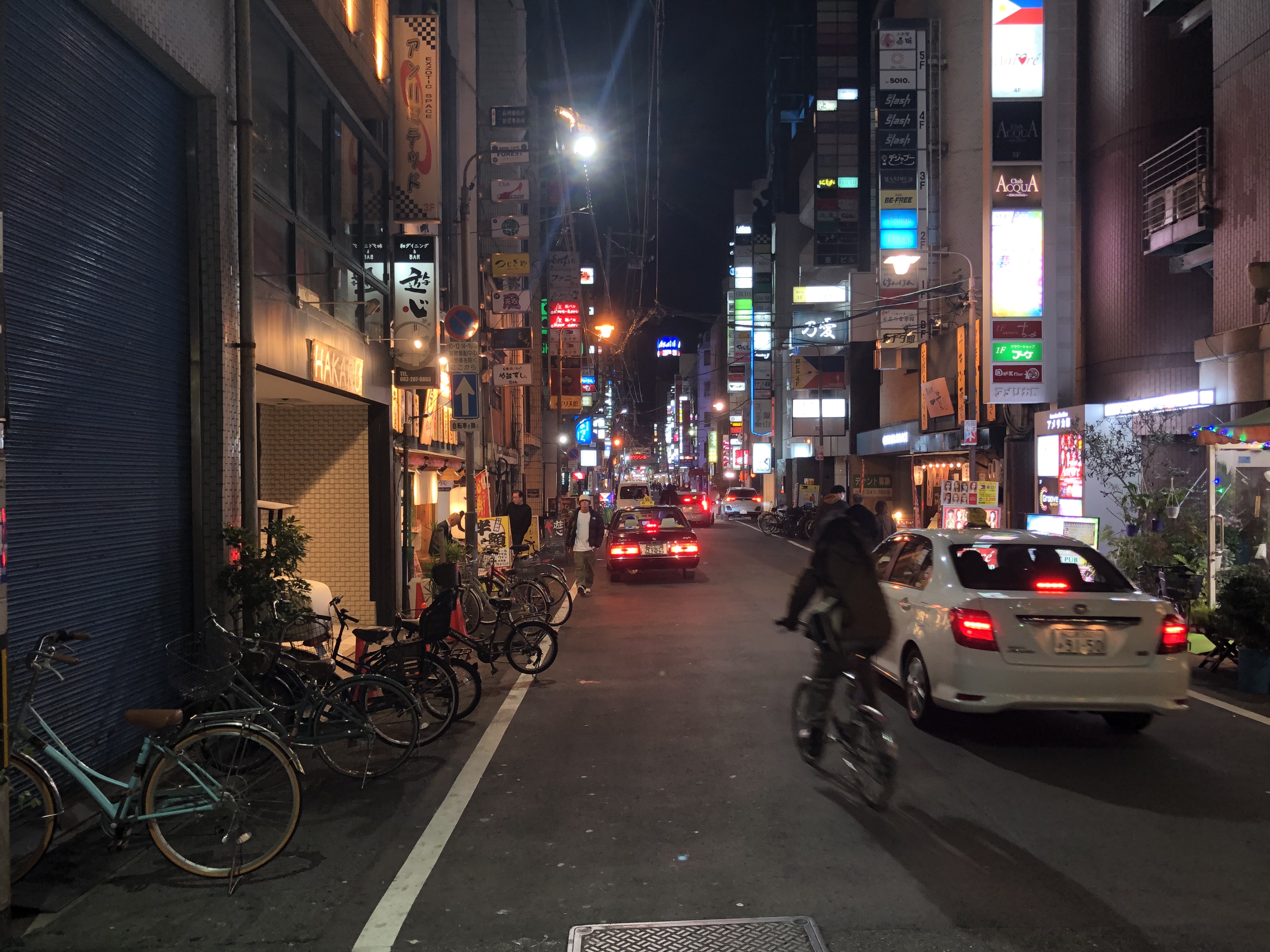
With little else to do I head over to the nightlife area. This maze of buildings containing multiple bars is huge. From one intersection I can see 300 different bars in the four directions I look. It’s common for buildings in Japan to contain loads of tiny bars, and usually I bravely enter these bars with no plan as to where my night will go. Each individual sign in my photograph represents a single bar.

The first bar I go into the owner tells me, “No foreigners.” The same thing happens in the second, third, and fourth bar I attempt to visit. I understand that maybe the bar owners had negative experiences with foreigners in the past, or may not be comfortable communicating in English, but it is never acceptable to discriminate against someone based on their nationality or ethnicity, and it leaves me feeling hurt and frustrated.

I do eventually find a small friendly bar that will accept me, and stay up until closing time drinking and singing with the foreign owner’s Japanese guests. It’s actually one of the best nights out I’ve had in a while, so much so, that by the end of the night I’ve forgotten entirely about the toothache, the twisted ankle, and the racism.

Parks and Simulation

It’s humid beneath my mask. It appears that it rained slightly this morning for the first time in weeks, but now it’s hot. I can’t begin to imagine what the summer will be like. I shouldn’t complain though, the unusually warm start to the winter is set to end later this week, and Japan will become enveloped in an icy-cold ambience.

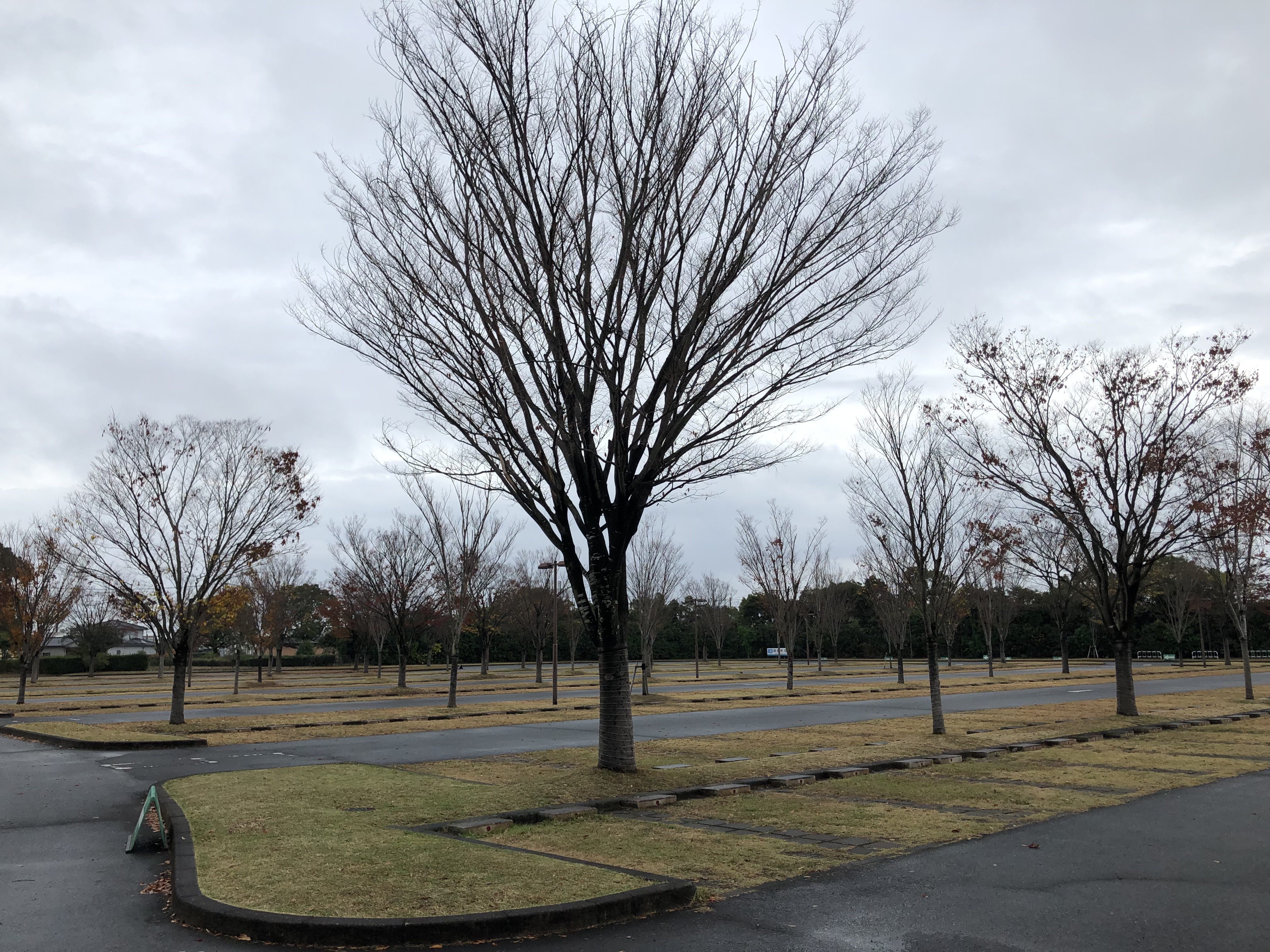
I take a train to Saga Prefecture, my first destination today, Yoshinogari Historical Park, an archæological site dating back to between the 3rd century BC and the 3rd century AD. I walk two kilometres from the nearest train station, and arrive at the entrance. The car park here is huge, empty, and covered in fallen leaves from the skeletal trees.

I arrive at the aptly named Entrance Zone. Each area of this park has a zone name. There is the Ancient Forest Zone, the Moat Encircled Village Zone, the Aztec Zone, and the Medieval Zone. I pay the ¥460 entrance fee, and note that the two day pass costs only slightly more, a reasonable ¥500.

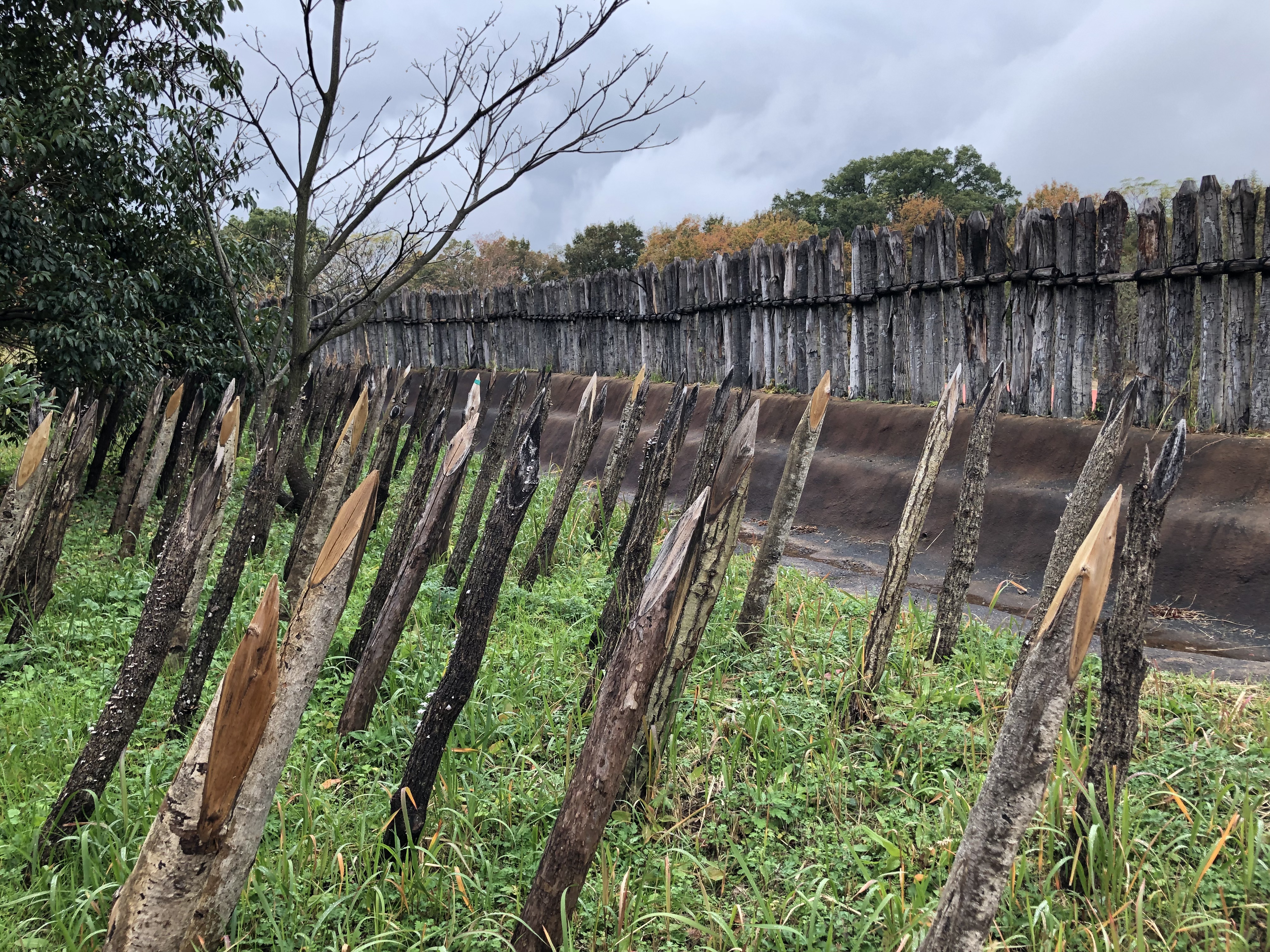
After crossing a massive red bridge, I arrive at the park. The first thing that draws my attention are what appear to be loads of large wooden spike traps.

As rice cultivation increased, more people fought one another to control the water and occupy the land. People set up barricades with sharpened posts or tree trunks, especially around strategic areas such as the entrance to the village in order to strictly protect their properties. These stakes are called sakamogi.

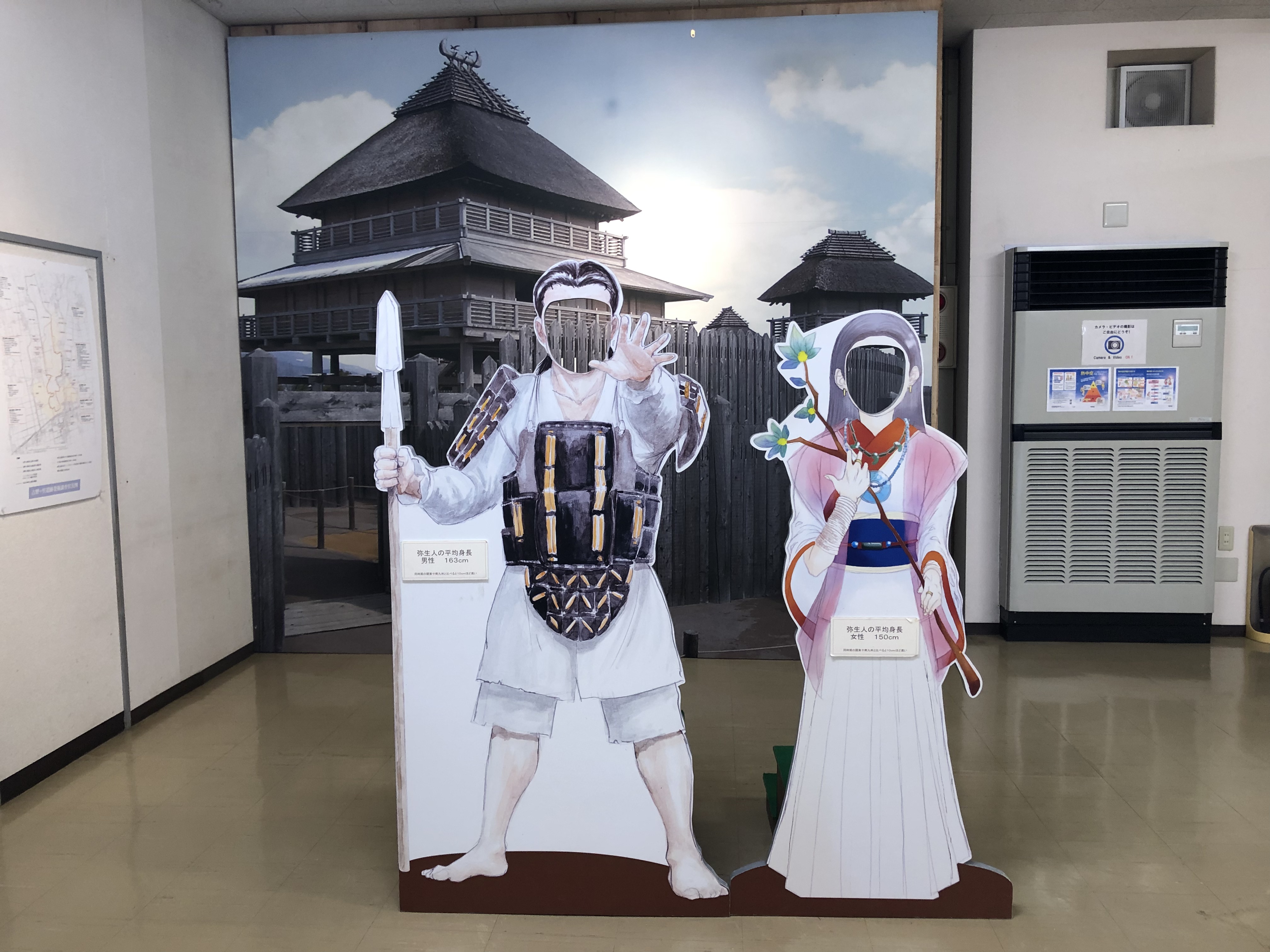
I leave the abatises and wander further along the tree-lined path, passing what looks like straw statues of wild boar, before finding a small museum. The first thing I notice when entering the museum is the eagerly awaited return of a small fascination of mine, Carnival Cutouts.

The museum itself contains loads of old pottery from the Jomon era, bronze daggers and bronze swords, the jaws of wild boar, deer skulls, hunting tools, arrowheads, stone daggers, and a 2,000-year-old human skeleton.

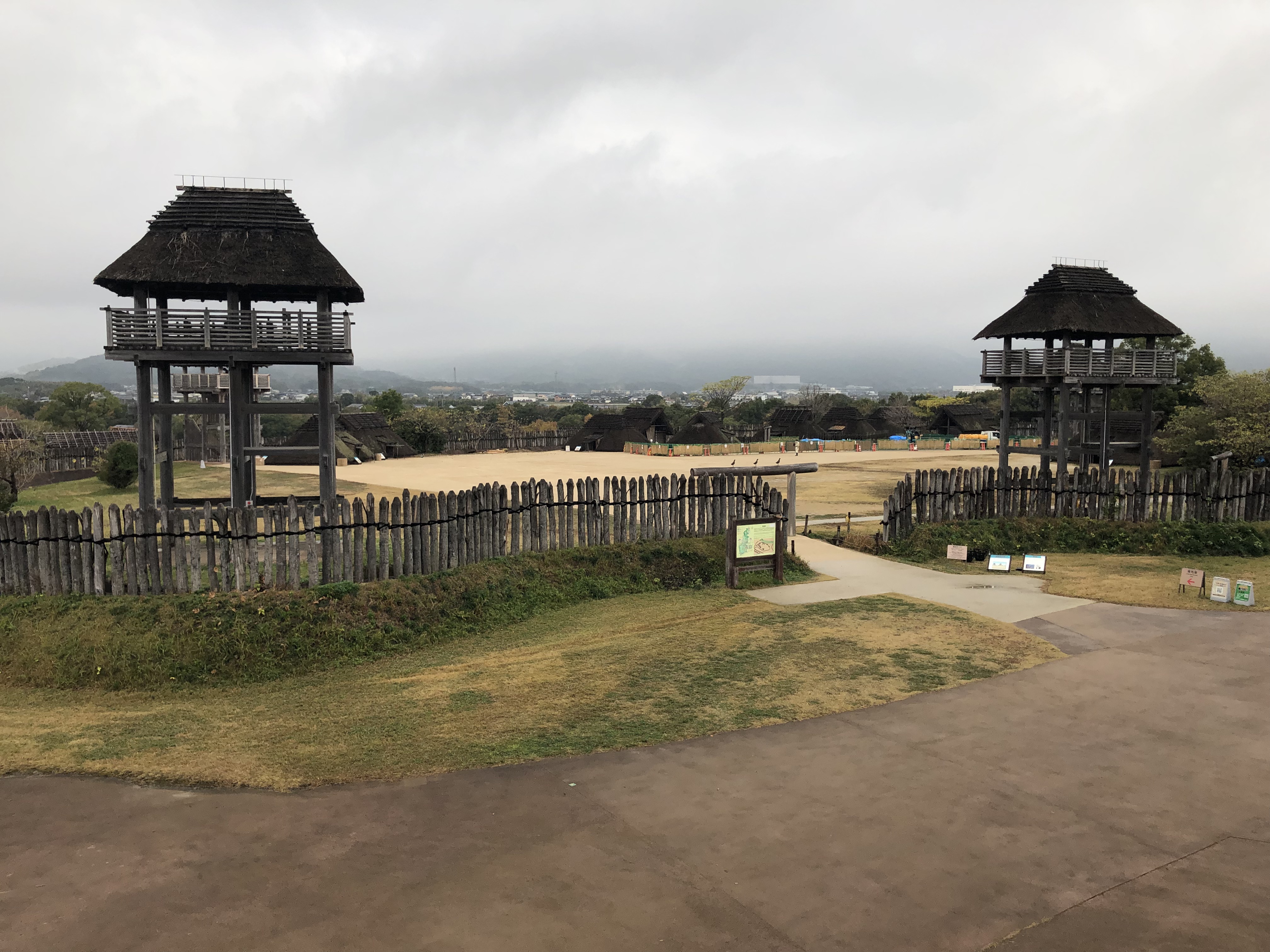
I leave the museum and in the distance I see some watchtowers. These watchtowers mark the entrance to the South Inner Palace, and were once manned by sentries.

I climb up the slippery wet wooden steps to the top of the Gate Tower, this tower had guards with shields at its four corners. The tower offers a good vantage point to watch for people entering and leaving the enclosure.

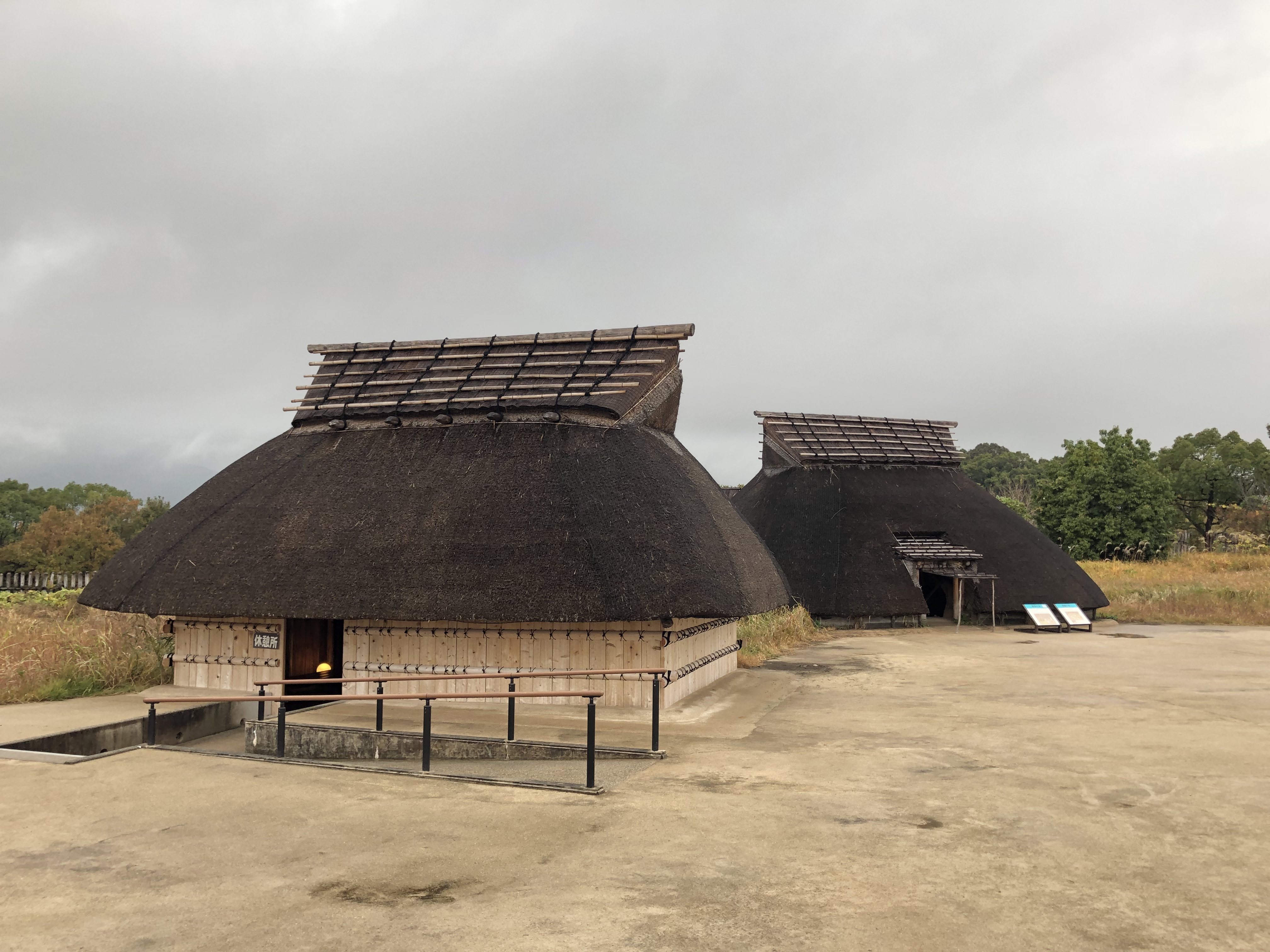
I wander further along, passing the moat and fences that guard the Palace, to the houses beyond, to the zone known as Moat Village. This area contains the village that once housed each of the residents. From the kitchens to the main assembly halls, each house can be entered and fully explored.

I visit the Brewery House, where women would brew sake for festivals and rituals by steaming rice from the years’ harvest. The Sericulture House, where precious silkworms were raised to produce silk thread to weave textiles. And finally, to the Barracks, where the soldiers who guarded the northern defences would rest.

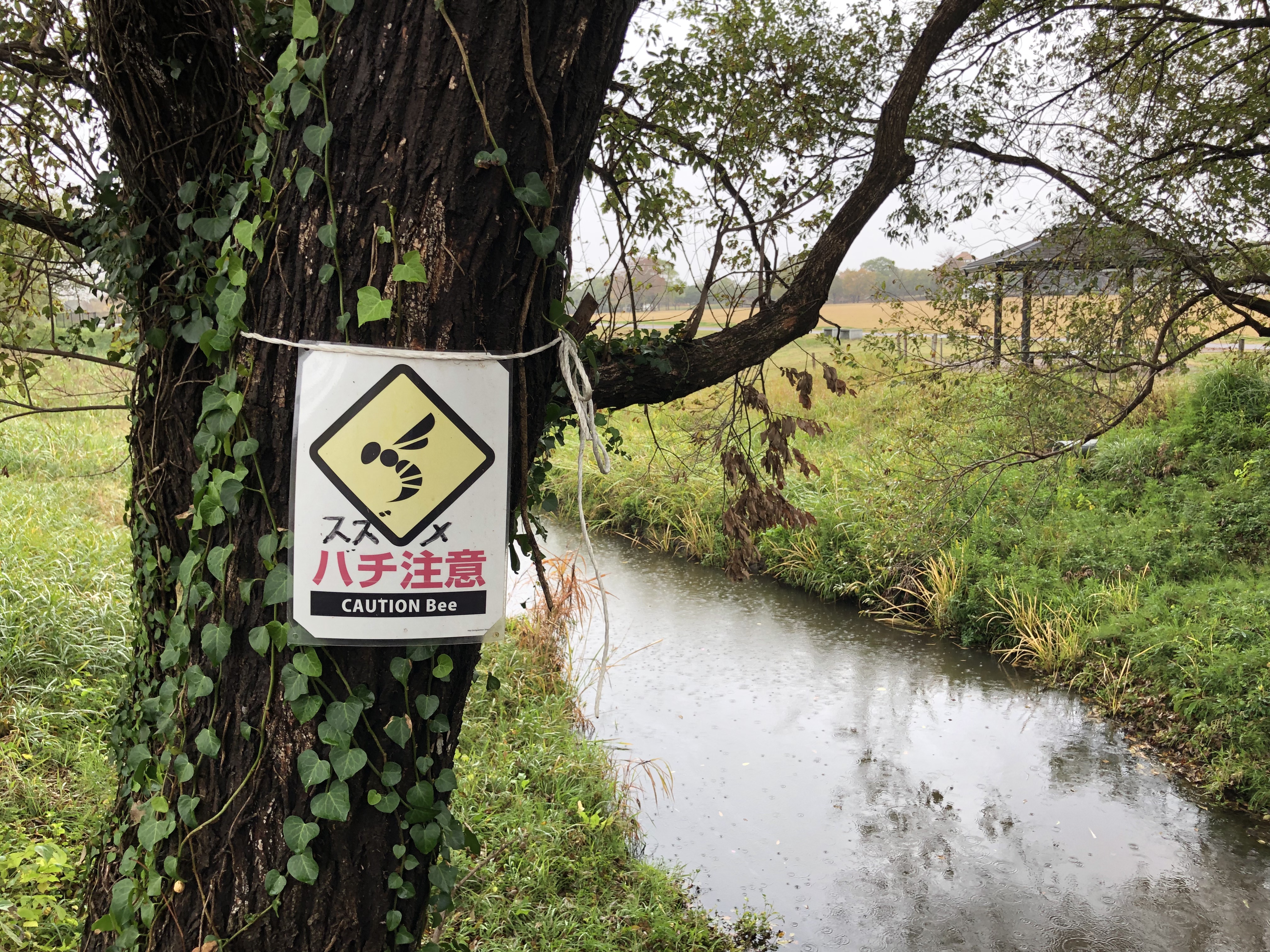
I find a map only to realise that I’ve explored just a quarter of this giant historical site. Its sheer size is quite alarming. The map also shows that the park boasts four car parks, one at each corner of the site. Some Christmas lights are dotted around for good measure; evening illuminations, but I have other places to be. I wander in search of an exit and see a sign in desperate need of pluralisation.

Suddenly the clouds burst and the unforeseen downpour leaves me completely soaked. I see a man who has been given the arduous task of sweeping up the fallen leaves, he’s equally soaked. I pass a golf course, two full sized football pitches, and a petting zoo, and wonder if these such things were here 2,000 years ago too.

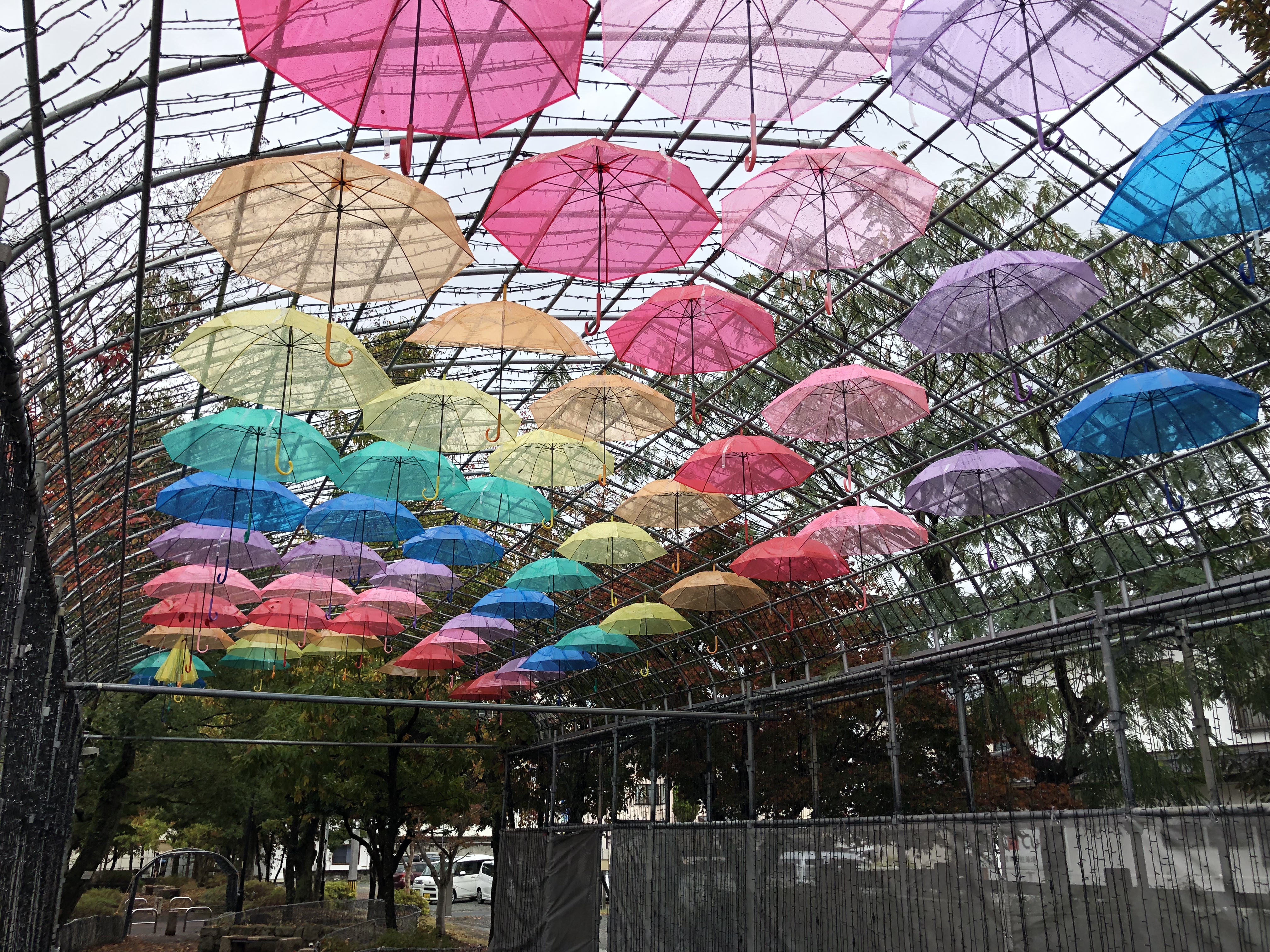
Eventually I find an exit, walk two kilometres to the nearest train station, and hop on a train bound for Saga City. At Saga, the rain has stopped. I walk twenty minutes in the direction of the Saga Balloon Museum. Before I arrive, I spot a canopy of umbrellas that might have been useful thirty minutes ago.

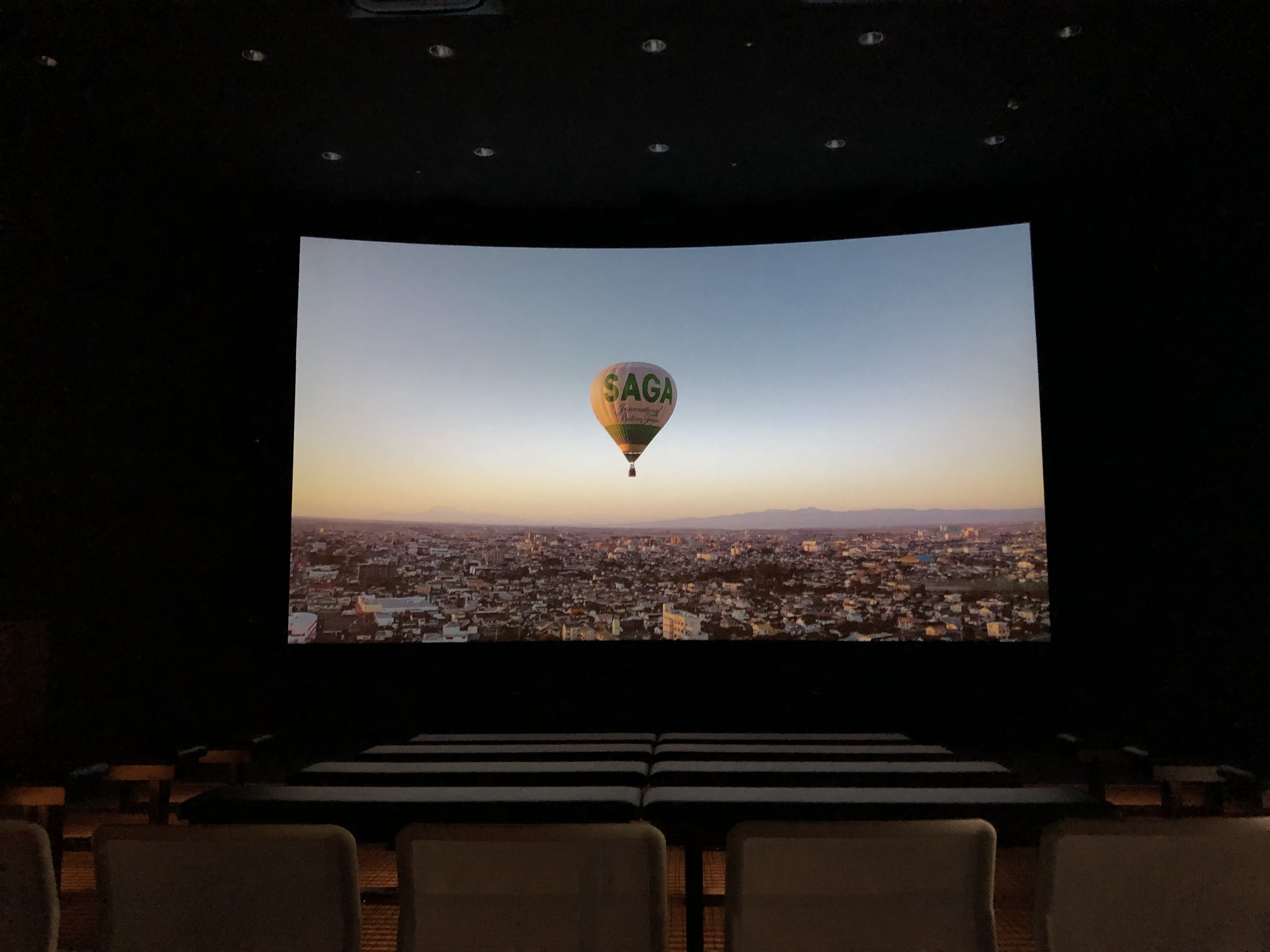
For some reason, Saga Prefecture is famous for hot air balloons. Inside the Saga Balloon Museum, I learn that the very first time a human being “flew in the sky like a bird” was in 1783, in Paris. In Japan, the first manned flight by a gas balloon was completed in 1877, in Kyoto, an event watched by 50,000 spectators. And in 1903, the Wright brothers flew an aeroplane, making the hot air balloon useless.

I take a seat in a small cinema describing itself as a “Super High-Vision Theatre” with a 280-inch screen. Here, I watch a film that claims to be so realistic that you will think that you’re there. I learn about balloons, what makes them fly, before leaving the cinema and heading up to the second floor. Here I get the opportunity to fly a hot air balloon myself, using the advanced simulator.

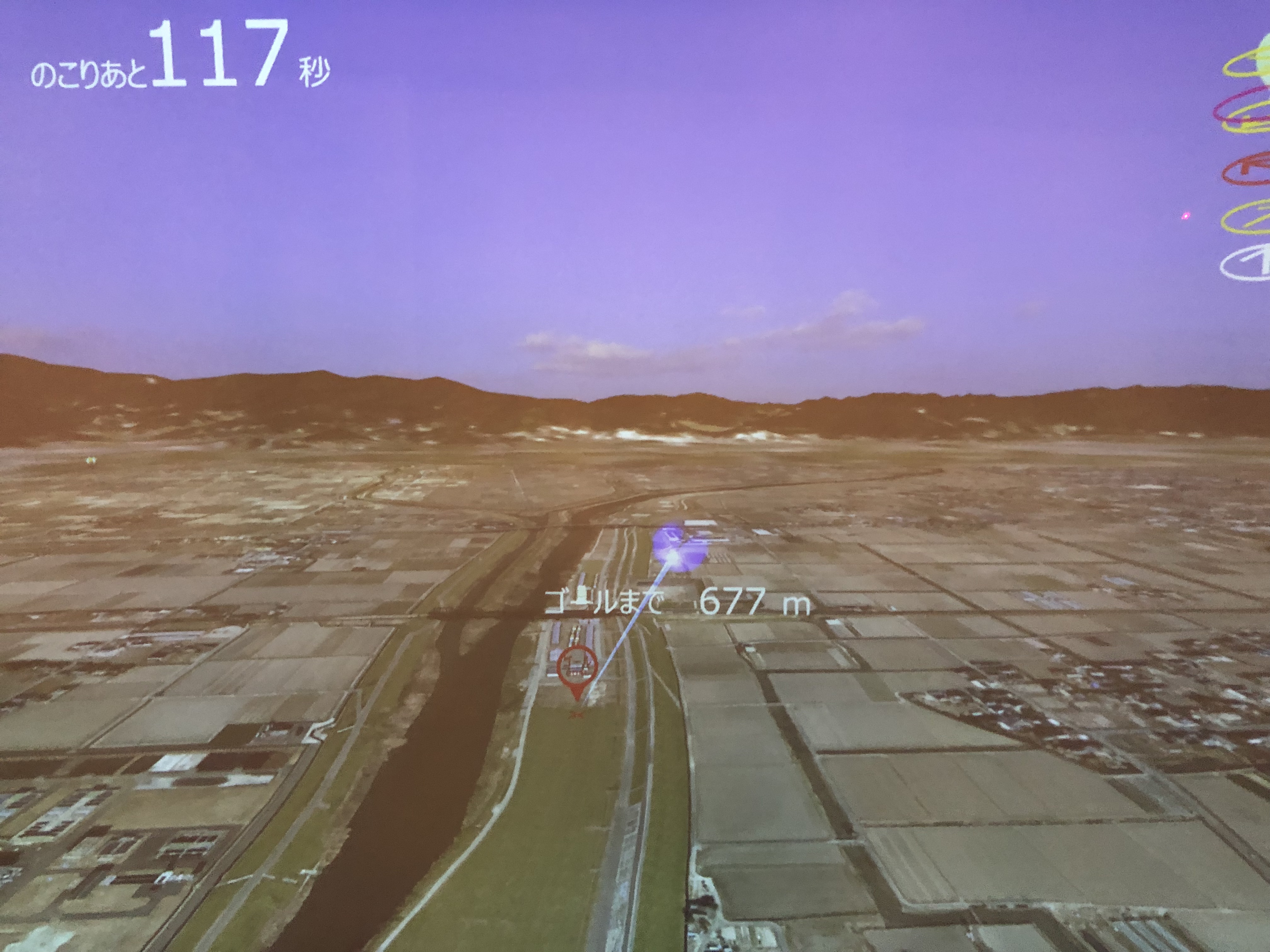
I stand inside the hot air balloon simulator and begin. I have 180-seconds to land the balloon in the target area, taking into account wind direction and wind speed, all the time sporadically pulling on a lever that releases pretend propane gas. When the lever is pressed down the balloon floats further upwards, when it’s released, the balloon slowly floats further downwards and catches in the wind. Apparently the trick is to control the lever early, anticipating the atmospheric conditions.

Landing the balloon within one metre of the target awards ‘S’ rank. The rest of the ranks rate down from ‘A’ to ‘E’ and the sign next to the machine offers the following encouragement, “Ride the wind and get a high rank!”

Obviously, I spectacularly crash the balloon into the sea.

Robots, Androids, and Mechanical Oddities

dl_logo_wrob

For many people in Japan, October is a time for Halloween festivities, including scary costumes, decorations, and excited children. However, for some, the most anticipated event this month involves forward chaining, service robots, degrees of freedom, and excitement akin to a child in a Halloween sweet shop. Today marks Japan Robot Week 2014, and I can’t wait to discover what it’s all about.

The event occurs biennially at the Tokyo International Exhibition Centre, known as Tokyo Big Sight. Halls one to three are packed with a wide array of exhibits, featuring a total of 480 companies across 926 booths. Here are the highlights of my day:

Kawada Industries, Inc.

Like many other companies present here, Kawada Industries focuses on creating robots designed to assist with menial tasks. A prime example is NEXTAGE, a Next Generation Industrial Robot.

nextage_cafe[1]

NEXTAGE can be effortlessly controlled using a cutting-edge global user interface. Equipped with image recognition, stereo vision providing three-dimensional coordination, and hand cameras for precision, NEXTAGE excels in performing tasks that might be challenging for Japan’s aging population. To showcase its remarkable abilities, employees at Kawada Industries have it brewing tea and coffee all day long.

Kobayashi Laboratory

Muscle Suit is an innovative design from Kobayashi Laboratory—a wearable robot back support unit designed to assist people facing lifting difficulties. Effectively an exoskeleton, the device naturally mimics human movements.

kobalab[1]

Two models are set to hit the market soon: one weighing fifteen kilogrammes and the slightly larger model weighing thirty kilogrammes. While thirty kilogrammes might seem like a substantial weight to bear on your back, the demonstrator effortlessly lifts heavy boxes filled with bags of rice without breaking a sweat.

Tomy Company, Ltd.

I am fortunate enough to witness the Tomy Company unveiling their new toy for children. Arriving at the DeAgostini booth just before noon, I find quite a crowd already gathered. Three large cameras record every second of the action. Initially, there’s a demonstration of Robi, the build-it-yourself robot that comes with its own magazine. By purchasing the magazine each week, you receive the next part of the robot. Robi does a little dance, says “Hello” in Japanese, all while a mysterious purple cloth covers the forthcoming announcement.

tomyone[1]

After a lengthy discussion and multiple trailers displayed on various television screens, Robi is placed down, and eventually, the purple cloth covering something is removed. Finally, after a long wait, Robi Jr is revealed, but he appears frightened and doesn’t seem to behave very well at all. Initially, I wonder if this robot toy begins as a baby, and part of the enjoyment is teaching it to grow wiser and more capable, utilising some of the one-thousand pre-programmed phrases boasted by its creators.

tommy2[1]

However, all Robi Jr seems capable of doing is turning its head from side to side (accompanied by loud creaking from its mechanical parts) and moving its arms up and down in what seems like a marching tantrum. Perhaps I am missing the point. If I were a child again, I might find the prospect of owning a Robi Jr somewhat compelling. However, these emotions no longer stir within me, and I leave the exhibit feeling confused.

Atsugi Monozukuri Brand Project

What do you get when you cross pig organs, sweetfish, wires, and a pile of cardboard?
ATSUMO!

atsumo[1]

This near life-sized robot, featuring a pig’s face, is based on Ayukoro, the mascot of Kanagawa Prefecture, particularly from the city of Atsugi. A fusion of local delicacies—ayu fish and pig organs—inspired this mechanical mascot, taking on Ayukoro’s form. ATSUMO has the ability to run, speak, shake hands, and do what all other robots seem to be capable of doing, and that is of course dancing. The cardboard looking robot even has its own cardboard Carnival Cutouts.

Project Team Atom

“Grab your dreams!” is the tagline for this next exhibit, the Power Assist Hand. The team behind the project was overly welcoming and spoke superb English. I was very surprised when they invited me over to try out their product hands-on.

powerhand[1]

The Power Assist Hand is incredible. The glove mimics finger joints, aiding those who have lost the ability to use their hand. For instance, individuals suffering from hemiparesis due to a stroke find it extremely challenging to use their hand effectively, and this product offers a much-needed solution. The glove fits comfortably and is controlled remotely. With a push of a button, my hand grasps firmly; even when I try to resist, my fingers snap open and closed. The device makes picking things up and gripping objects as easy as flicking a switch. A recent study suggested that repetitive movement can help regenerate behavioural patterns in the brain. Therefore, this device could assist stroke victims in both physical recovery and mental capacity.

Daiwa House

Daiwa House has fittingly named their crawlspace inspection robot after a cat: Moogle. This feline-shaped robot is slightly more cunning, equipped with an inspection camera, LED lighting, and various types of sensors. It boasts a fully operational tail that aids its ability to climb large objects or traverse uneven terrain.

moogle[1]

The demonstration of this robot has it climbing up stairs and crawling around, all the while projecting what it is seeing onto a large monitor. As far as remote-controlled cat tank torch camera robots go, Moogle is the best.

Aldebaran SoftBank

Most people in Japan are quite familiar with Pepper, a robot from SoftBank that appears on television almost every five minutes. Developed by Aldebaran for SoftBank, the next installation comes in the form of NAO. The tagline, ‘ASK NAO,’ is an acronym meaning Autism Solution for Kids. This creative, friendly teaching robot has been created as a way to help children learn.

nao[1]

I’ve been told that children with autism are often more drawn to technology. NAO has been designed to bridge the gap between technology and the human social world. Appearing slightly more polished than some of the other robots I’ve seen today, NAO boasts two cameras, an inertial measurement unit, capacitive touch sensors, freedom of movement, four directional microphones, two sonar channels for distance, and is powered by an Intel ATOM 1.6 GHz CPU. Just as I’m about to leave, the K-pop classic ‘Gangnam Style’ begins to play, and NAO joins in with a perfectly choreographed dance routine. If you have around ¥850,000 to spare, you can purchase your own NAO and use voice commands to ask it to kick a ball around, or something.

Okayama University

Tetsushi Kamegawa and his team from Okayama University are here to demonstrate their ‘As Seen on TV’ rescue robot. The robot crawls along the ground before coiling like a snake.

climbinguptubes[1]

With a helical rolling motion, this robot exhibits the ability to tackle unusual surfaces. Equipped with a front-mounted camera, it is an excellent creation designed to locate people trapped in hard-to-reach areas during disasters. The snakelike robot can impressively climb trees and almost unassisted, crawl up vertical pipes.

Everything Else

Japan Robot Week features an incredible variety of small robots freely wandering around. There are robots randomly washing cars, others engaged in fights, and some building small metal houses. It’s quite challenging not to get distracted; there’s simply far too much to see.

Besides Robot Week, three other exhibitions are simultaneously taking place in the same halls. Vacuum 2014 focuses on vacuum technology and equipment, with cleaning robots actively removing dust. Naoko Yamazaki, a former astronaut from the Japan Aerospace Exploration Agency, is giving a lecture on vacuum-related topics. The Pan-Exhibition for Wash and Clean showcases industrial washing and cleaning machinery, featuring an exhibition by the Fine Bubbles Industry Association. Monzukuri Matching Japan, the final exhibition, includes booths highlighting additives, manufacturing technology, and surface finishing. Notably, the WAS Cutting System in this section is impressive—a machine effortlessly cutting through metal using jets of water.

wascutting[1]

If robots aren’t quite your cup of tea (although if they are, I’m sure NEXTAGE will make one for you), there’s an abundance of other technologies here to explore. From hydraulic devices designed to lift disabled people from toilets to machines aiding individuals getting in and out of hospital beds, a vast section on 3D printing techniques, an array of cutting devices, microsurgery tools, medical assistant droids, and much, much more.

Amidst the whirl of innovation and the buzz of cutting-edge tech, Japan Robot Week truly paints a vibrant canvas of tomorrow’s possibilities, leaving us all eagerly anticipating what the future holds in the realm of robotics and beyond.