The Golden Reptile

With a new home comes a new train station. Today, I head to the nearby Minowa Station and take the Hibiya Line. At Kayabacho Station, a man runs out of the train as the doors close, trapping his foot. He falls over, smashing his face on the platform. The doors re-open, he gets up, and walks away calmly, as if it didn’t happen. The train is also full of screaming babies, which is endlessly annoying. I much prefer the calmness of the Ginza Line. I remain on the noisy train for as long as I can stand; which happens to be twelve stops later, at Hibiya.

“I’ve never been to Hibiya before, but the area seems to take its name from a train line, so I’m hopeful I’ll find something interesting here. Inside the station, the yellow area information map presents a world of endless possibilities. There’s the Passport Centre, the Imperial Hospital, or even the Diet Building. Instead, I opt to explore Hibiya Park. As I approach the park’s entrance, a group of marathon runners rushes past me. In the distance, I hear the sound of megaphones. Inside the park, a festival.

theyliketrains[1]

Today marks the 21st Railway Festival. On the main stage, a big yellow mascot, shaped like the front of a train, dances around energetically. Market stalls are brimming with train-based information and souvenirs. Adults form queues, eager to have their photographs taken with various images depicting trains through the ages.

A crowd of people stands silently, engrossed in taking photographs, so I head over to investigate. A man holds up a sign that reads ‘On Air.’ A complete film crew is present, recording for a channel called Ch.546. They are filming a segment focused on the railway festival, featuring what seems to be a Japanese idol displaying a remarkable enthusiasm for trains.

onair[1]

The bustling stalls attract a steady stream of people, children brimming with excitement, and families enjoying picnics. Despite the event being a railway festival, the only physical trains in sight are on a miniature track featuring characters like Thomas and Percy from Thomas the Tank Engine—a ride that children happily pay an overpriced fee to experience.

Deeper into the festival grounds, a queue of over a thousand people forms for a live music event. I decide to continue my stroll through the park, which turns out to be quite charming with its fountains, ponds, and well-tended gardens. After a while, feeling a bit bored, I decide to leave and make my way to Ginza. Here, I indulge in the familiar tranquillity of the Tokyo Metro Ginza Line until I eventually arrive at Ueno Station.

Today marks the 31st Kappabashi Kitchen Festival. I start my journey from Ueno towards Asakusa, walking through the bustling Kappabashi Kitchen Town. The place is crowded; too many cooks.

kitchenfestival[1]

This area is a hub where all the kitchen shops in Japan are clustered together. It’s the primary destination for purchasing kitchen products in the country. The festival serves as an avenue for shopkeepers to sell off their summer inventory at discounted rates, making room for their winter stock. Prices have been significantly reduced, resulting in a rush of shoppers clamouring for bowls, knives, pans, and even shop signage. Meanwhile, the enticing aroma of delicious food from various small stands fills the air.

I swim through bustling crowds until I spot a group of people capturing photographs of a statue—a golden kappa.

goldkappa[1]

The kappa has evolved into the official mascot of Kappabashi Street, although the reason might not be immediately apparent. One story suggests that ‘kappa’ translates to ‘raincoat’ in Japanese, as many merchants used to hang their wet raincoats out to dry on a nearby bridge. Another tale revolves around a merchant named Kappaya, who supposedly constructed a canal in the area to manage floodwater. Consequently, the street was named after him to honour his contributions. However, as time passed, these origins faded into obscurity, and now the street is simply associated with the homophonically named kappa—a mythical frog lizard—replacing historical roots with legend.

At the Asakusa end of Kappabashi Street, I make a brief stop at Cafe Byron Bay for a radio interview with the Japan FM Network, discussing vending machines. Interestingly, the interview won’t be broadcast until next month, and despite being recorded in Tokyo, it’s to be aired everywhere except here.

Turning the corner from the cafe, I’m greeted by the commencement of festivities—traditional Japanese taiko drums echoing through the air.

streetdrumsyetagain[1]

As I finally depart from the festival, the resonating beats of the drums linger in my ears. Heading back towards Minowa, the rain begins to fall—another typhoon approaching. Quick to act, I grab some snacks from Seven Eleven and opt to seek refuge in my apartment for the evening, bracing for the impending storm.

Parasite at the Museum

Today is a public holiday dedicated to respecting the elderly and celebrating longevity. In Japan, there are fifteen different public holidays annually, and due to the implementation of the ‘Happy Monday System,’ several holidays have been shifted to Mondays to grant people a three-day weekend. Unfortunately, my toothache has plunged me into perpetual agony today. Regrettably, all the dentists are on holiday because of the celebration honouring the elderly. Not wishing to bare one’s teeth, I struggle on in pain.

My first stop today is Shibuya Station. With most of the country off work today, the area is overcrowded and annoying. I grab a bottle of drink that claims to contain one thousand lemons (which I very much doubt) before walking in the sunshine toward Harajuku, in search of some illustrious graffiti. On the way, I pass Yoyogi Park; here, there are swarms of teenage girls all standing around waiting for some sort of summer concert to start. I decide to pass on the concert. In Harajuku, it is just as crowded. I wander around side streets but find the graffiti to be somewhat lacklustre. I take just one photograph before walking back to Harajuku Station.

haragraf[1]

I take the Yamanote Line to Meguro, which translates to mean ‘black eyes’. After eventually finding a map, I discover that my destination isn’t marked. So, I search for a Seven Eleven and use their free wireless Internet. I then head to the Meguro Parasitological Museum; the only parasite museum in the world, I might add. I am surprised to find it open on a public holiday, and I am even more surprised to find that the entry is free.

If you are looking for a cheap destination for a romantic afternoon, then the Meguro Parasitological Museum is for you. Here, there are jars of parasites, magnifying glasses for that closer look, and an interactive screen displaying the life cycle of a parasite. There is even a small souvenir shop selling shirts depicting parasitological dissections. Finally, a gift shop selling something worth buying.

parasites[1]

With my appetite faded, I leave the museum and decide to skip lunch. I take the Meguro Line six stops to Ookayama Station. Each time the train starts up, it sounds like a jet engine. I change at Ookayama to the Tokyu Oimachi Line; this train also sounds like it is about to take off as it leaves the station. Eventually, I land in Jiyugaoka.

Jiyugaoka is often voted as one of the best places to live in Tokyo. The streets here are a cluster of expensive clothes shops and shops selling expensive cakes and sweets. Some stores have signs outside that say, ‘Women only.’ The roads here are even pedestrianised during the daytime, providing extra space for the many crowds. My intrigue takes me to a place called ‘Sweets Forest.’

sweetsforest[1]

Sweets Forest is an indoor theme park filled with cake shops and overpriced candies. For no apparent reason, traditional Irish folk music is playing inside. However, the thought of eating sweets brings more pain to my teeth, so I decide it’s time to leave. I take the Tokyu Toyoko Line to Shibuya, transferring to the Ginza Line before heading home.

Back at the hostel, everything is getting on my nerves. People keep asking each other the same questions, speaking in languages that could be English, but I can’t be sure. There’s too much noise, and I can’t seem to focus my mind. I try to write, but the pain in my teeth and jaw keeps distracting me. Tomorrow, I’m faced with the daunting task of visiting a Japanese dentist. A friend jokes about how dentists here continue to administer pain even if you scream and raise your hand to signal them to stop, or how instead of fixing your problem, they just remove your teeth.

With my appetence faded and my mind consumed by pain, I try to get an early night. I head off to bed at 9 p.m.; although sleep, I expect, will be somewhat limited. Not a very happy Monday at all.

On a Clear Day I Can See Forever

Summer surrenders to autumn, and the weather swiftly turns cool, as if overnight. My can of Boss Coffee falls from the vending machine piping hot. Today, I decide to explore the Toei Oedo Line. I walk twenty minutes to Kuramae Station. En route, I pass the Bandai Headquarters; a huge banner informs me that Tamagotchi is making a comeback at the end of this month. At Kuramae Station, I wait patiently for the train and receive strange looks as I laugh at the following sign:

outofafence[1]

I hop on the train without taking any notice of the time. It is, of course, 9 a.m. — rush hour. The train is packed. Today, I learn that this train goes all the way to Shinjuku. At every stop, more people get on. The crowding worsens, and the oxygen levels deplete. After about ten minutes, it becomes too much, so I squeeze my way out of the train at Kachidoki Station. I need air.

Kachidoki is in Koto and is the nearest station to the Tokyo Port Terminal. Whilst I’m here, I decide to take a little wander around the docks and the small interconnected islands. Dengue fever has now spread throughout Tokyo, and this area is a terrible place to be. All the streets here are lined with shrubbery and swarming with mosquitoes. A sign warns me to ‘Be careful with mosquitoes!’ Joking aside, it’s actually pretty serious, and I take the warning seriously.

I head toward the Harumi Railway Bridge.

HarumiRailwayBridge[1]

The bridge is no longer in use. Barbed wire warns me not to cross, although I wouldn’t anyway as it doesn’t look very safe. What’s interesting here is that from this bridge, I can see both Tokyo Skytree and Tokyo Tower. I suppose it makes the trip worthwhile, maybe not. After I photograph the bridge and Tokyo Tower in the distance, I head back to Kachidoki Station. Rush hour is now long gone.

I take the Toei Oedo Line all the way to Shinjuku. I end up getting lost in the station, then get back on the same train as before, taking it to Tochomae Station. Here, I change trains but stay on the same line and head to Higashi-Shinjuku Station. Outside, I walk around looking for something to do. There isn’t a lot here—just restaurants, shops, and plenty of bars; a good place for a night out if I didn’t live so far away. I cross under the Yamanote Line and see children painting the wall beneath the tracks.

arttrack[1]

I follow the wall of graffiti to the entrance of Shin-Okubo Station and take the Yamanote Line to Ueno, changing trains once more before heading to Tawaramachi Station.

When I arrive back at the hostel, Hiro tells me that tonight we are having a soba party. “Not again!” I quip. The flyer for the party is the same as last time but with a different date. I relax for a while, killing time, before heading out for my seventh train of the day.

I take the Tobu Skytree Line just one stop to Tokyo Skytree Station. If I’m completely honest, I could have just walked it; it isn’t far. I blame the convenience of Japan for my laziness. I’ve been here almost four months now, and with Tokyo Skytree practically on my doorstep, I decide I might as well take the plunge. ‘Plunge’ probably isn’t the best word to have used.

I pay ¥2060 and wait anxiously for the lift. Surprisingly, there is absolutely no queue. The lift travels so fast that it makes my ears pop. 350 metres later, I arrive at the Tembo Observation Deck. The view is staggering.

fromthetop[1]

Skytree Radio blares through the speakers. As I gaze over the Sumida River, I can see my hostel. “From the top of the tower, radio buzz in my ears, I can see my house from here, I can see my house from here.” The Owen Pallett song, ‘The CN Tower Belongs to the Dead,’ gets stuck in my head, and it will most likely stay there for the remainder of the day; not necessarily a bad thing though.

I wander the massive observation deck for a while, being careful not to get too close to the edge. There’s an option to pay an additional ¥1030 to go up to the next deck, another one-hundred metres higher. I think it’s terrible that this was never advertised to me until I’m already 350 metres in the sky—a sneaky trick to try and make me pay more. I decide not to bother; I’ve already spent a small fortune today as it is. Instead, I take the escalator down ten metres. Here, there’s a glass viewing point where I can stare at the traffic on the street below. Oddly, it doesn’t look like I’m too high up from here.

glassviewpoint[1]

There’s another area where I can actually stand on a glass platform and have my photograph taken by the staff, although I can’t use my own camera. All I want to do is take a photograph of my foot on the glass panel, but I’m not allowed. Another trick: if you like the photograph, you can spend even more money and buy it.

I take the lift back down to the inescapable 5th floor. It would be unfair to say that the most exciting part of the Tokyo Skytree experience is the lift, but then again, I am quite the unfair person. As I had imagined, the exit to the lift leads into the gift shop. The train station is on the first floor, and surprisingly, I am forced to exit through not just one gift shop, but three. After three floors of tacky goods, I then have to walk all the way through a huge indoor food market just to get to my train.

Back at the hostel and with an hour to kill, I write whilst listening to Owen Pallett, or at least I try to write. At some point, all hell breaks loose: a monsoon. Tokyo is issued a flood and heavy rain warning—a red warning. I have honestly never seen rain so hard; I can’t possibly explain it without appearing to exaggerate. The hostel floods. I spend an hour helping out: moving furniture from flooded rooms to dry rooms, and mopping. Mopping until I have no energy to mop anymore. It’s just lucky that my laundry is comfortably drying on the 4th floor, so I don’t mind getting my clothes soaked in dirty floodwater. Eventually, the rain stops, and with a lot of hard work from the team here, everything is high and eventually dry.

It is fair to say that the soba party is a bit of a washout. Eventually, after an hour delay, it finally gets started. I shower and change clothes before enjoying some free noodles and beer. Deserved beer.

skymoon2[1]

After the party, I take a wander outside to catch the end of the Harvest Moon. Somewhat fittingly, the moon hovers just behind Tokyo Skytree. An apposite end to the day.

Eat Fish or Die Tryin’

I meet my friend Dagmar for breakfast at ten. At breakfast, I drink away my hangover with a bottle of a tasteless drink called ‘Delicious Water’ before heading out alone for the train. Someone told me yesterday that beneath the banks and office buildings between Mitsukoshimae Station and Otemachi Station, hidden deep underground, the Japanese government grows secret rice.

Somewhere along the Ginza Line, my train just powers down. All the lights extinguish, plunging the carriage into an abyss of darkness. The train drifts aimlessly towards Ueno Station and finally grinds to a haunting halt. The silence thickens, shrouding the dead train in an eerie stillness, an unsettling void that grips the carriage. Everyone remains silent, messing with their mobile phones, despite the obvious sorrow of the situation. It is all very worrying. About five minutes pass, and there is an announcement in Japanese, then nothing. A further five minutes, and the train starts up like nothing ever happened.

As I exit Mitsukoshimae Station, I accidentally wander into an adjacent department store.

maskmaskmask[1]

Inside the department store, there is a Mask Art Museum, and it is free. A nice but rather small exhibition. The store housing the museum is incredibly upmarket. I ask politely if I am allowed to take photographs, and lucky for me, it is fine. The exhibition actually ends today. Rather fittingly, all of the mannequins in this department store are wearing masks.

One thing I have noticed in Japan are the many strange museums. I believe I have previously mentioned the famous World Bags and Luggage Museum. A few other favourites of mine that I am yet to visit are the Gas Science Museum, the National Leprosy Museum, and the Parasite Museum.

I wander around for a while looking for the entrance to the secret underground rice bunker. It takes a while but I eventually find a huge office building that has every window on one side completely covered in plants. On the other side of the building I scare away an eagle pecking at a gold statue of Prometheus. This must be the place, I think to myself. It turns out it is.

prometheus[1]

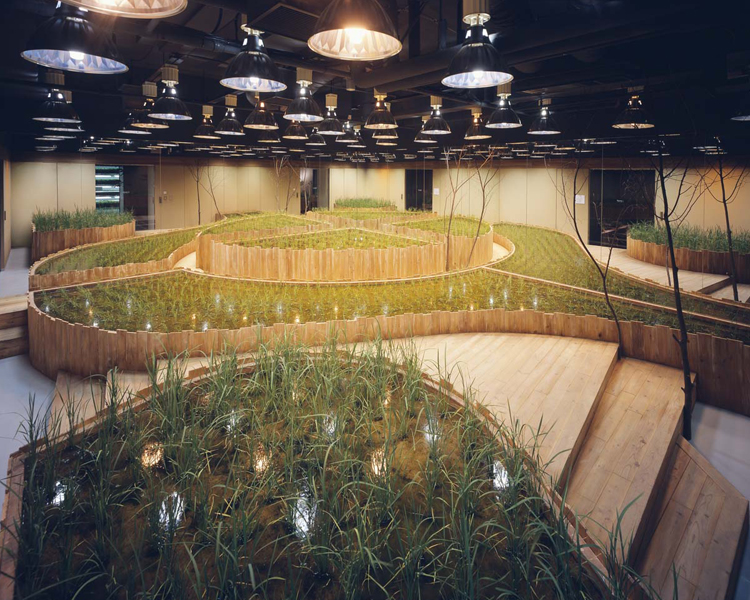
Deeply tucked away in the second basement level of a huge skyscraper, they grow rice. I am not entirely sure why they grow rice, but people are free to come and see it. Huge natural light shines from above. Rice grows. From what I was told, this area stretches under the whole business district, although it doesn’t. The size of the area was heavily exaggerated to me. The rice isn’t really that much of a secret; it’s not too well advertised, but no one is trying to hide the fact that it grows here either. In fact, I think it’s encouraged for people to come here and learn about rice cultivation. So, another urban myth shattered then.

ricetomeetyou

After looking at rice for a few minutes, I decide to walk to the Imperial Palace. I’m surprised by how close the stations are to each other in this area. Tokyo, Kanda, Shinbashi, and Nihonbashi Stations are literally within a five-minute walk of each other. Outside the Imperial Palace, about thirty elderly Japanese people are sitting and painting.

The Imperial Palace is home to Emperor Akihito, the last remaining monarch in the world to go by the name of Emperor. There isn’t really much else to see at the palace. The grass outside is cut immaculately, and the water fountains spray jets of water about two metres into the air. I notice there is a great view of Tokyo Station from the Palace car park, though. I wander to the nearby Ginza Station and take the train back to Asakusa.

tokyostation[1]

I decide to inspect a potential apartment. Small apartments in Japan are ironically referred to as “mansions.” These one-room coffin apartments offer little to no space and an equal amount of comfort. Another phenomenon in Japan is the grouping of shops, whole areas dedicated to selling one type of product. The area where the apartment is housed is completely surrounded by funeral shops. One street has eight shops in a row, all selling tombstones. I decide the area doesn’t quite feel right. Chimes sound from nowhere as I head back to the hostel, chiming five times signalling 5 p.m.

At 6 p.m., Richard, Luis, Remi, and I head to a nearby restaurant that serves fugu. Jokes are made about toxicity, tetrodotoxin, paralysis, and death. In reality, fugu poison is one-thousand two-hundred times stronger than cyanide; this is no laughing matter. The most poisonous part of the fish is the liver. Outside the restaurant, we watch our dinner for a while, graciously swimming around in a tank. In a moment, this beautiful blowfish will be killed on our behalf; we sure hope it doesn’t have a taste for revenge.

blowfishing[1]

There was a time when a fugu chef would have to pass a training course of ten years before being given certification to prepare fugu. These laws changed about three years ago, and now the rules state just a two or three-year course is required. We really hope that our chef today is of the older generation.

We take a seat in a tatami room. We order fresh blowfish sashimi. We also order diced blowfish sashimi just so I can make a pun about how we diced with death. Oddly, one of the options on the menu is hot sake with dried blowfish fin floating in the liquid. “We only serve the finest live domestic tiger blowfish,” says the menu. Served live? I certainly hope not. We wait anxiously for our food to arrive.

The poisonous fish is served in elegantly arranged translucent slices; it doesn’t look very threatening.

blowfish1[1]

A taste for revenge would be an overstatement. A taste of anything would be welcome. The food is the freshest fish I have ever tasted, of course; it has been dead just minutes. The food is also the least tasty fish I have ever had. It has no flavour at all; perhaps there is a subtle hint of death. I’m just glad we went to a cheap non-certified restaurant. It costs us just ¥5480 between the four of us for two dishes and four drinks.

I tried the sacred fugu of Japan and all I got was this lousy anecdote.

Pyrotechnics and Parade

I wake up at 5 a.m. to the sound of a drunk man in our dormitory room. He spends fifteen minutes trying to open his locker before giving up and leaving the room. It’s nights like these that I wish I were in a hotel. An hour later, the same guy who doesn’t know how to open a locker comes back and spends fifteen minutes trying to climb the ladder to his bed, which, of course, is the bed above mine.

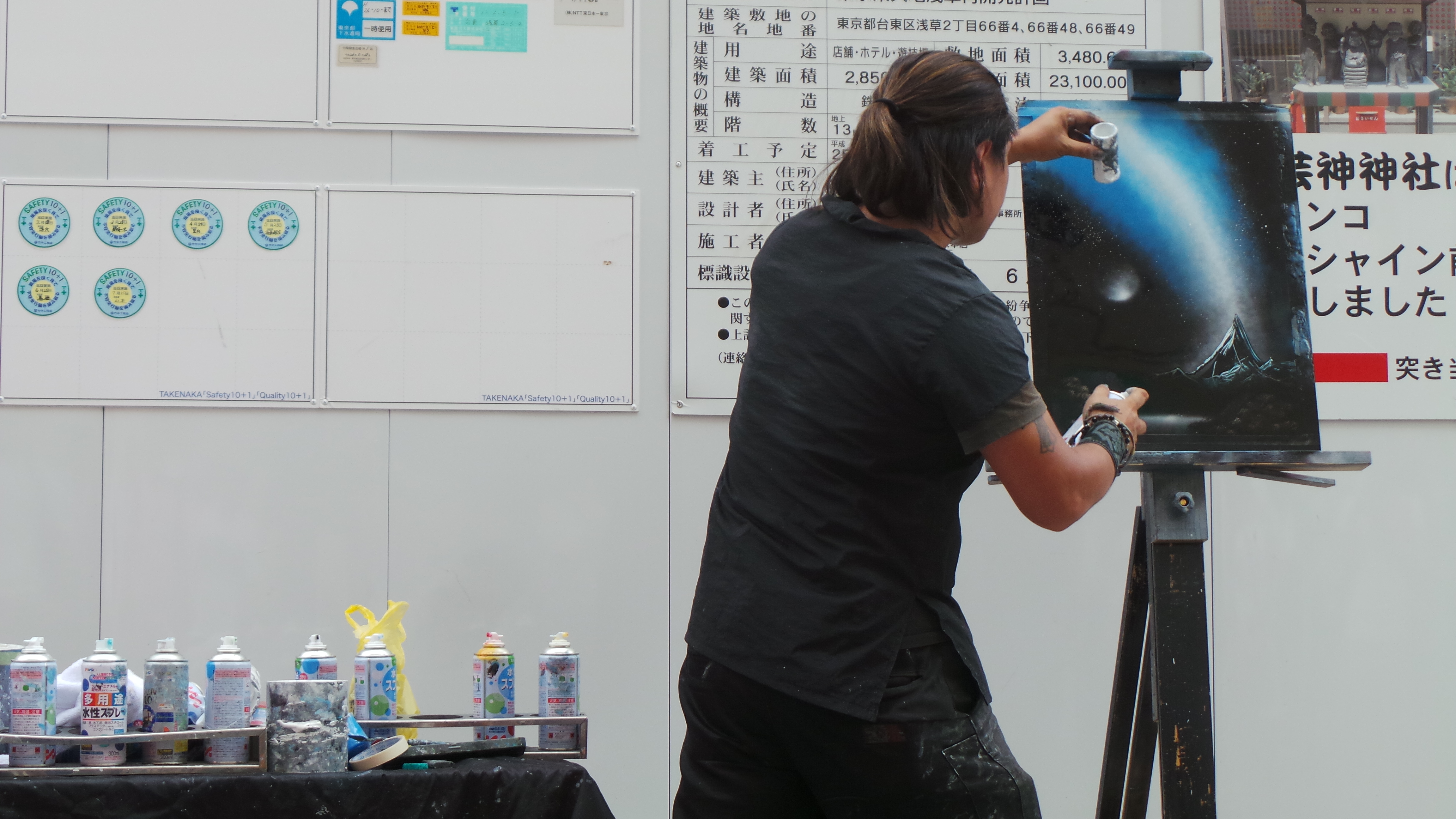
More noise at eight. Two people packing and re-packing their cases loudly, stamping around loudly. I give up on sleep and get up, tired and annoyed. I kill time, drink coffee, then go to a cafe at nine for more coffee. Despite drinking a lot of coffee, I still feel drained. The hot weather adds to my exhaustion. I lazily stroll through the mid-morning Asakusa streets. There is an artist on the street using spray paint to create science-fiction themed space art. He goes from a blank canvas to a beautiful planetscape in a matter of minutes. Incredible.

streetarts

I continue wandering. One guy raises his hand above his head as I walk past, “Woah! You are too tall!” he exclaims, much to my amusement. I head back to where the street performers gather and watch a yo-yo master skilfully Split the Atom.

Back at the hostel, I write up non-events, then kill time playing Baldur’s Gate on my camera. At 3 p.m., I still have no energy but need to get out of the hostel. I decide to head to Chofu. I take the Tokyo Metro Ginza Line to Shibuya. On the way, I hop off at Nihonbashi Station for a ¥300 smoothie (orange and ginger), then back on the next train three minutes later.

I cross Shibuya Crossing and take a shortcut through Yoyogi Park. My shortcut is somewhat obstructed by the Super Yosakoi dance festival. The entrance to Yoyogi Park’s event open space is blocked by hundreds of people dancing in the street.

yoyogistreetdance[1]

The dancing here is actually quite good, the music catchy and rhythmic; I much prefer it to the Samba music that was playing all day yesterday. The stage here is in use too, with people in traditional clothing waving flags and dancing to very similar music to that of the street dancers. I take the ten-minute walk to Harajuku Station, trying to get away from the crowds. My plan is a shortcut through the forests surrounding the peaceful Meiji Shrine.

My shortcut is somewhat obstructed by the crowds of people gathering at the entrance to the shrine. A stage has been erected here, and more people are dancing. The Super Yosakoi dance festival is everywhere. The music from the speakers here is so loud that I actually have to walk with my fingers in my ears. A one-way system through the grounds of Meiji Shrine is also in place.

Halfway through my route through the shrine grounds, a third stage is active and features more dancing and loud live music. There is a sign with a big red cross over a picture of a camera; I presume it to mean “No photography,” yet everyone seems to be taking photographs. Very odd. Perhaps I have been misinterpreting this sign all these years.

nophoto[1]

I leave Meiji Shrine and head toward Shinjuku Station. It’s another hot day, and I have another ten minutes of walking to endure in the heat. Somehow, as this realisation of the temperature comes to mind, a stranger in the street hands me a fan. At Shinjuku Station, I get a little lost but eventually find my way to the entrance to the Keio Line. A million other people have decided to take this train too. I take the second train that pulls in as there is no room on the first. As I am pushed into the carriage, I see that the crowd behind me spills up the steps and beyond. It appears the whole of Tokyo is following me to Chofu.

The Special Express train makes just one other stop between Shinjuku and Chofu, and I arrive promptly at 6 p.m. I follow the swarms of people to the Tamagawa River. Just as I arrive at the river, there is an explosion in the sky.

fireworks7[1]

Today is the annual Chofu City Fireworks Festival. It runs for an hour and includes 8,000 fireworks. I have a pretty decent spot and enjoy the spectacle. All along the river, little stores sell street food, and even Lawson Stores and Seven Eleven are getting in on the action. They have beers for sale outside floating in big ice buckets, and they have moved their hot food counters to the front of their stores.

The fireworks are impressive, although very stop and start. A lot of fireworks are launched at once, then nothing happens for twenty or so seconds, then lots of fireworks at once, et cætera. Every time a big explosion occurs, everyone around me says, “Sugoiii!” “Sugoi!” and “Oh, Sugoi!” This word means ‘amazing’ in English and seems to be the only word that the Japanese people here use to describe the fireworks. They certainly were amazing.

fireworks6[1]

At 19:11, I head back to the station; the fireworks will continue for another twenty minutes or so, but I really don’t like the idea of getting back on a packed train. It seems everyone else has had the same idea; once again, the station is packed. I am not proud of it, but when the doors finally open, I dash to grab a ‘Priority Seat.’ These seats are intended for pregnant, elderly, and disabled people. I feel somewhat less guilty when the other seven Priority Seats are taken by youths.

Back in Shinjuku, I change to the Marunuchi Line and take it as far as Ginza before switching to the Ginza Line. I arrive back in Asakusa around eight.

I meet with some friends, and we head to a nearby British pub run by actual British people. They brew their own beer here, play British music, and serve by the pint. I go for the porter; nice but expensive at ¥1000. The song ‘Empty at the End’ by my friend’s band The Electric Soft Parade comes on at some point in the evening; my mind ends up back in Brighton.