Somewhere Oji We Know

The day is warm but grey. I head over to the Sumida River to take a look at a traditional Japanese festival known as Hina-matsuri. It’s a day dedicated to girls, celebrating the passing of ancient dolls from generation to generation. Originally, these dolls were floated along the river. However, due to issues with local fishermen, this practice was discontinued. Nowadays, the dolls are cast into the ocean before being collected and burnt. As is customary, the dolls are believed to contain evil spirits, and Japan utilises fire to cleanse them of the demons within.

Unfortunately, upon my arrival at the Sumida River, the event has already concluded, and the market stalls and stage are in the process of being taken down. With not much left to do for the day, I hop on my bicycle and once again head in the direction of Kita Ward, towards a quaint little place known as Oji.

oji1[1]

I find myself standing in Asukayama Park, a vast area designated in 1873 as one of Japan’s first public parks. Instead of climbing the steep steps for entry, feeling particularly lazy, I opted to ride for free on the monorail that crawls along the incline and into the park. Interestingly, the train station here runs alongside the park. As I look in one direction, I’m surrounded by lush greenery, while in the other, I see the familiar sights of billboards, buildings, railway tracks, and advertisements in the sky.

As I explore Asukayama Park, I’m pleasantly surprised to discover a unique playground for children, quite different from what I’m accustomed to seeing. The play area features old trains repurposed into climbing frames. Among them, two locomotives stand prominently, and my personal favourite is D51 853, a steam train donated to the park on August 31st, 1943. A nearby sign mentions something about coal, water, and charcoal, though I have no idea what it is referring to.

oji3[1]

D51 853 is awesome. Not only can I go inside and look at the old steam engine, but I can also climb onto the roof and pretend I am in a movie. I feel happy for the children who come here. Parks in Japan offer excellent facilities and interesting attractions. It makes me wish that I had such adventurous play areas in England when I was a child, but instead, all we had were rubbish swings. A sign says, ‘D51 853 is somewhat dangerous. Play carefully, duck down, or climb up on the high locomotive!’

I continue my exploration and discover that this park also boasts old waterfalls absent of water, beautiful foliage, and multiple statues and sculptures of varying shapes and sizes. One such sculpture is merely a small pile of rocks, while another is a giant rock enveloped in a small wooden shelter.

oji2[1]

A sign beside the massive rock mentions something about the ceremonial transfer of a divided tutelary deity to a new location, although the meaning escapes me. It also notes that the inscription is challenging to decipher in Japanese, as the letters were written using ancient kanji and rare calligraphy. Despite the protective wooden house, the words have succumbed to a weathered, entropic fate. A second sign, written in English, amuses me; it simply says, ‘Rock, please do not climb.’ Instead, I climb the protective wooden house.

As I leave the park, I pass by the Paper Museum and ponder how interesting it must be. Unfortunately, it’s closed today. I continue to walk, heading toward a bridge, where I follow some old stone steps down to Otonashi Shinsui Park.

Oji4[1]

Hidden beneath the bridge, Otonashi Shinsui Park is simply amazing. It boasts its own old wooden bridge, a small stream, an abundance of beautiful nature, and an opportunity for rock climbing practice on the many craggy stone structures that don’t appear to be dangerous at all. I stand for a while, deciding not to climb but only to observe, taking in the beauty of the scenery. After a while, I head back up the steps and across the bridge.

Beyond the bridge, there’s a huge torii gate and a massive shrine.

oji5[1]

Oji Shrine, one of Emperor Meiji’s Ten Shrines of Tokyo, is part of a pilgrimage trail consisting of ten shrines. Today, the shrine is devoid of visitors; perhaps they are all too busy enjoying the festivities with their dolls. Legend has it that the shrine was renamed by Toyoshima, a Japanese warlord. However, the most intriguing aspect here is a much smaller shrine dedicated to the god of hairdressing and wig-making. Quite peculiar.

I continue cycling around the area, searching for something of interest. Eventually, I stumble upon large castle walls with modern houses built above them. Steep stone slopes run along the castle wall, eventually leading to Oji Inari Shrine—a place where foxes seemingly guard the playground for children situated at the bottom of the hill.

The god of rice harvesting resides here, and so do the foxes. Among all the fox shrines in Tokyo, Oji Inari Shrine is considered the main one. Every year, at the end of the year, foxes reportedly visit from all over Japan to guard the god of the rice harvest, and presumably, to offer their prayers. It’s hard to believe that if I came here on New Year’s Eve, the shrine grounds would be filled with foxes, but that’s what the information here tells me, and who am I to argue with information.

oji7[1]

I leave the shrine and start cycling back toward Asakusa. I make a brief stop at the Banknote and Postage Stamp Museum, but unfortunately, it’s closed today. It’s a shame really because inside this free museum, it’s said that you can lift one billion yen. I would have loved to take one billion yen home with me, but sadly, that won’t be happening today.

Back in Asakusa, I finally get a chance to experience Hina-matsuri through traditional food. Chirashizushi (scattered sushi) is the dish that women typically eat on this day. It’s supposed to be sugar-flavoured, featuring vinegared sushi rice. While the toppings usually include raw fish, for some reason, my friend has given me a unique mix of rice topped with egg, cream cheese, and strawberries. Although three of the ingredients generally go well together, the addition of strawberries for the sugar-flavoured element is what I find a bit strange. While this might be a traditional food in Japan, strawberries with egg and rice is something I struggle to bring myself to enjoy.

As I cycle home with the taste of Chirashizushi scattered in my mouth, I decide that my next blog post will be primarily about food.
Ticket to (almost) Ride

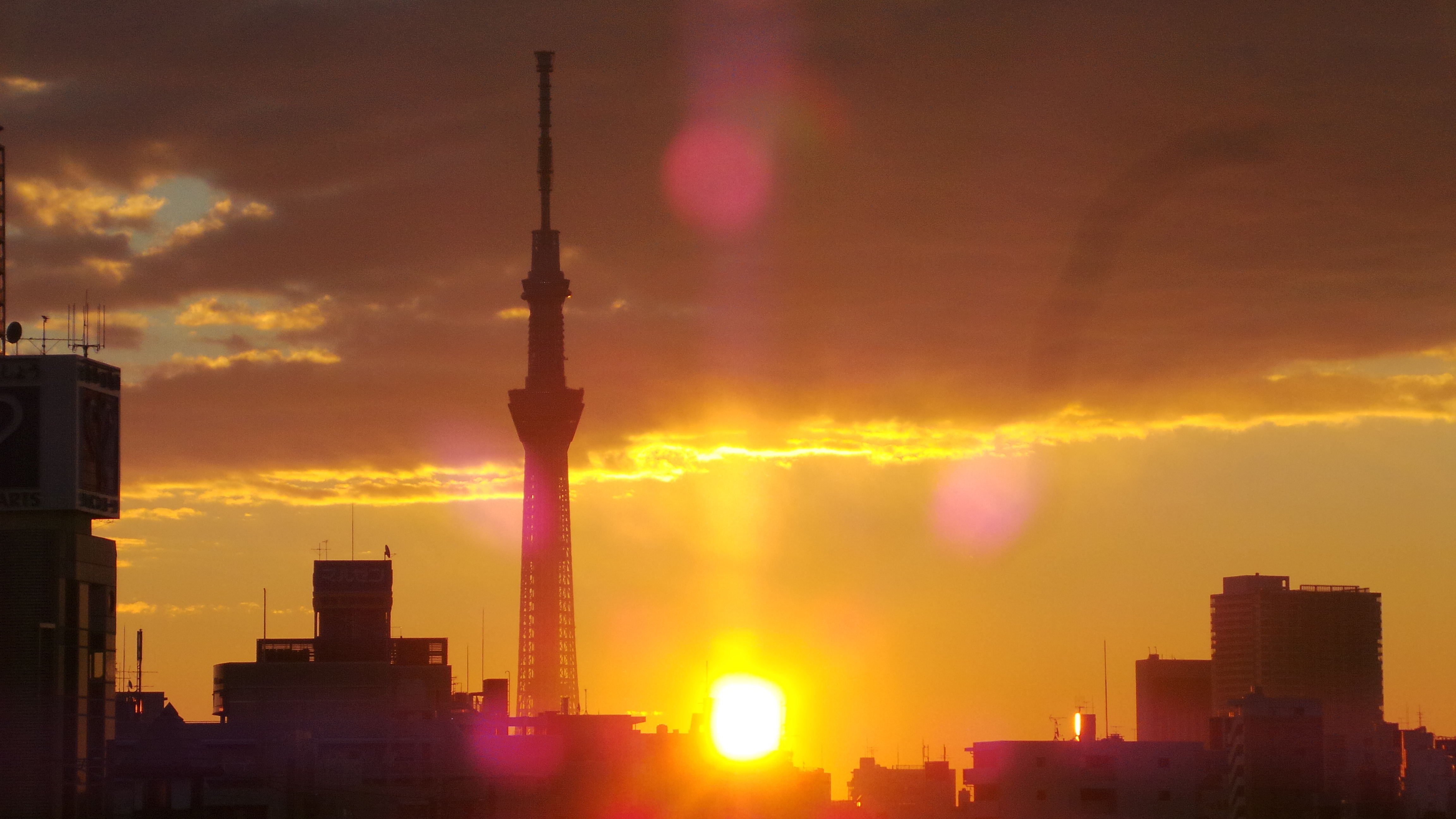
Today is Christmas Day. I wake up at 4 a.m. with a Christmas party hangover. It is too early to think, but I have things to do. Today, my friend Christine is arriving in Japan from England, and it is my job to act as a tour guide for the next few days. I walk to Nippori Station and arrive a little too early for my train. In order to kill time, I wander over the tracks to witness my second sunrise in Japan, the warm winter sun silhouetting Tokyo Skytree. My photograph is ruined by a smudge across my lens.

20141225_065945

Inside Nippori Station, it’s business as usual. Today might be Christmas, but for Japan, nothing changes. Salarymen dash to make their connections on the busy trains, Seven Eleven workers look exhausted from a heavy night shift, and ‘Let It Go’ blares from every speaker, as usual. It’s a normal business day here in Tokyo.

I take the Keisei Skyliner to Narita International Airport and wait. Eventually, my friend appears wearing a knitted Christmas jumper and a Santa hat. Despite seeing her in festive garb, it never really feels like Christmas. No trees and no snow; in fact, another clear warm day. There is no Christmas music in the airport either, just the constant drone of nonsensical announcements.

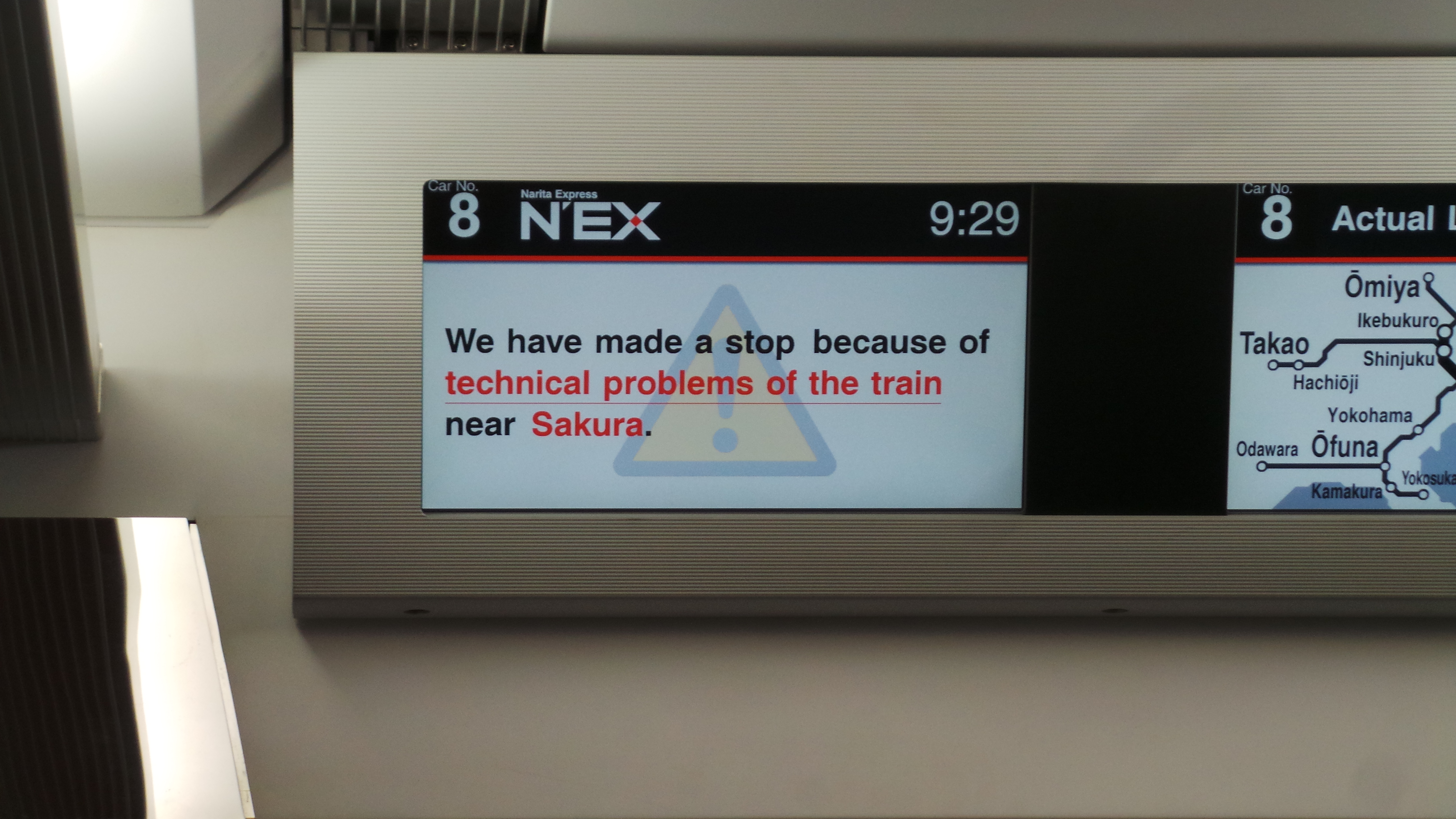
We take the Narita Express bound for Shinjuku Station. The Narita Express describes itself as ‘fast, convenient, and pleasant to ride,’ but never has a quotation been so far from the truth. On the train, Christine makes an offhand comment about whether things ever break in Japan. I tell her, ‘This is Japan,’ which translates to mean, ‘Things never break here.’ No less than five minutes later, our ‘pleasant to ride’ train crawls to a halt outside Sakura Station.

20141225_093039

We sit on the train for what seems like an hour before an announcement in Japanese tells us all to get off. A kind Japanese man sitting one row in front of us explains to us in English what is happening. We have to take a Sobu Line train from here to Chiba before continuing toward Shinjuku on local trains. For some unexplained reason, the Narita Express and the rapid line are out of action. Apparently, our ¥3390 tickets can be refunded in Shinjuku.

Not wishing to spend all day sitting on trains, we decide to get off close to Asakusa. We wander to Senso-ji Temple to get our fortune, something that I very much enjoy doing. Christine receives a ‘Bad Fortune’ and leaves it for the gods. We eat sushi at my favourite standing sushi restaurant before taking the train to Akihabara.

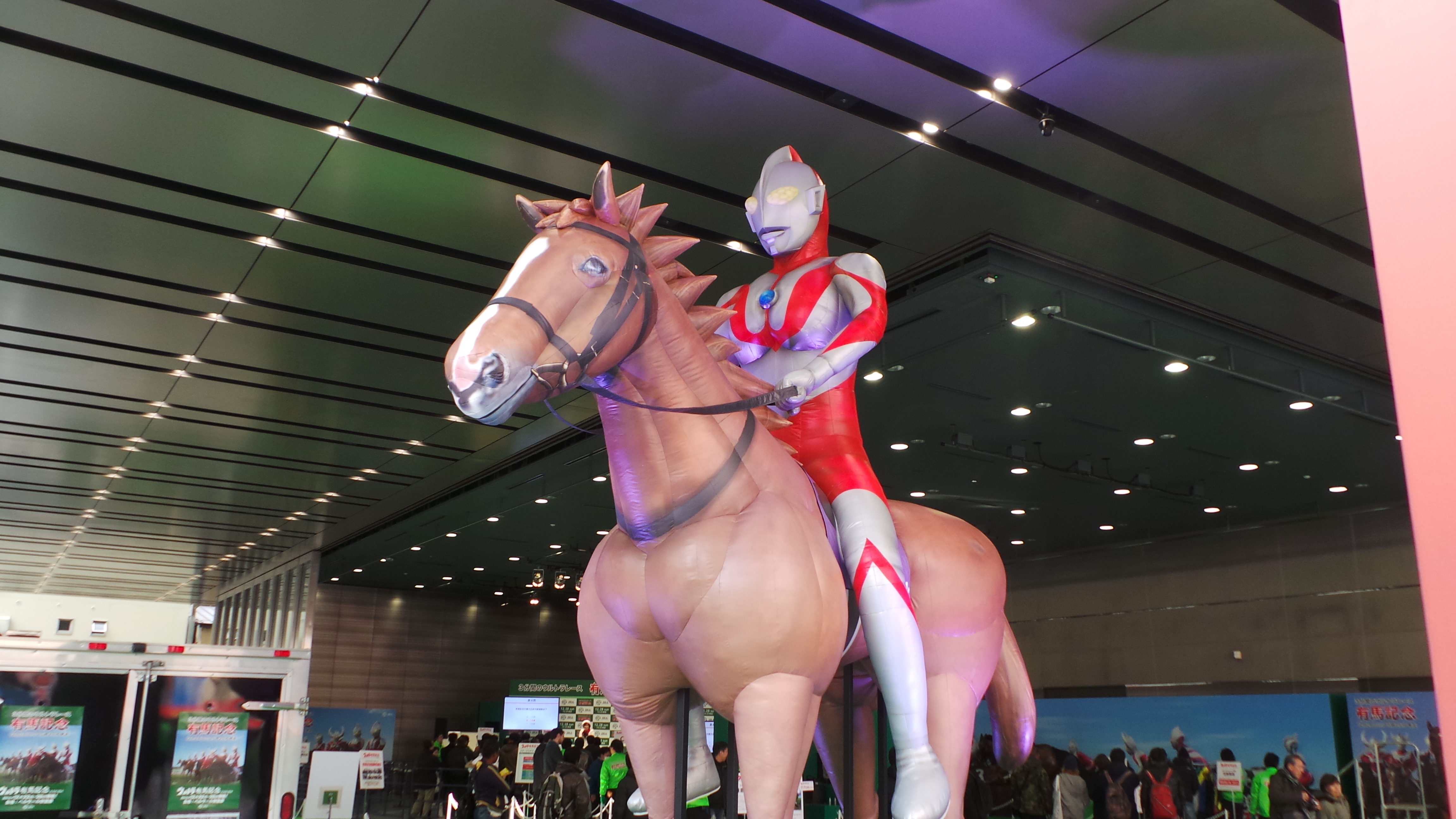
In Akihabara, for reasons that can’t be discerned, Ultraman is seen riding a horse.

20141225_133741

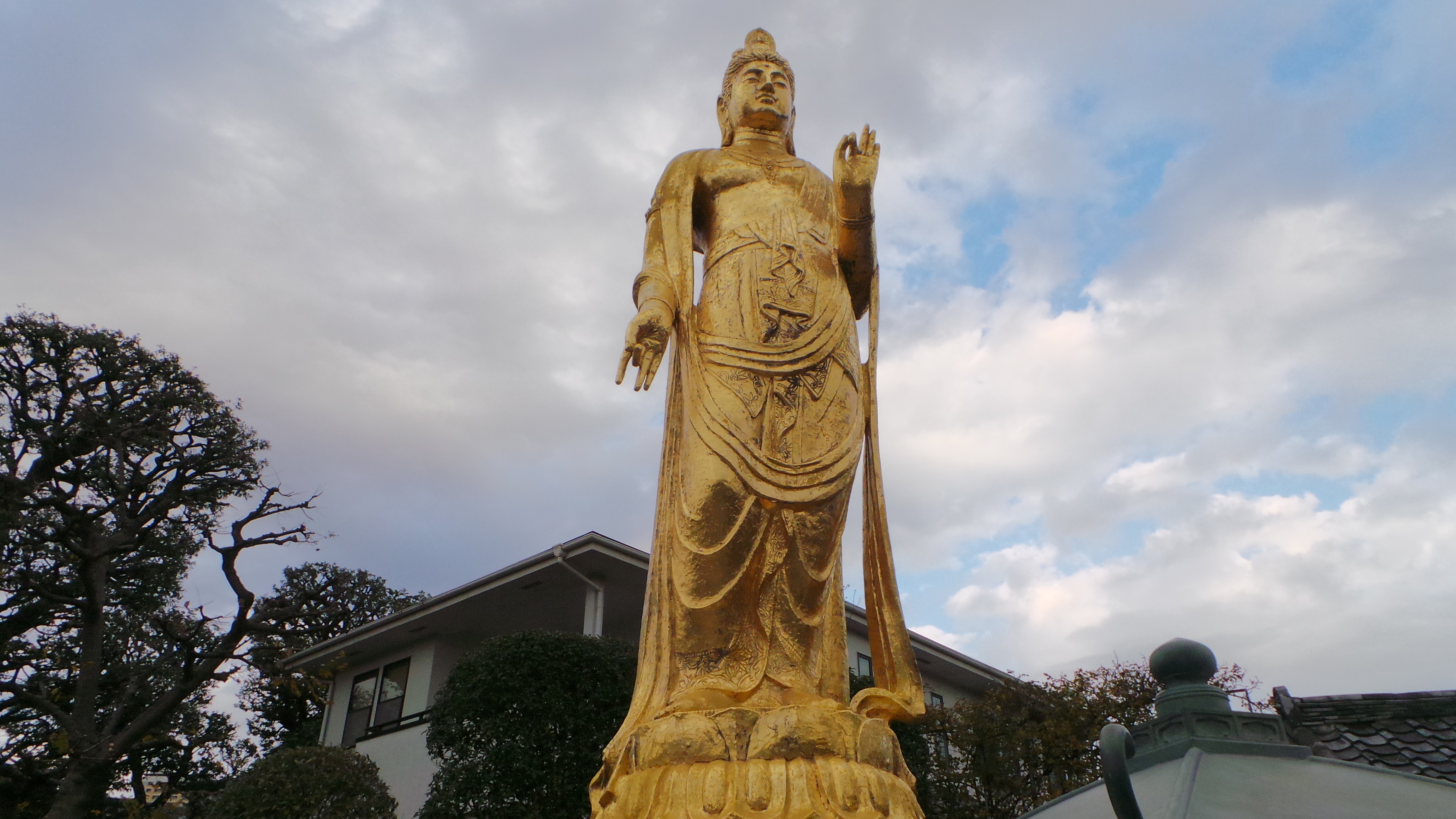
We hop on a Yamanote Line train and get off at a random station. Her choice is Nippori, my fourth visit to this station this week. We wander across the tracks and explore the many temples and shrines. Passing through Yanaka Ginza Street, we stop off at a small park. Tired and with feet hurting from too much walking, we take a breather at Zenshoan Temple. As we enter the temple grounds, in the distance stands a huge gold statue.

20141225_150326

The statue of Kannon is impressive, but what is potentially even more captivating is the Ghost Museum. Sadly, the museum featuring silk scroll paintings depicting ghosts and macabre ghost stories is only open during the summer months. There’s something about horror stories warming your blood, which is the reason for the seasonal opening hours.

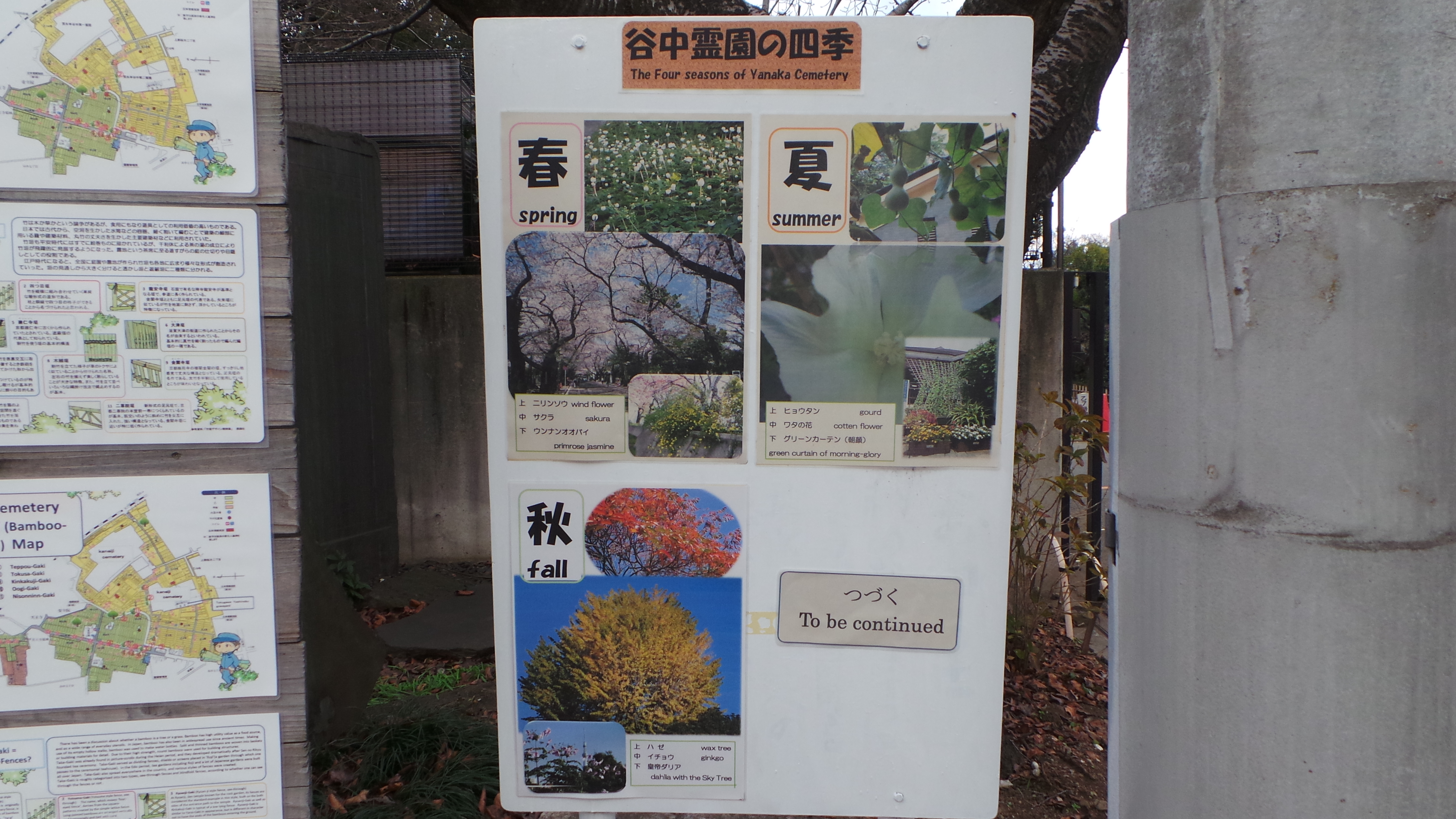
With all this talk of spirits, we take a wander through Yanaka Cemetery. I have visited here once before and found it incredibly peaceful, and do so now. There’s something about the perfect rows of decorated graves that is somewhat calming. Perhaps the quiet all around adds to this feeling. For some reason, the unfinished sign doesn’t display how winter should look here. The row of sakura trees and blossoming primrose jasmine in spring is a reason to once again walk among the dead next year.

20141225_151114

We head back to a hostel in Asakusa, the same one I had previously stayed at for eighty-two days. Tonight, the hostel is having a Christmas party, and Santa Claus will be arriving at half past eight by subway train. Exhausted from a long day and in need of my own bed, I decide to give the party a miss and head home.

Back in Minowa, I dine on Domino’s Pizza (four seasons) and a New York Cheesecake. I could post a photograph of a Japanese pizza from Domino’s, but it really isn’t any different from anywhere else. Instead, here are some instructions for Christmas decorations that I saw earlier today:

letsdecorate[1]

Merry Christmas.

The Golden Reptile

With a new home comes a new train station. Today, I head to the nearby Minowa Station and take the Hibiya Line. At Kayabacho Station, a man runs out of the train as the doors close, trapping his foot. He falls over, smashing his face on the platform. The doors re-open, he gets up, and walks away calmly, as if it didn’t happen. The train is also full of screaming babies, which is endlessly annoying. I much prefer the calmness of the Ginza Line. I remain on the noisy train for as long as I can stand; which happens to be twelve stops later, at Hibiya.

“I’ve never been to Hibiya before, but the area seems to take its name from a train line, so I’m hopeful I’ll find something interesting here. Inside the station, the yellow area information map presents a world of endless possibilities. There’s the Passport Centre, the Imperial Hospital, or even the Diet Building. Instead, I opt to explore Hibiya Park. As I approach the park’s entrance, a group of marathon runners rushes past me. In the distance, I hear the sound of megaphones. Inside the park, a festival.

theyliketrains[1]

Today marks the 21st Railway Festival. On the main stage, a big yellow mascot, shaped like the front of a train, dances around energetically. Market stalls are brimming with train-based information and souvenirs. Adults form queues, eager to have their photographs taken with various images depicting trains through the ages.

A crowd of people stands silently, engrossed in taking photographs, so I head over to investigate. A man holds up a sign that reads ‘On Air.’ A complete film crew is present, recording for a channel called Ch.546. They are filming a segment focused on the railway festival, featuring what seems to be a Japanese idol displaying a remarkable enthusiasm for trains.

onair[1]

The bustling stalls attract a steady stream of people, children brimming with excitement, and families enjoying picnics. Despite the event being a railway festival, the only physical trains in sight are on a miniature track featuring characters like Thomas and Percy from Thomas the Tank Engine—a ride that children happily pay an overpriced fee to experience.

Deeper into the festival grounds, a queue of over a thousand people forms for a live music event. I decide to continue my stroll through the park, which turns out to be quite charming with its fountains, ponds, and well-tended gardens. After a while, feeling a bit bored, I decide to leave and make my way to Ginza. Here, I indulge in the familiar tranquillity of the Tokyo Metro Ginza Line until I eventually arrive at Ueno Station.

Today marks the 31st Kappabashi Kitchen Festival. I start my journey from Ueno towards Asakusa, walking through the bustling Kappabashi Kitchen Town. The place is crowded; too many cooks.

kitchenfestival[1]

This area is a hub where all the kitchen shops in Japan are clustered together. It’s the primary destination for purchasing kitchen products in the country. The festival serves as an avenue for shopkeepers to sell off their summer inventory at discounted rates, making room for their winter stock. Prices have been significantly reduced, resulting in a rush of shoppers clamouring for bowls, knives, pans, and even shop signage. Meanwhile, the enticing aroma of delicious food from various small stands fills the air.

I swim through bustling crowds until I spot a group of people capturing photographs of a statue—a golden kappa.

goldkappa[1]

The kappa has evolved into the official mascot of Kappabashi Street, although the reason might not be immediately apparent. One story suggests that ‘kappa’ translates to ‘raincoat’ in Japanese, as many merchants used to hang their wet raincoats out to dry on a nearby bridge. Another tale revolves around a merchant named Kappaya, who supposedly constructed a canal in the area to manage floodwater. Consequently, the street was named after him to honour his contributions. However, as time passed, these origins faded into obscurity, and now the street is simply associated with the homophonically named kappa—a mythical frog lizard—replacing historical roots with legend.

At the Asakusa end of Kappabashi Street, I make a brief stop at Cafe Byron Bay for a radio interview with the Japan FM Network, discussing vending machines. Interestingly, the interview won’t be broadcast until next month, and despite being recorded in Tokyo, it’s to be aired everywhere except here.

Turning the corner from the cafe, I’m greeted by the commencement of festivities—traditional Japanese taiko drums echoing through the air.

streetdrumsyetagain[1]

As I finally depart from the festival, the resonating beats of the drums linger in my ears. Heading back towards Minowa, the rain begins to fall—another typhoon approaching. Quick to act, I grab some snacks from Seven Eleven and opt to seek refuge in my apartment for the evening, bracing for the impending storm.

Parasite at the Museum

Today is a public holiday dedicated to respecting the elderly and celebrating longevity. In Japan, there are fifteen different public holidays annually, and due to the implementation of the ‘Happy Monday System,’ several holidays have been shifted to Mondays to grant people a three-day weekend. Unfortunately, my toothache has plunged me into perpetual agony today. Regrettably, all the dentists are on holiday because of the celebration honouring the elderly. Not wishing to bare one’s teeth, I struggle on in pain.

My first stop today is Shibuya Station. With most of the country off work today, the area is overcrowded and annoying. I grab a bottle of drink that claims to contain one thousand lemons (which I very much doubt) before walking in the sunshine toward Harajuku, in search of some illustrious graffiti. On the way, I pass Yoyogi Park; here, there are swarms of teenage girls all standing around waiting for some sort of summer concert to start. I decide to pass on the concert. In Harajuku, it is just as crowded. I wander around side streets but find the graffiti to be somewhat lacklustre. I take just one photograph before walking back to Harajuku Station.

haragraf[1]

I take the Yamanote Line to Meguro, which translates to mean ‘black eyes’. After eventually finding a map, I discover that my destination isn’t marked. So, I search for a Seven Eleven and use their free wireless Internet. I then head to the Meguro Parasitological Museum; the only parasite museum in the world, I might add. I am surprised to find it open on a public holiday, and I am even more surprised to find that the entry is free.

If you are looking for a cheap destination for a romantic afternoon, then the Meguro Parasitological Museum is for you. Here, there are jars of parasites, magnifying glasses for that closer look, and an interactive screen displaying the life cycle of a parasite. There is even a small souvenir shop selling shirts depicting parasitological dissections. Finally, a gift shop selling something worth buying.

parasites[1]

With my appetite faded, I leave the museum and decide to skip lunch. I take the Meguro Line six stops to Ookayama Station. Each time the train starts up, it sounds like a jet engine. I change at Ookayama to the Tokyu Oimachi Line; this train also sounds like it is about to take off as it leaves the station. Eventually, I land in Jiyugaoka.

Jiyugaoka is often voted as one of the best places to live in Tokyo. The streets here are a cluster of expensive clothes shops and shops selling expensive cakes and sweets. Some stores have signs outside that say, ‘Women only.’ The roads here are even pedestrianised during the daytime, providing extra space for the many crowds. My intrigue takes me to a place called ‘Sweets Forest.’

sweetsforest[1]

Sweets Forest is an indoor theme park filled with cake shops and overpriced candies. For no apparent reason, traditional Irish folk music is playing inside. However, the thought of eating sweets brings more pain to my teeth, so I decide it’s time to leave. I take the Tokyu Toyoko Line to Shibuya, transferring to the Ginza Line before heading home.

Back at the hostel, everything is getting on my nerves. People keep asking each other the same questions, speaking in languages that could be English, but I can’t be sure. There’s too much noise, and I can’t seem to focus my mind. I try to write, but the pain in my teeth and jaw keeps distracting me. Tomorrow, I’m faced with the daunting task of visiting a Japanese dentist. A friend jokes about how dentists here continue to administer pain even if you scream and raise your hand to signal them to stop, or how instead of fixing your problem, they just remove your teeth.

With my appetence faded and my mind consumed by pain, I try to get an early night. I head off to bed at 9 p.m.; although sleep, I expect, will be somewhat limited. Not a very happy Monday at all.

On a Clear Day I Can See Forever

Summer surrenders to autumn, and the weather swiftly turns cool, as if overnight. My can of Boss Coffee falls from the vending machine piping hot. Today, I decide to explore the Toei Oedo Line. I walk twenty minutes to Kuramae Station. En route, I pass the Bandai Headquarters; a huge banner informs me that Tamagotchi is making a comeback at the end of this month. At Kuramae Station, I wait patiently for the train and receive strange looks as I laugh at the following sign:

outofafence[1]

I hop on the train without taking any notice of the time. It is, of course, 9 a.m. — rush hour. The train is packed. Today, I learn that this train goes all the way to Shinjuku. At every stop, more people get on. The crowding worsens, and the oxygen levels deplete. After about ten minutes, it becomes too much, so I squeeze my way out of the train at Kachidoki Station. I need air.

Kachidoki is in Koto and is the nearest station to the Tokyo Port Terminal. Whilst I’m here, I decide to take a little wander around the docks and the small interconnected islands. Dengue fever has now spread throughout Tokyo, and this area is a terrible place to be. All the streets here are lined with shrubbery and swarming with mosquitoes. A sign warns me to ‘Be careful with mosquitoes!’ Joking aside, it’s actually pretty serious, and I take the warning seriously.

I head toward the Harumi Railway Bridge.

HarumiRailwayBridge[1]

The bridge is no longer in use. Barbed wire warns me not to cross, although I wouldn’t anyway as it doesn’t look very safe. What’s interesting here is that from this bridge, I can see both Tokyo Skytree and Tokyo Tower. I suppose it makes the trip worthwhile, maybe not. After I photograph the bridge and Tokyo Tower in the distance, I head back to Kachidoki Station. Rush hour is now long gone.

I take the Toei Oedo Line all the way to Shinjuku. I end up getting lost in the station, then get back on the same train as before, taking it to Tochomae Station. Here, I change trains but stay on the same line and head to Higashi-Shinjuku Station. Outside, I walk around looking for something to do. There isn’t a lot here—just restaurants, shops, and plenty of bars; a good place for a night out if I didn’t live so far away. I cross under the Yamanote Line and see children painting the wall beneath the tracks.

arttrack[1]

I follow the wall of graffiti to the entrance of Shin-Okubo Station and take the Yamanote Line to Ueno, changing trains once more before heading to Tawaramachi Station.

When I arrive back at the hostel, Hiro tells me that tonight we are having a soba party. “Not again!” I quip. The flyer for the party is the same as last time but with a different date. I relax for a while, killing time, before heading out for my seventh train of the day.

I take the Tobu Skytree Line just one stop to Tokyo Skytree Station. If I’m completely honest, I could have just walked it; it isn’t far. I blame the convenience of Japan for my laziness. I’ve been here almost four months now, and with Tokyo Skytree practically on my doorstep, I decide I might as well take the plunge. ‘Plunge’ probably isn’t the best word to have used.

I pay ¥2060 and wait anxiously for the lift. Surprisingly, there is absolutely no queue. The lift travels so fast that it makes my ears pop. 350 metres later, I arrive at the Tembo Observation Deck. The view is staggering.

fromthetop[1]

Skytree Radio blares through the speakers. As I gaze over the Sumida River, I can see my hostel. “From the top of the tower, radio buzz in my ears, I can see my house from here, I can see my house from here.” The Owen Pallett song, ‘The CN Tower Belongs to the Dead,’ gets stuck in my head, and it will most likely stay there for the remainder of the day; not necessarily a bad thing though.

I wander the massive observation deck for a while, being careful not to get too close to the edge. There’s an option to pay an additional ¥1030 to go up to the next deck, another one-hundred metres higher. I think it’s terrible that this was never advertised to me until I’m already 350 metres in the sky—a sneaky trick to try and make me pay more. I decide not to bother; I’ve already spent a small fortune today as it is. Instead, I take the escalator down ten metres. Here, there’s a glass viewing point where I can stare at the traffic on the street below. Oddly, it doesn’t look like I’m too high up from here.

glassviewpoint[1]

There’s another area where I can actually stand on a glass platform and have my photograph taken by the staff, although I can’t use my own camera. All I want to do is take a photograph of my foot on the glass panel, but I’m not allowed. Another trick: if you like the photograph, you can spend even more money and buy it.

I take the lift back down to the inescapable 5th floor. It would be unfair to say that the most exciting part of the Tokyo Skytree experience is the lift, but then again, I am quite the unfair person. As I had imagined, the exit to the lift leads into the gift shop. The train station is on the first floor, and surprisingly, I am forced to exit through not just one gift shop, but three. After three floors of tacky goods, I then have to walk all the way through a huge indoor food market just to get to my train.

Back at the hostel and with an hour to kill, I write whilst listening to Owen Pallett, or at least I try to write. At some point, all hell breaks loose: a monsoon. Tokyo is issued a flood and heavy rain warning—a red warning. I have honestly never seen rain so hard; I can’t possibly explain it without appearing to exaggerate. The hostel floods. I spend an hour helping out: moving furniture from flooded rooms to dry rooms, and mopping. Mopping until I have no energy to mop anymore. It’s just lucky that my laundry is comfortably drying on the 4th floor, so I don’t mind getting my clothes soaked in dirty floodwater. Eventually, the rain stops, and with a lot of hard work from the team here, everything is high and eventually dry.

It is fair to say that the soba party is a bit of a washout. Eventually, after an hour delay, it finally gets started. I shower and change clothes before enjoying some free noodles and beer. Deserved beer.

skymoon2[1]

After the party, I take a wander outside to catch the end of the Harvest Moon. Somewhat fittingly, the moon hovers just behind Tokyo Skytree. An apposite end to the day.