Prelude to a Quiche

The Kaleidoscope Museum is a unique establishment with a fascinating twist. It proudly exhibits fifty distinct kaleidoscopes, chosen from an expanding collection of approximately 150 pieces. Among these are exceptionally valuable kaleidoscopes crafted by renowned artists from various corners of the world. I discovered that the term ‘kaleidoscope’ originates from Greek roots: ‘kalos‘ meaning ‘beautiful’, ‘eidos‘ meaning ‘form’, and ‘scopes‘ meaning ‘to look at’—a beautiful amalgamation that translates to ‘to look at beautiful forms’.

At the museum, visitors can freely pick up and use kaleidoscopes, ranging from finely crafted ones to those ingeniously made from plastic drink bottles. Among the assortment, my favourite piece doubles as a music box, serenading me with a tune while the images twirl before my eyes. Additionally, there’s a quaint shop within the premises offering kaleidoscopes, kits, and keychains. It’s a fantastic way to kick-start the day. Unfortunately, photography isn’t permitted, and I find myself constantly shadowed by a staff member. However, I manage to sneak a photograph of the inside of a kaleidoscope when she isn’t looking.

kaleide[1]

After leaving the museum, I walk for fifteen minutes, crossing the river to reach Yoboji Temple. I feel it’s only fair that my first temple is a Nichiren Buddhist one—the school of Buddhism I am familiar with. The Temple was built in 1548. It’s actually a rebuilding of two temples that previously occupied the area but had been burnt to the ground two years before.

In 1536, the warrior-monks of Mount Hiei attacked the city, burning down all 21 of the Nichiren Buddhist head temples in Kyoto, along with the entire southern half of the city and a substantial portion of the northern half. This event is known as the Tenmon Persecution. The temple itself is rather quaint.

Yoboji_Temple[1]

Not far from Yoboji Temple, I stumble upon a Paper and Printing Item Shop. The gallery is tiny, and a woman sits at the desk, watching my every move. I’m tempted to pull out my camera and capture a photograph of one of the ornamental fans or origami animals, but to avoid any hassle, I decide against it.

I choose to visit a shrine next. The road I stroll along is lined with various temples, shrines, plenty of walking routes, maps, and bus stops. You can literally shrine-hop by taking the bus if you’re feeling lazy. However, I prefer to walk, and I’m not inclined to see more than one temple and shrine a day. It can be a bit overwhelming to take in too much at once. I ascend about fifty concrete steps to reach Awata-jinga Shrine. Before entering, I participate in the purification ritual.

dragonfountain[1]

This tradition of cleansing is observed before entering a sacred space. The basin here features a water-breathing dragon, which also serves as the source of water for the ritual. I must admit, this is one of the most exquisite purification basins I’ve encountered at a Shinto shrine. I start by washing my left hand, then my right hand, and finally, my mouth.

Awata-jinga Shrine dates back to 794 AD and specialises in preventing illness. However, inside the shrine, someone is noisily using an electric saw, which disrupts the serenity of the moment for me. Nevertheless, the shrine itself is visually stunning. I descend the fifty or so steps and continue along a road lined with traditional Japanese-style houses.

Awata[1]

Downtown Kyoto bustles with tourists, drawn here to explore the shrines, temples, museums, galleries, restaurants, and the renowned souvenir shops the city offers. I spot three cat cafes and a lone dog cafe among the bustling streets. Purchasing a can of cold coffee from a vending machine, I encounter one of those machines that promises a prize if it lands on triple sevens. Miraculously, it does! I win any drink of my choice, and naturally, I opt for a second can of Coffee Boss Rainbow Blend.

It’s mid-afternoon, and feeling a bit peckish, I opt for a light bite to eat. Given the scorching 35°C temperature, I choose to stay in the cool shade of the shopping arcade. A sign catches my eye, indicating a vegan and organic cafe nearby. As I step inside, I’m greeted with a chorus of “Hello” from the other patrons. Taking a seat, I order a set meal featuring a vegan quiche.

vegan1[1]

My food promptly arrives—a serving of vegan quiche, accompanied by a delightful salad dressed in a delicious vinaigrette, a ramekin of squash, chickpeas, and peppers. Alongside it comes a bowl of leek, cabbage, and mushroom soup, complemented by glasses of cold water and cold green tea. The entire meal comes to ¥918. If I weren’t already full, I’d happily indulge in another slice of quiche—it was that delicious.

Outside the cafe, a guy on a bicycle whizzes past, blaring an air horn from the spot where a bell would typically be. The shopping arcade strictly prohibits vehicles, including bicycles. A bit further along, I encounter a television crew filming people and asking them why they enjoy eating crêpes. While tempted to participate, I realise I’m not particularly fond of eating crêpes.

crepefilming[1]

Back at the hostel, I settle on the roof with a can of Suntory whisky highball, delving into my fifth Haruki Murakami novel since arriving here sixty-two days ago. The air has cooled, and the refreshing breeze is a welcome relief. Japan has been grappling with a severe heatwave for the past week, and it seems it will persist right through until the weekend.

I read until 8 p.m. before heading to a nearby music shop for a free gig. A stage has been set up next to the ukuleles. The band performing is a two-piece folk band. Their sound is somewhat average. Nonetheless, it’s pleasant to experience some live music, even though the venue is rather unusual.

My night winds down at the hostel bar, talking to random people with their random ideas.

Rice and Shime

I wake up at 11 a.m. Today, I’m heading to a place called Dazaifu, roughly fifteen kilometres away. Cycling on my one-speed bike in a straight line towards it, it should take me about an hour. Last night, the girl I met suggested I visit there—a kind suggestion.

As I set out, I discover a Domino’s Pizza just five minutes away from the hostel on the same road. I haven’t had one since arriving here—fifty days in Japan, only four pizzas so far. Tomorrow, it’ll probably become five.

A bit further along the road, near the Mikasagawa River, the skyscrapers start to disappear, and the sight of rice growing underwater becomes commonplace. Paddy fields full of semi-aquatic rice—it’s a picturesque sight, deserving a photograph.

rice[1]

Amidst the distraction of the rice fields, I suddenly realise that I am completely lost. In typical Fukuoka fashion, I see no maps, and signs pointing to Dazaifu have ceased to appear. Eventually, after cycling for about an hour, I find myself somehow at the base of a mountain.

For about ten minutes, I cycle without seeing another pedestrian. Eventually, a sign for a place called Shime catches my eye. My brain pauses for a second before a pun crashes into my consciousness. I decide to head there if only to make use of the pun: Rice and Shime.

shime[1]

It turns out Shime is up a hill—likely the same mountain I spotted earlier. I haven’t done much uphill cycling since Beppu, so my knees aren’t quite prepared for it. The footpath leading into Shime is in a state of disarray. Eventually, the incline transforms into a decline, and I find myself in a free fall into Shime. The wind is refreshingly cool on what is otherwise an alarmingly hot day.

overgrowth[1]

If you thought my post about Nishioita Station was exciting, wait until you hear about what Shime has to offer. Low-flying planes drift over and hang gracefully in the sky. At least I can follow the planes and track back to Fukuoka Airport; I know this isn’t far from Hakata, where I am staying.

I cycle around Shime, searching for anything of interest, but find nothing. Wikipedia confirmed it: ‘Although the town still has a railway station, the line is no longer used.’ Seems there’s no escaping Shime. Just as I decide to leave, I finally spot something noteworthy: a chicken wandering around in some mud.

torisan[1]

“Koke-kokko,” says the chicken in Japanese.
“Cluck-cluck,” I correct in English.

As I leave Shime, I find myself on the urban expressway, where all of the signs point to unfamiliar place names. I give in and revert to my plan of following the planes, soon arriving at the not very well-signed Fukuoka Airport.

fukuokaairport[1]

I see the same Chinook I saw yesterday, just landed. How very odd—I haven’t seen a Chinook in over fifteen years, and yet this week, I’ve seen the same one twice.

After cycling for a total of three hours, I arrive back at the hostel and indulge in a Seven Eleven lunch: a bottle of Pocari Sweat, a fruit salad, and, as usual, egg sandwiches.

After lunch, I do my laundry. In the Coin Laundry waiting area, there’s a rather odd set of photographs. I have no idea what they are showing. Alongside the images are some Japanese notices.

laundrycops[1]

I translate the notices back at the hostel. They read, ‘To prevent theft: if you notice any suspicious individuals, please contact the barnyard alternating Hakata police station if it was a robbery.’ There are also references to a theft in February, and still images captured by the 24-hour CCTV camera showing the criminal’s face. Named and shamed in a Coin Laundry.

After doing laundry and spending some time on Skype, I head to Hakata Station. Instead of taking the lift, I monotonously explore each of the ten floors. Hakata Station is a massive shopping centre with all sorts of shops, including the biggest bookstore I have ever seen.

There’s a record shop selling rare Japanese versions of classic albums. Perhaps there’s a profit to be made in reselling, but I don’t have the patience for that. I check for ‘Com Lag,’ but it’s the only Radiohead album they don’t have. The record shop also dedicates three entire aisles to the music of everyone’s favourite J-pop idols, AKB48. Crazy.

neonnight[1]

On the roof of the train station, I sit for a few hours, finishing off 159 pages of a Murakami novel. Night quietly sweeps in. The view at night is okay, but devoid of any stars. I ponder for a moment, questioning reality.

The Murakami book somewhat inspires me to make some changes in my life, specifically to start running more often.

On the tenth floor of Hakata Station, a Spanish restaurant.

seafoodpaella[1]

Paella and Rioja happen.

I jog back to the hostel, finding the late hours have already wrapped the city in silence, a stark contrast to the bustling streets earlier. Passing by the second Christmas tree I’ve seen since arriving in Japan, I can’t help but wonder why it’s there; it does seem a little early for such decorations.

christmastree[1]

The reflection of Lawson blue bounces off the glass beyond.

Sentient Pigs, Birthday Cake, Neon Electric Girl

Today is different. For some reason I don’t feel like myself, I cannot explain how I feel. I just don’t feel right. I decide to sell my second camera, a Nikon. Never used. My Samsung camera literally taking all of the action.

I take a bicycle. Thirty minutes later, I arrive at Reisen Park. I step into the ‘We buy and sell any camera’ shop and place my bulky Nikon on the desk. I hand the man all the wires, still locked inside opaque plastic. ‘Charger?’ he asks. Oh, I forgot the charger.

One hour later, I return to Reisen Park with the charger, and the sale concludes. In the park opposite, a stage appears to be taken down. I stop by a bookshop and use some of my camera money to purchase a book; there are so many books I need to read. I spend ¥1160 on the one I choose, ‘Kafka on the Shore’.

murakami[1]

Outside the rain drops like scattered gunfire, but you probably don’t care about the weather. I decide to grab an early lunch from the second floor of Hakata Station. I deliberately go via one of the shortest escalators in the World. Just for fun.

small_escalator[1]

Most restaurants in Japan display plastic models of their dishes outside. These models are crafted so meticulously that mistaking them for real food is easy if you didn’t know any better. The attention to detail is incredible. Taking a chance, I enter a restaurant that lacks these plastic models, leaving me clueless about what’s on the menu.

It is one of those restaurants where Japanese is the only language spoken, which is fine by me. I order a set meal of tuna on seaweed with rice, accompanied by something resembling coleslaw but with a different taste, miso soup, a spicy horseradish green condiment (the name escapes my memory), and a delicious red bean cake for dessert. Overall, it’s a nice meal.

After I leave, a woman chases me out of the restaurant with my forgotten umbrella.

epiclunch[1]

I return the bicycle to the hostel, just as the rain stops. I sit on the roof terrace and read eighty-six pages of Kafka on the Shore.

After reading, I take a stroll around at dusk. I walk toward Tenjin. I take a photograph of the city from the river, and then walk back. I was going to fill up space by talking about wasting electricity with all this neon, I will instead waste words telling you that Fukuoka is the sixth biggest city in Japan.

I realise on my walk back that I haven’t been on a train or bus for three days. Maybe I haven’t done anything but read for two. A Chinook passes over me. Ironically, I am on my way to meet a helicopter pilot.

neonriver[1]

At the bar, the manager pours me a free glass of ice cold rice wine. The helicopter pilot is with his wife. I talk to him for ten minutes, before sitting at the bar with my book. Not to disturb him as his food arrives. The helicopter pilot is Japanese, I met him last night in the same bar. His English is average. He told me to come back again today, “Not a problem,” I told him. “The bar is five minutes from my hostel.”

I sit at the bar for a while, eyeing the skewers of meat atop the glass counter. Eventually, the helicopter pilot’s daughter arrives. She’s studying English at university, and for the next two hours, we converse in English. Her eyes are a deep-set brown, strikingly profound. Her black hair has an unusual texture, reminiscent of straw to the touch.

I agree to meet her tomorrow over a bowl of Paella. She leaves. I pay for six Suntory whisky highballs and her orange juice, ¥2345. A nice clean number.

As I wander back via a Lawson Stores, I see these odd workers:

signalmen[1]

I see them everywhere, actually. They stand on roads, at entrances to car parks, and next to building sites. They wave on traffic and pedestrians with their red lightsabers. Sometimes there will be three or four, all standing on the quietest street next to a cement mixer or ladder. A very strange job.

Back at the hostel I have a craving for salt and vinegar crisps; another thing that I cannot find here. I sit in the lounge with a can of Suntory whisky highball, and talk with the Koreans. There is a Korean woman who is both the same age as me, and two years younger. East Asian age reckoning.

It becomes one of the Koreans’ birthday; an amazing cake duly arrives, bang on midnight.

birthdaycake[1]

One of the Korean guys is studying philosophy, and his sister is incredibly intelligent. We talk about philosophy, another thing I really miss doing. He quite likes my discussion on M-theory. We also talk a lot about sentient pigs.

The intelligent Korean girl tells me that my eyes look lonely.

Much Beppu About Nothing

I haven’t really done any touristy things during my last two days in Beppu. Instead, I have listened to far too much Blind Pilot and filled the rest of my days reading Haruki Murakami. In the evenings I have visited bars. On Friday night I got to the semi-finals of a Table Tennis tournament, only to be beaten by Yojiro. Today I will write about general things in Japan.

Vending machines. There are far too many Coca Cola vending machines for my liking. One is too many if I am completely honest. As a non-consumer of this particular brand of misery (reasons: child labour, worker rights, pollution, murder), I often find myself cycling around looking for a machine with the Suntory Boss brand. The best vending machines offer Coffee Boss Rainbow Blend, and if I am really lucky, Boss Ice Creamy Latte.

Vendingboss[1]

Vending machine coffee in the summer is mostly cold. I have always enjoyed cold coffee anyway. In the winter, the machine changes and the can of coffee is hot. In the vending machine above, Coffee Boss Rainbow Blend is on a Price Down!

In Japan, there are far too many silly notices and signs in English; most have terrible grammar and bad spelling. Presumably these signs are mistranslated when they are put through Yahoo! BableFish. Google is surprisingly unpopular amongst the Japanese people. For news, emails, and searches, almost everyone here uses Yahoo! Here is an example of a bad sign:

Umbrellastand[1]

I like umbrellas.

Yesterday I met a vegetarian couple. They decided before coming to Japan that being a vegetarian here would be ‘too difficult’, so they have chosen to eat meat while they are here. I don’t quite understand this logic. Admittedly, vegetarianism is somewhat uncommon here. I find that simply learning to explain that you don’t eat certain foods will get you by. I have even seen people with printouts in Japanese explaining their dietary requirements. There are ways, and there are also plenty of amazing vegetarian dishes here too.

I think I have mentioned it before, but the streets here are littered with cats. Here are some cats:

Catseverywhere[1]

There are a lot of things I miss about England. Eating cheese. Crust on my sandwiches. Coleslaw. Sometimes I really wish I could sit playing the guitar for a few hours, but I don’t have a guitar here, maybe I can rent one. I also mentioned the stars before. Never visible. So strange. Maybe it is just because of the weather. When I finally see the stars I will probably write a huge post about it.

I went for a late-night walk in the ocean last night. The ocean here appears clear or blue, depending on the time of day. Sitting on the beach at midnight with a few beers, followed by a walk in the warm ocean — even at midnight, the air here stays warm. Even during heavy rain, the air remains warm. I’m uncertain about the winter; time will tell.

Here is the ocean in the day time. Very blue:

Bluebird[1]

Walking around at night with a beer and not breaking the law is also amazing. Convenience stores are everywhere, so if you cant find any nightlife, you can buy a beer from Seven Eleven, finish it by the time you get to Family Mart, buy a beer, finish it by the time you get to Lawson Stores, et cætera. Basically if you walked to every 24-hour convenience store in one area buying one beer at a time, you would get nicely drunk. I count eight stores within ten minute walking distance from my hostel.

I enjoy the lampposts and traffic lights playing happy tunes. I like being in Japan and being from England. When most Japanese people ask me where I am from, their attitude changes when I say England. It is as though I have uttered some code word that makes people more friendly. “Ah, from England! You know Sherlock Holmes?” The other night a Japanese salaryman bought me a drink in a bar, he said it was because he, “Likes England so much.”

Random things are placed on the streets here. This is inside Beppu shopping arcade. Spot the Carnival Cutouts:

Bignose[1]

There are things I don’t like. I dislike being tall. The number of times I’ve smashed my head into the top of a doorframe surprises me; I’m amazed I haven’t suffered a mild traumatic brain injury. Although, maybe I will ten years from now. I often forget the occasional English word. Whilst talking to someone, I might suddenly draw a blank on a word I should know. It’s like there’s a void in my head where the word used to reside. At other times, I unconsciously substitute a Japanese word for an English one without even realising.

I hate inconsideration, but who doesn’t. I am in a four bedroom dormitory room trying to sleep. Someone comes in, sits down on his bed and starts to eat from a bento box (a lunchbox style Japanese meal; commonly with sections for rice, pickled or cooked vegetables, and a type of meat or fish). He is eating chicken, but I don’t eat chicken. Now, my room smells of chicken, and amidst this olfactory assault, all I can hear is him chomping loudly on his food. The hostel has a dining area and a lounge area, so please refrain from eating chicken in the dormitory room. Additionally, some people insist on loudly packing their suitcase for about an hour at 7 o’clock in the morning. It shouldn’t take that long and can be done the night before.

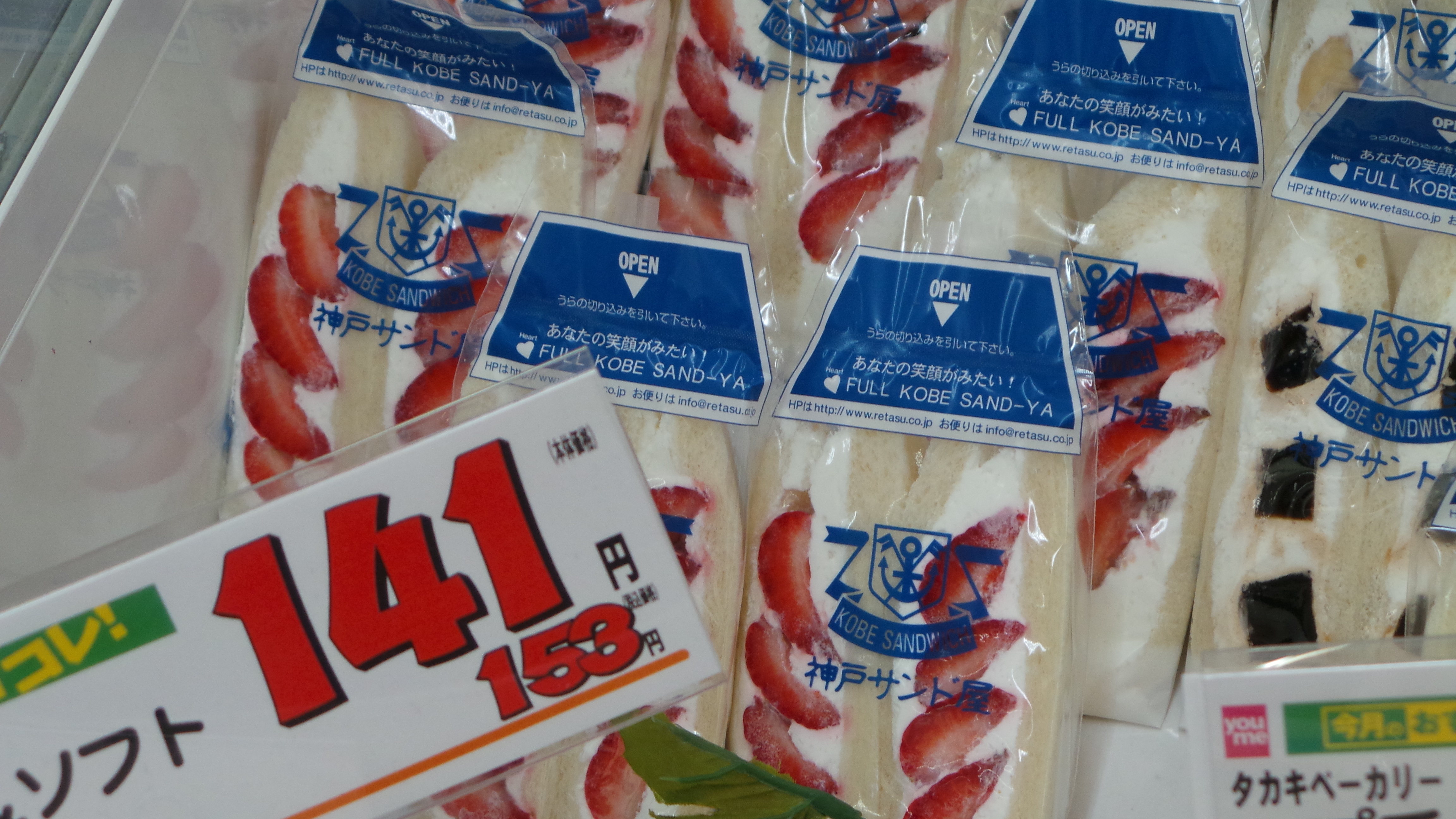
I went to the supermarket to photograph a bento box, but they had completely sold out. So instead, here is a photograph of some strawberry and cream sandwiches:

20140713_115654

Anyway, I have a bus to catch. Next stop: Fukuoka.

So Long, Tokyo, and Thanks for All the Fish

After a month of staying at the best hostel in the world (and finally memorising all nineteen stops on the Tokyo Metro Ginza Line), it is time to move on. The anticipation of spending eight hours on two different trains is something I lack. To avoid a whole day of travel I instead book a really cheap hotel at Kokura, which is the destination of the first of two trains.

At Tokyo Station, I purchase a ticket for the bullet train, the Shinkansen Nozomi. This high-speed train reaches speeds of up to 186 mph. After handing over my ¥22,310, I receive my ticket and proceed to the platform. I wait for thirty minutes while the train is cleaned in preparation for departure. The cacophony of noise from other platforms, announcements, station staff, and random whistles and bells floods back to me; I had forgotten just how prevalent it was when catching a bullet train.

seatontrain[1]

I take my ‘reserved’ seat by the window. The perfect seat. No one sitting next to me, and a plug socket for all my charging needs. If I had booked a ‘non-reserved’ seat, it would have meant queueing outside one of the first three carriages. When the doors open, it’s basically a free-for-all—first come, first served for seat selection. With my journey lasting an exact 4 hours and 48 minutes, rushing and fighting over a seat was out of the question. If no seats are available, you’re forced to stand up. Opting for a seat in a reserved carriage is well worth the extra couple of thousand Yen.

Back at my seat I weigh up the prices. A seven-day JR Rail Pass costs ¥29,110; this allows unlimited travel on all JR Rail lines for an activated seven-day period. Considering I still have a second leg of travel tomorrow (which will cost another ¥4000), the JR Rail Pass is a necessity if you are visiting Japan and plan to travel across the country. Travelling from Tokyo to Beppu will almost cost me the same as the seven-day pass.

this_taste_any_time[1]

The food cart eventually passes and I buy a packet of crisps for breakfast (Anytime, any where; right?) and a beer. I work my way through a third of Murakami’s ‘A Wild Sheep Chase’. Three beers later and I go for a doze. I wake up with an hour to go so listen to OK Computer. OK Commuter. I arrive at Kokura. My journey is an exact 288 minutes. Not a second more. Not a second less.

Kokura is located between Honshu and Kyushu; two of the largest of the four main islands that make up Japan’s geography. Honshu is the largest island, referred to as the Japanese mainland. It is the island that I’ve just left. Kyushu is the most south-westerly island, and where I am heading. Outside Kokura Station I am surprised to see a vending machine that for ¥650 sells unusual bottles containing fish in a brown liquid. I have no idea.

fishaction[1]

I am still reeling from the fish vending machine. With no sense of direction I find that my hotel is clearly marked on the Township Guide Map. Hooray! I take an unhurried walk carrying all of my stuff on my back for the first time in a month; I am sure it is heavier than I remember. I hate this kind of travel, moving to a hotel for just a day, then on to somewhere else. Nope. Book two weeks at a time minimum in the same place, that’s how I prefer it. I can take my time and take it all in. One thing a day. I don’t like to rush about.

After checking in to the hotel, I venture out for some food. Exhausted from the hours on a train and a few too many heavy nights of drinking, I grab some quick stand up sushi and head back to the hotel. The hotel was really cheap, ¥3400 cheap; and I understand why. The room is the size of a small cupboard. I can’t get the television to work, but luckily there are instructions in Japanese. I take a photograph of the instructions and my camera translates them to English. “Press and hold Power then press 3, 1, 3.” It works! I spend the night watching game shows and talent shows before falling asleep.

The next day (which is today, unless you’re reading this on a different day) 

I wake up to find time has moved the day to Sunday. To make up for my lack of updates I will continue on with this one. I’ve been merely socialising instead of sightseeing and feel a bit bad having not wrote anything for five days. I check out of the hotel early. Not to miss an opportunity, I head for Kokura Castle. The skies are hot and clear and I feel out of place with an umbrella and a rucksack. After seeing the castle, I head back to Kokura Station.

kokuro_castle[1]

No one I have met has spoken English in Kokura. I get through the ticket booking process by nodding and saying, “Hai!” I think the first question was, ‘single or return?’ The second was probably, ‘reserved or non-reserved?’ I receive my single reserved ticket; it costs me ¥4220 for 1 hour and 8 minutes on a train. This weekend is getting expensive and I still have to hand over ¥18,000 for two weeks at the hostel. On the way back, at least my travel time will be broken up by two-week intervals as I sweep back towards Tokyo. Between now and then I have 7 weeks of semi-planned stops along the way.

Beppu-bound on the Limited Express Sonic Train, I am glad for last night’s rest; having my own space and a bathtub were quite the treat. On the train I continue to read ‘A Wild Sheep Chase’ and find myself laughing out loud at regular intervals. The train journey flies by in no time at all.

beech[1]

I leave Beppu Station in awe. Beppu is by the sea and surrounded in every direction by tall mountains covered in wildlife. At my hostel I discover that I am a one minute walk from the beach and a two minute walk from Beppu Tower. As I hand over my ¥18,000, the woman at the reception desk finds it unusual that I am staying for two weeks. “What are you going to be doing for two weeks?” Take it all in. That’s how I prefer it. I don’t like to rush about.

It is Sunday and there is a nearby section of interesting intersecting streets filled with shops, bars, and restaurants; mostly closed. I find a vending machine selling not fish, but ice cream. I also find that my Suica card works on the vending machines here, a nice surprise. These little Japanese pre-paid cards can be used at Seven Eleven stores, some vending machines, and ticket barriers. I didn’t think they would work this far from Tokyo. The Pasmo card definitely doesn’t work. If you plan on travelling around Japan, always choose the Suica card over the Pasmo card.

pizzandwine[1]

I find a pasta and pizza restaurant with no English menu. I order a glass of wine and a pizza in Japanese. This is the first time I’ve ever felt I needed to speak the native language. In Tokyo I could get by just fine. Perhaps this is for the better; I got a little too comfortable and this might just give me some motivation to actually study a bit harder. The food costs ¥842 for the lot. At least I’ll save some money on food here.

Back at the hostel for 3 o’clock chicken time! I realise that I’m going to miss the crew in Asakusa; I’ve been missing a lot recently. I remind myself that this is not for here. Moving on I find my room; it is a traditional Japanese-style room with a Tatami flooring. Four beds, so sharing with just three others. Less crowded which is good. The view from the balcony is amazing. I can see Beppu Tower, which lights up at night. I can see a horizon of skyscraper obstructed mountains. I wonder which way the sun comes up; my sense of direction very much missing too.

tatamibed[1]

I explore my local surroundings. There is an international bar called Hot Bepper, it is thirty seconds away. You might think I exaggerate with my walking distances sometimes, but I can actually see the bar from the hostel. The bar has its very own table tennis table and is hosting a tournament next week. Hot Bepper is also run by the same company that runs the hostels I’ve been staying at. I like the pun name too, considering where I am.

I swing by the nearby Family Mart. An occurrence that will never fail to make me smile occurs. Staff at a convenience store greeting me through the door, bowing, saying thank you, bowing, and saying goodbye as I leave. Back at the hostel, I drink Suntory whisky highballs and write up the two days you’ve just read. I plan now to take a hot spring bath in the hostel’s very own hot spring baths; before heading out to the Hot Bepper bar, which will most likely be closed on Sundays.