After the Form

Bang, bang-bang. Bang, bang-bang. Bang, bang-bang.

The repetitive yet timely sound of drumsticks hitting against stretched animal hide stirs me from peaceful dreams. Not one to miss out on an opportunity to write about whatever is parading by my house, emitting this loud but perfectly rhythmic noise, I decide that I will follow the source of the sound right after I wake up with a coffee.

I haven’t written for a while as I’ve been extremely busy researching and organising paperwork, the details of which will become apparent later in this post. But for now, drums. I head outside to find that whatever was causing the loud banging appears to move at astonishing speeds; either that, or I drink coffee a little too slowly. I jump on my bicycle and follow the distant echo of drums before eventually locating the source to a small shrine in Imado.

monksfuneral[1]

It seems that I have inadvertently started my day with a funeral. The five monks stand within the shrine grounds, chanting and maintaining a steady balance of drums. I head back home to pick up some paperwork before cycling over to Asakusa. Outside the train station, the same five monks pass me again. This is quite a walk from Imado, which adds confirmation to the pace of these speeding monks. I take a train over to Ueno Station. The usual random mascots are here, serving no clear purpose but to frighten me.

statuenomasc[1]

I change to the Yamanote Line and head to Shinagawa, a place I have only visited once before when I felt the need to stand inside the belly of a whale. This time, I am here to visit the Tokyo Immigration Information Centre. A note on their website claims that, ‘This is where all inquiries should first be made concerning immigration issues, wherever you are in Japan.’ Luckily for me, I am already in Tokyo; otherwise, this would have been quite the journey. Also, seeing as I am in need of information pertaining to immigration issues, it looks like I am heading to the right place; the so-called ‘centre of information.’

Much to my delight, as I leave the train, I find that a bus service regularly runs to the offices I am here to visit. Everything is running a little too smoothly.

busstopaliens[1]

I am greeted outside of the immigration office by hordes of people giving out paraphernalia advertising their respective companies or cults. A woman is spreading the joy of Christianity, a man hands me a document offering ‘Legal Support for Aliens,’ and another man is holding a sign demanding China stop the act of organ harvesting.

Inside the Immigration Centre, I head over to the Advice and Information Counter, take a ticket (147), and then find a seat. The woman at the counter is talking to a young French couple in broken English. Every few seconds, she lets out a yawn or scratches her head, illustrating her apparent boredom.

Eventually, the French couple leave. The woman at the counter presses a button, and the bright red display shows the number 145. She waits less than three seconds before pressing the button again, displaying 146. Without much delay, she presses it again, showing 147—my number. As I approach the counter, her finger hovers over the button to call the next number, her eyes filled with resentment that I might sit down before her within my three-second window. I take a seat just as she sighs. I understand that maybe I am the one hundred and forty-seventh person she has seen today, not counting the people she frantically skipped, but this is her job. To counter her obvious state of disregard, I greet her in an overly cheerful manner, smiling as I sit.

The woman I talk to speaks limited English, looks bored, and probably hates her job. I inquire about the application form that I should take in reference to the activities I want to pursue in Japan. My questions are generally ignored, and at one point, the woman randomly asks, “So you want to stay in Japan to study Judo?”
“No, I didn’t say anything about Judo.”
“Okay, but if you are studying Judo, you need to go to End Counter B, second floor.”
“Okay, I actually …” She cuts away my words with metaphorical scissors of despair.
“End Counter B,” she reiterates, “second floor.”

So much for the best place to visit for information and advice.

I head to the second floor, to End Counter B. As I approach, the woman, slightly more miserable than the last, looks me up and down and says, without any hint of emotion or benevolence, “Passport.” Just one word is all she spares me. I hand her my passport. She adds rather sternly, “What do you want?” I explain that I want to collect an application form for … Before I have a chance to finish my sentence, she says, “Application, go queue over there,” pointing to a line of about thirty people.

aliens[1]

I join the queue, wait thirty minutes, and then find out that I am in the queue for application checking. I am not here to have applications checked; I am here to collect application forms and ask for advice. So far, neither of these two things has transpired.

My third and final stop is back on the first floor. I wander over to the desk marked simply as ‘Information.’
“What?” asks the woman behind the counter.
“Excuse me, where can I collect an application form?”
“Here,” she says, as if wanting to add the word ‘obviously,’ but she conveys it only with her tone of voice. Eventually, she begrudgingly hands me an application form.
“Thank you,” I say. No response. My politeness falls on deaf ears. The woman just flashes me a frown that contains the absence of all the hope in the universe before trudging off into a sea of misery.

Three counts of rudeness in one hour. It is no surprise that the hundreds of people here, waiting with folders or loose paperwork, look so dejected. Of all my time in Japan, a country that prides itself on politeness and good customer service, this is the rudest I have been treated and the smallest I have felt. The service here is disgraceful, not helpful, and has filled me with no confidence at all going forward. Perhaps this is the hidden agenda: make everyone feel unwelcome so they never come back to complete their applications. Regardless, I have to come back, most likely next week.

Outside, I am handed more leaflets for various different things. A woman tries to give me a newspaper. I say I am fine. She asks me where in Canada I am from. I say I am not from Canada but England. She mutters something about Elton John and then walks off. After wasting what was effectively a whole day, I leave with none of the much sought-after advice I had taken the trip here to receive. Instead, just an application form that I could have quite easily downloaded online and printed out myself.

I head over to Asakusa in need of a drink. On the main road, a protest is taking place about atrocities caused by North Korea. The people here have megaphones and sound extremely angry as they shout in Japanese.

protesting[1]

Trying to take in their words, I can’t help but be distracted by the late January Christmas decorations that loom over the protest.

As I walk toward one of my favourite bars, an elderly woman on a bicycle drops her handbag but doesn’t realise it. “Excuse me!” I shout in Japanese before she has the chance to ride away. She stops her bicycle and looks back. I scoop up her bag and walk over to her, promptly passing her the handbag. She apologises and thanks me, nodding her head more times than I can actually count in Japanese. She is so thankful, so happy that I helped her, and at this moment, just a slight bit of the decency and politeness of this culture finally returns—the kind of decency that has made me love Japan but has almost been entirely washed away by the events and abhorrent treatment I had experienced this afternoon.
Ticket to (almost) Ride

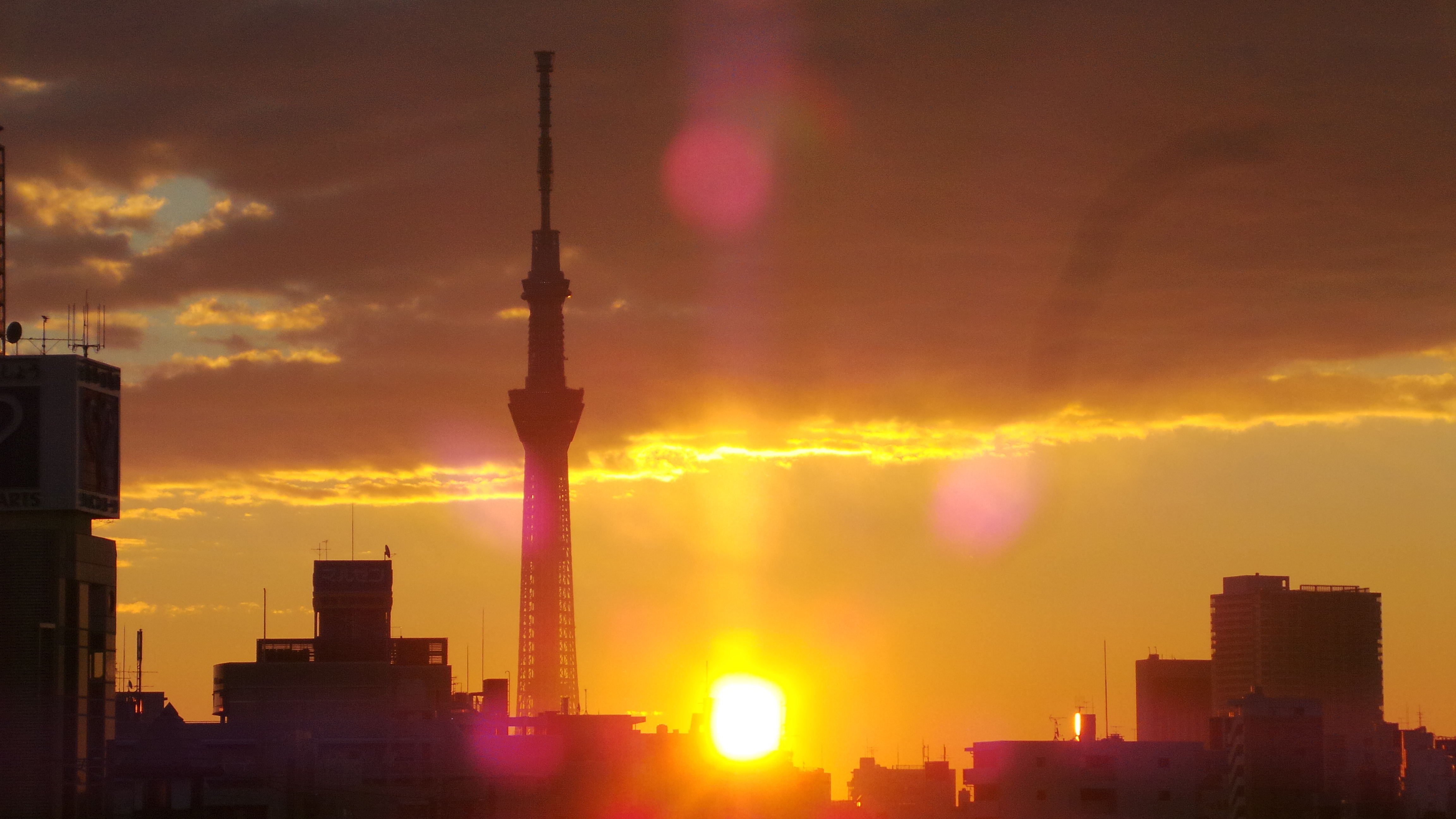
Today is Christmas Day. I wake up at 4 a.m. with a Christmas party hangover. It is too early to think, but I have things to do. Today, my friend Christine is arriving in Japan from England, and it is my job to act as a tour guide for the next few days. I walk to Nippori Station and arrive a little too early for my train. In order to kill time, I wander over the tracks to witness my second sunrise in Japan, the warm winter sun silhouetting Tokyo Skytree. My photograph is ruined by a smudge across my lens.

20141225_065945

Inside Nippori Station, it’s business as usual. Today might be Christmas, but for Japan, nothing changes. Salarymen dash to make their connections on the busy trains, Seven Eleven workers look exhausted from a heavy night shift, and ‘Let It Go’ blares from every speaker, as usual. It’s a normal business day here in Tokyo.

I take the Keisei Skyliner to Narita International Airport and wait. Eventually, my friend appears wearing a knitted Christmas jumper and a Santa hat. Despite seeing her in festive garb, it never really feels like Christmas. No trees and no snow; in fact, another clear warm day. There is no Christmas music in the airport either, just the constant drone of nonsensical announcements.

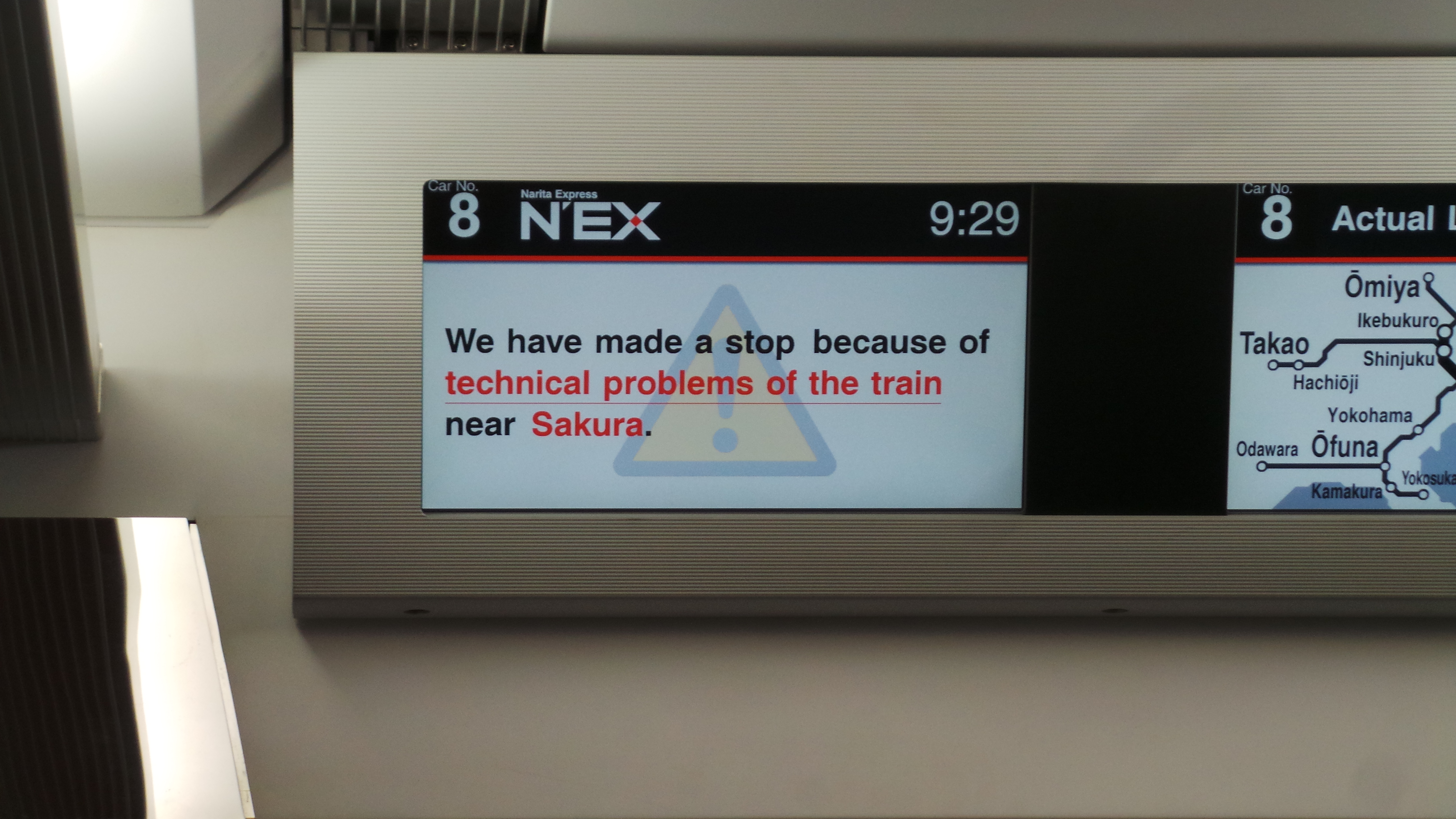
We take the Narita Express bound for Shinjuku Station. The Narita Express describes itself as ‘fast, convenient, and pleasant to ride,’ but never has a quotation been so far from the truth. On the train, Christine makes an offhand comment about whether things ever break in Japan. I tell her, ‘This is Japan,’ which translates to mean, ‘Things never break here.’ No less than five minutes later, our ‘pleasant to ride’ train crawls to a halt outside Sakura Station.

20141225_093039

We sit on the train for what seems like an hour before an announcement in Japanese tells us all to get off. A kind Japanese man sitting one row in front of us explains to us in English what is happening. We have to take a Sobu Line train from here to Chiba before continuing toward Shinjuku on local trains. For some unexplained reason, the Narita Express and the rapid line are out of action. Apparently, our ¥3390 tickets can be refunded in Shinjuku.

Not wishing to spend all day sitting on trains, we decide to get off close to Asakusa. We wander to Senso-ji Temple to get our fortune, something that I very much enjoy doing. Christine receives a ‘Bad Fortune’ and leaves it for the gods. We eat sushi at my favourite standing sushi restaurant before taking the train to Akihabara.

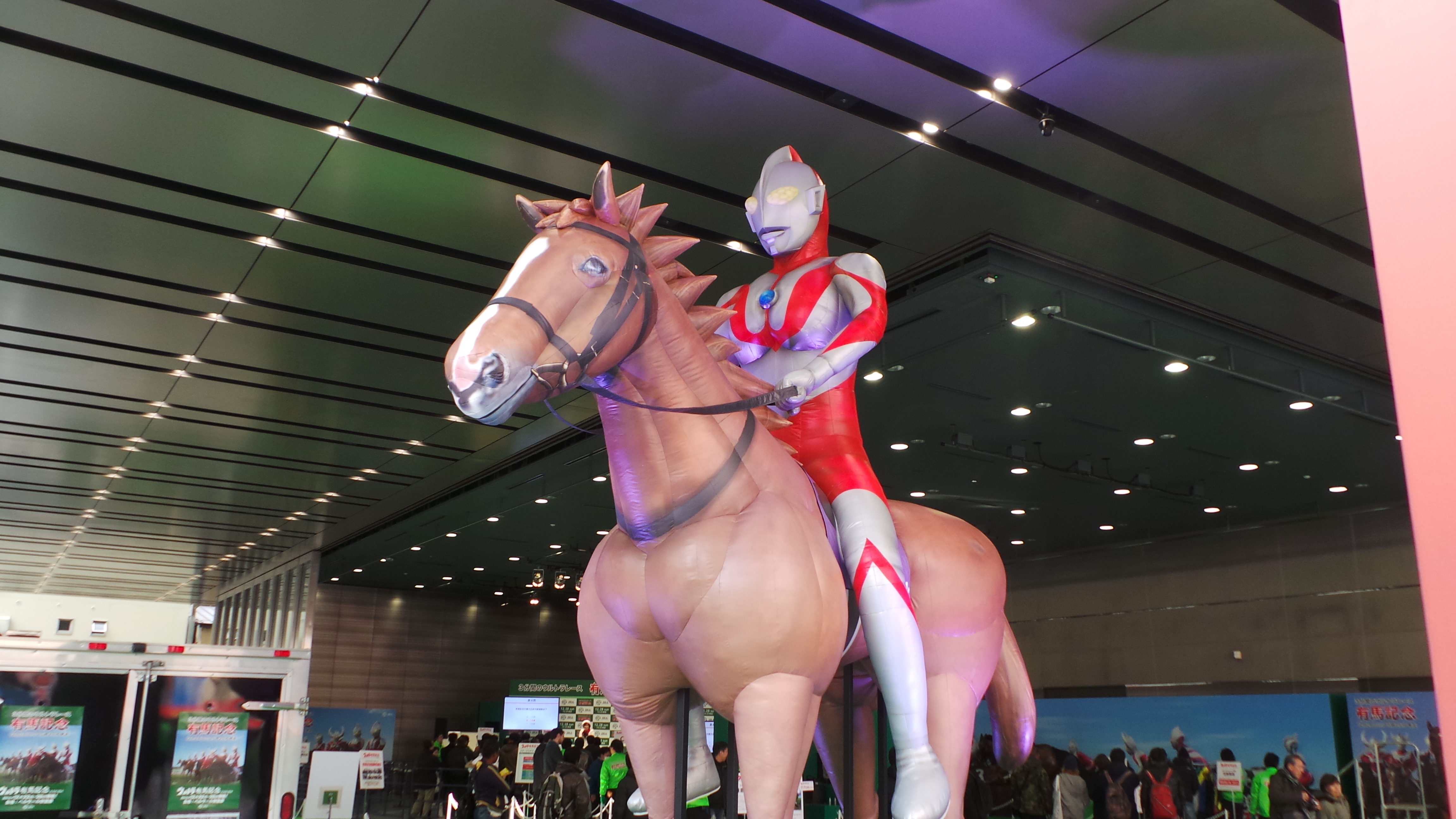
In Akihabara, for reasons that can’t be discerned, Ultraman is seen riding a horse.

20141225_133741

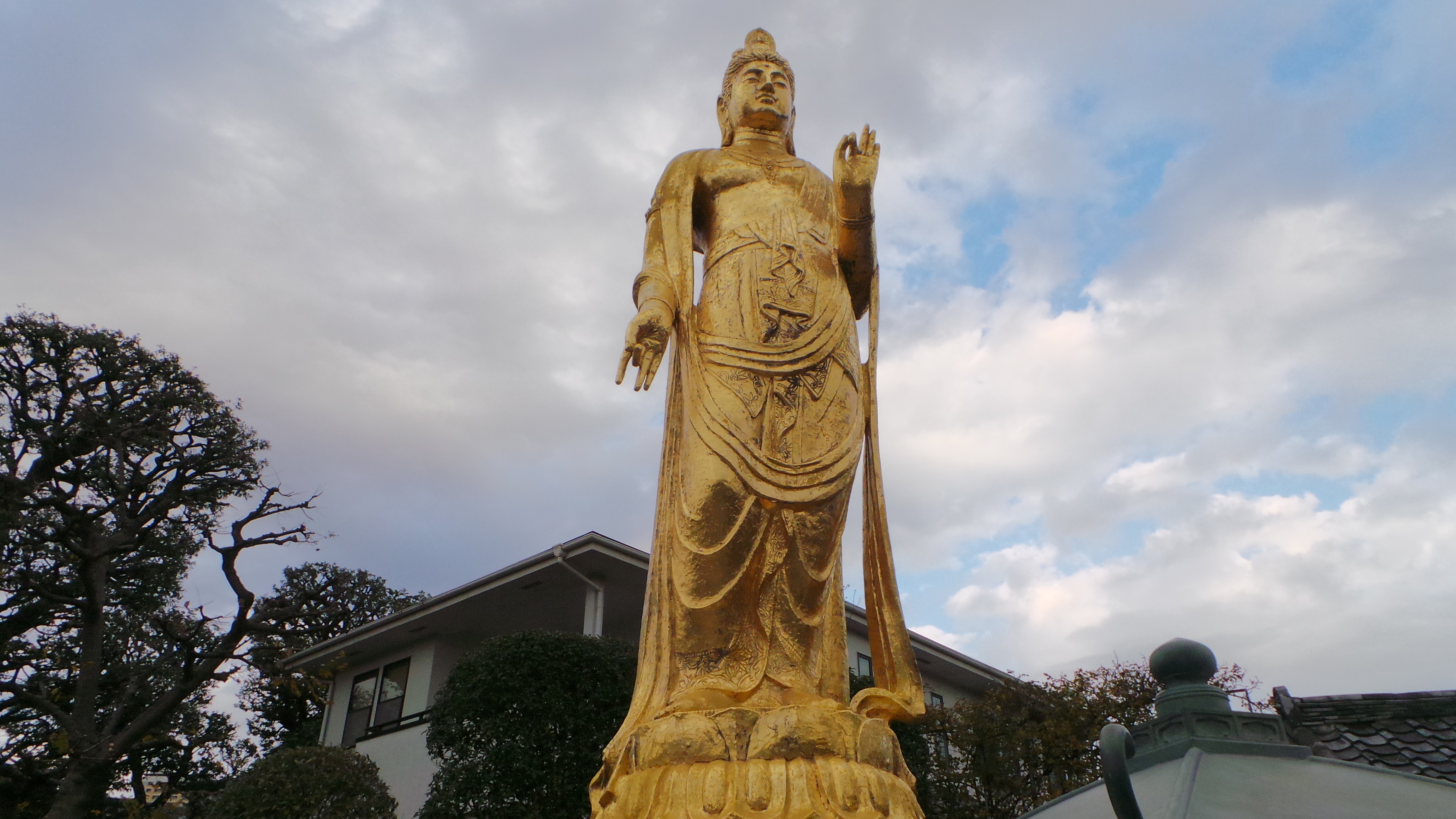
We hop on a Yamanote Line train and get off at a random station. Her choice is Nippori, my fourth visit to this station this week. We wander across the tracks and explore the many temples and shrines. Passing through Yanaka Ginza Street, we stop off at a small park. Tired and with feet hurting from too much walking, we take a breather at Zenshoan Temple. As we enter the temple grounds, in the distance stands a huge gold statue.

20141225_150326

The statue of Kannon is impressive, but what is potentially even more captivating is the Ghost Museum. Sadly, the museum featuring silk scroll paintings depicting ghosts and macabre ghost stories is only open during the summer months. There’s something about horror stories warming your blood, which is the reason for the seasonal opening hours.

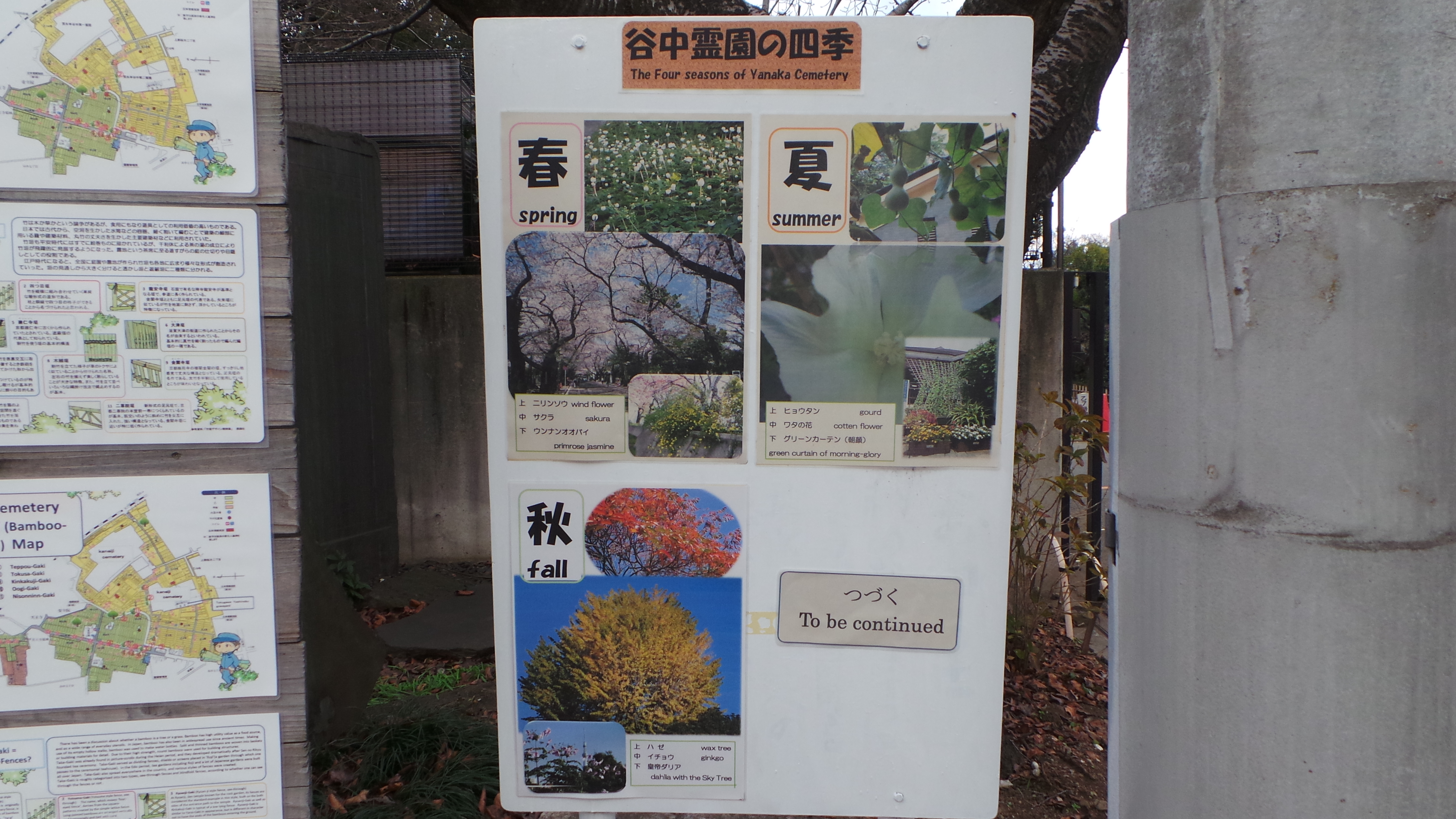
With all this talk of spirits, we take a wander through Yanaka Cemetery. I have visited here once before and found it incredibly peaceful, and do so now. There’s something about the perfect rows of decorated graves that is somewhat calming. Perhaps the quiet all around adds to this feeling. For some reason, the unfinished sign doesn’t display how winter should look here. The row of sakura trees and blossoming primrose jasmine in spring is a reason to once again walk among the dead next year.

20141225_151114

We head back to a hostel in Asakusa, the same one I had previously stayed at for eighty-two days. Tonight, the hostel is having a Christmas party, and Santa Claus will be arriving at half past eight by subway train. Exhausted from a long day and in need of my own bed, I decide to give the party a miss and head home.

Back in Minowa, I dine on Domino’s Pizza (four seasons) and a New York Cheesecake. I could post a photograph of a Japanese pizza from Domino’s, but it really isn’t any different from anywhere else. Instead, here are some instructions for Christmas decorations that I saw earlier today:

letsdecorate[1]

Merry Christmas.

There Will Be Flood

Typhoon Phanfone is making its miserable way toward Tokyo and is expected to arrive this evening. I can’t wait. It’s already raining today, and judging by the state of the pavement outside, it seems like it has been raining all night. To avoid getting soaked, I walk for one minute to reach the nearest station and take the somewhat aptly named Tsukuba Express Line (pronounced ‘scuba’), before transferring to the Yamanote Line at Akihabara Station.

My destination today is Meiji Shrine. The train ride takes thirty-one minutes to reach Harajuku Station. While on the train, the telescreen has taken a break from displaying the usual dull advertisements and, instead, is showing the current position of the looming typhoon.

I leave the station and make my way through the pouring rain towards Meiji Shrine.

meijifest[1]

There’s a weird festival happening called Ningyo Kanshasai, centred around setting fire to broken old toys. This unique event is a way to express gratitude to dolls and is held annually at Meiji Shrine. It originated in 1989 and this year marks its 26th anniversary. In Japan, there’s a belief that a fragment of your soul resides within your possessions. Consequently, the practice of giving used gifts isn’t very common here, as it’s believed that a part of your essence accompanies the second-hand object.

Today, this Shinto exorcism ceremony serves as a method to purify the doll, releasing the part of your soul believed to be encapsulated within the inanimate object—a means to attain a liberated spirit for a healthy mind. For a nominal fee of ¥3000, you can include your dolls in the extensive collection along with others, granting your soul its liberation. The spirit of the doll is elevated through the Haraikiyome (purification) ritual performed by the priest, involving a cleansing ceremony known as Oharai conducted on the dolls.

thanksdolls2[1]

Last year, over 7,000 people donated a staggering 44,000 dolls for purification. The assortment of dolls is incredibly diverse, encompassing Japanese traditional dolls, Western dolls, and popular stuffed animals this year. The rain has somewhat subdued the turnout, but there’s still a plentiful display of dolls. Inside the main hall, two women in splendid costumes are conducting a captivating and beautiful ritual. According to the official website, this solemn festival is highly recommended as a must-see.

I depart just before the distribution of the ‘sacred sake.’ Despite the shelter provided by the numerous trees within Meiji Shrine, I am still soaked by the storm outside. Determined to seek refuge, I make my way across the road to Yoyogi Park, only to discover yet another event taking place.

Hokkai[1]

This weekend’s event is ‘The Road of Hokkai-Food,’ a celebration dedicated to Hokkaido cuisine. Interestingly, like the previous festival, this event also commemorates its 26th year, despite appearing unrelated. Here, there are almost ninety stalls selling a variety of snacks, inexpensive meals, trinkets, cheeses, and beer. The tightly packed stalls, accompanied by the pouring rain and the tantalising aroma of food, create an energetic atmosphere akin to a lively music event.

Some of the foods on offer include, Ishikari-nabe (salmon, stewed vegetables, and tofu in a miso broth), Yakitori (grilled chicken on a stick), various types of seafood, and plenty of Sapporo beer. The only thing missing is the people; it would be fair to say the event is a complete washout. There’s a woman dressed in a smart white suit giving a talk on the stage for an event advertised as ‘Sapporo Presents …’; however, she speaks only in Japanese, and my language skills are still lacking.

hokkaifoods[1]

I leave the festival and head over to Shibuya. Today marks the final day of an art exhibition I’ve been planning to visit, so while I’m in the area, I decide to drop by Bunkamura—a venue encompassing a concert hall, theatre, and museum. ‘Visual Deception II: Into the Future’ is a trick art exhibition focusing on shadows, silhouettes, mirror images, optical illusions, and anamorphosis. Admission costs ¥1500, providing a nice respite from the weather. The display of peculiar artwork can only be described as mind-boggling. As usual, photography is not permitted.

After the exhibition, I opt to head home before potential train cancellations. At my hostel, preventive measures have already been taken to tackle potential flooding: staff members cleaned out the drains and placed a row of bricks in front of the steps where flooding occurred last month.

Back at the hostel, I order Glastonbury Festival tickets and spend some time writing before heading out for a few drinks at a nearby bar. The rain persists. As I eventually leave the bar, I find the pavement outside flooded with rushing pools of water.

puddles2[1]

The forecast predicts the rain to persist throughout the night, intensifying at 3 a.m. as Typhoon Phanfone hits Tokyo. I doubt I’ll witness the full impact of the storm; I’ll likely be asleep by then, unless the howling wind wakes me up amidst the chaos outside.

A Tale of Sorrow and Sadness

I spend my morning shaking off a karaoke gin hangover, arguably the worst kind. At 1 p.m., Dagmar and I take the train to Ginza to meet our friend Aram. The plan is a visit to the Vanilla Gallery; the number one gallery in Tokyo for eroticism, fetishism, and sadism.

Despite having visited the Vanilla Gallery before, it remains difficult to locate. We get a little lost but eventually find it hidden away on an inconspicuous street. This month, the theme showcases artwork that tells the tale of time and sorrow—’An exhibit of illustrated stories and dolls pertaining to madness and sadness.’ The entry fee is a pleasing ¥500.

dertilgung[1]

The exhibition is called Der Tilgung. Dagmar tells me that this is German for ‘The Repayment.’ Nowhere else in Tokyo can you experience such a vortex of phenomenal imagination.

Room-A features a collection of artwork and imagery from MoriKaoru. I’m surprised to find that most of the paintings have sold out. The work focuses on desolate women surrounded by monsters depicted as men. There’s an uneasy emphasis on slavery and torture. One exhibit displays iron shackles laid to rest on a leather sofa. Another portrays a drawing of a young woman bound at the wrists, sitting in a cell surrounded by decapitated limbs, while a male figure with a menacing grin watches her through the bars.

Room-B is slightly less horrific but disturbing in other ways. Suna-mura Hiroaki is the artist. The display features half-naked corpses of women—dolls. A child lies still in a coffin, and two dolls hang from chains with beautiful flowers blossoming from their dead faces. A doll resembling a nurse has her chest cut open, held by wire, and inside reside many small, menacing demons. Trees grow from faces, and dolls scream in anguish. Some dolls are made from the skulls of unnamed animals. Despite the theme, the craftsmanship here is incredible. My favourite piece is a naked woman, half her body covered by flesh, the other completely skeletal; half her face a picture of harrowing decay.

vanilla5[1]

Most of the exhibits are for sale, with prices ranging from ¥50,000 to ¥300,000 per piece. Haunting music floods the gallery. Sadly, the Vanilla Gallery forbids photography, so my only photographs are from the entrance and the flyer. I’ll probably have nightmares for a week thanks to what I’ve seen here. We stay for maybe twenty minutes before heading to the station.

Back at the hostel, there’s yet another party. Tonight’s theme is a ‘Sake Fair.’ Here, we can witness the process of making Japanese sake, sample ‘free’ sake, and indulge in the many complimentary snacks available. A PowerPoint presentation is set up on a projector—classic. The concept behind the free sake is to promote a brewery tour scheduled for tomorrow. For tonight, there are five different bottles of sake for hostel guests to try.

sakefair[1]

Suginishiki Yamahai Junmai is my favourite; it takes twice as long to make as your regular sake and is full-bodied with plenty of flavour. Shosetsu Daiginjo is also very nice—light, mild, and clear, with a banana scent and a subtle hint of fruit. I don’t usually like sake, but the drinks on offer here are actually very nice, perhaps a bit more expensive than I’m used to.

I decide to sign up for the tour tomorrow. It will be interesting to learn about the process, and I’m pleased to find out that the tour takes place at a brewery at the base of Mount Hakone. The tour costs ¥8500, including transportation, and it’s a great opportunity for me to discover more about this traditional Japanese drink.

Rock, Shock and Tooth Aching Perils

Today is D-Day. Dentist Day. I wake up at 5 a.m. with pain in the whole left side of my mouth, all my teeth are throbbing with pain. It is excruciating. It is deafening. I wait until 10 a.m., before my Japanese speaking friend books me an appointment with a nearby dentist. I eat something out of necessity, scrambled eggs; before heading back to the hostel to play the waiting game.

At around half twelve, the pain feels like an earthquake. The building begins to shake. It isn’t pain, though; a magnitude 5.6 earthquake has struck Ibaraki, some 100 kilometres northeast of Asakusa. After one minute, the shaking stops. I head into the hostel lounge, and everyone is just carrying on as normal, as if nothing has happened. How strange.

I kill time reading about earthquakes before the time arrives to visit the dentist. I must admit, I am a little nervous. My friend is here though, so I have nothing to worry about as far as speaking Japanese is concerned. We head to the nearby Rox building; a massive commercial shopping complex containing many different shops, a gymnasium, a public bath, and oddly, a dental clinic.

rox[1]

We head up to the fifth floor to the clinic and fill out all the necessary paperwork at the reception. How often do I brush my teeth? How long have I been in pain? The usual questions. My name is eventually called at five to three, and I head into the surgery. Rather than separate rooms, the dentists work in an open space divided by booths separated by curtains. As I walk to my booth, the other dentists greet me with a cheery “Hello.” The atmosphere is somewhat comforting.

My booth is immaculately clean, shiny, and very white. I take a seat in the dentist chair, which has a television screen showing news footage of the earlier earthquake. A cloth is placed over my eyes while my teeth are carefully examined one by one. Next, I am asked to go for an X-ray. The dentist says that I am the tallest person to ever use the X-ray machine; it is clearly not designed for somebody of my height. I actually have to squat slightly to use it. As the X-ray machine scans my teeth, ‘Für Elise’ by Beethoven plays.

A tablet screen is placed in front of me showing the X-ray results. The dentist goes off somewhere, so I decide to count my teeth while I wait: an even thirty-two.

dentist[1]

When the dentist returns, he examines my X-ray before putting a camera in my mouth to take photographs of the suspect area. The problem lies in my upper left third molar—a cavity. The news is replaced with the photograph he has just taken. The dentist is surprised by the state of my teeth; he says it is very rare to see such ‘Virgin teeth,’ as he puts it. My teeth are immaculate and untouched; I have never had any type of dental surgery before—no fillings, no tooth removals, and no severed nerves. He says that usually in Japan, a problem like the one I have would be solved by killing the nerve so the pain stops permanently. But because I have all of my nerves intact, he gives me the option to have the cavity cleaned, which he assures me has an 85% chance of success. If it doesn’t solve the problem, then I can always come back again and have my nerve severed.

I agree to the treatment. He places a numbing agent in the affected area before administering a local anæsthetic. Three seconds after the injection, I say to my friend, “I don’t feel so good.” Actually, my entire body begins to tingle and turn numb. I go into anaphylactic shock. My body starts to shake. Eyes open, mind elsewhere. My gaze remains fixed, staring off into some distant abyss.

Darkness envelops me, spiriting me away to a realm beyond comprehension. I traverse a dimension so profound, a depth within my own mind or an alternative world more tangible than our reality. Here, an overwhelming sensation engulfs me, a nameless horror that devours my very essence. Describing the depth of my emotions during this time eludes words; I exist, yet not as myself; and the memory evaporates the instant I return.

I blink, gripped by fear. As my eyes reopen, two figures shrouded in blue masks materialise before me—one male, one female. A woman, unfamiliar and indistinct, clasps my hand, murmuring words I cannot grasp. Panic seizes me. I’m adrift in an abyss of unknowing, unaware of my surroundings or even my own identity. Desperation claws at me; tears threaten to spill. Never before have I felt such terror. Who are these strangers? A momentary void swallows my memory. Was I just born anew? Did I perish? I attempt speech, but words elude me. Tremors wrack my body, not violently, but quivering with sheer nervousness and dread. Slowly, like a fog lifting, memories trickle back, accompanied by my friend’s urgent directive to “Breathe deeply.” Gradually, I emerge from the haze, shaken, tearful, and engulfed by sheer panic.

Eventually, things calm down. My friend explains what happened—about my vacant stare and trembling. My knee hurts; I must have bumped it against the machine. The dentist, with my friend translating, clarifies that I received only a half dose of local anæsthetic. I had previously told my friend that I hadn’t taken any medication for over ten years, a detail I fortunately mentioned to her. She relayed this information to the dentist before the injection; had she not, the full dosage of anæsthesia could have been lethal. She might have just saved my life. I could have remained in that other place forever; eyes open, mind elsewhere.

The dentist reassures me that I will be okay, all smiles and jokes now. I relax but can’t shake images from my head. This moment will be etched in my memory forever. The procedure is eventually finished, the cavity cleaned, and I am free to go and pay. The whole treatment and two packets of painkillers cost me a total of ¥7890. Drowsy, with my knee hurting and my mind drifting, I head back to the hostel to sleep.