The Adventures of Tin Toys

Yesterday, as I was walking around Yokohama, I noticed many interesting things on the numerous maps that adorned the streets. Having visited Yokohama only once before, I decided to stay the night and spend a second day exploring this historic city. While staring at the points of interest on the signs, one thing genuinely excited me: the Tin Toy Museum.

I begin my exploration by walking through the Yamate area. This place is characterised by interlocking stone pathways that bend and crawl at various steep degrees, reminiscent of my hometown with its steep hills and Western-style houses. Despite being a popular spot for tourists, locally known as ‘The Bluff,’ I am surprised to find that most maps in this hilly terrain are in Japanese. Needless to say, I get lost and eventually stumble upon a random Spanish-style house.

flutepiano[1]

There is no charge to enter the house, but upon entry, I am required to remove my shoes. Inside, I find a woman playing the flute, accompanied by another woman on the piano, seemingly without any apparent reason. While I recognise the melody, I struggle to put a name to it. As I wander around, I am afforded the opportunity to explore a genuine Spanish kitchen, complete with old cutlery. It surprises me to learn that the house was built by an American but designed by a British architect, adding a layer of complexity to its Spanish theme that I can’t quite comprehend. The Bluff is dotted with many houses of diverse styles, allowing visitors to freely wander and experience the architecture of different countries. From the balcony window, I catch a glimpse of what locals refer to as the ‘British House’ in the distance.

I make my way into the dining room, anticipating tables and chairs, only to be surprised by the presence of strange artwork that clearly doesn’t belong in this space.

hotair[1]

I leave the house, resuming my quest for the Tin Toy Museum. I meander through a cemetery for British soldiers and emerge on the other side. Stumbling upon the oldest wooden Christian church in Japan, I find it of little interest and continue walking for about an hour through maze-like streets. Finally, I locate a map in English. The Tin Toy Museum is on the opposite side of The Bluff, close to the house I visited earlier. I navigate steep hills and winding alleyways, and after another half-hour, I arrive at the museum, half-expecting it to be closed today.

At the entrance, I pay ¥200 and race inside.

oldrobots[1]

As I step inside the Tin Toy Museum, I’m greeted by the sound of The Beatles’ album ‘Help!’ playing from the speakers—an unexpected but delightful touch. The exhibition showcases over three thousand miniature toys produced in Japan between 1890 and 1960. Most of the toys, ranging from cars and rockets to robots, form the extensive personal collection of Teruhisa Kitahara, a man with a passionate affection for all things toy.

A sign next to some rather unsettling clowns reads, “Clown and circus toys are highly comical, perfectly capturing the lively movement of the circus. They are popular for their acrobatic flair.” Inside the museum, there’s a second exhibit called the ‘Mini-Mini Museum.’ Included in the ticket price, this small shoe-box-sized exhibit initially seems like a pointless distraction. However, as I explore, I discover it features even smaller toys than I could have imagined were possible to create.

naoko[1]

Back at the main exhibition, I find that JAXA astronaut Naoko Yamazaki has visited here too, and she appears to have forgotten a signed postcard of herself, left amongst Atomic Rockets and Space Ship X-7’s. I feel tempted to buy a remote control alligator for the price of a month’s rent, but I instead opt for a wind-up robot for ¥1242; quite expensive, but full of nostalgia, and I like robots.

I leave the museum and the Yamate area, heading for Yamashita Park. The park, situated on the waterfront, is unfortunately cast in shadow by the massive Hikawa Maru, an ocean liner that blocks the sunshine and seems unnecessarily colossal. Nowadays, it serves as another museum, overshadowing the park inconsiderately. Nevertheless, the reason for my visit to this park was sparked by a sign pointing to another point of interest that intrigued me – the Statue of the Guardian God of Water.

guardianofwater[1]

It’s no secret that I enjoy irony, so I find it incredibly amusing that the statue here stands within a construction site, placed in a small pond filled with bricks and completely devoid of any water whatsoever. I can’t imagine the statue is pleased with its surroundings.

My final stop in Yokohama is also within Yamashita Park – the Statue of the Little Girl with Red Shoes On. I didn’t have specific expectations, but the description on the sign proved accurate. The girl represents a children’s song from 1922 called ‘Akai Kutsu,’ written by Ujo Noguchi, translating to mean ‘Red Shoes.’

redshoes[1]

A young girl with red shoes, was taken away by a foreigner.
She rode on a ship from Yokohama pier, taken away by a foreigner.
I imagine right now she has become blue-eyed, living in that foreigner’s land.
Every time I see red shoes, I think of her.
And every time I meet a foreigner, I think of her.

I’m not too sure what the song is about, and the only explanation offered by the sign is that Yokohama City wants this statue to become a cherished landmark for its countless visitors. Sadly, most visitors seem to just walk along, not giving the statue a second glance.

I decide that there is little else to do in Yokohama; despite having enjoyed two nice sightseeing days, it is time to head back to the reality of Tokyo. I take the train over to Shibuya. As I leave the station, I navigate through crowds of photographers capturing images of what once was and still is – just a crossing. The bright lights of Shibuya act as a neon reminder of what I was expecting Japan to look like before I arrived here nine months ago.
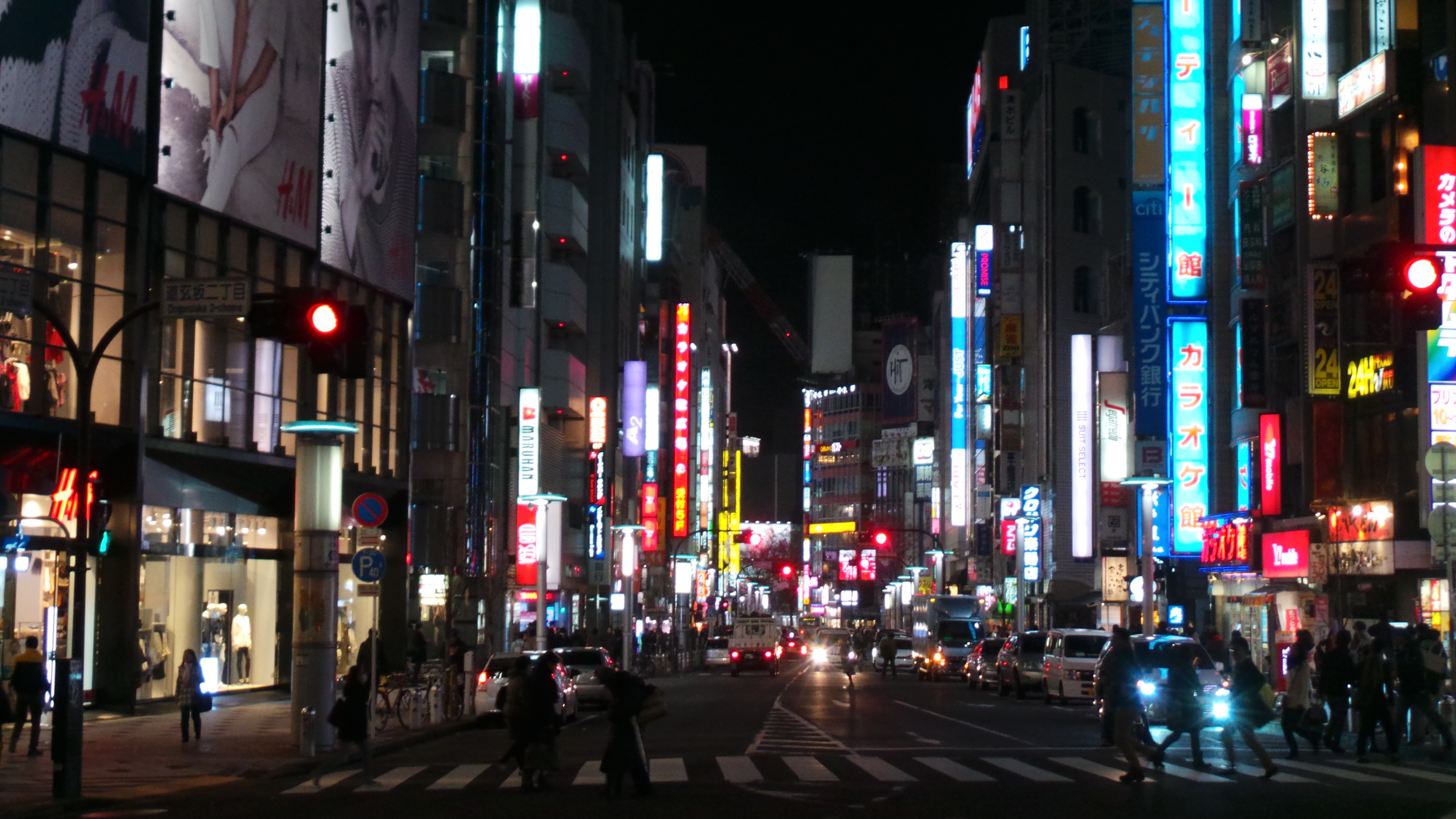
backtoshibuya

I wander aimlessly for a while through the busy nightlife before feeling overwhelmed by the lights and sounds, eventually making me feel dizzy. After a tiring few days, it’s time for me to go home. I buy some takeaway food for the train, taken away by a foreigner, and head back to Minowa.

Roasting the Masu-Bean

Another day, another post about the endless goings-on in the Asakusa area of Tokyo. I wander aimlessly toward Senso-ji Temple, walking with my head in the clouds as I follow the distant bellow of a beating drum. It somehow slipped my mind that today was the official festival of Setsubun, but here I am now, standing in the cold amongst the eager crowd.

Thousands of people wait in front of a wooden stage constructed specifically for the event. Poor carpentry makes the stage look out of place, perhaps even unfinished. I hadn’t planned on attending today, but with nothing else to do on this gloomy afternoon, and finding myself standing here, I decide it might be best to stick around and enjoy the spirit of this age-old festival.

setcrowds[2]

The television people are here, filming every second of the action. But sadly for me, and unfortunately for the television crew, the action is a little muted. First, an announcer takes to the stage and begins reading out names. Some get no reaction at all; other names cause the crowd to cheer with excitement. One name gets a huge reaction, but I was barely listening to a word the announcer was saying because I allowed myself to become distracted by a pigeon.

Eventually, the twelve celebrities waltz onto the stage. They each carry a large wooden masu box, usually reserved for large quantities of sake. At the announcer’s count, they all start throwing pouches of roasted beans into the crowd. Following the bean-throwing, each of the twelve ‘celebrities’ is given a chance to speak with the microphone, seemingly using the opportunity for self-promotion before thanking the crowds for attending.

animal[1]

The last person to speak on the badly erected wooden stage is Animal Hamaguchi, a famous Japanese wrestler who coached his own daughter, Kyoko. She went on to win two Olympic medals in wrestling. Kyoko was born in this area too, so it is no surprise that she was chosen to take part in the event.

After Animal has finished speaking, a man sings ‘When You’re Smiling’ by Louis Armstrong; he sings in very clear English. Some of the other guests join in too. Animal Hamaguchi decides to start shouting in Japanese and laughs deeply, much to the enjoyment of the people around me. Pigeons fly away in fear as his laughter echoes around the grounds of the temple. “Mwahahaha!”

The festival ends, and the crowds disperse. I decide to do a little exploring in the area close to my house. I walk to a small park and am surprised to see that there is another festival taking place, albeit a little stranger than one that encourages the throwing of roasted plant seeds.

crazycostumes[1]

The festival offers no explanation behind its meaning. The only clue here is an array of masked men and women. They march around the park, passing the swings and the slide before heading off toward the red-light district. I am completely oblivious as to what this festival is here to represent; my confusion further added to by all kinds of different Japanese costumes, including dragons, ghosts, foxes, demons, and flute-playing elephants.

After the festival, I decide to explore a little further. I stumble upon Tozenji Temple, said to house one of the six jizos of Tokyo. A jizo is a Buddhist saint in search of truth and enlightenment; they are also guardians of children. It appears that the statue of this saint has been stolen or is simply missing. The only thing of interest here is another large statue of Buddha.

zozenji[1]

After walking in almost a full circle, I arrive back in Asakusa and head over to the Sumida River. I stare into the glistening waters for far too long, looking directly at the reflection of Tokyo Skytree. The way the river shakes and shimmers distorts the image of the tower, and it does begin to take the form of a tree. After a while, I forget where I am, lost to the flow of time. It is only when my hands begin to feel frozen that I snap out of the trancelike state that I have allowed my mind to enter.

My head returns to the clouds, and I wander around like a lost child, looking for excitement. There isn’t even a jizo around to guide me. Eventually, I find a clothing store that displays a wonderful sign. I believe the sign is trying to tell people not to consume food or drink inside their establishment.

teat[1]

Unfortunately for the shop, a translation blunder instead suggests that lactation is forbidden, much to my amazement.

Journey to the Centre of the Buddha

It has gotten very cold as of late, but today offers rare blue skies and a warm winter sun. Today might be the last day hot enough to do anything practical before spring, so I decide to make the most of it with a day trip out of Tokyo. My destination is a little over two hours away by train: the city of Kamakura.

Outside Kamakura Station, I am approached by a poorly dressed Japanese man speaking in English with an American accent. He is banging on about Buddhism, or something. When I mention that I have things to do, he looks a little disappointed before wandering off to talk to some new people just off the train.

I wander through the city, its streets lined with souvenir shops, gift shops, and stores selling various mementos. At this point, I realise I haven’t taken a single photograph in Kamakura, so I decide to walk up to the first temple I see.

genjitemple[1]

Shu Genji Temple doesn’t exude much happiness. It was once the residence of Shijo Kingo, a renowned Nichiren Buddhist skilled in medicine. Following Nichiren’s death, Shijo Kingo attended the funeral but ultimately chose to end his own life to demonstrate his unwavering faith in the religion.

A little further from the temple, I spot a strange machine covered in stickers. The ‘Happy Capsule’ machine costs ¥100, and each capsule contains at least three prizes. I try to resist, but as if possessed by some demon from another world, I find that I have already inserted a coin.

nogarbage[1]

My capsule contains a small glass fish statue with fried eggs randomly painted on each side, a colourful ankle bracelet with a small relic in the shape of an ice cream, and a teddy bear with the word ‘Love’ written on it. I also receive a ‘Lucky Sticker,’ which I am free to add to all the other lucky stickers that litter the machine. Noting the sign for ‘No Garbage,’ I take another look at my happy prizes and stand for a moment, enjoying the irony.

Eventually, I arrive at the place I came here to visit, Kotoku-in Temple. It is home to a giant Buddha, the same Buddha featured in Rudyard Kipling’s poem ‘The Five Nations.

A tourist-show, a legend told,
A rusting bulk of bronze and gold,
So much, and scarce so much, ye hold,
The meaning of Kamakura?

kamabud[1]

I pay ¥200 to enter the grounds of the temple and stand for a while in awe. The Great Buddha of Kamakura was housed within a wooden temple three times. It was destroyed by strong winds twice but rebuilt on both occasions. Eventually, in 1498, it was destroyed for a third time by a tsunami and was never rebuilt. The Buddha survived and now sits outside in the cold of winter, patiently waiting for the seasons to change.

As I walk around the statue, I notice two windows located in its back. There is a sign in Japanese emphasising the importance of showing deep respect when walking around inside the Great Buddha. A man sits half asleep at a small booth, and a sign above displays a price of ¥20. For such a low price, I would be a fool not to enter. I squeeze my way into a small hole in Buddha’s side and take the steps up into his massive belly.

innerbuddha[1]

Inside the Great Buddha of Kamakura, the acoustics are fantastic. I speak softly to myself and find that my words are thrown around by the bronze interior, echoing off into infinity. However, a bit of graffiti inside slightly spoils the experience — a complete lack of reverence by some.

I exit the Buddha and leave the temple. On the way out, I spot a sign warning about a particular type of bird in the area that likes to steal food from tourists. I start heading back toward the train station, stopping off at a small food shop to enjoy a sweet potato croquette. All the while, I keep my eye out for the hungry birds. Unfortunately, the birds don’t materialise, which is a shame.

I decide to take a different route for variety, and eventually, I spot some steps that sweep up a mountain. Intrigued, I take a little detour to see where they might lead.

anothertemple[1]

I find myself standing in front of Amanawa Shinmei Shrine. The place is deserted, seemingly untouched for years, presenting a stark contrast to the other places I have seen in Kamakura. This shrine, founded in 710 AD, is the oldest Shinto shrine in the city and is dedicated to Amaterasu, the goddess of the sun and the universe.

The view from the shrine is stunning, offering a different perspective of the area. In the distance, I see mountains, old houses, and multiple temples and shrines. From the top of the steps, I can also glimpse the sea. As I am about to leave, I spot a small path carved into the side of the mountain above, and with nobody else around, I decide to investigate.

upthemountain[1]

As I climb, the path is relatively easy to follow, twisting around the mountain and becoming less obvious. I have to brush away cobwebs from my face as I follow the steep approach. With every step, I am careful not to lose my footing as the mud gets wetter and the path becomes steeper. After about five minutes of climbing, the overgrowth becomes too much, and I can’t continue. I stop and take a look around, taking in my surroundings, and realise that this was probably not a good idea.

I struggle to get back down, having to crawl a little to ease my way down from the path that has clearly not been used for years. I use my hands on the rocks as I work my way back to safety. I am slightly disappointed that I couldn’t find where it leads, perhaps to the sun goddess, or maybe just an escape route lost over time. There’s nothing for me to see, though, and eventually, I am back at the shrine, taking the steps back toward the main road.

I wander down deserted side streets that are full of old houses, some with massive gardens, others with disproportionately small ones.

mygarden[1]

Back at Kamakura Station, I get ready to endure another two hours sitting on trains. Day trips are fun but rather exhausting at the same time. It’s nice to escape, though, and see places that offer a difference. I think about climbing up that mountain path, feeling completely free for a short time—free from anything but my own eagerness to explore, or perhaps to escape altogether. I decide that my next day trip will be to a mountain of sorts, a place unlike those I have been discovering of late. Somewhere new and exciting, where I can rekindle my sense of adventure. A place flowing with natural beauty.

As I arrive back in Tokyo, a chill consumes the air. Above, thick clouds made of snow hover over the skyscrapers, lying in wait—almost ready to unleash their flakes of misery over the city.

The Fat Sumo Halloween Special

My day begins with me being completely lost in Shinjuku, searching for an event called ‘Shinjuku Magic of Halloween.’ I was under the impression that the event starts with a massive street parade of people dressed in spooky costumes, but nothing of the sort appears to be happening. I give up searching and head back to the train station.

Outside Shinjuku Station, a television crew and a few people dressed up are standing in front of a big stage. With over two hundred entrances to the station, I have inadvertently stumbled upon the event I was here to see in the first place; and by the looks of it, the show is just about to start. Excellent timing as always. The lights come up, white smoke bellows from machines on either side of the stage, and the band comes out, much to the delight of the ghosts, witches, and Iron Man.

annabegins[1]

Today, I get the pleasure of seeing Anna Tsuchiya singing live. The former Kamikaze Girls actress-turned-model-turned-singer is simply amazing. I am about six rows from the front of the stage and have a great view. The music is great. The atmosphere is great. The weather is great. Anna sings two songs about Halloween in English before contractually mentioning the video game Psycho Break, the sponsor for the event.

For the third and final song, we get a little bit more from the smoke machines, and Anna sings her third single and first top-ten hit, ‘Rose’.

annasings[1]

After singing, she thanks the crowd, and the band leaves the stage. One minute later, the entire crowd has dispersed, and I am the only one standing at the stage. So much for the Halloween parade. I follow the rest of the crowd into the train station and head back to Minowa.

The day is still warm, so I decide on a mid-afternoon bicycle ride. I cycle over the Sumida River in a straight line for ninety minutes, stopping off at the odd shrine or temple along the way. Eventually, I arrive at the Arakawa River and cross over into Edogawa. I haven’t been here before today, and I can’t find anything to do. I cycle around for a while until the sun begins to set.

edogawasun[1]

After watching the sun from the bridge, it starts to cool down, so I race back to Asakusa.

Tonight, I have been invited to a party celebrating the one-year anniversary of a sumo restaurant. I have things to do first, though, so I arrive rather late; everyone is already drunk. Blind drunk. A few of my friends from the boat party are here too, and they are struggling to stand. A never-ending supply of glasses filled with a suspicious green liquid seem to be appearing from nowhere, and the familiar drinking chant of, “Yoi yoi yoisho,” makes its rounds. A sumo wrestler consumes a giant bottle of tequila in one go.

sumodrinking[1]

My masseur is here too; he tells me that my shoulders were the hardest he has ever had to massage in his entire career. Or at least I think that’s what he said; his slurs are somewhat difficult to decipher. I join in with the proceedings, enjoying the all-you-can-drink spread put on by the owner. Karaoke ends just as quickly as it starts, and bottles of spirits are passed around. I stay, drinking until I am dizzy, before deciding it is time to go home. As I leave, I am handed a gift bag filled with lovely souvenirs to go with my memories.

“But Sir, it’s Only a Model”

Today is the third and final day of a street performing arts festival in Asakusa. Outside, it’s a clear day and a wonderful 28°C. I spend the best part of the morning wandering between the many different stages. I see a magician, a group of jugglers, a yo-yo master, people dressed in Halloween costumes, and a guy who specialises in tricks using crystal balls. Every performer seems to draw a strong but silent crowd.

crystalballs[1]

At lunch, I head back to Koto, to Tokyo Big Sight. Today, the venue hosts The 54th All Japan Model and Hobby Show. Alongside this event, there are many other exhibitions at Tokyo Big Sight, including the Trend Fashion EXPO and a free show about female auto racing drivers. I head to West Hall Two where the entrance fee is ¥1000.

The event today is organised by the Japan Radio-Controlled Model Manufacturers Association and the Japan Plastic Model Manufacturers Association. Inside, there are almost ninety different stalls representing various branches of the hobby and model industry. Upon entering, I’m greeted by a display of scaled-down model warships.

iseenoships[1]

All the major model companies are present. Kyosho proudly claims to produce ‘The Finest Remote Control Models.’ Nippon Remote Control showcases their latest flying helicopters, while Tamiya demonstrates their new remote control car. Besides remote control products, the exhibition features model trains, warships, cars, toys, hobby crafts, painting supplies, and character figures.

A woman in cosplay is signing various publications, while other individuals in cosplay attire are attempting to attract visitors to their stalls; women pose for photographs and entice men to buy tanks. Thousands of items are on display, including models of famous historic sites in Japan. Among them is a to-scale model of Kaminarimon Gate at Senso-ji Temple, priced at ¥38,000. Additionally, various figurines featuring characters from famous Japanese anime make an appearance

attacktitan[1]

As I mentioned, there’s a substantial section dedicated to remote control flying machines. While some machines are more impressive than others, the skill level of the operators varies. I observed a guy attempting to elegantly guide a helicopter through a hoop, but instead, he spectacularly crashed it, causing one of the wings to snap off. This unfortunate incident promptly led to the closure of the exhibition. However, amidst these mishaps, some machines stand out for their superior performance. I watched another person skilfully manoeuvre a large drone vertically, achieving somewhat impressive speeds.

flyingmachines[1]

I visit a shooting range where individuals are aiming at targets with fake plastic guns. Several talks are ongoing throughout the venue. A woman delivers a speech on a large stage, captivating the attention of many eager attendees. However, as is customary in Japan, I notice the restriction against taking photographs of people on stages, a common practice here.

Bandai’s presence here is immense. A massive crowd gathers to watch a special viewing of a new episode of Gundam or something similar. They’ve set up a stall showcasing figurines aligned with the upcoming release of their new film, Space Battleship Yamato 2199. Additionally, serving as the representative for Star Wars in Japan, Bandai offers an extensive array of merchandise. A giant screen plays footage from one of the Star Wars movies, drawing people to photograph models of Darth Vader and the Millennium Falcon. It’s a bit overwhelming with the sheer volume of offerings.

starwars[1]

I decide to leave and head to the train station, taking the Yurikamome Line to Shinbashi before transferring to the Ginza Line. However, I get distracted and end up missing the Tawaramachi stop. Instead, I disembark one stop later at Asakusa Station, which happens to be the last stop.

I decide to stroll through Senso-ji on my way home while the sun is still shining. Amidst my walk, I come across a shrine I’ve never seen before—Hikan Inari Shrine. It’s notably small but carries a profound symbolism of recovery. What strikes me as unusual, though, is the presence of over three hundred small statues of foxes inside the shrine. I notice an important-looking sign in Japanese and decide to photograph it.

foxtemple[1]

Back at the hostel, I ask my friend Hiro to translate the sign. It reads, ‘Please don’t ring the bell at night, as our neighbours in the area are trying to sleep. Be careful not to wander around too much in the evening because you might be possessed by a fox.’ The concept of being possessed by a fox is quite intriguing. Apparently, there’s a traditional folktale in Japan about a condition called ‘Kitsunetsuki,’ which refers to a form of madness caused by fox possession.

I decide to explore this superstition further. I spend the evening wandering around the temples and shrines of Asakusa, until I turn into a fox.