Eat Fish or Die Tryin’

I meet my friend Dagmar for breakfast at ten. At breakfast, I drink away my hangover with a bottle of a tasteless drink called ‘Delicious Water’ before heading out alone for the train. Someone told me yesterday that beneath the banks and office buildings between Mitsukoshimae Station and Otemachi Station, hidden deep underground, the Japanese government grows secret rice.

Somewhere along the Ginza Line, my train just powers down. All the lights extinguish, plunging the carriage into an abyss of darkness. The train drifts aimlessly towards Ueno Station and finally grinds to a haunting halt. The silence thickens, shrouding the dead train in an eerie stillness, an unsettling void that grips the carriage. Everyone remains silent, messing with their mobile phones, despite the obvious sorrow of the situation. It is all very worrying. About five minutes pass, and there is an announcement in Japanese, then nothing. A further five minutes, and the train starts up like nothing ever happened.

As I exit Mitsukoshimae Station, I accidentally wander into an adjacent department store.

maskmaskmask[1]

Inside the department store, there is a Mask Art Museum, and it is free. A nice but rather small exhibition. The store housing the museum is incredibly upmarket. I ask politely if I am allowed to take photographs, and lucky for me, it is fine. The exhibition actually ends today. Rather fittingly, all of the mannequins in this department store are wearing masks.

One thing I have noticed in Japan are the many strange museums. I believe I have previously mentioned the famous World Bags and Luggage Museum. A few other favourites of mine that I am yet to visit are the Gas Science Museum, the National Leprosy Museum, and the Parasite Museum.

I wander around for a while looking for the entrance to the secret underground rice bunker. It takes a while but I eventually find a huge office building that has every window on one side completely covered in plants. On the other side of the building I scare away an eagle pecking at a gold statue of Prometheus. This must be the place, I think to myself. It turns out it is.

prometheus[1]

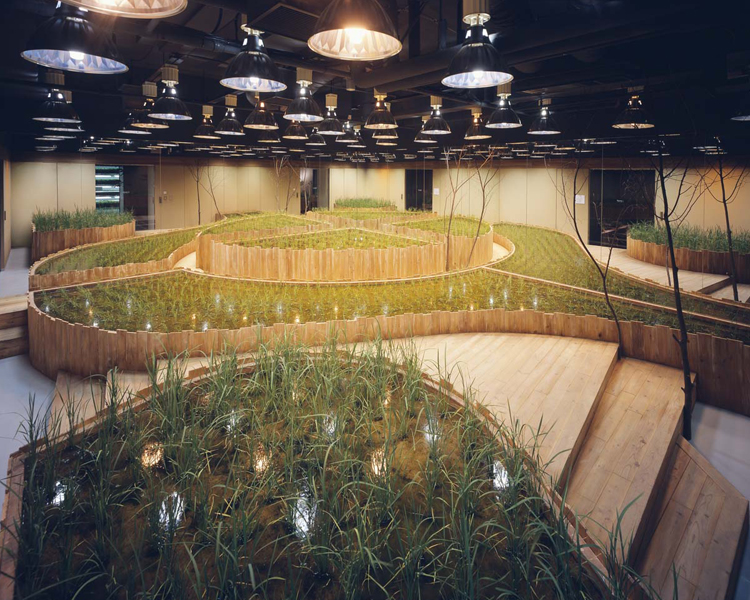
Deeply tucked away in the second basement level of a huge skyscraper, they grow rice. I am not entirely sure why they grow rice, but people are free to come and see it. Huge natural light shines from above. Rice grows. From what I was told, this area stretches under the whole business district, although it doesn’t. The size of the area was heavily exaggerated to me. The rice isn’t really that much of a secret; it’s not too well advertised, but no one is trying to hide the fact that it grows here either. In fact, I think it’s encouraged for people to come here and learn about rice cultivation. So, another urban myth shattered then.
ricetomeetyou

After looking at rice for a few minutes, I decide to walk to the Imperial Palace. I’m surprised by how close the stations are to each other in this area. Tokyo, Kanda, Shinbashi, and Nihonbashi Stations are literally within a five-minute walk of each other. Outside the Imperial Palace, about thirty elderly Japanese people are sitting and painting.

The Imperial Palace is home to Emperor Akihito, the last remaining monarch in the world to go by the name of Emperor. There isn’t really much else to see at the palace. The grass outside is cut immaculately, and the water fountains spray jets of water about two metres into the air. I notice there is a great view of Tokyo Station from the Palace car park, though. I wander to the nearby Ginza Station and take the train back to Asakusa.

tokyostation[1]

I decide to inspect a potential apartment. Small apartments in Japan are ironically referred to as “mansions.” These one-room coffin apartments offer little to no space and an equal amount of comfort. Another phenomenon in Japan is the grouping of shops, whole areas dedicated to selling one type of product. The area where the apartment is housed is completely surrounded by funeral shops. One street has eight shops in a row, all selling tombstones. I decide the area doesn’t quite feel right. Chimes sound from nowhere as I head back to the hostel, chiming five times signalling 5 p.m.

At 6 p.m., Richard, Luis, Remi, and I head to a nearby restaurant that serves fugu. Jokes are made about toxicity, tetrodotoxin, paralysis, and death. In reality, fugu poison is one-thousand two-hundred times stronger than cyanide; this is no laughing matter. The most poisonous part of the fish is the liver. Outside the restaurant, we watch our dinner for a while, graciously swimming around in a tank. In a moment, this beautiful blowfish will be killed on our behalf; we sure hope it doesn’t have a taste for revenge.

blowfishing[1]

There was a time when a fugu chef would have to pass a training course of ten years before being given certification to prepare fugu. These laws changed about three years ago, and now the rules state just a two or three-year course is required. We really hope that our chef today is of the older generation.

We take a seat in a tatami room. We order fresh blowfish sashimi. We also order diced blowfish sashimi just so I can make a pun about how we diced with death. Oddly, one of the options on the menu is hot sake with dried blowfish fin floating in the liquid. “We only serve the finest live domestic tiger blowfish,” says the menu. Served live? I certainly hope not. We wait anxiously for our food to arrive.

The poisonous fish is served in elegantly arranged translucent slices; it doesn’t look very threatening.

blowfish1[1]

A taste for revenge would be an overstatement. A taste of anything would be welcome. The food is the freshest fish I have ever tasted, of course; it has been dead just minutes. The food is also the least tasty fish I have ever had. It has no flavour at all; perhaps there is a subtle hint of death. I’m just glad we went to a cheap non-certified restaurant. It costs us just ¥5480 between the four of us for two dishes and four drinks.

I tried the sacred fugu of Japan and all I got was this lousy anecdote.

Some Like It Hot Tea

I decide to hire a bicycle. A friend from England, Damien, decides to join me. We grab two ¥300 bicycles for the day and cycle in the direction of Ueno. On the way, we pass a random stage on Kappabashi ‘kitchen’ Street. Men and women dressed in traditional taiko clothing hit massive taiko drums. A security guard stands watch, eyeing me up as I take a photograph.

kappadrums[1]

We cycle around Ueno Station and toward Ueno Park. Today and tomorrow, there is a festival here, the Philippine Festival 2014. The festival is sponsored by the international money transfer company Western Union. The space for the festival hasn’t been very well utilised. There are two rows of small stalls on both sides, and a third row through the middle, which completely obstructs the view of the small stage.

I promised a friend I would bring her a souvenir from the festival. To my dismay, all of the stalls appear to be for financial institutions or property letting companies. There is a stall offering tax refunds, there are stalls for various banks, there are stalls selling insurance. There is not one stand that seems to offer anything remotely souvenir.

philippinefest[1]

We take a seat near an ice cream shop opposite the festival. I rant to Damien about how much the festival has annoyed me; he is in agreement. A woman starts to sing from the stage that you can’t even see. The song from Frozen, ‘Let It Go.’ I almost go on another angry rant but decide to just let it go.

Back on the bikes, we head to Nippori Station, cycling through Textile Town and Fabric Town on the way. We cross the railway tracks and head to a big area of green on my map, thinking it will be some kind of park or temple.

For the second day in a row I find myself standing in a cemetery.

graveyardandtree[1]

Yanaka Reien is massive. Over 7,000 tombstones are here. The cemetery is so big that it contains a police station and a children’s swing park. The Tokugawa Family Graveyard is here too. The last shogun, Tokugawa Yoshinobu, rests here alongside fourteen other Tokugawa shoguns. There is one area that slightly confuses me; it is marked on the map as ‘The First Three-dimensional Deposit Facility’. We have no idea what this means, a Google search is like spinning our wheels, so we get back on the bicycles and do just that.

We head back toward Ueno Park, stopping off at the Daimyo Clock Museum to kill some time before returning to Asakusa. Outside the Don Quixote store, there is the Rokku Hanamichi Flower Festival taking place. Music is being performed on a small stage, but the flowers are notable by their absence.

Our next stop is over the Sumida River, to a place I visited whilst filming the cycle tour: Mukojima-Hyakkaen Gardens. The entrance fee is still ¥150. Today is Mushi-Kiki-no-Kai, which I am told means, ‘Enjoying the sound of insects.’ The event today describes itself as ‘An exhibition of various kinds of chirping insects, their chirping sounds, and the fantastic garden scenery.’ The insects aren’t quite as attractive as the description of the event, but the sounds they make are.

chirpinginsect[1]

A Japanese lady in a kimono approaches us as we stare at the crickets. “Where are you from?” … “Ah, England! Do you like tea ceremony?” Both Damien and I are yet to experience a traditional Japanese tea ceremony, so we go along with it and are invited into a tatami mat room, shoes off, kneel down, join the others. The other thirteen people attending are Japanese.

We wait a while before the process begins. When it finally does, we pass around a tray containing sweets filled with a red bean filling. I thank the person to my right for passing me the tray, I bow, I thank Damien to my left for letting me take a sweet before him, I bow, I take a sweet, I eat it. It is all very methodical. Next, it is tea time. Young women in kimonos kneel one at a time in front of people, bow, and place a bowl of green tea in front of them. They move in a clockwise order.

Before drinking, I ask the woman to my right if she would like any more tea, and politely, she refuses. No one ever says, ‘Yes,’ at this stage; it is purely a formality. I lift the bowl of tea, place it on my left hand, turn it clockwise twice, then drink it all in one go. Then when the bowl is collected, I bow once again.

The sweet was delicious, the tea was cold. I always preferred hot tea. The woman that invited us to the ceremony said that they would usually offer hot tea, but because it is a hot day, they decided to serve it cold. After the ceremony, we are allowed to inspect the beautifully crafted bowls and the container that holds the green tea powder.

greenteapowder[1]

The tea ceremony, I later find out, should have cost us ¥2000 each, but we were never asked to pay anything.

We head back to Asakusa, return our bicycles, then go our separate ways. I head to Cafe Byron Bay for a green curry and a chat with the locals. I meet a real-life ninja and a fugu chef. Fugu is a delicacy in Japan, but is somewhat poisonous. I make plans to eat the deadly fish and take down the details of the restaurant. Maybe I will be visiting my third cemetery in a week.

Bring Me the Head of Kubikiri Jizo

Today, I’m sitting at the bar of a small cafe having breakfast when a man named Yoshio notices I’m not Japanese and strikes up a conversation while I chomp on my vegetarian Eggs Benedict. “I just got back from America,” he tells me, “I got back yesterday.” His English is pretty good, and I stay for a second cup of coffee, chatting with him for about thirty minutes before he has to leave. After he departs, the cafe owner shares Yoshio’s full name with me. A quick Google search reveals his Wikipedia page, and I discover that the man I had breakfast with is a famous Japanese comedian.

After coffee, I head out to meet Luis, the Chilean guy I met during the World Cup. He is back in Asakusa for the final leg of his trip, so we arrange to meet up for 1 p.m. We take the Ginza Line to Akasaka-mitsuke Station. Akasaka is known for being quite a posh area, so we wanted to get a feel for what a rich neighbourhood looks like. No different from anywhere else, it turns out.

From Akasaka, we walk to Roppongi and head for Tokyo Midtown. Here, there is a giant 1:7 scale statue of Godzilla.

godzilla[1]

After Godzilla, Luis and I head back to Asakusa and eat at my favourite Indian restaurant. Luis has only ever had curry before one other time in his life, madness. After food, we head our separate ways.

Whilst I was exploring accommodation options for October, it was suggested to me by a 71-year-old Japanese man that I try the area known as San’ya; apparently, the apartments there are relatively cheap. San’ya is still in Taito Ward, and a forty-five minute walk from Asakusa. I head in the vague directions I am given and discover that San’ya no longer exists. All signs mentioning the word San’ya no longer exist. Every mention of the area has been removed, like a Japanese history book; all traces have been erased from memory.

The only sign that has any mention of a San’ya past is the sign for Namidabashi. The sign literally translates as ‘Tears Bridge’ and was where people came to say goodbye to loved ones before they were taken to be killed at the Kozukappara execution grounds, hence the tears. These days, the bridge has been buried under the concrete of an intersection, the execution ground painted over by a bus station.

busgrounds[1]

All that really remains, other than human remains, is Enmeiji Temple. It was this statue of Kubikiri Jizo, the decapitation Buddha, who watched over the nearby execution grounds. For those who were executed, the last image they would have seen is the Buddha. Its name literally translates to ‘neck cutting Buddha’. An estimated two hundred thousand prisoners were killed here. Ironically, during the March 2011 Tohoku earthquake, the Buddha was damaged and its head broke off. A sign details the step-by-step process of how the head was repaired.

There is also a sign here that says, ‘Nam-Myoho-Renge-Kyo,’ the all-too-familiar chant of the Nichiren Buddhist. Gravestones without names make up the backdrop.

kubikirijizo[1]

The main street here translates as ‘Bone Street’. It was on this street that the decapitated heads of the executed were put on display. The executions stopped in 1873, and after that point, the area suffered further misery. Somehow, San’ya became Japan’s biggest leather-producing area. The problem with leather is that it comes from cows, and cows in Buddhism are not to be used for leather production; this being a Buddhist country doesn’t help matters. The people here became complete outcasts, and leather production work was considered the lowest of careers. A certain stigma became attached to the already stigmatic San’ya area, and it fell into decline. It was around this time that the name San’ya was abolished. These days, the shops are all boarded up, the streets are empty, and the dead stay dead.

Today, if you live in the old San’ya area, you are still looked upon as different. You are judged for living here. The accommodation is cheap; however, I wouldn’t like to stay here. The people aren’t liked, the energy is wrong, and then there are the souls of murdered cows and headless criminals. I leave the macabre of San’ya and head to the somewhat less chilling ‘Flying God Temple’.

flyinggod[1]

The Legend of Tobi-Fudo comes from the Shobo-in Temple. It was first built in 1530. “Once upon a time, the chief priest of this temple went to the Omine Mountain in Nara Prefecture to pursue his learning; he took the principal image of Buddha with him to the mountain from his temple, but the principal image flew back to this place in Edo within one night and gave diving favours to the people.” I am not sure what ‘diving favours’ are, but this is what it said at the temple entrance. I think it is supposed to say divine.

In recent years, people visit the temple to pray for safety in air travel, praying their plane doesn’t crash. I suppose ‘diving’ is probably the wrong word to be using when talking about air accidents. There is also a sign saying a festival takes place in October on the temple grounds. I add it to my calendar and leave.

Pyrotechnics and Parade

I wake up at 5 a.m. to the sound of a drunk man in our dormitory room. He spends fifteen minutes trying to open his locker before giving up and leaving the room. It’s nights like these that I wish I were in a hotel. An hour later, the same guy who doesn’t know how to open a locker comes back and spends fifteen minutes trying to climb the ladder to his bed, which, of course, is the bed above mine.

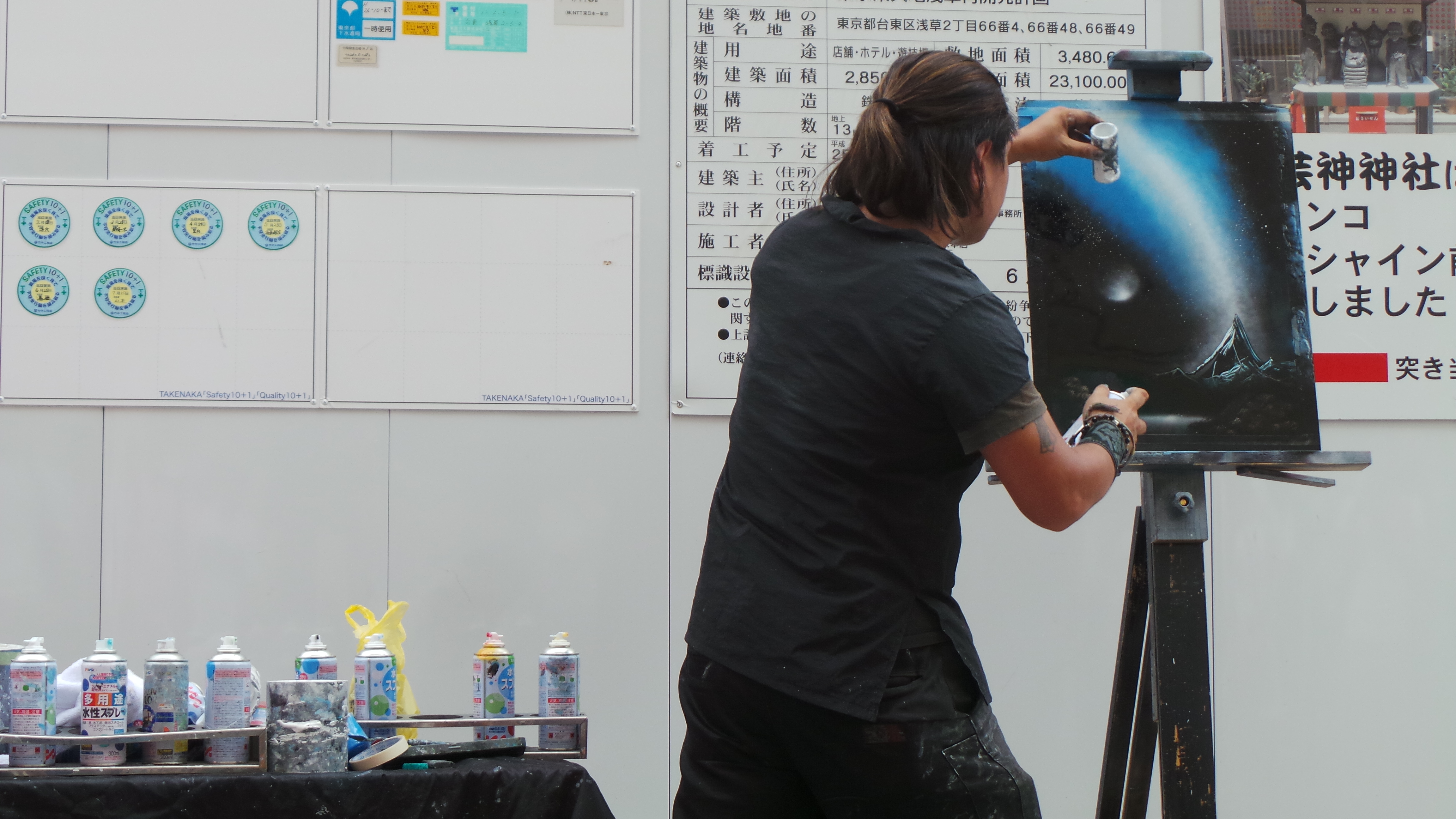
More noise at eight. Two people packing and re-packing their cases loudly, stamping around loudly. I give up on sleep and get up, tired and annoyed. I kill time, drink coffee, then go to a cafe at nine for more coffee. Despite drinking a lot of coffee, I still feel drained. The hot weather adds to my exhaustion. I lazily stroll through the mid-morning Asakusa streets. There is an artist on the street using spray paint to create science-fiction themed space art. He goes from a blank canvas to a beautiful planetscape in a matter of minutes. Incredible.

streetarts

I continue wandering. One guy raises his hand above his head as I walk past, “Woah! You are too tall!” he exclaims, much to my amusement. I head back to where the street performers gather and watch a yo-yo master skilfully Split the Atom.

Back at the hostel, I write up non-events, then kill time playing Baldur’s Gate on my camera. At 3 p.m., I still have no energy but need to get out of the hostel. I decide to head to Chofu. I take the Tokyo Metro Ginza Line to Shibuya. On the way, I hop off at Nihonbashi Station for a ¥300 smoothie (orange and ginger), then back on the next train three minutes later.

I cross Shibuya Crossing and take a shortcut through Yoyogi Park. My shortcut is somewhat obstructed by the Super Yosakoi dance festival. The entrance to Yoyogi Park’s event open space is blocked by hundreds of people dancing in the street.

yoyogistreetdance[1]

The dancing here is actually quite good, the music catchy and rhythmic; I much prefer it to the Samba music that was playing all day yesterday. The stage here is in use too, with people in traditional clothing waving flags and dancing to very similar music to that of the street dancers. I take the ten-minute walk to Harajuku Station, trying to get away from the crowds. My plan is a shortcut through the forests surrounding the peaceful Meiji Shrine.

My shortcut is somewhat obstructed by the crowds of people gathering at the entrance to the shrine. A stage has been erected here, and more people are dancing. The Super Yosakoi dance festival is everywhere. The music from the speakers here is so loud that I actually have to walk with my fingers in my ears. A one-way system through the grounds of Meiji Shrine is also in place.

Halfway through my route through the shrine grounds, a third stage is active and features more dancing and loud live music. There is a sign with a big red cross over a picture of a camera; I presume it to mean “No photography,” yet everyone seems to be taking photographs. Very odd. Perhaps I have been misinterpreting this sign all these years.

nophoto[1]

I leave Meiji Shrine and head toward Shinjuku Station. It’s another hot day, and I have another ten minutes of walking to endure in the heat. Somehow, as this realisation of the temperature comes to mind, a stranger in the street hands me a fan. At Shinjuku Station, I get a little lost but eventually find my way to the entrance to the Keio Line. A million other people have decided to take this train too. I take the second train that pulls in as there is no room on the first. As I am pushed into the carriage, I see that the crowd behind me spills up the steps and beyond. It appears the whole of Tokyo is following me to Chofu.

The Special Express train makes just one other stop between Shinjuku and Chofu, and I arrive promptly at 6 p.m. I follow the swarms of people to the Tamagawa River. Just as I arrive at the river, there is an explosion in the sky.

fireworks7[1]

Today is the annual Chofu City Fireworks Festival. It runs for an hour and includes 8,000 fireworks. I have a pretty decent spot and enjoy the spectacle. All along the river, little stores sell street food, and even Lawson Stores and Seven Eleven are getting in on the action. They have beers for sale outside floating in big ice buckets, and they have moved their hot food counters to the front of their stores.

The fireworks are impressive, although very stop and start. A lot of fireworks are launched at once, then nothing happens for twenty or so seconds, then lots of fireworks at once, et cætera. Every time a big explosion occurs, everyone around me says, “Sugoiii!” “Sugoi!” and “Oh, Sugoi!” This word means ‘amazing’ in English and seems to be the only word that the Japanese people here use to describe the fireworks. They certainly were amazing.

fireworks6[1]

At 19:11, I head back to the station; the fireworks will continue for another twenty minutes or so, but I really don’t like the idea of getting back on a packed train. It seems everyone else has had the same idea; once again, the station is packed. I am not proud of it, but when the doors finally open, I dash to grab a ‘Priority Seat.’ These seats are intended for pregnant, elderly, and disabled people. I feel somewhat less guilty when the other seven Priority Seats are taken by youths.

Back in Shinjuku, I change to the Marunuchi Line and take it as far as Ginza before switching to the Ginza Line. I arrive back in Asakusa around eight.

I meet with some friends, and we head to a nearby British pub run by actual British people. They brew their own beer here, play British music, and serve by the pint. I go for the porter; nice but expensive at ¥1000. The song ‘Empty at the End’ by my friend’s band The Electric Soft Parade comes on at some point in the evening; my mind ends up back in Brighton.

Dance, Dance, Ambulance

It is humid today, a cool 31°C with patches of rain, the perfect weather for dancing in the street. I head over to Tawaramachi Station for a train to Shibuya. From Shibuya Station, I head to Yoyogi Park, stopping off at the Tobacco and Salt Museum. The sign in the window reassures me that the museum will relocate to Sumida in spring 2015. It closed almost a year ago. I begin to wonder why it takes almost a full two years to move the contents of a museum.

I continue my walk, taking a detour through a ‘Shopping road that is nice to people’ before eventually arriving at Yoyogi Park. This weekend, there is a festival held at the Yoyogi Park event open space, the ‘Battle of the Udon.’

udonfest[1]

There are nine different television stations here. There are nineteen different udon stands, each selling their own local variety of udon noodles. Stalls also sell various non-noodle-based drinks and snacks. The best noodles from all over Japan have come here to compete in the nation’s biggest food competition. Every bowl of noodles is charged at a flat rate of ¥500. When you order food at the Battle of the Udon, you are given a vote card with the name of the stall. On the final day of the event, the votes are tallied up, and the best udon in Tokyo is crowned.

The noise here is deafening; every store has a banner, mascot, and a guy with a megaphone shouting at me to visit their store. Some of the mascots are better than others. I really like stall number 18’s mascot from Nagoya; they are promoting their Kishimen-style udon noodles.

a18udon[1]

I go to stall number 19 from Saitama Prefecture, offering Shoji-style udon noodles. As I approach the store, the guy at the counter shouts, “Welcome!” in English and literally welcomes me with open arms. When I arrive, he reaches out his hand to shake mine. He looks genuinely pleased that I chose his store; most likely, he is proud of the food he makes. “Udon!” I exclaim, my smile matched by his.

After food, I head back to Asakusa. I exit Tawaramachi Station to the sound of tourism and the sight of umbrellas. The rain has started now, but the show will go on. Today is the 33rd Asakusa Samba Carnival, and half a million people are expected to attend. The streets are packed on every side, and the roads are closed to vehicles. The carnival is just about to start.

streetslined[1]

This festival first began in 1981 when the mayor of Taito Ward invited the winning team of the Brazilian Rio Carnival to perform on the streets of Asakusa. Each of the teams has its own theme, but in effect, they compete to be crowned the winner of a dancing contest. The parade starts behind Senso-ji temple, where a display of the floats is free to inspect, and conveniently finishes close to Tawaramachi Station.

The teams vary in style. There is a ‘Puzzles & Dragons’ float, loads of marching bands, women dancing Samba dressed in traditional Brazilian garb. Some teams even have a comedy aspect, like women with fish on their heads or dancing clowns. For the rest of the afternoon, every inch of Asakusa is alive with the sound of drums and loud music.

sambaclown[1]

At 5 p.m., I decide to eat some food from Seven Eleven before heading to Cafe Byron Bay to drink. Instead, the night takes a somewhat unexpected turn, and one of my friends from the cafe is in need of medical treatment. An ambulance is called, and we wait an age.

The owner of the cafe, our friend, and I sit in a parked ambulance for ten minutes. Here, her symptoms are explained, and the usual questions are answered. I think that this procedure could have been done during the journey to the hospital, but then again, I don’t have any medical training, so what do I know? Eventually, we are on the move. Something I have observed in the past is that ambulances in Japan move seemingly without any haste or purpose. They wait at traffic lights with sirens blazing. They move with absolutely no urgency.

ambulance[1]

We arrive at a small hospital in Ueno. Our friend is placed into the Emergency Room, and we wait outside. Sitting in the hospital, an overwhelming sense of exhaustion washes over me. The humming clock reads 20:20, but it’s boring, like the walls; once white, now stained yellow. We ask if there is any news on our friend, but we are politely told that they don’t know anything. Hospitals have a way of draining energy from people; sitting here any longer might just kill me. We decide to go for a walk.

We head to an Indian restaurant and eat some excellent food. I suggest to the cafe owner that she should serve similar food and rename her shop to Cafe Byron Bombay. Despite worrying about our friend in the hospital, we make the most of the situation and try to enjoy ourselves as much as we can. In the end, I don’t have such a terrible time.

After four hours, our friend is allowed to leave and is going to be alright; good news. We hop on the train at the nearby Ueno Station and head back to Tawaramachi Station before going our separate ways.