The Train Station at the End of the Universe

Today I am going to an aquarium. As I walk to the train station the lampposts are playing the Beatles, ‘You Never Give Me Your Money’. Lampposts in Japan often play random music, usually relaxing classical pieces, but today is Sunday so I suppose that explains it. At the train station I get on a train bound for Oita.

It turns out I am on the wrong train. I don’t realise until it passes the first stop. I check my instructions. Bus. It clearly says to take the bus bound for Oita, not the train. The mistake costs me ¥230 each way. Trains by habit. Bus to habitat. I get off at the second stop, Nishioita Station. Here, there is a solitary ticket gate manned by a solitary person.

theendoftheworld[1]

I exit the station so it doesn’t look like I got on the wrong train, not that anybody is watching. Outside the station I see a sign for the ferry terminal and think about escaping. I decide to make the most of my error and take a stroll around Nishioita. There isn’t much here. They have a Lawson Stores, that is it. A road sign says that Umitamago Aquarium is 5 kilometres away.

A sign at the ocean says, “Welcom.” I take a stroll to the pier. It is a nice view, maybe Nishioita is not as bleak as I first thought. Two lighthouses guard the pier, one red, one white. There isn’t really much else here though. I sit for a while drinking my Pocari Sweat, enjoying the sounds of birdsong and the shimmer of the ocean, before turning around and heading back to the station.

Pier[1]

Back inside the station and taking a seat, I see there is a bin for plastic bottles but there are no vending machines. Maybe people come to Nishioita to dispose of their rubbish. I wait but no train shows up. Behind me the tracks lead to Oita. In front of where I am sitting, the trains head back in the direction of Beppu.

I watch two massive fork lift trucks move crates around. They don’t look to be moving them with any purpose; it seems they are just tidying up the stacks. There is an announcement through the speakers about standing near the tracks. Seconds later a limited express train whizzes by before disappearing in the direction of Oita. They don’t stop here, at the Train Station at the End of the Universe.

crates[1]

The surrounding area is somewhat pretty I suppose. Tranquil. There are many bushes of purple flowers, full bloom. Cicadas drone on in the background. I gaze into the mountains. They gaze back. Another announcement and an express train passes in front of me in the direction of Beppu. Fifteen minutes pass me by. Although I expect time passes differently here. It feels like I’ve been here for days.

An old woman enters the platform and sits down next to me. There are four unoccupied seats to the left of me, yet she chooses to sit beside me. I think to myself that the old woman being here suggests that a train will be here soon too. Nope. I wait a further fifteen minutes as a rapid train whizzes by. The woman sneezes. The fork lift trucks beep as they reverse disturbing the serenity. Perturbing my sanity.

cliffside[1]

I start to wonder, maybe the old woman isn’t here for the train. Maybe she is here for the flowers and the mountains and the fork lift trucks. The joke is on me. Maybe she knows that the next train isn’t for another two years. A young man with glasses enters the station. He stands facing the tracks that lead away from Beppu. He lights up a cigarette and smokes it in one go. He lights up another.

I get excited when I hear an announcement about a train, but my excitement is short lived. The train to Oita stops and the man gets on. Nobody gets off. The doors to the train linger open for a tempting few seconds longer than they should. I hesitate for too long and the train is gone. I somehow feel I have wasted my morning as the train to Beppu finally arrives. The woman remains seated. I get on the train. As it departs, it squeaks and splutters like an old animal waiting to die.

trainarrivesatlast[1]

Back at Beppu Station I change from train to a bus. I take the bus bound for Oita and get off at Umitamago Aquarium. The bus stops right outside. Across the road from the aquarium are two other attractions. There is a Monkey Park and a place called, ‘Forest Therapy Road’. The sign outside the forest claims to, “Help you stay healthy mentally and physically and prevent disease while immersing yourself in the atmosphere of the woods.”

At the aquarium, I pay the steep entry fee, ¥1950. I am handed my ticket and a nice brochure that says, “The friendly aquarium welcomes you!” At least they can spell ‘welcome’. Inside, the aquarium is massive. Animals living here include seals, otters, dolphins, penguins, sharks, sea lions, frogs, sea turtles, walruses, and various fish.

reef[1]

After spending far too long looking at dolphins, it is time to leave and get some food. I consider checking out the forest but the once-every-hour bus literally pulls up as I cross the road and it has just started to rain. I might come back here to check out the Monkey Park and forest when the weather is nicer.

I eat back at the hostel and relax for an hour or so before heading to Nagahama Shrine Summer Festival. This is the very first summer festival held in Oita Prefecture every year. It is famous for rice cakes and merchants selling hand made dolls, pictures, and other unique works.

liftingtheshrine[1]

At Nagahama Shrine Summer Festival, summer is probably the wrong word to have used. The rain is heavy in Oita. There are market stalls selling various foods spread all along the side of the road, however, the road isn’t closed. I walk through the streets avoiding cars and following my ears. I find the main ceremony in full swing; around fifty people dressed in purple clothing carrying portable shrines. People bang drums and play flutes. Spirit levels are quite high, in spite of the weather.

After following the procession for a good twenty minutes, I find that I am soaking wet. I decide that I’ve seen enough and head back to Beppu. I take the limited express train. As it whizzes past Nishioita Station, I peer out of the window half expecting to see the old woman still sitting there. No surprises really, but the station is completely empty.

So Long, Tokyo, and Thanks for All the Fish

After a month of staying at the best hostel in the world (and finally memorising all nineteen stops on the Tokyo Metro Ginza Line), it is time to move on. The anticipation of spending eight hours on two different trains is something I lack. To avoid a whole day of travel I instead book a really cheap hotel at Kokura, which is the destination of the first of two trains.

At Tokyo Station, I purchase a ticket for the bullet train, the Shinkansen Nozomi. This high-speed train reaches speeds of up to 186 mph. After handing over my ¥22,310, I receive my ticket and proceed to the platform. I wait for thirty minutes while the train is cleaned in preparation for departure. The cacophony of noise from other platforms, announcements, station staff, and random whistles and bells floods back to me; I had forgotten just how prevalent it was when catching a bullet train.

seatontrain[1]

I take my ‘reserved’ seat by the window. The perfect seat. No one sitting next to me, and a plug socket for all my charging needs. If I had booked a ‘non-reserved’ seat, it would have meant queueing outside one of the first three carriages. When the doors open, it’s basically a free-for-all—first come, first served for seat selection. With my journey lasting an exact 4 hours and 48 minutes, rushing and fighting over a seat was out of the question. If no seats are available, you’re forced to stand up. Opting for a seat in a reserved carriage is well worth the extra couple of thousand Yen.

Back at my seat I weigh up the prices. A seven-day JR Rail Pass costs ¥29,110; this allows unlimited travel on all JR Rail lines for an activated seven-day period. Considering I still have a second leg of travel tomorrow (which will cost another ¥4000), the JR Rail Pass is a necessity if you are visiting Japan and plan to travel across the country. Travelling from Tokyo to Beppu will almost cost me the same as the seven-day pass.

this_taste_any_time[1]

The food cart eventually passes and I buy a packet of crisps for breakfast (Anytime, any where; right?) and a beer. I work my way through a third of Murakami’s ‘A Wild Sheep Chase’. Three beers later and I go for a doze. I wake up with an hour to go so listen to OK Computer. OK Commuter. I arrive at Kokura. My journey is an exact 288 minutes. Not a second more. Not a second less.

Kokura is located between Honshu and Kyushu; two of the largest of the four main islands that make up Japan’s geography. Honshu is the largest island, referred to as the Japanese mainland. It is the island that I’ve just left. Kyushu is the most south-westerly island, and where I am heading. Outside Kokura Station I am surprised to see a vending machine that for ¥650 sells unusual bottles containing fish in a brown liquid. I have no idea.

fishaction[1]

I am still reeling from the fish vending machine. With no sense of direction I find that my hotel is clearly marked on the Township Guide Map. Hooray! I take an unhurried walk carrying all of my stuff on my back for the first time in a month; I am sure it is heavier than I remember. I hate this kind of travel, moving to a hotel for just a day, then on to somewhere else. Nope. Book two weeks at a time minimum in the same place, that’s how I prefer it. I can take my time and take it all in. One thing a day. I don’t like to rush about.

After checking in to the hotel, I venture out for some food. Exhausted from the hours on a train and a few too many heavy nights of drinking, I grab some quick stand up sushi and head back to the hotel. The hotel was really cheap, ¥3400 cheap; and I understand why. The room is the size of a small cupboard. I can’t get the television to work, but luckily there are instructions in Japanese. I take a photograph of the instructions and my camera translates them to English. “Press and hold Power then press 3, 1, 3.” It works! I spend the night watching game shows and talent shows before falling asleep.

The next day (which is today, unless you’re reading this on a different day) 

I wake up to find time has moved the day to Sunday. To make up for my lack of updates I will continue on with this one. I’ve been merely socialising instead of sightseeing and feel a bit bad having not wrote anything for five days. I check out of the hotel early. Not to miss an opportunity, I head for Kokura Castle. The skies are hot and clear and I feel out of place with an umbrella and a rucksack. After seeing the castle, I head back to Kokura Station.

kokuro_castle[1]

No one I have met has spoken English in Kokura. I get through the ticket booking process by nodding and saying, “Hai!” I think the first question was, ‘single or return?’ The second was probably, ‘reserved or non-reserved?’ I receive my single reserved ticket; it costs me ¥4220 for 1 hour and 8 minutes on a train. This weekend is getting expensive and I still have to hand over ¥18,000 for two weeks at the hostel. On the way back, at least my travel time will be broken up by two-week intervals as I sweep back towards Tokyo. Between now and then I have 7 weeks of semi-planned stops along the way.

Beppu-bound on the Limited Express Sonic Train, I am glad for last night’s rest; having my own space and a bathtub were quite the treat. On the train I continue to read ‘A Wild Sheep Chase’ and find myself laughing out loud at regular intervals. The train journey flies by in no time at all.

beech[1]

I leave Beppu Station in awe. Beppu is by the sea and surrounded in every direction by tall mountains covered in wildlife. At my hostel I discover that I am a one minute walk from the beach and a two minute walk from Beppu Tower. As I hand over my ¥18,000, the woman at the reception desk finds it unusual that I am staying for two weeks. “What are you going to be doing for two weeks?” Take it all in. That’s how I prefer it. I don’t like to rush about.

It is Sunday and there is a nearby section of interesting intersecting streets filled with shops, bars, and restaurants; mostly closed. I find a vending machine selling not fish, but ice cream. I also find that my Suica card works on the vending machines here, a nice surprise. These little Japanese pre-paid cards can be used at Seven Eleven stores, some vending machines, and ticket barriers. I didn’t think they would work this far from Tokyo. The Pasmo card definitely doesn’t work. If you plan on travelling around Japan, always choose the Suica card over the Pasmo card.

pizzandwine[1]

I find a pasta and pizza restaurant with no English menu. I order a glass of wine and a pizza in Japanese. This is the first time I’ve ever felt I needed to speak the native language. In Tokyo I could get by just fine. Perhaps this is for the better; I got a little too comfortable and this might just give me some motivation to actually study a bit harder. The food costs ¥842 for the lot. At least I’ll save some money on food here.

Back at the hostel for 3 o’clock chicken time! I realise that I’m going to miss the crew in Asakusa; I’ve been missing a lot recently. I remind myself that this is not for here. Moving on I find my room; it is a traditional Japanese-style room with a Tatami flooring. Four beds, so sharing with just three others. Less crowded which is good. The view from the balcony is amazing. I can see Beppu Tower, which lights up at night. I can see a horizon of skyscraper obstructed mountains. I wonder which way the sun comes up; my sense of direction very much missing too.

tatamibed[1]

I explore my local surroundings. There is an international bar called Hot Bepper, it is thirty seconds away. You might think I exaggerate with my walking distances sometimes, but I can actually see the bar from the hostel. The bar has its very own table tennis table and is hosting a tournament next week. Hot Bepper is also run by the same company that runs the hostels I’ve been staying at. I like the pun name too, considering where I am.

I swing by the nearby Family Mart. An occurrence that will never fail to make me smile occurs. Staff at a convenience store greeting me through the door, bowing, saying thank you, bowing, and saying goodbye as I leave. Back at the hostel, I drink Suntory whisky highballs and write up the two days you’ve just read. I plan now to take a hot spring bath in the hostel’s very own hot spring baths; before heading out to the Hot Bepper bar, which will most likely be closed on Sundays.

A Kale of Two Sakes

I ride the Tokyo Metro Ginza Line. I get off the train at Nihonbashi Station to buy a drink. I recently discovered that there is a small shop selling ¥300 smoothies here. It is the same side of the crossing gate as the tracks so there is no need for me to buy another ticket. I buy a smoothie and hop onto the next train some two minutes later. Today I choose a healthy bright green plastic cup of crushed kale.

From Harajuku Station, I take the five minute walk to Yoyogi Park. There is a festival here today in celebration of fifty years of diplomatic relationship between Japan and Jamaica. The festival is relatively quiet, but it is still morning. There are market stalls selling jerk chicken, mugs, and adorable hats adorning the Jamaican flag; the usual. There is a stage and a choir, they sound good but they are only sound checking, so no one applauds when they finish. I wander for fifteen minutes before deciding to leave.

one_love[1]

As I exit the festival a man with a shaved head and white clothing approaches me. He hands me a gold card with a picture of Siddhārtha Gautama etched to the surface. He is not a native Japanese person, and is probably not even a real monk. He tries to get me to write my name, address, and how much money I am willing to ‘pledge’ to him. I tell him that I’m not interested, give him back his card, and walk away shaking my head. Using religion to scam people out of money, that’s a first.

Around the corner from the park, opposite the entrance to Harajuku Station is Takeshita Street; a famous pedestrianised shopping street with an amusing name. It is lined with small boutiques featuring all the newest fashion, and far too many ice cream shops. There is nothing really of interest for me here so I walk the length of the street before returning to Harajuku Station and jumping back on the train.

takeshita[1]

Back in Asakusa I hire a bicycle. ¥200 for four hours, brilliant. I park my bike at the hostel and sit on the pavement to take photographs of a lit up Tokyo Skytree; I try to improve the image by messing around with my cameras settings. Someone shouts my name from behind me, “Luke, what are you doing sitting on the floor?” It is a woman who works at the hostel. I tell her I am messing around with exposure and shutter speed. “Oh,” she says rather confused, “I’m emptying trash!”

I think to myself that I probably know more about emptying rubbish than I do exposure and shutter speed.

Back on my bike, I cycle around in search of food. After a while, I eventually give in to a Seven Eleven tartare sauce fish burger and a bottle of Pocari Sweat. Pocari Sweat is going to be the first sports drink that has a billboard on the moon, or so an advertising leaflet claims. I cycle around the quiet back streets of Asakusa, stop off for a rest outside the exciting World Bags and Luggage Museum. No idea. I randomly bump into a person I know from the Fuji TV show; he is stood talking to a man dressed as a tree. No idea.

treefingers[1]

Back at the hostel I chill out in my favourite room, the 4th floor laundry lounge. The room is actually an outdoor conservatory in a big tent. It features a ball pit, a lovely water fountain, and a bath tub full of soil. Cherry tomatoes grow from the soil. I sit on a chair and read the last thirty or so pages of Murakami’s ‘Hard-Boiled Wonderland and the End of the World’. It is here that I lose myself to the tranquillity of my surroundings. A staff member interrupts my serenity. She is here to do ‘maintenance’ on the ball pit, or so she tells me with a grin. She elegantly makes sure all the balls are neatly resting in the bathtub before leaving me in peace.

After finishing my book I pop over the road for a quick drink in A.S.A.B. I chat to the bar owner and ask him if he knows any good places to eat. “Yes,” he states matter-of-factly, “I draw you map.” He draws me a map. I thank him, pay, and leave the bar. His map is very accurate and I find the place with ease. Inside, I take a stool at the bar and am handed an English menu, a nice surprise.

izaks[1]

So, from the top left I have a pot and saucer of Japanese mustard for dipping, fresh cabbage served on ice, a side salad, spring onions, rice, a white box, some odd tasting red pickles, edamame beans, and the star of the show, cutlassfish marinated in soy sauce. The set meal also comes with miso soup, but it is pork based so I ask to have my meal without. I drink two Suntory whisky highballs whilst I feast, and pay ¥2240.

Now, that white box. Natto. It has no place with the rest of the meal so I take it back to the hostel. On the way I buy a tube of salt and vinegar flavour Pringles. I eat the natto using chop sticks, I wrap three to five fermented soy beans around a crisp; the correct way to eat natto, probably. The natto smells so bad that it even comes with a sachet of strong smelling mustard, and some red sauce that just about cancels out the disappointing smell.

natto[1]

In the hostel I meet up with a couple of guys from Hong Kong, and Aaliya, the Canadian I met during my first week here. It is her last night in Japan, so we decide to drink. We go to a bar, closed. We go to another, they’ve stopped serving. At the third bar, Asakusa OTO, we are humbly welcomed inside. It is a sake bar selling Japanese rice wine. It tastes okay, better than the supermarket rubbish I am used to. Sayaka, the English speaking Japanese staff member asks me to go through her English menu and correct the twelve mistakes. The owner of the bar puts on the ‘most famous’ Britpop band ever, Ride. I tell him I’ve never heard of Ride. Instead he puts on The Smiths.

‘Girlfriend in a Coma’ plays in the background while I eat crushed ice with sweet sauces. Delicious. It is time to leave after about an hour of sake drinking. We go to pay and the owner refuses to take our money. He says I should tell more foreigners about his bar in exchange for the drinks he has given us. It’s the least I can do, I tell him, scribbling his website on the back of my hand.

Twenty-Four Hours in Japan

Sitting on a British Airways flight for thirteen hours with Suzuki-san, I land at Tokyo-Narita International Airport with a strong hangover and a profound but newfound knowledge of ballroom dancing. I was happy that I had someone to talk to during the flight, and Mr. Suzuki was happy because he got to practice his English. What struck me as odd, though, is that after two small Heineken beers, Mr. Suzuki handed me a pamphlet for his ballroom dancing studio, complete with a nice map and address. One Heineken later, he gave me a business card with his home address, telephone number, and email address. Japan must be the only country I have experienced that has such a high level of trust.

As I approach immigration at the airport, I notice a sign that reads, “Please refrain from physical contact with others, except for the staff.” I adhere to this unusual instruction and proceed to have my fingerprints and photograph taken. After a swift 90-minute train journey on the Narita Express, I arrive at Tokyo Station. Here, I make a seamless transition to what has always been my preferred railway loop line in Japan: the Yamanote Line. This remarkable train route encircles all the main stations in Tokyo, spanning 29 stops in just one hour—a line I aspire to traverse entirely on foot one day.

For now, I take a brief two-minute train ride from Tokyo Station to the following stop on the loop, Kanda Station. It’s at Kanda Station that I transfer to what will likely serve as my new home for the next month: the Tokyo Metro Ginza Line.

Finally, after a total of twenty-two hours of solid travelling, I step out of the subway, gaze across the skyline for a few seconds, and spot the second tallest structure in the world, as well as the tallest tower in the world, Tokyo Skytree. Standing a mere 634 metres tall, this will be my Polaris.

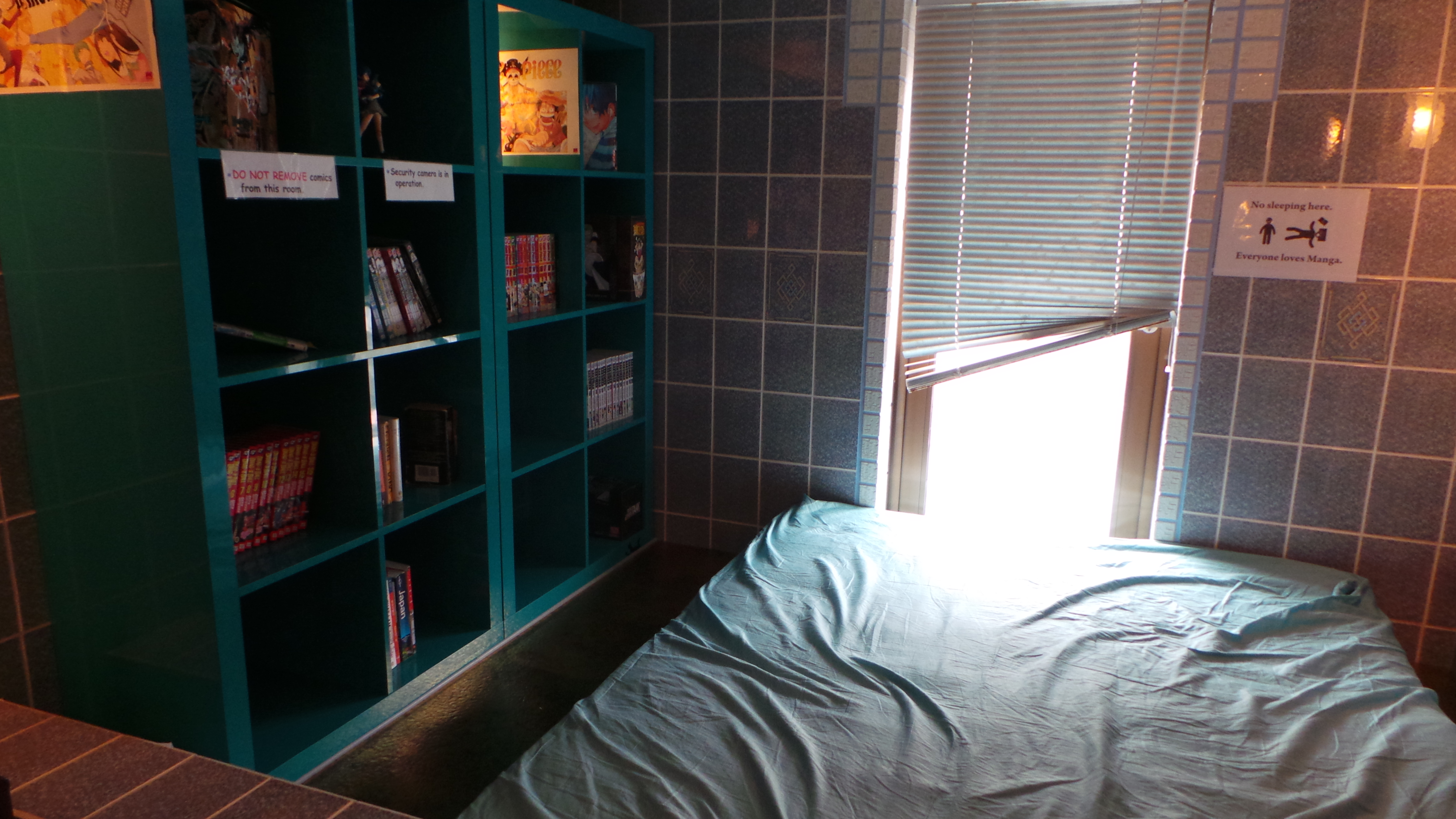
After finding my hostel with somewhat relative ease, I check-in. After a few moments I already decide that I have made the right choice to start my Japan journey here. “We offer free laundry powder,” the receptionist says in perfect English. “We also have a comic room!” he exclaims.
“A what?”
“A comic room,” he repeats. So up the lift we go, and he shows me to the comic room, with its free massage chair, and free manga comics.

Image

It is the official place to chill out and read manga comics, apparently. And it’s all free!

‘Free’ a word I will be hearing a lot of in the next few hours. The hostel has free tea and coffee, free laundry powder, free manga comics, free massage chair, free wireless Internet, free computers with free Internet, free toilet roll, and every Thursday, in a little room that doubles up as a whisky bar, is a free Jazz night, featuring excellent and professional Jazz musicians. Luckily for me, today is Thursday.

After finding my room and my amazing bed, I check out the facilities and find out that all the toilets in this hostel are made by Toshiba. I also find the hostel vending machines: one selling soft drinks and Boss coffee, one selling extremely cheap Asahi beer and 6% cider, and the other selling, ‘FOOD FOOD HOT FOOD 24 SEVEN,’ or so it says.

I relax in the hostel for a while reading one of the ‘free’ guide books. Eventually I team up with an Irish man, who is sharing my hostel room and whom I had previously met, and an American man. After a few beers we decide to head out for some food. The Irish man knows a great ramen shop across town, so off we go.

20140529_201217[1]

He was right, the ramen was amazing.

On the way back to the hostel for the Jazz night, the American spots a sign he had referenced previously that evening. It basically says free beer in exchange for some bar work, so we decide to check it out. I have been in Japan for less than a day and, although paid in beer, I have effectively landed a job.

Here, in this small back alley bar, Japanese men and women come to practice their English. My job is for thirty minutes to sit and talk to a Japanese lady in my native tongue. The moment I sit down a beer is poured for me, and it is on the house. Free beer brings the English speakers in, English conversation brings the Japanese customers in. A clever idea in a country that generally has limited to poor English speaking ability.

After thirty minutes of stop-start, but very enjoyable conversation, the bar owner asks the three of us to switch around. The Irish man gets put with the Japanese lady I had just been talking to; and I sit with a young Japanese man, probably in his mid-twenties. Another beer is poured for me, once again it is free.

This man has excellent English speaking ability, probably better than some of the native English speaking customers I have spoken to during my previous employment. He does not need to be here. I would argue that he is only in this bar to improve his confidence when speaking in English, however, this man has the confidence to come to this back alley bar, on his own; so I am not sure his confidence needs improving too much. Shortly into our thirty minute conversation he mentions a Japanese art and acting form called kabuki. Oddly, a few days ago I had watched an NHK World documentary about the subject, so from that, the conversation flows.

After our two thirty minute sittings, and my two free beers, the three of us head back to the hostel to find that unfortunately the Jazz has finished. However, the whisky is still flowing and the party in the Jazz club is far from over.

20140529_205706[1]

I don’t remember a great deal else from tonight, just that I leave in the early hours in a haze and head back to my room to sleep off almost 48 hours of being awake.

My first day in Japan.