Inoue Sake Brewery

Today I meet with Naoto, the English speaking organiser of the sake tour. I am the only person to sign up. Not wanting to waste his whole day, I ask whether we should still go on the tour. It turns out Naoto is still quite eager to visit the brewery. Naoto is passionate about sake, and wants to spread the word about this traditional Japanese drink, which dates back to two thousand years ago. So off we go.

We head to Tokyo Station, before taking the the Tokaido Line to Kozu Station. The journey takes about ninety minutes. We have to wait at Kozu for a while; the trains here appear just twice an hour. Eventually a train comes, and we take the Gotemba Line to our destination, Kami-Oi Station. From the train I can see the sea.

Kami-Oi Station is deserted, it is so quiet that there is no ticket gate. “What, so we just walk out without paying?” I ask.
“This is the countryside,” is the explanation Naoto gives. I am still confused. The area is definitely the countryside, mountains and the sea. Rice growing everywhere. The air is clean. We leave the station and head to the Inoue Sake Brewery.

cedar[1]

The cedar globe outside serves as a symbol for the current year’s sake production. When the new batch is made in late October, the globe will be replaced. Its changing colour from green to brown as the sake matures is a visual representation of the sake’s aging process. It’s a lovely tradition that mirrors the transformation of the drink itself.

Inoue Sake Brewery’s rich history since its establishment in 1789 during the Edo period is remarkable. Mister Inoue’s humility and passion shine through as he shares insights into the sake-making process, its history, and the diverse range of sake types. The tour of the brewery kicks off promptly, and Mister Inoue highlights how the cold Hakone air plays a crucial role in sake production. He emphasises the use of locally sourced rice and pristine water from a depth of 150 metres underground. Tasting the water confirms its anticipated qualities: cleanliness, freshness, and clarity.

sakewater[1]

Sake production resembles wine production, yet it involves an additional step before fermentation. Starch from the rice is combined with Koji, a diastatic enzyme that aids in breaking down the rice and converting its starch into sugar through a process called saccharification. Following this, sugar and yeast are added to commence fermentation. In contrast, grapes used in winemaking naturally contain sugars, so only yeast is added to initiate fermentation. Despite this difference, the subsequent processes in both sake and wine production follow a similar path.

We visit the room where the Koji is added to the rice and see the large tanks used for steaming, storage, and the mashing process. I’m surprised to learn that all these procedures are performed manually. For instance, the mashing process occurs in enormous 8,000-litre tanks. The masher stands atop a precarious-looking wooden platform above the tank, vigorously pounding a massive stick into the rice for four days.

saketanks[1]

The outcome is a liquid derived from starch. Subsequently, multiple parallel fermentations occur. The mixture rests for up to 32 days, enabling simultaneous saccharification and fermentation. Afterward, the sake undergoes pressing through cloth, filtration, and enters a pasteurisation phase. Finally, the sake ages for up to six months, is bottled, and eventually reaches the consumer for sale.

The sake is sold in 1.8 litre bottles, or 720 ml bottles. A much smaller bottle is also sold, however, the other two sizes are the most common. After the tour we sit down and try a few varieties of sake. My favourite is the gold-medal winning Hakone-yama Junmai. Junmaishu is a traditional style of sake, and often has a mellow bouquet with a rich, smooth flavour.

bottleitup[1]

Hakone-yama Junmai offers three different serving options: room temperature, cold, or hot. Initially, we try it at room temperature, finding it good with a subtle flavour. When served cold, it becomes much nicer, boasting a smoother texture. Lastly, the hot variety also impresses; the flavour expands, and the scent intensifies, offering a delightful experience.

After the tasting, I am given a masu as a souvenir, a small wooden box which was originally used to measure rice, but these days it is used as a container for drinking sake. Impressed with what I have seen and tasted today, I decide to buy a bottle of sake for ¥1200. After that we say goodbye to the owner and return to Kami-Oi Station.

fujievening[1]

From the train station I can see the base of Mount Fuji.

A Tale of Sorrow and Sadness

I spend my morning shaking off a karaoke gin hangover, arguably the worst kind. At 1 p.m., Dagmar and I take the train to Ginza to meet our friend Aram. The plan is a visit to the Vanilla Gallery; the number one gallery in Tokyo for eroticism, fetishism, and sadism.

Despite having visited the Vanilla Gallery before, it remains difficult to locate. We get a little lost but eventually find it hidden away on an inconspicuous street. This month, the theme showcases artwork that tells the tale of time and sorrow—’An exhibit of illustrated stories and dolls pertaining to madness and sadness.’ The entry fee is a pleasing ¥500.

dertilgung[1]

The exhibition is called Der Tilgung. Dagmar tells me that this is German for ‘The Repayment.’ Nowhere else in Tokyo can you experience such a vortex of phenomenal imagination.

Room-A features a collection of artwork and imagery from MoriKaoru. I’m surprised to find that most of the paintings have sold out. The work focuses on desolate women surrounded by monsters depicted as men. There’s an uneasy emphasis on slavery and torture. One exhibit displays iron shackles laid to rest on a leather sofa. Another portrays a drawing of a young woman bound at the wrists, sitting in a cell surrounded by decapitated limbs, while a male figure with a menacing grin watches her through the bars.

Room-B is slightly less horrific but disturbing in other ways. Suna-mura Hiroaki is the artist. The display features half-naked corpses of women—dolls. A child lies still in a coffin, and two dolls hang from chains with beautiful flowers blossoming from their dead faces. A doll resembling a nurse has her chest cut open, held by wire, and inside reside many small, menacing demons. Trees grow from faces, and dolls scream in anguish. Some dolls are made from the skulls of unnamed animals. Despite the theme, the craftsmanship here is incredible. My favourite piece is a naked woman, half her body covered by flesh, the other completely skeletal; half her face a picture of harrowing decay.

vanilla5[1]

Most of the exhibits are for sale, with prices ranging from ¥50,000 to ¥300,000 per piece. Haunting music floods the gallery. Sadly, the Vanilla Gallery forbids photography, so my only photographs are from the entrance and the flyer. I’ll probably have nightmares for a week thanks to what I’ve seen here. We stay for maybe twenty minutes before heading to the station.

Back at the hostel, there’s yet another party. Tonight’s theme is a ‘Sake Fair.’ Here, we can witness the process of making Japanese sake, sample ‘free’ sake, and indulge in the many complimentary snacks available. A PowerPoint presentation is set up on a projector—classic. The concept behind the free sake is to promote a brewery tour scheduled for tomorrow. For tonight, there are five different bottles of sake for hostel guests to try.

sakefair[1]

Suginishiki Yamahai Junmai is my favourite; it takes twice as long to make as your regular sake and is full-bodied with plenty of flavour. Shosetsu Daiginjo is also very nice—light, mild, and clear, with a banana scent and a subtle hint of fruit. I don’t usually like sake, but the drinks on offer here are actually very nice, perhaps a bit more expensive than I’m used to.

I decide to sign up for the tour tomorrow. It will be interesting to learn about the process, and I’m pleased to find out that the tour takes place at a brewery at the base of Mount Hakone. The tour costs ¥8500, including transportation, and it’s a great opportunity for me to discover more about this traditional Japanese drink.

On a Clear Day I Can See Forever

Summer surrenders to autumn, and the weather swiftly turns cool, as if overnight. My can of Boss Coffee falls from the vending machine piping hot. Today, I decide to explore the Toei Oedo Line. I walk twenty minutes to Kuramae Station. En route, I pass the Bandai Headquarters; a huge banner informs me that Tamagotchi is making a comeback at the end of this month. At Kuramae Station, I wait patiently for the train and receive strange looks as I laugh at the following sign:

outofafence[1]

I hop on the train without taking any notice of the time. It is, of course, 9 a.m. — rush hour. The train is packed. Today, I learn that this train goes all the way to Shinjuku. At every stop, more people get on. The crowding worsens, and the oxygen levels deplete. After about ten minutes, it becomes too much, so I squeeze my way out of the train at Kachidoki Station. I need air.

Kachidoki is in Koto and is the nearest station to the Tokyo Port Terminal. Whilst I’m here, I decide to take a little wander around the docks and the small interconnected islands. Dengue fever has now spread throughout Tokyo, and this area is a terrible place to be. All the streets here are lined with shrubbery and swarming with mosquitoes. A sign warns me to ‘Be careful with mosquitoes!’ Joking aside, it’s actually pretty serious, and I take the warning seriously.

I head toward the Harumi Railway Bridge.

HarumiRailwayBridge[1]

The bridge is no longer in use. Barbed wire warns me not to cross, although I wouldn’t anyway as it doesn’t look very safe. What’s interesting here is that from this bridge, I can see both Tokyo Skytree and Tokyo Tower. I suppose it makes the trip worthwhile, maybe not. After I photograph the bridge and Tokyo Tower in the distance, I head back to Kachidoki Station. Rush hour is now long gone.

I take the Toei Oedo Line all the way to Shinjuku. I end up getting lost in the station, then get back on the same train as before, taking it to Tochomae Station. Here, I change trains but stay on the same line and head to Higashi-Shinjuku Station. Outside, I walk around looking for something to do. There isn’t a lot here—just restaurants, shops, and plenty of bars; a good place for a night out if I didn’t live so far away. I cross under the Yamanote Line and see children painting the wall beneath the tracks.

arttrack[1]

I follow the wall of graffiti to the entrance of Shin-Okubo Station and take the Yamanote Line to Ueno, changing trains once more before heading to Tawaramachi Station.

When I arrive back at the hostel, Hiro tells me that tonight we are having a soba party. “Not again!” I quip. The flyer for the party is the same as last time but with a different date. I relax for a while, killing time, before heading out for my seventh train of the day.

I take the Tobu Skytree Line just one stop to Tokyo Skytree Station. If I’m completely honest, I could have just walked it; it isn’t far. I blame the convenience of Japan for my laziness. I’ve been here almost four months now, and with Tokyo Skytree practically on my doorstep, I decide I might as well take the plunge. ‘Plunge’ probably isn’t the best word to have used.

I pay ¥2060 and wait anxiously for the lift. Surprisingly, there is absolutely no queue. The lift travels so fast that it makes my ears pop. 350 metres later, I arrive at the Tembo Observation Deck. The view is staggering.

fromthetop[1]

Skytree Radio blares through the speakers. As I gaze over the Sumida River, I can see my hostel. “From the top of the tower, radio buzz in my ears, I can see my house from here, I can see my house from here.” The Owen Pallett song, ‘The CN Tower Belongs to the Dead,’ gets stuck in my head, and it will most likely stay there for the remainder of the day; not necessarily a bad thing though.

I wander the massive observation deck for a while, being careful not to get too close to the edge. There’s an option to pay an additional ¥1030 to go up to the next deck, another one-hundred metres higher. I think it’s terrible that this was never advertised to me until I’m already 350 metres in the sky—a sneaky trick to try and make me pay more. I decide not to bother; I’ve already spent a small fortune today as it is. Instead, I take the escalator down ten metres. Here, there’s a glass viewing point where I can stare at the traffic on the street below. Oddly, it doesn’t look like I’m too high up from here.

glassviewpoint[1]

There’s another area where I can actually stand on a glass platform and have my photograph taken by the staff, although I can’t use my own camera. All I want to do is take a photograph of my foot on the glass panel, but I’m not allowed. Another trick: if you like the photograph, you can spend even more money and buy it.

I take the lift back down to the inescapable 5th floor. It would be unfair to say that the most exciting part of the Tokyo Skytree experience is the lift, but then again, I am quite the unfair person. As I had imagined, the exit to the lift leads into the gift shop. The train station is on the first floor, and surprisingly, I am forced to exit through not just one gift shop, but three. After three floors of tacky goods, I then have to walk all the way through a huge indoor food market just to get to my train.

Back at the hostel and with an hour to kill, I write whilst listening to Owen Pallett, or at least I try to write. At some point, all hell breaks loose: a monsoon. Tokyo is issued a flood and heavy rain warning—a red warning. I have honestly never seen rain so hard; I can’t possibly explain it without appearing to exaggerate. The hostel floods. I spend an hour helping out: moving furniture from flooded rooms to dry rooms, and mopping. Mopping until I have no energy to mop anymore. It’s just lucky that my laundry is comfortably drying on the 4th floor, so I don’t mind getting my clothes soaked in dirty floodwater. Eventually, the rain stops, and with a lot of hard work from the team here, everything is high and eventually dry.

It is fair to say that the soba party is a bit of a washout. Eventually, after an hour delay, it finally gets started. I shower and change clothes before enjoying some free noodles and beer. Deserved beer.

skymoon2[1]

After the party, I take a wander outside to catch the end of the Harvest Moon. Somewhat fittingly, the moon hovers just behind Tokyo Skytree. An apposite end to the day.

Eat Fish or Die Tryin’

I meet my friend Dagmar for breakfast at ten. At breakfast, I drink away my hangover with a bottle of a tasteless drink called ‘Delicious Water’ before heading out alone for the train. Someone told me yesterday that beneath the banks and office buildings between Mitsukoshimae Station and Otemachi Station, hidden deep underground, the Japanese government grows secret rice.

Somewhere along the Ginza Line, my train just powers down. All the lights extinguish, plunging the carriage into an abyss of darkness. The train drifts aimlessly towards Ueno Station and finally grinds to a haunting halt. The silence thickens, shrouding the dead train in an eerie stillness, an unsettling void that grips the carriage. Everyone remains silent, messing with their mobile phones, despite the obvious sorrow of the situation. It is all very worrying. About five minutes pass, and there is an announcement in Japanese, then nothing. A further five minutes, and the train starts up like nothing ever happened.

As I exit Mitsukoshimae Station, I accidentally wander into an adjacent department store.

maskmaskmask[1]

Inside the department store, there is a Mask Art Museum, and it is free. A nice but rather small exhibition. The store housing the museum is incredibly upmarket. I ask politely if I am allowed to take photographs, and lucky for me, it is fine. The exhibition actually ends today. Rather fittingly, all of the mannequins in this department store are wearing masks.

One thing I have noticed in Japan are the many strange museums. I believe I have previously mentioned the famous World Bags and Luggage Museum. A few other favourites of mine that I am yet to visit are the Gas Science Museum, the National Leprosy Museum, and the Parasite Museum.

I wander around for a while looking for the entrance to the secret underground rice bunker. It takes a while but I eventually find a huge office building that has every window on one side completely covered in plants. On the other side of the building I scare away an eagle pecking at a gold statue of Prometheus. This must be the place, I think to myself. It turns out it is.

prometheus[1]

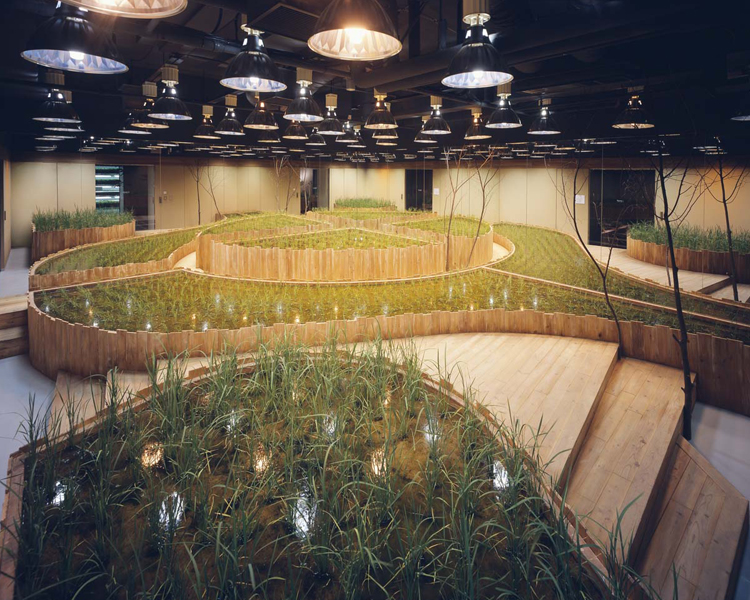
Deeply tucked away in the second basement level of a huge skyscraper, they grow rice. I am not entirely sure why they grow rice, but people are free to come and see it. Huge natural light shines from above. Rice grows. From what I was told, this area stretches under the whole business district, although it doesn’t. The size of the area was heavily exaggerated to me. The rice isn’t really that much of a secret; it’s not too well advertised, but no one is trying to hide the fact that it grows here either. In fact, I think it’s encouraged for people to come here and learn about rice cultivation. So, another urban myth shattered then.

ricetomeetyou

After looking at rice for a few minutes, I decide to walk to the Imperial Palace. I’m surprised by how close the stations are to each other in this area. Tokyo, Kanda, Shinbashi, and Nihonbashi Stations are literally within a five-minute walk of each other. Outside the Imperial Palace, about thirty elderly Japanese people are sitting and painting.

The Imperial Palace is home to Emperor Akihito, the last remaining monarch in the world to go by the name of Emperor. There isn’t really much else to see at the palace. The grass outside is cut immaculately, and the water fountains spray jets of water about two metres into the air. I notice there is a great view of Tokyo Station from the Palace car park, though. I wander to the nearby Ginza Station and take the train back to Asakusa.

tokyostation[1]

I decide to inspect a potential apartment. Small apartments in Japan are ironically referred to as “mansions.” These one-room coffin apartments offer little to no space and an equal amount of comfort. Another phenomenon in Japan is the grouping of shops, whole areas dedicated to selling one type of product. The area where the apartment is housed is completely surrounded by funeral shops. One street has eight shops in a row, all selling tombstones. I decide the area doesn’t quite feel right. Chimes sound from nowhere as I head back to the hostel, chiming five times signalling 5 p.m.

At 6 p.m., Richard, Luis, Remi, and I head to a nearby restaurant that serves fugu. Jokes are made about toxicity, tetrodotoxin, paralysis, and death. In reality, fugu poison is one-thousand two-hundred times stronger than cyanide; this is no laughing matter. The most poisonous part of the fish is the liver. Outside the restaurant, we watch our dinner for a while, graciously swimming around in a tank. In a moment, this beautiful blowfish will be killed on our behalf; we sure hope it doesn’t have a taste for revenge.

blowfishing[1]

There was a time when a fugu chef would have to pass a training course of ten years before being given certification to prepare fugu. These laws changed about three years ago, and now the rules state just a two or three-year course is required. We really hope that our chef today is of the older generation.

We take a seat in a tatami room. We order fresh blowfish sashimi. We also order diced blowfish sashimi just so I can make a pun about how we diced with death. Oddly, one of the options on the menu is hot sake with dried blowfish fin floating in the liquid. “We only serve the finest live domestic tiger blowfish,” says the menu. Served live? I certainly hope not. We wait anxiously for our food to arrive.

The poisonous fish is served in elegantly arranged translucent slices; it doesn’t look very threatening.

blowfish1[1]

A taste for revenge would be an overstatement. A taste of anything would be welcome. The food is the freshest fish I have ever tasted, of course; it has been dead just minutes. The food is also the least tasty fish I have ever had. It has no flavour at all; perhaps there is a subtle hint of death. I’m just glad we went to a cheap non-certified restaurant. It costs us just ¥5480 between the four of us for two dishes and four drinks.

I tried the sacred fugu of Japan and all I got was this lousy anecdote.

Bring Me the Head of Kubikiri Jizo

Today, I’m sitting at the bar of a small cafe having breakfast when a man named Yoshio notices I’m not Japanese and strikes up a conversation while I chomp on my vegetarian Eggs Benedict. “I just got back from America,” he tells me, “I got back yesterday.” His English is pretty good, and I stay for a second cup of coffee, chatting with him for about thirty minutes before he has to leave. After he departs, the cafe owner shares Yoshio’s full name with me. A quick Google search reveals his Wikipedia page, and I discover that the man I had breakfast with is a famous Japanese comedian.

After coffee, I head out to meet Luis, the Chilean guy I met during the World Cup. He is back in Asakusa for the final leg of his trip, so we arrange to meet up for 1 p.m. We take the Ginza Line to Akasaka-mitsuke Station. Akasaka is known for being quite a posh area, so we wanted to get a feel for what a rich neighbourhood looks like. No different from anywhere else, it turns out.

From Akasaka, we walk to Roppongi and head for Tokyo Midtown. Here, there is a giant 1:7 scale statue of Godzilla.

godzilla[1]

After Godzilla, Luis and I head back to Asakusa and eat at my favourite Indian restaurant. Luis has only ever had curry before one other time in his life, madness. After food, we head our separate ways.

Whilst I was exploring accommodation options for October, it was suggested to me by a 71-year-old Japanese man that I try the area known as San’ya; apparently, the apartments there are relatively cheap. San’ya is still in Taito Ward, and a forty-five minute walk from Asakusa. I head in the vague directions I am given and discover that San’ya no longer exists. All signs mentioning the word San’ya no longer exist. Every mention of the area has been removed, like a Japanese history book; all traces have been erased from memory.

The only sign that has any mention of a San’ya past is the sign for Namidabashi. The sign literally translates as ‘Tears Bridge’ and was where people came to say goodbye to loved ones before they were taken to be killed at the Kozukappara execution grounds, hence the tears. These days, the bridge has been buried under the concrete of an intersection, the execution ground painted over by a bus station.

busgrounds[1]

All that really remains, other than human remains, is Enmeiji Temple. It was this statue of Kubikiri Jizo, the decapitation Buddha, who watched over the nearby execution grounds. For those who were executed, the last image they would have seen is the Buddha. Its name literally translates to ‘neck cutting Buddha’. An estimated two hundred thousand prisoners were killed here. Ironically, during the March 2011 Tohoku earthquake, the Buddha was damaged and its head broke off. A sign details the step-by-step process of how the head was repaired.

There is also a sign here that says, ‘Nam-Myoho-Renge-Kyo,’ the all-too-familiar chant of the Nichiren Buddhist. Gravestones without names make up the backdrop.

kubikirijizo[1]

The main street here translates as ‘Bone Street’. It was on this street that the decapitated heads of the executed were put on display. The executions stopped in 1873, and after that point, the area suffered further misery. Somehow, San’ya became Japan’s biggest leather-producing area. The problem with leather is that it comes from cows, and cows in Buddhism are not to be used for leather production; this being a Buddhist country doesn’t help matters. The people here became complete outcasts, and leather production work was considered the lowest of careers. A certain stigma became attached to the already stigmatic San’ya area, and it fell into decline. It was around this time that the name San’ya was abolished. These days, the shops are all boarded up, the streets are empty, and the dead stay dead.

Today, if you live in the old San’ya area, you are still looked upon as different. You are judged for living here. The accommodation is cheap; however, I wouldn’t like to stay here. The people aren’t liked, the energy is wrong, and then there are the souls of murdered cows and headless criminals. I leave the macabre of San’ya and head to the somewhat less chilling ‘Flying God Temple’.

flyinggod[1]

The Legend of Tobi-Fudo comes from the Shobo-in Temple. It was first built in 1530. “Once upon a time, the chief priest of this temple went to the Omine Mountain in Nara Prefecture to pursue his learning; he took the principal image of Buddha with him to the mountain from his temple, but the principal image flew back to this place in Edo within one night and gave diving favours to the people.” I am not sure what ‘diving favours’ are, but this is what it said at the temple entrance. I think it is supposed to say divine.

In recent years, people visit the temple to pray for safety in air travel, praying their plane doesn’t crash. I suppose ‘diving’ is probably the wrong word to be using when talking about air accidents. There is also a sign saying a festival takes place in October on the temple grounds. I add it to my calendar and leave.