Everything Was Beautiful And Nothing Hurt

With toothache and a twisted ankle, I take the Bullet Train over to Hiroshima. My first stop, a place I visited ten years ago, Hiroshima Peace Memorial Park. Immediately after the atomic bombing, it was said that no plants or trees would grow for 75 years, but as I hobble along Peace Boulevard towards the park, I notice it is lined with large trees and lush greenery. Following a tree-planting campaign in 1956, in which neighbouring municipalities in Hiroshima Prefecture were asked to donate trees to the city, Hiroshima has been transformed into a verdant paradise.

I stroll in silence through Hiroshima Peace Memorial Park. I take note of the fountains, the newly laid flowers at the cenotaph, the looming Atomic Bomb Dome in the distance; a survivor, its form so full of imperfections, its beauty an aide memoire of an aftermath of events that left it in such a state; a symbol of everything left behind, a skeletal figure of what once was, now ruins.
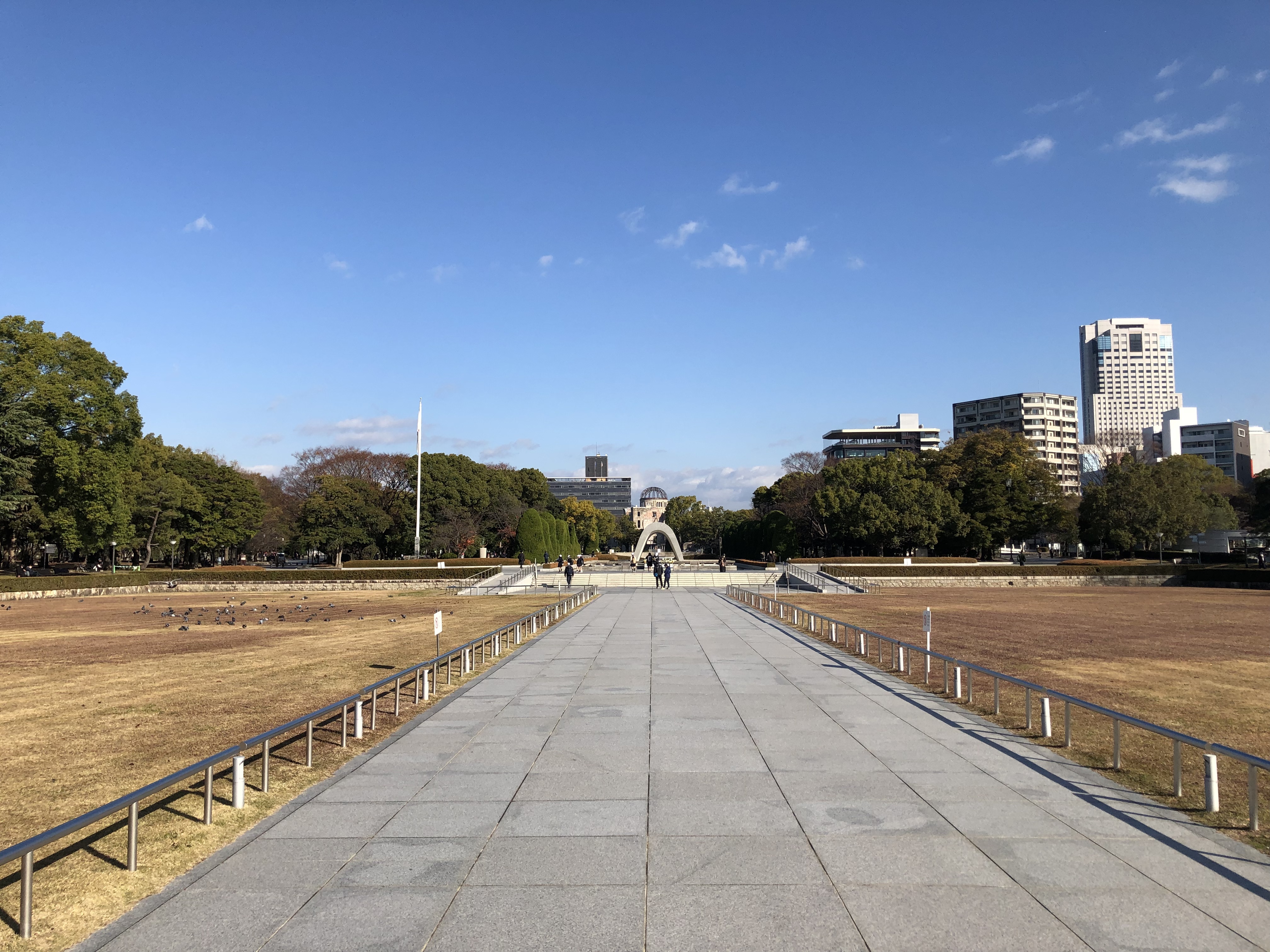
Seventy-seven years ago United States President Harry Truman authorised the bombing of Hiroshima. His actions, which would be considered a war crime today, resulted in the instant deaths of 80,000 people. As I further walk toward the dome in the distance, I can’t help but think about the enormous impact of these events; the devastation of an entire city in a single moment.

The building that houses the skeletal remains of the Atomic Bomb Dome is known as the Hiroshima Prefectural Industrial Promotion Hall, and in December 1996 it was added to the UNESCO World Heritage List as a reminder to the whole world of the horrors of the atomic bomb, and a symbol of global peace. As I look at this building I can’t help but become overwhelmed by sadness.
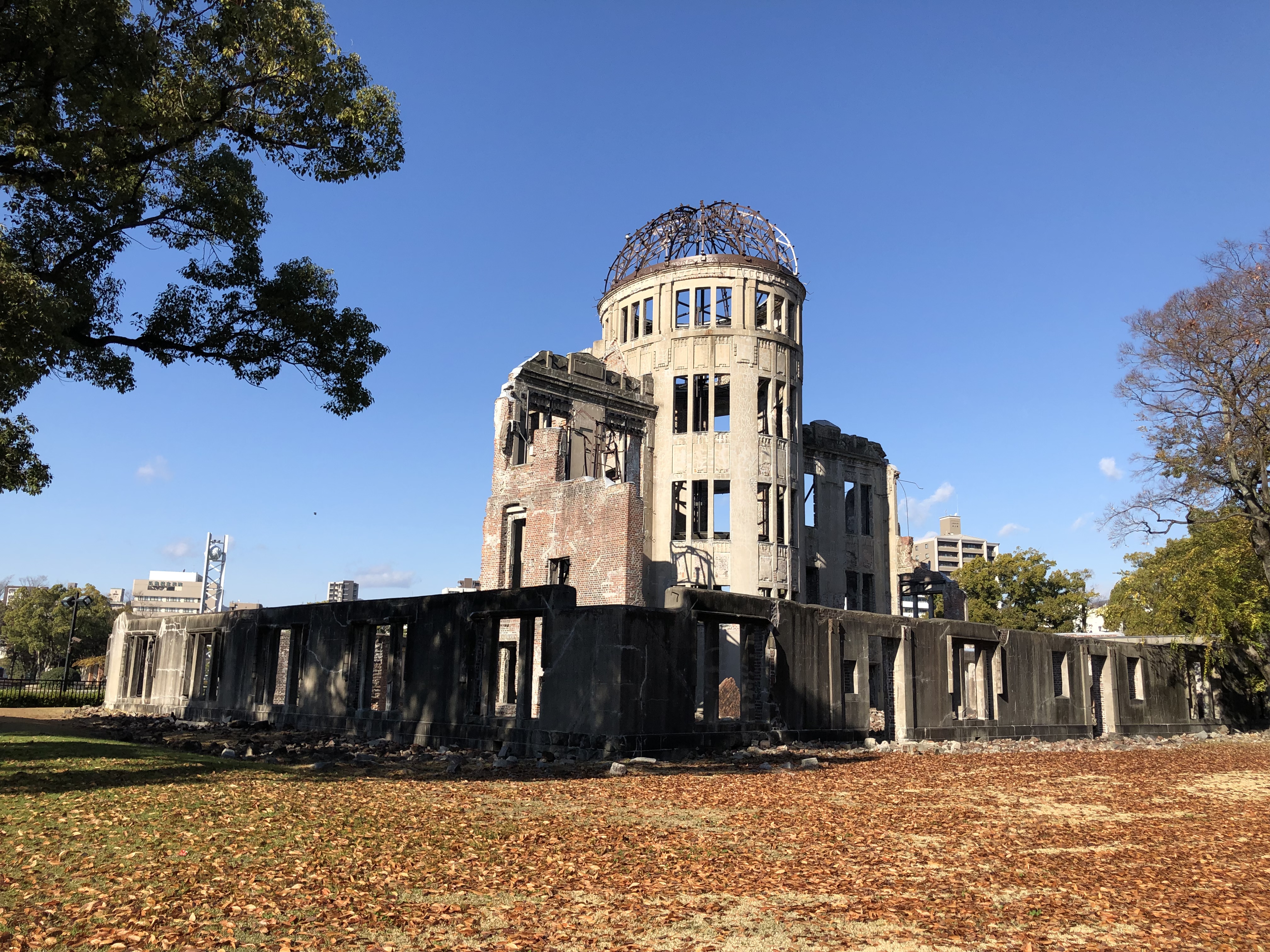
Because the bomb dropped on Hiroshima exploded from almost directly above this structure, some of the walls and the iron frame making up the dome remained standing, whereas everything else around it for miles was flattened to the ground. There has been some controversy about this building in the past, some people argued that it should be destroyed, for it’s a dangerously dilapidated building that evokes painful memories. Others argue that is should be preserved as a memorial to the bombing. Since the UNESCO status, the building is now protected and efforts are continually made to ensure that it looks identical to how it looked on that fateful day in 1945.

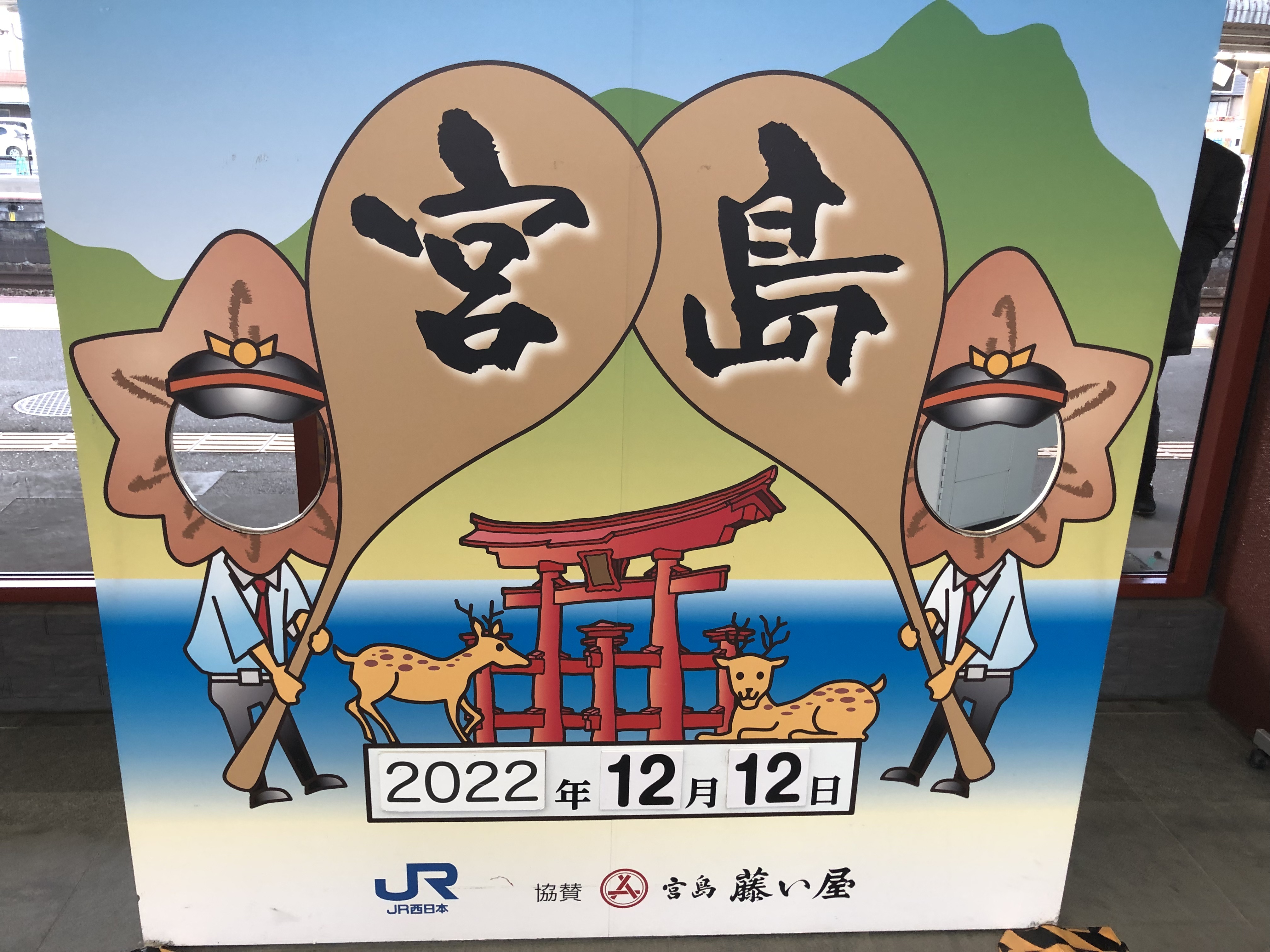
Leaving the solemn Peace Memorial Park behind, I embark on a journey by train to Miyajimaguchi Station. Located on the serene Miyajima Island, the revered Itsukushima Shrine is said to offer one of Japan’s most breathtaking views. As I enter the station, a display of the shrine and its iconic, wandering deer greets me with a festive flourish.
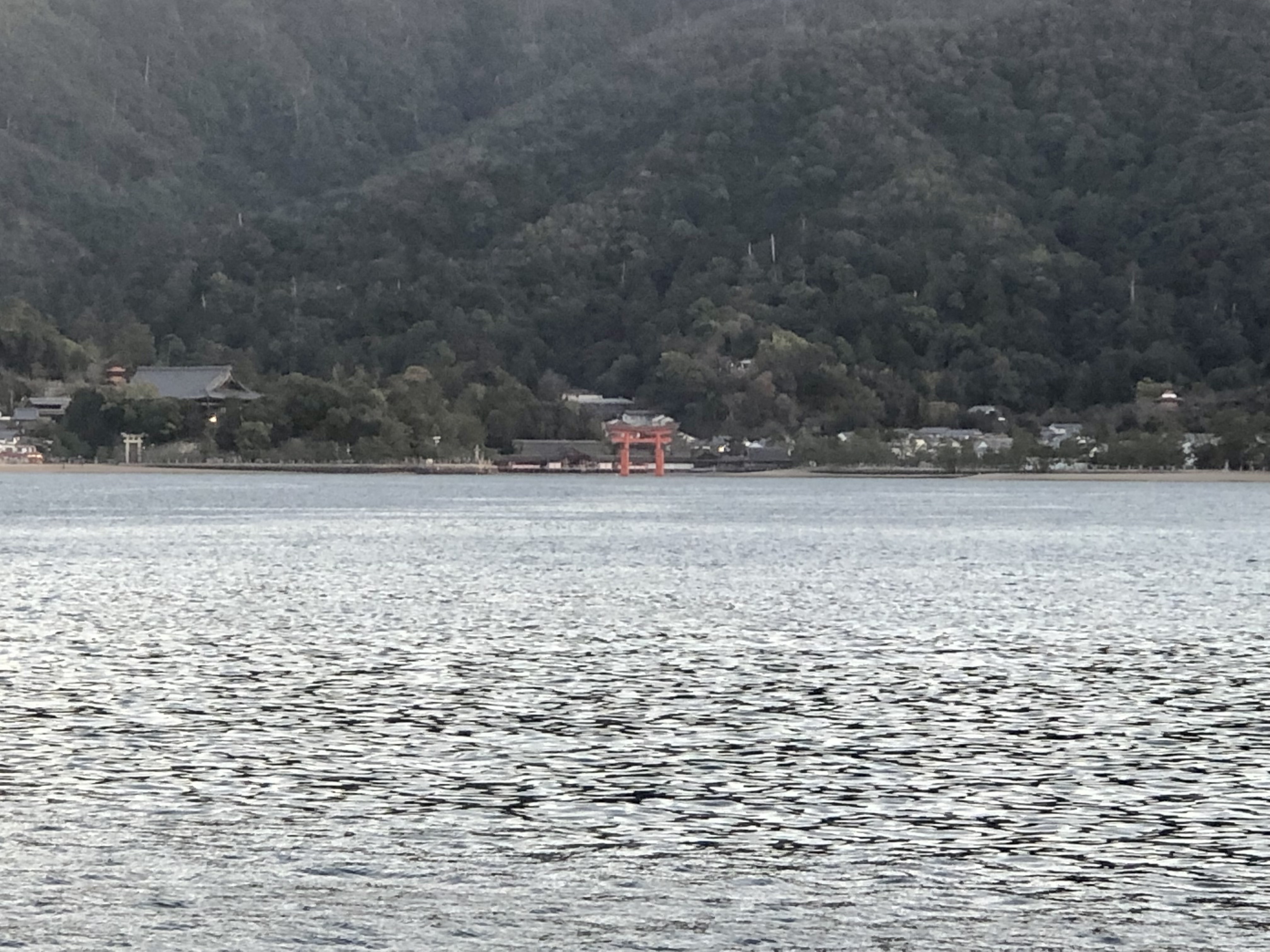
Before taking the ferry over to the island, I pause to capture a photograph of Itsukushima Shrine from the mainland. The shrine, known for its red torii gate that floats in the water during high tide, beckons me with its breathtaking beauty. I stare across at the shimmering water below, the sparkling lustre of Hiroshima Bay that stretches out before me, and with a sense of awe and wonder, I set out on the ferry towards the island, eager to explore its marvels.

The shrine is a Japanese National Treasure and a UNESCO World Cultural Heritage site. Unfortunately for me, there are none of the anticipated roaming deer hanging around today, but despite that, the shrine is amazing to look at. I can’t begin to describe how beautiful the red torii gate is up close. This landmark is one of the most photographed places in Japan, and I urge anyone visiting Japan to go and see it for themselves. My original photograph from the ferry port is the one I select here, as some things you just need to see and enjoy for yourself.
As I wander the streets of Hiroshima, I am determined to find a small standing bar that I visited 10 years ago. I remember the hotel I stayed at nearby and the bar owner’s enthusiasm for football, and I am eager to see if the owner’s guestbook is still around. However, after searching for over an hour, I discover that the bar’s location has been swallowed up by the ever-expanding Hiroshima Station, much to my disappointment. I had hoped to read the entry I made in the guestbook during my first trip to Japan back in 2012, but it seems that the bar’s memories have been lost to time.

With little else to do I head over to the nightlife area. This maze of buildings containing multiple bars is huge. From one intersection I can see 300 different bars in the four directions I look. It’s common for buildings in Japan to contain loads of tiny bars, and usually I bravely enter these bars with no plan as to where my night will go. Each individual sign in my photograph represents a single bar.
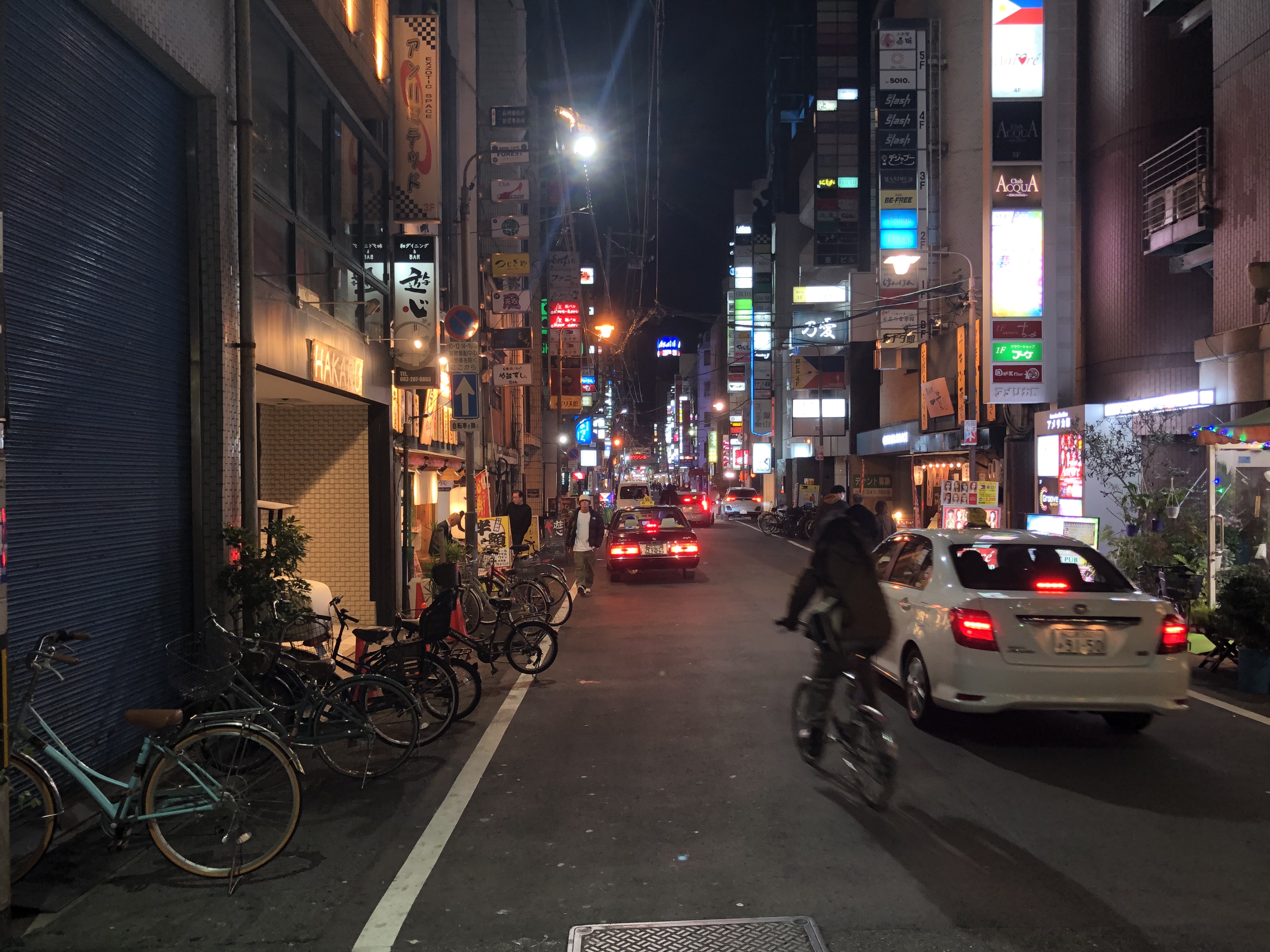
The first bar I go into the owner tells me, “No foreigners.” The same thing happens in the second, third, and fourth bar I attempt to visit. I understand that maybe the bar owners had negative experiences with foreigners in the past, or may not be comfortable communicating in English, but it is never acceptable to discriminate against someone based on their nationality or ethnicity, and it leaves me feeling hurt and frustrated.

I do eventually find a small friendly bar that will accept me, and stay up until closing time drinking and singing with the foreign owner’s Japanese guests. It’s actually one of the best nights out I’ve had in a while, so much so, that by the end of the night I’ve forgotten entirely about the toothache, the twisted ankle, and the racism.
A Bear Called Kumamon

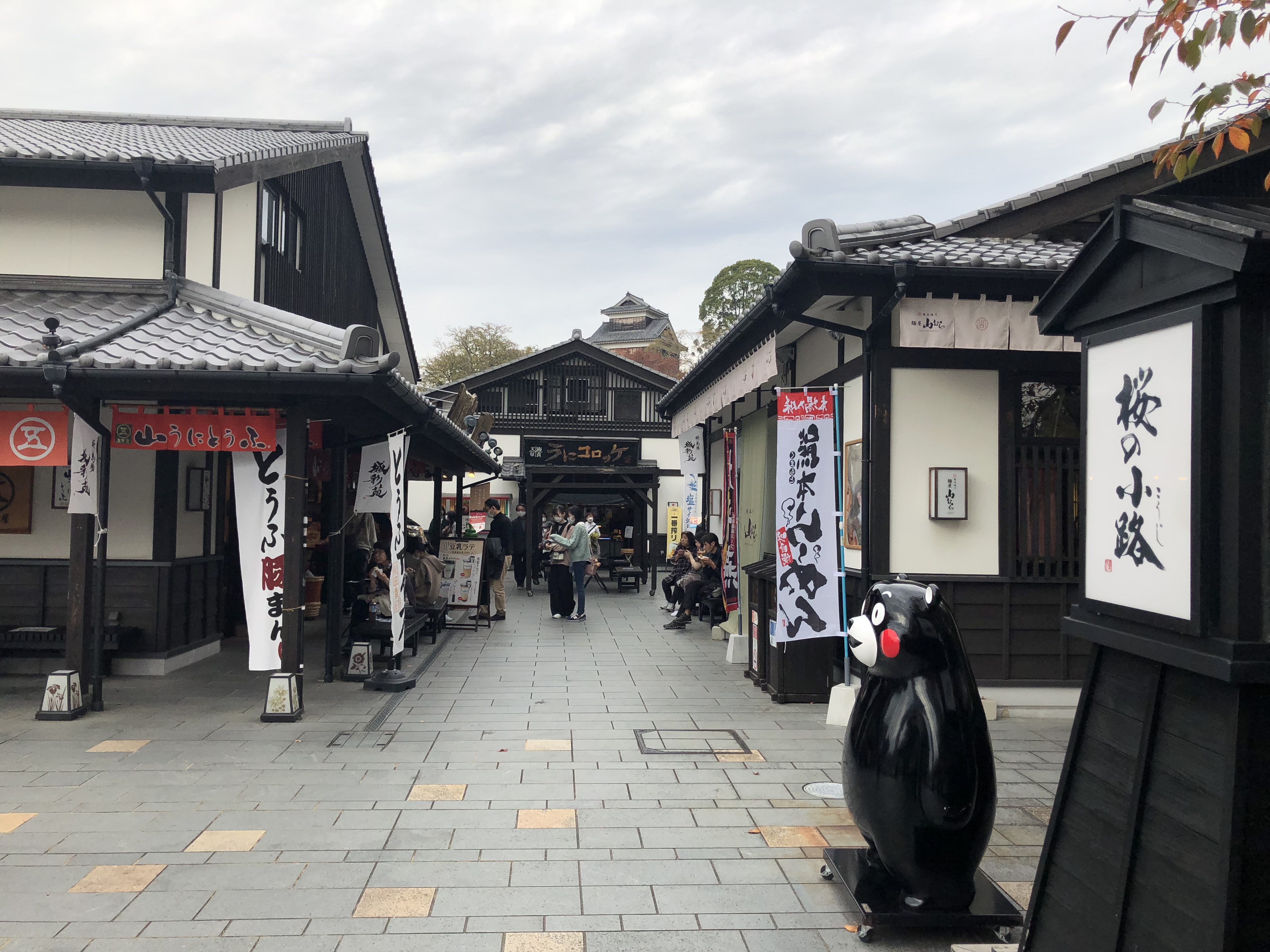
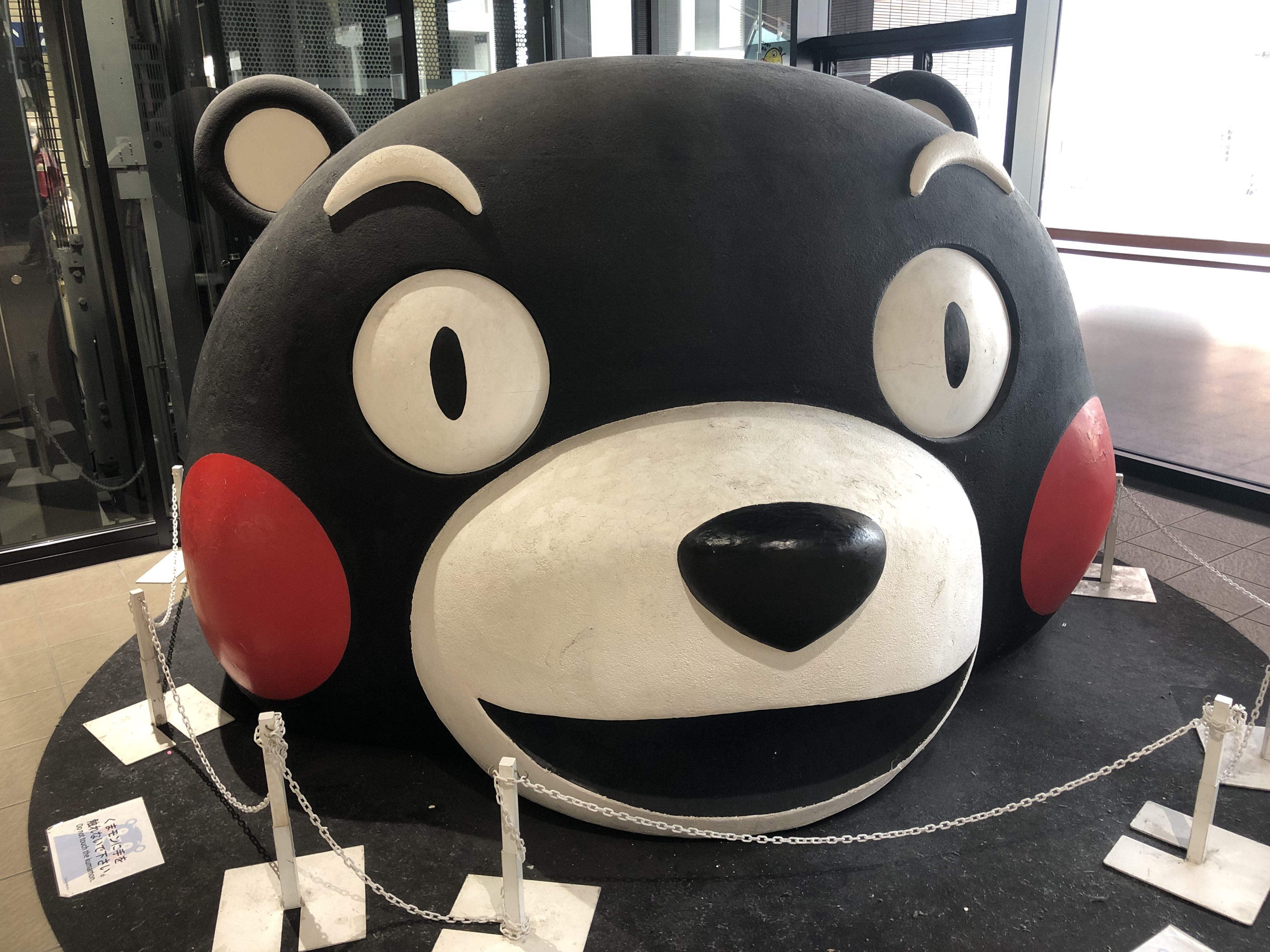
Kumamoto Prefecture is famous for mascots, and not just any mascot, the most famous mascot in all of Japan, Kumamon. In 2010, in a bid to help promote tourism in this region, Kumamon was created. His name literally means ‘Person from Kumamoto’ in the local dialect, and ‘Bear Person’ in Japanese characters. Despite Kumamon being a wide-eyed red-cheeked bear and not a person, the official website states that he is neither, and is in fact just a Kumamon.

Unsurprisingly, there are countless Kumamon within the train station, even a Family Mart doubles up as a souvenir shop selling official Kumamon goods, it’s a bit much.

Exiting Kumamoto Station, I instantly notice the cold. It feels as though I’ve entered a different climate. I start by taking a walk along the Shirakawa River, before returning to the city streets, heading in the direction of Kumamoto Castle. What strikes me as I wander is the complete lack of convenience stores in this area, I’ve been walking for about thirty minutes and I’m yet to see even one.

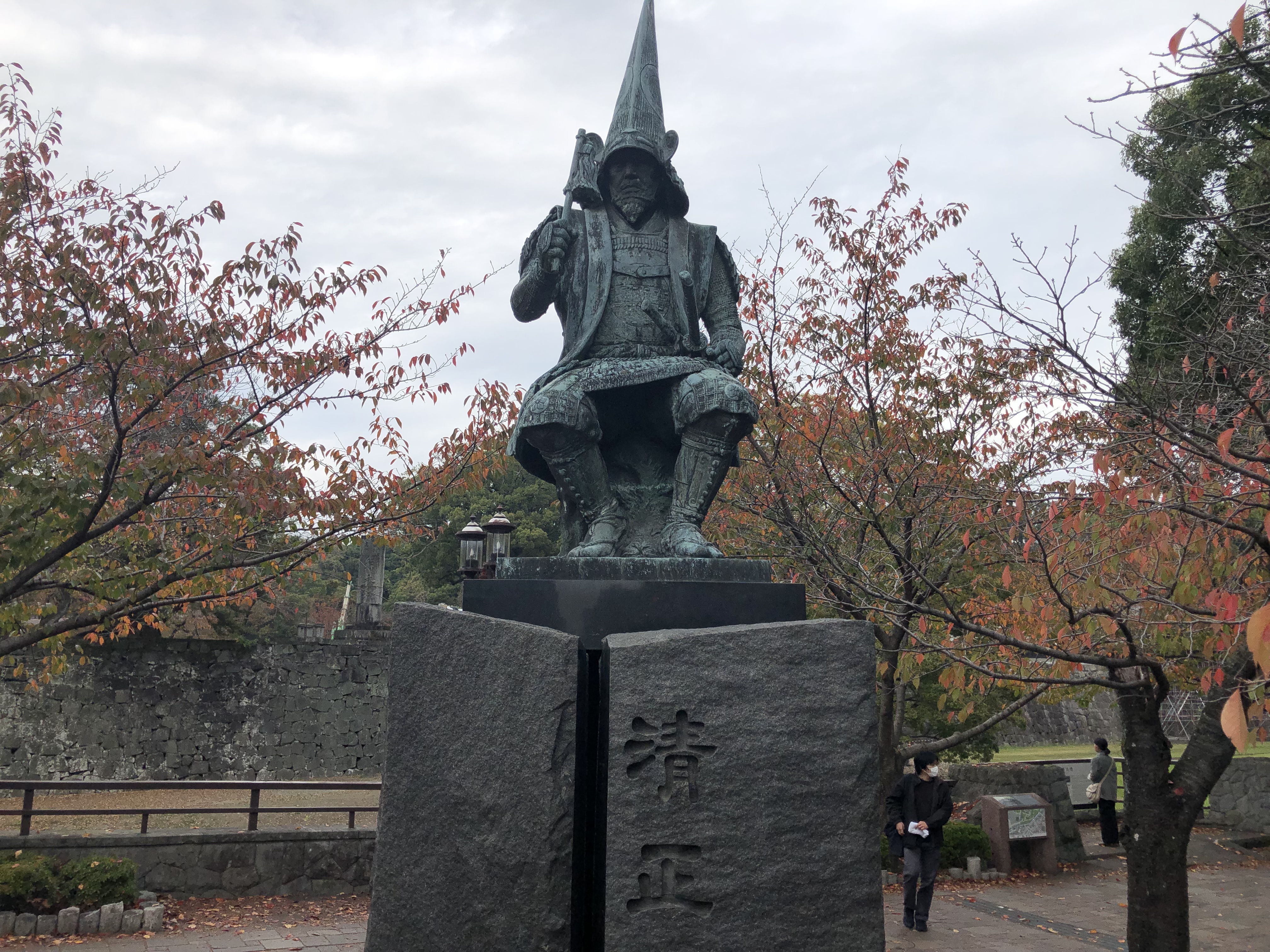
Eventually I do find a Seven Eleven, and as I enter the shop the heat hits me. It is so hot, the cold outside temperature contrasted to extremity. I’ve found this in Japan, in the summer the convivence stores are remarkably cold, with air conditioning turned down to a freezing blast. One cold day and they’ll switch to heating at full blast. Leaving Seven Eleven, I continue my walk, before spotting a giant statue of Kato Kiyomasa.

Kiyomasa was a fierce warrior, designer of castles, and was a general who led an army of 100,000 samurai into Korea. The sign next to the massive statue says, “He is wearing his trademark beard and a kind of tall black hat. The statue is slightly larger than life size.” I look back up at the Herculean statue. I look down at the tiny person next to the statue. I decide slightly larger is a huge understatement.

During the Japanese invasions of Korea (1592-1598) Kato Kiyomasa’s army were ordered to slice off the noses of those they had killed, pickle them in salt, and send them back to Japan. During the Battle of Hondo, Kiyomasa ordered his men to slice open the bellies of every pregnant Christian woman, and then to cut off their infants’ heads. Kiyomasa, it seems, was slightly barbaric. I decide to go and have a look at the castle he designed.

“Above the stone wall of the minor tower, there were iron spikes called shinobi-gaeshi, which were used to help keep out enemies, with various traps laid out in inconspicuous places. Searching for these is one of many ways to enjoy Kumamoto Castle,” states a sign at the entrance.

Kumamoto Castle was completed in 1607 by Kato Kiyamasa, and boasts its very own virtual reality technology. Here you can enjoy discovering Kumamoto Castle and its history through VR. You can even see the castle using virtual reality. I can see the virtual reality booths from the actual castle.

I leave the castle and head to the nearby Suizenji Jojuen Gardens.

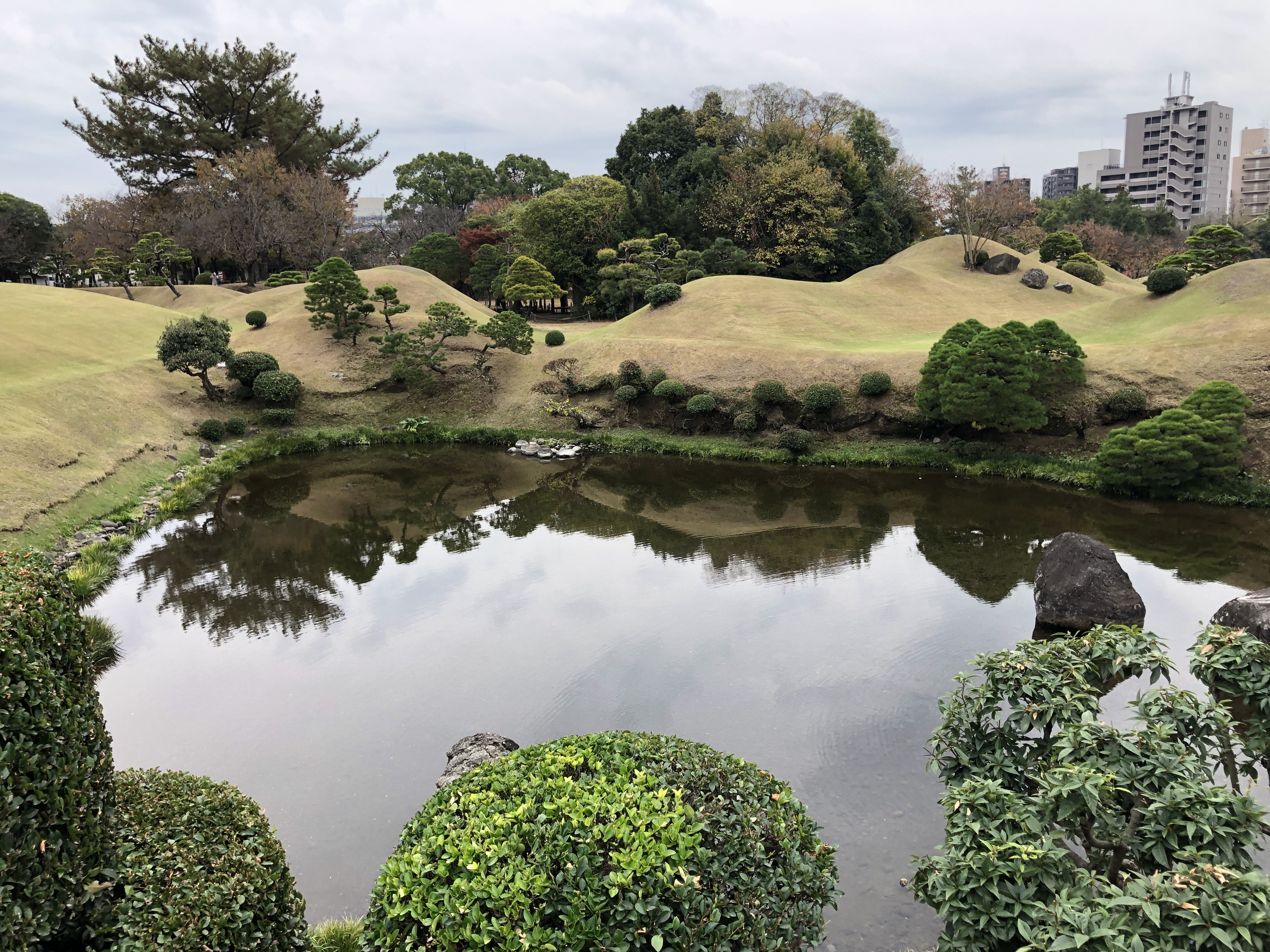
These gardens are on the southeast side of Kumamoto Castle and they are beautiful. There is a large lake in the middle, a small tea house, a Buddhist temple, and even an artificial mountain in the shape of Mount Fuji. I take a time to explore the gardens and their many attractions, lanterns, and monuments. Three old Japanese ladies stop to say hello to me as I stand reading a sign next to a tree.

Nagi, Tree of Matchmaking, regarded as an auspicious plant since ancient times, has two broad leaves that grow symmetrically like a couple at each point of the twig. The custom is for the female to keep the leaf behind her mirror; the strength of the leaf symbolising the strength of the relationship with her partner. The sign says, “A couple keeping a leaf can have a faithful married life without a two-faced relationship.”

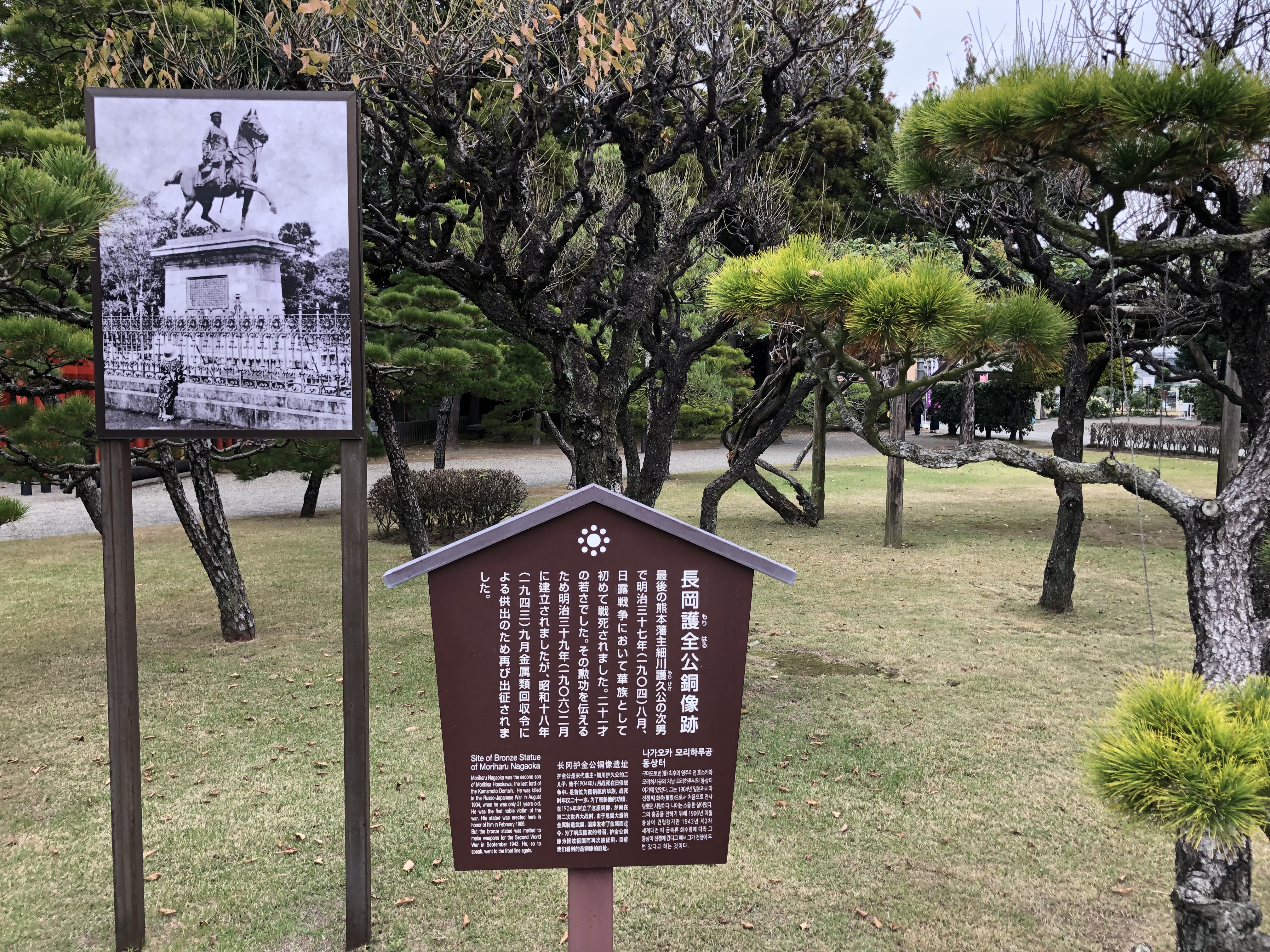
Next to the tree is the bronze statue of Moriharu Nagaoka, or at least that’s what’s supposed to be here. It seems that the enormous bronze statue has been stolen and replaced by an old photograph of the statue.

I leave the gardens and begin to walk in the direction of the Kumamoto Prefectural Government Office. I notice the pavements here are in somewhat disarray, and I keep tripping up on loose bricks. Some teenage Japanese guy approaches me and tells me he’s from Ibaraki Prefecture. He asks to take a photograph of me. I think he thinks I am somebody else.

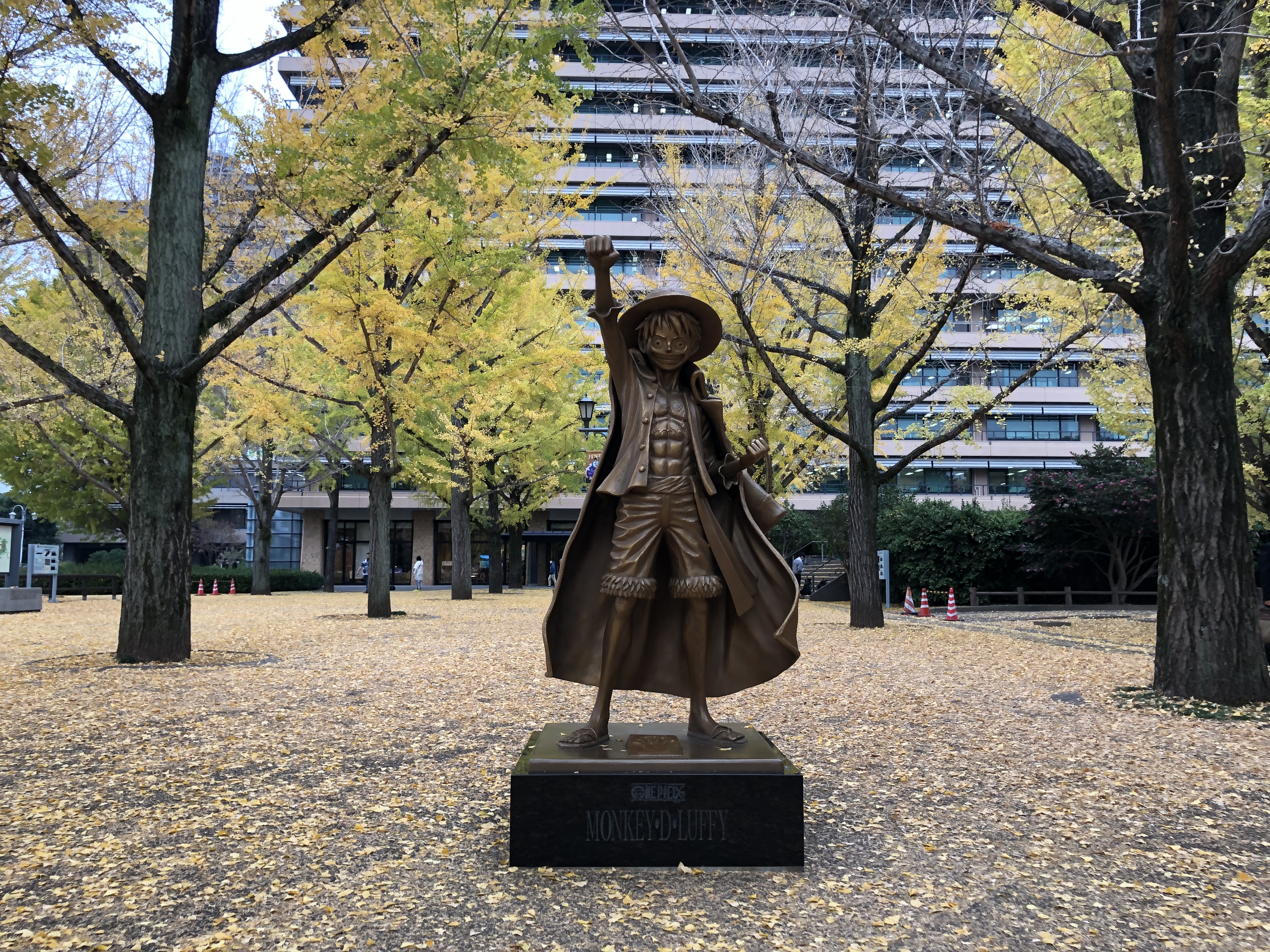
I pass police stations and car parks which are using Kumamon to advertise. I see a woman wearing a shirt that says, “Declare Bouncy Sanction,” whatever that means. I reach the grounds of the government office and wander straight over to where a crowd of people are having their photographs taken next to a statue of Monkey D. Luffy.

Luffy is the main character in One Piece, a pirate anime which first aired in 1999, and at the time of writing, there are 1,043 episodes. The show features Devil Fruits which when eaten give the characters superhuman powers. As I photograph the statue, a child approaches me and asks me how I am, “I’m very well thank you, and you?” is my reply.
“I’m happy good,” says the child.

I leave Luffy and start back in the direction of Kumamoto Station, getting a little lost in the process. My phone tells me that I have walked 40,000 steps today. My phone also tells me that I have just 3% battery remaining. After my phone dies I have no access to any maps, and it does, and I get further lost. Eventually, I do find the train station, and needless to say, I get back home in one piece.

The Lost Samurai

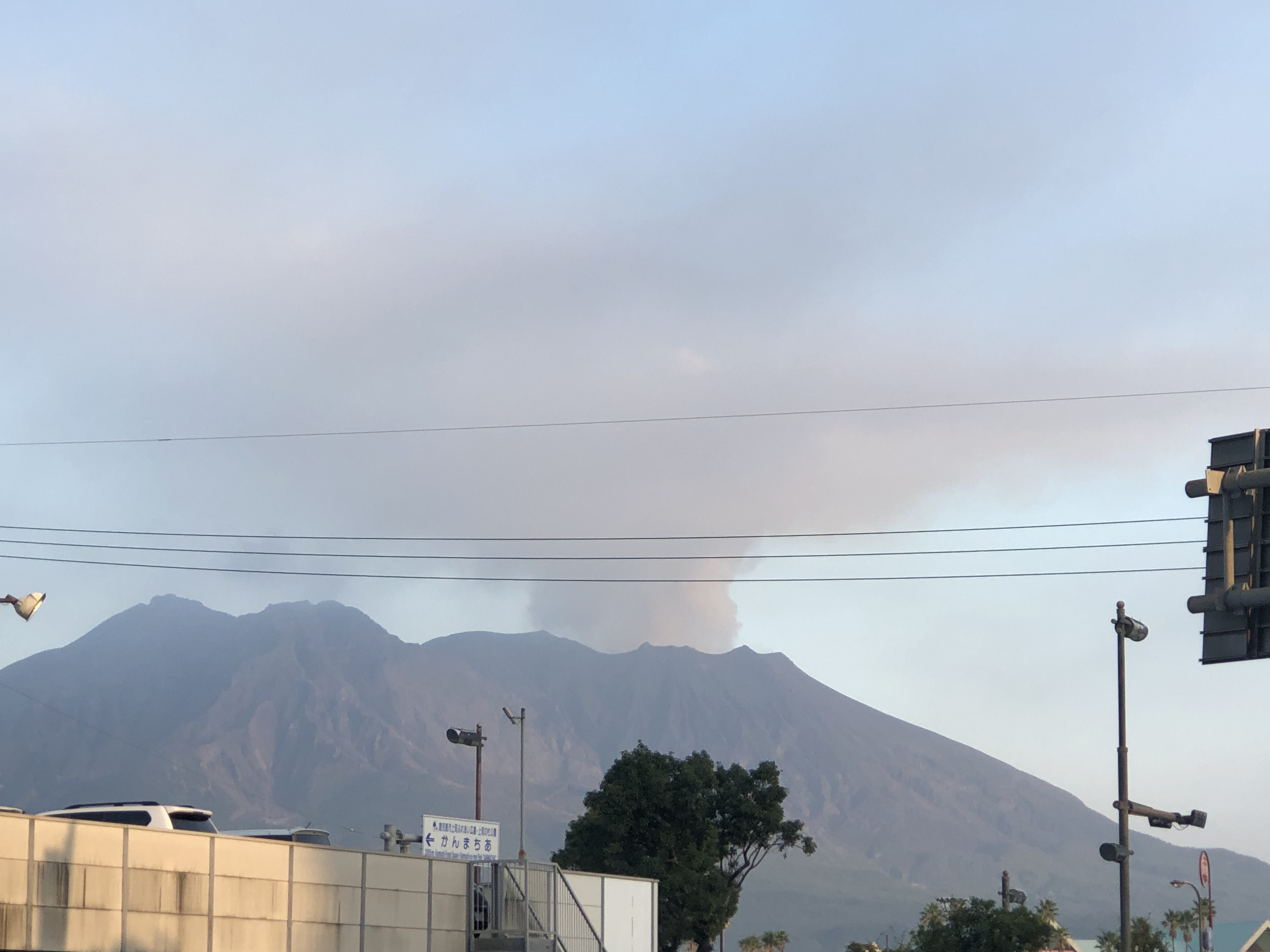
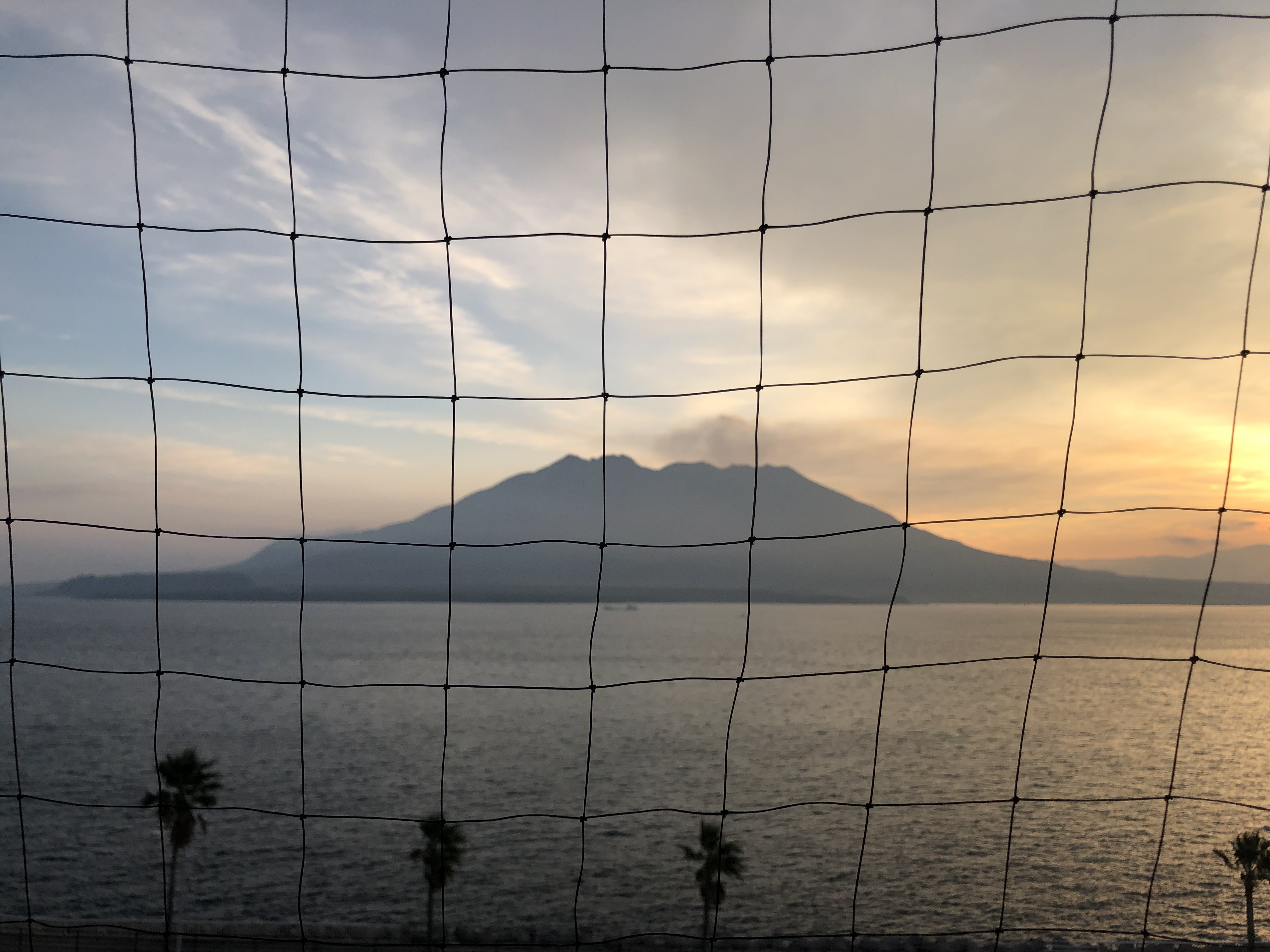
Many days fell away with nothing to show. Today, the first thing I notice as I step out of Kagoshima Station is the giant volcano that appears to be erupting in the distance. Kagoshima Prefecture is famous for Sakurajima, the most active volcano in Japan. It lurks ominously in the distance, alone, on its island surrounded by the water of Kagoshima Bay.

Sakurajima literally translates to mean Cherry Blossom Island, but don’t let the nice name fool you, this volcano is monstrous in size; standing at a colossal 1,117 metres above sea level, it can be seen from everywhere. Wherever I go in Kagoshima, the volcano seems to follow.

Today the Volcano Alert System is at level three. I am told to refrain from entering the danger zone and to pay attention to the future volcanic activity. The Volcano Alert System has five levels, they are:

5: Evacuate.
4: Evacuation of the elderly, et cætera.
3: Do not approach.
2: Do not approach the crater.
1: Caution advised around the crater.

I decide to try to get a better view, so head towards the Shiroyama Park Observation Deck. As I wander, I feel the streets here are much wider than I’m used to, the roads twice the size as usual. Tram lines criss and cross through the city streets whilst foghorns blast intermittently in the distance.

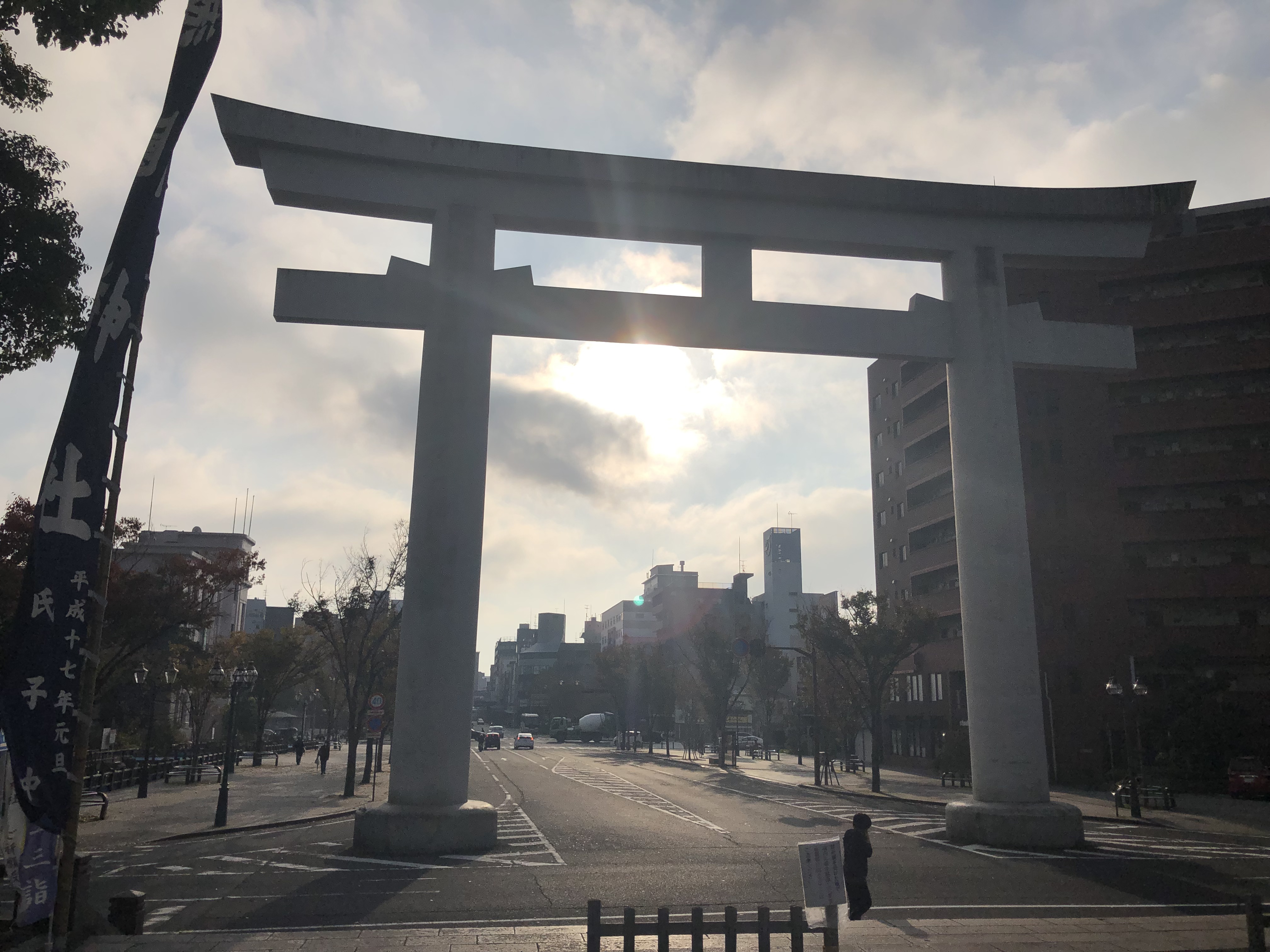
Before reaching the observation deck, I see a huge stone torii gate in the middle of one of the many large roads. I check my map to find it is simply named Big Torii. I’ve never seen such a gate before, usually torii gates are for people, it’s unusual to see traffic passing beneath.

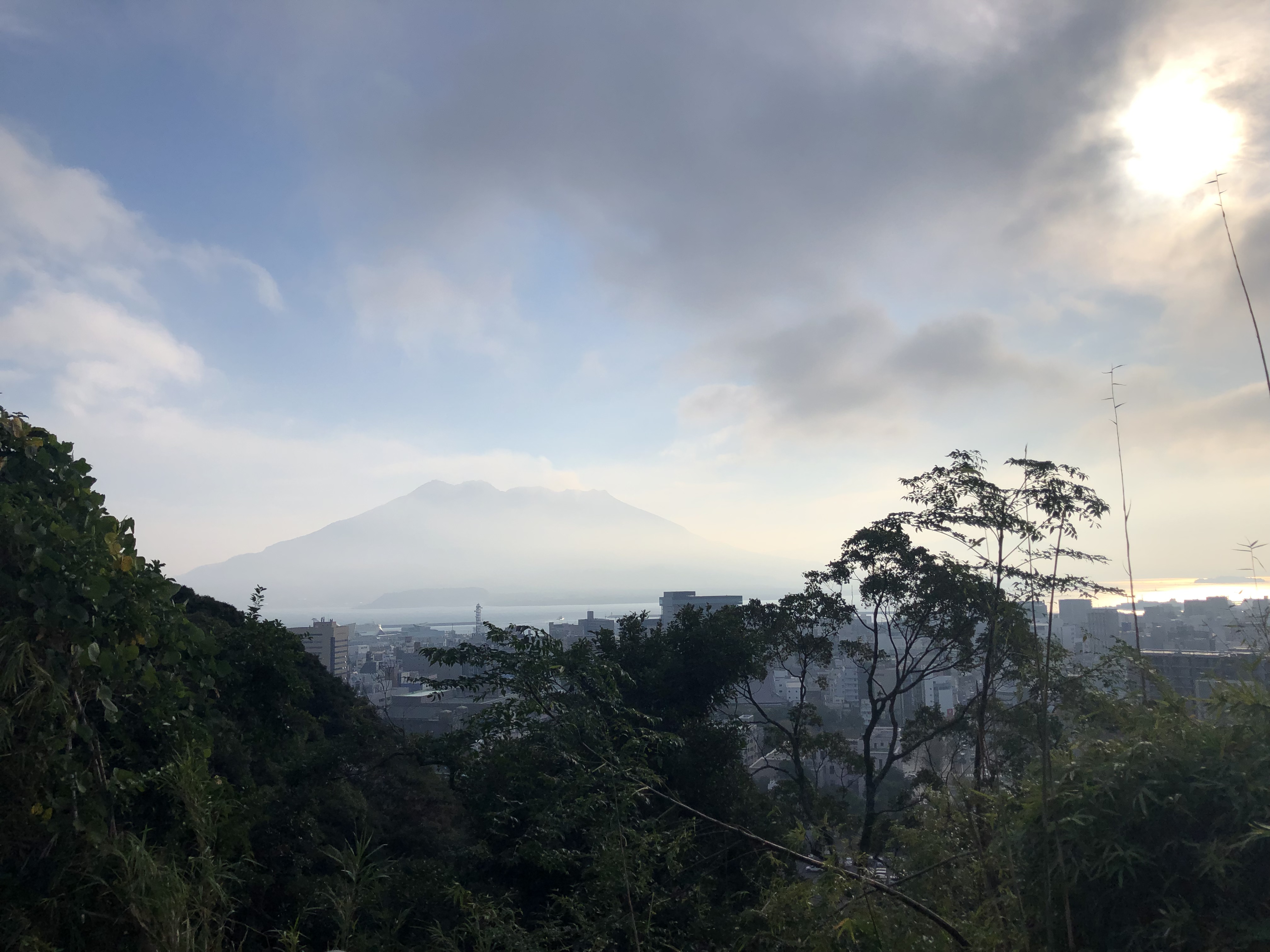
After walking under Big Torii, I start to climb up some steep stone steps that spiral and meander, before finding myself 107-metres higher, at the top of Castle Mountain. In the distance, grey clouds roll over the hills bringing darkness from above, and I realise that I have selected the worse possible day to photograph the volcano.

I traipse back down the stone steps and into Central Park. The park isn’t that large, but somehow I can’t seem to find the statue that I’m here to see. I do another lap of the park, look for English signs, walk the park a third time only to realise that the statue isn’t even in Central Park.

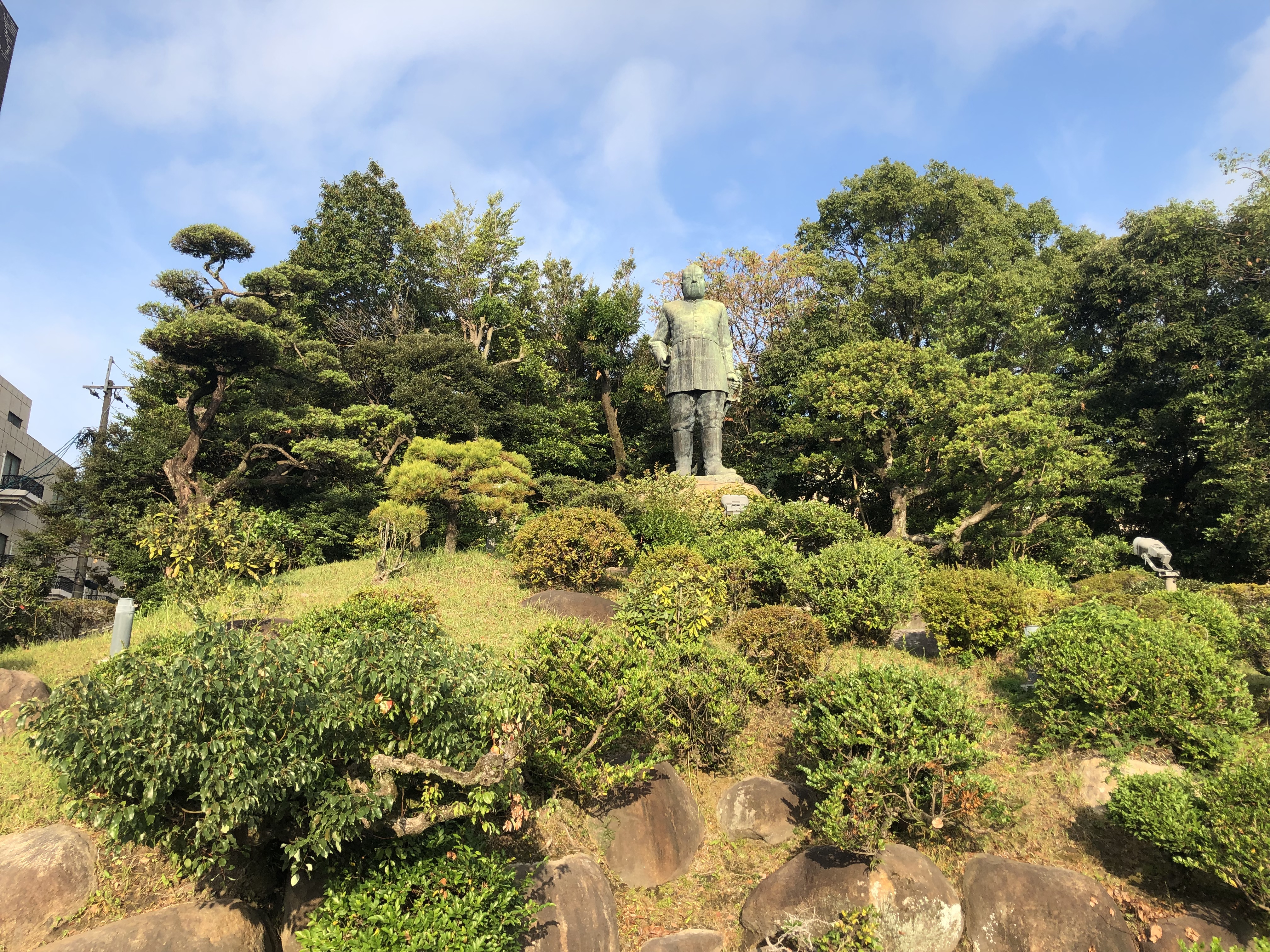
Eventually, I find the bronze statue of Saigo Takamori, betterwise known as The Last Samurai, and inspiration for the film of the same name. Saigo Takamori led the army of the Satsuma Rebellion against the Meiji government, and is one of the most influential samurai in Japanese history. The statue here is 8-metres high and took eight years to craft. There’s also a rather small statue of Hachiko the dog here, for no reason that I can ascertain.

Still desperate for a better view and a decent photograph of Sakurajima, I head on down to the Amami Okinawa Ferry Terminal, the source of the foghorns I heard earlier. I find a nearby hotel with a balcony that faces out toward the volcano. The hotel room is a little pricey, but it does offer a pour-it-yourself beer server in the lobby, and it’s totally free.

The view from my balcony is slightly spoilt by a net, but good enough.

After helping myself to some lovely free beer, I end the day by walking around Kagoshima; the ubiquitous Sakurajima volcano continues to prowl in every direction, its omnipresence ever threatening, until the darkness of the night engulfs its existence.

Journey to the Centre of the Buddha

It has gotten very cold as of late, but today offers rare blue skies and a warm winter sun. Today might be the last day hot enough to do anything practical before spring, so I decide to make the most of it with a day trip out of Tokyo. My destination is a little over two hours away by train: the city of Kamakura.

Outside Kamakura Station, I am approached by a poorly dressed Japanese man speaking in English with an American accent. He is banging on about Buddhism, or something. When I mention that I have things to do, he looks a little disappointed before wandering off to talk to some new people just off the train.

I wander through the city, its streets lined with souvenir shops, gift shops, and stores selling various mementos. At this point, I realise I haven’t taken a single photograph in Kamakura, so I decide to walk up to the first temple I see.

genjitemple[1]

Shu Genji Temple doesn’t exude much happiness. It was once the residence of Shijo Kingo, a renowned Nichiren Buddhist skilled in medicine. Following Nichiren’s death, Shijo Kingo attended the funeral but ultimately chose to end his own life to demonstrate his unwavering faith in the religion.

A little further from the temple, I spot a strange machine covered in stickers. The ‘Happy Capsule’ machine costs ¥100, and each capsule contains at least three prizes. I try to resist, but as if possessed by some demon from another world, I find that I have already inserted a coin.

nogarbage[1]

My capsule contains a small glass fish statue with fried eggs randomly painted on each side, a colourful ankle bracelet with a small relic in the shape of an ice cream, and a teddy bear with the word ‘Love’ written on it. I also receive a ‘Lucky Sticker,’ which I am free to add to all the other lucky stickers that litter the machine. Noting the sign for ‘No Garbage,’ I take another look at my happy prizes and stand for a moment, enjoying the irony.

Eventually, I arrive at the place I came here to visit, Kotoku-in Temple. It is home to a giant Buddha, the same Buddha featured in Rudyard Kipling’s poem ‘The Five Nations.

A tourist-show, a legend told,
A rusting bulk of bronze and gold,
So much, and scarce so much, ye hold,
The meaning of Kamakura?

kamabud[1]

I pay ¥200 to enter the grounds of the temple and stand for a while in awe. The Great Buddha of Kamakura was housed within a wooden temple three times. It was destroyed by strong winds twice but rebuilt on both occasions. Eventually, in 1498, it was destroyed for a third time by a tsunami and was never rebuilt. The Buddha survived and now sits outside in the cold of winter, patiently waiting for the seasons to change.

As I walk around the statue, I notice two windows located in its back. There is a sign in Japanese emphasising the importance of showing deep respect when walking around inside the Great Buddha. A man sits half asleep at a small booth, and a sign above displays a price of ¥20. For such a low price, I would be a fool not to enter. I squeeze my way into a small hole in Buddha’s side and take the steps up into his massive belly.

innerbuddha[1]

Inside the Great Buddha of Kamakura, the acoustics are fantastic. I speak softly to myself and find that my words are thrown around by the bronze interior, echoing off into infinity. However, a bit of graffiti inside slightly spoils the experience — a complete lack of reverence by some.

I exit the Buddha and leave the temple. On the way out, I spot a sign warning about a particular type of bird in the area that likes to steal food from tourists. I start heading back toward the train station, stopping off at a small food shop to enjoy a sweet potato croquette. All the while, I keep my eye out for the hungry birds. Unfortunately, the birds don’t materialise, which is a shame.

I decide to take a different route for variety, and eventually, I spot some steps that sweep up a mountain. Intrigued, I take a little detour to see where they might lead.

anothertemple[1]

I find myself standing in front of Amanawa Shinmei Shrine. The place is deserted, seemingly untouched for years, presenting a stark contrast to the other places I have seen in Kamakura. This shrine, founded in 710 AD, is the oldest Shinto shrine in the city and is dedicated to Amaterasu, the goddess of the sun and the universe.

The view from the shrine is stunning, offering a different perspective of the area. In the distance, I see mountains, old houses, and multiple temples and shrines. From the top of the steps, I can also glimpse the sea. As I am about to leave, I spot a small path carved into the side of the mountain above, and with nobody else around, I decide to investigate.

upthemountain[1]

As I climb, the path is relatively easy to follow, twisting around the mountain and becoming less obvious. I have to brush away cobwebs from my face as I follow the steep approach. With every step, I am careful not to lose my footing as the mud gets wetter and the path becomes steeper. After about five minutes of climbing, the overgrowth becomes too much, and I can’t continue. I stop and take a look around, taking in my surroundings, and realise that this was probably not a good idea.

I struggle to get back down, having to crawl a little to ease my way down from the path that has clearly not been used for years. I use my hands on the rocks as I work my way back to safety. I am slightly disappointed that I couldn’t find where it leads, perhaps to the sun goddess, or maybe just an escape route lost over time. There’s nothing for me to see, though, and eventually, I am back at the shrine, taking the steps back toward the main road.

I wander down deserted side streets that are full of old houses, some with massive gardens, others with disproportionately small ones.

mygarden[1]

Back at Kamakura Station, I get ready to endure another two hours sitting on trains. Day trips are fun but rather exhausting at the same time. It’s nice to escape, though, and see places that offer a difference. I think about climbing up that mountain path, feeling completely free for a short time—free from anything but my own eagerness to explore, or perhaps to escape altogether. I decide that my next day trip will be to a mountain of sorts, a place unlike those I have been discovering of late. Somewhere new and exciting, where I can rekindle my sense of adventure. A place flowing with natural beauty.

As I arrive back in Tokyo, a chill consumes the air. Above, thick clouds made of snow hover over the skyscrapers, lying in wait—almost ready to unleash their flakes of misery over the city.

Paint and Gunpowder

The four of us from last night absorb a new person into our group, a guy called Josh. We head out on foot toward Ueno Park. Today, the National Museum of Western Art is having a free admission day, and despite being in Japan, we consider it worth a look. We stroll inside and are asked to show our tickets. “Free admission day,” I tell the lady.
“You still need to get a ticket,” she informs me. We head out of the museum and to the ticket office. We ask for five tickets, and hand over no money before heading back inside and handing over the tickets to the lady. A rather trivial exercise.

museum[1]

The Museum of Western Art is the primary institution of its kind in Japan, emphasising paintings with a few sculptures thrown in for good measure. The museum is adorned with an abundance of macabre Baroque works, where death and torture seem to be popular themes. Amidst the horror, notable pieces include ‘The Last Supper’ painted by Marten de Vos, Vincent van Gogh’s ‘Roses’, and a rather disappointing collection of Claude Monet paintings. Not one to truly appreciate art, I find that Monet’s work looks terrible up close, especially ‘Water Lilies’, which, in my opinion, looks plain awful.

My favourite piece on display is Pablo Picasso’s ‘Couple’. Abstract expressionism has always been a preference of mine; I’ll take this over a bowl of fruit or a basket of flowers any day. Picasso painted this incredible piece at eighty-eight years old.

pablo[1]

We leave the museum and take a Yamanote Line train from Ueno to Ikebukuro. Outside the station, we need to head east. Josh turns out to be well-prepared, pulling out an actual compass and casually guiding us in the direction of east. This earns him the nickname ‘Compass Josh’ for the rest of the day, and he seems to take to the idea quite fondly.

The reason we are here is to visit a shop run by a company that has faced criticism for its practices, including accusations of contributing to infant mortality in underdeveloped countries due to its reluctance to spend extra profit on proper labelling for its baby milk formula. The shop sells a specific type of confectionery that is hugely popular in Japan. This two-fingered chocolate-covered wafer bar confection is available in many remarkable flavours, such as wasabi, strawberry cheesecake, and sakura.

While the others queue for their chocolate, I wander around outside and admire the street art.

ikart[1]

We head to a small coffee shop before making our way back to the train station. On the platform, two men are fighting. One guy stands up and walks away, his face dripping with blood, his eyes bruised. This is the first time I witness violence like this in Japan, and it comes as a bit of a shock.

I head home for a while to prepare for a performance this evening before meeting the others in Odaiba. Compass Josh’s partner, Jessica, has joined us, expanding our group to six. We explore the giant statue of Gundam before settling in the food court of Diver City, enjoying overpriced wine in undersized glasses. Outside Diver City, an extraordinary bus stop catches my eye, begging to be photographed.

extr[1]

Tonight in Odaiba, a special fireworks display is scheduled for 7 p.m. We wander around the area, with the evening darkness stolen by extravagant illuminations. There’s a feeling of forgotten Christmas lights here, and decorations that will likely remain year-round. Trees glisten, Tokyo Tower in the distance shines orange, and the Rainbow Bridge is bathed in a spectrum of light from red to violet.

We position ourselves on the balcony of the Decks building, a vast shopping mall offering a spectacular view of Tokyo Bay. At exactly seven o’clock, fireworks shoot into the sky, creating a dazzling display that lasts for ten minutes. Below us, boats are illuminated in various colours, their reflections shimmering on the water alongside the radiant Rainbow Bridge. Tokyo Tower continues to shine in the distance. The backdrop consists of a sea of lights from office buildings, adding to the immersive experience. In the foreground, the glow from the massive firework display warms the air, completing the enchanting scene.

odaibafireworks[1]

After the fireworks, we take the train back to Asakusa, passing by the Fuji TV building as it displays bright flashing text: ‘What a cool we are!’

Back in Asakusa, we part ways. I head to Cafe Byron Bay for a bonenkai, a ‘forget the year’ party widely celebrated here. The tap-dancing balloon artist, whom I first saw performing on the streets of Asakusa during my first week in Japan, is here to entertain. A belly dancer is also putting on a show. I perform with trumpet and guitar. Food is free and all-you-can-eat. Everyone gets very drunk. After the entertainment, we each give a speech about the year we’ve had and what we hope to achieve in 2015. My resolution and absolute aim are to publish a science-fiction novel.

After the end-of-year party, I head out with seven Japanese friends for a second night in a row of karaoke.