Flossed in Translation

I wake up early and resume my pilgrimage. My first stop is Jueiji Temple, which happens to be five minutes from my house. Inside the temple sits Hotei. He is often described as fat and happy. He certainly appears very fat and happy, as he is the god of abundance and good health. Awkwardly, I join a queue of people with my camera out. Yesterday, I didn’t take any photographs of the actual gods; I was more caught up in the stories of the temples.

Today, I wait patiently as people before me offer their prayers. They place coins in the gaping mouth of Hotei, though he certainly doesn’t need anything else to eat. One person even starts rubbing the statue’s body with his hand. Eventually, it’s my turn. I quickly snap a photograph before leisurely descending the stone steps to exit the temple.

pil21[1]

As I exit, a man chases me down the street. I stop, completely confused. He hands me a map of the pilgrimage trail. Brilliant, I think. No more confusing maps and getting lost. The only problem is that the map is written entirely in Japanese, and is therefore confusing and will most likely get me lost.

I head to my second stop, Shohoin Temple, also known as the Flying God Temple. I am here to meet the fourth god of seven, Ebisu. Ebisu is the god of fishers or merchants and is often depicted carrying a fish. In the temple, a sign says, “Ebisu is the god of candour, cheerfulness, and goog [sic] fortune.”

pil22[1]

Sitting beside the god are two statues of Arhat. These represent individuals who have undergone enough religious training to become worthy after attaining enlightenment. Arhat is often used as an honorific title for those blessed persons who have realised the ultimate truth. While the reason for these two statues sitting beside the sacred god of fishing isn’t explained, at least this temple features some English text.

I head over to Ryusen, to Bentenin Temple. This temple is difficult to find, located basically in a children’s play park and quite tiny. There is no activity here, no other pilgrims in sight. It’s as if this temple has either been missed off the route, or everyone is wandering around the side streets in search of this sacred spot. With no sign of a god anywhere, I snap a photograph that might be, but probably isn’t, the goddess Benzaiten; the goddess of knowledge, art, beauty, and music.

The goddess is usually depicted carrying a musical instrument, but this statue isn’t, which is the reason for my doubt.

pil23[1]

I head back to Asakusa. My pilgrimage is put on hold for another day, thanks to a trip to the dentist. I’ve now lost count of the number of times I’ve been to the dentist in Japan. It has become nothing more than a fortnightly inconvenience. Still, off I go, alone. As I sit in the waiting room at five to five, anticipating my half-past-four appointment, the wait is actually killing me.

An elderly woman enters, holding a wrapped present with a bow in tow. She hands it over to the receptionist, smiles, then bows. I find it unusual that someone would bring a present to the dentist. Next, a mother and daughter ask if they can ‘borrow’ one of the books for children. Again, a strange reason to make a visit to the dentist. Eventually, I am called, thirty minutes after my scheduled appointment time. Inside the ‘treatment room,’ the dentist holds up a gold bracelet that clearly belongs to a woman. “Luke-san, is this yours?” she asks, with genuine inquisition and lacking any sense of irony. What was supposed to be an amusing anecdote about dental floss has somehow descended into a gift-giving ceremony, a library, and a circus.

The dentist pulls out a ‘super sonic,’ as she calls it, and sprays water on my teeth. Next, she uses a scraping tool to clean, before finally flossing my teeth for me. Effectively, I have gone to the dentist to have my teeth brushed. Afterwards, the dentist gives me a packet of dental floss as a parting gift, wishes me a Happy New Year, and charges me just ¥740. Thank you, Japanese National Health Insurance.

I leave the dentist just as night begins to engulf the city. I head over to Senso-ji Temple. The crowds of people haven’t dispersed, and the New Year celebrations are still in full swing. For some reason, the first three days of the New Year are important days to visit temples and shrines, and because of this, queues of thousands are still waiting to pray for the first time this year. As I wander through the hordes of people, a man on stilts dressed as a giant sheep almost kicks me to the ground.

yearofram[1]

Still fatigued from seven days of intense sightseeing, I head home for another early night. Tomorrow, I will visit the final two gods of the pilgrimage, and finally, I can enjoy a much-needed break from exploring the city.

Lucky Number Seven Gods of Fortune

Today, I attempt to go on a pilgrimage. Seven different gods, seven different temples, and no idea where to start. I head into Asakusa for a traditional Japanese breakfast and find that a Japanese New Year’s ritual is taking place outside my favourite izakaya. “Happy Merry Christmas after year,” the owner says to me, flashing his trademark ten-yen smile.

The ritual is mochi making. Mochi is sticky rice that is boiled, and when it is hit with a wooden mallet, it becomes soft. These rice cakes end up more like dumplings and are consumed during January. Some sort of stew is cooking in a big pot beside the mochi, but I have no idea if it’s relevant to the ritual or not.

pil1[1]

After watching a man hit rice with a mallet for far too long, I decide to visit the first temple: Shingen-ji Temple in Iriya. This temple has two names; ‘Iriya no Kishibojin’ is the other name used, which just adds to my confusion. Inside the temple, I can hear the sound of monks chanting. Two young Japanese women dressed in kimonos pose for photographs. I wander to the temple, throw in some loose change, and pray.

The temple not only houses one of the seven gods but also Kishimojin, a goddess of children. Her story goes that she was once an evil goddess, snatching children and then eating them. One day, Gautama Buddha kidnapped the youngest son of this goddess, and it was only after experiencing the sorrow of losing a child that she became good. Now, she is worshipped as the guardian of childbirth and child-growing. However, she remains a criminal in my mind; all the children that she previously devoured have somehow been forgotten with her forgiveness.

pil2[1]

Next to the temple sits Fukurokuju, the god of happiness, wealth, and longevity—the first of the seven gods that I am here to visit on this pilgrimage.

My second stop is Eishinji Temple, which enshrines Daikokuten, another of the seven gods of fortune. Daikokuten is considered to bring the belief of commercial prosperity. At the entrance, children play with spinning tops and badminton rackets. This temple gives me the opportunity to get my fortune for ¥200, and with me currently on a roll of good fortune from these things, I decide to participate once again.

pil10[1]

The fortune I receive is huge. It contains three separate pieces of paper and one golden plastic frog.

“Average luck: Leading to the road of happiness will bless you if you have your own eyes open to the gods. Keeping the person in harm dear in my heart, will ensure that no harm is done, and the world will fit into the flame. With love, be aggressive. Take time to contemplate. The person you are waiting for will come, but will be very late. Don’t be impatient with your law suit. Contemplate. The lost article will be found and returned by someone with kindness. Be honest with money. If you are planning a trip, wait.”

pil7[1]

As for the little golden frog, it should be placed in my wallet to ensure that money always comes back. There is also a mention of rakes and ovals, but I can’t understand what this means. Additionally, the fortune tells of magical eggplants, but again, I have no idea. “This lucky charm grants wishes and brings happiness. Please keep it always in your purse.”

At the temple exit, I study the slightly confusing map and head to temple number three.

pil3[1]

Following the map, I end up at Onoterusaki Shrine. Although this shrine doesn’t house one of the seven lucky gods, I continue to explore it regardless. A monk on a balcony is hitting drums in a timely rhythm, and something about its calmness draws me inside. The shrine features a man-made imitation in the image of Mount Fuji.

Apparently, many Japanese people once believed that there was a god that lived inside the mountain; therefore, Mount Fuji became a place of worship for many religious groups. This particular Mount Fuji is called Fujizuka of Shitaya-Sakamoto and looks like a big pile of rocks. On July 1st every year, to celebrate the start of the climbing season of the actual Mount Fuji, this miniature mountain is open for the public to climb.

pil5[1]

Onoterusaki Shrine is also dedicated to Ono-no-Takamura, a scholar of Chinese classics in the early years of the Heian period.

Scattered around the shrine are these unusual white arrows. I discover that these arrows are known as hamaya. The name is derived from a once dangerously popular game for children involving archery and target practice. Nowadays, these arrows, which translate to mean ‘Demon-breaking arrows,’ are a popular means to dispel evil spirits at the beginning of the New Year.

pil4[1]

I leave the shrine and go in search of the third of the seven temples on the pilgrimage course. Temples with multiple names, maps that have no sense of scale, and a cold day of wandering around unfamiliar places. I end up in Uguisudani, an area that should contain one of the seven gods, but for me, the only things in and around the train station are love hotels.

I’ve been walking a lot this last week. Tired and slightly cold, I give up for the day. I head back to Minowa to rest my legs and tumble into a deep sleep.

Japanese New Year’s Eve

New Year’s Eve in Japan differs significantly from the celebrations and lively scenes I’m accustomed to in England. We kick off the evening at our favourite izakaya, where the owner, in his broken English, warmly greets us with, “Good morning this evening.” The atmosphere is festive, with people enjoying drinks and exchanging smiles all around. Among the options on the extensive Japanese menu is ‘Smile, ¥10, limited to ten per day.’ Fortunately, the stocks are plentiful, so I toss the owner a ten-yen coin in exchange for his wonderfully elaborate smile.

The television set above the bar is broadcasting the 65th annual Kohaku Uta Gassen.

NYtelevision[1]

Kohaku is a live talent battle between two teams of musical acts that have had a successful year in Japan. The white team consists of all male artists, while the red team is composed of all female artists. This exclusive, invitation-only event happens to be the most-watched show on NHK every year. Audience members cast their votes, and the only prize is pride for the winning team.

I was thoroughly enjoying a band of male vocalists singing, “La lalalala lalalala,” when out of nowhere, the owner of the izakaya switches channels to watch the latest episode of the popular pirate anime, One Piece. Food is then served to each of us in tiny bowls—traditional Japanese soba noodles, known as toshikoshi soba.

NYfood[1]

Soba noodles are notably thin and long, with the belief that their length symbolises a long life. It is also said that consuming these noodles helps ward off any lingering ghosts as the New Year arrives. The seasoning for the meal is served from a salt shaker crafted from a light bulb. While I’m unsure if this is part of the traditional way to eat Japanese soba, I find it quite appealing.

One Piece comes to an end, and the owner channel-hops, briefly settling on boxing before switching back to Kohaku. On the television, Idina Menzel graces the stage, singing ‘Let It Go.’ It’s quite rare for a non-native Japanese artist to be invited to perform at the event, but given the immense success of the movie Frozen in Japan, her appearance comes as no surprise. It’s at this moment that I’m hit with my first Tokyo Disneyland flashback.

We continue to enjoy our drinks, with people singing along to ‘Let It Go.’ Suddenly, the owner begins handing out gifts in small white envelopes.

NYsheep[1]

Next year marks the Chinese zodiac year of the Ram, or ‘sheep’ as my Japanese friend corrects me. I suppose interpretations vary across countries. The pendant I receive, if I’m completely honest, looks more like a goat. Regardless, I appreciate the gesture and the unexpected gift.

As midnight rapidly approaches, we finish our drinks and take a wander over to Senso-ji for Joyanokane. At the stroke of midnight, a priest will ring the bell 108 times, symbolising the 108 sins of Buddhism. Unfortunately for me, sarcasm is one of those sins. By merely staying and listening to the tolls of the bell, your body and mind are believed to be cleansed—an excellent way to start the year, if only we could get close enough to hear them.

nysenso[1]

It’s incredibly crowded here. People are queueing up to make their first prayer of the New Year. Others are here to shop at the many little food stores lining the route to the temple, while some are here to count down to the New Year. Our purpose is simpler—we are here to listen to the bells. Eventually, as the clock approaches midnight, we manage to get close enough to the temple, arriving at about two minutes to midnight.

The first bell chimes, and we cheer. Suddenly, as if a switch has been flicked, the plastic sheeting over the market stalls starts to shake. A ferocious wind appears out of nowhere, and the temperature drops to the lowest it has been since I arrived in Japan. It’s as if the gods are angry or trying to sleep, with the millions of people here disturbing their slumber.

It will probably take over two hours to queue and make our first prayer of the year, and the cold is too much to bear. We decide to postpone this ritual until tomorrow. Instead, we opt to get our fortunes for ¥100 each. Surprisingly, none of our group receives a bad fortune. I, personally, receive a ‘Good Fortune’ that says, ‘The linen robe turns into a green one.’ I’m not entirely sure what this means, but I presume it implies that I will turn into a kappa.

After receiving our fortunes, we go our separate ways. As I cycle home, the wind almost blows me off my bike.

Ticket to (almost) Ride

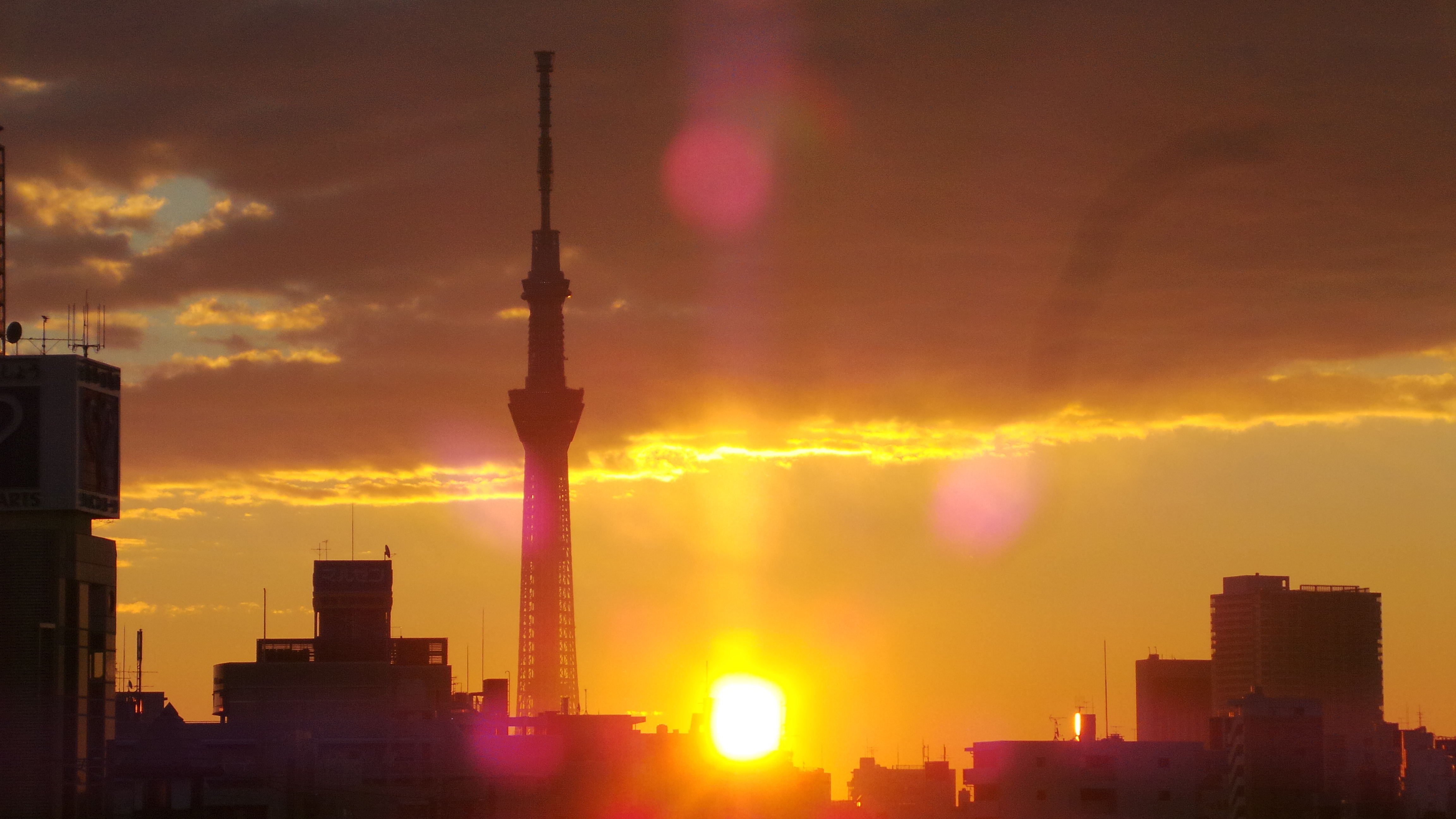
Today is Christmas Day. I wake up at 4 a.m. with a Christmas party hangover. It is too early to think, but I have things to do. Today, my friend Christine is arriving in Japan from England, and it is my job to act as a tour guide for the next few days. I walk to Nippori Station and arrive a little too early for my train. In order to kill time, I wander over the tracks to witness my second sunrise in Japan, the warm winter sun silhouetting Tokyo Skytree. My photograph is ruined by a smudge across my lens.

20141225_065945

Inside Nippori Station, it’s business as usual. Today might be Christmas, but for Japan, nothing changes. Salarymen dash to make their connections on the busy trains, Seven Eleven workers look exhausted from a heavy night shift, and ‘Let It Go’ blares from every speaker, as usual. It’s a normal business day here in Tokyo.

I take the Keisei Skyliner to Narita International Airport and wait. Eventually, my friend appears wearing a knitted Christmas jumper and a Santa hat. Despite seeing her in festive garb, it never really feels like Christmas. No trees and no snow; in fact, another clear warm day. There is no Christmas music in the airport either, just the constant drone of nonsensical announcements.

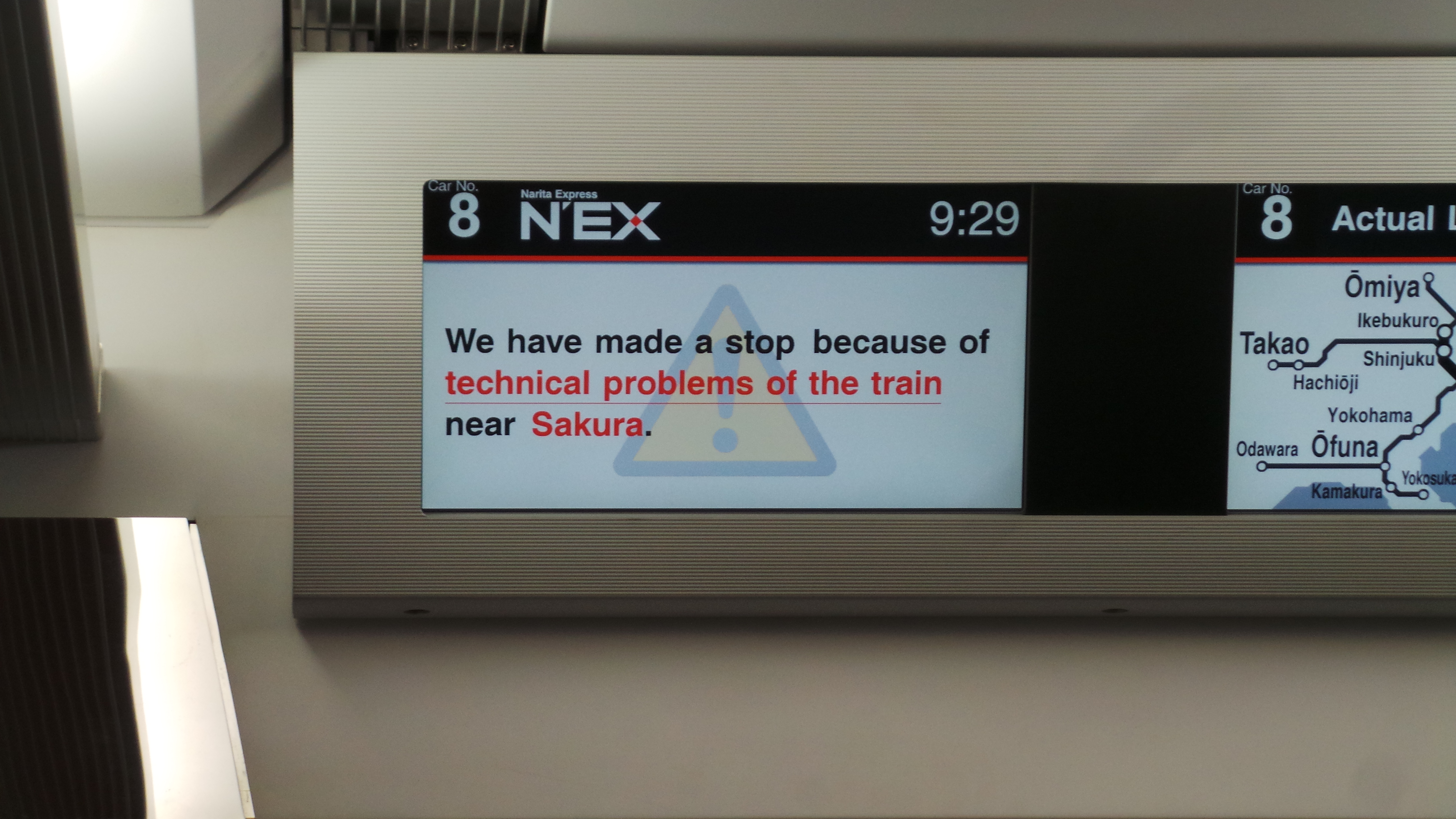
We take the Narita Express bound for Shinjuku Station. The Narita Express describes itself as ‘fast, convenient, and pleasant to ride,’ but never has a quotation been so far from the truth. On the train, Christine makes an offhand comment about whether things ever break in Japan. I tell her, ‘This is Japan,’ which translates to mean, ‘Things never break here.’ No less than five minutes later, our ‘pleasant to ride’ train crawls to a halt outside Sakura Station.

20141225_093039

We sit on the train for what seems like an hour before an announcement in Japanese tells us all to get off. A kind Japanese man sitting one row in front of us explains to us in English what is happening. We have to take a Sobu Line train from here to Chiba before continuing toward Shinjuku on local trains. For some unexplained reason, the Narita Express and the rapid line are out of action. Apparently, our ¥3390 tickets can be refunded in Shinjuku.

Not wishing to spend all day sitting on trains, we decide to get off close to Asakusa. We wander to Senso-ji Temple to get our fortune, something that I very much enjoy doing. Christine receives a ‘Bad Fortune’ and leaves it for the gods. We eat sushi at my favourite standing sushi restaurant before taking the train to Akihabara.

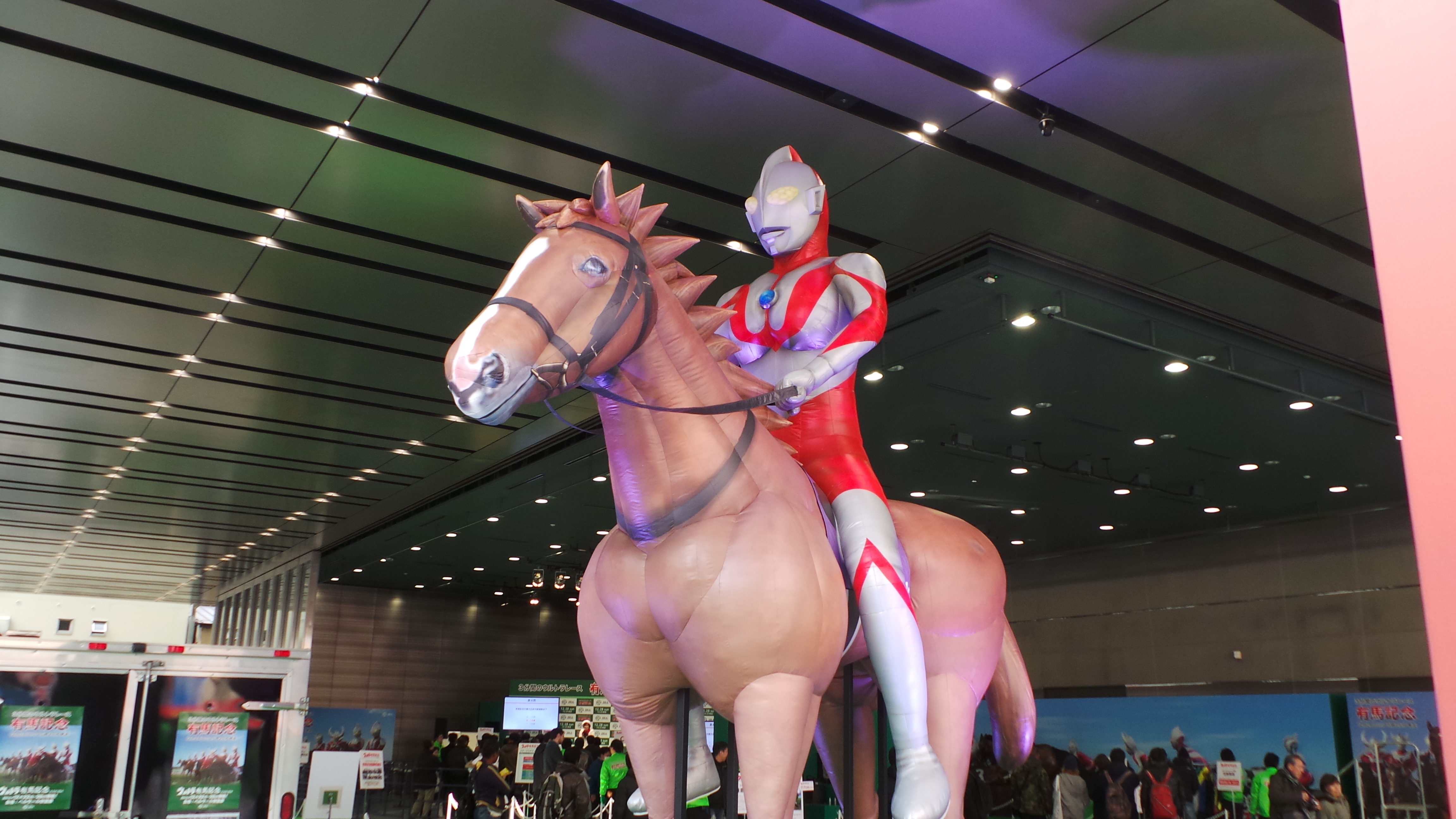
In Akihabara, for reasons that can’t be discerned, Ultraman is seen riding a horse.

20141225_133741

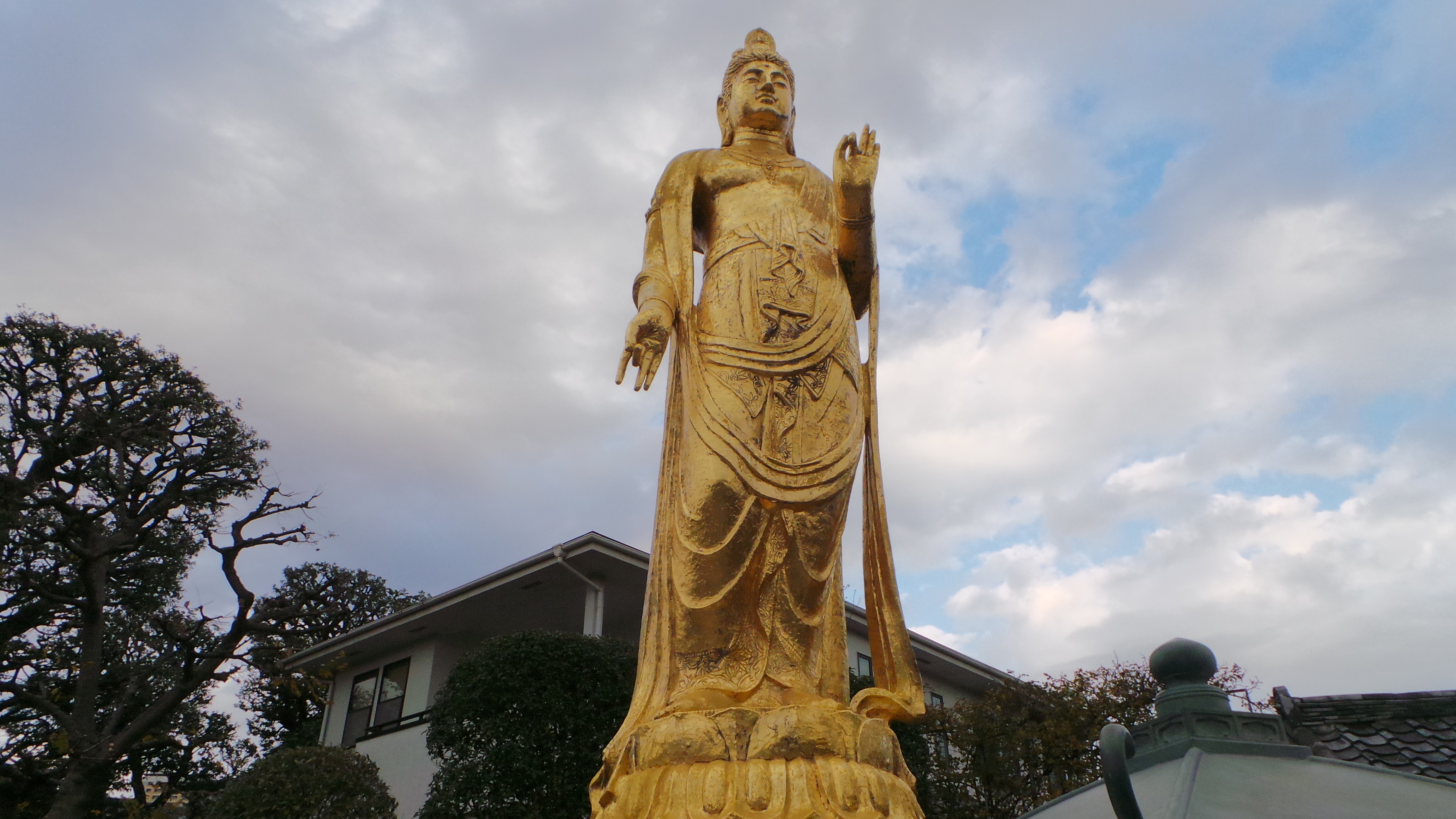
We hop on a Yamanote Line train and get off at a random station. Her choice is Nippori, my fourth visit to this station this week. We wander across the tracks and explore the many temples and shrines. Passing through Yanaka Ginza Street, we stop off at a small park. Tired and with feet hurting from too much walking, we take a breather at Zenshoan Temple. As we enter the temple grounds, in the distance stands a huge gold statue.

20141225_150326

The statue of Kannon is impressive, but what is potentially even more captivating is the Ghost Museum. Sadly, the museum featuring silk scroll paintings depicting ghosts and macabre ghost stories is only open during the summer months. There’s something about horror stories warming your blood, which is the reason for the seasonal opening hours.

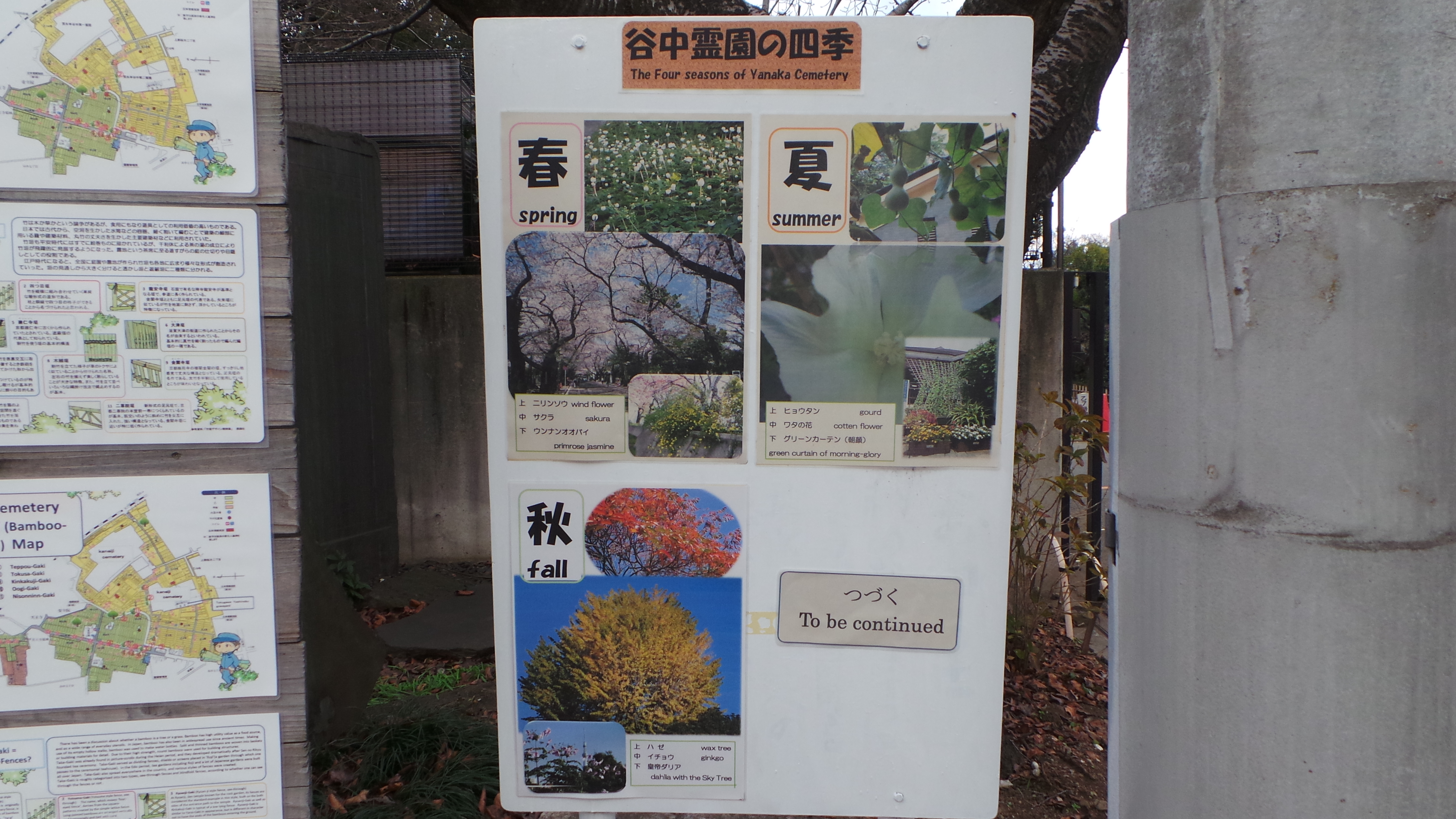
With all this talk of spirits, we take a wander through Yanaka Cemetery. I have visited here once before and found it incredibly peaceful, and do so now. There’s something about the perfect rows of decorated graves that is somewhat calming. Perhaps the quiet all around adds to this feeling. For some reason, the unfinished sign doesn’t display how winter should look here. The row of sakura trees and blossoming primrose jasmine in spring is a reason to once again walk among the dead next year.

20141225_151114

We head back to a hostel in Asakusa, the same one I had previously stayed at for eighty-two days. Tonight, the hostel is having a Christmas party, and Santa Claus will be arriving at half past eight by subway train. Exhausted from a long day and in need of my own bed, I decide to give the party a miss and head home.

Back in Minowa, I dine on Domino’s Pizza (four seasons) and a New York Cheesecake. I could post a photograph of a Japanese pizza from Domino’s, but it really isn’t any different from anywhere else. Instead, here are some instructions for Christmas decorations that I saw earlier today:

letsdecorate[1]

Merry Christmas.

Palace Under Fire

Today is His Imperial Majesty the Emperor’s 81st Birthday. To celebrate this momentous occasion, the people of Japan will enjoy a public holiday, taking a day off work. The only person not celebrating, it seems, is His Imperial Majesty the Emperor himself. Today, he will address the nation from the inner grounds of the Imperial Palace, a place that is only open to the public two days a year. Not one to pass up an opportunity to go inside the Imperial Palace walls, I head straight to Kanda Station directly after breakfast.

I enjoy a leisurely thirty-minute walk. The sky is clear, the sun is bright; it feels far too hot on this December day to resemble the apparent winter. His Imperial Majesty the Emperor himself couldn’t have ordered better weather for this special day, even if he tried. I walk to the Imperial Palace, stopping to admire some trees along the way. It seems that I go through phases of fascination, and, as you might be able to surmise, this month’s juncture is trees.

kandatrees[1]

The trees here were once used by the Meteorological Agency to help further their studies into phenological phenomena. These Yoshino Cherry and Japanese Maple trees served as specimens. The long-term observations from studying these trees helped solve problems regarding changes in weather conditions almost sixty years ago. With this data, the Meteorological Agency can accurately predict the days when cherry blossoms will flower. An important and worthwhile discovery.

When I finally arrive at the Imperial Palace, I find out that I have missed His Imperial Majesty the Emperor’s speech by a mere two hours; I will still be allowed inside, though, if I can find the correct entrance. I wander around the outer Imperial Palace walls. There is a large statue of Wake no Kiyomaro, a preacher of Buddhism and once a trusted advisor to the Emperor during the Nara period.

palacestatue[1]

Wake no Kiyomaro had his share of good and bad fortune. He was once exiled for years and forced to have the sinews of his legs cut out, rendering him immobile. Luckily, some stone boar statues magically came to life and healed his legs, and he was freed from exile. Eventually, he was reinstated as a trusted advisor to the Emperor. Nowadays, he is remembered by the grand title of ‘God of healing foot disease,’ and at this location outside the Imperial Palace, he has become a regular target for defecating birds.

I eventually find the entrance to the Imperial Palace grounds. Here, I get told off by a policeman for walking against the flow of people. One-way system, no signs. I head across the coned-off concrete and to a security checkpoint. After being thoroughly searched, I am clear to enter the inner grounds, free of charge. At the gate, I stand and watch a lifeless guard. He doesn’t blink for well over five minutes. I speculate that this man is actually an android, but his lack of animatronic function appears to counter my observation. I want to stay and watch, to see how long he can go without blinking, but a policeman kindly asks me to move along.

statueguard[1]

Inside the Imperial Palace grounds, there are more security guards than visitors. I wander past some overgrown trees and toward the Imperial Household Building. Outside, a small marquee has been erected. At the marquee, I am given the opportunity to write my name, nationality, and a nice message for His Imperial Majesty the Emperor. I write ‘Happy Birthday, His Imperial Majesty the Emperor.’ I take care to write it down neatly and deliberately. A sign hanging above tells me that my message of ‘Happy Birthday, His Imperial Majesty the Emperor,’ will be duly forwarded to its highest destination as an expression of my warm congratulations.

palacesigning[1]

After signing, I continue along the one-way system. Still no signs. The grass here is completely overgrown and is in desperate need of a gardener. The Japanese taxpayer covers the cost of outer garden maintenance, which boasts neatly trimmed grass cut on a daily basis. It feels like a waste of money to me. Inside, it is a very different story. Perhaps the tax money doesn’t quite make it into the ‘inner sanctum,’ or maybe His Imperial Majesty the Emperor is required to cut the grass here by himself. I am not sure, but regardless, the grass inside the Imperial Palace grounds is an overgrown shambles.

I pass an Obansho Great Guardhouse, one of three remaining, and the final checkpoint on the way to the Imperial Palace. This place would have had the highest-ranking samurai guardsmen stationed here. Ironically, it is at this point that the security guard and police presence seems to completely diminish. Further along the path, someone appears to have forgotten their ladder.

randomladder[1]

I walk idly along, somewhat unimpressed. I head up a slope before passing through the remains of Chujakumon Gate and into the public gardens. These gardens are somewhat more remarkable than the rest of the Imperial Palace grounds; the grass here is cut really short. Before me stands an orchard. His Imperial Majesty the Emperor personally planted three of these cultivars in 2008: the Sanbokan Grapefruit, a sour orange; the Tangor, a cross between a tangerine and an orange; and the Cherry Orange, a variety of Mandarin orange. The orchard was created on the site of the Castle of Edo based on His Imperial Majesty the Emperor’s idea that visitors would be able to enjoy the popular fruits of the Edo era.

lemontrees[1]

Forgetting about fruit and foliage for a moment, I decide to check out the mysterious Ishimuro Stone Cellar. Some people say this was an emergency storehouse to supply the inner section of the Imperial Palace. Some people say that this stone cellar housed an underground passage that once led directly into the Imperial Palace. Some people say that this cellar was a secret passage that led to hoards of treasure. I personally hope it was used as a secret passage, but perhaps I will never know. Despite the angle of the photograph, it is not possible to explore deeper inside the Ishimuro Stone Cellar, thanks to a fence blocking the entrance.

dungeon2[1]

My final stop is the Tenshuku Donjon Base, the highest-ever donjon built in Japan and a symbol of the Tokugawa Shogunate’s authority. Just nineteen years after it was built, in 1657, there was a conflagration known as the Great Fire of Meireki. The fire lasted three days, claimed over 100,000 lives, and destroyed this donjon. It was never constructed again.

The view from the ruined donjon is the old Edo Castle Honmaru Goten Palace, now just a large lawn full of people sleeping and enjoying the sunshine. Formerly, this area was lined with buildings. Presumably, these too were burnt down during the Great Fire of Meireki; a fire that is considered to be one of the worst disasters in Japanese history. A fire that left the old Edo city, now known as Tokyo, in complete ruin.

palacegarden[1]

The fire was said to be caused by a priest. According to legend, there was a cursed kimono that killed teenage girls, and the priest decided to burn it on that day in March 1657. It didn’t help that the buildings of that time were made from flammable materials such as wood, were built closely together, and had thin paper walls. The fire spread to all parts of Tokyo, leaving destruction and devastation in its wake.

From the ruined donjon, there is barely a trace left of the fire. All that remains is the site of an old castle now replaced by a neatly cut lawn, an orchard of lemon trees, and the overly developed city skyline looming in the distance.