Head of a Lion, Tail of a Dog

The sun is shining, which naturally makes me feel productive. I head over to Roppongi to visit the Tokyo Midtown Award 2014. The awards are in their 7th year, and the ceremony is a design and art competition sponsored by Tokyo Midtown. Its aim is to discover and support future designers and artists. Fourteen award-winning artworks and designs are on display, all competing for the grand prize: a trophy designed and produced by the famous Japanese sculptor Kimio Tsuchiya.

The audience here are given the opportunity to vote by pushing a button on a digital display board. The display unfairly shows the number of votes each piece of art has received. Currently winning is a piece from Saki Maeda, called, “Konkan.”

konkan[1]

“Konkan” is similar to the Japanese “inkan,” a name given to a personal seal commonly used in Japan in place of a signature. Inkan are akin to the emblems used in medieval England, stamped into wax to seal an envelope. This seemingly simple piece of art holds slightly more depth. My interpretation is that the two konkan represent the male (black) and female (red), lying together to symbolise the seal of marriage.

Among the other pieces are: Waami, a Japanese-patterned grill pan; Yoroikappa, an armored raincoat; Origami Tale, a fairy tale told using paper folding; Harmonaca, a box of harmonica-shaped sweets filled with red-bean paste; and Omikuji, a selection of Japanese fortune picks. The winner of the competition will be announced on Friday, November 7th.

My favourite piece is Toru Otsuka’s, Empty Freezer.

emptyfreezer[1]

The reason I vote for this piece is not just for the incredible design, but also for the fitting message that accompanies it:

“Buddhism teaches of impermanence, that there is a beginning and end to all things. As long as this world is impermanent. Buddhist statues will some day fade just as disposable cups do, and may not be much different. However, Buddhist statues and disposable goods are considered separate. That is why I would like to use the same carving techniques for Buddhist statues on disposable goods, indicating my questioning of existing values.”

freezergood[1]

After browsing all the pieces vying for the prize, I step back into the sunshine and make my way to the outdoor display area. Today, an exhibition called ‘Seating Forest’ is taking place. The setting is hardly a forest; instead, it’s a collection of diverse chairs, each carrying a unique theme or artistic edge.

There are seats that take the concept of ‘musical chairs’ a bit too literally, crafted from musical instruments; sitting down causes the seat to play music. Additionally, two chairs shaped like ears are placed on opposite sides of the forest. These ears are somehow connected, allowing communication between the individuals seated in them. However, the standout chair is a wooden structure featuring a seat on a pulley, with apples hanging from above. It allows me to hoist myself up into the sky while remaining seated.

chairsandchairs[1]

After Roppongi, I head over to Asakusa. Today, two of my friends are playing afternoon jazz music at a bar called Soultrane, named after the Coltrane album. The bar is a bit tricky to locate, but eventually, I find it, pay my ¥2000 ‘music charge,’ and take a seat. It’s tiny, with a drum kit in one corner and a grand piano in the other. Other instruments here include a double bass, a trumpet, two guitars, and a flute.

There are about ten people here, all flipping through sheet music books—a music collective and the closest thing to an open mic event I’ve found in Japan. As a song finishes, people applaud in appreciation, and then the owner/barman calls out names. If your name is called, you get up and play, even if you have no knowledge of the song. If he asks for the trumpet and you play the trumpet, you perform. After two hours of live spontaneous jazz, we all part ways.

I wander through Asakusa for a while, and head to where all the performing artists hang out. This afternoon, they are wrestling.

streetwrestling[1]

The four wrestlers are incredibly lively, each dressed as characters from popular television shows. Pikachu is seen taking a beating from a character resembling Goku from Dragon Ball Z. Meanwhile, a ninja stealthily moves about, brandishing ‘Kapow!’ signs in true Batman style at precisely the right moments. Adding to the chaos, a person dressed in pink manages to overpower everyone using their tail. The scene is a whirlwind of props and rapid costume changes.

Eventually, the wrestling finishes and is replaced by the spray paint space art performer, whom I’ve seen many times before. I decide to continue wandering around. As I stroll, I pass by five geishas adorned in full makeup. Soon after, the sound of drums catches my attention, prompting me to follow the noise until I arrive at Kokusai Street.

KokusaiStreet[1]

In the middle of the road, music fills the air. Today marks a festival celebrating music and dance from the Okinawa Islands. Okinawa, situated as the furthest southwest prefecture in Japan, lies directly south of Kyushu. With its tropical climate and frequent encounters with typhoons, Okinawa seems to be both an attractive and challenging place to live. Interestingly, Okinawans have a longer life expectancy than people from anywhere else in the world, attributed to their incredibly healthy diet.

There are about ten different acts from the islands, and the procession traverses the full length of the street, culminating on an outdoor stage situated on the second floor of a hotel. The music is fantastic, and the dancing is equally impressive. Some of the costumes or characters, however, are rather intimidating.

weirdcreatures[1]

Shisa, the official mascot of the island of Okinawa, embodies a fusion of a lion and a dog and is believed to ward off evil spirits. Three shisa are present today, each seemingly more intimidating than the last. Ironically, the only spirits here that appear malevolent are these lion-dog creatures themselves.

As I watch the well-choreographed dancing and listen to the music, I notice a sign proclaiming ‘Best International Authentic Town,’ while another heralds the event’s tenth year celebration. However, the only downside to the event is the absence of stalls vending local cuisine—those dishes known for their health benefits and longevity. I’ve been curious to try the exotic ‘dragon fruit’ of Okinawa, but alas, there are neither dragons nor fruits in sight.

Kokfest[1]

I stay at the festival until it ends, then head home to dream of lion dogs wrestling with giant Pokémon, all set to the music of ‘Polka Dots and Moonbeams’.

“But Sir, it’s Only a Model”

Today is the third and final day of a street performing arts festival in Asakusa. Outside, it’s a clear day and a wonderful 28°C. I spend the best part of the morning wandering between the many different stages. I see a magician, a group of jugglers, a yo-yo master, people dressed in Halloween costumes, and a guy who specialises in tricks using crystal balls. Every performer seems to draw a strong but silent crowd.

crystalballs[1]

At lunch, I head back to Koto, to Tokyo Big Sight. Today, the venue hosts The 54th All Japan Model and Hobby Show. Alongside this event, there are many other exhibitions at Tokyo Big Sight, including the Trend Fashion EXPO and a free show about female auto racing drivers. I head to West Hall Two where the entrance fee is ¥1000.

The event today is organised by the Japan Radio-Controlled Model Manufacturers Association and the Japan Plastic Model Manufacturers Association. Inside, there are almost ninety different stalls representing various branches of the hobby and model industry. Upon entering, I’m greeted by a display of scaled-down model warships.

iseenoships[1]

All the major model companies are present. Kyosho proudly claims to produce ‘The Finest Remote Control Models.’ Nippon Remote Control showcases their latest flying helicopters, while Tamiya demonstrates their new remote control car. Besides remote control products, the exhibition features model trains, warships, cars, toys, hobby crafts, painting supplies, and character figures.

A woman in cosplay is signing various publications, while other individuals in cosplay attire are attempting to attract visitors to their stalls; women pose for photographs and entice men to buy tanks. Thousands of items are on display, including models of famous historic sites in Japan. Among them is a to-scale model of Kaminarimon Gate at Senso-ji Temple, priced at ¥38,000. Additionally, various figurines featuring characters from famous Japanese anime make an appearance

attacktitan[1]

As I mentioned, there’s a substantial section dedicated to remote control flying machines. While some machines are more impressive than others, the skill level of the operators varies. I observed a guy attempting to elegantly guide a helicopter through a hoop, but instead, he spectacularly crashed it, causing one of the wings to snap off. This unfortunate incident promptly led to the closure of the exhibition. However, amidst these mishaps, some machines stand out for their superior performance. I watched another person skilfully manoeuvre a large drone vertically, achieving somewhat impressive speeds.

flyingmachines[1]

I visit a shooting range where individuals are aiming at targets with fake plastic guns. Several talks are ongoing throughout the venue. A woman delivers a speech on a large stage, captivating the attention of many eager attendees. However, as is customary in Japan, I notice the restriction against taking photographs of people on stages, a common practice here.

Bandai’s presence here is immense. A massive crowd gathers to watch a special viewing of a new episode of Gundam or something similar. They’ve set up a stall showcasing figurines aligned with the upcoming release of their new film, Space Battleship Yamato 2199. Additionally, serving as the representative for Star Wars in Japan, Bandai offers an extensive array of merchandise. A giant screen plays footage from one of the Star Wars movies, drawing people to photograph models of Darth Vader and the Millennium Falcon. It’s a bit overwhelming with the sheer volume of offerings.

starwars[1]

I decide to leave and head to the train station, taking the Yurikamome Line to Shinbashi before transferring to the Ginza Line. However, I get distracted and end up missing the Tawaramachi stop. Instead, I disembark one stop later at Asakusa Station, which happens to be the last stop.

I decide to stroll through Senso-ji on my way home while the sun is still shining. Amidst my walk, I come across a shrine I’ve never seen before—Hikan Inari Shrine. It’s notably small but carries a profound symbolism of recovery. What strikes me as unusual, though, is the presence of over three hundred small statues of foxes inside the shrine. I notice an important-looking sign in Japanese and decide to photograph it.

foxtemple[1]

Back at the hostel, I ask my friend Hiro to translate the sign. It reads, ‘Please don’t ring the bell at night, as our neighbours in the area are trying to sleep. Be careful not to wander around too much in the evening because you might be possessed by a fox.’ The concept of being possessed by a fox is quite intriguing. Apparently, there’s a traditional folktale in Japan about a condition called ‘Kitsunetsuki,’ which refers to a form of madness caused by fox possession.

I decide to explore this superstition further. I spend the evening wandering around the temples and shrines of Asakusa, until I turn into a fox.

A Tale of Sorrow and Sadness

I spend my morning shaking off a karaoke gin hangover, arguably the worst kind. At 1 p.m., Dagmar and I take the train to Ginza to meet our friend Aram. The plan is a visit to the Vanilla Gallery; the number one gallery in Tokyo for eroticism, fetishism, and sadism.

Despite having visited the Vanilla Gallery before, it remains difficult to locate. We get a little lost but eventually find it hidden away on an inconspicuous street. This month, the theme showcases artwork that tells the tale of time and sorrow—’An exhibit of illustrated stories and dolls pertaining to madness and sadness.’ The entry fee is a pleasing ¥500.

dertilgung[1]

The exhibition is called Der Tilgung. Dagmar tells me that this is German for ‘The Repayment.’ Nowhere else in Tokyo can you experience such a vortex of phenomenal imagination.

Room-A features a collection of artwork and imagery from MoriKaoru. I’m surprised to find that most of the paintings have sold out. The work focuses on desolate women surrounded by monsters depicted as men. There’s an uneasy emphasis on slavery and torture. One exhibit displays iron shackles laid to rest on a leather sofa. Another portrays a drawing of a young woman bound at the wrists, sitting in a cell surrounded by decapitated limbs, while a male figure with a menacing grin watches her through the bars.

Room-B is slightly less horrific but disturbing in other ways. Suna-mura Hiroaki is the artist. The display features half-naked corpses of women—dolls. A child lies still in a coffin, and two dolls hang from chains with beautiful flowers blossoming from their dead faces. A doll resembling a nurse has her chest cut open, held by wire, and inside reside many small, menacing demons. Trees grow from faces, and dolls scream in anguish. Some dolls are made from the skulls of unnamed animals. Despite the theme, the craftsmanship here is incredible. My favourite piece is a naked woman, half her body covered by flesh, the other completely skeletal; half her face a picture of harrowing decay.

vanilla5[1]

Most of the exhibits are for sale, with prices ranging from ¥50,000 to ¥300,000 per piece. Haunting music floods the gallery. Sadly, the Vanilla Gallery forbids photography, so my only photographs are from the entrance and the flyer. I’ll probably have nightmares for a week thanks to what I’ve seen here. We stay for maybe twenty minutes before heading to the station.

Back at the hostel, there’s yet another party. Tonight’s theme is a ‘Sake Fair.’ Here, we can witness the process of making Japanese sake, sample ‘free’ sake, and indulge in the many complimentary snacks available. A PowerPoint presentation is set up on a projector—classic. The concept behind the free sake is to promote a brewery tour scheduled for tomorrow. For tonight, there are five different bottles of sake for hostel guests to try.

sakefair[1]

Suginishiki Yamahai Junmai is my favourite; it takes twice as long to make as your regular sake and is full-bodied with plenty of flavour. Shosetsu Daiginjo is also very nice—light, mild, and clear, with a banana scent and a subtle hint of fruit. I don’t usually like sake, but the drinks on offer here are actually very nice, perhaps a bit more expensive than I’m used to.

I decide to sign up for the tour tomorrow. It will be interesting to learn about the process, and I’m pleased to find out that the tour takes place at a brewery at the base of Mount Hakone. The tour costs ¥8500, including transportation, and it’s a great opportunity for me to discover more about this traditional Japanese drink.

Pyrotechnics and Parade

I wake up at 5 a.m. to the sound of a drunk man in our dormitory room. He spends fifteen minutes trying to open his locker before giving up and leaving the room. It’s nights like these that I wish I were in a hotel. An hour later, the same guy who doesn’t know how to open a locker comes back and spends fifteen minutes trying to climb the ladder to his bed, which, of course, is the bed above mine.

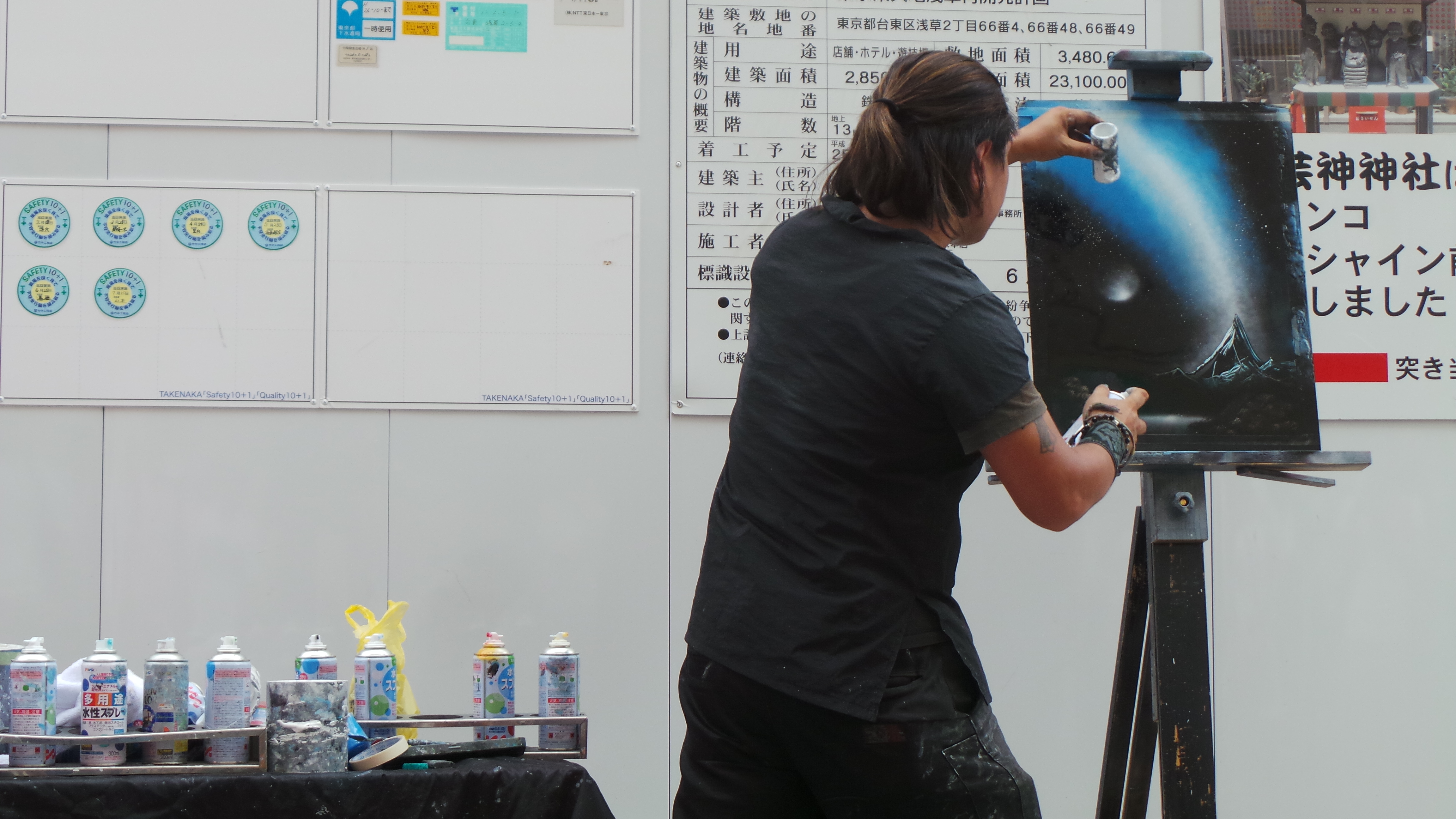
More noise at eight. Two people packing and re-packing their cases loudly, stamping around loudly. I give up on sleep and get up, tired and annoyed. I kill time, drink coffee, then go to a cafe at nine for more coffee. Despite drinking a lot of coffee, I still feel drained. The hot weather adds to my exhaustion. I lazily stroll through the mid-morning Asakusa streets. There is an artist on the street using spray paint to create science-fiction themed space art. He goes from a blank canvas to a beautiful planetscape in a matter of minutes. Incredible.

streetarts

I continue wandering. One guy raises his hand above his head as I walk past, “Woah! You are too tall!” he exclaims, much to my amusement. I head back to where the street performers gather and watch a yo-yo master skilfully Split the Atom.

Back at the hostel, I write up non-events, then kill time playing Baldur’s Gate on my camera. At 3 p.m., I still have no energy but need to get out of the hostel. I decide to head to Chofu. I take the Tokyo Metro Ginza Line to Shibuya. On the way, I hop off at Nihonbashi Station for a ¥300 smoothie (orange and ginger), then back on the next train three minutes later.

I cross Shibuya Crossing and take a shortcut through Yoyogi Park. My shortcut is somewhat obstructed by the Super Yosakoi dance festival. The entrance to Yoyogi Park’s event open space is blocked by hundreds of people dancing in the street.

yoyogistreetdance[1]

The dancing here is actually quite good, the music catchy and rhythmic; I much prefer it to the Samba music that was playing all day yesterday. The stage here is in use too, with people in traditional clothing waving flags and dancing to very similar music to that of the street dancers. I take the ten-minute walk to Harajuku Station, trying to get away from the crowds. My plan is a shortcut through the forests surrounding the peaceful Meiji Shrine.

My shortcut is somewhat obstructed by the crowds of people gathering at the entrance to the shrine. A stage has been erected here, and more people are dancing. The Super Yosakoi dance festival is everywhere. The music from the speakers here is so loud that I actually have to walk with my fingers in my ears. A one-way system through the grounds of Meiji Shrine is also in place.

Halfway through my route through the shrine grounds, a third stage is active and features more dancing and loud live music. There is a sign with a big red cross over a picture of a camera; I presume it to mean “No photography,” yet everyone seems to be taking photographs. Very odd. Perhaps I have been misinterpreting this sign all these years.

nophoto[1]

I leave Meiji Shrine and head toward Shinjuku Station. It’s another hot day, and I have another ten minutes of walking to endure in the heat. Somehow, as this realisation of the temperature comes to mind, a stranger in the street hands me a fan. At Shinjuku Station, I get a little lost but eventually find my way to the entrance to the Keio Line. A million other people have decided to take this train too. I take the second train that pulls in as there is no room on the first. As I am pushed into the carriage, I see that the crowd behind me spills up the steps and beyond. It appears the whole of Tokyo is following me to Chofu.

The Special Express train makes just one other stop between Shinjuku and Chofu, and I arrive promptly at 6 p.m. I follow the swarms of people to the Tamagawa River. Just as I arrive at the river, there is an explosion in the sky.

fireworks7[1]

Today is the annual Chofu City Fireworks Festival. It runs for an hour and includes 8,000 fireworks. I have a pretty decent spot and enjoy the spectacle. All along the river, little stores sell street food, and even Lawson Stores and Seven Eleven are getting in on the action. They have beers for sale outside floating in big ice buckets, and they have moved their hot food counters to the front of their stores.

The fireworks are impressive, although very stop and start. A lot of fireworks are launched at once, then nothing happens for twenty or so seconds, then lots of fireworks at once, et cætera. Every time a big explosion occurs, everyone around me says, “Sugoiii!” “Sugoi!” and “Oh, Sugoi!” This word means ‘amazing’ in English and seems to be the only word that the Japanese people here use to describe the fireworks. They certainly were amazing.

fireworks6[1]

At 19:11, I head back to the station; the fireworks will continue for another twenty minutes or so, but I really don’t like the idea of getting back on a packed train. It seems everyone else has had the same idea; once again, the station is packed. I am not proud of it, but when the doors finally open, I dash to grab a ‘Priority Seat.’ These seats are intended for pregnant, elderly, and disabled people. I feel somewhat less guilty when the other seven Priority Seats are taken by youths.

Back in Shinjuku, I change to the Marunuchi Line and take it as far as Ginza before switching to the Ginza Line. I arrive back in Asakusa around eight.

I meet with some friends, and we head to a nearby British pub run by actual British people. They brew their own beer here, play British music, and serve by the pint. I go for the porter; nice but expensive at ¥1000. The song ‘Empty at the End’ by my friend’s band The Electric Soft Parade comes on at some point in the evening; my mind ends up back in Brighton.

Siliconan the Ovarian

The previous three days drifted along to the tune of uneventfulness. I met old friends, went out for dinners, and had drinks. I didn’t even leave Asakusa once. Today, a sign in my hostel says, “Soba party today, come and enjoy Japanese noodles!” There is also a list of local artists that will be here to teach various arts and crafts. Free food and free crafts, excellent.

Outside, it is a blistering 36°C. I take the Tokyo Metro Ginza Line to Ginza. Ginza is a massive shopping district and fashion area. The kind of place you only drive through if you have an Aston Martin or a Bentley. If there is a Tokyo edition of the board game Monopoly, Ginza would be Mayfair. There is an array of well-dressed people, expensive fashion boutiques, and all the high-priced big brand stores.

My first stop in Ginza is the rather difficult-to-find Vanilla Gallery. Hidden away in a basement floor of a rather uninteresting building, it plays host to the Fourth Artificial Otome Expo: a Love Dolls exhibition. I shyly pay my ¥1000 entry fee to a young woman and shuffle through the gallery, trying to avoid eye contact with the other customers and the dolls. The dolls are made of silicone, are hauntingly childlike, and can be customised to the finest detail; every part of a doll can be ‘made to order’. Also in the exhibition is the mould that creates these dolls; a sign says, ‘Crystal craftsmanship to build the doll up to perfection.’

The Vanilla Gallery is small, and the exhibition is in just two little rooms. Orient Industry has been making these luxury Love Dolls for thirty-seven years, or so a video of the production process tells me. They also claim to make the most luxurious and expensive dolls; probably why they chose Ginza to showcase their creations. There is one doll that you can touch, ‘Feel her soft realistic skin,’ a sign says. I pass on the touching. I can only show the photograph of the sign, as there was a strict no-photography policy in place.

lovedolls[1]

I once saw a television interview with a Japanese man who said that he doesn’t want his wife to know about his collection of Love Dolls, so he rents a second apartment just for his dolls. I stay for no longer than five minutes. The life-size, realistic-looking dolls scare me. Their stillness makes me think of the dead.

Next in Ginza, I head to the nearby ‘Hello Kitty Toy Park.’ Here, there are so many toys, games, keyrings, plates, umbrellas—everything you can imagine featuring Hello Kitty. Five floors of toys, two floors of restaurants, a theatre, and a small theme park. I have never seen so many Hello Kitty items in one place. I don’t know which is more embarrassing, going to a Love Doll exhibition or entering a Hello Kitty store. Inside the store, I see a policeman on his break, inspecting the Hello Kitty toys.

kittytwo[1]

Next, I head in the direction of the Police Museum. On the way, I see a huge Yamaha store and decide to play on some very expensive-looking pianos for a while. I also spot the Pachinko Museum. A sign outside says, ‘We can teach you the basics about pachinko.’ It is adults only, but free. I head inside to find that they have forgotten the museum aspect. It’s just a regular pachinko parlour. ‘More enjoy more happy,’ a sign outside tells me as I leave.

The Police Museum doesn’t seem to exist. The building that houses it is under heavy construction and gated off. A shame, I was looking forward to doing something normal today. I see a sign for the nearby Kyobashi Station; lucky for me, I know this station is on the Ginza Line, so I take the train back to Asakusa.

Back at the hostel, I watch the news. A company called Shin-shin Foods has decided to stop its one-hundred-year-long pickle production and has converted its headquarters into a capsule hotel. I learn about a process called muon tomography, cosmic rays that detect radiation. Twenty-nine cats have mysteriously been found dead in Ota Ward; police think it was poison. The usual nonsense. I do some writing before heading out for a Shiatsu massage.

messageboard[1]

The place I go to was recommended to me by the owner of Cafe Byron Bay and is owned by her friend. When I enter the building, the woman at reception looks shocked to see me. I don’t think the place gets too many overseas visitors. I mention that I know her friend, and the tension in the room instantly fades away. After my thirty-minute massage, the tension in my shoulders also fades away. The man who performed the massage offers me a fifty percent discount, just ¥1500. I actually don’t think this is fair to him; the massage was good. I compromise and tell him to keep the ¥500 change, which he does. So much for not tipping in Japan. He thanks me and gives me a points card; I am nine more massages away from a free one-hour session.

Back at the hostel, the soba party is just starting. Soba are Japanese noodles made from buckwheat flour. This is actually my favourite type of noodle. There are stalls selling badges made from Instagram photographs. You can send them six of your photographs, and they’ll make them into high-quality badges or magnets. There is also a store where you can rent a kimono or a yukata. The word kimono inventively translates as ‘thing to wear’.

soba[1]

There is, of course, plenty of free food. Plates piled high with ice-cold soba noodles. Tiny plastic bowls are filled with sauce, and a selection of toppings is available. I eat my noodles with spring onion and seaweed. Delicious. There is also free rice wine to drink. When all the free sake has been consumed, I head to the hostel bar for more free drinks. The night crawls along. I eat soba noodles in the lounge and get considerably less sober at the bar. The night ends, and I crawl to my room.