Bring Me the Head of Kubikiri Jizo

Today, I’m sitting at the bar of a small cafe having breakfast when a man named Yoshio notices I’m not Japanese and strikes up a conversation while I chomp on my vegetarian Eggs Benedict. “I just got back from America,” he tells me, “I got back yesterday.” His English is pretty good, and I stay for a second cup of coffee, chatting with him for about thirty minutes before he has to leave. After he departs, the cafe owner shares Yoshio’s full name with me. A quick Google search reveals his Wikipedia page, and I discover that the man I had breakfast with is a famous Japanese comedian.

After coffee, I head out to meet Luis, the Chilean guy I met during the World Cup. He is back in Asakusa for the final leg of his trip, so we arrange to meet up for 1 p.m. We take the Ginza Line to Akasaka-mitsuke Station. Akasaka is known for being quite a posh area, so we wanted to get a feel for what a rich neighbourhood looks like. No different from anywhere else, it turns out.

From Akasaka, we walk to Roppongi and head for Tokyo Midtown. Here, there is a giant 1:7 scale statue of Godzilla.

godzilla[1]

After Godzilla, Luis and I head back to Asakusa and eat at my favourite Indian restaurant. Luis has only ever had curry before one other time in his life, madness. After food, we head our separate ways.

Whilst I was exploring accommodation options for October, it was suggested to me by a 71-year-old Japanese man that I try the area known as San’ya; apparently, the apartments there are relatively cheap. San’ya is still in Taito Ward, and a forty-five minute walk from Asakusa. I head in the vague directions I am given and discover that San’ya no longer exists. All signs mentioning the word San’ya no longer exist. Every mention of the area has been removed, like a Japanese history book; all traces have been erased from memory.

The only sign that has any mention of a San’ya past is the sign for Namidabashi. The sign literally translates as ‘Tears Bridge’ and was where people came to say goodbye to loved ones before they were taken to be killed at the Kozukappara execution grounds, hence the tears. These days, the bridge has been buried under the concrete of an intersection, the execution ground painted over by a bus station.

busgrounds[1]

All that really remains, other than human remains, is Enmeiji Temple. It was this statue of Kubikiri Jizo, the decapitation Buddha, who watched over the nearby execution grounds. For those who were executed, the last image they would have seen is the Buddha. Its name literally translates to ‘neck cutting Buddha’. An estimated two hundred thousand prisoners were killed here. Ironically, during the March 2011 Tohoku earthquake, the Buddha was damaged and its head broke off. A sign details the step-by-step process of how the head was repaired.

There is also a sign here that says, ‘Nam-Myoho-Renge-Kyo,’ the all-too-familiar chant of the Nichiren Buddhist. Gravestones without names make up the backdrop.

kubikirijizo[1]

The main street here translates as ‘Bone Street’. It was on this street that the decapitated heads of the executed were put on display. The executions stopped in 1873, and after that point, the area suffered further misery. Somehow, San’ya became Japan’s biggest leather-producing area. The problem with leather is that it comes from cows, and cows in Buddhism are not to be used for leather production; this being a Buddhist country doesn’t help matters. The people here became complete outcasts, and leather production work was considered the lowest of careers. A certain stigma became attached to the already stigmatic San’ya area, and it fell into decline. It was around this time that the name San’ya was abolished. These days, the shops are all boarded up, the streets are empty, and the dead stay dead.

Today, if you live in the old San’ya area, you are still looked upon as different. You are judged for living here. The accommodation is cheap; however, I wouldn’t like to stay here. The people aren’t liked, the energy is wrong, and then there are the souls of murdered cows and headless criminals. I leave the macabre of San’ya and head to the somewhat less chilling ‘Flying God Temple’.

flyinggod[1]

The Legend of Tobi-Fudo comes from the Shobo-in Temple. It was first built in 1530. “Once upon a time, the chief priest of this temple went to the Omine Mountain in Nara Prefecture to pursue his learning; he took the principal image of Buddha with him to the mountain from his temple, but the principal image flew back to this place in Edo within one night and gave diving favours to the people.” I am not sure what ‘diving favours’ are, but this is what it said at the temple entrance. I think it is supposed to say divine.

In recent years, people visit the temple to pray for safety in air travel, praying their plane doesn’t crash. I suppose ‘diving’ is probably the wrong word to be using when talking about air accidents. There is also a sign saying a festival takes place in October on the temple grounds. I add it to my calendar and leave.
Pyrotechnics and Parade

I wake up at 5 a.m. to the sound of a drunk man in our dormitory room. He spends fifteen minutes trying to open his locker before giving up and leaving the room. It’s nights like these that I wish I were in a hotel. An hour later, the same guy who doesn’t know how to open a locker comes back and spends fifteen minutes trying to climb the ladder to his bed, which, of course, is the bed above mine.

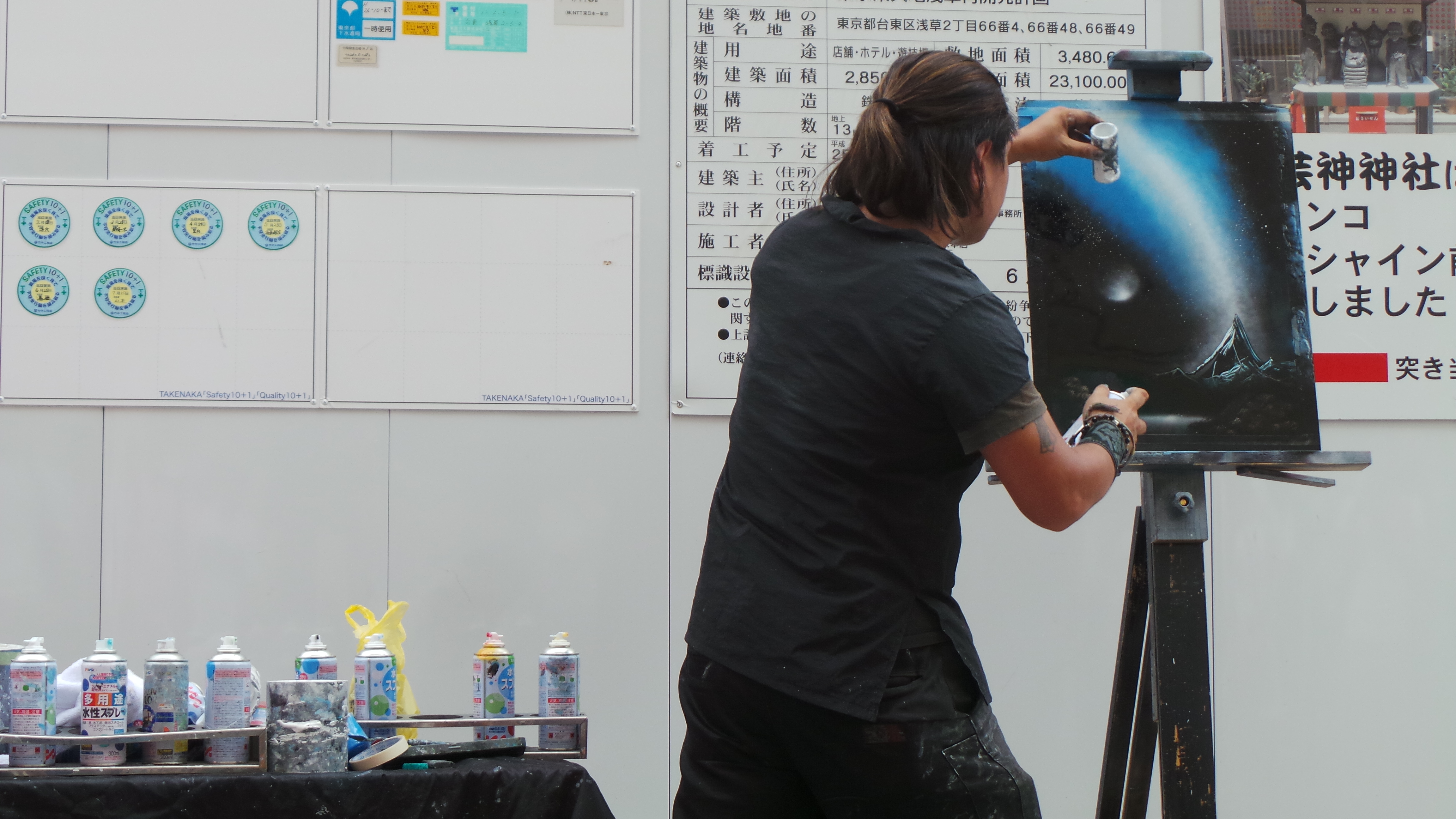
More noise at eight. Two people packing and re-packing their cases loudly, stamping around loudly. I give up on sleep and get up, tired and annoyed. I kill time, drink coffee, then go to a cafe at nine for more coffee. Despite drinking a lot of coffee, I still feel drained. The hot weather adds to my exhaustion. I lazily stroll through the mid-morning Asakusa streets. There is an artist on the street using spray paint to create science-fiction themed space art. He goes from a blank canvas to a beautiful planetscape in a matter of minutes. Incredible.

streetarts

I continue wandering. One guy raises his hand above his head as I walk past, “Woah! You are too tall!” he exclaims, much to my amusement. I head back to where the street performers gather and watch a yo-yo master skilfully Split the Atom.

Back at the hostel, I write up non-events, then kill time playing Baldur’s Gate on my camera. At 3 p.m., I still have no energy but need to get out of the hostel. I decide to head to Chofu. I take the Tokyo Metro Ginza Line to Shibuya. On the way, I hop off at Nihonbashi Station for a ¥300 smoothie (orange and ginger), then back on the next train three minutes later.

I cross Shibuya Crossing and take a shortcut through Yoyogi Park. My shortcut is somewhat obstructed by the Super Yosakoi dance festival. The entrance to Yoyogi Park’s event open space is blocked by hundreds of people dancing in the street.

yoyogistreetdance[1]

The dancing here is actually quite good, the music catchy and rhythmic; I much prefer it to the Samba music that was playing all day yesterday. The stage here is in use too, with people in traditional clothing waving flags and dancing to very similar music to that of the street dancers. I take the ten-minute walk to Harajuku Station, trying to get away from the crowds. My plan is a shortcut through the forests surrounding the peaceful Meiji Shrine.

My shortcut is somewhat obstructed by the crowds of people gathering at the entrance to the shrine. A stage has been erected here, and more people are dancing. The Super Yosakoi dance festival is everywhere. The music from the speakers here is so loud that I actually have to walk with my fingers in my ears. A one-way system through the grounds of Meiji Shrine is also in place.

Halfway through my route through the shrine grounds, a third stage is active and features more dancing and loud live music. There is a sign with a big red cross over a picture of a camera; I presume it to mean “No photography,” yet everyone seems to be taking photographs. Very odd. Perhaps I have been misinterpreting this sign all these years.

nophoto[1]

I leave Meiji Shrine and head toward Shinjuku Station. It’s another hot day, and I have another ten minutes of walking to endure in the heat. Somehow, as this realisation of the temperature comes to mind, a stranger in the street hands me a fan. At Shinjuku Station, I get a little lost but eventually find my way to the entrance to the Keio Line. A million other people have decided to take this train too. I take the second train that pulls in as there is no room on the first. As I am pushed into the carriage, I see that the crowd behind me spills up the steps and beyond. It appears the whole of Tokyo is following me to Chofu.

The Special Express train makes just one other stop between Shinjuku and Chofu, and I arrive promptly at 6 p.m. I follow the swarms of people to the Tamagawa River. Just as I arrive at the river, there is an explosion in the sky.

fireworks7[1]

Today is the annual Chofu City Fireworks Festival. It runs for an hour and includes 8,000 fireworks. I have a pretty decent spot and enjoy the spectacle. All along the river, little stores sell street food, and even Lawson Stores and Seven Eleven are getting in on the action. They have beers for sale outside floating in big ice buckets, and they have moved their hot food counters to the front of their stores.

The fireworks are impressive, although very stop and start. A lot of fireworks are launched at once, then nothing happens for twenty or so seconds, then lots of fireworks at once, et cætera. Every time a big explosion occurs, everyone around me says, “Sugoiii!” “Sugoi!” and “Oh, Sugoi!” This word means ‘amazing’ in English and seems to be the only word that the Japanese people here use to describe the fireworks. They certainly were amazing.

fireworks6[1]

At 19:11, I head back to the station; the fireworks will continue for another twenty minutes or so, but I really don’t like the idea of getting back on a packed train. It seems everyone else has had the same idea; once again, the station is packed. I am not proud of it, but when the doors finally open, I dash to grab a ‘Priority Seat.’ These seats are intended for pregnant, elderly, and disabled people. I feel somewhat less guilty when the other seven Priority Seats are taken by youths.

Back in Shinjuku, I change to the Marunuchi Line and take it as far as Ginza before switching to the Ginza Line. I arrive back in Asakusa around eight.

I meet with some friends, and we head to a nearby British pub run by actual British people. They brew their own beer here, play British music, and serve by the pint. I go for the porter; nice but expensive at ¥1000. The song ‘Empty at the End’ by my friend’s band The Electric Soft Parade comes on at some point in the evening; my mind ends up back in Brighton.

Dance, Dance, Ambulance

It is humid today, a cool 31°C with patches of rain, the perfect weather for dancing in the street. I head over to Tawaramachi Station for a train to Shibuya. From Shibuya Station, I head to Yoyogi Park, stopping off at the Tobacco and Salt Museum. The sign in the window reassures me that the museum will relocate to Sumida in spring 2015. It closed almost a year ago. I begin to wonder why it takes almost a full two years to move the contents of a museum.

I continue my walk, taking a detour through a ‘Shopping road that is nice to people’ before eventually arriving at Yoyogi Park. This weekend, there is a festival held at the Yoyogi Park event open space, the ‘Battle of the Udon.’

udonfest[1]

There are nine different television stations here. There are nineteen different udon stands, each selling their own local variety of udon noodles. Stalls also sell various non-noodle-based drinks and snacks. The best noodles from all over Japan have come here to compete in the nation’s biggest food competition. Every bowl of noodles is charged at a flat rate of ¥500. When you order food at the Battle of the Udon, you are given a vote card with the name of the stall. On the final day of the event, the votes are tallied up, and the best udon in Tokyo is crowned.

The noise here is deafening; every store has a banner, mascot, and a guy with a megaphone shouting at me to visit their store. Some of the mascots are better than others. I really like stall number 18’s mascot from Nagoya; they are promoting their Kishimen-style udon noodles.

a18udon[1]

I go to stall number 19 from Saitama Prefecture, offering Shoji-style udon noodles. As I approach the store, the guy at the counter shouts, “Welcome!” in English and literally welcomes me with open arms. When I arrive, he reaches out his hand to shake mine. He looks genuinely pleased that I chose his store; most likely, he is proud of the food he makes. “Udon!” I exclaim, my smile matched by his.

After food, I head back to Asakusa. I exit Tawaramachi Station to the sound of tourism and the sight of umbrellas. The rain has started now, but the show will go on. Today is the 33rd Asakusa Samba Carnival, and half a million people are expected to attend. The streets are packed on every side, and the roads are closed to vehicles. The carnival is just about to start.

streetslined[1]

This festival first began in 1981 when the mayor of Taito Ward invited the winning team of the Brazilian Rio Carnival to perform on the streets of Asakusa. Each of the teams has its own theme, but in effect, they compete to be crowned the winner of a dancing contest. The parade starts behind Senso-ji temple, where a display of the floats is free to inspect, and conveniently finishes close to Tawaramachi Station.

The teams vary in style. There is a ‘Puzzles & Dragons’ float, loads of marching bands, women dancing Samba dressed in traditional Brazilian garb. Some teams even have a comedy aspect, like women with fish on their heads or dancing clowns. For the rest of the afternoon, every inch of Asakusa is alive with the sound of drums and loud music.

sambaclown[1]

At 5 p.m., I decide to eat some food from Seven Eleven before heading to Cafe Byron Bay to drink. Instead, the night takes a somewhat unexpected turn, and one of my friends from the cafe is in need of medical treatment. An ambulance is called, and we wait an age.

The owner of the cafe, our friend, and I sit in a parked ambulance for ten minutes. Here, her symptoms are explained, and the usual questions are answered. I think that this procedure could have been done during the journey to the hospital, but then again, I don’t have any medical training, so what do I know? Eventually, we are on the move. Something I have observed in the past is that ambulances in Japan move seemingly without any haste or purpose. They wait at traffic lights with sirens blazing. They move with absolutely no urgency.

ambulance[1]

We arrive at a small hospital in Ueno. Our friend is placed into the Emergency Room, and we wait outside. Sitting in the hospital, an overwhelming sense of exhaustion washes over me. The humming clock reads 20:20, but it’s boring, like the walls; once white, now stained yellow. We ask if there is any news on our friend, but we are politely told that they don’t know anything. Hospitals have a way of draining energy from people; sitting here any longer might just kill me. We decide to go for a walk.

We head to an Indian restaurant and eat some excellent food. I suggest to the cafe owner that she should serve similar food and rename her shop to Cafe Byron Bombay. Despite worrying about our friend in the hospital, we make the most of the situation and try to enjoy ourselves as much as we can. In the end, I don’t have such a terrible time.

After four hours, our friend is allowed to leave and is going to be alright; good news. We hop on the train at the nearby Ueno Station and head back to Tawaramachi Station before going our separate ways.

Siliconan the Ovarian

The previous three days drifted along to the tune of uneventfulness. I met old friends, went out for dinners, and had drinks. I didn’t even leave Asakusa once. Today, a sign in my hostel says, “Soba party today, come and enjoy Japanese noodles!” There is also a list of local artists that will be here to teach various arts and crafts. Free food and free crafts, excellent.

Outside, it is a blistering 36°C. I take the Tokyo Metro Ginza Line to Ginza. Ginza is a massive shopping district and fashion area. The kind of place you only drive through if you have an Aston Martin or a Bentley. If there is a Tokyo edition of the board game Monopoly, Ginza would be Mayfair. There is an array of well-dressed people, expensive fashion boutiques, and all the high-priced big brand stores.

My first stop in Ginza is the rather difficult-to-find Vanilla Gallery. Hidden away in a basement floor of a rather uninteresting building, it plays host to the Fourth Artificial Otome Expo: a Love Dolls exhibition. I shyly pay my ¥1000 entry fee to a young woman and shuffle through the gallery, trying to avoid eye contact with the other customers and the dolls. The dolls are made of silicone, are hauntingly childlike, and can be customised to the finest detail; every part of a doll can be ‘made to order’. Also in the exhibition is the mould that creates these dolls; a sign says, ‘Crystal craftsmanship to build the doll up to perfection.’

The Vanilla Gallery is small, and the exhibition is in just two little rooms. Orient Industry has been making these luxury Love Dolls for thirty-seven years, or so a video of the production process tells me. They also claim to make the most luxurious and expensive dolls; probably why they chose Ginza to showcase their creations. There is one doll that you can touch, ‘Feel her soft realistic skin,’ a sign says. I pass on the touching. I can only show the photograph of the sign, as there was a strict no-photography policy in place.

lovedolls[1]

I once saw a television interview with a Japanese man who said that he doesn’t want his wife to know about his collection of Love Dolls, so he rents a second apartment just for his dolls. I stay for no longer than five minutes. The life-size, realistic-looking dolls scare me. Their stillness makes me think of the dead.

Next in Ginza, I head to the nearby ‘Hello Kitty Toy Park.’ Here, there are so many toys, games, keyrings, plates, umbrellas—everything you can imagine featuring Hello Kitty. Five floors of toys, two floors of restaurants, a theatre, and a small theme park. I have never seen so many Hello Kitty items in one place. I don’t know which is more embarrassing, going to a Love Doll exhibition or entering a Hello Kitty store. Inside the store, I see a policeman on his break, inspecting the Hello Kitty toys.

kittytwo[1]

Next, I head in the direction of the Police Museum. On the way, I see a huge Yamaha store and decide to play on some very expensive-looking pianos for a while. I also spot the Pachinko Museum. A sign outside says, ‘We can teach you the basics about pachinko.’ It is adults only, but free. I head inside to find that they have forgotten the museum aspect. It’s just a regular pachinko parlour. ‘More enjoy more happy,’ a sign outside tells me as I leave.

The Police Museum doesn’t seem to exist. The building that houses it is under heavy construction and gated off. A shame, I was looking forward to doing something normal today. I see a sign for the nearby Kyobashi Station; lucky for me, I know this station is on the Ginza Line, so I take the train back to Asakusa.

Back at the hostel, I watch the news. A company called Shin-shin Foods has decided to stop its one-hundred-year-long pickle production and has converted its headquarters into a capsule hotel. I learn about a process called muon tomography, cosmic rays that detect radiation. Twenty-nine cats have mysteriously been found dead in Ota Ward; police think it was poison. The usual nonsense. I do some writing before heading out for a Shiatsu massage.

messageboard[1]

The place I go to was recommended to me by the owner of Cafe Byron Bay and is owned by her friend. When I enter the building, the woman at reception looks shocked to see me. I don’t think the place gets too many overseas visitors. I mention that I know her friend, and the tension in the room instantly fades away. After my thirty-minute massage, the tension in my shoulders also fades away. The man who performed the massage offers me a fifty percent discount, just ¥1500. I actually don’t think this is fair to him; the massage was good. I compromise and tell him to keep the ¥500 change, which he does. So much for not tipping in Japan. He thanks me and gives me a points card; I am nine more massages away from a free one-hour session.

Back at the hostel, the soba party is just starting. Soba are Japanese noodles made from buckwheat flour. This is actually my favourite type of noodle. There are stalls selling badges made from Instagram photographs. You can send them six of your photographs, and they’ll make them into high-quality badges or magnets. There is also a store where you can rent a kimono or a yukata. The word kimono inventively translates as ‘thing to wear’.

soba[1]

There is, of course, plenty of free food. Plates piled high with ice-cold soba noodles. Tiny plastic bowls are filled with sauce, and a selection of toppings is available. I eat my noodles with spring onion and seaweed. Delicious. There is also free rice wine to drink. When all the free sake has been consumed, I head to the hostel bar for more free drinks. The night crawls along. I eat soba noodles in the lounge and get considerably less sober at the bar. The night ends, and I crawl to my room.

Dog Day, Afternoon

Saturday 

For the past three days, the Obon festival has been taking place in Japan. This 500-year-old Buddhist festival emphasises honouring the deceased. Today marks the final day of Obon, coinciding with the Asakusa Summer Night Festival. The event originated in 1946, shortly after the end of World War II, serving as a way for people to bid farewell to those who perished. As I arrive before the opening ceremony, the bridge is already overflowing with tourists.

skytreebridge[1]

The Japanese name for this event is Toro Nagashi, which translates literally to ‘flow of lanterns’. Here, you can purchase a small paper lantern for ¥1500. Each lantern symbolises the soul of a deceased relative. Visitors have the opportunity to write a message on the lantern, queue up, and then release it into the water. I find the entire process quite abstruse.

As the lanterns float down the Sumida River, carrying the souls of the departed to the other world, a certain solemnity lingers in the air.

lanternsontheriver[1]

After the festival, the atmosphere becomes somewhat lighter. I meet up with Robin, a German I befriended in Kyoto, who happens to be staying in Asakusa. We decide to unwind over drinks and perhaps get a bit less sober. We head to Nui and indulge until just after ten, then make our way to a Family Mart to play a few rounds of the Konbini Hop drinking game.

Outside our third convenience store, we come across a poster featuring numerous Japanese individuals with sunflowers encircling their heads. Despite our attempts to decipher its meaning, we’re left utterly baffled. It remains an enigma, leaving us without a single clue.

flowers[1]

We head to a Japanese bar nestled behind Senso-ji. This area houses around ten small bars, each with only two to three bar stools. I’ve long desired to experience a drink in one of these hidden spots since my visit in June, yet I never found the courage to venture in alone. Describing the way to this area would probably confound you; it’s remarkably concealed, and my directions are truly abysmal.

We settle in a small bar called Tom². This bar, with only four bar stools, feels quite spacious compared to the others nearby. ‘I Was Made for Lovin’ You’ by Kiss fills the air from the speakers. Two Japanese men occupy two stools, and we take the remaining two. The bartender seems a bit tipsy. We order a Suntory whisky highball and a beer for ¥500 each, and enjoy complimentary peanuts.

Then a dog appears.

inu[1]

The dog, incredibly friendly, joins us and settles in. We discover that Tsutomo, the owner, resides above the bar. We linger for some time—I manage to outlast Robin in drinks, and eventually, he departs. I remain for two more. The two Japanese gentlemen present speak minimal English, and the dog, unsurprisingly, doesn’t contribute much to the conversation. So, I sit there, mostly in silence, sipping my drink and exchanging glances with the dog. An atypical end to the evening.

Sunday

I rent a ¥300 bicycle for the day and cycle thirty minutes to Nihonbashi, making a stop to see my friend Daisuke along the way. It’s a shame to find out he no longer works at the hostel where I’m staying. Today, Nihonbashi hosts the annual Fukagawa Hachiman Matsuri festival. It’s considered one of the three major Shinto festivals in Tokyo and is likely the largest.

The festival is celebrated in its entirety once every three years, and today happens to be that day. With one hundred and twenty portable shrines, three hundred thousand participants, and half a million spectators, it’s definitely not an ideal day for cycling.

shrinesandshrines[1]

Amidst the crowds, people throw buckets of water over those carrying the shrines, a ritual to cool them down, earning the festival its nickname, the ‘Water Fight Festival’. It’s undoubtedly challenging to bear these enormous shrines in such sweltering heat, particularly under today’s scorching summer sky. I opt to step away from the bustling crowds and take a stroll through Nihonbashi. While I visit the renowned Nihonbashi Bridge, it fails to captivate me. I decide to return to Asakusa in search of some food.

I head to my favorite Japanese restaurant, Mizuguchi. I indulge in breaded salmon and salmon teriyaki, served with a side of greens, potato salad, pickles, and rice. Absolutely delicious. The total comes to ¥1810, including a Suntory whisky highball.

As I leave the restaurant I hear applause. It turns out there is a street performer just outside. Never a dull moment in Asakusa on a Sunday.

coneman[1]

The street performer does a balancing act whilst juggling a traffic cone between two sticks. He has drawn in a huge crowd. He is also a comedian. Throughout his routine he speaks intermittently on a microphone, telling jokes in Japanese, everyone laughs. When he is finished he cheekily places three bowler hats on the floor, upturned for tips. I give him ¥1000. He was really good.

Back at my hostel, The Strokes are playing from the speakers. ‘Is This It?’ I write for a while before heading back out to meet fellow Englishman, Richard. We meet at 8 p.m. and drink until 4 a.m. A typical end to the evening.