Gion with the Finned

Today is my last day in Kyoto. Tomorrow I will go to Osaka for three days, before heading off to Nagoya. I still have one temple I want to see, a temple with a difference. I head through the arcade, the same French song is playing that I’ve heard about four other times this week. I know the song but can’t recall the name. There is a pachinko parlour with a picture of Rowan Atkinson on the advertising board. There is also a strange mascot wandering around the arcade, promoting a festival here this evening.

I start by walking through a district called Gion. Gion is the most famous place in Japan for spotting geisha, although here they use the local term ‘Geiko,’ which translates to mean a ‘person of the arts.’ Gion is filled with numerous traditional old streets lined with even older houses, alongside a mix of theatres and other traditional entertainment.

old_style_houses[1]

I head up the mountainside to my last Kyoto temple, Otowa-san Kiyomizu-dera, a UNESCO World Heritage Site and one of the seventeen Historical Monuments of Ancient Kyoto. There are some very interesting things to do here. One of them is walking from one sacred stone to the other with your eyes closed. If you succeed, you will supposedly be lucky in love. Another, which is actually prohibited now, is the chance to jump from a 13-metre-high stage. Surviving would mean your wish would be granted. This tradition dates back to the Edo period, where the survival rate was 85.4%.

The main reason I came here, though, was to experience the ‘womb’ of Daizuigu Bosatsu. This occurs not in the main temple building but in the smaller Tainai-meguri Hall. It costs me ¥100 to enter. I take off my shoes and walk down a few steps, all the while holding onto the handrail made of prayer beads. Beyond the steps, I take a right turn and enter a room of complete darkness.

wombtemple[1]

Daizuigu Bosatsu, a female Bodhisattva, possesses the mystical ability to fulfill any human wish. Alone, I navigate through a labyrinth of corridors shrouded in an abyss of blackness so consuming that it swallows all semblance of light. Oddly, it is somewhat peaceful, yet simultaneously horrifying. After an eternity of carefully navigating through the darkness, a distant glimmer pierces through the shadows—a radiant stone. It is at this stone that I make a wish.

Once outside, I continue to wander through this vast temple complex. Here, there’s a natural water spring available for ¥200, but I opt not to drink from it. After sufficient exploration, I decide it’s time to head back; the heat becomes a bit too overwhelming for me. As I descend the mountain, I catch sight of an incredible, bright red shrine: Yasaka Shrine.

lego[1]

My next destination today is along the Takase River, at The Birthplace of the Japanese Motion Pictures Industry. Inabata Katsutaro showcased the first experimental film in Japan. Following his visit to Paris in 1896 to attend the Paris Exposition, he returned to Japan with a cinematograph he acquired from the French inventor Auguste Lumière. In 1897, he screened the film in the garden of the building.

Unfortunately, the building is closed today.

I feel a little hungry and decide that today I’ll try grilled eel for the first time. After wandering for a while, I finally find the place and take a seat in the restaurant. There are probably eight or nine other people eating here. The restaurant plays no music, and there is absolutely no ambiance. Nobody talks either; everyone just sits in silence with their grilled eel, as if waiting for the end of the world.

eels[1]

The menu is a little pricey, so I opt for the small grilled eel on rice with pickles. It arrives with a teapot full of hot green tea. Had I known, I wouldn’t have ordered a beer. The dish, called ‘Unadon,’ is delicious. It’s not what I was expecting; the texture is somewhere between meat and fish, and the soy-based glaze is delicious. Even the rice is good; I savour every grain. In total, it costs me ¥2800, an expensive treat.

I head back to the hostel for a short while to write before heading out again for the Kyoto Tanabata Festival, which starts at 6 p.m.

The festival stretches all along the Kamo River, hosting around one hundred small stalls selling various Japanese snacks, little gifts, and the usual souvenirs. Dubbed the ‘Star Festival,’ it’s said that writing your wish on a special piece of paper here will magically make it come true. One side of the festival is adorned with paper lanterns, while the other side is lined with lanterns made of reflective coloured paper.

tanabatafest[1]

At the entrance to the festival, a female performer is essentially doing karaoke, while at the other end, people dance to music on a stage. For no apparent reason, one guy is dressed as a polar bear. As nothing particularly interests me about the festival, I walk its length and then leave.

I head back to the hostel, up to the roof terrace, to read my book.

The evening sky looks like the end of the world.

endoftheworld[1]

Withdrawal & I

Today, I have a rough plan: a day trip to Nara with a stop in Uji. Last night, I arranged to meet my friend Slavek at noon. He’s planning on going to Nara anyway, so we decided to travel together. I wake up at 11 a.m. with a hangover; I shouldn’t have stayed up until 4 a.m. drinking whisky and teaching people magic tricks.

Slavek and I walk to Kyoto Station. I’m pleased to find that he is a fellow fast walker, and his pace matches mine perfectly. It takes us ten minutes at a brisk stride. On the way, I stop off at Seven Eleven to withdraw a ¥10,000 note. Seven Eleven cash machines are the only ones that accept my card in Japan, and the minimum withdrawal here is ten thousand yen. We pay ¥240 and head to Uji by train. Slavek is a very clever guy with great English skills, a keen eye for both nutrition and politics, and he’s an avid Haruki Murakami reader. We have decent conversations. In Uji, we’re off to see the temple that is depicted on every ten-yen coin.

coins[1]

I’m fond of Japanese coins. The 100% aluminium ¥1 coin floats on water and sticks to any part of your face without falling off. The copper ¥10 coin brought us to Uji to see the temple. The ¥500 coin is the most valuable everyday coin globally, and it’s also the most interesting. When tilted at a certain angle, you can spot the kanji for ‘five-hundred-yen’ hidden in the grooved lines. Additionally, the word ‘Japan’ is discreetly engraved in 0.2mm across the coin’s face.

Amidst my blathering about coinage, we end up missing the stop for Uji. Getting off the train, we cross the platform and board another train bound for Kyoto Station. It’s an easy mistake, one forgiven by the Japanese train ticketing system. Finally arriving at Uji Station, we head to Byodoin Temple, the one featured on the ten-yen coin.

Byodin[1]

Byodoin is a UNESCO World Heritage Site, marking another off my list. It’s one of the few remaining examples of Heian temple architecture in Japan, dating back to its original construction in 998 AD. Surprisingly, it doesn’t seem to attract many tourists; in fact, most of the visitors I see here are Japanese. The temple features Japan’s most beautiful Pure Land Gardens among the few that remain, alongside a small museum, both covered by the entry fee.

The museum has won four architecture awards. Inside, it houses 52 wooden Bodhisattvas, the temple bell, the south-end Phoenix, and other historically noteworthy items. Additionally, the temple bell here is recognised as a national treasure. I discover that the golden phoenix here is the same one depicted on the rear side of the ¥10,000 note. More money musings. After exploring the museum, we hop onto a packed train filled with tourists heading to Nara:

emptytrain[1]

We arrive in Nara just after 3 p.m. It’s a warm afternoon, thankfully quite cloudy. Heading to Todaiji Temple, we pass a lovely pond with turtles swimming around. We also visit a few smaller temples and a five-storey pagoda. Kohfukuji Temple, part of the Historic Monuments of Ancient Nara, is sadly closed for reconstruction. Surprisingly, it closed in October 2010 and won’t be ready until 2018. Eight years to reconstruct a temple. Just nuts.

And then there are the deer. Sika Deer roam freely through the town, with an estimated 1,200 of them in Nara. You can purchase deer snacks and feed them to these creatures. I’ve been told that the deer bow when you feed them. We witness a herd waiting patiently at a red crossing light, only crossing when the light turns green. They’re remarkably tame.

deercrossing[1]

Todaiji Temple is the second-largest wooden structure on the planet. It was built during the Nara period on the instruction of Emperor Shomu. We pay our ¥600 entry fee and stroll through the gardens toward the temple. On the temple grounds, there used to be two 100-metre-tall pagodas, but they were destroyed during an earthquake. In 751 AD, these pagodas would have been the second tallest structures in the world, after the Egyptian Pyramids.

Some interesting facts about the temple: Emperor Shomu issued a law in Japan stating that the people should directly participate in the creation of new Buddhist temples across the country. Thanks to this law, 2,600,000 people were involved in the construction of the Great Buddha Hall and the statue inside.

bigwoodentemple[1]

Another interesting fact: the Great Buddha Hall is 1/3 smaller than the original, as it burnt down in 1180 AD and again in 1567 AD. That’s what you get when you build it entirely out of wood. I’ve noticed that nearly every temple I’ve visited in Kyoto has suffered the same fate of burning down and being rebuilt. Inside the hall stands the statue of the Vairocana Buddha, also known as the ‘Buddha that shines throughout the world like a sun.’

This is the world’s largest bronze image of the Buddha, towering at 14.98 metres. The construction of this Buddha nearly bankrupted the Japanese economy at the time, as it consumed all of the available bronze in the country. Sadly, behind the statue, there are many small gift shops that seem out of place and frankly spoil the ambiance of the scene.

bigbuddha[1]

It’s just after 5 p.m., so Slavek and I decide to grab some food in Nara. We end up eating far too much sushi, spending a total of ¥6436 at the restaurant. Later, we hop on the express train back to Kyoto, mistakenly using our tickets intended for the local train. During the journey, the conductor asks us to pay an additional ¥510 as a surplus charge for the express train. The express train takes about twenty minutes, half the time of the local train. Finally, we walk back to the hostel from Kyoto Station.

In the hostel bar, I enjoy ¥500 glasses of Suntory whisky highball. It’s not until my third drink that I inquire about the price of a double, as the standard highball is a bit weak for my taste. “It’s ¥500,” explains Daiki, the barman. So, after being here for five nights, I discover that a double whisky and soda costs the same as a single. If this holds true in all Japanese bars, I’m in luck. I also order some bar snacks—¥100 for mixed nuts. Daiki places a small bowl on a tiny set of scales, pouring nuts into the bowl until they reach the specified weight. Just nuts.

Let’s Go to Space, Brother!

In 1994, Rokuon-ji Temple was designated as a World Cultural Heritage Site. The Golden Pavilion is adorned with gold foil on lacquer, making it a spectacular and breathtaking structure. Gleaming brightly in gold, it peacefully rests on an island in the middle of a lake, encircled by stunning Zen gardens. Even the vending machines here offer disposable cameras, beckoning visitors to capture the Golden Pavilion’s magnificence.

golden[1]

The entry fee is just ¥400, and the ticket, crafted from beautiful paper and adorned with expert calligraphy, adds to the experience. The path meanders through the belfry, past the abbot’s chamber, the pond, the Golden Pavilion, Galaxy Spring, and the Sekka-tei Tea House, all while being enveloped by the mysterious mountains in the background. It’s a wonderful route that takes me about twenty minutes at an unhurried pace. Along the way, small wooden shacks selling souvenirs entice tourists.

After visiting Rokuon-ji Temple, I catch a bus to Kyoto Station. From there, I walk back to Kawaramachi Station, passing by Kyoto Tower on the way, although I opt not to go inside. I’ve had my fill of 360-degree panoramic views this month; it’s enough to last me a lifetime.

kyototower[1]

As I walk away from Kyoto Tower, I notice some signs. One warns that bicycles parked on Kyoto’s streets will be removed, with a ¥2300 fine upon retrieval. Another indicates that Kyoto is a ‘no smoking’ city, imposing a ¥1000 fine on anyone caught smoking on the streets. A third sign highlights a ¥30,000 fine for littering. I appreciate Kyoto for these regulations, although the frequency of enforcing these fines remains uncertain. At times, it feels as if Japan exists within a vast panopticon.

I see a sign saying, ‘Now, Life is Living You.’ Beyond the sign lies the entrance to yet another temple: Higashi Honganji Temple. I cross over a moat of water filled with lily pads and approach this marvel. The temple also features a cleansing basin adorned with a water-breathing dragon—seems to be a common sight in Kyoto.

HigashiHonganji[1]

The Goeido Hall stands as the second-largest wooden structure in Kyoto and ranks amongst the world’s largest wooden buildings. Its garden is recognised as a site of National Scenic Beauty. The temple follows the Shinran sect of Buddhism. In 1532, a Nichiren Buddhism sect felt that the Shinran sect was gaining too much influence, leading to the burning down of the temple.

As I continue my walk toward Downtown Kyoto, I recall seeing a sign on the train yesterday, advertising an art exhibition at the Museum of Kyoto. Conveniently, the museum is just a ten-minute walk from my hostel. On the way, I pass by a shop called ‘Eggs and Things,’ where a queue of at least thirty women stands outside, enduring the 33°C Kyoto heat, boiling, much like the eggs. I walk up four seemingly random steps, cross a road, and then descend another set of four random steps. Amidst this confusion, a perplexing sign catches my eye.

level_difference[1]

At the Museum of Kyoto, I attend the opening of the ‘Space Brothers’ exhibition, which will run from today until September 23rd. Men from the Koyama Astronomical Observatory are currently giving a one-off presentation. The presentation is entirely in Japanese, with a man talking and pointing at a projector with a red laser pen. Television crews are also present, with five large cameras and two microphones on sticks, capturing every image and every word.

Space Brothers is a Japanese manga narrating the tale of two brothers aspiring to become astronauts. This exhibition marks the first large-scale showcase of the author Chuya Koyama’s work. It features over two hundred pieces of original illustrations. Alongside the artwork, there’s a collection of replicas of space uniforms and models of rockets, all loaned from the Japan Aerospace Exploration Agency (JAXA).

astronaught[1]

There’s an audio guide in Japanese narrated by two voice actors from the anime series. Spread across two floors, the exhibition showcases videos of the moon landing, real satellites displayed in glass boxes, model rockets, a dedicated section about Apo the dog, and genuine meteorites. All this is available for the ticket price of ¥1000. Even the museum restaurant offers a space-themed menu. Additionally, Pocari Sweat has a stand here where you can write a message to be sent to the moon during their upcoming interstellar flight next year.

As I make my way through the gift shop, I find myself tempted to purchase something. Normally, I wouldn’t bother, but this is space stuff. At a price of ¥1296, I buy ‘Space Bread’ and ‘Space Ice Cream’—foods that astronauts actually consume during missions to space or while floating about on the International Space Station. ‘In space, no one can hear you ice scream.’

spacefood[1]

I take my space snacks back to the hostel. The ice cream feels as light as polystyrene but surprisingly tastes delightful. It’s akin to chomping on soft vanilla ice cream-flavoured chalk that turns to powder with each bite. The texture is peculiar, yet it somehow retains the taste of ice cream. On the other hand, the bread tastes rather plain, like ordinary bread. Surprisingly, it still manages to maintain a fresh taste.

I sit on the roof terrace with my book for a while until suddenly, sirens begin wailing all around—loads of them. Three fire engines, a police car, and an ambulance rush to a building on the same block as the hostel. The 20-storey building appears to have a fire on the twentieth floor. Firefighters swiftly ascend to the roof, and one courageous fireman descends from a rope, abseiling onto the balcony below.

firefight[1]

Twenty minutes later, the fire is extinguished, the sirens cease, and the vehicles depart. I linger on the roof a little while longer, engrossed in my book, ‘Dance Dance Dance.’ In the distance, the sky echoes with the rumbling of thunder, seemingly serving as an early warning for the impending rain. The precise moment the thunder halts, raindrops begin to fall. Deciding to set aside my book as I’m getting soaked, I grab a hostel umbrella and make my way for some food. Taking refuge in the arcade, I escape from the rain’s downpour. Through the speakers, a saxophone cover of ‘Yesterday’ by the Beatles fills the space.

I opt for Earth food: Kyoto-style Okonomiyaki. Often likened to a pancake or referred to as a Japanese-style pizza, Okonomiyaki is distinct from both. It’s made of batter, cabbage, Okonomiyaki sauce, and shavings of smoked bonito. To complete the dish, small flakes of aonori, a dried seaweed, are sprinkled over the top.

Okonomiyaki[1]

My table features a section in the middle with an iron griddle where the cooked ‘pizza’ is promptly placed. Due to the heat, the fish shavings seem to come alive, moving around on the dish. I squeeze some mayonnaise over the top. While the food tastes good, I’m not particularly fond of the sauce. Nonetheless, the rest of the meal is fantastic. I decide to add a sprinkle of chili powder to give it an extra kick.

Some places serve Okonomiyaki with raw ingredients, allowing you to cook it yourself. It’s a ‘what you like’ dish, where you can request any topping or filling you desire. Not wanting to navigate the ordering process in Japanese, I simply pointed at the word ‘vegetarian’ on the menu. The meal, along with a glass of whisky, totals ¥1010.

I head back to the hostel and, as usual, wrap up the night at the bar.

The Mountain: a story about climbing Mount Fuji

It is Wednesday 4th July 2012 and it’s very cold. I am at the top of Mount Fuji, 3,776 metres above sea level, and there is a fierce blizzard going on. Winds that appear somewhere between gale force and hurricane force on the Beaufort scale. Snow on the ground and snow falling fresh from the sky combined with freezing rain that can only be described as freezing rain. Then there is the thick cold fog that makes it impossible for me to see my hand in front of my face, despite the incredibly bright headlamp that for some reason can’t penetrate thick cold fog at a distance greater than 15 centimetres. Legs aching. Face aching. Losing count of the amount of times I’ve fallen over. Here we are at the top of the highest mountain in Japan. We’re contemplating waiting here until 4:40 a.m. to see the sunrise. There is however another problem …

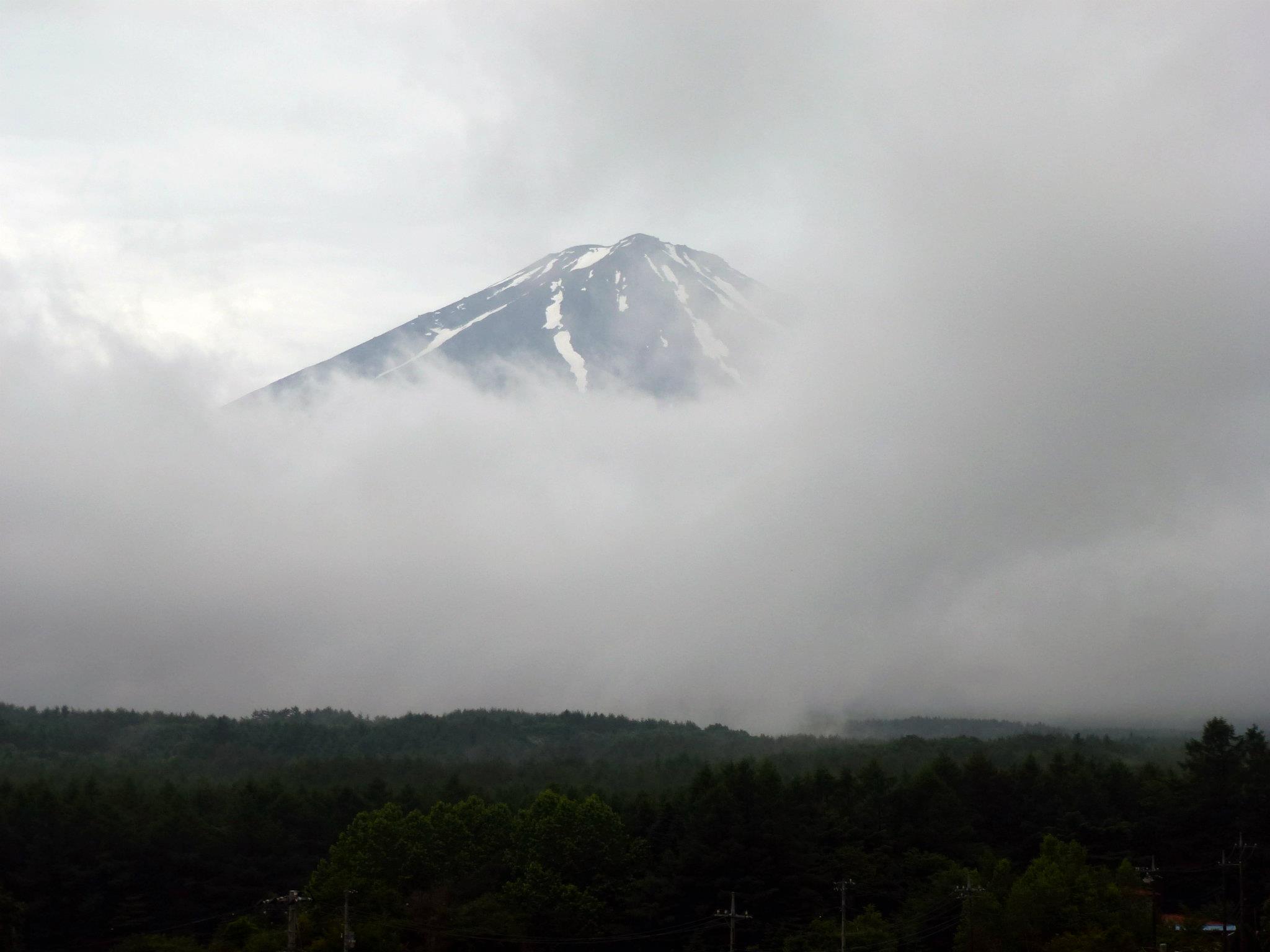
fujiview

We don’t have a clue what time it is.

Three days ago I couldn’t sleep. The excitement of visiting a foreign country often has that effect on me. Travelling across time zones, navigating planes, taxis, and a relentless journey left me smiling at an airport on the opposite side of the world, yet internally adrift.

I meet my friend Sean at the airport, we hop on a train for 2 hours, and finally arrive in Shinjuku. It’s lunchtime in Japan. I’ve been awake for about 31 hours, and we can’t check into the hotel for another four. After some sightseeing and food, it hits around 4 p.m., so we head to the hotel. I crash in my room and quickly fall asleep.

Tuesday rejuvenates my spirit, restoring me after what feels like the best sleep ever. Tokyo calls for exploration, and after a few trips on the Yamanote Line, it starts pouring. The sky darkens as massive clouds block most of the sunshine on what was a relatively hot July day. The rain pounds down, the air thick with humidity. Buying an umbrella becomes a solemn act, seeking shelter beneath it as if seeking refuge from the downpour of life’s uncertainties. We head back to the hotel a bit early to dry off and snag some extra sleep for tomorrow’s adventure: climbing Mount Fuji.

After some struggle finding the bus, finally, at 11:27 a.m., we’re ready to set off. The ¥2700 highway bus takes us through Japanese countryside, across bridges and valleys, until, a few hours later, we reach Mount Fuji Fifth Station—the starting point for climbers. There are ten stations in total, the tenth being the summit.

Here at the Fifth Station, the sun shines, and the mood is upbeat. Restaurants, souvenir shops, and gear stores line the area. I forgot warm clothing, so I grab a nice fleece for ¥6000. After a satisfying Japanese meal, it’s time to climb. We rent a coin locker and leave everything non-essential at Station Five, setting off promptly.

The hike to Station Six is pleasant, perhaps taking forty minutes or even less. We rest, snack on Kendal Mint Cake, then resume climbing. What’s heartening as we ascend is the warm greetings from every person we pass—each offering a smile and a ‘konnichiwa!’

Somewhere between Station Six and Seven, there are dreadful steps. Loads of them, sweeping from left to right, hindering progress. We take a break and chat with an American couple descending the Mountain. They joke that it’ll take another ten hours to reach the top. Hilarious, I hope.

A few hours pass since Station Six, and we arrive at Station Seven—equipped with a bench, a toilet, and a shop selling instant ramen. We pause to admire the view before continuing. Around this climb point, we’re engulfed in clouds, and it starts getting cooler. No more steps, thankfully … just rocks.

Endless rocks.

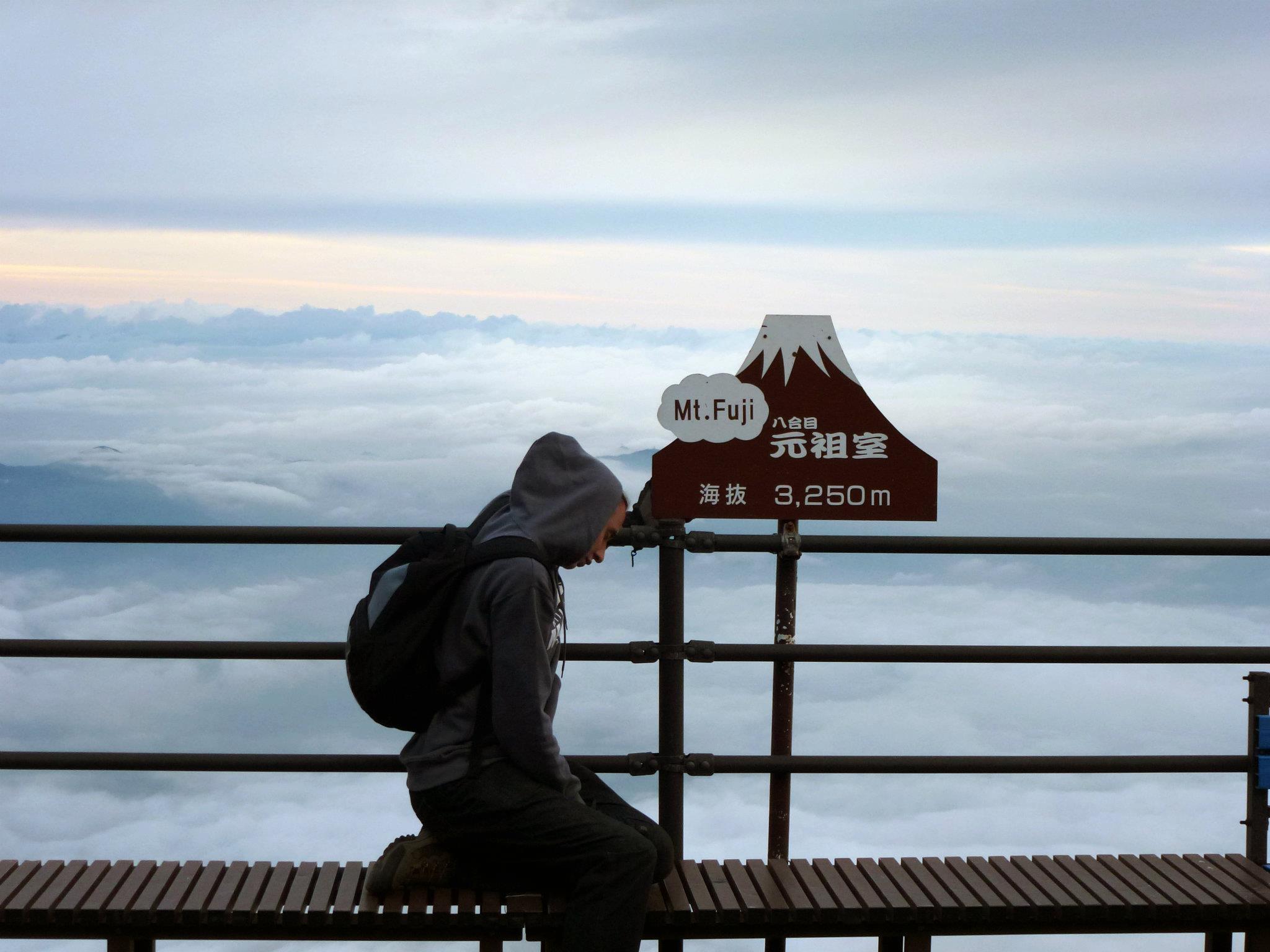
Arguably the worst part of the Mount Fuji climb is between the Seventh and Eighth stations. This stretch demands hand-climbing over endless slippery rocks. Thankfully, there are about eight or nine mountain huts interspersed, each with a bench, toilet, shop, and if needed, a place to sleep. I’m grateful for these intermittent rests, although the prices keep climbing higher with altitude. I recall one of the higher shops selling two cans of Coke and a Snickers bar for the equivalent of £10, though the exchange rate wasn’t as favourable back in 2012.

fujisan

After leaving the last hut at Station Eight, the skies begin to darken. This part of the climb features volcanic rock littering the trails—loads of smashed-up or small bits of rock and stone. Tricky to walk on, they slide around under our feet. The darkness doesn’t favour us here, so it’s time to put on the all-important headlamp.

Somewhere before the penultimate Ninth Station, we encounter a mountain hut. A Japanese man outside informs us that the mountain huts beyond this point are closed, urging us to stay for the night. Uncertain if he’s honest or aiming for extra business, it turns out he’s genuinely concerned for our safety.

At Station Nine, perched at 3,600 metres above sea level, the solitary mountain hut stands closed, swallowed by pitch-black darkness. Devoid of light, shops, or comfort, it echoes with the haunting symphony of wind and rain. An impending storm brews, casting a foreboding shadow over our proximity to the summit—just 176 metres away.

In daylight, this section of the Mountain might take about 40 minutes. In the dark amid increasing rain and wind, it takes us 2 hours. Passing through a torii gate, we venture deeper into darkness. Here, the volcanic rocky ground ends, and a very difficult climb begins. Bare rocks mark the path, and climbing these slippery, wet rocks is no fun at all. My vision reduces to a black screen with flickering white dots, snowfall illuminated by my headlamp. After navigating the treacherous rocks, a white torii gate signals the final steps, and we reach the summit. Exhausted, cold, wet, but relieved.

At Mount Fuji’s peak, all the shops are closed; no light, no life. The summit at night is bleak—snow falls, wind howls stronger. We huddle by a closed mountain hut, attempting to shield ourselves from the wind. Trying to calculate the time, as we have no devices or clocks, it becomes a futile exercise. Everything is in the coin locker back at Station Five, and with nobody around to ask, we are forced to do some calculations.

  • The sun set hours ago.
  • On Monday, we missed the sunset due to our late afternoon sleep.
  • Tuesday’s rain and sudden darkness hid the sunset.
  • We do know the sun rises at 4:40 a.m.
  • We set off from Station Five around 2 p.m.
  • The American couple said it takes at least ten hours.
  • It feels like we’ve been walking for at least ten hours.
  • We decide it’s probably around midnight, but we have no way to be sure.

Contemplating waiting for sunrise, hoping the sun would warm us, we realise the risk of freezing if we linger. We opt to head down the dark, slippery, snow-covered rocks.

Hours seem to pass, and eventually, we return to Station 8.5. A Japanese man and woman greet us, whispering, indicating that people are already asleep, planning to wake an hour before sunrise for the final climb. For ¥5500 each, we acquire a small bean bag pillow, a blanket, and space on the hard wooden floor. Cold and exhausted, I could’ve slept anywhere. A clock on the hut wall reads 10:47 p.m. Turns out, in summer in Japan, the sun sets just after 6 p.m.

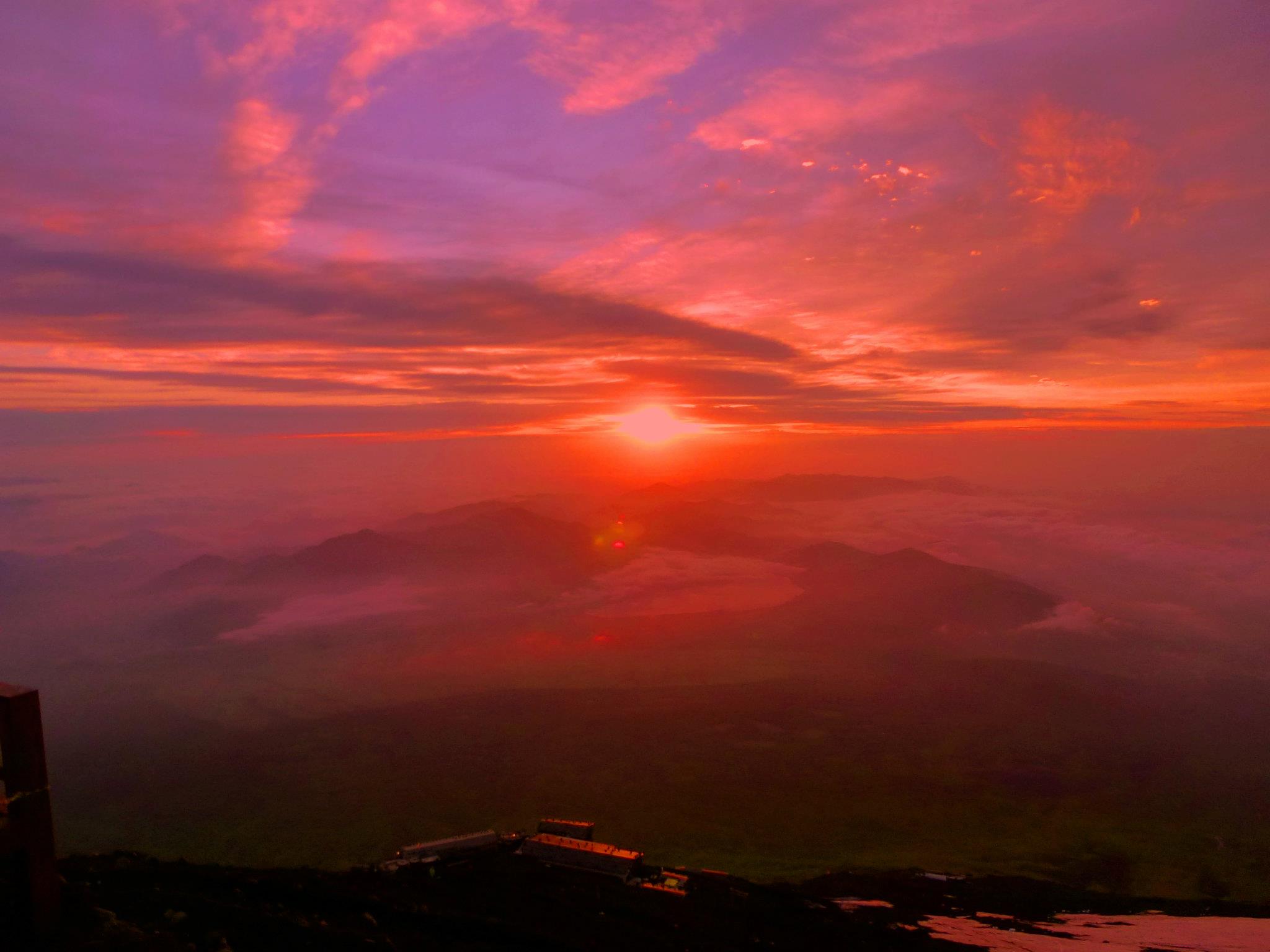
In the morning there was this:

sunrise

Descending the Mountain proves far easier than ascending it. There’s a twisted pleasure in knowing those we pass on the way down will face what we’ve just endured. I now understand why those descending greeted us with smiles and a cheerful ‘konnichiwa!’ as we ascended.

July and August mark Mount Fuji’s ‘climbing season.’ We tackled the Mountain just days into the season, hence the lingering snow on the summit and the closure of mountain huts past Station 8.5.

Returning to Station Five, we board a bus to Kawaguchiko Station, encountering a French lady and her daughters who scaled the Mountain that same night. She recounts a chilling warning from Station Five’s security, advising against venturing beyond Station 8.5 due to hazardous snow. In her narrative, a haunting reality unfolds: the Mountain’s icy grasp clung to mortality’s edge, our steps teetered on a malevolent dance with death. Each footfall echoed a grim refrain, a chilling symphony marking our unnerving closeness to an untimely encounter with the abyss.

In June 2013 Mount Fuji was granted UNESCO World Heritage status.