Paint and Gunpowder

The four of us from last night absorb a new person into our group, a guy called Josh. We head out on foot toward Ueno Park. Today, the National Museum of Western Art is having a free admission day, and despite being in Japan, we consider it worth a look. We stroll inside and are asked to show our tickets. “Free admission day,” I tell the lady.
“You still need to get a ticket,” she informs me. We head out of the museum and to the ticket office. We ask for five tickets, and hand over no money before heading back inside and handing over the tickets to the lady. A rather trivial exercise.

museum[1]

The Museum of Western Art is the primary institution of its kind in Japan, emphasising paintings with a few sculptures thrown in for good measure. The museum is adorned with an abundance of macabre Baroque works, where death and torture seem to be popular themes. Amidst the horror, notable pieces include ‘The Last Supper’ painted by Marten de Vos, Vincent van Gogh’s ‘Roses’, and a rather disappointing collection of Claude Monet paintings. Not one to truly appreciate art, I find that Monet’s work looks terrible up close, especially ‘Water Lilies’, which, in my opinion, looks plain awful.

My favourite piece on display is Pablo Picasso’s ‘Couple’. Abstract expressionism has always been a preference of mine; I’ll take this over a bowl of fruit or a basket of flowers any day. Picasso painted this incredible piece at eighty-eight years old.

pablo[1]

We leave the museum and take a Yamanote Line train from Ueno to Ikebukuro. Outside the station, we need to head east. Josh turns out to be well-prepared, pulling out an actual compass and casually guiding us in the direction of east. This earns him the nickname ‘Compass Josh’ for the rest of the day, and he seems to take to the idea quite fondly.

The reason we are here is to visit a shop run by a company that has faced criticism for its practices, including accusations of contributing to infant mortality in underdeveloped countries due to its reluctance to spend extra profit on proper labelling for its baby milk formula. The shop sells a specific type of confectionery that is hugely popular in Japan. This two-fingered chocolate-covered wafer bar confection is available in many remarkable flavours, such as wasabi, strawberry cheesecake, and sakura.

While the others queue for their chocolate, I wander around outside and admire the street art.

ikart[1]

We head to a small coffee shop before making our way back to the train station. On the platform, two men are fighting. One guy stands up and walks away, his face dripping with blood, his eyes bruised. This is the first time I witness violence like this in Japan, and it comes as a bit of a shock.

I head home for a while to prepare for a performance this evening before meeting the others in Odaiba. Compass Josh’s partner, Jessica, has joined us, expanding our group to six. We explore the giant statue of Gundam before settling in the food court of Diver City, enjoying overpriced wine in undersized glasses. Outside Diver City, an extraordinary bus stop catches my eye, begging to be photographed.

extr[1]

Tonight in Odaiba, a special fireworks display is scheduled for 7 p.m. We wander around the area, with the evening darkness stolen by extravagant illuminations. There’s a feeling of forgotten Christmas lights here, and decorations that will likely remain year-round. Trees glisten, Tokyo Tower in the distance shines orange, and the Rainbow Bridge is bathed in a spectrum of light from red to violet.

We position ourselves on the balcony of the Decks building, a vast shopping mall offering a spectacular view of Tokyo Bay. At exactly seven o’clock, fireworks shoot into the sky, creating a dazzling display that lasts for ten minutes. Below us, boats are illuminated in various colours, their reflections shimmering on the water alongside the radiant Rainbow Bridge. Tokyo Tower continues to shine in the distance. The backdrop consists of a sea of lights from office buildings, adding to the immersive experience. In the foreground, the glow from the massive firework display warms the air, completing the enchanting scene.

odaibafireworks[1]

After the fireworks, we take the train back to Asakusa, passing by the Fuji TV building as it displays bright flashing text: ‘What a cool we are!’

Back in Asakusa, we part ways. I head to Cafe Byron Bay for a bonenkai, a ‘forget the year’ party widely celebrated here. The tap-dancing balloon artist, whom I first saw performing on the streets of Asakusa during my first week in Japan, is here to entertain. A belly dancer is also putting on a show. I perform with trumpet and guitar. Food is free and all-you-can-eat. Everyone gets very drunk. After the entertainment, we each give a speech about the year we’ve had and what we hope to achieve in 2015. My resolution and absolute aim are to publish a science-fiction novel.

After the end-of-year party, I head out with seven Japanese friends for a second night in a row of karaoke.

I Warm Duck Smoke

I wake to the sound of helicopters and sirens, more than one of each. I look out of my apartment window and see a pillar of billowing smoke that seems to be attracting the attention of five helicopters; they circle around the black cloud like flies. An ambulance buzzes by at speed, its sirens adding to the cacophony of early morning racket.

I head outside into the slums, making my way toward Minowa Station. Today, I have the pleasure of buying a Halloween costume, and the only place that offers any sort of choice, I am led to believe, is Tokyu Hands in Shibuya. At Minowa Station, there are seventeen fire engines.

fire[1]

I take the Hibiya Line. Distracted, I miss my stop at Ueno, so I stay on the train until Akihabara Station. I walk ten minutes through the crowd of young women in maid outfits trying to tempt me and head for Suehirocho Station. Here, I take the Ginza Line, Shibuya-bound.

It seems I have been drastically misled. Tokyu Hands has a Halloween range, albeit rather small. I begrudgingly spend ¥4800 on some awful ghoulish nonsense that I will only use once before heading back to the train station, Minowa-bound.

Outside Minowa Station, firefighters are still tackling the huge blaze, the smoke so thick that it chokes me. Helicopters armed with television cameras continue to drone on. Unbelievably, an advertising blimp for the insurance company ‘MetLife’ floats above the disaster, cashing in on some extra television airtime.

metlife[1]

At home, I grab my bicycle and cycle toward Kanda. I get as far as Asakusa and run into my good friend and fellow bicycle enthusiast, Khin. He asks me if I’ve had lunch yet. Realising that I am actually quite hungry, I agree to join him, and we head to a gyoza restaurant. I finally get to eat one of my favourite foods, vegetable dumplings—the first time I have had this food since coming to Japan. Delicious.

After the meal, we head over to Senso-ji to get our fortunes. I luck out and receive ‘Good Fortune.’ Khin doesn’t do so well and gets ‘Regular Fortune,’ so he ties it up for the gods to deal with. My fortune says, “It is a good sign to dream of a young horse in spring and a dream of a swift horse will bee [sic] a much better sign.”

goodfortune[1]

Next, we head over to the Edo Shitamachi Traditional Crafts Museum, an excellent little museum discreetly tucked away inside an indoor shopping arcade. Free entry seals the deal, and in we go. Inside, we find ourselves the only visitors. On display are fishing rods, fans, hand-forged cutters, paper lanterns, badminton rackets depicting kabuki characters, Buddhist statues, pottery, leather bags, and paintings. There is also a rack of very straight arrows.

Winter is coming, apparently. To celebrate, a small truck with a little stove on the back is circling around, selling hot sweet potatoes. As it passes by, it plays a little jingle in Japanese known as the baked potato song: ‘Ishiyaki imo, yaki imo, yaki imooooo,’ literally translating as ‘Baked sweet potatoes, sweet potatoes, sweet potatoooooes.’ I chase after the truck but waste time taking a photograph before it turns left and blazes off into the distance.

bakedpotato[1]

Khin and I head over to Cafe Byron Bay to meet some friends before heading out as a group of eight to a fish izakaya. Tonight is Dagmar’s last evening in Japan, so we are having a little leaving party for her. At the izakaya, we take off our shoes and sit at a nice table with tatami mat flooring. I am handed an English menu, and it just so happens to be the best menu I have ever seen.

The menu boasts the following delicious highlights:

Dirt Japanese bluefish drying a fish whole firing, ¥380
Wall thickness, taste are plentiful, and grease appears! ¥980
Semigrow and drag knob salad, ¥580
Tatami mat sardine, ¥280
Butter charcoal fire firing of the nettle tree, ¥380

ducksmoke[1]

The butter charcoal fire firing of the nettle tree turns out to be mushrooms, and the tatami mat sardine ends up on the floor. We eat plenty, drink plenty, and drink plenty, before going our separate ways, bidding our last goodbyes.

At home, I dream of horses in the spring.

Parasite at the Museum

Today is a public holiday dedicated to respecting the elderly and celebrating longevity. In Japan, there are fifteen different public holidays annually, and due to the implementation of the ‘Happy Monday System,’ several holidays have been shifted to Mondays to grant people a three-day weekend. Unfortunately, my toothache has plunged me into perpetual agony today. Regrettably, all the dentists are on holiday because of the celebration honouring the elderly. Not wishing to bare one’s teeth, I struggle on in pain.

My first stop today is Shibuya Station. With most of the country off work today, the area is overcrowded and annoying. I grab a bottle of drink that claims to contain one thousand lemons (which I very much doubt) before walking in the sunshine toward Harajuku, in search of some illustrious graffiti. On the way, I pass Yoyogi Park; here, there are swarms of teenage girls all standing around waiting for some sort of summer concert to start. I decide to pass on the concert. In Harajuku, it is just as crowded. I wander around side streets but find the graffiti to be somewhat lacklustre. I take just one photograph before walking back to Harajuku Station.

haragraf[1]

I take the Yamanote Line to Meguro, which translates to mean ‘black eyes’. After eventually finding a map, I discover that my destination isn’t marked. So, I search for a Seven Eleven and use their free wireless Internet. I then head to the Meguro Parasitological Museum; the only parasite museum in the world, I might add. I am surprised to find it open on a public holiday, and I am even more surprised to find that the entry is free.

If you are looking for a cheap destination for a romantic afternoon, then the Meguro Parasitological Museum is for you. Here, there are jars of parasites, magnifying glasses for that closer look, and an interactive screen displaying the life cycle of a parasite. There is even a small souvenir shop selling shirts depicting parasitological dissections. Finally, a gift shop selling something worth buying.

parasites[1]

With my appetite faded, I leave the museum and decide to skip lunch. I take the Meguro Line six stops to Ookayama Station. Each time the train starts up, it sounds like a jet engine. I change at Ookayama to the Tokyu Oimachi Line; this train also sounds like it is about to take off as it leaves the station. Eventually, I land in Jiyugaoka.

Jiyugaoka is often voted as one of the best places to live in Tokyo. The streets here are a cluster of expensive clothes shops and shops selling expensive cakes and sweets. Some stores have signs outside that say, ‘Women only.’ The roads here are even pedestrianised during the daytime, providing extra space for the many crowds. My intrigue takes me to a place called ‘Sweets Forest.’

sweetsforest[1]

Sweets Forest is an indoor theme park filled with cake shops and overpriced candies. For no apparent reason, traditional Irish folk music is playing inside. However, the thought of eating sweets brings more pain to my teeth, so I decide it’s time to leave. I take the Tokyu Toyoko Line to Shibuya, transferring to the Ginza Line before heading home.

Back at the hostel, everything is getting on my nerves. People keep asking each other the same questions, speaking in languages that could be English, but I can’t be sure. There’s too much noise, and I can’t seem to focus my mind. I try to write, but the pain in my teeth and jaw keeps distracting me. Tomorrow, I’m faced with the daunting task of visiting a Japanese dentist. A friend jokes about how dentists here continue to administer pain even if you scream and raise your hand to signal them to stop, or how instead of fixing your problem, they just remove your teeth.

With my appetence faded and my mind consumed by pain, I try to get an early night. I head off to bed at 9 p.m.; although sleep, I expect, will be somewhat limited. Not a very happy Monday at all.

Eat Fish or Die Tryin’

I meet my friend Dagmar for breakfast at ten. At breakfast, I drink away my hangover with a bottle of a tasteless drink called ‘Delicious Water’ before heading out alone for the train. Someone told me yesterday that beneath the banks and office buildings between Mitsukoshimae Station and Otemachi Station, hidden deep underground, the Japanese government grows secret rice.

Somewhere along the Ginza Line, my train just powers down. All the lights extinguish, plunging the carriage into an abyss of darkness. The train drifts aimlessly towards Ueno Station and finally grinds to a haunting halt. The silence thickens, shrouding the dead train in an eerie stillness, an unsettling void that grips the carriage. Everyone remains silent, messing with their mobile phones, despite the obvious sorrow of the situation. It is all very worrying. About five minutes pass, and there is an announcement in Japanese, then nothing. A further five minutes, and the train starts up like nothing ever happened.

As I exit Mitsukoshimae Station, I accidentally wander into an adjacent department store.

maskmaskmask[1]

Inside the department store, there is a Mask Art Museum, and it is free. A nice but rather small exhibition. The store housing the museum is incredibly upmarket. I ask politely if I am allowed to take photographs, and lucky for me, it is fine. The exhibition actually ends today. Rather fittingly, all of the mannequins in this department store are wearing masks.

One thing I have noticed in Japan are the many strange museums. I believe I have previously mentioned the famous World Bags and Luggage Museum. A few other favourites of mine that I am yet to visit are the Gas Science Museum, the National Leprosy Museum, and the Parasite Museum.

I wander around for a while looking for the entrance to the secret underground rice bunker. It takes a while but I eventually find a huge office building that has every window on one side completely covered in plants. On the other side of the building I scare away an eagle pecking at a gold statue of Prometheus. This must be the place, I think to myself. It turns out it is.

prometheus[1]

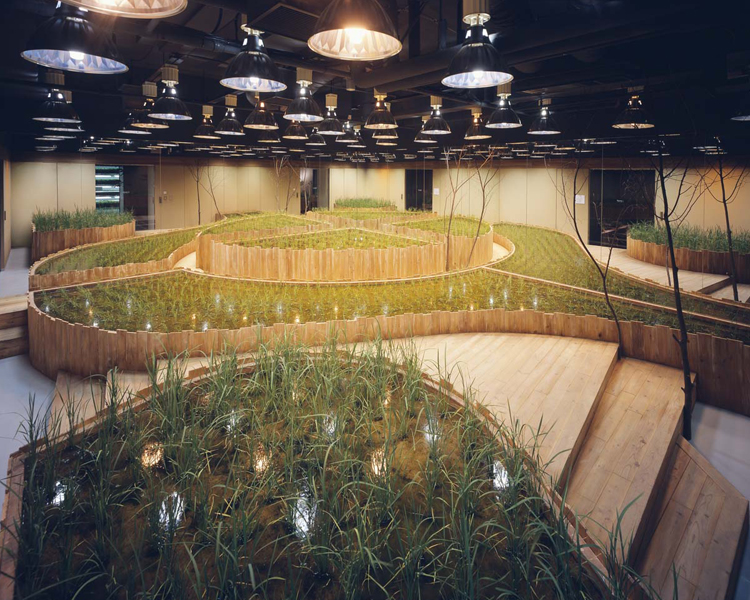
Deeply tucked away in the second basement level of a huge skyscraper, they grow rice. I am not entirely sure why they grow rice, but people are free to come and see it. Huge natural light shines from above. Rice grows. From what I was told, this area stretches under the whole business district, although it doesn’t. The size of the area was heavily exaggerated to me. The rice isn’t really that much of a secret; it’s not too well advertised, but no one is trying to hide the fact that it grows here either. In fact, I think it’s encouraged for people to come here and learn about rice cultivation. So, another urban myth shattered then.

ricetomeetyou

After looking at rice for a few minutes, I decide to walk to the Imperial Palace. I’m surprised by how close the stations are to each other in this area. Tokyo, Kanda, Shinbashi, and Nihonbashi Stations are literally within a five-minute walk of each other. Outside the Imperial Palace, about thirty elderly Japanese people are sitting and painting.

The Imperial Palace is home to Emperor Akihito, the last remaining monarch in the world to go by the name of Emperor. There isn’t really much else to see at the palace. The grass outside is cut immaculately, and the water fountains spray jets of water about two metres into the air. I notice there is a great view of Tokyo Station from the Palace car park, though. I wander to the nearby Ginza Station and take the train back to Asakusa.

tokyostation[1]

I decide to inspect a potential apartment. Small apartments in Japan are ironically referred to as “mansions.” These one-room coffin apartments offer little to no space and an equal amount of comfort. Another phenomenon in Japan is the grouping of shops, whole areas dedicated to selling one type of product. The area where the apartment is housed is completely surrounded by funeral shops. One street has eight shops in a row, all selling tombstones. I decide the area doesn’t quite feel right. Chimes sound from nowhere as I head back to the hostel, chiming five times signalling 5 p.m.

At 6 p.m., Richard, Luis, Remi, and I head to a nearby restaurant that serves fugu. Jokes are made about toxicity, tetrodotoxin, paralysis, and death. In reality, fugu poison is one-thousand two-hundred times stronger than cyanide; this is no laughing matter. The most poisonous part of the fish is the liver. Outside the restaurant, we watch our dinner for a while, graciously swimming around in a tank. In a moment, this beautiful blowfish will be killed on our behalf; we sure hope it doesn’t have a taste for revenge.

blowfishing[1]

There was a time when a fugu chef would have to pass a training course of ten years before being given certification to prepare fugu. These laws changed about three years ago, and now the rules state just a two or three-year course is required. We really hope that our chef today is of the older generation.

We take a seat in a tatami room. We order fresh blowfish sashimi. We also order diced blowfish sashimi just so I can make a pun about how we diced with death. Oddly, one of the options on the menu is hot sake with dried blowfish fin floating in the liquid. “We only serve the finest live domestic tiger blowfish,” says the menu. Served live? I certainly hope not. We wait anxiously for our food to arrive.

The poisonous fish is served in elegantly arranged translucent slices; it doesn’t look very threatening.

blowfish1[1]

A taste for revenge would be an overstatement. A taste of anything would be welcome. The food is the freshest fish I have ever tasted, of course; it has been dead just minutes. The food is also the least tasty fish I have ever had. It has no flavour at all; perhaps there is a subtle hint of death. I’m just glad we went to a cheap non-certified restaurant. It costs us just ¥5480 between the four of us for two dishes and four drinks.

I tried the sacred fugu of Japan and all I got was this lousy anecdote.

Pot, Kettle, Snack

Today, I take the Toei Asakusa Line for the first time in my life. Each time the train starts, it sounds as if there is music coming from beneath the carriages. It turns out that the music is the scraping of the train on the tracks; it does sound rather tuneful, though, perhaps this is the intention. It reminds me of an experience I often have on the Tokyo Metro Ginza Line; between Aoyama-itchome and Gaienmae, the train intermittently makes the sound of a dog being strangled.

I change trains at Shinbashi Station and depart in the direction of Yokohama. The journey time is an hour in total, and I arrive in Yokohama at 10 o’clock sharp. Outside the station, it is 21°C, cold in comparison to what I am used to. I search desperately for a Seven Eleven so I can update my maps using the free wireless Internet, but it seems Family Mart has the monopoly here. I eventually find a sketchy map and head toward Yokohama Bay.

yokohama[1]

There is a theme park here, Cosmo World. I contemplate riding the giant Ferris wheel (not pictured) to get a decent view of the area, but I remember that I am alone, so decide to give the solitary capsule ride a miss. I head to Yokohama F.Marinos MM21 Training Centre, the stadium for the football team ‘Yokohama F.Marinos’. Outside the stadium, two of the star players sign autographs for a small queue of fans.

The reason I came to Yokohama today is to visit the Cup Noodles Museum. For no reason that will ever become clear to anyone, a dinosaur stands guard at the entrance to the museum, a Deinonychus. This is the type of dinosaur that the raptors were based on in the movie Jurassic Park. I sneak past the Deinonychus and head to the ticket office. “How many people?” a young woman asks me. It is painstakingly obvious that it is just me.
“One person,” I say, looking around me for answers, “I think,” I add, deadpan. I pay the ¥500, and I am given a rather glossy museum guidebook.

dinocup[1]

Inside the museum, I am given a cardboard hat featuring a cartooned yellow bird, presumably a mascot of sorts. There is every packet of instant ramen and every type of Cup Noodle that has ever been created, arranged in a huge timeline. Just to clarify, this museum is for the brand of cup noodle called ‘Cup Noodle,’ made by Nissin; it is not a museum of cup noodles.

Momofuku Ando invented chicken instant ramen in his shed in 1958. With the overwhelming success of his chicken noodles, he went on to invent the cup noodle in September 1971. Not satisfied with his achievements, at the age of 96, he invented the first ramen that can be consumed in space. There is a wonderful exhibition of his life, a model replica of his famous shed, and loads of crazy noodle-based artwork here too.

cupnoodle[1]

There are noodle workshops where I can make ramen noodles from scratch or create my very own products. I pay an additional ¥300 and join the queue. I wait forty minutes, and eventually, I am given the opportunity to design my very own brand of Cup Noodle. First, I am given a blank Cup Noodle cup and am free to write or draw whatever I want. I graffiti the front of my cup, so where it once said, ‘Cup Noodle Museum,’ it now says, ‘Cook Pass Babtridge.’ I find the available pens to be of slightly poor quality, which spoils the whole experience for me.

Next, I get to choose the broth and toppings. A sign boasts that there are a total of 5,460 flavour combinations. “Gotta mismatch ’em all!” After toppings are added to the noodles, the lid is sealed in place, and the cup is vacuum-packed. After I finish making my lunch, I go to the top floor of the museum and check out the restaurants. No prizes for guessing what is on the menu.

After the museum, I stumble across a rather odd-looking building down some rather old-looking stone steps. It looks like a set from a science fiction movie; perhaps it once was.

bricksandstone[1]

I head into a Yodobashi Camera store. The place is silent; no crowds, no people shouting at me to buy their stuff. It is the complete opposite of the store in Akihabara. On the sixth floor, middle-aged men are queueing to buy AKB48’s 37th Single, ‘Senbatsu Sousenkyo,’ which was released today and will most likely be number one in the Billboard Japan Hot 100 chart by the weekend.

Outside, I grab a can of Suntory Black Boss coffee from a vending machine and make my way back toward the station. On the way, I pass a huge ship that looks amazing. It is actually part of the Yokohama Port Museum, sadly not a museum of fortified wine. The ship was built in 1930 and is used for training exercises. Even though there is a massive ship here, it doesn’t look out of place.

boatyokohama[1]

At the station, I take three different trains, and an hour later, I arrive back in Asakusa. I am actually completely exhausted but can’t sleep. I play video games for a while, then head out at six for a Dal Vindaloo at my favourite Indian restaurant. As I eat, I remind myself that I am in Japan and should maybe try Japanese food once in a while.

After food, I head to the hostel bar to conclude the day. A young Australian woman tells me that I sound like Russell Brand. I strongly disagree.