Good News About Hell

In the far north of Japan, where the land is as silent as the dead, there is a mountain where nothing grows. A place where souls hesitate. Osorezan, one of the three most sacred sites in Japan, is known by another name: the Jaws of Hell.

I often find myself drawn to stories of mortality and the afterworld. Today, I will glimpse into the hellscape of a Buddhist afterlife.
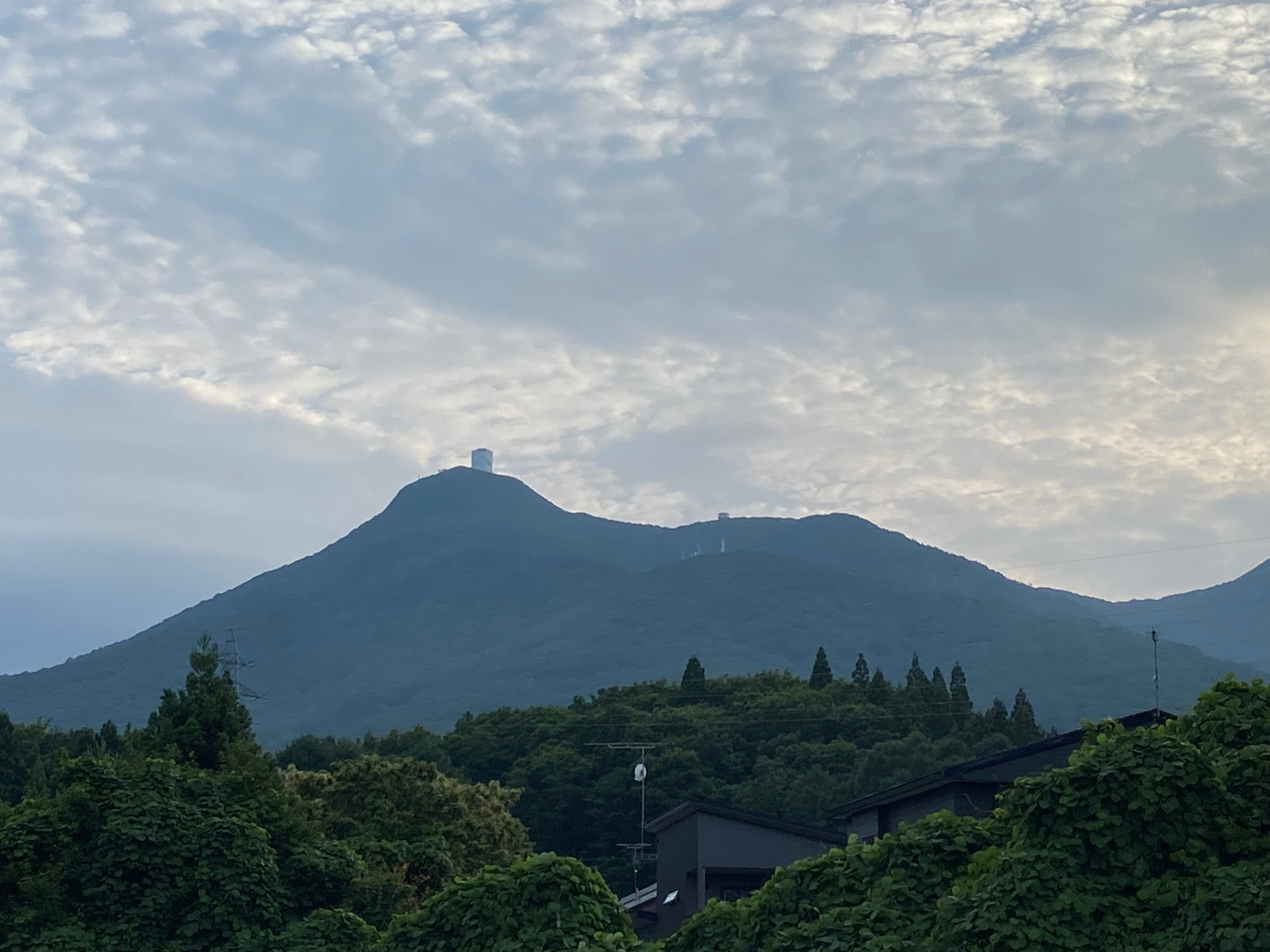
Sacred Mount Osorezan seen from the base, shrouded in cloud and myth, believed to be a path to the underworld.

Before I reach the summit, I come across Osorezan Reisui, a fountain flowing with cold, clear water. It looks like a typical purification site, but legend has it that drinking the water from this spring will make you ten years younger.

Desperate to claw back lost time, I reach for the water, drink from its flow, and fill up my water bottle before continuing the climb.
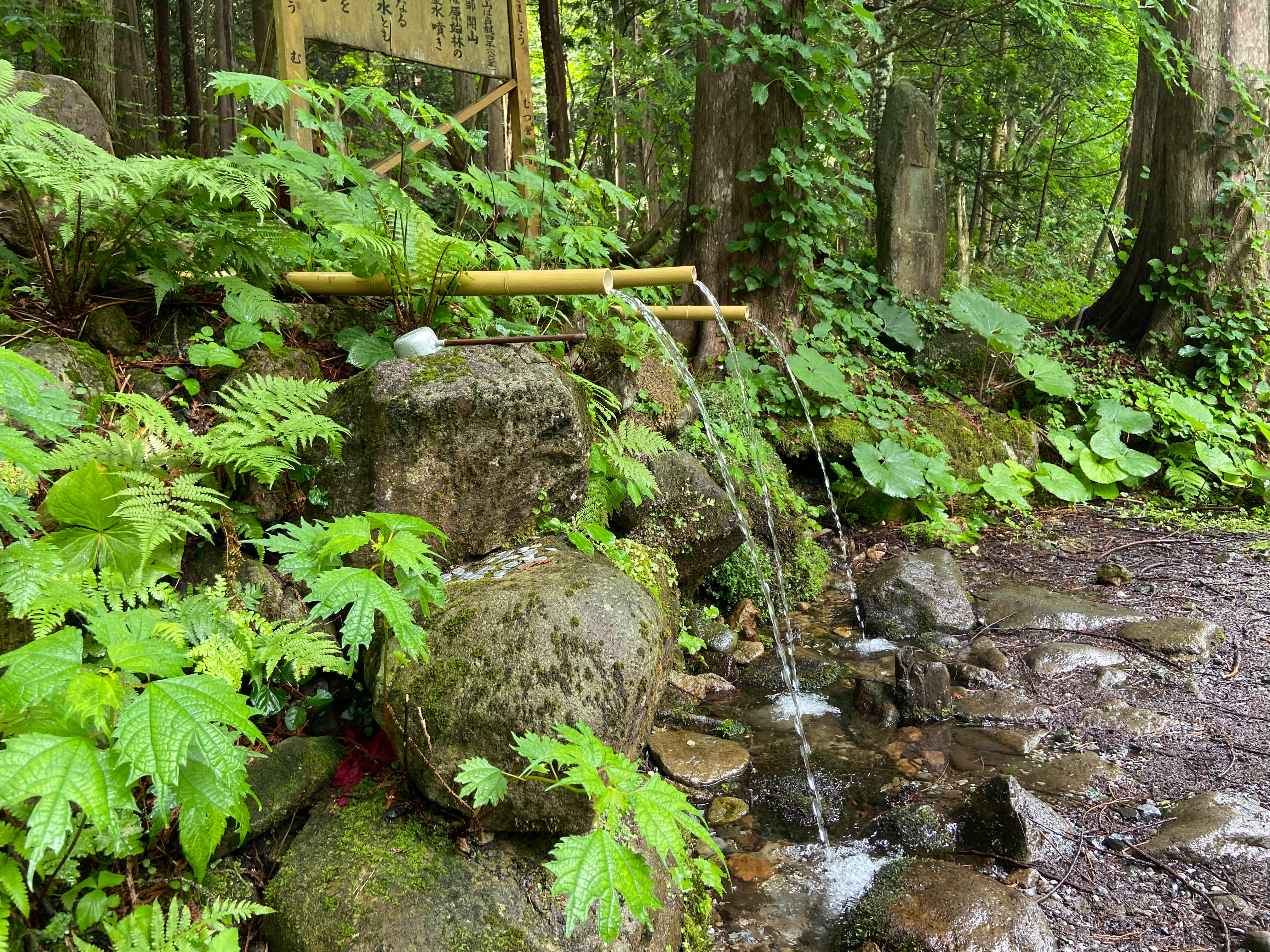
Lush spring of Osorezan Reisui, legendary fountain said to make visitors ten years younger with a single sip.

Further up, the trees and grass make way for shale and volcanic glass, and it is dry. There has been no rain of late to keep the dust down, so with every step the sulphurous ash creates clouds under my feet. Some gets into my mouth, and I choke. Luckily, I still have water from the fountain of youth, so I wash away the bitterness and the years before carrying on.

Higher up, the mountain opens its mouth wide. Nothing moves. There are no roots. There are no birds. Just the crunch of my footsteps echoes through the wasteland. Everything else is… still.
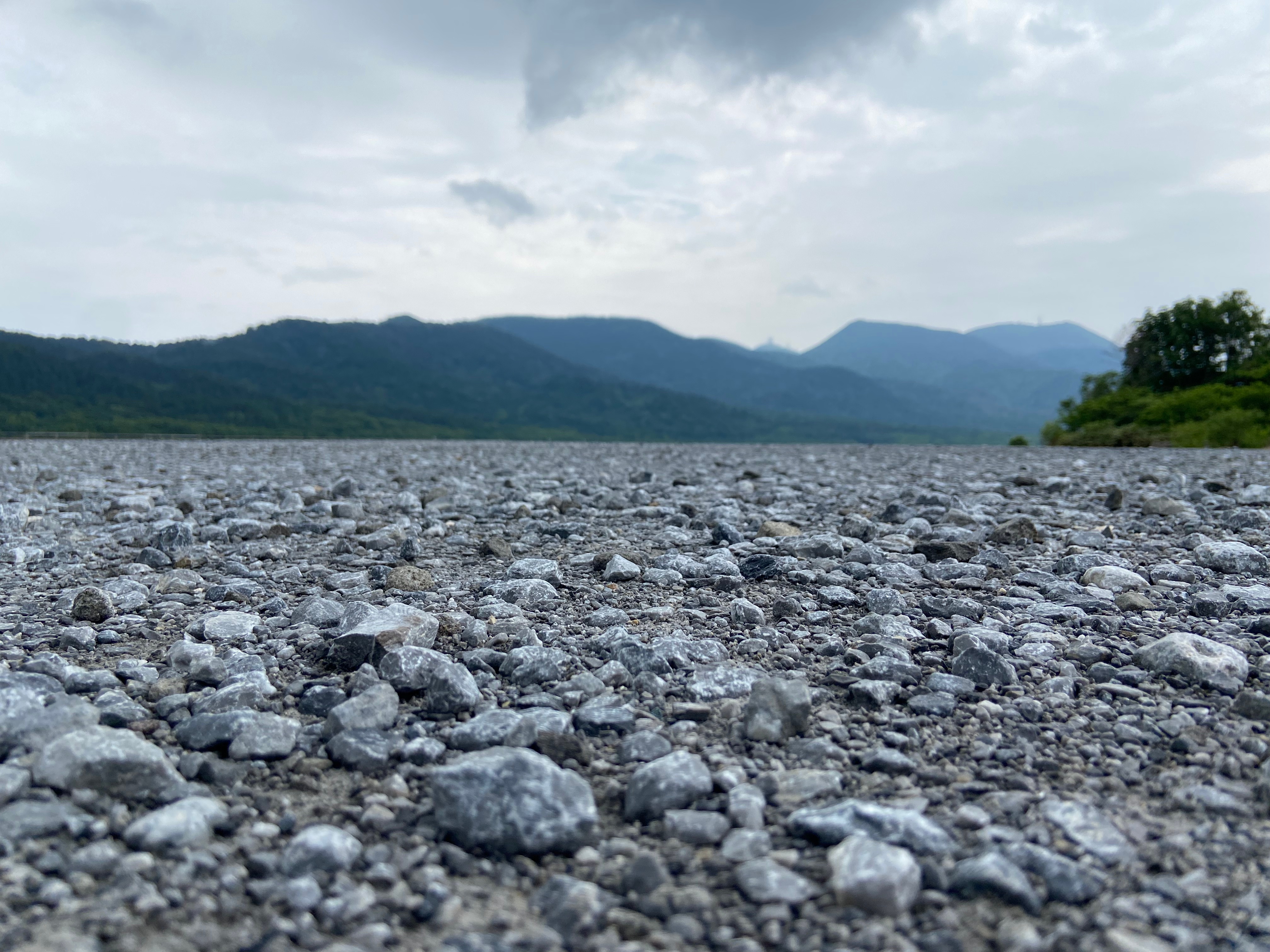
Desolate volcanic wasteland of Mount Osorezan in northern Japan, sacred Buddhist site known as the gateway to hell.

In the distance, Lake Usori lies in eerie repose, a lake of poison. The acidity is so high that nothing can live here. Even the wind seems unwilling to touch the surface, but I am.

Kneeling, I dip my hand into the water. A freezing chill shoots up my arm. For a moment, the water feels alive, tightening impossibly around my fingers. Not liquid, but something with intent. I wrench my hand away, breath unsteady, as if something almost followed me out.
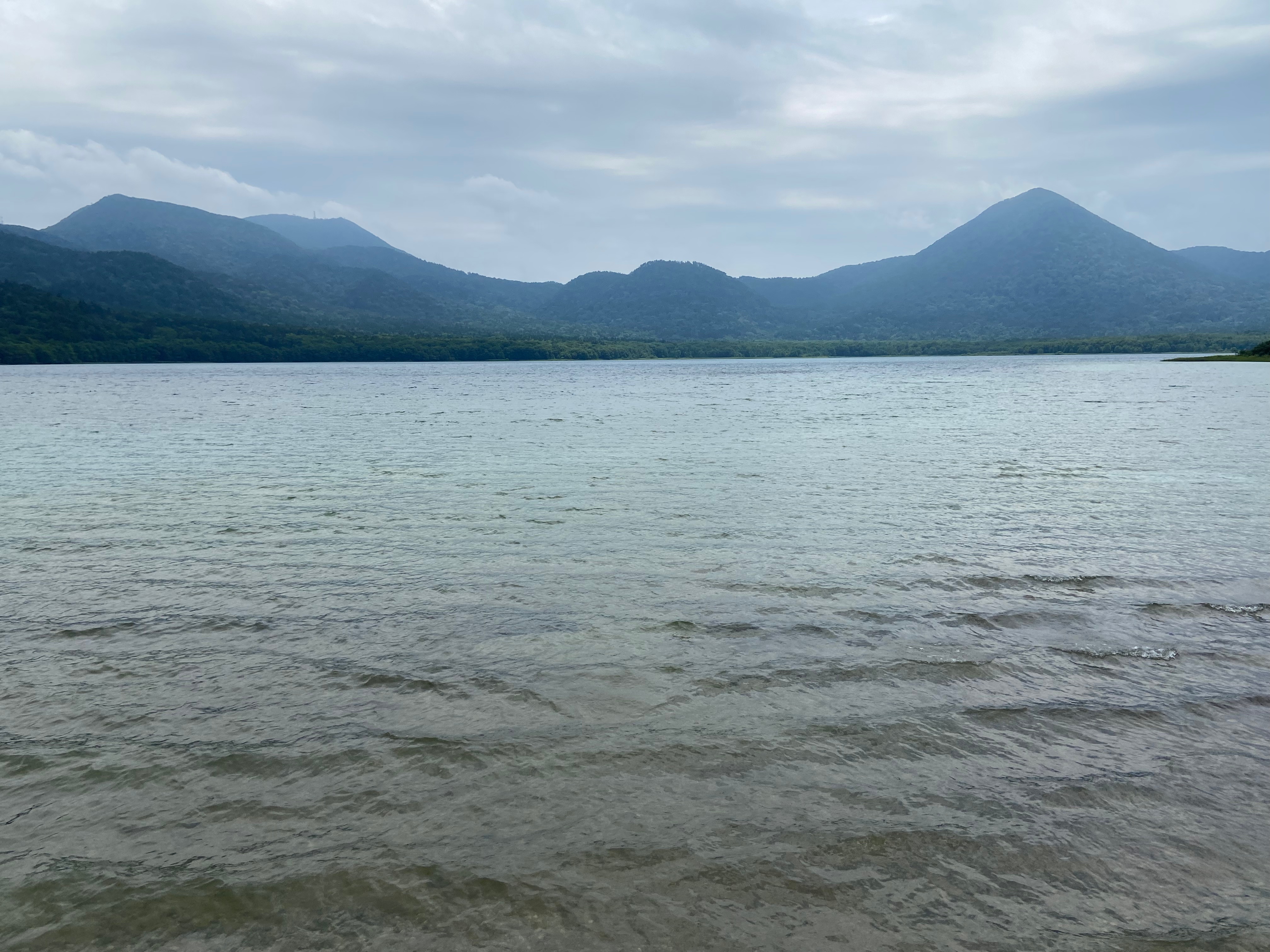
Eerie, acidic waters of Lake Usori in Aomori Prefecture, Japan—still and lifeless, at the heart of Osorezan.

I remain kneeling a while longer, lost terribly in thought. I watch as the ripples in the lake distort my own reflection. I see not just my face, but the faces of every version of myself I’ve left behind. I watch them shifting, like a shimmer of sorts. I take a deep breath, stand up, and walk away, before something walks away with me.

Draining from Lake Usori is the Sanzu River; its waters flowing silently, black and sluggish, like blood oozing from a wound that will never heal. It is at this river the dead must cross to move into the next world. The journey across this river reflects the life one has led: the good cross by bridge, the average wade through the shallows, and the bad must swim amongst the river’s monsters.
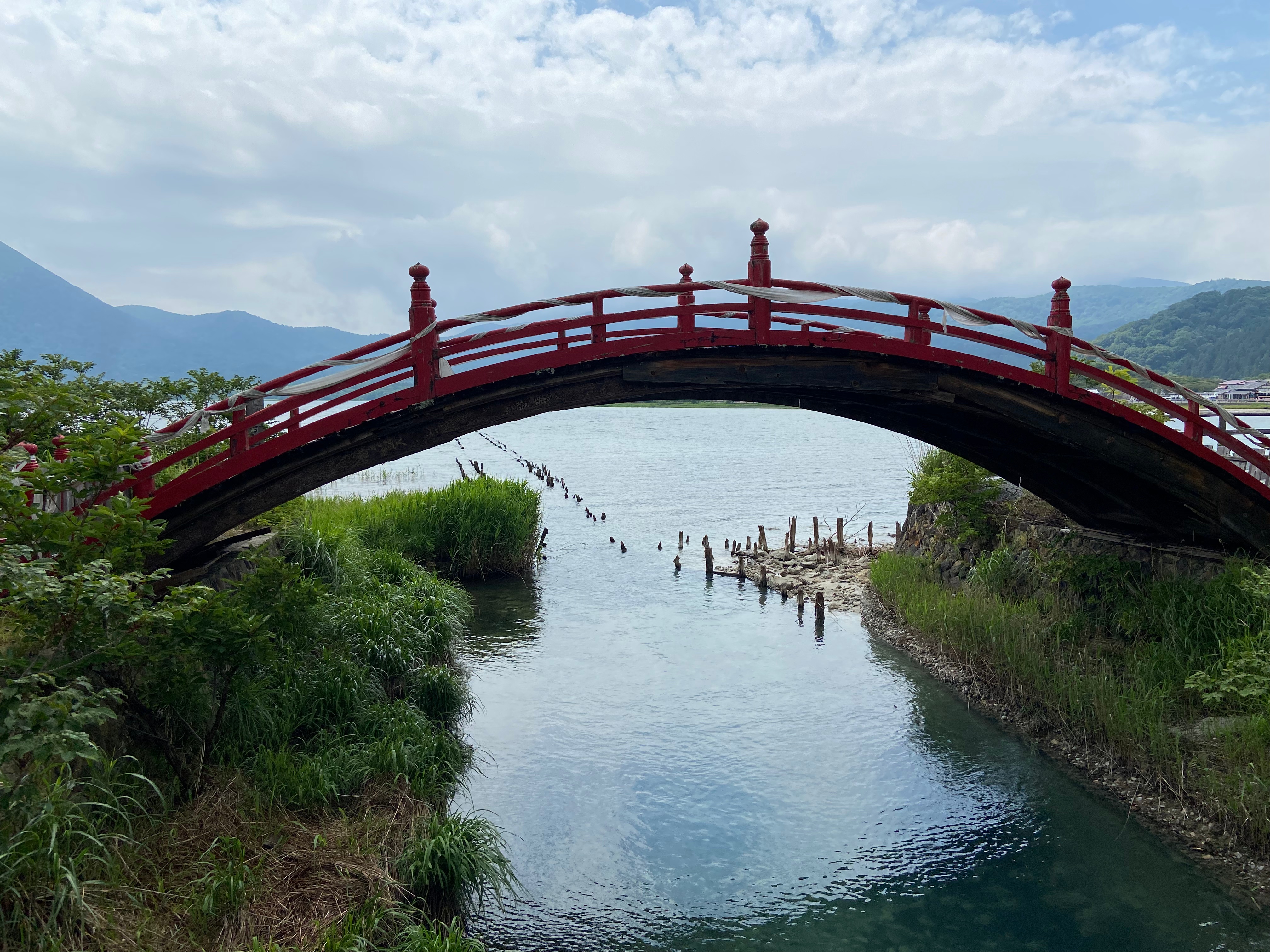
Red bridge over the Sanzu River at Osorezan, symbolising the soul’s crossing into the afterlife in Japanese Buddhist lore.

I watch the river for a time, wondering which path I would take. I approach the bridge, its red painted wood the only colour I’ve seen up on this mountain. I take a step toward it, but something inside me pulls back. Not fear or superstition; just a quiet, sinking knowledge that maybe I was here before, and I don’t think I should be here again.

Along the riverbed, piles of pebbles litter the landscape, said to have been stacked by the spirits of unborn children or those who died young. These children build piles of rocks as an offering to Buddha, only to have demons knock them down, condemning the children to rebuild over and over, for eternity; forever trapped in the netherworld, unable to transcend.
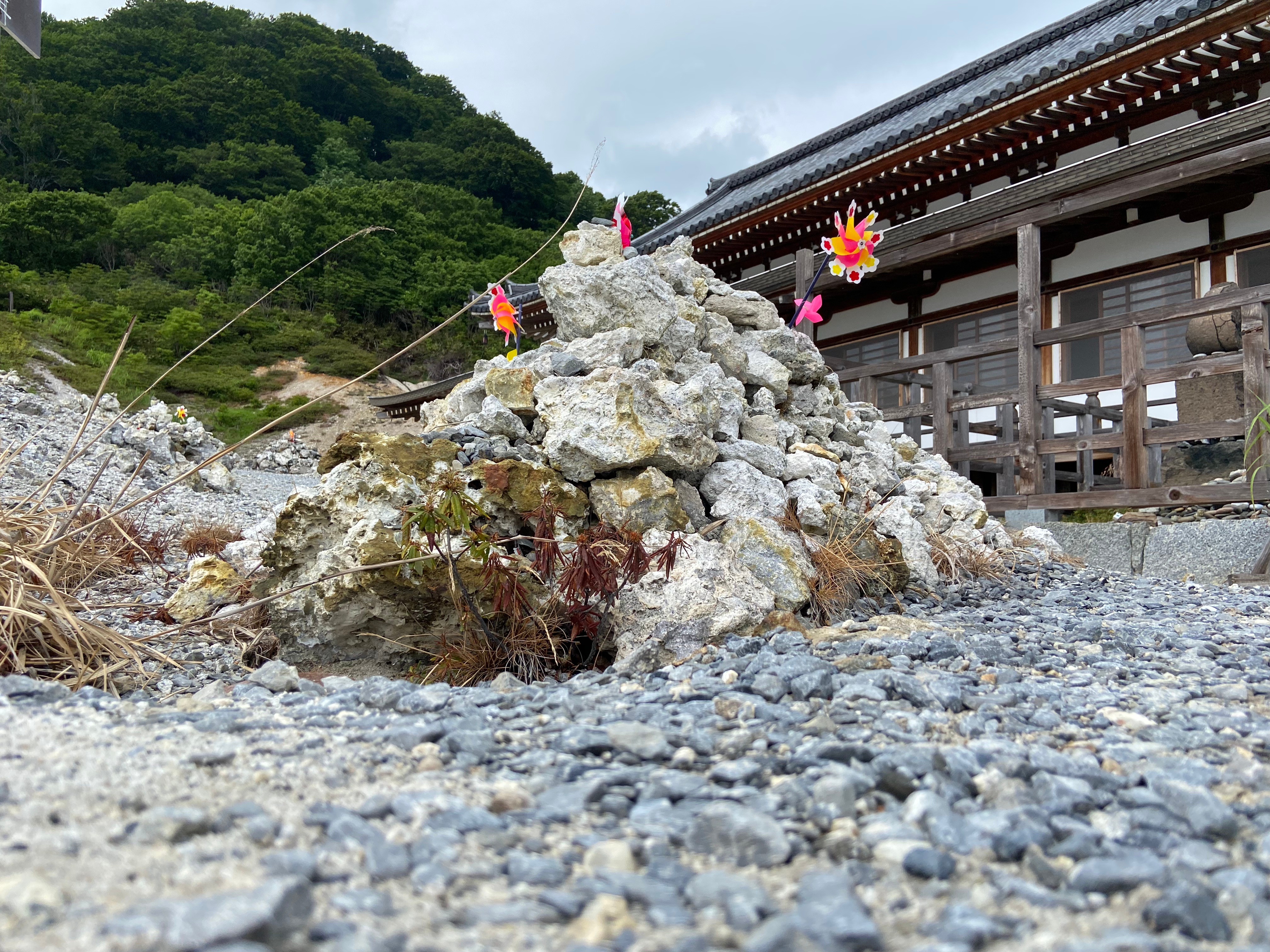
Gravel mound with windmills at Osorezan, symbolizing unborn children stacking stones in the Buddhist afterlife.

Not far from the river stands Bodaiji Temple, where monks pray for the lost souls who wander Osorezan. After all the stories of sorrow, the temple stands as the only promise of mercy.

Inside, the air hums with low chants. The scent of incense curls through the dim light, thick as fog, as if the prayers themselves are rising. The monks recite sutras; their voices steady. For all the suffering that lingers in the air, this place feels… still.
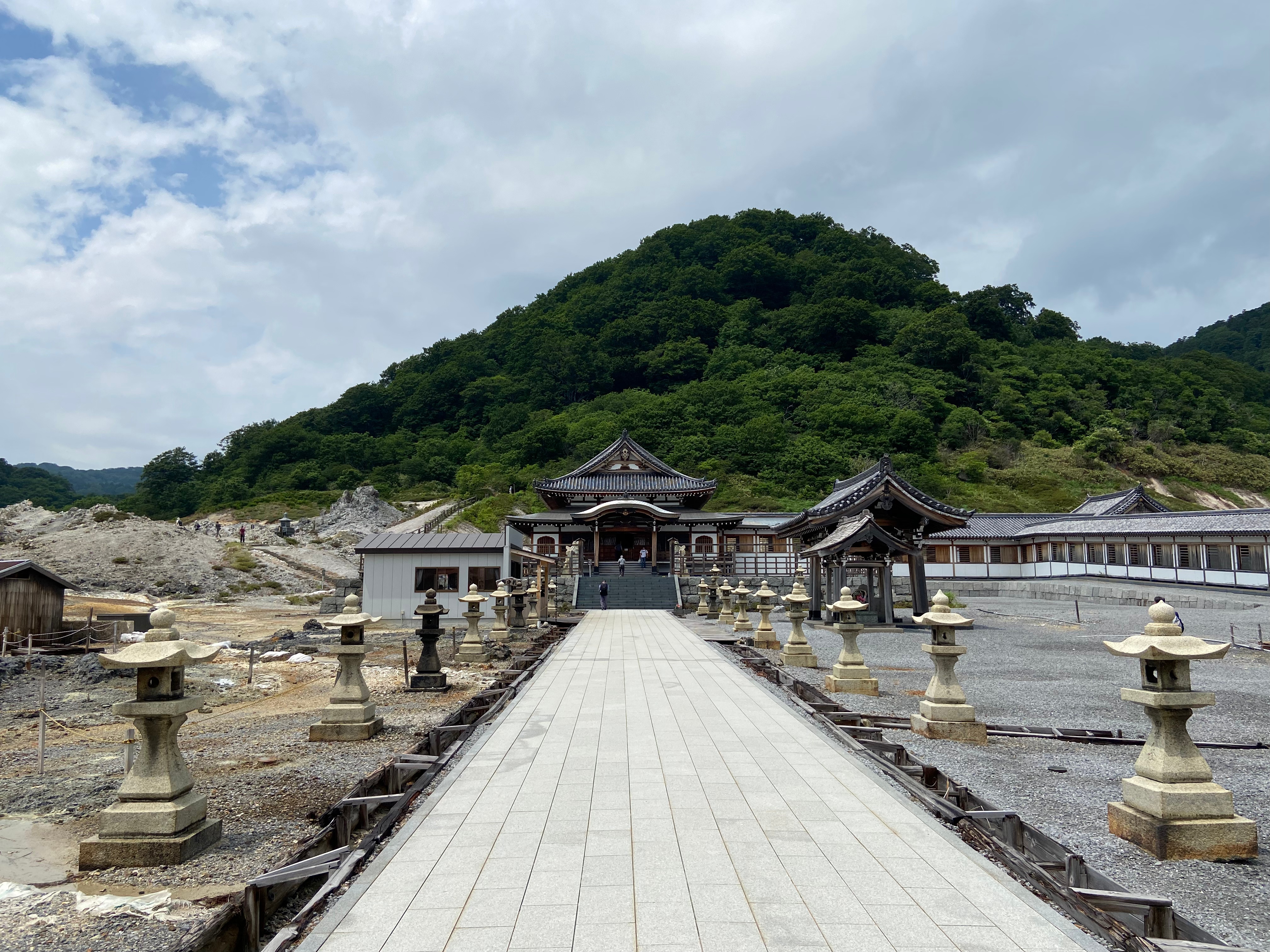
Entrance to Bodaiji Temple at Osorezan, where monks pray for lost souls in Japan’s most haunted Buddhist sanctuary.

As the sky darkens, bruised and swollen with the weight of a coming storm, I take one last look at Osorezan. The myths here aren’t just stories. They are things we carry. Things we live. The demons at the river are the silent battles fought in hospital beds. The pebbles are the burdens we carry and rebuild, again and again. And the river, the slow, black current, is the harrowing divide between despair and hope; a crossing that everyone must face.

I turn away and begin my descent.
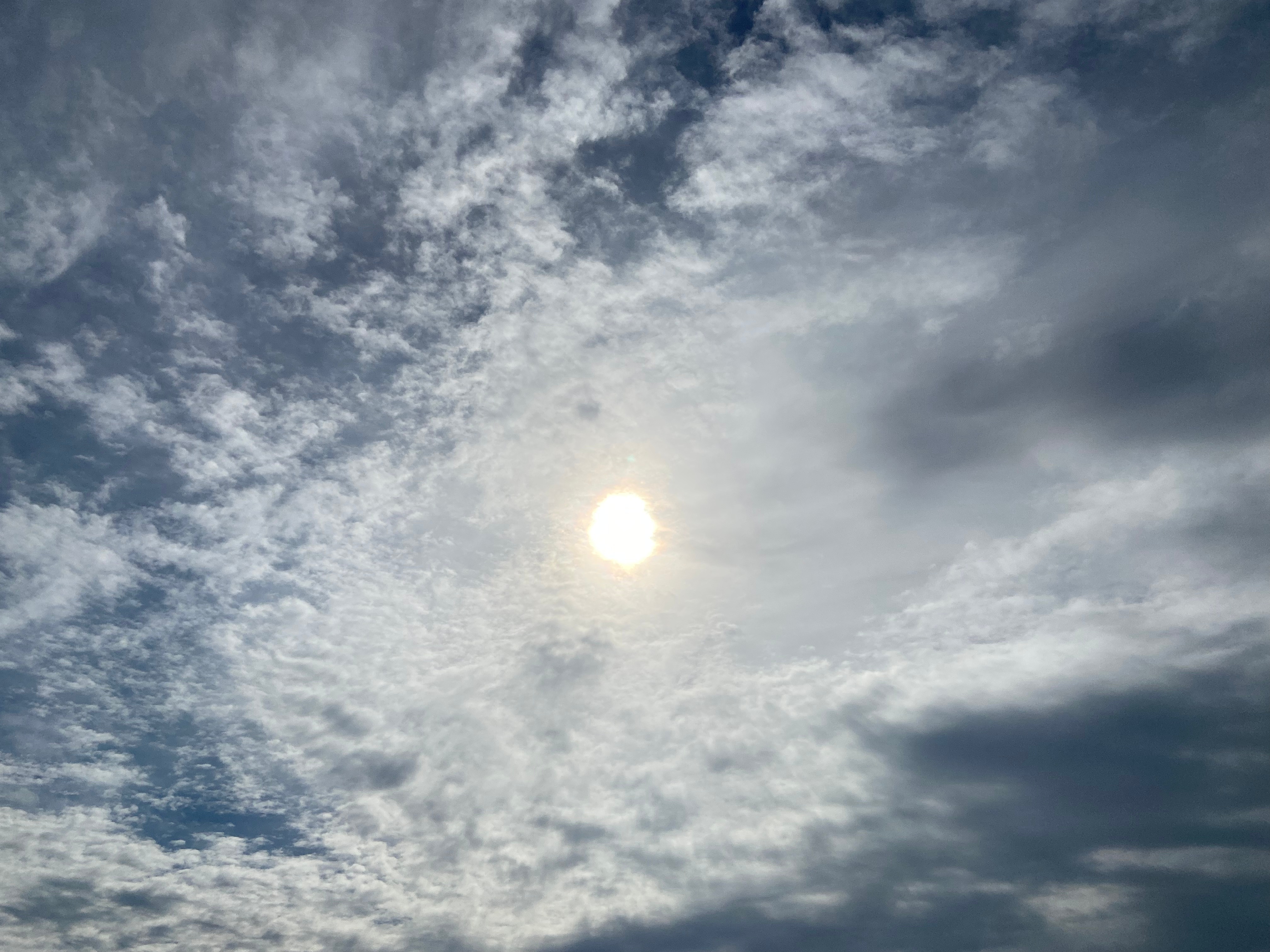
Dark storm clouds gather over Mount Osorezan—an ominous sky reflecting Japan’s Buddhist land of the dead.

Back at my hotel, an old building stitched together with crumbling wallpaper and tired walls, I try to relax, but the lights buzz like a wasp in a lampshade, and the floorboards creak even when I’m not moving, as if something beneath them is shifting.

I turn on the television. The screen blinks to life; the world rushes back in, bright, absurd, relentless. A puppet show flickers on, but the puppets are just human hands wearing tiny masks. They bow, expressionless. The audience laughs. I change the channel. Static hums for a second too long. An old woman in a blindfold stumbles through a collapsing obstacle course. Laughter again, louder this time. The world keeps moving. Always moving. And I am here… still.

I change one last time. A man in a bear costume is balancing ramen bowls on his head whilst a studio audience screams. I turn the TV off. Hell can wait.
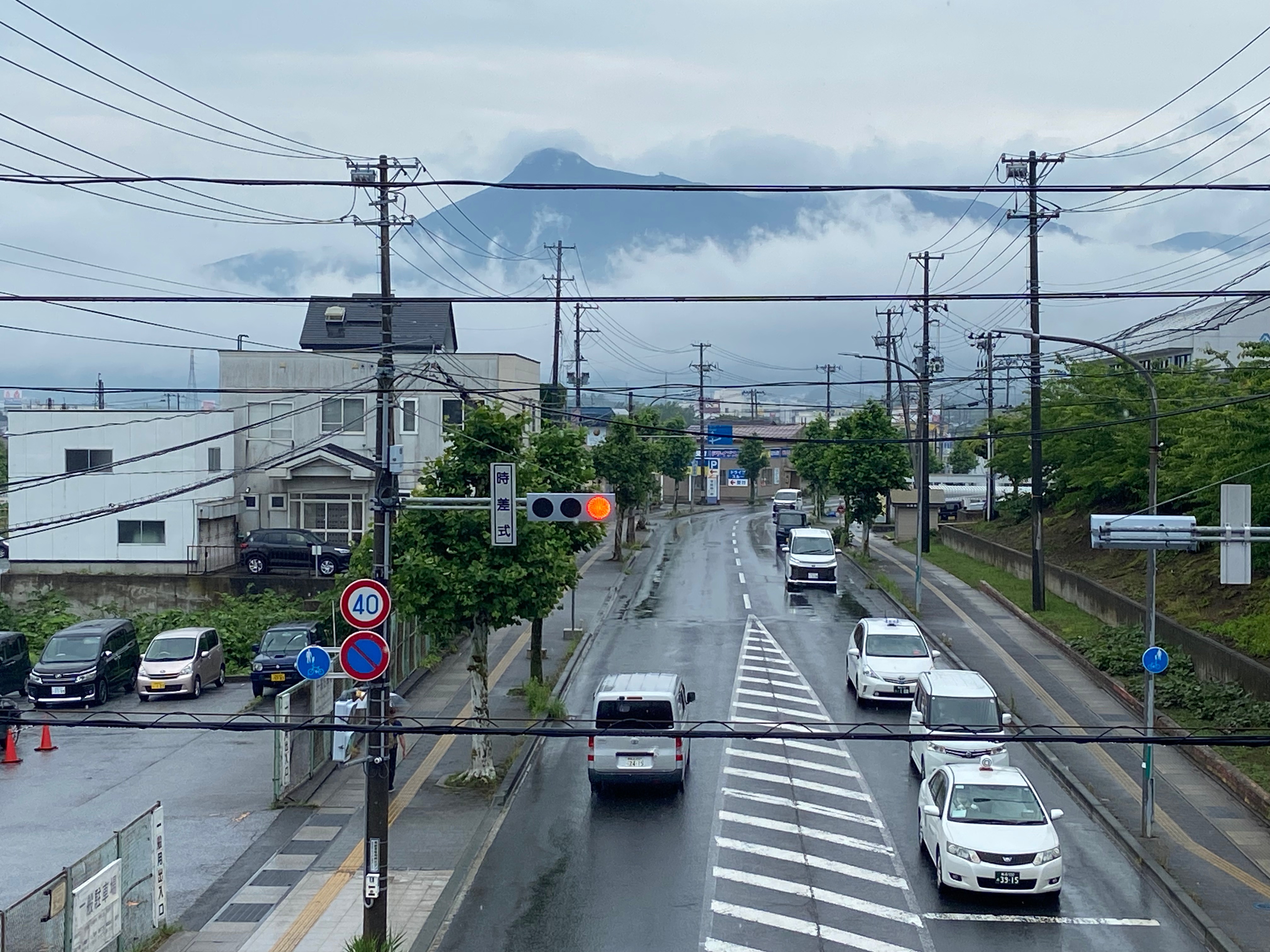
Outside my window, the mountain holds its breath. Somewhere, beneath the floorboards, the dead keep stacking stones.
Show My Gear, the Policeman Said

I am standing in Seven Eleven, queueing up to buy my morning coffee. The man two before me in the queue smiles and nods as our glances cross. I don’t recognise him, yet he keeps his eyes fixed on mine, quietly staring. Eventually, he points to his eyes and says, “Your eyes are blue.” He seems to be in a state of amazement, “Europa?” he asks.
I decide not to correct him, despite me not being from one of the moons of Jupiter. “Yes,” I say, “England.”
He pauses for thought for a time before asking, “Are you happy?” His question catches me off guard, and I have to give it a certain degree of thought. Perhaps I look a little miserable because I am standing in Seven Eleven at 9 a.m. I eventually reply with a yes. “Good, you should be happy, have a nice day.” With that, he pays for his can of beer and leaves the store.

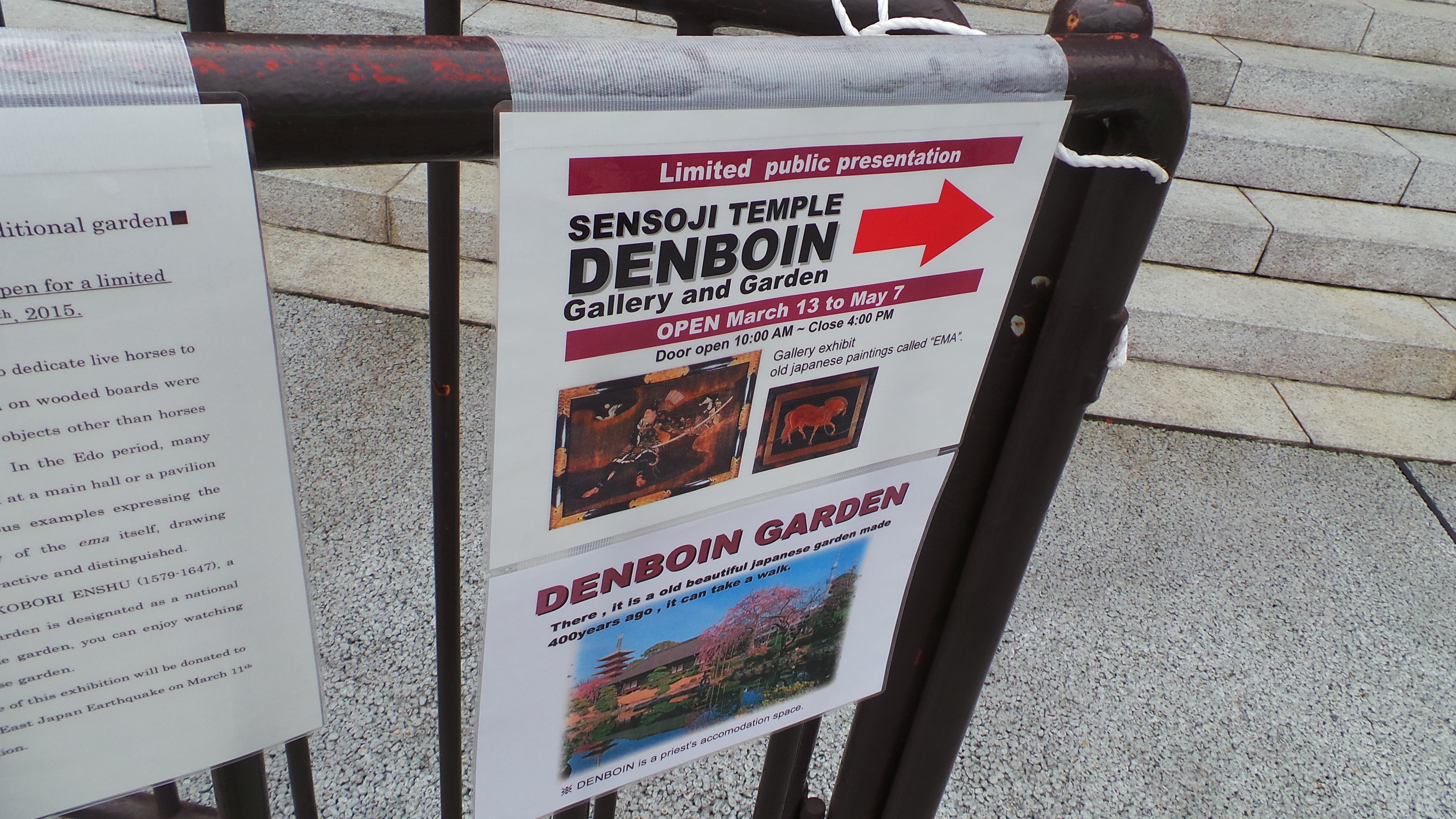
I cycle over to Asakusa, to Senso-ji Temple. To mark the four-year anniversary of the Great East Japan Earthquake, the temple has opened up its secret garden and gallery to the public. ¥300 to enter, and all the proceeds will be donated to support the ongoing recovery. A sign at the entrance says, “There, it is an old beautiful Japanese garden made 400 years ago, it can take a walk.”

takeawalk

I have often seen these gardens on the maps around the temple, and even tried to find them once or twice, but to no avail. Now it is clear to me why; they were a secret. I start queueing just before they open at 10 a.m. Waiting in line once again, but with nobody asking me about being from Jupiter, I stay calm. Eventually, the doors open, and I pay my ¥300 entry fee.

It isn’t just the gardens that are open to the public for the next two months, but also a gallery of artwork depicting samurai and legends. Good quality artwork; dated. No photography is allowed inside the gallery, but for anyone in Tokyo right now or in the coming months, I urge you to visit. It is for a great cause, and the artwork is stunning. After wandering around inside for a time, I head out into the gardens, where my breath is stolen away by the beauty.

sensogard

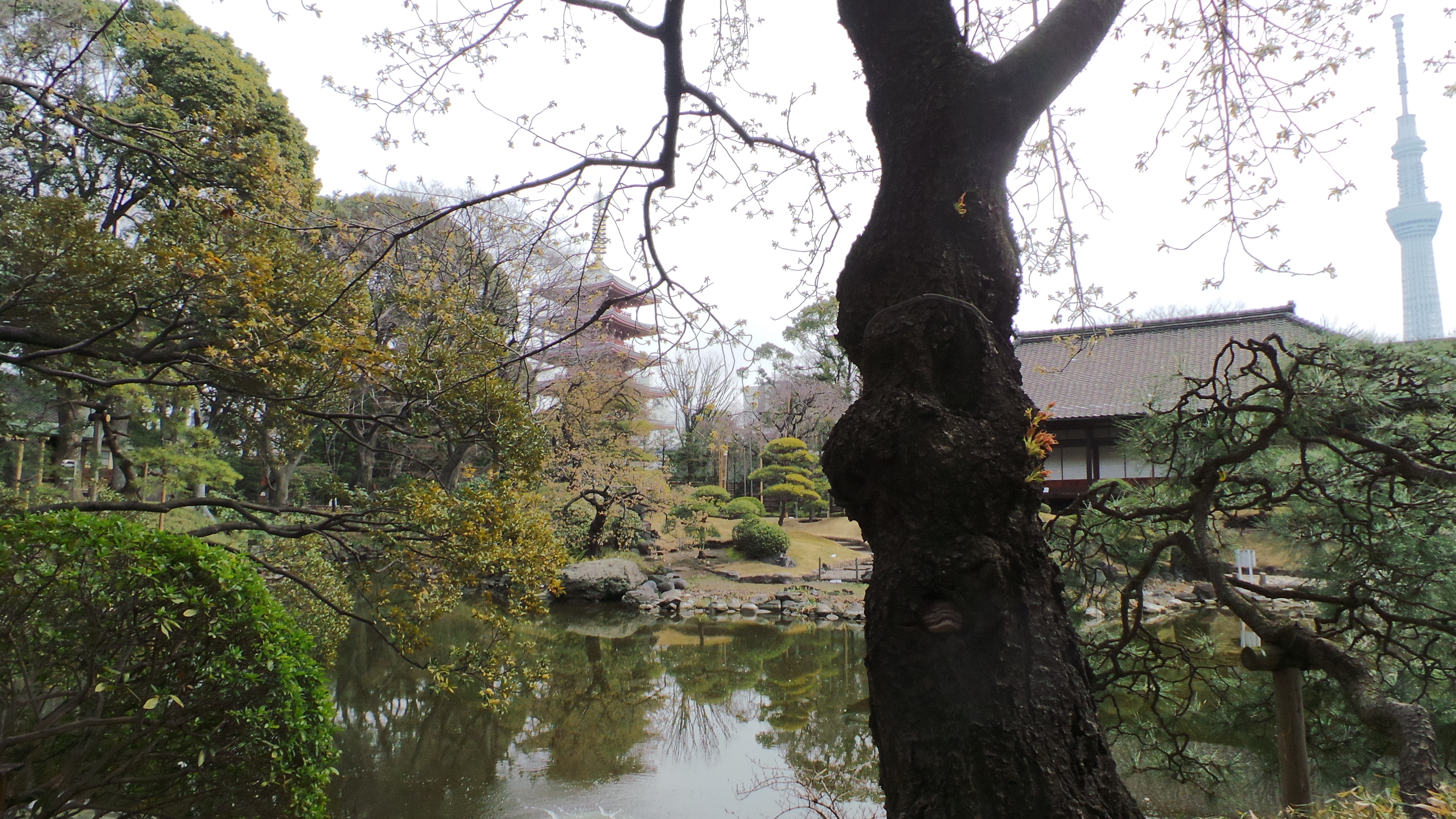
Why these gardens are normally closed is beyond me. Prior to the earthquake, the gardens were visited exclusively by noblemen. One thousand square metres of garden, made by an eminent gardener in the early 17th century, sit behind hidden walls. A small building known as Denbou-in stands in the garden, a place where priests from the temple would train in Buddhist discipline. It also became a lodging place for the many nobles that came here to visit. I wander around the circuit, following the route of the signs, and take great care with the multiple signs instructing me to, “Please stop walking, drink in the garden!”

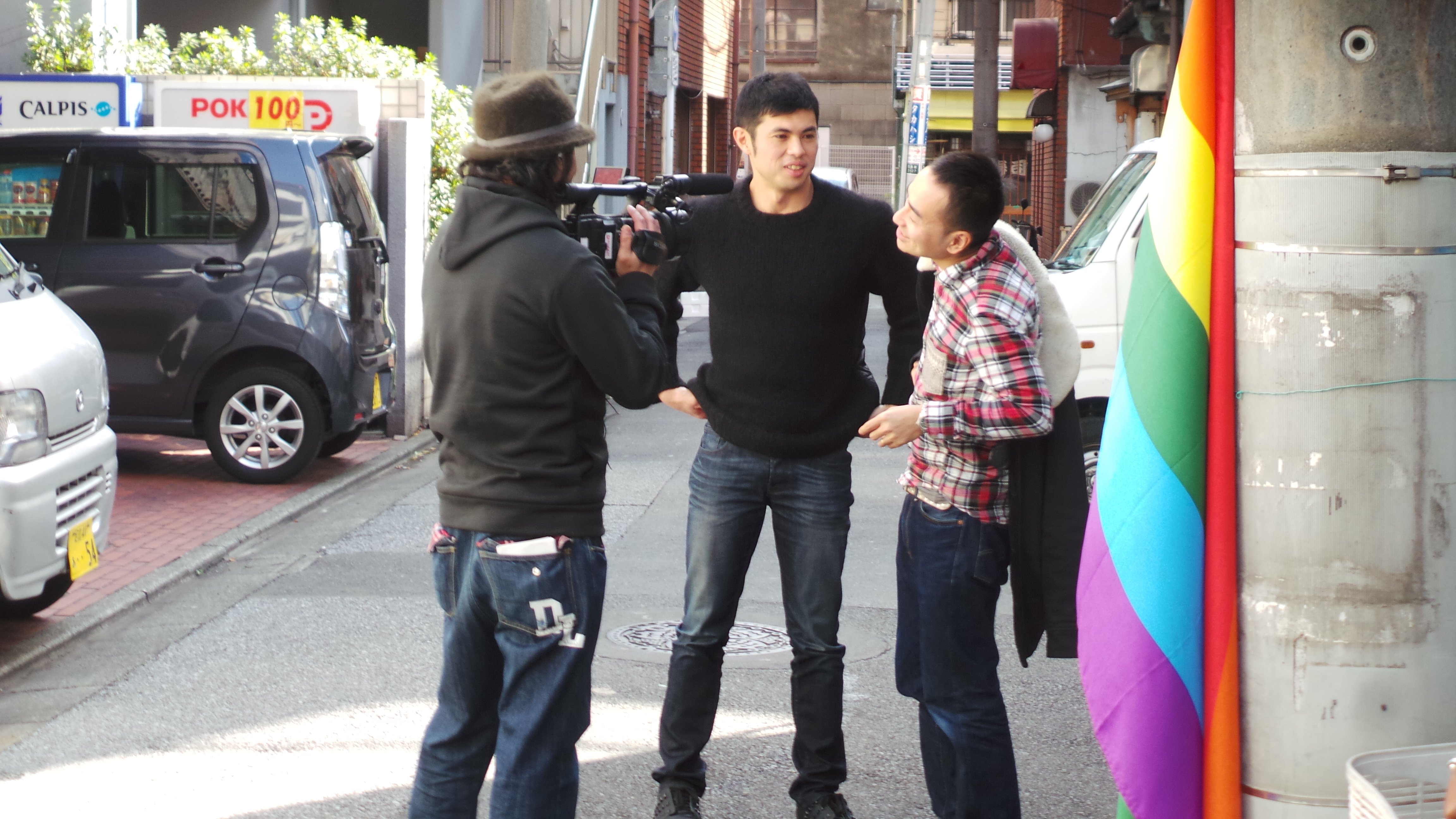
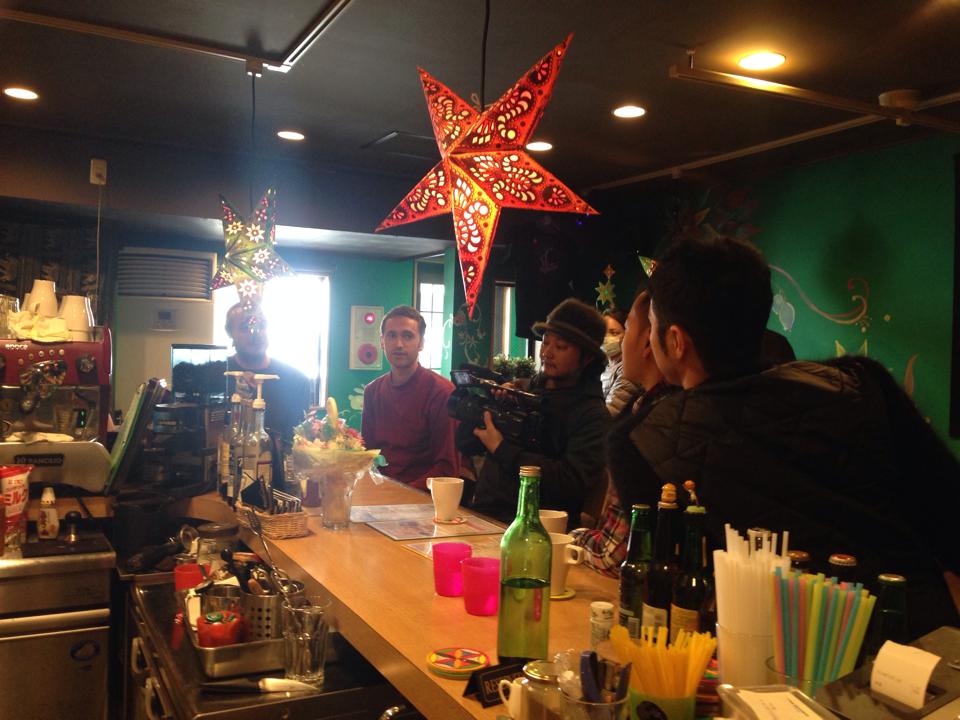
After enjoying the scenery, I head, as usual, to Cafe Byron Bay. Today, I am taking part in a television show starring Yoshio Kojima, a comedian I previously met back in August.

yoshiokojima

The show features a second comedian, Udai Iwasaki. Very little information can be found about this man. Apparently, he won an award in 2013 for being the funniest man in Japan. He is in a comedy group known as Kamomental, which translates to mean Duck Metal, and his blood type is AB. When researching Yoshio Kojima, I am not at all surprised to find a mention of his blood type, a slight obsession in Japan similar to horoscopes. For the record, his blood type is O.

The show is in English and is a tour of Yoshio Kojima’s favourite neighbourhood, Asakusa. “This coffee is very comfortable,” he says, sipping on his latte. Everyone gets interviewed about where they are from or why they came to Japan before Yoshio Kojima treats us to his famous catchphrase, performed again in English. After that, the show ends. I get a chance to talk to the comedians a little after the shooting. Both of them have excellent English ability and are both very nice people.

comedyshowagain

The show will air on CS TV Asahi on either May 10th or 24th, but the television people haven’t decided yet. Overall, the shooting was good fun, but I am not sure how much of myself will be included in the final cut.

I leave the cafe and start walking toward my house. As part of my application process to stay in Japan a little longer, I have to get my photograph taken. I find a photo booth that offers the size of photograph that I require, and after inserting my ¥900, I discover that the booth speaks two languages, Japanese and American. Call me naïve, but I didn’t know that there was a language called American. Regardless, a nice man speaks to me in English after I select this option, photographs are snapped, and finally, I am given the chance to modify my photographs. With summer just a few months away, I opt for the sun tan option. “Your photograph will be ready in nineteen seconds,” says the voice in English. Very precise.

As I near my house, two policemen surround me, and in broken English, they ask me for my identification, look at every card in my wallet, search my pockets, write things down, look at me with suspicion, then they apologise, get back on their one-speed bicycles, and disappear; presumably to harass somebody else. A part of me questions their selection process, and for whatever reason, I become adamant that it has something to do with me being from Europa.

International Food and Beverage Exhibition

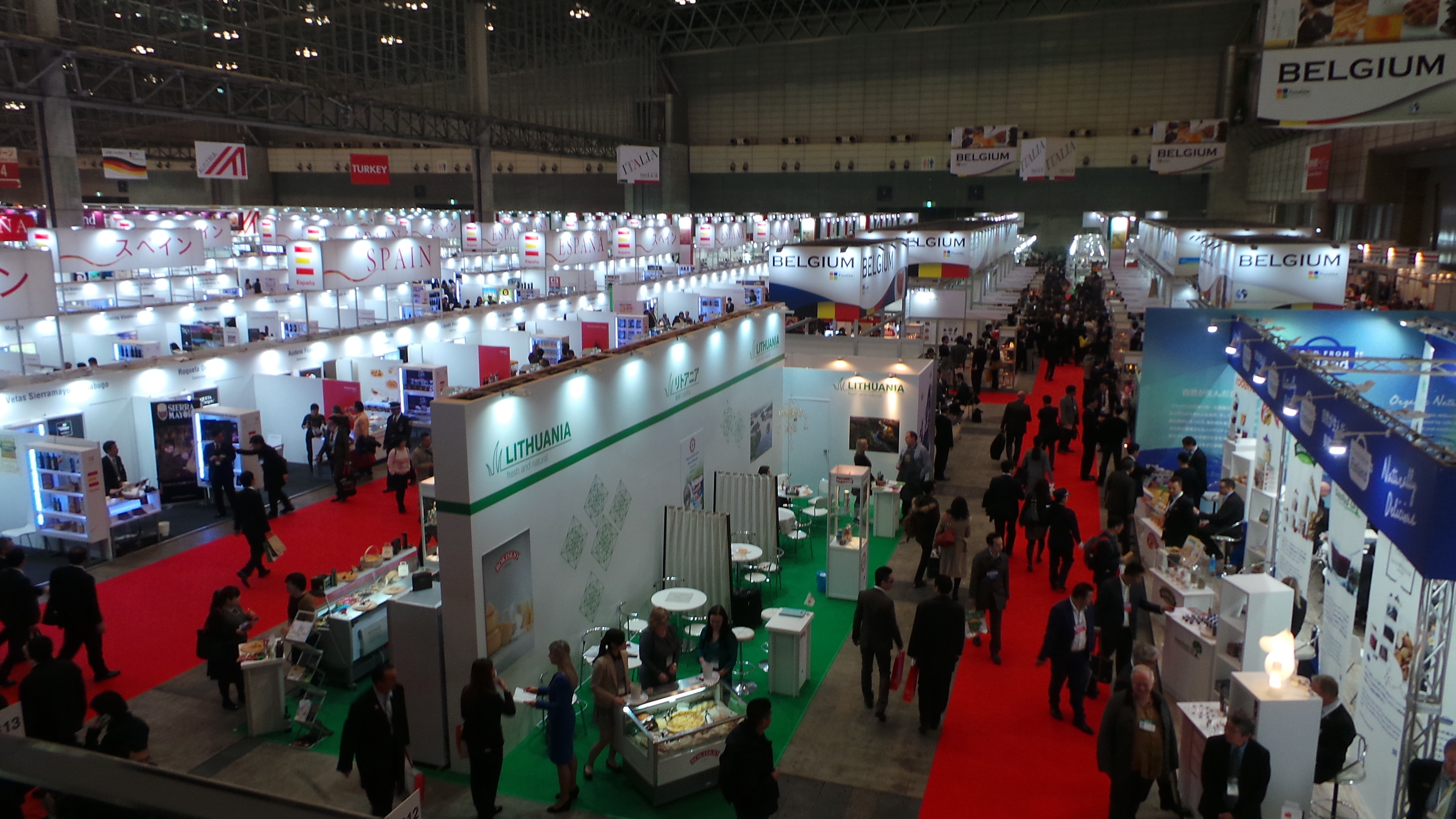
Today, I am at Makuhari Messe Convention Centre for Foodex Japan. In its 40th year, the event stands as the biggest trade show for food and beverage in Asia, featuring three thousand exhibitors from seventy-nine different countries. I received a private invitation, allowing me to hand over a business card at the entrance and receive my journalist pass, thus saving me the ¥5000 public entry fee. The first challenge I encounter at the event is their strict no-photography policy. They even threaten ejection from the event for anyone caught taking photographs, sneaking in animals, or attending solely for free food and drink.

Naturally, I adhere strictly to the rules, refraining from releasing any concealed animals into the exhibition halls or taking sneaky snaps of the event from a balcony above.  And, of course, my primary purpose for attending is certainly not to indulge in the free samples of food and drink offered by the three thousand exhibitors. Today, all food and drink are complimentary, with stallholders actively encouraging me to sample their offerings.

foodex5

I start with cheese. I seldom eat cheese in Japan, so when given the opportunity to be an official judge in a packaging and taste competition, I seize the chance. The competition involves comparing thirty-one cheeses from Japan. Just as I’m about to get serious about my judging responsibilities, the comedian in charge reminds me to take it seriously before asking me to select a wooden stick from a box. “Careful for electric shocks,” the man says, “this is high technology, like a supercomputer.” So much for taking things too seriously.

The cheese I have randomly selected is a Brazilian cream cheese made in Japan. I assess the packaging (somewhat basic) and evaluate the unique selling point of the product (non-existent). Next, I can choose any two other cheeses to rate in comparison. I opt for two cheeses that I’m eager to try. Following the rating, a taste test ensues, providing me with the opportunity to score the flavour and determine the likelihood of a future purchase. Interestingly, the cheese I selected, which appears to be the most expensive among the thirty-one, turns out to be the worst cheese I have ever tried.

After savouring the cheese, I crave a drink, prompting me to head for a cup of tea.

foodex3

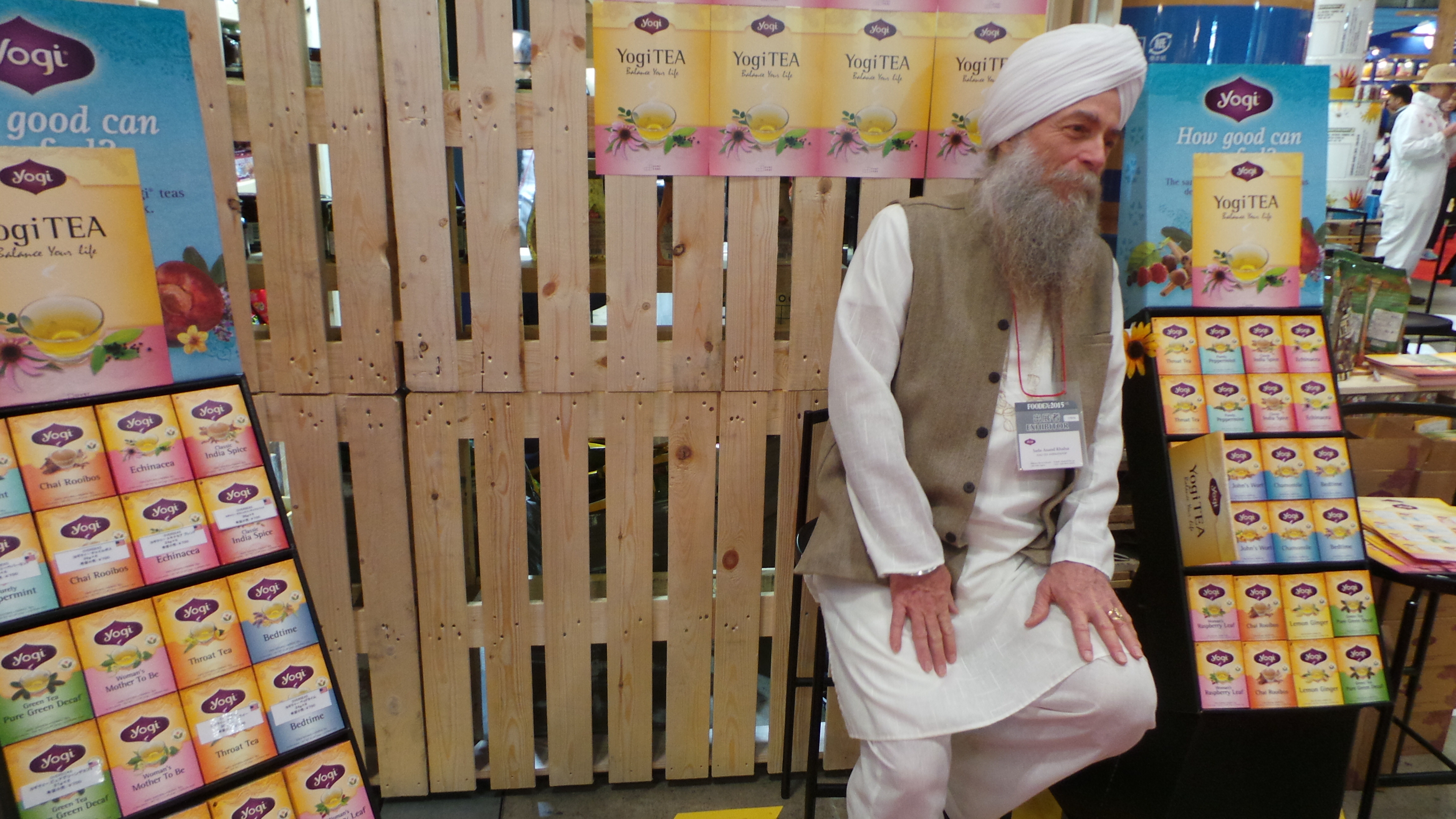
Unfortunately, the Yogi Tea stand offers their sample in the form of a tea bag. No hot water here. I have a chat with Sada-Anand Khalsa, a self proclaimed Yogi Tea Ambassador. His beard is better than mine, and his tea is apparently very wonderful. As I talk to him, he appears distracted, distant, and looks like he is about to fall off his stool. He’s probably had a few too many cups of his bedtime organic tea product, no doubt.

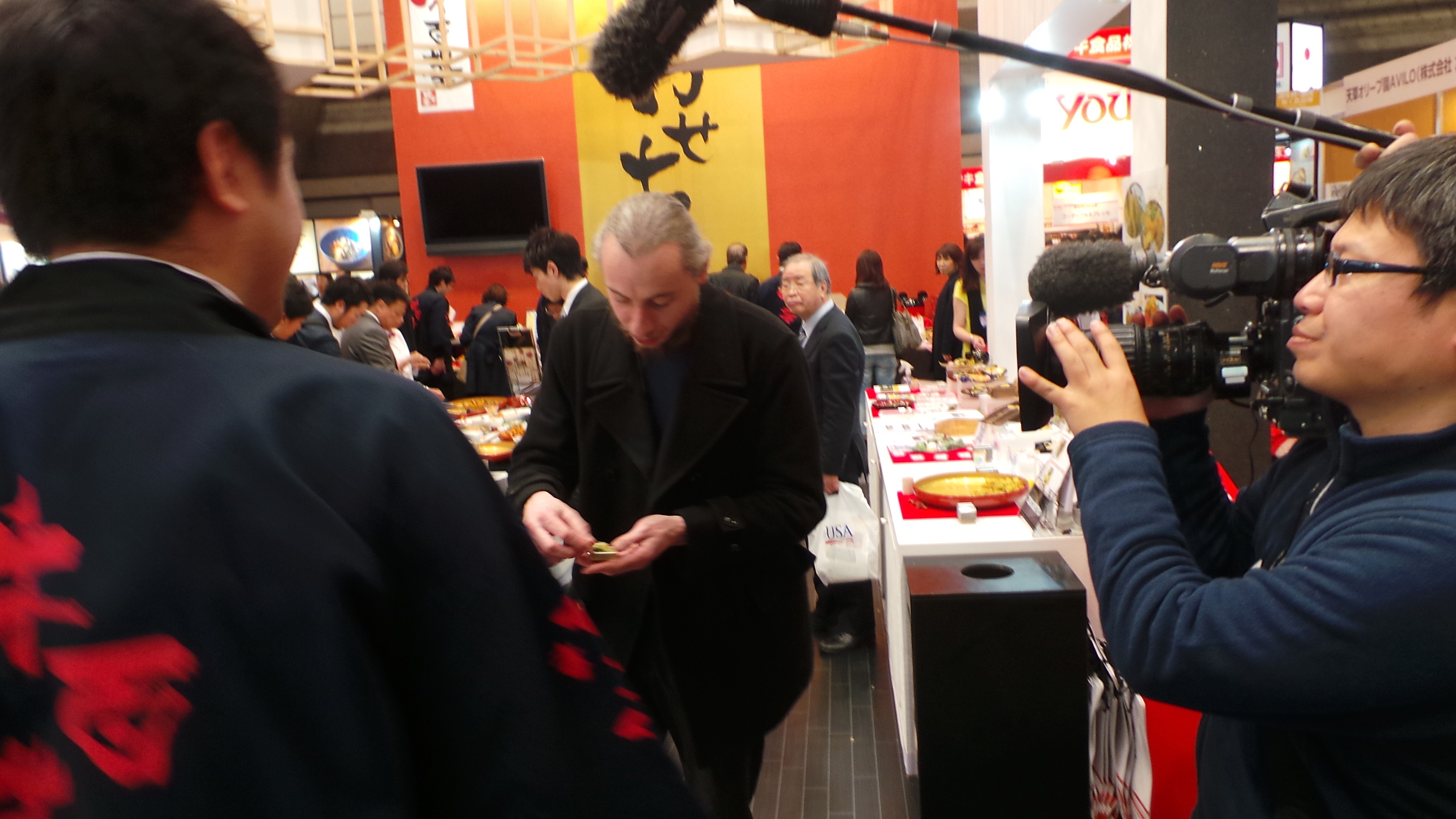
I continue exploring the red-carpeted route, treating myself to devil fruits and açaí berry smoothies. In Pakistan, I’m given the chance to try six-billion-year-old sea salt, and in Egypt, I indulge in some tasty salted peanuts. Upon reaching Japan, I find myself surrounded by microphones and cameras, as I become the subject of a television show—quite ironic, considering the event’s no photography or recording equipment policy. During the interview, I’m asked to sample Japanese food to capture my authentic reaction. However, they choose edamame, a dish I consume almost weekly, making it challenging for me to convey a genuine response to the familiar taste of beans.

foodex2

After the interview, I head to England to enjoy a scone. However, I notice that the stalls here are manned by individuals with uninviting expressions and disappointed faces. Unlike everywhere else I’ve stopped, where warm smiles and polite conversation welcomed me, it’s a different experience in England. Disheartened, I make the decision to leave and never return. Instead, I choose to visit the friendly land of Scotland for some delectable scallops. Later, I make my way to the welcoming Wales to enjoy a sample of a beer I’m already familiar with—Dark Side of the Moose.

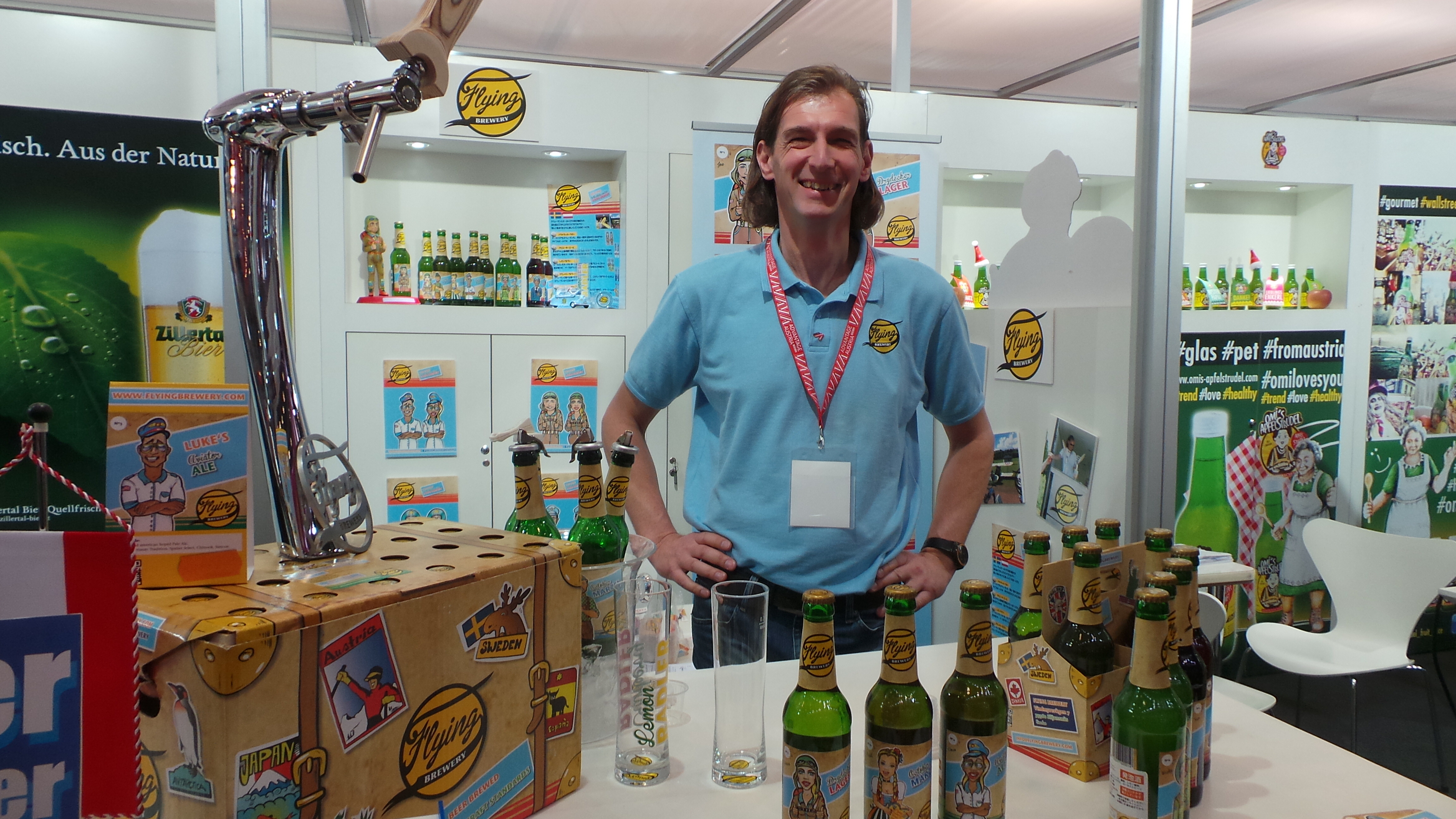
In Austria, I take a moment to chat with a friendly man about beer. The Flying Brewery proves to be wonderful and charming. After expressing a clear interest in sampling copious amounts of their free alcohol, the amiable man turns to his colleague and exclaims, “He wants to try them all!” This marks perhaps the turning point in my day, leading me into the delightful world of free alcohol. The beers here are fantastic, and I relish each and every one. The brewery even gifts me a set of twelve coasters and poses for a photograph. While a part of me considers that the journalist pass around my neck might have influenced their hospitality, another part of me believes that they are genuinely kind and passionate about their craft.

foodex4

With an ever-increasing thirst for beer, I head over to the only place that can satisfy my taste: Belgium. After wandering around in beer heaven for about an hour and sampling familiar delights such as Stella Artois and Hoegaarden, I move on to some of my favourite drinks—Delirium Tremens, Kriek, and Chimay.
“One more glass, sir?” says the man at the Chimay stand.
“Why, thank you, sir,” I reply, feeling very humbled and slightly drunk.

I continue to explore, observing snakes in bottles of miscellaneous liquid and engaging with companies solely present at the event to secure a Japanese distributor. After a bit of stumbling, I find myself in Mexico, enticed by amusingly shaped bottles of expensive tequila.

foodex1

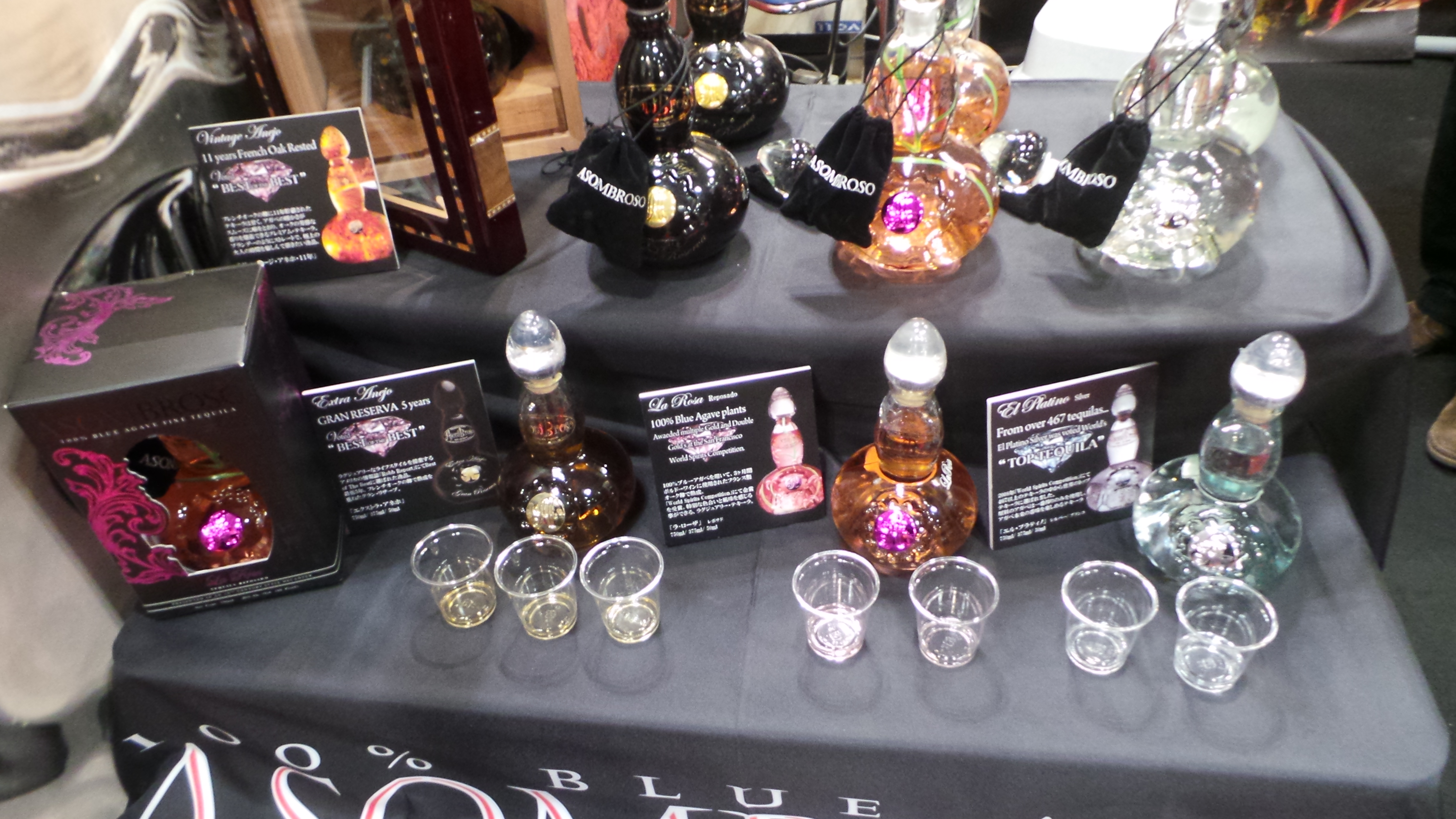
AsomBroso is a luxury tequila from Tequila, Mexico, and one bottle costs around ¥7000. After sampling a small glass, I strike up a conversation with the friendly man manning the booth. A simple mention of the word ‘journalist’ earns me a second glass and an invitation to take a photograph of his display. The tequila is, in fact, the best I have ever tasted—good quality stuff.

In Finland, I chat with a nice lady about the health benefits of bilberry. In Indonesia, I indulge in fresh tuna sashimi. Thailand offers me samples of multiple hot sauces served with various delicious canapés. However, my favourite dish of the day comes from Malaysia—shrimp noodles in a spicy sauce broth that comes with a strong warning: ‘Extremely hot, eat carefully and very slowly.’ As I wander through multiple stores offering sweets, dried fruits, organic chocolate, and health products, I somehow take a wrong turn and end up in Australia. Unfortunately, there’s no attention from the yawning people here, no free samples, only misery.

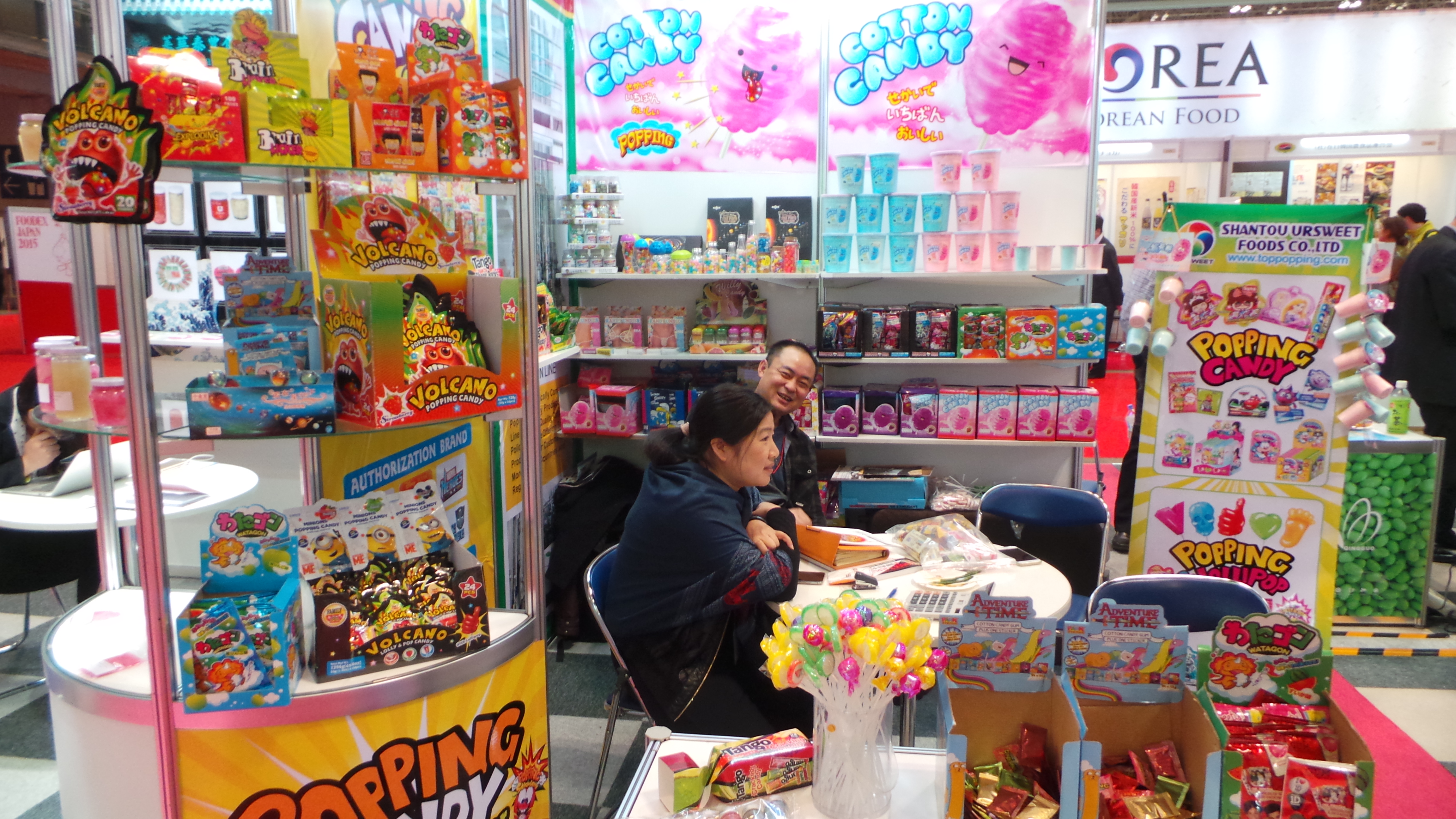
Finally, I explore what China has to offer. I am surprised by the contrast between China and Australia; the politeness expressed by the people here at such a late time in the day, and the complete lack of yawning and misery is a big surprise to me. Everyone wants to speak to me, everyone is friendly, and of course, everyone wants me to try their products. One store I particularly enjoyed was Shantou Sweet House Foodstuff.

foodex6

This Chinese confectioner offers many interestingly named products, such as Brain Licker, Nipple Lipstick Tooth Candy, and Plastic Fruity Sour Sour Stick. “Wait here for a moment,” says the stallholder, following our long conversation about sugar. He returns with a huge bag of sweets, including strawberry-flavoured popping candy that comes with two free stickers.

Leaving China, it feels like I’ve just been on a six-hour tour around the whole world. I exit the event and take the free shuttle bus over to Kaihin-Makuhari Station. For some reason, a woman in the train station hands me a free sample of a doughnut. Free samples are the last thing I can enjoy right now; food is the very last thing on my mind.

foodex7

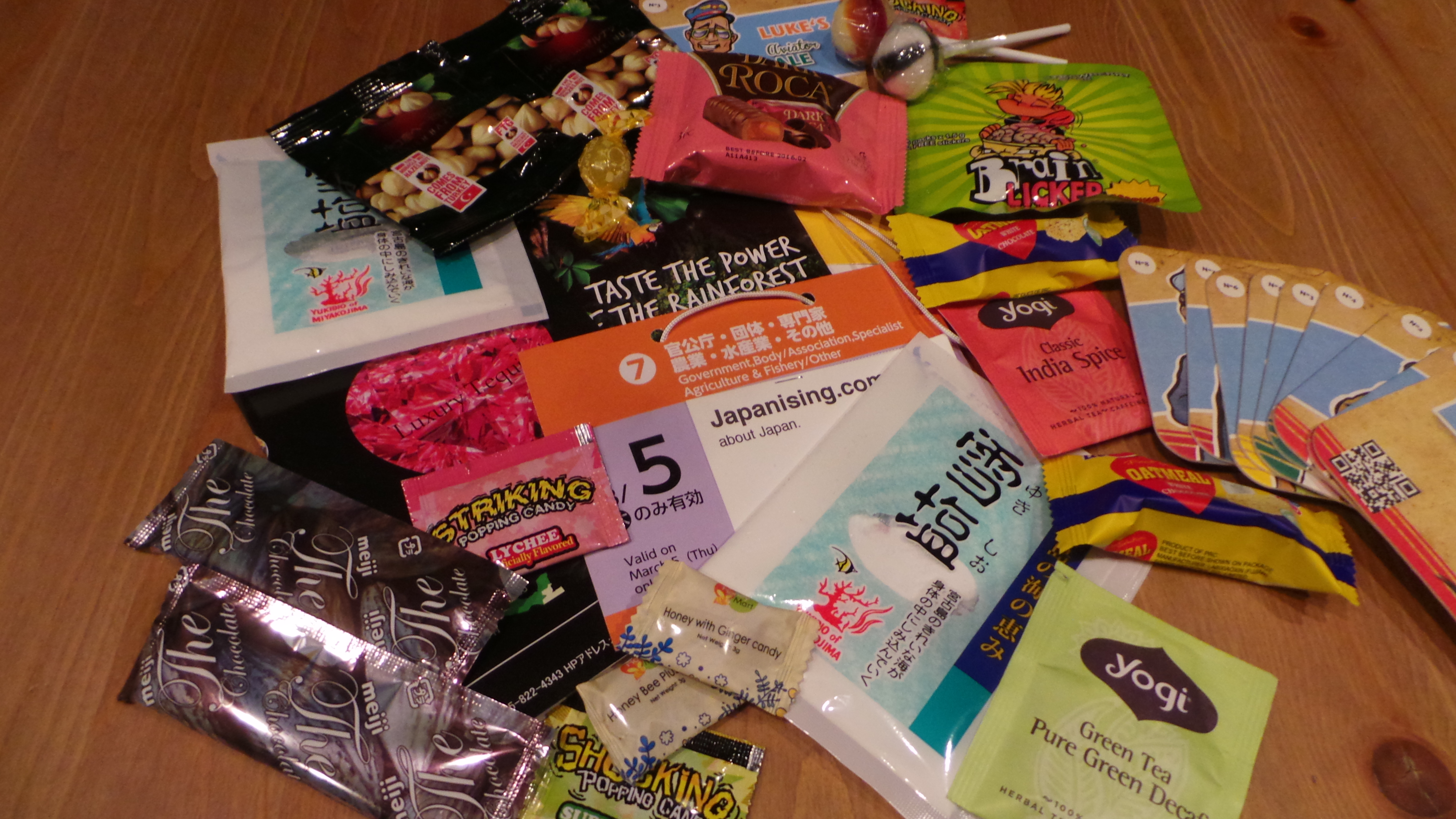
Back at home, as I empty out my full pockets of the many free gifts and brochures, it reminds me of a lost childhood memory of Halloween. I still have an awful lot more food to eat, but I can’t really complain. I enjoyed the event, the food, the beverages, on what has been quite a wonderful day in Chiba.

Japanese New Year’s Eve

New Year’s Eve in Japan differs significantly from the celebrations and lively scenes I’m accustomed to in England. We kick off the evening at our favourite izakaya, where the owner, in his broken English, warmly greets us with, “Good morning this evening.” The atmosphere is festive, with people enjoying drinks and exchanging smiles all around. Among the options on the extensive Japanese menu is ‘Smile, ¥10, limited to ten per day.’ Fortunately, the stocks are plentiful, so I toss the owner a ten-yen coin in exchange for his wonderfully elaborate smile.

The television set above the bar is broadcasting the 65th annual Kohaku Uta Gassen.

NYtelevision[1]

Kohaku is a live talent battle between two teams of musical acts that have had a successful year in Japan. The white team consists of all male artists, while the red team is composed of all female artists. This exclusive, invitation-only event happens to be the most-watched show on NHK every year. Audience members cast their votes, and the only prize is pride for the winning team.

I was thoroughly enjoying a band of male vocalists singing, “La lalalala lalalala,” when out of nowhere, the owner of the izakaya switches channels to watch the latest episode of the popular pirate anime, One Piece. Food is then served to each of us in tiny bowls—traditional Japanese soba noodles, known as toshikoshi soba.

NYfood[1]

Soba noodles are notably thin and long, with the belief that their length symbolises a long life. It is also said that consuming these noodles helps ward off any lingering ghosts as the New Year arrives. The seasoning for the meal is served from a salt shaker crafted from a light bulb. While I’m unsure if this is part of the traditional way to eat Japanese soba, I find it quite appealing.

One Piece comes to an end, and the owner channel-hops, briefly settling on boxing before switching back to Kohaku. On the television, Idina Menzel graces the stage, singing ‘Let It Go.’ It’s quite rare for a non-native Japanese artist to be invited to perform at the event, but given the immense success of the movie Frozen in Japan, her appearance comes as no surprise. It’s at this moment that I’m hit with my first Tokyo Disneyland flashback.

We continue to enjoy our drinks, with people singing along to ‘Let It Go.’ Suddenly, the owner begins handing out gifts in small white envelopes.

NYsheep[1]

Next year marks the Chinese zodiac year of the Ram, or ‘sheep’ as my Japanese friend corrects me. I suppose interpretations vary across countries. The pendant I receive, if I’m completely honest, looks more like a goat. Regardless, I appreciate the gesture and the unexpected gift.

As midnight rapidly approaches, we finish our drinks and take a wander over to Senso-ji for Joyanokane. At the stroke of midnight, a priest will ring the bell 108 times, symbolising the 108 sins of Buddhism. Unfortunately for me, sarcasm is one of those sins. By merely staying and listening to the tolls of the bell, your body and mind are believed to be cleansed—an excellent way to start the year, if only we could get close enough to hear them.

nysenso[1]

It’s incredibly crowded here. People are queueing up to make their first prayer of the New Year. Others are here to shop at the many little food stores lining the route to the temple, while some are here to count down to the New Year. Our purpose is simpler—we are here to listen to the bells. Eventually, as the clock approaches midnight, we manage to get close enough to the temple, arriving at about two minutes to midnight.

The first bell chimes, and we cheer. Suddenly, as if a switch has been flicked, the plastic sheeting over the market stalls starts to shake. A ferocious wind appears out of nowhere, and the temperature drops to the lowest it has been since I arrived in Japan. It’s as if the gods are angry or trying to sleep, with the millions of people here disturbing their slumber.

It will probably take over two hours to queue and make our first prayer of the year, and the cold is too much to bear. We decide to postpone this ritual until tomorrow. Instead, we opt to get our fortunes for ¥100 each. Surprisingly, none of our group receives a bad fortune. I, personally, receive a ‘Good Fortune’ that says, ‘The linen robe turns into a green one.’ I’m not entirely sure what this means, but I presume it implies that I will turn into a kappa.

After receiving our fortunes, we go our separate ways. As I cycle home, the wind almost blows me off my bike.

Twelve Hundred Monkeys

Super Typhoon Neoguri is planning to slam into Kyushu in two days time. Bringing with it rain, wind, high tides, and destruction. Looking at the predicted trajectory, the eye of the storm is where I was yesterday, Nishioita Station. All of last night I was woken up by heavy thunder and flashes of lightning all around me. Since 4 p.m. yesterday afternoon it hasn’t stopped raining. Water on the pavement outside pours downhill toward the ocean. Typhoon ‘Wild Raccoon’ is coming.

eyeofthestorm[1]

On a much lighter note, I spend about half an hour drying my shoes with a hairdryer; before heading to the station. My shoes are still soaking wet. What a waste of time. At Beppu Station the rain suddenly stops and a little bit of sun comes out. I decide that I should probably go to the Monkey Park and Forest Therapy Road, while I still have the chance.

As I wait for my bus a 68-year-old Japanese woman approaches me and asks me the usual questions. “Where are you from?” “What is your age?” “Do you know Elizabeth, the Queen?” She is quite polite about it, however, and I am somewhat relieved when my bus finally arrives. The 68-year-old woman thanks me for that chat, and apologises for bothering me. I reply with my favourite Japanese phrase, “Tondemo gozaimasen.” It is a super polite expression meaning ‘no problem’. She is surprised to hear me say it.

The entrance to Mount Takasaki Monkey Land National Park is at the bottom of a mountain. The mountain is 628 metres high, and the monkeys are about halfway up. I pay my ¥510 entrance fee and begin to walk the rather easy path. There was an option to pay to take a small train to the top, but I would rather walk, immersing myself in the atmosphere of the woods.

monkey_steps[1]

I get to some stairs and there are wild monkeys wandering around all over the place. A sign tells me, “If you look into their eyes, they will perceive this as a threat and they will attack.” Not looking into their eyes is actually harder than you might think. At the Monkey Park there are Japanese monkeys everywhere. Just over 1,200 monkeys, to be almost exact. They wander around by my feet, pretending not to notice me, or just not caring about me being here.

There is a staff member speaking Japanese on a microphone. Randomly all of the monkeys in every direction scream, this occurs maybe every minute or so. The sound is deafening. It turns out I have arrived just before feeding time, and the monkeys are screaming because they know this and want their food.

feeding[1]

A crate of food is brought out and the screams get even more intense. From every direction monkeys run toward the food. The member of staff takes the makeshift wheelbarrow carrying the crate of food, and runs away from all the monkeys. They chase him, jumping into the crate to grab food before jumping out again, satisfied.

The monkeys find their own little private spots to enjoy their food. One sits down right next to my foot and munches on a miscellaneous vegetable; another monkey swings back and forth on a swing. I wander around taking photographs of monkeys before heading back down the mountain. I was hoping to go to Forest Therapy Road, but it turns out that the path up the mountain was the magical healing forest.

swing[1]

The next bus to Beppu is in forty-five minutes time. Not as lucky with the bus as I was yesterday. Through the mask of clouds in the distance I can make out Beppu Tower. It doesn’t look too far away so I begin to walk. Some 4.3 kilometres later and I arrive at the supermarket near my hostel. Inside, I head to a restaurant and have a delicious lunch of raw tuna and fried salmon on a stick.

Back at the hostel I watch the television show that aired on Fuji TV on Saturday, Moshimo Tours. I am on screen during the very opening scene of the show. I also appear in the background at the very end. I was going to share the link but it has already been removed from YouTube. Instead, here is another poor quality photograph of my computer monitor. I promise the next photograph will be better.

moshimoto[1]

After watching the show, I take a bicycle and travel for a few hours with no real destination. It suddenly becomes really foggy in Beppu. I start to head back to the hostel, just as the first few drops of rain begin to fall. I grab a snack (a cake) from Seven Eleven and retire to the hostel computer to research typhoons.

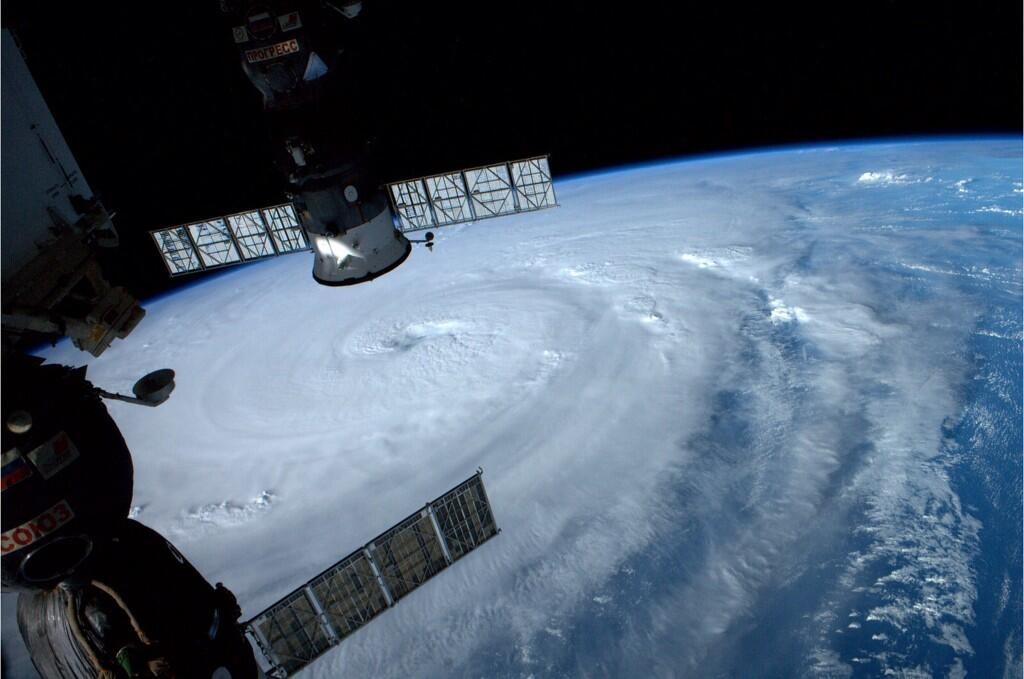
Reid Wiseman is an American astronaut living on the International Space Station. He took this photograph of Typhoon Neoguri. In a few hours it will hit the tiny island of Okinawa. Then a day after that it will come to Kyushu, the island I am on. If its course stays the same, it will pass directly through Beppu.

space

After a discussion with some of the locals, I’m undecided on whether to stay here in Beppu or take the train further north. Beppu has mountains behind it, which might act as a shield against the onslaught of wind. The exact path of the typhoon can easily change. Considering its size, most of Japan is likely to face the worst of it anyway, so attempting to escape it might have the opposite effect.

I think about the people in Okinawa. I also think about the monkeys on Mount Takasaki. Probably two of the worst places you can be during a Super Typhoon; on a tiny island, and halfway up a mountain.