Bach No Senritsu Wo Yoru Ni Kiita Sei Desu

I sign up through Craigslist for an event in March 2015. Bach’s 330th birthday celebration. All day and all night the music of Bach will be played in subways and public spaces. The website specifically states that, ‘Solos, ensembles, flash mobs and Bach marathons are all encouraged.’

Outside, rainy season has started. The unexpected heat wave during my first week here has now stepped aside and the rain has taken over. It will not stop raining now until mid-July. I take a ‘free’ umbrella from the hostel and walk to the boat terminal. Here I take a ¥1580 boat ride down the Sumida River to Odaiba; an artificial island. The journey takes about forty minutes.

BOAT[1]

I see The Goddess of Liberty, a to-scale model of the Statue of Liberty. There is a giant Ferris wheel with no riders and a huge arcade with no customers. It is nearly lunch time and there is nobody else here. A Toyota theme park showcases new vehicles and offers driving lessons and ‘games’. A Shell museum offers not seashells but the history of petrol pumps and petroleum. I am very disappointed.

Japan are preparing for the 2020 Olympic games, and Odaiba, with its large areas of open space, is one of the venues that has been selected. I walk long distances in the rain trying to find the giant 1/1 scale statue of a Gundam robot. I never find it and there is nobody around to ask. I eventually give up and take the train back to Tokyo.

lolympics[1]

For lunch it’s another Cheese Mushi Cake. This one is from Family Mart and is sadly not as good as the one from Seven Eleven. I also have a natto wrap and a bag of the ‘best crisps’, or so I am told by a member of staff at the hostel.

Natto is fermented soy beans. It is a traditional food of Japan and is usually eaten for breakfast. I once read that most people in Japan eat natto but don’t like it, and that they only eat it for its excellent health benefits. My natto is wrapped in rice and seaweed. The smell is overpowering, and the taste is disappointing.

natto[1]

I spend the next hour or so in the hostel until I am in the right place at the right time. The hostel manager approaches me. He says a film crew for TV Tokyo are making a documentary, and are looking to film someone that is staying here for a while. I immediately agree and wait anxiously until the film crew are ready.

The director cannot speak any English but she has brought with her a language interpreter. I am asked to go to the reception so they can film the hostel staff recommending a strange place for me to visit. I already know that we are going to a bird cafe, so I have to pretend I don’t know where I am going; it is all very odd. The crew film me talking to Daisuke at reception. He recommends that I visit Asakusa’s Owl & Parakeet Cafe, before making me laugh with his chicken noises. We film the same scene again, without the chicken noises, and he marks the cafe on my map.

parrot1[1]

The film crew then follow me through Asakusa. I rely only on the instructions from the hostel; I am not allowed to ask the film crew for help. Daisuke’s directions are pretty good though, and I find the bird cafe with relative ease. Once inside I am asked to stroke the birds, play with the birds, feed the birds, and get bitten by the birds. They ask me some really random questions. I am not sure whether to direct my answers at the interpreter or the director, and I’m never really sure which parts they are filming.

Once we finish the interview, we head back to the hostel. Overall the experience was rather enjoyable and I am pleased to have been given the opportunity to be on television. I have no idea which footage they will use for their program, only that it will air at the end of the month.

At the hostel I meet with a few of the nice people that I have spent time with over the last few days; almost all of them will be leaving in the morning and I will once again be alone. A few hours of whisky and beer later and the Thursday night Jazz Club is in full swing. Five of us decide to head out through the soaking and somewhat flooded streets of Asakusa to get some food. Tempura again for the third time this week; I don’t think I’ll ever get bored of it though.

raindrops[1]

After food it’s back to the hostel to catch the end of the Jazz Club washed down with a few cans of Suntory Strong Zero 9%.

In a City of the Future it is Difficult to Concentrate

Breakfast from a Seven Eleven. The quality and selection of food in Japanese convenience stores is amazing. The Cheese Mushi Cake was actually quite pleasant; soft with a very light texture, softer than a sponge cake with a subtle hint of cheese. I wash it down with a blueberry yogurt drink. It is a wonderful time.

MUSHICAKE[1]

Today is laundry day; I grab some of the ‘free’ detergent from the reception and head up to the 4th floor of the hostel. The laundry room here is amazing. It costs me ¥200 to wash my clothes. Also in the laundry room random plugs litter the floor, there is a stone water fountain, and a bathtub full of colourful plastic balls.

I see Daisuke here, he is on his break and just chilling out in the laundry area. I ask him to take my photograph. Afterwards, he starts to pick up some of the balls and begins to throw them at me. We have a ‘fight’ for a short while before tidying up our multicoloured mess.

bathtub[1]

After laundry, I take a six minute train ride to Akihabara Electric Town. I go into a few of the shops looking specifically for models of Final Fantasy characters for a friend back home. In one shop I see Magic the Gathering cards next to the pornography. In another shop the lift is playing House of Cards by Radiohead. Elsewhere in Akihabara, the girl idol band AKB48 are doing a meet and greet, the queue of adult males is insane.

Inside the Club Sega arcade, elderly individuals sit alone whilst playing computer games, while men in suits attempt to win stuffed Pikachu’s from crane claw machines. Outside, a woman dressed in a maid costume hands out flyers for a maid cafe.

maid_entrance[1]

Akihabara is a little too much and the humidity is high today. I begin to feel a little dizzy so I head back to Asakusa. On my way back I see a sign saying, ‘In the stations, please refrain from putting a thing on the floor.’ At the hostel it’s 5 p.m. and Daisuke has just finished his shift. I join him in the lounge for a beer and he once again emphasises that I should go to the Robot Restaurant. Soon, I tell him.

I am invited out for a trip to Shibuya for some sightseeing and food. A group of six of us is randomly formed, including Conor, Grant, and Edwina from previous evenings; and we head out to Shibuya. This time I get the chance to see if people crossing the road looks any better during a busy evening surrounded by neon lights. I admit, it is a little better than the day time, but it is still just people crossing a road.

crosstwo1[1]

There are some quality English signs here in Shibuya. The highlights for me are a restaurant called the Raj Mahal, a dress shop called 1000% Wedding, and a drinking establishment called Gaspanic.

We search a while in Shibuya until we find a restaurant that we all agree on. We buy our meal tickets from the vending machine outside; I order the ‘no pork’ vegetarian ramen and a beer for ¥1380. After ordering we go inside, sit down and hand over our tickets. Eventually our food comes out. It looks pretty good and tastes pretty good. My ramen contains cabbage, spring onions, beansprouts, and noodles in an unidentifiable broth.

20140604_202620[1]

After lunch, the group splits. Conor and the others head off to check out a love hotel. Edwina, Grant and I head back to the hostel. On the train there is a sign advertising Suntory Strong Zero. The sign, for no apparent reason says, ‘Suntory Strong Zero 9% Wash You!’ On the way back to the hostel we stop off at the five-storey convenience store. At the store I buy a 135ml can of Asahi for ¥95. It is the smallest can of beer I have ever seen. I also buy a bottle of my favourite Japanese whisky.

At the hostel we do some drinking. Eventually the others return and we regroup for a few games of cards and some bad magic tricks. The night ends at around 2 a.m. We make plans for the following morning then go our separate ways to sleep.

Niagara Falls and Karaoke!

I am standing in the panoramic observation deck on the 45th floor of the Tokyo Metropolitan Government Building and the view is amazing. I am here with two of the people I was drinking with last night. Daryl, a guy from Tennessee, Ollie, a guy from England, and Edwina, an Australian who we met this morning in the hostel. At the ground level of the building, for no apparent reason, there is a tourist information office selling onions. We leave the Government Building and wander Shinjuku in search of food.

We stop at a random bakery in a train station. I buy two of something that I am told is fish, and some green tea in a bottle for a total of ¥399. The green tea comes with a complimentary tea bag. We walk to Shinjuku Central Park and sit on a bench in front of Shinjuku Niagara Falls. I eat my fish bread, it is very disappointing and I regret purchasing two. After we eat, we wander the park and eventually find a stone gazebo with a bench and table. Ollie randomly has a deck of playing cards, so the four of us sit for a few hours playing cards. It is the first time I forget that I am in Japan.

Niagrafalls[1]

We eventually leave the park, leave Shinjuku, and head back. We stop off at the biggest convenience store I have ever seen, with five floors selling just about everything. I finally find a bottle of 12-year-old Hibiki for ¥4361; they also sell the much rarer 21-year-old Hibiki, for the so low price of ¥17,047; which is about 50% cheaper than back home.

After a brief rest, Edwina, Daryl and I head out for some food. Inside a restaurant we order five or six dishes between us and share everything. We eat deep fried fish paste, deep fried tofu, deep fried squid, deep fried mackerel, deep fried crab, and some delicious vegetable I’ve never heard of before; the vegetable is deep fried, of course. We are also served a complimentary Japanese omelette. The food is really good. It comes to a total of ¥4600 between the three of us.

Omlettandstuff[1]

After the meal we head back to the hostel and regroup with the others. I chat with Daisuke, the Japanese guy that works here. He is making a joke about the check-in time being 3 p.m. at the hostel. He says, “3 o’clock chicken time!” Then starts to make chicken noises. He repeats this joke probably one hundred times, before it starts to get old. He also teaches me a new word, ‘nomihodai’, meaning all-you-can-drink.

Eventually it is time to head out and we take the short five minute walk to the karaoke building. Somehow Daryl has managed to round up a total of 17 people. We are given a private nomihodai room with a wonderful view of the neon Tokyo skyline. In our room there is a phone that calls reception, which is used for ordering beer. We order fifteen beers at a time.

rainbow[1]

We finally figure out how to change the instructions to English, and the karaoke begins. Randomly, Pop is Dead is one of the 22 Radiohead songs available. My rendition of Fake Plastic Trees scores ‘92% accurate rating!’

Pictures are taken and pitchers of beer are delivered to our room every five minutes. We sing, we laugh, we drink. Eventually we are all very drunk. I vaguely remember us all singing Hey Jude, but I don’t remember much else. After what was probably four hours of solid karaoke, I return to the hostel and sleep off an incredible evening.

One Zoo Over; the Panda Impressed

Today I once again decide to stay within the boundary of Taito Ward. Taito is where I am technically living. It is one of the 23 municipalities in Tokyo. It is home to five districts, one being Asakusa and another being Ueno; where I will be heading to this morning. Since arriving in Asakusa I have only ventured out of Taito Ward once, which was yesterday’s trip to the other side of the Sumida River.

I set off from my hostel about 9 a.m. It is 33°C today in Asakusa, and I am incredibly thankful that every building in Japan is heavily air‐conditioned. I start walking, remaining on the same road for ten minutes, before arriving at Ueno. A short stroll later and I am near the entrance to Ueno Park.

The park is home to the Tokyo National Museum and the National Museum of Nature and Science, both closed at the moment; probably because it is Sunday morning. Ueno Park is also home to many temples, statues, art galleries, and a concert hall. I hear a crowd in the distance and decide to see what’s happening. Deeper into the park I walk, until I find the source of the noise, a baseball field. Baseball is a very popular sport in Japan, and a crowd of about forty people gather here to watch what is probably some amateurs practicing. After watching for about ten minutes, I decide to check out the Shinto shrine, Tosho-gu.

Another thing that Ueno Park is famous for is Ueno Zoo. I arrive at the entrance and am surprised to find it is open. I use the automatic ticket machine, with its English option, pay the bargain price of ¥600, and enter the zoo. The zoo is home to many animals, including the Asian elephant, the hippo, toucans, kangaroos, pelicans, puffins, flamingos, crocodiles, the reticulated giraffe, the red panda, and of course the two giant pandas, Siennyu and Shinshin. Unfortunately, the giant pandas are inside an annoyingly reflective glass enclosure making it very difficult to get a good photograph. This one was my favourite:

PANDA

After the zoo, I walk back to the hostel and rest for a while. I caught the sun quite badly and my face is a little red with sunburn. Eventually it is time to head out to get some food.

It’s lunch time in Japan, and most of the restaurants are very busy. I have a desire to eat fish today so take a while wandering around until I see a restaurant with plastic models of sushi and sashimi bowls outside.

The cool air conditioned restaurant is very busy and I am seated opposite a Japanese man. I order a big bottle (660ml) of Asahi, costing ¥550. It is served in the smallest glass I have ever seen; so small in fact, that I probably had to refill the glass no fewer than ten times during my meal. Browsing the menu I notice the restaurant also offers my favourite Japanese whisky, Hibiki. They offer both the 17 year old and the 21 year old for ¥700, much cheaper then back home. I order the tuna sashimi rice bowl set, served with a tofu based Miso soup, Daikon and seaweed. It is delicious. The tuna some of the freshest I have ever had. The food is ¥1550, making the total cost of the meal, a very good value for money ¥2100.

sashimi[1]

On the way back from the restaurant I take a detour through the market streets of Asakusa and see yet more outdoor street performers. The first act features a man playing The Entertainer by Scott Joplin on a keyboard, as a male and female clown play musical chairs. There is no dialogue, just over exaggerated hand gestures and some convincing facial expressions. The duo of clowns eventually invite a woman from the audience to play musical chairs with them. The audience member wins the game, after a large amount of clowning about. The acts finish, pass around their hats, and move aside to let a second act set up.

The second act is a female balloon artist, tap dancer, and comedian. Again, much like the first act there is no dialogue. She is being filmed by two people with professional looking cameras. After making some balloon animals and flowers and doing pranks on the children of the audience, she randomly brings out some bright and colourful boards and starts to tap dance. She then starts doing tricks with her hat; she starts by rolling it down her back, then catching it. Tossing it over her body, catching it with her foot, before flipping it back up into the air, where she catches it in her hand. Next she rolls it up her arm and flips it back into the air before catching it on her head. It is actually very impressive.

20140601_161621[1]

After she is finished, and her hat is passed around, the camera people leave, the performers leave and the crowd disperses. I decide to go for a few beers in the English bar next to the hostel. Here I end up talking to a Japanese man. He asks me where I am from, and I tell him England. “You know Oasis and The Beatles?” He asks. I tell him I don’t like Oasis. The very next thing he asks me is, “Do you know Radiohead?” After about an hour of talking about Radiohead, the Japanese man has to go.

Next an attractive Japanese lady comes into the bar and sits next to me. She is thirty years old and spent 7 years in England as a child. Her accent is incredible. She goes from sounding like a Japanese person speaking English, then her accent randomly changes into a posh sounding London accent, just for the odd sentence or word. After a few beers and a decent conversation, I decide it is time for me to sleep. I ask to pay my bill, which should have been ¥2320, but I am only asked to pay ¥1000. I have no idea who, if anyone has paid for any of my beer tonight. I don’t argue, pay my ¥1000, say goodbye to everyone, and leave.

A Tale of Two Squids

I wake up to the birds cheeping outside and the sun blazing through the window. An early start today in the far too hotter than I’m used to 30°C Tokyo sunshine finds me out and about for 9 a.m. I head across to the bar I had been the previous evening, which luckily for me, doubles up as a vegan and vegetarian restaurant in the day time; and only a 45 second walk from my hostel too. After a breakfast of beans, egg, and toast, washed down with a damn fine cup of coffee, it’s time for a stroll.

I take a five-minute walk to Senso-ji, a Buddhist Temple in Asakusa and the oldest temple in Tokyo. The entrance to the temple is marked by a giant red and white lantern, and probably the largest lantern I have seen in my life. This section is known as Kaminarimon, or the Thunder Gate. Standing either side of the gate are two large statues, the one on the left, I am told, is Fujin, the god of wind; and to the right, Raijin, the god of thunder.

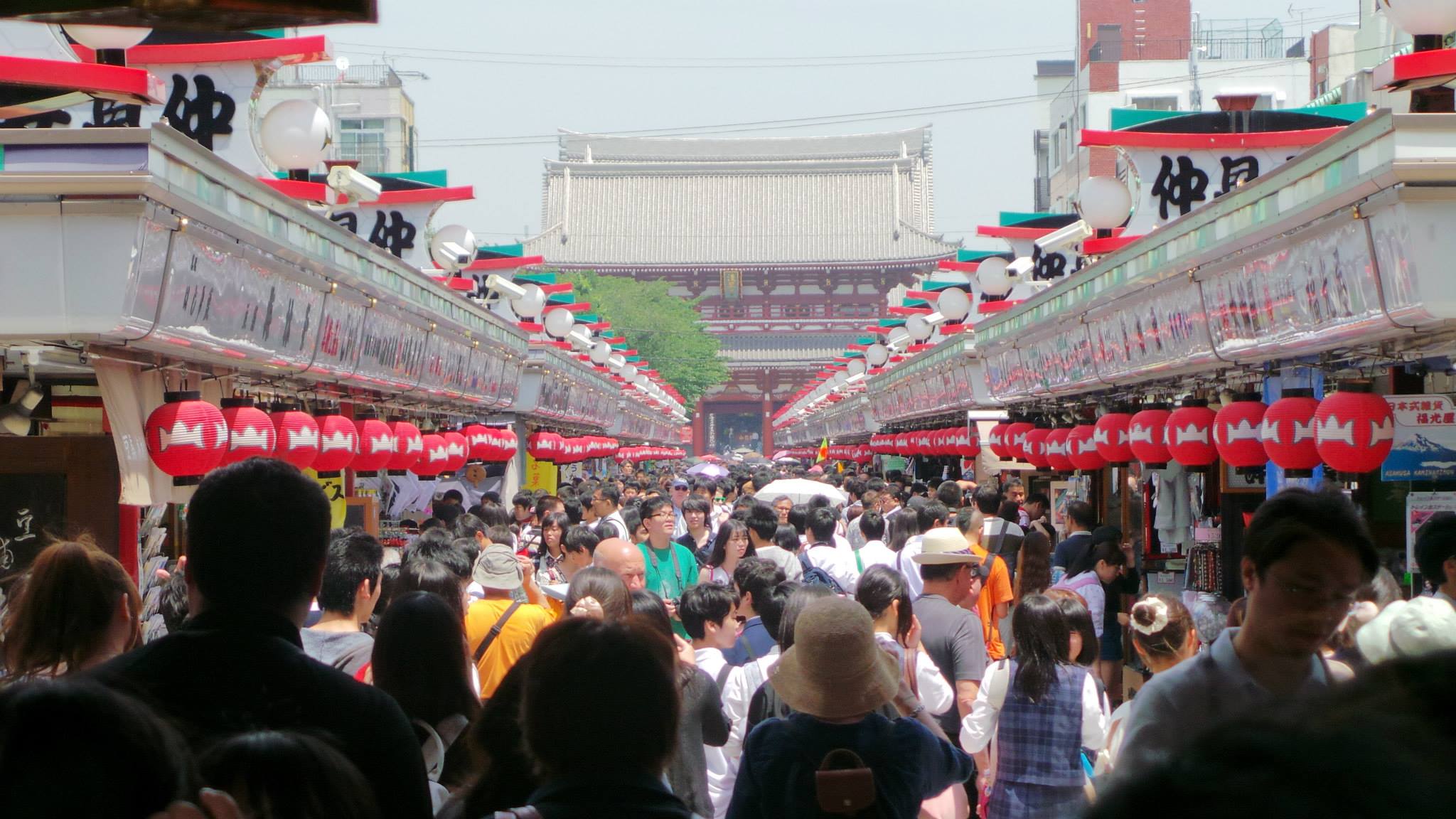
Continuing towards the temple, there’s a line of over 80 stalls offering fans, umbrellas, souvenirs, and an array of food items (bean paste buns and rice crackers seem to be popular today), along with clothing, handbags, and even a stall claiming to sell tortoise shell and coral. Known as Nakamise-Dori, this stretch forms a beautiful lantern-lit pathway of stalls leading to the temple.

senso

In the temple courtyard stands Goju-no-To, a five-story pagoda that stands at 53 metres tall, making it the second-highest pagoda in all of Japan. Prior to the temple entrance, there’s a massive cauldron emitting thick incense smoke. This cauldron marks the threshold before the entrance to the Hondo, or Main Hall. Inside the Main Hall, a striking golden statue of Kannon, the goddess of mercy, awaits. Legend claims the statue was retrieved from a lake in the year 628 AD by two fishermen.

After some sightseeing around the temple, I head to a nearby shaded indoor market. After a short while, I notice a woman who, for no apparent reason, is strolling through the market balancing a bottle of green tea on her head. As she passes by, I stop and turn around to confirm what I had just witnessed – indeed, a woman balancing a bottle of green tea on her head. In the process, I almost get knocked over by a passing cyclist.

Upon returning to the hostel, I start feeling somewhat tired: a touch of jet lag, extended periods of wakefulness, and my newfound, albeit very healthy diet of Suntory Black Boss Coffee being the obvious causes. I opt to take a nap.

I awaken. It’s 8 p.m., and outside, the darkness of the sky has been replaced by the brilliance of vibrant neon lights. I realise that Japan takes on a strikingly different appearance in the evening. I begin my walk back toward Senso-ji, passing by pachinko parlours, game arcades, and brightly lit restaurants that seemed non-existent earlier today. The streets are now bustling with people seated at tables, dining. Shutters down, shutters up—there isn’t a clothing shop in sight; everything has been transformed into restaurants.

restaurants[1]

I return to Senso-ji to witness the Pagoda and Temple illuminated at night—an impressive sight. Strolling back through Nakamise-Dori, almost all of the 80 stalls are now closed with their shutters down. Only a single food stall remains open; it’s time to find something to eat.

I opt for a tempura restaurant that proudly boasts an English menu. According to the menu, their prawns are exceptionally tasty due to being raised using extensive aquaculture—an environmentally friendly method. They exclusively use 100 percent vegetable oil with no cholesterol. Ordering a tempura set with noodles and a pint of Kirin Beer, I indulge in tempura sweet potato, lotus root, squid, and prawn, all served on a bed of rice. While the squid tempura is remarkable, the standout, confirming the menu’s claim, happens to be the most delectable prawn I’ve ever tasted.

tenpura[1]

The meal, including the beer, costs me ¥1060—an incredibly reasonable price indeed.

Deciding to conclude the night back at the hostel, my appetite is thoroughly satisfied. I purchase a few affordable cans of Asahi from the vending machines and head to my room, where I’m greeted by a few fellow roommates. A lady from Taiwan offers me some squid on a stick. ‘Try it,’ she says with a grin, ‘it’s nice and a little bit spicy too!’ For some reason, I agree to give it a try.

Two minutes later, I’m still at the tap, trying to wash away the taste of what must have been the most disgusting food I have ever tasted. The texture was chewy, the taste was off, the regret was apparent.

My second day in Japan oddly mirrored by both morning and evening visits to Senso-ji Temple: walking the same streets once bathed in the brightness of a hot sunny day and then again in the neon-lit darkness of the night; and some food to remember, followed by food to forget.