Street Festivals, Buddhist Temples, Ninjas, and Rubik’s Cubes

I am listening to Clint Mansell’s soundtrack for the film The Fountain as I drink a Yakult based watery yoghurt thing; I don’t really know what it is, except that it is disgusting. I am a little sad this morning, more people I have become friends with are leaving today. I check my messages, I have one from Satoko reminding me about the Oko Ceremony, saying that she hopes to see me there. I receive some good news too in the form of messages from both Grant and Edwina; they are back in Asakusa in a few days time and we will hang out again.

I leave the hostel and walk over the Sumida River to the Hongyoji Temple. Inside, I am seated and given a prayer book and prayer beads, there are about 450 people here. At exactly eleven we start to chant for ten minutes straight; the Temple is so very warm and my mouth is so very dry from the constant chanting. Next, the first prayer is read out and four silent prayers then follow. There is then another ten minutes of straight chanting before the Chief Priest Marakami-san comes out to deliver his sermon.

After the sermon has finished, a woman takes to the podium and reads something in Japanese, it moves her to tears. Next a man does the same. A brief chant concludes the 90 minute Ceremony. I am given a handwritten account of the Chief Priests sermon translated during the Ceremony by Satoko. I am asked by Yoko to please come and visit again, I say that I will. Outside the Temple the rain has finally stopped after a constant 72 hours of downpour. I feel thirsty and exhausted, but also pleased about the overall experience.

guitar_man[1]

I start walking down the road to my hostel, after about 10 minutes on a random street corner I find a festival. I see a man named Kazuma, an artist from Shiburoko playing the guitar and singing very upbeat songs about being happy. I am handed a flyer in Japanese, it reads, ‘Asakusa spirit! Confused Street Live!’ There is also a schedule for the rest of today’s festivities, but it is written entirely in Japanese.

At the hostel I use the Internet to help translate the flyer. It reveals that at 4 p.m. a group called Yunlong Taiko will be playing a Japanese drum show. I bump into Heather, one of two English women I met last night, and we head out for the drum show. After the drumming stops, Heather and I take a walk up to the Sumida River, where we randomly see a man dressed in a full ninja outfit. I say to him, “Ninja!” He pulls his forefinger up to his lips and makes a ‘shhhh’ sound, before casually strolling off.

drums_and_dragons[1]

Back at the street festival the Hero Show is starting. This is a superhero-action-comedy starring Gun Caliber, famous for his live action features. I would explain the story but it genuinely made no sense to me at all. There was a scene where a woman dressed like the Pink Power Ranger came from nowhere and revived the defeated alligator/snake man with a large bag of biscuits. It was all very strange.

At the hostel Andy is still here. He couldn’t get a bus today so will stay in Asakusa at a different hostel for another night. We join Heather and Steffi, and the four of us head out to find a bar twenty minutes walk away that Andy has recommended. We stop off at a Lawson Stores for snacks, and I buy for ¥108 an egg sandwich that says: Making the everyday better. We arrive at Bar Nui and it looks impressive. It is a public bar on the ground floor of a hostel. ‘Bar opening times: 18:00 – 26:00’ boasts a sign outside. Inside, I order the ‘big beer’ and am handed a massive 1 litre jug of Asahi, and a bill for ¥1000. Eventually I switch to The Macallan 12 year old at ¥700 a time.

lightbulb_moment[1]

Heading back to the hostel I realise that I had left my umbrella at the Lawson Stores on the way to the bar, so we stop off there; I am pleased to find that my umbrella is still intact. Andy and I buy cans of beer at Lawson Stores, just so we can walk down the street drinking alcohol in open containers, no outdoor drinking laws here! We pass two trouserless businessmen with ties around their heads. They insist on high-fiving us as they pass.

My night ends in the hostel listening to an in-depth and incredibly nerdy conversation between Andy and James about the algorithms and patterns used in solving the Rubik’s Cube. Andy claims that he can solve one in under 1 minute and has his Dayan Speed Cube in his bag at the other hostel. I am very disappointed that this has only come up in conversation on his final night.

Coincidences, Strangers, and Stranger Coincidences

I wake myself up screaming in pain. I have cramp in my left leg and I’ve just woken everyone up. Not the best start to the day. I have a shower, get dressed, then stumble to the lift. Researching cramp, Yahoo Answers tells me that I need to drink more red wine, add more salt to my diet, and eat less bananas.

At the hostel I meet a freelance journalist from Canada. Her name is Aaliya. It is her first day in Japan, so I offer to give her the tour of the area. We walk to Senso-ji where we both receive an o-mikuji fortune. Aaliya gets The Good Fortune; it says that the ‘patient will not get well soon, but will escape death.’ I hate to think what the bad fortune is like. I receive The Best Fortune.

best_forutne[1]

After a stroll around Asakusa, we take the Tokyo Metro Ginza Line to Shibuya. A short walk from the station and we arrive at the famous Shibuya Crossing. There are three massive television screens mounted on buildings, they only show advertisements. We decide to go into the Starbucks Coffee shop for a better view of the crossing. I later find out that this is the busiest Starbucks Coffee shop in the world.

Overall, I find Shibuya Crossing to be quite underwhelming. It is literally people crossing a road. How this became a famous tourist attraction, I have no idea. After we take photographs of people crossing a road, we walk around Shibuya for a while. We notice a neon sign saying ‘CAT’ and decide to check it out. It is, of course, a cat cafe; a place where you have a cup of tea surrounded by cats. Unfortunately, they only allow two people in at once for thirty minutes at a time; there are two people already waiting, so we decide to leave.

crossing1[1]

After a walk around Shibuya, we change to the Yamanote Line and head to Akihabara. Here we get some food. Tempura again today, two prawns, squid, sand borer, and scallop served on rice with seaweed. ¥1280 with a pint of beer. After a look around a few of the shops in Akihabara, we head back on the train and return to the hostel.

Radiohead are playing on the speakers in the hostel lounge. There is also a film crew here interviewing people for Japanese channel TV Tokyo. I hang out in the lounge with a couple of the hostel staff who have just finished their shift for the day. One of the staff members recommends that I check out the Robot Restaurant in Shinjuku, another recommends I eat at an Alcatraz themed restaurant. I note both down as options for another day.

I hang out for a while longer with one of the guys that works here; he is genuinely hilarious and I can see myself becoming good friends with him. We joke about forming a Japanese manzai act together; a style of traditional comedy here in Japan involving two performers. He says that if I want to I can work at the hostel for three hours a day, cleaning, in exchange for a free room. A lot of backpackers do this, apparently.

After a light snack of salmon teriyaki, I head out to an izakaya pub with Aaliya and two of her friends from the hostel, James and Matt. Here we drink for a while, sitting outside and enjoying the warm evening and a light breeze. Eventually the three of them head back to the hostel; they have to be up at 3 a.m. to catch a taxi to the Tsukiji fish market. I decline the invitation to join them; I will be not be getting up that early.

izaka[1]

I wander alone around Asakusa at night, taking my time, taking photographs and taking in the neon lights. When I get back to the hostel, I grab a beer in the lounge. I hear a man talking about Shane Carruth, director of Primer and Upstream Color. I am surprised to hear his name. I join the conversation and it transpires that we have both read Shane Carruth’s script for his abandoned project, A Topiary.

The man says that another director he really likes is Zal Batmanglij, I am also a huge fan. I find it very odd. The conversation naturally turns to Brit Marling and Mike Cahill, and the coincidences continue. This is probably only interesting to me, but it seems that all of my favourite people, artists, authors, and musicians keep being mentioned. I didn’t say so in my blog a few nights ago, but the Irish guy staying in my hostel room, his favourite author was the same as mine, Iain Banks. He was also reading a different book by the same author as me, Haruki Murakami. I find it all very strange.

I stay in the hostel lounge and spend the rest of the night drinking with some random people. Two of which are from England. There is talk of a group karaoke trip tomorrow, which I really hope goes ahead. The rest of the night becomes a bit of a blur, and I retire to my room just before 3 a.m. Meanwhile, the others wake up to visit the fish market.

Penguins, the Universe and Everything Else

Once again it is very hot. The hottest day so far this year in Tokyo. A stroll along the Sumida River and into the city of Sumida signals the start of my Saturday. I start by heading towards the tallest tower in the world. Eventually I arrive at the base of Tokyo Skytree; here is an area known as Tokyo Skytree Town. It is full of souvenir shops and restaurants. There are plenty of tourists here today; 9 days ago was the two year anniversary of Skytree’s completion, and it seems the celebrations are still going on.

My initial plan today was to head to the top of Skytree and take some incredible photographs of Tokyo from the observation deck, but instead I see a sign for the Sumida Penguin Aquarium and my interest is piqued. I walk up to the ticket booth. “How many people?” I am asked by the lady at the counter. I make a deliberate point of looking over my own shoulder and around into the deserted space behind me, before indicting that it will be just one. I hand over my ¥2050 and enter the aquarium.

The first level of the aquarium is dedicated to living aquascapes, a word I heard for the first time yesterday, and will no doubt hear again tomorrow. The aquarium is quite small but does have some interesting things to see, most notable are the jellyfish and sharks. The highlight for me, however, is the aptly named ‘Animals Enjoying Water’ section. This is home to fur seals and loads of penguins. They seem to be enjoying the water.

Penguin[1]

After leaving the aquarium and deciding that half an hour is too long a time to be queueing for Skytree, I decide to check out Sumida Park. I don’t make it to the park though, as along the way I am randomly stopped by a Japanese lady who hands me a flyer and says, “Would you like to come and see our Temple?” I accept her offer and she guides me across the road to the Temple.

The Temple is home to a branch of Nichiren Buddhism called, Shoshu Buddhism. I am invited to sit down in front of a beautiful alter, but unfortunately I’m not allowed to take photographs inside the Temple. Three more people join us, one man and two women. One of the women speaks very good English, and so we sit and she tells me the story and history of how this branch of Buddhism began and what it means.

Next I am given prayer beads to wear across my hands and invited to chant with them. “Nam-Myoho-Renge-Kyo,” repeat three times. After we chant, I sit for a while longer discussing their beliefs. They ask me if I would come to their Buddhist ceremony in eight days time at the Temple. I accept their invitation and we chant one more time before leaving the temple and saying our goodbyes.

On the way back to the hostel I see a blindfolded street juggler. He manages six balls at once and gets quite the applause from the large crowd that has gathered around. Then I see a man on stilts dressed as a dragon, but with a white painted face and a terrifying smile. Finally I see a woman in a bright red suit and matching hat, she is wandering around one of the many markets playing the accordion and being photographed by just about everyone.

My intrigue leads me to the sound of a beating drum, and I soon arrive at a random pole lantern festival in the middle of a crowded street. The performers here balance massive 12 metre tall lantern poles on their palms, foreheads and backs; while other participants hit drums, play flutes and get the audience to clap and sing chants of encouragement. These lanterns are usually lit with candles, but it is the middle of the day, so perhaps this is just a practice for a performance later tonight.

matsuri1[1]

After the festival has finished and the performers have left, I head back to the hostel for a beer and a short rest.

A few beers later and I need food. I think about risking the hot food vending machine, but it only sells ‘Casual Hot Foods.’ Instead I head back out into the burning hot streets of Asakusa, and take the ten minute walk to a one Michelin starred sushi restaurant. It is closed. I think about waiting for two hours for it to open, instead, I decide that I will come back here another day, and to see what else is in this area.

The next street from the restaurant features a market selling plants and shrubberies. The market is huge and spans far off into the distance. There are even people in uniforms specifically here to direct the traffic. There are not many restaurants though, so I head back towards the middle of Asakusa, and I am so glad that I did.

crazymime[1]

I get to see this guy. A random mime promoting Pantomime Week here in Tokyo. His show is in Japanese, but is easy to understand as it is mostly body language. I stay and watch the whole fifteen minute show and find it hilariously funny. After he is done, I throw some money in his hat before heading off to finally get food.

I decide on a little Italian restaurant. I know it isn’t Japanese food and I’m not in Rome, but I am longing for something familiar after a crazy few days. I decide on a tuna, eggplant, and oregano pizza. It costs ¥1450, and tastes somewhat average. The restaurant also sells small bottles of Asahi for ¥600, which is far too expensive. After food I head back to the hostel to sleep off a very busy day.

A Tale of Two Squids

I wake up to the birds cheeping outside and the sun blazing through the window. An early start today in the far too hotter than I’m used to 30°C Tokyo sunshine finds me out and about for 9 a.m. I head across to the bar I had been the previous evening, which luckily for me, doubles up as a vegan and vegetarian restaurant in the day time; and only a 45 second walk from my hostel too. After a breakfast of beans, egg, and toast, washed down with a damn fine cup of coffee, it’s time for a stroll.

I take a five-minute walk to Senso-ji, a Buddhist Temple in Asakusa and the oldest temple in Tokyo. The entrance to the temple is marked by a giant red and white lantern, and probably the largest lantern I have seen in my life. This section is known as Kaminarimon, or the Thunder Gate. Standing either side of the gate are two large statues, the one on the left, I am told, is Fujin, the god of wind; and to the right, Raijin, the god of thunder.

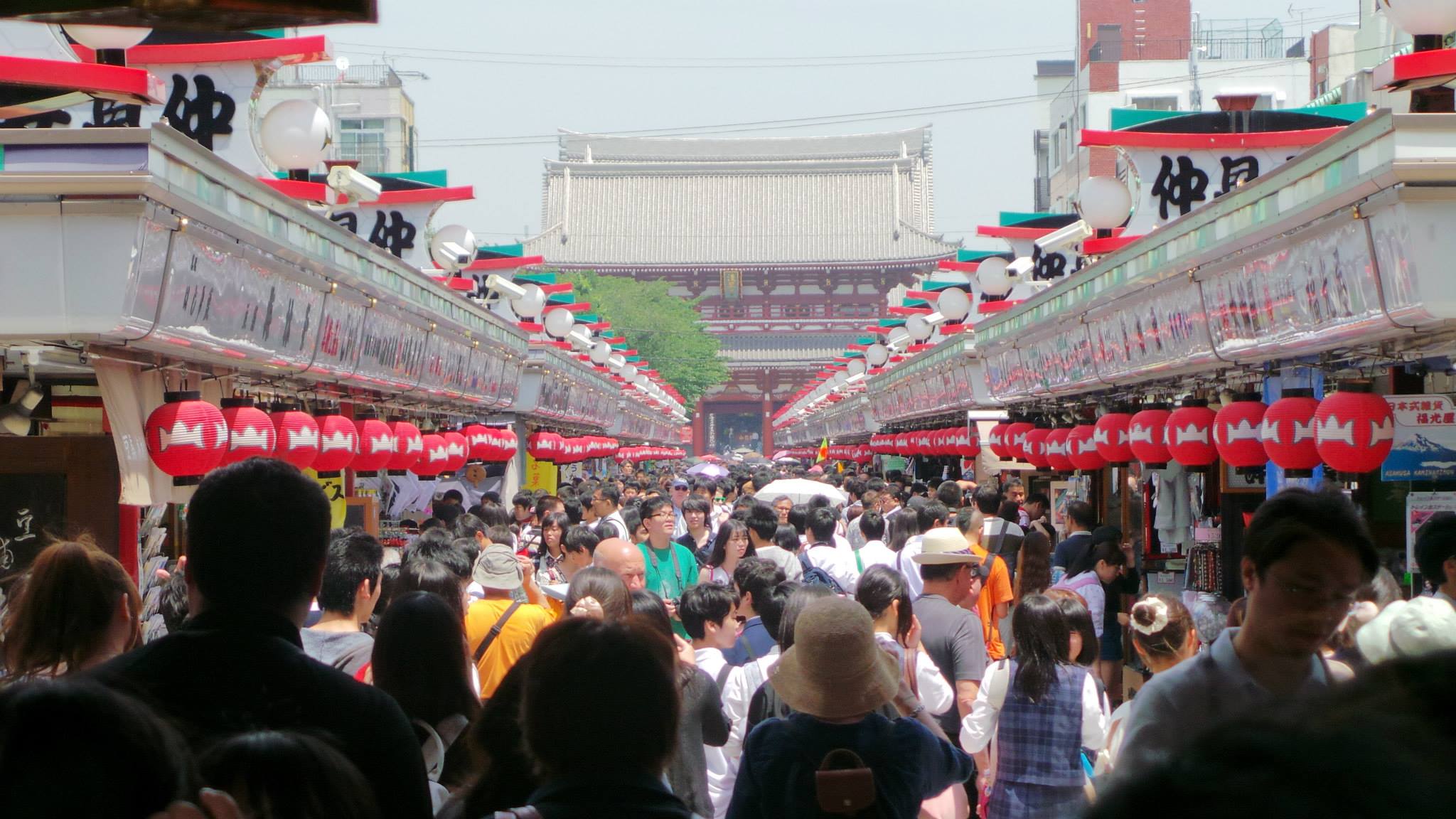
Continuing towards the temple, there’s a line of over 80 stalls offering fans, umbrellas, souvenirs, and an array of food items (bean paste buns and rice crackers seem to be popular today), along with clothing, handbags, and even a stall claiming to sell tortoise shell and coral. Known as Nakamise-Dori, this stretch forms a beautiful lantern-lit pathway of stalls leading to the temple.

senso

In the temple courtyard stands Goju-no-To, a five-story pagoda that stands at 53 metres tall, making it the second-highest pagoda in all of Japan. Prior to the temple entrance, there’s a massive cauldron emitting thick incense smoke. This cauldron marks the threshold before the entrance to the Hondo, or Main Hall. Inside the Main Hall, a striking golden statue of Kannon, the goddess of mercy, awaits. Legend claims the statue was retrieved from a lake in the year 628 AD by two fishermen.

After some sightseeing around the temple, I head to a nearby shaded indoor market. After a short while, I notice a woman who, for no apparent reason, is strolling through the market balancing a bottle of green tea on her head. As she passes by, I stop and turn around to confirm what I had just witnessed – indeed, a woman balancing a bottle of green tea on her head. In the process, I almost get knocked over by a passing cyclist.

Upon returning to the hostel, I start feeling somewhat tired: a touch of jet lag, extended periods of wakefulness, and my newfound, albeit very healthy diet of Suntory Black Boss Coffee being the obvious causes. I opt to take a nap.

I awaken. It’s 8 p.m., and outside, the darkness of the sky has been replaced by the brilliance of vibrant neon lights. I realise that Japan takes on a strikingly different appearance in the evening. I begin my walk back toward Senso-ji, passing by pachinko parlours, game arcades, and brightly lit restaurants that seemed non-existent earlier today. The streets are now bustling with people seated at tables, dining. Shutters down, shutters up—there isn’t a clothing shop in sight; everything has been transformed into restaurants.

restaurants[1]

I return to Senso-ji to witness the Pagoda and Temple illuminated at night—an impressive sight. Strolling back through Nakamise-Dori, almost all of the 80 stalls are now closed with their shutters down. Only a single food stall remains open; it’s time to find something to eat.

I opt for a tempura restaurant that proudly boasts an English menu. According to the menu, their prawns are exceptionally tasty due to being raised using extensive aquaculture—an environmentally friendly method. They exclusively use 100 percent vegetable oil with no cholesterol. Ordering a tempura set with noodles and a pint of Kirin Beer, I indulge in tempura sweet potato, lotus root, squid, and prawn, all served on a bed of rice. While the squid tempura is remarkable, the standout, confirming the menu’s claim, happens to be the most delectable prawn I’ve ever tasted.

tenpura[1]

The meal, including the beer, costs me ¥1060—an incredibly reasonable price indeed.

Deciding to conclude the night back at the hostel, my appetite is thoroughly satisfied. I purchase a few affordable cans of Asahi from the vending machines and head to my room, where I’m greeted by a few fellow roommates. A lady from Taiwan offers me some squid on a stick. ‘Try it,’ she says with a grin, ‘it’s nice and a little bit spicy too!’ For some reason, I agree to give it a try.

Two minutes later, I’m still at the tap, trying to wash away the taste of what must have been the most disgusting food I have ever tasted. The texture was chewy, the taste was off, the regret was apparent.

My second day in Japan oddly mirrored by both morning and evening visits to Senso-ji Temple: walking the same streets once bathed in the brightness of a hot sunny day and then again in the neon-lit darkness of the night; and some food to remember, followed by food to forget.