Shiitake My Breath Away

The hostel shared news of a festival at Mukojima-Hyakkaen Gardens. Today is Tsukimi-no-Kai, which means ‘Moon Viewing’ – a tradition marking its 210th year in these gardens. The goal tonight is to celebrate and enjoy the Harvest Moon. We’re set to meet up at 4 p.m. It’s cloudy outside; I doubt the moon will be visible, but the event sounds fun.

My first destination of the day is the brilliantly titled ‘Project Eat More Mushrooms,’ just an enticing eleven stations away on the Ginza Line. This year, it’s hosted at Ark Hills, a substantial office development in the heart of Akasaka. I hop on the train and disembark at mnemonic favourite, Toranamon, to run a marathon. I take a rather unhurried walk to the venue. Along the way I pass the Embassy of Micronesia and the Foundation of Miracles, before finally arriving at Project Eat More Mushrooms.

mushroommarket[1]

The mushroom festival here is disappointing, an absolute waste of thirty minutes each way on the train. Forget about eating more mushrooms; having more stores selling them would be a welcome start. I can hardly classify four market stalls as a festival. There are no miracles here, no mascots either, and certainly not many mushrooms. To salvage the journey from being a complete waste, I purchase some shiitake mushrooms and enoki mushrooms for a total of ¥450.

Back at the hostel, it dawns on me that these mushrooms are precisely the same ones I could have purchased from Seven Eleven. Considering the wasted time and train fares, these have turned out to be the most expensive mushrooms on the planet.

mushrooms3[1]

After the mushroom episode, I gather as planned at 4 p.m. The small group of seven comprises my friends Aram and Dagmar, along with two fantastic tour guides from the hostel, Keina and Gomez. We make our way to Asakusa Station and board the Tobu Skytree Line to Higashimukojima Station. Interestingly, the train deliberately slows to a crawl as it crosses the Sumida River to showcase the glorious view, or so we’re told. Upon reaching Sumida, we head straight to Mukojima-Hyakkaen Gardens, marking my third visit to these beautiful gardens during my time in Japan. The entrance fee remains the usual ¥150.

At the entrance, we’re requested to douse ourselves in mosquito repellent due to a Dengue fever outbreak in Tokyo. Just last week, Yoyogi Park was closed for extensive fumigation to eradicate mosquitoes and is likely to remain shut for several months. Similarly, Shinjuku Gyoen Park underwent the same treatment two days ago. It seems this week might be the least opportune time to visit an outdoor garden.

We enter the gardens, and inside, offerings are being made to the moon.

giftsforthemoon[1]

Television crews are setting up at the entrance to the Hagi Tunnel. Swarms of people are queueing up for the ¥2000 tea ceremony, the same ceremony I had previously enjoyed at no cost. The sound of chirping insects fills the air. We kill some time exploring the park before heading back to the wisteria trellis for the opening ceremony. Following a short opening speech, a performance of the shinobue begins.

A shinobue is a Japanese transverse flute made from hollow bamboo. Two performers play for almost thirty minutes. During their performance, I lose myself in meditation on a bench surrounded by foliage and mosquitoes.

fluteladies[1]

After the performance, it’s time to light the many lanterns scattered throughout the gardens. The paper lanterns are lit just as twilight sets in. In total, there are thirty-five lanterns, and volunteers are encouraged to participate in the event. Each lantern is decorated with a haiku.

Once the lanterns are lit, a curtain of dusk descends to the melodic tune of the koto, a traditional thirteen-stringed Japanese instrument. The five performers play in perfect harmony, and the sweet sound of the koto resonates throughout the gardens. Eventually, the earlier gifts presented and the beautiful music work their magic, transforming the overcast evening sky into a clear one. As if on cue, the clouds part ways, unveiling the face of the Harvest Moon.

festivalsounds[1]

We sit down and admire the sky. The moon is a ghostly white, brighter than I can ever recall; but it has been a while. Like the stars, the moon rarely appears above the Tokyo skyline. Tonight the moon doesn’t hide, it looks beautiful, it is breathtaking.

We eat snacks. The chatter combines with the music. The thought crosses my mind that this ceremony has been taking place exactly where I am right now, for the last two-hundred or so years. It probably hasn’t changed much since then either. My mind transported to another time.

I eat a bowl of oden, a Japanese winter food consisting of various fish and vegetables in a soy-flavoured broth. It costs ¥800 and is delicious. We chat for a while longer, enjoying the sound of the insects, the music from the koto performance, and the lull of the moon.

harvestmoon[1]

At 7 p.m., it feels much later than it is. Darkness arrives earlier now, but the weather is still warm—an atypical autumn. We all head back to Asakusa on the train before going our separate ways.

I take the Ginza Line for thirty minutes, and as I exit the station into the crowds of Shibuya Crossing, it begins to rain. At 9 p.m., I meet up with a friend from England, Laurence, and his two friends. We gather outside Hachiko, a statue of a dog. The dog belonged to Professor Ueno. Hachiko would wait for the professor at the end of each day outside Shibuya Station until one day, in 1925, the Professor died. Despite the professor’s absence, Hachiko continued to wait faithfully, but his owner never appeared. Legend says the dog returned to the station at the same time every day for nine years, yet Professor Ueno never returned. Then, sadly, in 1935, Hachiko passed away.

Our evening begins in an absinthe bar exclusively playing The Smiths’ music and ends in a cheap izakaya-style bar. Artwork and literature dominate our evening’s discussions. An enjoyable night washed away with rain and ¥450 Suntory whisky highballs. I don’t take a single photograph; much like Hachiko, my camera is dead. With no photographs of my own, Laurence kindly lets me use one of his: Neon Nirvana:
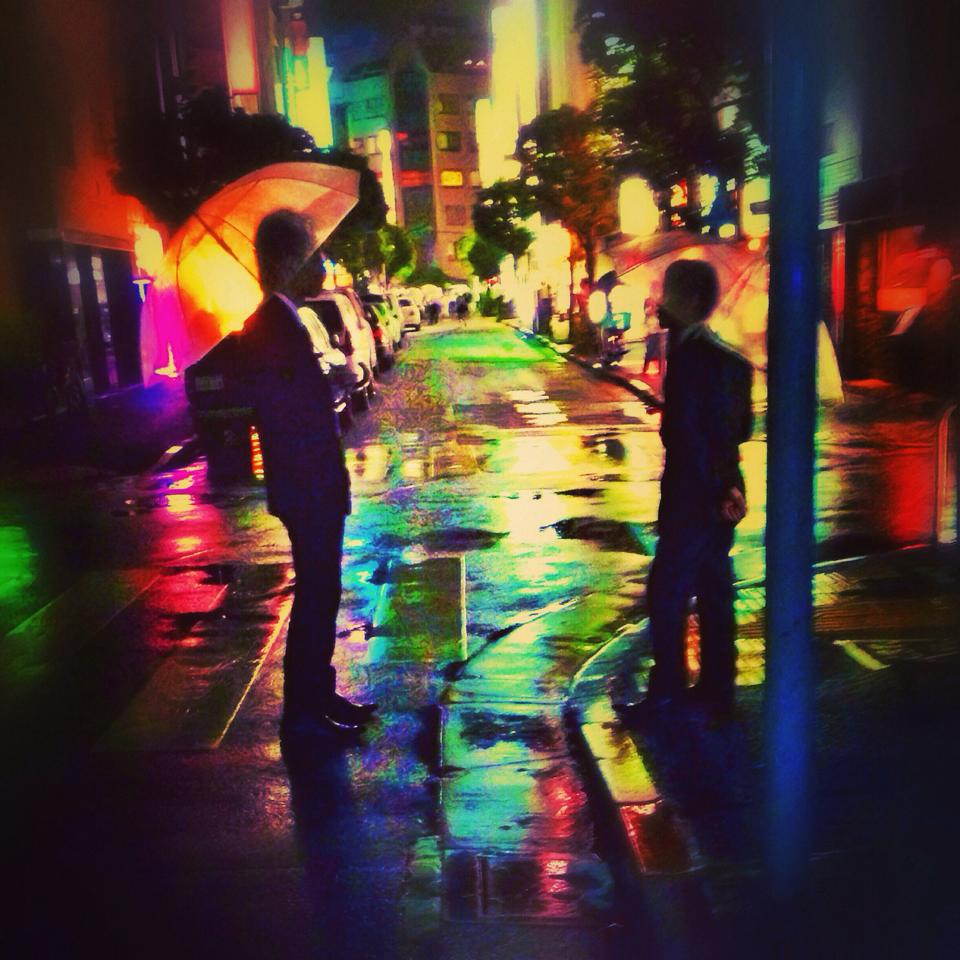
Neon nirvana

Bring Me the Head of Kubikiri Jizo

Today, I’m sitting at the bar of a small cafe having breakfast when a man named Yoshio notices I’m not Japanese and strikes up a conversation while I chomp on my vegetarian Eggs Benedict. “I just got back from America,” he tells me, “I got back yesterday.” His English is pretty good, and I stay for a second cup of coffee, chatting with him for about thirty minutes before he has to leave. After he departs, the cafe owner shares Yoshio’s full name with me. A quick Google search reveals his Wikipedia page, and I discover that the man I had breakfast with is a famous Japanese comedian.

After coffee, I head out to meet Luis, the Chilean guy I met during the World Cup. He is back in Asakusa for the final leg of his trip, so we arrange to meet up for 1 p.m. We take the Ginza Line to Akasaka-mitsuke Station. Akasaka is known for being quite a posh area, so we wanted to get a feel for what a rich neighbourhood looks like. No different from anywhere else, it turns out.

From Akasaka, we walk to Roppongi and head for Tokyo Midtown. Here, there is a giant 1:7 scale statue of Godzilla.

godzilla[1]

After Godzilla, Luis and I head back to Asakusa and eat at my favourite Indian restaurant. Luis has only ever had curry before one other time in his life, madness. After food, we head our separate ways.

Whilst I was exploring accommodation options for October, it was suggested to me by a 71-year-old Japanese man that I try the area known as San’ya; apparently, the apartments there are relatively cheap. San’ya is still in Taito Ward, and a forty-five minute walk from Asakusa. I head in the vague directions I am given and discover that San’ya no longer exists. All signs mentioning the word San’ya no longer exist. Every mention of the area has been removed, like a Japanese history book; all traces have been erased from memory.

The only sign that has any mention of a San’ya past is the sign for Namidabashi. The sign literally translates as ‘Tears Bridge’ and was where people came to say goodbye to loved ones before they were taken to be killed at the Kozukappara execution grounds, hence the tears. These days, the bridge has been buried under the concrete of an intersection, the execution ground painted over by a bus station.

busgrounds[1]

All that really remains, other than human remains, is Enmeiji Temple. It was this statue of Kubikiri Jizo, the decapitation Buddha, who watched over the nearby execution grounds. For those who were executed, the last image they would have seen is the Buddha. Its name literally translates to ‘neck cutting Buddha’. An estimated two hundred thousand prisoners were killed here. Ironically, during the March 2011 Tohoku earthquake, the Buddha was damaged and its head broke off. A sign details the step-by-step process of how the head was repaired.

There is also a sign here that says, ‘Nam-Myoho-Renge-Kyo,’ the all-too-familiar chant of the Nichiren Buddhist. Gravestones without names make up the backdrop.

kubikirijizo[1]

The main street here translates as ‘Bone Street’. It was on this street that the decapitated heads of the executed were put on display. The executions stopped in 1873, and after that point, the area suffered further misery. Somehow, San’ya became Japan’s biggest leather-producing area. The problem with leather is that it comes from cows, and cows in Buddhism are not to be used for leather production; this being a Buddhist country doesn’t help matters. The people here became complete outcasts, and leather production work was considered the lowest of careers. A certain stigma became attached to the already stigmatic San’ya area, and it fell into decline. It was around this time that the name San’ya was abolished. These days, the shops are all boarded up, the streets are empty, and the dead stay dead.

Today, if you live in the old San’ya area, you are still looked upon as different. You are judged for living here. The accommodation is cheap; however, I wouldn’t like to stay here. The people aren’t liked, the energy is wrong, and then there are the souls of murdered cows and headless criminals. I leave the macabre of San’ya and head to the somewhat less chilling ‘Flying God Temple’.

flyinggod[1]

The Legend of Tobi-Fudo comes from the Shobo-in Temple. It was first built in 1530. “Once upon a time, the chief priest of this temple went to the Omine Mountain in Nara Prefecture to pursue his learning; he took the principal image of Buddha with him to the mountain from his temple, but the principal image flew back to this place in Edo within one night and gave diving favours to the people.” I am not sure what ‘diving favours’ are, but this is what it said at the temple entrance. I think it is supposed to say divine.

In recent years, people visit the temple to pray for safety in air travel, praying their plane doesn’t crash. I suppose ‘diving’ is probably the wrong word to be using when talking about air accidents. There is also a sign saying a festival takes place in October on the temple grounds. I add it to my calendar and leave.

No More Dream

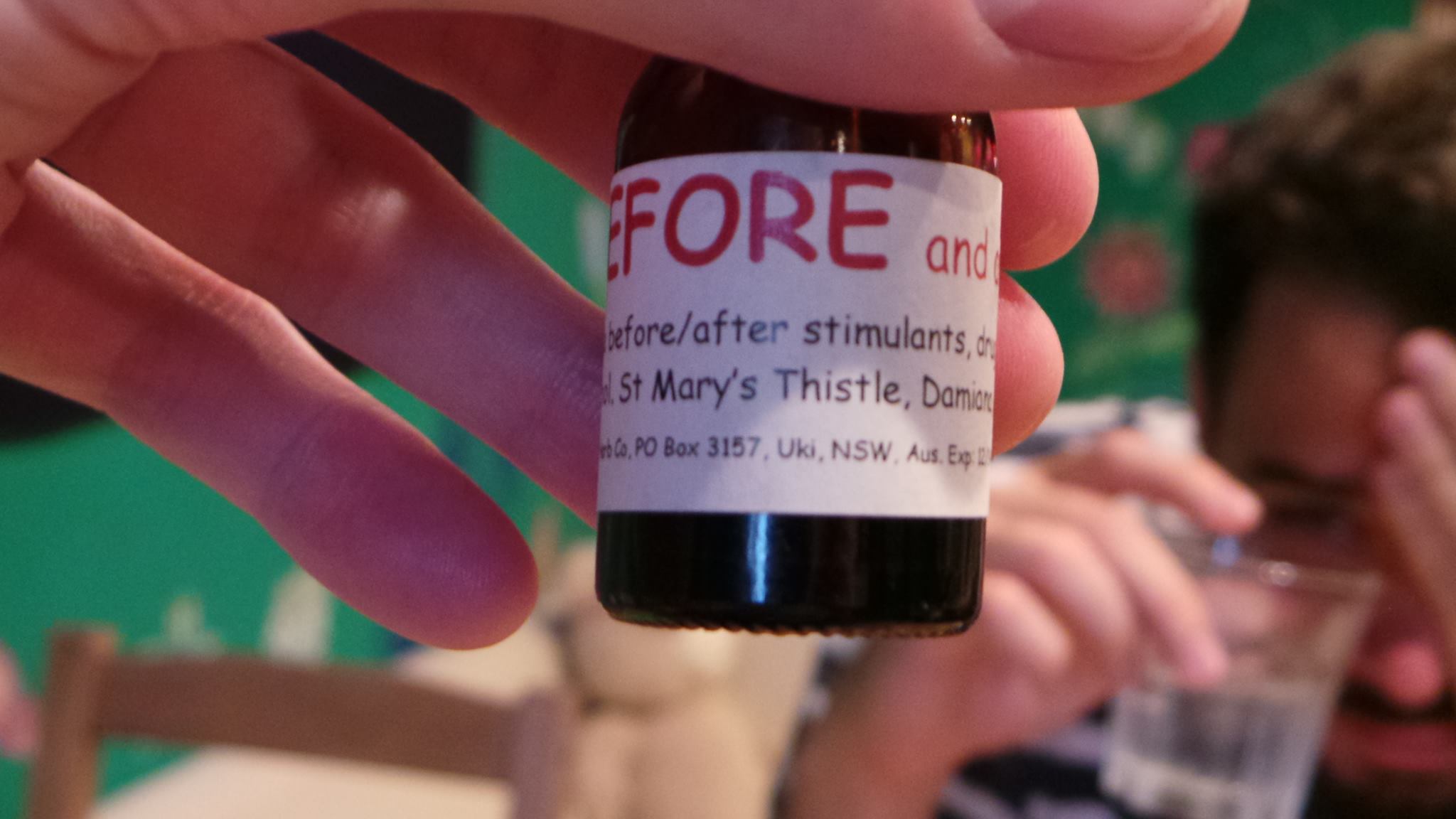
At breakfast I have an amazing caffeine free chai tea with free range ‘happy’ eggs. Andy sits across from me, for his breakfast he has a hangover. Incense is lit and a hangover cure is delivered in the form of a tiny bottle. One drop before and one drop after is all you need, or so the bottle states. From his initial reaction it doesn’t look good.

hangover

After breakfast Andy checks the time, it is quarter to eleven. He suggests going for beer. Hangover cure confirmed to work. We take the train to Odaiba, and head for the Gundam. We arrive and there is a huge crowd of people, they are here for more than just a robot. At the Gundam there are about one thousand girls, each with an umbrella. A man with a megaphone makes an announcement in Japanese and the girls begin to scream with excitement.

Members of a Korean hip-hop boy band are shown on a large television screen, there are seven of them in total. Jungkook being the youngest member at 16, Jin and Suga are the oldest at 21. The best named member is Rap Monster. The band are called Bangtan Boys, often abbreviated to BTS. The name of the band literally translates to Bulletproof Boy Scouts.

bts2[1]

BTS play their debut release, No More Dream, much to the delight of the one thousand screaming fans. The band then talk on the microphones for about twenty minutes before jumping into their second song, Rise of Bangtan. It features a heavy backing track and some lyrics in English. “Cuz we got fire fire fire, Get higher higher higher.” Andy and I stay for about half an hour. The Gundam is underwhelming in comparison to the music.

Back in Asakusa, Matt joins us for a bit of English teaching and free beer. Kaes, a Canadian friend of Andy’s, joins us, and eventually, two English women we met earlier at the hostel, Steffi and Heather join us too. After last orders, we head out to a late-night bar for some food.

Sashimi_time[1]

At the restaurant we have to take our shoes off before entering the seating area. At the table I eat ¥450 seared mackerel sashimi, ¥450 fried fish cutlet bites served with a delicious but unrecognisable dip, and a nice big ¥481 beer. Probably one of my favourite meals I’ve had on this trip.

After the meal it’s back to the hostel for some card games via a Seven Eleven. I pay for my goods, totalling ¥212, with a ten-thousand Yen note, the equivalent would be paying with a £60 note in England. It goes unquestioned and I receive my ¥9788 change without any fuss. Paying for things with a £10 note in England is sometimes met with a frown or sarcastic comment.

Sake[1]

At the hostel, the English women have sake with them—three bottles, to be precise. I’ve tried hot sake on my trip, but I didn’t really enjoy it. This will be my first time trying it cold. Once again, I find it somewhat unsatisfactory. Finally, I’ve discovered something in Japan that I don’t like.

Bach No Senritsu Wo Yoru Ni Kiita Sei Desu

I sign up through Craigslist for an event in March 2015. Bach’s 330th birthday celebration. All day and all night the music of Bach will be played in subways and public spaces. The website specifically states that, ‘Solos, ensembles, flash mobs and Bach marathons are all encouraged.’

Outside, rainy season has started. The unexpected heat wave during my first week here has now stepped aside and the rain has taken over. It will not stop raining now until mid-July. I take a ‘free’ umbrella from the hostel and walk to the boat terminal. Here I take a ¥1580 boat ride down the Sumida River to Odaiba; an artificial island. The journey takes about forty minutes.

BOAT[1]

I see The Goddess of Liberty, a to-scale model of the Statue of Liberty. There is a giant Ferris wheel with no riders and a huge arcade with no customers. It is nearly lunch time and there is nobody else here. A Toyota theme park showcases new vehicles and offers driving lessons and ‘games’. A Shell museum offers not seashells but the history of petrol pumps and petroleum. I am very disappointed.

Japan are preparing for the 2020 Olympic games, and Odaiba, with its large areas of open space, is one of the venues that has been selected. I walk long distances in the rain trying to find the giant 1/1 scale statue of a Gundam robot. I never find it and there is nobody around to ask. I eventually give up and take the train back to Tokyo.

lolympics[1]

For lunch it’s another Cheese Mushi Cake. This one is from Family Mart and is sadly not as good as the one from Seven Eleven. I also have a natto wrap and a bag of the ‘best crisps’, or so I am told by a member of staff at the hostel.

Natto is fermented soy beans. It is a traditional food of Japan and is usually eaten for breakfast. I once read that most people in Japan eat natto but don’t like it, and that they only eat it for its excellent health benefits. My natto is wrapped in rice and seaweed. The smell is overpowering, and the taste is disappointing.

natto[1]

I spend the next hour or so in the hostel until I am in the right place at the right time. The hostel manager approaches me. He says a film crew for TV Tokyo are making a documentary, and are looking to film someone that is staying here for a while. I immediately agree and wait anxiously until the film crew are ready.

The director cannot speak any English but she has brought with her a language interpreter. I am asked to go to the reception so they can film the hostel staff recommending a strange place for me to visit. I already know that we are going to a bird cafe, so I have to pretend I don’t know where I am going; it is all very odd. The crew film me talking to Daisuke at reception. He recommends that I visit Asakusa’s Owl & Parakeet Cafe, before making me laugh with his chicken noises. We film the same scene again, without the chicken noises, and he marks the cafe on my map.

parrot1[1]

The film crew then follow me through Asakusa. I rely only on the instructions from the hostel; I am not allowed to ask the film crew for help. Daisuke’s directions are pretty good though, and I find the bird cafe with relative ease. Once inside I am asked to stroke the birds, play with the birds, feed the birds, and get bitten by the birds. They ask me some really random questions. I am not sure whether to direct my answers at the interpreter or the director, and I’m never really sure which parts they are filming.

Once we finish the interview, we head back to the hostel. Overall the experience was rather enjoyable and I am pleased to have been given the opportunity to be on television. I have no idea which footage they will use for their program, only that it will air at the end of the month.

At the hostel I meet with a few of the nice people that I have spent time with over the last few days; almost all of them will be leaving in the morning and I will once again be alone. A few hours of whisky and beer later and the Thursday night Jazz Club is in full swing. Five of us decide to head out through the soaking and somewhat flooded streets of Asakusa to get some food. Tempura again for the third time this week; I don’t think I’ll ever get bored of it though.

raindrops[1]

After food it’s back to the hostel to catch the end of the Jazz Club washed down with a few cans of Suntory Strong Zero 9%.