Eat Fish or Die Tryin’

I meet my friend Dagmar for breakfast at ten. At breakfast, I drink away my hangover with a bottle of a tasteless drink called ‘Delicious Water’ before heading out alone for the train. Someone told me yesterday that beneath the banks and office buildings between Mitsukoshimae Station and Otemachi Station, hidden deep underground, the Japanese government grows secret rice.

Somewhere along the Ginza Line, my train just powers down. All the lights extinguish, plunging the carriage into an abyss of darkness. The train drifts aimlessly towards Ueno Station and finally grinds to a haunting halt. The silence thickens, shrouding the dead train in an eerie stillness, an unsettling void that grips the carriage. Everyone remains silent, messing with their mobile phones, despite the obvious sorrow of the situation. It is all very worrying. About five minutes pass, and there is an announcement in Japanese, then nothing. A further five minutes, and the train starts up like nothing ever happened.

As I exit Mitsukoshimae Station, I accidentally wander into an adjacent department store.

maskmaskmask[1]

Inside the department store, there is a Mask Art Museum, and it is free. A nice but rather small exhibition. The store housing the museum is incredibly upmarket. I ask politely if I am allowed to take photographs, and lucky for me, it is fine. The exhibition actually ends today. Rather fittingly, all of the mannequins in this department store are wearing masks.

One thing I have noticed in Japan are the many strange museums. I believe I have previously mentioned the famous World Bags and Luggage Museum. A few other favourites of mine that I am yet to visit are the Gas Science Museum, the National Leprosy Museum, and the Parasite Museum.

I wander around for a while looking for the entrance to the secret underground rice bunker. It takes a while but I eventually find a huge office building that has every window on one side completely covered in plants. On the other side of the building I scare away an eagle pecking at a gold statue of Prometheus. This must be the place, I think to myself. It turns out it is.

prometheus[1]

Deeply tucked away in the second basement level of a huge skyscraper, they grow rice. I am not entirely sure why they grow rice, but people are free to come and see it. Huge natural light shines from above. Rice grows. From what I was told, this area stretches under the whole business district, although it doesn’t. The size of the area was heavily exaggerated to me. The rice isn’t really that much of a secret; it’s not too well advertised, but no one is trying to hide the fact that it grows here either. In fact, I think it’s encouraged for people to come here and learn about rice cultivation. So, another urban myth shattered then.
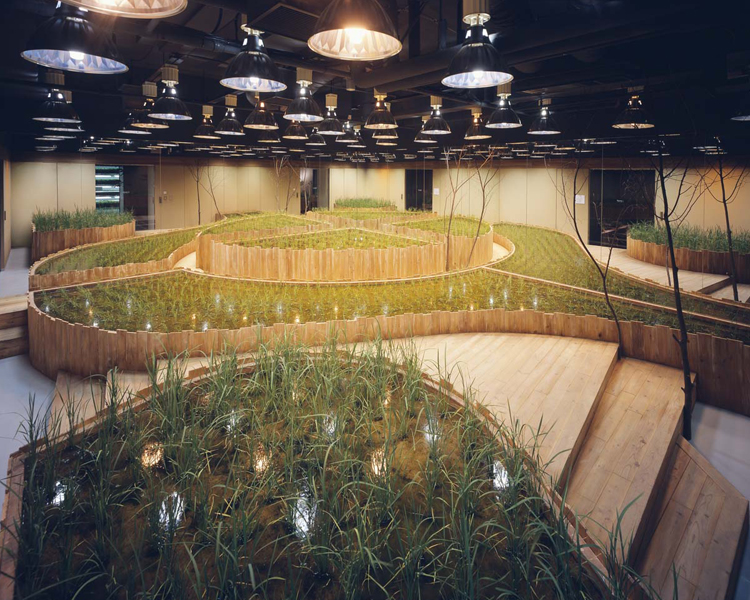
ricetomeetyou

After looking at rice for a few minutes, I decide to walk to the Imperial Palace. I’m surprised by how close the stations are to each other in this area. Tokyo, Kanda, Shinbashi, and Nihonbashi Stations are literally within a five-minute walk of each other. Outside the Imperial Palace, about thirty elderly Japanese people are sitting and painting.

The Imperial Palace is home to Emperor Akihito, the last remaining monarch in the world to go by the name of Emperor. There isn’t really much else to see at the palace. The grass outside is cut immaculately, and the water fountains spray jets of water about two metres into the air. I notice there is a great view of Tokyo Station from the Palace car park, though. I wander to the nearby Ginza Station and take the train back to Asakusa.

tokyostation[1]

I decide to inspect a potential apartment. Small apartments in Japan are ironically referred to as “mansions.” These one-room coffin apartments offer little to no space and an equal amount of comfort. Another phenomenon in Japan is the grouping of shops, whole areas dedicated to selling one type of product. The area where the apartment is housed is completely surrounded by funeral shops. One street has eight shops in a row, all selling tombstones. I decide the area doesn’t quite feel right. Chimes sound from nowhere as I head back to the hostel, chiming five times signalling 5 p.m.

At 6 p.m., Richard, Luis, Remi, and I head to a nearby restaurant that serves fugu. Jokes are made about toxicity, tetrodotoxin, paralysis, and death. In reality, fugu poison is one-thousand two-hundred times stronger than cyanide; this is no laughing matter. The most poisonous part of the fish is the liver. Outside the restaurant, we watch our dinner for a while, graciously swimming around in a tank. In a moment, this beautiful blowfish will be killed on our behalf; we sure hope it doesn’t have a taste for revenge.

blowfishing[1]

There was a time when a fugu chef would have to pass a training course of ten years before being given certification to prepare fugu. These laws changed about three years ago, and now the rules state just a two or three-year course is required. We really hope that our chef today is of the older generation.

We take a seat in a tatami room. We order fresh blowfish sashimi. We also order diced blowfish sashimi just so I can make a pun about how we diced with death. Oddly, one of the options on the menu is hot sake with dried blowfish fin floating in the liquid. “We only serve the finest live domestic tiger blowfish,” says the menu. Served live? I certainly hope not. We wait anxiously for our food to arrive.

The poisonous fish is served in elegantly arranged translucent slices; it doesn’t look very threatening.

blowfish1[1]

A taste for revenge would be an overstatement. A taste of anything would be welcome. The food is the freshest fish I have ever tasted, of course; it has been dead just minutes. The food is also the least tasty fish I have ever had. It has no flavour at all; perhaps there is a subtle hint of death. I’m just glad we went to a cheap non-certified restaurant. It costs us just ¥5480 between the four of us for two dishes and four drinks.

I tried the sacred fugu of Japan and all I got was this lousy anecdote.

Siliconan the Ovarian

The previous three days drifted along to the tune of uneventfulness. I met old friends, went out for dinners, and had drinks. I didn’t even leave Asakusa once. Today, a sign in my hostel says, “Soba party today, come and enjoy Japanese noodles!” There is also a list of local artists that will be here to teach various arts and crafts. Free food and free crafts, excellent.

Outside, it is a blistering 36°C. I take the Tokyo Metro Ginza Line to Ginza. Ginza is a massive shopping district and fashion area. The kind of place you only drive through if you have an Aston Martin or a Bentley. If there is a Tokyo edition of the board game Monopoly, Ginza would be Mayfair. There is an array of well-dressed people, expensive fashion boutiques, and all the high-priced big brand stores.

My first stop in Ginza is the rather difficult-to-find Vanilla Gallery. Hidden away in a basement floor of a rather uninteresting building, it plays host to the Fourth Artificial Otome Expo: a Love Dolls exhibition. I shyly pay my ¥1000 entry fee to a young woman and shuffle through the gallery, trying to avoid eye contact with the other customers and the dolls. The dolls are made of silicone, are hauntingly childlike, and can be customised to the finest detail; every part of a doll can be ‘made to order’. Also in the exhibition is the mould that creates these dolls; a sign says, ‘Crystal craftsmanship to build the doll up to perfection.’

The Vanilla Gallery is small, and the exhibition is in just two little rooms. Orient Industry has been making these luxury Love Dolls for thirty-seven years, or so a video of the production process tells me. They also claim to make the most luxurious and expensive dolls; probably why they chose Ginza to showcase their creations. There is one doll that you can touch, ‘Feel her soft realistic skin,’ a sign says. I pass on the touching. I can only show the photograph of the sign, as there was a strict no-photography policy in place.

lovedolls[1]

I once saw a television interview with a Japanese man who said that he doesn’t want his wife to know about his collection of Love Dolls, so he rents a second apartment just for his dolls. I stay for no longer than five minutes. The life-size, realistic-looking dolls scare me. Their stillness makes me think of the dead.

Next in Ginza, I head to the nearby ‘Hello Kitty Toy Park.’ Here, there are so many toys, games, keyrings, plates, umbrellas—everything you can imagine featuring Hello Kitty. Five floors of toys, two floors of restaurants, a theatre, and a small theme park. I have never seen so many Hello Kitty items in one place. I don’t know which is more embarrassing, going to a Love Doll exhibition or entering a Hello Kitty store. Inside the store, I see a policeman on his break, inspecting the Hello Kitty toys.

kittytwo[1]

Next, I head in the direction of the Police Museum. On the way, I see a huge Yamaha store and decide to play on some very expensive-looking pianos for a while. I also spot the Pachinko Museum. A sign outside says, ‘We can teach you the basics about pachinko.’ It is adults only, but free. I head inside to find that they have forgotten the museum aspect. It’s just a regular pachinko parlour. ‘More enjoy more happy,’ a sign outside tells me as I leave.

The Police Museum doesn’t seem to exist. The building that houses it is under heavy construction and gated off. A shame, I was looking forward to doing something normal today. I see a sign for the nearby Kyobashi Station; lucky for me, I know this station is on the Ginza Line, so I take the train back to Asakusa.

Back at the hostel, I watch the news. A company called Shin-shin Foods has decided to stop its one-hundred-year-long pickle production and has converted its headquarters into a capsule hotel. I learn about a process called muon tomography, cosmic rays that detect radiation. Twenty-nine cats have mysteriously been found dead in Ota Ward; police think it was poison. The usual nonsense. I do some writing before heading out for a Shiatsu massage.

messageboard[1]

The place I go to was recommended to me by the owner of Cafe Byron Bay and is owned by her friend. When I enter the building, the woman at reception looks shocked to see me. I don’t think the place gets too many overseas visitors. I mention that I know her friend, and the tension in the room instantly fades away. After my thirty-minute massage, the tension in my shoulders also fades away. The man who performed the massage offers me a fifty percent discount, just ¥1500. I actually don’t think this is fair to him; the massage was good. I compromise and tell him to keep the ¥500 change, which he does. So much for not tipping in Japan. He thanks me and gives me a points card; I am nine more massages away from a free one-hour session.

Back at the hostel, the soba party is just starting. Soba are Japanese noodles made from buckwheat flour. This is actually my favourite type of noodle. There are stalls selling badges made from Instagram photographs. You can send them six of your photographs, and they’ll make them into high-quality badges or magnets. There is also a store where you can rent a kimono or a yukata. The word kimono inventively translates as ‘thing to wear’.

soba[1]

There is, of course, plenty of free food. Plates piled high with ice-cold soba noodles. Tiny plastic bowls are filled with sauce, and a selection of toppings is available. I eat my noodles with spring onion and seaweed. Delicious. There is also free rice wine to drink. When all the free sake has been consumed, I head to the hostel bar for more free drinks. The night crawls along. I eat soba noodles in the lounge and get considerably less sober at the bar. The night ends, and I crawl to my room.

Dog Day, Afternoon

Saturday 

For the past three days, the Obon festival has been taking place in Japan. This 500-year-old Buddhist festival emphasises honouring the deceased. Today marks the final day of Obon, coinciding with the Asakusa Summer Night Festival. The event originated in 1946, shortly after the end of World War II, serving as a way for people to bid farewell to those who perished. As I arrive before the opening ceremony, the bridge is already overflowing with tourists.

skytreebridge[1]

The Japanese name for this event is Toro Nagashi, which translates literally to ‘flow of lanterns’. Here, you can purchase a small paper lantern for ¥1500. Each lantern symbolises the soul of a deceased relative. Visitors have the opportunity to write a message on the lantern, queue up, and then release it into the water. I find the entire process quite abstruse.

As the lanterns float down the Sumida River, carrying the souls of the departed to the other world, a certain solemnity lingers in the air.

lanternsontheriver[1]

After the festival, the atmosphere becomes somewhat lighter. I meet up with Robin, a German I befriended in Kyoto, who happens to be staying in Asakusa. We decide to unwind over drinks and perhaps get a bit less sober. We head to Nui and indulge until just after ten, then make our way to a Family Mart to play a few rounds of the Konbini Hop drinking game.

Outside our third convenience store, we come across a poster featuring numerous Japanese individuals with sunflowers encircling their heads. Despite our attempts to decipher its meaning, we’re left utterly baffled. It remains an enigma, leaving us without a single clue.

flowers[1]

We head to a Japanese bar nestled behind Senso-ji. This area houses around ten small bars, each with only two to three bar stools. I’ve long desired to experience a drink in one of these hidden spots since my visit in June, yet I never found the courage to venture in alone. Describing the way to this area would probably confound you; it’s remarkably concealed, and my directions are truly abysmal.

We settle in a small bar called Tom². This bar, with only four bar stools, feels quite spacious compared to the others nearby. ‘I Was Made for Lovin’ You’ by Kiss fills the air from the speakers. Two Japanese men occupy two stools, and we take the remaining two. The bartender seems a bit tipsy. We order a Suntory whisky highball and a beer for ¥500 each, and enjoy complimentary peanuts.

Then a dog appears.

inu[1]

The dog, incredibly friendly, joins us and settles in. We discover that Tsutomo, the owner, resides above the bar. We linger for some time—I manage to outlast Robin in drinks, and eventually, he departs. I remain for two more. The two Japanese gentlemen present speak minimal English, and the dog, unsurprisingly, doesn’t contribute much to the conversation. So, I sit there, mostly in silence, sipping my drink and exchanging glances with the dog. An atypical end to the evening.

Sunday

I rent a ¥300 bicycle for the day and cycle thirty minutes to Nihonbashi, making a stop to see my friend Daisuke along the way. It’s a shame to find out he no longer works at the hostel where I’m staying. Today, Nihonbashi hosts the annual Fukagawa Hachiman Matsuri festival. It’s considered one of the three major Shinto festivals in Tokyo and is likely the largest.

The festival is celebrated in its entirety once every three years, and today happens to be that day. With one hundred and twenty portable shrines, three hundred thousand participants, and half a million spectators, it’s definitely not an ideal day for cycling.

shrinesandshrines[1]

Amidst the crowds, people throw buckets of water over those carrying the shrines, a ritual to cool them down, earning the festival its nickname, the ‘Water Fight Festival’. It’s undoubtedly challenging to bear these enormous shrines in such sweltering heat, particularly under today’s scorching summer sky. I opt to step away from the bustling crowds and take a stroll through Nihonbashi. While I visit the renowned Nihonbashi Bridge, it fails to captivate me. I decide to return to Asakusa in search of some food.

I head to my favorite Japanese restaurant, Mizuguchi. I indulge in breaded salmon and salmon teriyaki, served with a side of greens, potato salad, pickles, and rice. Absolutely delicious. The total comes to ¥1810, including a Suntory whisky highball.

As I leave the restaurant I hear applause. It turns out there is a street performer just outside. Never a dull moment in Asakusa on a Sunday.

coneman[1]

The street performer does a balancing act whilst juggling a traffic cone between two sticks. He has drawn in a huge crowd. He is also a comedian. Throughout his routine he speaks intermittently on a microphone, telling jokes in Japanese, everyone laughs. When he is finished he cheekily places three bowler hats on the floor, upturned for tips. I give him ¥1000. He was really good.

Back at my hostel, The Strokes are playing from the speakers. ‘Is This It?’ I write for a while before heading back out to meet fellow Englishman, Richard. We meet at 8 p.m. and drink until 4 a.m. A typical end to the evening.

A Kale of Two Sakes

I ride the Tokyo Metro Ginza Line. I get off the train at Nihonbashi Station to buy a drink. I recently discovered that there is a small shop selling ¥300 smoothies here. It is the same side of the crossing gate as the tracks so there is no need for me to buy another ticket. I buy a smoothie and hop onto the next train some two minutes later. Today I choose a healthy bright green plastic cup of crushed kale.

From Harajuku Station, I take the five minute walk to Yoyogi Park. There is a festival here today in celebration of fifty years of diplomatic relationship between Japan and Jamaica. The festival is relatively quiet, but it is still morning. There are market stalls selling jerk chicken, mugs, and adorable hats adorning the Jamaican flag; the usual. There is a stage and a choir, they sound good but they are only sound checking, so no one applauds when they finish. I wander for fifteen minutes before deciding to leave.

one_love[1]

As I exit the festival a man with a shaved head and white clothing approaches me. He hands me a gold card with a picture of Siddhārtha Gautama etched to the surface. He is not a native Japanese person, and is probably not even a real monk. He tries to get me to write my name, address, and how much money I am willing to ‘pledge’ to him. I tell him that I’m not interested, give him back his card, and walk away shaking my head. Using religion to scam people out of money, that’s a first.

Around the corner from the park, opposite the entrance to Harajuku Station is Takeshita Street; a famous pedestrianised shopping street with an amusing name. It is lined with small boutiques featuring all the newest fashion, and far too many ice cream shops. There is nothing really of interest for me here so I walk the length of the street before returning to Harajuku Station and jumping back on the train.

takeshita[1]

Back in Asakusa I hire a bicycle. ¥200 for four hours, brilliant. I park my bike at the hostel and sit on the pavement to take photographs of a lit up Tokyo Skytree; I try to improve the image by messing around with my cameras settings. Someone shouts my name from behind me, “Luke, what are you doing sitting on the floor?” It is a woman who works at the hostel. I tell her I am messing around with exposure and shutter speed. “Oh,” she says rather confused, “I’m emptying trash!”

I think to myself that I probably know more about emptying rubbish than I do exposure and shutter speed.

Back on my bike, I cycle around in search of food. After a while, I eventually give in to a Seven Eleven tartare sauce fish burger and a bottle of Pocari Sweat. Pocari Sweat is going to be the first sports drink that has a billboard on the moon, or so an advertising leaflet claims. I cycle around the quiet back streets of Asakusa, stop off for a rest outside the exciting World Bags and Luggage Museum. No idea. I randomly bump into a person I know from the Fuji TV show; he is stood talking to a man dressed as a tree. No idea.

treefingers[1]

Back at the hostel I chill out in my favourite room, the 4th floor laundry lounge. The room is actually an outdoor conservatory in a big tent. It features a ball pit, a lovely water fountain, and a bath tub full of soil. Cherry tomatoes grow from the soil. I sit on a chair and read the last thirty or so pages of Murakami’s ‘Hard-Boiled Wonderland and the End of the World’. It is here that I lose myself to the tranquillity of my surroundings. A staff member interrupts my serenity. She is here to do ‘maintenance’ on the ball pit, or so she tells me with a grin. She elegantly makes sure all the balls are neatly resting in the bathtub before leaving me in peace.

After finishing my book I pop over the road for a quick drink in A.S.A.B. I chat to the bar owner and ask him if he knows any good places to eat. “Yes,” he states matter-of-factly, “I draw you map.” He draws me a map. I thank him, pay, and leave the bar. His map is very accurate and I find the place with ease. Inside, I take a stool at the bar and am handed an English menu, a nice surprise.

izaks[1]

So, from the top left I have a pot and saucer of Japanese mustard for dipping, fresh cabbage served on ice, a side salad, spring onions, rice, a white box, some odd tasting red pickles, edamame beans, and the star of the show, cutlassfish marinated in soy sauce. The set meal also comes with miso soup, but it is pork based so I ask to have my meal without. I drink two Suntory whisky highballs whilst I feast, and pay ¥2240.

Now, that white box. Natto. It has no place with the rest of the meal so I take it back to the hostel. On the way I buy a tube of salt and vinegar flavour Pringles. I eat the natto using chop sticks, I wrap three to five fermented soy beans around a crisp; the correct way to eat natto, probably. The natto smells so bad that it even comes with a sachet of strong smelling mustard, and some red sauce that just about cancels out the disappointing smell.

natto[1]

In the hostel I meet up with a couple of guys from Hong Kong, and Aaliya, the Canadian I met during my first week here. It is her last night in Japan, so we decide to drink. We go to a bar, closed. We go to another, they’ve stopped serving. At the third bar, Asakusa OTO, we are humbly welcomed inside. It is a sake bar selling Japanese rice wine. It tastes okay, better than the supermarket rubbish I am used to. Sayaka, the English speaking Japanese staff member asks me to go through her English menu and correct the twelve mistakes. The owner of the bar puts on the ‘most famous’ Britpop band ever, Ride. I tell him I’ve never heard of Ride. Instead he puts on The Smiths.

‘Girlfriend in a Coma’ plays in the background while I eat crushed ice with sweet sauces. Delicious. It is time to leave after about an hour of sake drinking. We go to pay and the owner refuses to take our money. He says I should tell more foreigners about his bar in exchange for the drinks he has given us. It’s the least I can do, I tell him, scribbling his website on the back of my hand.

Stop! Hamarikyu Time!

It’s 9:31 a.m. and the bar in my hostel is open for business. Japan are playing their opening World Cup game in just under thirty minutes; much to the delight of the staff here. Samurai Blue, a ¥300 cocktail named after the Japan squad is being sold. ‘Free’ soft drinks and bar snacks are also available. Almost everyone is wearing Japanese football shirts, face paint, and bandannas. Fans are waving megaphones and flags.

tv[1]

Yesterday, a fifty inch television was installed in preparation for the ‘big game’, and signs advertising the match were strategically placed around the hostel. The football is finally here. TV Tokyo are here again too; filming ‘foreigners’ in the hostel who are watching the match. After a good start from Japan, the game ends in a disappointing defeat, but everyone remains upbeat.

I apply for some jobs before deciding to leave the air conditioned hostel and get some breakfast. I go outside to check if I need an umbrella today or sunscreen. Outside clear skies and 30°C; so much for the rainy season. My breakfast consists of a crustless egg sandwich and a British stereotype in the form of Royal Milk Tea; I’m anemic royalty! It is one of many satisfying moments to my day.

royal_milk_tea[1]

After breakfast I have no plans, so I take the Tokyo Metro Ginza Line to a random station. At Shinbashi Station I walk past a Porsche showroom, a broadcasting tower, and an advertising museum. I keep walking until I eventually find an information board with a map; ironically the advertising museum isn’t advertised on the information board. I see a place nearby that looks like a park and decide to check it out.

On the way I pass a drunk man in a Japanese football shirt, randomly singing the names of football players. He slurs his words and staggers as he drinks from a can of Kirin Beer. I arrive at the park, which isn’t actually a park. I pay the ¥300 entrance fee, and enter a place called ‘Hamarikyu Gardens’.

The Hamarikyu Gardens were once the family garden of the Tokugawa Shogunate, but were later donated to the City of Tokyo by the Imperial Family in 1945. They are now designated as a Special Place of Scenic Beauty and Special Historical Site of Japan. I wander the lush gardens for a while finally free from the hustle and bustle of Tokyo; however, my tranquillity is somewhat spoilt by the tall office blocks that scrape the sky in every direction.

gardens1[1]

Back at the hostel there is a poster pinned to the notice board for a gyoza party tomorrow night, offering free dumplings. There is also an advertisement from broadcaster NHK. It is looking for volunteers for a TV program I am familiar with called ‘Tokyo Eye’, which is broadcast worldwide via satellite and the Internet. It’s for a short documentary to film tourists experiences in Odaiba. I sign up.

On Tuesday morning I am to take part in a televised bike tour featuring local foods and activities as part of the ongoing TV Tokyo documentary. On Wednesday morning I am involved in a feature for Fuji TV at Cafe Byron Bay; the English bar I have mentioned many times before, and my local drinking establishment here in Asakusa. It has been voted number 1 out of 2,136 restaurants in Taito on TripAdvisor.

byron[1]

Japan has been kind to me so far, and I consider myself lucky to be featured in three different television shows in my first three weeks of being here.

I swing by Cafe Byron Bay for a quick Suntory whisky highball (whisky and soda). A few highballs later and it’s time to eat. I am still exploring the thousands of restaurants in Asakusa; today I decide on Indian cuisine. I order a vegetarian set meal for ¥980. At the time of ordering there’s a lovely little scale ranging from one to five chilies. I ask for three and the waiter says, “Three! But three is really really hot!” I change my mind and choose two chilies.

My food arrives. It includes a salad, a lentil based Daal, a nondescript ‘vegetarian curry’, the smallest portion of rice I have ever seen, and the largest naan bread I have ever seen. It tastes great, and the photograph probably doesn’t do the food justice. The Daal is so hot that it causes my eyes to water; I somehow manage to eat it though. It is so hot that I hate to think what would have happened to my eyes had I ordered the three chilies option. Presumably the five chilies option was off the Scoville Scale and on fire.

curry[1]

After my meal, the chef personally comes out of the kitchen and asks me in English how my food was. I tell him that it was very good and I would return. I actually would return and had already been eyeing up the Tandoori Fish option on the menu.

Back at the hostel for a few cans of Suntory whisky highball. I end up in A.S.A.B. drinking with a Swedish guy who’s friend looks and sounds exactly like Steve Buscemi. After a couple of drinks here I take the two minute walk from the bar back to the hostel for a relatively early night.