Shiitake My Breath Away

The hostel shared news of a festival at Mukojima-Hyakkaen Gardens. Today is Tsukimi-no-Kai, which means ‘Moon Viewing’ – a tradition marking its 210th year in these gardens. The goal tonight is to celebrate and enjoy the Harvest Moon. We’re set to meet up at 4 p.m. It’s cloudy outside; I doubt the moon will be visible, but the event sounds fun.

My first destination of the day is the brilliantly titled ‘Project Eat More Mushrooms,’ just an enticing eleven stations away on the Ginza Line. This year, it’s hosted at Ark Hills, a substantial office development in the heart of Akasaka. I hop on the train and disembark at mnemonic favourite, Toranamon, to run a marathon. I take a rather unhurried walk to the venue. Along the way I pass the Embassy of Micronesia and the Foundation of Miracles, before finally arriving at Project Eat More Mushrooms.

mushroommarket[1]

The mushroom festival here is disappointing, an absolute waste of thirty minutes each way on the train. Forget about eating more mushrooms; having more stores selling them would be a welcome start. I can hardly classify four market stalls as a festival. There are no miracles here, no mascots either, and certainly not many mushrooms. To salvage the journey from being a complete waste, I purchase some shiitake mushrooms and enoki mushrooms for a total of ¥450.

Back at the hostel, it dawns on me that these mushrooms are precisely the same ones I could have purchased from Seven Eleven. Considering the wasted time and train fares, these have turned out to be the most expensive mushrooms on the planet.

mushrooms3[1]

After the mushroom episode, I gather as planned at 4 p.m. The small group of seven comprises my friends Aram and Dagmar, along with two fantastic tour guides from the hostel, Keina and Gomez. We make our way to Asakusa Station and board the Tobu Skytree Line to Higashimukojima Station. Interestingly, the train deliberately slows to a crawl as it crosses the Sumida River to showcase the glorious view, or so we’re told. Upon reaching Sumida, we head straight to Mukojima-Hyakkaen Gardens, marking my third visit to these beautiful gardens during my time in Japan. The entrance fee remains the usual ¥150.

At the entrance, we’re requested to douse ourselves in mosquito repellent due to a Dengue fever outbreak in Tokyo. Just last week, Yoyogi Park was closed for extensive fumigation to eradicate mosquitoes and is likely to remain shut for several months. Similarly, Shinjuku Gyoen Park underwent the same treatment two days ago. It seems this week might be the least opportune time to visit an outdoor garden.

We enter the gardens, and inside, offerings are being made to the moon.

giftsforthemoon[1]

Television crews are setting up at the entrance to the Hagi Tunnel. Swarms of people are queueing up for the ¥2000 tea ceremony, the same ceremony I had previously enjoyed at no cost. The sound of chirping insects fills the air. We kill some time exploring the park before heading back to the wisteria trellis for the opening ceremony. Following a short opening speech, a performance of the shinobue begins.

A shinobue is a Japanese transverse flute made from hollow bamboo. Two performers play for almost thirty minutes. During their performance, I lose myself in meditation on a bench surrounded by foliage and mosquitoes.

fluteladies[1]

After the performance, it’s time to light the many lanterns scattered throughout the gardens. The paper lanterns are lit just as twilight sets in. In total, there are thirty-five lanterns, and volunteers are encouraged to participate in the event. Each lantern is decorated with a haiku.

Once the lanterns are lit, a curtain of dusk descends to the melodic tune of the koto, a traditional thirteen-stringed Japanese instrument. The five performers play in perfect harmony, and the sweet sound of the koto resonates throughout the gardens. Eventually, the earlier gifts presented and the beautiful music work their magic, transforming the overcast evening sky into a clear one. As if on cue, the clouds part ways, unveiling the face of the Harvest Moon.

festivalsounds[1]

We sit down and admire the sky. The moon is a ghostly white, brighter than I can ever recall; but it has been a while. Like the stars, the moon rarely appears above the Tokyo skyline. Tonight the moon doesn’t hide, it looks beautiful, it is breathtaking.

We eat snacks. The chatter combines with the music. The thought crosses my mind that this ceremony has been taking place exactly where I am right now, for the last two-hundred or so years. It probably hasn’t changed much since then either. My mind transported to another time.

I eat a bowl of oden, a Japanese winter food consisting of various fish and vegetables in a soy-flavoured broth. It costs ¥800 and is delicious. We chat for a while longer, enjoying the sound of the insects, the music from the koto performance, and the lull of the moon.

harvestmoon[1]

At 7 p.m., it feels much later than it is. Darkness arrives earlier now, but the weather is still warm—an atypical autumn. We all head back to Asakusa on the train before going our separate ways.

I take the Ginza Line for thirty minutes, and as I exit the station into the crowds of Shibuya Crossing, it begins to rain. At 9 p.m., I meet up with a friend from England, Laurence, and his two friends. We gather outside Hachiko, a statue of a dog. The dog belonged to Professor Ueno. Hachiko would wait for the professor at the end of each day outside Shibuya Station until one day, in 1925, the Professor died. Despite the professor’s absence, Hachiko continued to wait faithfully, but his owner never appeared. Legend says the dog returned to the station at the same time every day for nine years, yet Professor Ueno never returned. Then, sadly, in 1935, Hachiko passed away.

Our evening begins in an absinthe bar exclusively playing The Smiths’ music and ends in a cheap izakaya-style bar. Artwork and literature dominate our evening’s discussions. An enjoyable night washed away with rain and ¥450 Suntory whisky highballs. I don’t take a single photograph; much like Hachiko, my camera is dead. With no photographs of my own, Laurence kindly lets me use one of his: Neon Nirvana:
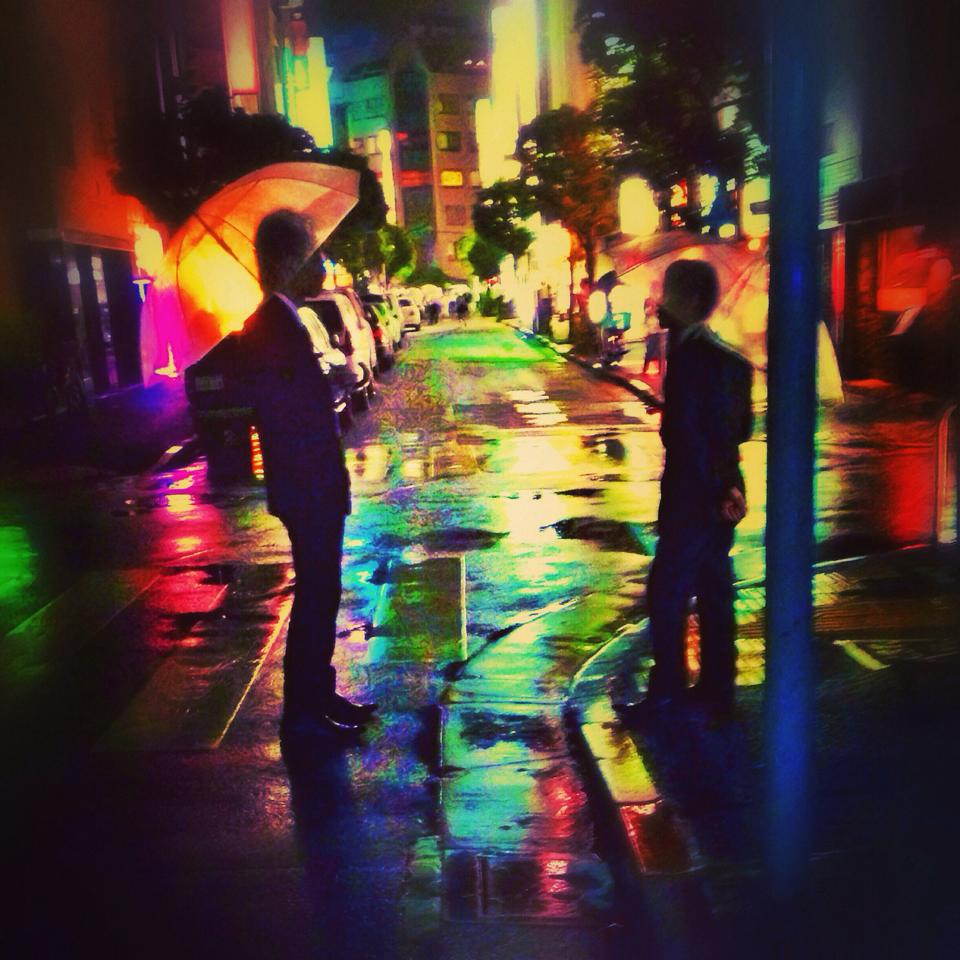
Neon nirvana

Eat Fish or Die Tryin’

I meet my friend Dagmar for breakfast at ten. At breakfast, I drink away my hangover with a bottle of a tasteless drink called ‘Delicious Water’ before heading out alone for the train. Someone told me yesterday that beneath the banks and office buildings between Mitsukoshimae Station and Otemachi Station, hidden deep underground, the Japanese government grows secret rice.

Somewhere along the Ginza Line, my train just powers down. All the lights extinguish, plunging the carriage into an abyss of darkness. The train drifts aimlessly towards Ueno Station and finally grinds to a haunting halt. The silence thickens, shrouding the dead train in an eerie stillness, an unsettling void that grips the carriage. Everyone remains silent, messing with their mobile phones, despite the obvious sorrow of the situation. It is all very worrying. About five minutes pass, and there is an announcement in Japanese, then nothing. A further five minutes, and the train starts up like nothing ever happened.

As I exit Mitsukoshimae Station, I accidentally wander into an adjacent department store.

maskmaskmask[1]

Inside the department store, there is a Mask Art Museum, and it is free. A nice but rather small exhibition. The store housing the museum is incredibly upmarket. I ask politely if I am allowed to take photographs, and lucky for me, it is fine. The exhibition actually ends today. Rather fittingly, all of the mannequins in this department store are wearing masks.

One thing I have noticed in Japan are the many strange museums. I believe I have previously mentioned the famous World Bags and Luggage Museum. A few other favourites of mine that I am yet to visit are the Gas Science Museum, the National Leprosy Museum, and the Parasite Museum.

I wander around for a while looking for the entrance to the secret underground rice bunker. It takes a while but I eventually find a huge office building that has every window on one side completely covered in plants. On the other side of the building I scare away an eagle pecking at a gold statue of Prometheus. This must be the place, I think to myself. It turns out it is.

prometheus[1]

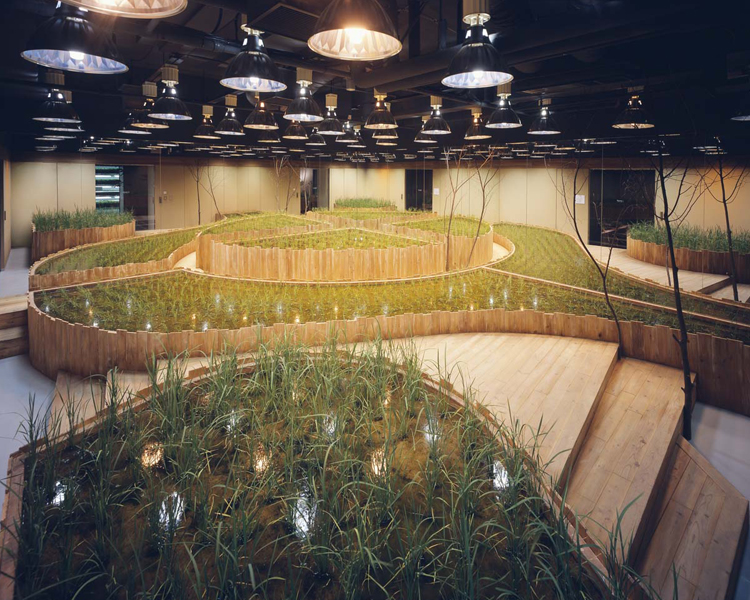
Deeply tucked away in the second basement level of a huge skyscraper, they grow rice. I am not entirely sure why they grow rice, but people are free to come and see it. Huge natural light shines from above. Rice grows. From what I was told, this area stretches under the whole business district, although it doesn’t. The size of the area was heavily exaggerated to me. The rice isn’t really that much of a secret; it’s not too well advertised, but no one is trying to hide the fact that it grows here either. In fact, I think it’s encouraged for people to come here and learn about rice cultivation. So, another urban myth shattered then.

ricetomeetyou

After looking at rice for a few minutes, I decide to walk to the Imperial Palace. I’m surprised by how close the stations are to each other in this area. Tokyo, Kanda, Shinbashi, and Nihonbashi Stations are literally within a five-minute walk of each other. Outside the Imperial Palace, about thirty elderly Japanese people are sitting and painting.

The Imperial Palace is home to Emperor Akihito, the last remaining monarch in the world to go by the name of Emperor. There isn’t really much else to see at the palace. The grass outside is cut immaculately, and the water fountains spray jets of water about two metres into the air. I notice there is a great view of Tokyo Station from the Palace car park, though. I wander to the nearby Ginza Station and take the train back to Asakusa.

tokyostation[1]

I decide to inspect a potential apartment. Small apartments in Japan are ironically referred to as “mansions.” These one-room coffin apartments offer little to no space and an equal amount of comfort. Another phenomenon in Japan is the grouping of shops, whole areas dedicated to selling one type of product. The area where the apartment is housed is completely surrounded by funeral shops. One street has eight shops in a row, all selling tombstones. I decide the area doesn’t quite feel right. Chimes sound from nowhere as I head back to the hostel, chiming five times signalling 5 p.m.

At 6 p.m., Richard, Luis, Remi, and I head to a nearby restaurant that serves fugu. Jokes are made about toxicity, tetrodotoxin, paralysis, and death. In reality, fugu poison is one-thousand two-hundred times stronger than cyanide; this is no laughing matter. The most poisonous part of the fish is the liver. Outside the restaurant, we watch our dinner for a while, graciously swimming around in a tank. In a moment, this beautiful blowfish will be killed on our behalf; we sure hope it doesn’t have a taste for revenge.

blowfishing[1]

There was a time when a fugu chef would have to pass a training course of ten years before being given certification to prepare fugu. These laws changed about three years ago, and now the rules state just a two or three-year course is required. We really hope that our chef today is of the older generation.

We take a seat in a tatami room. We order fresh blowfish sashimi. We also order diced blowfish sashimi just so I can make a pun about how we diced with death. Oddly, one of the options on the menu is hot sake with dried blowfish fin floating in the liquid. “We only serve the finest live domestic tiger blowfish,” says the menu. Served live? I certainly hope not. We wait anxiously for our food to arrive.

The poisonous fish is served in elegantly arranged translucent slices; it doesn’t look very threatening.

blowfish1[1]

A taste for revenge would be an overstatement. A taste of anything would be welcome. The food is the freshest fish I have ever tasted, of course; it has been dead just minutes. The food is also the least tasty fish I have ever had. It has no flavour at all; perhaps there is a subtle hint of death. I’m just glad we went to a cheap non-certified restaurant. It costs us just ¥5480 between the four of us for two dishes and four drinks.

I tried the sacred fugu of Japan and all I got was this lousy anecdote.

Some Like It Hot Tea

I decide to hire a bicycle. A friend from England, Damien, decides to join me. We grab two ¥300 bicycles for the day and cycle in the direction of Ueno. On the way, we pass a random stage on Kappabashi ‘kitchen’ Street. Men and women dressed in traditional taiko clothing hit massive taiko drums. A security guard stands watch, eyeing me up as I take a photograph.

kappadrums[1]

We cycle around Ueno Station and toward Ueno Park. Today and tomorrow, there is a festival here, the Philippine Festival 2014. The festival is sponsored by the international money transfer company Western Union. The space for the festival hasn’t been very well utilised. There are two rows of small stalls on both sides, and a third row through the middle, which completely obstructs the view of the small stage.

I promised a friend I would bring her a souvenir from the festival. To my dismay, all of the stalls appear to be for financial institutions or property letting companies. There is a stall offering tax refunds, there are stalls for various banks, there are stalls selling insurance. There is not one stand that seems to offer anything remotely souvenir.

philippinefest[1]

We take a seat near an ice cream shop opposite the festival. I rant to Damien about how much the festival has annoyed me; he is in agreement. A woman starts to sing from the stage that you can’t even see. The song from Frozen, ‘Let It Go.’ I almost go on another angry rant but decide to just let it go.

Back on the bikes, we head to Nippori Station, cycling through Textile Town and Fabric Town on the way. We cross the railway tracks and head to a big area of green on my map, thinking it will be some kind of park or temple.

For the second day in a row I find myself standing in a cemetery.

graveyardandtree[1]

Yanaka Reien is massive. Over 7,000 tombstones are here. The cemetery is so big that it contains a police station and a children’s swing park. The Tokugawa Family Graveyard is here too. The last shogun, Tokugawa Yoshinobu, rests here alongside fourteen other Tokugawa shoguns. There is one area that slightly confuses me; it is marked on the map as ‘The First Three-dimensional Deposit Facility’. We have no idea what this means, a Google search is like spinning our wheels, so we get back on the bicycles and do just that.

We head back toward Ueno Park, stopping off at the Daimyo Clock Museum to kill some time before returning to Asakusa. Outside the Don Quixote store, there is the Rokku Hanamichi Flower Festival taking place. Music is being performed on a small stage, but the flowers are notable by their absence.

Our next stop is over the Sumida River, to a place I visited whilst filming the cycle tour: Mukojima-Hyakkaen Gardens. The entrance fee is still ¥150. Today is Mushi-Kiki-no-Kai, which I am told means, ‘Enjoying the sound of insects.’ The event today describes itself as ‘An exhibition of various kinds of chirping insects, their chirping sounds, and the fantastic garden scenery.’ The insects aren’t quite as attractive as the description of the event, but the sounds they make are.

chirpinginsect[1]

A Japanese lady in a kimono approaches us as we stare at the crickets. “Where are you from?” … “Ah, England! Do you like tea ceremony?” Both Damien and I are yet to experience a traditional Japanese tea ceremony, so we go along with it and are invited into a tatami mat room, shoes off, kneel down, join the others. The other thirteen people attending are Japanese.

We wait a while before the process begins. When it finally does, we pass around a tray containing sweets filled with a red bean filling. I thank the person to my right for passing me the tray, I bow, I thank Damien to my left for letting me take a sweet before him, I bow, I take a sweet, I eat it. It is all very methodical. Next, it is tea time. Young women in kimonos kneel one at a time in front of people, bow, and place a bowl of green tea in front of them. They move in a clockwise order.

Before drinking, I ask the woman to my right if she would like any more tea, and politely, she refuses. No one ever says, ‘Yes,’ at this stage; it is purely a formality. I lift the bowl of tea, place it on my left hand, turn it clockwise twice, then drink it all in one go. Then when the bowl is collected, I bow once again.

The sweet was delicious, the tea was cold. I always preferred hot tea. The woman that invited us to the ceremony said that they would usually offer hot tea, but because it is a hot day, they decided to serve it cold. After the ceremony, we are allowed to inspect the beautifully crafted bowls and the container that holds the green tea powder.

greenteapowder[1]

The tea ceremony, I later find out, should have cost us ¥2000 each, but we were never asked to pay anything.

We head back to Asakusa, return our bicycles, then go our separate ways. I head to Cafe Byron Bay for a green curry and a chat with the locals. I meet a real-life ninja and a fugu chef. Fugu is a delicacy in Japan, but is somewhat poisonous. I make plans to eat the deadly fish and take down the details of the restaurant. Maybe I will be visiting my third cemetery in a week.

Bring Me the Head of Kubikiri Jizo

Today, I’m sitting at the bar of a small cafe having breakfast when a man named Yoshio notices I’m not Japanese and strikes up a conversation while I chomp on my vegetarian Eggs Benedict. “I just got back from America,” he tells me, “I got back yesterday.” His English is pretty good, and I stay for a second cup of coffee, chatting with him for about thirty minutes before he has to leave. After he departs, the cafe owner shares Yoshio’s full name with me. A quick Google search reveals his Wikipedia page, and I discover that the man I had breakfast with is a famous Japanese comedian.

After coffee, I head out to meet Luis, the Chilean guy I met during the World Cup. He is back in Asakusa for the final leg of his trip, so we arrange to meet up for 1 p.m. We take the Ginza Line to Akasaka-mitsuke Station. Akasaka is known for being quite a posh area, so we wanted to get a feel for what a rich neighbourhood looks like. No different from anywhere else, it turns out.

From Akasaka, we walk to Roppongi and head for Tokyo Midtown. Here, there is a giant 1:7 scale statue of Godzilla.

godzilla[1]

After Godzilla, Luis and I head back to Asakusa and eat at my favourite Indian restaurant. Luis has only ever had curry before one other time in his life, madness. After food, we head our separate ways.

Whilst I was exploring accommodation options for October, it was suggested to me by a 71-year-old Japanese man that I try the area known as San’ya; apparently, the apartments there are relatively cheap. San’ya is still in Taito Ward, and a forty-five minute walk from Asakusa. I head in the vague directions I am given and discover that San’ya no longer exists. All signs mentioning the word San’ya no longer exist. Every mention of the area has been removed, like a Japanese history book; all traces have been erased from memory.

The only sign that has any mention of a San’ya past is the sign for Namidabashi. The sign literally translates as ‘Tears Bridge’ and was where people came to say goodbye to loved ones before they were taken to be killed at the Kozukappara execution grounds, hence the tears. These days, the bridge has been buried under the concrete of an intersection, the execution ground painted over by a bus station.

busgrounds[1]

All that really remains, other than human remains, is Enmeiji Temple. It was this statue of Kubikiri Jizo, the decapitation Buddha, who watched over the nearby execution grounds. For those who were executed, the last image they would have seen is the Buddha. Its name literally translates to ‘neck cutting Buddha’. An estimated two hundred thousand prisoners were killed here. Ironically, during the March 2011 Tohoku earthquake, the Buddha was damaged and its head broke off. A sign details the step-by-step process of how the head was repaired.

There is also a sign here that says, ‘Nam-Myoho-Renge-Kyo,’ the all-too-familiar chant of the Nichiren Buddhist. Gravestones without names make up the backdrop.

kubikirijizo[1]

The main street here translates as ‘Bone Street’. It was on this street that the decapitated heads of the executed were put on display. The executions stopped in 1873, and after that point, the area suffered further misery. Somehow, San’ya became Japan’s biggest leather-producing area. The problem with leather is that it comes from cows, and cows in Buddhism are not to be used for leather production; this being a Buddhist country doesn’t help matters. The people here became complete outcasts, and leather production work was considered the lowest of careers. A certain stigma became attached to the already stigmatic San’ya area, and it fell into decline. It was around this time that the name San’ya was abolished. These days, the shops are all boarded up, the streets are empty, and the dead stay dead.

Today, if you live in the old San’ya area, you are still looked upon as different. You are judged for living here. The accommodation is cheap; however, I wouldn’t like to stay here. The people aren’t liked, the energy is wrong, and then there are the souls of murdered cows and headless criminals. I leave the macabre of San’ya and head to the somewhat less chilling ‘Flying God Temple’.

flyinggod[1]

The Legend of Tobi-Fudo comes from the Shobo-in Temple. It was first built in 1530. “Once upon a time, the chief priest of this temple went to the Omine Mountain in Nara Prefecture to pursue his learning; he took the principal image of Buddha with him to the mountain from his temple, but the principal image flew back to this place in Edo within one night and gave diving favours to the people.” I am not sure what ‘diving favours’ are, but this is what it said at the temple entrance. I think it is supposed to say divine.

In recent years, people visit the temple to pray for safety in air travel, praying their plane doesn’t crash. I suppose ‘diving’ is probably the wrong word to be using when talking about air accidents. There is also a sign saying a festival takes place in October on the temple grounds. I add it to my calendar and leave.

Pot, Kettle, Snack

Today, I take the Toei Asakusa Line for the first time in my life. Each time the train starts, it sounds as if there is music coming from beneath the carriages. It turns out that the music is the scraping of the train on the tracks; it does sound rather tuneful, though, perhaps this is the intention. It reminds me of an experience I often have on the Tokyo Metro Ginza Line; between Aoyama-itchome and Gaienmae, the train intermittently makes the sound of a dog being strangled.

I change trains at Shinbashi Station and depart in the direction of Yokohama. The journey time is an hour in total, and I arrive in Yokohama at 10 o’clock sharp. Outside the station, it is 21°C, cold in comparison to what I am used to. I search desperately for a Seven Eleven so I can update my maps using the free wireless Internet, but it seems Family Mart has the monopoly here. I eventually find a sketchy map and head toward Yokohama Bay.

yokohama[1]

There is a theme park here, Cosmo World. I contemplate riding the giant Ferris wheel (not pictured) to get a decent view of the area, but I remember that I am alone, so decide to give the solitary capsule ride a miss. I head to Yokohama F.Marinos MM21 Training Centre, the stadium for the football team ‘Yokohama F.Marinos’. Outside the stadium, two of the star players sign autographs for a small queue of fans.

The reason I came to Yokohama today is to visit the Cup Noodles Museum. For no reason that will ever become clear to anyone, a dinosaur stands guard at the entrance to the museum, a Deinonychus. This is the type of dinosaur that the raptors were based on in the movie Jurassic Park. I sneak past the Deinonychus and head to the ticket office. “How many people?” a young woman asks me. It is painstakingly obvious that it is just me.
“One person,” I say, looking around me for answers, “I think,” I add, deadpan. I pay the ¥500, and I am given a rather glossy museum guidebook.

dinocup[1]

Inside the museum, I am given a cardboard hat featuring a cartooned yellow bird, presumably a mascot of sorts. There is every packet of instant ramen and every type of Cup Noodle that has ever been created, arranged in a huge timeline. Just to clarify, this museum is for the brand of cup noodle called ‘Cup Noodle,’ made by Nissin; it is not a museum of cup noodles.

Momofuku Ando invented chicken instant ramen in his shed in 1958. With the overwhelming success of his chicken noodles, he went on to invent the cup noodle in September 1971. Not satisfied with his achievements, at the age of 96, he invented the first ramen that can be consumed in space. There is a wonderful exhibition of his life, a model replica of his famous shed, and loads of crazy noodle-based artwork here too.

cupnoodle[1]

There are noodle workshops where I can make ramen noodles from scratch or create my very own products. I pay an additional ¥300 and join the queue. I wait forty minutes, and eventually, I am given the opportunity to design my very own brand of Cup Noodle. First, I am given a blank Cup Noodle cup and am free to write or draw whatever I want. I graffiti the front of my cup, so where it once said, ‘Cup Noodle Museum,’ it now says, ‘Cook Pass Babtridge.’ I find the available pens to be of slightly poor quality, which spoils the whole experience for me.

Next, I get to choose the broth and toppings. A sign boasts that there are a total of 5,460 flavour combinations. “Gotta mismatch ’em all!” After toppings are added to the noodles, the lid is sealed in place, and the cup is vacuum-packed. After I finish making my lunch, I go to the top floor of the museum and check out the restaurants. No prizes for guessing what is on the menu.

After the museum, I stumble across a rather odd-looking building down some rather old-looking stone steps. It looks like a set from a science fiction movie; perhaps it once was.

bricksandstone[1]

I head into a Yodobashi Camera store. The place is silent; no crowds, no people shouting at me to buy their stuff. It is the complete opposite of the store in Akihabara. On the sixth floor, middle-aged men are queueing to buy AKB48’s 37th Single, ‘Senbatsu Sousenkyo,’ which was released today and will most likely be number one in the Billboard Japan Hot 100 chart by the weekend.

Outside, I grab a can of Suntory Black Boss coffee from a vending machine and make my way back toward the station. On the way, I pass a huge ship that looks amazing. It is actually part of the Yokohama Port Museum, sadly not a museum of fortified wine. The ship was built in 1930 and is used for training exercises. Even though there is a massive ship here, it doesn’t look out of place.

boatyokohama[1]

At the station, I take three different trains, and an hour later, I arrive back in Asakusa. I am actually completely exhausted but can’t sleep. I play video games for a while, then head out at six for a Dal Vindaloo at my favourite Indian restaurant. As I eat, I remind myself that I am in Japan and should maybe try Japanese food once in a while.

After food, I head to the hostel bar to conclude the day. A young Australian woman tells me that I sound like Russell Brand. I strongly disagree.