Pot, Kettle, Snack

Today, I take the Toei Asakusa Line for the first time in my life. Each time the train starts, it sounds as if there is music coming from beneath the carriages. It turns out that the music is the scraping of the train on the tracks; it does sound rather tuneful, though, perhaps this is the intention. It reminds me of an experience I often have on the Tokyo Metro Ginza Line; between Aoyama-itchome and Gaienmae, the train intermittently makes the sound of a dog being strangled.

I change trains at Shinbashi Station and depart in the direction of Yokohama. The journey time is an hour in total, and I arrive in Yokohama at 10 o’clock sharp. Outside the station, it is 21°C, cold in comparison to what I am used to. I search desperately for a Seven Eleven so I can update my maps using the free wireless Internet, but it seems Family Mart has the monopoly here. I eventually find a sketchy map and head toward Yokohama Bay.

yokohama[1]

There is a theme park here, Cosmo World. I contemplate riding the giant Ferris wheel (not pictured) to get a decent view of the area, but I remember that I am alone, so decide to give the solitary capsule ride a miss. I head to Yokohama F.Marinos MM21 Training Centre, the stadium for the football team ‘Yokohama F.Marinos’. Outside the stadium, two of the star players sign autographs for a small queue of fans.

The reason I came to Yokohama today is to visit the Cup Noodles Museum. For no reason that will ever become clear to anyone, a dinosaur stands guard at the entrance to the museum, a Deinonychus. This is the type of dinosaur that the raptors were based on in the movie Jurassic Park. I sneak past the Deinonychus and head to the ticket office. “How many people?” a young woman asks me. It is painstakingly obvious that it is just me.
“One person,” I say, looking around me for answers, “I think,” I add, deadpan. I pay the ¥500, and I am given a rather glossy museum guidebook.

dinocup[1]

Inside the museum, I am given a cardboard hat featuring a cartooned yellow bird, presumably a mascot of sorts. There is every packet of instant ramen and every type of Cup Noodle that has ever been created, arranged in a huge timeline. Just to clarify, this museum is for the brand of cup noodle called ‘Cup Noodle,’ made by Nissin; it is not a museum of cup noodles.

Momofuku Ando invented chicken instant ramen in his shed in 1958. With the overwhelming success of his chicken noodles, he went on to invent the cup noodle in September 1971. Not satisfied with his achievements, at the age of 96, he invented the first ramen that can be consumed in space. There is a wonderful exhibition of his life, a model replica of his famous shed, and loads of crazy noodle-based artwork here too.

cupnoodle[1]

There are noodle workshops where I can make ramen noodles from scratch or create my very own products. I pay an additional ¥300 and join the queue. I wait forty minutes, and eventually, I am given the opportunity to design my very own brand of Cup Noodle. First, I am given a blank Cup Noodle cup and am free to write or draw whatever I want. I graffiti the front of my cup, so where it once said, ‘Cup Noodle Museum,’ it now says, ‘Cook Pass Babtridge.’ I find the available pens to be of slightly poor quality, which spoils the whole experience for me.

Next, I get to choose the broth and toppings. A sign boasts that there are a total of 5,460 flavour combinations. “Gotta mismatch ’em all!” After toppings are added to the noodles, the lid is sealed in place, and the cup is vacuum-packed. After I finish making my lunch, I go to the top floor of the museum and check out the restaurants. No prizes for guessing what is on the menu.

After the museum, I stumble across a rather odd-looking building down some rather old-looking stone steps. It looks like a set from a science fiction movie; perhaps it once was.

bricksandstone[1]

I head into a Yodobashi Camera store. The place is silent; no crowds, no people shouting at me to buy their stuff. It is the complete opposite of the store in Akihabara. On the sixth floor, middle-aged men are queueing to buy AKB48’s 37th Single, ‘Senbatsu Sousenkyo,’ which was released today and will most likely be number one in the Billboard Japan Hot 100 chart by the weekend.

Outside, I grab a can of Suntory Black Boss coffee from a vending machine and make my way back toward the station. On the way, I pass a huge ship that looks amazing. It is actually part of the Yokohama Port Museum, sadly not a museum of fortified wine. The ship was built in 1930 and is used for training exercises. Even though there is a massive ship here, it doesn’t look out of place.

boatyokohama[1]

At the station, I take three different trains, and an hour later, I arrive back in Asakusa. I am actually completely exhausted but can’t sleep. I play video games for a while, then head out at six for a Dal Vindaloo at my favourite Indian restaurant. As I eat, I remind myself that I am in Japan and should maybe try Japanese food once in a while.

After food, I head to the hostel bar to conclude the day. A young Australian woman tells me that I sound like Russell Brand. I strongly disagree.

Internet Cafes, Bullet Trains, Irish Bars

Grilled fish of the day is salmon for the third day in a row. After breakfast, I return to my room and return my room to a state that looks exactly as it did before I arrived, a hotel habit of mine. After that, I check out and head to Popeye Media Cafe to write things up.

The Internet cafe doesn’t only provide Internet access. The following items are offered at no cost (¥0): bath towel, body soap, shampoo, conditioner, hair dryer, hair iron, toothbrush, skin toner, shaving equipment (razor and shaving foam), drinks from three vending machines (offering ‘over 50 kinds of drinks!’), mobile phone charging, two plugs per person (‘you can plug in a device!’), wireless Internet, showers, and a sunbed. All of these amenities are complimentary.

They also have a ¥360 hot food vending machine, but that seems to be the only thing you need to pay for, other than time. The cafe also offers a library of comic books, better known as manga. The amount of manga on offer is insane, with bookshelves spread endlessly in every direction. Where there isn’t a private booth with a computer, there is a bookshelf. The cafe boasts an impressive 179 computers.

internetandmanga[1]

“I paid ¥980 for five hours, the day rate. I’ve actually been here twice before. Those times, I foolishly came during the evening and paid ¥805 for two hours and ¥1330 for three hours.

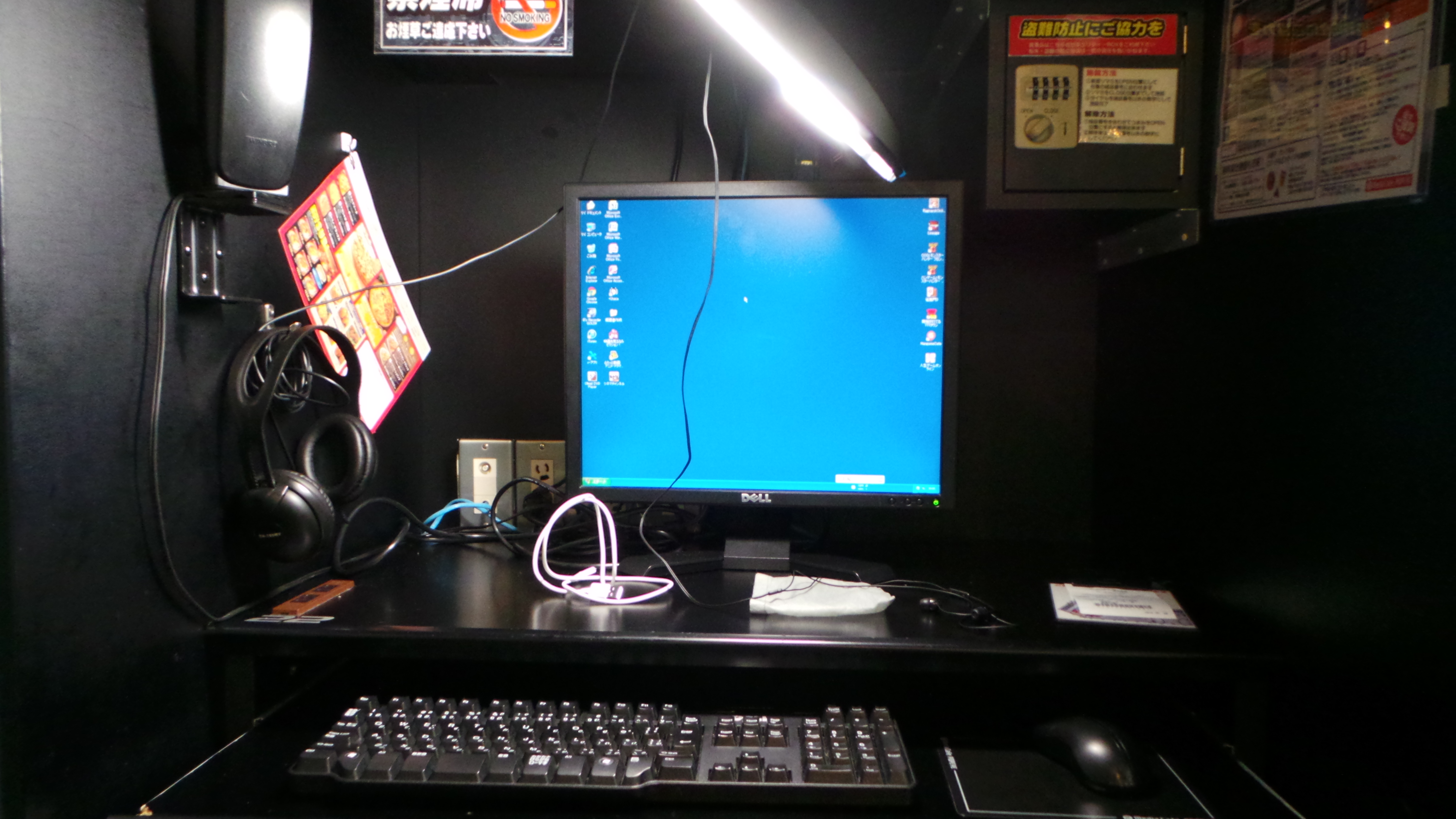
Today, I am assigned booth twenty-two. My computer runs Windows XP, and Google Chrome has already been downloaded. Next to my monitor is a menu for Domino’s Pizza. If I want, I can select a pizza from the menu, and the front desk will order it for me, handle the payment upon its arrival, and deliver it to my desk. The pizza will be added to my ‘check’ and paid for at the end.

I lounge in my reclining chair and write for five hours, all the while sipping on my free drinks. Today, I’m heading to Nagoya and can’t check into my hotel until 2 p.m. Might as well kill time by writing, that’s what I say.

20140804_200337

I like it here; dingy, comfortable chair, feels good. I can see how people can end up spending a whole night here. People actually do just that. Because of the free amenities on offer and the availability of private booths to rent for a special ‘all night’ rate, people actually sleep here. It works out cheaper than a hotel, and you can read all the comic books you desire.

When I’m done, I settle my bill and leave. Outside, the sun is far too bright, especially after sitting in the dark for five hours. At 3 p.m., I take the bullet train to Nagoya. It costs ¥6760 for a 52-minute journey. It’s twice as expensive as the local trains, but they take three times as long, and I can’t deal with that. I reserve a window seat to make use of the ‘free’ plug socket. I realise that this might well be my last ride on the bullet train for a while. It’s quite saddening, actually; the bullet train really is a treat.

I arrive in Nagoya at 4:02 p.m., precisely as stated on my ticket—efficient as always.

nagoyastation[1]

The station exits out into the heart of the city, and a beautiful city it is. Thunder sounds in the distance, threatening rain, with a few flashes of lightning in the sky, but I only have to walk for five minutes. It starts to rain ever so slightly just as I arrive at my hotel. The lift doors open as I approach, “Welcome in,” they say in a robotic female voice.

In my room, I find that I am given loads of free stuff: a comb, toothbrush, toothpaste, slippers to keep, a shower cap, razor, bottled water, cotton buds, tea, coffee, and my own individual wireless network. It feels like I am back at the Internet cafe. The complimentary toothbrush says, “Thank you for using me. Please relax slowly.”

Outside, Nagoya feels right, especially after Osaka and its indecipherable road layouts. Sometimes a place grabs you, giving an instant good feeling; Nagoya has just that. Some might think Nagoya is like everywhere else—tall buildings, concrete, and neon. They would be right. But something about the place, about my initial impression, draws me into the neon of the night.

neonnagoya[1]

I walk around for a good few hours. One of the things I enjoy about visiting a new place is thoroughly exploring the backstreets and restaurants—reconnoitering. I notice small rectangular holes cut into a wall, just the right size for a hand. On the other side of the hole is an anonymous person: a hand wrapped in a white glove, a small tray for exchanging objects or money. Worthless pachinko parlour prizes are discreetly swapped here for cash, with no one seeing anyone else’s face.

It’s 8 p.m. but feels like eleven. I step into an ‘Irish’ bar where American punk is playing, and ‘J Sports 2’ is showing a Japanese baseball game. Quite the Irish experience, indeed. I order half a Guinness and a Glenlivet 12 on the rocks; they each cost ¥600. The Guinness tastes poor at best, far from the standard I am used to from the pubs back home.

I am asked to pay up front, which is unusual here.

irishpub[1]

The music changes to the Libertines. I can’t complain. I consider the instructions on my receipt, ‘enjoy and enjoy and get dead drunk.’ After finishing my drinks, I stand up to leave. As I do, one of the barmen stops me. “It’s our eight-year anniversary. Please choose a colour,” he says.
“Okay …” I ponder the question for a moment. “Green,” I reply. The barman reaches into a box under the desk and pulls out a bright green t-shirt.
“This is free for you,” he tells me as he hands me the t-shirt. Amazing, even more free stuff. I thank him and leave.

Nagoya, the capital of Aichi Prefecture, is distinctly a business-centric hub. Everywhere I look, there are men in white shirts, black trousers, and black shoes—salarymen abound. The horizon is engulfed by a mix of black, white, and neon. Notably, Nagoya’s GDP accounts for 1% of the global economy. Toyota, too, began its journey here, in a town called Toyota, within a city, also named Toyota. It might seem like a kind gesture that the car manufacturer adopted the town’s name, but in reality, the city was initially called Koromo, only changing its name to Toyota in 1959. The town followed suit, renaming itself Toyota. Capitalism in Japan—a fascinating phenomenon.

With the Domino’s Pizza menu from earlier today lingering in my mind, I opt for another unconventional yet healthy choice for a traditional Japanese meal: Italian food. The menu is entirely in Japanese, but the waiter promptly prints off a fresh, crisp, English menu for me. I decide on a tuna pizza, which arrives with a lovely bowl of minestrone soup.

nagoyapizza[1]

As far as pizza goes, this is probably one of the greasiest I’ve ever had. But it’s good. Very good. I pay what seems like a lot and sneak a couple of the ‘free’ complimentary pieces of nutty caramel flapjack—very Italian. The bill comes to ¥2667, and I receive a delightful ¥333 in change.

Back at the hotel I fall asleep watching ‘Back to the Future’.

Height of the Lifting Tread

Today, I woke up at 4 a.m. My sleep pattern is completely messed up from spending a week in a fourteen-bedroom dormitory room, constantly being disrupted by shuffling, case repacking, and inconsiderate chicken eaters. Anyway, for the next seven nights, I’ll be enjoying the luxury of a lonely hotel.

With little else to do, I decide to take a look at Japanese television for the first time in months. Honda is launching an aeroplane, the HondaJet, which might as well be a spaceship considering its appearance. Cristiano Ronaldo is advertising some weird gadget that you roll on your body, perhaps to release muscle tension, but its exact purpose remains unclear. A baseball match is rained off. There’s a game show where a member of the girl idol band AKB48 is being chased down a street by one hundred convicts who escaped from prison vans. Hilarious. I switch the TV off.

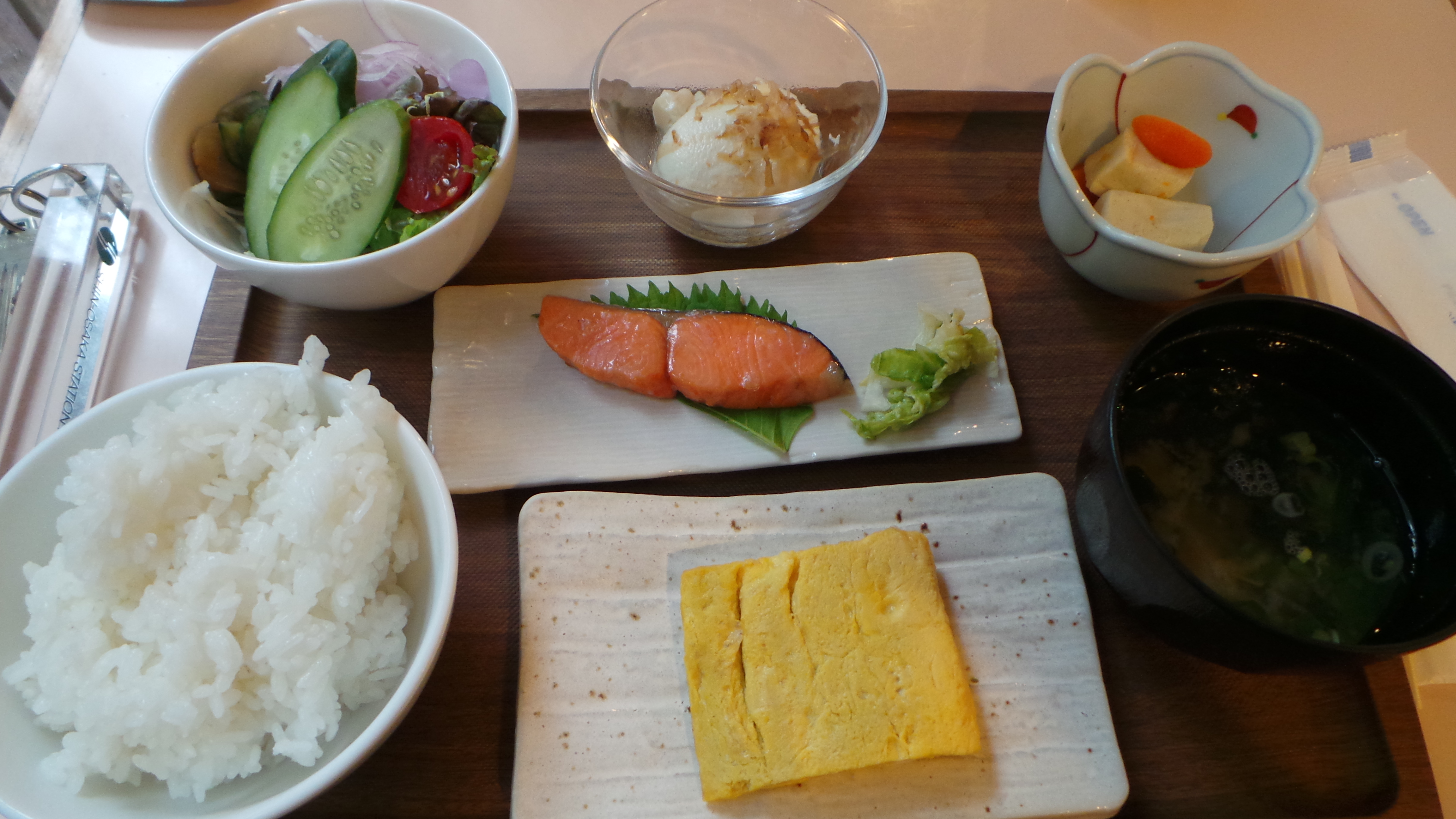
At 7 a.m. sharp, I head down for my ‘free’ breakfast. I am greeted by warm smiles, fastidious service, and first-class hospitality. My breakfast comprises a Japanese-style omelette, grilled fish of the day (salmon), salad with homemade dressing, cooked seasonal vegetables, homemade tofu, white rice, homemade pickles, and a pot of miso soup. Additionally, I help myself to drinks; opting for orange juice over coffee.

japanesebreakfast

The breakfast is a success, fitting my pescatarian diet as well. I enjoy everything except half of the tofu; it’s never been my preference. Although the rice and miso soup are self-service, allowing me to have more, I opt not to be greedy. Feeling satiated, I return to my room to read, but I find myself dozing off.

I wake up again just after 11 a.m.; I must have been really tired. I dry my shoes with a hairdryer, and ten minutes later, I’m out the hotel door, umbrella in hand. It’s the kind of hotel where you have to hand in your key at reception every time you leave. Works well for me—I hate carrying bulky hotel keys around anyway.

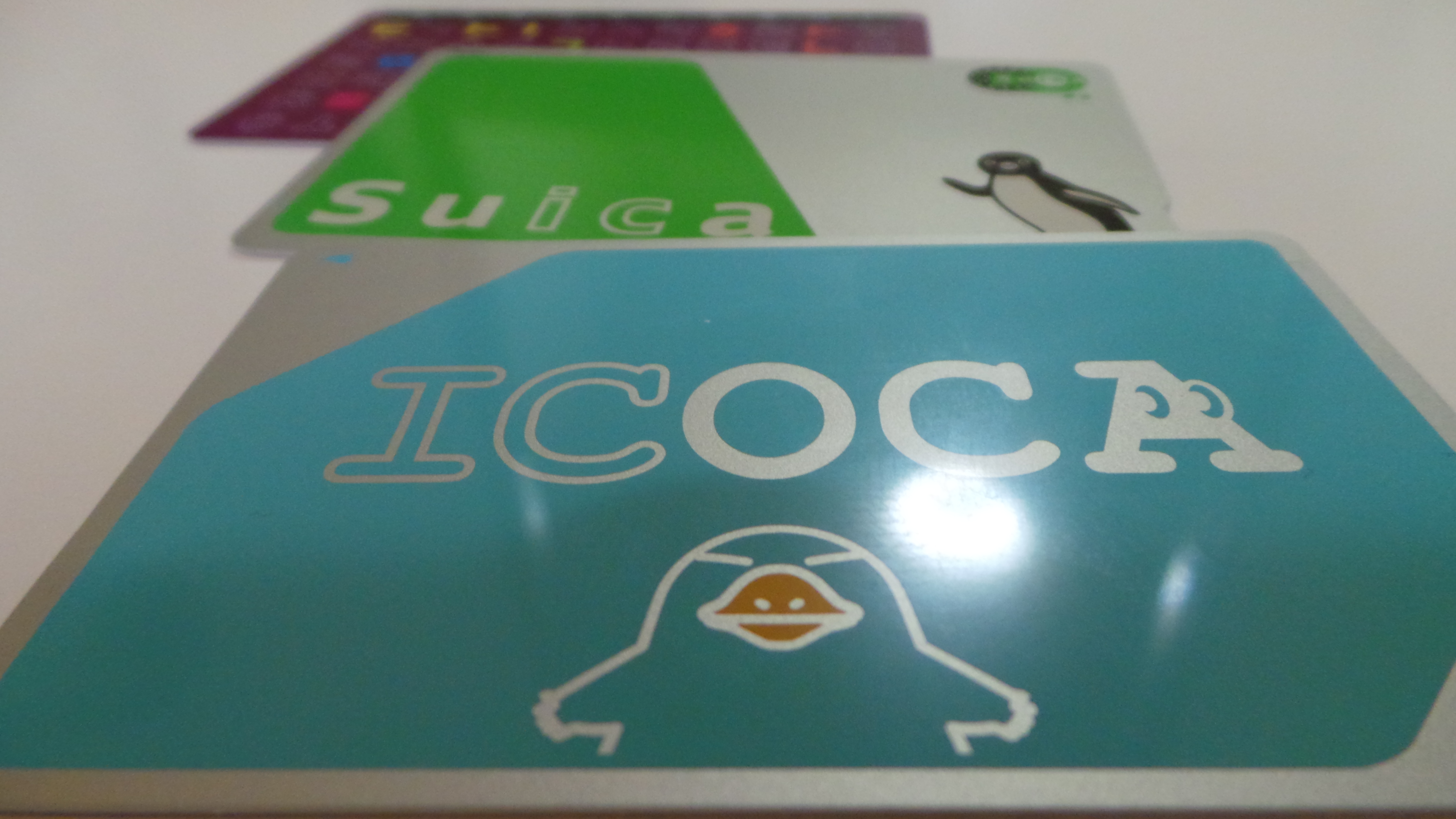
Outside, I take a train to Osaka Station for ¥160. Unfortunately, my Suica card randomly stops working, so I’m forced to buy an Icoca Card, the Osaka equivalent. The Icoca card is light blue and features Ico the Platypus. These cards often contain hidden puns. The ‘Super Urban Intelligent CArd’ is a play on the word ‘suika,’ meaning watermelon. ‘Sui sui’ is an ideophone signifying smooth movement. Much like a penguin swimming effortlessly in water, my card usually allows me to glide smoothly through the ticket gates—except when it randomly stops working at the gates.

20140806_091934

At Osaka Station, the Muzak drives me crazy. I keep hearing the same songs over and over. There’s this one Japanese song with a female vocalist and an incredibly catchy melody. I might even say I like it and want to find out its title. However, my issue is that every time it plays, it’s too quiet for me to catch any of the words. As usual, the tune will be stuck in my head for the next few hours, the jaunty music swirling around my head like a relentless earworm.

I escape the torture of the train station Muzak and head straight for the Umeda Sky Building. As I arrive, the rain stops. Just great — now I have to carry around a useless umbrella all day while humming the melody of that song. Spotting a sign for ‘Fun Fun Plaza’ cheers me right up.

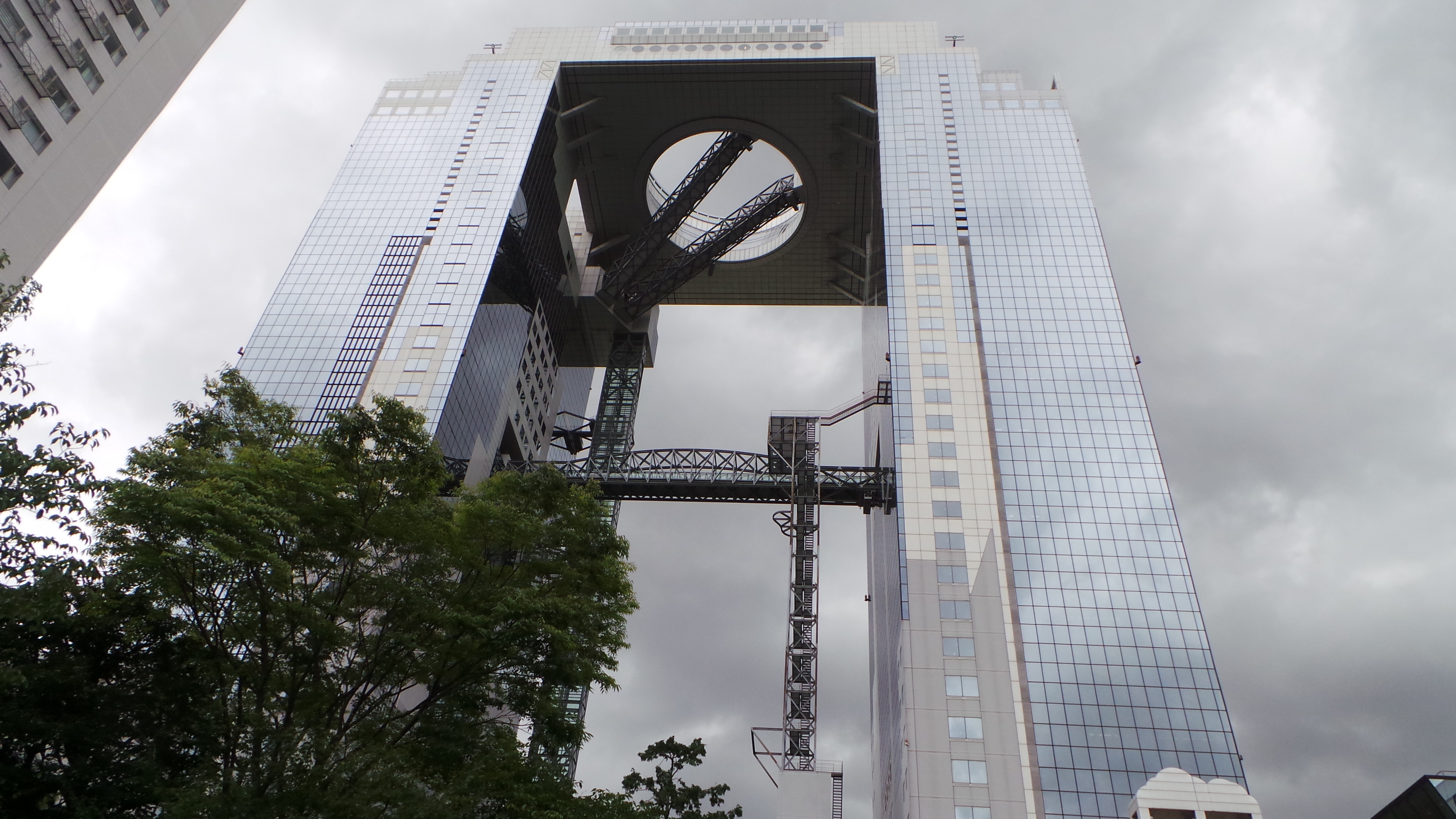
skybuilding

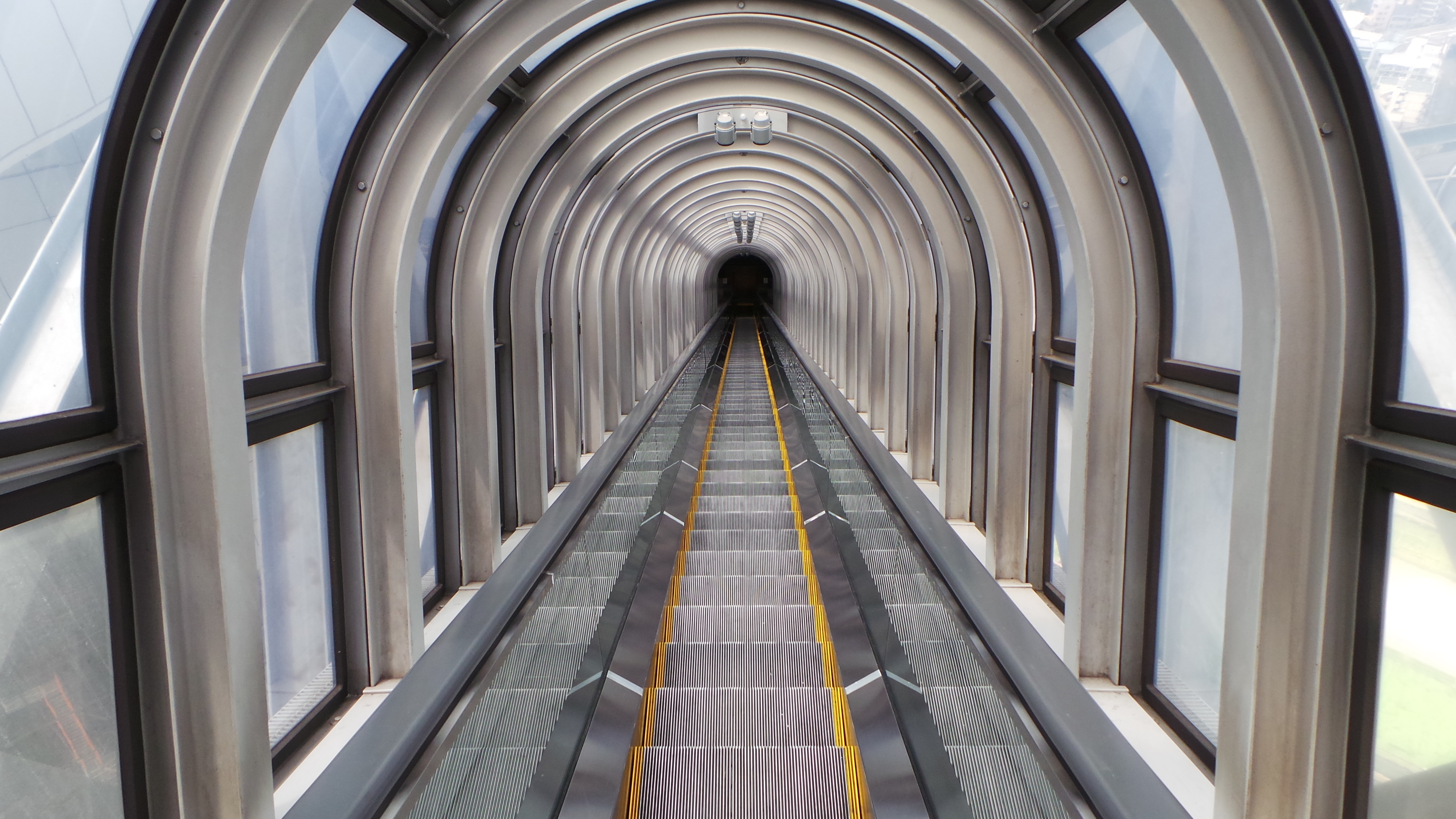
At the base of the Umeda Sky Building, there are numerous beautiful, well-cared-for gardens, and fountains. The building comprises two 40-storey skyscrapers connected near the top by two escalators that appear to float in mid-air. The rooftop terrace forms a floating sky garden.

To reach it, I have to take a glass elevator to the 39th floor. Interestingly, the building was designed by Hiroshi Hara, the same architect behind that lovely roof in Kyoto Station. Once I reach the 39th floor, I’m left with no option but to step onto the escalator. As my foot touches the moving walkway, I freeze. I could walk along the escalator and end this ordeal sooner, but I’m unable to move. The very top of the escalator stands at 173 metres above ground.

esc2

On the other side of the escalator, a woman greets me at reception, and I’m required to pay ¥700 to access the sky garden. There are various informative signs around. Interestingly, in 2008, Dorling Kindersley of ‘The Times’ newspaper mentioned that the Umeda Sky Building was among the top 20 buildings in the world, ranking it alongside the Parthenon and the Taj Mahal.

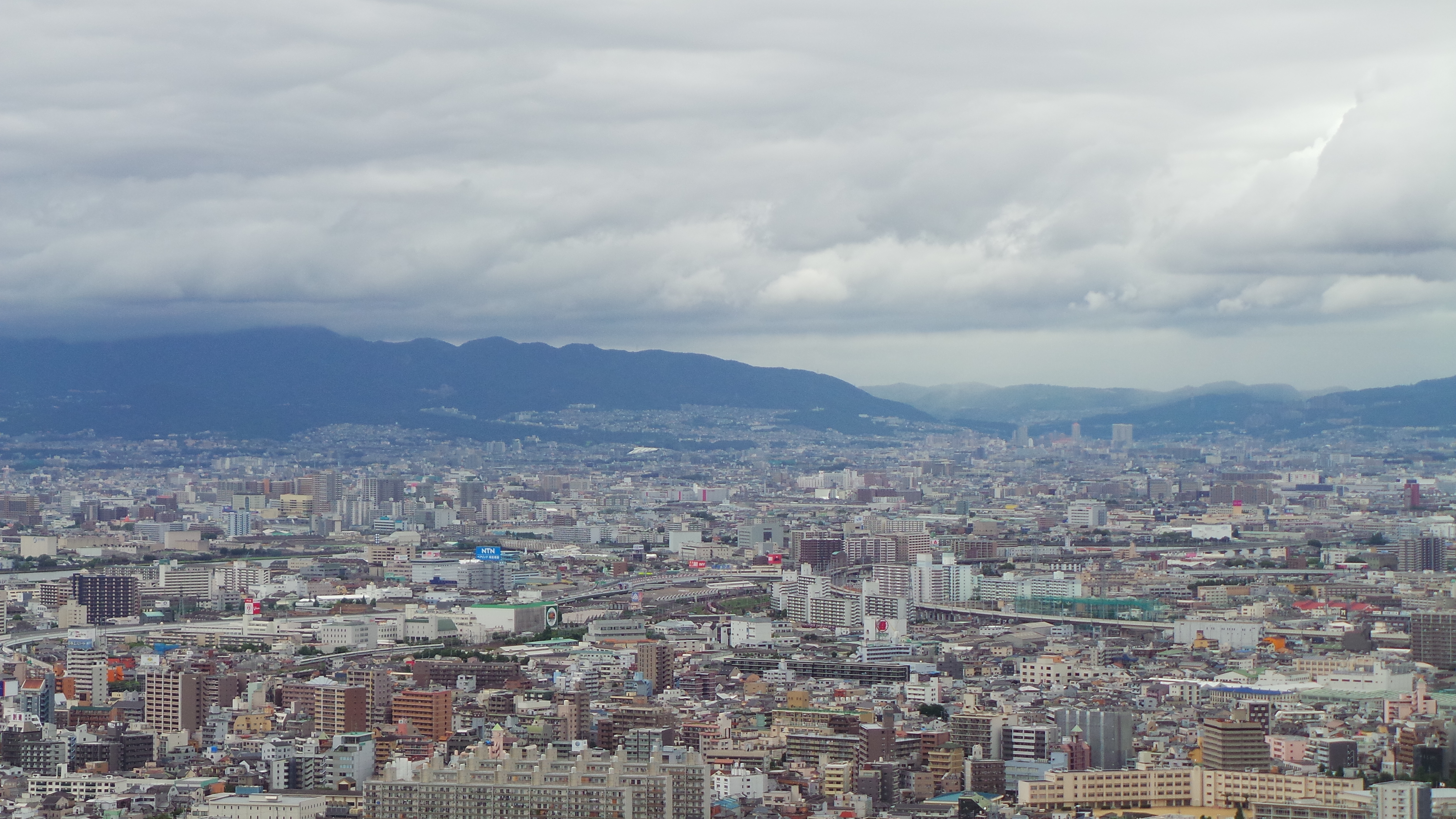
The route up to the sky garden showcases the history of tall buildings from the past, present, and, rather confusingly, the future. There’s information about a sky city in space, accompanied by to-scale models and concept artwork. The sky garden itself provides a complete 360-degree panoramic view of Osaka. Unlike other tall buildings or towers, the sky garden is outdoors, offering unobstructed views without reflective glass to spoil the magnificent scenery.

viewfromthesky

The strong winds up here feel incredibly refreshing. I snap a few photographs and leisurely stroll around, prolonging the inevitable return via the escalator. Eventually, it’s time to leave. As I traverse the slow-moving escalator steps again, surprisingly, it feels less challenging. I attempt to admire the view through the glass panels but struggle to focus. Descending in the see-through elevator, I decide that I’ve had enough of heights for the day.

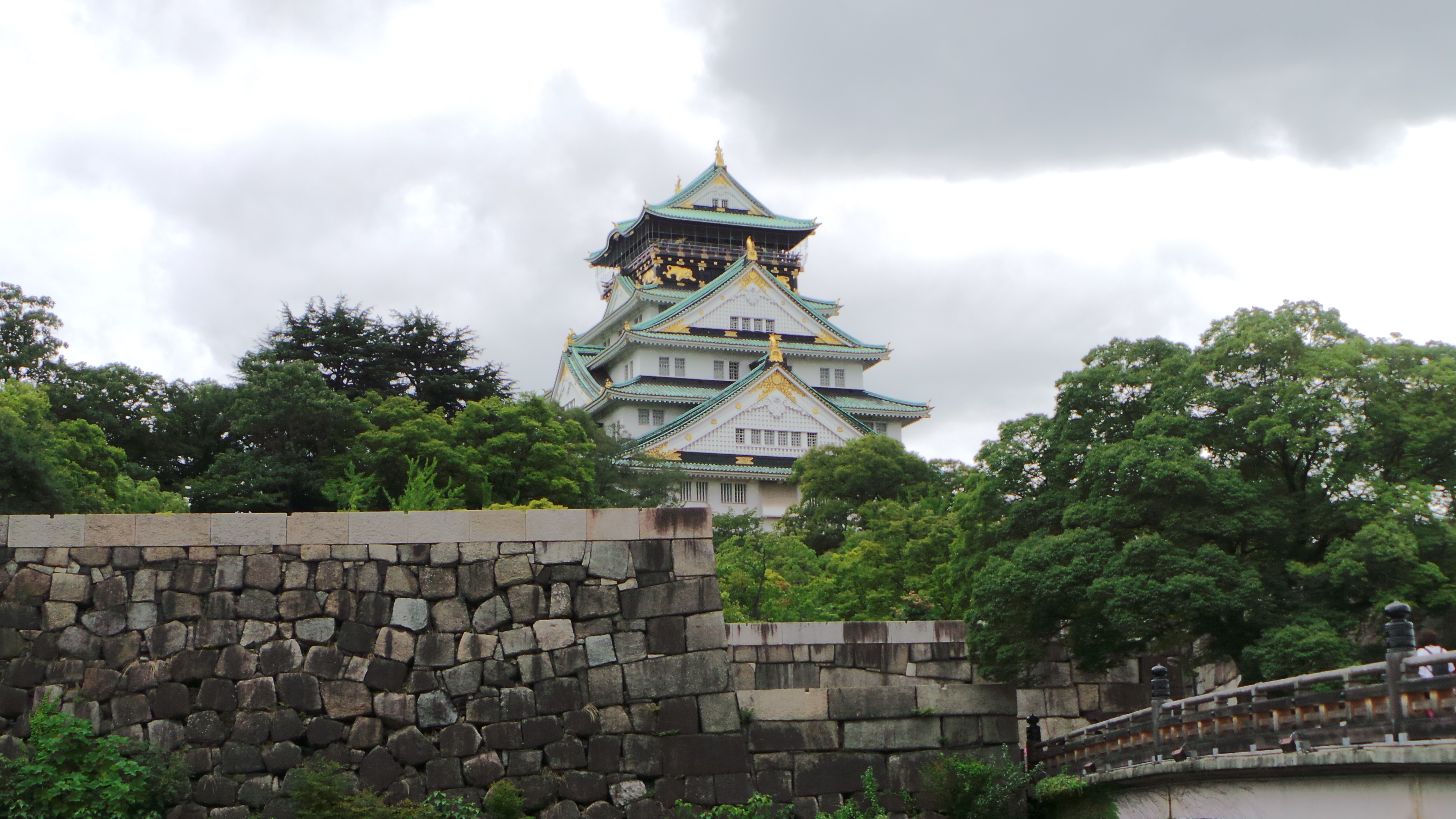
My next stop is Osaka Castle. I return to Osaka Station, take the loop line, and reach my destination, another ¥160 fare. Perched on stone and surrounded by moats, Osaka Castle sits at a considerable elevation. As usual, I climb numerous stone steps and finally reach the castle’s exterior. Unfortunately, someone has installed a small elevator and escalators that slightly obstruct the view from one side. Fortunately, I approached from the opposite direction and captured an unspoiled photograph. The castle is like a ‘TARDIS,’ appearing to have five stories on the outside but revealing eight stories inside. Very odd.

osakacastle

After visiting the castle, I take the trains back to Shin-Osaka. Upon reaching the hotel, I collect my key and am pleasantly surprised to receive a breakfast token for the next day—amazing, another free breakfast. Passing some time, I decide to take a short nap. At 6 p.m., I head out for dinner. Earlier, I had researched a nearby place that offers vegan food within walking distance. With my bearings in place, I cross the tracks and turn left at the graffiti

I find the restaurant with ease; it’s right next to Nishinakajimaminamigata Station. I take a seat inside, the only customer. The male owner is very welcoming but doesn’t speak English. A woman with a dog walks in, the owner’s wife. I already knew the restaurant was owned by a middle-aged couple. Independently run, organic, and vegan-friendly—although I’m not a vegan. I point vaguely at the menu, “Yasai,” I say, not quite sure what to expect.

veganosaka

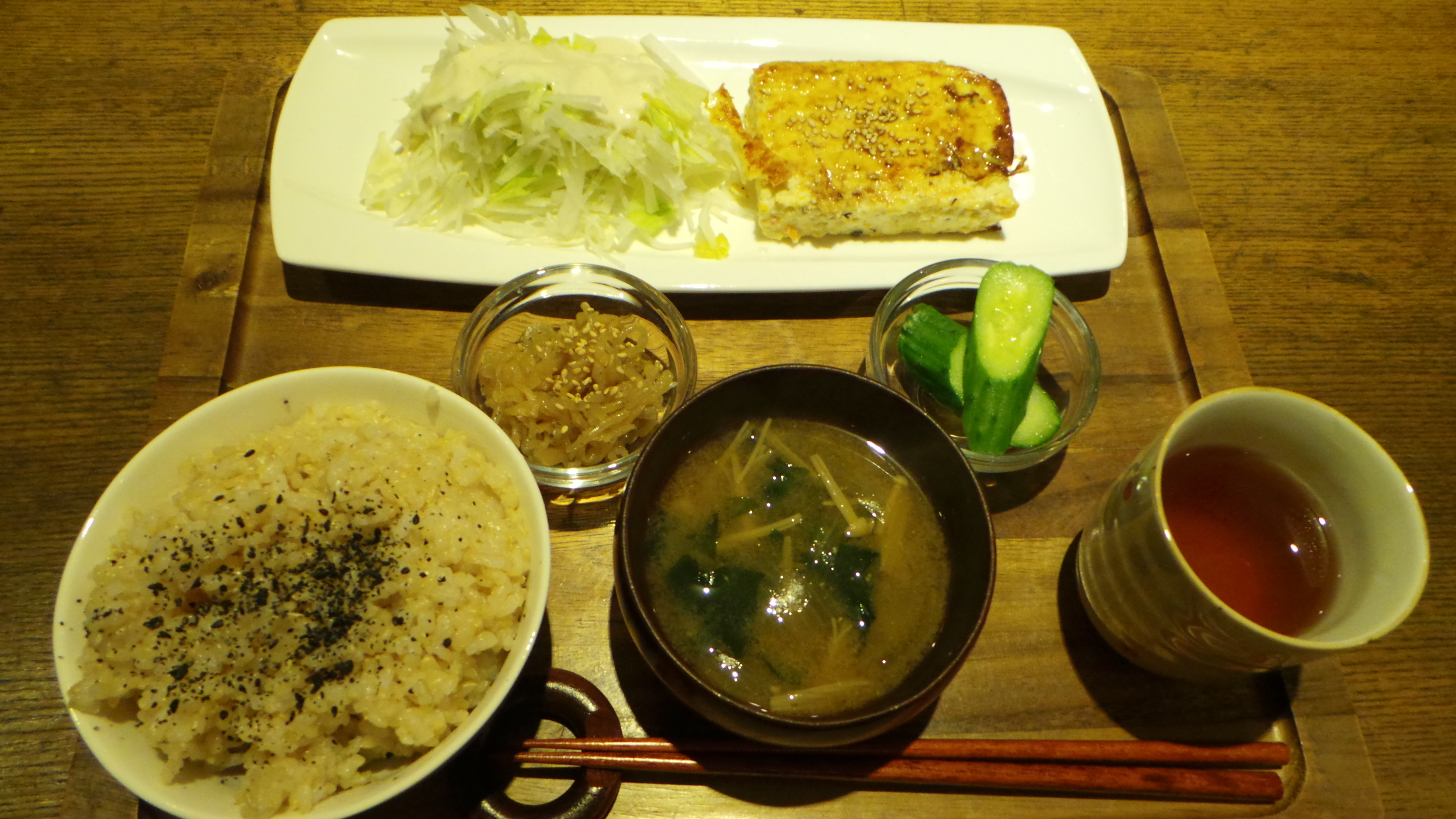
The food looks amazing. As I take out my camera, the man who served me, also the chef, laughs and says, “Douzo,” indicating that I’m welcome to take a photograph. This is the first time I’ve been served brown rice, and its taste oddly reminds me of porridge, much better than the ‘dead’ white rice I’m used to. The main part of my dish puzzles me; it has a texture similar to quiche but without the pastry. It could be tofu, but I’d be very surprised; tofu could never taste this good. I pay just ¥880 for what turned out to be a really nice meal.

After eating, I head back to the hotel for another considerably early night.

Cicadas of the Lost Park

Today, I wake up at 8 a.m. I go outside and take a short wander. It seems that Kyoto is still sleeping. I return to the hostel to steal a few more hours for myself. By 11 a.m., Kyoto still seems to be asleep; shops are closed, and nothing much is happening. I decide to do some sightseeing. I am fortunate to be staying in Downtown Kyoto; many places are within walking distance, which is very convenient as I am tired of trains. I walk from the hostel in a straight line along the same road for ten minutes, eventually arriving at Kyoto Imperial Palace Park.

The gardens here are quite impressive, featuring Omiya Palace, Sento Palace, multiple shrines, a peach grove, and, of course, the Kyoto Imperial Palace. The peach grove is odd; the peaches are within arm’s reach, so I could steal a few if I wanted to, but I don’t. The most appealing shrine is the Isukushima Shrine; it sits quietly over a lake.

giongardens[1]

There are signs in some areas of Kyoto Imperial Palace Park that say, “Not to be visited by tourists.” There are little to no other tourists here anyway; perhaps the signs have driven them all away. However, there are hordes of homeless people. Some paths are overgrown, others forgotten many years ago. I see one gardener delicately pollarding the branches of a tree. Just one gardener tending to a park 1.3 kilometres in length.

As for the Kyoto Imperial Palace, it lies behind a moat and a tall wall. The water in the moat has dried up, and the wall is too high to see the Palace beyond. Even if the wall weren’t there, it would be completely shrouded by trees anyway. I quite literally can’t see the Palace for the trees.

kyotopalace[1]

There is one thing I do like, and that’s the sound made by the cicadas. These little insects just love to sing, and the trees here are full of them. And there are a lot of trees; ten thousand trees in the Palace Park alone. The noise these insects make sounds alien to me, perhaps robotic, but calming. I spend a full hour wandering the park.

It is another hot day. Well over 30°C, as usual. A woman outside sprays water from a hosepipe around the path leading into her shop. I believe this is to keep the dust down. I cross the Kamo River; much like the Palace moat, it is dried up from the heat, the fish left behind for the birds. As I walk through the shopping arcade, I realise that there are loads of crêperies here; at least eight or nine shops selling pancakes. A sign in one of the pancake shops attempts to forecast the weather:

signwarm[1]

Back at the hostel, I sit opposite a guy as he flips through a Lonely Planet guidebook. “Where are you going today?” he asks, half for the sake of conversation, half for ideas of places to visit. He waits for me to list off all of the same places as everyone else, but I don’t.
“I’m going to a Kaleidoscope Museum,” I tell him proudly, and his expression fills with puzzlement. He desperately flicks through his guidebook, presumably the ‘Kyoto’ section, but to no avail.
“Hmmph,” he utters, suggesting that if it isn’t in his guidebook, then it doesn’t exist.

I walk halfway across the city, only to find that the Kaleidoscope Museum of Kyoto is closed on a Monday. “I’ll be back,” I say to the locked door with a shake of my head.

Kaleidoscope[1]

One thing I like about Kyoto is that on street corners, there are nice little plaques in English offering insightful history about the area—a nice touch. Feeling a little hungry, I decide to swing by a local cafe at the organic market. I pay ¥940 for a soybean croquette, a cheese croquette, and a beer. The food and drink aren’t particularly photogenic, so I skip taking a photograph.

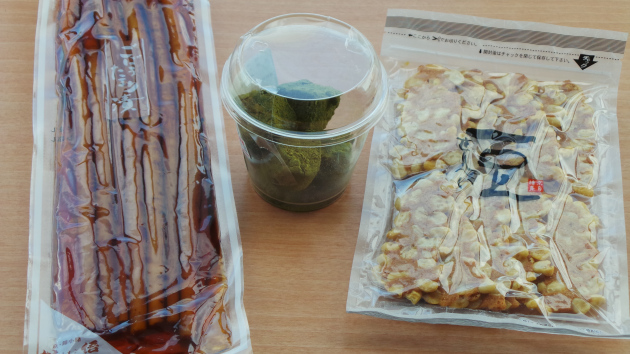
While I’m here at Nishiki Market, I decide to sample some of the local foods. With over a hundred shops and restaurants, they sell seasonal foods and Kyoto specialties like Japanese sweets, pickles, dried seafood, and sushi. I buy three different traditional Japanese snacks and take them back to the hostel.

snackssnack

On the left, I have Gobo Tamari Zuke, or pickled burdock root; marinated in sugar and soy sauce. I wish I had bought this in Okayama to go with the dandelion. In the middle, there’s some sort of matcha snack. It’s basically Turkish Delight coated in a fine green tea-flavoured powder, instead of the usual icing sugar. On the right, there’s a Japanese traditional cake with soybeans, said to have been made for approximately 150 years using the same traditional manufacturing method. According to the packaging, ‘One piece of one piece is the cracker which I baked carefully.’ The cake costs ¥400 and is my favourite of the three.

After trying my snacks and finishing my book, I head out for dinner.

I spot a gyoza restaurant, a food I am yet to try in Japan. Gyoza is a type of Japanese dumpling, usually filled with meat. This restaurant has an English menu outside, stating that one of the fillings they offer is shrimp. I order the shrimp gyoza along with a beer and a side of spiced cucumber. The cucumber dish arrives whilst I wait for my dumplings; the spices provide a good balance to what would normally be a dull snack. Three pieces of shrimp gyoza show up, although I was expecting at least five. After I finish my first three, a plate of ten fried dumplings is placed in front of me.

gyoza[1]

As I bite into the first of ten, I realise it is pork. The staff don’t speak English, but I manage to convey the message. My plate of pork gyoza is taken away, and I’m told it will take eight minutes for the shrimp. While I wait, I order a second beer. Eventually, I am handed a set of shrimp gyoza, albeit only five pieces instead of ten. Apparently, shrimp is twice as expensive as pork.

As I eat, I mishandle my chopsticks. One of the dumplings falls and lands in the saucer of soy sauce; the sauce splashes up and hits me in my left eye. It stings, and I spend the rest of my meal with tears rolling down one side of my face. After finishing my meal, I offer to pay for the wasted pork gyoza, unsure if it was my mistake or theirs. Admittedly, the restaurant is rather cheap. We compromise, and I pay a total of ¥1570 for eight pieces of shrimp gyoza and two pints of Asahi Beer.

I head back to the hostel’s bar and notice a guy reading ‘Women’ by Charles Bukowski. I share that I’m not a fan of Bukowski, only to find out that the guy is from Surrey. I end up spending the rest of the evening in the bar, discussing literature and politics.

Grandiose Encounters of the Third Class

I went without any Internet connection for a few days, so I couldn’t post anything. Here’s a summary of the last three days:

Friday – Fukuoka

Today, I met a German guy named Klaus. It’s his first day in Japan after spending a month in South Korea. He wants to stay here tomorrow night as well, but there are no available rooms in the hostel. I cancel my reservation for tomorrow night, and he takes my room. I wanted to start traveling early tomorrow anyway, as I have a fourteen-hour train journey to endure.

Klaus and I take a stroll around Hakata Station. I show him the sights, starting with the roof terrace. We then wander through the enormous indoor shopping complex, exploring various random gifts. I spot some excellent souvenir ideas. Later, we head for food—a classic dish of mixed vegetable and prawn tempura on rice, accompanied by a pint of Kirin Beer. Kirin isn’t my first choice for Japanese beer, but I don’t complain.

tenpura3[1]

Afterward, we head over to Tenjin Station because Klaus is really keen on seeing the giant cardboard train. I don’t mind showing him around as I have nothing else planned in Fukuoka. Klaus is quite funny, and his English is good, so I don’t have to speak slowly or anything. We enter the building where I thought the cardboard train was, but we can’t seem to find it. Unfortunately, I deleted the photograph, so I can’t prove to him that it was real. He starts doubting its existence altogether, and I begin to question it myself, still feeling a bit off-kilter from yesterday. We hesitate to ask anyone else about the train because it might sound absurd. “Excuse me, miss, could you point us in the direction of the giant cardboard stream locomotive, please?”

After an hour of searching, we eventually find it in a completely different building from the one I had sworn it was in.

Next, we head to an izakaya by the river. It’s the first time I’ve visited an outdoor izakaya of this style. We choose the most welcoming one. “Please, you are welcome,” the owner says with an honest smile. This place serves skewers of meat and noodle soup. Klaus and I do what Germans and Britons do best: drink.

klaus[1]

We meet a couple of Japanese people: two guys, one of whom had visited Berlin last year, so he and Klaus engage in conversation. Two girls, one of whom had spent six months studying English in Leeds, so she and I chat. As the night progresses, Klaus teaches me about South Korea, and I share my knowledge about Japan with him. We drink, joke, and before we know it, the night disappears.

Saturday – Okayama

I board my third and final train for the day at Shimionoseki Station, taking the JR Sanyo Line. The train is old, with uncomfortable seats, no toilet, and no vending machine. I wish I had more than one bottle of water. The train announcements are exclusively in Japanese. Am I even on the right train? How would I even know?

This ‘local’ train makes an astonishing 83 stops, taking a total of eight hours. Finally, at 9 p.m., I arrive in Okayama. I decided to break up my travel to Kyoto with a nice stopover in a pleasant-looking business hotel. I enjoy staying in a hotel once a month; it offers a refreshing change from the noise of a dormitory room. By using my Seishun 18 ticket, I save myself the ¥16,060 that the bullet train would have cost me. In exchange, I sacrifice 569 minutes of my life.

As I step off the train, the speakers are bellowing out the tune, ‘I’ve Been Working on the Railroad’. In fact, they play the tune every time a train pulls up here. You might go insane if you were a member of the station staff. Leaving the station, I realise just how exhausted I am from doing absolutely nothing but sitting on trains. It wears me out.

There is a really lovely fountain just outside the entrance. I believe it’s shaped to look like a dandelion.

dandy[1]

One thing I notice immediately about Okayama is the maps—they are everywhere, massive, and in English. My hotel is on the same road as the station, about halfway between here and Okayama Castle. I grab a well-deserved can of Suntory whisky highball for the walk.

The main road through Okayama is wide, with trams drifting through the middle of the lanes. Neatly pollarded trees, lit up by lamps, line both sides of the pavement, adding to the city’s charm. Finding my hotel, I notice it’s slightly more upmarket than I’m used to. The room is of average size, with a laid-out yukata on the bed and all the usual hotel amenities. Unfortunately, my view isn’t of the castle but of the train station. Oddly, the hotel exists in a time before the World Wide Web and does not offer Internet access.

After settling into the hotel, I decide to take a walk. I head into the park, passing a group of people exercising to music from a stereo in the street. The park is pitch black, but I can vaguely make out a lake in the middle. In the distance, I see the castle, illuminated by bright green lights.

okcastle[1]

Similar to the park, the castle exterior is pitch black, earning it the nickname ‘Crow Castle’. After visiting the castle, I step out of the park and into the light. Following the neon signs, I navigate interlocking side streets filled with restaurants. People stand outside, attempting to usher customers into their establishments. As I walk around with an empty can of highball, a trick I discovered, I notice that nobody wants someone with an open can of drink in their restaurant. Consequently, I am almost completely ignored by the touts.

I decide to dine at a small family-run restaurant. Surprisingly, they have Basashi (raw horse meat) curry on the menu, alongside natto curry. Opting for a fish curry, I’m asked by the owner, ‘Medium heat, medium curry, okay?’ I request it to be hot. He brings out the familiar chart with the five chili symbols. His chart looks like this:

One: For children.
Two: Mild curry.
Three: Extremely hot!
Four: Daredevil!
Five:

Five is left blank, presumably because no one orders a five. I ask for a three. ‘Three!!!’ he exclaims. His response makes me start laughing. When my curry arrives, the smell is enticing, and the heat level is just right. It costs ¥1019, including a small can of Kirin Beer. It’s a good meal, albeit with a substandard beer.

Sunday – Kyoto

After traveling for four hours on trains, I finally arrive in Kyoto. I switch to the subway line headed to Kawaramachi Station, and surprisingly, the subway train happens to be the nicest I’ve ridden all week. Remembering my station name won’t be an issue either. During my month in Tokyo, my local station was Tawaramachi Station—here, just a letter’s difference. Leaving the station, I walk directly into a massive shopping arcade that sprawls out in every direction.

I pass by a huge market where everything is produced and sourced locally. There are numerous vegan and organic restaurants here as well—my kind of place. Additionally, within the arcade, there are random temples dotted about. Seishinin Temple is sandwiched between a small shop selling calligraphy on wooden blocks and a shop selling human caricatures.

arcadetemple[1]

It is only 2 p.m. and I have one hour before I can officially check-in. I find the hostel and fill out all the necessary paperwork and pay. The hostel offers to look after my bags for an hour. As I hand over my one bag, the staff member gives me a bewildered look. “That’s it?!” He asks me with surprise in his voice.
“Yep, that’s it,” I tell him.
“Not very heavy,” he says, struggling to grasp the concept of my luggage.
“I like to travel light,” I offer as an explanation. His expression retains a sense of disbelief.

I have an hour to kill, so I decide to find some lunch. I head to a small restaurant across the road that offers natural organic food. Like most restaurants here, it has an English menu, probably due to the sheer volume of tourists. They offer free wireless Internet, and Björk’s music is coming out of the speakers. I order a salmon, mushroom, and cheese omelette over rice, served with a big salad, along with a green tea latte. Although the food doesn’t look too pretty, it tastes and smells amazing. The meal costs ¥1944. No complaints here—good food, good music, free Internet.

nomelette[1]

Kyoto was formerly the imperial capital of Japan for over a thousand years. Now, it serves as the capital of Kyoto Prefecture. It’s often referred to as the ‘City of Ten Thousand Shrines.’ I’m not certain if it actually has ten thousand shrines, but it wouldn’t surprise me one bit if it did. I’ve counted eleven already today, and they were all within the indoor shopping arcade.

I return to the hostel to retrieve my room key. The hostel is modern, featuring five floors and a roof terrace. I decide to explore the public areas. The lounge is adorned with small wooden boxes housing growing plants, adding a touch of nature. A huge glass bay window floods the dining area with natural light. The outdoor roof terrace is neatly arranged, complete with beer and cup noodle vending machines. It seems someone in the hostel has organised a weekly late-night running group, with a clear emphasis on ‘going for a beer afterwards.’ I have a feeling I’m going to enjoy my one-week stay here.

terrace[1]

The hostel also features a library, and unlike Fukuoka and Beppu, it has a lift. While I’m writing up my weekend, a Japanese guy who works here comes over and introduces himself. He seems quite a character and turns out to be one of the barmen at the hostel’s bar, which is located in the basement and stays open until midnight every evening. They also offer ¥400 beer on tap. Tonight, the hostel is hosting a monthly party, which is fantastic—another stroke of lucky timing. At the party, I discover that the other barman is my friend Shonosuke. I had no idea he was here. Brilliant!