Tourism is a Dancer

Today I wake up to find that the hostel has been decorated with ‘Happy Halloween’ signs, spooky spiders, and multicoloured pumpkins and bats. Thinking the staff might have got the date wrong, I ask, “You do realise that Halloween isn’t for another month?”
The reply from the receptionists, “We know, but it looks so cute!” Fair enough.

I take two different trains to Koto, to the Tokyo International Exhibition Centre, nicknamed ‘Tokyo Big Sight.’ Today is an event oddly called ‘Japan Travel and Tourism Association Tourism EXPO Japan.’ The annual event is to increase awareness of tourism in Japan and to promote different countries and cultures from around the world. The exhibition centre is massive, looks like a spaceship, and is about to take off.

TokyoBigSight[1]

Tokyo Big Sight opened up in 1996, and will be the main broadcasting centre for the Tokyo 2020 Summer Olympics. The area outside is flourishing with well kept plants, perfectly cut lawns, benches, art pieces, and sculptures. The area inside contains an eight-storey conference tower, the East Exhibition Halls, and the West Exhibition Halls.

Today I head to the East Halls, six in total but merged to form two massive halls for the event today. Inside I am greeted by megaphones and mega queues. I arrive just after 1 p.m., queue for half an hour, before paying ¥1300 entry fee. I begin my tourism journey in East Hall One.

tourismexpo[1]

The exhibition includes booths from 150 nations and regions, all here to promote tourism in their respective countries. Additionally, booths from the 47 prefectures of Japan aim to raise awareness of local culture. Everywhere I go, I’m handed bags of souvenirs, each emphasising a specific country or prefecture. Mock passports are available, encouraging visitors to collect fake air travel stamps from the various countries represented here.

As I wander around, I spot two Japanese geisha. I haven’t previously seen a geisha in Japan, so this is a nice bonus. They even smile and let me take a photograph.

geishas[1]

The geisha are here to promote the area of Nihonbashi. I am handed an envelope containing a fake boarding pass and loads of smaller flyers advertising their area. One of the flyers describes Nihonbashi as ‘The crossroad of past and present – diving into an array of unique Edo experiences.’ It also features advertisements for local food outlets in the area, coupons for tea ceremonies, and adverts for shops that sell traditional crafts and gifts.

East Hall Six contains a massive RV show, which is of no interest to me. East Hall Five is littered with stands from outside of Asia. East Hall four contains stands for the many Japanese airlines and corporate companies. I continue my wandering around, getting more and more free flyers and bags of promotional material. It seems every stand here has some form of entertainment or a weird mascot. The Okaniwa stand even has an aquarium showcasing many of their tropical fish.

fishokinawa[1]

There is a section promoting Japanese Traditional Crafts, along with another section commemorating the 400th anniversary of Tokugawa Ieyasu’s death. The Robot Restaurant even has a stand here, featuring robots and scantily clad women to attract business. Pocari Sweat is hosting a talk about their plans to land on the moon. Drums can be heard in the distance everywhere I walk.

In addition to the aquarium, Okinawa is hosting a live dance and drum show. Men from Kanazawa Prefecture are balancing on dangerous-looking ladders while wearing traditional robes. A renowned female vocalist is performing on stage, but photography is not permitted. The people of Switzerland are dancing, and a sign inviting to ‘Meet South Africa’ hosts a live percussion show.

meetsouthafrica[1]

Egyptians dance too. The Taiwanese perform a circus act. China showcases a folk dance. South Korea presents a performance from an all-female K-pop band, followed by a live talk show where, again, no photography is allowed. Many more stands are hosting talks. I have a nice chat with the people of Bhutan, a country I’ve been interested in visiting for quite some time. I also discuss Climate Change and their government’s decision to go carbon neutral with representatives from the Maldives. Additionally, I have a random chat with Brianna Acosta, better known as Miss Hawaii 2013.

misshawaii[1]

I wander around a bit longer, enjoying the diverse dances, playful mascots, and individuals dressed as samurai. Overall, the exhibition is quite enjoyable; it provides an excellent opportunity for the people of Japan to engage firsthand with other cultures. Simultaneously, there is also plenty to discover and learn about Japan here.

Eventually, I tire and take the two trains back to Asakusa. Here, I dine at an Italian restaurant. The Japanese owner comes to talk to me after my meal, asking loads of questions. Apparently, he sees me almost every day and wants to know where I am from and what I am doing in Asakusa; he’s just curious, I suppose. When I go to pay, he randomly gives me a ten percent discount. “Grazie!” I say to him, but ironically, he doesn’t speak any Italian. Unbelievable.

Inoue Sake Brewery

Today I meet with Naoto, the English speaking organiser of the sake tour. I am the only person to sign up. Not wanting to waste his whole day, I ask whether we should still go on the tour. It turns out Naoto is still quite eager to visit the brewery. Naoto is passionate about sake, and wants to spread the word about this traditional Japanese drink, which dates back to two thousand years ago. So off we go.

We head to Tokyo Station, before taking the the Tokaido Line to Kozu Station. The journey takes about ninety minutes. We have to wait at Kozu for a while; the trains here appear just twice an hour. Eventually a train comes, and we take the Gotemba Line to our destination, Kami-Oi Station. From the train I can see the sea.

Kami-Oi Station is deserted, it is so quiet that there is no ticket gate. “What, so we just walk out without paying?” I ask.
“This is the countryside,” is the explanation Naoto gives. I am still confused. The area is definitely the countryside, mountains and the sea. Rice growing everywhere. The air is clean. We leave the station and head to the Inoue Sake Brewery.

cedar[1]

The cedar globe outside serves as a symbol for the current year’s sake production. When the new batch is made in late October, the globe will be replaced. Its changing colour from green to brown as the sake matures is a visual representation of the sake’s aging process. It’s a lovely tradition that mirrors the transformation of the drink itself.

Inoue Sake Brewery’s rich history since its establishment in 1789 during the Edo period is remarkable. Mister Inoue’s humility and passion shine through as he shares insights into the sake-making process, its history, and the diverse range of sake types. The tour of the brewery kicks off promptly, and Mister Inoue highlights how the cold Hakone air plays a crucial role in sake production. He emphasises the use of locally sourced rice and pristine water from a depth of 150 metres underground. Tasting the water confirms its anticipated qualities: cleanliness, freshness, and clarity.

sakewater[1]

Sake production resembles wine production, yet it involves an additional step before fermentation. Starch from the rice is combined with Koji, a diastatic enzyme that aids in breaking down the rice and converting its starch into sugar through a process called saccharification. Following this, sugar and yeast are added to commence fermentation. In contrast, grapes used in winemaking naturally contain sugars, so only yeast is added to initiate fermentation. Despite this difference, the subsequent processes in both sake and wine production follow a similar path.

We visit the room where the Koji is added to the rice and see the large tanks used for steaming, storage, and the mashing process. I’m surprised to learn that all these procedures are performed manually. For instance, the mashing process occurs in enormous 8,000-litre tanks. The masher stands atop a precarious-looking wooden platform above the tank, vigorously pounding a massive stick into the rice for four days.

saketanks[1]

The outcome is a liquid derived from starch. Subsequently, multiple parallel fermentations occur. The mixture rests for up to 32 days, enabling simultaneous saccharification and fermentation. Afterward, the sake undergoes pressing through cloth, filtration, and enters a pasteurisation phase. Finally, the sake ages for up to six months, is bottled, and eventually reaches the consumer for sale.

The sake is sold in 1.8 litre bottles, or 720 ml bottles. A much smaller bottle is also sold, however, the other two sizes are the most common. After the tour we sit down and try a few varieties of sake. My favourite is the gold-medal winning Hakone-yama Junmai. Junmaishu is a traditional style of sake, and often has a mellow bouquet with a rich, smooth flavour.

bottleitup[1]

Hakone-yama Junmai offers three different serving options: room temperature, cold, or hot. Initially, we try it at room temperature, finding it good with a subtle flavour. When served cold, it becomes much nicer, boasting a smoother texture. Lastly, the hot variety also impresses; the flavour expands, and the scent intensifies, offering a delightful experience.

After the tasting, I am given a masu as a souvenir, a small wooden box which was originally used to measure rice, but these days it is used as a container for drinking sake. Impressed with what I have seen and tasted today, I decide to buy a bottle of sake for ¥1200. After that we say goodbye to the owner and return to Kami-Oi Station.

fujievening[1]

From the train station I can see the base of Mount Fuji.

Last Day of Summer

Today is the Autumn Equinox; officially the day that summer ends and autumn begins. The weather seems to have forgotten about the shift in seasons, and has kindly gifted us with a clear sunny day and 27°C temperatures; the perfect day for say, a boat trip. Once a month, throughout summer, the people of Asakusa have a boat party. Fortunately for us, Dagmar and I have been given an invite.

The boat wasn’t cheap; we each paid ¥8640 in advance. This price includes ‘nomihodai’ and ‘tabehodai,’ which means ‘all-you-can-drink’ and ‘all-you-can-eat’. At half-past twelve, we meet up and head to Umayabashi Bridge, where our eagerly-awaited boat awaits us eagerly.

theboat[1]

The Japanese boat is referred to as ‘Yakatabune’, a traditional wooden boat with tatami flooring, primarily used for entertaining guests. The forty of us pile in and take a seat on the floor at a huge table where a banquet is already laid out. The boat gets moving along the Sumida River in the direction of Odaiba. Shuhei, the organiser, makes a speech, we toast, then start to eat. The meal initially consists of sliced raw fish, salad, edamame, rice, pickles, and prawn tempura.

Beer is passed around in huge bottles to fill small glasses. My glass is always kept topped up by someone else when it gets low; in turn I return the favour when I see someone else with a glass running absent of alcohol. The food is delicious, the beer ever flowing; a great start to the afternoon.

fromtheboat2[1]

We cruise along to excellent views of Tokyo, and I take photographs, eventually coining the word ‘boatographs’. As we head towards Tokyo Bay, more food is served: white fish tempura, eel tempura, sweet potato tempura, and finally, my favourite, mushroom tempura.

A few of the Japanese guys gather at the bow of the boat, cheering each other on to drink massive glasses of Japanese sake. I head over to take a photograph and am dragged into the madness. I’m handed a glass of sake, everyone cheers, and I drink. “No good, one more time,” they say. Great. After a second chant, I drink a second glass of strong sake.

anchored[1]

After about forty minutes, people seem quite drunk. We anchor in the middle of Tokyo Bay, opposite the Fuji TV Building.

Another speech is given, an endless supply of food continues to flow from the small kitchen. The beer just about stops, and people begin to take advantage of the all-you-can-drink spirits. There is a huge selection of shochu, wine, sake, and whisky. After a while, we all head to the upper deck for a group photograph, before heading back below for more food and drink.

diningarea[1]

Karaoke begins, bringing with it a drinking game. A microphone is passed around and everyone sings one line of the song. Whoever sings the last line of the verse has to drink. When the microphone lands in my hand, I improvise something in English to the same tune. People applaud, and somehow, I escape the fate of trying to sing broken Japanese lyrics.

We sing many songs and drink many drinks. I make some new friends and talk to the people I already know. The boat tilts from side to side, the party in full swing. Shuhei goes around pouring drinks into glasses, urging everyone to down them. It seems that everyone is determined to empty every bottle on the boat, and we indeed do just that.

The boat starts up again and cruises back toward Asakusa. More speeches are delivered, followed by more karaoke. We’re treated to a black bean dessert before finally docking back at the Umayabashi Bridge. A traditional clapping ritual signals the end of the festival, and we all disembark for one last group photograph. It’s only 4 p.m., but I’m already feeling a little drunk.

theboathatrocked[1]

A few of us share a taxi. The doors to the taxi magically open and close by themselves. Five minutes and ¥700 later, we arrive back at the hostel. One of the staff members hands me a piece of paper that says, ‘Last Summer Party.’ It turns out tonight, the hostel is hosting a Bon dance party—a traditional folk dance to commemorate the lives of loved ones who have passed away. Free food and drink are also available. Excellent.

I drink plenty of water and sober up ready for my second party of the day.

Shiitake My Breath Away

The hostel shared news of a festival at Mukojima-Hyakkaen Gardens. Today is Tsukimi-no-Kai, which means ‘Moon Viewing’ – a tradition marking its 210th year in these gardens. The goal tonight is to celebrate and enjoy the Harvest Moon. We’re set to meet up at 4 p.m. It’s cloudy outside; I doubt the moon will be visible, but the event sounds fun.

My first destination of the day is the brilliantly titled ‘Project Eat More Mushrooms,’ just an enticing eleven stations away on the Ginza Line. This year, it’s hosted at Ark Hills, a substantial office development in the heart of Akasaka. I hop on the train and disembark at mnemonic favourite, Toranamon, to run a marathon. I take a rather unhurried walk to the venue. Along the way I pass the Embassy of Micronesia and the Foundation of Miracles, before finally arriving at Project Eat More Mushrooms.

mushroommarket[1]

The mushroom festival here is disappointing, an absolute waste of thirty minutes each way on the train. Forget about eating more mushrooms; having more stores selling them would be a welcome start. I can hardly classify four market stalls as a festival. There are no miracles here, no mascots either, and certainly not many mushrooms. To salvage the journey from being a complete waste, I purchase some shiitake mushrooms and enoki mushrooms for a total of ¥450.

Back at the hostel, it dawns on me that these mushrooms are precisely the same ones I could have purchased from Seven Eleven. Considering the wasted time and train fares, these have turned out to be the most expensive mushrooms on the planet.

mushrooms3[1]

After the mushroom episode, I gather as planned at 4 p.m. The small group of seven comprises my friends Aram and Dagmar, along with two fantastic tour guides from the hostel, Keina and Gomez. We make our way to Asakusa Station and board the Tobu Skytree Line to Higashimukojima Station. Interestingly, the train deliberately slows to a crawl as it crosses the Sumida River to showcase the glorious view, or so we’re told. Upon reaching Sumida, we head straight to Mukojima-Hyakkaen Gardens, marking my third visit to these beautiful gardens during my time in Japan. The entrance fee remains the usual ¥150.

At the entrance, we’re requested to douse ourselves in mosquito repellent due to a Dengue fever outbreak in Tokyo. Just last week, Yoyogi Park was closed for extensive fumigation to eradicate mosquitoes and is likely to remain shut for several months. Similarly, Shinjuku Gyoen Park underwent the same treatment two days ago. It seems this week might be the least opportune time to visit an outdoor garden.

We enter the gardens, and inside, offerings are being made to the moon.

giftsforthemoon[1]

Television crews are setting up at the entrance to the Hagi Tunnel. Swarms of people are queueing up for the ¥2000 tea ceremony, the same ceremony I had previously enjoyed at no cost. The sound of chirping insects fills the air. We kill some time exploring the park before heading back to the wisteria trellis for the opening ceremony. Following a short opening speech, a performance of the shinobue begins.

A shinobue is a Japanese transverse flute made from hollow bamboo. Two performers play for almost thirty minutes. During their performance, I lose myself in meditation on a bench surrounded by foliage and mosquitoes.

fluteladies[1]

After the performance, it’s time to light the many lanterns scattered throughout the gardens. The paper lanterns are lit just as twilight sets in. In total, there are thirty-five lanterns, and volunteers are encouraged to participate in the event. Each lantern is decorated with a haiku.

Once the lanterns are lit, a curtain of dusk descends to the melodic tune of the koto, a traditional thirteen-stringed Japanese instrument. The five performers play in perfect harmony, and the sweet sound of the koto resonates throughout the gardens. Eventually, the earlier gifts presented and the beautiful music work their magic, transforming the overcast evening sky into a clear one. As if on cue, the clouds part ways, unveiling the face of the Harvest Moon.

festivalsounds[1]

We sit down and admire the sky. The moon is a ghostly white, brighter than I can ever recall; but it has been a while. Like the stars, the moon rarely appears above the Tokyo skyline. Tonight the moon doesn’t hide, it looks beautiful, it is breathtaking.

We eat snacks. The chatter combines with the music. The thought crosses my mind that this ceremony has been taking place exactly where I am right now, for the last two-hundred or so years. It probably hasn’t changed much since then either. My mind transported to another time.

I eat a bowl of oden, a Japanese winter food consisting of various fish and vegetables in a soy-flavoured broth. It costs ¥800 and is delicious. We chat for a while longer, enjoying the sound of the insects, the music from the koto performance, and the lull of the moon.

harvestmoon[1]

At 7 p.m., it feels much later than it is. Darkness arrives earlier now, but the weather is still warm—an atypical autumn. We all head back to Asakusa on the train before going our separate ways.

I take the Ginza Line for thirty minutes, and as I exit the station into the crowds of Shibuya Crossing, it begins to rain. At 9 p.m., I meet up with a friend from England, Laurence, and his two friends. We gather outside Hachiko, a statue of a dog. The dog belonged to Professor Ueno. Hachiko would wait for the professor at the end of each day outside Shibuya Station until one day, in 1925, the Professor died. Despite the professor’s absence, Hachiko continued to wait faithfully, but his owner never appeared. Legend says the dog returned to the station at the same time every day for nine years, yet Professor Ueno never returned. Then, sadly, in 1935, Hachiko passed away.

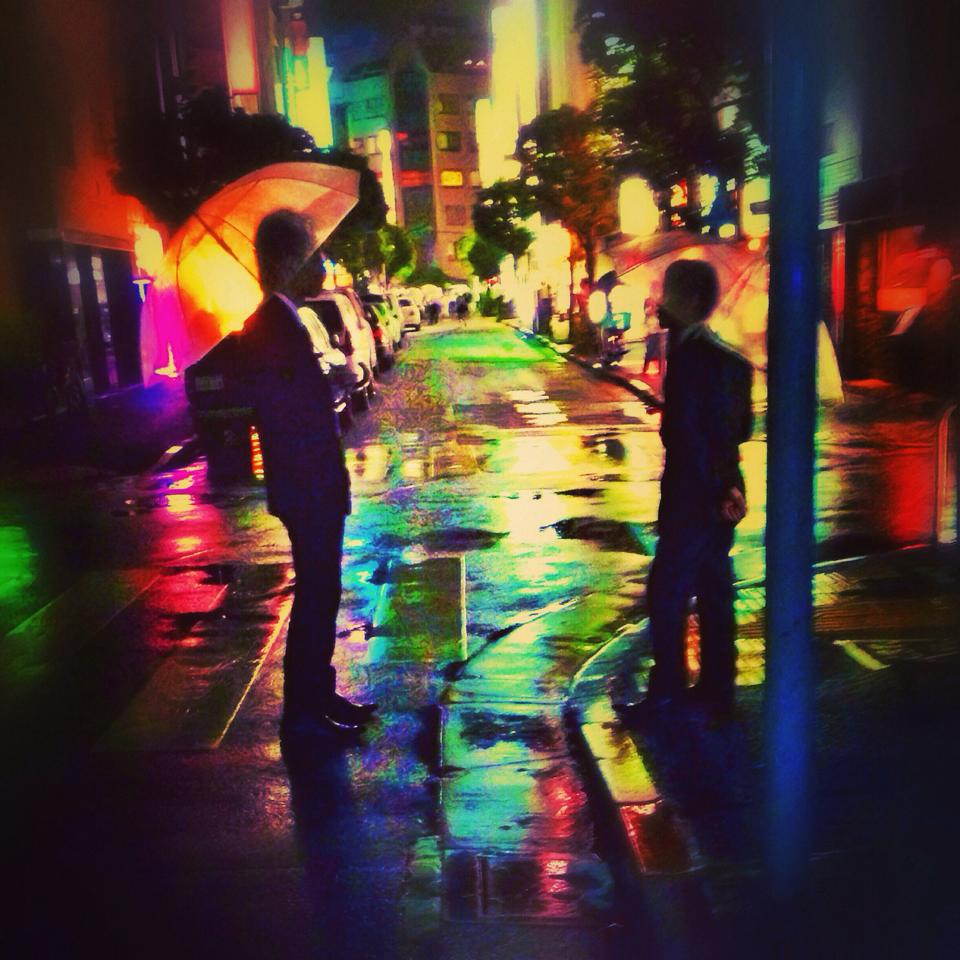
Our evening begins in an absinthe bar exclusively playing The Smiths’ music and ends in a cheap izakaya-style bar. Artwork and literature dominate our evening’s discussions. An enjoyable night washed away with rain and ¥450 Suntory whisky highballs. I don’t take a single photograph; much like Hachiko, my camera is dead. With no photographs of my own, Laurence kindly lets me use one of his: Neon Nirvana:

Neon nirvana

Some Like It Hot Tea

I decide to hire a bicycle. A friend from England, Damien, decides to join me. We grab two ¥300 bicycles for the day and cycle in the direction of Ueno. On the way, we pass a random stage on Kappabashi ‘kitchen’ Street. Men and women dressed in traditional taiko clothing hit massive taiko drums. A security guard stands watch, eyeing me up as I take a photograph.

kappadrums[1]

We cycle around Ueno Station and toward Ueno Park. Today and tomorrow, there is a festival here, the Philippine Festival 2014. The festival is sponsored by the international money transfer company Western Union. The space for the festival hasn’t been very well utilised. There are two rows of small stalls on both sides, and a third row through the middle, which completely obstructs the view of the small stage.

I promised a friend I would bring her a souvenir from the festival. To my dismay, all of the stalls appear to be for financial institutions or property letting companies. There is a stall offering tax refunds, there are stalls for various banks, there are stalls selling insurance. There is not one stand that seems to offer anything remotely souvenir.

philippinefest[1]

We take a seat near an ice cream shop opposite the festival. I rant to Damien about how much the festival has annoyed me; he is in agreement. A woman starts to sing from the stage that you can’t even see. The song from Frozen, ‘Let It Go.’ I almost go on another angry rant but decide to just let it go.

Back on the bikes, we head to Nippori Station, cycling through Textile Town and Fabric Town on the way. We cross the railway tracks and head to a big area of green on my map, thinking it will be some kind of park or temple.

For the second day in a row I find myself standing in a cemetery.

graveyardandtree[1]

Yanaka Reien is massive. Over 7,000 tombstones are here. The cemetery is so big that it contains a police station and a children’s swing park. The Tokugawa Family Graveyard is here too. The last shogun, Tokugawa Yoshinobu, rests here alongside fourteen other Tokugawa shoguns. There is one area that slightly confuses me; it is marked on the map as ‘The First Three-dimensional Deposit Facility’. We have no idea what this means, a Google search is like spinning our wheels, so we get back on the bicycles and do just that.

We head back toward Ueno Park, stopping off at the Daimyo Clock Museum to kill some time before returning to Asakusa. Outside the Don Quixote store, there is the Rokku Hanamichi Flower Festival taking place. Music is being performed on a small stage, but the flowers are notable by their absence.

Our next stop is over the Sumida River, to a place I visited whilst filming the cycle tour: Mukojima-Hyakkaen Gardens. The entrance fee is still ¥150. Today is Mushi-Kiki-no-Kai, which I am told means, ‘Enjoying the sound of insects.’ The event today describes itself as ‘An exhibition of various kinds of chirping insects, their chirping sounds, and the fantastic garden scenery.’ The insects aren’t quite as attractive as the description of the event, but the sounds they make are.

chirpinginsect[1]

A Japanese lady in a kimono approaches us as we stare at the crickets. “Where are you from?” … “Ah, England! Do you like tea ceremony?” Both Damien and I are yet to experience a traditional Japanese tea ceremony, so we go along with it and are invited into a tatami mat room, shoes off, kneel down, join the others. The other thirteen people attending are Japanese.

We wait a while before the process begins. When it finally does, we pass around a tray containing sweets filled with a red bean filling. I thank the person to my right for passing me the tray, I bow, I thank Damien to my left for letting me take a sweet before him, I bow, I take a sweet, I eat it. It is all very methodical. Next, it is tea time. Young women in kimonos kneel one at a time in front of people, bow, and place a bowl of green tea in front of them. They move in a clockwise order.

Before drinking, I ask the woman to my right if she would like any more tea, and politely, she refuses. No one ever says, ‘Yes,’ at this stage; it is purely a formality. I lift the bowl of tea, place it on my left hand, turn it clockwise twice, then drink it all in one go. Then when the bowl is collected, I bow once again.

The sweet was delicious, the tea was cold. I always preferred hot tea. The woman that invited us to the ceremony said that they would usually offer hot tea, but because it is a hot day, they decided to serve it cold. After the ceremony, we are allowed to inspect the beautifully crafted bowls and the container that holds the green tea powder.

greenteapowder[1]

The tea ceremony, I later find out, should have cost us ¥2000 each, but we were never asked to pay anything.

We head back to Asakusa, return our bicycles, then go our separate ways. I head to Cafe Byron Bay for a green curry and a chat with the locals. I meet a real-life ninja and a fugu chef. Fugu is a delicacy in Japan, but is somewhat poisonous. I make plans to eat the deadly fish and take down the details of the restaurant. Maybe I will be visiting my third cemetery in a week.