Shiitake My Breath Away

The hostel shared news of a festival at Mukojima-Hyakkaen Gardens. Today is Tsukimi-no-Kai, which means ‘Moon Viewing’ – a tradition marking its 210th year in these gardens. The goal tonight is to celebrate and enjoy the Harvest Moon. We’re set to meet up at 4 p.m. It’s cloudy outside; I doubt the moon will be visible, but the event sounds fun.

My first destination of the day is the brilliantly titled ‘Project Eat More Mushrooms,’ just an enticing eleven stations away on the Ginza Line. This year, it’s hosted at Ark Hills, a substantial office development in the heart of Akasaka. I hop on the train and disembark at mnemonic favourite, Toranamon, to run a marathon. I take a rather unhurried walk to the venue. Along the way I pass the Embassy of Micronesia and the Foundation of Miracles, before finally arriving at Project Eat More Mushrooms.

mushroommarket[1]

The mushroom festival here is disappointing, an absolute waste of thirty minutes each way on the train. Forget about eating more mushrooms; having more stores selling them would be a welcome start. I can hardly classify four market stalls as a festival. There are no miracles here, no mascots either, and certainly not many mushrooms. To salvage the journey from being a complete waste, I purchase some shiitake mushrooms and enoki mushrooms for a total of ¥450.

Back at the hostel, it dawns on me that these mushrooms are precisely the same ones I could have purchased from Seven Eleven. Considering the wasted time and train fares, these have turned out to be the most expensive mushrooms on the planet.

mushrooms3[1]

After the mushroom episode, I gather as planned at 4 p.m. The small group of seven comprises my friends Aram and Dagmar, along with two fantastic tour guides from the hostel, Keina and Gomez. We make our way to Asakusa Station and board the Tobu Skytree Line to Higashimukojima Station. Interestingly, the train deliberately slows to a crawl as it crosses the Sumida River to showcase the glorious view, or so we’re told. Upon reaching Sumida, we head straight to Mukojima-Hyakkaen Gardens, marking my third visit to these beautiful gardens during my time in Japan. The entrance fee remains the usual ¥150.

At the entrance, we’re requested to douse ourselves in mosquito repellent due to a Dengue fever outbreak in Tokyo. Just last week, Yoyogi Park was closed for extensive fumigation to eradicate mosquitoes and is likely to remain shut for several months. Similarly, Shinjuku Gyoen Park underwent the same treatment two days ago. It seems this week might be the least opportune time to visit an outdoor garden.

We enter the gardens, and inside, offerings are being made to the moon.

giftsforthemoon[1]

Television crews are setting up at the entrance to the Hagi Tunnel. Swarms of people are queueing up for the ¥2000 tea ceremony, the same ceremony I had previously enjoyed at no cost. The sound of chirping insects fills the air. We kill some time exploring the park before heading back to the wisteria trellis for the opening ceremony. Following a short opening speech, a performance of the shinobue begins.

A shinobue is a Japanese transverse flute made from hollow bamboo. Two performers play for almost thirty minutes. During their performance, I lose myself in meditation on a bench surrounded by foliage and mosquitoes.

fluteladies[1]

After the performance, it’s time to light the many lanterns scattered throughout the gardens. The paper lanterns are lit just as twilight sets in. In total, there are thirty-five lanterns, and volunteers are encouraged to participate in the event. Each lantern is decorated with a haiku.

Once the lanterns are lit, a curtain of dusk descends to the melodic tune of the koto, a traditional thirteen-stringed Japanese instrument. The five performers play in perfect harmony, and the sweet sound of the koto resonates throughout the gardens. Eventually, the earlier gifts presented and the beautiful music work their magic, transforming the overcast evening sky into a clear one. As if on cue, the clouds part ways, unveiling the face of the Harvest Moon.

festivalsounds[1]

We sit down and admire the sky. The moon is a ghostly white, brighter than I can ever recall; but it has been a while. Like the stars, the moon rarely appears above the Tokyo skyline. Tonight the moon doesn’t hide, it looks beautiful, it is breathtaking.

We eat snacks. The chatter combines with the music. The thought crosses my mind that this ceremony has been taking place exactly where I am right now, for the last two-hundred or so years. It probably hasn’t changed much since then either. My mind transported to another time.

I eat a bowl of oden, a Japanese winter food consisting of various fish and vegetables in a soy-flavoured broth. It costs ¥800 and is delicious. We chat for a while longer, enjoying the sound of the insects, the music from the koto performance, and the lull of the moon.

harvestmoon[1]

At 7 p.m., it feels much later than it is. Darkness arrives earlier now, but the weather is still warm—an atypical autumn. We all head back to Asakusa on the train before going our separate ways.

I take the Ginza Line for thirty minutes, and as I exit the station into the crowds of Shibuya Crossing, it begins to rain. At 9 p.m., I meet up with a friend from England, Laurence, and his two friends. We gather outside Hachiko, a statue of a dog. The dog belonged to Professor Ueno. Hachiko would wait for the professor at the end of each day outside Shibuya Station until one day, in 1925, the Professor died. Despite the professor’s absence, Hachiko continued to wait faithfully, but his owner never appeared. Legend says the dog returned to the station at the same time every day for nine years, yet Professor Ueno never returned. Then, sadly, in 1935, Hachiko passed away.

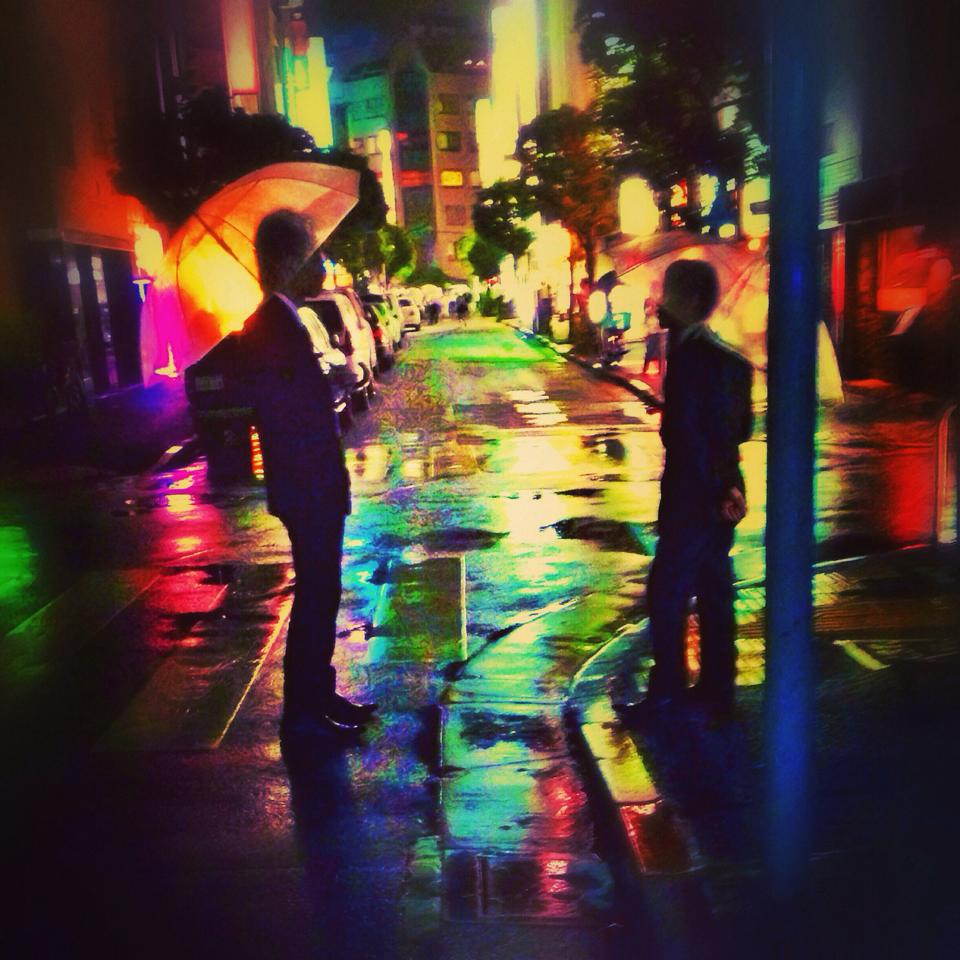
Our evening begins in an absinthe bar exclusively playing The Smiths’ music and ends in a cheap izakaya-style bar. Artwork and literature dominate our evening’s discussions. An enjoyable night washed away with rain and ¥450 Suntory whisky highballs. I don’t take a single photograph; much like Hachiko, my camera is dead. With no photographs of my own, Laurence kindly lets me use one of his: Neon Nirvana:
Neon nirvana

Some Like It Hot Tea

I decide to hire a bicycle. A friend from England, Damien, decides to join me. We grab two ¥300 bicycles for the day and cycle in the direction of Ueno. On the way, we pass a random stage on Kappabashi ‘kitchen’ Street. Men and women dressed in traditional taiko clothing hit massive taiko drums. A security guard stands watch, eyeing me up as I take a photograph.

kappadrums[1]

We cycle around Ueno Station and toward Ueno Park. Today and tomorrow, there is a festival here, the Philippine Festival 2014. The festival is sponsored by the international money transfer company Western Union. The space for the festival hasn’t been very well utilised. There are two rows of small stalls on both sides, and a third row through the middle, which completely obstructs the view of the small stage.

I promised a friend I would bring her a souvenir from the festival. To my dismay, all of the stalls appear to be for financial institutions or property letting companies. There is a stall offering tax refunds, there are stalls for various banks, there are stalls selling insurance. There is not one stand that seems to offer anything remotely souvenir.

philippinefest[1]

We take a seat near an ice cream shop opposite the festival. I rant to Damien about how much the festival has annoyed me; he is in agreement. A woman starts to sing from the stage that you can’t even see. The song from Frozen, ‘Let It Go.’ I almost go on another angry rant but decide to just let it go.

Back on the bikes, we head to Nippori Station, cycling through Textile Town and Fabric Town on the way. We cross the railway tracks and head to a big area of green on my map, thinking it will be some kind of park or temple.

For the second day in a row I find myself standing in a cemetery.

graveyardandtree[1]

Yanaka Reien is massive. Over 7,000 tombstones are here. The cemetery is so big that it contains a police station and a children’s swing park. The Tokugawa Family Graveyard is here too. The last shogun, Tokugawa Yoshinobu, rests here alongside fourteen other Tokugawa shoguns. There is one area that slightly confuses me; it is marked on the map as ‘The First Three-dimensional Deposit Facility’. We have no idea what this means, a Google search is like spinning our wheels, so we get back on the bicycles and do just that.

We head back toward Ueno Park, stopping off at the Daimyo Clock Museum to kill some time before returning to Asakusa. Outside the Don Quixote store, there is the Rokku Hanamichi Flower Festival taking place. Music is being performed on a small stage, but the flowers are notable by their absence.

Our next stop is over the Sumida River, to a place I visited whilst filming the cycle tour: Mukojima-Hyakkaen Gardens. The entrance fee is still ¥150. Today is Mushi-Kiki-no-Kai, which I am told means, ‘Enjoying the sound of insects.’ The event today describes itself as ‘An exhibition of various kinds of chirping insects, their chirping sounds, and the fantastic garden scenery.’ The insects aren’t quite as attractive as the description of the event, but the sounds they make are.

chirpinginsect[1]

A Japanese lady in a kimono approaches us as we stare at the crickets. “Where are you from?” … “Ah, England! Do you like tea ceremony?” Both Damien and I are yet to experience a traditional Japanese tea ceremony, so we go along with it and are invited into a tatami mat room, shoes off, kneel down, join the others. The other thirteen people attending are Japanese.

We wait a while before the process begins. When it finally does, we pass around a tray containing sweets filled with a red bean filling. I thank the person to my right for passing me the tray, I bow, I thank Damien to my left for letting me take a sweet before him, I bow, I take a sweet, I eat it. It is all very methodical. Next, it is tea time. Young women in kimonos kneel one at a time in front of people, bow, and place a bowl of green tea in front of them. They move in a clockwise order.

Before drinking, I ask the woman to my right if she would like any more tea, and politely, she refuses. No one ever says, ‘Yes,’ at this stage; it is purely a formality. I lift the bowl of tea, place it on my left hand, turn it clockwise twice, then drink it all in one go. Then when the bowl is collected, I bow once again.

The sweet was delicious, the tea was cold. I always preferred hot tea. The woman that invited us to the ceremony said that they would usually offer hot tea, but because it is a hot day, they decided to serve it cold. After the ceremony, we are allowed to inspect the beautifully crafted bowls and the container that holds the green tea powder.

greenteapowder[1]

The tea ceremony, I later find out, should have cost us ¥2000 each, but we were never asked to pay anything.

We head back to Asakusa, return our bicycles, then go our separate ways. I head to Cafe Byron Bay for a green curry and a chat with the locals. I meet a real-life ninja and a fugu chef. Fugu is a delicacy in Japan, but is somewhat poisonous. I make plans to eat the deadly fish and take down the details of the restaurant. Maybe I will be visiting my third cemetery in a week.

Prelude to a Quiche

The Kaleidoscope Museum is a unique establishment with a fascinating twist. It proudly exhibits fifty distinct kaleidoscopes, chosen from an expanding collection of approximately 150 pieces. Among these are exceptionally valuable kaleidoscopes crafted by renowned artists from various corners of the world. I discovered that the term ‘kaleidoscope’ originates from Greek roots: ‘kalos‘ meaning ‘beautiful’, ‘eidos‘ meaning ‘form’, and ‘scopes‘ meaning ‘to look at’—a beautiful amalgamation that translates to ‘to look at beautiful forms’.

At the museum, visitors can freely pick up and use kaleidoscopes, ranging from finely crafted ones to those ingeniously made from plastic drink bottles. Among the assortment, my favourite piece doubles as a music box, serenading me with a tune while the images twirl before my eyes. Additionally, there’s a quaint shop within the premises offering kaleidoscopes, kits, and keychains. It’s a fantastic way to kick-start the day. Unfortunately, photography isn’t permitted, and I find myself constantly shadowed by a staff member. However, I manage to sneak a photograph of the inside of a kaleidoscope when she isn’t looking.

kaleide[1]

After leaving the museum, I walk for fifteen minutes, crossing the river to reach Yoboji Temple. I feel it’s only fair that my first temple is a Nichiren Buddhist one—the school of Buddhism I am familiar with. The Temple was built in 1548. It’s actually a rebuilding of two temples that previously occupied the area but had been burnt to the ground two years before.

In 1536, the warrior-monks of Mount Hiei attacked the city, burning down all 21 of the Nichiren Buddhist head temples in Kyoto, along with the entire southern half of the city and a substantial portion of the northern half. This event is known as the Tenmon Persecution. The temple itself is rather quaint.

Yoboji_Temple[1]

Not far from Yoboji Temple, I stumble upon a Paper and Printing Item Shop. The gallery is tiny, and a woman sits at the desk, watching my every move. I’m tempted to pull out my camera and capture a photograph of one of the ornamental fans or origami animals, but to avoid any hassle, I decide against it.

I choose to visit a shrine next. The road I stroll along is lined with various temples, shrines, plenty of walking routes, maps, and bus stops. You can literally shrine-hop by taking the bus if you’re feeling lazy. However, I prefer to walk, and I’m not inclined to see more than one temple and shrine a day. It can be a bit overwhelming to take in too much at once. I ascend about fifty concrete steps to reach Awata-jinga Shrine. Before entering, I participate in the purification ritual.

dragonfountain[1]

This tradition of cleansing is observed before entering a sacred space. The basin here features a water-breathing dragon, which also serves as the source of water for the ritual. I must admit, this is one of the most exquisite purification basins I’ve encountered at a Shinto shrine. I start by washing my left hand, then my right hand, and finally, my mouth.

Awata-jinga Shrine dates back to 794 AD and specialises in preventing illness. However, inside the shrine, someone is noisily using an electric saw, which disrupts the serenity of the moment for me. Nevertheless, the shrine itself is visually stunning. I descend the fifty or so steps and continue along a road lined with traditional Japanese-style houses.

Awata[1]

Downtown Kyoto bustles with tourists, drawn here to explore the shrines, temples, museums, galleries, restaurants, and the renowned souvenir shops the city offers. I spot three cat cafes and a lone dog cafe among the bustling streets. Purchasing a can of cold coffee from a vending machine, I encounter one of those machines that promises a prize if it lands on triple sevens. Miraculously, it does! I win any drink of my choice, and naturally, I opt for a second can of Coffee Boss Rainbow Blend.

It’s mid-afternoon, and feeling a bit peckish, I opt for a light bite to eat. Given the scorching 35°C temperature, I choose to stay in the cool shade of the shopping arcade. A sign catches my eye, indicating a vegan and organic cafe nearby. As I step inside, I’m greeted with a chorus of “Hello” from the other patrons. Taking a seat, I order a set meal featuring a vegan quiche.

vegan1[1]

My food promptly arrives—a serving of vegan quiche, accompanied by a delightful salad dressed in a delicious vinaigrette, a ramekin of squash, chickpeas, and peppers. Alongside it comes a bowl of leek, cabbage, and mushroom soup, complemented by glasses of cold water and cold green tea. The entire meal comes to ¥918. If I weren’t already full, I’d happily indulge in another slice of quiche—it was that delicious.

Outside the cafe, a guy on a bicycle whizzes past, blaring an air horn from the spot where a bell would typically be. The shopping arcade strictly prohibits vehicles, including bicycles. A bit further along, I encounter a television crew filming people and asking them why they enjoy eating crêpes. While tempted to participate, I realise I’m not particularly fond of eating crêpes.

crepefilming[1]

Back at the hostel, I settle on the roof with a can of Suntory whisky highball, delving into my fifth Haruki Murakami novel since arriving here sixty-two days ago. The air has cooled, and the refreshing breeze is a welcome relief. Japan has been grappling with a severe heatwave for the past week, and it seems it will persist right through until the weekend.

I read until 8 p.m. before heading to a nearby music shop for a free gig. A stage has been set up next to the ukuleles. The band performing is a two-piece folk band. Their sound is somewhat average. Nonetheless, it’s pleasant to experience some live music, even though the venue is rather unusual.

My night winds down at the hostel bar, talking to random people with their random ideas.

Cicadas of the Lost Park

Today, I wake up at 8 a.m. I go outside and take a short wander. It seems that Kyoto is still sleeping. I return to the hostel to steal a few more hours for myself. By 11 a.m., Kyoto still seems to be asleep; shops are closed, and nothing much is happening. I decide to do some sightseeing. I am fortunate to be staying in Downtown Kyoto; many places are within walking distance, which is very convenient as I am tired of trains. I walk from the hostel in a straight line along the same road for ten minutes, eventually arriving at Kyoto Imperial Palace Park.

The gardens here are quite impressive, featuring Omiya Palace, Sento Palace, multiple shrines, a peach grove, and, of course, the Kyoto Imperial Palace. The peach grove is odd; the peaches are within arm’s reach, so I could steal a few if I wanted to, but I don’t. The most appealing shrine is the Isukushima Shrine; it sits quietly over a lake.

giongardens[1]

There are signs in some areas of Kyoto Imperial Palace Park that say, “Not to be visited by tourists.” There are little to no other tourists here anyway; perhaps the signs have driven them all away. However, there are hordes of homeless people. Some paths are overgrown, others forgotten many years ago. I see one gardener delicately pollarding the branches of a tree. Just one gardener tending to a park 1.3 kilometres in length.

As for the Kyoto Imperial Palace, it lies behind a moat and a tall wall. The water in the moat has dried up, and the wall is too high to see the Palace beyond. Even if the wall weren’t there, it would be completely shrouded by trees anyway. I quite literally can’t see the Palace for the trees.

kyotopalace[1]

There is one thing I do like, and that’s the sound made by the cicadas. These little insects just love to sing, and the trees here are full of them. And there are a lot of trees; ten thousand trees in the Palace Park alone. The noise these insects make sounds alien to me, perhaps robotic, but calming. I spend a full hour wandering the park.

It is another hot day. Well over 30°C, as usual. A woman outside sprays water from a hosepipe around the path leading into her shop. I believe this is to keep the dust down. I cross the Kamo River; much like the Palace moat, it is dried up from the heat, the fish left behind for the birds. As I walk through the shopping arcade, I realise that there are loads of crêperies here; at least eight or nine shops selling pancakes. A sign in one of the pancake shops attempts to forecast the weather:

signwarm[1]

Back at the hostel, I sit opposite a guy as he flips through a Lonely Planet guidebook. “Where are you going today?” he asks, half for the sake of conversation, half for ideas of places to visit. He waits for me to list off all of the same places as everyone else, but I don’t.
“I’m going to a Kaleidoscope Museum,” I tell him proudly, and his expression fills with puzzlement. He desperately flicks through his guidebook, presumably the ‘Kyoto’ section, but to no avail.
“Hmmph,” he utters, suggesting that if it isn’t in his guidebook, then it doesn’t exist.

I walk halfway across the city, only to find that the Kaleidoscope Museum of Kyoto is closed on a Monday. “I’ll be back,” I say to the locked door with a shake of my head.

Kaleidoscope[1]

One thing I like about Kyoto is that on street corners, there are nice little plaques in English offering insightful history about the area—a nice touch. Feeling a little hungry, I decide to swing by a local cafe at the organic market. I pay ¥940 for a soybean croquette, a cheese croquette, and a beer. The food and drink aren’t particularly photogenic, so I skip taking a photograph.

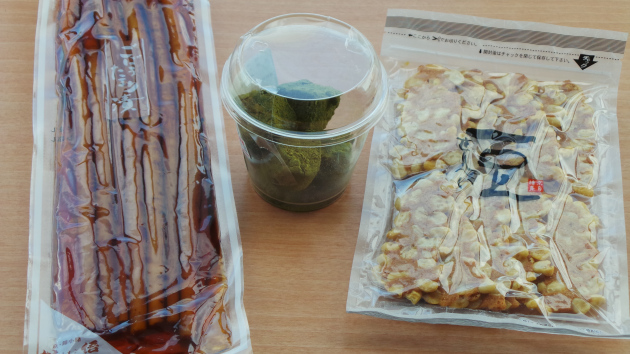
While I’m here at Nishiki Market, I decide to sample some of the local foods. With over a hundred shops and restaurants, they sell seasonal foods and Kyoto specialties like Japanese sweets, pickles, dried seafood, and sushi. I buy three different traditional Japanese snacks and take them back to the hostel.

snackssnack

On the left, I have Gobo Tamari Zuke, or pickled burdock root; marinated in sugar and soy sauce. I wish I had bought this in Okayama to go with the dandelion. In the middle, there’s some sort of matcha snack. It’s basically Turkish Delight coated in a fine green tea-flavoured powder, instead of the usual icing sugar. On the right, there’s a Japanese traditional cake with soybeans, said to have been made for approximately 150 years using the same traditional manufacturing method. According to the packaging, ‘One piece of one piece is the cracker which I baked carefully.’ The cake costs ¥400 and is my favourite of the three.

After trying my snacks and finishing my book, I head out for dinner.

I spot a gyoza restaurant, a food I am yet to try in Japan. Gyoza is a type of Japanese dumpling, usually filled with meat. This restaurant has an English menu outside, stating that one of the fillings they offer is shrimp. I order the shrimp gyoza along with a beer and a side of spiced cucumber. The cucumber dish arrives whilst I wait for my dumplings; the spices provide a good balance to what would normally be a dull snack. Three pieces of shrimp gyoza show up, although I was expecting at least five. After I finish my first three, a plate of ten fried dumplings is placed in front of me.

gyoza[1]

As I bite into the first of ten, I realise it is pork. The staff don’t speak English, but I manage to convey the message. My plate of pork gyoza is taken away, and I’m told it will take eight minutes for the shrimp. While I wait, I order a second beer. Eventually, I am handed a set of shrimp gyoza, albeit only five pieces instead of ten. Apparently, shrimp is twice as expensive as pork.

As I eat, I mishandle my chopsticks. One of the dumplings falls and lands in the saucer of soy sauce; the sauce splashes up and hits me in my left eye. It stings, and I spend the rest of my meal with tears rolling down one side of my face. After finishing my meal, I offer to pay for the wasted pork gyoza, unsure if it was my mistake or theirs. Admittedly, the restaurant is rather cheap. We compromise, and I pay a total of ¥1570 for eight pieces of shrimp gyoza and two pints of Asahi Beer.

I head back to the hostel’s bar and notice a guy reading ‘Women’ by Charles Bukowski. I share that I’m not a fan of Bukowski, only to find out that the guy is from Surrey. I end up spending the rest of the evening in the bar, discussing literature and politics.

Ainoshima Cat Island

With muscles loosened after a wonderful massage, I decide to truly test my body. My destination today is Shima Ferry Port. “You’re cycling to Shima?” asks a confused staff member. “Please make sure the bike is back before 9 p.m., okay? It has to be back before nine.” The time is now 11 a.m., and I have no intention of taking ten hours on this excursion. Little do I know.

I cycle for an hour in the direction Google suggested before realising I have no idea where I am. I spend a good half-hour navigating around an industrial estate, reaching a dead end, then turning around to eventually get back on track. None of the road signs are in my language, and there’s nobody around to ask for directions.

Ninety minutes into my journey and I arrive at a beach.

beach[1]

The beach offers a welcome rest, prompting me to park my bicycle and go for a short stroll. I stumble upon the only map in Fukuoka Prefecture and compare it to my photographed route; everything matches up. There’s still a long way to go, but at least now I know where I am. Thank you, ‘Mishima Water Area Circumference Route Map’.

At the end of the beach is what appears to be a closed amusement park called ‘Motown’

mowtown[1]

I continue cycling until the beach ends and the houses begin. I start uphill, hoping it’s the right direction toward Shima. Eventually, I find myself atop a mountain. It doesn’t seem right. Up here, I discover a stunning, random shrine and some very old houses, but not much else.

sshrine[1]

I eventually reach the downhill part of this frustrating journey, only to encounter a dead end overlooking the ocean. I have to push my bicycle back up the incredibly steep mountain roads, and it’s exhausting. Today is scorching at 35°C, and I’ve already used up a full bottle of Sun Aqua by now.

uphillstruggle[1]

At the top of the mountain, I spot a human being. I ask him in Japanese for directions to Shima. He responds in Japanese, and though I’m not entirely certain, I follow his directions. To my relief, I discover a small train station where one of the stops on the route is Shima.

I opt to follow the railway tracks, at times finding them disappear or being forced to detour due to a lack of pavement or road. After a challenging navigation, I finally spot a sign for Shima. I adhere to the instructions on the sign, and miraculously, after two hours and forty-five minutes of cycling, I arrive at Shingu Port.

“I’ve a feeling we’re not in Fukuoka anymore.” I pay ¥460 to a vending machine for a one-way ticket. After a forty-minute wait, the ferry finally arrives.

On the ferry, a television airs footage of a dirty factory in Shanghai. Staff members, their faces blurred out, are seen relabelling one-year-old rotten meat with new expiry dates. The screen shows a pile of processed meat spilling onto the floor while rats crawl below. The gloop is scooped up and pressed into another machine, which churns it into the shape of nuggets. I have no idea what this advertisement is for.

catisle1[1]

Ainoshima Island is just off the coast, a twenty-minute journey away. It boasts more cats than human inhabitants. In Japanese, the word for cat is ‘neko’, and its pronunciation rhymes with ‘echo’.

I arrive on the island to find a cluster of traditional old Japanese houses against a backdrop of mountainous terrain covered in deep forests. Despite its small size, the island takes a considerable amount of time to traverse completely. In the shade between each house, cats are scattered, peacefully asleep.

catisle2[1]

I wander around the island where the small Japanese houses provide little shade from the scorching summer sun. Today marks the hottest day of the year. I spot numerous cats, more than I care to photograph. Here are a few more:

catisle4[1]

There’s one cat that takes a shine to me. He follows me around the island as I walk, meowing or crying—I’m not sure which. I offer him some of my water, but he responds with ‘Nyaa nyaa’ (the typical cat noise here). Perhaps he’s just hungry. I assume tourists visit this island to come and feed the cats, but it’s merely a presumption.

catisle3[1]

I take the 4 p.m. ferry off the island. There are only three other people on the ferry and thirty-two empty seats. It seems like somewhat a waste of fuel, in my opinion. Sumo Wrestling is playing on the television.

There’s one last thing about Ainoshima Island not mentioned in any guidebooks: giant wasps that chase you. I managed to take a photograph of one that was idling, smaller in comparison to others. I’ll admit, though, most of my time on the island was spent either admiring the cats or running away from the wasps like a frightened rabbit.

bpwasp[1]

As the ferry pulls away, Ainoshima Island becomes nothing more than a blur.

I leave Shima at twenty past four, sticking to main roads and following the signs for Fukuoka. As I depart, a bus marked Tenjin Station mocks me as it cruises by.