A Wild Frog Chase

My morning starts with an unexpected knock at my bedroom door. Upon opening it, I find one of the Japanese men who live in my house standing there with a white carrier bag full of bread. Normally, I would find this unusual – a man at my door, giving me bread at 10 a.m. when I should be sound asleep. However, nothing is usual in my apartment. This same man, two weeks ago, gave me a box of laundry powder for no particular reason. Moreover, he believes I am fluent in Japanese. Not once has he engaged in a conversation with me in English. I simply nod, mutter some of my limited Japanese in his direction, and accept the loaf of bread.

With the thought of the donated bread weighing on my mind, I decide to hop on my bicycle and head to the nearby Arakawa Park, a place I haven’t visited before.
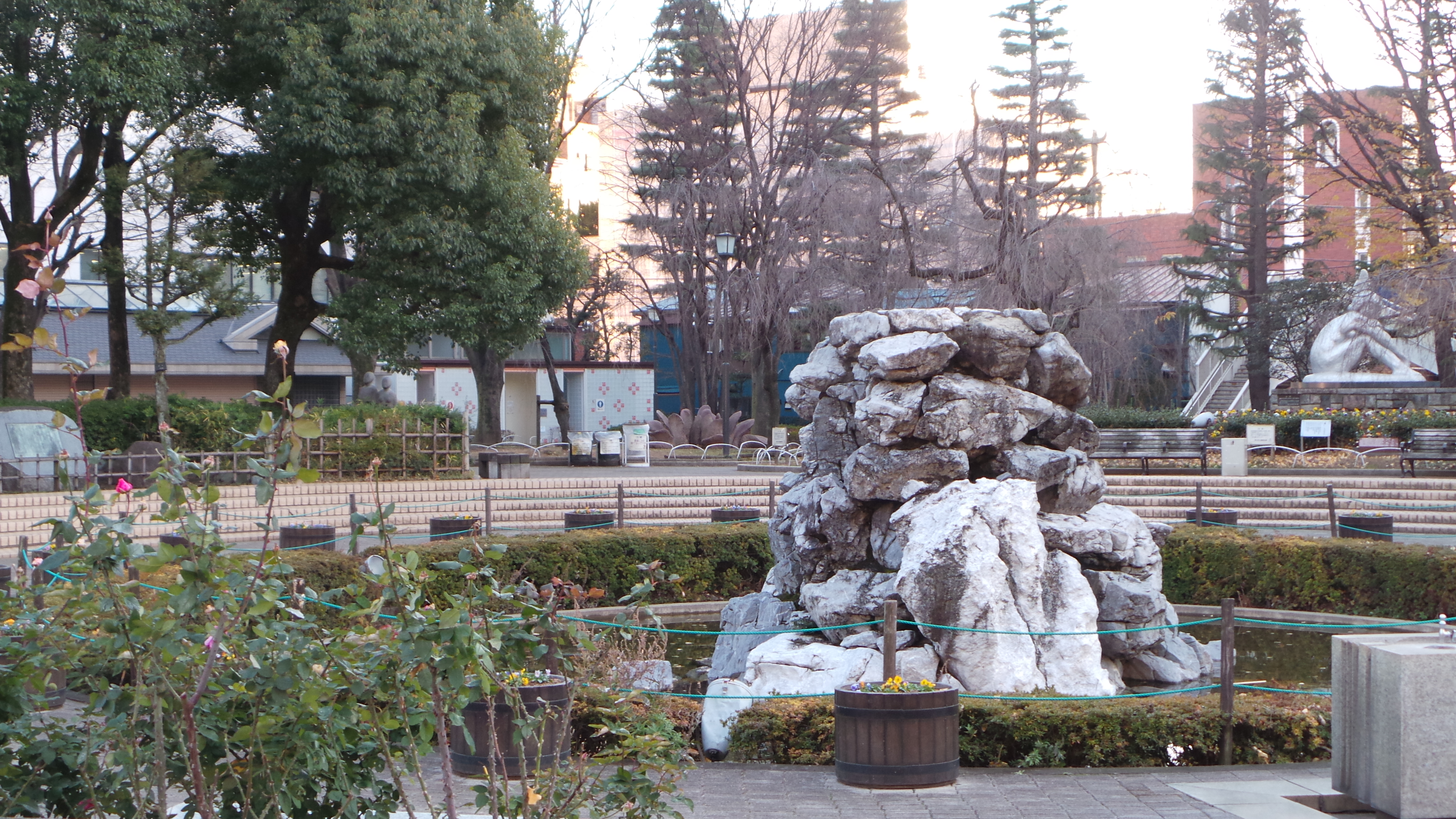
Arakawapark

This park seems to have somehow partially escaped the shedding of its leaves. On one side, it is skeletally bare; on the other side, it flourishes with nature. Laundry powder and bread. It is no secret that since being in Japan, I have lost an extreme amount of weight. Week by week, I find myself becoming skinnier, although previously, I didn’t think such a possibility could even exist. Perhaps that offers an explanation for the bread. However, my clothes are in no way dirty and in need of additional laundry powder.

I park my bicycle and take a seat on a bench to read my book: Murakami’s ‘Super-Frog Saves Tokyo.’ After consuming the book from start to finish, I take a little wander around the park. I come across a sign that says, ‘Do not feed the cats or pigeons.’ Oddly enough, I’ve seen multiple signs about feeding pigeons, often adorned with amusing text in speech bubbles, such as, ‘Don’t feed me; I can get my own foods.’ However, this is the first time I’ve seen a sign specifically addressing not feeding felines. With perfect timing, a cat appears from nowhere and takes a seat directly in front of the sign.
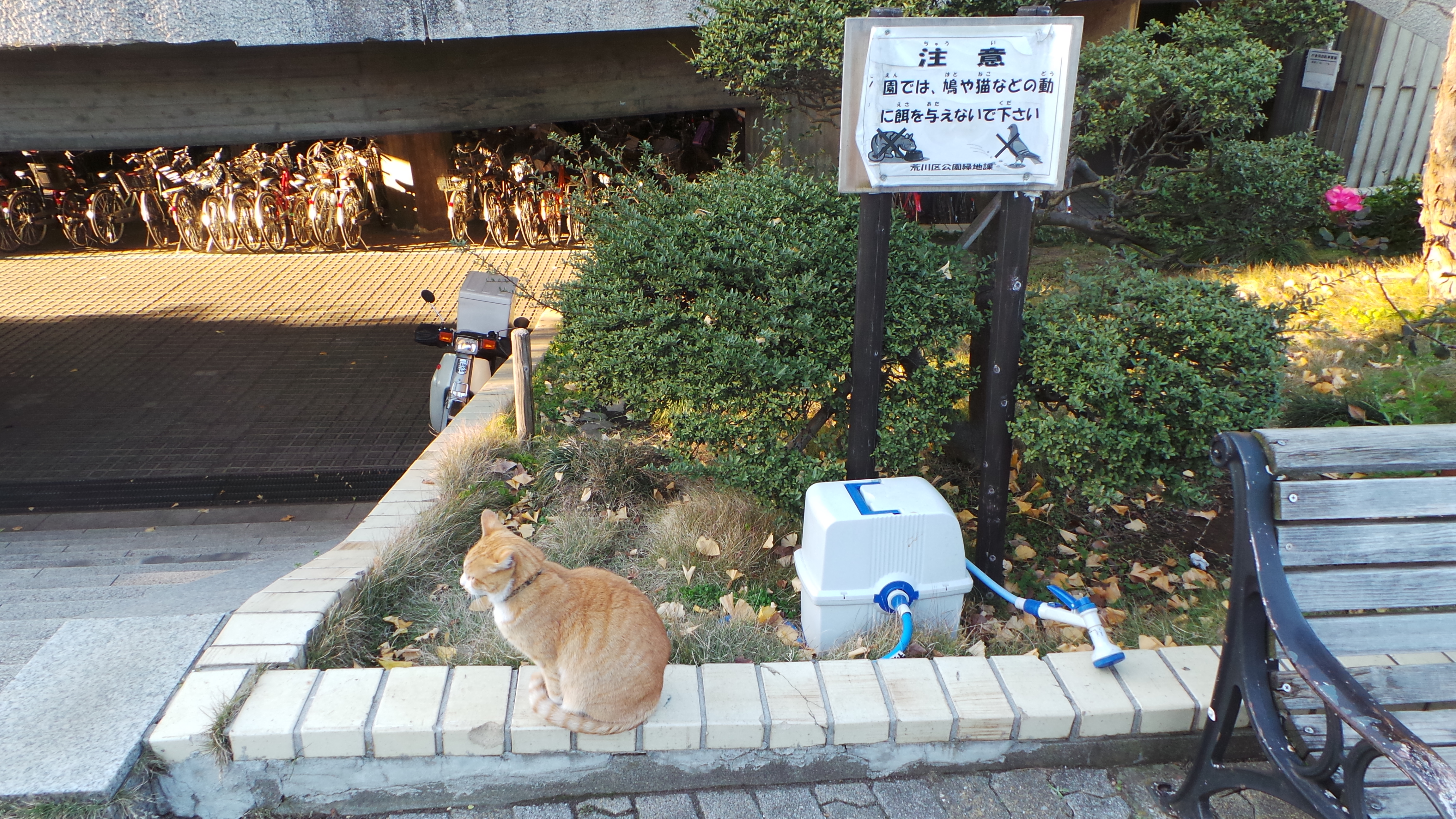
dontfeedthecat

The ginger cat decides to follow me around the park, meowing at me for food. Cats of this colour seem to have a habit of trailing behind me. I wander amongst the threadbare trees and reach a stone gazebo. Beneath the shelter, the homeless roam – about ten in total, walking around seemingly without purpose, wearing threadbare clothing to match the trees. They resemble characters in the starting area of an online role-playing game: lost, confused, and not knowing where they’re supposed to go. It strikes me that these people, much like the poor cat, actually don’t have anywhere to go.

I leave the park and stop off at a nearby shrine, only to be chased away by two massive guard dogs on leashes. Clearly, this shrine doesn’t welcome tourists. A little further up the road, I realise that as this day becomes more about animals, a better choice of reading material today would have been Agatha Christie’s ‘Cat Among the Pigeons’ because, for a second time in an hour, that’s exactly what I see.
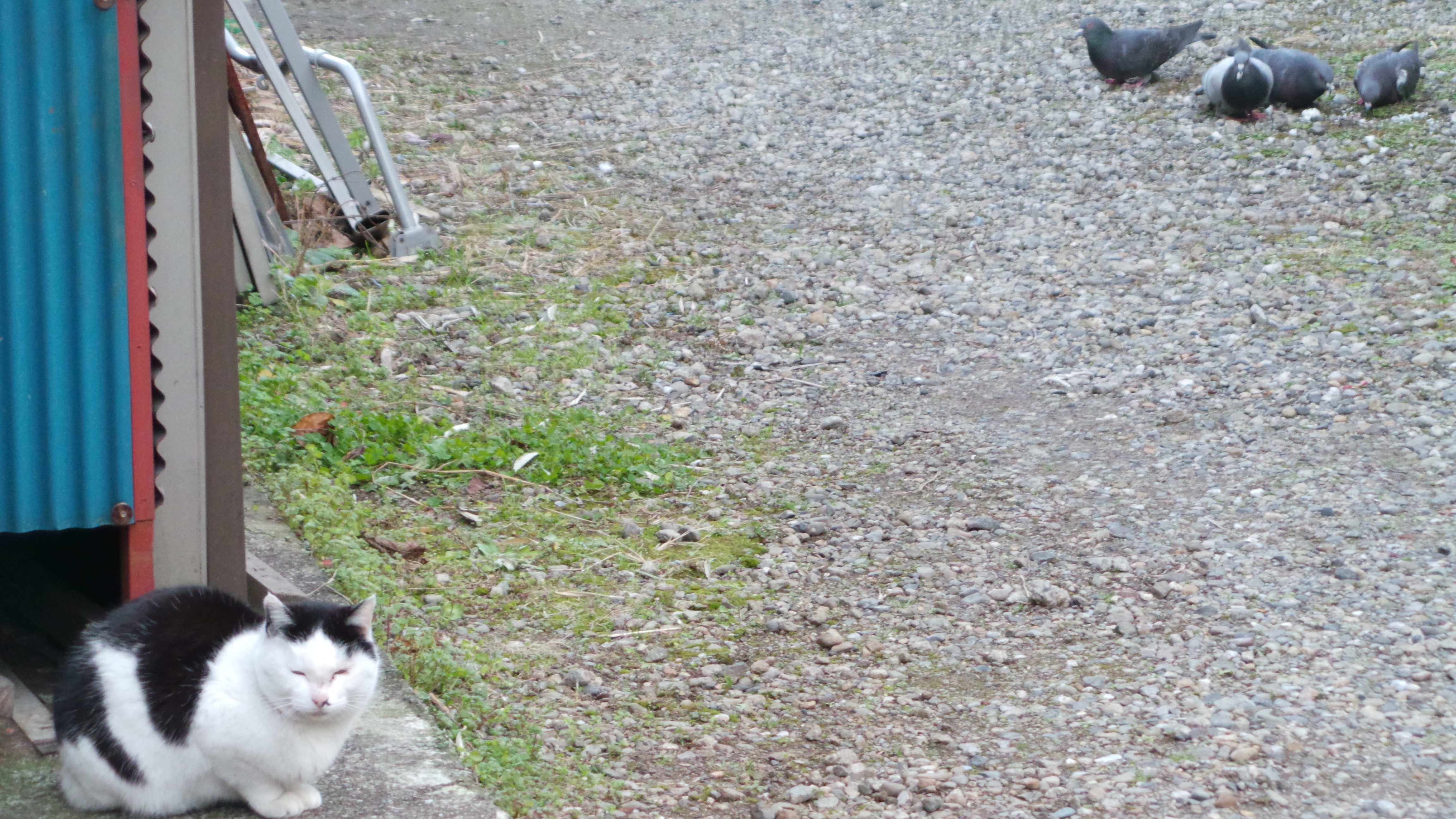
catsandpigeons

Leaving the stray cats behind, I cycle toward Nippori. One of my favourite things to do to keep myself occupied in Tokyo is cycling on warm days and exploring new areas. Without any real destination, I often pedal along, discovering random things that interest me. Today, the low winter sun provides the heat, and the opportunity to explore is seized.

I cycle through Fabric Town, passing a couple of interesting shops along the way. Highlights include a leather shop called ‘Touch of Fleather,’ a shoe store named ‘And Shoes,’ and a textile shop simply called ‘Tomato.’ After arriving at Nippori Station, I carry my bicycle up some steps and over the tracks. On the other side of the tracks, I am greeted by another bird in the form of a giant stone owl.
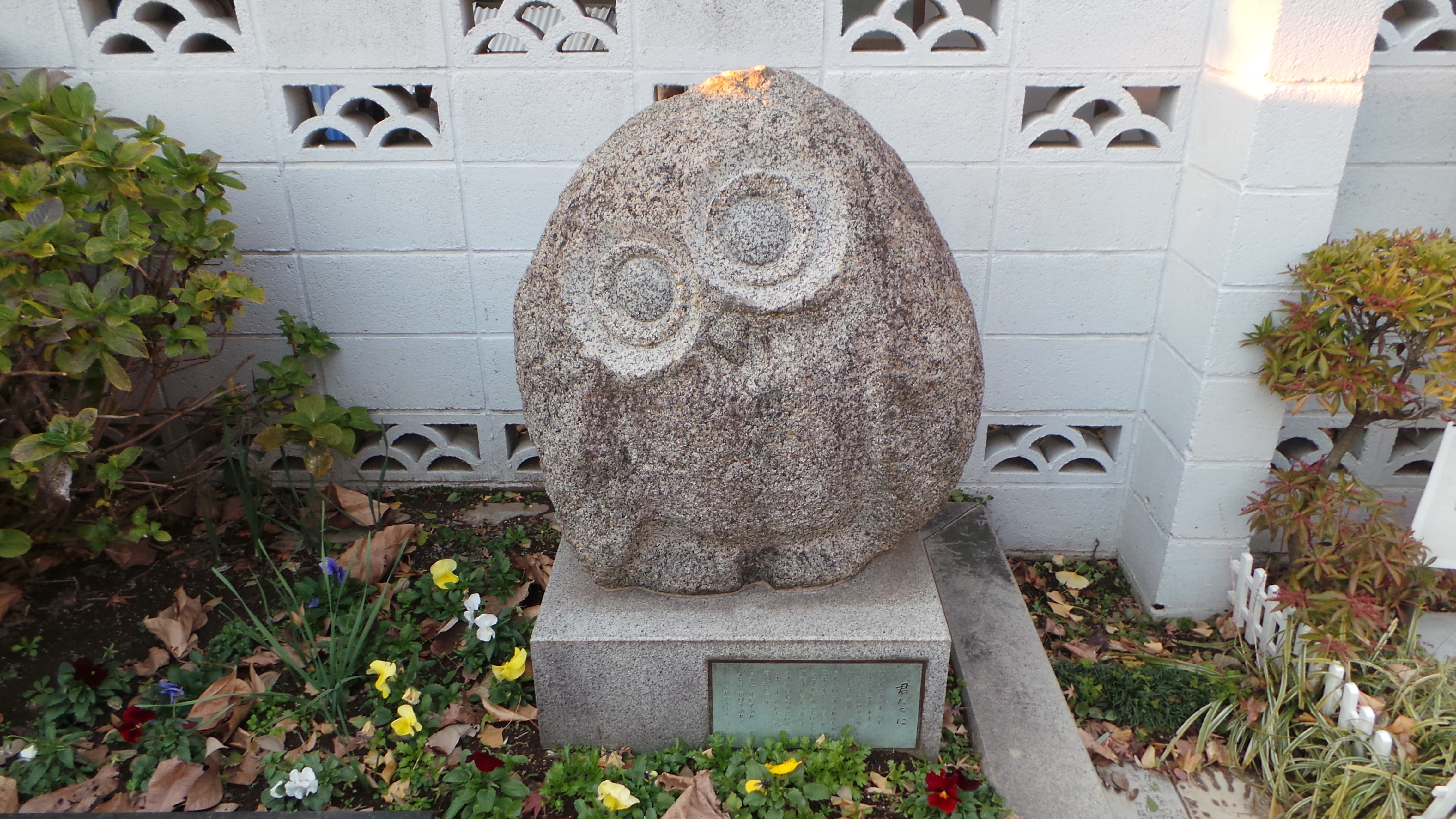
owlmonument

The owl describes itself as a ‘Memorial Monument for Takamura Kotaro,’ a famous Japanese poet and sculptor. Why they chose to honour his life with a statue of an owl is beyond me, but it looks nice, so I thought I would include it. The owl sits on Suwadai Street, a peculiar street that is at an elevation higher than the skyscrapers beyond. Additionally, the street boasts fifteen different temples and shrines.

I check the GPS on my camera to make sure that I’m still in Tokyo. Up here, even though I am just twenty minutes from my house, it feels like I am in the middle of the countryside. The nature in this area is simply stunning. I see a few signs with directions to a viewing point. On a clear day, I can witness the spectacle of a Mount Fuji sunset, where the sun and the mountain share the horizon. Unfortunately, I can’t see Mount Fuji — the story of my life. Nevertheless, I do get to witness the setting sun over a distant Tokyo skyline.
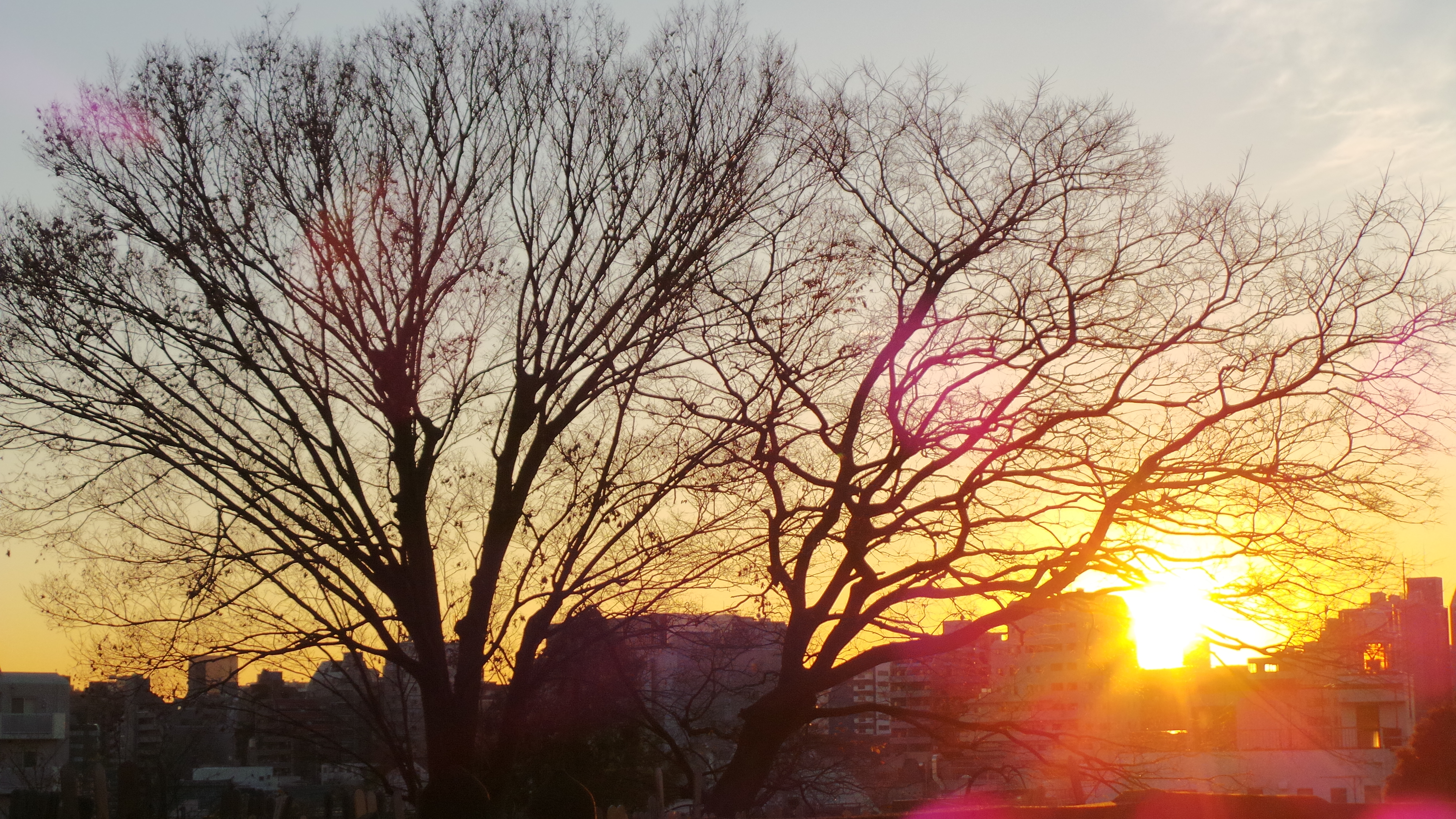
Nipporisunset

I cycle away from the temples, shrines, and stunning views, heading into Yanaka. The area is still uphill and features many old houses surrounded by leafless trees. I end up at a small market along some narrow streets: Yanaka Ginza Street. Conveniently downhill, the opportunity to cruise along, engaging in window shopping, controlling the flow of bicycle wheels with intermittent braking, is an enjoyment in itself. Navigating between the crowds of people, I narrowly miss shoppers who are presumably there to buy things they don’t need to impress people they don’t care about. As I try to remember a quote from Palahniuk’s ‘Fight Club,’ I get distracted and almost crash into a woman carrying a baby. Naturally, the baby starts screaming in fits of hysteria, so naturally, I cycle away as fast as I can.

I continue cycling until I arrive at another new place, Nezu. The streets here are adorned with beautifully crafted old lampposts and festive Christmas lanterns.
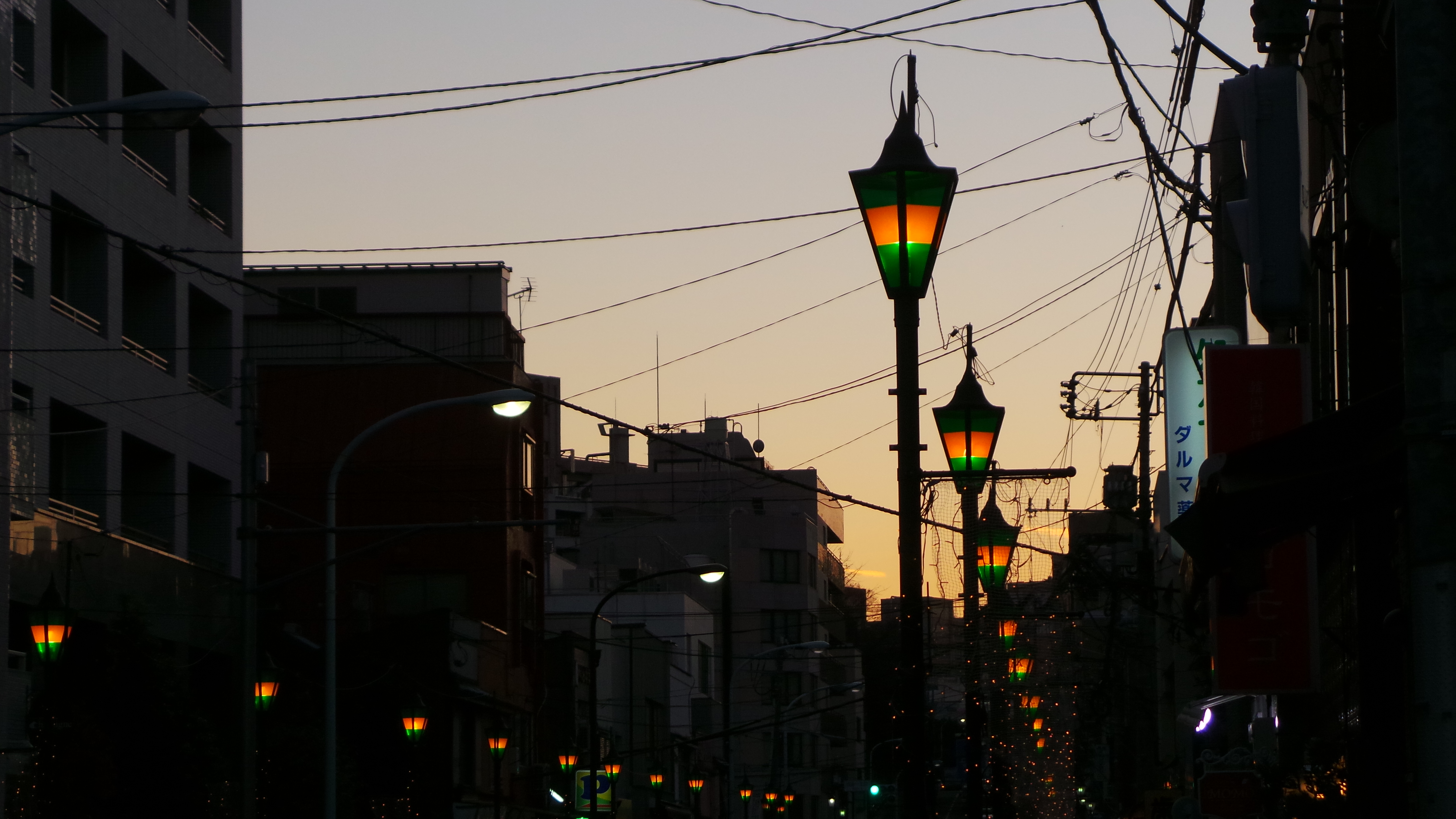
Nezu

Apart from a full-size train carriage parked randomly on the footpath, there isn’t much else to see in Nezu, so I head back toward familiarity. Outside Ueno Park, I study the map, desperately looking for something of interest. Four museums, but all presumably closed today; that’s how these things usually go. Then, something on the sign catches my eye. Perhaps it’s because I read about a character called ‘Frog’ today, or maybe some other intuition takes over, but the moment I spot a tiny dot on the huge map of Ueno Park below a caption saying ‘Fountain of Frog,’ I know that this will be my final destination today.

I search the park, passing dying crops and concrete views. After thirty minutes, the sun has completely set, and the weather has turned cold. Fierce winds chill the air but aren’t strong enough to dissuade my search. I cycle around the park, and each time I spot a map, I stop to double-check the location of the fountain. I often find that the fountain has changed its location from one map to the next, and on other maps, it has disappeared completely. Not one to give up on a personal challenge, I persist in my search for the elusive Fountain of Frog. Eventually, after forty-five minutes of cycling around Ueno Park, I find what I’ve been looking for.
frog

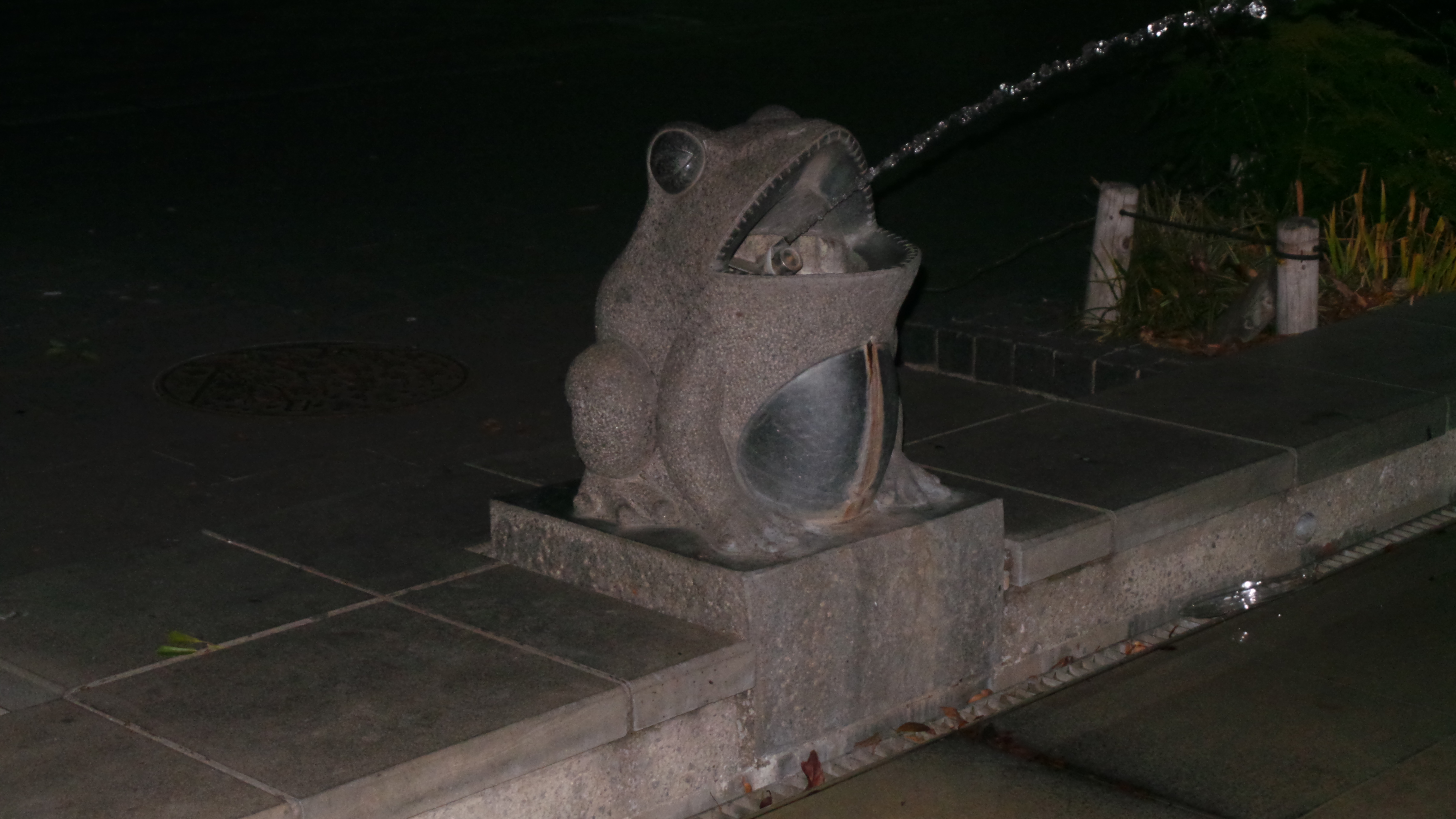
As it turns out, the Fountain of Frog is exactly what it sounds like: a small statue of a frog spitting water into an even smaller fountain. I head home, my mind filled with a sense of disenchantment. It’s a rather disappointing end to the day, but at least I have bread.

The Amazing Kanda Adventure

I exit Kanda station and walk toward the area known as Jinbocho. On the way, I stroll along a street featuring thirty-six sports shops, all lined up next to each other. There is also a small festival taking place here, the 20th Kanda Sports Festival. I continue walking until I see a sign that suggests pluralisation came as an afterthought.

book[1]

Jinbocho is named after Nagaharu Jinbo, a samurai who used to live here in days gone by. Although they took his name, there is little to no information about him on the Internet. Perhaps I can find something about him in one of the many history books on sale here today.

Book Town is great. One side of the street is exclusively used book shops. Little lanterns line the length of the street, and outside the usual stores, a massive corridor of small bookcases stretches the length of the event. On a typical day of book shopping, you would be spoiled for choice, but today, at the 55th Kanda Used Book Festival, the sheer number of used books in one area surpasses that of anywhere else in the world.

bookstreet[1]

There is a shop specialising in only fashion books, another selling just manga comics, and another selling rare history books; they even have one book for sale for ¥350,000. There is something I find calming about walking the aisles of a bookshop. Nobody is here trying to lure me into their shop, nobody asks me to enter when I am already inside, and nobody inside is speaking. The squeaking sound of my wet shoes is the only thing disturbing the silence.

The bookshops seem to stretch endlessly. I notice some arrows painted on the floor, so I follow them to a small charity-run street festival. Rows of stalls offer various foods. One man sits at a table, seemingly designated for people to leave their used plates and cutlery. I glance at the man, and he just shrugs his shoulders; he doesn’t know why he’s sitting there either.

charityfest[1]

At the other end of the festival, more bookshops await. I browse a little longer before heading in the direction of Ogawa Square for my fourth street festival of the day. Today’s event is the Kanda Curry Grand Prix, where twenty different shops are all selling ¥500 curry in the hopes of attaining the grand prize. A polling station with an honesty policy is in place; if I wanted, I could continuously vote for the same shop over and over.

Kanda boasts over two hundred curry restaurants, making it the perfect choice of location for this competition. Outside every stall, a tout shouts at me to go buy their food. A woman in a maid outfit gives me a smile and points in the direction of the store she is here to promote. Soaking wet mascots wander around, and there is a stage featuring live music. Three young women are signing autographs for middle-aged men. The enticing smell of curry keeps me at Ogawa Square for half an hour before it is time to go.

toutskanda[1]

I walk back to Akihabara and take the Hibiya Line to Minowa. Every piece of advertising space on the train is for the same company. On Japanese trains, there are usually about thirty to forty adverts in each carriage; however, on this train, all signs exclusively advertise an urban park town. Very strange.

I grab some things from home before cycling over to Asakusa, specifically to Cafe Byron Bay for a Halloween party. At the cafe, I put on makeup in the hope of looking like a zombie. Friends come and go, some with costumes and others without. Free Halloween-themed sweets are on offer, and glowing plastic pumpkins litter the cafe.

pumpkin1[1]

At one point, I am asked to fetch a forgotten cake from a local bakery. While waiting at the traffic lights, I notice a little child with her mother also waiting to cross the road. They are looking at me, so I make zombie noises at the child; the child screams and hides behind her mother’s leg. All in the good spirit of Halloween.

Back at the cafe, two French chefs are here to cook for everybody, and they are excellent chefs. Canapés, crêpes, and tuna gratin are the highlights. We are then treated to some live music from a local act and enjoy some delicious cake.

cakehal[1]

As the party draws to a close, a Japanese friend of mine hands me a signed copy of his book. It is my favourite book of his, albeit the only one I have ever read; the others are written in Japanese. I find it difficult to show feelings of genuine gratitude dressed as a zombie, but I will absolutely treasure his gift.

After the party, we head out to another bar for an event known as ‘Trick or Drink!’ I try to stay in character at the bar, bumping into walls, mumbling, and dragging one leg as I walk. Homer Simpson is the disc jockey, and his music choice is better than I would have imagined. My sumo wrestler friend is here too, still taller than me but a lot less drunk than the last time we met.

sumohalloween[1]

After getting photographed with a sumo wrestler while dressed in zombie makeup, I decide there isn’t really much else left to do in the world, so I head home to sleep.

I Warm Duck Smoke

I wake to the sound of helicopters and sirens, more than one of each. I look out of my apartment window and see a pillar of billowing smoke that seems to be attracting the attention of five helicopters; they circle around the black cloud like flies. An ambulance buzzes by at speed, its sirens adding to the cacophony of early morning racket.

I head outside into the slums, making my way toward Minowa Station. Today, I have the pleasure of buying a Halloween costume, and the only place that offers any sort of choice, I am led to believe, is Tokyu Hands in Shibuya. At Minowa Station, there are seventeen fire engines.

fire[1]

I take the Hibiya Line. Distracted, I miss my stop at Ueno, so I stay on the train until Akihabara Station. I walk ten minutes through the crowd of young women in maid outfits trying to tempt me and head for Suehirocho Station. Here, I take the Ginza Line, Shibuya-bound.

It seems I have been drastically misled. Tokyu Hands has a Halloween range, albeit rather small. I begrudgingly spend ¥4800 on some awful ghoulish nonsense that I will only use once before heading back to the train station, Minowa-bound.

Outside Minowa Station, firefighters are still tackling the huge blaze, the smoke so thick that it chokes me. Helicopters armed with television cameras continue to drone on. Unbelievably, an advertising blimp for the insurance company ‘MetLife’ floats above the disaster, cashing in on some extra television airtime.

metlife[1]

At home, I grab my bicycle and cycle toward Kanda. I get as far as Asakusa and run into my good friend and fellow bicycle enthusiast, Khin. He asks me if I’ve had lunch yet. Realising that I am actually quite hungry, I agree to join him, and we head to a gyoza restaurant. I finally get to eat one of my favourite foods, vegetable dumplings—the first time I have had this food since coming to Japan. Delicious.

After the meal, we head over to Senso-ji to get our fortunes. I luck out and receive ‘Good Fortune.’ Khin doesn’t do so well and gets ‘Regular Fortune,’ so he ties it up for the gods to deal with. My fortune says, “It is a good sign to dream of a young horse in spring and a dream of a swift horse will bee [sic] a much better sign.”

goodfortune[1]

Next, we head over to the Edo Shitamachi Traditional Crafts Museum, an excellent little museum discreetly tucked away inside an indoor shopping arcade. Free entry seals the deal, and in we go. Inside, we find ourselves the only visitors. On display are fishing rods, fans, hand-forged cutters, paper lanterns, badminton rackets depicting kabuki characters, Buddhist statues, pottery, leather bags, and paintings. There is also a rack of very straight arrows.

Winter is coming, apparently. To celebrate, a small truck with a little stove on the back is circling around, selling hot sweet potatoes. As it passes by, it plays a little jingle in Japanese known as the baked potato song: ‘Ishiyaki imo, yaki imo, yaki imooooo,’ literally translating as ‘Baked sweet potatoes, sweet potatoes, sweet potatoooooes.’ I chase after the truck but waste time taking a photograph before it turns left and blazes off into the distance.

bakedpotato[1]

Khin and I head over to Cafe Byron Bay to meet some friends before heading out as a group of eight to a fish izakaya. Tonight is Dagmar’s last evening in Japan, so we are having a little leaving party for her. At the izakaya, we take off our shoes and sit at a nice table with tatami mat flooring. I am handed an English menu, and it just so happens to be the best menu I have ever seen.

The menu boasts the following delicious highlights:

Dirt Japanese bluefish drying a fish whole firing, ¥380
Wall thickness, taste are plentiful, and grease appears! ¥980
Semigrow and drag knob salad, ¥580
Tatami mat sardine, ¥280
Butter charcoal fire firing of the nettle tree, ¥380

ducksmoke[1]

The butter charcoal fire firing of the nettle tree turns out to be mushrooms, and the tatami mat sardine ends up on the floor. We eat plenty, drink plenty, and drink plenty, before going our separate ways, bidding our last goodbyes.

At home, I dream of horses in the spring.

The Fat Sumo Halloween Special

My day begins with me being completely lost in Shinjuku, searching for an event called ‘Shinjuku Magic of Halloween.’ I was under the impression that the event starts with a massive street parade of people dressed in spooky costumes, but nothing of the sort appears to be happening. I give up searching and head back to the train station.

Outside Shinjuku Station, a television crew and a few people dressed up are standing in front of a big stage. With over two hundred entrances to the station, I have inadvertently stumbled upon the event I was here to see in the first place; and by the looks of it, the show is just about to start. Excellent timing as always. The lights come up, white smoke bellows from machines on either side of the stage, and the band comes out, much to the delight of the ghosts, witches, and Iron Man.

annabegins[1]

Today, I get the pleasure of seeing Anna Tsuchiya singing live. The former Kamikaze Girls actress-turned-model-turned-singer is simply amazing. I am about six rows from the front of the stage and have a great view. The music is great. The atmosphere is great. The weather is great. Anna sings two songs about Halloween in English before contractually mentioning the video game Psycho Break, the sponsor for the event.

For the third and final song, we get a little bit more from the smoke machines, and Anna sings her third single and first top-ten hit, ‘Rose’.

annasings[1]

After singing, she thanks the crowd, and the band leaves the stage. One minute later, the entire crowd has dispersed, and I am the only one standing at the stage. So much for the Halloween parade. I follow the rest of the crowd into the train station and head back to Minowa.

The day is still warm, so I decide on a mid-afternoon bicycle ride. I cycle over the Sumida River in a straight line for ninety minutes, stopping off at the odd shrine or temple along the way. Eventually, I arrive at the Arakawa River and cross over into Edogawa. I haven’t been here before today, and I can’t find anything to do. I cycle around for a while until the sun begins to set.

edogawasun[1]

After watching the sun from the bridge, it starts to cool down, so I race back to Asakusa.

Tonight, I have been invited to a party celebrating the one-year anniversary of a sumo restaurant. I have things to do first, though, so I arrive rather late; everyone is already drunk. Blind drunk. A few of my friends from the boat party are here too, and they are struggling to stand. A never-ending supply of glasses filled with a suspicious green liquid seem to be appearing from nowhere, and the familiar drinking chant of, “Yoi yoi yoisho,” makes its rounds. A sumo wrestler consumes a giant bottle of tequila in one go.

sumodrinking[1]

My masseur is here too; he tells me that my shoulders were the hardest he has ever had to massage in his entire career. Or at least I think that’s what he said; his slurs are somewhat difficult to decipher. I join in with the proceedings, enjoying the all-you-can-drink spread put on by the owner. Karaoke ends just as quickly as it starts, and bottles of spirits are passed around. I stay, drinking until I am dizzy, before deciding it is time to go home. As I leave, I am handed a gift bag filled with lovely souvenirs to go with my memories.

Willow Trees All The Way Down

Today, after almost nineteen weeks of living in mixed dormitories, I’ve finally moved out of hostel accommodation and into an apartment in Minowa, still within Taito Ward. The weather is clear and warm, prompting me to embark on a little exploration. Just a three-minute walk from my new place, I spot a shiny silver plaque near a Shell petrol station and decide to investigate. In the corner of the forecourt, I’m greeted by the sight of a massive weeping willow tree.

famouswillow[1]

The plaque informs me that the tree is named ‘Mikaeri Yanagi,’ translating to ‘looking-back willow tree.’ Its name stems from marking the entrance to Yoshiwara, a licensed red-light district that was relocated to this area in 1657. Legend has it that as people departed Yoshiwara, they would cast a sorrowful glance back at this tree, feeling painful reluctant to leave. Intrigued, I decide to take a little stroll.

Even under the bright daylight, numerous establishments have men in business suits, sporting earpieces, stationed outside, while the neon signs blaze at their brightest. As I stroll along, a grinning man asks, “Sex?” I politely shake my head and continue walking. The road is lined with smaller willow trees. After approximately ten minutes, I realise I’m in a familiar area—it’s the same road where my hostel used to be. It’s rather pleasing to discover that my new apartment is just a ten-minute walk from central Asakusa.

Deciding to make the most of my time, I hop on a train from Tawaramachi Station and make my way to Tokyo Big Sight. A friend has invited me to see his exhibition there today. However, upon arrival, I discover that the event operates on an ‘invite-only’ basis, with attendees exchanging forms for passes. Unfortunately, the only invite I received was verbal.

I decide to approach the information desk regardless and ask, “Can I see the exhibition, please?”
The young receptionist queries, “Do you have an invitation card?”
“Nope,” I reply.
“Well, you need an invitation card to enter,” she explains.
Pausing for a moment, I reach into my wallet and retrieve the business card of the friend who invited me, coincidentally the president of one of the exhibiting companies. Handing her the business card, I truthfully assert, “My friend invited me.”
She scrutinises the card for a while before saying, “Please fill out this form.” With a smile, I hand her the completed form, and in return, she hands me a laminated pass. I’m granted entry to the exhibition, completely free of charge. The power of business cards.

foodexpo2[1]

The exhibition is divided into two main sections. The first part highlights the advantages of health foods, particularly emphasising raw and organic foods, health supplements, enriched agricultural processes, health-beneficial rice cultivation methods, and natural seasonings aimed at enhancing taste.

On the other hand, the second part of the show delves into science and technology. This section showcases breakthrough technologies focused on food quality, packaging reduction methods, food safety and hygiene innovations, allergen test kits, and germ-preventive clothing.

Needless to say, everything is in Japanese, and I’m finding it quite challenging to understand what’s happening. The attendees seem to be either exhibitors or buyers, and they’re all dressed in suits. It’s evident that everyone here has a business card, except for me.

foodexpo[1]

After swinging by my friend’s stand, I briefly consider checking out the other three halls at Tokyo Big Sight. There’s an exhibition on packaging material today, but I have a feeling it might be a tad dull – almost like this post! So, I opt to skip it and make my way back to the train station instead.

After a relaxing break at home, dusk falls, and I venture out again in search of some liveliness. Exploring a new neighbourhood calls for a trusty companion—a can of Suntory whisky highball. Nearby stands a renowned tempura restaurant, crafted from wood and steeped in history. Established in the late 1800s, it’s among the oldest in the area, evidenced by the crowd outside patiently queueing, all with hearty appetites for tempura.

I stroll for about five minutes to reach the nearby Minowa Station. The area exudes a certain liveliness that could potentially make it my new go-to spot, but unfortunately, it seems to lack bars entirely. Among the occasional izakaya, what stands out are the abundance of hair salons, more per capita than any other place I’ve visited. Continuing my wandering, I somehow find myself back amidst the neon-lit streets of Yoshiwara. The traffic lights, like the moon this evening, an appropriate red.

redlights[1]

I swing by Seven Eleven for some food before heading home to eat. After eating, I’m completely at a loss about what to do with my rubbish. Hostels usually have just one bin for bottles and cans and another for everything else. However, my new place has seven different bins, all labelled in Japanese. I take some time to translate each one. One bin indicates it’s for ‘a leaf’, which is perfect timing as I’ve been waiting for an opportunity to dispose of my collection of leaves. Another bin, specifically for cans, confusingly instructs me to, ‘Crush the bottle as much as you can.’ Eventually, I divide the remains of my lunch into separate piles before throwing them into the appropriate bins.

I watch the usual array of Japanese television—a sports event, a sensational news report predicting the biggest typhoon hitting Tokyo this weekend, and even a game show involving pigeons. Eventually, feeling a bit bored with TV, I decide to order fifty personalised business cards. Before calling it a night, I capture a photograph of the red moon and then head to bed.