The Golden Reptile

With a new home comes a new train station. Today, I head to the nearby Minowa Station and take the Hibiya Line. At Kayabacho Station, a man runs out of the train as the doors close, trapping his foot. He falls over, smashing his face on the platform. The doors re-open, he gets up, and walks away calmly, as if it didn’t happen. The train is also full of screaming babies, which is endlessly annoying. I much prefer the calmness of the Ginza Line. I remain on the noisy train for as long as I can stand; which happens to be twelve stops later, at Hibiya.

“I’ve never been to Hibiya before, but the area seems to take its name from a train line, so I’m hopeful I’ll find something interesting here. Inside the station, the yellow area information map presents a world of endless possibilities. There’s the Passport Centre, the Imperial Hospital, or even the Diet Building. Instead, I opt to explore Hibiya Park. As I approach the park’s entrance, a group of marathon runners rushes past me. In the distance, I hear the sound of megaphones. Inside the park, a festival.

theyliketrains[1]

Today marks the 21st Railway Festival. On the main stage, a big yellow mascot, shaped like the front of a train, dances around energetically. Market stalls are brimming with train-based information and souvenirs. Adults form queues, eager to have their photographs taken with various images depicting trains through the ages.

A crowd of people stands silently, engrossed in taking photographs, so I head over to investigate. A man holds up a sign that reads ‘On Air.’ A complete film crew is present, recording for a channel called Ch.546. They are filming a segment focused on the railway festival, featuring what seems to be a Japanese idol displaying a remarkable enthusiasm for trains.

onair[1]

The bustling stalls attract a steady stream of people, children brimming with excitement, and families enjoying picnics. Despite the event being a railway festival, the only physical trains in sight are on a miniature track featuring characters like Thomas and Percy from Thomas the Tank Engine—a ride that children happily pay an overpriced fee to experience.

Deeper into the festival grounds, a queue of over a thousand people forms for a live music event. I decide to continue my stroll through the park, which turns out to be quite charming with its fountains, ponds, and well-tended gardens. After a while, feeling a bit bored, I decide to leave and make my way to Ginza. Here, I indulge in the familiar tranquillity of the Tokyo Metro Ginza Line until I eventually arrive at Ueno Station.

Today marks the 31st Kappabashi Kitchen Festival. I start my journey from Ueno towards Asakusa, walking through the bustling Kappabashi Kitchen Town. The place is crowded; too many cooks.

kitchenfestival[1]

This area is a hub where all the kitchen shops in Japan are clustered together. It’s the primary destination for purchasing kitchen products in the country. The festival serves as an avenue for shopkeepers to sell off their summer inventory at discounted rates, making room for their winter stock. Prices have been significantly reduced, resulting in a rush of shoppers clamouring for bowls, knives, pans, and even shop signage. Meanwhile, the enticing aroma of delicious food from various small stands fills the air.

I swim through bustling crowds until I spot a group of people capturing photographs of a statue—a golden kappa.

goldkappa[1]

The kappa has evolved into the official mascot of Kappabashi Street, although the reason might not be immediately apparent. One story suggests that ‘kappa’ translates to ‘raincoat’ in Japanese, as many merchants used to hang their wet raincoats out to dry on a nearby bridge. Another tale revolves around a merchant named Kappaya, who supposedly constructed a canal in the area to manage floodwater. Consequently, the street was named after him to honour his contributions. However, as time passed, these origins faded into obscurity, and now the street is simply associated with the homophonically named kappa—a mythical frog lizard—replacing historical roots with legend.

At the Asakusa end of Kappabashi Street, I make a brief stop at Cafe Byron Bay for a radio interview with the Japan FM Network, discussing vending machines. Interestingly, the interview won’t be broadcast until next month, and despite being recorded in Tokyo, it’s to be aired everywhere except here.

Turning the corner from the cafe, I’m greeted by the commencement of festivities—traditional Japanese taiko drums echoing through the air.

streetdrumsyetagain[1]

As I finally depart from the festival, the resonating beats of the drums linger in my ears. Heading back towards Minowa, the rain begins to fall—another typhoon approaching. Quick to act, I grab some snacks from Seven Eleven and opt to seek refuge in my apartment for the evening, bracing for the impending storm.

There Will Be Flood

Typhoon Phanfone is making its miserable way toward Tokyo and is expected to arrive this evening. I can’t wait. It’s already raining today, and judging by the state of the pavement outside, it seems like it has been raining all night. To avoid getting soaked, I walk for one minute to reach the nearest station and take the somewhat aptly named Tsukuba Express Line (pronounced ‘scuba’), before transferring to the Yamanote Line at Akihabara Station.

My destination today is Meiji Shrine. The train ride takes thirty-one minutes to reach Harajuku Station. While on the train, the telescreen has taken a break from displaying the usual dull advertisements and, instead, is showing the current position of the looming typhoon.

I leave the station and make my way through the pouring rain towards Meiji Shrine.

meijifest[1]

There’s a weird festival happening called Ningyo Kanshasai, centred around setting fire to broken old toys. This unique event is a way to express gratitude to dolls and is held annually at Meiji Shrine. It originated in 1989 and this year marks its 26th anniversary. In Japan, there’s a belief that a fragment of your soul resides within your possessions. Consequently, the practice of giving used gifts isn’t very common here, as it’s believed that a part of your essence accompanies the second-hand object.

Today, this Shinto exorcism ceremony serves as a method to purify the doll, releasing the part of your soul believed to be encapsulated within the inanimate object—a means to attain a liberated spirit for a healthy mind. For a nominal fee of ¥3000, you can include your dolls in the extensive collection along with others, granting your soul its liberation. The spirit of the doll is elevated through the Haraikiyome (purification) ritual performed by the priest, involving a cleansing ceremony known as Oharai conducted on the dolls.

thanksdolls2[1]

Last year, over 7,000 people donated a staggering 44,000 dolls for purification. The assortment of dolls is incredibly diverse, encompassing Japanese traditional dolls, Western dolls, and popular stuffed animals this year. The rain has somewhat subdued the turnout, but there’s still a plentiful display of dolls. Inside the main hall, two women in splendid costumes are conducting a captivating and beautiful ritual. According to the official website, this solemn festival is highly recommended as a must-see.

I depart just before the distribution of the ‘sacred sake.’ Despite the shelter provided by the numerous trees within Meiji Shrine, I am still soaked by the storm outside. Determined to seek refuge, I make my way across the road to Yoyogi Park, only to discover yet another event taking place.

Hokkai[1]

This weekend’s event is ‘The Road of Hokkai-Food,’ a celebration dedicated to Hokkaido cuisine. Interestingly, like the previous festival, this event also commemorates its 26th year, despite appearing unrelated. Here, there are almost ninety stalls selling a variety of snacks, inexpensive meals, trinkets, cheeses, and beer. The tightly packed stalls, accompanied by the pouring rain and the tantalising aroma of food, create an energetic atmosphere akin to a lively music event.

Some of the foods on offer include, Ishikari-nabe (salmon, stewed vegetables, and tofu in a miso broth), Yakitori (grilled chicken on a stick), various types of seafood, and plenty of Sapporo beer. The only thing missing is the people; it would be fair to say the event is a complete washout. There’s a woman dressed in a smart white suit giving a talk on the stage for an event advertised as ‘Sapporo Presents …’; however, she speaks only in Japanese, and my language skills are still lacking.

hokkaifoods[1]

I leave the festival and head over to Shibuya. Today marks the final day of an art exhibition I’ve been planning to visit, so while I’m in the area, I decide to drop by Bunkamura—a venue encompassing a concert hall, theatre, and museum. ‘Visual Deception II: Into the Future’ is a trick art exhibition focusing on shadows, silhouettes, mirror images, optical illusions, and anamorphosis. Admission costs ¥1500, providing a nice respite from the weather. The display of peculiar artwork can only be described as mind-boggling. As usual, photography is not permitted.

After the exhibition, I opt to head home before potential train cancellations. At my hostel, preventive measures have already been taken to tackle potential flooding: staff members cleaned out the drains and placed a row of bricks in front of the steps where flooding occurred last month.

Back at the hostel, I order Glastonbury Festival tickets and spend some time writing before heading out for a few drinks at a nearby bar. The rain persists. As I eventually leave the bar, I find the pavement outside flooded with rushing pools of water.

puddles2[1]

The forecast predicts the rain to persist throughout the night, intensifying at 3 a.m. as Typhoon Phanfone hits Tokyo. I doubt I’ll witness the full impact of the storm; I’ll likely be asleep by then, unless the howling wind wakes me up amidst the chaos outside.

Shiitake My Breath Away

The hostel shared news of a festival at Mukojima-Hyakkaen Gardens. Today is Tsukimi-no-Kai, which means ‘Moon Viewing’ – a tradition marking its 210th year in these gardens. The goal tonight is to celebrate and enjoy the Harvest Moon. We’re set to meet up at 4 p.m. It’s cloudy outside; I doubt the moon will be visible, but the event sounds fun.

My first destination of the day is the brilliantly titled ‘Project Eat More Mushrooms,’ just an enticing eleven stations away on the Ginza Line. This year, it’s hosted at Ark Hills, a substantial office development in the heart of Akasaka. I hop on the train and disembark at mnemonic favourite, Toranamon, to run a marathon. I take a rather unhurried walk to the venue. Along the way I pass the Embassy of Micronesia and the Foundation of Miracles, before finally arriving at Project Eat More Mushrooms.

mushroommarket[1]

The mushroom festival here is disappointing, an absolute waste of thirty minutes each way on the train. Forget about eating more mushrooms; having more stores selling them would be a welcome start. I can hardly classify four market stalls as a festival. There are no miracles here, no mascots either, and certainly not many mushrooms. To salvage the journey from being a complete waste, I purchase some shiitake mushrooms and enoki mushrooms for a total of ¥450.

Back at the hostel, it dawns on me that these mushrooms are precisely the same ones I could have purchased from Seven Eleven. Considering the wasted time and train fares, these have turned out to be the most expensive mushrooms on the planet.

mushrooms3[1]

After the mushroom episode, I gather as planned at 4 p.m. The small group of seven comprises my friends Aram and Dagmar, along with two fantastic tour guides from the hostel, Keina and Gomez. We make our way to Asakusa Station and board the Tobu Skytree Line to Higashimukojima Station. Interestingly, the train deliberately slows to a crawl as it crosses the Sumida River to showcase the glorious view, or so we’re told. Upon reaching Sumida, we head straight to Mukojima-Hyakkaen Gardens, marking my third visit to these beautiful gardens during my time in Japan. The entrance fee remains the usual ¥150.

At the entrance, we’re requested to douse ourselves in mosquito repellent due to a Dengue fever outbreak in Tokyo. Just last week, Yoyogi Park was closed for extensive fumigation to eradicate mosquitoes and is likely to remain shut for several months. Similarly, Shinjuku Gyoen Park underwent the same treatment two days ago. It seems this week might be the least opportune time to visit an outdoor garden.

We enter the gardens, and inside, offerings are being made to the moon.

giftsforthemoon[1]

Television crews are setting up at the entrance to the Hagi Tunnel. Swarms of people are queueing up for the ¥2000 tea ceremony, the same ceremony I had previously enjoyed at no cost. The sound of chirping insects fills the air. We kill some time exploring the park before heading back to the wisteria trellis for the opening ceremony. Following a short opening speech, a performance of the shinobue begins.

A shinobue is a Japanese transverse flute made from hollow bamboo. Two performers play for almost thirty minutes. During their performance, I lose myself in meditation on a bench surrounded by foliage and mosquitoes.

fluteladies[1]

After the performance, it’s time to light the many lanterns scattered throughout the gardens. The paper lanterns are lit just as twilight sets in. In total, there are thirty-five lanterns, and volunteers are encouraged to participate in the event. Each lantern is decorated with a haiku.

Once the lanterns are lit, a curtain of dusk descends to the melodic tune of the koto, a traditional thirteen-stringed Japanese instrument. The five performers play in perfect harmony, and the sweet sound of the koto resonates throughout the gardens. Eventually, the earlier gifts presented and the beautiful music work their magic, transforming the overcast evening sky into a clear one. As if on cue, the clouds part ways, unveiling the face of the Harvest Moon.

festivalsounds[1]

We sit down and admire the sky. The moon is a ghostly white, brighter than I can ever recall; but it has been a while. Like the stars, the moon rarely appears above the Tokyo skyline. Tonight the moon doesn’t hide, it looks beautiful, it is breathtaking.

We eat snacks. The chatter combines with the music. The thought crosses my mind that this ceremony has been taking place exactly where I am right now, for the last two-hundred or so years. It probably hasn’t changed much since then either. My mind transported to another time.

I eat a bowl of oden, a Japanese winter food consisting of various fish and vegetables in a soy-flavoured broth. It costs ¥800 and is delicious. We chat for a while longer, enjoying the sound of the insects, the music from the koto performance, and the lull of the moon.

harvestmoon[1]

At 7 p.m., it feels much later than it is. Darkness arrives earlier now, but the weather is still warm—an atypical autumn. We all head back to Asakusa on the train before going our separate ways.

I take the Ginza Line for thirty minutes, and as I exit the station into the crowds of Shibuya Crossing, it begins to rain. At 9 p.m., I meet up with a friend from England, Laurence, and his two friends. We gather outside Hachiko, a statue of a dog. The dog belonged to Professor Ueno. Hachiko would wait for the professor at the end of each day outside Shibuya Station until one day, in 1925, the Professor died. Despite the professor’s absence, Hachiko continued to wait faithfully, but his owner never appeared. Legend says the dog returned to the station at the same time every day for nine years, yet Professor Ueno never returned. Then, sadly, in 1935, Hachiko passed away.

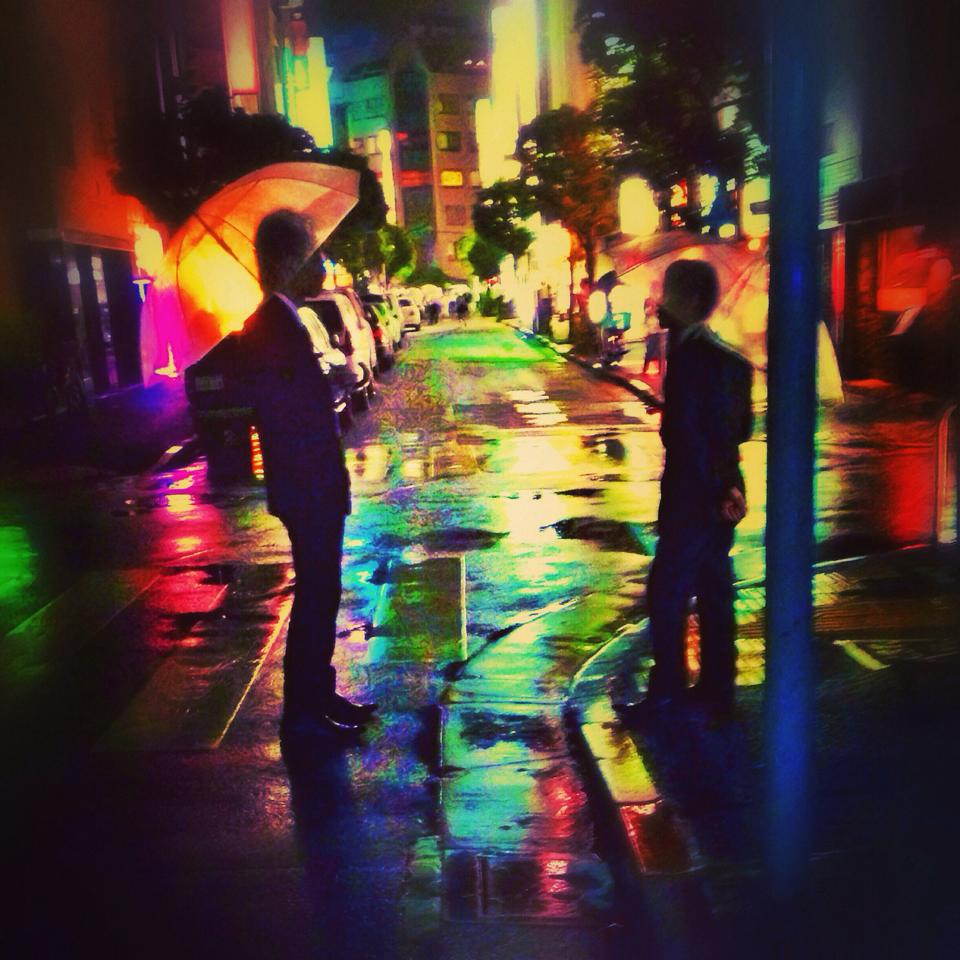
Our evening begins in an absinthe bar exclusively playing The Smiths’ music and ends in a cheap izakaya-style bar. Artwork and literature dominate our evening’s discussions. An enjoyable night washed away with rain and ¥450 Suntory whisky highballs. I don’t take a single photograph; much like Hachiko, my camera is dead. With no photographs of my own, Laurence kindly lets me use one of his: Neon Nirvana:

Neon nirvana

Some Like It Hot Tea

I decide to hire a bicycle. A friend from England, Damien, decides to join me. We grab two ¥300 bicycles for the day and cycle in the direction of Ueno. On the way, we pass a random stage on Kappabashi ‘kitchen’ Street. Men and women dressed in traditional taiko clothing hit massive taiko drums. A security guard stands watch, eyeing me up as I take a photograph.

kappadrums[1]

We cycle around Ueno Station and toward Ueno Park. Today and tomorrow, there is a festival here, the Philippine Festival 2014. The festival is sponsored by the international money transfer company Western Union. The space for the festival hasn’t been very well utilised. There are two rows of small stalls on both sides, and a third row through the middle, which completely obstructs the view of the small stage.

I promised a friend I would bring her a souvenir from the festival. To my dismay, all of the stalls appear to be for financial institutions or property letting companies. There is a stall offering tax refunds, there are stalls for various banks, there are stalls selling insurance. There is not one stand that seems to offer anything remotely souvenir.

philippinefest[1]

We take a seat near an ice cream shop opposite the festival. I rant to Damien about how much the festival has annoyed me; he is in agreement. A woman starts to sing from the stage that you can’t even see. The song from Frozen, ‘Let It Go.’ I almost go on another angry rant but decide to just let it go.

Back on the bikes, we head to Nippori Station, cycling through Textile Town and Fabric Town on the way. We cross the railway tracks and head to a big area of green on my map, thinking it will be some kind of park or temple.

For the second day in a row I find myself standing in a cemetery.

graveyardandtree[1]

Yanaka Reien is massive. Over 7,000 tombstones are here. The cemetery is so big that it contains a police station and a children’s swing park. The Tokugawa Family Graveyard is here too. The last shogun, Tokugawa Yoshinobu, rests here alongside fourteen other Tokugawa shoguns. There is one area that slightly confuses me; it is marked on the map as ‘The First Three-dimensional Deposit Facility’. We have no idea what this means, a Google search is like spinning our wheels, so we get back on the bicycles and do just that.

We head back toward Ueno Park, stopping off at the Daimyo Clock Museum to kill some time before returning to Asakusa. Outside the Don Quixote store, there is the Rokku Hanamichi Flower Festival taking place. Music is being performed on a small stage, but the flowers are notable by their absence.

Our next stop is over the Sumida River, to a place I visited whilst filming the cycle tour: Mukojima-Hyakkaen Gardens. The entrance fee is still ¥150. Today is Mushi-Kiki-no-Kai, which I am told means, ‘Enjoying the sound of insects.’ The event today describes itself as ‘An exhibition of various kinds of chirping insects, their chirping sounds, and the fantastic garden scenery.’ The insects aren’t quite as attractive as the description of the event, but the sounds they make are.

chirpinginsect[1]

A Japanese lady in a kimono approaches us as we stare at the crickets. “Where are you from?” … “Ah, England! Do you like tea ceremony?” Both Damien and I are yet to experience a traditional Japanese tea ceremony, so we go along with it and are invited into a tatami mat room, shoes off, kneel down, join the others. The other thirteen people attending are Japanese.

We wait a while before the process begins. When it finally does, we pass around a tray containing sweets filled with a red bean filling. I thank the person to my right for passing me the tray, I bow, I thank Damien to my left for letting me take a sweet before him, I bow, I take a sweet, I eat it. It is all very methodical. Next, it is tea time. Young women in kimonos kneel one at a time in front of people, bow, and place a bowl of green tea in front of them. They move in a clockwise order.

Before drinking, I ask the woman to my right if she would like any more tea, and politely, she refuses. No one ever says, ‘Yes,’ at this stage; it is purely a formality. I lift the bowl of tea, place it on my left hand, turn it clockwise twice, then drink it all in one go. Then when the bowl is collected, I bow once again.

The sweet was delicious, the tea was cold. I always preferred hot tea. The woman that invited us to the ceremony said that they would usually offer hot tea, but because it is a hot day, they decided to serve it cold. After the ceremony, we are allowed to inspect the beautifully crafted bowls and the container that holds the green tea powder.

greenteapowder[1]

The tea ceremony, I later find out, should have cost us ¥2000 each, but we were never asked to pay anything.

We head back to Asakusa, return our bicycles, then go our separate ways. I head to Cafe Byron Bay for a green curry and a chat with the locals. I meet a real-life ninja and a fugu chef. Fugu is a delicacy in Japan, but is somewhat poisonous. I make plans to eat the deadly fish and take down the details of the restaurant. Maybe I will be visiting my third cemetery in a week.

Pyrotechnics and Parade

I wake up at 5 a.m. to the sound of a drunk man in our dormitory room. He spends fifteen minutes trying to open his locker before giving up and leaving the room. It’s nights like these that I wish I were in a hotel. An hour later, the same guy who doesn’t know how to open a locker comes back and spends fifteen minutes trying to climb the ladder to his bed, which, of course, is the bed above mine.

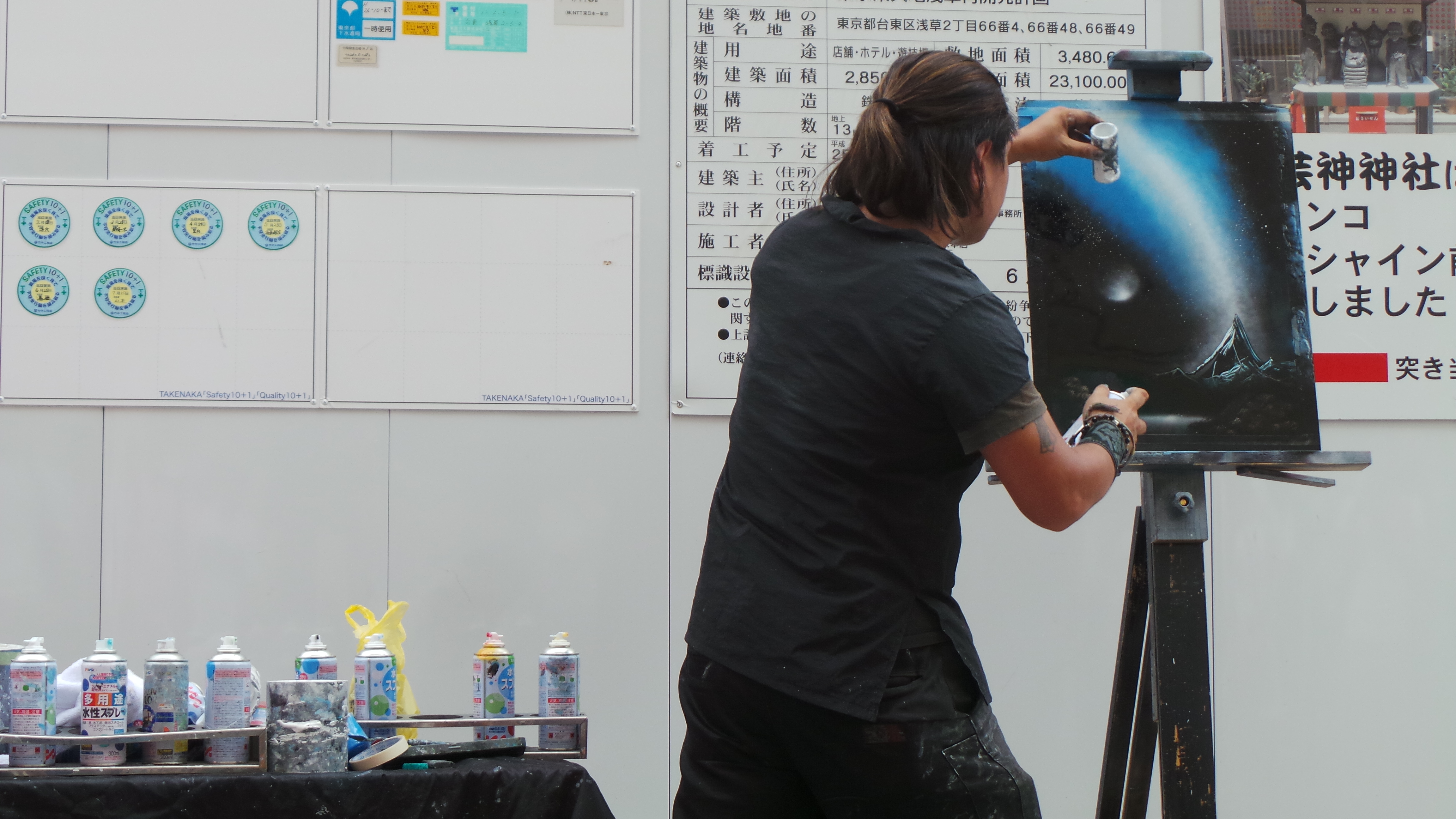
More noise at eight. Two people packing and re-packing their cases loudly, stamping around loudly. I give up on sleep and get up, tired and annoyed. I kill time, drink coffee, then go to a cafe at nine for more coffee. Despite drinking a lot of coffee, I still feel drained. The hot weather adds to my exhaustion. I lazily stroll through the mid-morning Asakusa streets. There is an artist on the street using spray paint to create science-fiction themed space art. He goes from a blank canvas to a beautiful planetscape in a matter of minutes. Incredible.

streetarts

I continue wandering. One guy raises his hand above his head as I walk past, “Woah! You are too tall!” he exclaims, much to my amusement. I head back to where the street performers gather and watch a yo-yo master skilfully Split the Atom.

Back at the hostel, I write up non-events, then kill time playing Baldur’s Gate on my camera. At 3 p.m., I still have no energy but need to get out of the hostel. I decide to head to Chofu. I take the Tokyo Metro Ginza Line to Shibuya. On the way, I hop off at Nihonbashi Station for a ¥300 smoothie (orange and ginger), then back on the next train three minutes later.

I cross Shibuya Crossing and take a shortcut through Yoyogi Park. My shortcut is somewhat obstructed by the Super Yosakoi dance festival. The entrance to Yoyogi Park’s event open space is blocked by hundreds of people dancing in the street.

yoyogistreetdance[1]

The dancing here is actually quite good, the music catchy and rhythmic; I much prefer it to the Samba music that was playing all day yesterday. The stage here is in use too, with people in traditional clothing waving flags and dancing to very similar music to that of the street dancers. I take the ten-minute walk to Harajuku Station, trying to get away from the crowds. My plan is a shortcut through the forests surrounding the peaceful Meiji Shrine.

My shortcut is somewhat obstructed by the crowds of people gathering at the entrance to the shrine. A stage has been erected here, and more people are dancing. The Super Yosakoi dance festival is everywhere. The music from the speakers here is so loud that I actually have to walk with my fingers in my ears. A one-way system through the grounds of Meiji Shrine is also in place.

Halfway through my route through the shrine grounds, a third stage is active and features more dancing and loud live music. There is a sign with a big red cross over a picture of a camera; I presume it to mean “No photography,” yet everyone seems to be taking photographs. Very odd. Perhaps I have been misinterpreting this sign all these years.

nophoto[1]

I leave Meiji Shrine and head toward Shinjuku Station. It’s another hot day, and I have another ten minutes of walking to endure in the heat. Somehow, as this realisation of the temperature comes to mind, a stranger in the street hands me a fan. At Shinjuku Station, I get a little lost but eventually find my way to the entrance to the Keio Line. A million other people have decided to take this train too. I take the second train that pulls in as there is no room on the first. As I am pushed into the carriage, I see that the crowd behind me spills up the steps and beyond. It appears the whole of Tokyo is following me to Chofu.

The Special Express train makes just one other stop between Shinjuku and Chofu, and I arrive promptly at 6 p.m. I follow the swarms of people to the Tamagawa River. Just as I arrive at the river, there is an explosion in the sky.

fireworks7[1]

Today is the annual Chofu City Fireworks Festival. It runs for an hour and includes 8,000 fireworks. I have a pretty decent spot and enjoy the spectacle. All along the river, little stores sell street food, and even Lawson Stores and Seven Eleven are getting in on the action. They have beers for sale outside floating in big ice buckets, and they have moved their hot food counters to the front of their stores.

The fireworks are impressive, although very stop and start. A lot of fireworks are launched at once, then nothing happens for twenty or so seconds, then lots of fireworks at once, et cætera. Every time a big explosion occurs, everyone around me says, “Sugoiii!” “Sugoi!” and “Oh, Sugoi!” This word means ‘amazing’ in English and seems to be the only word that the Japanese people here use to describe the fireworks. They certainly were amazing.

fireworks6[1]

At 19:11, I head back to the station; the fireworks will continue for another twenty minutes or so, but I really don’t like the idea of getting back on a packed train. It seems everyone else has had the same idea; once again, the station is packed. I am not proud of it, but when the doors finally open, I dash to grab a ‘Priority Seat.’ These seats are intended for pregnant, elderly, and disabled people. I feel somewhat less guilty when the other seven Priority Seats are taken by youths.

Back in Shinjuku, I change to the Marunuchi Line and take it as far as Ginza before switching to the Ginza Line. I arrive back in Asakusa around eight.

I meet with some friends, and we head to a nearby British pub run by actual British people. They brew their own beer here, play British music, and serve by the pint. I go for the porter; nice but expensive at ¥1000. The song ‘Empty at the End’ by my friend’s band The Electric Soft Parade comes on at some point in the evening; my mind ends up back in Brighton.