Conspirators of Treasure

The ¥130 sake cup vending machine near my house doesn’t require age verification. Additionally, there’s a vending machine selling lead pipes at the Asakusa View Hotel and another one offering plastic toy animals on the platform as you disembark from the Sobu Line at Akihabara Station. The latter is quite an unexpected sight, as plastic toy animals are the last thing on my mind when I exit a train. However, this is Japan, the land of the prizing sun, and today’s prize is tucked away inside a different kind of vending machine—the King’s Treasure Box.

kingstreasurebox[1]

A sticker on the front of the machine displays the English text, ‘Let it get.’ Unable to contain my curiosity any longer, I insert my ¥1000 note into the treasure box. Above the note slot, there’s an encouraging message, ‘One dream, One note!’ Among the potential prizes are a Nintendo Duel Screen, a PlayStation Vita, and even a product vaguely labelled as ‘Famous car.’

Following the instructions, I press any button, and the machine responds with an exciting clunk. I eagerly reach into the lower chamber to retrieve my prize.

My treasure quietly awaits me on the machine’s inner fake grass—Disco Glasses, proudly labelled ‘Made in China.’ These glasses, devoid of lenses and made from cheap plastic, boast voice-activated flashing red lights. Not exactly what I’d typically consider treasure. With no way of knowing if the machine stocks any ‘good’ prizes, it’s conceivable that it’s 100% Disco Glasses.

discoglasses[1]

Bitter and disappointed, I scrutinise the machine for refund information. Despite my limited Japanese ability, I discern that I can follow the ‘King’s Blog’ for more information. However, details about a refund aren’t quite as forthcoming.

Disheartened by my less-than-thrilling prize, I decide to escape my disappointment by taking trains. I make my way to Aoyama-itchome Station, where my friend Genmei is hosting an art exhibition in the basement of Club Edition. Titled ‘Colourful is Power,’ her display lives up to its name, boasting vibrant hues that captivate the eye.

The venue itself exudes a more bar-like ambiance than a conventional art gallery, contributing to its unique atmosphere. I engage in a brief conversation with Genmei, a talented live painter. Having witnessed some of her live art firsthand, I can confidently say that she is an amazing artist. Her creative endeavours predominantly unfold at trance parties or raves, drawing inspiration from the mood and music of the events.

In a friendly gesture, I offer her my Disco Glasses, but she gracefully declines.

genmei[1]

After leaving the gallery/bar, I step outside to find heavy rain pouring down. I navigate the rain-swept streets to reach the station and catch a train to Komagome. Today marks the opening ceremony for an event at Rikugien Gardens—an evening of autumn illuminations. I pay my ¥300 entry fee and enter the darkness.

These three-hundred-year-old landscape gardens have inspired countless poems. It’s been a while since I wrote a haiku, so here goes:

Hollow darkness welcomes me,
To black rain singing,
And decaying leaves screaming.

Stumbling through the woods, I eventually spot maple trees adorned with red and green lights. The path beneath my feet is sodden, my shoes squelching as they tread over the thick, wet mud. Small lanterns mark the way, guiding me through the enchanting scene. I follow the illuminated path, captivated by the beauty around me despite the biting cold. In the distance, ducks play in the lake, trees sway gently in the wind, and steam billows from spotlights, creating a stark contrast to the crisp winter air.

lanternsinthedark[1]

After walking around for about an hour, I realise I am lost in a maze of trees illuminated by scattered lights. At times, I find myself stumbling through the silent darkness. Eventually, I spot a steward; he lacks an umbrella and is soaked to the bone. As I approach, he remains silent, lifting his arm to point toward a small gap between some trees that appears to lead into a void. Quietly following his unspoken guidance, I venture through.

Ten minutes later, I emerge into a scene that resembles a different planet.

Soft blue light gently bathes the fallen autumn leaves, casting a mysterious glow over the tremendous yet somewhat spooky sight. The surroundings are shrouded in mystery and framed by towering trees. A small speaker nearby plays calming music, the falling rain inadvertently adding to the soothing chorus. Mesmerised, I watch the patterns of blue smoke, finally able to enjoy some illuminations.

blueleaves[1]

Having witnessed this captivating spectacle, I embark on a ten-minute journey through quicksand-like mud, eventually finding my way to the exit.

Back in Asakusa, I indulge in drinks until midnight before heading to Tori-no-Ichi part two—the second day of the rooster this month. Once again, the streets are filled with people wielding massive rakes, partaking in the festivities. While the crowd revels in the celebration, I have a singular focus—the street food market.

I opt for Korean-style yakisoba, a generous serving of vegetables and noodles topped with kimchi. Satisfied, I join a relatively short queue for a ¥300 bag of hot baked kasutera. As I relish each bite of my favourite snack, I savour the moment. It’s precisely at this juncture that I discover the batteries in my Disco Glasses have died.

Partly Mechanical, Hardly Human

Today I have a meeting with a robot. I take the Tokyo Metro Ginza Line to Aoyama-itchome Station. My destination is the Honda Aoyama Building. I arrive an hour early, so I decide to wander for a bit. I head to the NHK building but it doesn’t look like it’s for tourists, so I leave. I walk the length of Aoyama Cemetery. I kill time in the park. Eventually it is 3 o’clock, robot time!

I enter the Honda cafe. The ground floor of the building features a small stage, and a display of cars and motorcycles. As I wander around, every member of staff greets me with a cheery, “Hello,” and an overly practiced smile. The Honda Aoyama Building is free of charge to enter. There is a small shop selling surprisingly cheap drinks, the coffee is just ¥200 a cup, and hot too!

I take a seat five minutes before the exhibition is scheduled to begin. I am the only person here not wearing a business suit. Although there are thirty chairs, more than half remain empty. A factory construction line, depicting the process of building a car, plays on a large screen. I eagerly await its conclusion. Finally, when it ends, a woman appears, a door opens, and a strange machine drives itself onto the centre of the stage.

unicub[1]

The woman speaks only in Japanese, but luckily, the display screen shows English text. What I’m witnessing is a new Honda product called the ‘Uni Cub.’ This mobility device can travel at 6km/h. The machine cruises around the stage for a while before the woman giving the talk takes a seat on the device to demonstrate its capabilities.

I’m unsure of the control mechanism; she simply tilts her body in a particular direction, and the device responds by moving accordingly. It’s quite impressive, and I find myself wanting one. I snap a few photographs, but the other attendees seem less interested, probably here solely for the main event. After the Uni Cub’s display, the woman drives off the stage, vanishing into darkness through a doorway. The video screen then showcases some information about the Uni Cub. Two minutes later, ASIMO makes its appearance.

asimowaves[1]

ASIMO stands for Advanced Step in Innovative MObility, a humanoid robot integrated with Artificial Intelligence. Designed to assist people, ASIMO embodies Honda’s vision of harmonious coexistence between robots and humans. A concept drawing displayed on the screen illustrates a robot helping by carrying boxes up stairs—a representation of their goal. This aligns with Honda’s advertising slogan, ‘The Power of Dreams.’ However, despite their aspirations, ‘The Power of Dreams’ doesn’t seem to extend to comfortable seating. The chair I’m in during this demonstration happens to be the most uncomfortable seat I’ve ever experienced.

ASIMO demonstrates an array of skills: dancing, balancing on one leg, performing jumps with both feet off the ground, and showcasing impressive speed—he can run fast. His walking pace reaches 7km/h, slightly swifter than the Uni Cub. Interestingly, both ASIMO and the Uni Cub are constructed using the same technology. ASIMO stands at a height of 130 centimetres and weighs merely 50 kilogrammes.

asimolooks[1]

The presentation continues in Japanese, detailing Honda’s pioneering work in robotics, which commenced back in 1986. The earlier models—E1, E2, and E3—were primarily aimed at achieving human-like walking capabilities. Subsequent models, E4, E5, and E6, focused on mastering stair climbing. Gradually, a body, arms, and a head were integrated, culminating in Honda’s inaugural humanoid robot, P1. Subsequent iterations, P2 and P3, involved refining and automating various functionalities. Then, in October 2000, ASIMO made its debut, marking the pinnacle of Honda’s robotic advancements.

After additional discussions and visuals, ASIMO surprises us by showcasing its singing abilities. ASIMO’s remarkable skill in sign language communication comes to the forefront as it performs an original sign language song titled ‘Making Dreams Come True.’ A truly remarkable display of its multifaceted capabilities!

asimosings[1]

“The sky looks lovely today, The clouds flying lightly above.
I wonder, will tomorrow’s sky will [sic] be just as nice?
And how will our sky look in the future?
Let’s cherish our dreams today, and fulfil our dreams tomorrow.
Let’s combine our strength, and achieve our dreams together!”

After his song, ASIMO bids us farewell with a wave and a ‘Thank you.’ An opportunity arises for me to take a photograph alongside the humanoid robot. ASIMO stands, exhibiting human-like head movements and occasional speech. It appears that ASIMO can discern between Japanese and non-Japanese individuals. When a Japanese person approaches for a photographs, ASIMO addresses them in Japanese. However, when it’s my turn, he speaks to me in English, encouraging me to ‘Smile, smile,’ in a voice reminiscent of Pinocchio, the beloved Disney character, before counting down, ‘3 … 2 … 1 …’

hondastage[1]

The entire presentation lasted about twenty-five minutes. It was gratifying to witness the most advanced robot in existence. Following the presentation, I explore the small souvenir shop, which offers ASIMO stuffed toys, key rings, and other assorted junk.

On the train ride back to Asakusa, I think about the future of robotics. I really hope that someday in the near future, I will be cruising around on my Uni Cub with my very own ASIMO running alongside me.

Some Like It Hot Tea

I decide to hire a bicycle. A friend from England, Damien, decides to join me. We grab two ¥300 bicycles for the day and cycle in the direction of Ueno. On the way, we pass a random stage on Kappabashi ‘kitchen’ Street. Men and women dressed in traditional taiko clothing hit massive taiko drums. A security guard stands watch, eyeing me up as I take a photograph.

kappadrums[1]

We cycle around Ueno Station and toward Ueno Park. Today and tomorrow, there is a festival here, the Philippine Festival 2014. The festival is sponsored by the international money transfer company Western Union. The space for the festival hasn’t been very well utilised. There are two rows of small stalls on both sides, and a third row through the middle, which completely obstructs the view of the small stage.

I promised a friend I would bring her a souvenir from the festival. To my dismay, all of the stalls appear to be for financial institutions or property letting companies. There is a stall offering tax refunds, there are stalls for various banks, there are stalls selling insurance. There is not one stand that seems to offer anything remotely souvenir.

philippinefest[1]

We take a seat near an ice cream shop opposite the festival. I rant to Damien about how much the festival has annoyed me; he is in agreement. A woman starts to sing from the stage that you can’t even see. The song from Frozen, ‘Let It Go.’ I almost go on another angry rant but decide to just let it go.

Back on the bikes, we head to Nippori Station, cycling through Textile Town and Fabric Town on the way. We cross the railway tracks and head to a big area of green on my map, thinking it will be some kind of park or temple.

For the second day in a row I find myself standing in a cemetery.

graveyardandtree[1]

Yanaka Reien is massive. Over 7,000 tombstones are here. The cemetery is so big that it contains a police station and a children’s swing park. The Tokugawa Family Graveyard is here too. The last shogun, Tokugawa Yoshinobu, rests here alongside fourteen other Tokugawa shoguns. There is one area that slightly confuses me; it is marked on the map as ‘The First Three-dimensional Deposit Facility’. We have no idea what this means, a Google search is like spinning our wheels, so we get back on the bicycles and do just that.

We head back toward Ueno Park, stopping off at the Daimyo Clock Museum to kill some time before returning to Asakusa. Outside the Don Quixote store, there is the Rokku Hanamichi Flower Festival taking place. Music is being performed on a small stage, but the flowers are notable by their absence.

Our next stop is over the Sumida River, to a place I visited whilst filming the cycle tour: Mukojima-Hyakkaen Gardens. The entrance fee is still ¥150. Today is Mushi-Kiki-no-Kai, which I am told means, ‘Enjoying the sound of insects.’ The event today describes itself as ‘An exhibition of various kinds of chirping insects, their chirping sounds, and the fantastic garden scenery.’ The insects aren’t quite as attractive as the description of the event, but the sounds they make are.

chirpinginsect[1]

A Japanese lady in a kimono approaches us as we stare at the crickets. “Where are you from?” … “Ah, England! Do you like tea ceremony?” Both Damien and I are yet to experience a traditional Japanese tea ceremony, so we go along with it and are invited into a tatami mat room, shoes off, kneel down, join the others. The other thirteen people attending are Japanese.

We wait a while before the process begins. When it finally does, we pass around a tray containing sweets filled with a red bean filling. I thank the person to my right for passing me the tray, I bow, I thank Damien to my left for letting me take a sweet before him, I bow, I take a sweet, I eat it. It is all very methodical. Next, it is tea time. Young women in kimonos kneel one at a time in front of people, bow, and place a bowl of green tea in front of them. They move in a clockwise order.

Before drinking, I ask the woman to my right if she would like any more tea, and politely, she refuses. No one ever says, ‘Yes,’ at this stage; it is purely a formality. I lift the bowl of tea, place it on my left hand, turn it clockwise twice, then drink it all in one go. Then when the bowl is collected, I bow once again.

The sweet was delicious, the tea was cold. I always preferred hot tea. The woman that invited us to the ceremony said that they would usually offer hot tea, but because it is a hot day, they decided to serve it cold. After the ceremony, we are allowed to inspect the beautifully crafted bowls and the container that holds the green tea powder.

greenteapowder[1]

The tea ceremony, I later find out, should have cost us ¥2000 each, but we were never asked to pay anything.

We head back to Asakusa, return our bicycles, then go our separate ways. I head to Cafe Byron Bay for a green curry and a chat with the locals. I meet a real-life ninja and a fugu chef. Fugu is a delicacy in Japan, but is somewhat poisonous. I make plans to eat the deadly fish and take down the details of the restaurant. Maybe I will be visiting my third cemetery in a week.

Nothing Happens Until Something Moves

I have to walk ten minutes from my hotel to a different hotel with my laundry. The rain is heavy; a super typhoon has hit, making the rain and wind stronger than any I’ve ever experienced. However, I need to do my laundry. The sky outside is the darkest grey. Eventually, I find the other hotel. Fortunately, the coin laundry is accessible directly from the street, saving me the awkwardness of entering a hotel where I’m not staying just to use their facilities.

The laundry room is accessed through a shutter door currently pried open by what looks like a rotten plank of wood, which is a little worrying. Outside, noisy construction work is taking place despite the weather. The noise makes it rather difficult to concentrate on my book. I plan to spend as little time as possible outside today, so there is no point traipsing back through the storm just yet.

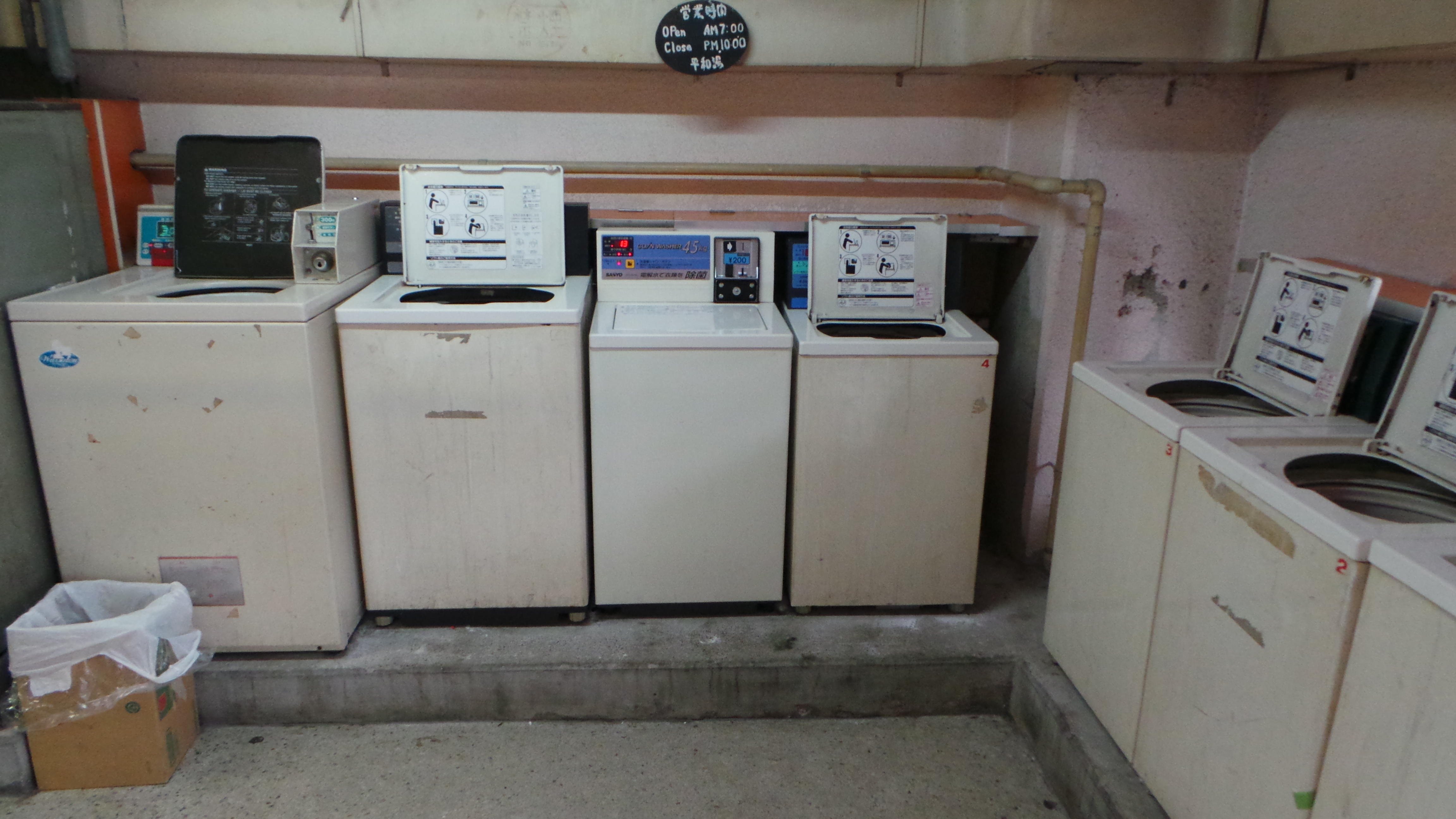
Inside the coin laundry, the room is dirty. The old vending machines no longer dispense detergent; luckily for me, I bought a ¥28 single-wash-sized pouch on the way here. I sit reading, waiting for my clothes, occasionally glancing up at the dirty walls.

laundrydecay

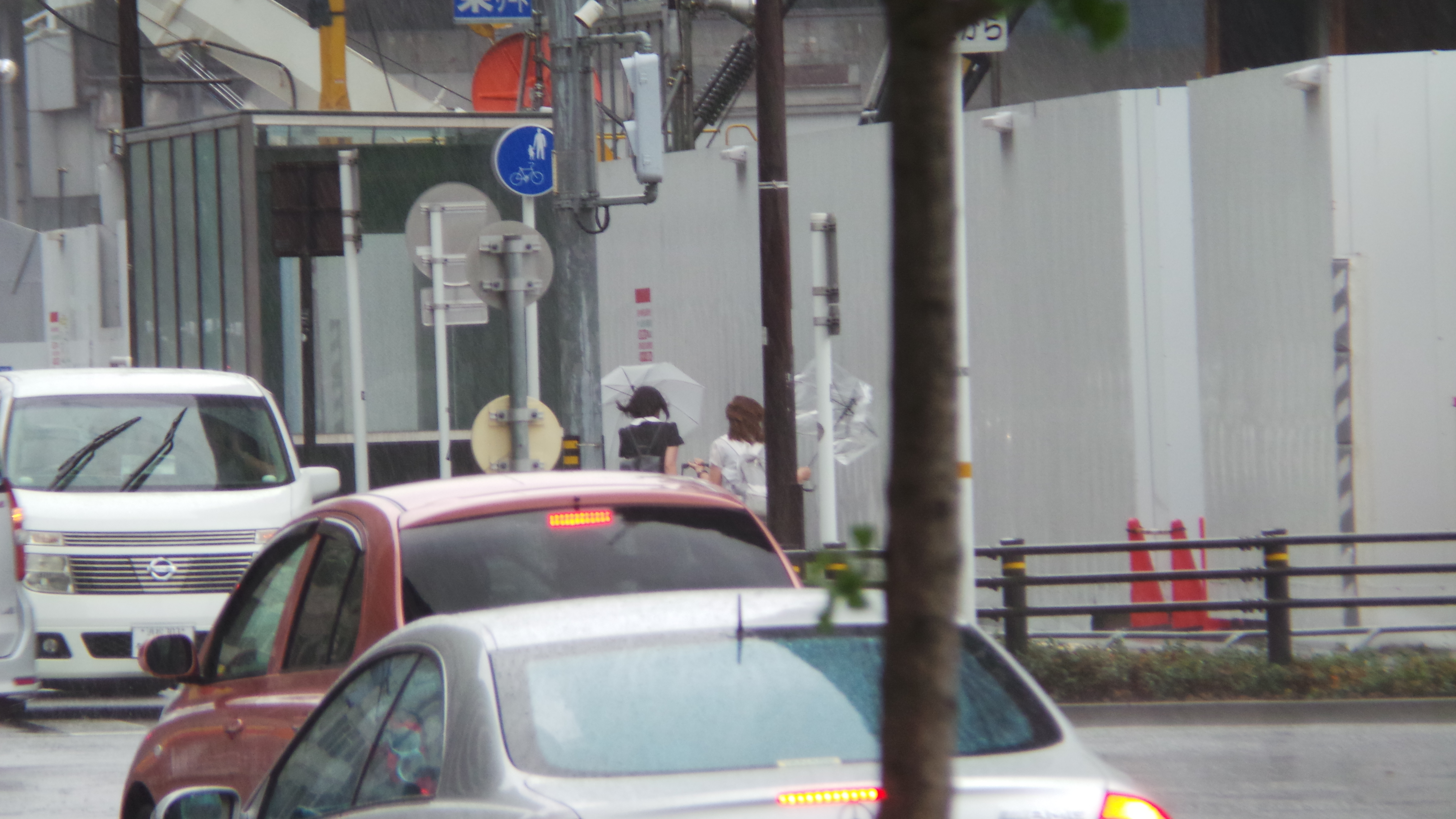
With the laundry done, I head back to the hotel as fast as I can. On the way, I notice abandoned inside-out umbrellas dumped on the street. I observe people ducking and diving into shelter, and I see areas of the pavement completely flooded. Meanwhile, the sound of sirens fills the air.

Back at the hotel, I sit by the balcony on the second floor of the lobby, quietly reading my book. I don’t mind rainy days, actually; I quite like the peace of sitting in silence and reading. It appears that a lot of people are holed up in the hotel today. Every now and then, someone walks to the window, sees that it is still raining, and then goes back to sit down. We are all waiting for the typhoon to pass.

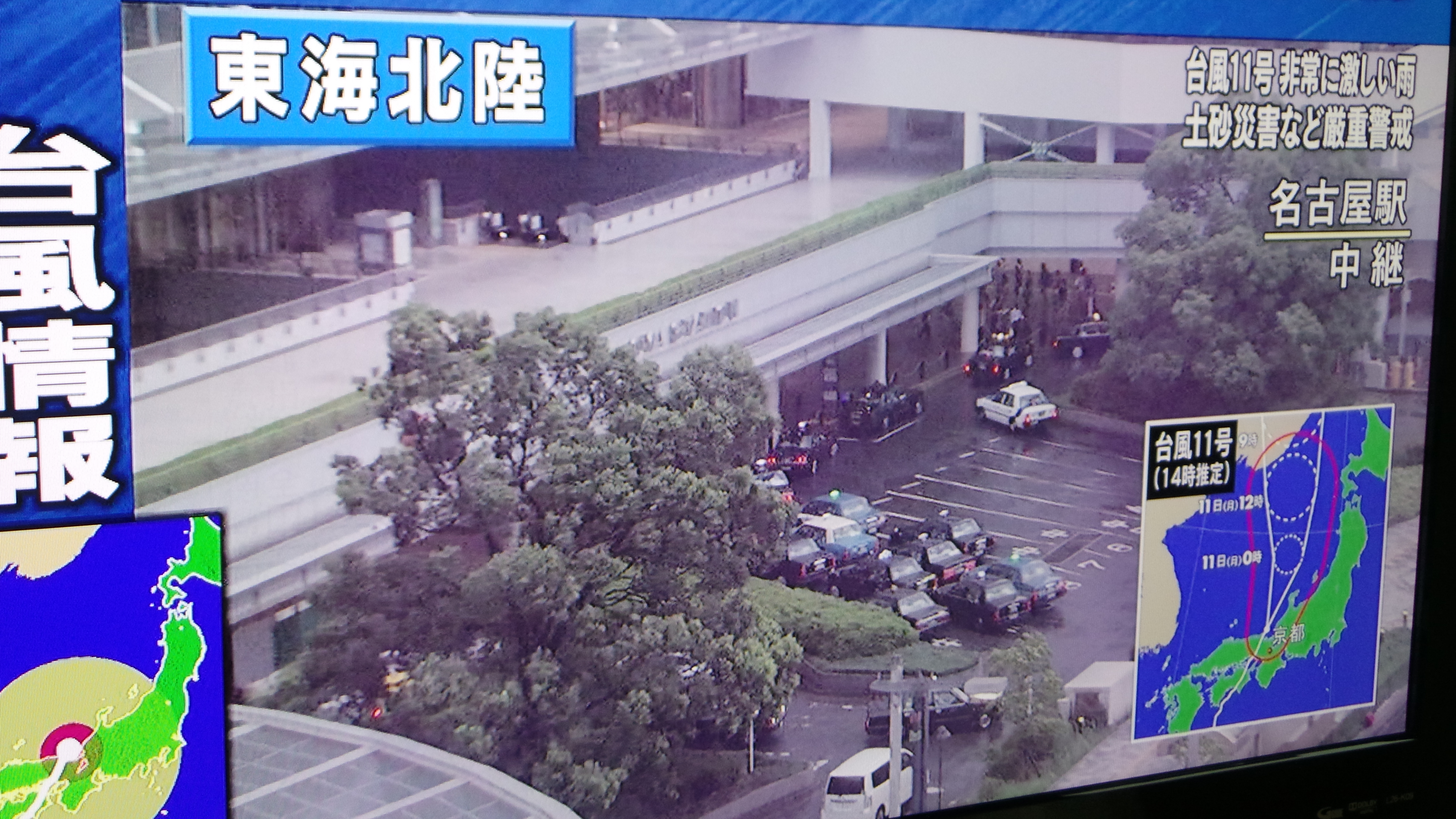
At 3 p.m., I am allowed back into my room. As I use the hairdryer on my shoes, I keep an eye on the news. After a short while, I hear the words, ‘Nagoya Station.’

nagoyast

There on the news is the train station, with taxis parked outside and rain falling. The typhoon has moved north, but the backlash of rain still falls. The bullet trains have all been cancelled.

Japan’s biggest broadcaster NHK seems to love this sort of stuff; for the next two hours, all they talk about is the typhoon. Cut to: Windscreen wipers frantically moving back and forth. Cut to: Drains overflowing. Cut to: Businessmen trying to juggle briefcases and carry an umbrella, only for it to whoosh inside-out. Cut to: All the bicycles blown over by the wind. Cut to: Rivers overflowing. Cut to: Trees shaking in the wind. This is about all I see for twenty minutes, then the footage repeats, and then repeats.

insideout

Outside, the rain looks like a white sheet being hung over the skyline. The wind is stronger now, blowing the rain sideways, making it very difficult to see the buildings in the distance. The last super typhoon I experienced passed miserably through the night; I never really got to see the chaos that it caused. Sitting here, I realise just how gloomy and grey today has been.

Eventually, the rain stops, and the wind dies down. At 7 p.m., I head out to the twenty-four-hour supermarket. On the way, I pass a sign about littering: a ten million yen fine and five years’ imprisonment. Inside the supermarket, a digitally transposed version of ‘Dreams’ by the Cranberries is playing. I buy some cheese and a small bottle of wine. At the self-service checkout, I scan the wine; a message pops up, ‘Are you over twenty? Yes/No.’ I press ‘yes’ and then finish and pay. There’s no one around to check, just press ‘yes.’ Honesty is the best policy.

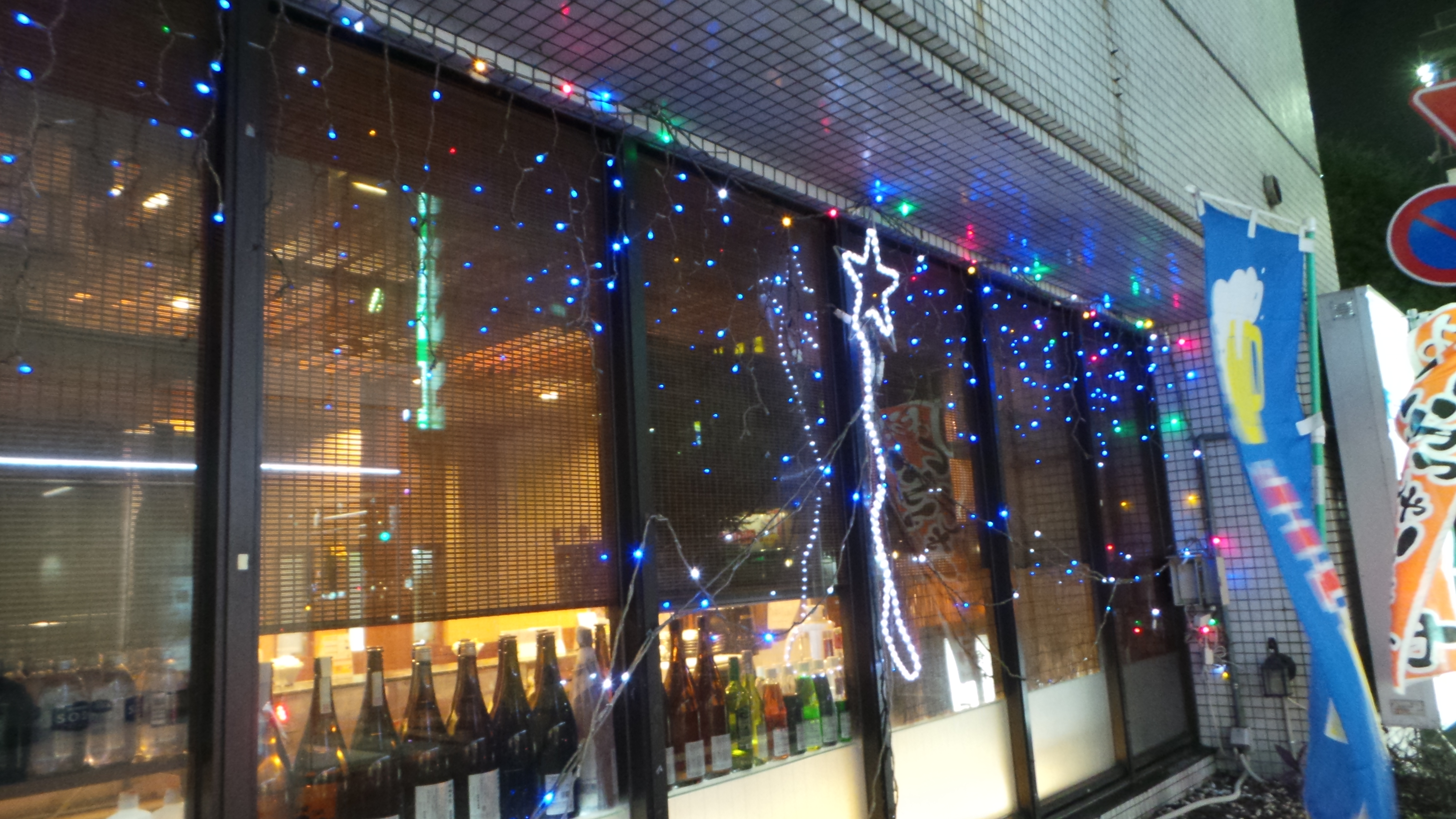
On the way back I pass a restaurant with a full set of Christmas lights. The full works.

christmaswine

Back at the hotel, I Skype with a friend from England. After that, I get deep into my reading until I finish my book. At 10 p.m., I head out to my nearest Family Mart to pick up some food. Inside Family Mart, that same Japanese song with the nice melody is playing. I can just make out a few words; hopefully, it will be enough to find out what it is.

When I return, I turn my attention to Japanese pop music. I listen to the top 30 songs in this week’s Billboard Japan Hot 100 chart. Oddly, Pharrell Williams with ‘Happy’ is at 29th. At 9th and 10th positions are two different songs from the same artist. A song from the anime Sailor Moon is in the top ten. AKB48 sister-band, SKE48, is number one. The song I am trying to find is nowhere to be heard.

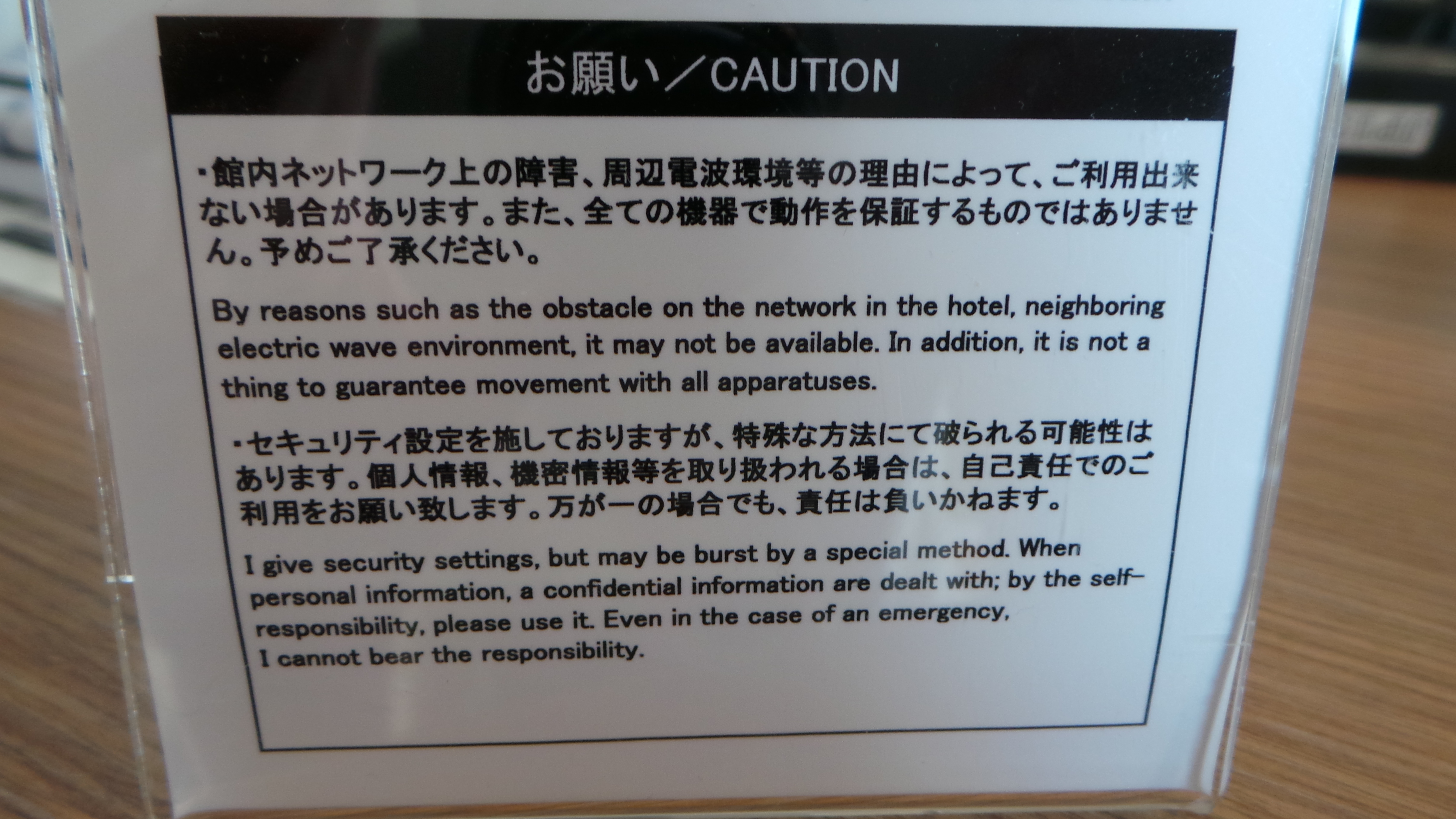
Instead, I find myself staring at this sign in my hotel room:

wirelessinternet

I do eventually find out the name of the song I keep hearing. It turns out to be a cover version of the other song I’ve been hearing, the one from Disney’s Frozen: ‘Let it Go’. It’s a Japanese version played on the piano, sounding very different from the English version—and a lot better, too. I spend the rest of my evening listening to various Japanese versions of ‘Let it Go’ on YouTube but can’t find the particular version I like. Maybe I shouldn’t have admitted that, though. I cannot bear the responsibility.

Robot Women, Fast Cars, Voodoo Dolls, and Dinosaurs

The queue for the Nagoya City Science Museum spills from the door. Inside, there is a snaked queue that runs eight rows deep. A screen on the wall tells me that every time slot for the world’s largest Planetarium has sold out, and it isn’t even 11 a.m. A shame, this was probably my best chance of seeing stars in Japan. The museum also has a special exhibit on at the moment, the Dragon Ball Science Event, and this is most likely the reason for all of the queueing chaos I am witnessing today.

nagoyascience[1]

To avoid wasting a day in a queue, I decide to take a look at the Electricity Museum, some two blocks away. I follow the signs and even find a map listing the museum, but for some reason, I can’t find it. I swing by the nearest Seven Eleven and connect to their free wireless Internet. Google Maps directs me to where I had just been walking, but nope. It doesn’t appear to be here. Perhaps closed down, who knows.

I swing by the Nagoya Musical Theatre to see what’s showing: the 5,000th performance of Beauty and the Beast. One thing I notice on my walk back toward Nagoya Station is that on nearly every street, there’s a building called ‘Toyota’. They seem to have infiltrated even the darkest Nagoya alleyways. Continuing my walk, it takes a somewhat dark turn. I wander into a lonely shopping arcade. All of the shops are closed or boarded up. Everywhere is silent. It’s as if this arcade is part of some other world. There hangs some incredibly macabre imagery.

voodoo[1]

A giant voodoo doll hangs from part of the roof, its belly split open, multi-coloured intestines bursting out, its mouth sewn up, and a giant needle stabbing into its neck. I have no idea what it begins to represent. The voodoo doll isn’t the only horrific image on this street. There’s also a giant multi-coloured face with a top hat and a satanic grin, a sinister-looking golden unicorn with eyes that seem to watch my every movement, and plenty of vampiric bats scattered around. As I pass through the arcade, my footsteps leave behind an echoed creak.

My next stop is a place called ‘Midland Square’. Inside there are many shops and restaurants. The official name for this skyscraper is the Toyota-Mainichi Building. This building is tall. The elevators take an alarmingly quick forty seconds to rise all the way to the top of this 247 metre structure. It also boasts the highest open-air observation deck in Japan.

Inside, there are posh restaurants, two car showrooms, a cinema, and sixty big brand stores such as Louis Vuitton and Vulcanize. These are all places where I’d never shop. Instead, I go and look at some cars. Displayed are a Toyota TS010 and a Toyota TS030 Hybrid.

toyota[1]

There’s an attractive young woman in a light brown suit wearing a mouthpiece. She speaks in Japanese, presumably about the vehicles. Something about her strikes me as odd—her voice doesn’t match her appearance, and her movements are very rigid. It’s entirely possible that she isn’t a human being but a very cleverly designed or disguised robot.

Next, I decide to visit the local gardens near my hotel—Noritake Gardens, to be precise. A sign at the entrance informs me that all animals must be kept in a cage; who exactly brings their caged dog to a public garden? This place is very famous as it’s the birthplace of modern pottery in Japan. There’s a spot marked on the map called ‘Chimney Gardens,’ so I head there and find six tall chimneys shrouded in foliage—the remnants of the pottery plant. The view of these historic chimneys is unexpectedly spoilt by a dinosaur.

chimneys[1]

For no reason that I can see, on the old grounds of this historic and award-winning site, stand three robotic dinosaurs. They move around, opening and closing their mouths, roaring at the children. This site holds industrial heritage significance, showcasing the conservation of a 110-year-old kiln that was used to develop the first Noritake plate. The company continues to trade today, and Noritake tableware remains a household name throughout Japan.

The remains of the factory wall can also be seen, reconstructed from the bricks of old kilns. Bricks were imported into Japan at the end of the Edo period, and the remnants of the red brick plant hold significant value as industrial heritage. However, this time, the remains of the wall are obstructed by a Tyrannosaurus Rex and Carnival Cutouts. Unbelievable.

brickwalls[1]

Also, for reasons I can’t explain, there are thousands of dragonflies here too. I’m not sure what it is about bricks that dragonflies like, but there are so many that everywhere I walk, I have to avoid being hit by one of these stray insects as they dart about without a care. No cages for the dragonflies.

My final stop today is Nagoya Castle. Every city I visit seems to have its own tower and castle. Nagoya Castle is probably a twenty-minute walk from Noritake Gardens. By the time I arrive, it’s 5 p.m., and the Genkan closed thirty minutes ago, bolted shut. The sign on the stone walls tells me not to climb, so it looks like I’m out of options. At least I can see the entire castle from a walkway over a busy intersection.

Nagoyacastle[1]

After visiting the castle, I return to the hotel and rent a laptop for three days for ¥3000. I spend three or four hours writing, and time drifts by. I’ve arranged to meet Nick at half past ten, a Canadian guy I met back in Asakusa who lives in Nagoya.

A guy in the Irish bar last night suggested I try Nagoya-style udon noodles. So, I decide to give them a second chance. I order a simple bowl of noodles with an egg mixed in for good measure. It’s a very cheap meal, ¥400 with a glass of water. On reflection, I still prefer every other type of noodle over udon.

I meet Nick outside Nagoya Station, and we walk half an hour across town to an international bar called ‘Shooters’. We drink and chat until last orders are called at half-past twelve, before walking back to Nagoya Station.

Nagoya is a huge city, yet I discover that Nick’s apartment is in the building directly across the road from my hotel.