Rock, Shock and Tooth Aching Perils

Today is D-Day. Dentist Day. I wake up at 5 a.m. with pain in the whole left side of my mouth, all my teeth are throbbing with pain. It is excruciating. It is deafening. I wait until 10 a.m., before my Japanese speaking friend books me an appointment with a nearby dentist. I eat something out of necessity, scrambled eggs; before heading back to the hostel to play the waiting game.

At around half twelve, the pain feels like an earthquake. The building begins to shake. It isn’t pain, though; a magnitude 5.6 earthquake has struck Ibaraki, some 100 kilometres northeast of Asakusa. After one minute, the shaking stops. I head into the hostel lounge, and everyone is just carrying on as normal, as if nothing has happened. How strange.

I kill time reading about earthquakes before the time arrives to visit the dentist. I must admit, I am a little nervous. My friend is here though, so I have nothing to worry about as far as speaking Japanese is concerned. We head to the nearby Rox building; a massive commercial shopping complex containing many different shops, a gymnasium, a public bath, and oddly, a dental clinic.

rox[1]

We head up to the fifth floor to the clinic and fill out all the necessary paperwork at the reception. How often do I brush my teeth? How long have I been in pain? The usual questions. My name is eventually called at five to three, and I head into the surgery. Rather than separate rooms, the dentists work in an open space divided by booths separated by curtains. As I walk to my booth, the other dentists greet me with a cheery “Hello.” The atmosphere is somewhat comforting.

My booth is immaculately clean, shiny, and very white. I take a seat in the dentist chair, which has a television screen showing news footage of the earlier earthquake. A cloth is placed over my eyes while my teeth are carefully examined one by one. Next, I am asked to go for an X-ray. The dentist says that I am the tallest person to ever use the X-ray machine; it is clearly not designed for somebody of my height. I actually have to squat slightly to use it. As the X-ray machine scans my teeth, ‘Für Elise’ by Beethoven plays.

A tablet screen is placed in front of me showing the X-ray results. The dentist goes off somewhere, so I decide to count my teeth while I wait: an even thirty-two.

dentist[1]

When the dentist returns, he examines my X-ray before putting a camera in my mouth to take photographs of the suspect area. The problem lies in my upper left third molar—a cavity. The news is replaced with the photograph he has just taken. The dentist is surprised by the state of my teeth; he says it is very rare to see such ‘Virgin teeth,’ as he puts it. My teeth are immaculate and untouched; I have never had any type of dental surgery before—no fillings, no tooth removals, and no severed nerves. He says that usually in Japan, a problem like the one I have would be solved by killing the nerve so the pain stops permanently. But because I have all of my nerves intact, he gives me the option to have the cavity cleaned, which he assures me has an 85% chance of success. If it doesn’t solve the problem, then I can always come back again and have my nerve severed.

I agree to the treatment. He places a numbing agent in the affected area before administering a local anæsthetic. Three seconds after the injection, I say to my friend, “I don’t feel so good.” Actually, my entire body begins to tingle and turn numb. I go into anaphylactic shock. My body starts to shake. Eyes open, mind elsewhere. My gaze remains fixed, staring off into some distant abyss.

Darkness envelops me, spiriting me away to a realm beyond comprehension. I traverse a dimension so profound, a depth within my own mind or an alternative world more tangible than our reality. Here, an overwhelming sensation engulfs me, a nameless horror that devours my very essence. Describing the depth of my emotions during this time eludes words; I exist, yet not as myself; and the memory evaporates the instant I return.

I blink, gripped by fear. As my eyes reopen, two figures shrouded in blue masks materialise before me—one male, one female. A woman, unfamiliar and indistinct, clasps my hand, murmuring words I cannot grasp. Panic seizes me. I’m adrift in an abyss of unknowing, unaware of my surroundings or even my own identity. Desperation claws at me; tears threaten to spill. Never before have I felt such terror. Who are these strangers? A momentary void swallows my memory. Was I just born anew? Did I perish? I attempt speech, but words elude me. Tremors wrack my body, not violently, but quivering with sheer nervousness and dread. Slowly, like a fog lifting, memories trickle back, accompanied by my friend’s urgent directive to “Breathe deeply.” Gradually, I emerge from the haze, shaken, tearful, and engulfed by sheer panic.

Eventually, things calm down. My friend explains what happened—about my vacant stare and trembling. My knee hurts; I must have bumped it against the machine. The dentist, with my friend translating, clarifies that I received only a half dose of local anæsthetic. I had previously told my friend that I hadn’t taken any medication for over ten years, a detail I fortunately mentioned to her. She relayed this information to the dentist before the injection; had she not, the full dosage of anæsthesia could have been lethal. She might have just saved my life. I could have remained in that other place forever; eyes open, mind elsewhere.

The dentist reassures me that I will be okay, all smiles and jokes now. I relax but can’t shake images from my head. This moment will be etched in my memory forever. The procedure is eventually finished, the cavity cleaned, and I am free to go and pay. The whole treatment and two packets of painkillers cost me a total of ¥7890. Drowsy, with my knee hurting and my mind drifting, I head back to the hostel to sleep.

Parasite at the Museum

Today is a public holiday dedicated to respecting the elderly and celebrating longevity. In Japan, there are fifteen different public holidays annually, and due to the implementation of the ‘Happy Monday System,’ several holidays have been shifted to Mondays to grant people a three-day weekend. Unfortunately, my toothache has plunged me into perpetual agony today. Regrettably, all the dentists are on holiday because of the celebration honouring the elderly. Not wishing to bare one’s teeth, I struggle on in pain.

My first stop today is Shibuya Station. With most of the country off work today, the area is overcrowded and annoying. I grab a bottle of drink that claims to contain one thousand lemons (which I very much doubt) before walking in the sunshine toward Harajuku, in search of some illustrious graffiti. On the way, I pass Yoyogi Park; here, there are swarms of teenage girls all standing around waiting for some sort of summer concert to start. I decide to pass on the concert. In Harajuku, it is just as crowded. I wander around side streets but find the graffiti to be somewhat lacklustre. I take just one photograph before walking back to Harajuku Station.

haragraf[1]

I take the Yamanote Line to Meguro, which translates to mean ‘black eyes’. After eventually finding a map, I discover that my destination isn’t marked. So, I search for a Seven Eleven and use their free wireless Internet. I then head to the Meguro Parasitological Museum; the only parasite museum in the world, I might add. I am surprised to find it open on a public holiday, and I am even more surprised to find that the entry is free.

If you are looking for a cheap destination for a romantic afternoon, then the Meguro Parasitological Museum is for you. Here, there are jars of parasites, magnifying glasses for that closer look, and an interactive screen displaying the life cycle of a parasite. There is even a small souvenir shop selling shirts depicting parasitological dissections. Finally, a gift shop selling something worth buying.

parasites[1]

With my appetite faded, I leave the museum and decide to skip lunch. I take the Meguro Line six stops to Ookayama Station. Each time the train starts up, it sounds like a jet engine. I change at Ookayama to the Tokyu Oimachi Line; this train also sounds like it is about to take off as it leaves the station. Eventually, I land in Jiyugaoka.

Jiyugaoka is often voted as one of the best places to live in Tokyo. The streets here are a cluster of expensive clothes shops and shops selling expensive cakes and sweets. Some stores have signs outside that say, ‘Women only.’ The roads here are even pedestrianised during the daytime, providing extra space for the many crowds. My intrigue takes me to a place called ‘Sweets Forest.’

sweetsforest[1]

Sweets Forest is an indoor theme park filled with cake shops and overpriced candies. For no apparent reason, traditional Irish folk music is playing inside. However, the thought of eating sweets brings more pain to my teeth, so I decide it’s time to leave. I take the Tokyu Toyoko Line to Shibuya, transferring to the Ginza Line before heading home.

Back at the hostel, everything is getting on my nerves. People keep asking each other the same questions, speaking in languages that could be English, but I can’t be sure. There’s too much noise, and I can’t seem to focus my mind. I try to write, but the pain in my teeth and jaw keeps distracting me. Tomorrow, I’m faced with the daunting task of visiting a Japanese dentist. A friend jokes about how dentists here continue to administer pain even if you scream and raise your hand to signal them to stop, or how instead of fixing your problem, they just remove your teeth.

With my appetence faded and my mind consumed by pain, I try to get an early night. I head off to bed at 9 p.m.; although sleep, I expect, will be somewhat limited. Not a very happy Monday at all.

“What Goes Up Must Come Down.”

Today, it’s back to exploring the Toei Oedo Line. I take two trains and eventually arrive at Bunkyo. As soon as I exit the train station, I am overwhelmed. In front of me is the massive Tokyo Dome, the home of the Yomiuri Giants baseball team, but this isn’t why I am here. Outside the stadium, there is the strangest roller coaster I have ever seen, Thunder Dolphin. The seventh tallest continuous circuit roller coaster in the world; it twists and turns between the buildings and through the middle of the first Ferris wheel in the world to have a hollow centre; again, this isn’t why I am here.

rollercoaster[1]

Today, I’m in Bunkyo to see a tree.

I follow what looks like a castle wall for about ten minutes before eventually arriving at the entrance to Koishikawa Korakuen Gardens. Special Historic Site and Special Place of Scenic Beauty, the gardens are named after a poem by Chinese poet, Fan Zhongyan; the poem is Yueyang Castle.

Be the first to take the world’s trouble to heart, be the last to enjoy the world’s pleasure.

At the entrance, I pay my ¥300 and make an inquiry about the location of the tree. “That is a different garden,” says the woman as she hands me the ticket I have just paid for. She then takes out a map of Bunkyo and highlights where I am right now, then circles the place where the tree is. Not wanting to upset the apple cart by asking for my money back, I thank her for her help and enter the gardens anyway.

underthedome[1]

The first thing that strikes me is the magic of Tokyo Dome. The dome is white and provides an impressive backdrop to the many Japanese silver leaf and maple trees. The interesting thing, though, is that the dome refuses to be photographed. As I focus my camera, the roof of the dome just magically disappears as it blends into the white Autumn sky. It’s hard to explain. The roof is made of some magical material that makes it look like a living organism, perhaps a chameleon.

I continue to explore the wrong gardens; the peace and tranquillity are quite welcoming. A huge lake takes up most of the area, and there is a nice walking route around the lake. The only thing that spoils it for me is the restoration project that is currently taking place until next year. The workers here have their work cut out today as it appears that a large part of the lake has crumbled during this week’s flooding. Water is being sucked away by a huge industrial pump.

The thing that makes these gardens worth a visit though, is the scarecrows.

scarecrows[1]

I actually spent time last week trying to find rice fields in Tokyo, just so that I could see what a Japanese scarecrow looks like. Today I am not disappointed. Never mind the crows, these sinister creations scare even me.

I continue to explore the deserted gardens. I must be the only person here; presumably everyone else in Japan is in Ginza queueing up for the new iPhone. I walk all the way around the lake, and toward the exit. I am really looking forward to revisiting all nine of the Metropolitan Cultural Heritage Gardens in Tokyo during different seasons; in a month’s time, I will get to enjoy the dappled shades of autumn leaves.

I leave Koishikawa Korakuen Gardens and walk the thirty minutes to the similarly named Koishikawa Botanical Gardens. I pay the ¥400 entry fee and explore.

botany[1]

These gardens are managed by the University of Tokyo Graduate School of Science and are the birthplace of Japanese botanical research. Dating back to 1684, the garden displays a collection of over four thousand species of plants and a herbarium containing over 1.4 million specimens. With over four thousand species and a map written entirely in Japanese, my search for one specific tree is almost fruitless.

I wander through the lush garden foliage for over an hour; it is the most peaceful place I’ve been to since leaving Kyoto. Eventually, I find Mendel’s Grapevine. Next to the grapevine is the tree, Newton’s apple tree.

Newton[1]

The tree rarely grows apples. When it finally does bear fruit, the apples are instantly devoured by the many crows in the park, so many crows; maybe I should have stolen a scarecrow from the other gardens.

Sir Isaac Newton’s apple tree is not the original tree that he floated under before he invented gravity. This tree is just a sapling from the famous tree and was delivered to Japan in 1964. It was almost incinerated on arrival at Haneda International Airport because the leaves were infected, but an agreement was made so that the tree could be replanted in an isolated environment, and now it is here.

Rather ironically, I learned today that the original Newton’s apple tree is in Lincolnshire, England. My birthplace.

After I inspect the tree, it is time to head back to Asakusa. I walk fifteen minutes to Myogadani Station, before taking the Marunouchi Line to Ochanomizu Station. Here I walk ten minutes in the direction of Akihabara. I get a little lost on the way, but eventually see the familiar sign for Big Apple Pachinko and Slot, and finally know where I am. I take the train from Akihabara back to Asakusa.

Back at the hostel, I drink in the bar for a while before meeting up with Malaysia, Germany, Italy, Chicago, and Japan, and the six of us head to Nui until close. After, we head to an all-night karaoke bar with the most confusing pricing structure ever. Everyone has incredibly good music taste, and I enjoy The Smiths until the early hours. There’s music and there’s people, and they’re young and alive.

thereisalight[1]

One thing that strikes me about karaoke in Japan is the videos. They don’t have the license to show the official music videos, so instead, they show random Japanese men sitting on park benches or salarymen rushing around the crowded streets of Tokyo.

We sing and drink gin until daylight.

On a Clear Day I Can See Forever

Summer surrenders to autumn, and the weather swiftly turns cool, as if overnight. My can of Boss Coffee falls from the vending machine piping hot. Today, I decide to explore the Toei Oedo Line. I walk twenty minutes to Kuramae Station. En route, I pass the Bandai Headquarters; a huge banner informs me that Tamagotchi is making a comeback at the end of this month. At Kuramae Station, I wait patiently for the train and receive strange looks as I laugh at the following sign:

outofafence[1]

I hop on the train without taking any notice of the time. It is, of course, 9 a.m. — rush hour. The train is packed. Today, I learn that this train goes all the way to Shinjuku. At every stop, more people get on. The crowding worsens, and the oxygen levels deplete. After about ten minutes, it becomes too much, so I squeeze my way out of the train at Kachidoki Station. I need air.

Kachidoki is in Koto and is the nearest station to the Tokyo Port Terminal. Whilst I’m here, I decide to take a little wander around the docks and the small interconnected islands. Dengue fever has now spread throughout Tokyo, and this area is a terrible place to be. All the streets here are lined with shrubbery and swarming with mosquitoes. A sign warns me to ‘Be careful with mosquitoes!’ Joking aside, it’s actually pretty serious, and I take the warning seriously.

I head toward the Harumi Railway Bridge.

HarumiRailwayBridge[1]

The bridge is no longer in use. Barbed wire warns me not to cross, although I wouldn’t anyway as it doesn’t look very safe. What’s interesting here is that from this bridge, I can see both Tokyo Skytree and Tokyo Tower. I suppose it makes the trip worthwhile, maybe not. After I photograph the bridge and Tokyo Tower in the distance, I head back to Kachidoki Station. Rush hour is now long gone.

I take the Toei Oedo Line all the way to Shinjuku. I end up getting lost in the station, then get back on the same train as before, taking it to Tochomae Station. Here, I change trains but stay on the same line and head to Higashi-Shinjuku Station. Outside, I walk around looking for something to do. There isn’t a lot here—just restaurants, shops, and plenty of bars; a good place for a night out if I didn’t live so far away. I cross under the Yamanote Line and see children painting the wall beneath the tracks.

arttrack[1]

I follow the wall of graffiti to the entrance of Shin-Okubo Station and take the Yamanote Line to Ueno, changing trains once more before heading to Tawaramachi Station.

When I arrive back at the hostel, Hiro tells me that tonight we are having a soba party. “Not again!” I quip. The flyer for the party is the same as last time but with a different date. I relax for a while, killing time, before heading out for my seventh train of the day.

I take the Tobu Skytree Line just one stop to Tokyo Skytree Station. If I’m completely honest, I could have just walked it; it isn’t far. I blame the convenience of Japan for my laziness. I’ve been here almost four months now, and with Tokyo Skytree practically on my doorstep, I decide I might as well take the plunge. ‘Plunge’ probably isn’t the best word to have used.

I pay ¥2060 and wait anxiously for the lift. Surprisingly, there is absolutely no queue. The lift travels so fast that it makes my ears pop. 350 metres later, I arrive at the Tembo Observation Deck. The view is staggering.

fromthetop[1]

Skytree Radio blares through the speakers. As I gaze over the Sumida River, I can see my hostel. “From the top of the tower, radio buzz in my ears, I can see my house from here, I can see my house from here.” The Owen Pallett song, ‘The CN Tower Belongs to the Dead,’ gets stuck in my head, and it will most likely stay there for the remainder of the day; not necessarily a bad thing though.

I wander the massive observation deck for a while, being careful not to get too close to the edge. There’s an option to pay an additional ¥1030 to go up to the next deck, another one-hundred metres higher. I think it’s terrible that this was never advertised to me until I’m already 350 metres in the sky—a sneaky trick to try and make me pay more. I decide not to bother; I’ve already spent a small fortune today as it is. Instead, I take the escalator down ten metres. Here, there’s a glass viewing point where I can stare at the traffic on the street below. Oddly, it doesn’t look like I’m too high up from here.

glassviewpoint[1]

There’s another area where I can actually stand on a glass platform and have my photograph taken by the staff, although I can’t use my own camera. All I want to do is take a photograph of my foot on the glass panel, but I’m not allowed. Another trick: if you like the photograph, you can spend even more money and buy it.

I take the lift back down to the inescapable 5th floor. It would be unfair to say that the most exciting part of the Tokyo Skytree experience is the lift, but then again, I am quite the unfair person. As I had imagined, the exit to the lift leads into the gift shop. The train station is on the first floor, and surprisingly, I am forced to exit through not just one gift shop, but three. After three floors of tacky goods, I then have to walk all the way through a huge indoor food market just to get to my train.

Back at the hostel and with an hour to kill, I write whilst listening to Owen Pallett, or at least I try to write. At some point, all hell breaks loose: a monsoon. Tokyo is issued a flood and heavy rain warning—a red warning. I have honestly never seen rain so hard; I can’t possibly explain it without appearing to exaggerate. The hostel floods. I spend an hour helping out: moving furniture from flooded rooms to dry rooms, and mopping. Mopping until I have no energy to mop anymore. It’s just lucky that my laundry is comfortably drying on the 4th floor, so I don’t mind getting my clothes soaked in dirty floodwater. Eventually, the rain stops, and with a lot of hard work from the team here, everything is high and eventually dry.

It is fair to say that the soba party is a bit of a washout. Eventually, after an hour delay, it finally gets started. I shower and change clothes before enjoying some free noodles and beer. Deserved beer.

skymoon2[1]

After the party, I take a wander outside to catch the end of the Harvest Moon. Somewhat fittingly, the moon hovers just behind Tokyo Skytree. An apposite end to the day.

Shiitake My Breath Away

The hostel shared news of a festival at Mukojima-Hyakkaen Gardens. Today is Tsukimi-no-Kai, which means ‘Moon Viewing’ – a tradition marking its 210th year in these gardens. The goal tonight is to celebrate and enjoy the Harvest Moon. We’re set to meet up at 4 p.m. It’s cloudy outside; I doubt the moon will be visible, but the event sounds fun.

My first destination of the day is the brilliantly titled ‘Project Eat More Mushrooms,’ just an enticing eleven stations away on the Ginza Line. This year, it’s hosted at Ark Hills, a substantial office development in the heart of Akasaka. I hop on the train and disembark at mnemonic favourite, Toranamon, to run a marathon. I take a rather unhurried walk to the venue. Along the way I pass the Embassy of Micronesia and the Foundation of Miracles, before finally arriving at Project Eat More Mushrooms.

mushroommarket[1]

The mushroom festival here is disappointing, an absolute waste of thirty minutes each way on the train. Forget about eating more mushrooms; having more stores selling them would be a welcome start. I can hardly classify four market stalls as a festival. There are no miracles here, no mascots either, and certainly not many mushrooms. To salvage the journey from being a complete waste, I purchase some shiitake mushrooms and enoki mushrooms for a total of ¥450.

Back at the hostel, it dawns on me that these mushrooms are precisely the same ones I could have purchased from Seven Eleven. Considering the wasted time and train fares, these have turned out to be the most expensive mushrooms on the planet.

mushrooms3[1]

After the mushroom episode, I gather as planned at 4 p.m. The small group of seven comprises my friends Aram and Dagmar, along with two fantastic tour guides from the hostel, Keina and Gomez. We make our way to Asakusa Station and board the Tobu Skytree Line to Higashimukojima Station. Interestingly, the train deliberately slows to a crawl as it crosses the Sumida River to showcase the glorious view, or so we’re told. Upon reaching Sumida, we head straight to Mukojima-Hyakkaen Gardens, marking my third visit to these beautiful gardens during my time in Japan. The entrance fee remains the usual ¥150.

At the entrance, we’re requested to douse ourselves in mosquito repellent due to a Dengue fever outbreak in Tokyo. Just last week, Yoyogi Park was closed for extensive fumigation to eradicate mosquitoes and is likely to remain shut for several months. Similarly, Shinjuku Gyoen Park underwent the same treatment two days ago. It seems this week might be the least opportune time to visit an outdoor garden.

We enter the gardens, and inside, offerings are being made to the moon.

giftsforthemoon[1]

Television crews are setting up at the entrance to the Hagi Tunnel. Swarms of people are queueing up for the ¥2000 tea ceremony, the same ceremony I had previously enjoyed at no cost. The sound of chirping insects fills the air. We kill some time exploring the park before heading back to the wisteria trellis for the opening ceremony. Following a short opening speech, a performance of the shinobue begins.

A shinobue is a Japanese transverse flute made from hollow bamboo. Two performers play for almost thirty minutes. During their performance, I lose myself in meditation on a bench surrounded by foliage and mosquitoes.

fluteladies[1]

After the performance, it’s time to light the many lanterns scattered throughout the gardens. The paper lanterns are lit just as twilight sets in. In total, there are thirty-five lanterns, and volunteers are encouraged to participate in the event. Each lantern is decorated with a haiku.

Once the lanterns are lit, a curtain of dusk descends to the melodic tune of the koto, a traditional thirteen-stringed Japanese instrument. The five performers play in perfect harmony, and the sweet sound of the koto resonates throughout the gardens. Eventually, the earlier gifts presented and the beautiful music work their magic, transforming the overcast evening sky into a clear one. As if on cue, the clouds part ways, unveiling the face of the Harvest Moon.

festivalsounds[1]

We sit down and admire the sky. The moon is a ghostly white, brighter than I can ever recall; but it has been a while. Like the stars, the moon rarely appears above the Tokyo skyline. Tonight the moon doesn’t hide, it looks beautiful, it is breathtaking.

We eat snacks. The chatter combines with the music. The thought crosses my mind that this ceremony has been taking place exactly where I am right now, for the last two-hundred or so years. It probably hasn’t changed much since then either. My mind transported to another time.

I eat a bowl of oden, a Japanese winter food consisting of various fish and vegetables in a soy-flavoured broth. It costs ¥800 and is delicious. We chat for a while longer, enjoying the sound of the insects, the music from the koto performance, and the lull of the moon.

harvestmoon[1]

At 7 p.m., it feels much later than it is. Darkness arrives earlier now, but the weather is still warm—an atypical autumn. We all head back to Asakusa on the train before going our separate ways.

I take the Ginza Line for thirty minutes, and as I exit the station into the crowds of Shibuya Crossing, it begins to rain. At 9 p.m., I meet up with a friend from England, Laurence, and his two friends. We gather outside Hachiko, a statue of a dog. The dog belonged to Professor Ueno. Hachiko would wait for the professor at the end of each day outside Shibuya Station until one day, in 1925, the Professor died. Despite the professor’s absence, Hachiko continued to wait faithfully, but his owner never appeared. Legend says the dog returned to the station at the same time every day for nine years, yet Professor Ueno never returned. Then, sadly, in 1935, Hachiko passed away.

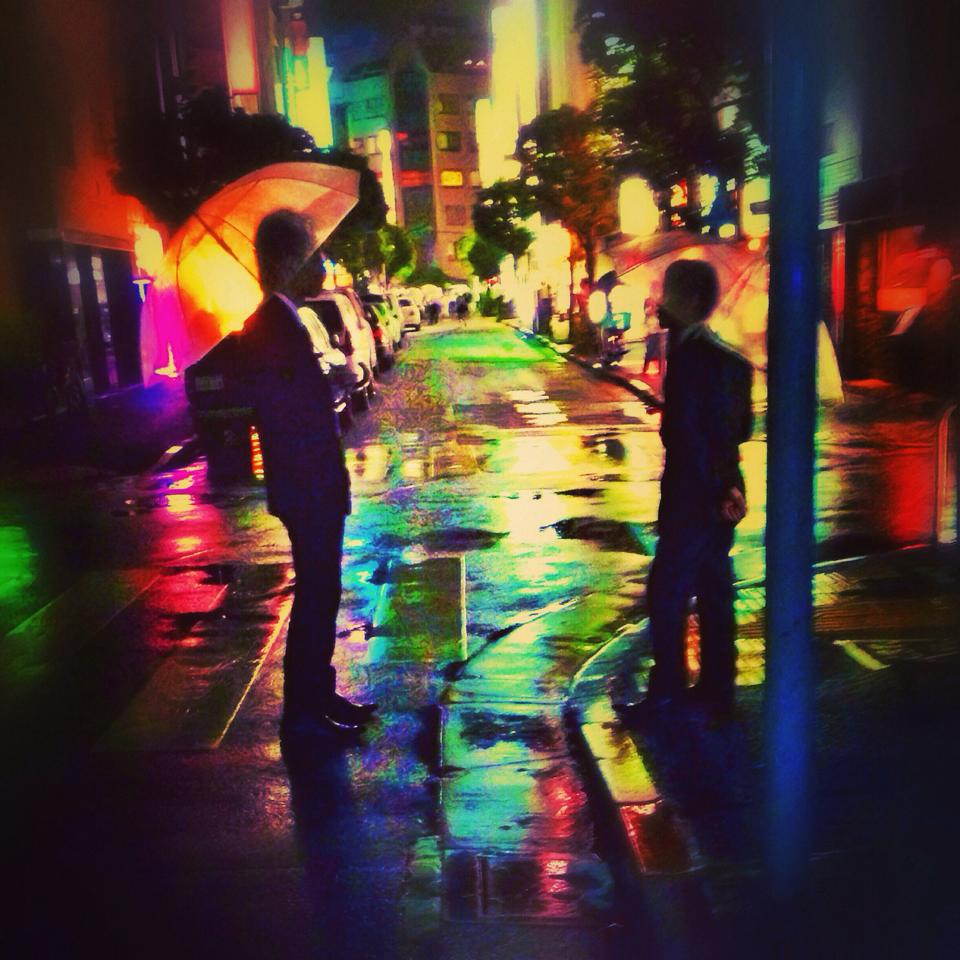
Our evening begins in an absinthe bar exclusively playing The Smiths’ music and ends in a cheap izakaya-style bar. Artwork and literature dominate our evening’s discussions. An enjoyable night washed away with rain and ¥450 Suntory whisky highballs. I don’t take a single photograph; much like Hachiko, my camera is dead. With no photographs of my own, Laurence kindly lets me use one of his: Neon Nirvana:

Neon nirvana