Coincidences, Strangers, and Stranger Coincidences

I wake myself up screaming in pain. I have cramp in my left leg and I’ve just woken everyone up. Not the best start to the day. I have a shower, get dressed, then stumble to the lift. Researching cramp, Yahoo Answers tells me that I need to drink more red wine, add more salt to my diet, and eat less bananas.

At the hostel I meet a freelance journalist from Canada. Her name is Aaliya. It is her first day in Japan, so I offer to give her the tour of the area. We walk to Senso-ji where we both receive an o-mikuji fortune. Aaliya gets The Good Fortune; it says that the ‘patient will not get well soon, but will escape death.’ I hate to think what the bad fortune is like. I receive The Best Fortune.

best_forutne[1]

After a stroll around Asakusa, we take the Tokyo Metro Ginza Line to Shibuya. A short walk from the station and we arrive at the famous Shibuya Crossing. There are three massive television screens mounted on buildings, they only show advertisements. We decide to go into the Starbucks Coffee shop for a better view of the crossing. I later find out that this is the busiest Starbucks Coffee shop in the world.

Overall, I find Shibuya Crossing to be quite underwhelming. It is literally people crossing a road. How this became a famous tourist attraction, I have no idea. After we take photographs of people crossing a road, we walk around Shibuya for a while. We notice a neon sign saying ‘CAT’ and decide to check it out. It is, of course, a cat cafe; a place where you have a cup of tea surrounded by cats. Unfortunately, they only allow two people in at once for thirty minutes at a time; there are two people already waiting, so we decide to leave.

crossing1[1]

After a walk around Shibuya, we change to the Yamanote Line and head to Akihabara. Here we get some food. Tempura again today, two prawns, squid, sand borer, and scallop served on rice with seaweed. ¥1280 with a pint of beer. After a look around a few of the shops in Akihabara, we head back on the train and return to the hostel.

Radiohead are playing on the speakers in the hostel lounge. There is also a film crew here interviewing people for Japanese channel TV Tokyo. I hang out in the lounge with a couple of the hostel staff who have just finished their shift for the day. One of the staff members recommends that I check out the Robot Restaurant in Shinjuku, another recommends I eat at an Alcatraz themed restaurant. I note both down as options for another day.

I hang out for a while longer with one of the guys that works here; he is genuinely hilarious and I can see myself becoming good friends with him. We joke about forming a Japanese manzai act together; a style of traditional comedy here in Japan involving two performers. He says that if I want to I can work at the hostel for three hours a day, cleaning, in exchange for a free room. A lot of backpackers do this, apparently.

After a light snack of salmon teriyaki, I head out to an izakaya pub with Aaliya and two of her friends from the hostel, James and Matt. Here we drink for a while, sitting outside and enjoying the warm evening and a light breeze. Eventually the three of them head back to the hostel; they have to be up at 3 a.m. to catch a taxi to the Tsukiji fish market. I decline the invitation to join them; I will be not be getting up that early.

izaka[1]

I wander alone around Asakusa at night, taking my time, taking photographs and taking in the neon lights. When I get back to the hostel, I grab a beer in the lounge. I hear a man talking about Shane Carruth, director of Primer and Upstream Color. I am surprised to hear his name. I join the conversation and it transpires that we have both read Shane Carruth’s script for his abandoned project, A Topiary.

The man says that another director he really likes is Zal Batmanglij, I am also a huge fan. I find it very odd. The conversation naturally turns to Brit Marling and Mike Cahill, and the coincidences continue. This is probably only interesting to me, but it seems that all of my favourite people, artists, authors, and musicians keep being mentioned. I didn’t say so in my blog a few nights ago, but the Irish guy staying in my hostel room, his favourite author was the same as mine, Iain Banks. He was also reading a different book by the same author as me, Haruki Murakami. I find it all very strange.

I stay in the hostel lounge and spend the rest of the night drinking with some random people. Two of which are from England. There is talk of a group karaoke trip tomorrow, which I really hope goes ahead. The rest of the night becomes a bit of a blur, and I retire to my room just before 3 a.m. Meanwhile, the others wake up to visit the fish market.

One Zoo Over; the Panda Impressed

Today I once again decide to stay within the boundary of Taito Ward. Taito is where I am technically living. It is one of the 23 municipalities in Tokyo. It is home to five districts, one being Asakusa and another being Ueno; where I will be heading to this morning. Since arriving in Asakusa I have only ventured out of Taito Ward once, which was yesterday’s trip to the other side of the Sumida River.

I set off from my hostel about 9 a.m. It is 33°C today in Asakusa, and I am incredibly thankful that every building in Japan is heavily air‐conditioned. I start walking, remaining on the same road for ten minutes, before arriving at Ueno. A short stroll later and I am near the entrance to Ueno Park.

The park is home to the Tokyo National Museum and the National Museum of Nature and Science, both closed at the moment; probably because it is Sunday morning. Ueno Park is also home to many temples, statues, art galleries, and a concert hall. I hear a crowd in the distance and decide to see what’s happening. Deeper into the park I walk, until I find the source of the noise, a baseball field. Baseball is a very popular sport in Japan, and a crowd of about forty people gather here to watch what is probably some amateurs practicing. After watching for about ten minutes, I decide to check out the Shinto shrine, Tosho-gu.

Another thing that Ueno Park is famous for is Ueno Zoo. I arrive at the entrance and am surprised to find it is open. I use the automatic ticket machine, with its English option, pay the bargain price of ¥600, and enter the zoo. The zoo is home to many animals, including the Asian elephant, the hippo, toucans, kangaroos, pelicans, puffins, flamingos, crocodiles, the reticulated giraffe, the red panda, and of course the two giant pandas, Siennyu and Shinshin. Unfortunately, the giant pandas are inside an annoyingly reflective glass enclosure making it very difficult to get a good photograph. This one was my favourite:

PANDA

After the zoo, I walk back to the hostel and rest for a while. I caught the sun quite badly and my face is a little red with sunburn. Eventually it is time to head out to get some food.

It’s lunch time in Japan, and most of the restaurants are very busy. I have a desire to eat fish today so take a while wandering around until I see a restaurant with plastic models of sushi and sashimi bowls outside.

The cool air conditioned restaurant is very busy and I am seated opposite a Japanese man. I order a big bottle (660ml) of Asahi, costing ¥550. It is served in the smallest glass I have ever seen; so small in fact, that I probably had to refill the glass no fewer than ten times during my meal. Browsing the menu I notice the restaurant also offers my favourite Japanese whisky, Hibiki. They offer both the 17 year old and the 21 year old for ¥700, much cheaper then back home. I order the tuna sashimi rice bowl set, served with a tofu based Miso soup, Daikon and seaweed. It is delicious. The tuna some of the freshest I have ever had. The food is ¥1550, making the total cost of the meal, a very good value for money ¥2100.

sashimi[1]

On the way back from the restaurant I take a detour through the market streets of Asakusa and see yet more outdoor street performers. The first act features a man playing The Entertainer by Scott Joplin on a keyboard, as a male and female clown play musical chairs. There is no dialogue, just over exaggerated hand gestures and some convincing facial expressions. The duo of clowns eventually invite a woman from the audience to play musical chairs with them. The audience member wins the game, after a large amount of clowning about. The acts finish, pass around their hats, and move aside to let a second act set up.

The second act is a female balloon artist, tap dancer, and comedian. Again, much like the first act there is no dialogue. She is being filmed by two people with professional looking cameras. After making some balloon animals and flowers and doing pranks on the children of the audience, she randomly brings out some bright and colourful boards and starts to tap dance. She then starts doing tricks with her hat; she starts by rolling it down her back, then catching it. Tossing it over her body, catching it with her foot, before flipping it back up into the air, where she catches it in her hand. Next she rolls it up her arm and flips it back into the air before catching it on her head. It is actually very impressive.

20140601_161621[1]

After she is finished, and her hat is passed around, the camera people leave, the performers leave and the crowd disperses. I decide to go for a few beers in the English bar next to the hostel. Here I end up talking to a Japanese man. He asks me where I am from, and I tell him England. “You know Oasis and The Beatles?” He asks. I tell him I don’t like Oasis. The very next thing he asks me is, “Do you know Radiohead?” After about an hour of talking about Radiohead, the Japanese man has to go.

Next an attractive Japanese lady comes into the bar and sits next to me. She is thirty years old and spent 7 years in England as a child. Her accent is incredible. She goes from sounding like a Japanese person speaking English, then her accent randomly changes into a posh sounding London accent, just for the odd sentence or word. After a few beers and a decent conversation, I decide it is time for me to sleep. I ask to pay my bill, which should have been ¥2320, but I am only asked to pay ¥1000. I have no idea who, if anyone has paid for any of my beer tonight. I don’t argue, pay my ¥1000, say goodbye to everyone, and leave.

Penguins, the Universe and Everything Else

Once again it is very hot. The hottest day so far this year in Tokyo. A stroll along the Sumida River and into the city of Sumida signals the start of my Saturday. I start by heading towards the tallest tower in the world. Eventually I arrive at the base of Tokyo Skytree; here is an area known as Tokyo Skytree Town. It is full of souvenir shops and restaurants. There are plenty of tourists here today; 9 days ago was the two year anniversary of Skytree’s completion, and it seems the celebrations are still going on.

My initial plan today was to head to the top of Skytree and take some incredible photographs of Tokyo from the observation deck, but instead I see a sign for the Sumida Penguin Aquarium and my interest is piqued. I walk up to the ticket booth. “How many people?” I am asked by the lady at the counter. I make a deliberate point of looking over my own shoulder and around into the deserted space behind me, before indicting that it will be just one. I hand over my ¥2050 and enter the aquarium.

The first level of the aquarium is dedicated to living aquascapes, a word I heard for the first time yesterday, and will no doubt hear again tomorrow. The aquarium is quite small but does have some interesting things to see, most notable are the jellyfish and sharks. The highlight for me, however, is the aptly named ‘Animals Enjoying Water’ section. This is home to fur seals and loads of penguins. They seem to be enjoying the water.

Penguin[1]

After leaving the aquarium and deciding that half an hour is too long a time to be queueing for Skytree, I decide to check out Sumida Park. I don’t make it to the park though, as along the way I am randomly stopped by a Japanese lady who hands me a flyer and says, “Would you like to come and see our Temple?” I accept her offer and she guides me across the road to the Temple.

The Temple is home to a branch of Nichiren Buddhism called, Shoshu Buddhism. I am invited to sit down in front of a beautiful alter, but unfortunately I’m not allowed to take photographs inside the Temple. Three more people join us, one man and two women. One of the women speaks very good English, and so we sit and she tells me the story and history of how this branch of Buddhism began and what it means.

Next I am given prayer beads to wear across my hands and invited to chant with them. “Nam-Myoho-Renge-Kyo,” repeat three times. After we chant, I sit for a while longer discussing their beliefs. They ask me if I would come to their Buddhist ceremony in eight days time at the Temple. I accept their invitation and we chant one more time before leaving the temple and saying our goodbyes.

On the way back to the hostel I see a blindfolded street juggler. He manages six balls at once and gets quite the applause from the large crowd that has gathered around. Then I see a man on stilts dressed as a dragon, but with a white painted face and a terrifying smile. Finally I see a woman in a bright red suit and matching hat, she is wandering around one of the many markets playing the accordion and being photographed by just about everyone.

My intrigue leads me to the sound of a beating drum, and I soon arrive at a random pole lantern festival in the middle of a crowded street. The performers here balance massive 12 metre tall lantern poles on their palms, foreheads and backs; while other participants hit drums, play flutes and get the audience to clap and sing chants of encouragement. These lanterns are usually lit with candles, but it is the middle of the day, so perhaps this is just a practice for a performance later tonight.

matsuri1[1]

After the festival has finished and the performers have left, I head back to the hostel for a beer and a short rest.

A few beers later and I need food. I think about risking the hot food vending machine, but it only sells ‘Casual Hot Foods.’ Instead I head back out into the burning hot streets of Asakusa, and take the ten minute walk to a one Michelin starred sushi restaurant. It is closed. I think about waiting for two hours for it to open, instead, I decide that I will come back here another day, and to see what else is in this area.

The next street from the restaurant features a market selling plants and shrubberies. The market is huge and spans far off into the distance. There are even people in uniforms specifically here to direct the traffic. There are not many restaurants though, so I head back towards the middle of Asakusa, and I am so glad that I did.

crazymime[1]

I get to see this guy. A random mime promoting Pantomime Week here in Tokyo. His show is in Japanese, but is easy to understand as it is mostly body language. I stay and watch the whole fifteen minute show and find it hilariously funny. After he is done, I throw some money in his hat before heading off to finally get food.

I decide on a little Italian restaurant. I know it isn’t Japanese food and I’m not in Rome, but I am longing for something familiar after a crazy few days. I decide on a tuna, eggplant, and oregano pizza. It costs ¥1450, and tastes somewhat average. The restaurant also sells small bottles of Asahi for ¥600, which is far too expensive. After food I head back to the hostel to sleep off a very busy day.

A Tale of Two Squids

I wake up to the birds cheeping outside and the sun blazing through the window. An early start today in the far too hotter than I’m used to 30°C Tokyo sunshine finds me out and about for 9 a.m. I head across to the bar I had been the previous evening, which luckily for me, doubles up as a vegan and vegetarian restaurant in the day time; and only a 45 second walk from my hostel too. After a breakfast of beans, egg, and toast, washed down with a damn fine cup of coffee, it’s time for a stroll.

I take a five-minute walk to Senso-ji, a Buddhist Temple in Asakusa and the oldest temple in Tokyo. The entrance to the temple is marked by a giant red and white lantern, and probably the largest lantern I have seen in my life. This section is known as Kaminarimon, or the Thunder Gate. Standing either side of the gate are two large statues, the one on the left, I am told, is Fujin, the god of wind; and to the right, Raijin, the god of thunder.

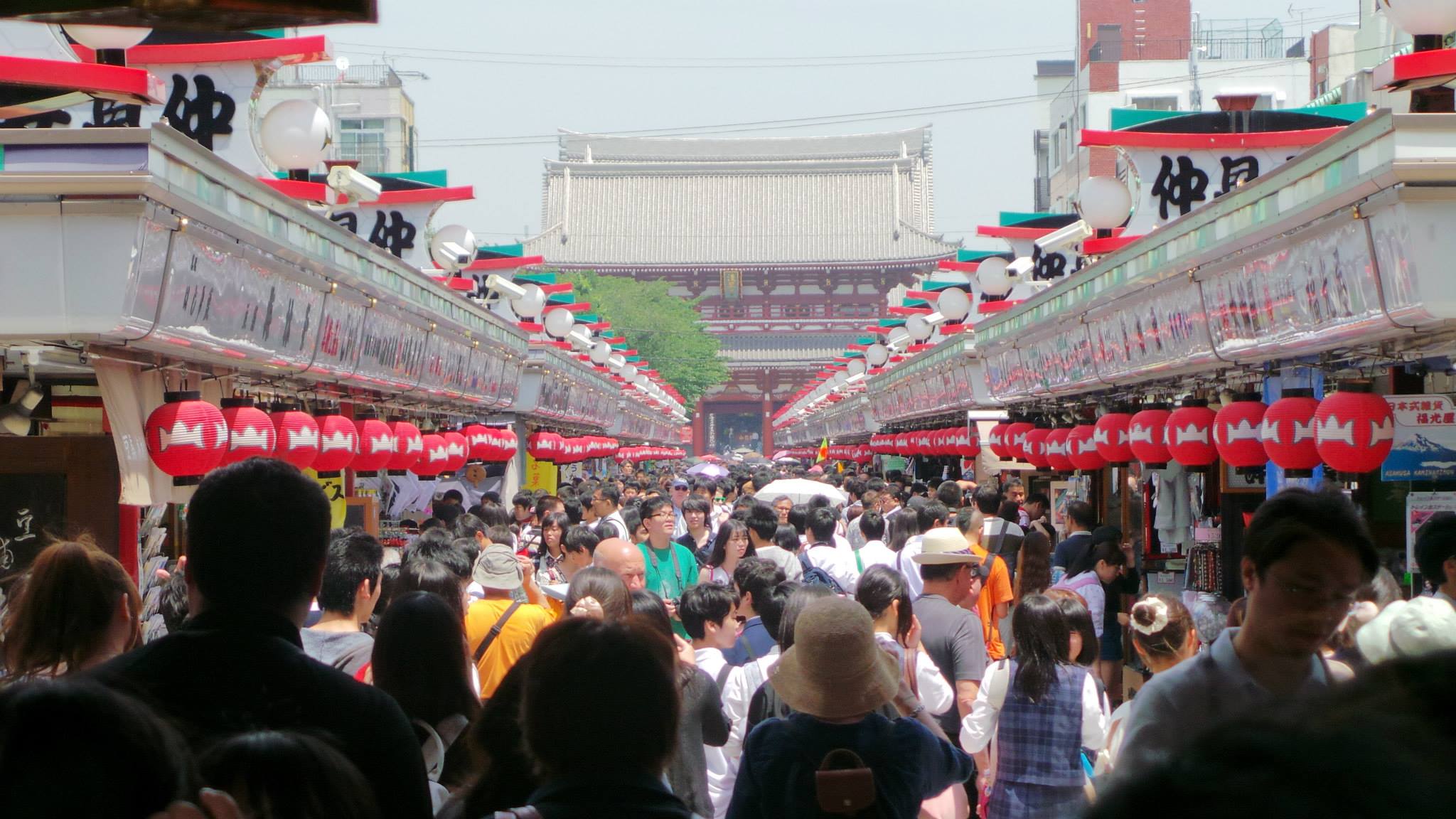
Continuing towards the temple, there’s a line of over 80 stalls offering fans, umbrellas, souvenirs, and an array of food items (bean paste buns and rice crackers seem to be popular today), along with clothing, handbags, and even a stall claiming to sell tortoise shell and coral. Known as Nakamise-Dori, this stretch forms a beautiful lantern-lit pathway of stalls leading to the temple.

senso

In the temple courtyard stands Goju-no-To, a five-story pagoda that stands at 53 metres tall, making it the second-highest pagoda in all of Japan. Prior to the temple entrance, there’s a massive cauldron emitting thick incense smoke. This cauldron marks the threshold before the entrance to the Hondo, or Main Hall. Inside the Main Hall, a striking golden statue of Kannon, the goddess of mercy, awaits. Legend claims the statue was retrieved from a lake in the year 628 AD by two fishermen.

After some sightseeing around the temple, I head to a nearby shaded indoor market. After a short while, I notice a woman who, for no apparent reason, is strolling through the market balancing a bottle of green tea on her head. As she passes by, I stop and turn around to confirm what I had just witnessed – indeed, a woman balancing a bottle of green tea on her head. In the process, I almost get knocked over by a passing cyclist.

Upon returning to the hostel, I start feeling somewhat tired: a touch of jet lag, extended periods of wakefulness, and my newfound, albeit very healthy diet of Suntory Black Boss Coffee being the obvious causes. I opt to take a nap.

I awaken. It’s 8 p.m., and outside, the darkness of the sky has been replaced by the brilliance of vibrant neon lights. I realise that Japan takes on a strikingly different appearance in the evening. I begin my walk back toward Senso-ji, passing by pachinko parlours, game arcades, and brightly lit restaurants that seemed non-existent earlier today. The streets are now bustling with people seated at tables, dining. Shutters down, shutters up—there isn’t a clothing shop in sight; everything has been transformed into restaurants.

restaurants[1]

I return to Senso-ji to witness the Pagoda and Temple illuminated at night—an impressive sight. Strolling back through Nakamise-Dori, almost all of the 80 stalls are now closed with their shutters down. Only a single food stall remains open; it’s time to find something to eat.

I opt for a tempura restaurant that proudly boasts an English menu. According to the menu, their prawns are exceptionally tasty due to being raised using extensive aquaculture—an environmentally friendly method. They exclusively use 100 percent vegetable oil with no cholesterol. Ordering a tempura set with noodles and a pint of Kirin Beer, I indulge in tempura sweet potato, lotus root, squid, and prawn, all served on a bed of rice. While the squid tempura is remarkable, the standout, confirming the menu’s claim, happens to be the most delectable prawn I’ve ever tasted.

tenpura[1]

The meal, including the beer, costs me ¥1060—an incredibly reasonable price indeed.

Deciding to conclude the night back at the hostel, my appetite is thoroughly satisfied. I purchase a few affordable cans of Asahi from the vending machines and head to my room, where I’m greeted by a few fellow roommates. A lady from Taiwan offers me some squid on a stick. ‘Try it,’ she says with a grin, ‘it’s nice and a little bit spicy too!’ For some reason, I agree to give it a try.

Two minutes later, I’m still at the tap, trying to wash away the taste of what must have been the most disgusting food I have ever tasted. The texture was chewy, the taste was off, the regret was apparent.

My second day in Japan oddly mirrored by both morning and evening visits to Senso-ji Temple: walking the same streets once bathed in the brightness of a hot sunny day and then again in the neon-lit darkness of the night; and some food to remember, followed by food to forget.

Twenty-Four Hours in Japan

Sitting on a British Airways flight for thirteen hours with Suzuki-san, I land at Tokyo-Narita International Airport with a strong hangover and a profound but newfound knowledge of ballroom dancing. I was happy that I had someone to talk to during the flight, and Mr. Suzuki was happy because he got to practice his English. What struck me as odd, though, is that after two small Heineken beers, Mr. Suzuki handed me a pamphlet for his ballroom dancing studio, complete with a nice map and address. One Heineken later, he gave me a business card with his home address, telephone number, and email address. Japan must be the only country I have experienced that has such a high level of trust.

As I approach immigration at the airport, I notice a sign that reads, “Please refrain from physical contact with others, except for the staff.” I adhere to this unusual instruction and proceed to have my fingerprints and photograph taken. After a swift 90-minute train journey on the Narita Express, I arrive at Tokyo Station. Here, I make a seamless transition to what has always been my preferred railway loop line in Japan: the Yamanote Line. This remarkable train route encircles all the main stations in Tokyo, spanning 29 stops in just one hour—a line I aspire to traverse entirely on foot one day.

For now, I take a brief two-minute train ride from Tokyo Station to the following stop on the loop, Kanda Station. It’s at Kanda Station that I transfer to what will likely serve as my new home for the next month: the Tokyo Metro Ginza Line.

Finally, after a total of twenty-two hours of solid travelling, I step out of the subway, gaze across the skyline for a few seconds, and spot the second tallest structure in the world, as well as the tallest tower in the world, Tokyo Skytree. Standing a mere 634 metres tall, this will be my Polaris.

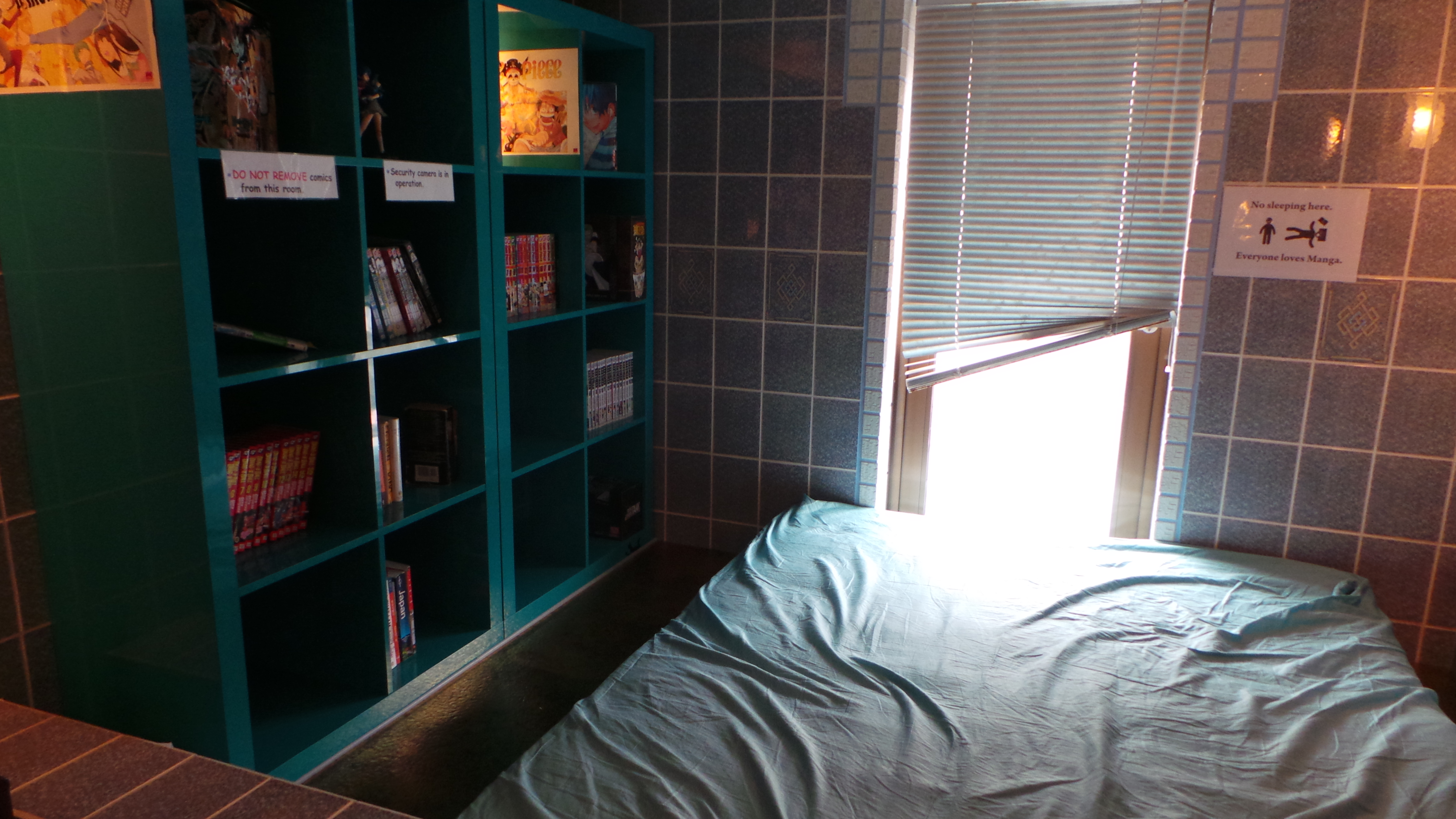
After finding my hostel with somewhat relative ease, I check-in. After a few moments I already decide that I have made the right choice to start my Japan journey here. “We offer free laundry powder,” the receptionist says in perfect English. “We also have a comic room!” he exclaims.
“A what?”
“A comic room,” he repeats. So up the lift we go, and he shows me to the comic room, with its free massage chair, and free manga comics.

Image

It is the official place to chill out and read manga comics, apparently. And it’s all free!

‘Free’ a word I will be hearing a lot of in the next few hours. The hostel has free tea and coffee, free laundry powder, free manga comics, free massage chair, free wireless Internet, free computers with free Internet, free toilet roll, and every Thursday, in a little room that doubles up as a whisky bar, is a free Jazz night, featuring excellent and professional Jazz musicians. Luckily for me, today is Thursday.

After finding my room and my amazing bed, I check out the facilities and find out that all the toilets in this hostel are made by Toshiba. I also find the hostel vending machines: one selling soft drinks and Boss coffee, one selling extremely cheap Asahi beer and 6% cider, and the other selling, ‘FOOD FOOD HOT FOOD 24 SEVEN,’ or so it says.

I relax in the hostel for a while reading one of the ‘free’ guide books. Eventually I team up with an Irish man, who is sharing my hostel room and whom I had previously met, and an American man. After a few beers we decide to head out for some food. The Irish man knows a great ramen shop across town, so off we go.

20140529_201217[1]

He was right, the ramen was amazing.

On the way back to the hostel for the Jazz night, the American spots a sign he had referenced previously that evening. It basically says free beer in exchange for some bar work, so we decide to check it out. I have been in Japan for less than a day and, although paid in beer, I have effectively landed a job.

Here, in this small back alley bar, Japanese men and women come to practice their English. My job is for thirty minutes to sit and talk to a Japanese lady in my native tongue. The moment I sit down a beer is poured for me, and it is on the house. Free beer brings the English speakers in, English conversation brings the Japanese customers in. A clever idea in a country that generally has limited to poor English speaking ability.

After thirty minutes of stop-start, but very enjoyable conversation, the bar owner asks the three of us to switch around. The Irish man gets put with the Japanese lady I had just been talking to; and I sit with a young Japanese man, probably in his mid-twenties. Another beer is poured for me, once again it is free.

This man has excellent English speaking ability, probably better than some of the native English speaking customers I have spoken to during my previous employment. He does not need to be here. I would argue that he is only in this bar to improve his confidence when speaking in English, however, this man has the confidence to come to this back alley bar, on his own; so I am not sure his confidence needs improving too much. Shortly into our thirty minute conversation he mentions a Japanese art and acting form called kabuki. Oddly, a few days ago I had watched an NHK World documentary about the subject, so from that, the conversation flows.

After our two thirty minute sittings, and my two free beers, the three of us head back to the hostel to find that unfortunately the Jazz has finished. However, the whisky is still flowing and the party in the Jazz club is far from over.

20140529_205706[1]

I don’t remember a great deal else from tonight, just that I leave in the early hours in a haze and head back to my room to sleep off almost 48 hours of being awake.

My first day in Japan.