Willow Trees All The Way Down

Today, after almost nineteen weeks of living in mixed dormitories, I’ve finally moved out of hostel accommodation and into an apartment in Minowa, still within Taito Ward. The weather is clear and warm, prompting me to embark on a little exploration. Just a three-minute walk from my new place, I spot a shiny silver plaque near a Shell petrol station and decide to investigate. In the corner of the forecourt, I’m greeted by the sight of a massive weeping willow tree.

famouswillow[1]

The plaque informs me that the tree is named ‘Mikaeri Yanagi,’ translating to ‘looking-back willow tree.’ Its name stems from marking the entrance to Yoshiwara, a licensed red-light district that was relocated to this area in 1657. Legend has it that as people departed Yoshiwara, they would cast a sorrowful glance back at this tree, feeling painful reluctant to leave. Intrigued, I decide to take a little stroll.

Even under the bright daylight, numerous establishments have men in business suits, sporting earpieces, stationed outside, while the neon signs blaze at their brightest. As I stroll along, a grinning man asks, “Sex?” I politely shake my head and continue walking. The road is lined with smaller willow trees. After approximately ten minutes, I realise I’m in a familiar area—it’s the same road where my hostel used to be. It’s rather pleasing to discover that my new apartment is just a ten-minute walk from central Asakusa.

Deciding to make the most of my time, I hop on a train from Tawaramachi Station and make my way to Tokyo Big Sight. A friend has invited me to see his exhibition there today. However, upon arrival, I discover that the event operates on an ‘invite-only’ basis, with attendees exchanging forms for passes. Unfortunately, the only invite I received was verbal.

I decide to approach the information desk regardless and ask, “Can I see the exhibition, please?”
The young receptionist queries, “Do you have an invitation card?”
“Nope,” I reply.
“Well, you need an invitation card to enter,” she explains.
Pausing for a moment, I reach into my wallet and retrieve the business card of the friend who invited me, coincidentally the president of one of the exhibiting companies. Handing her the business card, I truthfully assert, “My friend invited me.”
She scrutinises the card for a while before saying, “Please fill out this form.” With a smile, I hand her the completed form, and in return, she hands me a laminated pass. I’m granted entry to the exhibition, completely free of charge. The power of business cards.

foodexpo2[1]

The exhibition is divided into two main sections. The first part highlights the advantages of health foods, particularly emphasising raw and organic foods, health supplements, enriched agricultural processes, health-beneficial rice cultivation methods, and natural seasonings aimed at enhancing taste.

On the other hand, the second part of the show delves into science and technology. This section showcases breakthrough technologies focused on food quality, packaging reduction methods, food safety and hygiene innovations, allergen test kits, and germ-preventive clothing.

Needless to say, everything is in Japanese, and I’m finding it quite challenging to understand what’s happening. The attendees seem to be either exhibitors or buyers, and they’re all dressed in suits. It’s evident that everyone here has a business card, except for me.

foodexpo[1]

After swinging by my friend’s stand, I briefly consider checking out the other three halls at Tokyo Big Sight. There’s an exhibition on packaging material today, but I have a feeling it might be a tad dull – almost like this post! So, I opt to skip it and make my way back to the train station instead.

After a relaxing break at home, dusk falls, and I venture out again in search of some liveliness. Exploring a new neighbourhood calls for a trusty companion—a can of Suntory whisky highball. Nearby stands a renowned tempura restaurant, crafted from wood and steeped in history. Established in the late 1800s, it’s among the oldest in the area, evidenced by the crowd outside patiently queueing, all with hearty appetites for tempura.

I stroll for about five minutes to reach the nearby Minowa Station. The area exudes a certain liveliness that could potentially make it my new go-to spot, but unfortunately, it seems to lack bars entirely. Among the occasional izakaya, what stands out are the abundance of hair salons, more per capita than any other place I’ve visited. Continuing my wandering, I somehow find myself back amidst the neon-lit streets of Yoshiwara. The traffic lights, like the moon this evening, an appropriate red.

redlights[1]

I swing by Seven Eleven for some food before heading home to eat. After eating, I’m completely at a loss about what to do with my rubbish. Hostels usually have just one bin for bottles and cans and another for everything else. However, my new place has seven different bins, all labelled in Japanese. I take some time to translate each one. One bin indicates it’s for ‘a leaf’, which is perfect timing as I’ve been waiting for an opportunity to dispose of my collection of leaves. Another bin, specifically for cans, confusingly instructs me to, ‘Crush the bottle as much as you can.’ Eventually, I divide the remains of my lunch into separate piles before throwing them into the appropriate bins.

I watch the usual array of Japanese television—a sports event, a sensational news report predicting the biggest typhoon hitting Tokyo this weekend, and even a game show involving pigeons. Eventually, feeling a bit bored with TV, I decide to order fifty personalised business cards. Before calling it a night, I capture a photograph of the red moon and then head to bed.

Pot, Kettle, Snack

Today, I take the Toei Asakusa Line for the first time in my life. Each time the train starts, it sounds as if there is music coming from beneath the carriages. It turns out that the music is the scraping of the train on the tracks; it does sound rather tuneful, though, perhaps this is the intention. It reminds me of an experience I often have on the Tokyo Metro Ginza Line; between Aoyama-itchome and Gaienmae, the train intermittently makes the sound of a dog being strangled.

I change trains at Shinbashi Station and depart in the direction of Yokohama. The journey time is an hour in total, and I arrive in Yokohama at 10 o’clock sharp. Outside the station, it is 21°C, cold in comparison to what I am used to. I search desperately for a Seven Eleven so I can update my maps using the free wireless Internet, but it seems Family Mart has the monopoly here. I eventually find a sketchy map and head toward Yokohama Bay.

yokohama[1]

There is a theme park here, Cosmo World. I contemplate riding the giant Ferris wheel (not pictured) to get a decent view of the area, but I remember that I am alone, so decide to give the solitary capsule ride a miss. I head to Yokohama F.Marinos MM21 Training Centre, the stadium for the football team ‘Yokohama F.Marinos’. Outside the stadium, two of the star players sign autographs for a small queue of fans.

The reason I came to Yokohama today is to visit the Cup Noodles Museum. For no reason that will ever become clear to anyone, a dinosaur stands guard at the entrance to the museum, a Deinonychus. This is the type of dinosaur that the raptors were based on in the movie Jurassic Park. I sneak past the Deinonychus and head to the ticket office. “How many people?” a young woman asks me. It is painstakingly obvious that it is just me.
“One person,” I say, looking around me for answers, “I think,” I add, deadpan. I pay the ¥500, and I am given a rather glossy museum guidebook.

dinocup[1]

Inside the museum, I am given a cardboard hat featuring a cartooned yellow bird, presumably a mascot of sorts. There is every packet of instant ramen and every type of Cup Noodle that has ever been created, arranged in a huge timeline. Just to clarify, this museum is for the brand of cup noodle called ‘Cup Noodle,’ made by Nissin; it is not a museum of cup noodles.

Momofuku Ando invented chicken instant ramen in his shed in 1958. With the overwhelming success of his chicken noodles, he went on to invent the cup noodle in September 1971. Not satisfied with his achievements, at the age of 96, he invented the first ramen that can be consumed in space. There is a wonderful exhibition of his life, a model replica of his famous shed, and loads of crazy noodle-based artwork here too.

cupnoodle[1]

There are noodle workshops where I can make ramen noodles from scratch or create my very own products. I pay an additional ¥300 and join the queue. I wait forty minutes, and eventually, I am given the opportunity to design my very own brand of Cup Noodle. First, I am given a blank Cup Noodle cup and am free to write or draw whatever I want. I graffiti the front of my cup, so where it once said, ‘Cup Noodle Museum,’ it now says, ‘Cook Pass Babtridge.’ I find the available pens to be of slightly poor quality, which spoils the whole experience for me.

Next, I get to choose the broth and toppings. A sign boasts that there are a total of 5,460 flavour combinations. “Gotta mismatch ’em all!” After toppings are added to the noodles, the lid is sealed in place, and the cup is vacuum-packed. After I finish making my lunch, I go to the top floor of the museum and check out the restaurants. No prizes for guessing what is on the menu.

After the museum, I stumble across a rather odd-looking building down some rather old-looking stone steps. It looks like a set from a science fiction movie; perhaps it once was.

bricksandstone[1]

I head into a Yodobashi Camera store. The place is silent; no crowds, no people shouting at me to buy their stuff. It is the complete opposite of the store in Akihabara. On the sixth floor, middle-aged men are queueing to buy AKB48’s 37th Single, ‘Senbatsu Sousenkyo,’ which was released today and will most likely be number one in the Billboard Japan Hot 100 chart by the weekend.

Outside, I grab a can of Suntory Black Boss coffee from a vending machine and make my way back toward the station. On the way, I pass a huge ship that looks amazing. It is actually part of the Yokohama Port Museum, sadly not a museum of fortified wine. The ship was built in 1930 and is used for training exercises. Even though there is a massive ship here, it doesn’t look out of place.

boatyokohama[1]

At the station, I take three different trains, and an hour later, I arrive back in Asakusa. I am actually completely exhausted but can’t sleep. I play video games for a while, then head out at six for a Dal Vindaloo at my favourite Indian restaurant. As I eat, I remind myself that I am in Japan and should maybe try Japanese food once in a while.

After food, I head to the hostel bar to conclude the day. A young Australian woman tells me that I sound like Russell Brand. I strongly disagree.

Internet Cafes, Bullet Trains, Irish Bars

Grilled fish of the day is salmon for the third day in a row. After breakfast, I return to my room and return my room to a state that looks exactly as it did before I arrived, a hotel habit of mine. After that, I check out and head to Popeye Media Cafe to write things up.

The Internet cafe doesn’t only provide Internet access. The following items are offered at no cost (¥0): bath towel, body soap, shampoo, conditioner, hair dryer, hair iron, toothbrush, skin toner, shaving equipment (razor and shaving foam), drinks from three vending machines (offering ‘over 50 kinds of drinks!’), mobile phone charging, two plugs per person (‘you can plug in a device!’), wireless Internet, showers, and a sunbed. All of these amenities are complimentary.

They also have a ¥360 hot food vending machine, but that seems to be the only thing you need to pay for, other than time. The cafe also offers a library of comic books, better known as manga. The amount of manga on offer is insane, with bookshelves spread endlessly in every direction. Where there isn’t a private booth with a computer, there is a bookshelf. The cafe boasts an impressive 179 computers.

internetandmanga[1]

“I paid ¥980 for five hours, the day rate. I’ve actually been here twice before. Those times, I foolishly came during the evening and paid ¥805 for two hours and ¥1330 for three hours.

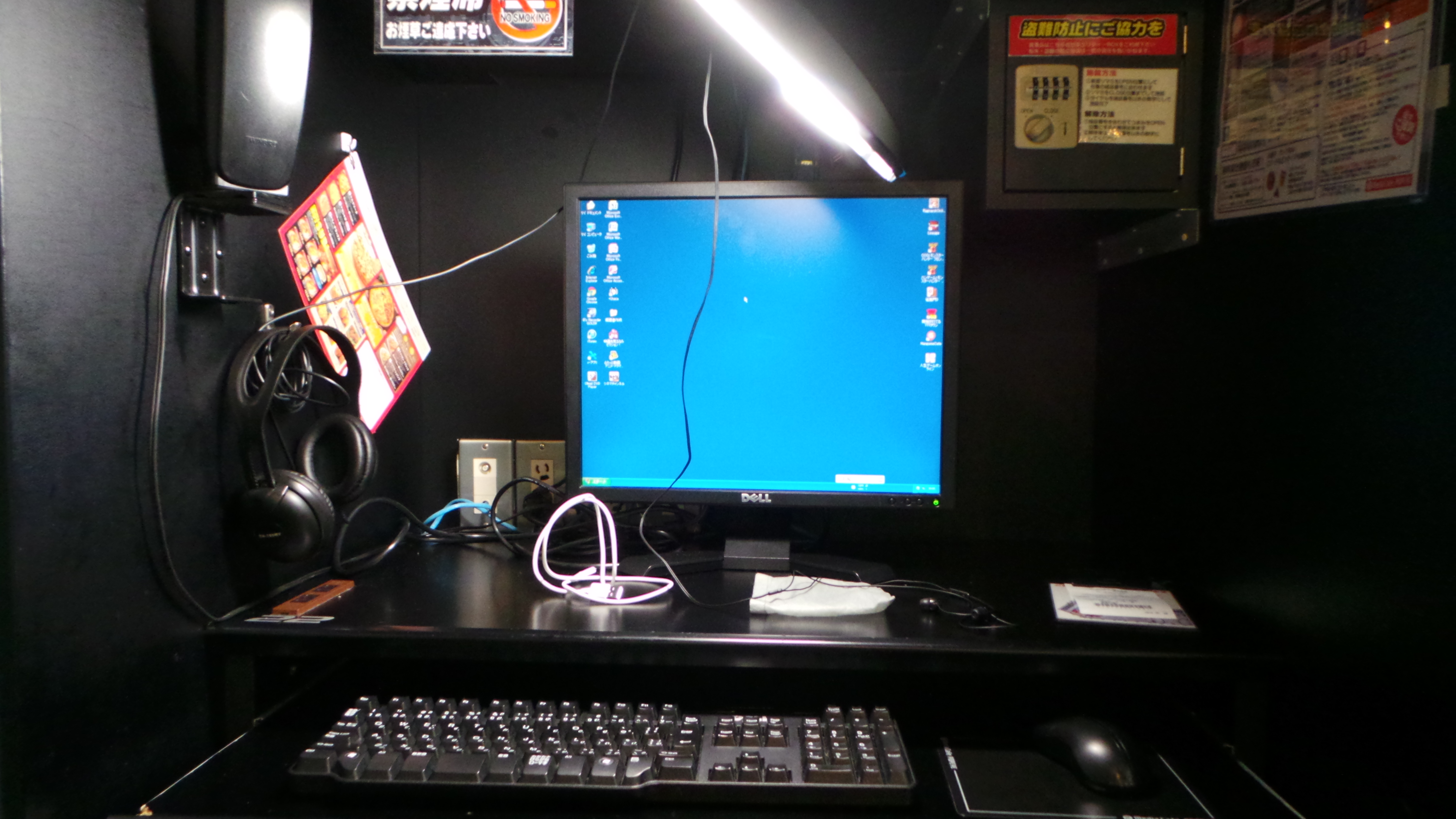
Today, I am assigned booth twenty-two. My computer runs Windows XP, and Google Chrome has already been downloaded. Next to my monitor is a menu for Domino’s Pizza. If I want, I can select a pizza from the menu, and the front desk will order it for me, handle the payment upon its arrival, and deliver it to my desk. The pizza will be added to my ‘check’ and paid for at the end.

I lounge in my reclining chair and write for five hours, all the while sipping on my free drinks. Today, I’m heading to Nagoya and can’t check into my hotel until 2 p.m. Might as well kill time by writing, that’s what I say.

20140804_200337

I like it here; dingy, comfortable chair, feels good. I can see how people can end up spending a whole night here. People actually do just that. Because of the free amenities on offer and the availability of private booths to rent for a special ‘all night’ rate, people actually sleep here. It works out cheaper than a hotel, and you can read all the comic books you desire.

When I’m done, I settle my bill and leave. Outside, the sun is far too bright, especially after sitting in the dark for five hours. At 3 p.m., I take the bullet train to Nagoya. It costs ¥6760 for a 52-minute journey. It’s twice as expensive as the local trains, but they take three times as long, and I can’t deal with that. I reserve a window seat to make use of the ‘free’ plug socket. I realise that this might well be my last ride on the bullet train for a while. It’s quite saddening, actually; the bullet train really is a treat.

I arrive in Nagoya at 4:02 p.m., precisely as stated on my ticket—efficient as always.

nagoyastation[1]

The station exits out into the heart of the city, and a beautiful city it is. Thunder sounds in the distance, threatening rain, with a few flashes of lightning in the sky, but I only have to walk for five minutes. It starts to rain ever so slightly just as I arrive at my hotel. The lift doors open as I approach, “Welcome in,” they say in a robotic female voice.

In my room, I find that I am given loads of free stuff: a comb, toothbrush, toothpaste, slippers to keep, a shower cap, razor, bottled water, cotton buds, tea, coffee, and my own individual wireless network. It feels like I am back at the Internet cafe. The complimentary toothbrush says, “Thank you for using me. Please relax slowly.”

Outside, Nagoya feels right, especially after Osaka and its indecipherable road layouts. Sometimes a place grabs you, giving an instant good feeling; Nagoya has just that. Some might think Nagoya is like everywhere else—tall buildings, concrete, and neon. They would be right. But something about the place, about my initial impression, draws me into the neon of the night.

neonnagoya[1]

I walk around for a good few hours. One of the things I enjoy about visiting a new place is thoroughly exploring the backstreets and restaurants—reconnoitering. I notice small rectangular holes cut into a wall, just the right size for a hand. On the other side of the hole is an anonymous person: a hand wrapped in a white glove, a small tray for exchanging objects or money. Worthless pachinko parlour prizes are discreetly swapped here for cash, with no one seeing anyone else’s face.

It’s 8 p.m. but feels like eleven. I step into an ‘Irish’ bar where American punk is playing, and ‘J Sports 2’ is showing a Japanese baseball game. Quite the Irish experience, indeed. I order half a Guinness and a Glenlivet 12 on the rocks; they each cost ¥600. The Guinness tastes poor at best, far from the standard I am used to from the pubs back home.

I am asked to pay up front, which is unusual here.

irishpub[1]

The music changes to the Libertines. I can’t complain. I consider the instructions on my receipt, ‘enjoy and enjoy and get dead drunk.’ After finishing my drinks, I stand up to leave. As I do, one of the barmen stops me. “It’s our eight-year anniversary. Please choose a colour,” he says.
“Okay …” I ponder the question for a moment. “Green,” I reply. The barman reaches into a box under the desk and pulls out a bright green t-shirt.
“This is free for you,” he tells me as he hands me the t-shirt. Amazing, even more free stuff. I thank him and leave.

Nagoya, the capital of Aichi Prefecture, is distinctly a business-centric hub. Everywhere I look, there are men in white shirts, black trousers, and black shoes—salarymen abound. The horizon is engulfed by a mix of black, white, and neon. Notably, Nagoya’s GDP accounts for 1% of the global economy. Toyota, too, began its journey here, in a town called Toyota, within a city, also named Toyota. It might seem like a kind gesture that the car manufacturer adopted the town’s name, but in reality, the city was initially called Koromo, only changing its name to Toyota in 1959. The town followed suit, renaming itself Toyota. Capitalism in Japan—a fascinating phenomenon.

With the Domino’s Pizza menu from earlier today lingering in my mind, I opt for another unconventional yet healthy choice for a traditional Japanese meal: Italian food. The menu is entirely in Japanese, but the waiter promptly prints off a fresh, crisp, English menu for me. I decide on a tuna pizza, which arrives with a lovely bowl of minestrone soup.

nagoyapizza[1]

As far as pizza goes, this is probably one of the greasiest I’ve ever had. But it’s good. Very good. I pay what seems like a lot and sneak a couple of the ‘free’ complimentary pieces of nutty caramel flapjack—very Italian. The bill comes to ¥2667, and I receive a delightful ¥333 in change.

Back at the hotel I fall asleep watching ‘Back to the Future’.

Prelude to a Quiche

The Kaleidoscope Museum is a unique establishment with a fascinating twist. It proudly exhibits fifty distinct kaleidoscopes, chosen from an expanding collection of approximately 150 pieces. Among these are exceptionally valuable kaleidoscopes crafted by renowned artists from various corners of the world. I discovered that the term ‘kaleidoscope’ originates from Greek roots: ‘kalos‘ meaning ‘beautiful’, ‘eidos‘ meaning ‘form’, and ‘scopes‘ meaning ‘to look at’—a beautiful amalgamation that translates to ‘to look at beautiful forms’.

At the museum, visitors can freely pick up and use kaleidoscopes, ranging from finely crafted ones to those ingeniously made from plastic drink bottles. Among the assortment, my favourite piece doubles as a music box, serenading me with a tune while the images twirl before my eyes. Additionally, there’s a quaint shop within the premises offering kaleidoscopes, kits, and keychains. It’s a fantastic way to kick-start the day. Unfortunately, photography isn’t permitted, and I find myself constantly shadowed by a staff member. However, I manage to sneak a photograph of the inside of a kaleidoscope when she isn’t looking.

kaleide[1]

After leaving the museum, I walk for fifteen minutes, crossing the river to reach Yoboji Temple. I feel it’s only fair that my first temple is a Nichiren Buddhist one—the school of Buddhism I am familiar with. The Temple was built in 1548. It’s actually a rebuilding of two temples that previously occupied the area but had been burnt to the ground two years before.

In 1536, the warrior-monks of Mount Hiei attacked the city, burning down all 21 of the Nichiren Buddhist head temples in Kyoto, along with the entire southern half of the city and a substantial portion of the northern half. This event is known as the Tenmon Persecution. The temple itself is rather quaint.

Yoboji_Temple[1]

Not far from Yoboji Temple, I stumble upon a Paper and Printing Item Shop. The gallery is tiny, and a woman sits at the desk, watching my every move. I’m tempted to pull out my camera and capture a photograph of one of the ornamental fans or origami animals, but to avoid any hassle, I decide against it.

I choose to visit a shrine next. The road I stroll along is lined with various temples, shrines, plenty of walking routes, maps, and bus stops. You can literally shrine-hop by taking the bus if you’re feeling lazy. However, I prefer to walk, and I’m not inclined to see more than one temple and shrine a day. It can be a bit overwhelming to take in too much at once. I ascend about fifty concrete steps to reach Awata-jinga Shrine. Before entering, I participate in the purification ritual.

dragonfountain[1]

This tradition of cleansing is observed before entering a sacred space. The basin here features a water-breathing dragon, which also serves as the source of water for the ritual. I must admit, this is one of the most exquisite purification basins I’ve encountered at a Shinto shrine. I start by washing my left hand, then my right hand, and finally, my mouth.

Awata-jinga Shrine dates back to 794 AD and specialises in preventing illness. However, inside the shrine, someone is noisily using an electric saw, which disrupts the serenity of the moment for me. Nevertheless, the shrine itself is visually stunning. I descend the fifty or so steps and continue along a road lined with traditional Japanese-style houses.

Awata[1]

Downtown Kyoto bustles with tourists, drawn here to explore the shrines, temples, museums, galleries, restaurants, and the renowned souvenir shops the city offers. I spot three cat cafes and a lone dog cafe among the bustling streets. Purchasing a can of cold coffee from a vending machine, I encounter one of those machines that promises a prize if it lands on triple sevens. Miraculously, it does! I win any drink of my choice, and naturally, I opt for a second can of Coffee Boss Rainbow Blend.

It’s mid-afternoon, and feeling a bit peckish, I opt for a light bite to eat. Given the scorching 35°C temperature, I choose to stay in the cool shade of the shopping arcade. A sign catches my eye, indicating a vegan and organic cafe nearby. As I step inside, I’m greeted with a chorus of “Hello” from the other patrons. Taking a seat, I order a set meal featuring a vegan quiche.

vegan1[1]

My food promptly arrives—a serving of vegan quiche, accompanied by a delightful salad dressed in a delicious vinaigrette, a ramekin of squash, chickpeas, and peppers. Alongside it comes a bowl of leek, cabbage, and mushroom soup, complemented by glasses of cold water and cold green tea. The entire meal comes to ¥918. If I weren’t already full, I’d happily indulge in another slice of quiche—it was that delicious.

Outside the cafe, a guy on a bicycle whizzes past, blaring an air horn from the spot where a bell would typically be. The shopping arcade strictly prohibits vehicles, including bicycles. A bit further along, I encounter a television crew filming people and asking them why they enjoy eating crêpes. While tempted to participate, I realise I’m not particularly fond of eating crêpes.

crepefilming[1]

Back at the hostel, I settle on the roof with a can of Suntory whisky highball, delving into my fifth Haruki Murakami novel since arriving here sixty-two days ago. The air has cooled, and the refreshing breeze is a welcome relief. Japan has been grappling with a severe heatwave for the past week, and it seems it will persist right through until the weekend.

I read until 8 p.m. before heading to a nearby music shop for a free gig. A stage has been set up next to the ukuleles. The band performing is a two-piece folk band. Their sound is somewhat average. Nonetheless, it’s pleasant to experience some live music, even though the venue is rather unusual.

My night winds down at the hostel bar, talking to random people with their random ideas.

Cycling into Locals

‘Cycling into Locals’ is the name of today’s bicycle tour. The name amuses me. I head just outside the hostel to a bicycle rental shop. It costs me ¥300 to rent a bike for eight hours, dirt cheap. The minimum fare for a train is ¥170, even if I take just one stop, the lovely purple bicycle I’ve chosen today costs me less than a return train ticket. I will certainly be taking advantage of this service again in future.

There are seven hostel guests taking part in the tour, a TV crew of four people, and staff members Gomez and Keina from the hostel. We meet up at 10 a.m. for a briefing, before finally departing some ten minutes later. The thirteen of us take to our bicycles, and we begin to head in the direction of the Sumida River. Here we see Tokyo Skytree from a position where you can see a second Skytree in the reflection of the Asahi building. Apparently, people come to this spot all the time to take this famous shot.

bikes[5]

Next, we cycle over the river to Ushijima Shrine. Here we do a cleansing ritual and a prayer ritual before being invited into the main hall by the priest. He tells us about the history of the shrine and then hits a massive drum a few times. Outside the shrine there is a statue of a cow. The cow statue is said to have magical healing properties. I touch my throat, then I touch the cow’s throat. My sore throat will now heal quicker thanks to the magic statue. Cowabunga!

We stop off at a Japanese tea house for a traditional snack. For ¥300 we are served sweet bean paste wrapped in a salt-pickled cherry blossom leaf, and a cup of green tea. The leaves have been picked from the banks of the Sumida River. After being filmed eating some leaves, it is time to leave.

greenteas[6]

Hatonomachi Dori Shotengai is a historical street featuring very local shopping and various small art museums and craft houses. We visit a shop where a woman has spent the last fifty years hand making small model geisha’s, which she sells for a small fortune. Next we enter a small shop selling badminton rackets decorated with kabuki theatre performers. We are given the history of Badminton. It turns out it all began in Japan as a game called Hanetsuki, before arriving in England and becoming the sport that it is known as today.

We swing by Kira-Kira Tachibana Street. There is a local street market here, surrounded by really old houses and some interesting side streets. I see a stall selling a watermelon for ¥2200. Next our tour takes us to Mukojima-Hyakkaen Gardens, the entrance fee is ¥150. We go to a traditional cafe and eat ¥500 rice balls with a sour plum topping served with a really tasty miso soup. We are then served a complimentary glass of a bright yellow liquid. It smells like flowers and tastes very sweet.

Mukojima[1]

The cameras stop rolling and we take a short break. We are free to explore the gardens on our own for thirty minutes. I spend fifteen of the minutes trying to photograph a dragonfly in flight. We regroup and return to our bicycles. The final stop on our tour is Tokyo Skytree. Here we are each individually interviewed about the tour. We are given the option to stay and explore Tokyo Skytree Town on our own, or head back to the hostel. I decide to head back after an exhausting six hours of cycling into locals.

Back at the hostel Björk is playing through the speakers. I arrange to meet Conor, a friend from England I met almost two weeks ago. He’s back in Tokyo for two nights after travelling around Japan and South Korea. We meet at my hostel and go out in search for some food. We find a vending machine restaurant. I order hot soba noodles in a soy based broth. The noodles are topped with tempura vegetables, seaweed, and an egg. It costs just ¥480.

Vendingfood[1]

After food, we wander past a lit up Senso-ji, before heading for a drink. On the way, we see a kabuki theatre. A show has just finished and there are about ten people standing outside in full costume and makeup. I decide that I will come back here in a few days time to watch a show. After a drink I say goodbye to Conor and we head our separate ways to our hostels. At the hostel I go straight to my room to sleep off a very busy day of cycling and sightseeing.