There Will Be Flood

Typhoon Phanfone is making its miserable way toward Tokyo and is expected to arrive this evening. I can’t wait. It’s already raining today, and judging by the state of the pavement outside, it seems like it has been raining all night. To avoid getting soaked, I walk for one minute to reach the nearest station and take the somewhat aptly named Tsukuba Express Line (pronounced ‘scuba’), before transferring to the Yamanote Line at Akihabara Station.

My destination today is Meiji Shrine. The train ride takes thirty-one minutes to reach Harajuku Station. While on the train, the telescreen has taken a break from displaying the usual dull advertisements and, instead, is showing the current position of the looming typhoon.

I leave the station and make my way through the pouring rain towards Meiji Shrine.

meijifest[1]

There’s a weird festival happening called Ningyo Kanshasai, centred around setting fire to broken old toys. This unique event is a way to express gratitude to dolls and is held annually at Meiji Shrine. It originated in 1989 and this year marks its 26th anniversary. In Japan, there’s a belief that a fragment of your soul resides within your possessions. Consequently, the practice of giving used gifts isn’t very common here, as it’s believed that a part of your essence accompanies the second-hand object.

Today, this Shinto exorcism ceremony serves as a method to purify the doll, releasing the part of your soul believed to be encapsulated within the inanimate object—a means to attain a liberated spirit for a healthy mind. For a nominal fee of ¥3000, you can include your dolls in the extensive collection along with others, granting your soul its liberation. The spirit of the doll is elevated through the Haraikiyome (purification) ritual performed by the priest, involving a cleansing ceremony known as Oharai conducted on the dolls.

thanksdolls2[1]

Last year, over 7,000 people donated a staggering 44,000 dolls for purification. The assortment of dolls is incredibly diverse, encompassing Japanese traditional dolls, Western dolls, and popular stuffed animals this year. The rain has somewhat subdued the turnout, but there’s still a plentiful display of dolls. Inside the main hall, two women in splendid costumes are conducting a captivating and beautiful ritual. According to the official website, this solemn festival is highly recommended as a must-see.

I depart just before the distribution of the ‘sacred sake.’ Despite the shelter provided by the numerous trees within Meiji Shrine, I am still soaked by the storm outside. Determined to seek refuge, I make my way across the road to Yoyogi Park, only to discover yet another event taking place.

Hokkai[1]

This weekend’s event is ‘The Road of Hokkai-Food,’ a celebration dedicated to Hokkaido cuisine. Interestingly, like the previous festival, this event also commemorates its 26th year, despite appearing unrelated. Here, there are almost ninety stalls selling a variety of snacks, inexpensive meals, trinkets, cheeses, and beer. The tightly packed stalls, accompanied by the pouring rain and the tantalising aroma of food, create an energetic atmosphere akin to a lively music event.

Some of the foods on offer include, Ishikari-nabe (salmon, stewed vegetables, and tofu in a miso broth), Yakitori (grilled chicken on a stick), various types of seafood, and plenty of Sapporo beer. The only thing missing is the people; it would be fair to say the event is a complete washout. There’s a woman dressed in a smart white suit giving a talk on the stage for an event advertised as ‘Sapporo Presents …’; however, she speaks only in Japanese, and my language skills are still lacking.

hokkaifoods[1]

I leave the festival and head over to Shibuya. Today marks the final day of an art exhibition I’ve been planning to visit, so while I’m in the area, I decide to drop by Bunkamura—a venue encompassing a concert hall, theatre, and museum. ‘Visual Deception II: Into the Future’ is a trick art exhibition focusing on shadows, silhouettes, mirror images, optical illusions, and anamorphosis. Admission costs ¥1500, providing a nice respite from the weather. The display of peculiar artwork can only be described as mind-boggling. As usual, photography is not permitted.

After the exhibition, I opt to head home before potential train cancellations. At my hostel, preventive measures have already been taken to tackle potential flooding: staff members cleaned out the drains and placed a row of bricks in front of the steps where flooding occurred last month.

Back at the hostel, I order Glastonbury Festival tickets and spend some time writing before heading out for a few drinks at a nearby bar. The rain persists. As I eventually leave the bar, I find the pavement outside flooded with rushing pools of water.

puddles2[1]

The forecast predicts the rain to persist throughout the night, intensifying at 3 a.m. as Typhoon Phanfone hits Tokyo. I doubt I’ll witness the full impact of the storm; I’ll likely be asleep by then, unless the howling wind wakes me up amidst the chaos outside.

A Tale of Sorrow and Sadness

I spend my morning shaking off a karaoke gin hangover, arguably the worst kind. At 1 p.m., Dagmar and I take the train to Ginza to meet our friend Aram. The plan is a visit to the Vanilla Gallery; the number one gallery in Tokyo for eroticism, fetishism, and sadism.

Despite having visited the Vanilla Gallery before, it remains difficult to locate. We get a little lost but eventually find it hidden away on an inconspicuous street. This month, the theme showcases artwork that tells the tale of time and sorrow—’An exhibit of illustrated stories and dolls pertaining to madness and sadness.’ The entry fee is a pleasing ¥500.

dertilgung[1]

The exhibition is called Der Tilgung. Dagmar tells me that this is German for ‘The Repayment.’ Nowhere else in Tokyo can you experience such a vortex of phenomenal imagination.

Room-A features a collection of artwork and imagery from MoriKaoru. I’m surprised to find that most of the paintings have sold out. The work focuses on desolate women surrounded by monsters depicted as men. There’s an uneasy emphasis on slavery and torture. One exhibit displays iron shackles laid to rest on a leather sofa. Another portrays a drawing of a young woman bound at the wrists, sitting in a cell surrounded by decapitated limbs, while a male figure with a menacing grin watches her through the bars.

Room-B is slightly less horrific but disturbing in other ways. Suna-mura Hiroaki is the artist. The display features half-naked corpses of women—dolls. A child lies still in a coffin, and two dolls hang from chains with beautiful flowers blossoming from their dead faces. A doll resembling a nurse has her chest cut open, held by wire, and inside reside many small, menacing demons. Trees grow from faces, and dolls scream in anguish. Some dolls are made from the skulls of unnamed animals. Despite the theme, the craftsmanship here is incredible. My favourite piece is a naked woman, half her body covered by flesh, the other completely skeletal; half her face a picture of harrowing decay.

vanilla5[1]

Most of the exhibits are for sale, with prices ranging from ¥50,000 to ¥300,000 per piece. Haunting music floods the gallery. Sadly, the Vanilla Gallery forbids photography, so my only photographs are from the entrance and the flyer. I’ll probably have nightmares for a week thanks to what I’ve seen here. We stay for maybe twenty minutes before heading to the station.

Back at the hostel, there’s yet another party. Tonight’s theme is a ‘Sake Fair.’ Here, we can witness the process of making Japanese sake, sample ‘free’ sake, and indulge in the many complimentary snacks available. A PowerPoint presentation is set up on a projector—classic. The concept behind the free sake is to promote a brewery tour scheduled for tomorrow. For tonight, there are five different bottles of sake for hostel guests to try.

sakefair[1]

Suginishiki Yamahai Junmai is my favourite; it takes twice as long to make as your regular sake and is full-bodied with plenty of flavour. Shosetsu Daiginjo is also very nice—light, mild, and clear, with a banana scent and a subtle hint of fruit. I don’t usually like sake, but the drinks on offer here are actually very nice, perhaps a bit more expensive than I’m used to.

I decide to sign up for the tour tomorrow. It will be interesting to learn about the process, and I’m pleased to find out that the tour takes place at a brewery at the base of Mount Hakone. The tour costs ¥8500, including transportation, and it’s a great opportunity for me to discover more about this traditional Japanese drink.

Rock, Shock and Tooth Aching Perils

Today is D-Day. Dentist Day. I wake up at 5 a.m. with pain in the whole left side of my mouth, all my teeth are throbbing with pain. It is excruciating. It is deafening. I wait until 10 a.m., before my Japanese speaking friend books me an appointment with a nearby dentist. I eat something out of necessity, scrambled eggs; before heading back to the hostel to play the waiting game.

At around half twelve, the pain feels like an earthquake. The building begins to shake. It isn’t pain, though; a magnitude 5.6 earthquake has struck Ibaraki, some 100 kilometres northeast of Asakusa. After one minute, the shaking stops. I head into the hostel lounge, and everyone is just carrying on as normal, as if nothing has happened. How strange.

I kill time reading about earthquakes before the time arrives to visit the dentist. I must admit, I am a little nervous. My friend is here though, so I have nothing to worry about as far as speaking Japanese is concerned. We head to the nearby Rox building; a massive commercial shopping complex containing many different shops, a gymnasium, a public bath, and oddly, a dental clinic.

rox[1]

We head up to the fifth floor to the clinic and fill out all the necessary paperwork at the reception. How often do I brush my teeth? How long have I been in pain? The usual questions. My name is eventually called at five to three, and I head into the surgery. Rather than separate rooms, the dentists work in an open space divided by booths separated by curtains. As I walk to my booth, the other dentists greet me with a cheery “Hello.” The atmosphere is somewhat comforting.

My booth is immaculately clean, shiny, and very white. I take a seat in the dentist chair, which has a television screen showing news footage of the earlier earthquake. A cloth is placed over my eyes while my teeth are carefully examined one by one. Next, I am asked to go for an X-ray. The dentist says that I am the tallest person to ever use the X-ray machine; it is clearly not designed for somebody of my height. I actually have to squat slightly to use it. As the X-ray machine scans my teeth, ‘Für Elise’ by Beethoven plays.

A tablet screen is placed in front of me showing the X-ray results. The dentist goes off somewhere, so I decide to count my teeth while I wait: an even thirty-two.

dentist[1]

When the dentist returns, he examines my X-ray before putting a camera in my mouth to take photographs of the suspect area. The problem lies in my upper left third molar—a cavity. The news is replaced with the photograph he has just taken. The dentist is surprised by the state of my teeth; he says it is very rare to see such ‘Virgin teeth,’ as he puts it. My teeth are immaculate and untouched; I have never had any type of dental surgery before—no fillings, no tooth removals, and no severed nerves. He says that usually in Japan, a problem like the one I have would be solved by killing the nerve so the pain stops permanently. But because I have all of my nerves intact, he gives me the option to have the cavity cleaned, which he assures me has an 85% chance of success. If it doesn’t solve the problem, then I can always come back again and have my nerve severed.

I agree to the treatment. He places a numbing agent in the affected area before administering a local anæsthetic. Three seconds after the injection, I say to my friend, “I don’t feel so good.” Actually, my entire body begins to tingle and turn numb. I go into anaphylactic shock. My body starts to shake. Eyes open, mind elsewhere. My gaze remains fixed, staring off into some distant abyss.

Darkness envelops me, spiriting me away to a realm beyond comprehension. I traverse a dimension so profound, a depth within my own mind or an alternative world more tangible than our reality. Here, an overwhelming sensation engulfs me, a nameless horror that devours my very essence. Describing the depth of my emotions during this time eludes words; I exist, yet not as myself; and the memory evaporates the instant I return.

I blink, gripped by fear. As my eyes reopen, two figures shrouded in blue masks materialise before me—one male, one female. A woman, unfamiliar and indistinct, clasps my hand, murmuring words I cannot grasp. Panic seizes me. I’m adrift in an abyss of unknowing, unaware of my surroundings or even my own identity. Desperation claws at me; tears threaten to spill. Never before have I felt such terror. Who are these strangers? A momentary void swallows my memory. Was I just born anew? Did I perish? I attempt speech, but words elude me. Tremors wrack my body, not violently, but quivering with sheer nervousness and dread. Slowly, like a fog lifting, memories trickle back, accompanied by my friend’s urgent directive to “Breathe deeply.” Gradually, I emerge from the haze, shaken, tearful, and engulfed by sheer panic.

Eventually, things calm down. My friend explains what happened—about my vacant stare and trembling. My knee hurts; I must have bumped it against the machine. The dentist, with my friend translating, clarifies that I received only a half dose of local anæsthetic. I had previously told my friend that I hadn’t taken any medication for over ten years, a detail I fortunately mentioned to her. She relayed this information to the dentist before the injection; had she not, the full dosage of anæsthesia could have been lethal. She might have just saved my life. I could have remained in that other place forever; eyes open, mind elsewhere.

The dentist reassures me that I will be okay, all smiles and jokes now. I relax but can’t shake images from my head. This moment will be etched in my memory forever. The procedure is eventually finished, the cavity cleaned, and I am free to go and pay. The whole treatment and two packets of painkillers cost me a total of ¥7890. Drowsy, with my knee hurting and my mind drifting, I head back to the hostel to sleep.

Parasite at the Museum

Today is a public holiday dedicated to respecting the elderly and celebrating longevity. In Japan, there are fifteen different public holidays annually, and due to the implementation of the ‘Happy Monday System,’ several holidays have been shifted to Mondays to grant people a three-day weekend. Unfortunately, my toothache has plunged me into perpetual agony today. Regrettably, all the dentists are on holiday because of the celebration honouring the elderly. Not wishing to bare one’s teeth, I struggle on in pain.

My first stop today is Shibuya Station. With most of the country off work today, the area is overcrowded and annoying. I grab a bottle of drink that claims to contain one thousand lemons (which I very much doubt) before walking in the sunshine toward Harajuku, in search of some illustrious graffiti. On the way, I pass Yoyogi Park; here, there are swarms of teenage girls all standing around waiting for some sort of summer concert to start. I decide to pass on the concert. In Harajuku, it is just as crowded. I wander around side streets but find the graffiti to be somewhat lacklustre. I take just one photograph before walking back to Harajuku Station.

haragraf[1]

I take the Yamanote Line to Meguro, which translates to mean ‘black eyes’. After eventually finding a map, I discover that my destination isn’t marked. So, I search for a Seven Eleven and use their free wireless Internet. I then head to the Meguro Parasitological Museum; the only parasite museum in the world, I might add. I am surprised to find it open on a public holiday, and I am even more surprised to find that the entry is free.

If you are looking for a cheap destination for a romantic afternoon, then the Meguro Parasitological Museum is for you. Here, there are jars of parasites, magnifying glasses for that closer look, and an interactive screen displaying the life cycle of a parasite. There is even a small souvenir shop selling shirts depicting parasitological dissections. Finally, a gift shop selling something worth buying.

parasites[1]

With my appetite faded, I leave the museum and decide to skip lunch. I take the Meguro Line six stops to Ookayama Station. Each time the train starts up, it sounds like a jet engine. I change at Ookayama to the Tokyu Oimachi Line; this train also sounds like it is about to take off as it leaves the station. Eventually, I land in Jiyugaoka.

Jiyugaoka is often voted as one of the best places to live in Tokyo. The streets here are a cluster of expensive clothes shops and shops selling expensive cakes and sweets. Some stores have signs outside that say, ‘Women only.’ The roads here are even pedestrianised during the daytime, providing extra space for the many crowds. My intrigue takes me to a place called ‘Sweets Forest.’

sweetsforest[1]

Sweets Forest is an indoor theme park filled with cake shops and overpriced candies. For no apparent reason, traditional Irish folk music is playing inside. However, the thought of eating sweets brings more pain to my teeth, so I decide it’s time to leave. I take the Tokyu Toyoko Line to Shibuya, transferring to the Ginza Line before heading home.

Back at the hostel, everything is getting on my nerves. People keep asking each other the same questions, speaking in languages that could be English, but I can’t be sure. There’s too much noise, and I can’t seem to focus my mind. I try to write, but the pain in my teeth and jaw keeps distracting me. Tomorrow, I’m faced with the daunting task of visiting a Japanese dentist. A friend jokes about how dentists here continue to administer pain even if you scream and raise your hand to signal them to stop, or how instead of fixing your problem, they just remove your teeth.

With my appetence faded and my mind consumed by pain, I try to get an early night. I head off to bed at 9 p.m.; although sleep, I expect, will be somewhat limited. Not a very happy Monday at all.

Eat Fish or Die Tryin’

I meet my friend Dagmar for breakfast at ten. At breakfast, I drink away my hangover with a bottle of a tasteless drink called ‘Delicious Water’ before heading out alone for the train. Someone told me yesterday that beneath the banks and office buildings between Mitsukoshimae Station and Otemachi Station, hidden deep underground, the Japanese government grows secret rice.

Somewhere along the Ginza Line, my train just powers down. All the lights extinguish, plunging the carriage into an abyss of darkness. The train drifts aimlessly towards Ueno Station and finally grinds to a haunting halt. The silence thickens, shrouding the dead train in an eerie stillness, an unsettling void that grips the carriage. Everyone remains silent, messing with their mobile phones, despite the obvious sorrow of the situation. It is all very worrying. About five minutes pass, and there is an announcement in Japanese, then nothing. A further five minutes, and the train starts up like nothing ever happened.

As I exit Mitsukoshimae Station, I accidentally wander into an adjacent department store.

maskmaskmask[1]

Inside the department store, there is a Mask Art Museum, and it is free. A nice but rather small exhibition. The store housing the museum is incredibly upmarket. I ask politely if I am allowed to take photographs, and lucky for me, it is fine. The exhibition actually ends today. Rather fittingly, all of the mannequins in this department store are wearing masks.

One thing I have noticed in Japan are the many strange museums. I believe I have previously mentioned the famous World Bags and Luggage Museum. A few other favourites of mine that I am yet to visit are the Gas Science Museum, the National Leprosy Museum, and the Parasite Museum.

I wander around for a while looking for the entrance to the secret underground rice bunker. It takes a while but I eventually find a huge office building that has every window on one side completely covered in plants. On the other side of the building I scare away an eagle pecking at a gold statue of Prometheus. This must be the place, I think to myself. It turns out it is.

prometheus[1]

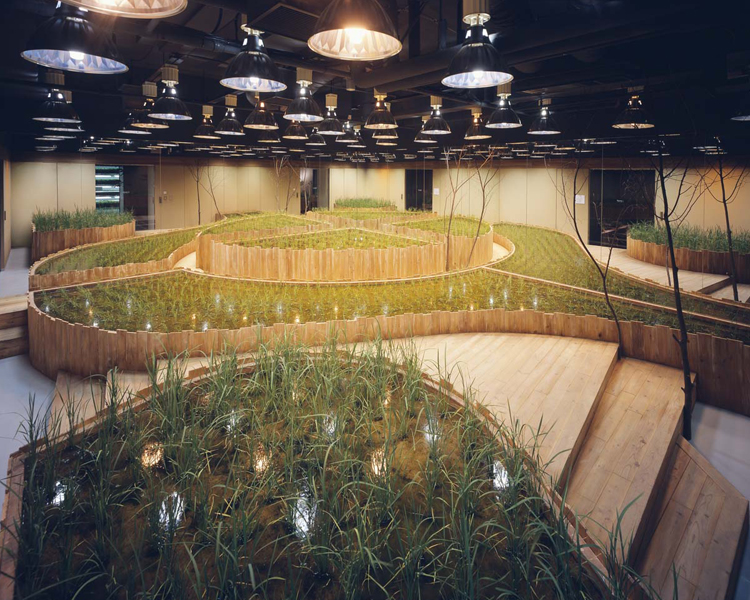
Deeply tucked away in the second basement level of a huge skyscraper, they grow rice. I am not entirely sure why they grow rice, but people are free to come and see it. Huge natural light shines from above. Rice grows. From what I was told, this area stretches under the whole business district, although it doesn’t. The size of the area was heavily exaggerated to me. The rice isn’t really that much of a secret; it’s not too well advertised, but no one is trying to hide the fact that it grows here either. In fact, I think it’s encouraged for people to come here and learn about rice cultivation. So, another urban myth shattered then.

ricetomeetyou

After looking at rice for a few minutes, I decide to walk to the Imperial Palace. I’m surprised by how close the stations are to each other in this area. Tokyo, Kanda, Shinbashi, and Nihonbashi Stations are literally within a five-minute walk of each other. Outside the Imperial Palace, about thirty elderly Japanese people are sitting and painting.

The Imperial Palace is home to Emperor Akihito, the last remaining monarch in the world to go by the name of Emperor. There isn’t really much else to see at the palace. The grass outside is cut immaculately, and the water fountains spray jets of water about two metres into the air. I notice there is a great view of Tokyo Station from the Palace car park, though. I wander to the nearby Ginza Station and take the train back to Asakusa.

tokyostation[1]

I decide to inspect a potential apartment. Small apartments in Japan are ironically referred to as “mansions.” These one-room coffin apartments offer little to no space and an equal amount of comfort. Another phenomenon in Japan is the grouping of shops, whole areas dedicated to selling one type of product. The area where the apartment is housed is completely surrounded by funeral shops. One street has eight shops in a row, all selling tombstones. I decide the area doesn’t quite feel right. Chimes sound from nowhere as I head back to the hostel, chiming five times signalling 5 p.m.

At 6 p.m., Richard, Luis, Remi, and I head to a nearby restaurant that serves fugu. Jokes are made about toxicity, tetrodotoxin, paralysis, and death. In reality, fugu poison is one-thousand two-hundred times stronger than cyanide; this is no laughing matter. The most poisonous part of the fish is the liver. Outside the restaurant, we watch our dinner for a while, graciously swimming around in a tank. In a moment, this beautiful blowfish will be killed on our behalf; we sure hope it doesn’t have a taste for revenge.

blowfishing[1]

There was a time when a fugu chef would have to pass a training course of ten years before being given certification to prepare fugu. These laws changed about three years ago, and now the rules state just a two or three-year course is required. We really hope that our chef today is of the older generation.

We take a seat in a tatami room. We order fresh blowfish sashimi. We also order diced blowfish sashimi just so I can make a pun about how we diced with death. Oddly, one of the options on the menu is hot sake with dried blowfish fin floating in the liquid. “We only serve the finest live domestic tiger blowfish,” says the menu. Served live? I certainly hope not. We wait anxiously for our food to arrive.

The poisonous fish is served in elegantly arranged translucent slices; it doesn’t look very threatening.

blowfish1[1]

A taste for revenge would be an overstatement. A taste of anything would be welcome. The food is the freshest fish I have ever tasted, of course; it has been dead just minutes. The food is also the least tasty fish I have ever had. It has no flavour at all; perhaps there is a subtle hint of death. I’m just glad we went to a cheap non-certified restaurant. It costs us just ¥5480 between the four of us for two dishes and four drinks.

I tried the sacred fugu of Japan and all I got was this lousy anecdote.