Once again it is very hot. The hottest day so far this year in Tokyo. A stroll along the Sumida River and into the city of Sumida signals the start of my Saturday. I start by heading towards the tallest tower in the world. Eventually I arrive at the base of Tokyo Skytree; here is an area known as Tokyo Skytree Town. It is full of souvenir shops and restaurants. There are plenty of tourists here today; 9 days ago was the two year anniversary of Skytree’s completion, and it seems the celebrations are still going on.
My initial plan today was to head to the top of Skytree and take some incredible photographs of Tokyo from the observation deck, but instead I see a sign for the Sumida Penguin Aquarium and my interest is piqued. I walk up to the ticket booth. “How many people?” I am asked by the lady at the counter. I make a deliberate point of looking over my own shoulder and around into the deserted space behind me, before indicting that it will be just one. I hand over my ¥2050 and enter the aquarium.
The first level of the aquarium is dedicated to living aquascapes, a word I heard for the first time yesterday, and will no doubt hear again tomorrow. The aquarium is quite small but does have some interesting things to see, most notable are the jellyfish and sharks. The highlight for me, however, is the aptly named ‘Animals Enjoying Water’ section. This is home to fur seals and loads of penguins. They seem to be enjoying the water.
![Penguin[1]](https://japanising.com/wp-content/uploads/2014/05/penguin1.jpg)
After leaving the aquarium and deciding that half an hour is too long a time to be queueing for Skytree, I decide to check out Sumida Park. I don’t make it to the park though, as along the way I am randomly stopped by a Japanese lady who hands me a flyer and says, “Would you like to come and see our Temple?” I accept her offer and she guides me across the road to the Temple.
The Temple is home to a branch of Nichiren Buddhism called, Shoshu Buddhism. I am invited to sit down in front of a beautiful alter, but unfortunately I’m not allowed to take photographs inside the Temple. Three more people join us, one man and two women. One of the women speaks very good English, and so we sit and she tells me the story and history of how this branch of Buddhism began and what it means.
Next I am given prayer beads to wear across my hands and invited to chant with them. “Nam-Myoho-Renge-Kyo,” repeat three times. After we chant, I sit for a while longer discussing their beliefs. They ask me if I would come to their Buddhist ceremony in eight days time at the Temple. I accept their invitation and we chant one more time before leaving the temple and saying our goodbyes.
On the way back to the hostel I see a blindfolded street juggler. He manages six balls at once and gets quite the applause from the large crowd that has gathered around. Then I see a man on stilts dressed as a dragon, but with a white painted face and a terrifying smile. Finally I see a woman in a bright red suit and matching hat, she is wandering around one of the many markets playing the accordion and being photographed by just about everyone.
My intrigue leads me to the sound of a beating drum, and I soon arrive at a random pole lantern festival in the middle of a crowded street. The performers here balance massive 12 metre tall lantern poles on their palms, foreheads and backs; while other participants hit drums, play flutes and get the audience to clap and sing chants of encouragement. These lanterns are usually lit with candles, but it is the middle of the day, so perhaps this is just a practice for a performance later tonight.
![matsuri1[1]](https://japanising.com/wp-content/uploads/2014/05/matsuri11.jpg)
After the festival has finished and the performers have left, I head back to the hostel for a beer and a short rest.
A few beers later and I need food. I think about risking the hot food vending machine, but it only sells ‘Casual Hot Foods.’ Instead I head back out into the burning hot streets of Asakusa, and take the ten minute walk to a one Michelin starred sushi restaurant. It is closed. I think about waiting for two hours for it to open, instead, I decide that I will come back here another day, and to see what else is in this area.
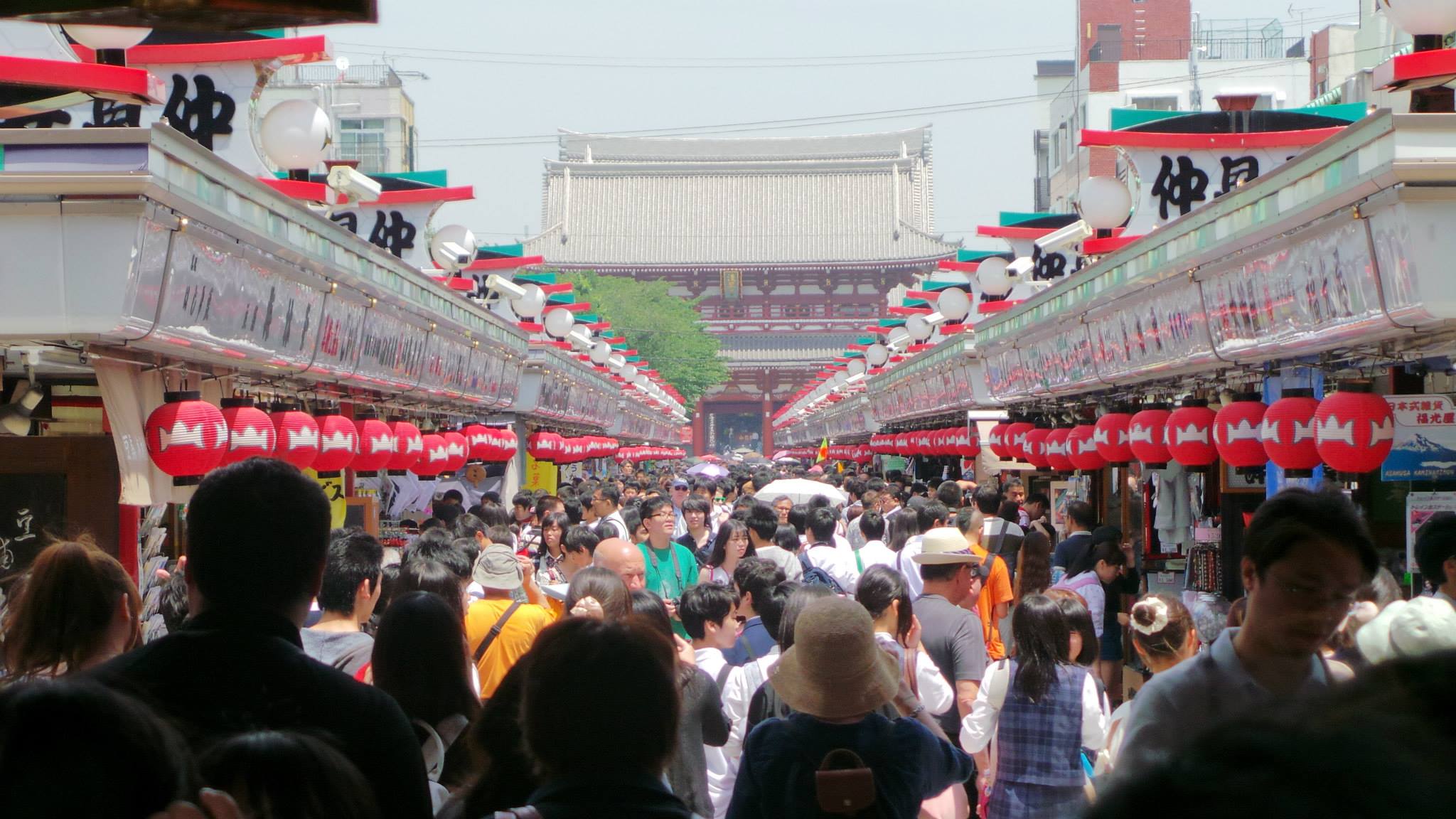
The next street from the restaurant features a market selling plants and shrubberies. The market is huge and spans far off into the distance. There are even people in uniforms specifically here to direct the traffic. There are not many restaurants though, so I head back towards the middle of Asakusa, and I am so glad that I did.
![crazymime[1]](https://japanising.com/wp-content/uploads/2014/05/crazymime1.jpg)
I get to see this guy. A random mime promoting Pantomime Week here in Tokyo. His show is in Japanese, but is easy to understand as it is mostly body language. I stay and watch the whole fifteen minute show and find it hilariously funny. After he is done, I throw some money in his hat before heading off to finally get food.
I decide on a little Italian restaurant. I know it isn’t Japanese food and I’m not in Rome, but I am longing for something familiar after a crazy few days. I decide on a tuna, eggplant, and oregano pizza. It costs ¥1450, and tastes somewhat average. The restaurant also sells small bottles of Asahi for ¥600, which is far too expensive. After food I head back to the hostel to sleep off a very busy day.
![restaurants[1]](https://japanising.com/wp-content/uploads/2014/05/restaurants1.jpg)
![tenpura[1]](https://japanising.com/wp-content/uploads/2014/05/tenpura1.jpg)
 Japanising.com
You must be logged in to post a comment.