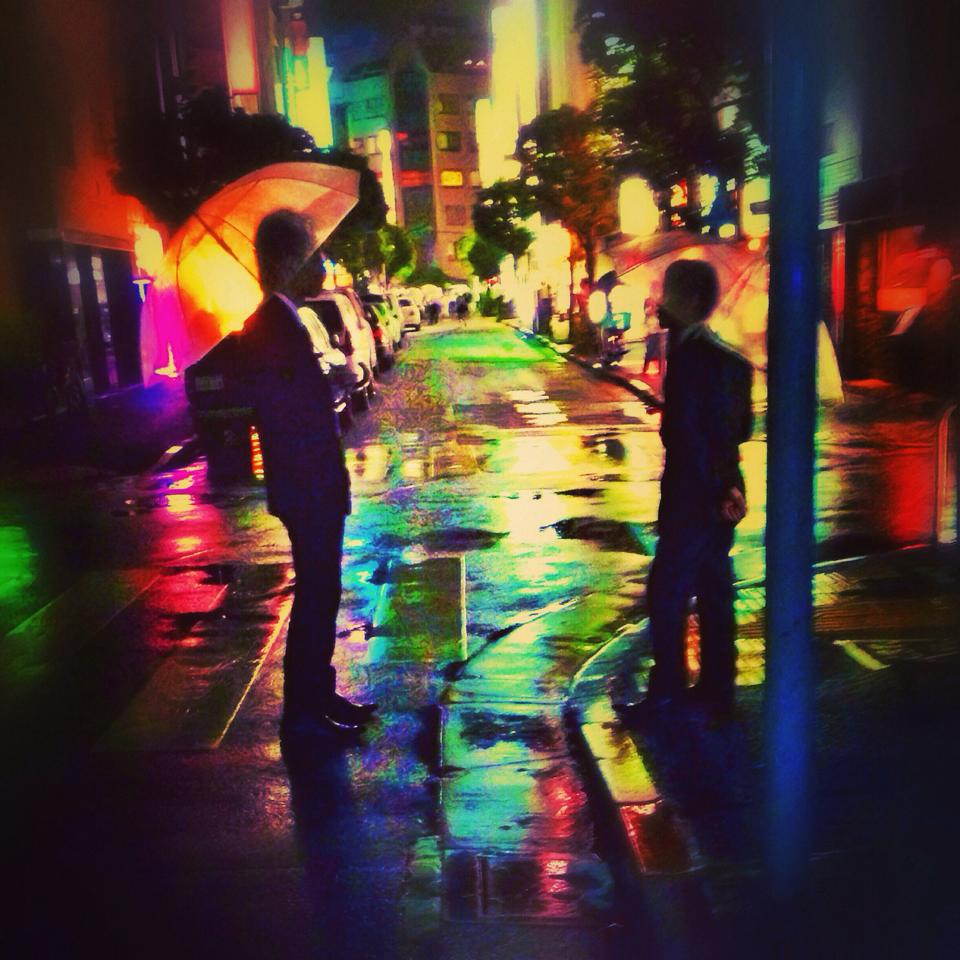
There Will Be Flood

Typhoon Phanfone is making its miserable way toward Tokyo and is expected to arrive this evening. I can’t wait. It’s already raining today, and judging by the state of the pavement outside, it seems like it has been raining all night. To avoid getting soaked, I walk for one minute to reach the nearest station and take the somewhat aptly named Tsukuba Express Line (pronounced ‘scuba’), before transferring to the Yamanote Line at Akihabara Station.

My destination today is Meiji Shrine. The train ride takes thirty-one minutes to reach Harajuku Station. While on the train, the telescreen has taken a break from displaying the usual dull advertisements and, instead, is showing the current position of the looming typhoon.

I leave the station and make my way through the pouring rain towards Meiji Shrine.

meijifest[1]

There’s a weird festival happening called Ningyo Kanshasai, centred around setting fire to broken old toys. This unique event is a way to express gratitude to dolls and is held annually at Meiji Shrine. It originated in 1989 and this year marks its 26th anniversary. In Japan, there’s a belief that a fragment of your soul resides within your possessions. Consequently, the practice of giving used gifts isn’t very common here, as it’s believed that a part of your essence accompanies the second-hand object.

Today, this Shinto exorcism ceremony serves as a method to purify the doll, releasing the part of your soul believed to be encapsulated within the inanimate object—a means to attain a liberated spirit for a healthy mind. For a nominal fee of ¥3000, you can include your dolls in the extensive collection along with others, granting your soul its liberation. The spirit of the doll is elevated through the Haraikiyome (purification) ritual performed by the priest, involving a cleansing ceremony known as Oharai conducted on the dolls.

thanksdolls2[1]

Last year, over 7,000 people donated a staggering 44,000 dolls for purification. The assortment of dolls is incredibly diverse, encompassing Japanese traditional dolls, Western dolls, and popular stuffed animals this year. The rain has somewhat subdued the turnout, but there’s still a plentiful display of dolls. Inside the main hall, two women in splendid costumes are conducting a captivating and beautiful ritual. According to the official website, this solemn festival is highly recommended as a must-see.

I depart just before the distribution of the ‘sacred sake.’ Despite the shelter provided by the numerous trees within Meiji Shrine, I am still soaked by the storm outside. Determined to seek refuge, I make my way across the road to Yoyogi Park, only to discover yet another event taking place.

Hokkai[1]

This weekend’s event is ‘The Road of Hokkai-Food,’ a celebration dedicated to Hokkaido cuisine. Interestingly, like the previous festival, this event also commemorates its 26th year, despite appearing unrelated. Here, there are almost ninety stalls selling a variety of snacks, inexpensive meals, trinkets, cheeses, and beer. The tightly packed stalls, accompanied by the pouring rain and the tantalising aroma of food, create an energetic atmosphere akin to a lively music event.

Some of the foods on offer include, Ishikari-nabe (salmon, stewed vegetables, and tofu in a miso broth), Yakitori (grilled chicken on a stick), various types of seafood, and plenty of Sapporo beer. The only thing missing is the people; it would be fair to say the event is a complete washout. There’s a woman dressed in a smart white suit giving a talk on the stage for an event advertised as ‘Sapporo Presents …’; however, she speaks only in Japanese, and my language skills are still lacking.

hokkaifoods[1]

I leave the festival and head over to Shibuya. Today marks the final day of an art exhibition I’ve been planning to visit, so while I’m in the area, I decide to drop by Bunkamura—a venue encompassing a concert hall, theatre, and museum. ‘Visual Deception II: Into the Future’ is a trick art exhibition focusing on shadows, silhouettes, mirror images, optical illusions, and anamorphosis. Admission costs ¥1500, providing a nice respite from the weather. The display of peculiar artwork can only be described as mind-boggling. As usual, photography is not permitted.

After the exhibition, I opt to head home before potential train cancellations. At my hostel, preventive measures have already been taken to tackle potential flooding: staff members cleaned out the drains and placed a row of bricks in front of the steps where flooding occurred last month.

Back at the hostel, I order Glastonbury Festival tickets and spend some time writing before heading out for a few drinks at a nearby bar. The rain persists. As I eventually leave the bar, I find the pavement outside flooded with rushing pools of water.

puddles2[1]

The forecast predicts the rain to persist throughout the night, intensifying at 3 a.m. as Typhoon Phanfone hits Tokyo. I doubt I’ll witness the full impact of the storm; I’ll likely be asleep by then, unless the howling wind wakes me up amidst the chaos outside.

Partly Mechanical, Hardly Human

Today I have a meeting with a robot. I take the Tokyo Metro Ginza Line to Aoyama-itchome Station. My destination is the Honda Aoyama Building. I arrive an hour early, so I decide to wander for a bit. I head to the NHK building but it doesn’t look like it’s for tourists, so I leave. I walk the length of Aoyama Cemetery. I kill time in the park. Eventually it is 3 o’clock, robot time!

I enter the Honda cafe. The ground floor of the building features a small stage, and a display of cars and motorcycles. As I wander around, every member of staff greets me with a cheery, “Hello,” and an overly practiced smile. The Honda Aoyama Building is free of charge to enter. There is a small shop selling surprisingly cheap drinks, the coffee is just ¥200 a cup, and hot too!

I take a seat five minutes before the exhibition is scheduled to begin. I am the only person here not wearing a business suit. Although there are thirty chairs, more than half remain empty. A factory construction line, depicting the process of building a car, plays on a large screen. I eagerly await its conclusion. Finally, when it ends, a woman appears, a door opens, and a strange machine drives itself onto the centre of the stage.

unicub[1]

The woman speaks only in Japanese, but luckily, the display screen shows English text. What I’m witnessing is a new Honda product called the ‘Uni Cub.’ This mobility device can travel at 6km/h. The machine cruises around the stage for a while before the woman giving the talk takes a seat on the device to demonstrate its capabilities.

I’m unsure of the control mechanism; she simply tilts her body in a particular direction, and the device responds by moving accordingly. It’s quite impressive, and I find myself wanting one. I snap a few photographs, but the other attendees seem less interested, probably here solely for the main event. After the Uni Cub’s display, the woman drives off the stage, vanishing into darkness through a doorway. The video screen then showcases some information about the Uni Cub. Two minutes later, ASIMO makes its appearance.

asimowaves[1]

ASIMO stands for Advanced Step in Innovative MObility, a humanoid robot integrated with Artificial Intelligence. Designed to assist people, ASIMO embodies Honda’s vision of harmonious coexistence between robots and humans. A concept drawing displayed on the screen illustrates a robot helping by carrying boxes up stairs—a representation of their goal. This aligns with Honda’s advertising slogan, ‘The Power of Dreams.’ However, despite their aspirations, ‘The Power of Dreams’ doesn’t seem to extend to comfortable seating. The chair I’m in during this demonstration happens to be the most uncomfortable seat I’ve ever experienced.

ASIMO demonstrates an array of skills: dancing, balancing on one leg, performing jumps with both feet off the ground, and showcasing impressive speed—he can run fast. His walking pace reaches 7km/h, slightly swifter than the Uni Cub. Interestingly, both ASIMO and the Uni Cub are constructed using the same technology. ASIMO stands at a height of 130 centimetres and weighs merely 50 kilogrammes.

asimolooks[1]

The presentation continues in Japanese, detailing Honda’s pioneering work in robotics, which commenced back in 1986. The earlier models—E1, E2, and E3—were primarily aimed at achieving human-like walking capabilities. Subsequent models, E4, E5, and E6, focused on mastering stair climbing. Gradually, a body, arms, and a head were integrated, culminating in Honda’s inaugural humanoid robot, P1. Subsequent iterations, P2 and P3, involved refining and automating various functionalities. Then, in October 2000, ASIMO made its debut, marking the pinnacle of Honda’s robotic advancements.

After additional discussions and visuals, ASIMO surprises us by showcasing its singing abilities. ASIMO’s remarkable skill in sign language communication comes to the forefront as it performs an original sign language song titled ‘Making Dreams Come True.’ A truly remarkable display of its multifaceted capabilities!

asimosings[1]

“The sky looks lovely today, The clouds flying lightly above.
I wonder, will tomorrow’s sky will [sic] be just as nice?
And how will our sky look in the future?
Let’s cherish our dreams today, and fulfil our dreams tomorrow.
Let’s combine our strength, and achieve our dreams together!”

After his song, ASIMO bids us farewell with a wave and a ‘Thank you.’ An opportunity arises for me to take a photograph alongside the humanoid robot. ASIMO stands, exhibiting human-like head movements and occasional speech. It appears that ASIMO can discern between Japanese and non-Japanese individuals. When a Japanese person approaches for a photographs, ASIMO addresses them in Japanese. However, when it’s my turn, he speaks to me in English, encouraging me to ‘Smile, smile,’ in a voice reminiscent of Pinocchio, the beloved Disney character, before counting down, ‘3 … 2 … 1 …’

hondastage[1]

The entire presentation lasted about twenty-five minutes. It was gratifying to witness the most advanced robot in existence. Following the presentation, I explore the small souvenir shop, which offers ASIMO stuffed toys, key rings, and other assorted junk.

On the train ride back to Asakusa, I think about the future of robotics. I really hope that someday in the near future, I will be cruising around on my Uni Cub with my very own ASIMO running alongside me.

Tourism is a Dancer

Today I wake up to find that the hostel has been decorated with ‘Happy Halloween’ signs, spooky spiders, and multicoloured pumpkins and bats. Thinking the staff might have got the date wrong, I ask, “You do realise that Halloween isn’t for another month?”
The reply from the receptionists, “We know, but it looks so cute!” Fair enough.

I take two different trains to Koto, to the Tokyo International Exhibition Centre, nicknamed ‘Tokyo Big Sight.’ Today is an event oddly called ‘Japan Travel and Tourism Association Tourism EXPO Japan.’ The annual event is to increase awareness of tourism in Japan and to promote different countries and cultures from around the world. The exhibition centre is massive, looks like a spaceship, and is about to take off.

TokyoBigSight[1]

Tokyo Big Sight opened up in 1996, and will be the main broadcasting centre for the Tokyo 2020 Summer Olympics. The area outside is flourishing with well kept plants, perfectly cut lawns, benches, art pieces, and sculptures. The area inside contains an eight-storey conference tower, the East Exhibition Halls, and the West Exhibition Halls.

Today I head to the East Halls, six in total but merged to form two massive halls for the event today. Inside I am greeted by megaphones and mega queues. I arrive just after 1 p.m., queue for half an hour, before paying ¥1300 entry fee. I begin my tourism journey in East Hall One.

tourismexpo[1]

The exhibition includes booths from 150 nations and regions, all here to promote tourism in their respective countries. Additionally, booths from the 47 prefectures of Japan aim to raise awareness of local culture. Everywhere I go, I’m handed bags of souvenirs, each emphasising a specific country or prefecture. Mock passports are available, encouraging visitors to collect fake air travel stamps from the various countries represented here.

As I wander around, I spot two Japanese geisha. I haven’t previously seen a geisha in Japan, so this is a nice bonus. They even smile and let me take a photograph.

geishas[1]

The geisha are here to promote the area of Nihonbashi. I am handed an envelope containing a fake boarding pass and loads of smaller flyers advertising their area. One of the flyers describes Nihonbashi as ‘The crossroad of past and present – diving into an array of unique Edo experiences.’ It also features advertisements for local food outlets in the area, coupons for tea ceremonies, and adverts for shops that sell traditional crafts and gifts.

East Hall Six contains a massive RV show, which is of no interest to me. East Hall Five is littered with stands from outside of Asia. East Hall four contains stands for the many Japanese airlines and corporate companies. I continue my wandering around, getting more and more free flyers and bags of promotional material. It seems every stand here has some form of entertainment or a weird mascot. The Okaniwa stand even has an aquarium showcasing many of their tropical fish.

fishokinawa[1]

There is a section promoting Japanese Traditional Crafts, along with another section commemorating the 400th anniversary of Tokugawa Ieyasu’s death. The Robot Restaurant even has a stand here, featuring robots and scantily clad women to attract business. Pocari Sweat is hosting a talk about their plans to land on the moon. Drums can be heard in the distance everywhere I walk.

In addition to the aquarium, Okinawa is hosting a live dance and drum show. Men from Kanazawa Prefecture are balancing on dangerous-looking ladders while wearing traditional robes. A renowned female vocalist is performing on stage, but photography is not permitted. The people of Switzerland are dancing, and a sign inviting to ‘Meet South Africa’ hosts a live percussion show.

meetsouthafrica[1]

Egyptians dance too. The Taiwanese perform a circus act. China showcases a folk dance. South Korea presents a performance from an all-female K-pop band, followed by a live talk show where, again, no photography is allowed. Many more stands are hosting talks. I have a nice chat with the people of Bhutan, a country I’ve been interested in visiting for quite some time. I also discuss Climate Change and their government’s decision to go carbon neutral with representatives from the Maldives. Additionally, I have a random chat with Brianna Acosta, better known as Miss Hawaii 2013.

misshawaii[1]

I wander around a bit longer, enjoying the diverse dances, playful mascots, and individuals dressed as samurai. Overall, the exhibition is quite enjoyable; it provides an excellent opportunity for the people of Japan to engage firsthand with other cultures. Simultaneously, there is also plenty to discover and learn about Japan here.

Eventually, I tire and take the two trains back to Asakusa. Here, I dine at an Italian restaurant. The Japanese owner comes to talk to me after my meal, asking loads of questions. Apparently, he sees me almost every day and wants to know where I am from and what I am doing in Asakusa; he’s just curious, I suppose. When I go to pay, he randomly gives me a ten percent discount. “Grazie!” I say to him, but ironically, he doesn’t speak any Italian. Unbelievable.

Last Day of Summer

Today is the Autumn Equinox; officially the day that summer ends and autumn begins. The weather seems to have forgotten about the shift in seasons, and has kindly gifted us with a clear sunny day and 27°C temperatures; the perfect day for say, a boat trip. Once a month, throughout summer, the people of Asakusa have a boat party. Fortunately for us, Dagmar and I have been given an invite.

The boat wasn’t cheap; we each paid ¥8640 in advance. This price includes ‘nomihodai’ and ‘tabehodai,’ which means ‘all-you-can-drink’ and ‘all-you-can-eat’. At half-past twelve, we meet up and head to Umayabashi Bridge, where our eagerly-awaited boat awaits us eagerly.

theboat[1]

The Japanese boat is referred to as ‘Yakatabune’, a traditional wooden boat with tatami flooring, primarily used for entertaining guests. The forty of us pile in and take a seat on the floor at a huge table where a banquet is already laid out. The boat gets moving along the Sumida River in the direction of Odaiba. Shuhei, the organiser, makes a speech, we toast, then start to eat. The meal initially consists of sliced raw fish, salad, edamame, rice, pickles, and prawn tempura.

Beer is passed around in huge bottles to fill small glasses. My glass is always kept topped up by someone else when it gets low; in turn I return the favour when I see someone else with a glass running absent of alcohol. The food is delicious, the beer ever flowing; a great start to the afternoon.

fromtheboat2[1]

We cruise along to excellent views of Tokyo, and I take photographs, eventually coining the word ‘boatographs’. As we head towards Tokyo Bay, more food is served: white fish tempura, eel tempura, sweet potato tempura, and finally, my favourite, mushroom tempura.

A few of the Japanese guys gather at the bow of the boat, cheering each other on to drink massive glasses of Japanese sake. I head over to take a photograph and am dragged into the madness. I’m handed a glass of sake, everyone cheers, and I drink. “No good, one more time,” they say. Great. After a second chant, I drink a second glass of strong sake.

anchored[1]

After about forty minutes, people seem quite drunk. We anchor in the middle of Tokyo Bay, opposite the Fuji TV Building.

Another speech is given, an endless supply of food continues to flow from the small kitchen. The beer just about stops, and people begin to take advantage of the all-you-can-drink spirits. There is a huge selection of shochu, wine, sake, and whisky. After a while, we all head to the upper deck for a group photograph, before heading back below for more food and drink.

diningarea[1]

Karaoke begins, bringing with it a drinking game. A microphone is passed around and everyone sings one line of the song. Whoever sings the last line of the verse has to drink. When the microphone lands in my hand, I improvise something in English to the same tune. People applaud, and somehow, I escape the fate of trying to sing broken Japanese lyrics.

We sing many songs and drink many drinks. I make some new friends and talk to the people I already know. The boat tilts from side to side, the party in full swing. Shuhei goes around pouring drinks into glasses, urging everyone to down them. It seems that everyone is determined to empty every bottle on the boat, and we indeed do just that.

The boat starts up again and cruises back toward Asakusa. More speeches are delivered, followed by more karaoke. We’re treated to a black bean dessert before finally docking back at the Umayabashi Bridge. A traditional clapping ritual signals the end of the festival, and we all disembark for one last group photograph. It’s only 4 p.m., but I’m already feeling a little drunk.

theboathatrocked[1]

A few of us share a taxi. The doors to the taxi magically open and close by themselves. Five minutes and ¥700 later, we arrive back at the hostel. One of the staff members hands me a piece of paper that says, ‘Last Summer Party.’ It turns out tonight, the hostel is hosting a Bon dance party—a traditional folk dance to commemorate the lives of loved ones who have passed away. Free food and drink are also available. Excellent.

I drink plenty of water and sober up ready for my second party of the day.

Shiitake My Breath Away

The hostel shared news of a festival at Mukojima-Hyakkaen Gardens. Today is Tsukimi-no-Kai, which means ‘Moon Viewing’ – a tradition marking its 210th year in these gardens. The goal tonight is to celebrate and enjoy the Harvest Moon. We’re set to meet up at 4 p.m. It’s cloudy outside; I doubt the moon will be visible, but the event sounds fun.

My first destination of the day is the brilliantly titled ‘Project Eat More Mushrooms,’ just an enticing eleven stations away on the Ginza Line. This year, it’s hosted at Ark Hills, a substantial office development in the heart of Akasaka. I hop on the train and disembark at mnemonic favourite, Toranamon, to run a marathon. I take a rather unhurried walk to the venue. Along the way I pass the Embassy of Micronesia and the Foundation of Miracles, before finally arriving at Project Eat More Mushrooms.

mushroommarket[1]

The mushroom festival here is disappointing, an absolute waste of thirty minutes each way on the train. Forget about eating more mushrooms; having more stores selling them would be a welcome start. I can hardly classify four market stalls as a festival. There are no miracles here, no mascots either, and certainly not many mushrooms. To salvage the journey from being a complete waste, I purchase some shiitake mushrooms and enoki mushrooms for a total of ¥450.

Back at the hostel, it dawns on me that these mushrooms are precisely the same ones I could have purchased from Seven Eleven. Considering the wasted time and train fares, these have turned out to be the most expensive mushrooms on the planet.

mushrooms3[1]

After the mushroom episode, I gather as planned at 4 p.m. The small group of seven comprises my friends Aram and Dagmar, along with two fantastic tour guides from the hostel, Keina and Gomez. We make our way to Asakusa Station and board the Tobu Skytree Line to Higashimukojima Station. Interestingly, the train deliberately slows to a crawl as it crosses the Sumida River to showcase the glorious view, or so we’re told. Upon reaching Sumida, we head straight to Mukojima-Hyakkaen Gardens, marking my third visit to these beautiful gardens during my time in Japan. The entrance fee remains the usual ¥150.

At the entrance, we’re requested to douse ourselves in mosquito repellent due to a Dengue fever outbreak in Tokyo. Just last week, Yoyogi Park was closed for extensive fumigation to eradicate mosquitoes and is likely to remain shut for several months. Similarly, Shinjuku Gyoen Park underwent the same treatment two days ago. It seems this week might be the least opportune time to visit an outdoor garden.

We enter the gardens, and inside, offerings are being made to the moon.

giftsforthemoon[1]

Television crews are setting up at the entrance to the Hagi Tunnel. Swarms of people are queueing up for the ¥2000 tea ceremony, the same ceremony I had previously enjoyed at no cost. The sound of chirping insects fills the air. We kill some time exploring the park before heading back to the wisteria trellis for the opening ceremony. Following a short opening speech, a performance of the shinobue begins.

A shinobue is a Japanese transverse flute made from hollow bamboo. Two performers play for almost thirty minutes. During their performance, I lose myself in meditation on a bench surrounded by foliage and mosquitoes.

fluteladies[1]

After the performance, it’s time to light the many lanterns scattered throughout the gardens. The paper lanterns are lit just as twilight sets in. In total, there are thirty-five lanterns, and volunteers are encouraged to participate in the event. Each lantern is decorated with a haiku.

Once the lanterns are lit, a curtain of dusk descends to the melodic tune of the koto, a traditional thirteen-stringed Japanese instrument. The five performers play in perfect harmony, and the sweet sound of the koto resonates throughout the gardens. Eventually, the earlier gifts presented and the beautiful music work their magic, transforming the overcast evening sky into a clear one. As if on cue, the clouds part ways, unveiling the face of the Harvest Moon.

festivalsounds[1]

We sit down and admire the sky. The moon is a ghostly white, brighter than I can ever recall; but it has been a while. Like the stars, the moon rarely appears above the Tokyo skyline. Tonight the moon doesn’t hide, it looks beautiful, it is breathtaking.

We eat snacks. The chatter combines with the music. The thought crosses my mind that this ceremony has been taking place exactly where I am right now, for the last two-hundred or so years. It probably hasn’t changed much since then either. My mind transported to another time.

I eat a bowl of oden, a Japanese winter food consisting of various fish and vegetables in a soy-flavoured broth. It costs ¥800 and is delicious. We chat for a while longer, enjoying the sound of the insects, the music from the koto performance, and the lull of the moon.

harvestmoon[1]

At 7 p.m., it feels much later than it is. Darkness arrives earlier now, but the weather is still warm—an atypical autumn. We all head back to Asakusa on the train before going our separate ways.

I take the Ginza Line for thirty minutes, and as I exit the station into the crowds of Shibuya Crossing, it begins to rain. At 9 p.m., I meet up with a friend from England, Laurence, and his two friends. We gather outside Hachiko, a statue of a dog. The dog belonged to Professor Ueno. Hachiko would wait for the professor at the end of each day outside Shibuya Station until one day, in 1925, the Professor died. Despite the professor’s absence, Hachiko continued to wait faithfully, but his owner never appeared. Legend says the dog returned to the station at the same time every day for nine years, yet Professor Ueno never returned. Then, sadly, in 1935, Hachiko passed away.

Our evening begins in an absinthe bar exclusively playing The Smiths’ music and ends in a cheap izakaya-style bar. Artwork and literature dominate our evening’s discussions. An enjoyable night washed away with rain and ¥450 Suntory whisky highballs. I don’t take a single photograph; much like Hachiko, my camera is dead. With no photographs of my own, Laurence kindly lets me use one of his: Neon Nirvana:

Neon nirvana