Schindler’s Lift

Recently I have been a little caught up with having a cold, taking numerous visits to the dentist, and a sudden urge to spend the remainder of my free time filling out multiple sheets of paperwork pertaining to banking and insurance. This morning, I head outside to discover that everything has fallen down. I lift my bicycle up from the floor, pulling it apart from the scattered mess of other fallen bikes. The temperature in Japan is freezing cold now. Two days ago, there was snow in central Tokyo. Today, a strong wind blows through the air. I take my bicycle, armed with winter clothes, and cycle to Asakusa.

I head over to Senso-ji, passing hordes of skeletal trees. For the next three days, a festival takes place. Something to do with badminton rackets, or so it seems.

badmin1[1]

Today is Hagoita-ichi, a festival of decorated battledores—old-style badminton rackets depicting characters from kabuki shows. There are about twelve different stores here, each selling these rackets at a high price. These decorated wooden boards are supposed to deflect evil; perhaps this is where the ‘bad’ comes from in badminton. The sport that these rackets are used for is something of a Japanese childhood game called ‘hanetsuki,’ very similar to badminton but played without a net. I suppose the evil is the shuttlecock, and hitting it toward your opponent is a way to deflect that evil upon others.

The traditional way that hanetsuki is played involves the use of face paint. If you lose a point, your opponent gets to rub paint on your face. If you were terrible at the game, I suppose after a while, your colourful face might begin to resemble one of the characters portrayed on the hagoita. These days, these rackets are mainly used for decoration purposes. Sandwiched between the stores selling badminton rackets are food shops, and one specific store that caught my eye because it looked so out of place.

daruma[1]

Daruma dolls are traditional Buddhist dolls depicting the image of Dharma, and they are considered a symbol of good luck. With white eyes that stare into nothingness, it is said that if you colour in one eye, you can make a wish. Once the wish comes true, colour in the second eye, and your Daruma is almost complete. The only thing left for the doll is to be returned to the temple it was bought from and burned. It feels slightly unfair to burn an object that has done its best to grant you a wish, but sadly, that’s just how these things go. As I am taking a photograph of the dolls, a man next to me is doing the same. His hat flies off his head in a gust of wind. Somehow, I manage to reach my hand up and catch his hat in mid-air, like a pro.

After the festival, I go to Akihabara for some Christmas shopping. In Japan, where Alcatraz-themed restaurants and robot cabaret shows are common, it’s no longer strange to find a cafe themed around a popular girl idol band. Akihabara is bustling with comic book stores, video game shops, and large electronic department stores. However, that’s not my reason for being here. Almost instinctively, I leave the station and head directly to the AKB48 Cafe and Shop.

akbcafe[1]

The last twenty-three single releases by AKB48 have consistently claimed the top spot on the charts, indicating their immense popularity among Japanese people. One clever marketing strategy involves including a ticket for a handshake with a band member with every CD purchase. Observing the guy in front of me in the queue buying over one hundred copies of the same CD, it’s clear that he’s a fan of handshaking. I exit the store with ten copies of ‘Kiboteki Refrain’, and I can’t help but feel like a weirdo. Nevertheless, I’ve managed to wrap up Christmas shopping for ten people in less than ten minutes.

Before returning to Asakusa, I make a detour to Yodobashi Camera to play some piano. However, after thirty minutes, I decide to leave because one of the staff members is giving me an ‘are you going to buy anything?’ sort of look. Outside Akihabara Station, somebody seems to have mixed their Christmas up with Easter.

dancingrabits[1]

For some unknown reason, it is not possible to open a bank account in Japan unless you have lived here for a minimum of six months. Since my time in the country has exceeded that quota by almost three weeks, I decide it’s about time to get my documents in order and take the plunge toward integration. But, I can’t just wander into a bank saying, “I have been here six months, give me a bank account!” First, I need to get myself a personal seal. Not the aquatic mammal I had been hoping for; this seal is more like a stamp and is known as an ‘inkan’.

I head over to a small inkan shop opposite Tawaramachi Station and take the escalator up to the second floor. The escalator provides me with amusement, and the title of this overdue blog post practically writes itself.

schindlerslift[1]

Inside the shop, there are wonderfully expensive stamps on display in high-priced cases. Since I am only getting this product for one reason – a bank account – I opt for the second cheapest option available. The woman draws a circle that takes up a whole page of A4 paper and asks me to write my name in the way I would like it to be engraved in the stamp. Horizontally or vertically? Kanji or katakana? I don’t really care, so I just scribble my name across the paper as quickly as possible, and with very little thought.

Next, I select a case, once again opting for one of the cheapest available, but still seemingly of high quality. Perhaps there is no such thing as bad quality inkan. I hand over ¥2950, the cost of both the inkan and the case. The woman informs me that it will be ready in thirty minutes, hands me a slip of paper, and asks me to bring it back with me when ‘my time is up’.

myinkan[1]

Half an hour later, I am the proud owner of my very own inkan. Naturally, I head home immediately and start stamping my name on everything I own.

Dome Alone

Over the last few days, the temperature has been getting increasingly colder. Winter is finally upon us. Recently, as I have wandered around in just a short-sleeved shirt, I have started to lose count of the number of times I have been asked, “Aren’t you cold?” The weather today is 18°C, and Tokyo is just a rainstorm away from resembling an English summer. I head out into the freezing cold in search of something to do.

My first stop is an event in Asakusa known as Neko Matsuri, translating to mean ‘Cat Festival.’ Unfortunately, a more accurate translation might be ‘Cat Disappointment.’ The festival consists of two small market stalls selling cat postcards and biscuits with cat faces on them—nothing else, not even a cat mascot to photograph. Disappointed, I leave the festival and start walking in the direction of Ueno Park to see some ninjas.

ninjacarnival[1]

Today is the Iga-Ueno Ninja Festival. Market stalls here sell overpriced food, and on stage, a band comprises eight young women dancing and looking exhausted. The only ninjas present are those trying to trick small children into winning rubbish prizes at fairground-style attractions. Once again, not a very exciting festival for me; perhaps this one is more of a family event, and coming here alone at thirty years old, I am probably not the target audience. At least I got to see a man dressed as a ninja, though.

I take a short wander in the direction of Akihabara Station. Inside the station, I am surprised to find that just outside the entrance to the Sobu Line is a live music event known as JR Live. With five different lines at Akihabara Station, only the people heading to this platform get to witness the delights of this event. It’s a strange location for a stage, if you ask me.

jrlive[1]

The band is dressed in festive clothing and is performing a familiar tune, but I can’t quite place it. The poster says that ‘This mini orchestra can be enjoyed by both children and the elderly.’ Once again today, I don’t quite fit into the age demographic, and subsequently, I can’t enjoy the music.

I take a train and arrive at Suidobashi Station. From here, I walk five minutes to Tokyo Dome. Today, and for the next three months, the entirety of Tokyo Dome City is wrapped in light as part of its annual winter illuminations.

domeplanets[1]

It becomes apparent to me that at this time of year, all the interesting festivals seem to have finished, only to be replaced by Christmas illuminations and other festive events. In a country where fewer than 1% of the population are Christian, I find it strange that so many places are littered with Christmas decorations, playing Christmas music, and promoting a holiday that doesn’t quite fit in with traditional Japanese culture.

The theme for this year’s Tokyo Dome illuminations is ‘Light of Promenade,’ and there are lots of lights—2.2 million to be exact. Attractions include the ‘Galaxy Dome,’ the elaborately titled ‘Glorious Chandelier,’ and a ‘Milky Way’ of light featuring a 140-metre-long corridor lit by motion sensors. The corridor of lights changes colour as people walk beneath them. The corridor is directly under the path of a well-lit roller coaster; as the ride roars above, the lights flicker and shake.

tunneldome[1]

Despite the subtle Christmas theme featuring only nine massive Christmas trees, the rest of the illuminations look quite nice. An instrumental version of ‘A Whole New World’ from Disney’s Aladdin plays from every speaker in the vicinity. A giant statue of Ultraman stands guard beside a glass pyramid of multicoloured lights, and people dressed in Santa Claus outfits dash about merrily.

Alone, I walk the full length of the illuminations, passing couple after couple holding hands and smiling. I realise that this is my first time seeing any public displays of affection in Japan. It reminds me of just how lonely it is here—the mix of Christmas displays, pretty lights, and couples in love. I take one last photograph of some ordinary trees before heading back to the train station.

domeleaves[1]

On the train, I see a sign that says, ‘Merry ChristmaSOCKS!,’ and it instantly cheers me up.

In the Land of Spuds and Money

Today, I overslept, and it’s 4 p.m. by the time I finally crawl out of bed. Having missed most of the day and without a plan, I decide to head to Asakusa to find something to do.

When I arrive in Asakusa, the rhythmic sound of banging drums instantly captures my attention. Following the music, I discover a lively festival underway—the Hirosaki Nebuta Festival. Although traditionally a summer event, the participants have brought their vibrant celebration to the more commercial area of Asakusa to garner attention for their unique tradition. The Nebuta floats, featuring a samurai and a golden dragon, are skilfully dragged on wheels across the lively festival grounds.

asakusa10th[1]

Until last year, these floats were carried in the air. Sadly, during an event in Hirosaki last year, a man was crushed to death when one of the floats collapsed. Due to safety reasons, the floats no longer soar in the air.

The parade features participants carrying lanterns, beating drums, and a chorus of flutes providing musical accompaniment. Notably, there are more individuals wielding red traffic-controlling light sticks gathered in one place than I have ever seen before. I continue to follow the procession through Asakusa until it passes Senso-ji. At this point, I decide I have seen enough and opt to head off in search of something to drink.

paradesensoji[1]

I head to Cafe Byron Bay for a chat with some locals. There, I meet a man who hasn’t had a day off for over a year, working an average of fourteen hours a day. In an unexpected turn of events, a man celebrating his birthday walks into the cafe dressed in a full Santa Claus outfit – quite an odd sight for the beginning of November. Undeterred by the unusual attire, he orders a bottle of champagne and generously pours everyone a glass.

As conversations flow, a few customers mention an event scheduled for tonight, beginning precisely at midnight. Intrigued, I decide to attend, realising that waking up at 4 p.m. isn’t as much of a waste of a day as I initially thought.

After a while of drinking, I head outside and discover that the department store Rox is putting up their Christmas decorations. However, these aren’t the only decorations outside; the route leading to the shrine for the festival is adorned with loads of little yellow paper lanterns. Intrigued, I follow the yellow-lit road, and it eventually leads me to the entrance of Otori Shrine.

torinoichi[1]

Tonight marks the Tori-no-Ichi event, a unique festival held every November on each day of the rooster. Over thirty Otori Shrines across Japan host this celebration, and today is the first part of the two-part festival; the second instalment will be held twelve days from now. The primary focus of the festival is on rakes, particularly a special one known as a ‘kumade.’ This unique rake is believed to harness the power of a god, bringing with it good financial fortune and prosperity in business.

Here, people are holding last year’s kumade, returning them to replace them with a slightly larger rake. There’s no refund for the rake they bought last year, and I’m not even sure what happens to them; presumably, they are resold in twelve days. These decorated rakes come in various sizes, starting from the smallest versions, which cost around ¥1000 each, to the largest rakes usually reserved for huge companies, costing around ¥800 million.

torigifts[1]

I find it somewhat ironic that the more you spend on a kumade, the more wealth you are said to acquire. However, I choose to take a small ¥1000 rake and keep my money, thanks. Every time a kumade is sold, a ritual of hand clapping known as ‘tejime’ is performed by the stallholder, and just about everyone else in the vicinity.

After walking through a vast market of shops, all selling the same thing, I no longer feel as though I am inside the grounds of a shrine. It feels like I am lost in a city of market stalls that stretches infinitely and indefinitely.

Pulled along by the wave of shuffling crowds, my route is decided for me, and somehow, I end up at the front of the main shrine. I decide to participate, throwing in a ¥100 coin (adding to the expense), ringing one of the huge bells. The ritual continues as I bow twice, clap twice, bow again, before praying, for nothing at all. After the brief ritual, I find myself pushed out of the shrine toward one of the side exits.

People leave the shrine happy, now in possession of their blessed kumade. The only thing left for them is to carry their massive rakes home. The shrine exits into yet another market.

markettwo[1]

The market smells incredible, with stalls mostly offering a variety of foods and beverages. For the third time today, I am reminded of Christmas. Intrigued, I approach a stall selling decorated bananas. Once again, etiquette dictates that I have to buy a souvenir, and I can’t think of a better gift than a chocolate-coated banana. After handing over ¥300 to the stallholder, he makes a fist with his hand. ‘One, two, three, rock,’ he says. I hold out my hand flat. ‘Ah, paper, you win!’ Brilliantly, for the second time this week, I win a banana.

Next, I come across a stall emitting the most enticing aroma I have ever experienced. Eager to try, I join a queue that takes about fifteen minutes. During the wait, I can’t help but salivate as I watch more and more of the delicious-looking hotcakes being baked before my eyes.

deliciousnacks[1]

Eventually, I reach the front of the queue. Excitedly, I hand over ¥300 and purchase a bag of twelve delicious hot kasutera. This sponge cake, made from milk, honey, eggs, sugar, and flour, has quickly become my favourite snack. I’m already considering returning for Tori-no-Ichi part two, if only to indulge in more of this delightful treat.

I head to a shop selling yakisoba, a type of Japanese fried noodle served with vegetables. The stallholder notices my exceptionally blue eyes and offers me a special, larger serving. I find a bench, sit down, and proceed to devour my yakisoba, surrounded by the sights and smells of this bustling market.

On my way home, I continue my walk through the stalls and come across a shop selling ¥400 baked potatoes. Still slightly hungry, I decide to make one final stop. Surprisingly, the stallholder here doesn’t know how to haggle. I ask for one potato, but he insists that I can have four for ¥300 instead—a discount of 25% for four times the potato I initially requested. I can’t argue with his wild logic.

hotpotatoes[1]

With my free banana, discounted potatoes, and an empty bag of kasutera, I realise that for me, the prosperity promised by this festival has instantly started to pay off.

Bridges and Balloons

Today, I head into Asakusa, to the tax-free discount shop, Don Quixote. My plan is to finally buy my own bicycle. After browsing for a while, I decide to buy one of the faster ‘red’ coloured bikes. The woman in the shop calls for an English speaker, and within five minutes, all paperwork including the bicycle registration is completed for me. I pay ¥14,324 and become the proud owner of a bright red bicycle.

I cycle over the Sumida River toward Ryogoku. There is a row of parked bicycles, each with a bright purple sticker featuring today’s date. I want to park too, but for some reason, I can’t find any attendant or any machines. I try a bicycle parking lot, but oddly, the machine doesn’t want to accept my coins. No matter how many combinations I try or how much I hammer the buttons on the machine, a Japanese voice just continually thanks me. Instead, I decide to park inconspicuously by some balloons.

mynewbicycle[1]

Ryogoku is renowned as ‘Sumo Town’ and hosts the Edo Tokyo Museum. Here, a large sumo stadium stands tall, alongside shops specifically selling clothes for ‘larger’ individuals, and it’s common to spot many sumo wrestlers in full costume casually strolling around. I even pass by one sumo wrestler riding a bicycle, the man’s weight making the handlebars visibly strain and threaten to buckle.

The sumo stadium isn’t open, so I head into the adjacent Old Yasuda Garden. Free entry is a bonus. Originally built in 1688, the gardens have endured numerous changes. They were destroyed by an earthquake, completely remodelled, and marred by pollution from the Sumida River. They reopened in 1971, and the pond has now been designed to resemble the Japanese kanji character ‘kokoro’, meaning heart, mind, or spirit. Although I don’t see the resemblance. Ryogoku Sumo Hall sits idly in the distance, beyond a small red bridge.

YasudaGarden[1]

I wander through the garden for a while, relishing the escape from the bustling city, before hurrying back to retrieve my bicycle. I’m worried it might get removed, and if it does, a ¥5000 retrieval fee is required, almost half the cost of the bike itself.

I check out a nearby map and notice there’s a Fireworks Museum nearby, so I head in that direction. With fate as malleable as clay, the Firework Museum is closed today—typical. I check another map and find a Stationery Museum. Crossing the bridge back over the Sumida River, I discover that all trace of the Stationery Museum has been erased. My lucky day.

I continue cycling around, passing an amusingly named cafe called ‘Nob Coffee’ and a similarly amusingly named clothes shop called ‘Very International’ before spotting the most premature Christmas decorations I have ever seen.

OctoberChristmas[1]

I found it somewhat crazy when Halloween decorations started popping up everywhere by the end of September, in every shop, bar, and restaurant. However, these Christmas decorations take early celebrations to another extreme. I remind myself that it’s still the middle of October before darting off toward another sign. I’m attempting to find something else to do today—a day that, so far, holds no real plans, meaning, or motivations.

The ‘Kokucho Time Bell’ is marked as a place of interest, about ten minutes away from my current location. Sounds interesting enough!

KokuchoTimeBell[1]

The bell sits unusually in the middle of a children’s play park, positioned in front of a Nichiren Buddhist temple. There’s a famous Senryu—a three-line poem with seventeen syllables—about the bell that claims, ‘The bell of Kokucho reaches as far as Nagasaki.’ Considering Nagasaki is in Kyushu, over one thousand kilometres away, I highly doubt the accuracy of the poem.

After searching intensely for places of interest, I cycle back in the direction of Asakusa. Along the way, I cross a bridge and notice a plaque with some English writing. Intrigued, I double back to check out the text:

“The Yanagibashi Bridge was first built in 1698, the present bridge was erected in 1929. There are several explanations for the origin of the name, yanagi (meaning willow) bridge. One explanation is that willow trees stood at the base of the bridge. In the 19th century this neighbourhood was a bustling red-light district known in Japanese as Gay World. Yanabashi was the subject of art and literature at that time.”

gaybridge[1]

Once again, the willow is the symbol for a red-light district in Japan. The small river leading up to the bridge is dotted with numerous small boats housing little bars and restaurants. Intrigued, I decide to explore the area around the bridge, only to discover that Gay World and the red-light district have since been replaced by street after street of fashion shops.

As the night draws in, it’s time for me to head home. While cycling back, I make an exciting discovery—the light on my bicycle is powered by a gyroscope. It’s probably the most exciting thing that has happened to me all day.

Nothing Happens Until Something Moves

I have to walk ten minutes from my hotel to a different hotel with my laundry. The rain is heavy; a super typhoon has hit, making the rain and wind stronger than any I’ve ever experienced. However, I need to do my laundry. The sky outside is the darkest grey. Eventually, I find the other hotel. Fortunately, the coin laundry is accessible directly from the street, saving me the awkwardness of entering a hotel where I’m not staying just to use their facilities.

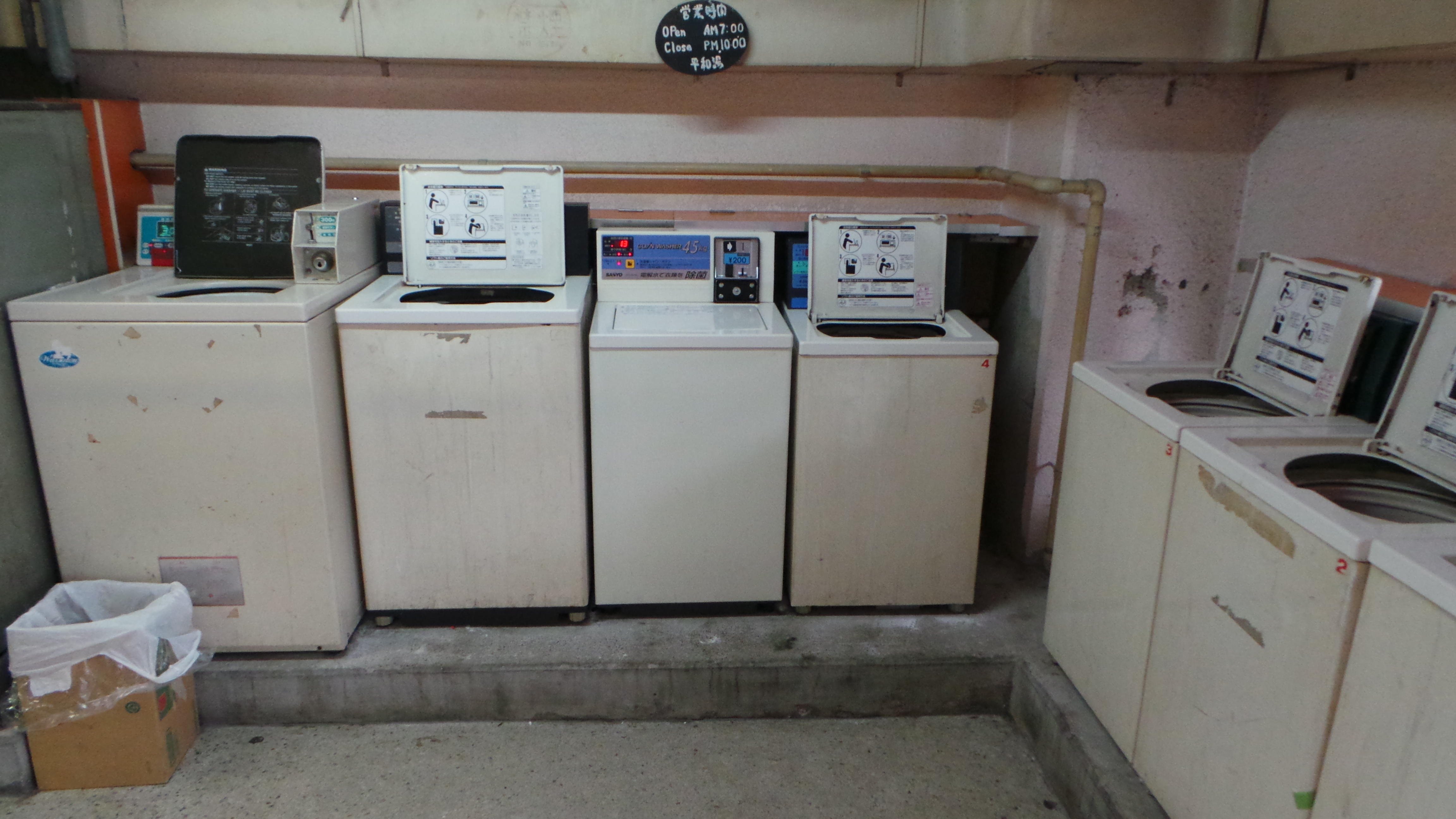
The laundry room is accessed through a shutter door currently pried open by what looks like a rotten plank of wood, which is a little worrying. Outside, noisy construction work is taking place despite the weather. The noise makes it rather difficult to concentrate on my book. I plan to spend as little time as possible outside today, so there is no point traipsing back through the storm just yet.

Inside the coin laundry, the room is dirty. The old vending machines no longer dispense detergent; luckily for me, I bought a ¥28 single-wash-sized pouch on the way here. I sit reading, waiting for my clothes, occasionally glancing up at the dirty walls.

laundrydecay

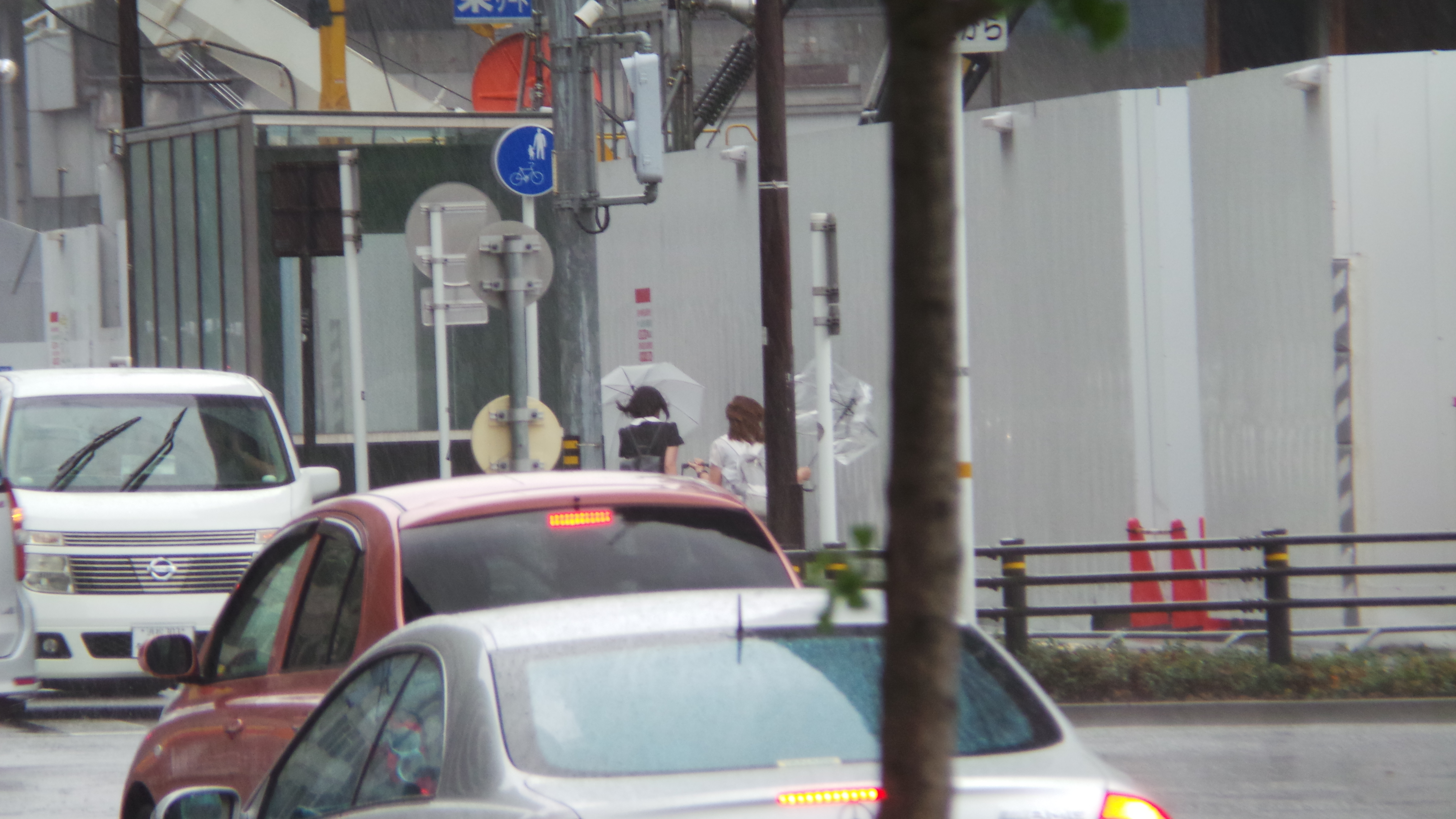
With the laundry done, I head back to the hotel as fast as I can. On the way, I notice abandoned inside-out umbrellas dumped on the street. I observe people ducking and diving into shelter, and I see areas of the pavement completely flooded. Meanwhile, the sound of sirens fills the air.

Back at the hotel, I sit by the balcony on the second floor of the lobby, quietly reading my book. I don’t mind rainy days, actually; I quite like the peace of sitting in silence and reading. It appears that a lot of people are holed up in the hotel today. Every now and then, someone walks to the window, sees that it is still raining, and then goes back to sit down. We are all waiting for the typhoon to pass.

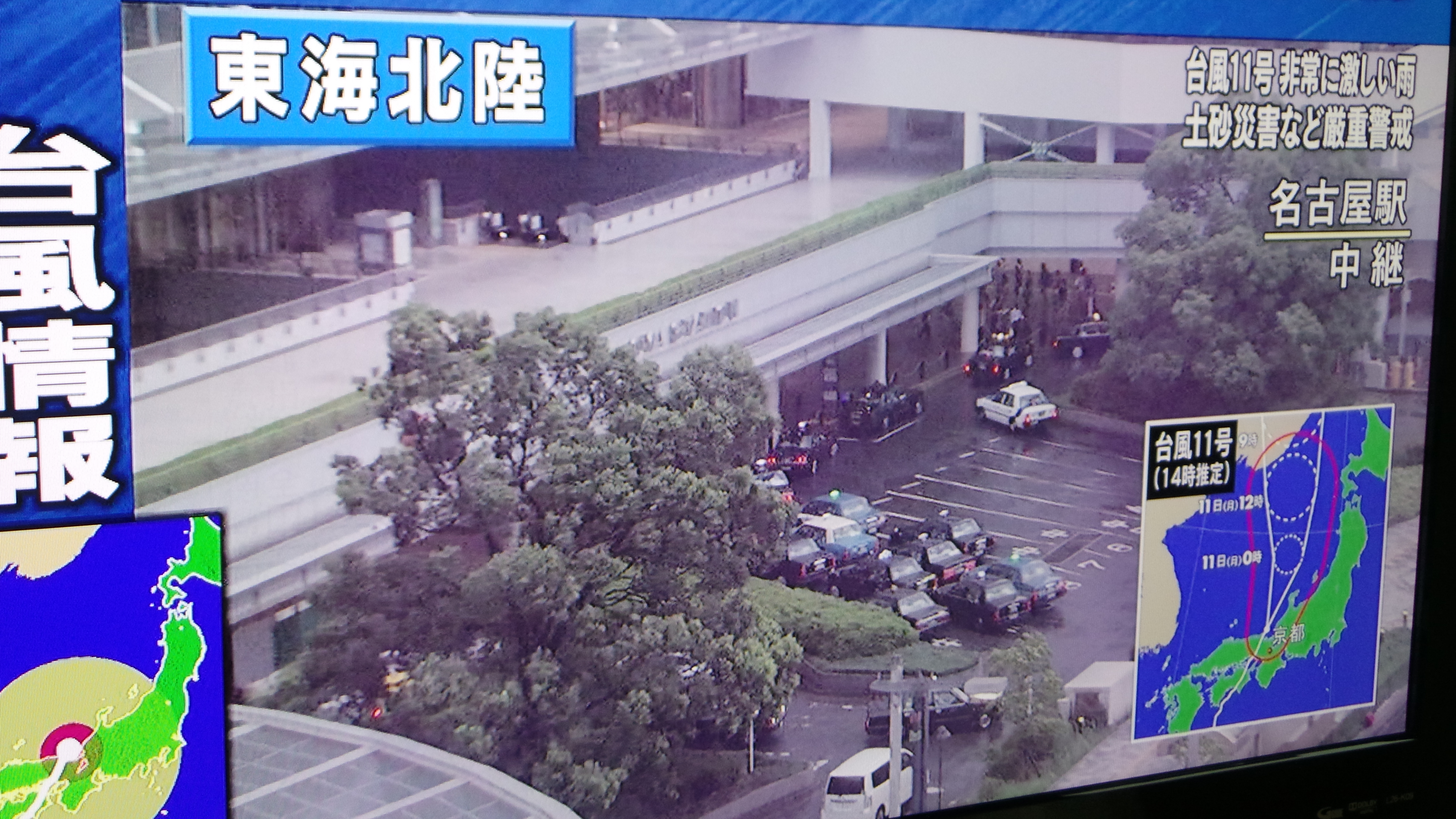
At 3 p.m., I am allowed back into my room. As I use the hairdryer on my shoes, I keep an eye on the news. After a short while, I hear the words, ‘Nagoya Station.’

nagoyast

There on the news is the train station, with taxis parked outside and rain falling. The typhoon has moved north, but the backlash of rain still falls. The bullet trains have all been cancelled.

Japan’s biggest broadcaster NHK seems to love this sort of stuff; for the next two hours, all they talk about is the typhoon. Cut to: Windscreen wipers frantically moving back and forth. Cut to: Drains overflowing. Cut to: Businessmen trying to juggle briefcases and carry an umbrella, only for it to whoosh inside-out. Cut to: All the bicycles blown over by the wind. Cut to: Rivers overflowing. Cut to: Trees shaking in the wind. This is about all I see for twenty minutes, then the footage repeats, and then repeats.

insideout

Outside, the rain looks like a white sheet being hung over the skyline. The wind is stronger now, blowing the rain sideways, making it very difficult to see the buildings in the distance. The last super typhoon I experienced passed miserably through the night; I never really got to see the chaos that it caused. Sitting here, I realise just how gloomy and grey today has been.

Eventually, the rain stops, and the wind dies down. At 7 p.m., I head out to the twenty-four-hour supermarket. On the way, I pass a sign about littering: a ten million yen fine and five years’ imprisonment. Inside the supermarket, a digitally transposed version of ‘Dreams’ by the Cranberries is playing. I buy some cheese and a small bottle of wine. At the self-service checkout, I scan the wine; a message pops up, ‘Are you over twenty? Yes/No.’ I press ‘yes’ and then finish and pay. There’s no one around to check, just press ‘yes.’ Honesty is the best policy.

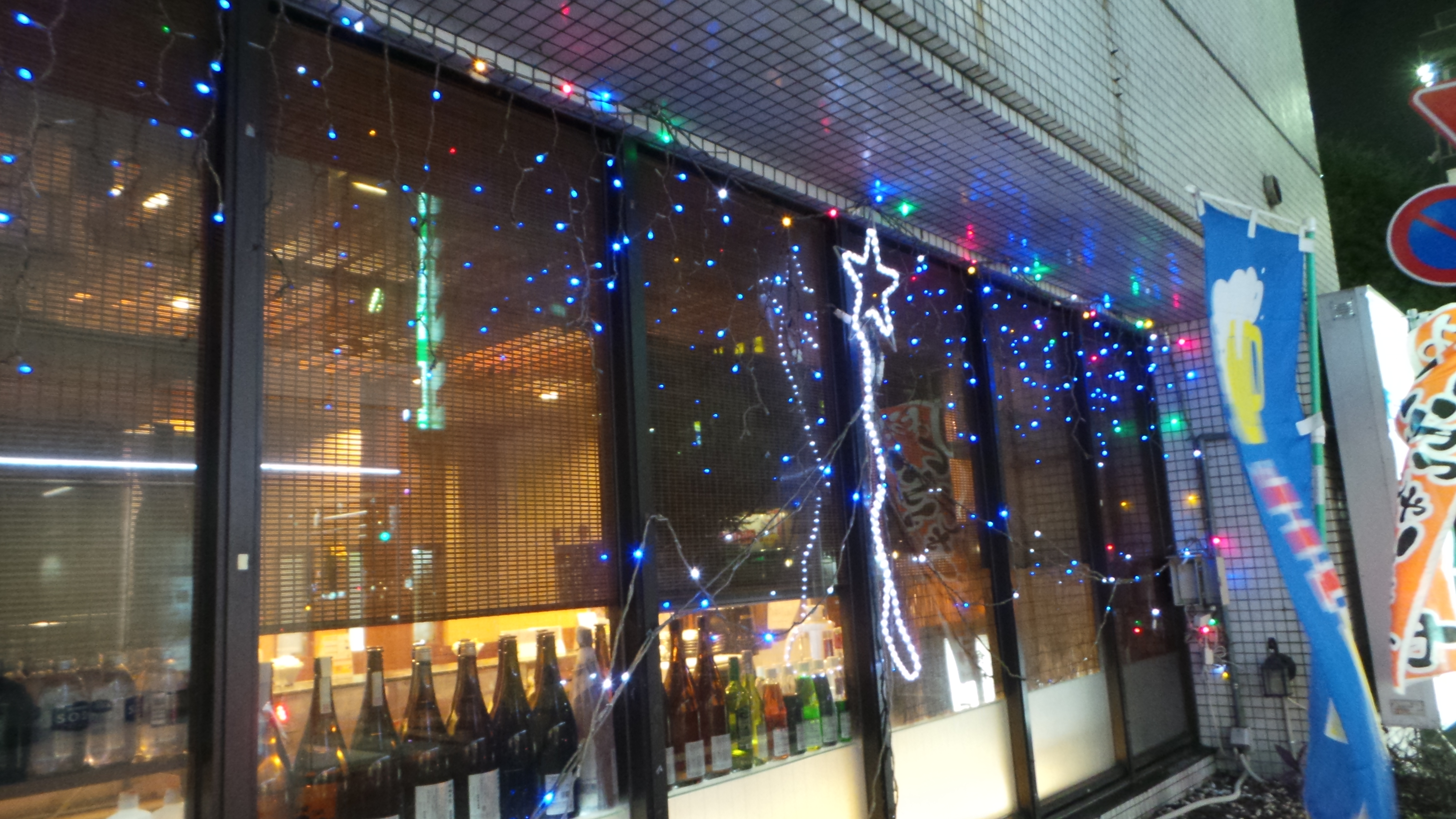
On the way back I pass a restaurant with a full set of Christmas lights. The full works.

christmaswine

Back at the hotel, I Skype with a friend from England. After that, I get deep into my reading until I finish my book. At 10 p.m., I head out to my nearest Family Mart to pick up some food. Inside Family Mart, that same Japanese song with the nice melody is playing. I can just make out a few words; hopefully, it will be enough to find out what it is.

When I return, I turn my attention to Japanese pop music. I listen to the top 30 songs in this week’s Billboard Japan Hot 100 chart. Oddly, Pharrell Williams with ‘Happy’ is at 29th. At 9th and 10th positions are two different songs from the same artist. A song from the anime Sailor Moon is in the top ten. AKB48 sister-band, SKE48, is number one. The song I am trying to find is nowhere to be heard.

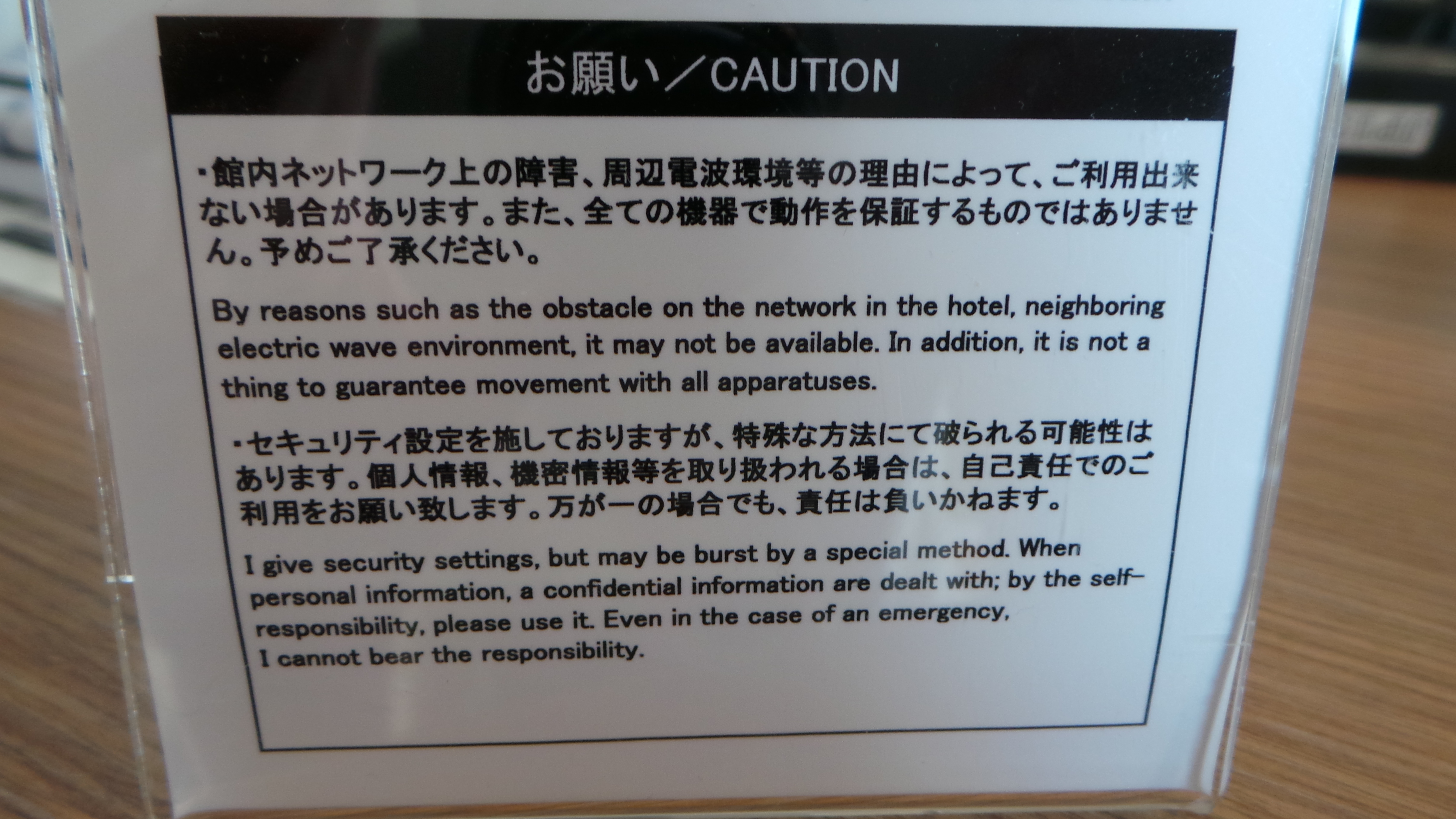
Instead, I find myself staring at this sign in my hotel room:

wirelessinternet

I do eventually find out the name of the song I keep hearing. It turns out to be a cover version of the other song I’ve been hearing, the one from Disney’s Frozen: ‘Let it Go’. It’s a Japanese version played on the piano, sounding very different from the English version—and a lot better, too. I spend the rest of my evening listening to various Japanese versions of ‘Let it Go’ on YouTube but can’t find the particular version I like. Maybe I shouldn’t have admitted that, though. I cannot bear the responsibility.