Twenty-Four Hours in Japan

Sitting on a British Airways flight for thirteen hours with Suzuki-san, I land at Tokyo-Narita International Airport with a strong hangover and a profound but newfound knowledge of ballroom dancing. I was happy that I had someone to talk to during the flight, and Mr. Suzuki was happy because he got to practice his English. What struck me as odd, though, is that after two small Heineken beers, Mr. Suzuki handed me a pamphlet for his ballroom dancing studio, complete with a nice map and address. One Heineken later, he gave me a business card with his home address, telephone number, and email address. Japan must be the only country I have experienced that has such a high level of trust.

As I approach immigration at the airport, I notice a sign that reads, “Please refrain from physical contact with others, except for the staff.” I adhere to this unusual instruction and proceed to have my fingerprints and photograph taken. After a swift 90-minute train journey on the Narita Express, I arrive at Tokyo Station. Here, I make a seamless transition to what has always been my preferred railway loop line in Japan: the Yamanote Line. This remarkable train route encircles all the main stations in Tokyo, spanning 29 stops in just one hour—a line I aspire to traverse entirely on foot one day.

For now, I take a brief two-minute train ride from Tokyo Station to the following stop on the loop, Kanda Station. It’s at Kanda Station that I transfer to what will likely serve as my new home for the next month: the Tokyo Metro Ginza Line.

Finally, after a total of twenty-two hours of solid travelling, I step out of the subway, gaze across the skyline for a few seconds, and spot the second tallest structure in the world, as well as the tallest tower in the world, Tokyo Skytree. Standing a mere 634 metres tall, this will be my Polaris.

After finding my hostel with somewhat relative ease, I check-in. After a few moments I already decide that I have made the right choice to start my Japan journey here. “We offer free laundry powder,” the receptionist says in perfect English. “We also have a comic room!” he exclaims.
“A what?”
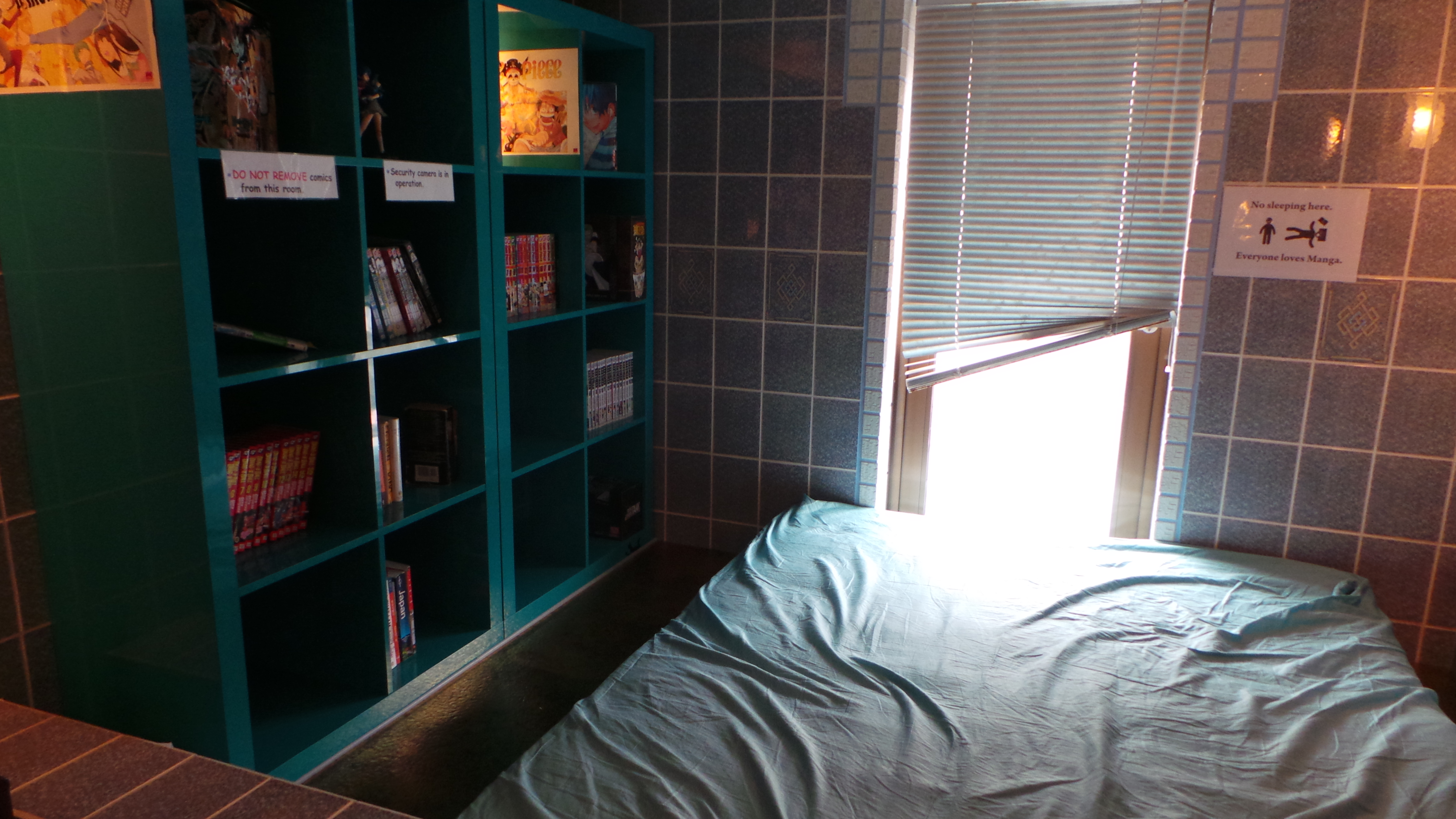
“A comic room,” he repeats. So up the lift we go, and he shows me to the comic room, with its free massage chair, and free manga comics.
Image

It is the official place to chill out and read manga comics, apparently. And it’s all free!

‘Free’ a word I will be hearing a lot of in the next few hours. The hostel has free tea and coffee, free laundry powder, free manga comics, free massage chair, free wireless Internet, free computers with free Internet, free toilet roll, and every Thursday, in a little room that doubles up as a whisky bar, is a free Jazz night, featuring excellent and professional Jazz musicians. Luckily for me, today is Thursday.

After finding my room and my amazing bed, I check out the facilities and find out that all the toilets in this hostel are made by Toshiba. I also find the hostel vending machines: one selling soft drinks and Boss coffee, one selling extremely cheap Asahi beer and 6% cider, and the other selling, ‘FOOD FOOD HOT FOOD 24 SEVEN,’ or so it says.

I relax in the hostel for a while reading one of the ‘free’ guide books. Eventually I team up with an Irish man, who is sharing my hostel room and whom I had previously met, and an American man. After a few beers we decide to head out for some food. The Irish man knows a great ramen shop across town, so off we go.

20140529_201217[1]

He was right, the ramen was amazing.

On the way back to the hostel for the Jazz night, the American spots a sign he had referenced previously that evening. It basically says free beer in exchange for some bar work, so we decide to check it out. I have been in Japan for less than a day and, although paid in beer, I have effectively landed a job.

Here, in this small back alley bar, Japanese men and women come to practice their English. My job is for thirty minutes to sit and talk to a Japanese lady in my native tongue. The moment I sit down a beer is poured for me, and it is on the house. Free beer brings the English speakers in, English conversation brings the Japanese customers in. A clever idea in a country that generally has limited to poor English speaking ability.

After thirty minutes of stop-start, but very enjoyable conversation, the bar owner asks the three of us to switch around. The Irish man gets put with the Japanese lady I had just been talking to; and I sit with a young Japanese man, probably in his mid-twenties. Another beer is poured for me, once again it is free.

This man has excellent English speaking ability, probably better than some of the native English speaking customers I have spoken to during my previous employment. He does not need to be here. I would argue that he is only in this bar to improve his confidence when speaking in English, however, this man has the confidence to come to this back alley bar, on his own; so I am not sure his confidence needs improving too much. Shortly into our thirty minute conversation he mentions a Japanese art and acting form called kabuki. Oddly, a few days ago I had watched an NHK World documentary about the subject, so from that, the conversation flows.

After our two thirty minute sittings, and my two free beers, the three of us head back to the hostel to find that unfortunately the Jazz has finished. However, the whisky is still flowing and the party in the Jazz club is far from over.

20140529_205706[1]

I don’t remember a great deal else from tonight, just that I leave in the early hours in a haze and head back to my room to sleep off almost 48 hours of being awake.

My first day in Japan.
The Mountain: a story about climbing Mount Fuji

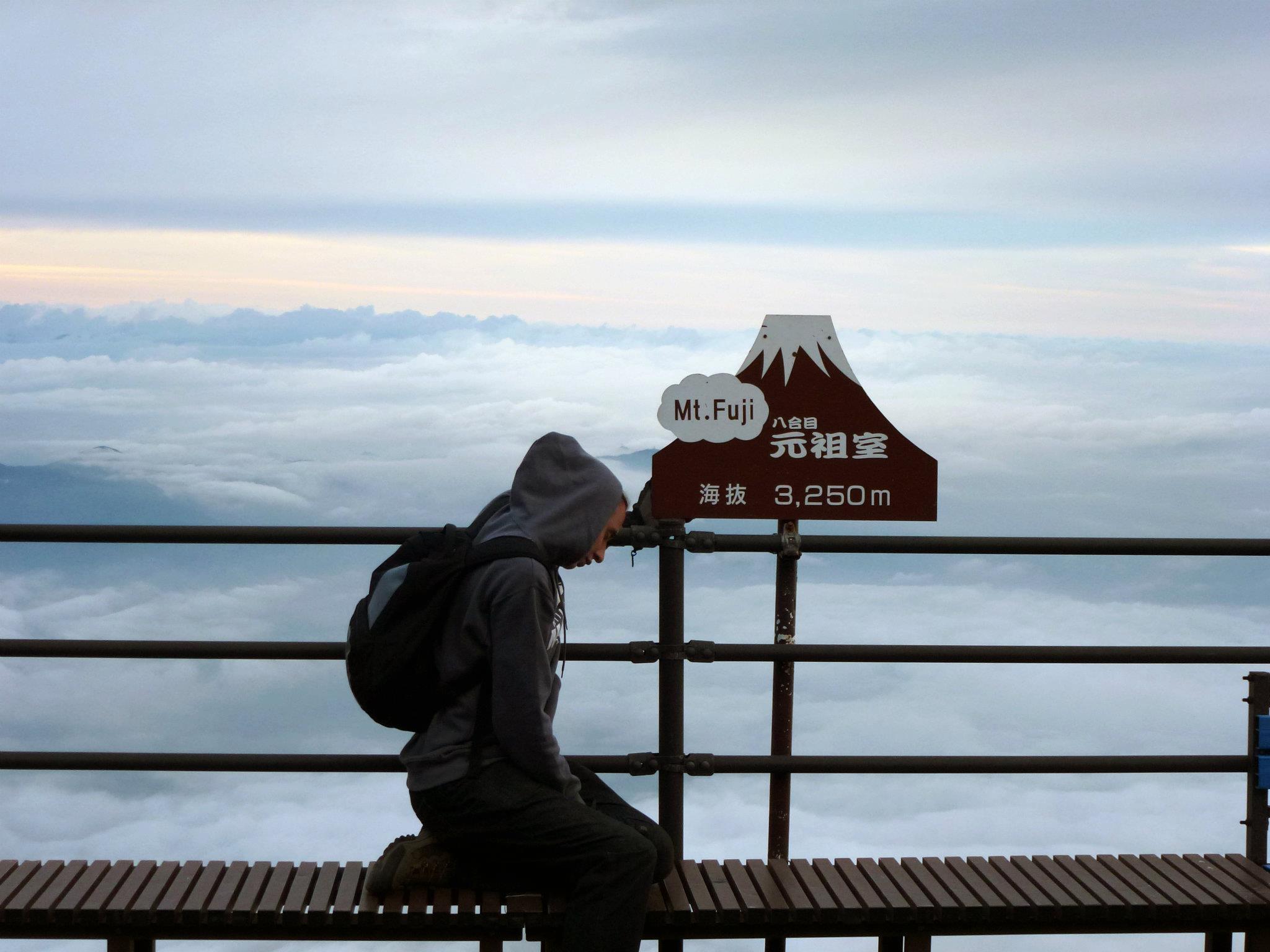
It is Wednesday 4th July 2012 and it’s very cold. I am at the top of Mount Fuji, 3,776 metres above sea level, and there is a fierce blizzard going on. Winds that appear somewhere between gale force and hurricane force on the Beaufort scale. Snow on the ground and snow falling fresh from the sky combined with freezing rain that can only be described as freezing rain. Then there is the thick cold fog that makes it impossible for me to see my hand in front of my face, despite the incredibly bright headlamp that for some reason can’t penetrate thick cold fog at a distance greater than 15 centimetres. Legs aching. Face aching. Losing count of the amount of times I’ve fallen over. Here we are at the top of the highest mountain in Japan. We’re contemplating waiting here until 4:40 a.m. to see the sunrise. There is however another problem …

fujiview

We don’t have a clue what time it is.

Three days ago I couldn’t sleep. The excitement of visiting a foreign country often has that effect on me. Travelling across time zones, navigating planes, taxis, and a relentless journey left me smiling at an airport on the opposite side of the world, yet internally adrift.

I meet my friend Sean at the airport, we hop on a train for 2 hours, and finally arrive in Shinjuku. It’s lunchtime in Japan. I’ve been awake for about 31 hours, and we can’t check into the hotel for another four. After some sightseeing and food, it hits around 4 p.m., so we head to the hotel. I crash in my room and quickly fall asleep.

Tuesday rejuvenates my spirit, restoring me after what feels like the best sleep ever. Tokyo calls for exploration, and after a few trips on the Yamanote Line, it starts pouring. The sky darkens as massive clouds block most of the sunshine on what was a relatively hot July day. The rain pounds down, the air thick with humidity. Buying an umbrella becomes a solemn act, seeking shelter beneath it as if seeking refuge from the downpour of life’s uncertainties. We head back to the hotel a bit early to dry off and snag some extra sleep for tomorrow’s adventure: climbing Mount Fuji.

After some struggle finding the bus, finally, at 11:27 a.m., we’re ready to set off. The ¥2700 highway bus takes us through Japanese countryside, across bridges and valleys, until, a few hours later, we reach Mount Fuji Fifth Station—the starting point for climbers. There are ten stations in total, the tenth being the summit.

Here at the Fifth Station, the sun shines, and the mood is upbeat. Restaurants, souvenir shops, and gear stores line the area. I forgot warm clothing, so I grab a nice fleece for ¥6000. After a satisfying Japanese meal, it’s time to climb. We rent a coin locker and leave everything non-essential at Station Five, setting off promptly.

The hike to Station Six is pleasant, perhaps taking forty minutes or even less. We rest, snack on Kendal Mint Cake, then resume climbing. What’s heartening as we ascend is the warm greetings from every person we pass—each offering a smile and a ‘konnichiwa!’

Somewhere between Station Six and Seven, there are dreadful steps. Loads of them, sweeping from left to right, hindering progress. We take a break and chat with an American couple descending the Mountain. They joke that it’ll take another ten hours to reach the top. Hilarious, I hope.

A few hours pass since Station Six, and we arrive at Station Seven—equipped with a bench, a toilet, and a shop selling instant ramen. We pause to admire the view before continuing. Around this climb point, we’re engulfed in clouds, and it starts getting cooler. No more steps, thankfully … just rocks.

Endless rocks.

Arguably the worst part of the Mount Fuji climb is between the Seventh and Eighth stations. This stretch demands hand-climbing over endless slippery rocks. Thankfully, there are about eight or nine mountain huts interspersed, each with a bench, toilet, shop, and if needed, a place to sleep. I’m grateful for these intermittent rests, although the prices keep climbing higher with altitude. I recall one of the higher shops selling two cans of Coke and a Snickers bar for the equivalent of £10, though the exchange rate wasn’t as favourable back in 2012.

fujisan

After leaving the last hut at Station Eight, the skies begin to darken. This part of the climb features volcanic rock littering the trails—loads of smashed-up or small bits of rock and stone. Tricky to walk on, they slide around under our feet. The darkness doesn’t favour us here, so it’s time to put on the all-important headlamp.

Somewhere before the penultimate Ninth Station, we encounter a mountain hut. A Japanese man outside informs us that the mountain huts beyond this point are closed, urging us to stay for the night. Uncertain if he’s honest or aiming for extra business, it turns out he’s genuinely concerned for our safety.

At Station Nine, perched at 3,600 metres above sea level, the solitary mountain hut stands closed, swallowed by pitch-black darkness. Devoid of light, shops, or comfort, it echoes with the haunting symphony of wind and rain. An impending storm brews, casting a foreboding shadow over our proximity to the summit—just 176 metres away.

In daylight, this section of the Mountain might take about 40 minutes. In the dark amid increasing rain and wind, it takes us 2 hours. Passing through a torii gate, we venture deeper into darkness. Here, the volcanic rocky ground ends, and a very difficult climb begins. Bare rocks mark the path, and climbing these slippery, wet rocks is no fun at all. My vision reduces to a black screen with flickering white dots, snowfall illuminated by my headlamp. After navigating the treacherous rocks, a white torii gate signals the final steps, and we reach the summit. Exhausted, cold, wet, but relieved.

At Mount Fuji’s peak, all the shops are closed; no light, no life. The summit at night is bleak—snow falls, wind howls stronger. We huddle by a closed mountain hut, attempting to shield ourselves from the wind. Trying to calculate the time, as we have no devices or clocks, it becomes a futile exercise. Everything is in the coin locker back at Station Five, and with nobody around to ask, we are forced to do some calculations.

  • The sun set hours ago.
  • On Monday, we missed the sunset due to our late afternoon sleep.
  • Tuesday’s rain and sudden darkness hid the sunset.
  • We do know the sun rises at 4:40 a.m.
  • We set off from Station Five around 2 p.m.
  • The American couple said it takes at least ten hours.
  • It feels like we’ve been walking for at least ten hours.
  • We decide it’s probably around midnight, but we have no way to be sure.

Contemplating waiting for sunrise, hoping the sun would warm us, we realise the risk of freezing if we linger. We opt to head down the dark, slippery, snow-covered rocks.

Hours seem to pass, and eventually, we return to Station 8.5. A Japanese man and woman greet us, whispering, indicating that people are already asleep, planning to wake an hour before sunrise for the final climb. For ¥5500 each, we acquire a small bean bag pillow, a blanket, and space on the hard wooden floor. Cold and exhausted, I could’ve slept anywhere. A clock on the hut wall reads 10:47 p.m. Turns out, in summer in Japan, the sun sets just after 6 p.m.

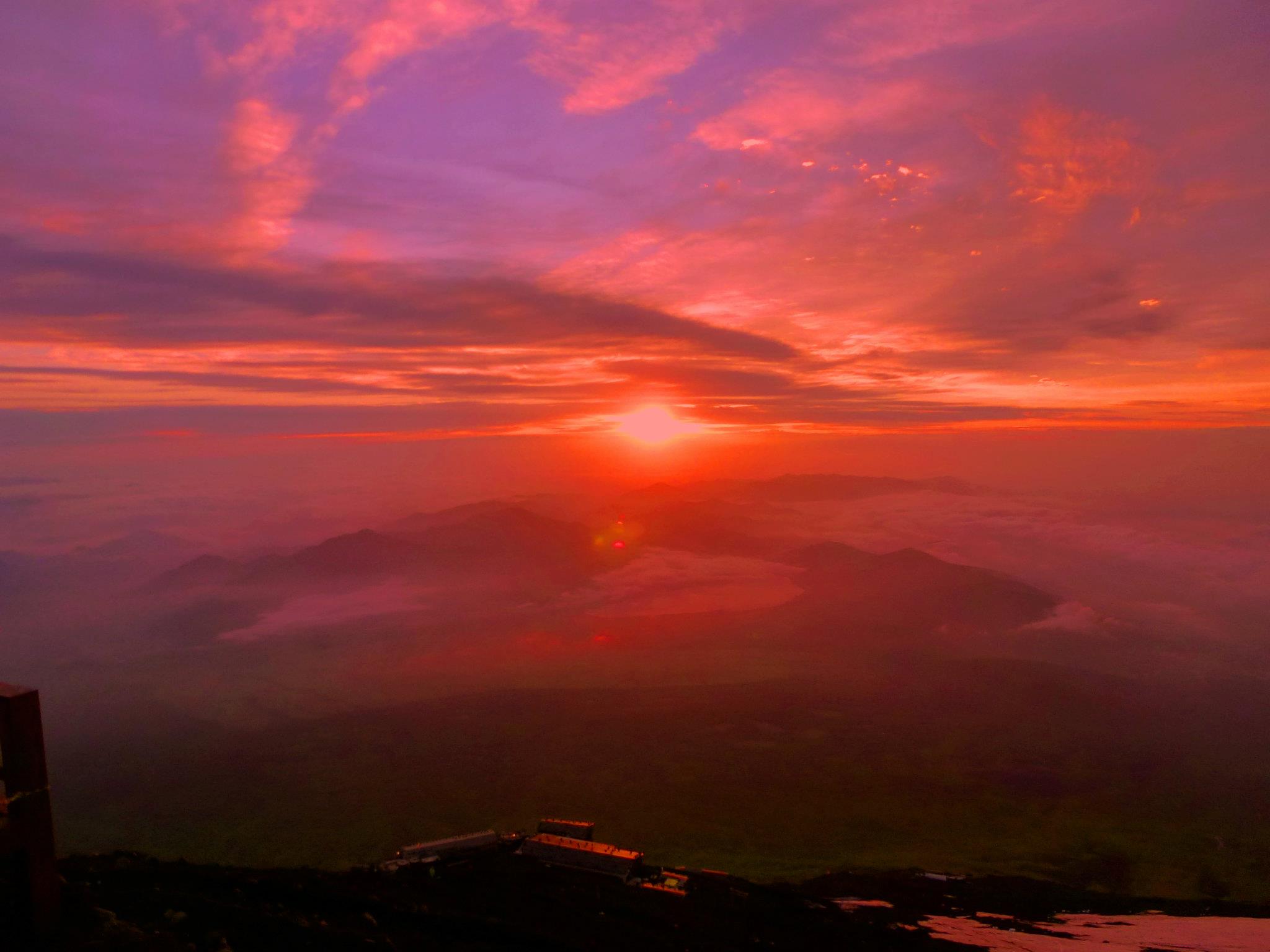
In the morning there was this:

sunrise

Descending the Mountain proves far easier than ascending it. There’s a twisted pleasure in knowing those we pass on the way down will face what we’ve just endured. I now understand why those descending greeted us with smiles and a cheerful ‘konnichiwa!’ as we ascended.

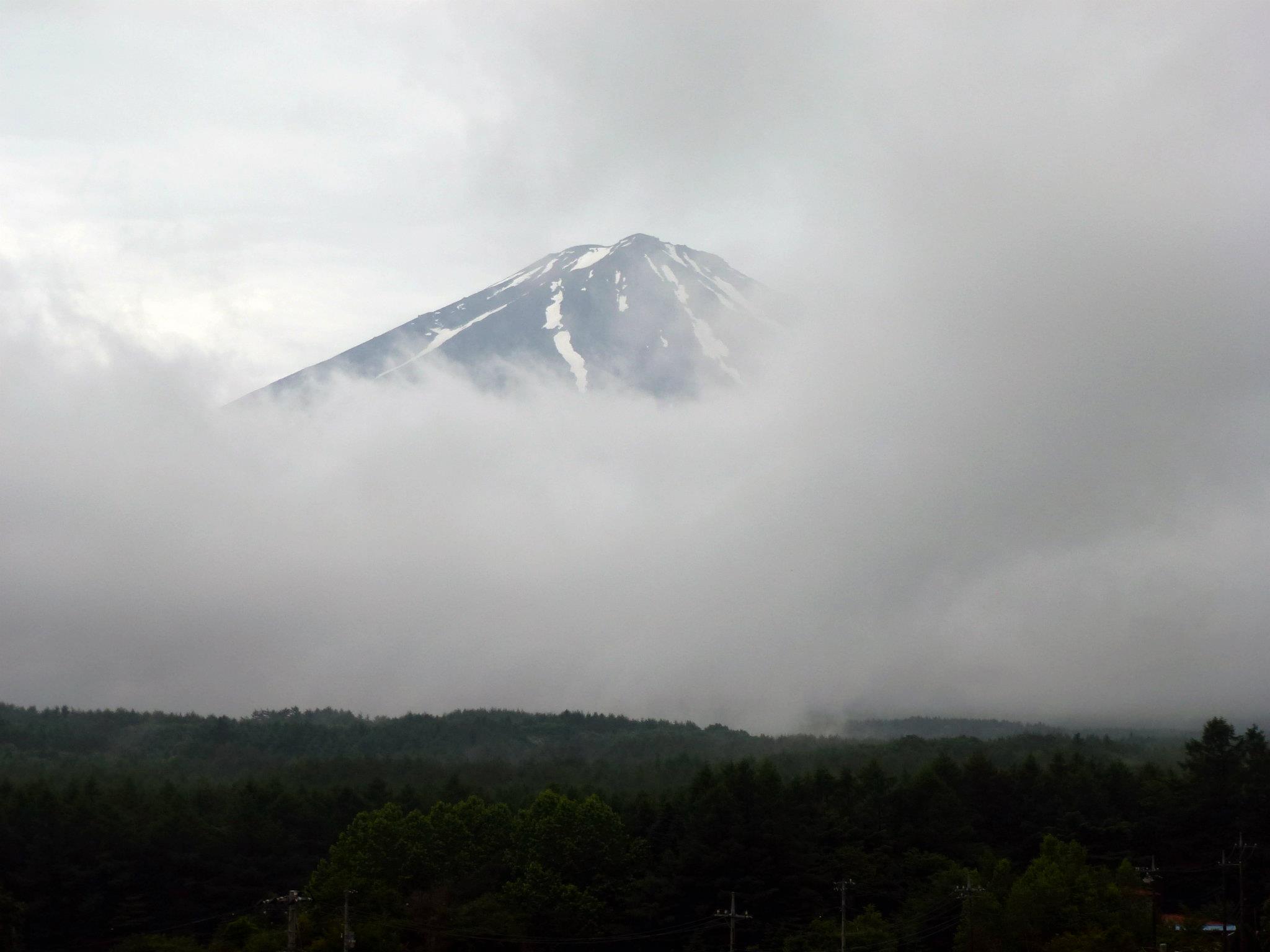
July and August mark Mount Fuji’s ‘climbing season.’ We tackled the Mountain just days into the season, hence the lingering snow on the summit and the closure of mountain huts past Station 8.5.

Returning to Station Five, we board a bus to Kawaguchiko Station, encountering a French lady and her daughters who scaled the Mountain that same night. She recounts a chilling warning from Station Five’s security, advising against venturing beyond Station 8.5 due to hazardous snow. In her narrative, a haunting reality unfolds: the Mountain’s icy grasp clung to mortality’s edge, our steps teetered on a malevolent dance with death. Each footfall echoed a grim refrain, a chilling symphony marking our unnerving closeness to an untimely encounter with the abyss.

In June 2013 Mount Fuji was granted UNESCO World Heritage status.