Today, I wake up at 8 a.m. I go outside and take a short wander. It seems that Kyoto is still sleeping. I return to the hostel to steal a few more hours for myself. By 11 a.m., Kyoto still seems to be asleep; shops are closed, and nothing much is happening. I decide to do some sightseeing. I am fortunate to be staying in Downtown Kyoto; many places are within walking distance, which is very convenient as I am tired of trains. I walk from the hostel in a straight line along the same road for ten minutes, eventually arriving at Kyoto Imperial Palace Park.
The gardens here are quite impressive, featuring Omiya Palace, Sento Palace, multiple shrines, a peach grove, and, of course, the Kyoto Imperial Palace. The peach grove is odd; the peaches are within arm’s reach, so I could steal a few if I wanted to, but I don’t. The most appealing shrine is the Isukushima Shrine; it sits quietly over a lake.
![giongardens[1]](https://japanising.com/wp-content/uploads/2014/07/giongardens1.jpg)
There are signs in some areas of Kyoto Imperial Palace Park that say, “Not to be visited by tourists.” There are little to no other tourists here anyway; perhaps the signs have driven them all away. However, there are hordes of homeless people. Some paths are overgrown, others forgotten many years ago. I see one gardener delicately pollarding the branches of a tree. Just one gardener tending to a park 1.3 kilometres in length.
As for the Kyoto Imperial Palace, it lies behind a moat and a tall wall. The water in the moat has dried up, and the wall is too high to see the Palace beyond. Even if the wall weren’t there, it would be completely shrouded by trees anyway. I quite literally can’t see the Palace for the trees.
![kyotopalace[1]](https://japanising.com/wp-content/uploads/2014/07/kyotopalace1.jpg)
There is one thing I do like, and that’s the sound made by the cicadas. These little insects just love to sing, and the trees here are full of them. And there are a lot of trees; ten thousand trees in the Palace Park alone. The noise these insects make sounds alien to me, perhaps robotic, but calming. I spend a full hour wandering the park.
It is another hot day. Well over 30°C, as usual. A woman outside sprays water from a hosepipe around the path leading into her shop. I believe this is to keep the dust down. I cross the Kamo River; much like the Palace moat, it is dried up from the heat, the fish left behind for the birds. As I walk through the shopping arcade, I realise that there are loads of crêperies here; at least eight or nine shops selling pancakes. A sign in one of the pancake shops attempts to forecast the weather:
![signwarm[1]](https://japanising.com/wp-content/uploads/2014/07/signwarm1.jpg)
Back at the hostel, I sit opposite a guy as he flips through a Lonely Planet guidebook. “Where are you going today?” he asks, half for the sake of conversation, half for ideas of places to visit. He waits for me to list off all of the same places as everyone else, but I don’t.
“I’m going to a Kaleidoscope Museum,” I tell him proudly, and his expression fills with puzzlement. He desperately flicks through his guidebook, presumably the ‘Kyoto’ section, but to no avail.
“Hmmph,” he utters, suggesting that if it isn’t in his guidebook, then it doesn’t exist.
I walk halfway across the city, only to find that the Kaleidoscope Museum of Kyoto is closed on a Monday. “I’ll be back,” I say to the locked door with a shake of my head.
![Kaleidoscope[1]](https://japanising.com/wp-content/uploads/2014/07/kaleidoscope1.jpg)
One thing I like about Kyoto is that on street corners, there are nice little plaques in English offering insightful history about the area—a nice touch. Feeling a little hungry, I decide to swing by a local cafe at the organic market. I pay ¥940 for a soybean croquette, a cheese croquette, and a beer. The food and drink aren’t particularly photogenic, so I skip taking a photograph.
While I’m here at Nishiki Market, I decide to sample some of the local foods. With over a hundred shops and restaurants, they sell seasonal foods and Kyoto specialties like Japanese sweets, pickles, dried seafood, and sushi. I buy three different traditional Japanese snacks and take them back to the hostel.
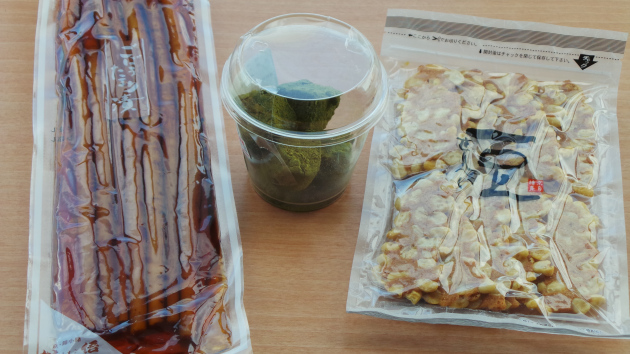
On the left, I have Gobo Tamari Zuke, or pickled burdock root; marinated in sugar and soy sauce. I wish I had bought this in Okayama to go with the dandelion. In the middle, there’s some sort of matcha snack. It’s basically Turkish Delight coated in a fine green tea-flavoured powder, instead of the usual icing sugar. On the right, there’s a Japanese traditional cake with soybeans, said to have been made for approximately 150 years using the same traditional manufacturing method. According to the packaging, ‘One piece of one piece is the cracker which I baked carefully.’ The cake costs ¥400 and is my favourite of the three.
After trying my snacks and finishing my book, I head out for dinner.
I spot a gyoza restaurant, a food I am yet to try in Japan. Gyoza is a type of Japanese dumpling, usually filled with meat. This restaurant has an English menu outside, stating that one of the fillings they offer is shrimp. I order the shrimp gyoza along with a beer and a side of spiced cucumber. The cucumber dish arrives whilst I wait for my dumplings; the spices provide a good balance to what would normally be a dull snack. Three pieces of shrimp gyoza show up, although I was expecting at least five. After I finish my first three, a plate of ten fried dumplings is placed in front of me.
![gyoza[1]](https://japanising.com/wp-content/uploads/2014/07/gyoza1.jpg)
As I bite into the first of ten, I realise it is pork. The staff don’t speak English, but I manage to convey the message. My plate of pork gyoza is taken away, and I’m told it will take eight minutes for the shrimp. While I wait, I order a second beer. Eventually, I am handed a set of shrimp gyoza, albeit only five pieces instead of ten. Apparently, shrimp is twice as expensive as pork.
As I eat, I mishandle my chopsticks. One of the dumplings falls and lands in the saucer of soy sauce; the sauce splashes up and hits me in my left eye. It stings, and I spend the rest of my meal with tears rolling down one side of my face. After finishing my meal, I offer to pay for the wasted pork gyoza, unsure if it was my mistake or theirs. Admittedly, the restaurant is rather cheap. We compromise, and I pay a total of ¥1570 for eight pieces of shrimp gyoza and two pints of Asahi Beer.
I head back to the hostel’s bar and notice a guy reading ‘Women’ by Charles Bukowski. I share that I’m not a fan of Bukowski, only to find out that the guy is from Surrey. I end up spending the rest of the evening in the bar, discussing literature and politics.
![bikes[5]](https://japanising.com/wp-content/uploads/2014/06/bikes5.jpg)
![greenteas[6]](https://japanising.com/wp-content/uploads/2014/06/greenteas6.jpg)
![Mukojima[1]](https://japanising.com/wp-content/uploads/2014/06/mukojima1.jpg)
![Vendingfood[1]](https://japanising.com/wp-content/uploads/2014/06/vendingfood1.jpg)
 Japanising.com
You must be logged in to post a comment.