Bach No Senritsu Wo Yoru Ni Kiita Sei Desu

I sign up through Craigslist for an event in March 2015. Bach’s 330th birthday celebration. All day and all night the music of Bach will be played in subways and public spaces. The website specifically states that, ‘Solos, ensembles, flash mobs and Bach marathons are all encouraged.’

Outside, rainy season has started. The unexpected heat wave during my first week here has now stepped aside and the rain has taken over. It will not stop raining now until mid-July. I take a ‘free’ umbrella from the hostel and walk to the boat terminal. Here I take a ¥1580 boat ride down the Sumida River to Odaiba; an artificial island. The journey takes about forty minutes.

BOAT[1]

I see The Goddess of Liberty, a to-scale model of the Statue of Liberty. There is a giant Ferris wheel with no riders and a huge arcade with no customers. It is nearly lunch time and there is nobody else here. A Toyota theme park showcases new vehicles and offers driving lessons and ‘games’. A Shell museum offers not seashells but the history of petrol pumps and petroleum. I am very disappointed.

Japan are preparing for the 2020 Olympic games, and Odaiba, with its large areas of open space, is one of the venues that has been selected. I walk long distances in the rain trying to find the giant 1/1 scale statue of a Gundam robot. I never find it and there is nobody around to ask. I eventually give up and take the train back to Tokyo.

lolympics[1]

For lunch it’s another Cheese Mushi Cake. This one is from Family Mart and is sadly not as good as the one from Seven Eleven. I also have a natto wrap and a bag of the ‘best crisps’, or so I am told by a member of staff at the hostel.

Natto is fermented soy beans. It is a traditional food of Japan and is usually eaten for breakfast. I once read that most people in Japan eat natto but don’t like it, and that they only eat it for its excellent health benefits. My natto is wrapped in rice and seaweed. The smell is overpowering, and the taste is disappointing.

natto[1]

I spend the next hour or so in the hostel until I am in the right place at the right time. The hostel manager approaches me. He says a film crew for TV Tokyo are making a documentary, and are looking to film someone that is staying here for a while. I immediately agree and wait anxiously until the film crew are ready.

The director cannot speak any English but she has brought with her a language interpreter. I am asked to go to the reception so they can film the hostel staff recommending a strange place for me to visit. I already know that we are going to a bird cafe, so I have to pretend I don’t know where I am going; it is all very odd. The crew film me talking to Daisuke at reception. He recommends that I visit Asakusa’s Owl & Parakeet Cafe, before making me laugh with his chicken noises. We film the same scene again, without the chicken noises, and he marks the cafe on my map.

parrot1[1]

The film crew then follow me through Asakusa. I rely only on the instructions from the hostel; I am not allowed to ask the film crew for help. Daisuke’s directions are pretty good though, and I find the bird cafe with relative ease. Once inside I am asked to stroke the birds, play with the birds, feed the birds, and get bitten by the birds. They ask me some really random questions. I am not sure whether to direct my answers at the interpreter or the director, and I’m never really sure which parts they are filming.

Once we finish the interview, we head back to the hostel. Overall the experience was rather enjoyable and I am pleased to have been given the opportunity to be on television. I have no idea which footage they will use for their program, only that it will air at the end of the month.

At the hostel I meet with a few of the nice people that I have spent time with over the last few days; almost all of them will be leaving in the morning and I will once again be alone. A few hours of whisky and beer later and the Thursday night Jazz Club is in full swing. Five of us decide to head out through the soaking and somewhat flooded streets of Asakusa to get some food. Tempura again for the third time this week; I don’t think I’ll ever get bored of it though.

raindrops[1]

After food it’s back to the hostel to catch the end of the Jazz Club washed down with a few cans of Suntory Strong Zero 9%.
The Mountain: a story about climbing Mount Fuji

It is Wednesday 4th July 2012 and it’s very cold. I am at the top of Mount Fuji, 3,776 metres above sea level, and there is a fierce blizzard going on. Winds that appear somewhere between gale force and hurricane force on the Beaufort scale. Snow on the ground and snow falling fresh from the sky combined with freezing rain that can only be described as freezing rain. Then there is the thick cold fog that makes it impossible for me to see my hand in front of my face, despite the incredibly bright headlamp that for some reason can’t penetrate thick cold fog at a distance greater than 15 centimetres. Legs aching. Face aching. Losing count of the amount of times I’ve fallen over. Here we are at the top of the highest mountain in Japan. We’re contemplating waiting here until 4:40 a.m. to see the sunrise. There is however another problem …

fujiview

We don’t have a clue what time it is.

Three days ago I couldn’t sleep. The excitement of visiting a foreign country often has that effect on me. Travelling across time zones, navigating planes, taxis, and a relentless journey left me smiling at an airport on the opposite side of the world, yet internally adrift.

I meet my friend Sean at the airport, we hop on a train for 2 hours, and finally arrive in Shinjuku. It’s lunchtime in Japan. I’ve been awake for about 31 hours, and we can’t check into the hotel for another four. After some sightseeing and food, it hits around 4 p.m., so we head to the hotel. I crash in my room and quickly fall asleep.

Tuesday rejuvenates my spirit, restoring me after what feels like the best sleep ever. Tokyo calls for exploration, and after a few trips on the Yamanote Line, it starts pouring. The sky darkens as massive clouds block most of the sunshine on what was a relatively hot July day. The rain pounds down, the air thick with humidity. Buying an umbrella becomes a solemn act, seeking shelter beneath it as if seeking refuge from the downpour of life’s uncertainties. We head back to the hotel a bit early to dry off and snag some extra sleep for tomorrow’s adventure: climbing Mount Fuji.

After some struggle finding the bus, finally, at 11:27 a.m., we’re ready to set off. The ¥2700 highway bus takes us through Japanese countryside, across bridges and valleys, until, a few hours later, we reach Mount Fuji Fifth Station—the starting point for climbers. There are ten stations in total, the tenth being the summit.

Here at the Fifth Station, the sun shines, and the mood is upbeat. Restaurants, souvenir shops, and gear stores line the area. I forgot warm clothing, so I grab a nice fleece for ¥6000. After a satisfying Japanese meal, it’s time to climb. We rent a coin locker and leave everything non-essential at Station Five, setting off promptly.

The hike to Station Six is pleasant, perhaps taking forty minutes or even less. We rest, snack on Kendal Mint Cake, then resume climbing. What’s heartening as we ascend is the warm greetings from every person we pass—each offering a smile and a ‘konnichiwa!’

Somewhere between Station Six and Seven, there are dreadful steps. Loads of them, sweeping from left to right, hindering progress. We take a break and chat with an American couple descending the Mountain. They joke that it’ll take another ten hours to reach the top. Hilarious, I hope.

A few hours pass since Station Six, and we arrive at Station Seven—equipped with a bench, a toilet, and a shop selling instant ramen. We pause to admire the view before continuing. Around this climb point, we’re engulfed in clouds, and it starts getting cooler. No more steps, thankfully … just rocks.

Endless rocks.

Arguably the worst part of the Mount Fuji climb is between the Seventh and Eighth stations. This stretch demands hand-climbing over endless slippery rocks. Thankfully, there are about eight or nine mountain huts interspersed, each with a bench, toilet, shop, and if needed, a place to sleep. I’m grateful for these intermittent rests, although the prices keep climbing higher with altitude. I recall one of the higher shops selling two cans of Coke and a Snickers bar for the equivalent of £10, though the exchange rate wasn’t as favourable back in 2012.

fujisan

After leaving the last hut at Station Eight, the skies begin to darken. This part of the climb features volcanic rock littering the trails—loads of smashed-up or small bits of rock and stone. Tricky to walk on, they slide around under our feet. The darkness doesn’t favour us here, so it’s time to put on the all-important headlamp.

Somewhere before the penultimate Ninth Station, we encounter a mountain hut. A Japanese man outside informs us that the mountain huts beyond this point are closed, urging us to stay for the night. Uncertain if he’s honest or aiming for extra business, it turns out he’s genuinely concerned for our safety.

At Station Nine, perched at 3,600 metres above sea level, the solitary mountain hut stands closed, swallowed by pitch-black darkness. Devoid of light, shops, or comfort, it echoes with the haunting symphony of wind and rain. An impending storm brews, casting a foreboding shadow over our proximity to the summit—just 176 metres away.

In daylight, this section of the Mountain might take about 40 minutes. In the dark amid increasing rain and wind, it takes us 2 hours. Passing through a torii gate, we venture deeper into darkness. Here, the volcanic rocky ground ends, and a very difficult climb begins. Bare rocks mark the path, and climbing these slippery, wet rocks is no fun at all. My vision reduces to a black screen with flickering white dots, snowfall illuminated by my headlamp. After navigating the treacherous rocks, a white torii gate signals the final steps, and we reach the summit. Exhausted, cold, wet, but relieved.

At Mount Fuji’s peak, all the shops are closed; no light, no life. The summit at night is bleak—snow falls, wind howls stronger. We huddle by a closed mountain hut, attempting to shield ourselves from the wind. Trying to calculate the time, as we have no devices or clocks, it becomes a futile exercise. Everything is in the coin locker back at Station Five, and with nobody around to ask, we are forced to do some calculations.

  • The sun set hours ago.
  • On Monday, we missed the sunset due to our late afternoon sleep.
  • Tuesday’s rain and sudden darkness hid the sunset.
  • We do know the sun rises at 4:40 a.m.
  • We set off from Station Five around 2 p.m.
  • The American couple said it takes at least ten hours.
  • It feels like we’ve been walking for at least ten hours.
  • We decide it’s probably around midnight, but we have no way to be sure.

Contemplating waiting for sunrise, hoping the sun would warm us, we realise the risk of freezing if we linger. We opt to head down the dark, slippery, snow-covered rocks.

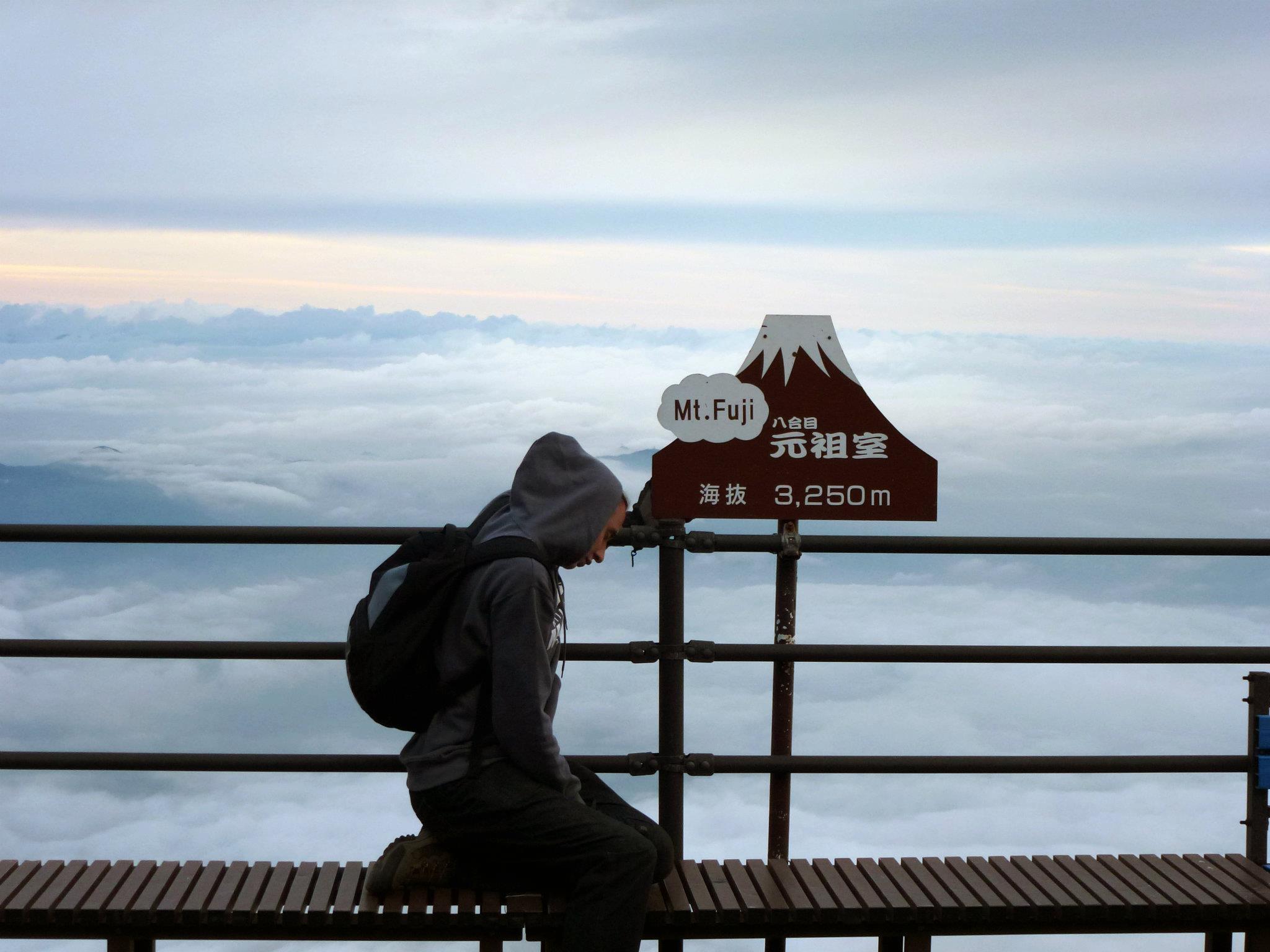
Hours seem to pass, and eventually, we return to Station 8.5. A Japanese man and woman greet us, whispering, indicating that people are already asleep, planning to wake an hour before sunrise for the final climb. For ¥5500 each, we acquire a small bean bag pillow, a blanket, and space on the hard wooden floor. Cold and exhausted, I could’ve slept anywhere. A clock on the hut wall reads 10:47 p.m. Turns out, in summer in Japan, the sun sets just after 6 p.m.

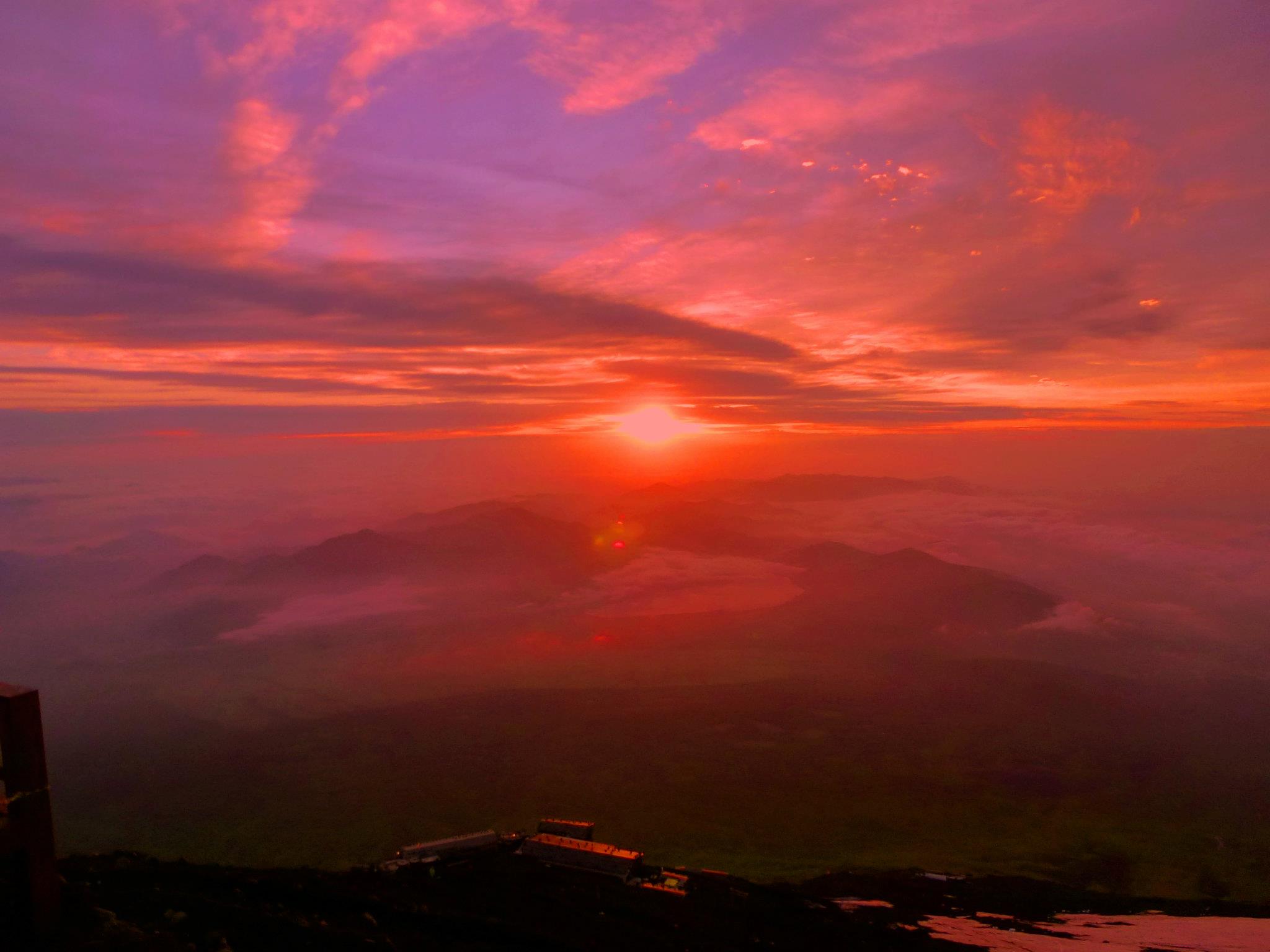
In the morning there was this:

sunrise

Descending the Mountain proves far easier than ascending it. There’s a twisted pleasure in knowing those we pass on the way down will face what we’ve just endured. I now understand why those descending greeted us with smiles and a cheerful ‘konnichiwa!’ as we ascended.

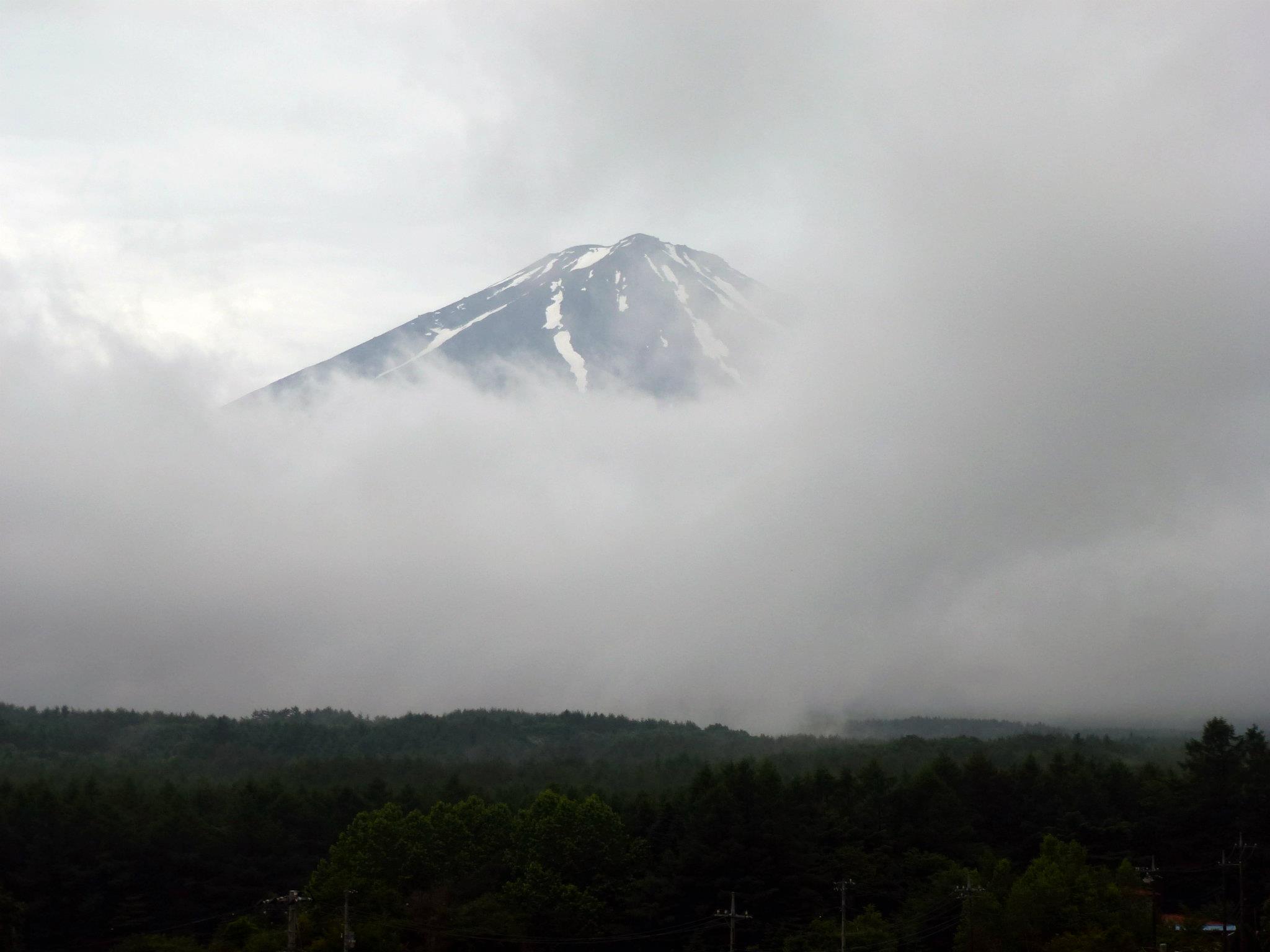
July and August mark Mount Fuji’s ‘climbing season.’ We tackled the Mountain just days into the season, hence the lingering snow on the summit and the closure of mountain huts past Station 8.5.

Returning to Station Five, we board a bus to Kawaguchiko Station, encountering a French lady and her daughters who scaled the Mountain that same night. She recounts a chilling warning from Station Five’s security, advising against venturing beyond Station 8.5 due to hazardous snow. In her narrative, a haunting reality unfolds: the Mountain’s icy grasp clung to mortality’s edge, our steps teetered on a malevolent dance with death. Each footfall echoed a grim refrain, a chilling symphony marking our unnerving closeness to an untimely encounter with the abyss.

In June 2013 Mount Fuji was granted UNESCO World Heritage status.