Parasite at the Museum

Today is a public holiday dedicated to respecting the elderly and celebrating longevity. In Japan, there are fifteen different public holidays annually, and due to the implementation of the ‘Happy Monday System,’ several holidays have been shifted to Mondays to grant people a three-day weekend. Unfortunately, my toothache has plunged me into perpetual agony today. Regrettably, all the dentists are on holiday because of the celebration honouring the elderly. Not wishing to bare one’s teeth, I struggle on in pain.

My first stop today is Shibuya Station. With most of the country off work today, the area is overcrowded and annoying. I grab a bottle of drink that claims to contain one thousand lemons (which I very much doubt) before walking in the sunshine toward Harajuku, in search of some illustrious graffiti. On the way, I pass Yoyogi Park; here, there are swarms of teenage girls all standing around waiting for some sort of summer concert to start. I decide to pass on the concert. In Harajuku, it is just as crowded. I wander around side streets but find the graffiti to be somewhat lacklustre. I take just one photograph before walking back to Harajuku Station.

haragraf[1]

I take the Yamanote Line to Meguro, which translates to mean ‘black eyes’. After eventually finding a map, I discover that my destination isn’t marked. So, I search for a Seven Eleven and use their free wireless Internet. I then head to the Meguro Parasitological Museum; the only parasite museum in the world, I might add. I am surprised to find it open on a public holiday, and I am even more surprised to find that the entry is free.

If you are looking for a cheap destination for a romantic afternoon, then the Meguro Parasitological Museum is for you. Here, there are jars of parasites, magnifying glasses for that closer look, and an interactive screen displaying the life cycle of a parasite. There is even a small souvenir shop selling shirts depicting parasitological dissections. Finally, a gift shop selling something worth buying.

parasites[1]

With my appetite faded, I leave the museum and decide to skip lunch. I take the Meguro Line six stops to Ookayama Station. Each time the train starts up, it sounds like a jet engine. I change at Ookayama to the Tokyu Oimachi Line; this train also sounds like it is about to take off as it leaves the station. Eventually, I land in Jiyugaoka.

Jiyugaoka is often voted as one of the best places to live in Tokyo. The streets here are a cluster of expensive clothes shops and shops selling expensive cakes and sweets. Some stores have signs outside that say, ‘Women only.’ The roads here are even pedestrianised during the daytime, providing extra space for the many crowds. My intrigue takes me to a place called ‘Sweets Forest.’

sweetsforest[1]

Sweets Forest is an indoor theme park filled with cake shops and overpriced candies. For no apparent reason, traditional Irish folk music is playing inside. However, the thought of eating sweets brings more pain to my teeth, so I decide it’s time to leave. I take the Tokyu Toyoko Line to Shibuya, transferring to the Ginza Line before heading home.

Back at the hostel, everything is getting on my nerves. People keep asking each other the same questions, speaking in languages that could be English, but I can’t be sure. There’s too much noise, and I can’t seem to focus my mind. I try to write, but the pain in my teeth and jaw keeps distracting me. Tomorrow, I’m faced with the daunting task of visiting a Japanese dentist. A friend jokes about how dentists here continue to administer pain even if you scream and raise your hand to signal them to stop, or how instead of fixing your problem, they just remove your teeth.

With my appetence faded and my mind consumed by pain, I try to get an early night. I head off to bed at 9 p.m.; although sleep, I expect, will be somewhat limited. Not a very happy Monday at all.

Shiitake My Breath Away

The hostel shared news of a festival at Mukojima-Hyakkaen Gardens. Today is Tsukimi-no-Kai, which means ‘Moon Viewing’ – a tradition marking its 210th year in these gardens. The goal tonight is to celebrate and enjoy the Harvest Moon. We’re set to meet up at 4 p.m. It’s cloudy outside; I doubt the moon will be visible, but the event sounds fun.

My first destination of the day is the brilliantly titled ‘Project Eat More Mushrooms,’ just an enticing eleven stations away on the Ginza Line. This year, it’s hosted at Ark Hills, a substantial office development in the heart of Akasaka. I hop on the train and disembark at mnemonic favourite, Toranamon, to run a marathon. I take a rather unhurried walk to the venue. Along the way I pass the Embassy of Micronesia and the Foundation of Miracles, before finally arriving at Project Eat More Mushrooms.

mushroommarket[1]

The mushroom festival here is disappointing, an absolute waste of thirty minutes each way on the train. Forget about eating more mushrooms; having more stores selling them would be a welcome start. I can hardly classify four market stalls as a festival. There are no miracles here, no mascots either, and certainly not many mushrooms. To salvage the journey from being a complete waste, I purchase some shiitake mushrooms and enoki mushrooms for a total of ¥450.

Back at the hostel, it dawns on me that these mushrooms are precisely the same ones I could have purchased from Seven Eleven. Considering the wasted time and train fares, these have turned out to be the most expensive mushrooms on the planet.

mushrooms3[1]

After the mushroom episode, I gather as planned at 4 p.m. The small group of seven comprises my friends Aram and Dagmar, along with two fantastic tour guides from the hostel, Keina and Gomez. We make our way to Asakusa Station and board the Tobu Skytree Line to Higashimukojima Station. Interestingly, the train deliberately slows to a crawl as it crosses the Sumida River to showcase the glorious view, or so we’re told. Upon reaching Sumida, we head straight to Mukojima-Hyakkaen Gardens, marking my third visit to these beautiful gardens during my time in Japan. The entrance fee remains the usual ¥150.

At the entrance, we’re requested to douse ourselves in mosquito repellent due to a Dengue fever outbreak in Tokyo. Just last week, Yoyogi Park was closed for extensive fumigation to eradicate mosquitoes and is likely to remain shut for several months. Similarly, Shinjuku Gyoen Park underwent the same treatment two days ago. It seems this week might be the least opportune time to visit an outdoor garden.

We enter the gardens, and inside, offerings are being made to the moon.

giftsforthemoon[1]

Television crews are setting up at the entrance to the Hagi Tunnel. Swarms of people are queueing up for the ¥2000 tea ceremony, the same ceremony I had previously enjoyed at no cost. The sound of chirping insects fills the air. We kill some time exploring the park before heading back to the wisteria trellis for the opening ceremony. Following a short opening speech, a performance of the shinobue begins.

A shinobue is a Japanese transverse flute made from hollow bamboo. Two performers play for almost thirty minutes. During their performance, I lose myself in meditation on a bench surrounded by foliage and mosquitoes.

fluteladies[1]

After the performance, it’s time to light the many lanterns scattered throughout the gardens. The paper lanterns are lit just as twilight sets in. In total, there are thirty-five lanterns, and volunteers are encouraged to participate in the event. Each lantern is decorated with a haiku.

Once the lanterns are lit, a curtain of dusk descends to the melodic tune of the koto, a traditional thirteen-stringed Japanese instrument. The five performers play in perfect harmony, and the sweet sound of the koto resonates throughout the gardens. Eventually, the earlier gifts presented and the beautiful music work their magic, transforming the overcast evening sky into a clear one. As if on cue, the clouds part ways, unveiling the face of the Harvest Moon.

festivalsounds[1]

We sit down and admire the sky. The moon is a ghostly white, brighter than I can ever recall; but it has been a while. Like the stars, the moon rarely appears above the Tokyo skyline. Tonight the moon doesn’t hide, it looks beautiful, it is breathtaking.

We eat snacks. The chatter combines with the music. The thought crosses my mind that this ceremony has been taking place exactly where I am right now, for the last two-hundred or so years. It probably hasn’t changed much since then either. My mind transported to another time.

I eat a bowl of oden, a Japanese winter food consisting of various fish and vegetables in a soy-flavoured broth. It costs ¥800 and is delicious. We chat for a while longer, enjoying the sound of the insects, the music from the koto performance, and the lull of the moon.

harvestmoon[1]

At 7 p.m., it feels much later than it is. Darkness arrives earlier now, but the weather is still warm—an atypical autumn. We all head back to Asakusa on the train before going our separate ways.

I take the Ginza Line for thirty minutes, and as I exit the station into the crowds of Shibuya Crossing, it begins to rain. At 9 p.m., I meet up with a friend from England, Laurence, and his two friends. We gather outside Hachiko, a statue of a dog. The dog belonged to Professor Ueno. Hachiko would wait for the professor at the end of each day outside Shibuya Station until one day, in 1925, the Professor died. Despite the professor’s absence, Hachiko continued to wait faithfully, but his owner never appeared. Legend says the dog returned to the station at the same time every day for nine years, yet Professor Ueno never returned. Then, sadly, in 1935, Hachiko passed away.

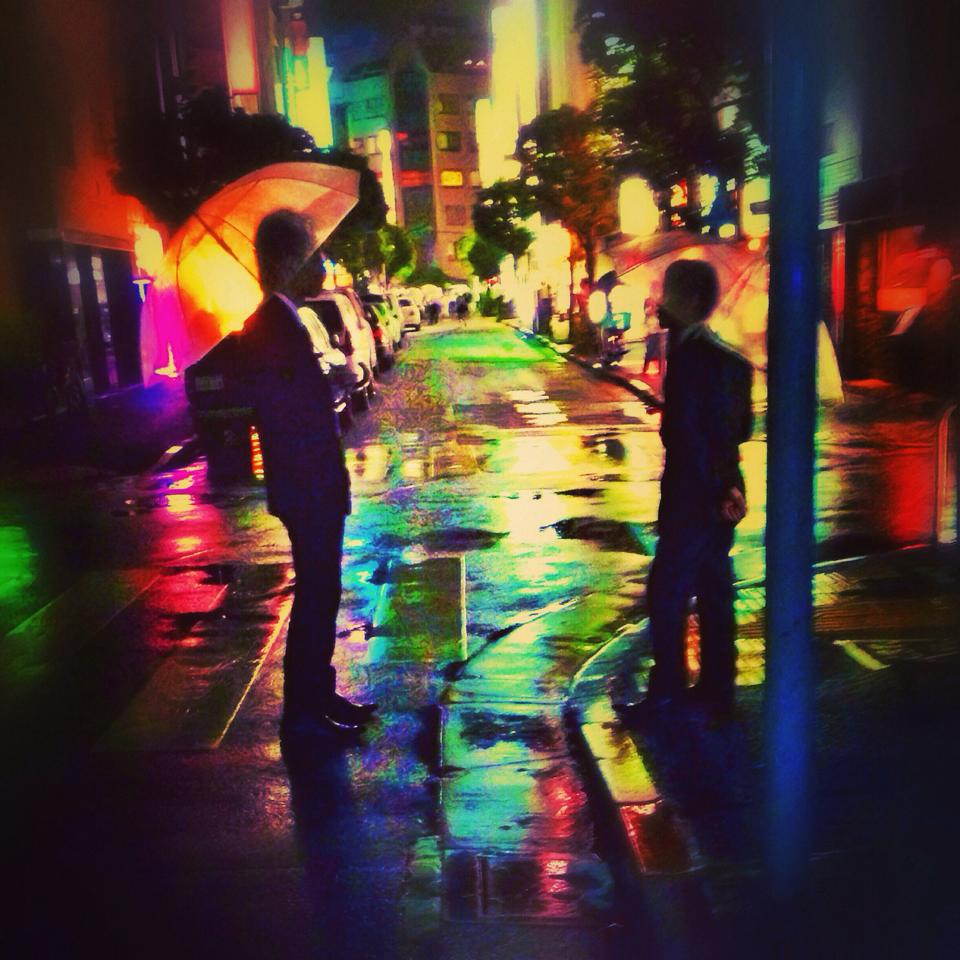
Our evening begins in an absinthe bar exclusively playing The Smiths’ music and ends in a cheap izakaya-style bar. Artwork and literature dominate our evening’s discussions. An enjoyable night washed away with rain and ¥450 Suntory whisky highballs. I don’t take a single photograph; much like Hachiko, my camera is dead. With no photographs of my own, Laurence kindly lets me use one of his: Neon Nirvana:

Neon nirvana

Pyrotechnics and Parade

I wake up at 5 a.m. to the sound of a drunk man in our dormitory room. He spends fifteen minutes trying to open his locker before giving up and leaving the room. It’s nights like these that I wish I were in a hotel. An hour later, the same guy who doesn’t know how to open a locker comes back and spends fifteen minutes trying to climb the ladder to his bed, which, of course, is the bed above mine.

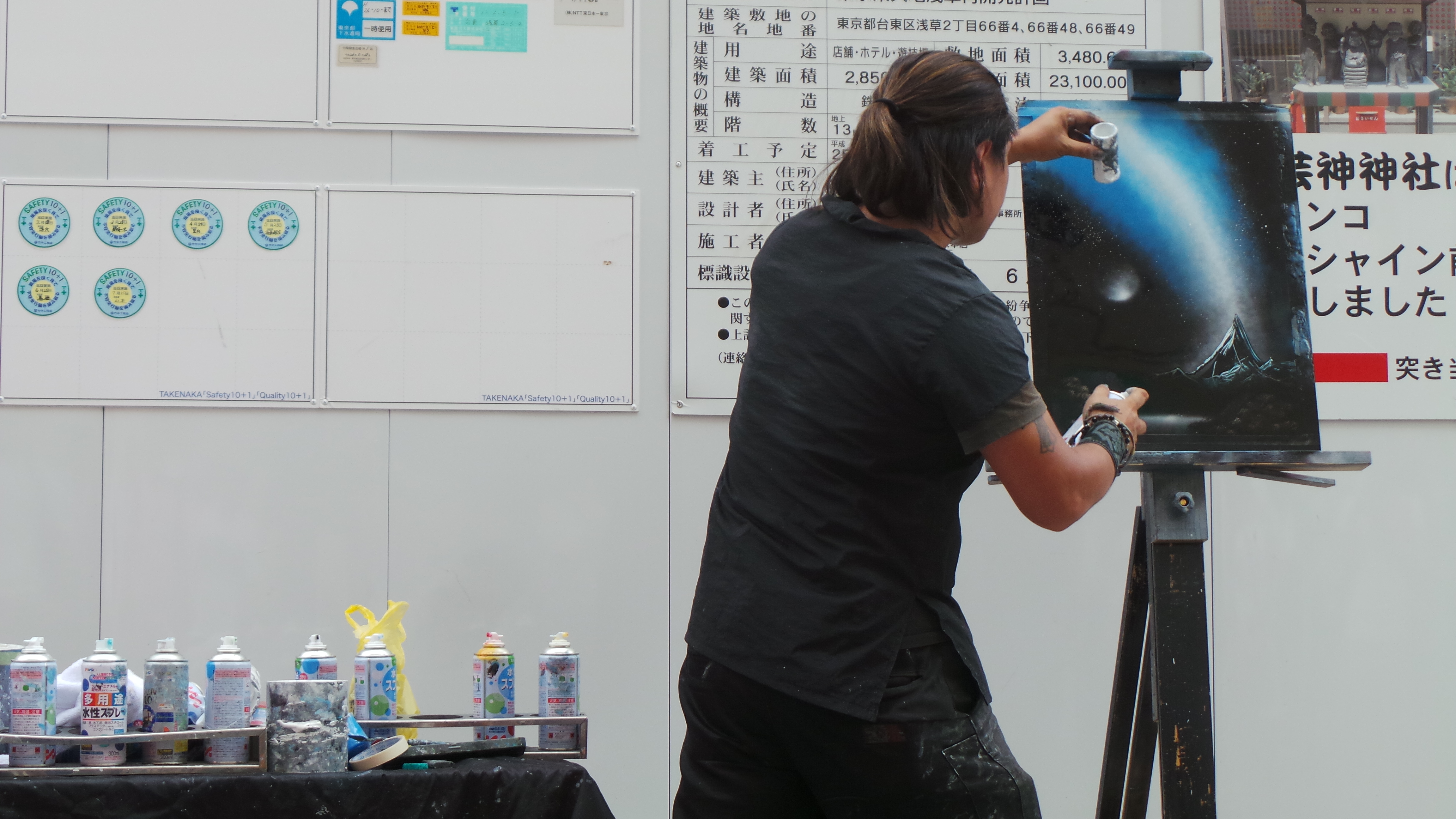
More noise at eight. Two people packing and re-packing their cases loudly, stamping around loudly. I give up on sleep and get up, tired and annoyed. I kill time, drink coffee, then go to a cafe at nine for more coffee. Despite drinking a lot of coffee, I still feel drained. The hot weather adds to my exhaustion. I lazily stroll through the mid-morning Asakusa streets. There is an artist on the street using spray paint to create science-fiction themed space art. He goes from a blank canvas to a beautiful planetscape in a matter of minutes. Incredible.

streetarts

I continue wandering. One guy raises his hand above his head as I walk past, “Woah! You are too tall!” he exclaims, much to my amusement. I head back to where the street performers gather and watch a yo-yo master skilfully Split the Atom.

Back at the hostel, I write up non-events, then kill time playing Baldur’s Gate on my camera. At 3 p.m., I still have no energy but need to get out of the hostel. I decide to head to Chofu. I take the Tokyo Metro Ginza Line to Shibuya. On the way, I hop off at Nihonbashi Station for a ¥300 smoothie (orange and ginger), then back on the next train three minutes later.

I cross Shibuya Crossing and take a shortcut through Yoyogi Park. My shortcut is somewhat obstructed by the Super Yosakoi dance festival. The entrance to Yoyogi Park’s event open space is blocked by hundreds of people dancing in the street.

yoyogistreetdance[1]

The dancing here is actually quite good, the music catchy and rhythmic; I much prefer it to the Samba music that was playing all day yesterday. The stage here is in use too, with people in traditional clothing waving flags and dancing to very similar music to that of the street dancers. I take the ten-minute walk to Harajuku Station, trying to get away from the crowds. My plan is a shortcut through the forests surrounding the peaceful Meiji Shrine.

My shortcut is somewhat obstructed by the crowds of people gathering at the entrance to the shrine. A stage has been erected here, and more people are dancing. The Super Yosakoi dance festival is everywhere. The music from the speakers here is so loud that I actually have to walk with my fingers in my ears. A one-way system through the grounds of Meiji Shrine is also in place.

Halfway through my route through the shrine grounds, a third stage is active and features more dancing and loud live music. There is a sign with a big red cross over a picture of a camera; I presume it to mean “No photography,” yet everyone seems to be taking photographs. Very odd. Perhaps I have been misinterpreting this sign all these years.

nophoto[1]

I leave Meiji Shrine and head toward Shinjuku Station. It’s another hot day, and I have another ten minutes of walking to endure in the heat. Somehow, as this realisation of the temperature comes to mind, a stranger in the street hands me a fan. At Shinjuku Station, I get a little lost but eventually find my way to the entrance to the Keio Line. A million other people have decided to take this train too. I take the second train that pulls in as there is no room on the first. As I am pushed into the carriage, I see that the crowd behind me spills up the steps and beyond. It appears the whole of Tokyo is following me to Chofu.

The Special Express train makes just one other stop between Shinjuku and Chofu, and I arrive promptly at 6 p.m. I follow the swarms of people to the Tamagawa River. Just as I arrive at the river, there is an explosion in the sky.

fireworks7[1]

Today is the annual Chofu City Fireworks Festival. It runs for an hour and includes 8,000 fireworks. I have a pretty decent spot and enjoy the spectacle. All along the river, little stores sell street food, and even Lawson Stores and Seven Eleven are getting in on the action. They have beers for sale outside floating in big ice buckets, and they have moved their hot food counters to the front of their stores.

The fireworks are impressive, although very stop and start. A lot of fireworks are launched at once, then nothing happens for twenty or so seconds, then lots of fireworks at once, et cætera. Every time a big explosion occurs, everyone around me says, “Sugoiii!” “Sugoi!” and “Oh, Sugoi!” This word means ‘amazing’ in English and seems to be the only word that the Japanese people here use to describe the fireworks. They certainly were amazing.

fireworks6[1]

At 19:11, I head back to the station; the fireworks will continue for another twenty minutes or so, but I really don’t like the idea of getting back on a packed train. It seems everyone else has had the same idea; once again, the station is packed. I am not proud of it, but when the doors finally open, I dash to grab a ‘Priority Seat.’ These seats are intended for pregnant, elderly, and disabled people. I feel somewhat less guilty when the other seven Priority Seats are taken by youths.

Back in Shinjuku, I change to the Marunuchi Line and take it as far as Ginza before switching to the Ginza Line. I arrive back in Asakusa around eight.

I meet with some friends, and we head to a nearby British pub run by actual British people. They brew their own beer here, play British music, and serve by the pint. I go for the porter; nice but expensive at ¥1000. The song ‘Empty at the End’ by my friend’s band The Electric Soft Parade comes on at some point in the evening; my mind ends up back in Brighton.

Dance, Dance, Ambulance

It is humid today, a cool 31°C with patches of rain, the perfect weather for dancing in the street. I head over to Tawaramachi Station for a train to Shibuya. From Shibuya Station, I head to Yoyogi Park, stopping off at the Tobacco and Salt Museum. The sign in the window reassures me that the museum will relocate to Sumida in spring 2015. It closed almost a year ago. I begin to wonder why it takes almost a full two years to move the contents of a museum.

I continue my walk, taking a detour through a ‘Shopping road that is nice to people’ before eventually arriving at Yoyogi Park. This weekend, there is a festival held at the Yoyogi Park event open space, the ‘Battle of the Udon.’

udonfest[1]

There are nine different television stations here. There are nineteen different udon stands, each selling their own local variety of udon noodles. Stalls also sell various non-noodle-based drinks and snacks. The best noodles from all over Japan have come here to compete in the nation’s biggest food competition. Every bowl of noodles is charged at a flat rate of ¥500. When you order food at the Battle of the Udon, you are given a vote card with the name of the stall. On the final day of the event, the votes are tallied up, and the best udon in Tokyo is crowned.

The noise here is deafening; every store has a banner, mascot, and a guy with a megaphone shouting at me to visit their store. Some of the mascots are better than others. I really like stall number 18’s mascot from Nagoya; they are promoting their Kishimen-style udon noodles.

a18udon[1]

I go to stall number 19 from Saitama Prefecture, offering Shoji-style udon noodles. As I approach the store, the guy at the counter shouts, “Welcome!” in English and literally welcomes me with open arms. When I arrive, he reaches out his hand to shake mine. He looks genuinely pleased that I chose his store; most likely, he is proud of the food he makes. “Udon!” I exclaim, my smile matched by his.

After food, I head back to Asakusa. I exit Tawaramachi Station to the sound of tourism and the sight of umbrellas. The rain has started now, but the show will go on. Today is the 33rd Asakusa Samba Carnival, and half a million people are expected to attend. The streets are packed on every side, and the roads are closed to vehicles. The carnival is just about to start.

streetslined[1]

This festival first began in 1981 when the mayor of Taito Ward invited the winning team of the Brazilian Rio Carnival to perform on the streets of Asakusa. Each of the teams has its own theme, but in effect, they compete to be crowned the winner of a dancing contest. The parade starts behind Senso-ji temple, where a display of the floats is free to inspect, and conveniently finishes close to Tawaramachi Station.

The teams vary in style. There is a ‘Puzzles & Dragons’ float, loads of marching bands, women dancing Samba dressed in traditional Brazilian garb. Some teams even have a comedy aspect, like women with fish on their heads or dancing clowns. For the rest of the afternoon, every inch of Asakusa is alive with the sound of drums and loud music.

sambaclown[1]

At 5 p.m., I decide to eat some food from Seven Eleven before heading to Cafe Byron Bay to drink. Instead, the night takes a somewhat unexpected turn, and one of my friends from the cafe is in need of medical treatment. An ambulance is called, and we wait an age.

The owner of the cafe, our friend, and I sit in a parked ambulance for ten minutes. Here, her symptoms are explained, and the usual questions are answered. I think that this procedure could have been done during the journey to the hospital, but then again, I don’t have any medical training, so what do I know? Eventually, we are on the move. Something I have observed in the past is that ambulances in Japan move seemingly without any haste or purpose. They wait at traffic lights with sirens blazing. They move with absolutely no urgency.

ambulance[1]

We arrive at a small hospital in Ueno. Our friend is placed into the Emergency Room, and we wait outside. Sitting in the hospital, an overwhelming sense of exhaustion washes over me. The humming clock reads 20:20, but it’s boring, like the walls; once white, now stained yellow. We ask if there is any news on our friend, but we are politely told that they don’t know anything. Hospitals have a way of draining energy from people; sitting here any longer might just kill me. We decide to go for a walk.

We head to an Indian restaurant and eat some excellent food. I suggest to the cafe owner that she should serve similar food and rename her shop to Cafe Byron Bombay. Despite worrying about our friend in the hospital, we make the most of the situation and try to enjoy ourselves as much as we can. In the end, I don’t have such a terrible time.

After four hours, our friend is allowed to leave and is going to be alright; good news. We hop on the train at the nearby Ueno Station and head back to Tawaramachi Station before going our separate ways.

A Kale of Two Sakes

I ride the Tokyo Metro Ginza Line. I get off the train at Nihonbashi Station to buy a drink. I recently discovered that there is a small shop selling ¥300 smoothies here. It is the same side of the crossing gate as the tracks so there is no need for me to buy another ticket. I buy a smoothie and hop onto the next train some two minutes later. Today I choose a healthy bright green plastic cup of crushed kale.

From Harajuku Station, I take the five minute walk to Yoyogi Park. There is a festival here today in celebration of fifty years of diplomatic relationship between Japan and Jamaica. The festival is relatively quiet, but it is still morning. There are market stalls selling jerk chicken, mugs, and adorable hats adorning the Jamaican flag; the usual. There is a stage and a choir, they sound good but they are only sound checking, so no one applauds when they finish. I wander for fifteen minutes before deciding to leave.

one_love[1]

As I exit the festival a man with a shaved head and white clothing approaches me. He hands me a gold card with a picture of Siddhārtha Gautama etched to the surface. He is not a native Japanese person, and is probably not even a real monk. He tries to get me to write my name, address, and how much money I am willing to ‘pledge’ to him. I tell him that I’m not interested, give him back his card, and walk away shaking my head. Using religion to scam people out of money, that’s a first.

Around the corner from the park, opposite the entrance to Harajuku Station is Takeshita Street; a famous pedestrianised shopping street with an amusing name. It is lined with small boutiques featuring all the newest fashion, and far too many ice cream shops. There is nothing really of interest for me here so I walk the length of the street before returning to Harajuku Station and jumping back on the train.

takeshita[1]

Back in Asakusa I hire a bicycle. ¥200 for four hours, brilliant. I park my bike at the hostel and sit on the pavement to take photographs of a lit up Tokyo Skytree; I try to improve the image by messing around with my cameras settings. Someone shouts my name from behind me, “Luke, what are you doing sitting on the floor?” It is a woman who works at the hostel. I tell her I am messing around with exposure and shutter speed. “Oh,” she says rather confused, “I’m emptying trash!”

I think to myself that I probably know more about emptying rubbish than I do exposure and shutter speed.

Back on my bike, I cycle around in search of food. After a while, I eventually give in to a Seven Eleven tartare sauce fish burger and a bottle of Pocari Sweat. Pocari Sweat is going to be the first sports drink that has a billboard on the moon, or so an advertising leaflet claims. I cycle around the quiet back streets of Asakusa, stop off for a rest outside the exciting World Bags and Luggage Museum. No idea. I randomly bump into a person I know from the Fuji TV show; he is stood talking to a man dressed as a tree. No idea.

treefingers[1]

Back at the hostel I chill out in my favourite room, the 4th floor laundry lounge. The room is actually an outdoor conservatory in a big tent. It features a ball pit, a lovely water fountain, and a bath tub full of soil. Cherry tomatoes grow from the soil. I sit on a chair and read the last thirty or so pages of Murakami’s ‘Hard-Boiled Wonderland and the End of the World’. It is here that I lose myself to the tranquillity of my surroundings. A staff member interrupts my serenity. She is here to do ‘maintenance’ on the ball pit, or so she tells me with a grin. She elegantly makes sure all the balls are neatly resting in the bathtub before leaving me in peace.

After finishing my book I pop over the road for a quick drink in A.S.A.B. I chat to the bar owner and ask him if he knows any good places to eat. “Yes,” he states matter-of-factly, “I draw you map.” He draws me a map. I thank him, pay, and leave the bar. His map is very accurate and I find the place with ease. Inside, I take a stool at the bar and am handed an English menu, a nice surprise.

izaks[1]

So, from the top left I have a pot and saucer of Japanese mustard for dipping, fresh cabbage served on ice, a side salad, spring onions, rice, a white box, some odd tasting red pickles, edamame beans, and the star of the show, cutlassfish marinated in soy sauce. The set meal also comes with miso soup, but it is pork based so I ask to have my meal without. I drink two Suntory whisky highballs whilst I feast, and pay ¥2240.

Now, that white box. Natto. It has no place with the rest of the meal so I take it back to the hostel. On the way I buy a tube of salt and vinegar flavour Pringles. I eat the natto using chop sticks, I wrap three to five fermented soy beans around a crisp; the correct way to eat natto, probably. The natto smells so bad that it even comes with a sachet of strong smelling mustard, and some red sauce that just about cancels out the disappointing smell.

natto[1]

In the hostel I meet up with a couple of guys from Hong Kong, and Aaliya, the Canadian I met during my first week here. It is her last night in Japan, so we decide to drink. We go to a bar, closed. We go to another, they’ve stopped serving. At the third bar, Asakusa OTO, we are humbly welcomed inside. It is a sake bar selling Japanese rice wine. It tastes okay, better than the supermarket rubbish I am used to. Sayaka, the English speaking Japanese staff member asks me to go through her English menu and correct the twelve mistakes. The owner of the bar puts on the ‘most famous’ Britpop band ever, Ride. I tell him I’ve never heard of Ride. Instead he puts on The Smiths.

‘Girlfriend in a Coma’ plays in the background while I eat crushed ice with sweet sauces. Delicious. It is time to leave after about an hour of sake drinking. We go to pay and the owner refuses to take our money. He says I should tell more foreigners about his bar in exchange for the drinks he has given us. It’s the least I can do, I tell him, scribbling his website on the back of my hand.