Shiitake My Breath Away

The hostel shared news of a festival at Mukojima-Hyakkaen Gardens. Today is Tsukimi-no-Kai, which means ‘Moon Viewing’ – a tradition marking its 210th year in these gardens. The goal tonight is to celebrate and enjoy the Harvest Moon. We’re set to meet up at 4 p.m. It’s cloudy outside; I doubt the moon will be visible, but the event sounds fun.

My first destination of the day is the brilliantly titled ‘Project Eat More Mushrooms,’ just an enticing eleven stations away on the Ginza Line. This year, it’s hosted at Ark Hills, a substantial office development in the heart of Akasaka. I hop on the train and disembark at mnemonic favourite, Toranamon, to run a marathon. I take a rather unhurried walk to the venue. Along the way I pass the Embassy of Micronesia and the Foundation of Miracles, before finally arriving at Project Eat More Mushrooms.

mushroommarket[1]

The mushroom festival here is disappointing, an absolute waste of thirty minutes each way on the train. Forget about eating more mushrooms; having more stores selling them would be a welcome start. I can hardly classify four market stalls as a festival. There are no miracles here, no mascots either, and certainly not many mushrooms. To salvage the journey from being a complete waste, I purchase some shiitake mushrooms and enoki mushrooms for a total of ¥450.

Back at the hostel, it dawns on me that these mushrooms are precisely the same ones I could have purchased from Seven Eleven. Considering the wasted time and train fares, these have turned out to be the most expensive mushrooms on the planet.

mushrooms3[1]

After the mushroom episode, I gather as planned at 4 p.m. The small group of seven comprises my friends Aram and Dagmar, along with two fantastic tour guides from the hostel, Keina and Gomez. We make our way to Asakusa Station and board the Tobu Skytree Line to Higashimukojima Station. Interestingly, the train deliberately slows to a crawl as it crosses the Sumida River to showcase the glorious view, or so we’re told. Upon reaching Sumida, we head straight to Mukojima-Hyakkaen Gardens, marking my third visit to these beautiful gardens during my time in Japan. The entrance fee remains the usual ¥150.

At the entrance, we’re requested to douse ourselves in mosquito repellent due to a Dengue fever outbreak in Tokyo. Just last week, Yoyogi Park was closed for extensive fumigation to eradicate mosquitoes and is likely to remain shut for several months. Similarly, Shinjuku Gyoen Park underwent the same treatment two days ago. It seems this week might be the least opportune time to visit an outdoor garden.

We enter the gardens, and inside, offerings are being made to the moon.

giftsforthemoon[1]

Television crews are setting up at the entrance to the Hagi Tunnel. Swarms of people are queueing up for the ¥2000 tea ceremony, the same ceremony I had previously enjoyed at no cost. The sound of chirping insects fills the air. We kill some time exploring the park before heading back to the wisteria trellis for the opening ceremony. Following a short opening speech, a performance of the shinobue begins.

A shinobue is a Japanese transverse flute made from hollow bamboo. Two performers play for almost thirty minutes. During their performance, I lose myself in meditation on a bench surrounded by foliage and mosquitoes.

fluteladies[1]

After the performance, it’s time to light the many lanterns scattered throughout the gardens. The paper lanterns are lit just as twilight sets in. In total, there are thirty-five lanterns, and volunteers are encouraged to participate in the event. Each lantern is decorated with a haiku.

Once the lanterns are lit, a curtain of dusk descends to the melodic tune of the koto, a traditional thirteen-stringed Japanese instrument. The five performers play in perfect harmony, and the sweet sound of the koto resonates throughout the gardens. Eventually, the earlier gifts presented and the beautiful music work their magic, transforming the overcast evening sky into a clear one. As if on cue, the clouds part ways, unveiling the face of the Harvest Moon.

festivalsounds[1]

We sit down and admire the sky. The moon is a ghostly white, brighter than I can ever recall; but it has been a while. Like the stars, the moon rarely appears above the Tokyo skyline. Tonight the moon doesn’t hide, it looks beautiful, it is breathtaking.

We eat snacks. The chatter combines with the music. The thought crosses my mind that this ceremony has been taking place exactly where I am right now, for the last two-hundred or so years. It probably hasn’t changed much since then either. My mind transported to another time.

I eat a bowl of oden, a Japanese winter food consisting of various fish and vegetables in a soy-flavoured broth. It costs ¥800 and is delicious. We chat for a while longer, enjoying the sound of the insects, the music from the koto performance, and the lull of the moon.

harvestmoon[1]

At 7 p.m., it feels much later than it is. Darkness arrives earlier now, but the weather is still warm—an atypical autumn. We all head back to Asakusa on the train before going our separate ways.

I take the Ginza Line for thirty minutes, and as I exit the station into the crowds of Shibuya Crossing, it begins to rain. At 9 p.m., I meet up with a friend from England, Laurence, and his two friends. We gather outside Hachiko, a statue of a dog. The dog belonged to Professor Ueno. Hachiko would wait for the professor at the end of each day outside Shibuya Station until one day, in 1925, the Professor died. Despite the professor’s absence, Hachiko continued to wait faithfully, but his owner never appeared. Legend says the dog returned to the station at the same time every day for nine years, yet Professor Ueno never returned. Then, sadly, in 1935, Hachiko passed away.

Our evening begins in an absinthe bar exclusively playing The Smiths’ music and ends in a cheap izakaya-style bar. Artwork and literature dominate our evening’s discussions. An enjoyable night washed away with rain and ¥450 Suntory whisky highballs. I don’t take a single photograph; much like Hachiko, my camera is dead. With no photographs of my own, Laurence kindly lets me use one of his: Neon Nirvana:
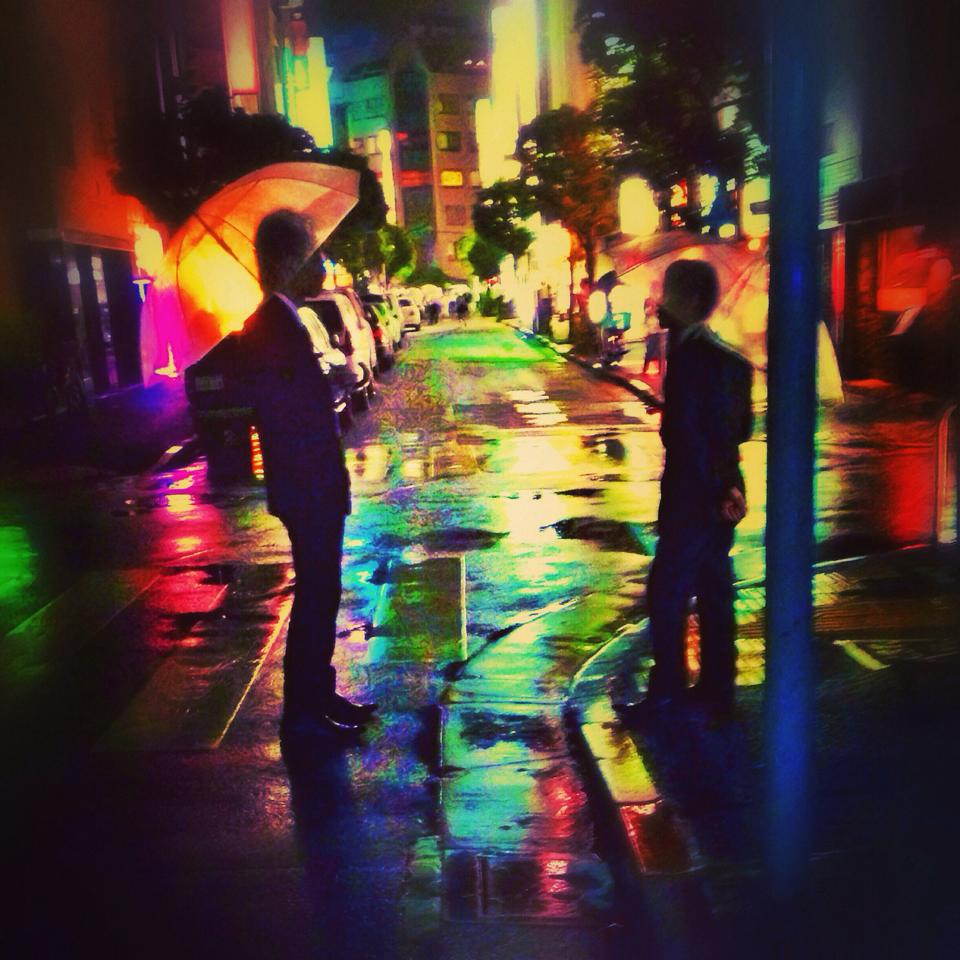
Neon nirvana

Some Like It Hot Tea

I decide to hire a bicycle. A friend from England, Damien, decides to join me. We grab two ¥300 bicycles for the day and cycle in the direction of Ueno. On the way, we pass a random stage on Kappabashi ‘kitchen’ Street. Men and women dressed in traditional taiko clothing hit massive taiko drums. A security guard stands watch, eyeing me up as I take a photograph.

kappadrums[1]

We cycle around Ueno Station and toward Ueno Park. Today and tomorrow, there is a festival here, the Philippine Festival 2014. The festival is sponsored by the international money transfer company Western Union. The space for the festival hasn’t been very well utilised. There are two rows of small stalls on both sides, and a third row through the middle, which completely obstructs the view of the small stage.

I promised a friend I would bring her a souvenir from the festival. To my dismay, all of the stalls appear to be for financial institutions or property letting companies. There is a stall offering tax refunds, there are stalls for various banks, there are stalls selling insurance. There is not one stand that seems to offer anything remotely souvenir.

philippinefest[1]

We take a seat near an ice cream shop opposite the festival. I rant to Damien about how much the festival has annoyed me; he is in agreement. A woman starts to sing from the stage that you can’t even see. The song from Frozen, ‘Let It Go.’ I almost go on another angry rant but decide to just let it go.

Back on the bikes, we head to Nippori Station, cycling through Textile Town and Fabric Town on the way. We cross the railway tracks and head to a big area of green on my map, thinking it will be some kind of park or temple.

For the second day in a row I find myself standing in a cemetery.

graveyardandtree[1]

Yanaka Reien is massive. Over 7,000 tombstones are here. The cemetery is so big that it contains a police station and a children’s swing park. The Tokugawa Family Graveyard is here too. The last shogun, Tokugawa Yoshinobu, rests here alongside fourteen other Tokugawa shoguns. There is one area that slightly confuses me; it is marked on the map as ‘The First Three-dimensional Deposit Facility’. We have no idea what this means, a Google search is like spinning our wheels, so we get back on the bicycles and do just that.

We head back toward Ueno Park, stopping off at the Daimyo Clock Museum to kill some time before returning to Asakusa. Outside the Don Quixote store, there is the Rokku Hanamichi Flower Festival taking place. Music is being performed on a small stage, but the flowers are notable by their absence.

Our next stop is over the Sumida River, to a place I visited whilst filming the cycle tour: Mukojima-Hyakkaen Gardens. The entrance fee is still ¥150. Today is Mushi-Kiki-no-Kai, which I am told means, ‘Enjoying the sound of insects.’ The event today describes itself as ‘An exhibition of various kinds of chirping insects, their chirping sounds, and the fantastic garden scenery.’ The insects aren’t quite as attractive as the description of the event, but the sounds they make are.

chirpinginsect[1]

A Japanese lady in a kimono approaches us as we stare at the crickets. “Where are you from?” … “Ah, England! Do you like tea ceremony?” Both Damien and I are yet to experience a traditional Japanese tea ceremony, so we go along with it and are invited into a tatami mat room, shoes off, kneel down, join the others. The other thirteen people attending are Japanese.

We wait a while before the process begins. When it finally does, we pass around a tray containing sweets filled with a red bean filling. I thank the person to my right for passing me the tray, I bow, I thank Damien to my left for letting me take a sweet before him, I bow, I take a sweet, I eat it. It is all very methodical. Next, it is tea time. Young women in kimonos kneel one at a time in front of people, bow, and place a bowl of green tea in front of them. They move in a clockwise order.

Before drinking, I ask the woman to my right if she would like any more tea, and politely, she refuses. No one ever says, ‘Yes,’ at this stage; it is purely a formality. I lift the bowl of tea, place it on my left hand, turn it clockwise twice, then drink it all in one go. Then when the bowl is collected, I bow once again.

The sweet was delicious, the tea was cold. I always preferred hot tea. The woman that invited us to the ceremony said that they would usually offer hot tea, but because it is a hot day, they decided to serve it cold. After the ceremony, we are allowed to inspect the beautifully crafted bowls and the container that holds the green tea powder.

greenteapowder[1]

The tea ceremony, I later find out, should have cost us ¥2000 each, but we were never asked to pay anything.

We head back to Asakusa, return our bicycles, then go our separate ways. I head to Cafe Byron Bay for a green curry and a chat with the locals. I meet a real-life ninja and a fugu chef. Fugu is a delicacy in Japan, but is somewhat poisonous. I make plans to eat the deadly fish and take down the details of the restaurant. Maybe I will be visiting my third cemetery in a week.

Dog Day, Afternoon

Saturday 

For the past three days, the Obon festival has been taking place in Japan. This 500-year-old Buddhist festival emphasises honouring the deceased. Today marks the final day of Obon, coinciding with the Asakusa Summer Night Festival. The event originated in 1946, shortly after the end of World War II, serving as a way for people to bid farewell to those who perished. As I arrive before the opening ceremony, the bridge is already overflowing with tourists.

skytreebridge[1]

The Japanese name for this event is Toro Nagashi, which translates literally to ‘flow of lanterns’. Here, you can purchase a small paper lantern for ¥1500. Each lantern symbolises the soul of a deceased relative. Visitors have the opportunity to write a message on the lantern, queue up, and then release it into the water. I find the entire process quite abstruse.

As the lanterns float down the Sumida River, carrying the souls of the departed to the other world, a certain solemnity lingers in the air.

lanternsontheriver[1]

After the festival, the atmosphere becomes somewhat lighter. I meet up with Robin, a German I befriended in Kyoto, who happens to be staying in Asakusa. We decide to unwind over drinks and perhaps get a bit less sober. We head to Nui and indulge until just after ten, then make our way to a Family Mart to play a few rounds of the Konbini Hop drinking game.

Outside our third convenience store, we come across a poster featuring numerous Japanese individuals with sunflowers encircling their heads. Despite our attempts to decipher its meaning, we’re left utterly baffled. It remains an enigma, leaving us without a single clue.

flowers[1]

We head to a Japanese bar nestled behind Senso-ji. This area houses around ten small bars, each with only two to three bar stools. I’ve long desired to experience a drink in one of these hidden spots since my visit in June, yet I never found the courage to venture in alone. Describing the way to this area would probably confound you; it’s remarkably concealed, and my directions are truly abysmal.

We settle in a small bar called Tom². This bar, with only four bar stools, feels quite spacious compared to the others nearby. ‘I Was Made for Lovin’ You’ by Kiss fills the air from the speakers. Two Japanese men occupy two stools, and we take the remaining two. The bartender seems a bit tipsy. We order a Suntory whisky highball and a beer for ¥500 each, and enjoy complimentary peanuts.

Then a dog appears.

inu[1]

The dog, incredibly friendly, joins us and settles in. We discover that Tsutomo, the owner, resides above the bar. We linger for some time—I manage to outlast Robin in drinks, and eventually, he departs. I remain for two more. The two Japanese gentlemen present speak minimal English, and the dog, unsurprisingly, doesn’t contribute much to the conversation. So, I sit there, mostly in silence, sipping my drink and exchanging glances with the dog. An atypical end to the evening.

Sunday

I rent a ¥300 bicycle for the day and cycle thirty minutes to Nihonbashi, making a stop to see my friend Daisuke along the way. It’s a shame to find out he no longer works at the hostel where I’m staying. Today, Nihonbashi hosts the annual Fukagawa Hachiman Matsuri festival. It’s considered one of the three major Shinto festivals in Tokyo and is likely the largest.

The festival is celebrated in its entirety once every three years, and today happens to be that day. With one hundred and twenty portable shrines, three hundred thousand participants, and half a million spectators, it’s definitely not an ideal day for cycling.

shrinesandshrines[1]

Amidst the crowds, people throw buckets of water over those carrying the shrines, a ritual to cool them down, earning the festival its nickname, the ‘Water Fight Festival’. It’s undoubtedly challenging to bear these enormous shrines in such sweltering heat, particularly under today’s scorching summer sky. I opt to step away from the bustling crowds and take a stroll through Nihonbashi. While I visit the renowned Nihonbashi Bridge, it fails to captivate me. I decide to return to Asakusa in search of some food.

I head to my favorite Japanese restaurant, Mizuguchi. I indulge in breaded salmon and salmon teriyaki, served with a side of greens, potato salad, pickles, and rice. Absolutely delicious. The total comes to ¥1810, including a Suntory whisky highball.

As I leave the restaurant I hear applause. It turns out there is a street performer just outside. Never a dull moment in Asakusa on a Sunday.

coneman[1]

The street performer does a balancing act whilst juggling a traffic cone between two sticks. He has drawn in a huge crowd. He is also a comedian. Throughout his routine he speaks intermittently on a microphone, telling jokes in Japanese, everyone laughs. When he is finished he cheekily places three bowler hats on the floor, upturned for tips. I give him ¥1000. He was really good.

Back at my hostel, The Strokes are playing from the speakers. ‘Is This It?’ I write for a while before heading back out to meet fellow Englishman, Richard. We meet at 8 p.m. and drink until 4 a.m. A typical end to the evening.

Cycling into Locals

‘Cycling into Locals’ is the name of today’s bicycle tour. The name amuses me. I head just outside the hostel to a bicycle rental shop. It costs me ¥300 to rent a bike for eight hours, dirt cheap. The minimum fare for a train is ¥170, even if I take just one stop, the lovely purple bicycle I’ve chosen today costs me less than a return train ticket. I will certainly be taking advantage of this service again in future.

There are seven hostel guests taking part in the tour, a TV crew of four people, and staff members Gomez and Keina from the hostel. We meet up at 10 a.m. for a briefing, before finally departing some ten minutes later. The thirteen of us take to our bicycles, and we begin to head in the direction of the Sumida River. Here we see Tokyo Skytree from a position where you can see a second Skytree in the reflection of the Asahi building. Apparently, people come to this spot all the time to take this famous shot.

bikes[5]

Next, we cycle over the river to Ushijima Shrine. Here we do a cleansing ritual and a prayer ritual before being invited into the main hall by the priest. He tells us about the history of the shrine and then hits a massive drum a few times. Outside the shrine there is a statue of a cow. The cow statue is said to have magical healing properties. I touch my throat, then I touch the cow’s throat. My sore throat will now heal quicker thanks to the magic statue. Cowabunga!

We stop off at a Japanese tea house for a traditional snack. For ¥300 we are served sweet bean paste wrapped in a salt-pickled cherry blossom leaf, and a cup of green tea. The leaves have been picked from the banks of the Sumida River. After being filmed eating some leaves, it is time to leave.

greenteas[6]

Hatonomachi Dori Shotengai is a historical street featuring very local shopping and various small art museums and craft houses. We visit a shop where a woman has spent the last fifty years hand making small model geisha’s, which she sells for a small fortune. Next we enter a small shop selling badminton rackets decorated with kabuki theatre performers. We are given the history of Badminton. It turns out it all began in Japan as a game called Hanetsuki, before arriving in England and becoming the sport that it is known as today.

We swing by Kira-Kira Tachibana Street. There is a local street market here, surrounded by really old houses and some interesting side streets. I see a stall selling a watermelon for ¥2200. Next our tour takes us to Mukojima-Hyakkaen Gardens, the entrance fee is ¥150. We go to a traditional cafe and eat ¥500 rice balls with a sour plum topping served with a really tasty miso soup. We are then served a complimentary glass of a bright yellow liquid. It smells like flowers and tastes very sweet.

Mukojima[1]

The cameras stop rolling and we take a short break. We are free to explore the gardens on our own for thirty minutes. I spend fifteen of the minutes trying to photograph a dragonfly in flight. We regroup and return to our bicycles. The final stop on our tour is Tokyo Skytree. Here we are each individually interviewed about the tour. We are given the option to stay and explore Tokyo Skytree Town on our own, or head back to the hostel. I decide to head back after an exhausting six hours of cycling into locals.

Back at the hostel Björk is playing through the speakers. I arrange to meet Conor, a friend from England I met almost two weeks ago. He’s back in Tokyo for two nights after travelling around Japan and South Korea. We meet at my hostel and go out in search for some food. We find a vending machine restaurant. I order hot soba noodles in a soy based broth. The noodles are topped with tempura vegetables, seaweed, and an egg. It costs just ¥480.

Vendingfood[1]

After food, we wander past a lit up Senso-ji, before heading for a drink. On the way, we see a kabuki theatre. A show has just finished and there are about ten people standing outside in full costume and makeup. I decide that I will come back here in a few days time to watch a show. After a drink I say goodbye to Conor and we head our separate ways to our hostels. At the hostel I go straight to my room to sleep off a very busy day of cycling and sightseeing.

Street Festivals, Buddhist Temples, Ninjas, and Rubix Cubes

I am listening to Clint Mansell’s soundtrack for the film The Fountain as I drink a Yakult based watery yoghurt thing; I don’t really know what it is, except that it is disgusting. I am a little sad this morning, more people I have become friends with are leaving today. I check my messages, I have one from Satoko reminding me about the Oko Ceremony, saying that she hopes to see me there. I receive some good news too in the form of messages from both Grant and Edwina; they are back in Asakusa in a few days time and we will hang out again.

I leave the hostel and walk over the Sumida River to the Hongyoji Temple. Inside, I am seated and given a prayer book and prayer beads, there are about 450 people here. At exactly eleven we start to chant for ten minutes straight; the Temple is so very warm and my mouth is so very dry from the constant chanting. Next, the first prayer is read out and four silent prayers then follow. There is then another ten minutes of straight chanting before the Chief Priest Marakami-san comes out to deliver his sermon.

After the sermon has finished, a woman takes to the podium and reads something in Japanese, it moves her to tears. Next a man does the same. A brief chant concludes the 90 minute Ceremony. I am given a handwritten account of the Chief Priests sermon translated during the Ceremony by Satoko. I am asked by Yoko to please come and visit again, I say that I will. Outside the Temple the rain has finally stopped after a constant 72 hours of downpour. I feel thirsty and exhausted, but also pleased about the overall experience.

guitar_man[1]

I start walking down the road to my hostel, after about 10 minutes on a random street corner I find a festival. I see a man named Kazuma, an artist from Shiburoko playing the guitar and singing very upbeat songs about being happy. I am handed a flyer in Japanese, it reads, ‘Asakusa spirit! Confused Street Live!’ There is also a schedule for the rest of today’s festivities, but it is written entirely in Japanese.

At the hostel I use the Internet to help translate the flyer. It reveals that at 4 p.m. a group called Yunlong Taiko will be playing a Japanese drum show. I bump into Heather, one of two English women I met last night, and we head out for the drum show. After the drumming stops, Heather and I take a walk up to the Sumida River, where we randomly see a man dressed in a full ninja outfit. I say to him, “Ninja!” He pulls his forefinger up to his lips and makes a ‘shhhh’ sound, before casually strolling off.

drums_and_dragons[1]

Back at the street festival the Hero Show is starting. This is a superhero-action-comedy starring Gun Caliber, famous for his live action features. I would explain the story but it genuinely made no sense to me at all. There was a scene where a woman dressed like the Pink Power Ranger came from nowhere and revived the defeated alligator/snake man with a large bag of biscuits. It was all very strange.

At the hostel Andy is still here. He couldn’t get a bus today so will stay in Asakusa at a different hostel for another night. We join Heather and Steffi, and the four of us head out to find a bar twenty minutes walk away that Andy has recommended. We stop off at a Lawson Stores for snacks, and I buy for ¥108 an egg sandwich that says: Making the everyday better. We arrive at Bar Nui and it looks impressive. It is a public bar on the ground floor of a hostel. ‘Bar opening times: 18:00 – 26:00’ boasts a sign outside. Inside, I order the ‘big beer’ and am handed a massive 1 litre jug of Asahi, and a bill for ¥1000. Eventually I switch to The Macallan 12 year old at ¥700 a time.

lightbulb_moment[1]

Heading back to the hostel I realise that I had left my umbrella at the Lawson Stores on the way to the bar, so we stop off there; I am pleased to find that my umbrella is still intact. Andy and I buy cans of beer at Lawson Stores, just so we can walk down the street drinking alcohol in open containers, no outdoor drinking laws here! We pass two trouserless businessmen with ties around their heads. They insist on high-fiving us as they pass.

My night ends in the hostel listening to an in-depth and incredibly nerdy conversation between Andy and James about the algorithms and patterns used in solving the Rubix Cube. Andy claims that he can solve one in under 1 minute and has his Dayan Speed Cube in his bag at the other hostel. I am very disappointed that this has only come up in conversation on his final night.